
Articles | Volume 25, issue 2
https://doi.org/10.5194/nhess-25-451-2025
© Author(s) 2025. This work is distributed under
the Creative Commons Attribution 4.0 License.
the Creative Commons Attribution 4.0 License.
https://doi.org/10.5194/nhess-25-451-2025
© Author(s) 2025. This work is distributed under
the Creative Commons Attribution 4.0 License.
the Creative Commons Attribution 4.0 License.
Research article
| 
03 Feb 2025
Research article |
| 03 Feb 2025
| 03 Feb 2025
Unraveling landslide failure mechanisms with seismic signal analysis for enhanced pre-survey understanding
Jui-Ming Chang
Department of Civil Engineering, National Yang Ming Chiao Tung University, Hsinchu 30010, Taiwan
Disaster Prevention and Water Environment Research Center, National Yang Ming Chiao Tung University, Hsinchu 30010, Taiwan
Che-Ming Yang
CORRESPONDING AUTHOR

Department of Civil and Disaster Prevention Engineering, National United University, Miaoli 36063, Taiwan
Wei-An Chao
Department of Civil Engineering, National Yang Ming Chiao Tung University, Hsinchu 30010, Taiwan
Disaster Prevention and Water Environment Research Center, National Yang Ming Chiao Tung University, Hsinchu 30010, Taiwan
Chin-Shang Ku
Institute of Earth Sciences, Academia Sinica, Taipei 11529, Taiwan
Ming-Wan Huang
Department of Civil and Disaster Prevention Engineering, National United University, Miaoli 36063, Taiwan
He Yu Engineering Consultants Co. Ltd., Taichung 40642, Taiwan
Tung-Chou Hsieh
Disaster Prevention and Water Environment Research Center, National Yang Ming Chiao Tung University, Hsinchu 30010, Taiwan
Chi-Yao Hung
Department of Soil and Water Conservation, National Chung Hsing University, Taichung 40227, Taiwan
Related authors
Jui-Ming Chang, Nativ Ron, Qi Zhou, and Shang Jyh Yiin
EGUsphere, https://doi.org/10.5194/egusphere-2026-884, https://doi.org/10.5194/egusphere-2026-884, 2026
Short summary
Short summary
Natural hazard studies need diverse expertise, but busy specialists may not meet early enough to shape the first research questions. We present a virtual panel that guides a discussion and records agreements, disagreements, missing information, and follow-up checks. Using a debris flow monitoring example in Switzerland, the panel shows that year to year environmental change can weaken detection, so testing should follow time order. The workflow helps turn ideas into testable studies.
Ching-Chou Fu, Sheng-Fu Hu, Li-Hung Lin, Kuo-Hang Chen, Chin-Shang Ku, Hao Kuo-Chen, Kuo-Wei Wu, and Chin-Jen Lin
EGUsphere, https://doi.org/10.5194/egusphere-2026-4934, https://doi.org/10.5194/egusphere-2026-4934, 2026
This preprint is open for discussion and under review for Biogeosciences (BG).
Short summary
Short summary
We developed a low-cost automated system for continuous monitoring of carbon dioxide released from soils. Laboratory and field tests showed good agreement with reference methods. During more than five months of field operation, the system captured both background emissions and changes caused by heavy rainfall. The system provides an accessible approach for long-term monitoring of soil carbon emissions and environmental change.
Jui-Ming Chang, Nativ Ron, Qi Zhou, and Shang Jyh Yiin
EGUsphere, https://doi.org/10.5194/egusphere-2026-884, https://doi.org/10.5194/egusphere-2026-884, 2026
Short summary
Short summary
Natural hazard studies need diverse expertise, but busy specialists may not meet early enough to shape the first research questions. We present a virtual panel that guides a discussion and records agreements, disagreements, missing information, and follow-up checks. Using a debris flow monitoring example in Switzerland, the panel shows that year to year environmental change can weaken detection, so testing should follow time order. The workflow helps turn ideas into testable studies.
Tzu-Yin Kasha Chen, Ying-Chen Wu, Chi-Yao Hung, Hervé Capart, and Vaughan R. Voller
Earth Surf. Dynam., 11, 325–342, https://doi.org/10.5194/esurf-11-325-2023, https://doi.org/10.5194/esurf-11-325-2023, 2023
Short summary
Short summary
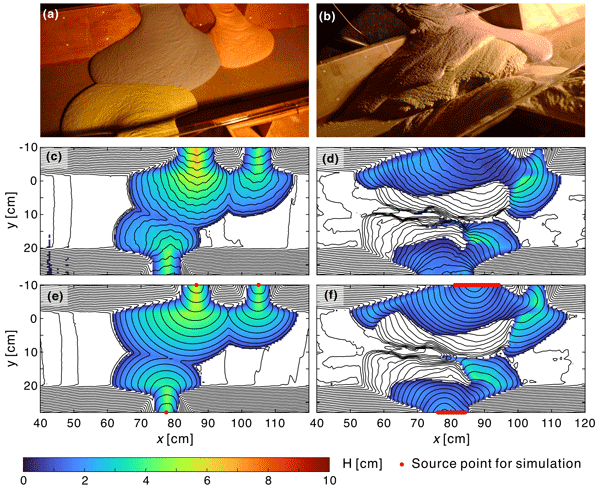
Predicting the extent and thickness of debris flow deposits is important for assessing and mitigating hazards. We propose a simplified mass balance model for predicting the morphology of terminated debris flows depositing over complex topography. A key element in this model is that the termination of flow of the deposit is determined by prescribed values of yield stress and friction angle. The model results are consistent with available analytical solutions and field and laboratory observations.
Cited articles
Agliardi, F., Crosta, G., and Zanchi, A.: Structural constraints on deep-seated slope deformation kinematics, Eng. Geol., 59, 83–102, https://doi.org/10.1016/S0013-7952(00)00066-1, 2001.
Aki, K. and Ferrazzini, V.: Seismic monitoring and modeling of an active volcano for prediction, J. Geophys. Res., 105, 16617–16640, https://doi.org/10.1029/2000JB900033, 2000.
Allstadt, K.: Extracting source characteristics and dynamics of the August 2010 Mount Meager landslide from broadband seismograms, J. Geophys. Res., 118, 1472–1490, https://doi.org/10.1002/jgrf.20110, 2013.
Brodsky, E. E., Gordeev, E., and Kanamori, H.: Landslide basal friction as measured by seismic waves, Geophys. Res. Lett., 30, 2236, https://doi.org/10.1029/2003GL018485, 2003.
Central Weather Administration: Central Weather Administration Seismographic Network, International Federation of Digital Seismograph Networks, Central Weather Administration [data set], https://doi.org/10.7914/SN/T5, 2012.
Chang, J. M.: Seismic signal for Cilan landslide, figshare [data set], https://doi.org/10.6084/m9.figshare.24464281.v1, 2023.
Chang, J. M., Chao, W. A., Chen, H., Kuo, Y. T., and Yang, C. M.: Locating rock slope failures along highways and understanding their physical processes using seismic signals, Earth Surf. Dynam., 9, 505–517, https://doi.org/10.5194/esurf-9-505-2021, 2021.
Chang, J. M., Chao, W. A., Kuo, Y. T., Yang, C. M., Chen, H., and Wang, Y.: Field experiments: How well can seismic monitoring assess rock mass falling?, Eng. Geol., 323, 107211, https://doi.org/10.1016/j.enggeo.2023.107211, 2023.
Chang, J. M., Kuo, Y. T., Chao, W. A., Lin, C. M., Lan, H. W., Yang, C. M., and Chen, H.: Landslide Warning Area Delineation through Seismic Signals and Landslide Characteristics: Insights from the Silabaku Landslide in Southern Taiwan, Seismol. Res. Lett., 95, 2986–2996, https://doi.org/10.1785/0220230396, 2024.
Chao, W. A., Zhao, L., Chen, S. C., Wu, Y. M., Chen, C. H., and Huang, H. H.: Seismology-based early identification of dam-formation landquake events, Sci. Rep., 6, 19259, https://doi.org/10.1038/srep19259, 2016.
Chao, W. A., Wu, Y. M., Zhao, L., Chen, H., Chen, Y. G., Chang, J. M., and Lin, C. M.: A first near real-time seismology-based landquake monitoring system, Sci. Rep., 7, 43510, https://doi.org/10.1038/srep43510, 2017.
Chao, W. A., Wu, T. R., Ma, K. F., Kuo, Y. T., Wu, Y. M., Zhao, L., Chung, M. J., Wu, H., and Tsai, Y. L.: The large Greenland landslide of 2017: Was a tsunami warning possible?, Seismol. Res. Lett., 89, 1335–1344, https://doi.org/10.1785/0220170160, 2018.
Chen, C.-H., Chao, W. A., Wu, Y. M., Zhao, L., Chen, Y. G., Ho, W. Y., Lin, T. L., Kuo, K. H., and Chang, J. M.: A seismological study of landquakes using a real-time broad-band seismic network, Geophys. J. Int., 194, 885–898, https://doi.org/10.1093/gji/ggt121, 2013.
Chen, L. C.: Action Plan for Prevention and Control of Large-Scale Landslide Disasters, National Science and Technology Center for Disaster Reduction, Taiwan, https://reurl.cc/M8anXL (last access: 30 October 2024), 2015.
Chigira, M.: Long-term gravitational deformation of rocks by mass rock creep, Eng. Geol., 32, 157–184, https://doi.org/10.1016/0013-7952(92)90043-X, 1992.
Colombero, C., Jongmans, D., Fiolleau, S., Valentin, J., Baillet, L., and Bièvre, G.: Seismic noise parameters as indicators of reversible modifications in slope stability: a review, Surv. Geophys., 42, 339–375, https://doi.org/10.1007/s10712-021-09632-w, 2021.
Cooper, R. G.: Mass Movements in Great Britain, Geological Conservation Review Series No. 33, Joint Nature Conservation Committee, Peterborough, 348 pp., http://www.ukgeohazards.info/pages/eng_geol/landslide_geohazard_newstyle/eng_geol_landslides_diag.htm (last access: 1 February 2025), 2007.
Corominas, J.: The angle of reach as a mobility index for small and large landslides, Can. Geotech. J., 33, 260–271, https://doi.org/10.1139/t96-005, 1996.
Dammeier, F., Moore, J. R., Haslinger, F., and Loew, S.: Characterization of alpine rockslides using statistical analysis of seismic signals, J. Geophys. Res., 116, F04024, https://doi.org/10.1029/2011JF002037, 2011.
Dietze, M., Turowski, J. M., Cook, K. L., and Hovius, N.: Spatiotemporal patterns, triggers and anatomies of seismically detected rockfalls, Earth Surf. Dynam., 5, 757–779, https://doi.org/10.5194/esurf-5-757-2017, 2017.
Ekström, G. and Stark, C. P.: Simple scaling of catastrophic landslide dynamics, Science, 339, 1416–1419, https://doi.org/10.1126/science.1232887, 2013.
Fei, L. Y. and Chen, M. M.: Geological investigation and database construction for upstream of flood-prone area – maps and explanatory text, Central Geological Survey, MOEA, Taiwan, 192 pp., ISBN 9789860398649, https://twgeoref.gsmma.gov.tw/GipOpenWeb/wSite/ct?xItem=146213&ctNode=341&mp=106 (last access: 1 February 2025), 2013.
Feng, Z.: The seismic signatures of the 2009 Shiaolin landslide in Taiwan, Nat. Hazards Earth Syst. Sci., 11, 1559–1569, https://doi.org/10.5194/nhess-11-1559-2011, 2011.
Fuchs, F., Lenhardt, W., Bokelmann, G., and the AlpArray Working Group: Seismic detection of rockslides at regional scale: examples from the Eastern Alps and feasibility of kurtosis-based event location, Earth Surf. Dynam., 6, 955–970, https://doi.org/10.5194/esurf-6-955-2018, 2018.
Gualtieri, L. and Ekström, G.: Broad-band seismic analysis and modeling of the 2015 Taan Fjord, Alaska landslide using Instaseis, Geophys. J. Int., 213, 1912–1923, https://doi.org/10.1093/gji/ggy086, 2018.
Guinau, M., Tapia, M., Pérez-Guillén, C., Suriñach, E., Roig, P., Khazaradze, G., Torné, M., Royán, M. J., and Echeverria, A.: Remote sensing and seismic data integration for the characterization of a rock slide and an artificially triggered rock fall, Eng. Geol., 257, 105113, https://doi.org/10.1016/j.enggeo.2019.04.010, 2019.
Hibert, C., Ekström, G., and Stark, C. P.: Dynamics of the Bingham Canyon Mine landslides from seismic signal analysis, Geophys. Res. Lett., 41, 4413–4804, https://doi.org/10.1002/2014GL060592, 2014.
Hibert, C., Stark, C. P., and Ekström, G.: Dynamics of the Oso-Steelhead landslide from broadband seismic analysis, Nat. Hazards Earth Syst. Sci., 15, 1265–1273, https://doi.org/10.5194/nhess-15-1265-2015, 2015.
Hungr, O. and Evans, S. G.: Entrainment of debris in rock avalanches: An analysis of a long run-out mechanism, GSA Bull., 116, 1240–1252, https://doi.org/10.1130/B25362.1, 2004.
IESAS – Institute of Earth Sciences, Academia Sinica: Broadband Array in Taiwan for Seismology, International Federation of Digital Seismograph Networks, IESAS [data set], https://doi.org/10.7914/SN/TW, 1996.
Kanamori, H. and Given, J. W.: Analysis of long-period seismic waves excited by the May 18, 1980, eruption of Mount St. Helens – A terrestrial monopole?, J. Geophys. Res., 87, 5422–5432, https://doi.org/10.1029/JB087iB07p05422, 1982.
Kang, K. H., Chao, W. A., Yang, C. M., Chung, M. C., Kuo, Y. T., Yeh, C. H., Liu, H. C., Lin, C. H., Lin, C. P., Liao, J. J., Chang, J. M., Ngui, Y. N., and Tai, T. L.: Rigidity Strengthening of Landslide Materials Measured by Seismic Interferometry, Remote Sens., 13, 2834, https://doi.org/10.3390/rs13142834, 2021.
Kao, H., Jian, P. R., Ma, K. F., Huang, B. S., and Liu, C. C.: Moment-tensor inversion for offshore earthquakes east of Taiwan and their implications to regional collision, Geophys. Res. Lett., 25, 3619–3622, https://doi.org/10.1029/98GL02803, 1998.
Kuo, H. L., Lin, G. W., Chen, C. W., Saito, H., Lin, C. W., Chen, H., and Chao, W. A.: Evaluating critical rainfall conditions for large-scale landslides by detecting event times from seismic records, Nat. Hazards Earth Syst. Sci., 18, 2877–2891, https://doi.org/10.5194/nhess-18-2877-2018, 2018.
Le Breton, M., Bontemps, N., Guillemot, A., Baillet, L., and Larose, É.: Landslide monitoring using seismic ambient noise correlation: challenges and applications, Earth-Sci. Rev., 216, 103518, https://doi.org/10.1016/j.earscirev.2021.103518, 2021.
Legros, F.: The Mobility of Long-Runout Landslides, Eng. Geol., 63, 301–331, https://doi.org/10.1016/S0013-7952(01)00090-4, 2002.
Li, W., Zhang, Y., Xu, Y., Zheng, X., Wang, R., Su, J., Yi, G., and Huang, Q.: Complex dynamics of repeating and river-blocking landslides in Jiangda during 2018, Earthq. Sci., 34, 3–14, https://doi.org/10.29382/eqs-2020-0034, 2021.
Manconi, A., Mondini, A. C., and the AlpArray working group: Landslides caught on seismic networks and satellite radars, Nat. Hazards Earth Syst. Sci., 22, 1655–1664, https://doi.org/10.5194/nhess-22-1655-2022, 2022.
Ministry of the Interior: The 20 digital terrain model (DTM) of the 20 m resolution in Taiwan, Ministry of the Interior [data set], https://data.gov.tw/dataset/35430 (last access: 30 October 2024), 2016.
Moretti, L., Mangeney, A., Capdeville, Y., Stutzmann, E., Huggel, C., Schneider, D., and Bouchut, F.: Numerical modeling of the mount Steller landslide flow history and of the generated long period seismic waves, Geophys. Res. Lett., 39, L16402, https://doi.org/10.1029/2012GL052511, 2012.
National Land Surveying and Mapping Center: The road shape files, http://maps.nlsc.gov.tw/S_Maps/wms (last access: 30 October 2024), 2024.
Provost, F., Malet, J.-P., Hibert, C., Helmstetter, A., Radiguet, M., Amitrano, D., Langet, N., Larose, E., Abancó, C., Hürlimann, M., Lebourg, T., Levy, C., Le Roy, G., Ulrich, P., Vidal, M., and Vial, B.: Towards a standard typology of endogenous landslide seismic sources, Earth Surf. Dynam., 6, 1059–1088, https://doi.org/10.5194/esurf-6-1059-2018, 2018.
Sassa, K.: Landslide volume–apparent friction angle relationship in the case of rapid loading on alluvial deposits, Landslide News 6, 16–19, 1992.
Shin, T. C. and Chen, Y. L.: Study of earthquake location of 3-D velocity structure in Taiwan area, Meteorol. Bull., 42, 135–169, 1998.
Squarzoni, G., Bayer, B., Franceschini, S., and Simoni, A.: Pre-and post-failure dynamics of landslides in the Northern Apennines revealed by space-borne synthetic aperture radar interferometry (InSAR), Geomorphology, 369, 107353, https://doi.org/10.1016/j.geomorph.2020.107353, 2020.
Suriñach, E., Vilajosana, I., Khazaradze, G., Biescas, B., Furdada, G., and Vilaplana, J. M.: Seismic detection and characterization of landslides and other mass movements, Nat. Hazards Earth Syst. Sci., 5, 791–798, https://doi.org/10.5194/nhess-5-791-2005, 2005.
Varnes, D.: Slope movement types and processes, in: Landslides: Analysis and Control, edited by: Schuster, R. L. and Krizek, R. J., Transportation Research Board, National Academy of Science, Washington, https://onlinepubs.trb.org/onlinepubs/sr/sr176/176-002.pdf (last access: 1 February 2025), 1978.
Vilajosana, I., Suriñach, E., Abellán, A., Khazaradze, G., Garcia, D., and Llosa, J.: Rockfall induced seismic signals: case study in Montserrat, Catalonia, Nat. Hazards Earth Syst. Sci., 8, 805–812, https://doi.org/10.5194/nhess-8-805-2008, 2008.
Walsh, B., Jolly, A. D., and Procter, J.: Calibrating the amplitude source location (ASL) method by using active seismic sources: An example from Te Maari volcano, Tongariro National Park, New Zealand, Geophys. Res. Lett., 44, 3591–3599, https://doi.org/10.1002/2017GL073000, 2017.
Walter, F., Burtin, A., McArdell, B. W., Hovius, N., Weder, B., and Turowski, J. M.: Testing seismic amplitude source location for fast debris-flow detection at Illgraben, Switzerland, Nat. Hazards Earth Syst. Sci., 17, 939–955, https://doi.org/10.5194/nhess-17-939-2017, 2017.
Weng, M. C., Lin, C. H., Shiu, W. J., Chao, W. A., Chiu, C. C., Lee, C. F., Huang, W. K., and Yang, C. M.: Towards a rapid assessment of highway slope disasters by using multidisciplinary techniques, Landslides, 19, 687–701, https://doi.org/10.1007/s10346-021-01808-0, 2022.
WP/WLI – International Geotechnical Societies UNESCO Working Party on World Landslide Inventory: A suggested method for describing the activity of a landslide, Bull. Eng. Geol., 47, 53–57, 1993.
Wu, Y. M., Chang, C. H., Zhao, L., Shyu, J. B. H., Chen, Y. G., Sieh, K., and Avouac, J. P.: Seismic tomography of Taiwan: improved constraints from a dense network of strong-motion stations, J. Geophys. Res.-Solid, 112, B08312, https://doi.org/10.1029/2007JB004983, 2007.
Yamada, M., Kumagai, H., Matsushi, Y., and Matsuzawa, T.: Dynamic landslide processes revealed by broadband seismic records, Geophys. Res. Lett., 40, 2998–3002, https://doi.org/10.1002/grl.50437, 2013.
Yang, C. M., Chang, J. M., Hung, C. Y., Lu, C. H., Chao, W. A. and Kang, K. H.: Life span of a landslide dam on mountain valley caught on seismic signals and its possible early warnings, Landslides, 19, 637–646, https://doi.org/10.1007/s10346-021-01818-y, 2022.
Short summary
The study on the Cilan landslide (CL) demonstrates the utilization of seismic analysis results as preliminary data for geologists during field surveys. Spectrograms revealed that the first event of CL consisted of four sliding failures accompanied by a gradual reduction in landslide volume. The second and third events were minor toppling and rockfalls. Then combining the seismological-based knowledge and field survey results, the spatiotemporal variation in landslide evolution is proposed.
The study on the Cilan landslide (CL) demonstrates the utilization of seismic analysis results...


Altmetrics
Final-revised paper
Preprint