
Articles | Volume 22, issue 10
https://doi.org/10.5194/nhess-22-3361-2022
© Author(s) 2022. This work is distributed under
the Creative Commons Attribution 4.0 License.
the Creative Commons Attribution 4.0 License.
https://doi.org/10.5194/nhess-22-3361-2022
© Author(s) 2022. This work is distributed under
the Creative Commons Attribution 4.0 License.
the Creative Commons Attribution 4.0 License.
Research article
| 
18 Oct 2022
Research article |
| 18 Oct 2022
| 18 Oct 2022
Earthquake-induced landslides in Haiti: analysis of seismotectonic and possible climatic influences
Hans-Balder Havenith
CORRESPONDING AUTHOR
Georisk and Environment, Department of Geology, University of Liège, Liège, 4000, Belgium
Kelly Guerrier
URGéo, LMI-CARIBACT, Faculté des Sciences, Université d'Etat d'Haïti, Port-au-Prince, Haiti
Romy Schlögel
Georisk and Environment, Department of Geology, University of Liège, Liège, 4000, Belgium
Centre Spatial de Liège, Liège, 4000, Belgium
Anika Braun
Department of Engineering Geology, Faculty VI – Planning Building Environment, TU Berlin, Berlin, 1587, Germany
Sophia Ulysse
URGéo, LMI-CARIBACT, Faculté des Sciences, Université d'Etat d'Haïti, Port-au-Prince, Haiti
Unité Technique de Sismologie, Bureau des Mines et de l'Energie, Port-au-Prince, Delmas 31, Haiti
Anne-Sophie Mreyen
Applied Geophysics, Department of Urban and Environmental Engineering, University of Liège, Liège, 4000, Belgium
Karl-Henry Victor
URGéo, LMI-CARIBACT, Faculté des Sciences, Université d'Etat d'Haïti, Port-au-Prince, Haiti
Newdeskarl Saint-Fleur
URGéo, LMI-CARIBACT, Faculté des Sciences, Université d'Etat d'Haïti, Port-au-Prince, Haiti
Léna Cauchie
Georisk and Environment, Department of Geology, University of Liège, Liège, 4000, Belgium
Dominique Boisson
URGéo, LMI-CARIBACT, Faculté des Sciences, Université d'Etat d'Haïti, Port-au-Prince, Haiti
Claude Prépetit
Unité Technique de Sismologie, Bureau des Mines et de l'Energie, Port-au-Prince, Delmas 31, Haiti
Related authors
Valentine Piroton, Adam Emmer, and Hans-Balder Havenith
EGUsphere, https://doi.org/10.5194/egusphere-2026-1442, https://doi.org/10.5194/egusphere-2026-1442, 2026
Short summary
Short summary
High-resolution satellite imagery was used to map the expansion in number and area of glacial lakes across Kyrgyzstan from 2016 to 2024. Small, high-elevation, glacier-connected lakes grew most, whereas larger, lower-elevation lakes remained stable. Including these often omitted small dynamic lakes in the 2024 inventory advances comprehensive monitoring of glacier–lake systems and high-mountain hydrology, highlighting how glacier retreat and topography shape lake distribution.
Ascanio Rosi, William Frodella, Nicola Nocentini, Francesco Caleca, Hans Balder Havenith, Alexander Strom, Mirzo Saidov, Gany Amirgalievich Bimurzaev, and Veronica Tofani
Nat. Hazards Earth Syst. Sci., 23, 2229–2250, https://doi.org/10.5194/nhess-23-2229-2023, https://doi.org/10.5194/nhess-23-2229-2023, 2023
Short summary
Short summary
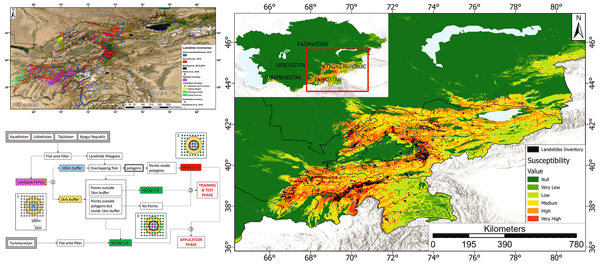
This work was carried out within the Strengthening Financial Resilience and Accelerating Risk Reduction in Central Asia (SFRARR) project and is focused on the first landslide susceptibility analysis at a regional scale for Central Asia. The most detailed available landslide inventories were implemented in a random forest model. The final aim was to provide a useful tool for reduction strategies to landslide scientists, practitioners, and administrators.
Hans-Balder Havenith, Kelly Guerrier, Romy Schlögel, Anne-Sophie Mreyen, Sophia Ulysse, Anika Braun, Karl-Henry Victor, Newdeskarl Saint-Fleur, Léna Cauchie, Dominique Boisson, and Claude Prépetit
Nat. Hazards Earth Syst. Sci. Discuss., https://doi.org/10.5194/nhess-2022-83, https://doi.org/10.5194/nhess-2022-83, 2022
Preprint withdrawn
Short summary
Short summary
First analyses of landslide distribution and triggering factors are presented for the region affected by the Mw = 7.2 earthquake, 2021, in Haiti. The landslide inventory created for the 2021 event is compared with catalogues compiled by others both for the 2021 and 2010 events. Related analyses show that the larger total area of landslides triggered in 2021, can be explained, e.g., by (a) the stronger shaking intensity in 2021, (b) a climatic influence on slope stability in the 2021-affected area.
Vipin Kumar, Léna Cauchie, Anne-Sophie Mreyen, Mihai Micu, and Hans-Balder Havenith
Nat. Hazards Earth Syst. Sci., 21, 3767–3788, https://doi.org/10.5194/nhess-21-3767-2021, https://doi.org/10.5194/nhess-21-3767-2021, 2021
Short summary
Short summary
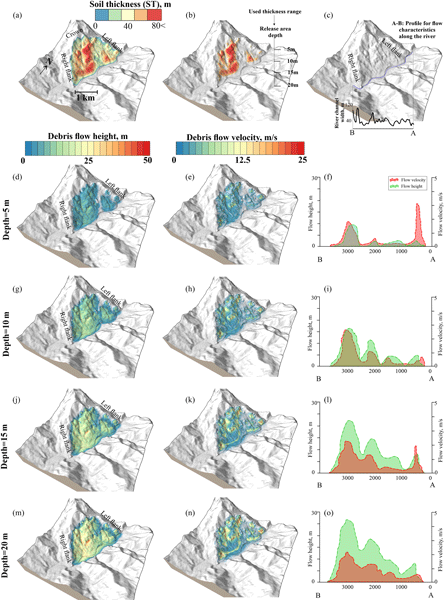
The SE Carpathians belong to one of the most active seismic regions of Europe. In recent decades, extreme rainfall events have also been common. These natural processes result in frequent landslides, particularly of a debris flow type. Despite such regimes, the region has been little explored to understand the response of the landslides in seismic and rainfall conditions. This study attempts to fill this gap by evaluating landslide responses under seismic and extreme-rainfall regimes.
Valentine Piroton, Adam Emmer, and Hans-Balder Havenith
EGUsphere, https://doi.org/10.5194/egusphere-2026-1442, https://doi.org/10.5194/egusphere-2026-1442, 2026
Short summary
Short summary
High-resolution satellite imagery was used to map the expansion in number and area of glacial lakes across Kyrgyzstan from 2016 to 2024. Small, high-elevation, glacier-connected lakes grew most, whereas larger, lower-elevation lakes remained stable. Including these often omitted small dynamic lakes in the 2024 inventory advances comprehensive monitoring of glacier–lake systems and high-mountain hydrology, highlighting how glacier retreat and topography shape lake distribution.
Carlo Destouches, Arona Diedhiou, Sandrine Anquetin, Benoit Hingray, Armand Pierre, Dominique Boisson, and Adermus Joseph
Earth Syst. Dynam., 16, 497–512, https://doi.org/10.5194/esd-16-497-2025, https://doi.org/10.5194/esd-16-497-2025, 2025
Short summary
Short summary
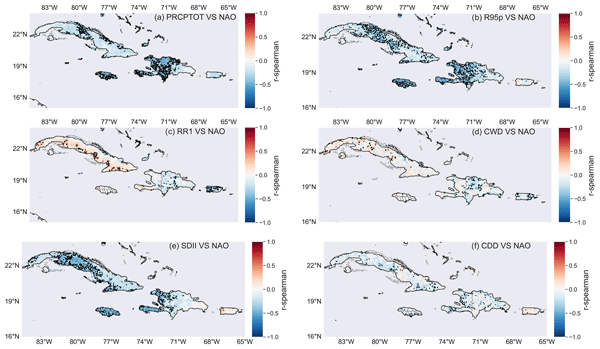
This work provides a relevant analysis of changes in extreme precipitation over the Caribbean and their link with warming in different ocean basins. It also improves our understanding of the impact of warming on extreme precipitation events, which can cause devastating damage to economic sectors such as agriculture, biodiversity, health, and energy.
Ascanio Rosi, William Frodella, Nicola Nocentini, Francesco Caleca, Hans Balder Havenith, Alexander Strom, Mirzo Saidov, Gany Amirgalievich Bimurzaev, and Veronica Tofani
Nat. Hazards Earth Syst. Sci., 23, 2229–2250, https://doi.org/10.5194/nhess-23-2229-2023, https://doi.org/10.5194/nhess-23-2229-2023, 2023
Short summary
Short summary
This work was carried out within the Strengthening Financial Resilience and Accelerating Risk Reduction in Central Asia (SFRARR) project and is focused on the first landslide susceptibility analysis at a regional scale for Central Asia. The most detailed available landslide inventories were implemented in a random forest model. The final aim was to provide a useful tool for reduction strategies to landslide scientists, practitioners, and administrators.
Hans-Balder Havenith, Kelly Guerrier, Romy Schlögel, Anne-Sophie Mreyen, Sophia Ulysse, Anika Braun, Karl-Henry Victor, Newdeskarl Saint-Fleur, Léna Cauchie, Dominique Boisson, and Claude Prépetit
Nat. Hazards Earth Syst. Sci. Discuss., https://doi.org/10.5194/nhess-2022-83, https://doi.org/10.5194/nhess-2022-83, 2022
Preprint withdrawn
Short summary
Short summary
First analyses of landslide distribution and triggering factors are presented for the region affected by the Mw = 7.2 earthquake, 2021, in Haiti. The landslide inventory created for the 2021 event is compared with catalogues compiled by others both for the 2021 and 2010 events. Related analyses show that the larger total area of landslides triggered in 2021, can be explained, e.g., by (a) the stronger shaking intensity in 2021, (b) a climatic influence on slope stability in the 2021-affected area.
Vipin Kumar, Léna Cauchie, Anne-Sophie Mreyen, Mihai Micu, and Hans-Balder Havenith
Nat. Hazards Earth Syst. Sci., 21, 3767–3788, https://doi.org/10.5194/nhess-21-3767-2021, https://doi.org/10.5194/nhess-21-3767-2021, 2021
Short summary
Short summary
The SE Carpathians belong to one of the most active seismic regions of Europe. In recent decades, extreme rainfall events have also been common. These natural processes result in frequent landslides, particularly of a debris flow type. Despite such regimes, the region has been little explored to understand the response of the landslides in seismic and rainfall conditions. This study attempts to fill this gap by evaluating landslide responses under seismic and extreme-rainfall regimes.
Cited articles
Acker, G. and Leptoukh, G.: Online Analysis Enhances Use of NASA Earth Science Data, Eos T. Am. Geophys. Un., 88, 14–17, 2007.
Ali, S. T., Freed, A. M., Calais, E., Manaker, D. M., and McCann, W. R.: Coulomb stress evolution in Northeastern Caribbean over the past 250 years due to coseismic, postseismic and interseismic deformation, Geophys. J. Int., 174, 904–918, https://doi.org/10.1111/j.1365-246X.2008.03634.x, 2008.
Amatya, P., Kirschbaum, D., Stanley, T., and Tanyas, H.: Landslide mapping using object-based image analysis and open source tools, Eng. Geol., 282, 106000, https://doi.org/10.1016/j.enggeo.2021.106000, 2021.
Arias, A.: A measure of earthquake intensity, in: Seismic design for Nuclear Powerplants, edited by: Hansen, R. J., MIT Press, Cambridge, Massachusetts, 438–483, ISBN 978-0262080415, 1970.
Bakun, W. H., Flores, C. H., and ten Brink, U. S.: Significant Earthquakes on the Enriquillo Fault System, Hispaniola, 1500–2010: Implications for Seismic Hazard, B. Seismol. Soc. Am., 102, 18–30, https://doi.org/10.1785/0120110077, 2012.
Calais, E., Freed, A., Mattioli, G., Amelung, F., Jónsson, S., Jansma, P., Hong, S. H., Dixon, T., Prépetit, C., and Momplaisir, R.: Transpressional rupture of an unmapped fault during the 2010 Haiti earthquake, Nat. Geosci., 3, 794–799, https://doi.org/10.1038/ngeo992, 2010.
Calais, E., Symithe, S., Monfret, T., Delouis, B., Lomax, A., Courboulex, F., Ampuero, J. P., Lara, P. E., Bletery, Q., Chèze, J., Peix, F., Deschamps, A., de Lépinay, B., Raimbault, B., Jolivet, R., Paul, S., St. Fleur, S., Boisson, D., Fukushima, Y., Duputel, Z., Xu, L., and Meng, L.: Citizen seismology helps decipher the 2021 Haiti earthquake, Science, 376, 283–287, https://doi.org/10.1126/science.abn1045, 2022.
DeMets, C., Jansma, P. E., Mattioli, G. S., Dixon, T. H., Farina, F., Bilham, R., Calais, E., and Mann, P.: GPS geodetic constraints on Caribbean-North America plate motion, Geophys. Res. Lett., 27, 437–440, https://doi.org/10.1029/1999GL005436, 2000.
Fan, X., Juang, C. H., Wasowski, J., Huang, R., Xu, Q., Scaringi, G., van Westen, C. J., and Havenith, H. B.: What we have learned from the 2008 Wenchuan Earthquake and its aftermath: A decade of research and challenges, Eng. Geol., 241, 25–32, https://doi.org/10.1016/j.enggeo.2018.05.004, 2018.
Frankel, A., Harmsen, S., Mueller, C., Calais, E., and Haase, J.: Seismic hazard maps for Haiti, Earthq. Spectra, 27, 23–41, https://doi.org/10.1193/1.3631016, 2011.
Fritz, H. M., Hillaire, J. V., Molière, E., Wei, Y., and Mohammed, F.: Twin tsunamis triggered by the 12 January 2010 Haiti earthquake, Pure Appl. Geophys., 170, 1463–1474, https://doi.org/10.1007/S00024-012-0479-3, 2013.
Gischig, V., Eberhardt, E., Moore, J., and Hungr, O.: On the seismic response of deep-seated rock slope instabilities – insights from numerical modeling, Eng. Geol., 193, 1–18, https://doi.org/10.1016/j.enggeo.2015.04.003, 2015.
Gorum, T., Fan, X., van Westen, C. J., Huang, R., Xu, Q., Tang, C., and Wang, G.: Distribution pattern of earthquake-induced landslides triggered by the 12 May 2008 Wenchuan earthquake, Geomorphology, 133, 152–167, https://doi.org/10.1016/j.geomorph.2010.12.030, 2011.
Gorum, T., van Westen, C. J., Korup, O., van der Meijde, M., Fan, X., and van der Meer, F. D.: Complex rupture mechanism and topography control symmetry of mass – wasting pattern, 2010 Haiti earthquake, Geomorphology, 184, 127–138, https://doi.org/10.1016/j.geomorph.2012.11.027, 2013.
Harp, E. L. and Wilson, R. C.: Shaking intensity thresholds for rock falls and slides: evidence from 1987 Whittier Narrows and Superstition Hills earthquake strong-motion records, B. Seismol. Soc. Am., 85, 1739–1757, 1995.
Harp, E. L., Jibson, R. W., and Schmitt, R. G.: Map of landslides triggered by the January 12, 2010, Haiti earthquake: U. S. Geological Survey Scientific Investigations Map 3353, 15 p., 1 sheet, scale 1:150 000, https://doi.org/10.3133/sim3353, 2016.
Havenith, H. B., Strom, A., Torgoev, I., Torgoev, A., Lamair, L., Ischuk, A., and Abdrakhmatov, K.: Tien Shan Geohazards Database: Earthquakes and Landslides, Geomorphology, 249, 16–31, https://doi.org/10.1016/j.geomorph.2015.01.037, 2015.
Havenith, H. B., Torgoev, A., Braun, A., Schlögel, R., and Micu, M.: A new classification of earthquake-induced landslide event sizes based on seismotectonic, topographic, climatic and geologic factors, Geoenvir. Disasters, 3, 2–24, https://doi.org/10.1186/s40677-016-0041-1, 2016.
Hedges, S. B., Cohen, W. B., Timyan, J., and Yang, Z.: Haiti's biodiversity threatened by nearly complete loss of primary forest, P. Natl. Acad. Sci. USA, 115, 11850–11855, https://doi.org/10.1073/pnas.1809753115, 2018.
Kargel, J., Leonard, G., Shugar, D., Haritashya, U., Bevington, A., Fielding, E., Fujita, K., Geertsema, M., Miles, E., Steiner, J., Anderson, E., Bajracharya, S., Bawden, G., Breashears, D., Byers, A., Collins, B., Dhital, M., Donnellan, A., Evans, T., Geai, M., Glasscoe, M., Green, D., Gurung, D., Heijenk, R., Hilborn, A., Hudnut, K., Huyck, C., Immerzeel, W., Liming, J., Jibson, R., Kääb, A., Khanal, N., Kirschbaum, D., Kraaijenbrink, P., Lamsal, D., Shiyin, L., Mingyang, L., McKinney, D., Nahirnick, N., Zhuotong, N., Ojha, S., Olsenholler, J., Painter, T., Pleasants, M., Pratima, K., Yuan, Q., Raup, B., Regmi, D., Rounce, D., Sakai, A., Donghui, S., Shea, J., Shrestha, A., Shukla, A., Stumm, D., van der Kooij, M., Voss, K., Xin, W., Weihs, B., Wolfe, D., Lizong, W., Xiaojun, Y., Yoder, M., and Young, N.: Geomorphic and geologic controls of geohazards induced by Nepal's 2015 Gorkha earthquake, Science, 351, aac8353, https://doi.org/10.1126/science.aac8353, 2016.
Keefer, D. K. and Wilson, R. C.: Predicting earthquake-induced landslides, with emphasis on arid and semi-arid environments, in: Landslides in a Semi-arid environment, edited by: Sadler, P. M. and Morton, D. M., Inland Geological Society, 2, 118–149, 1989.
Lacroix, P.: Landslides triggered by the Gorkha earthquake in the Langtang valley, volumes and initiation processes, Earth Planets Space, 68, 46, https://doi.org/10.1186/s40623-016-0423-3, 2016.
Lemaire, E., Mreyen, A.-S., Dufresne, A., and Havenith, H.-B.: Analysis of the influence of structural geology on the massive seismic slope failure potential supported by numerical modelling, Geosciences, 10, 323, https://doi.org/10.3390/geosciences10080323, 2020.
Malamud, B. D., Turcotte, D. L., Guzzetti, F., and Reichenbach, P.: Landslide inventories and their statistical properties, Earth Surf. Proc. Land., 29, 687–711, https://doi.org/10.1002/esp.1064, 2004.
Marc, O., Meunier, P., and Hovius, N.: Prediction of the area affected by earthquake-induced landsliding based on seismological parameters, Nat. Hazards Earth Syst. Sci., 17, 1159–1175, https://doi.org/10.5194/nhess-17-1159-2017, 2017.
Martinez, S. N., Allstadt, K. E., Slaughter, S. L., Schmitt, R., Collins, E., Schaefer, L. N., and Ellison, S.: Landslides triggered by the August 14, 2021, magnitude 7.2 Nippes, Haiti, earthquake, U. S. Geological Survey Open-File Report 2021–1112, 17 p., https://doi.org/10.3133/ofr20211112, 2021.
Okuwaki, R. and Fan, W.: Oblique convergence causes both thrust and strike-slip ruptures during the 2021 M 7.2 Haiti earthquake, Geophys. Res. Lett., 49, e2021GL096373, https://doi.org/10.1029/2021GL096373, 2022.
Olson, S., Green, R., Lasley, S., Martin, N., Cox, B., Rathje, E., Bachhuber, J., and French, J.: Documenting Liquefaction and Lateral Spreading Triggered by the 12 January 2010 Haiti Earthquake, Earthq. Spectra, 27, 93–116, https://doi.org/10.1193/1.3639270, 2011.
Parker, R. N., Hancox, G. T., Petley, D. N., Massey, C. I., Densmore, A. L., and Rosser, N. J.: Spatial distributions of earthquake-induced landslides and hillslope preconditioning in the northwest South Island, New Zealand, Earth Surf. Dynam., 3, 501–525, https://doi.org/10.5194/esurf-3-501-2015, 2015.
Petley, D.: Landslides from the 14 August 2021 earthquake in Haiti, https://blogs.agu.org/landslideblog/2021/09/03/landslides-from-the-14-august-2021-earthquake-in-haiti (last access: 10 June 2022), 2021.
Poupardin, A., Calais, E., Heinrich, P., Hébert, H., Rodriguez, M., Leroy, S., Aochi, H., and Douilly, R.: Deep submarine landslide contribution to the 2010 Haiti earthquake tsunami, Nat. Hazards Earth Syst. Sci., 20, 2055–2065, https://doi.org/10.5194/nhess-20-2055-2020, 2020.
Saint Fleur, N., Klinger, Y., and Feuillet, N.: Detailed map, displacement, paleoseismology, and segmentation of the Enriquillo-Plantain Garden Fault in Haiti, Tectonophysics, 778, 228368, https://doi.org/10.1016/j.tecto.2020.228368, 2020.
Sassa, S. and Takagawa, T.: Liquefied gravity flow-induced tsunami: first evidence and comparison from the 2018 Indonesia Sulawesi earthquake and tsunami disasters, Landslides, 16, 195–200, https://doi.org/10.1007/s10346-018-1114-x, 2018.
Stark, C. P. and Hovius, N.: The characterization of landslide size distributions, Geophys. Res. Lett., 28, 1091–1094, https://doi.org/10.1029/2000GL008527, 2001.
Stein, R. S., Toda, S., Lin, J., and Sevilgen, V.: Are the 2021 and 2010 Haiti earthquakes part of a progressive sequence?, Temblor, https://doi.org/10.32858/temblor.197, 2021.
Symithe, S. J., Calais, E., Haase, J. S., Freed, A. M., and Douilly, R.: Coseismic Slip Distribution of the 2010 M 7.0 Haiti Earthquake and Resulting Stress Changes on Regional Faults, B. Seismol. Soc. Am., 103, 2326–2343, https://doi.org/10.1785/0120120306, 2013.
Tanyaş, H. and Lombardo, L.: Variation in landslide-affected area under the control of ground motion and topography, Eng. Geol., 260, 105229, https://doi.org/10.1016/j.enggeo.2019.105229, 2019.
Tanyaş, H., Westen, C. J., Allstadt, K. E., Jessee, M. A. N., Görüm, T., Jibson, R. W., Godt, J. W., Sato, H. P., Schmitt, R. G., Marc, O., and Hovius, N.: Presentation and Analysis of a Worldwide Database of Earthquake-Induced Landslide Inventories, J. Geophys. Res.-Earth, 122, 1991–2015, https://doi.org/10.1002/2017jf004236, 2017.
Tanyas, H., Rossi, M., Alvioli, M., van Westen, C. J., and Marchesini, I.: A global slope unit-based method for the near real-time prediction of earthquake-induced landslides, Geomorphology, 327, 126–146, https://doi.org/10.1016/j.geomorph.2018.10.022, 2019a.
Tanyaş, H., Westen, C. J., Allstadt, K. E., and Jibson, R. W.: Factors controlling landslide frequency–area distributions, Earth Surf. Proc. Land., 44, 900–917, https://doi.org/10.1002/esp.4543, 2019b.
Tanyaş, H., Görüm, T., Fadel, I., Yıldırım, C., and Lombardo, L.: An open dataset for landslides triggered by the 2016 Mw 7.8 Kaikōura earthquake, New Zealand, Landslides, 19, 1405–1420, https://doi.org/10.1007/s10346-022-01869-9, 2022.
Von Hillebrandt-Andrade, C. and Vanacore, E.: Citizen science for studying earthquakes, Science, 376, 246–247, https://doi.org/10.1126/science.abo5378, 2022.
Wartman, J., Dunham, L., Tiwari, B., and Pradel, D.: Landslides in Eastern Honshu Induced by the 2011 Tohoku Earthquake Landslides in Eastern Honshu Induced by the 2011 Tohoku Earthquake, B. Seismol. Soc. Am., 103, 1503–1521, https://doi.org/10.1785/0120120128, 2013.
Wilson, R. C. and Keefer, D. K.: Predicting the areal limits of earthquake-induced landsliding, in: Evaluating Earthquake Hazards in the Los Angeles Region – An Earth Science Perspective, edited by: Ziony, J. I., U. S. Geol. Surv. Prof. Paper 1360, 316–345, 1985.
Xu, C., Shyu, J. B. H., and Xu, X.: Landslides triggered by the 12 January 2010 Port-au-Prince, Haiti, Mw=7.0 earthquake: visual interpretation, inventory compiling, and spatial distribution statistical analysis, Nat. Hazards Earth Syst. Sci., 14, 1789–1818, https://doi.org/10.5194/nhess-14-1789-2014, 2014.
Zhao, B., Wang, Y., Li, W., Lu, H., and Li, Z.: Evaluation of factors controlling the spatial and size distributions of landslides, 2021 Nippes earthquake, Haiti, Geomorphology, 415, 1–16, https://doi.org/10.1016/j.geomorph.2022.108419, 2022.
Short summary
We present a new landslide inventory for the 2021, M 7.2, Haiti, earthquake. We compare characteristics of this inventory with those of the 2010 seismically induced landslides, highlighting the much larger total area of 2021 landslides. This fact could be related to the larger earthquake magnitude in 2021, to the more central location of the fault segment ruptured in 2021 with respect to coastal zones, and/or to possible climatic preconditioning of slope failures in the 2021 affected area.
We present a new landslide inventory for the 2021, M 7.2, Haiti, earthquake. We compare...


Altmetrics
Final-revised paper
Preprint