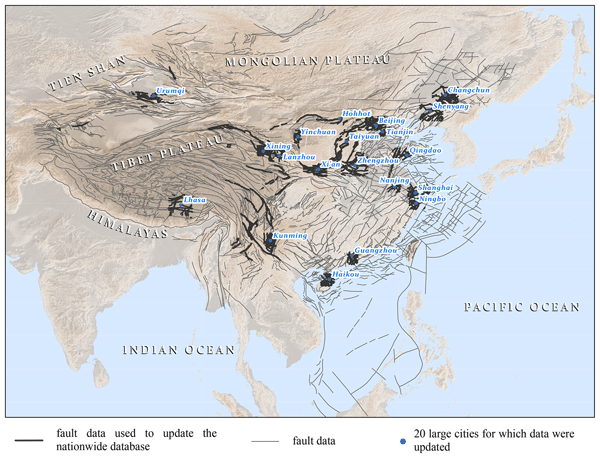
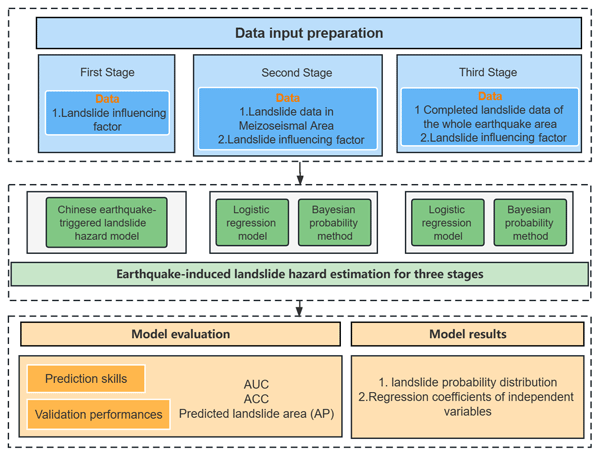
Campbell, K. and Bozorgnia, Y.: NGA-West2 ground motion model for the average horizontal components of PGA, PGV, and 5 % damped linear acceleration response spectra, Earthq. Spectra, 30, 1087–1115, 2014.
Cao, Y., Jin, M., Qian, J., Chen, J., and Anyiam, U.: Crustal structure and seismicity characteristics based on dense array monitoring in northwestern Yunnan, China, Phys. Earth Planet. In., 340, 107047, https://doi.org/10.1016/j.pepi.2023.107047, 2023.
Chang, Z., Zhang, Y., Li, J., and Zang, Y.: The Geological and Geomorphic Characteristic of Late Quaternary Activity of the Deqin-Zhongdian-Daju Fault, Journal of Seismological Research, 37, 46–52, 2014 (in Chinese with English abstract).
Chang, Z., Chang, H., Zang, Y., and Dai, B.: Recent active features of Weixi-Qiaohou fault and its relationship with the Honghe fault, Journal of Geomechanics, 22, 517–530, 2016 (in Chinese with English abstract).
Chang, C., Chang, C., Gao, J., and Chan, C.: Quantifying the probability and uncertainty of multiple-structure rupture for Taiwan, Terr. Atmos. Ocean. Sci., 34, 7, https://doi.org/10.1007/s44195-023-00040-8, 2023.
Chartier, T., Scotti, O., Lyon-Caen, H., and Boiselet, A.: Methodology for earthquake rupture rate estimates of fault networks: example for the western Corinth rift, Greece, Nat. Hazards Earth Syst. Sci., 17, 1857–1869, https://doi.org/10.5194/nhess-17-1857-2017, 2017.
Chartier, T., Scotti, O., and Lyon-Caen, H.: SHERIFS: Open-Source code for computing earthquake rates in fault systems and constructing hazard models, Seismol. Res. Lett., 90, 1678–1688, https://doi.org/10.1785/0220180332, 2019.
Chartier, T., Scotti, O., Lyon-Caen, H., Richard-Dinger, K., Dieterich, J. H., and Shaw, B. E.: Modelling earthquake rates and associated uncertainties in the Marmara Region, Turkey, Nat. Hazards Earth Syst. Sci., 21, 2733–2751, https://doi.org/10.5194/nhess-21-2733-2021, 2021.
Chen, G., Magistrale, H., Rong, Y., Cheng, J., Binselam, A., and Xu, X.: Seismic site condition of Mainland China from Geology, Seismol. Res. Lett., 92, 998–1010, 2021.
Cheng, J., Xu, X., Gan, W., Ma, W., Chen, W., and Zhang, Y.: Block model and dynamic implication from the earthquake activities and crustal motion in the southeastern margin of Tibetan plateau, Chinese J. Geophys., 55, 1198–1212, 2012 (in Chinese with English abstract).
Cheng, J., Rong, Y., Magistrale, H., Chen, G., and Xu, X.: An Mw-based historical earthquake catalog for mainland China, B. Seismol. Soc. Am., 107, 2490–2500, 2017.
Cheng, J., Rong, Y., Magistrale, H., Chen, G., and Xu, X.: Earthquake rupture scaling relations for mainland China, Seismol. Res. Lett., 91, 248–261, 2020.
Cheng, J., Chartier, T., and Xu, X.: Multisegment Rupture Hazard Modeling along the Xianshuihe Fault Zone, Southeastern Tibetan Plateau, Seismol. Res. Lett., 92, 951–964, https://doi.org/10.1785/0220200117, 2021.
Chiou, B. and Youngs, R.: Update of the Chiou and Youngs NGA Model for the Average Horizontal Component of Peak Ground Motion and Response Spectra, Earthq. Spectra, 30, 1117–1153, 2014.
Cunningham, W. and Mann, P.: Tectonics of Strike-Slip Restraining and Releasing Bends, Geological Society, London, Special Publications, 290, 1–12, https://doi.org/10.1144/SP290.1, 2007.
Dai, C., Gan, W., Li, Z., Liang, S., Xiao, G., Zhang, K., and Zhang, L.: Characteristics of Regional GPS Crustal Deformation before the 2021 Yunnan Yangbi Ms 6.4 Earthquake and Its Implications for Determining Potential Areas of Future Strong Earthquakes, Remote Sens., 15, 3195, https://doi.org/10.3390/rs15123195, 2023.
Dangkua, D., Rong, Y., and Magistrale, H.: Evaluation of NGA-West2 and Chinese Ground-Motion Prediction Equations for Developing Seismic Hazard Maps of Mainland China, B. Seismol. Soc. Am., 108, 2422–2443, 2018.
Deng, Q., Zhang, P., Ran, Y., Yang, X., Min, W., and Chu, Q.: Basic characteristics of active tectonics of China, Sci. China Earth Sci., 46, 356–372, 2003.
Ding, R., Ren, J., Zhang, S., Lu, Y., and Liu, H.: Late Quaternary Paleoearthquakes on the Middle segment of the Lijiang-Xiaojinhe fault, Southeastern Tibet, Seismology and Geology, 40, 622–640, 2018 (in Chinese with English abstract).
Dutykh, D., Mitsotakis, D., Gardeil, X., and Dias, F.: On the use of the finite fault solution for tsunami generation problems, Theor. Comp. Fluid Dyn., 27, 177–199, 2013.
Ekström, G., Nettles, M., and Dziewonski, A. M.: The global CMT project 2004-2010: Centroid-moment tensors for 13,017 earthquakes, Phys. Earth Planet. In., 200–201, 1–9, https://doi.org/10.1016/j.pepi.2012.04.002, 2012.
Field, E., Arrowsmith, R., Biasi, G., Bird, P., Dawson, T., Felzer, K., Jackson, D., Johnson, K., Jordan, T., Madden, C., Michael, A., Milner, K., Page, M., Parsons, T., Powers, P., Shaw, B., Thatcher, W., Weldon, R., and Zeng, Y.: Uniform California Earthquake Rupture Forecast, version 3 (UCERF3)–The time-independent model, B. Seismol. Soc. Am., 104, 1122–1180, 2014.
Gan, W., Zhang, P., Shen, Z., Niu, Z., Wang, M., Wan, Y., Zhou, D., and Cheng, J.: Present-day crustal motion within the Tibetan Plateau inferred from GPS measurements, J. Geophys. Res.-Sol. Ea., 112, B08416, https://doi.org/10.1029/2005JB004120, 2007.
Gao, M., Li, X., Xu, X., Wei, K., Yu, Y., Zhou, B., Zhao, F., Pan, H., Lv, Y., and Zhou, Q.: GB18306-2015: Introduction to the Seismic Hazard Map of China, Standards Press of China, Beijing, 1–133, ISBN: 9787506678889, 2015 (in Chinese).
Gao, Y., Ding, R., Zhang, S., and Ren, J.: Slip rate of Lijiang-Xiaojinhe fault in the Holocene, Technology for Earthquake Disaster Prevention, 14, 617–627, 2019 (in Chinese with English abstract).
Guo, S., Zhang, J., Li, X., Xiang, H., Chen, T., and Zhang, G.: Fault displacement and recurrence intervals of earthquakes at the northern segment of the Honghe fault zone, Yunnan Province, Seismology and Geology, 6, 1–12, 1984 (in Chinese with English abstract).
Han, Z., Guo, S., Xiang, H., Zhang, J., and Ran, Y.: Seismotectonic Environment of occurring the February 3, 1996 Lijiang
M = 7.0 earthquake, Yunnan Province, Acta Seismologica Sinica, 26, 410–418, 2004 (in Chinese with English abstract).
Han, Z., Xiang, H., and Guo, S.: Sinistral shear and extension of the northern section of Lijiang Basin in northwest Yunnan in Quaternary, Chinese Sci. Bull., 50, 452–459, 2005.
Harris, R. and Day, S.: Dynamic 3D simulations of earthquakes on En Echelon Faults, Geophys. Res. Lett., 26, 2089–2092, 1999.
Huang, X., Wu, Z., Huang, X., and Luo, R.: Tectonic Geomorphology constrains on Quaternary Activity and Segmentation along Chenghai-Binchuan Fault zone in Northwest Yunnan, China, Earth Sci., 43, 4651–4670, 2018 (in Chinese with English abstract).
Huang, X., Wu, Z., Liu, F., Tian, T., Huang, X., and Zhang, Y.: Tectonic interpretation of the main paleoseismic landslides and their distribution characteristics in the Chenghai fault zone, Northwest Yunnan, Earth Science Frontiers, 28, 125–139, 2021 (in Chinese with English abstract).
Huang, P., Gao, Y., and Xue, B.: Advances in the deep tectonics and seismic anisotropy of the Lijiang-Xiaojinhe fault zone in the Sichuan-Yunnan Block, Southwestern China, Earthquake Research Advances, 2, 100116, https://doi.org/10.1016/j.eqrea.2022.100116, 2022.
Lay, T. and Nishenko, S.: Updated concepts of seismic gaps and asperities to assess great earthquake hazard along South America, P. Natl. Acad. Sci. USA, 119, e2216843119, https://doi.org/10.1073/pnas.2216843119, 2022.
Lee, Y., Hui, Z., Daneshvaran, S., Sedaghati, F., and Graf, W.: Impacts on catastrophe risk assessments from multi-segment and multi-fault ruptures in the UCERF3 model, Earthq. Spectra, 38, 128–151, 2022.
Leonard, M.: Earthquake Fault Scaling: Self-Consistent Relating of Rupture Length, Width, Average Displacement, and Moment Release, B. Seismol. Soc. Am., 100, 1971–1988, 2010.
Lindsey, E., Wang, Y., Aung, L., Chong, J., Qiu, Q., Mallick, R., Feng, L., Aung, P., Tin, T., Min, S., Bradley, K., Than, O., Oo, K., Thant, M., Masson, F., Bürgmann, R., and Hill, E.: Active subduction and strain partitioning in western Myanmar revealed by a dense survey GNSS network, Earth Planet. Sc. Lett., 622, 118384, https://doi.org/10.1016/j.epsl.2023.118384, 2023.
Liu, C., Lay, T., Wang, R., Taymaz, T., Xie, Z., Xiong, X., Irmak, T., Kahraman, M., and Erman, C.: Complex multi-fault rupture and triggering during the 2023 earthquake doublet in southeastern Türkiye, Nat. Commun., 14, 5564, https://doi.org/10.1038/s41467-023-41404-5, 2023.
Lozos, J., Oglesby, D., Brune, J., and Olsen, K.: Small intermediate fault segments can either aid or hinder rupture propagation at stepovers, Geophys. Res. Lett., 39, L18305, https://doi.org/10.1029/2012GL053005, 2012.
Manighetti, I., Campillo, M., Bouley, S., and Cotton, F.: Earthquake scaling, fault segmentation, and structural maturity, Earth Planet. Sc. Lett., 253, 429–438, 2007.
Manighetti, I., Mercier, A., and De Barros, L.: Fault trace corrugation and segmentation as a measure of fault structural maturity, Geophys. Res. Lett., 48, e2021GL095372, https://doi.org/10.1029/2021GL095372, 2021.
Mignan, A., Danciu, L., and Giardini, D.: Reassessment of the Maximum Fault Rupture Length of Strike-Slip Earthquakes and Inference on Mmax in the Anatolian Peninsula, Turkey, Seismol. Res. Lett., 86, 890–900, 2015.
Nowicki, M., Wald, D., Hamburger, M., Hearne, M., and Thompson, E.: Development of a globally applicable model for near real-time prediction of seismically induced landslides, Eng. Geol., 173, 54–65, 2014.
Pagani, M., Monelli, D., Weatherill, G., Danciu, L., Crowley, H., Silva, V., Henshaw, P., Butler, L., Nastasi, M., Panzeri, L., Simionato, M., and Vigano, D.: OpenQuake Engine: An Open Hazard (and Risk) Software for the Global Earthquake Model, Seismol. Res. Lett., 85, 692–702, 2014.
Page, M., Field, E., Milner, K., and Powers, P.: The UCERF3 Grand Inversion: Solving for the Long-term rate of ruptures in a fault system, B. Seismol. Soc. Am., 104, 1181–1204, 2014.
Petersen, G. M., Büyükakpinar, P., Sanhueza, P., Metz, M., Cesca, S., Akbayram, K., Saul, J., and Dahm, T.: The 2023 Southeast Türkiye Seismic Sequence: Rupture of a Complex Fault Network, The Seismic Record, 3, 134–143, 2023.
Rangin, C., Maurin, T., and Masson, F.: Combined effects of Eurasia/Sunda oblique convergence and East-Tibetan crustal flow on the active tectonics of Burma, J. Asian Earth Sci., 76, 185–194, 2013.
Rashidi, A., Shomali, Z. H., Dutykh, D., and Keshavarz Farajkhah, N.: Tsunami hazard assessment in the Makran subduction zone, Nat. Hazards, 100, 861–875, https://doi.org/10.1007/s11069-019-03848-1, 2020.
Ren, J., Zhang, S., Hou, Z., and Liu, X.: Study of Late Quaternary slip rate in the Mid-Segment of the Tongdian-Weishan fault, Seismology and Geology, 29, 756–764, 2007 (in Chinese with English abstract).
Rong, Y., Xu, X., Cheng, J., Chen, G., Magistrale, H., and Shen, Z.: A probabilistic seismic hazard model for mainland China, Earthq. Spectra, 36, 181–209, https://doi.org/10.1177/8755293020910754, 2020.
Schwartz, D. and Coppersmith, K.: Fault behavior and characteristic earthquakes: Examples from the Wasatch and San Andreas Fault Zones, J. Geophys. Res., 89, 5681–5698, 1984.
Shao, X., Ma, S., Xu, C., and Zhou, Q.: Effects of sampling intensity and non-slide/slide sample ratio on the occurrence probability of coseismic landslides, Geomorphology, 363, 107222, https://doi.org/10.1016/j.geomorph.2020.107222, 2020.
Shen, J., Wang, Y., and Ren, J.: Quaternary dextral strike slip motion of the Deqin-Daju-Daju fault zone, Yunnan, China, in: Study on the recent deformation and dynamic of the Lithosphere of Qinghai-Xizang Plateau, edited by: Ma, Z., Wang, Y., and Zhang, Y., Seismological Press, Beijing, China, 106–122, ISBN: 7-5028-1938-X, 2001 (in Chinese with English abstract).
Shen, Z., Lu, J., Wang, M., and Burgmann, R.: Contemporary crustal deformation around the southeast borderland of the Tibetan Plateau, J. Geophys. Res., 110, B11409, https://doi.org/10.1029/2004JB003421, 2005.
Shi, X., Sieh, K., Weldon, R., Zhu, C., Han, Y., Yang, J., and Robinson, S.: Slip rate and rare large prehistoric earthquakes of the Red River fault, southwestern China, Geochem. Geophy. Geosy., 19, 2014–2031, https://doi.org/10.1029/2017GC007420, 2018.
Stirling, M., Goded, T., Berryman, K., and Litchfield, N.: Selection of Earthquake Scaling Relationships for Seismic-Hazard Analysis, B. Seismol. Soc. Am., 103, 2993–3011, 2013.
Sun, C., Li, D., Shen, X., Kang, Y., Liu, R., and Zhang, Y.: Holocene activity evidence on the southeast boundary fault of Heqing basin, middle segment of Heqing-Eryuan fault zone, West Yunnan Province, China, J. Mt. Sci., 14, 1445–1453, 2017.
Tang, F., Ma, H., and Song, J.: Study on the Late Quaternary activity of Chenghai fault zone, in: Proceeding of the 16th World conference on earthquake engineering, Santiago, Chile, 9–13 January 2017, Paper No. 1378, 1–9,
https://www.wcee.nicee.org/wcee/article/16WCEE/WCEE2017-1378.pdf (last access: 19 February 2025), 2017.
Tang, Y., Hu, C., Tian, Q., Wang, L., Yang, P., and Xiong, R.: A Preliminary Study of Paleo-earthquakes in the Jianchuan Section of Longpan-Qiaohou Fault Zone, Yunnan Province, Earthquake, 34, 117–124, 2014 (in Chinese with English abstract).
Wang, E., Burchfiel, C., Royden, L., Chen, L., Chen, L., Li, W., and Chen, Z.: Late Cenozoic Xianshuihe-Xiaojiang, Red River, and Dali Fault Systems of Southwestern Sichuan and Central Yunnan, China, Geological Society of America Special Paper, 327, 1–108, ISBN: 9780813723273, 1998.
Wang, M. and Shen, Z.: Present-Day Crustal Deformation of Continental China Derived from GPS and Its Tectonic Implications, J. Geophys. Res.-Sol. Ea., 125, e2019JB018774, https://doi.org/10.1029/2019JB018774, 2020.
Wang, Y. and Rathje, E.: Probabilistic seismic landslide hazard maps including epistemic uncertainty, Eng. Geol., 196, 313–324, 2015.
Wells, D. and Coppersmith, K.: New empirical relationships among magnitude, rupture length, rupture width, rupture area, and surface displacement, B. Seismol. Soc. Am., 84, 974–1002, 1994.
Wu, F., Jiang, L., Zhang, G., and Song, Z.: The fault activity and seismic hazard assessment of central north segmentof the Deqin-Zhongdian fault, southeastern Qinghai-Tibet plateau, Acta Geol. Sin., 93, 2657–2665, 2019 (in Chinese with English abstract).
Wu, W., Long, F., Yang, J., Liang, M., Su, J., Wei, Y., Wu, P., and Lu, T.: Relocation, focal mechanisms and seismogenic structur
e of the 2013 Shangrila-Dêrong earthquake swarm sequence in the Yunnan-Sichuan border region, Chinese J. Geophys., 58, 1584–1596, 2015 (in Chinese with English abstract).
Wu, X., Xu, X., Yu, G., Ren, J., Yang, X., Chen, G., Xu, C., Du, K., Huang, X., Yang, H., Li, K., and Hao, H.: The China Active Faults Database (CAFD) and its web system, Earth Syst. Sci. Data, 16, 3391–3417, https://doi.org/10.5194/essd-16-3391-2024, 2024.
Xu, C., Xu, X., Zhou, B., and Shen, L.: Probability of coseismic landslides: A new generation of earthquake-triggered landslide hazard model, Journal of Engineering Geology, 27, 1122–1130, 2019 (in Chinese with English abstract).
Xu, L., Mohanna, S., Meng, L., Ji, C., Ampuero, J., Zhang, Y., Hasnain, M., Chu, R., and Liang, C.: The overall-subshear and multi-segment rupture of the 2023
Mw 7.8 Kahramanmaras, Turkey earthquake in millennia supercycle, Commun. Earth Environ., 4, 379, https://doi.org/10.1038/s43247-023-01030-x, 2023.
Xu, W., Feng, G., Meng, L., Zhang, A., Ampuero, J., and Burgmann, R.: Transpressional rupture cascade of the 2016
Mw 7.8 Kaikoura earthquake, New Zealand, J. Geophys. Res.- Sol. Ea., 123, 2396–2409, 2018.
Xu, X., Wen, X., Zheng, R., Ma, W., Song, F., and Yu, G.: Pattern of latest tectonic motion and its dynamics for active blocks in Sichuan–Yunnan region, China, Sci. China Earth Sci., 46, 210–226, 2003.
Xu, X., Wen, X., Yu, G., Chen, G., Klinger, Y., Hubbard, Y., and Shaw, J.: Coseismic reverse- and oblique-slip surface faulting generated by the 2008
Mw 7.9 Wenchuan earthquake, China, Geology, 37, 515–518, 2009.
Xu, X., Wu, X., Yu, G., Tan, X., and Li, K.: Seismo-geological signatures for identifying
M ≥ 7.0 earthquake risk areas and their premilimary application in mainland China, Seismology and Geology, 39, 219–275, 2017 (in Chinese with English abstract).
Yao, S. and Yang, H.: Towards ground motion prediction for potential large earthquakes from interseismic locking models, Earth Planet. Sc. Lett., 601, 117905, https://doi.org/10.1016/j.epsl.2022.117905, 2023.
Youngs, R. and Coppersmith, K.: Implications of fault slip rates and earthquake recurrence models to Probabilistic Seismic Hazard estimates, B. Seismol. Soc. Am., 75, 939–964, 1985.
Yu, L., Dong, Y., Zhou, W., Zhang, D., Wang, D., Yu, H., Ren, Y., and Li, J.: Evaluation of the rock uplift pattern in the Central Yunnan Subblock, SE Tibetan Plateau: Based on the Bedrock Channel Profile, Front. Earth Sci., 10, 821367, https://doi.org/10.3389/feart.2022.821367, 2022.
Yu, W., Zhang, J., Zhou, G., Wang, J., and Zeng, X.: Surface Rupture of the 2001 Yongsheng
M 6 Earthquake and Chenghai Fault, Journal of Seismological Research, 28, 125–128, 2005 (in Chinese with English abstract).
Yu, Y., Li, S., and Xiao, L.: Development of ground motion attenuation relations for the new seismic hazard map of China, Technology for Earthquake Disaster Prevention, 8, 24–33, 2013 (in Chinese with English abstract).
Zhang, J., Chen, X., Cai, J., Liu, Z., Dong, Z., Guo, C., Han, B., Jiang, F., and Cui, T.: Magnetotelluric evidence for the crustal deformation beneath the region around the Lijiang-Xiaojinhe fault, SE margin of the Tibetan Plateau, J. Asian Earth Sci., 235, 105308, https://doi.org/10.1016/j.jseaes.2022.105308, 2022.
Zhang, P., Shen, Z., Wang, M., Gan, W., Burgmann, R., Molnar, P., Wang, Q., Niu, Z., Sun, J., Wu, J., Sun, H., and You, X.: Continuous deformation of the Tibetan Plateau from global positioning system data, Geology, 32, 809–812, 2004.
Zhang, Z., Zhang, W., Chen, X., Li, P., and Fu, C.: Rupture dynamics and ground motion from potential earthquakes around Taiyuan, China, B. Seismol. Soc. Am., 107, 1201–1212, 2017.
Zhang, Z., Yao, H., and Yang, Y.: Shear wave velocity structure of the crust and upper mantle in Southeastern Tibet and its geodynamic implications, Sci. China Earth Sci., 63, 1278–1293, 2020.
Zhao, L., Xie, X., He, J., Tian, X., and Yao, Z.: Crustal flow pattern beneath the Tibetan Plateau constrained by regional Lg-wave Q tomography, Earth Planet. Sc. Lett., 383, 113–122, 2013.
Zhou, Q., Guo, S., and Xiang, H.: Principle and method of delineation of potential seismic sources in northeastern Yunnan Province, Seismology and Geology, 26, 761–771, 2004 (in Chinese with English abstract).
Zhou, R., Ye, Y., Li, Y., Li, X., He, Y., and Ge, T.: Late Quaternary activity of the Shawan segment of the Litang faults, Quaternary Sciences, 27, 45–53, 2007 (in Chinese with English abstract).
Zhou, Y., Ren, C., Ghosh, A., Meng, H., Fang, L., Yue, H., Zhou, S., and Su, Y.: Seismological Characterization of the 2021 Yangbi Foreshock-Mainshock Sequence, Yunnan, China: More than a Triggered Cascade, J. Geophys. Res., 127, e2022JB024534, https://doi.org/10.1029/2022JB024534, 2022.