Articles | Volume 22, issue 1
https://doi.org/10.5194/nhess-22-65-2022
© Author(s) 2022. This work is distributed under
the Creative Commons Attribution 4.0 License.
https://doi.org/10.5194/nhess-22-65-2022
© Author(s) 2022. This work is distributed under
the Creative Commons Attribution 4.0 License.
Brief communication: Radar images for monitoring informal urban settlements in vulnerable zones in Lima, Peru
Japan-Peru Center for Earthquake Engineering Research and Disaster Mitigation, National University of Engineering, Tupac Amaru Avenue 1150, Lima 25, Peru
International Research Institute of Disaster Science, Tohoku University, Aoba 468-1, Aramaki, Aoba-ku, Sendai 980-8572, Japan
Fernando Garcia
Graduate School of Civil Engineering, National University of Engineering, Tupac Amaru Avenue 280, Lima 25, Peru
Carlos Gonzales
Japan-Peru Center for Earthquake Engineering Research and Disaster Mitigation, National University of Engineering, Tupac Amaru Avenue 1150, Lima 25, Peru
Miguel Diaz
Japan-Peru Center for Earthquake Engineering Research and Disaster Mitigation, National University of Engineering, Tupac Amaru Avenue 1150, Lima 25, Peru
Carlos Zavala
Japan-Peru Center for Earthquake Engineering Research and Disaster Mitigation, National University of Engineering, Tupac Amaru Avenue 1150, Lima 25, Peru
Miguel Estrada
Japan-Peru Center for Earthquake Engineering Research and Disaster Mitigation, National University of Engineering, Tupac Amaru Avenue 1150, Lima 25, Peru
Fumio Yamazaki
National Research Institute for Earth Science and Disaster Resilience, Tsukuba, Ibaraki 305-0006, Japan
Shunichi Koshimura
International Research Institute of Disaster Science, Tohoku University, Aoba 468-1, Aramaki, Aoba-ku, Sendai 980-8572, Japan
Erick Mas
International Research Institute of Disaster Science, Tohoku University, Aoba 468-1, Aramaki, Aoba-ku, Sendai 980-8572, Japan
Bruno Adriano
Geoinformatics Unit, RIKEN Center for Advanced Intelligence Project (AIP), Tokyo, Japan
Related authors
No articles found.
Javier Jaimes, Luis Moya, Marta Vilela, María Santa María, Sandra Santa Cruz, and Carlos Gonzales
EGUsphere, https://doi.org/10.5194/egusphere-2025-5987, https://doi.org/10.5194/egusphere-2025-5987, 2026
This preprint is open for discussion and under review for Natural Hazards and Earth System Sciences (NHESS).
Short summary
Short summary
This study presented a semi-supervised method to map recent urban growth in Metropolitan Lima using satellite images and partial reference data. It reveals that the city expanded into several districts and in areas exposed to hazards such as landslides, earthquakes, and tsunamis. The approach helps detect early land occupations and supports safer land-use planning and better local decision-making.
Ronald E. Sanchez Escobar, Juan Jose Ferrer, Erick R. Velasco-Reyes, and Erick Mas
EGUsphere, https://doi.org/10.5194/egusphere-2025-4986, https://doi.org/10.5194/egusphere-2025-4986, 2025
Short summary
Short summary
This study shows how tsunamis interacting with coastal sediments intensify flooding risks in Tumaco Bay, Colombia. Using computer simulations, we found that including sediment transport raises water levels, flood depths, and affected areas, while proposed defenses reduce flooding but also reflect waves. These insights underscore the importance of incorporating sediment into tsunami models to design more robust protection and enhance coastal resilience.
Ruben Vescovo, Bruno Adriano, Sesa Wiguna, Chia Yee Ho, Jorge Morales, Xuanyan Dong, Shin Ishii, Kazuki Wako, Yudai Ezaki, Ayumu Mizutani, Erick Mas, Satoshi Tanaka, and Shunichi Koshimura
Earth Syst. Sci. Data, 17, 5259–5276, https://doi.org/10.5194/essd-17-5259-2025, https://doi.org/10.5194/essd-17-5259-2025, 2025
Short summary
Short summary
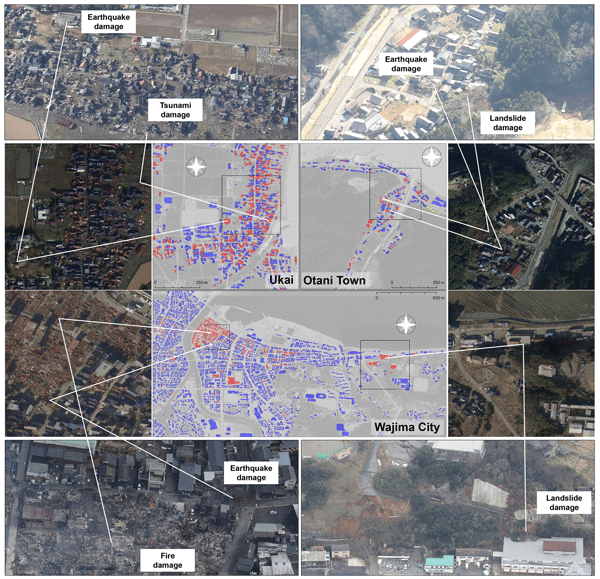
We compiled an inventory of building condition (destroyed vs. survived) following the 2024 Noto Peninsula earthquake for the entire affected area, totaling over 140 000 structures. We discuss how we fused freely available data of different types and from different sources to generate the final dataset. We show that our method produces highly accurate results relative to those obtained by on-site surveys. These data can be used to train AI to quickly detect damaged structures in future disasters.
Wei Yuan, Changqing Liu, Tianyi Wang, Bruno Adriano, Han Bao, Ryosuke Shibasaki, and Shunichi Koshimura
Int. Arch. Photogramm. Remote Sens. Spatial Inf. Sci., XLVIII-G-2025, 1663–1668, https://doi.org/10.5194/isprs-archives-XLVIII-G-2025-1663-2025, https://doi.org/10.5194/isprs-archives-XLVIII-G-2025-1663-2025, 2025
Wei Yuan, Weihang Ran, Bruno Adriano, Ryosuke Shibasaki, and Shunichi Koshimura
ISPRS Ann. Photogramm. Remote Sens. Spatial Inf. Sci., X-4-2024, 433–440, https://doi.org/10.5194/isprs-annals-X-4-2024-433-2024, https://doi.org/10.5194/isprs-annals-X-4-2024-433-2024, 2024
Cited articles
CISMID: Seismic microzoning of Chorrillos distric, available at:
http://sigrid.cenepred.gob.pe/docs/PARA PUBLICAR/CISMID/Chorrillos Informe Microzonificacion Sismica MVCS-CISMID.pdf
(last access: 4 May 2021), 2010 (in Spanish). a
CISMID: Seismic microzoning of Villa el Salvador distric, available at:
http://sigrid.cenepred.gob.pe/docs/PARA PUBLICAR/CISMID/Chorrillos Informe Microzonificacion Sismica MVCS-CISMID.pdf
(last access: 4 May 2021), 2011 (in Spanish). a
Geiß, C., Zhu, Y., Qiu, C., Mou, L., Zhu, X. X., and Taubenböck, H.: Deep
Relearning in the Geospatial Domain for Semantic Remote Sensing Image
Segmentation, IEEE Geosci. Remote Sens. Lett., 19, 1–5, 2020. a
Gestion: Policía inicia operativo de desalojo de familias que invaden zona
intangible del Morro Solar en Chorrillos, available at:
https://gestion.pe/peru/morro-solar-de-chorrillos-policia-inicia-operacion-de-desalojo-de-familias-que-invaden-zona-intangible-video-nndc-noticia/
(last access: 10 October 2021), 2021 (in Spanish). a
Gonzales, C., Sekiguchi, T., and Nakai, S.: Parametric Study on the Seismic
Response of Two Contrasting Populated Slopes in Lima, Peru, in: Proceedings
of the XVI Pan-American Conference on Soil Mechanics and Geotechnical
Engineering (XVI PCSMGE), pp. 2009–2016, 17–20 November 2019, Cancun, Mexico, 2019. a
Inga, C.: Lima Peru. Zone known as `Lomo de Corvina'. People illegal invasion
on land. Poor people and illegal land dealer, available at:
https://www.dreamstime.com/lima-peru-zone-known-as-lomo-de-corvina-people-illegal-invasion-land-poor-dealer-april-th-aerial-media-over-dealers-image217502453
(last access: 20 October 2021), 2021a. a
Inga, C.: Profile, Dreamstime, available at: https://www.dreamstime.com/info532049_info (last access: October 2021), 2021b. a
Kapstein, P. and Aranda, E.: Las periferias interiores de Lima: localización
e identificación de los barrios focos de vulnerabilidad. El caso de San
Cosme, Revista INVI, 29, 19–62, 2014. a
Kraff, N. J., Wurm, M., and Taubenböck, H.: The dynamics of poor urban areas –
analyzing morphologic transformations across the globe using Earth
observation data, Cities, 107, 102905, https://doi.org/10.1016/j.cities.2020.102905, 2020. a
Kuffer, M., Pfeffer, K., and Sliuzas, R.: Slums from Space—15 Years of Slum
Mapping Using Remote Sensing, Remote Sensing, 8, 455, https://doi.org/10.3390/rs8060455, 2016. a
Luque, G. and Núñes, S.: Technical Report No. A6532: Geological-Geotechnical
evaluation of rockfall in the Inty Llacta settlement, District of Chorrillos, available at: https://hdl.handle.net/20.500.12544/1706 (last access: 9 January 2022),
Lima, Instituto Geológico Minero y Metalúrgico, 2011 (in Spanish).
a
Medina, L., Gómez, D., and Benavente, C.: Technical Report No. A6637:Technical
Inspection of Geological Hazards in Human Settlements of The Lomo De Corvina
Sector, available at: https://hdl.handle.net/20.500.12544/1677 (last access: 9 January 2022), Instituto Geológico Minero y Metalúrgico, 2013 (in Spanish). a
Ministry of Housing, Construction and Sanitation: Presentación de nueva Ley
de Desarrollo Urbano, available at:
https://www.gob.pe/institucion/vivienda/informes-publicaciones/1846852-presentacion-de-nueva-ley-de-desarrollo-urbano
(last access: 8 May 2021), 2021 (in Spanish). a
Moya, L., Geiß, C., Hashimoto, M., Mas, E., Koshimura, S., and Strunz, G.:
Disaster Intensity-Based Selection of Training Samples for Remote Sensing
Building Damage Classification, IEEE T. Geosci. Remote, 59, 8288–8304, 2021. a
Müller, I., Taubenböck, H., Kuffer, M., and Wurm, M.: Misperceptions of
Predominant Slum Locations? Spatial Analysis of Slum Locations in Terms of
Topography Based on Earth Observation Data, Remote Sensing, 12, 2474, https://doi.org/10.3390/rs12152474, 2020. a
Shi, L., Taubenböck, H., Zhang, Z., Liu, F., and Wurm, M.: Urbanization in
China from the end of 1980s until 2010 – spatial dynamics and patterns of
growth using EO-data, Int. J. Digit. Earth, 12, 78–94,
2019. a
Taubenböck, H., Kraff, N., and Wurm, M.: The morphology of the Arrival City –
A global categorization based on literature surveys and remotely sensed data,
Appl. Geogr., 92, 150–167, 2018. a
United Nations: World Urbanization Prospects: The 2018 Revision
(ST/ESA/SER.A/420), United Nations, New York, 2019. a
Short summary
Informal occupation of unused lands for settlements is a critical issue in Peru. In most cases, such areas are unsafe against natural hazards. We performed a time-series analysis of Sentinel-1 images at recent informal settlements in Lima. The result suggests that a low-cost and sustainable monitoring system of informal settlements can be implemented.
Informal occupation of unused lands for settlements is a critical issue in Peru. In most cases,...
Altmetrics
Final-revised paper
Preprint