
Articles | Volume 25, issue 4
https://doi.org/10.5194/nhess-25-1439-2025
© Author(s) 2025. This work is distributed under
the Creative Commons Attribution 4.0 License.
the Creative Commons Attribution 4.0 License.
https://doi.org/10.5194/nhess-25-1439-2025
© Author(s) 2025. This work is distributed under
the Creative Commons Attribution 4.0 License.
the Creative Commons Attribution 4.0 License.
Research article
| 
15 Apr 2025
Research article |
| 15 Apr 2025
| 15 Apr 2025
Untangling the waves: decomposing extreme sea levels in a non-tidal basin, the Baltic Sea
Marvin Lorenz
CORRESPONDING AUTHOR

Leibniz Institute for Baltic Sea Research Warnemünde, Rostock, Germany
Federal Waterways Engineering and Research Institute, Hamburg, Germany
Katri Viigand
Department of Cybernetics, School of Science, Tallinn University of Technology, Tallinn, Estonia
Ulf Gräwe
Leibniz Institute for Baltic Sea Research Warnemünde, Rostock, Germany
Related authors
Markus Reinert, Claudia Wekerle, Knut Klingbeil, Marvin Lorenz, and Hans Burchard
The Cryosphere, 20, 4563–4584, https://doi.org/10.5194/tc-20-4563-2026, https://doi.org/10.5194/tc-20-4563-2026, 2026
Short summary
Short summary
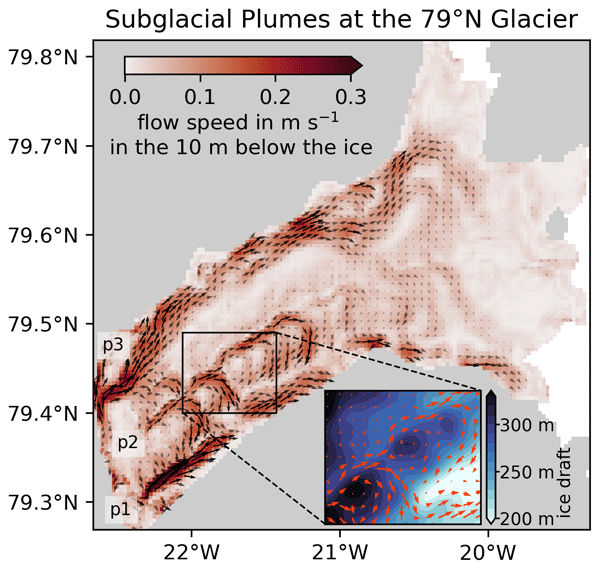
The Greenland Ice Sheet is an important contributor to global sea level rise. In northern Greenland, floating glacier tongues are primarily melted by ocean currents. These processes are difficult to observe, so we developed a realistic numerical model to study ocean-driven melting at Greenland's largest floating ice tongue, the 79° North Glacier. Our simulation reveals the details of the oceanic currents bringing warm water toward the ice base, melting and shaping the glacier tongue from below.
Joshua Kiesel, Claudia Wolff, and Marvin Lorenz
Nat. Hazards Earth Syst. Sci., 24, 3841–3849, https://doi.org/10.5194/nhess-24-3841-2024, https://doi.org/10.5194/nhess-24-3841-2024, 2024
Short summary
Short summary
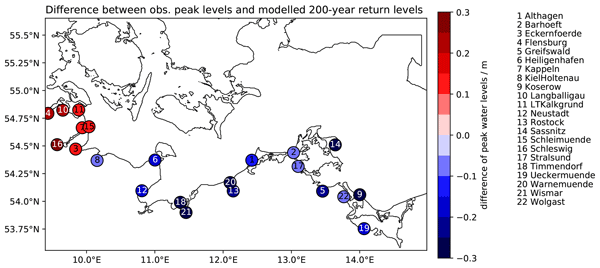
In October 2023, one of the strongest storm surges on record hit the southwestern Baltic Sea coast, causing severe impacts in the German federal state of Schleswig-Holstein, including dike failures. Recent studies on coastal flooding from the same region align well with the October 2023 surge, with differences in peak water levels of less than 30 cm. This rare coincidence is used to assess current capabilities and limitations of coastal flood modelling and derive key areas for future research.
Marvin Lorenz and Ulf Gräwe
Ocean Sci., 19, 1753–1771, https://doi.org/10.5194/os-19-1753-2023, https://doi.org/10.5194/os-19-1753-2023, 2023
Short summary
Short summary
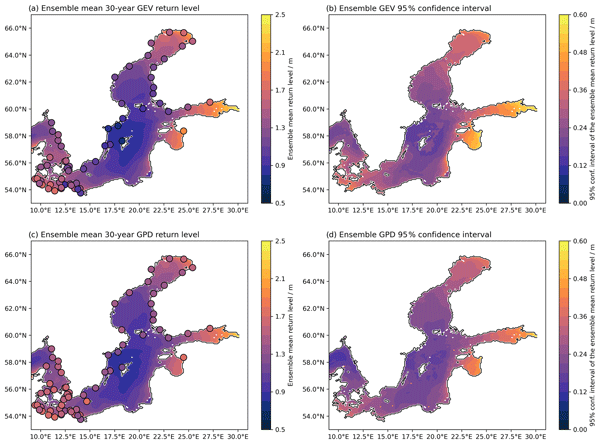
We study the variability of extreme sea levels in a 13 member hindcast ensemble for the Baltic Sea. The ensemble mean shows good agreement with observations regarding return levels and trends. However, we find great variability and uncertainty within the ensemble. We argue that the variability of storms in the atmospheric data directly translates into the variability of the return levels. These results highlight the need for large regional ensembles to minimise uncertainties.
Joshua Kiesel, Marvin Lorenz, Marcel König, Ulf Gräwe, and Athanasios T. Vafeidis
Nat. Hazards Earth Syst. Sci., 23, 2961–2985, https://doi.org/10.5194/nhess-23-2961-2023, https://doi.org/10.5194/nhess-23-2961-2023, 2023
Short summary
Short summary
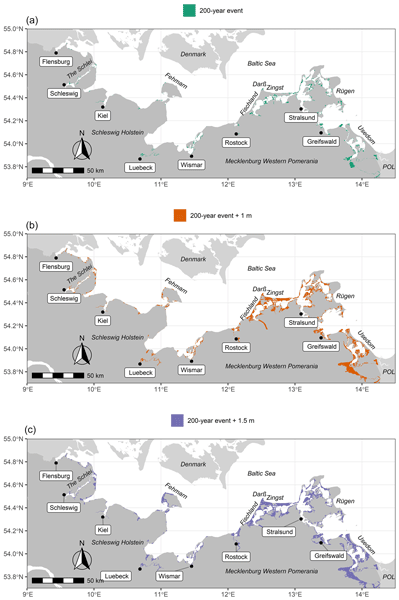
Among the Baltic Sea littoral states, Germany is anticipated to experience considerable damage as a result of increased coastal flooding due to sea-level rise (SLR). Here we apply a new modelling framework to simulate how flooding along the German Baltic Sea coast may change until 2100 if dikes are not upgraded. We find that the study region is highly exposed to flooding, and we emphasise the importance of current plans to update coastal protection in the future.
Markus Reinert, Claudia Wekerle, Knut Klingbeil, Marvin Lorenz, and Hans Burchard
The Cryosphere, 20, 4563–4584, https://doi.org/10.5194/tc-20-4563-2026, https://doi.org/10.5194/tc-20-4563-2026, 2026
Short summary
Short summary
The Greenland Ice Sheet is an important contributor to global sea level rise. In northern Greenland, floating glacier tongues are primarily melted by ocean currents. These processes are difficult to observe, so we developed a realistic numerical model to study ocean-driven melting at Greenland's largest floating ice tongue, the 79° North Glacier. Our simulation reveals the details of the oceanic currents bringing warm water toward the ice base, melting and shaping the glacier tongue from below.
Florian Börgel, Sven Karsten, Karoline Rummel, and Ulf Gräwe
Geosci. Model Dev., 18, 2005–2019, https://doi.org/10.5194/gmd-18-2005-2025, https://doi.org/10.5194/gmd-18-2005-2025, 2025
Short summary
Short summary
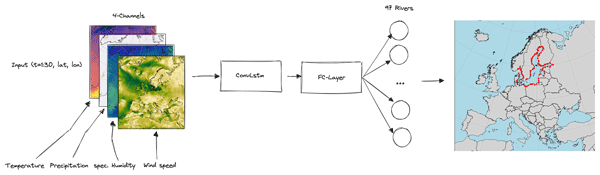
Forecasting river runoff, which is crucial for managing water resources and understanding climate impacts, can be challenging. This study introduces a new method using convolutional long short-term memory (ConvLSTM) networks, a machine learning model that processes spatial and temporal data. Focusing on the Baltic Sea region, our model uses weather data as input to predict daily river runoff for 97 rivers.
Joshua Kiesel, Claudia Wolff, and Marvin Lorenz
Nat. Hazards Earth Syst. Sci., 24, 3841–3849, https://doi.org/10.5194/nhess-24-3841-2024, https://doi.org/10.5194/nhess-24-3841-2024, 2024
Short summary
Short summary
In October 2023, one of the strongest storm surges on record hit the southwestern Baltic Sea coast, causing severe impacts in the German federal state of Schleswig-Holstein, including dike failures. Recent studies on coastal flooding from the same region align well with the October 2023 surge, with differences in peak water levels of less than 30 cm. This rare coincidence is used to assess current capabilities and limitations of coastal flood modelling and derive key areas for future research.
Marvin Lorenz and Ulf Gräwe
Ocean Sci., 19, 1753–1771, https://doi.org/10.5194/os-19-1753-2023, https://doi.org/10.5194/os-19-1753-2023, 2023
Short summary
Short summary
We study the variability of extreme sea levels in a 13 member hindcast ensemble for the Baltic Sea. The ensemble mean shows good agreement with observations regarding return levels and trends. However, we find great variability and uncertainty within the ensemble. We argue that the variability of storms in the atmospheric data directly translates into the variability of the return levels. These results highlight the need for large regional ensembles to minimise uncertainties.
Joshua Kiesel, Marvin Lorenz, Marcel König, Ulf Gräwe, and Athanasios T. Vafeidis
Nat. Hazards Earth Syst. Sci., 23, 2961–2985, https://doi.org/10.5194/nhess-23-2961-2023, https://doi.org/10.5194/nhess-23-2961-2023, 2023
Short summary
Short summary
Among the Baltic Sea littoral states, Germany is anticipated to experience considerable damage as a result of increased coastal flooding due to sea-level rise (SLR). Here we apply a new modelling framework to simulate how flooding along the German Baltic Sea coast may change until 2100 if dikes are not upgraded. We find that the study region is highly exposed to flooding, and we emphasise the importance of current plans to update coastal protection in the future.
Bronwyn E. Cahill, Piotr Kowalczuk, Lena Kritten, Ulf Gräwe, John Wilkin, and Jürgen Fischer
Biogeosciences, 20, 2743–2768, https://doi.org/10.5194/bg-20-2743-2023, https://doi.org/10.5194/bg-20-2743-2023, 2023
Short summary
Short summary
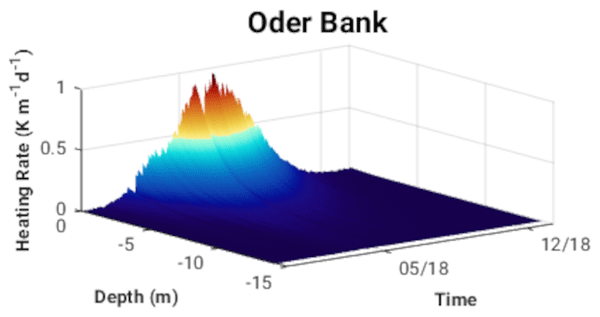
We quantify the impact of optically significant water constituents on surface heating rates and thermal energy fluxes in the western Baltic Sea. During productive months in 2018 (April to September) we found that the combined effect of coloured
dissolved organic matter and particulate absorption contributes to sea surface heating of between 0.4 and 0.9 K m−1 d−1 and a mean loss of heat (ca. 5 W m−2) from the sea to the atmosphere. This may be important for regional heat balance budgets.
Pia Kolb, Anna Zorndt, Hans Burchard, Ulf Gräwe, and Frank Kösters
Ocean Sci., 18, 1725–1739, https://doi.org/10.5194/os-18-1725-2022, https://doi.org/10.5194/os-18-1725-2022, 2022
Short summary
Short summary
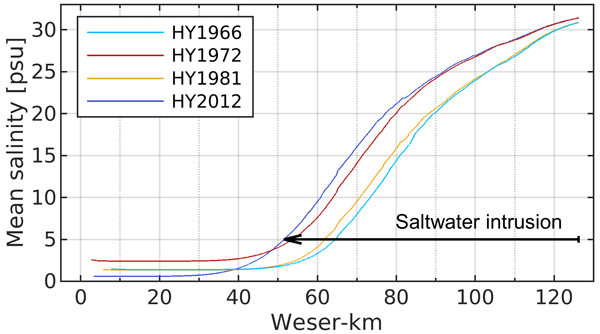
River engineering measures greatly changed tidal dynamics in the Weser estuary. We studied the effect on saltwater intrusion with numerical models. Our analysis shows that a deepening of the navigation channel causes saltwater to intrude further into the Weser estuary. This effect is mostly masked by the natural variability of river discharge. In our study, it proved essential to recalibrate individual hindcast models due to differences in sediments, bed forms, and underlying bathymetric data.
Matthias Gröger, Manja Placke, H. E. Markus Meier, Florian Börgel, Sandra-Esther Brunnabend, Cyril Dutheil, Ulf Gräwe, Magnus Hieronymus, Thomas Neumann, Hagen Radtke, Semjon Schimanke, Jian Su, and Germo Väli
Geosci. Model Dev., 15, 8613–8638, https://doi.org/10.5194/gmd-15-8613-2022, https://doi.org/10.5194/gmd-15-8613-2022, 2022
Short summary
Short summary
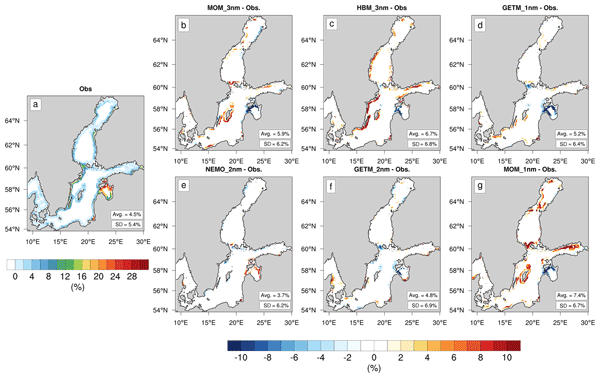
Comparisons of oceanographic climate data from different models often suffer from different model setups, forcing fields, and output of variables. This paper provides a protocol to harmonize these elements to set up multidecadal simulations for the Baltic Sea, a marginal sea in Europe. First results are shown from six different model simulations from four different model platforms. Topical studies for upwelling, marine heat waves, and stratification are also assessed.
Cited articles
Andrée, E., Su, J., Dahl Larsen, M. A., Drews, M., Stendel, M., and Skovgaard Madsen, K.: The role of preconditioning for extreme storm surges in the western Baltic Sea, Nat. Hazards Earth Syst. Sci., 23, 1817–1834, https://doi.org/10.5194/nhess-23-1817-2023, 2023. a, b
Arns, A., Wahl, T., Haigh, I., Jensen, J., and Pattiaratchi, C.: Estimating extreme water level probabilities: A comparison of the direct methods and recommendations for best practise, Coast. Eng., 81, 51–66, https://doi.org/10.1016/j.coastaleng.2013.07.003, 2013. a, b
Arns, A., Wahl, T., Wolff, C., Vafeidis, A. T., Haigh, I. D., Woodworth, P., Niehüser, S., and Jensen, J.: Non-linear interaction modulates global extreme sea levels, coastal flood exposure, and impacts, Nat. Commun., 11, 1–9, https://doi.org/10.1038/s41467-020-15752-5, 2020. a, b, c, d
Bierstedt, S. E., Hünicke, B., and Zorita, E.: Variability of wind direction statistics of mean and extreme wind events over the Baltic Sea region, Tellus A, 67, 29073, https://doi.org/10.3402/tellusa.v67.29073, 2015. a
Bilskie, M. V., Hagen, S. C., Medeiros, S. C., and Passeri, D. L.: Dynamics of sea level rise and coastal flooding on a changing landscape, Geophys. Res. Lett., 41, 927–934, https://doi.org/10.1002/2013GL058759, 2014. a
Burchard, H. and Bolding, K.: GETM, A General Estuarine Transport Model: Scientific Documentation, Tech. Rep. EUR 20253, EN, Eur. Comm., 2002. a
Coles, S.: An introduction to statistical modeling of extreme values, London, Springer, https://doi.org/10.1007/978-1-4471-3675-0, 2001. a
Fox-Kemper, B., Hewitt, H., Xiao, C., Aðalgeirsdóttir, G., Drijfhout, S., Edwards, T., Golledge, N., Hemer, M., Kopp, R., Krinner, G., Mix, A., Notz, D., Nowicki, S., Nurhati, I., Ruiz, L., Sallée, J.-B., Slangen, A., and Yu, Y.: Ocean, Cryosphere and Sea Level Change, in: Climate Change 2021: The Physical Science Basis. Contribution of Working Group I to the Sixth Assessment Report of the Intergovernmental Panel on Climate Change, Cambridge University Press, https://doi.org/10.1017/9781009157896.011, 2021. a, b
Gräwe, U. and Burchard, H.: Storm surges in the Western Baltic Sea: the present and a possible future, Clim. Dynam., 39, 165–183, https://doi.org/10.1007/s00382-011-1185-z, 2012. a, b
Gräwe, U., Naumann, M., Mohrholz, V., and Burchard, H.: Anatomizing one of the largest saltwater inflows into the Baltic Sea in December 2014, J. Geophys. Res.-Oceans, 120, 7676–7697, https://doi.org/10.1002/2015JC011269, 2015. a, b
Groll, N., Gaslikova, L., and Weisse, R.: Recent Baltic Sea Storm Surge Events From A Climate Perspective, EGUsphere [preprint], https://doi.org/10.5194/egusphere-2024-2664, 2024. a, b, c
Haigh, I. D., Marcos, M., Talke, S. A., Woodworth, P. L., Hunter, J. R., Hague, B. S., Arns, A., Bradshaw, E., and Thompson, P.: GESLA Version 3: A major update to the global higher-frequency sea-level dataset, Geosci. Data J., 10, 293–314, https://doi.org/10.31223/x5mp65, 2022. a
Heinrich, P., Hagemann, S., Weisse, R., Schrum, C., Daewel, U., and Gaslikova, L.: Compound flood events: analysing the joint occurrence of extreme river discharge events and storm surges in northern and central Europe, Nat. Hazards Earth Syst. Sci., 23, 1967–1985, https://doi.org/10.5194/nhess-23-1967-2023, 2023. a
Hendry, A., Haigh, I. D., Nicholls, R. J., Winter, H., Neal, R., Wahl, T., Joly-Laugel, A., and Darby, S. E.: Assessing the characteristics and drivers of compound flooding events around the UK coast, Hydrol. Earth Syst. Sci., 23, 3117–3139, https://doi.org/10.5194/hess-23-3117-2019, 2019. a
Hersbach, H., Bell, B., Berrisford, P., Hirahara, S., Horányi, A., Muñoz-Sabater, J., Nicolas, J., Peubey, C., Radu, R., Schepers, D., Simmons, A., Soci, C., Abdalla, S., Abellan, X., Balsamo, G., Bechtold, P., Biavati, G., Bidlot, J., Bonavita, M., De Chiara, G., Dahlgren, P., Dee, D., Diamantakis, M, Dragani, R., Flemming, J., Forbes, R., Fuentes, M., Geer, A., Haimberger, L., Healy, S., Hogan, R. J., Hólm, E., Janisková, M., Keeley, S., Laloyaux, P., Lopez, P., Lupu, C., Radnoti, G., de Rosnay, P., Rozum, I., Vamborg, F., Villaume, S., and Thépaut, J.-N.: The ERA5 global reanalysis, Q. J. Roy. Meteor. Soc., 146, 1999–2049, https://doi.org/10.1002/qj.3803, 2020. a
Hieronymus, M., Dieterich, C., Andersson, H., and Hordoir, R.: The effects of mean sea level rise and strengthened winds on extreme sea levels in the Baltic Sea, Theoretical and Applied Mechanics Letters, 8, 366–371, https://doi.org/10.1016/j.taml.2018.06.008, 2018. a
Idier, D., Bertin, X., Thompson, P., and Pickering, M. D.: Interactions between mean sea level, tide, surge, waves and flooding: mechanisms and contributions to sea level variations at the coast, Surv. Geophys., 40, 1603–1630, https://doi.org/10.1007/s10712-019-09549-5, 2019. a
Kiesel, J., Honsel, L. E., Lorenz, M., Gräwe, U., and Vafeidis, A. T.: Raising dikes and managed realignment may be insufficient for maintaining current flood risk along the German Baltic Sea coast, Communications Earth & Environment, 4, 433, https://doi.org/10.1038/s43247-023-01100-0, 2023a. a, b
Kiesel, J., Lorenz, M., König, M., Gräwe, U., and Vafeidis, A. T.: Regional assessment of extreme sea levels and associated coastal flooding along the German Baltic Sea coast, Nat. Hazards Earth Syst. Sci., 23, 2961–2985, https://doi.org/10.5194/nhess-23-2961-2023, 2023b. a, b, c
Kiesel, J., Wolff, C., and Lorenz, M.: Brief communication: From modelling to reality – flood modelling gaps highlighted by a recent severe storm surge event along the German Baltic Sea coast, Nat. Hazards Earth Syst. Sci., 24, 3841–3849, https://doi.org/10.5194/nhess-24-3841-2024, 2024. a
Kirezci, E., Young, I. R., Ranasinghe, R., Muis, S., Nicholls, R. J., Lincke, D., and Hinkel, J.: Projections of global-scale extreme sea levels and resulting episodic coastal flooding over the 21st century, Sci. Rep.-UK, 10, 11629, https://doi.org/10.1038/s41598-020-67736-6, 2020. a
Knutson, T. R., McBride, J. L., Chan, J., Emanuel, K., Holland, G., Landsea, C., Held, I., Kossin, J. P., Srivastava, A., and Sugi, M.: Tropical cyclones and climate change, Nat. Geosci., 3, 157–163, https://doi.org/10.1038/ngeo779, 2010. a
Kudryavtseva, N., Soomere, T., and Männikus, R.: Non-stationary analysis of water level extremes in Latvian waters, Baltic Sea, during 1961–2018, Nat. Hazards Earth Syst. Sci., 21, 1279–1296, https://doi.org/10.5194/nhess-21-1279-2021, 2021. a
Leppäranta, M. and Myrberg, K.: Physical oceanography of the Baltic Sea, Berlin, Heidelberg, Germany, Springer Science & Business Media, https://doi.org/10.1007/978-3-540-79703-6, 2009. a
Longuet-Higgins, M. and Stewart, R.: Radiation stresses in water waves; a physical discussion, with applications, Deep Sea Research and Oceanographic Abstracts, 11, 529–562, https://doi.org/10.1016/0011-7471(64)90001-4, 1964. a
Lorenz, M. and Gräwe, U.: Results of the study “Uncertainties and discrepancies in the representation of recent storm surges in a non-tidal semi-enclosed basin: a hind-cast ensemble for the Baltic Sea” in Ocean Science, Zenodo [data set], https://doi.org/10.5281/zenodo.8340649, 2023b. a
Lorenz, M. and Gräwe, U.: Results of the study “Untangling the Waves: Decomposing Extreme Sea Levels in a non-tidal basin, the Baltic Sea”, Zenodo [data set], https://doi.org/10.5281/zenodo.13903910, 2024. a
Lorenz, M., Arns, A., and Gräwe, U.: How Sea Level Rise May Hit You Through the Backdoor: Changing Extreme Water Levels in Shallow Coastal Lagoons, Geophys. Res. Lett., 50, e2023GL105512, https://doi.org/10.1029/2023GL105512, 2023. a, b
Luomaranta, A., Ruosteenoja, K., Jylhä, K., Gregow, H., Haapala, J., and Laaksonen, A.: Multimodel estimates of the changes in the Baltic Sea ice cover during the present century, Tellus A, 66, 22617, https://doi.org/10.3402/tellusa.v66.22617, 2014. a
MacPherson, L. R., Arns, A., Fischer, S., Méndez, F. J., and Jensen, J.: Bayesian extreme value analysis of extreme sea levels along the German Baltic coast using historical information, Nat. Hazards Earth Syst. Sci., 23, 3685–3701, https://doi.org/10.5194/nhess-23-3685-2023, 2023. a, b, c, d
Madsen, K. S., Høyer, J. L., Fu, W., and Donlon, C.: Blending of satellite and tide gauge sea level observations and its assimilation in a storm surge model of the North Sea and Baltic Sea, J. Geophys. Res.-Oceans, 120, 6405–6418, https://doi.org/10.1002/2015JC011070, 2015. a
Mäll, M., Suursaar, Ü., Nakamura, R., and Shibayama, T.: Modelling a storm surge under future climate scenarios: case study of extratropical cyclone Gudrun (2005), Nat. Hazards, 89, 1119–1144, https://doi.org/10.1007/s11069-017-3011-3, 2017. a, b, c
Männikus, R., Soomere, T., and Kudryavtseva, N.: Identification of mechanisms that drive water level extremes from in situ measurements in the Gulf of Riga during 1961-2017, Cont. Shelf Res., 182, 22–36, https://doi.org/10.1016/j.csr.2019.05.014, 2019. a
McGranahan, G., Balk, D., and Anderson, B.: The rising tide: assessing the risks of climate change and human settlements in low elevation coastal zones, Environ. Urban., 19, 17–37, https://doi.org/10.1177/0956247807076960, 2007. a
Meier, H. E. M., Dieterich, C., Gröger, M., Dutheil, C., Börgel, F., Safonova, K., Christensen, O. B., and Kjellström, E.: Oceanographic regional climate projections for the Baltic Sea until 2100, Earth Syst. Dynam., 13, 159–199, https://doi.org/10.5194/esd-13-159-2022, 2022a. a, b
Meier, H. E. M., Kniebusch, M., Dieterich, C., Gröger, M., Zorita, E., Elmgren, R., Myrberg, K., Ahola, M. P., Bartosova, A., Bonsdorff, E., Börgel, F., Capell, R., Carlén, I., Carlund, T., Carstensen, J., Christensen, O. B., Dierschke, V., Frauen, C., Frederiksen, M., Gaget, E., Galatius, A., Haapala, J. J., Halkka, A., Hugelius, G., Hünicke, B., Jaagus, J., Jüssi, M., Käyhkö, J., Kirchner, N., Kjellström, E., Kulinski, K., Lehmann, A., Lindström, G., May, W., Miller, P. A., Mohrholz, V., Müller-Karulis, B., Pavón-Jordán, D., Quante, M., Reckermann, M., Rutgersson, A., Savchuk, O. P., Stendel, M., Tuomi, L., Viitasalo, M., Weisse, R., and Zhang, W.: Climate change in the Baltic Sea region: a summary, Earth Syst. Dynam., 13, 457–593, https://doi.org/10.5194/esd-13-457-2022, 2022b. a, b, c
Moftakhari, H., Muñoz, D. F., Akbari Asanjan, A., AghaKouchak, A., Moradkhani, H., and Jay, D. A.: Nonlinear Interactions of Sea-Level Rise and Storm Tide Alter Extreme Coastal Water Levels: How and Why?, AGU Advances, 5, e2023AV000996, https://doi.org/10.1029/2023AV000996, 2024. a
Monserrat, S., Vilibić, I., and Rabinovich, A. B.: Meteotsunamis: atmospherically induced destructive ocean waves in the tsunami frequency band, Nat. Hazards Earth Syst. Sci., 6, 1035–1051, https://doi.org/10.5194/nhess-6-1035-2006, 2006. a
Parker, K., Erikson, L., Thomas, J., Nederhoff, K., Barnard, P., and Muis, S.: Relative contributions of water-level components to extreme water levels along the US Southeast Atlantic Coast from a regional-scale water-level hindcast, Nat. Hazards, 117, 2219–2248, https://doi.org/10.1007/s11069-023-05939-6, 2023. a, b
Pattiaratchi, C. and Wijeratne, E. M. S.: Observations of meteorological tsunamis along the south-west Australian coast, Springer International Publishing, Cham, https://doi.org/10.1007/978-3-319-12712-5_16, pp. 281–303, 2015a. a
Pattiaratchi, C. B. and Wijeratne, E.: Are meteotsunamis an underrated hazard?, Philos. T. R. Soc. A, 373, 20140377, https://doi.org/10.1098/rsta.2014.0377, 2015b. a
Pellikka, H., Laurila, T. K., Boman, H., Karjalainen, A., Björkqvist, J.-V., and Kahma, K. K.: Meteotsunami occurrence in the Gulf of Finland over the past century, Nat. Hazards Earth Syst. Sci., 20, 2535–2546, https://doi.org/10.5194/nhess-20-2535-2020, 2020. a, b
Pellikka, H., Šepić, J., Lehtonen, I., and Vilibić, I.: Meteotsunamis in the northern Baltic Sea and their relation to synoptic patterns, Weather and Climate Extremes, 38, 100527, https://doi.org/10.1016/j.wace.2022.100527, 2022. a, b
Peltier, W. R.: Global glacial isostasy and the surface of the ice-age Earth: the ICE-5G (VM2) model and GRACE, Annu. Rev. Earth Pl. Sc., 32, 111–149, https://doi.org/10.1146/annurev.earth.32.082503.144359, 2004. a
Pietrzak, J.: The use of TVD limiters for forward-in-time upstream-biased advection schemes in ocean modeling, Mon. Weather Rev., 126, 812–830, https://doi.org/10.1175/1520-0493(1998)126<0812:tuotlf>2.0.co;2, 1998. a
Pindsoo, K. and Soomere, T.: Basin-wide variations in trends in water level maxima in the Baltic Sea, Cont. Shelf Res., 193, 104029, https://doi.org/10.1016/j.csr.2019.104029, 2020. a, b
Proudman, J.: The Effects on the Sea of Changes in Atmospheric Pressure, Geophysical Supplements to the Monthly Notices of the Royal Astronomical Society, 2, 197–209, https://doi.org/10.1111/j.1365-246X.1929.tb05408.x, 1929. a
Rantanen, M., van den Broek, D., Cornér, J., Sinclair, V. A., Johansson, M. M., Särkkä, J., Laurila, T. K., and Jylhä, K.: The Impact of Serial Cyclone Clustering on Extremely High Sea Levels in the Baltic Sea, Geophys. Res. Lett., 51, e2023GL107203, https://doi.org/10.1029/2023GL107203, e2023GL107203 2023GL107203, 2024. a, b
Ridal, M., Olsson, E., Unden, P., Zimmermann, K., and Ohlsson, A.: Uncertainties in Ensembles of Regional Re-Analyses–Deliverable D2. 7 HARMONIE reanalysis report of results and dataset, Swedish Meteorological and Hydrological Institute, Norrköping, Sweden, 2017. a
Rueda, A., Vitousek, S., Camus, P., Tomás, A., Espejo, A., Losada, I. J., Barnard, P. L., Erikson, L. H., Ruggiero, P., Reguero, B. G., and Mendez, F. J.: A global classification of coastal flood hazard climates associated with large-scale oceanographic forcing, Sci. Rep.-UK, 7, 1–8, https://doi.org/10.1038/s41598-017-05090-w, 2017. a
Rutgersson, A., Kjellström, E., Haapala, J., Stendel, M., Danilovich, I., Drews, M., Jylhä, K., Kujala, P., Larsén, X. G., Halsnæs, K., Lehtonen, I., Luomaranta, A., Nilsson, E., Olsson, T., Särkkä, J., Tuomi, L., and Wasmund, N.: Natural hazards and extreme events in the Baltic Sea region, Earth Syst. Dynam., 13, 251–301, https://doi.org/10.5194/esd-13-251-2022, 2022. a, b
Soomere, T. and Keevallik, S.: Anisotropy of moderate and strong winds in the Baltic Proper, Proc. Estonian Acad. Sci.-Eng., 7, 35–49, https://doi.org/10.3176/eng.2001.1.04, 2001. a
Soomere, T. and Pindsoo, K.: Spatial variability in the trends in extreme storm surges and weekly-scale high water levels in the eastern Baltic Sea, Cont. Shelf Res., 115, 53–64, https://doi.org/10.1016/j.csr.2015.12.016, 2016. a, b
Soomere, T., Pindsoo, K., Bishop, S. R., Käärd, A., and Valdmann, A.: Mapping wave set-up near a complex geometric urban coastline, Nat. Hazards Earth Syst. Sci., 13, 3049–3061, https://doi.org/10.5194/nhess-13-3049-2013, 2013. a, b
Soomere, T., Eelsalu, M., Kurkin, A., and Rybin, A.: Separation of the Baltic Sea water level into daily and multi-weekly components, Cont. Shelf Res., 103, 23–32, https://doi.org/10.1016/j.csr.2015.04.018, 2015. a
Su, J., Murawski, J., Nielsen, J. W., and Madsen, K. S.: Coinciding storm surge and wave setup: A regional assessment of sea level rise impact, Ocean Eng., 305, 117885, https://doi.org/10.1016/j.oceaneng.2024.117885, 2024. a, b, c
Talke, S. A., Familkhalili, R., and Jay, D. A.: The Influence of Channel Deepening on Tides, River Discharge Effects, and Storm Surge, J. Geophys. Res.-Oceans, 126, e2020JC016328, https://doi.org/10.1029/2020JC016328, 2021. a, b
Thyng, K. M., Greene, C. A., Hetland, R. D., Zimmerle, H. M., and DiMarco, S. F.: True colors of oceanography: Guidelines for effective and accurate colormap selection, Oceanography, 29, 9–13, https://doi.org/10.5670/oceanog.2016.66, 2016. a
Vestøl, O., Ågren, J., Steffen, H., Kierulf, H., and Tarasov, L.: NKG2016LU: a new land uplift model for Fennoscandia and the Baltic Region, J. Geodesy, 93, 1759–1779, https://doi.org/10.1007/s00190-019-01280-8, 2019. a
Vousdoukas, M., Mentaschi, L., Mongelli, I., Martinez, C., Hinkel, J., Ward, P., Gosling, S., and Feyen, L.: Adapting to rising coastal flood risk in the EU under climate change, EUR 29969 EN, Publications Office of the European Union, Luxembourg, https://doi.org/10.2760/456870, 2020. a
Vousdoukas, M. I., Mentaschi, L., Voukouvalas, E., Verlaan, M., Jevrejeva, S., Jackson, L. P., and Feyen, L.: Global probabilistic projections of extreme sea levels show intensification of coastal flood hazard, Nat. Commun., 9, 1–12, https://doi.org/10.1038/s41467-018-04692-w, 2018. a
Wahl, T., Jain, S., Bender, J., Meyers, S. D., and Luther, M. E.: Increasing risk of compound flooding from storm surge and rainfall for major US cities, Nat. Clim. Change, 5, 1093–1097, https://doi.org/10.1038/nclimate2736, 2015. a
Wahl, T., Haigh, I. D., Nicholls, R. J., Arns, A., Dangendorf, S., Hinkel, J., and Slangen, A. B.: Understanding extreme sea levels for broad-scale coastal impact and adaptation analysis, Nat. Commun., 8, 1–12, https://doi.org/10.1038/ncomms16075, 2017. a
Weisse, R., Dailidienė, I., Hünicke, B., Kahma, K., Madsen, K., Omstedt, A., Parnell, K., Schöne, T., Soomere, T., Zhang, W., and Zorita, E.: Sea level dynamics and coastal erosion in the Baltic Sea region, Earth Syst. Dynam., 12, 871–898, https://doi.org/10.5194/esd-12-871-2021, 2021. a, b
Wolski, T. and Wiśniewski, B.: Geographical diversity in the occurrence of extreme sea levels on the coasts of the Baltic Sea, J. Sea Res., 159, 101890, https://doi.org/10.1016/j.seares.2020.101890, 2020. a
Wolski, T., Wiśniewski, B., Giza, A., Kowalewska-Kalkowska, H., Boman, H., Grabbi-Kaiv, S., Hammarklint, T., Holfort, J., and Lydeikaitė, Ž.: Extreme sea levels at selected stations on the Baltic Sea coast, Oceanologia, 56, 259–290, https://doi.org/10.5697/oc.56-2.259, 2014. a, b
Woodworth, P. L., Hunter, J. R., Marcos, M., Caldwell, P., Menéndez, M., and Haigh, I.: Towards a global higher-frequency sea level dataset, Geosci. Data J., 3, 50–59, https://doi.org/10.1002/gdj3.42, 2016. a
Zakharchuk, E. A., Tikhonova, N., Zakharova, E., and Kouraev, A. V.: Spatiotemporal structure of Baltic free sea level oscillations in barotropic and baroclinic conditions from hydrodynamic modelling, Ocean Sci., 17, 543–559, https://doi.org/10.5194/os-17-543-2021, 2021. a, b, c
Short summary
This study divides the sea level components that contribute to extreme sea levels in the Baltic Sea into three parts: the filling state of the Baltic Sea, seiches, and storm surges. In the western part of the Baltic Sea, storm surges are the main factor, while in the central and northern parts, the filling state plays a larger role. Using a numerical model, we show that wind and air pressure are the main drivers of these events, with Atlantic sea level also playing a small role.
This study divides the sea level components that contribute to extreme sea levels in the Baltic...


Altmetrics
Final-revised paper
Preprint