
Articles | Volume 21, issue 8
https://doi.org/10.5194/nhess-21-2523-2021
© Author(s) 2021. This work is distributed under
the Creative Commons Attribution 4.0 License.
the Creative Commons Attribution 4.0 License.
https://doi.org/10.5194/nhess-21-2523-2021
© Author(s) 2021. This work is distributed under
the Creative Commons Attribution 4.0 License.
the Creative Commons Attribution 4.0 License.
Research article
| 
25 Aug 2021
Research article |
| 25 Aug 2021
| 25 Aug 2021
Towards an efficient storm surge and inundation forecasting system over the Bengal delta: chasing the Supercyclone Amphan
Md. Jamal Uddin Khan
CORRESPONDING AUTHOR
LEGOS UMR5566, CNRS/CNES/IRD/UPS, 31400 Toulouse, France
Fabien Durand
LEGOS UMR5566, CNRS/CNES/IRD/UPS, 31400 Toulouse, France
Laboratório de Geoquímica, Instituto de Geociencias, Universidade de Brasilia, Brasília, Brazil
Xavier Bertin
UMR 7266 LIENSs, CNRS – La Rochelle University, 17000 La Rochelle, France
Laurent Testut
LEGOS UMR5566, CNRS/CNES/IRD/UPS, 31400 Toulouse, France
UMR 7266 LIENSs, CNRS – La Rochelle University, 17000 La Rochelle, France
Yann Krien
UMR 7266 LIENSs, CNRS – La Rochelle University, 17000 La Rochelle, France
currently at: SHOM (DOPS/STM/REC), Toulouse, France
A. K. M. Saiful Islam
Institute of Water and Flood Management (IWFM), Bangladesh University of Engineering and Technology (BUET),
Dhaka-1000, Bangladesh
Marc Pezerat
UMR 7266 LIENSs, CNRS – La Rochelle University, 17000 La Rochelle, France
Sazzad Hossain
Flood Forecasting and Warning Centre, BWDB, Dhaka, Bangladesh
Department of Geography and Environmental Science, University of Reading, Reading, UK
Related authors
Md Jamal Uddin Khan, Inge Van Den Beld, Guy Wöppelmann, Laurent Testut, Alexa Latapy, and Nicolas Pouvreau
Earth Syst. Sci. Data, 15, 5739–5753, https://doi.org/10.5194/essd-15-5739-2023, https://doi.org/10.5194/essd-15-5739-2023, 2023
Short summary
Short summary
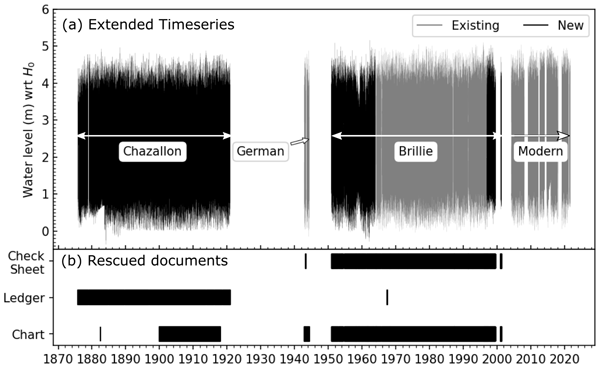
Established in the southwest of France in 1875, the Socoa tide gauge is part of the national sea level monitoring network in France. Through a data archaeology exercise, a large part of the records of this gauge in paper format have been rescued and digitized. The digitized data were processed and quality controlled to produce a uniform hourly sea level time series covering 1875 to the present day. This new dataset is important for climate research on sea level rise, tides, and storm surges.
Md Jamal Uddin Khan, Fabien Durand, Kerry Emanuel, Yann Krien, Laurent Testut, and A. K. M. Saiful Islam
Nat. Hazards Earth Syst. Sci., 22, 2359–2379, https://doi.org/10.5194/nhess-22-2359-2022, https://doi.org/10.5194/nhess-22-2359-2022, 2022
Short summary
Short summary
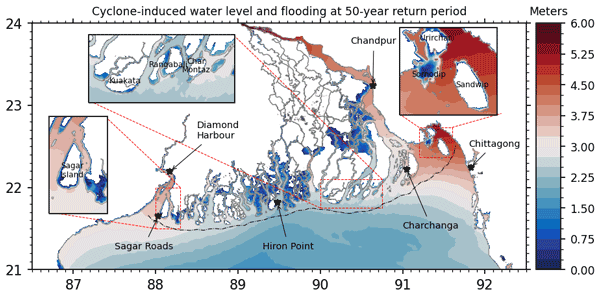
Cyclonic storm surges constitute a major threat to lives and properties along the vast coastline of the Bengal delta. From a combination of cyclone and storm surge modelling, we present a robust probabilistic estimate of the storm surge flooding hazard under the current climate. The estimated extreme water levels vary regionally, and the inland flooding is strongly controlled by the embankments. More than 1/10 of the coastal population is currently exposed to 50-year return period flooding.
Aurélia Bernard, Nathalie Long, Mélanie Becker, Jamal Khan, and Sylvie Fanchette
Nat. Hazards Earth Syst. Sci., 22, 729–751, https://doi.org/10.5194/nhess-22-729-2022, https://doi.org/10.5194/nhess-22-729-2022, 2022
Short summary
Short summary
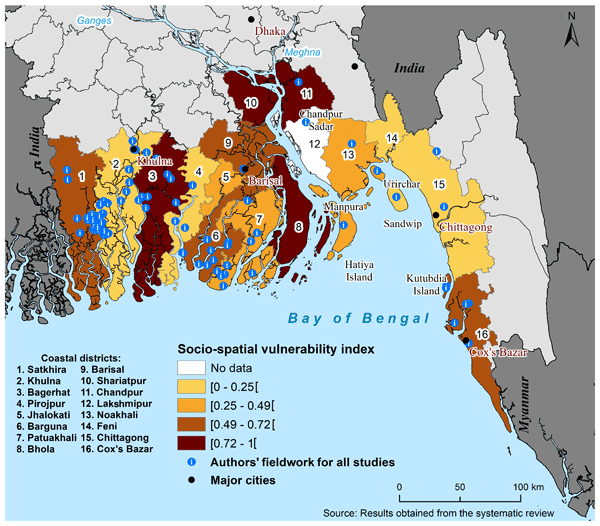
This article reviews current scientific literature in order to define vulnerability in the context of coastal Bangladesh facing cyclonic flooding. A new metric, called the socio-spatial vulnerability index, is defined as a function of both the probability of the cyclonic flood hazard and the sensitivity of delta inhabitants. The main result shows that three very densely populated districts, located in the Ganges delta tidal floodplain, are highly vulnerable to cyclonic flooding.
Ewen Cottour, Guillaume Dodet, Clémence Chupin, Laurent Testut, Taina Postec, Lisa Maillard, Swen Jullien, and Frédéric Bouchette
EGUsphere, https://doi.org/10.5194/egusphere-2026-3219, https://doi.org/10.5194/egusphere-2026-3219, 2026
This preprint is open for discussion and under review for Ocean Science (OS).
Short summary
Short summary
We studied how water levels and waves vary across Rangiroa Atoll, a low-lying island system that is especially exposed to climate change. Using SWOT satellite data and measurements collected in the field, we tested how well the satellite can track conditions in and around the lagoon. The satellite captured key patterns and improved estimates of water levels. Our results show that it can help monitor flooding risks and better understand how waves and tides affect vulnerable atoll islands.
Axelle Gaffet, Xavier Bertin, Damien Sous, Héloïse Michaud, Aron Roland, and Emmanuel Cordier
Geosci. Model Dev., 18, 1929–1946, https://doi.org/10.5194/gmd-18-1929-2025, https://doi.org/10.5194/gmd-18-1929-2025, 2025
Short summary
Short summary
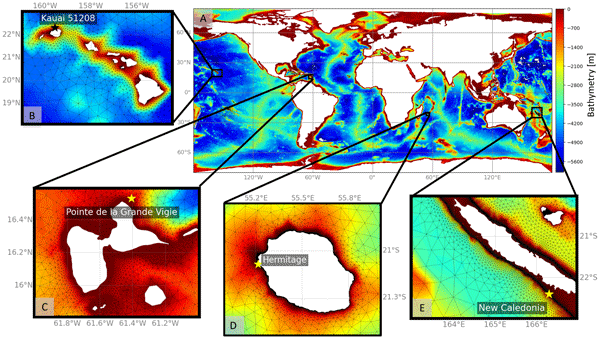
This study presents a new global wave model that improves predictions of sea states in tropical areas by using a high-resolution grid and corrected wind fields. The model is validated globally with satellite data and nearshore using in situ data. The model allows for the first time direct comparisons with in situ data collected at 10–30 m water depth, which is very close to shore due to the steep slope usually surrounding volcanic islands.
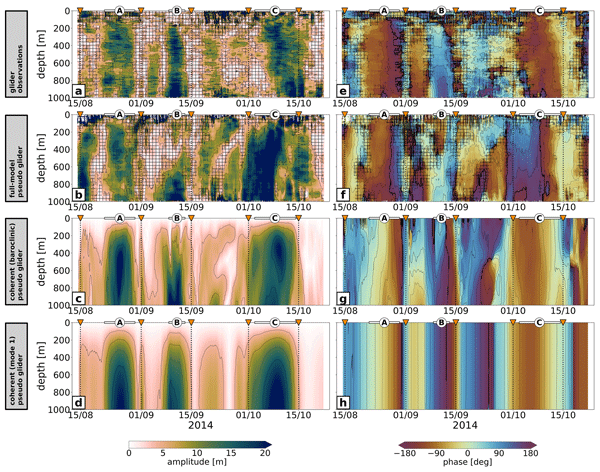
Arne Bendinger, Sophie Cravatte, Lionel Gourdeau, Luc Rainville, Clément Vic, Guillaume Sérazin, Fabien Durand, Frédéric Marin, and Jean-Luc Fuda
Ocean Sci., 20, 945–964, https://doi.org/10.5194/os-20-945-2024, https://doi.org/10.5194/os-20-945-2024, 2024
Short summary
Short summary
A unique dataset of glider observations reveals tidal beams south of New Caledonia – an internal-tide-generation hot spot in the southwestern tropical Pacific. Observations are in good agreement with numerical modeling output, highlighting the glider's capability to infer internal tides while assessing the model's realism of internal-tide dynamics. Discrepancies are in large part linked to eddy–internal-tide interactions. A methodology is proposed to deduce the internal-tide surface signature.
Md Jamal Uddin Khan, Inge Van Den Beld, Guy Wöppelmann, Laurent Testut, Alexa Latapy, and Nicolas Pouvreau
Earth Syst. Sci. Data, 15, 5739–5753, https://doi.org/10.5194/essd-15-5739-2023, https://doi.org/10.5194/essd-15-5739-2023, 2023
Short summary
Short summary
Established in the southwest of France in 1875, the Socoa tide gauge is part of the national sea level monitoring network in France. Through a data archaeology exercise, a large part of the records of this gauge in paper format have been rescued and digitized. The digitized data were processed and quality controlled to produce a uniform hourly sea level time series covering 1875 to the present day. This new dataset is important for climate research on sea level rise, tides, and storm surges.
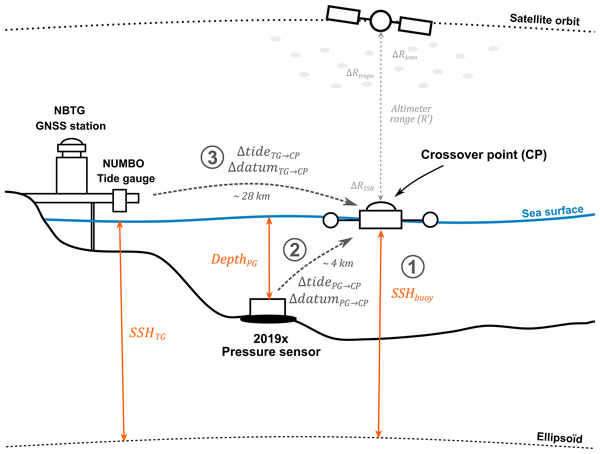
Clémence Chupin, Valérie Ballu, Laurent Testut, Yann-Treden Tranchant, and Jérôme Aucan
Ocean Sci., 19, 1277–1314, https://doi.org/10.5194/os-19-1277-2023, https://doi.org/10.5194/os-19-1277-2023, 2023
Short summary
Short summary
Reducing uncertainties in coastal sea level trend estimates requires a better understanding of altimeter measurements and local sea level dynamics. Using long-term sea level time series from the Nouméa tide gauge (New Caledonia) and in situ data collected as part of the GEOCEAN-NC campaign, this study presents a method inspired from Cal/Val studies to re-analyse about 20 years of altimetry observations and re-address the question of sea level evolution in the lagoon.
Md Jamal Uddin Khan, Fabien Durand, Kerry Emanuel, Yann Krien, Laurent Testut, and A. K. M. Saiful Islam
Nat. Hazards Earth Syst. Sci., 22, 2359–2379, https://doi.org/10.5194/nhess-22-2359-2022, https://doi.org/10.5194/nhess-22-2359-2022, 2022
Short summary
Short summary
Cyclonic storm surges constitute a major threat to lives and properties along the vast coastline of the Bengal delta. From a combination of cyclone and storm surge modelling, we present a robust probabilistic estimate of the storm surge flooding hazard under the current climate. The estimated extreme water levels vary regionally, and the inland flooding is strongly controlled by the embankments. More than 1/10 of the coastal population is currently exposed to 50-year return period flooding.
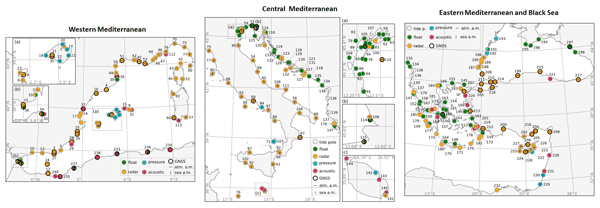
Begoña Pérez Gómez, Ivica Vilibić, Jadranka Šepić, Iva Međugorac, Matjaž Ličer, Laurent Testut, Claire Fraboul, Marta Marcos, Hassen Abdellaoui, Enrique Álvarez Fanjul, Darko Barbalić, Benjamín Casas, Antonio Castaño-Tierno, Srđan Čupić, Aldo Drago, María Angeles Fraile, Daniele A. Galliano, Adam Gauci, Branislav Gloginja, Víctor Martín Guijarro, Maja Jeromel, Marcos Larrad Revuelto, Ayah Lazar, Ibrahim Haktan Keskin, Igor Medvedev, Abdelkader Menassri, Mohamed Aïssa Meslem, Hrvoje Mihanović, Sara Morucci, Dragos Niculescu, José Manuel Quijano de Benito, Josep Pascual, Atanas Palazov, Marco Picone, Fabio Raicich, Mohamed Said, Jordi Salat, Erdinc Sezen, Mehmet Simav, Georgios Sylaios, Elena Tel, Joaquín Tintoré, Klodian Zaimi, and George Zodiatis
Ocean Sci., 18, 997–1053, https://doi.org/10.5194/os-18-997-2022, https://doi.org/10.5194/os-18-997-2022, 2022
Short summary
Short summary
This description and mapping of coastal sea level monitoring networks in the Mediterranean and Black seas reveals the existence of 240 presently operational tide gauges. Information is provided about the type of sensor, time sampling, data availability, and ancillary measurements. An assessment of the fit-for-purpose status of the network is also included, along with recommendations to mitigate existing bottlenecks and improve the network, in a context of sea level rise and increasing extremes.
Aurélia Bernard, Nathalie Long, Mélanie Becker, Jamal Khan, and Sylvie Fanchette
Nat. Hazards Earth Syst. Sci., 22, 729–751, https://doi.org/10.5194/nhess-22-729-2022, https://doi.org/10.5194/nhess-22-729-2022, 2022
Short summary
Short summary
This article reviews current scientific literature in order to define vulnerability in the context of coastal Bangladesh facing cyclonic flooding. A new metric, called the socio-spatial vulnerability index, is defined as a function of both the probability of the cyclonic flood hazard and the sensitivity of delta inhabitants. The main result shows that three very densely populated districts, located in the Ganges delta tidal floodplain, are highly vulnerable to cyclonic flooding.
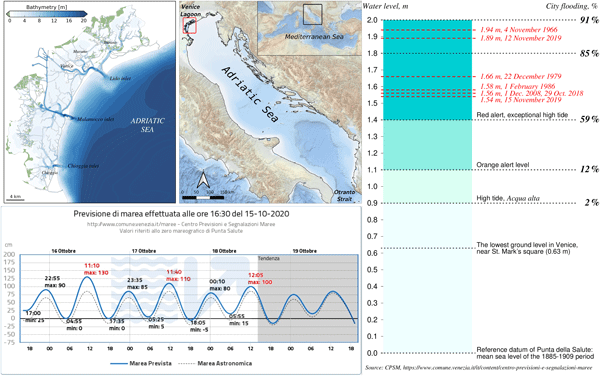
Georg Umgiesser, Marco Bajo, Christian Ferrarin, Andrea Cucco, Piero Lionello, Davide Zanchettin, Alvise Papa, Alessandro Tosoni, Maurizio Ferla, Elisa Coraci, Sara Morucci, Franco Crosato, Andrea Bonometto, Andrea Valentini, Mirko Orlić, Ivan D. Haigh, Jacob Woge Nielsen, Xavier Bertin, André Bustorff Fortunato, Begoña Pérez Gómez, Enrique Alvarez Fanjul, Denis Paradis, Didier Jourdan, Audrey Pasquet, Baptiste Mourre, Joaquín Tintoré, and Robert J. Nicholls
Nat. Hazards Earth Syst. Sci., 21, 2679–2704, https://doi.org/10.5194/nhess-21-2679-2021, https://doi.org/10.5194/nhess-21-2679-2021, 2021
Short summary
Short summary
The city of Venice relies crucially on a good storm surge forecast to protect its population and cultural heritage. In this paper, we provide a state-of-the-art review of storm surge forecasting, starting from examples in Europe and focusing on the Adriatic Sea and the Lagoon of Venice. We discuss the physics of storm surge, as well as the particular aspects of Venice and new techniques in storm surge modeling. We also give recommendations on what a future forecasting system should look like.
Cited articles
Ahsan, M. N., Khatun, A., Islam, M. S., Vink, K., Ohara, M., and Fakhruddin,
B. S.: Preferences for improved early warning services among coastal
communities at risk in cyclone prone south-west region of Bangladesh,
Progress in Disaster Science, 5, 100065,
https://doi.org/10.1016/j.pdisas.2020.100065, 2020. a
Alam, E. and Dominey-Howes, D.: A new catalogue of tropical cyclones of the
northern Bay of Bengal and the distribution and effects of selected
landfalling events in Bangladesh, Int. J. Climatol., 35,
801–835, https://doi.org/10.1002/joc.4035, 2014. a, b
Ali, A.: Climate change impacts and adaptation assessment in Bangladesh,
Clim. Res., 12, 109–116, https://doi.org/10.3354/cr012109, 1999. a, b
Antony, C. and Unnikrishnan, A. S.: Observed characteristics of tide-surge
interaction along the east coast of India and the head of Bay of
Bengal, Estuar. Coast. Shelf S., 131, 6–11,
https://doi.org/10.1016/j.ecss.2013.08.004, 2013. a, b
Antony, C., Unnikrishnan, A., Krien, Y., Murty, P., Samiksha, S., and Islam,
A.: Tide–surge interaction at the head of the Bay of Bengal
during Cyclone Aila, Regional Studies in Marine Science, 35, 101133,
https://doi.org/10.1016/j.rsma.2020.101133, 2020. a
Ardhuin, F., Rogers, E., Babanin, A. V., Filipot, J.-F., Magne, R., Roland, A.,
van der Westhuysen, A., Queffeulou, P., Lefevre, J.-M., Aouf, L., and
Collard, F.: Semiempirical Dissipation Source Functions for Ocean Waves. Part
I: Definition, Calibration, and Validation, J. Phys. Oceanogr.,
40, 1917–1941, https://doi.org/10.1175/2010jpo4324.1, 2010. a
As-Salek, J. A. and Yasuda, T.: Tide–Surge Interaction in the Meghna
Estuary: Most Severe Conditions, J. Phys. Oceanogr.,
31, 3059–3072, https://doi.org/10.1175/1520-0485(2001)031<3059:tsiitm>2.0.co;2,
2001. a, b, c
Auerbach, L. W., Jr, S. L. G., Mondal, D. R., Wilson, C. A., Ahmed, K. R., Roy,
K., Steckler, M. S., Small, C., Gilligan, J. M., and Ackerly, B. A.: Flood
risk of natural and embanked landscapes on the Ganges–Brahmaputra tidal
delta plain, Nat. Clim. Change, 5, 153–157, https://doi.org/10.1038/nclimate2472,
2015. a, b
Battjes, J. A. and Janssen, J. P. F. M.: Energy Loss and Set-Up Due to
Breaking of Random Waves, in: Coastal Engineering 1978,
American Society of Civil Engineers, Hamburg, Germany, 569–587,
https://doi.org/10.1061/9780872621909.034, 1978. a
Bernier, N. B. and Thompson, K. R.: Deterministic and ensemble storm surge
prediction for Atlantic Canada with lead times of hours to ten days,
Ocean Model., 86, 114–127, https://doi.org/10.1016/j.ocemod.2014.12.002, 2015. a
Bertin, X., Li, K., Roland, A., Zhang, Y. J., Breilh, J. F., and Chaumillon,
E.: A modeling-based analysis of the flooding associated with Xynthia,
central Bay of Biscay, Coast. Eng., 94, 80–89,
https://doi.org/10.1016/j.coastaleng.2014.08.013, 2014. a, b
Bertin, X., Li, K., Roland, A., and Bidlot, J.-R.: The contribution of
short-waves in storm surges: Two case studies in the Bay of Biscay,
Cont. Shelf Res., 96, 1–15, https://doi.org/10.1016/j.csr.2015.01.005, 2015. a, b
Bhardwaj, P. and Singh, O.: Climatological characteristics of Bay of Bengal
tropical cyclones: 1972–2017, Theor. Appl. Climatol., 139,
615–629, https://doi.org/10.1007/s00704-019-02989-4, 2019. a
Bouwer, L. M. and Jonkman, S. N.: Global mortality from storm surges is
decreasing, Environ. Res. Lett., 13, 014008,
https://doi.org/10.1088/1748-9326/aa98a3, 2018. a
Center For International Earth Science Information Network (CIESIN), Columbia
University: Documentation for Gridded Population of the World, Version 4
(GPWv4), https://doi.org/10.7927/H4D50JX4, 2016. a
Chowdhury, M. A. M. and Al Rahim, M.: A proposal on new scheduling of turbine
discharge at Kaptai hydro-electric power plant to avoid the wastage of water
due to overflow in the dam, in: 2012 7th International Conference on
Electrical and Computer Engineering, IEEE, 758–762, 2012. a
Condon, A. J., Sheng, Y. P., and Paramygin, V. A.: Toward High-Resolution,
Rapid, Probabilistic Forecasting of the Inundation Threat from
Landfalling Hurricanes, Mon. Weather Rev., 141, 1304–1323,
https://doi.org/10.1175/mwr-d-12-00149.1,
2013. a
Daniel, P., Haie, B., and Aubail, X.: Operational Forecasting of Tropical
Cyclones Storm Surges at Meteo-France, Mar. Geod., 32,
233–242, https://doi.org/10.1080/01490410902869649,
2009. a
Das, P. K.: Prediction Model for Storm Surges in the Bay of Bengal,
Nature, 239, 211–213, https://doi.org/10.1038/239211a0, 1972. a
Deb, M. and Ferreira, C. M.: Simulation of cyclone-induced storm surges in the
low-lying delta of Bangladesh using coupled hydrodynamic and wave model
(SWAN + ADCIRC), J. Flood Risk
Manag., 11, S750–S765, https://doi.org/10.1111/jfr3.12254, 2016. a, b
DhakaTribune: Govt: Cyclone caused damage worth Tk1, 100 crore,
https://www.dhakatribune.com/bangladesh/crisis/2020/05/21/govt-estimated-damages-from-amphan-worth-1-100-crore last access: 22 May 2020. a
Dube, S. K., Chittibabu, P., Sinha, P. C., Rao, A. D., and Murty, T. S.:
Numerical Modelling of Storm Surge in the Head Bay of Bengal
Using Location Specific Model, Nat. Hazards, 31, 437–453,
https://doi.org/10.1023/b:nhaz.0000023361.94609.4a, 2004. a, b
Dube, S. K., Jain, I., Rao, A. D., and Murty, T. S.: Storm surge modelling for
the Bay of Bengal and Arabian Sea, Nat. Hazards, 51, 3–27,
https://doi.org/10.1007/s11069-009-9397-9, 2009. a, b
Durand, F., Piecuch, C. G., Becker, M., Papa, F., Raju, S. V., Khan, J. U., and
Ponte, R. M.: Impact of Continental Freshwater Runoff on Coastal Sea Level,
Surv. Geophys., 40, 1437–1466, https://doi.org/10.1007/s10712-019-09536-w, 2019. a
Egbert, G. D. and Erofeeva, S. Y.: Efficient inverse modeling of barotropic
ocean tides, J. Atmos. Ocean. Tech., 19, 183–204,
2002. a
Emanuel, K.: Increasing destructiveness of tropical cyclones over the past
30 years, Nature, 436, 686–688, https://doi.org/10.1038/nature03906,
2005. a
Emanuel, K. and Rotunno, R.: Self-Stratification of Tropical Cyclone
Outflow. Part I: Implications for Storm Structure, J.
Atmos. Sci., 68, 2236–2249, https://doi.org/10.1175/jas-d-10-05024.1, 2011. a
Fernández-Montblanc, T., Vousdoukas, M., Ciavola, P., Voukouvalas, E.,
Mentaschi, L., Breyiannis, G., Feyen, L., and Salamon, P.: Towards robust
pan-European storm surge forecasting, Ocean Model., 133, 129–144,
https://doi.org/10.1016/j.ocemod.2018.12.001, 2019. a, b
Flather, R. A.: A Storm Surge Prediction Model for the Northern Bay
of Bengal with Application to the Cyclone Disaster in April 1991,
J. Phys. Oceanogr., 24, 172–190,
https://doi.org/10.1175/1520-0485(1994)024<0172:asspmf>2.0.co;2, 1994. a
Flowerdew, J., Mylne, K., Jones, C., and Titley, H.: Extending the forecast
range of the UK storm surge ensemble, Q. J. Roy.
Meteor. Soc., 139, 184–197, https://doi.org/10.1002/qj.1950, 2012. a
Fortunato, A. B., Oliveira, A., Rogeiro, J., Tavares da Costa, R., Gomes,
J. L., Li, K., de Jesus, G., Freire, P., Rilo, A., Mendes, A., Rodrigues, M.,
and Azevedo, A.: Operational forecast framework applied to extreme sea levels
at regional and local scales, J. Oper. Oceanogr., 10, 1–15,
https://doi.org/10.1080/1755876X.2016.1255471, 2017. a, b, c
Frank, N. L. and Husain, S.: The deadliest tropical cyclone in history?,
B. Am. Meteorol. Soc., 52, 438–445, 1971. a
Guérin, T., Bertin, X., Coulombier, T., and de Bakker, A.: Impacts of
wave-induced circulation in the surf zone on wave setup, Ocean Model.,
123, 86–97, https://doi.org/10.1016/j.ocemod.2018.01.006, 2018. a, b
Holland, G. J.: An Analytic Model of the Wind and Pressure Profiles
in Hurricanes, Mon. Weather Rev., 108, 1212–1218,
https://doi.org/10.1175/1520-0493(1980)108<1212:aamotw>2.0.co;2, 1980. a
Idier, D., Bertin, X., Thompson, P., and Pickering, M. D.: Interactions
Between Mean Sea Level, Tide, Surge, Waves and Flooding:
Mechanisms and Contributions to Sea Level Variations at the
Coast, Surv. Geophys., 40, 1603–1630,
https://doi.org/10.1007/s10712-019-09549-5, 2019. a, b
IFRC: Bangladesh: Cyclone – Final report early action,
https://reliefweb.int/sites/reliefweb.int/files/resources/EAP2018BD01fr.pdf (last access: 22 February 2021)
2020b. a
IMD: Super Cyclonic Storm “AMPHAN” over the southeast
Bay of Bengal (16th–21st May 2020): A Report, Tech. rep., Cyclone Warning Division – India Meteorological Department, New Delhi, available at: https://www.rsmcnewdelhi.imd.gov.in/uploads/report/26/26_936e63_amphan.pdf, last access: 27 July 2021. a
Islam, A. S., Bala, S. K., Hussain, M. A., Hossain, M. A., and Rahman, M. M.:
Performance of Coastal Structures during Cyclone Sidr, Nat.
Hazards Rev., 12, 111–116, https://doi.org/10.1061/(asce)nh.1527-6996.0000031, 2011. a
Ji, M., Aikman, F., and Lozano, C.: Toward improved operational surge and
inundation forecasts and coastal warnings, Nat. Hazards, 53, 195–203,
https://doi.org/10.1007/s11069-009-9414-z, 2009. a
Johns, B. and Ali, M. A.: The numerical modelling of storm surges in the Bay
of Bengal, Q. J. Roy. Meteor. Soc., 106,
1–18, https://doi.org/10.1002/qj.49710644702, 1980. a, b, c
Khalid, A. and Ferreira, C.: Advancing real-time flood prediction in large
estuaries: iFLOOD a fully coupled surge-wave automated web-based guidance
system, Environ. Modell. Softw., 131, 104748,
https://doi.org/10.1016/j.envsoft.2020.104748, 2020. a, b
Khalil, G. M.: The catastrophic cyclone of April 1991: Its Impact on the
economy of Bangladesh, Nat. Hazards, 8, 263–281,
https://doi.org/10.1007/bf00690911,
1993. a
Khan, M. J. U.: Digitized flood location dataset during cyclone Amphan from
newspaper survey, Zenodo [data set], https://doi.org/10.5281/ZENODO.4086102, 2020. a, b
Khan, M. J. U., Ansary, M. N., Durand, F., Testut, L., Ishaque, M., Calmant,
S., Krien, Y., Islam, A. K. M. S., and Papa, F.: High-Resolution
Intertidal Topography from Sentinel-2 Multi-Spectral Imagery:
Synergy between Remote Sensing and Numerical Modeling, Remote
Sensing, 11, 2888, https://doi.org/10.3390/rs11242888, 2019. a, b, c
Krien, Y., Mayet, C., Testut, L., Durand, F., Tazkia, A. R., Islam, A. K.
M. S., Gopalakrishna, V. V., Becker, M., Calmant, S., Shum, C. K., Khan,
Z. H., Papa, F., and Ballu, V.: Improved Bathymetric Dataset and Tidal
Model for the Northern Bay of Bengal, Mar. Geodesy, 39, 422–438,
https://doi.org/10.1080/01490419.2016.1227405, 2016. a, b, c, d
Krien, Y., Testut, L., Islam, A. K. M. S., Bertin, X., Durand, F., Mayet, C.,
Tazkia, A. R., Becker, M., Calmant, S., Papa, F., Ballu, V., Shum, C. K., and
Khan, Z. H.: Towards improved storm surge models in the northern Bay of
Bengal, Cont. Shelf Res., 135, 58–73,
https://doi.org/10.1016/j.csr.2017.01.014, 2017. a, b, c, d, e, f, g, h, i, j, k, l, m, n, o, p
Krien, Y., Arnaud, G., Cécé, R., Ruf, C., Belmadani, A., Khan, J., Bernard,
D., Islam, A. K. M. S., Durand, F., Testut, L., Palany, P., and Zahibo, N.:
Can We Improve Parametric Cyclonic Wind Fields Using Recent
Satellite Remote Sensing Data?, Remote Sensing, 10, 1963,
https://doi.org/10.3390/rs10121963, 2018. a, b, c
Kumar, T. S., Murty, P., Kumar, M. P., Kumar, M. K., Padmanabham, J., Kumar,
N. K., Shenoi, S., Mohapatra, M., Nayak, S., and Mohanty, P.: Modeling Storm
Surge and its Associated Inland Inundation Extent Due to Very Severe Cyclonic
Storm Phailin, Mar. Geod., 38, 345–360,
https://doi.org/10.1080/01490419.2015.1053640, 2015. a
Kuroda, T., Saito, K., Kunii, M., and Kohno, N.: Numerical Simulations of
Myanmar Cyclone Nargis and the Associated Storm Surge Part I:
Forecast Experiment with a Nonhydrostatic Model and Simulation of
Storm Surge, J. Meteorol. Soc. JPN, 88,
521–545, https://doi.org/10.2151/jmsj.2010-315, 2010. a, b
Lane, E. M., Walters, R. A., Gillibrand, P. A., and Uddstrom, M.: Operational
forecasting of sea level height using an unstructured grid ocean model, Ocean
Model., 28, 88–96, https://doi.org/10.1016/j.ocemod.2008.11.004, 2009. a, b
Lazo, J. K. and Waldman, D. M.: Valuing improved hurricane forecasts, Econ.
Lett., 111, 43–46, https://doi.org/10.1016/j.econlet.2010.12.012, 2011. a
Lazo, J. K., Bostrom, A., Morss, R. E., Demuth, J. L., and Lazrus, H.: Factors
Affecting Hurricane Evacuation Intentions, Risk Anal., 35, 1837–1857,
https://doi.org/10.1111/risa.12407, 2015. a
Lewis, M., Bates, P., Horsburgh, K., Neal, J., and Schumann, G.: A storm surge
inundation model of the northern Bay of Bengal using publicly available
data, Q. J. Roy. Meteorol. Soc., 139, 358–369,
https://doi.org/10.1002/qj.2040, 2013. a
Lin, N. and Chavas, D.: On hurricane parametric wind and applications in storm
surge modeling, J. Geophys. Res.-Atmos., 117, D09120,
https://doi.org/10.1029/2011jd017126,
2012. a, b
Loftis, J. D., Mitchell, M., Schatt, D., Forrest, D. R., Wang, H. V., Mayfield,
D., and Stiles, W. A.: Validating an Operational Flood Forecast Model Using
Citizen Science in Hampton Roads, VA, USA, Journal of Marine Science and
Engineering, 7, 242, https://doi.org/10.3390/jmse7080242, 2019. a
Longuet-Higgins, M. S. and Stewart, R. w.: Radiation stresses in water
waves; a physical discussion, with
applications, Deep Sea Research and Oceanographic Abstracts, 11, 529–562,
https://doi.org/10.1016/0011-7471(64)90001-4, 1962. a
Madsen, H. and Jakobsen, F.: Cyclone induced storm surge and flood forecasting
in the northern Bay of Bengal, Coastal Eng., 51, 277–296,
https://doi.org/10.1016/j.coastaleng.2004.03.001, 2004. a
Magnusson, L., Bidlot, J.-R., Bonavita, M., Brown, A. R., Browne, P. A.,
Chiara, G. D., Dahoui, M., Lang, S. T. K., McNally, T., Mogensen, K. S.,
Pappenberger, F., Prates, F., Rabier, F., Richardson, D. S., Vitart, F., and
Malardel, S.: ECMWF Activities for Improved Hurricane Forecasts,
B. Am. Meteorol. Soc., 100, 445–458,
https://doi.org/10.1175/bams-d-18-0044.1,
2019. a
Melton, G., Gall, M., Mitchell, J. T., and Cutter, S. L.: Hurricane Katrina
storm surge delineation: implications for future storm surge forecasts and
warnings, Nat. Hazards, 54, 519–536, https://doi.org/10.1007/s11069-009-9483-z, 2009. a
Miller, R. J., Schrader, A. J., Sampson, C. R., and Tsui, T. L.: The
Automated Tropical Cyclone Forecasting System (ATCF), Weather
Forecast., 5, 653–660,
https://doi.org/10.1175/1520-0434(1990)005<0653:tatcfs>2.0.co;2, 1990. a
Morss, R. E., Cuite, C. L., Demuth, J. L., Hallman, W. K., and Shwom, R. L.: Is
storm surge scary? The influence of hazard, impact, and fear-based messages
and individual differences on responses to hurricane risks in the USA,
Int. J. Disast. Risk Red., 30, 44–58,
https://doi.org/10.1016/j.ijdrr.2018.01.023, 2018. a
Mukhopadhyay, S., Biswas, H., De, T., and Jana, T.: Fluxes of nutrients from
the tropical River Hooghly at the land–ocean boundary of
Sundarbans, NE Coast of Bay of Bengal, India, J. Marine Syst.,
62, 9–21, https://doi.org/10.1016/j.jmarsys.2006.03.004, 2006. a
Munroe, R., Montz, B., and Curtis, S.: Getting More out of Storm Surge
Forecasts: Emergency Support Personnel Needs in North Carolina, Weather
Clim. Soc., 10, 813–820, https://doi.org/10.1175/wcas-d-17-0074.1, 2018. a
Murty, P. L. N., Sandhya, K. G., Bhaskaran, P. K., Jose, F., Gayathri, R.,
Nair, T. M. B., Kumar, T. S., and Shenoi, S. S. C.: A coupled hydrodynamic
modeling system for PHAILIN cyclone in the Bay of Bengal, Coast.
Eng., 93, 71–81, https://doi.org/10.1016/j.coastaleng.2014.08.006, 2014. a, b, c, d
Murty, P. L. N., Bhaskaran, P. K., Gayathri, R., Sahoo, B., Kumar, T. S., and
SubbaReddy, B.: Numerical study of coastal hydrodynamics using a coupled
model for Hudhud cyclone in the Bay of Bengal, Estuar. Coast.
Shelf S., 183, 13–27, https://doi.org/10.1016/j.ecss.2016.10.013, 2016. a, b
Murty, P. L. N., Padmanabham, J., Kumar, T. S., Kumar, N. K., Chandra, V. R.,
Shenoi, S. S. C., and Mohapatra, M.: Real-time storm surge and inundation
forecast for very severe cyclonic storm “Hudhud”, Ocean Eng., 131,
25–35, https://doi.org/10.1016/j.oceaneng.2016.12.026, 2017. a, b, c
Murty, T. S., Flather, R. A., and Henry, R. F.: The storm surge problem in the
bay of Bengal, Prog. Oceanogr., 16, 195–233,
https://doi.org/10.1016/0079-6611(86)90039-x, 1986. a, b, c, d
National Centers for Environmental Prediction, National Weather Service, NOAA,
U.S. Department of Commerce: NCEP GDAS/FNL 0.25 Degree Global
Tropospheric Analyses and Forecast Grids, Research Data Archive at
the National Center for Atmospheric Research [data set], Computational and Information
Systems Laboratory, Boulder CO,
https://doi.org/10.5065/D65Q4T4Z, 2015. a
Needham, H. F., Keim, B. D., and Sathiaraj, D.: A review of tropical
cyclone-generated storm surges: Global data sources, observations, and
impacts, Rev. Geophys., 53, 545–591, https://doi.org/10.1002/2014rg000477, 2015. a, b
Nowreen, S., Jalal, M. R., and Khan, M. S. A.: Historical analysis of
rationalizing South West coastal polders of Bangladesh, Water Policy,
16, 264–279, https://doi.org/10.2166/wp.2013.172, 2013. a, b
Oliveira, A., Fortunato, A., Rogeiro, J., Teixeira, J., Azevedo, A., Lavaud,
L., Bertin, X., Gomes, J., David, M., Pina, J., Rodrigues, M., and Lopes, P.:
OPENCoastS: An open-access service for the automatic generation of
coastal forecast systems, Environ. Modell. Softw., 124, 104585,
https://doi.org/10.1016/j.envsoft.2019.104585, 2020. a, b, c, d
Paul, B. K.: Why relatively fewer people died? The case of Bangladesh's Cyclone
Sidr, Nat. Hazards, 50, 289–304, https://doi.org/10.1007/s11069-008-9340-5, 2009. a
Paul, B. K. and Dutt, S.: Hazard Warnings and Responses to Evacuation Orders:
the Case of Bangladesh's Cyclone Sidr, Geogr. Rev.,
100, 336–355, https://doi.org/10.1111/j.1931-0846.2010.00040.x, 2010. a, b, c
Pezerat, M., Martins, K., and Bertin, X.: Modelling Storm Waves in the
Nearshore Area Using Spectral Models, J. Coastal Res.,
95, 1240, https://doi.org/10.2112/SI95-240.1, 2020. a, b
Pezerat, M., Bertin, X., Martins, K., Mengual, B., and Hamm, L.: Simulating
storm waves in the nearshore area using spectral model: Current issues and a
pragmatic solution, Ocean Model., 158, 101737,
https://doi.org/10.1016/j.ocemod.2020.101737, 2021. a, b
Ray, R. D.: A global ocean tide model from TOPEX/POSEIDON altimetry:
GOT99. 2, National Aeronautics and Space Administration, Goddard Space
Flight Center, 1999. a
Roland, A., Zhang, Y. J., Wang, H. V., Meng, Y., Teng, Y.-C., Maderich, V.,
Brovchenko, I., Dutour-Sikiric, M., and Zanke, U.: A fully coupled 3D
wave-current interaction model on unstructured grids, J. Geophys.
Res.-Oceans, 117, C00J33, https://doi.org/10.1029/2012jc007952, 2012. a
Roy, C., Sarkar, S. K., Åberg, J., and Kovordanyi, R.: The
current cyclone early warning system in Bangladesh:
Providers' and
receivers' views, Int. J.
Disast. Risk Re., 12, 285–299, https://doi.org/10.1016/j.ijdrr.2015.02.004, 2015. a, b, c
SCHISM development team: SCHISM v5.8, GitHub [code], available at: https://github.com/schism-dev/schism, last access: 15 May 2020. a
Schmidt, S., Kemfert, C., and Höppe, P.: Tropical cyclone losses in the USA
and the impact of climate change – A trend analysis based on data from a
new approach to adjusting storm losses, Environmental Impact Assessment
Review, 29, 359–369, https://doi.org/10.1016/j.eiar.2009.03.003, 2009. a
Seo, S. N. and Bakkensen, L. A.: Is Tropical Cyclone Surge, Not
Intensity, What Kills So Many People in South Asia?, Weather
Clim. Soc., 9, 171–181, https://doi.org/10.1175/wcas-d-16-0059.1, 2017. a
Suh, S. W., Lee, H. Y., Kim, H. J., and Fleming, J. G.: An efficient early
warning system for typhoon storm surge based on time-varying advisories by
coupled ADCIRC and SWAN, Ocean Dynam., 65, 617–646,
https://doi.org/10.1007/s10236-015-0820-3, 2015. a, b
Tallapragada, V., Kieu, C., Kwon, Y., Trahan, S., Liu, Q., Zhang, Z., and Kwon,
I.-H.: Evaluation of Storm Structure from the Operational HWRF during
2012 Implementation, Mon. Weather Rev., 142, 4308–4325,
https://doi.org/10.1175/MWR-D-13-00010.1, 2014. a, b
Tazkia, A. R., Krien, Y., Durand, F., Testut, L., Islam, A. S., Papa, F., and
Bertin, X.: Seasonal modulation of M2 tide in the Northern Bay of
Bengal, Cont. Shelf Res., 137, 154–162,
https://doi.org/10.1016/j.csr.2016.12.008, 2017. a, b
Verlaan, M., Zijderveld, A., Vries, H. d., and Kroos, J.: Operational storm
surge forecasting in the Netherlands: developments in the last decade,
Philosophical Transactions of the Royal Society A: Mathematical, Phys.
Eng. Sci., 363, 1441–1453, https://doi.org/10.1098/rsta.2005.1578, 2005. a
Warner, J. F., van Staveren, M. F., and van Tatenhove, J.: Cutting dikes,
cutting ties? Reintroducing flood dynamics in coastal polders in
Bangladesh and the netherlands, Int. J. Disast. Risk
Re., 32, 106–112, https://doi.org/10.1016/j.ijdrr.2018.03.020, 2018.
a
WW3DG: User manual and system documentation of WAVEWATCH
III TM, GitHub [code], available at: https://github.com/NOAA-EMC/WW3 (last access: 30 May 2020), 2019. a
Yang, K., Paramygin, V. A., and Sheng, Y. P.: A Rapid Forecasting and
Mapping System of Storm Surge and Coastal Flooding, Weather
Forecast., 35, 1663–1681, https://doi.org/10.1175/WAF-D-19-0150.1, 2020. a
Ye, F., Zhang, Y. J., Yu, H., Sun, W., Moghimi, S., Myers, E., Nunez, K.,
Zhang, R., Wang, H. V., Roland, A., Martins, K., Bertin, X., Du, J., and Liu,
Z.: Simulating storm surge and compound flooding events with a creek-to-ocean
model: Importance of baroclinic effects, Ocean Model., 145, 101526,
https://doi.org/10.1016/j.ocemod.2019.101526, 2020. a
Zhang, Y. and Baptista, A. M.: SELFE: A semi-implicit
Eulerian–Lagrangian finite-element model for cross-scale ocean
circulation, Ocean Model., 21, 71–96, https://doi.org/10.1016/j.ocemod.2007.11.005,
2008. a
Zhang, Y. J., Stanev, E. V., and Grashorn, S.: Unstructured-grid model for the
North Sea and Baltic Sea: Validation against observations, Ocean
Model., 97, 91–108, https://doi.org/10.1016/j.ocemod.2015.11.009, 2016a. a
Zhang, Y. J., Ye, F., Stanev, E. V., and Grashorn, S.: Seamless cross-scale
modeling with SCHISM, Ocean Model., 102, 64–81,
https://doi.org/10.1016/j.ocemod.2016.05.002,
2016b. a
Zhang, Y. J., Ye, F., Yu, H., Sun, W., Moghimi, S., Myers, E., Nunez, K.,
Zhang, R., Wang, H., Roland, A., Du, J., and Liu, Z.: Simulating compound
flooding events in a hurricane, Ocean Dynam., 70, 621–640,
https://doi.org/10.1007/s10236-020-01351-x, 2020. a
Short summary
The Bay of Bengal is well known for some of the deadliest cyclones in history. At the same time, storm surge forecasting in this region is physically involved and computationally costly. Here we show a proof of concept of a real-time, computationally efficient, and physically consistent forecasting system with an application to the recent Supercyclone Amphan. While challenges remain, our study paves the path forward to the improvement of the quality of localized forecast and disaster management.
The Bay of Bengal is well known for some of the deadliest cyclones in history. At the same time,...


Altmetrics
Final-revised paper
Preprint