
Articles | Volume 17, issue 10
https://doi.org/10.5194/nhess-17-1779-2017
© Author(s) 2017. This work is distributed under
the Creative Commons Attribution 4.0 License.
the Creative Commons Attribution 4.0 License.
https://doi.org/10.5194/nhess-17-1779-2017
© Author(s) 2017. This work is distributed under
the Creative Commons Attribution 4.0 License.
the Creative Commons Attribution 4.0 License.
Research article
| 
19 Oct 2017
Research article |
| 19 Oct 2017
| 19 Oct 2017
GB-InSAR monitoring of slope deformations in a mountainous area affected by debris flow events
William Frodella
CORRESPONDING AUTHOR
Department of Earth Sciences, University of Firenze, Via La Pira 4, 50121 Florence, Italy
Teresa Salvatici
Department of Earth Sciences, University of Firenze, Via La Pira 4, 50121 Florence, Italy
Veronica Pazzi
Department of Earth Sciences, University of Firenze, Via La Pira 4, 50121 Florence, Italy
Stefano Morelli
Department of Earth Sciences, University of Firenze, Via La Pira 4, 50121 Florence, Italy
Riccardo Fanti
Department of Earth Sciences, University of Firenze, Via La Pira 4, 50121 Florence, Italy
Related authors

Carlo Tacconi Stefanelli, William Frodella, Francesco Caleca, Zhanar Raimbekova, Ruslan Umaraliev, and Veronica Tofani
Nat. Hazards Earth Syst. Sci., 24, 1697–1720, https://doi.org/10.5194/nhess-24-1697-2024, https://doi.org/10.5194/nhess-24-1697-2024, 2024
Short summary
Short summary
Central Asia regions are marked by active tectonics, high mountains with glaciers, and strong rainfall. These predisposing factors make large landslides a serious threat in the area and a source of possible damming scenarios, which endanger the population. To prevent this, a semi-automated geographic information system (GIS-)based mapping method, centered on a bivariate correlation of morphometric parameters, was applied to give preliminary information on damming susceptibility in Central Asia.
Francesco Caleca, Chiara Scaini, William Frodella, and Veronica Tofani
Nat. Hazards Earth Syst. Sci., 24, 13–27, https://doi.org/10.5194/nhess-24-13-2024, https://doi.org/10.5194/nhess-24-13-2024, 2024
Short summary
Short summary
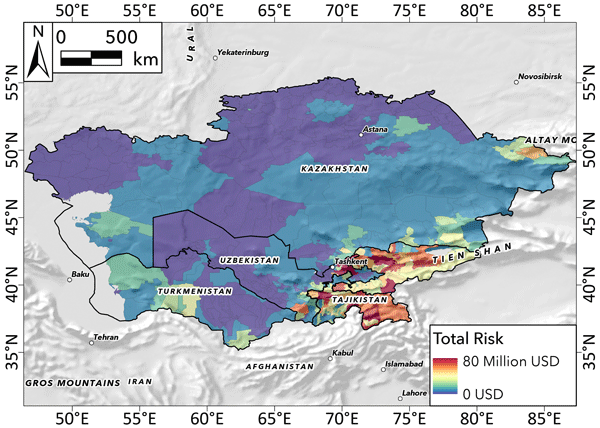
Landslide risk analysis is a powerful tool because it allows us to identify where physical and economic losses could occur due to a landslide event. The purpose of our work was to provide the first regional-scale analysis of landslide risk for central Asia, and it represents an advanced step in the field of risk analysis for very large areas. Our findings show, per square kilometer, a total risk of about USD 3.9 billion and a mean risk of USD 0.6 million.
Ascanio Rosi, William Frodella, Nicola Nocentini, Francesco Caleca, Hans Balder Havenith, Alexander Strom, Mirzo Saidov, Gany Amirgalievich Bimurzaev, and Veronica Tofani
Nat. Hazards Earth Syst. Sci., 23, 2229–2250, https://doi.org/10.5194/nhess-23-2229-2023, https://doi.org/10.5194/nhess-23-2229-2023, 2023
Short summary
Short summary
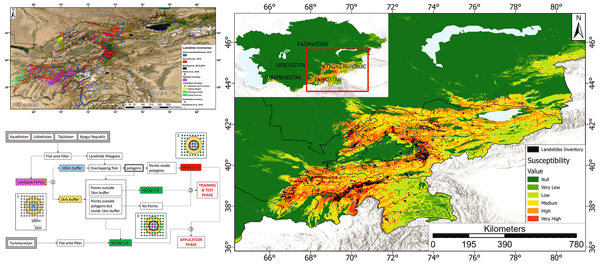
This work was carried out within the Strengthening Financial Resilience and Accelerating Risk Reduction in Central Asia (SFRARR) project and is focused on the first landslide susceptibility analysis at a regional scale for Central Asia. The most detailed available landslide inventories were implemented in a random forest model. The final aim was to provide a useful tool for reduction strategies to landslide scientists, practitioners, and administrators.
Carlo Tacconi Stefanelli, William Frodella, Francesco Caleca, Zhanar Raimbekova, Ruslan Umaraliev, and Veronica Tofani
Nat. Hazards Earth Syst. Sci., 24, 1697–1720, https://doi.org/10.5194/nhess-24-1697-2024, https://doi.org/10.5194/nhess-24-1697-2024, 2024
Short summary
Short summary
Central Asia regions are marked by active tectonics, high mountains with glaciers, and strong rainfall. These predisposing factors make large landslides a serious threat in the area and a source of possible damming scenarios, which endanger the population. To prevent this, a semi-automated geographic information system (GIS-)based mapping method, centered on a bivariate correlation of morphometric parameters, was applied to give preliminary information on damming susceptibility in Central Asia.
Francesco Caleca, Chiara Scaini, William Frodella, and Veronica Tofani
Nat. Hazards Earth Syst. Sci., 24, 13–27, https://doi.org/10.5194/nhess-24-13-2024, https://doi.org/10.5194/nhess-24-13-2024, 2024
Short summary
Short summary
Landslide risk analysis is a powerful tool because it allows us to identify where physical and economic losses could occur due to a landslide event. The purpose of our work was to provide the first regional-scale analysis of landslide risk for central Asia, and it represents an advanced step in the field of risk analysis for very large areas. Our findings show, per square kilometer, a total risk of about USD 3.9 billion and a mean risk of USD 0.6 million.
V. Bonora, I. Centauro, L. Fiorini, A. Conti, T. Salvatici, S. Calandra, R. Raffa, E. Intrieri, C. A. Garzonio, and G. Tucci
Int. Arch. Photogramm. Remote Sens. Spatial Inf. Sci., XLVIII-M-2-2023, 273–280, https://doi.org/10.5194/isprs-archives-XLVIII-M-2-2023-273-2023, https://doi.org/10.5194/isprs-archives-XLVIII-M-2-2023-273-2023, 2023
Ascanio Rosi, William Frodella, Nicola Nocentini, Francesco Caleca, Hans Balder Havenith, Alexander Strom, Mirzo Saidov, Gany Amirgalievich Bimurzaev, and Veronica Tofani
Nat. Hazards Earth Syst. Sci., 23, 2229–2250, https://doi.org/10.5194/nhess-23-2229-2023, https://doi.org/10.5194/nhess-23-2229-2023, 2023
Short summary
Short summary
This work was carried out within the Strengthening Financial Resilience and Accelerating Risk Reduction in Central Asia (SFRARR) project and is focused on the first landslide susceptibility analysis at a regional scale for Central Asia. The most detailed available landslide inventories were implemented in a random forest model. The final aim was to provide a useful tool for reduction strategies to landslide scientists, practitioners, and administrators.
Cited articles
Abellán, A., Vilaplana, J. M., and Martínez, J.: Application of a long-range terrestrial laser scanner to a detailed rockfall study at Vall de Núria (Eastern pyrenees, Spain), Eng. Geol., 88, 136–148, 2006.
Antonello, G., Casagli, N., Farina, P., Leva, D., Nico, G., Sieber, A. J., and Tarchi, D.: Ground-based SAR interferometry for monitoring mass movements, Landslides, 1, 21–28, 2004.
Bamler, R. and Hartl, P.: Synthetic aperture radar interferometry, Inverse Probl., 14, 1–54, 1998.
Bardi, F., Frodella, W., Ciampalini, A., Bianchini, S., Del Ventisette, C., Gigli, G., Fanti, R., Moretti, S., Basile, G., and Casagli, N.: Integration between ground based and satellite SAR data in landslide mapping: the San Fratello case study, Geomorphology, 223, 45–60, 2014.
Bardi, F., Raspini, F., Frodella, W., Lombardi, L., Nocentini, M., Gigli, G., Morelli, S., Corsini, A., and Casagli, N.: Monitoring the rapid-moving reactivation of Earth flows by means of GB-InSAR: the April 2013 Capriglio Landslide (Northern Appennines, Italy), Remote Sensing, 9, 165, https://doi.org/10.3390/rs9020165, 2017a.
Bardi, F., Raspini, F., Frodella, W., Lombardi, L., Nocentini, M., Gigli, G., Morelli, S., Corsini, A., and Casagli, N.: Remote sensing mapping and monitoring of the Capriglio landslide (Parma Province, northern Italy), in: Advancing Culture of Living With Landslides, Vol. 3 – Advances in Landslide Technology, edited by: Mikos, M., Arbanas, Ž., Yin, Y., Sassa, K., Springer International Publishing, Switzerland, 231–238, https://doi.org/10.1007/978-3-319-53487-9_26, 2017b.
Bertolaso, G., De Bernardinis, B., Bosi, V., Cardaci, C., Ciolli, S., Colozza, R., Cristiani, C., Mangione, D., Ricciardi, A., Rosi, M., Scalzo, A., and Soddu, P.: Civil protection preparedness and response to the 2007 eruptive crisis of Stromboli volcano, Italy, J. Volcanol. Geoth. Res., 182, 269–277, 2009.
Bossi, G., Crema, S., Frigerio, S., Mantovani, M., Marcato, G., Pasuto, A., Schenato, L., and Cavalli, M.: The Rotolon catchment early-warning system, in: Engineering Geology for Society and Territory, edited by: Lollino, G. et al., Springer International Publishing, Switzerland, vol. 3, 91–95, https://doi.org/10.1007/978-3-319-09054-2_18, 2015.
Broussolle, J., Kyovtorov, V., Basso, M., Ferraro Di Silvi, E., Castiglione, G., Figueiredo Morgado, J., Giuliani, R., Oliveri, F., Sammartino, P. F., and Tarchi, D.: MELISSA, a new class of ground based InSAR system. An example of application in support to the Costa Concordia, ISPRS J. Photogramm., 91, 50–58, 2014.
Carlà, T., Intrieri, E., Di Traglia, F., and Casagli, N.: A statistical-based approach for determining the intensity of unrest phases at Stromboli volcano (Southern Italy) using one-step-ahead forecasts of displacement time series, Nat. Hazards, 84, 669–683, 2016.
Casagli, N., Catani, F., Del Ventisette, C., and Luzi, G.: Monitoring, prediction, and early warning using ground-based radar interferometry, Landslides, 7, 291–301, 2010.
Casagli, N., Frodella, W., Morelli, S., Tofani, V., Ciampalini, A., Intrieri, E., Raspini, F., Rossi, G., Tanteri, L., and Lu, P.: Spaceborne, UAV and ground-based remote sensing techniques for landslide mapping, monitoring and early warning, Geoenvironmental Disasters, 4, https://doi.org/10.1186/s40677-017-0073-1, 2017a.
Casagli, N., Tofani, V., Morelli, S., Frodella, W., Ciampalini, A., Raspini, F., and Intrieri, E.: Remote sensing techniques in landslide mapping and monitoring, keynote lecture, in: Advancing Culture of Living With Landslides, Vol. 3 – Advances in Landslide Technology, edited by: Mikos, M., Arbanas, Ž., Yin, Y., Sassa, K., Springer International Publishing, Switzerland, 1–19, https://doi.org/10.1007/978-3-319-53487-9_1, 2017b.
Casu, F., Manzo, M., and Lanari, R.: A quantitative assessment of the SBAS algorithm performance for surface deformation retrieval from DInSAR data, Remote Sens. Environ., 102, 195–210, 2006.
Chandler, J.: Effective application of automated digital photogrammetry for geomorphological research, Earth Surf. Proc. Land., 24, 51–63, 1999.
Ciampalini, A., Raspini, F., Bianchini, S., Frodella, W., Bardi, F., Lagomarsino, D., Di Traglia, F., Moretti, S., Proietti, C., Pagliara, P., Onori, R., Corazza, A., Duro, A., Basile, G., and Casagli, N.: Remote sensing as tool for development of landslide databases: the case of the Messina Province (Italy) geodatabase, Geomorphology, 249, 103–118, 2015.
Ciampalini, A., Raspini, F., Frodella, W., Bardi, F., Bianchini, S., and Moretti, S.: The effectiveness of high-resolution LiDAR data combined with PSInSAR data, Landslides, 13, 399–410, 2016.
Confuorto, P., Di Martire, D., Centolanza, G., Iglesias, R., Mallorqui, J. J., Novellino, A., Plank, S, Ramondini, M., Thuro, K., and Calcaterra, D.: Post-failure evolution analysis of a rainfall-triggered landslide by multi-temporal interferometry SAR approaches integrated with geotechnical analysis, Remote Sens. Environ., 188, 51–72, 2017.
Crosta, G. B.: Landslide, spreading, deep seated gravitational deformation: analysis, examples, problems and proposals, Geogr. Fis. Din. Quat., 19, 297–313, 1996.
Crosta, G. B. and Agliardi, F.: Failure forecast for large rock slides by surface displacement measurements, Can. Geotech. J., 40, 176–191, 2003.
Cruden, D. M. and Varnes, D. J.: Landslides types and Processes, in: Landslides: Investigation and Mitigation, edited by: Turner, A. K., Schuster, R. L., Transportation Research Board Special Report 247, National Academy Press, Washington, DC, USA, 36–75, 1996.
Del Soldato, M., Segoni, S., De Vita, P., Pazzi, V., Tofani, V., and Moretti, S.: Thickness model of pyroclastic soils along mountain slopes of Campania (southern Italy), in: Landslides and Engineered Slopes. Experience, Theory and Practice, edited by: Aversa et al., Associazione Geotecnica Italaiana, Rome, Italy, ISBN:978-1-138-02988-0, 2016.
Del Ventisette, C., Intrieri, E., Luzi, G., Casagli, N., Fanti, R., and Leva, D.: Using ground based radar interferometry during emergency: the case of the A3 motorway (Calabria Region, Italy) threatened by a landslide, Nat. Hazards Earth Syst. Sci., 11, 2483–2495, https://doi.org/10.5194/nhess-11-2483-2011, 2011.
De Zanche, V. and Mietto, P.: Review of the Triassic sequence of Recoaro (Italy) and related problems, Rend. Soc. Geol. It. Padova, 4, 25–28, 1981.
Di Traglia, F., Intrieri, E., Nolesini, T., Bardi, F., Del Ventisette, C., Ferrigno, F., Frangioni, S., Frodella, W., Gigli, G., Lotti, A., Tacconi Stefanelli, C., Tanteri, L., Leva, D., and Casagli, N.: The ground-based InSAR monitoring system at Stromboli volcano: linking changes in displacement rate and intensity of persistent volcanic activity, B. Volcanol., 76, 786, https://doi.org/10.1007/s00445-013-0786-2, 2014a.
Di Traglia, F., Nolesini, T., Intrieri, E., Mugnai, F., Leva, D., Rosi, M., and Casagli, N.: Review of ten years of volcano deformations recorded by the ground-based InSAR monitoring system at Stromboli volcano: a tool to mitigate volcano flank dynamics and intense volcanic activity, Earth-Sci. Rev., 139, 317–335, 2014b.
Di Traglia, F., Battaglia, M., Nolesini, T., Lagomarsino, D., and Casagli, N.: Shifts in the eruptive styles at Stromboli in 2010–2014 revealed by ground-based InSAR data, Sci. Rep.-UK, 5, 13569, https://doi.org/10.1038/srep13569, 2015.
Fidolini, F., Pazzi, V., Frodella, W., Morelli, S., and Fanti, R.: Geomorphological characterization, monitoring and modeling of the Monte Rotolon complex landslide (Recoaro terme, Italy), Engineering Geology for Society and Territory, Springer International Publishing, Switzerland, vol. 2, 1311–1315, 2015.
Frigerio, S., Schenato, L., Bossi, G., Cavalli, M., Mantovani, M., Marcato, G., and Pasuto, A.: A web-based platform for automatic and continuous landslide monitoring: the Rotolon (Eastern Italian Alps) case study, Comput. Geosci., 63, 96–105, https://doi.org/10.1016/j.cageo.2013.10.015, 2014.
Frodella, W., Morelli, S., Fidolini, F., Pazzi, V., and Fanti, R.: Geomorphology of the Rotolon landslide (Veneto region, Italy), J. Maps, 10, 394–401, 2014.
Frodella, W., Fidolini, F., Morelli, S., and Pazzi, V.: Application of infrared thermography for landslide mapping: the Rotolon DSGDS case study, Rend. Online Soc. Geol. It., 35, 144–147, 2015.
Frodella, W., Ciampalini, A., Gigli, G., Lombardi, L., Raspini, F., Nocentini, M., Scardigli, C., and Casagli, N.: Synergic use of satellite and ground based remote sensing methods for monitoring the San Leo rock cliff (Northern Italy), Geomorphology, 264, 80–94, 2016.
Frodella, W., Morelli, S., and Pazzi, V.: Infrared thermographic surveys for landslide mapping and characterization: the Rotolon DSGSD (Norther Italy) case study, Ital. J. Eng. Geol. Environ., 1, 77–84, https://doi.org/10.4408/IJEGE.2017-01.S-07, 2017.
Kostinakis, K. G., Athanatopoulou, A. M., and Avramidis, I. E.: Orientation effects of horizontal seismic components on longitudinal reinforcement in R/C frame elements, Nat. Hazards Earth Syst. Sci., 12, 1–10, https://doi.org/10.5194/nhess-12-1-2012, 2012.
Gigli, G., Intrieri, E., Lombardi, L., Nocentini, M., Frodella, W., Balducci, M., Venanti, L. D., and Casagli, N.: Event scenario analysis for the design of rockslide countermeasures, J. Mt. Sci., 11, 1521–1530, 2014a.
Gigli, G., Frodella, W., Garfagnoli, F., Mugnai, F., Morelli, S., Menna, F., and Casagli, N.: 3-D geomechanical rock mass characterization for the evaluation of rockslide susceptibility scenarios, Landslides, 11, 131–140, 2014b.
Gigli, G., Morelli, S., Fornera, S., and Casagli, N.: Terrestrial laser scanner and geomechanical surveys for the rapid evaluation of rock fall susceptibility scenarios, Landslides, 11, 1–14, 2014c.
Gullà, G., Peduto, D., Borrelli, L., Antronico, L., and Fornaro, G.: Geometric and kinematic characterization of landslides affecting urban areas: the Lungro case study (Calabria, Southern Italy), Landslides, 14, 171–188, https://doi.org/10.1007/s10346-015-0676-0, 2017.
Guzzetti, F., Mondini, A. C., Cardinali, M., Fiorucci, M., Santangelo, M., and Chang, K. T.: Landslide inventory maps: new tools for an old problem, Earth-Sci. Rev., 112, 1–25, 2012.
Intrieri, E., Gigli, G., Mugnai, F., Fanti, R., and Casagli, N.: Design and implementation of a landslide early warning system, Eng. Geol., 147, 124–136, 2012.
Intrieri, E., Gigli, G., Casagli, N., and Nadim, F.: Brief communication “Landslide Early Warning System: toolbox and general concepts”, Nat. Hazards Earth Syst. Sci., 13, 85–90, https://doi.org/10.5194/nhess-13-85-2013, 2013.
Jaboyedoff, M., Oppikofer, T., Abellán, A., Derron, M. H., Loye, A., Metzger, R., and Pedrazzini, A.: Use of LIDAR in landslide investigations: a review, Nat. Hazards, 61, 5–28, 2012.
Lombardi, L., Nocentini, M., Frodella, W., Nolesini, T., Bardi, F., Intrieri, E., Carlà, T., Solari, L., Dotta, G., Ferrigno, F., and Casagli, N.: The Calatabiano landslide (southern Italy): preliminary GB-InSAR monitoring data and remote 3D mapping, Landslides, 14, 685–696, https://doi.org/10.1007/s10346-016-0767-6, 2017.
Lotti, A., Saccorotti, G., Fiaschi, A., Matassoni, L., Gigli, G., Pazzi, V., and Casagli, N.: Seismic monitoring of rockslide: the Torgiovannetto quarry (Central Apennines, Italy), in: Engineering Geology for Society and Territory – Vol. 2, edited by: Lollino, G. et al., Springer International Publishing, Switzerland, 1537–1540, https://doi.org/10.1007/978-3-319-09057-3_272, 2015.
Luzi, G., Pieraccini, M., Mecatti, D., Noferini, L., Guidi, G., Moia, F., and Atzeni, C.: Ground-based radar interferometry for landslides monitoring: atmospheric and instrumental decorrelation sources on experimental data, IEEE T. Geosci. Remote, 42, 2454–2466, 2004.
Luzi, G.: Ground Based SAR Interferometry: a novel tool for geosciences, in: Geoscience and Remote Sensing. New Achievements, edited by: Imperatore, P., Riccio, D., InTech, 1–26, https://doi.org/10.5772/9090, 2010.
Monserrat, O., Crosetto, M., and Luzi, G.: A review of ground-based SAR interferometry for deformation measurement, ISPRS J. Photogramm., 93, 40–48, 2014.
Morelli, S., Pazzi, V., Monroy, V. H. G., and Casagli, N.: Residual slope stability in low order streams of angangueo mining area (Michoacán, Mexico) after the 2010 Debris flows, in: Advancing Culture of Living With Landslides, Vol. 4 – Diversity of Landslide Forms, edited by: Mikos, M., Casagli, N., Yin, Y., Sassa, K., Springer International Publishing, Switzerland, 651–660, https://doi.org/10.1007/978-3-319-53485-5_75, 2017.
Nicodemo G, Peduto D, Ferlisi S and Maccabiani, J.: Investigating building settlements via very high resolution SAR sensors, in: Life-Cycle of Engineering Systems: Emphasis on Sustainable Civil Infrastructure, edited by: Bakker, J., Frangopol, D. M., van Breugel, K., 2017, Taylor and Francis Group, London, 2256–2263, 2016.
Nolesini, T., Di Traglia, F., Del Ventisette, C., Moretti, S., and Casagli, N.: Deformations and slope instability on Stromboli volcano: integration of GBInSAR data and analog modeling, Geomorphology, 180, 242–254, 2013.
Nolesini, T., Frodella, W., Bianchini, S., and Casagli, N.: Detecting slope and urban potential unstable areas by means of multi-platform remote sensing techniques: the Volterra (Italy) case study, Remote Sensing, 8, 746, https://doi.org/10.3390/rs8090746, 2016.
Pagliara, P., Basile, G., Cara, P., Corazza, A., Duro, A., Manfrè, B., Onori, R., Proietti, C., and Sansone, V.: Integration of earth observation and ground-based HR data in the civil protection emergency cycle: the case of the DORIS project, in: Mathematics of Planet Earth, Lecture Notes in Earth System Sciences, edited by: Pardo-Igúzquiza, E., Guardiola-Albert, C., Heredia, J., Moreno-Merino, L., Durán, J. J., Vargas-Guzmán, J. A., Springer, Berlin Heidelberg, 263–266, 2014.
Pazzi, V., Tanteri, L., Bicocchi, G., Caselli, A., D'Ambosio, M., and Fanti, R.: H/V technique for the rapid detection of landslide slip surface(s): assessment of the optimized measurements spatial distribution, in: Advancing Culture of Living With Landslides, Vol. 2 – Advances in Landslide Science, edited by: Mikos, M., Tiwari, B., Yin, Y., Sassa, K., Springer International Publishing, Switzerland, 335–343, https://doi.org/10.1007/978-3-319-53498-5_38, 2017a.
Pazzi, V., Tanteri, L., Bicocchi, G., D'Ambrosio, M., Caselli, A., and Fanti, R.: H/V measurements as an effective tool for the reliable detection of landslide slip surfaces: case studies of Castagnola (La Spezia, Italy) and Roccalbegna (Grosseto, Italy), Phys. Chem. Earth, 98, 136–153, https://doi.org/10.1016/j.pce.2016.10.014, 2017b.
Peduto, D., Ferlisi, S., Nicodemo, G., Reale, D., Pisciotta, G., and Gullà G.: Empirical fragility and vulnerability curves for buildings exposed to slow-moving landslides at medium and large scales, Landslides, in press, https://doi.org/10.1007/s10346-017-0826-7, 2017a.
Peduto, D., Nicodemo, G., Maccabiani, J., and Ferlisi, S.: Multi-scale analysis of settlement induced building damage using damage surveys and DInSAR data: a case study in the Netherlands. Eng. Geol., 218, 117–133, https://doi.org/10.1016/j.enggeo.2016.12.018, 2017b.
Pieraccini, M., Tarchi, D., Rudolf, H., Leva, D., Luzi, G., Bartoli, G., and Atzeni, C.: Structural static testing by interferometric synthetic radar, NDT&E Int., 33, 565–570, 2000.
Pieraccini, M., Casagli, N., Luzi, G., Tarchi, D., Mecatti, D., Noferini, L., and Atzeni, C.: Landslide monitoring by ground-based radar interferometry: a field test in Valdarno (Italy), Int. J. Remote Sens., 24, 1385–1391, 2002.
Salvatici, T., Morelli, S., Pazzi, V., Frodella, W., and Fanti, R.: Debris flow hazard assessment by means of numerical simulations: implications for the Rotolon Creek Valley (Northern Italy), J. Mt. Sci, 14, 636–648, https://doi.org/10.1007/s11629-016-4197-7, 2017.
Tarchi, D., Ohlmer, E., and Sieber, A. J.: Monitoring of structural changes by radar interferometry, Res. Nondestruct. Eval., 9, 213–225, 1997.
Tarchi, D., Casagli, N., Fanti, R., Leva, D., Luzi, G., Pasuto, A., Pieraccini, M., and Silvano, S.: Landslide monitoring by using ground-based SAR interferometry: an example of application to the Tessina landslide in Italy, Eng. Geol., 68, 15–30, 2003.
Tapete, D., Gigli, G., Mugnai, F., Vannocci, P., Pecchioni, E., Morelli, S., Fanti, R., and Casagli, N.: Correlation between erosion patterns and rockfall hazard susceptibility in hilltop fortifications by terrestrial laser scanning and diagnostic investigations, in: IEEE International Geoscience and Remote Sensing Symposium. Remote Sensing for a Dynamic Earth, Munich, Germany, 22–27 July 2012, Germany, 4809–4812, ISBN 978-1-4673-1159-5, 2012.
Tofani, V., Raspini, F., Catani, F., and Casagli, N.: Persistent scatterer interferometry (PSI) technique for landslide characterization and monitoring, in: Landslide Science for a Safer Geoenvironment Methods of Landslide Studies 2, edited by: Sassa, K., Canuti, P., Yueping, Y., Springer International Publishing, Switzerland, 351–357, ISBN: 9783319050492, 2014.
Zhang, Z., Zheng, S., and Zhan, Z.: Digital terrestrial photogrammetry with photo total station, International Archives of Photogrammetry and Remote Sensing, Istanbul, Turkey, 232–236, 2004.
Zischinsky, U.: Uber sackungen, Rock Mech., 1, 30–52, 1969.
Short summary
A local scale GB-InSAR system was implemented for mapping and monitoring slope landslide residual deformations and for early warning purposes in case of landslide reactivations, with the aim of assuring the safety of the valley inhabitants and the personnel involved in the post-event recovery phase. The here presented methodology could represent a useful contribution to a better understanding of landslide phenomena and decision making process during the post-emergency management activities.
A local scale GB-InSAR system was implemented for mapping and monitoring slope landslide...


Altmetrics
Final-revised paper
Preprint