
Articles | Volume 16, issue 12
https://doi.org/10.5194/nhess-16-2713-2016
© Author(s) 2016. This work is distributed under
the Creative Commons Attribution 3.0 License.
the Creative Commons Attribution 3.0 License.
https://doi.org/10.5194/nhess-16-2713-2016
© Author(s) 2016. This work is distributed under
the Creative Commons Attribution 3.0 License.
the Creative Commons Attribution 3.0 License.
Research article
| 
15 Dec 2016
Research article |
| 15 Dec 2016
A new search-and-rescue service in the Mediterranean Sea: a demonstration of the operational capability and an evaluation of its performance using real case scenarios
Giovanni Coppini
CORRESPONDING AUTHOR
CMCC, Fondazione Centro Euro-Mediterraneo sui Cambiamenti Climatici, 73100 Lecce, Italy
Eric Jansen
CMCC, Fondazione Centro Euro-Mediterraneo sui Cambiamenti Climatici, 73100 Lecce, Italy
Giuseppe Turrisi
CMCC, Fondazione Centro Euro-Mediterraneo sui Cambiamenti Climatici, 73100 Lecce, Italy
Sergio Creti
CMCC, Fondazione Centro Euro-Mediterraneo sui Cambiamenti Climatici, 73100 Lecce, Italy
Elena Yurievna Shchekinova
CMCC, Fondazione Centro Euro-Mediterraneo sui Cambiamenti Climatici, 73100 Lecce, Italy
SRCSB, Stuttgart Research Center Systems Biology, Stuttgart, Germany
Nadia Pinardi
CMCC, Fondazione Centro Euro-Mediterraneo sui Cambiamenti Climatici, 73100 Lecce, Italy
UNIBO, University of Bologna, viale Berti Pichat, 6/2, 40127 Bologna, Italy
Rita Lecci
CMCC, Fondazione Centro Euro-Mediterraneo sui Cambiamenti Climatici, 73100 Lecce, Italy
Ivano Carluccio
CMCC, Fondazione Centro Euro-Mediterraneo sui Cambiamenti Climatici, 73100 Lecce, Italy
Yogesh Vittal Kumkar
CMCC, Fondazione Centro Euro-Mediterraneo sui Cambiamenti Climatici, 73100 Lecce, Italy
Alessandro D'Anca
CMCC, Fondazione Centro Euro-Mediterraneo sui Cambiamenti Climatici, 73100 Lecce, Italy
Gianandrea Mannarini
CMCC, Fondazione Centro Euro-Mediterraneo sui Cambiamenti Climatici, 73100 Lecce, Italy
Sara Martinelli
CMCC, Fondazione Centro Euro-Mediterraneo sui Cambiamenti Climatici, 73100 Lecce, Italy
Palmalisa Marra
LINKS S.p.a., Links Management and Technology, via R. Scotellaro, 73100 Lecce, Italy
Tommaso Capodiferro
ITCG, Italian Coast Guard, Direzione Marittima di Bari, Bari, Italy
Tommaso Gismondi
ITCG, Italian Coast Guard, Direzione Marittima di Bari, Bari, Italy
Related authors
Archit Shirish Wadalkar, Michalis I. Vousdoukas, Massimo Tondello, Vitali Sharmar, Evangelos Voukouvalas, Salvatore Causio, Ivan Federico, Giovanni Coppini, and Lorenzo Mentaschi
Earth Syst. Sci. Data Discuss., https://doi.org/10.5194/essd-2026-598, https://doi.org/10.5194/essd-2026-598, 2026
Preprint under review for ESSD
Short summary
Short summary
We present a global hazard-oriented dataset of storm surges and significant wave heights, including bulk and spectral peak wave parameters, spanning 1950–2023 on a high-resolution in coastal areas. Significant wave heights are bias-corrected using satellite altimetry, while storm surges are derived from sea surface heights through frequency-based filtering. The dataset is tailor made for regional downscaling and assessment of compound-events for multi hazard mapping.
Mohammad Hadi Bahmanpour, Alois Tilloy, Michalis Vousdoukas, Ivan Federico, Giovanni Coppini, Luc Feyen, and Lorenzo Mentaschi
Hydrol. Earth Syst. Sci., 30, 2301–2314, https://doi.org/10.5194/hess-30-2301-2026, https://doi.org/10.5194/hess-30-2301-2026, 2026
Short summary
Short summary
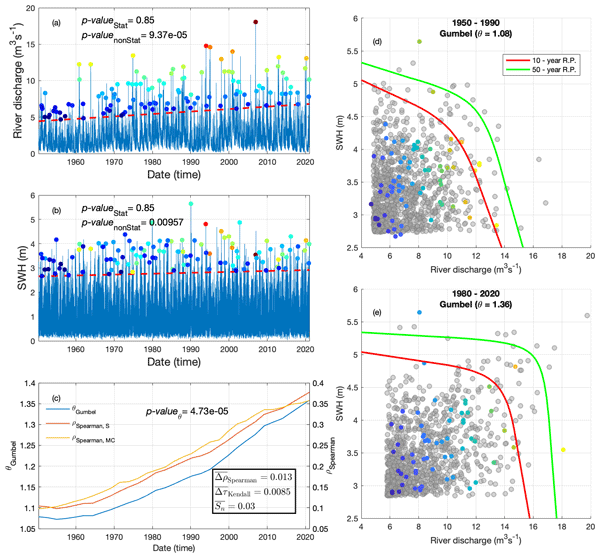
As natural hazards evolve, understanding how extreme events interact over time is crucial. While single extremes have been widely studied, joint extremes remain challenging to analyze. We present a framework that combines advanced statistical modeling with copula theory to capture changing dependencies. Applying it to historical data reveals dynamic patterns in extreme events. To support broader use, we provide an open-source tool for improved hazard assessment.
Simona Masina, Andrea Cipollone, Doroteaciro Iovino, Stefania Ciliberti, Rita Lecci, Sergio Cretí, Vladyslav Lyubartsev, Giovanni Coppini, and Emanuela Clementi
EGUsphere, https://doi.org/10.5194/egusphere-2026-887, https://doi.org/10.5194/egusphere-2026-887, 2026
Short summary
Short summary
The paper presents GOFS16, an eddy-resolving global operational ocean and sea ice forecasting system which provides 6-day forecasts of three-dimensional temperature, salinity, currents, sea level, and sea ice properties. The system assimilates satellite and in situ observations using a 3D variational data assimilation scheme. Validation is conducted routinely using global and regional metrics. Results indicate that GOFS16 performs within the expected range of skill for current global systems.

Italo dos Reis Lopes, Ivan Federico, Michalis Vousdoukas, Luisa Perini, Salvatore Causio, Giovanni Coppini, Maurilio Milella, Nadia Pinardi, and Lorenzo Mentaschi
Nat. Hazards Earth Syst. Sci., 26, 811–825, https://doi.org/10.5194/nhess-26-811-2026, https://doi.org/10.5194/nhess-26-811-2026, 2026
Short summary
Short summary
We improved a computer model to simulate coastal flooding by including temporary barriers like sand dunes. We tested it where sand dunes are built seasonally to protect the shoreline for two real storms: one that broke through the dunes and another where dunes held strong. Our model showed how important it is to design these defenses carefully since even if a small part of a dune fails, a major flooding can happen. Overall, our work helps create better tools to manage and protect coastal areas.
Seimur Shirinov, Ivan Federico, Simone Bonamano, Salvatore Causio, Nicolás Biocca, Viviana Piermattei, Daniele Piazzolla, Jacopo Alessandri, Lorenzo Mentaschi, Giovanni Coppini, Marco Marcelli, and Nadia Pinardi
Nat. Hazards Earth Syst. Sci., 25, 3737–3758, https://doi.org/10.5194/nhess-25-3737-2025, https://doi.org/10.5194/nhess-25-3737-2025, 2025
Short summary
Short summary
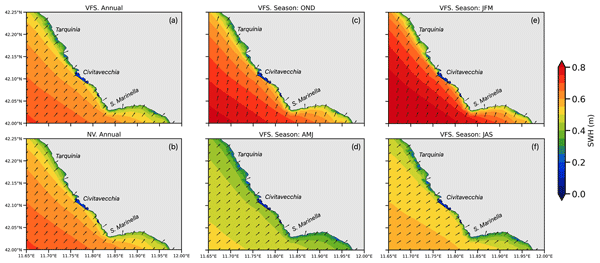
This research investigates how seagrass meadows attenuate coastal waves. Our methodology integrates site measurements with numerical simulations, revealing that plant flexibility and seasonal growth cycles are crucial factors that enhance model fidelity for predicting wave damping. These insights aid ecosystem-based coastal protection and conservation of these vital habitats. Future work should address current–sediment–vegetation interactions for a more complete hydrodynamic understanding.
Salvatore Causio, Seimur Shirinov, Ivan Federico, Giovanni De Cillis, Emanuela Clementi, Lorenzo Mentaschi, and Giovanni Coppini
Ocean Sci., 21, 1105–1123, https://doi.org/10.5194/os-21-1105-2025, https://doi.org/10.5194/os-21-1105-2025, 2025
Short summary
Short summary
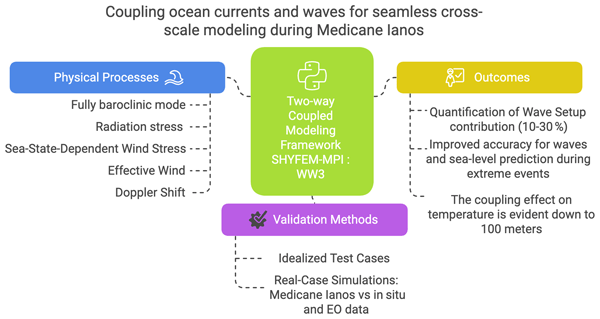
This study examines how waves and ocean currents interact during severe weather, focusing on Medicane Ianos, one of the strongest storms in the Mediterranean. Using advanced modeling, we created a unique system to simulate these interactions, capturing effects like wave-induced water levels and wave-induced effects on the vertical structure of the ocean. We validated our approach with ideal tests and real data from the storm.
Giovanni Coppini, Emanuela Clementi, Gianpiero Cossarini, Stefano Salon, Gerasimos Korres, Michalis Ravdas, Rita Lecci, Jenny Pistoia, Anna Chiara Goglio, Massimiliano Drudi, Alessandro Grandi, Ali Aydogdu, Romain Escudier, Andrea Cipollone, Vladyslav Lyubartsev, Antonio Mariani, Sergio Cretì, Francesco Palermo, Matteo Scuro, Simona Masina, Nadia Pinardi, Antonio Navarra, Damiano Delrosso, Anna Teruzzi, Valeria Di Biagio, Giorgio Bolzon, Laura Feudale, Gianluca Coidessa, Carolina Amadio, Alberto Brosich, Arnau Miró, Eva Alvarez, Paolo Lazzari, Cosimo Solidoro, Charikleia Oikonomou, and Anna Zacharioudaki
Ocean Sci., 19, 1483–1516, https://doi.org/10.5194/os-19-1483-2023, https://doi.org/10.5194/os-19-1483-2023, 2023
Short summary
Short summary
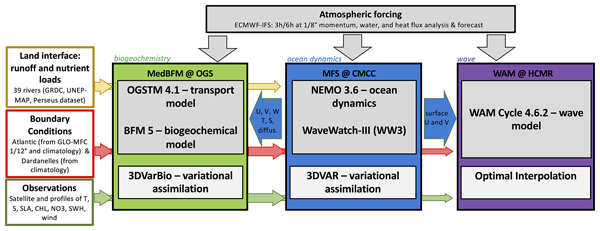
The paper presents the Mediterranean Forecasting System evolution and performance developed in the framework of the Copernicus Marine Service.
Giorgio Micaletto, Ivano Barletta, Silvia Mocavero, Ivan Federico, Italo Epicoco, Giorgia Verri, Giovanni Coppini, Pasquale Schiano, Giovanni Aloisio, and Nadia Pinardi
Geosci. Model Dev., 15, 6025–6046, https://doi.org/10.5194/gmd-15-6025-2022, https://doi.org/10.5194/gmd-15-6025-2022, 2022
Short summary
Short summary
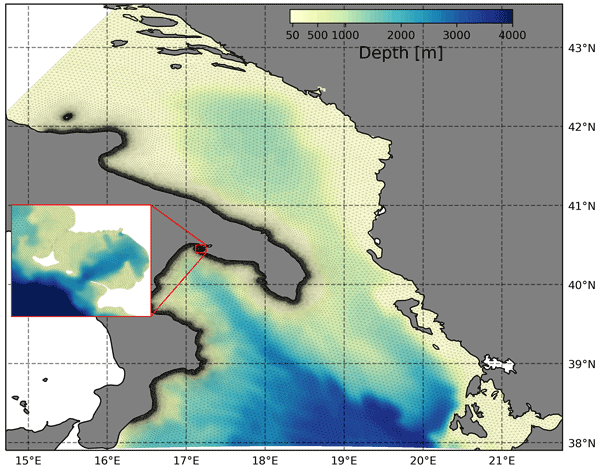
The full exploitation of supercomputing architectures requires a deep revision of the current climate models. This paper presents the parallelization of the three-dimensional hydrodynamic model SHYFEM (System of HydrodYnamic Finite Element Modules). Optimized numerical libraries were used to partition the model domain and solve the sparse linear system of equations in parallel. The performance assessment demonstrates a good level of scalability with a realistic configuration used as a benchmark.
Anna Chiara Goglio, Emanuela Clementi, Nadia Pinardi, Giulio Boccaletti, Paolo Oddo, and Lorenzo Mentaschi
EGUsphere, https://doi.org/10.5194/egusphere-2026-4734, https://doi.org/10.5194/egusphere-2026-4734, 2026
This preprint is open for discussion and under review for Natural Hazards and Earth System Sciences (NHESS).
Short summary
Short summary
Venice, one of the world's most famous cities, is threatened by flooding, locally known as Acqua Alta. Based on numerical results from the Copernicus Marine Mediterranean Analysis and Forecasting System, we investigate each process involved in the dynamics of these events to improve their predictability. For the first time, we identify processes occurring within the water column that contribute to the sea level peak, providing new insight into the understanding and modeling of Acqua Alta events.
Archit Shirish Wadalkar, Michalis I. Vousdoukas, Massimo Tondello, Vitali Sharmar, Evangelos Voukouvalas, Salvatore Causio, Ivan Federico, Giovanni Coppini, and Lorenzo Mentaschi
Earth Syst. Sci. Data Discuss., https://doi.org/10.5194/essd-2026-598, https://doi.org/10.5194/essd-2026-598, 2026
Preprint under review for ESSD
Short summary
Short summary
We present a global hazard-oriented dataset of storm surges and significant wave heights, including bulk and spectral peak wave parameters, spanning 1950–2023 on a high-resolution in coastal areas. Significant wave heights are bias-corrected using satellite altimetry, while storm surges are derived from sea surface heights through frequency-based filtering. The dataset is tailor made for regional downscaling and assessment of compound-events for multi hazard mapping.
Skyler Kern, Mary E. McGuinn, Katherine M. Smith, Nadia Pinardi, Kyle E. Niemeyer, Nicole S. Lovenduski, and Peter E. Hamlington
Geosci. Model Dev., 19, 5601–5622, https://doi.org/10.5194/gmd-19-5601-2026, https://doi.org/10.5194/gmd-19-5601-2026, 2026
Short summary
Short summary
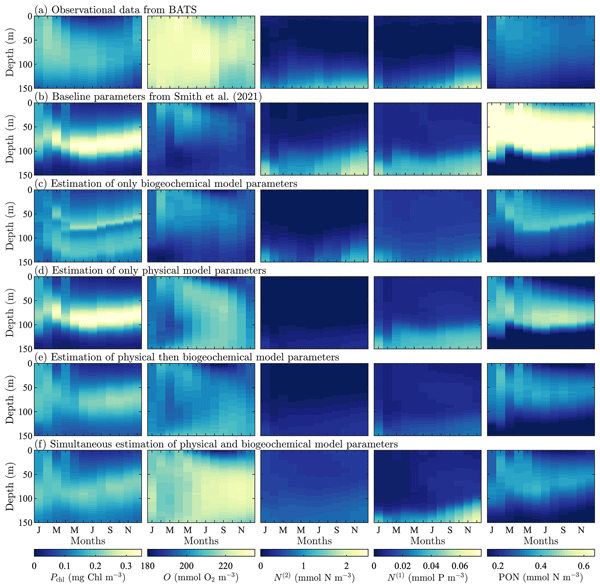
The parameters that control a model's behavior determine its ability to represent a system. In this work, multiple cases test how to estimate the parameters of a model with components corresponding to both the physics and the chemical and biological processes (i.e. the biogeochemistry) of the ocean. While demonstrating how to approach this problem type, the results show estimating both sets of parameters simultaneously is better than estimating the physics then the biogeochemistry separately.
Mohammad Hadi Bahmanpour, Alois Tilloy, Michalis Vousdoukas, Ivan Federico, Giovanni Coppini, Luc Feyen, and Lorenzo Mentaschi
Hydrol. Earth Syst. Sci., 30, 2301–2314, https://doi.org/10.5194/hess-30-2301-2026, https://doi.org/10.5194/hess-30-2301-2026, 2026
Short summary
Short summary
As natural hazards evolve, understanding how extreme events interact over time is crucial. While single extremes have been widely studied, joint extremes remain challenging to analyze. We present a framework that combines advanced statistical modeling with copula theory to capture changing dependencies. Applying it to historical data reveals dynamic patterns in extreme events. To support broader use, we provide an open-source tool for improved hazard assessment.
Rita Lecci, Robyn Gwee, Kun Yan, Sanne Muis, Nadia Pinardi, Jun She, Martin Verlaan, Simona Masina, Wenshan Li, Hui Wang, Salvatore Causio, Antonio Novellino, Marco Alba, Etiënne Kras, Sandra Gaytan Aguilar, and Jan-Bart Calewaert
Nat. Hazards Earth Syst. Sci., 26, 1767–1783, https://doi.org/10.5194/nhess-26-1767-2026, https://doi.org/10.5194/nhess-26-1767-2026, 2026
Short summary
Short summary
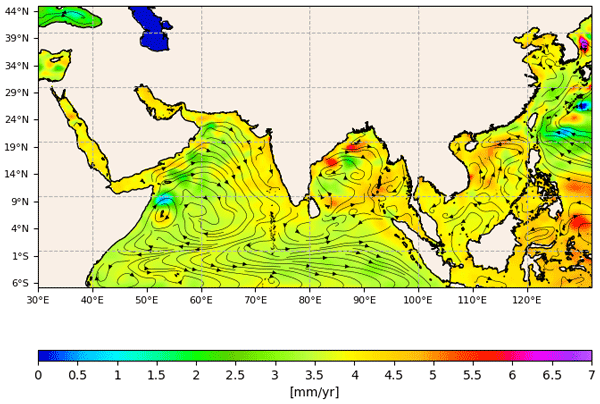
This study explored how sea level is changing along the China-Europe Sea Route. By combining satellite and in-situ observations with advanced modeling, the research identified ongoing sea level rise and an increasing frequency of extreme water level events in some regions. These findings underscore the importance of continued monitoring and provide useful knowledge to support long-term planning, coastal resilience, and informed decision-making.
Jacopo Alessandri, Giulia Bonino, Tomas Lovato, Momme Butenschön, Lorenzo Mentaschi, Giorgia Verri, Ivan Federico, and Nadia Pinardi
EGUsphere, https://doi.org/10.5194/egusphere-2026-1119, https://doi.org/10.5194/egusphere-2026-1119, 2026
Short summary
Short summary
Coastal seas are strongly shaped by complex coastlines, shallow depths, and inputs from rivers, which influence marine life and water quality. This study introduces a new high-resolution modelling system that combines ocean circulation and marine ecosystem processes on unstructured grids. Applied to the northern Adriatic Sea, the model realistically captures seasonal changes in key biogeochemical variables, offering improved tools to support coastal environmental management.
Simona Masina, Andrea Cipollone, Doroteaciro Iovino, Stefania Ciliberti, Rita Lecci, Sergio Cretí, Vladyslav Lyubartsev, Giovanni Coppini, and Emanuela Clementi
EGUsphere, https://doi.org/10.5194/egusphere-2026-887, https://doi.org/10.5194/egusphere-2026-887, 2026
Short summary
Short summary
The paper presents GOFS16, an eddy-resolving global operational ocean and sea ice forecasting system which provides 6-day forecasts of three-dimensional temperature, salinity, currents, sea level, and sea ice properties. The system assimilates satellite and in situ observations using a 3D variational data assimilation scheme. Validation is conducted routinely using global and regional metrics. Results indicate that GOFS16 performs within the expected range of skill for current global systems.
Leonardo Lima, Diana Azevedo, Mehmet Ilicak, Eric Jansen, Filipe Costa, Adil Sozer, Pietro Miraglio, and Emanuela Clementi
Ocean Sci., 22, 1051–1072, https://doi.org/10.5194/os-22-1051-2026, https://doi.org/10.5194/os-22-1051-2026, 2026
Short summary
Short summary
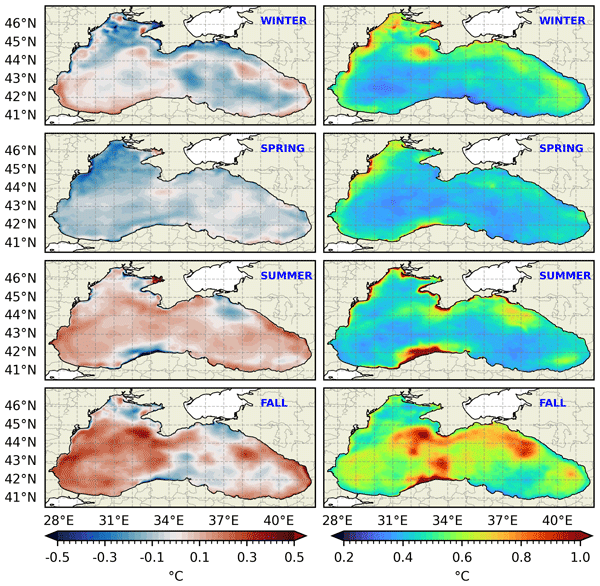
We used a high-resolution ocean model to investigate how the Black Sea is responding to external drivers, including climate change. Our results show clear warming, particularly in the upper 150 m, and reveal significant changes in ocean circulation and water masses. The model also supports the development of ocean monitoring indicators that help track the sea’s response to climate-related trends and improve our understanding of how ocean conditions in the Black Sea evolve.
Italo dos Reis Lopes, Ivan Federico, Michalis Vousdoukas, Luisa Perini, Salvatore Causio, Giovanni Coppini, Maurilio Milella, Nadia Pinardi, and Lorenzo Mentaschi
Nat. Hazards Earth Syst. Sci., 26, 811–825, https://doi.org/10.5194/nhess-26-811-2026, https://doi.org/10.5194/nhess-26-811-2026, 2026
Short summary
Short summary
We improved a computer model to simulate coastal flooding by including temporary barriers like sand dunes. We tested it where sand dunes are built seasonally to protect the shoreline for two real storms: one that broke through the dunes and another where dunes held strong. Our model showed how important it is to design these defenses carefully since even if a small part of a dune fails, a major flooding can happen. Overall, our work helps create better tools to manage and protect coastal areas.

Mahmud Hasan Ghani, Nadia Pinardi, Antonio Navarra, Lorenzo Mentaschi, Silvia Bianconcini, Francesco Maicu, and Francesco Trotta
Ocean Sci., 22, 427–441, https://doi.org/10.5194/os-22-427-2026, https://doi.org/10.5194/os-22-427-2026, 2026
Short summary
Short summary
Using the same sea surface temperature and the same bulk formula but different atmospheric reanalysis and analysis surface-variable datasets, we show that a higher-resolution dataset is crucial for evaluating the heat-budget closure hypothesis in the Mediterranean Sea. For the first time, we investigate the impact of extreme heat-loss events in the Mediterranean Sea by computing the long-term, basin-averaged mean heat budget.

Paolo Oddo, Mario Adani, Francesco Carere, Andrea Cipollone, Anna Chiara Goglio, Eric Jansen, Ali Aydogdu, Francesca Mele, Italo Epicoco, Jenny Pistoia, Emanuela Clementi, Nadia Pinardi, and Simona Masina
Geosci. Model Dev., 19, 423–445, https://doi.org/10.5194/gmd-19-423-2026, https://doi.org/10.5194/gmd-19-423-2026, 2026
Short summary
Short summary
This study present a data assimilation system that combines ocean observational data with ocean model results to better understand the ocean and predict its future state. The method uses a three dimensional incremental variational approach focusing on the physical relationships between all the state vector variables errors. Testing in the Mediterranean Sea showed that a complex sea level operator based on a barotropic model works best.
Seimur Shirinov, Ivan Federico, Simone Bonamano, Salvatore Causio, Nicolás Biocca, Viviana Piermattei, Daniele Piazzolla, Jacopo Alessandri, Lorenzo Mentaschi, Giovanni Coppini, Marco Marcelli, and Nadia Pinardi
Nat. Hazards Earth Syst. Sci., 25, 3737–3758, https://doi.org/10.5194/nhess-25-3737-2025, https://doi.org/10.5194/nhess-25-3737-2025, 2025
Short summary
Short summary
This research investigates how seagrass meadows attenuate coastal waves. Our methodology integrates site measurements with numerical simulations, revealing that plant flexibility and seasonal growth cycles are crucial factors that enhance model fidelity for predicting wave damping. These insights aid ecosystem-based coastal protection and conservation of these vital habitats. Future work should address current–sediment–vegetation interactions for a more complete hydrodynamic understanding.
Leonardo Lima, Rafael Menezes, Ehsan Sadighrad, Ronan McAdam, Filipe Costa, Pietro Miraglio, Mehmet Ilicak, Eric Jansen, Ali Aydogdu, Francesco Maicu, and Emanuela Clementi
State Planet Discuss., https://doi.org/10.5194/sp-2025-6, https://doi.org/10.5194/sp-2025-6, 2025
Revised manuscript accepted for SP
Short summary
Short summary
As climate change intensifies, marine heatwaves (MHWs), periods of unusually high ocean temperatures, threaten ecosystems and communities. This study analyzes MHWs in the Mediterranean and Black Seas, examining surface temperatures and ocean heat content in the upper 0–40 meters to capture subsurface warming. Findings highlight the need to monitor both surface and subsurface conditions for a comprehensive understanding and better management considering ongoing warming trends in both seas.
Salvatore Causio, Seimur Shirinov, Ivan Federico, Giovanni De Cillis, Emanuela Clementi, Lorenzo Mentaschi, and Giovanni Coppini
Ocean Sci., 21, 1105–1123, https://doi.org/10.5194/os-21-1105-2025, https://doi.org/10.5194/os-21-1105-2025, 2025
Short summary
Short summary
This study examines how waves and ocean currents interact during severe weather, focusing on Medicane Ianos, one of the strongest storms in the Mediterranean. Using advanced modeling, we created a unique system to simulate these interactions, capturing effects like wave-induced water levels and wave-induced effects on the vertical structure of the ocean. We validated our approach with ideal tests and real data from the storm.
Bart van den Hurk, Nadia Pinardi, Alexander Bisaro, Giulia Galluccio, José A. Jiménez, Kate Larkin, Angélique Melet, Lavinia Giulia Pomarico, Kristin Richter, Kanika Singh, Roderik van de Wal, and Gundula Winter
State Planet, 3-slre1, 1, https://doi.org/10.5194/sp-3-slre1-1-2024, https://doi.org/10.5194/sp-3-slre1-1-2024, 2024
Short summary
Short summary
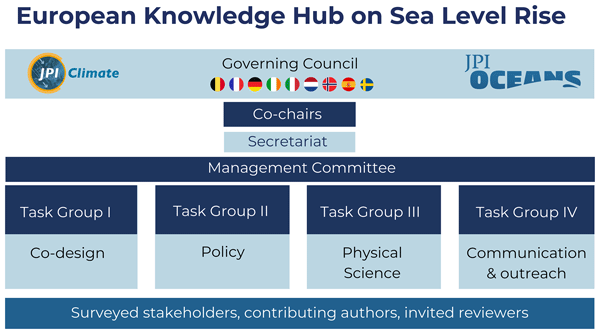
The Summary for Policymakers compiles findings from “Sea Level Rise in Europe: 1st Assessment Report of the Knowledge Hub on Sea Level Rise”. It covers knowledge gaps, observations, projections, impacts, adaptation measures, decision-making principles, and governance challenges. It provides information for each European basin (Mediterranean, Black Sea, North Sea, Baltic Sea, Atlantic, and Arctic) and aims to assist policymakers in enhancing the preparedness of European coasts for sea level rise.
Nadia Pinardi, Bart van den Hurk, Michael Depuydt, Thorsten Kiefer, Petra Manderscheid, Lavinia Giulia Pomarico, and Kanika Singh
State Planet, 3-slre1, 2, https://doi.org/10.5194/sp-3-slre1-2-2024, https://doi.org/10.5194/sp-3-slre1-2-2024, 2024
Short summary
Short summary
The Knowledge Hub on Sea Level Rise (KH-SLR), a joint effort between JPI Climate and JPI Oceans, addresses the critical need for science-based information on sea level changes in Europe. The KH-SLR actively involves stakeholders through a co-design process discussing the impacts, adaptation planning, and policy requirements related to SLR in Europe. Its primary output is the KH Assessment Report (KH-AR), which is described in this volume.
José A. Jiménez, Gundula Winter, Antonio Bonaduce, Michael Depuydt, Giulia Galluccio, Bart van den Hurk, H. E. Markus Meier, Nadia Pinardi, Lavinia G. Pomarico, and Natalia Vazquez Riveiros
State Planet, 3-slre1, 3, https://doi.org/10.5194/sp-3-slre1-3-2024, https://doi.org/10.5194/sp-3-slre1-3-2024, 2024
Short summary
Short summary
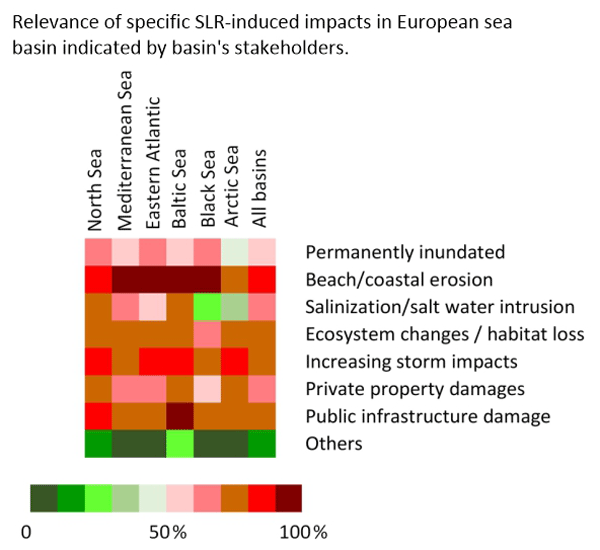
The Knowledge Hub on Sea Level Rise (SLR) has done a scoping study involving stakeholders from government and academia to identify gaps and needs in SLR information, impacts, and policies across Europe. Gaps in regional SLR projections and uncertainties were found, while concerns were raised about shoreline erosion and emerging problems like saltwater intrusion and ineffective adaptation plans. The need for improved communication to make better decisions on SLR adaptation was highlighted.
Karina von Schuckmann, Lorena Moreira, Mathilde Cancet, Flora Gues, Emmanuelle Autret, Ali Aydogdu, Lluis Castrillo, Daniele Ciani, Andrea Cipollone, Emanuela Clementi, Gianpiero Cossarini, Alvaro de Pascual-Collar, Vincenzo De Toma, Marion Gehlen, Rianne Giesen, Marie Drevillon, Claudia Fanelli, Kevin Hodges, Simon Jandt-Scheelke, Eric Jansen, Melanie Juza, Ioanna Karagali, Priidik Lagemaa, Vidar Lien, Leonardo Lima, Vladyslav Lyubartsev, Ilja Maljutenko, Simona Masina, Ronan McAdam, Pietro Miraglio, Helen Morrison, Tabea Rebekka Panteleit, Andrea Pisano, Marie-Isabelle Pujol, Urmas Raudsepp, Roshin Raj, Ad Stoffelen, Simon Van Gennip, Pierre Veillard, and Chunxue Yang
State Planet, 4-osr8, 2, https://doi.org/10.5194/sp-4-osr8-2-2024, https://doi.org/10.5194/sp-4-osr8-2-2024, 2024
Karina von Schuckmann, Lorena Moreira, Mathilde Cancet, Flora Gues, Emmanuelle Autret, Jonathan Baker, Clément Bricaud, Romain Bourdalle-Badie, Lluis Castrillo, Lijing Cheng, Frederic Chevallier, Daniele Ciani, Alvaro de Pascual-Collar, Vincenzo De Toma, Marie Drevillon, Claudia Fanelli, Gilles Garric, Marion Gehlen, Rianne Giesen, Kevin Hodges, Doroteaciro Iovino, Simon Jandt-Scheelke, Eric Jansen, Melanie Juza, Ioanna Karagali, Thomas Lavergne, Simona Masina, Ronan McAdam, Audrey Minière, Helen Morrison, Tabea Rebekka Panteleit, Andrea Pisano, Marie-Isabelle Pujol, Ad Stoffelen, Sulian Thual, Simon Van Gennip, Pierre Veillard, Chunxue Yang, and Hao Zuo
State Planet, 4-osr8, 1, https://doi.org/10.5194/sp-4-osr8-1-2024, https://doi.org/10.5194/sp-4-osr8-1-2024, 2024
Bethany McDonagh, Emanuela Clementi, Anna Chiara Goglio, and Nadia Pinardi
Ocean Sci., 20, 1051–1066, https://doi.org/10.5194/os-20-1051-2024, https://doi.org/10.5194/os-20-1051-2024, 2024
Short summary
Short summary
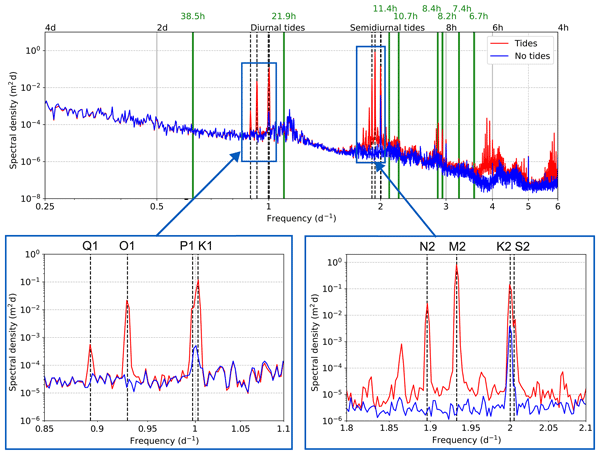
Tides in the Mediterranean Sea are typically of low amplitude, but twin experiments with and without tides demonstrate that tides affect the circulation directly at scales away from those of the tides. Analysis of the energy changes due to tides shows that they enhance existing oscillations, and internal tides interact with other internal waves. Tides also increase the mixed layer depth and enhance deep water formation in key regions. Internal tides are widespread in the Mediterranean Sea.
Roberta Benincasa, Giovanni Liguori, Nadia Pinardi, and Hans von Storch
Ocean Sci., 20, 1003–1012, https://doi.org/10.5194/os-20-1003-2024, https://doi.org/10.5194/os-20-1003-2024, 2024
Short summary
Short summary
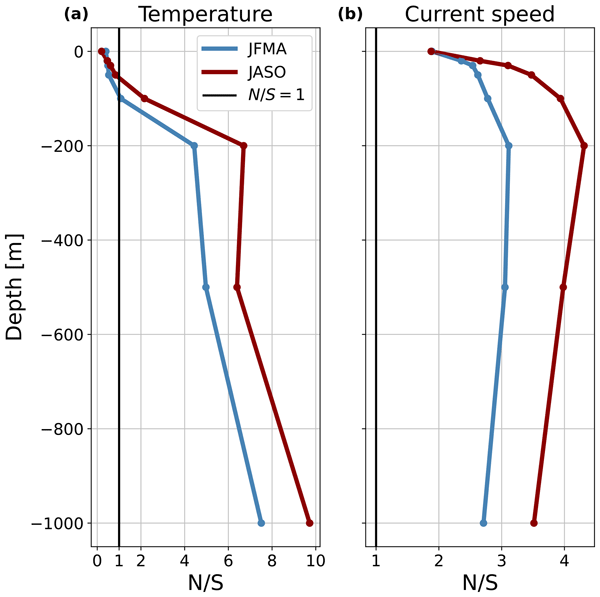
Ocean dynamics result from the interplay of internal processes and external inputs, primarily from the atmosphere. It is crucial to discern between these factors to gauge the ocean's intrinsic predictability and to be able to attribute a signal under study to either external factors or internal variability. Employing a simple analysis, we successfully characterized this variability in the Mediterranean Sea and compared it with the oceanic response induced by atmospheric conditions.

Gianandrea Mannarini, Mario Leonardo Salinas, Lorenzo Carelli, Nicola Petacco, and Josip Orović
Geosci. Model Dev., 17, 4355–4382, https://doi.org/10.5194/gmd-17-4355-2024, https://doi.org/10.5194/gmd-17-4355-2024, 2024
Short summary
Short summary
Ship weather routing has the potential to reduce CO2 emissions, but it currently lacks open and verifiable research. The Python-refactored VISIR-2 model considers currents, waves, and wind to optimise routes. The model was validated, and its computational performance is quasi-linear. For a ferry sailing in the Mediterranean Sea, VISIR-2 yields the largest percentage emission savings for upwind navigation. Given the vessel performance curve, the model is generalisable across various vessel types.
Skyler Kern, Mary E. McGuinn, Katherine M. Smith, Nadia Pinardi, Kyle E. Niemeyer, Nicole S. Lovenduski, and Peter E. Hamlington
Geosci. Model Dev., 17, 621–649, https://doi.org/10.5194/gmd-17-621-2024, https://doi.org/10.5194/gmd-17-621-2024, 2024
Short summary
Short summary
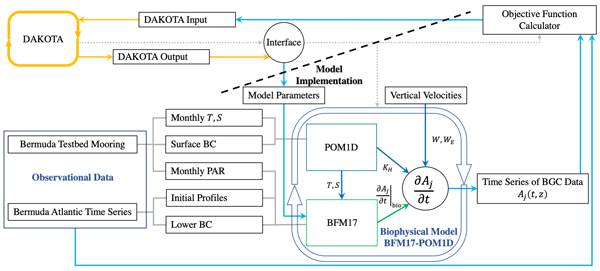
Computational models are used to simulate the behavior of marine ecosystems. The models often have unknown parameters that need to be calibrated to accurately represent observational data. Here, we propose a novel approach to simultaneously determine a large set of parameters for a one-dimensional model of a marine ecosystem in the surface ocean at two contrasting sites. By utilizing global and local optimization techniques, we estimate many parameters in a computationally efficient manner.
Giovanni Coppini, Emanuela Clementi, Gianpiero Cossarini, Stefano Salon, Gerasimos Korres, Michalis Ravdas, Rita Lecci, Jenny Pistoia, Anna Chiara Goglio, Massimiliano Drudi, Alessandro Grandi, Ali Aydogdu, Romain Escudier, Andrea Cipollone, Vladyslav Lyubartsev, Antonio Mariani, Sergio Cretì, Francesco Palermo, Matteo Scuro, Simona Masina, Nadia Pinardi, Antonio Navarra, Damiano Delrosso, Anna Teruzzi, Valeria Di Biagio, Giorgio Bolzon, Laura Feudale, Gianluca Coidessa, Carolina Amadio, Alberto Brosich, Arnau Miró, Eva Alvarez, Paolo Lazzari, Cosimo Solidoro, Charikleia Oikonomou, and Anna Zacharioudaki
Ocean Sci., 19, 1483–1516, https://doi.org/10.5194/os-19-1483-2023, https://doi.org/10.5194/os-19-1483-2023, 2023
Short summary
Short summary
The paper presents the Mediterranean Forecasting System evolution and performance developed in the framework of the Copernicus Marine Service.
Leonardo Lima, Salvatore Causio, Mehmet Ilicak, Ronan McAdam, and Eric Jansen
State Planet Discuss., https://doi.org/10.5194/sp-2023-19, https://doi.org/10.5194/sp-2023-19, 2023
Revised manuscript not accepted
Short summary
Short summary
Recent studies have revealed an increase in the ocean temperature and heat content in the Black Sea, where the research on marine heat waves (MHWs) is still incipient. Our study reveals long-lasting MHWs and interesting connections between surface and subsurface MHWs in the Black Sea. Our analysis is a starting point to create a monitoring system of MHWs for the Black Sea.

Umesh Pranavam Ayyappan Pillai, Nadia Pinardi, Ivan Federico, Salvatore Causio, Francesco Trotta, Silvia Unguendoli, and Andrea Valentini
Nat. Hazards Earth Syst. Sci., 22, 3413–3433, https://doi.org/10.5194/nhess-22-3413-2022, https://doi.org/10.5194/nhess-22-3413-2022, 2022
Short summary
Short summary
The study presents the application of high-resolution coastal modelling for wave hindcasting on the Emilia-Romagna coastal belt. The generated coastal databases which provide an understanding of the prevailing wind-wave characteristics can aid in predicting coastal impacts.
Giorgio Micaletto, Ivano Barletta, Silvia Mocavero, Ivan Federico, Italo Epicoco, Giorgia Verri, Giovanni Coppini, Pasquale Schiano, Giovanni Aloisio, and Nadia Pinardi
Geosci. Model Dev., 15, 6025–6046, https://doi.org/10.5194/gmd-15-6025-2022, https://doi.org/10.5194/gmd-15-6025-2022, 2022
Short summary
Short summary
The full exploitation of supercomputing architectures requires a deep revision of the current climate models. This paper presents the parallelization of the three-dimensional hydrodynamic model SHYFEM (System of HydrodYnamic Finite Element Modules). Optimized numerical libraries were used to partition the model domain and solve the sparse linear system of equations in parallel. The performance assessment demonstrates a good level of scalability with a realistic configuration used as a benchmark.
Cited articles
Allen, A. A.: Leeway divergence, Tech. Rep. CG-D-05-05, US Coast Guard Research and Development Center, Berlin, Germany, 2005.
Allen, A. A. and Plourde, J. V.: Review of leeway: Field experiments and implementation, Tech. Rep. CG-D-08-99, US Coast Guard Research and Development Center, https://ntrl.ntis.gov/NTRL/ (last access: December 2016), 1999.
Breivik, Ø. and Allen, A. A.: An operational search and rescue model for the Norwegian sea and the North sea, J. Mar. Syst., 69, 99–113, 2008.
De Dominicis, M., Pinardi, N., Zodiatis, G., and Lardner, R.: MEDSLIK-II, a Lagrangian marine surface oil spill model for short-term forecasting – Part 1: Theory, Geosci. Model Dev., 6, 1851–1869, https://doi.org/10.5194/gmd-6-1851-2013, 2013.
Dobricic, S. and Pinardi, N.: An oceanographic three-dimensional variational data assimilation scheme, Ocean Model., 22, 89–105, 2008.
Dobricic, S., Pinardi, N., Adani, M., Tonani, M., Fratianni, C., Bonazzi, A., and Fernandez, V.: Daily oceanographic analyses by Mediterranean Forecasting System at the basin scale, Ocean Sci., 3, 149–157, https://doi.org/10.5194/os-3-149-2007, 2007.
IMO: IAMSAR Manual 2016 Edition, Vol. I–III, London, UK, 2016.
Mannarini, G., Pinardi, N., Coppini, G., Oddo, P., and Iafrati, A.: VISIR-I: small vessels – least-time nautical routes using wave forecasts, Geosci. Model Dev., 9, 1597–1625, https://doi.org/10.5194/gmd-9-1597-2016, 2016a.
Mannarini, G., Turrisi, G., D'Anca, A., Scalas, M., Pinardi, N., Coppini, G., Palermo, F., Carluccio, I., Scuro, M., Cretì, S., Lecci, R., Nassisi, P., and Tedesco, L.: VISIR: technological infrastructure of an operational service for safe and efficient navigation in the Mediterranean Sea, Nat. Hazards Earth Syst. Sci., 16, 1791–1806, https://doi.org/10.5194/nhess-16-1791-2016, 2016b.
Oddo, P., Adani, M., Pinardi, N., Fratianni, C., Tonani, M., and Pettenuzzo, D.: A nested Atlantic-Mediterranean Sea general circulation model for operational forecasting, Ocean Sci., 5, 461–473, https://doi.org/10.5194/os-5-461-2009, 2009.
Pinardi, N., Allen, I., Demirov, E., De Mey, P., Korres, G., Lascaratos, A., Le Traon, P.-Y., Maillard, C., Manzella, G., and Tziavos, C.: The Mediterranean ocean forecasting system: first phase of implementation (1998–2001), Ann. Geophys., 21, 3–20, https://doi.org/10.5194/angeo-21-3-2003, 2003.
Tonani, M., Pinardi, N., Dobricic, S., Pujol, I., and Fratianni, C.: A high-resolution free-surface model of the Mediterranean Sea, Ocean Sci., 4, 1–14, https://doi.org/10.5194/os-4-1-2008, 2008.
Tonani, M., Pinardi, N., Fratianni, C., Pistoia, J., Dobricic, S., Pensieri, S., de Alfonso, M., and Nittis, K.: Mediterranean Forecasting System: forecast and analysis assessment through skill scores, Ocean Sci., 5, 649–660, https://doi.org/10.5194/os-5-649-2009, 2009.
Short summary
A new web-based and mobile Decision Support System (DSS) for Search-And-Rescue (SAR) at sea is presented, and its performance is evaluated using real case scenarios. The system, named OCEAN-SAR, is accessible via the website http://www.ocean-sar.com. OCEAN-SAR simulates drifting objects at sea, using as input ocean currents and wind. The performance of the service is evaluated by comparing simulations to data from the Italian Coast Guard pertaining to actual incidents in the Mediterranean Sea.
A new web-based and mobile Decision Support System (DSS) for Search-And-Rescue (SAR) at sea is...


Altmetrics
Final-revised paper
Preprint