
Articles | Volume 26, issue 1
https://doi.org/10.5194/nhess-26-367-2026
© Author(s) 2026. This work is distributed under
the Creative Commons Attribution 4.0 License.
the Creative Commons Attribution 4.0 License.
https://doi.org/10.5194/nhess-26-367-2026
© Author(s) 2026. This work is distributed under
the Creative Commons Attribution 4.0 License.
the Creative Commons Attribution 4.0 License.
Research article
| 
21 Jan 2026
Research article |
| 21 Jan 2026
| 21 Jan 2026
Predicting the amplitude and runup of the water waves induced by rotational cliff collapse, considering fragmentation
Hasnain Gardezi
CORRESPONDING AUTHOR
Department of Geotechnical Engineering, College of Civil Engineering, Tongji University, Shanghai 200092, China
Talha Khan
School of Aerospace Engineering and Applied Mechanics, Tongji University, Shanghai 200092, China
Xingyue Li
CORRESPONDING AUTHOR
Department of Geotechnical Engineering, College of Civil Engineering, Tongji University, Shanghai 200092, China
State Key Laboratory of Disaster Reduction in Civil Engineering, Tongji University, Shanghai 200092, China
Taimur Mazhar Sheikh
Department of Geotechnical Engineering, College of Civil Engineering, Tongji University, Shanghai 200092, China
Department of Civil Engineering, Wah Engineering College, University of Wah, Wah Cantt, Pakistan
Yu Huang
Department of Geotechnical Engineering, College of Civil Engineering, Tongji University, Shanghai 200092, China
State Key Laboratory of Disaster Reduction in Civil Engineering, Tongji University, Shanghai 200092, China
Zhiyi Chen
Department of Geotechnical Engineering, College of Civil Engineering, Tongji University, Shanghai 200092, China
Related authors
No articles found.
Louis Védrine, Xingyue Li, and Johan Gaume
Nat. Hazards Earth Syst. Sci., 22, 1015–1028, https://doi.org/10.5194/nhess-22-1015-2022, https://doi.org/10.5194/nhess-22-1015-2022, 2022
Short summary
Short summary
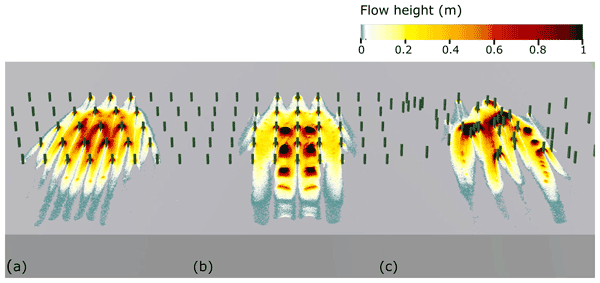
This study investigates how forests affect the behaviour of snow avalanches through the evaluation of the amount of snow stopped by the trees and the analysis of energy dissipation mechanisms. Different avalanche features and tree configurations have been examined, leading to the proposal of a unified law for the detrained snow mass. Outcomes from this study can be directly implemented in operational models for avalanche risk assessment and contribute to improved forest management strategy.
Cited articles
Aidun, C. K. and Clausen, J. R.: Lattice-Boltzmann method for complex flows, Annu. Rev. Fluid Mech., 42, 439–472, https://doi.org/10.1146/annurev-fluid-121108-145519, 2010.
Backbill, J. U., Kothe, D. B., and Zemach, C.: A continuum method for modeling surface tension for Modeling Surface Tension, J. Comput. Phys., 100, 335–354, 1992.
Bougouin, A., Paris, R., and Roche, O.: Impact of Fluidized Granular Flows into Water: Implications for Tsunamis Generated by Pyroclastic Flows, J. Geophys. Res. Solid Earth, 1–17, https://doi.org/10.1029/2019JB018954, 2020.
Boultbee, N., Stead, D., Schwab, J., and Geertsema, M.: The Zymoetz River rock avalanche, June 2002, British Columbia, Canada. Eng. Geol., 83, 76–93, https://doi.org/10.1016/j.enggeo.2005.06.038, 2006.
Bujak, D., Ilic, S., and Mili, H.: Wave Runup Prediction and Alongshore Variability on a Pocket Gravel Beach under Fetch-Limited Wave Conditions, J. Mar. Sci. Eng., https://doi.org/10.3390/jmse11030614, 2023.
Cesario, E., Giampá, S., Baglione, E., Cordrie, L., Selva, J., and Talia, D.: Machine Learning for Tsunami Waves Forecasting Using Regression Trees, Big Data Research, 36, 100452, https://doi.org/10.1016/j.bdr.2024.100452, 2024.
Cheng, J. C. P., Chen, W., Chen, K., and Wang, Q.: Automation in Construction Data-driven predictive maintenance planning framework for MEP components based on BIM and IoT using machine learning algorithms, Autom. Constr., 112, 103087, https://doi.org/10.1016/j.autcon.2020.103087, 2020.
Dai, Z., Li, X., and Lan, B.: Three-Dimensional Modeling of Tsunami Waves Triggered by Submarine Landslides Based on the Smoothed Particle Hydrodynamics Method, J. Mar. Sci. Eng., 11, https://doi.org/10.3390/jmse11102015, 2023.
Das, M. M. and Wiegel, L. R.: Waves Generated by Horizontal Motion of a Wall, Journal of the Waterways, Harbors and Costal Engineering Divison, 98, 49–65, 1972.
Dignan, J., Hayward, M. W., Salmanidou, D., Heidarzadeh, M., and Guillas, S.: Probabilistic Landslide Tsunami Estimation in the Makassar Strait, Indonesia, Using Statistical Emulation, Earth and Space Science, 10, https://doi.org/10.1029/2023EA002951, 2023.
Esposti Ongaro, T., de' Michieli Vitturi, M., Cerminara, M., Fornaciai, A., Nannipieri, L., Favalli, M., Calusi, B., Macías, J., Castro, M. J., Ortega, S., González-Vida, J. M., and Escalante, C.: Modeling Tsunamis Generated by Submarine Landslides at Stromboli Volcano (Aeolian Islands, Italy): A Numerical Benchmark Study, Front Earth Sci. (Lausanne), 9, https://doi.org/10.3389/feart.2021.628652, 2021.
Franci, A., Cremonesi, M., Perego, U., Crosta, G., and Oñate, E.: 3D simulation of Vajont disaster, Part 1: Numerical formulation and validation, Eng. Geol., 279, 105854, https://doi.org/10.1016/j.enggeo.2020.105854, 2020.
Franco, A., Moernaut, J., Schneider-Muntau, B., Strasser, M., and Gems, B.: The 1958 Lituya Bay tsunami – pre-event bathymetry reconstruction and 3D numerical modelling utilising the computational fluid dynamics software Flow-3D, Nat. Hazards Earth Syst. Sci., 20, 2255–2279, https://doi.org/10.5194/nhess-20-2255-2020, 2020.
Fritz, H., Hager, W., and Minor, H.: Near field characteristics of landslide generated impulse waves, J. Waterway Port Coastal and Ocean Eng., 130, 287–302, 2004.
Fritz, H. M., Hager, W. H., and Minor, H. E.: Landslide generated impulse waves., 1. Instantaneous flow fields, Exp. Fluids., 35, 505–519, https://doi.org/10.1007/s00348-003-0659-0, 2003.
Gardezi, H., Ikrama, M., Usama, M., Iqbal, M., Jalal, F. E., Hussain, A., and Li, X.: Predictive modeling of rutting depth in modified asphalt mixes using gene-expression programming (GEP): A sustainable use of RAP, fly ash, and plastic waste, Constr. Build. Mater., 443, 137809, https://doi.org/10.1016/j.conbuildmat.2024.137809, 2024.
Grilli, S. T., Tappin, D. R., Carey, S., Watt, S. F. L., Ward, S. N., Grilli, A. R., Engwell, S. L., Zhang, C., Kirby, J. T., Schambach, L., and Muin, M.: Modelling of the tsunami from the December 22, 2018 lateral collapse of Anak Krakatau volcano in the Sunda Straits, Indonesia. Sci. Rep., 9, 1–13, https://doi.org/10.1038/s41598-019-48327-6, 2019.
Guan, X. and Shi, H.: Translational momentum of deformable submarine landslides off a slope, J. Fluid Mech., 960, 1–41, https://doi.org/10.1017/jfm.2023.177, 2023.
Gylfadóttir, S. S., Kim, J., Helgason, J. K., Brynjólfsson, S., Höskuldsson, Á., Jóhannesson, T., Harbitz, C. B., and Løvholt, F.: The 2014 Lake Askja rockslide-induced tsunami: Optimization of numerical tsunami model using observed data, J. Geophys. Res. Oceans, 122, 4110–4122, https://doi.org/10.1002/2016JC012496, 2017.
Heidarzadeh, M., Ishibe, T., Sandanbata, O., Muhari, A., and Wijanarto, A. B.: Numerical modeling of the subaerial landslide source of the 22 December 2018 Anak Krakatoa volcanic tsunami, Indonesia. Ocean Engineering, 195, 106733, https://doi.org/10.1016/j.oceaneng.2019.106733, 2020.
Heller, V.: Landslide Generated Impulse Waves: Prediction of Near Field Characteristics, Doctoral dissertation, ETH Zurich, https://doi.org/10.3929/ethz-a-005512384, 2007.
Heller, V. and Spinneken, J.: Improved landslide-tsunami prediction: Effects of block model parameters and slide model, J. Geophys. Res. Oceans, 118, 1489–1507, https://doi.org/10.1002/jgrc.20099, 2013.
Heller, V. and Spinneken, J.: On the effect of the water body geometry on landslide-tsunamis: Physical insight from laboratory tests and 2D to 3D wave parameter transformation, Coastal Engineering, 104, 113–134, https://doi.org/10.1016/j.coastaleng.2015.06.006, 2015.
Heller, V., Attili, T., Chen, F., Gabl, R., and Wolters, G.: Large-scale investigation into iceberg-tsunamis generated by various iceberg calving mechanisms, Coast. Eng., 163, 103745, https://doi.org/10.1016/j.coastaleng.2020.103745, 2021.
Higman, B., Shugar, D. H., Stark, C. P., Ekström, G., Koppes, M. N., Lynett, P., Dufresne, A., Haeussler, P. J., Geertsema, M., Gulick, S., Mattox, A., Venditti, J. G., Walton, M. A. L., McCall, N., Mckittrick, E., MacInnes, B., Bilderback, E. L., Tang, H., Willis, M. J., Richmond, B., Reece, R. S., Larsen, C., Olson, B., Capra, J., Ayca, A., Bloom, C., Williams, H., Bonno, D., Weiss, R., Keen, A., Skanavis, V., and Loso, M.: The 2015 landslide and tsunami in Taan Fiord, Alaska, Sci. Rep., 8, 1–12, https://doi.org/10.1038/s41598-018-30475-w, 2018.
Hirt, C. W. and Nichols, B. D.: Volume of Fluid (VOF) Method for the Dynamics of Free Boundaries, J. Comput. Phys., 225, 201–225, 1981.
Huber, A. and Hager, W.: Forecasting impulse waves in reservoirs, in: Proc. 19th Congrès des Grands Barrages, Florence C.31:993-1005, ICOLD, Paris, 1997.
Kamphuis, J. and Bowering, R.: Impulse waves generated by landslides, in: Coastal Engineering Proceedings, 1, 35, https://doi.org/10.9753/icce.v12.35, 1970.
Khan, K., Ashfaq, M., Iqbal, M., Khan, M. A., Amin, M. N., Shalabi, F. I., Faraz, M. I., and Jalal, F. E.: Multi Expression Programming Model for Strength Prediction of Fly-Ash-Treated Alkali-Contaminated Soils, Materials, 15, https://doi.org/10.3390/ma15114025, 2022.
Kim, G. B., Cheng, W., Sunny, R. C., Horrillo, J. J., McFall, B. C., Mohammed, F., Fritz, H. M., Beget, J., and Kowalik, Z.: Three Dimensional Landslide Generated Tsunamis: Numerical and Physical Model Comparisons, Landslides, 17, 1145–1161, https://doi.org/10.1007/s10346-019-01308-2, 2020.
Kubota, Y. and Mochizuki, O.: Splash Formation by a Spherical Body Plunging into Water, J. Vis (Tokyo) 12, 339–346, 2009.
Li, Y., Ding, Y., Yang, L., Liu, X., and Liu, Y.: A prediction model for the rockslide-generated wave amplitude under the condition of bedrock mass breakup, Ocean Engineering, 272, 113845, https://doi.org/10.1016/j.oceaneng.2023.113845, 2023.
Li, Y., Peng, T., Xiao, L., Wei, H., and Li, X.: Wave runup prediction for a semi-submersible based on temporal convolutional neural network, Journal of Ocean Engineering and Science, 9, 528–540, https://doi.org/10.1016/j.joes.2022.08.005, 2024.
Lindstrøm, E. K.: Waves generated by subaerial slides with various porosities, Coastal Engineering, 116, 170–179, https://doi.org/10.1016/j.coastaleng.2016.07.001, 2016.
Lindstrøm, E. K., Pedersen, G. K., Jensen, A., and Glimsdal, S.: Experiments on slide generated waves in a 1:500 scale fjord model, Coastal Engineering, 92, 12–23, https://doi.org/10.1016/j.coastaleng.2014.06.010, 2014.
Lipiejko, N., Whittaker, C. N., Lane, E. M., and Power, W. L.: Wave Generation by Fluidized Granular Flows: Experimental Insights Into the Maximum Near-Field Wave Amplitude, J. Geophys. Res. Oceans, https://doi.org/10.1029/2022JC019583, 2023.
Liu, J., Heller, V., Wang, Y., and Yin, K.: Investigation of subaerial landslide–tsunamis generated by different mass movement types using smoothed particle hydrodynamics, Eng. Geol., 352, https://doi.org/10.1016/j.enggeo.2025.108055, 2025.
Liu, M. B. and Liu, G. R.: Smoothed Particle Hydrodynamics (SPH): an Overview and Recent Developments, Archives of Computational Methods in Engineering, 17, 25–76, https://doi.org/10.1007/s11831-010-9040-7, 2010.
Maciel, G. D. F., Pereira, J. B., Sáo, Y. T., Ferreira, F. D. O., and Ferreira, L. G.: Impulse wave in the Brazilian Lake of Capitólio, RBRH 28, https://doi.org/10.1590/2318-0331.282320230036, 2023.
McFall, B. C. and Fritz, H. M.: Physical modelling of tsunamis generated by three-dimensional deformable granular landslides on planar and conical island slopes, Proceedings of the Royal Society A: Mathematical, Physical and Engineering Sciences, 472, https://doi.org/10.1098/rspa.2016.0052, 2016.
Miller, D. J.: Giant waves in Lituya Bay, Alaska, Geological Survey Professional Paper No. 354 C, US Governement Printing Office, Washington, DC, USA, 51–86, https://doi.org/10.1785/BSSA0500020253, 1960.
Mohammed, F. and Fritz, H. M.: Physical modeling of tsunamis generated by three-dimensional deformable granular landslides, J. Geophys. Res. Oceans, 117, 1–20, https://doi.org/10.1029/2011JC007850, 2012.
Monaghan, J. J.: Simulating free surface flows with SPH, J. Comput. Phys., 110, 399–406, 1994.
Montagna, F., Bellotti, G., Di and Risio, M.: 3D numerical modeling of landslide-generated tsunamis around a conical island, Natural Hazards, 58, 591–608, https://doi.org/10.1007/s11069-010-9689-0, 2011.
Mulligan, R. P., Franci, A., Celigueta, M. A., and Take, W. A.: Simulations of Landslide Wave Generation and Propagation Using the Particle Finite Element Method, J. Geophys. Res. Oceans, 125, 1–17, https://doi.org/10.1029/2019JC015873, 2020.
Myrhaug, D. and Lader, P. F.: Random wave-induced current in shallow water using deep water wind and wave statistics, Maritime Engineering, 174, 1–20, 2019.
Noda, E.: Water waves generated by landslides, J. Water Port Coastal Ocean Div., Am Soc. Civ. Eng., 96, 835–855, 1970.
Panizzo, A., De Girolamo, P., and Petaccia, A.: Forecasting impulse waves generated by subaerial landslides, J. Geophys. Res. Oceans, 110, 1–23, https://doi.org/10.1029/2004JC002778, 2005.
Paris, A., Heinrich, P., and Abadie, S.: Landslide tsunamis: Comparison between depth-averaged and Navier–Stokes models, Coastal Engineering, 170, 104022, https://doi.org/10.1016/j.coastaleng.2021.104022, 2021.
Rauter, M., Viroulet, S., Gylfadóttir, S. S., Fellin, W., and Løvholt, F.: Granular porous landslide tsunami modelling – the 2014 Lake Askja flank collapse, Nat. Commun., 13, https://doi.org/10.1038/s41467-022-28296-7, 2022.
Ró, G. and Cerkowniak, G.: Soft postglacial cliffs in Poland under climate change, Oceanologia, 66, https://doi.org/10.1016/j.oceano.2024.01.003, 2024.
Romano, A., Lara, J. L., Barajas, G., Di Paolo, B., Bellotti, G., Di Risio, M., Losada, I. J., and De Girolamo, P.: Tsunamis Generated by Submerged Landslides: Numerical Analysis of the Near-Field Wave Characteristics, J. Geophys. Res. Oceans, 125, 1–26, https://doi.org/10.1029/2020JC016157, 2020.
Romano, A., Lara, J. L., Barajas, G., Losada, and Í. J.: Numerical modeling of tsunamis generated by granular landslides in OpenFOAM®: A Coulomb viscoplastic rheology, Coastal Engineering, 186, 104391, https://doi.org/10.1016/j.coastaleng.2023.104391, 2023.
Romano, M., Romano, M., Liong, S., Vu, M. T., Zemskyy, P., Doan, C. D., Dao, M. H., and Tkalich, P.: Artificial neural network for tsunami forecasting, J. Asian. Earth Sci., 36, 29–37, https://doi.org/10.1016/j.jseaes.2008.11.003, 2009.
Ruffini, G., Heller, V., and Briganti, R.: Numerical modelling of landslide-tsunami propagation in a wide range of idealised water body geometries, Coastal Engineering, 153, 103518, https://doi.org/10.1016/j.coastaleng.2019.103518, 2019.
Sælevik, G., Jensen, A., and Pedersen, G.: Experimental investigation of impact generated tsunami; related to a potential rock slide, Western Norway, Coastal Engineering, 56, 897–906, https://doi.org/10.1016/j.coastaleng.2009.04.007, 2009.
Sun, S. W., Wen, Q., do Carmo Reis Cavalcanti, M., Yang, X. R., and Wang, J. Q.: Numerical and laboratory experiments on the toppling behavior of a massive single block: a case study of the Furnas Reservoir, Brazil, Landslides, 21, 2327–2347, https://doi.org/10.1007/s10346-024-02288-8, 2024.
Svennevig, K., Hicks, S. P., Forbriger, T., Lecocq, T., Widmer-Schnidrig, R., Mangeney, A., Hibert, C., Korsgaard, N. J., Lucas, A., Satriano, C., Anthony, R. E., Mordret, A., Schippkus, S., Rysgaard, S., Boone, W., Gibbons, S. J., Cook, K. L., Glimsdal, S., Løvholt, F., Van Noten, K., Assink, J. D., Marboeuf, A., Lomax, A., Vanneste, K., Taira, T., Spagnolo, M., De Plaen, R., Koelemeijer, P., Ebeling, C., Cannata, A., Harcourt, W. D., Cornwell, D. G., Caudron, C., Poli, P., Bernard, P., Larose, E., Stutzmann, E., Voss, P. H., Lund, B., Cannavo, F., Castro-Díaz, M. J., Chaves, E., Dahl-Jensen, T., De Pinho Dias, N., Déprez, A., Develter, R., Dreger, D., Evers, L. G., Fernández-Nieto, E. D., Ferreira, A. M. G., Funning, G., Gabriel, A. A., Hendrickx, M., Kafka, A. L., Keiding, M., Kerby, J., Khan, S. A., Dideriksen, A. K., Lamb, O. D., Larsen, T. B., Lipovsky, B., Magdalena, I., Malet, J. P., Myrup, M., Rivera, L., Ruiz-Castillo, E., Wetter, S., and Wirtz, B.: A rockslide-generated tsunami in a Greenland fjord rang Earth for 9 d, Science (1979), 385, 1196–1205, https://doi.org/10.1126/science.adm9247, 2024.
Tarwidi, D., Redjeki, S., Adytia, D., and Apri, M.: MethodsX An optimized XGBoost-based machine learning method for predicting wave run-up on a sloping beach, MethodsX, 10, 102119, https://doi.org/10.1016/j.mex.2023.102119, 2023.
Tian, L., Lei, J., Mao, P., and Xie, W.: Landslide-Induced Wave Run-Up Prediction Based on Large-Scale Geotechnical Experiment: A Case Study of Wangjiashan Landslide Area of Baihetan Reservoir, China, Water (Basel), 17, 304, https://doi.org/10.3390/w17030304, 2025.
Tryggvason, G., Bunner, B., Esmaeeli, A., Juric, D., Al-Rawahi, N., Tauber, W., Han, J., Nas, S., and Jan, Y. J.: A Front-Tracking Method for the Computations of Multiphase Flow, J. Comput. Phys., 169, 708–759, https://doi.org/10.1006/jcph.2001.6726, 2001.
Usama, M., Gardezi, H., Jalal, F. E., Ali Rehman, M., Javed, N., Janjua, S., and Iqbal, M.: Predictive modelling of compression strength of waste GP/FA blended expansive soils using multi-expression programming, Constr. Build. Mater., 392, 131956, https://doi.org/10.1016/j.conbuildmat.2023.131956, 2023.
Wang, J., Ward, S. N., and Xiao, L.: Numerical simulation of the December 4, 2007 landslide-generated tsunami in Chehalis Lake, Canada, Geophys. J. Int., 201, 372–376, https://doi.org/10.1093/gji/ggv026, 2015.
Wang, W., Chen, G., Yin, K., Wang, Y., Zhou, S., and Liu, Y.: Modeling of landslide generated impulsive waves considering complex topography in reservoir area, Environ. Earth Sci., 75, 1–15, https://doi.org/10.1007/s12665-016-5252-y, 2016.
Wang, Y., Liu, J., Li, D., and Yan, S.: Optimization model for maximum tsunami amplitude generated by riverfront landslides based on laboratory investigations, Ocean Engineering, 142, 433–440, https://doi.org/10.1016/j.oceaneng.2017.07.030, 2017.
Watts, P.: Wavemaker curves for tsunamis generated by underwater landslides. J. Waterw. Port, Coast. Ocean Eng., 124, https://doi.org/10.1061/(ASCE)0733-950X(1998)124:3(127), 1998.
Wiguna, E. A.: Development of Real-Time Tsunami Early Warning System Dashboard Based on Tunami-F1 and Machine Learning in Sunda Arc, Indonesia, in: 2022 IEEE Ocean Engineering Technology and Innovation Conference: Management and Conservation for Sustainable and Resilient Marine and Coastal Resources (OETIC), IEEE, 23–29, https://doi.org/10.1109/OETIC57156.2022.10176243, 2022.
Wu, Y., Liu, L.-F. P., Hwang, K., and Hwung, H.-H.: A unified runup formula for breaking solitary waves on a uniform beach, in: Costal Engineering Proceedings, https://doi.org/10.9753/icce.v36.currents.3, 2018.
Wunnemann, K. and Weiss, R.: The meteorite impact-induced tsunami hazard, Philosophical Transactions, https://doi.org/10.1098/rsta.2014.0381, 2015.
Yang, X. and Kong, S.: 3D Simulation of Drop Impact on Dry Surface, Int. J. Comput. Methods, 15, 1–23, https://doi.org/10.1142/S0219876218500111, 2018.
Yarkoni, T. and Westfall, J.: Choosing prediction over explanation in psychology: lessons from machine learning, Prospect Psychol. Science, 12, 1100–1122, https://doi.org/10.1177/1745691617693393, 2019.
Yin, Y., Huang, B., Liu, G., and Wang, S.: Potential risk analysis on a Jianchuandong dangerous rockmass-generated impulse wave in the Three Gorges Reservoir, China. Environ. Earth Sci., 74, 2595–2607, https://doi.org/10.1007/s12665-015-4278-x, 2015.
Young, A. P., Guza, R. T., Matsumoto, H., Merri, M. A., Reilly, W. C. O., and Swirad, Z. M.: Geomorphology Three years of weekly observations of coastal cliff erosion by waves and rainfall Mean Profile Change (m), Geomorphology, 375, https://doi.org/10.1016/j.geomorph.2020.107545, 2021.
Short summary
The collapse of cliffs into small lakes and reservoirs induces powerful waves, threatening offshore infrastructure.
The collapse of cliffs into small lakes and reservoirs induces powerful waves, threatening...


Altmetrics
Final-revised paper
Preprint