
Articles | Volume 26, issue 1
https://doi.org/10.5194/nhess-26-571-2026
© Author(s) 2026. This work is distributed under
the Creative Commons Attribution 4.0 License.
the Creative Commons Attribution 4.0 License.
https://doi.org/10.5194/nhess-26-571-2026
© Author(s) 2026. This work is distributed under
the Creative Commons Attribution 4.0 License.
the Creative Commons Attribution 4.0 License.
Research article
| 
27 Jan 2026
Research article |
| 27 Jan 2026
| 27 Jan 2026
Large discrepancies between event- and response-based compound flood hazard estimates
Sara Santamaria-Aguilar
CORRESPONDING AUTHOR

Department of Civil, Environmental and Construction Engineering, University of Central Florida, Orlando, FL 32816, USA
National Center for Integrated Coastal Research, University of Central Florida, Orlando, FL 32816, USA
Pravin Maduwantha
Department of Civil, Environmental and Construction Engineering, University of Central Florida, Orlando, FL 32816, USA
National Center for Integrated Coastal Research, University of Central Florida, Orlando, FL 32816, USA
Alejandra R. Enriquez
School of Geosciences, College of Arts & Sciences, University of South Florida, St Petersburg, FL 33701, USA
Thomas Wahl
Department of Civil, Environmental and Construction Engineering, University of Central Florida, Orlando, FL 32816, USA
National Center for Integrated Coastal Research, University of Central Florida, Orlando, FL 32816, USA
Related authors

Pravin Maduwantha, Thomas Wahl, Sara Santamaria-Aguilar, Robert Jane, Sönke Dangendorf, Hanbeen Kim, and Gabriele Villarini
Hydrol. Earth Syst. Sci., 30, 401–420, https://doi.org/10.5194/hess-30-401-2026, https://doi.org/10.5194/hess-30-401-2026, 2026
Short summary
Short summary
Compound flooding occurs when multiple drivers, such as heavy rain and storm surge, occur simultaneously. Comprehensive compound flood risk assessments require simulating many storm events using flood models, but such historical data are limited. To address this, we developed a statistical framework to generate large numbers of synthetic yet realistic storm events for use in compound flood modeling.
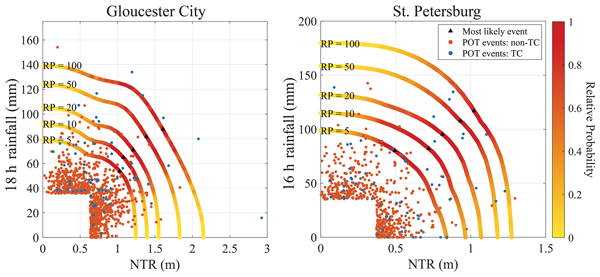
Pravin Maduwantha, Thomas Wahl, Sara Santamaria-Aguilar, Robert Jane, James F. Booth, Hanbeen Kim, and Gabriele Villarini
Nat. Hazards Earth Syst. Sci., 24, 4091–4107, https://doi.org/10.5194/nhess-24-4091-2024, https://doi.org/10.5194/nhess-24-4091-2024, 2024
Short summary
Short summary
When assessing the likelihood of compound flooding, most studies ignore that it can arise from different storm types with distinct statistical characteristics. Here, we present a new statistical framework that accounts for these differences and shows how neglecting these can impact the likelihood of compound flood potential.
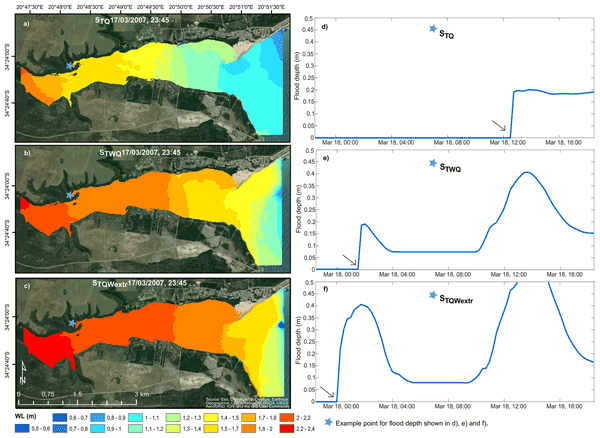
Sunna Kupfer, Sara Santamaria-Aguilar, Lara van Niekerk, Melanie Lück-Vogel, and Athanasios T. Vafeidis
Nat. Hazards Earth Syst. Sci., 22, 187–205, https://doi.org/10.5194/nhess-22-187-2022, https://doi.org/10.5194/nhess-22-187-2022, 2022
Short summary
Short summary
In coastal regions, flooding can occur from combined tides, storms, river discharge, and waves. Effects of waves are commonly neglected when assessing flooding, although these may strongly contribute to extreme water levels. We find that waves combined with tides and river discharge at Breede Estuary, South Africa, increased flood extent and depth and caused earlier flooding than when waves were neglected. This highlights the need to consider all major flood drivers in future flood assessments.
Robert Jane, Thomas Wahl, Pravin Maduwantha, and Gabriele Villarini
EGUsphere, https://doi.org/10.5194/egusphere-2026-5872, https://doi.org/10.5194/egusphere-2026-5872, 2026
This preprint is open for discussion and under review for Natural Hazards and Earth System Sciences (NHESS).
Short summary
Short summary
Rainfall and coastal flooding often occur together because they're driven by the same storms. In New Jersey's Mullica River watershed, tropical storms show higher but more spatially variable rainfall–surge correlations and contribute more to yearly flood risk than non-tropical storms. A simulation method using basin-average rainfall showed some bias, particularly for tropical storms, and underestimated tide-driven water levels.
Angel Amores, Roberto Alcaraz, Marta Marcos, Philip Thompson, Ariadna Martín, and Thomas Wahl
EGUsphere, https://doi.org/10.5194/egusphere-2026-5073, https://doi.org/10.5194/egusphere-2026-5073, 2026
This preprint is open for discussion and under review for Natural Hazards and Earth System Sciences (NHESS).
Short summary
Short summary
Coastal sea level records are short, full of gaps and often affected by instrument faults, which limits the study of extreme events and of how they are changing. We trained a neural network on these records to rebuild hourly sea level at 373 coastal sites worldwide, from 1940 to the present, driven mainly by weather data. It reproduces the observed sea level down to the largest storm surges, extends the records back in time, and can also flag faulty stretches in the measurements themselves.
Pravin Maduwantha, Thomas Wahl, Sara Santamaria-Aguilar, Robert Jane, Sönke Dangendorf, Hanbeen Kim, and Gabriele Villarini
Hydrol. Earth Syst. Sci., 30, 401–420, https://doi.org/10.5194/hess-30-401-2026, https://doi.org/10.5194/hess-30-401-2026, 2026
Short summary
Short summary
Compound flooding occurs when multiple drivers, such as heavy rain and storm surge, occur simultaneously. Comprehensive compound flood risk assessments require simulating many storm events using flood models, but such historical data are limited. To address this, we developed a statistical framework to generate large numbers of synthetic yet realistic storm events for use in compound flood modeling.
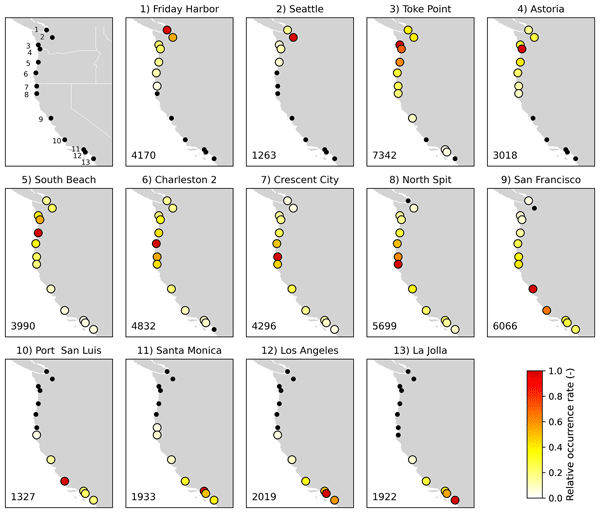
Huazhi Li, Robert A. Jane, Dirk Eilander, Alejandra R. Enríquez, Toon Haer, and Philip J. Ward
Nat. Hazards Earth Syst. Sci., 26, 391–409, https://doi.org/10.5194/nhess-26-391-2026, https://doi.org/10.5194/nhess-26-391-2026, 2026
Short summary
Short summary
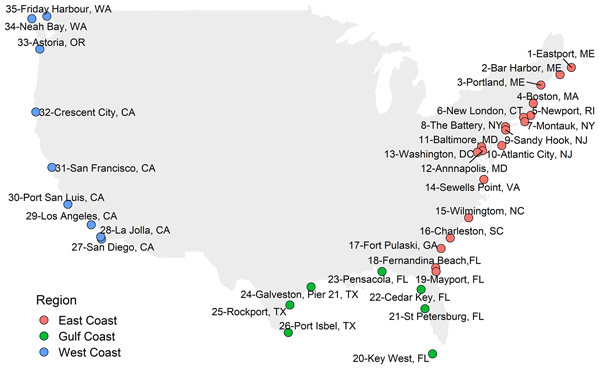
We assess the likelihood of widespread compound flooding along the U.S. coastline. Using a large set of generated plausible events preserving observed dependence, we find that nearly half of compound floods on the West coast affect multiple sites. Such events are rarer on the East coast while most compound events affect single sites on the Gulf coast. Our results underscore the importance of including spatial dependence in compound flood risk assessment and can help in better risk management.
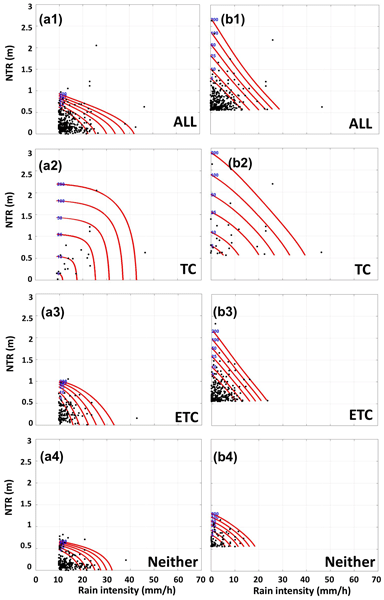
Ziyu Chen, Philip M. Orton, James F. Booth, Thomas Wahl, Arthur DeGaetano, Joel Kaatz, and Radley M. Horton
Hydrol. Earth Syst. Sci., 29, 3101–3117, https://doi.org/10.5194/hess-29-3101-2025, https://doi.org/10.5194/hess-29-3101-2025, 2025
Short summary
Short summary
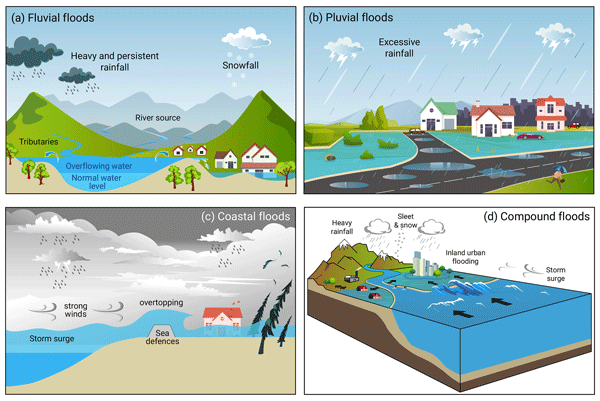
Urban flooding can be driven by rain and storm surge or the combination of the two, which is called compound flooding. In this study, we analyzed hourly historical rain and surge data for New York City to provide a more detailed statistical analysis than prior studies of this topic. The analyses reveal that tropical cyclones (e.g., hurricanes) have potential for causing more extreme compound floods than other storms, while extratropical cyclones cause less extreme, more frequent compound events.
Joshua Green, Ivan D. Haigh, Niall Quinn, Jeff Neal, Thomas Wahl, Melissa Wood, Dirk Eilander, Marleen de Ruiter, Philip Ward, and Paula Camus
Nat. Hazards Earth Syst. Sci., 25, 747–816, https://doi.org/10.5194/nhess-25-747-2025, https://doi.org/10.5194/nhess-25-747-2025, 2025
Short summary
Short summary
Compound flooding, involving the combination or successive occurrence of two or more flood drivers, can amplify flood impacts in coastal/estuarine regions. This paper reviews the practices, trends, methodologies, applications, and findings of coastal compound flooding literature at regional to global scales. We explore the types of compound flood events, their mechanistic processes, and the range of terminology. Lastly, this review highlights knowledge gaps and implications for future practices.
Pravin Maduwantha, Thomas Wahl, Sara Santamaria-Aguilar, Robert Jane, James F. Booth, Hanbeen Kim, and Gabriele Villarini
Nat. Hazards Earth Syst. Sci., 24, 4091–4107, https://doi.org/10.5194/nhess-24-4091-2024, https://doi.org/10.5194/nhess-24-4091-2024, 2024
Short summary
Short summary
When assessing the likelihood of compound flooding, most studies ignore that it can arise from different storm types with distinct statistical characteristics. Here, we present a new statistical framework that accounts for these differences and shows how neglecting these can impact the likelihood of compound flood potential.
Sönke Dangendorf, Qiang Sun, Thomas Wahl, Philip Thompson, Jerry X. Mitrovica, and Ben Hamlington
Earth Syst. Sci. Data, 16, 3471–3494, https://doi.org/10.5194/essd-16-3471-2024, https://doi.org/10.5194/essd-16-3471-2024, 2024
Short summary
Short summary
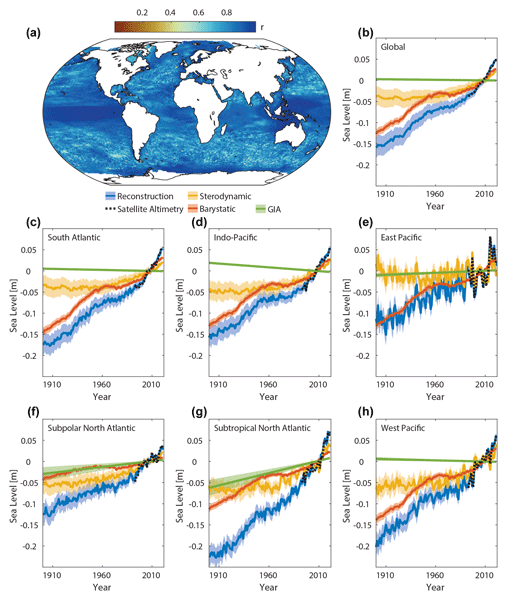
Sea-level information from the global ocean is sparse in time and space, with comprehensive data being limited to the period since 2005. Here we provide a novel reconstruction of sea level and its contributing causes, as determined by a Kalman smoother approach applied to tide gauge records over the period 1900–2021. The new reconstruction shows a continuing acceleration in global mean sea-level rise since 1970 that is dominated by melting land ice. Contributors vary significantly by region.
Simon Treu, Sanne Muis, Sönke Dangendorf, Thomas Wahl, Julius Oelsmann, Stefanie Heinicke, Katja Frieler, and Matthias Mengel
Earth Syst. Sci. Data, 16, 1121–1136, https://doi.org/10.5194/essd-16-1121-2024, https://doi.org/10.5194/essd-16-1121-2024, 2024
Short summary
Short summary
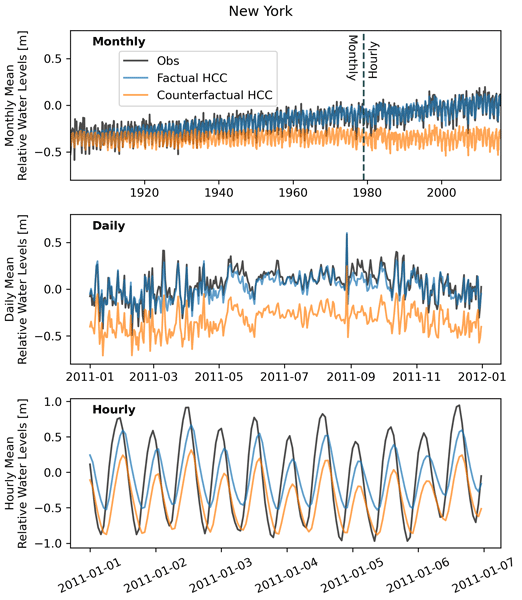
This article describes a reconstruction of monthly coastal water levels from 1900–2015 and hourly data from 1979–2015, both with and without long-term sea level rise. The dataset is based on a combination of three datasets that are focused on different aspects of coastal water levels. Comparison with tide gauge records shows that this combination brings reconstructions closer to the observations compared to the individual datasets.
Katherine L. Towey, James F. Booth, Alejandra Rodriguez Enriquez, and Thomas Wahl
Nat. Hazards Earth Syst. Sci., 22, 1287–1300, https://doi.org/10.5194/nhess-22-1287-2022, https://doi.org/10.5194/nhess-22-1287-2022, 2022
Short summary
Short summary
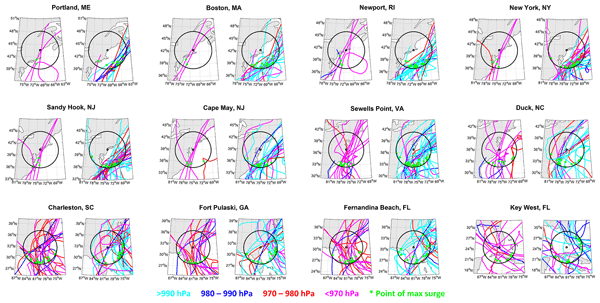
Coastal flooding due to storm surge from tropical cyclones is a significant hazard. The influence of tropical cyclone characteristics, including its proximity, intensity, path angle, and speed, on the magnitude of storm surge is examined along the eastern United States. No individual characteristic was found to be strongly related to how much surge occurred at a site, though there is an increased likelihood of high surge occurring when tropical cyclones are both strong and close to a location.
Sunna Kupfer, Sara Santamaria-Aguilar, Lara van Niekerk, Melanie Lück-Vogel, and Athanasios T. Vafeidis
Nat. Hazards Earth Syst. Sci., 22, 187–205, https://doi.org/10.5194/nhess-22-187-2022, https://doi.org/10.5194/nhess-22-187-2022, 2022
Short summary
Short summary
In coastal regions, flooding can occur from combined tides, storms, river discharge, and waves. Effects of waves are commonly neglected when assessing flooding, although these may strongly contribute to extreme water levels. We find that waves combined with tides and river discharge at Breede Estuary, South Africa, increased flood extent and depth and caused earlier flooding than when waves were neglected. This highlights the need to consider all major flood drivers in future flood assessments.
Ahmed A. Nasr, Thomas Wahl, Md Mamunur Rashid, Paula Camus, and Ivan D. Haigh
Hydrol. Earth Syst. Sci., 25, 6203–6222, https://doi.org/10.5194/hess-25-6203-2021, https://doi.org/10.5194/hess-25-6203-2021, 2021
Short summary
Short summary
We analyse dependences between different flooding drivers around the USA coastline, where the Gulf of Mexico and the southeastern and southwestern coasts are regions of high dependence between flooding drivers. Dependence is higher during the tropical season in the Gulf and at some locations on the East Coast but higher during the extratropical season on the West Coast. The analysis gives new insights on locations, driver combinations, and the time of the year when compound flooding is likely.
Cited articles
Alfonso, L., Mukolwe, M. M., and Di Baldassarre, G.: Probabilistic Flood Maps to support decision-making: Mapping the Value of Information, Water Resour Res, 52, 1026–1043, https://doi.org/10.1002/2015WR017378, 2016.
Baer, J. A.: Design storms underestimate flood hazard and risk derived from the stochastic storm transposition, Chapel Hill, 56 pp., https://doi.org/10.17615/72je-4t92, 2025.
Bartlett, M. S., Geldner, N., Cobell, Z., Partida, L., Diaz, O., Johnson, D. R., Kim, H., McMann, B., Villarini, G., Misra, S., Roberts, H. J., and Narayanaswamy, M.: Extending the Joint Probability Method to Compound Flooding: Statistical Delineation of Transition Zones and Design Event Selection, Water Resources Research, preprint, 2025.
Bates, P. D., Horritt, M. S., Aronica, G., and Beven, K.: Bayesian updating of flood inundation likelihoods conditioned on flood extent data, Hydrol Process, 18, 3347–3370, https://doi.org/10.1002/hyp.1499, 2004.
Bates, P. D., Dawson, R. J., Hall, J. W., Horritt, M. S., Nicholls, R. J., and Wicks, J.: Simplified two-dimensional numerical modelling of coastal flooding and example applications, Coastal Engineering, 52, 793–810, https://doi.org/10.1016/j.coastaleng.2005.06.001, 2005.
Codiga, D. L.: Unified Tidal Analysis and Prediction Using the UTide Matlab Functions, 59 pp., https://doi.org/10.13140/RG.2.1.3761.2008, 2011.
Cosby, A. G., Lebakula, V., Smith, C. N., Wanik, D. W., Bergene, K., Rose, A. N., Swanson, D., and Bloom, D. E.: Accelerating growth of human coastal populations at the global and continent levels: 2000–2018, Sci Rep, 14, 1–10, https://doi.org/10.1038/s41598-024-73287-x, 2024.
Couasnon, A., Sebastian, A., and Morales-Nápoles, O.: A Copula-based bayesian network for modeling compound flood hazard from riverine and coastal interactions at the catchment scale: An application to the houston ship channel, Texas, Water (Switzerland), 10, https://doi.org/10.3390/w10091190, 2018.
Danielson, J. J., Poppenga, S. K., Brock, J. C., Evans, G. A., Tyler, D. J., Gesch, D. B., Thatcher, C. A., and Barras, J. A.: Topobathymetric elevation model development using a new methodology: Coastal national elevation database, J. Coast. Res., 76, 75–89, https://doi.org/10.2112/SI76-008, 2016.
Dawson, R. J., Hall, J. W., Bates, P. D., and Nicholls, R. J.: Quantified analysis of the probability of flooding in the Thames estuary under imaginable worst-case Sea Level Rise scenarios, Int J Water Resour Dev, 21, 577–591, https://doi.org/10.1080/07900620500258380, 2005.
Di Baldassarre, G., Schumann, G., Bates, P. D., Freer, J. E., and Beven, K. J.: Flood-plain mapping: a critical discussion of deterministic and probabilistic approaches, Hydrological Sciences Journal, 55, 364–376, https://doi.org/10.1080/02626661003683389, 2010.
Dullaart, J. C. M., Muis, S., de Moel, H., Ward, P. J., Eilander, D., and Aerts, J. C. J. H.: Enabling dynamic modelling of coastal flooding by defining storm tide hydrographs, Nat. Hazards Earth Syst. Sci., 23, 1847–1862, https://doi.org/10.5194/nhess-23-1847-2023, 2023.
Enriquez, A. R., Wahl, T., Baranes, H. E., Talke, S. A., Orton, P., Booth, J. F., and Haigh, I. D.: Predictable changes in extreme sea levels and coastal flood risk due to long-term tidal.pdf, J Geophys Res Oceans, 127, https://doi.org/10.1029/2021JC018157, 2022.
FEMA: Flood Risk Report Camden County Coastal Project Area, New Jersey, Federal Emergency Management Agency (FEMA), U.S. Department of Homeland Security, FRR_Coastal_34007, https://msc.fema.gov/portal/downloadProduct?productTypeID=FLOOD_RISK_PRODUCT&productSubTypeID=FLOOD_RISK_REPORT&productID=FRR_Coastal_34007 (last access: 12 November 2024), 2016.
FEMA (F. E. M. A.): Guidance for Flood Risk Analysis and Mapping Superseded, FRM_Coastal_34007, https://msc.fema.gov/portal/downloadProduct?productTypeID=FLOOD_RISK_PRODUCT&productSubTypeID=FLOOD_RISK_MAP&productID=FRM_Coastal_34007 (last access: 12 November 2024), 2022.
Gori, A. and Lin, N.: Projecting Compound Flood Hazard Under Climate Change With Physical Models and Joint Probability Methods, Earths Future, 10, https://doi.org/10.1029/2022EF003097, 2022.
Gori, A., Lin, N., and Xi, D.: Tropical Cyclone Compound Flood Hazard Assessment: From Investigating Drivers to Quantifying Extreme Water Levels, Earths Future, 8, https://doi.org/10.1029/2020EF001660, 2020.
Gouldby, B., Méndez, F. J. J., Guanche, Y., Rueda, A., and Mínguez, R.: A methodology for deriving extreme nearshore sea conditions for structural design and flood risk analysis, Coastal Engineering, 88, 15–26, https://doi.org/10.1016/j.coastaleng.2014.01.012, 2014.
Grimley, L. E., Sebastian, A., and Gori, A.: Emerging Importance of Compound Flooding in Future Tropical Cyclone Hazard Profiles, Earth's Future preprint, 2025.
Haigh, I. D., Eliot, M., and Pattiaratchi, C.: Global influences of the 18.61 year nodal cycle and 8.85 year cycle of lunar perigee on high tidal levels, J Geophys Res Oceans, 116, 1–16, https://doi.org/10.1029/2010JC006645, 2011.
Helgeson, C., Auermuller, L., Bennett Gayle, D., Dangendorf, S., Gilmore, E. A., Keller, K., Kopp, R. E., Lorenzo-Trueba, J., Oppenheimer, M., Parrish, K., Ramenzoni, V., Tuana, N., and Wahl, T.: Exploratory Scoping of Place-Based Opportunities for Convergence Research, Earth's Futur., 13, 14, https://doi.org/10.1029/2024EF004908, 2025.
Hino, M. and Nance, E.: Five ways to ensure flood-risk research helps the most vulnerable, Nature, 595, 27–29, https://doi.org/10.1038/d41586-021-01750-0, 2021.
IPCC: Special report of the intergovernmental panel on climate change managing the risks of extreme events and disasters to advance climate change adaptation, NY, USA, https://doi.org/10.1017/CBO9781139177245, 2012.
Jane, R., Cadavid, L., Obeysekera, J., and Wahl, T.: Multivariate statistical modelling of the drivers of compound flood events in south Florida, Nat. Hazards Earth Syst. Sci., 20, 2681–2699, https://doi.org/10.5194/nhess-20-2681-2020, 2020.
Jane, R. A., Malagón-Santos, V., Rashid, M. M., Doebele, L., Wahl, T., Timmers, S. R., Serafin, K. A., Schmied, L., and Lindemer, C.: A Hybrid Framework for Rapidly Locating Transition Zones: A Comparison of Event- and Response-Based Return Water Levels in the Suwannee River FL, Water Resour Res, 58, https://doi.org/10.1029/2022WR032481, 2022.
Kim, H., Villarini, G., Jane, R., Wahl, T., Misra, S., and Michalek, A.: On the generation of high-resolution probabilistic design events capturing the.pdf, International Journal of Climatology, 43, 761–771, https://doi.org/10.1002/joc.7825, 2023.
Kitzmiller, D. H., Wu, W., Zhang, Z., Patrick, N., and Tan, X.: The Analysis of Record for Calibration: A High-Resolution Precipitation and Surface Weather Dataset for the United States, AGU Fall Meeting Abstracts, H41H-06, 2018.
Kupfer, S., MacPherson, L. R., Hinkel, J., Arns, A., and Vafeidis, A. T.: A Comprehensive Probabilistic Flood Assessment Accounting for Hydrograph Variability of ESL Events, J Geophys Res Oceans, 129, https://doi.org/10.1029/2023JC019886, 2024. Lehman, W.: FEMA's Future of Flood Risk Data Initiative, 1–6 pp., https://agu.confex.com/agu/fm18/meetingapp.cgi/Paper/390693 (last access: 4 October 2024), 2023.
Leijnse, T., van Ormondt, M., Nederhoff, K., and van Dongeren, A.: Modeling compound flooding in coastal systems using a computationally efficient reduced-physics solver: Including fluvial, pluvial, tidal, wind- and wave-driven processes, Coastal Engineering, 163, https://doi.org/10.1016/j.coastaleng.2020.103796, 2021.
Lucey, J. T. D. and Gallien, T. W.: Quantifying compound flood event uncertainties in a wave and tidally dominated coastal region: The impacts of copula selection, sampling, record length, and precipitation gauge selection, J Flood Risk Manag, 17, https://doi.org/10.1111/jfr3.12984, 2024.
Maduwantha, P.: Synthetic compound storm event generation using copula-based non-tidal residual–rainfall modeling (Version v1), Zenodo [code], https://doi.org/10.5281/zenodo.18216090, 2026.
Maduwantha, P., Wahl, T., Santamaria-Aguilar, S., Jane, R., Booth, J. F., Kim, H., and Villarini, G.: A multivariate statistical framework for mixed storm types in compound flood analysis, Nat. Hazards Earth Syst. Sci., 24, 4091–4107, https://doi.org/10.5194/nhess-24-4091-2024, 2024.
Maduwantha, P., Wahl, T., Santamaria-Aguilar, S., Jane, R., Dangendorf, S., Kim, H., and Villarini, G.: Generating Boundary Conditions for Compound Flood Modeling in a Probabilistic Framework, EGUsphere [preprint], https://doi.org/10.5194/egusphere-2025-1557, 2025.
McKeon, K. and Piecuch, C. G.: Compound Minor Floods and the Role of Discharge in the Delaware River Estuary, J Geophys Res Oceans, 130, https://doi.org/10.1029/2024JC021716, 2025.
Merz, B., Blöschl, G., Jüpner, R., Kreibich, H., Schröter, K., and Vorogushyn, S.: Invited perspectives: safeguarding the usability and credibility of flood hazard and risk assessments, Nat. Hazards Earth Syst. Sci., 24, 4015–4030, https://doi.org/10.5194/nhess-24-4015-2024, 2024.
Moftakhari, H., Schubert, J. E., AghaKouchak, A., Matthew, R. A., and Sanders, B. F.: Linking statistical and hydrodynamic modeling for compound flood hazard assessment in tidal channels and estuaries, Adv Water Resour, 128, 28–38, https://doi.org/10.1016/j.advwatres.2019.04.009, 2019.
Molinari, D., De Bruijn, K. M., Castillo-Rodríguez, J. T., Aronica, G. T., and Bouwer, L. M.: Validation of flood risk models: Current practice and possible improvements, International Journal of Disaster Risk Reduction, 33, 441–448, https://doi.org/10.1016/j.ijdrr.2018.10.022, 2019.
NCEI (N. N. C. for E. I.): U.S. Billion-Dollar Weather and Climate Disasters, https://doi.org/10.25921/stkw-7w73, 2024.
Nederhoff, K., Leijnse, T. W. B., Parker, K., Thomas, J., O'Neill, A., van Ormondt, M., McCall, R., Erikson, L., Barnard, P. L., Foxgrover, A., Klessens, W., Nadal-Caraballo, N. C., and Massey, T. C.: Tropical or extratropical cyclones: what drives the compound flood hazard, impact, and risk for the United States Southeast Atlantic coast?, Natural Hazards, 120, 8779–8825, https://doi.org/10.1007/s11069-024-06552-x, 2024.
New Jersey Department of Environmental Protection, Bureau of Geographic Information Systems: 11 Digit Hydrologic Unit Code delineations for New Jersey, New Jersey Department of Environmental Protection Open Data Portal [data set], https://gisdata-njdep.opendata.arcgis.com/datasets/02599a9424254a4ea33e689941559e3c_17 (last access: 31 March 2023), 2021.
New Jersey Department of Environmental Protection, Division of Information Technology, Bureau of Geographic Information Systems: Land Use/Land Cover of New Jersey 2015 (Edition 20201225), New Jersey Department of Environmental Protection Open Data Portal [data set], https://gisdata-njdep.opendata.arcgis.com/documents/njdep::land-use-land-cover-of-new-jersey-2015-download/about (last access: 7 February 2023), 2020.
Peña, F., Obeysekera, J., Jane, R., Nardi, F., Maran, C., Cadogan, A., de Groen, F., and Melesse, A.: Investigating compound flooding in a low elevation coastal karst environment using multivariate statistical and 2D hydrodynamic modeling, Weather Clim Extrem, 39, https://doi.org/10.1016/j.wace.2022.100534, 2023.
Perez, G., Coon, E. T., Rathore, S. S., and Le, P. V. V.: Advancing process-based flood frequency analysis for assessing flood hazard and population flood exposure, J Hydrol (Amst), 639, 131620, https://doi.org/10.1016/j.jhydrol.2024.131620, 2024.
Ponte, R. M., Carson, M., Cirano, M., Domingues, C. M., Jevrejeva, S., Marcos, M., Mitchum, G., van de Wal, R. S. W., Woodworth, P. L., Ablain, M., Ardhuin, F., Ballu, V., Becker, M., Benveniste, J., Birol, F., Bradshaw, E., Cazenave, A., De Mey-Frémaux, P., Durand, F., Ezer, T., Fu, L. L., Fukumori, I., Gordon, K., Gravelle, M., Griffies, S. M., Han, W., Hibbert, A., Hughes, C. W., Idier, D., Kourafalou, V. H., Little, C. M., Matthews, A., Melet, A., Merrifield, M., Meyssignac, B., Minobe, S., Penduff, T., Picot, N., Piecuch, C., Ray, R. D., Rickards, L., Santamaría-Gómez, A., Stammer, D., Staneva, J., Testut, L., Thompson, K., Thompson, P., Vignudelli, S., Williams, J., Simon, S. D., Wöppelmann, G., Zanna, L., and Zhang, X.: Towards comprehensive observing and modeling systems for monitoring and predicting regional to coastal sea level, Front Mar Sci, 6, 1–25, https://doi.org/10.3389/fmars.2019.00437, 2019.
Quinn, N., Lewis, M., Wadey, M. P., and Haigh, I. D. D.: Assessing the temporal variability in extreme storm-tide time series for coastal flood risk assessment, J Geophys Res Oceans, 119, 4983–4998, https://doi.org/10.1002/2014JC010197, 2014.
Salvadori, G., De Michele, C., and Durante, F.: On the return period and design in a multivariate framework, Hydrol. Earth Syst. Sci., 15, 3293–3305, https://doi.org/10.5194/hess-15-3293-2011, 2011.
Santamaria-Aguilar, S.: SFINCS Model Files for Gloucester City, NJ, US, Zenodo, https://doi.org/10.5281/zenodo.14251309, 2024.
Santamaria-Aguilar, S.: Compound flood simulations for 5000 Compound events for Gloucester City (NJ) Part 1, Zenodo [data set], https://doi.org/10.5281/zenodo.15047845, 2025a.
Santamaria-Aguilar, S.: Compound flood simulations for 5000 Compound events for Gloucester City (NJ) Part 2, Zenodo [data set], https://doi.org/10.5281/zenodo.15065555, 2025b.
Santamaria-Aguilar, S., Arns, A., and Vafeidis, A. T. A. T.: Sea-level rise impacts on the temporal and spatial variability of extreme water levels: A case study for St. Peter-Ording, Germany, J Geophys Res Oceans, 122, 1–22, https://doi.org/10.1002/2016JC012579, 2017.
Sebastian, A., Bader, D. J., Nederhoff, C. M., Leijnse, T. W. B., Bricker, J. D., and Aarninkhof, S. G. J.: Hindcast of pluvial, fluvial, and coastal flood damage in Houston, Texas during Hurricane Harvey (2017) using SFINCS, Natural Hazards, 109, 2343–2362, https://doi.org/10.1007/s11069-021-04922-3, 2021.
Smith, C.: Regional Flooding Study. Phase 1 Final Report, internal report, 2023.
Taherkhani, M., Vitousek, S., Barnard, P. L., Frazer, N., Anderson, T. R., and Fletcher, C. H.: Sea-level rise exponentially increases coastal flood frequency, Sci Rep, 10, https://doi.org/10.1038/s41598-020-62188-4, 2020.
Thompson, P. R., Widlansky, M. J., Hamlington, B. D., Merrifield, M. A., Marra, J. J., Mitchum, G. T., and Sweet, W.: Rapid increases and extreme months in projections of United States high-tide flooding, Nat Clim Chang, 11, https://doi.org/10.1038/s41558-021-01077-8, 2021.
USACE: HEC-RAS River Analysis System Creating Land Cover, Manning ' s N Values, And % Impervious, U.S. Army Corps of Engineers, Hydrologic Engineering Center (HEC), https://www.hec.usace.army.mil/confluence/rasdocs/r2dum/6.6/developing-aterrain-model-and-geospatial-layers/creating-land-cover-mannings-n-values-and-impervious-layers (last access: 13 March 2023), 2021.
U.S. Geological Survey, Earth Resources Observation and Science (EROS) Center: Coastal National Elevation Database (CoNED) topobathymetric elevation data, U.S. Geological Survey Data Release [data set], https://www.usgs.gov/special-topics/coastal-national-elevation-database-applications-project/data (last access: 9 January 2023), 2018.
Vousdoukas, M. I., Voukouvalas, E., Mentaschi, L., Dottori, F., Giardino, A., Bouziotas, D., Bianchi, A., Salamon, P., and Feyen, L.: Developments in large-scale coastal flood hazard mapping, Natural Hazards and Earth System Sciences, 16, 1841–1853, https://doi.org/10.5194/nhess-16-1841-2016, 2016.
Wadey, M. P., Cope, S. N., Nicholls, R. J., McHugh, K., Grewcock, G., and Mason, T.: Coastal flood analysis and visualisation for a small town, Ocean Coast Manag, 116, 237–247, https://doi.org/10.1016/j.ocecoaman.2015.07.028, 2015.
Wahl, T., Jain, S., Bender, J., Meyers, S. D., and Luther, M. E.: Increasing risk of compound flooding from storm surge and rainfall for major US cities, Nat Clim Chang, 5, 1093–1097, https://doi.org/10.1038/nclimate2736, 2015.
Wing, O. E. J., Bates, P. D., Quinn, N. D., Savage, J. T. S., Uhe, P. F., Cooper, A., Collings, T. P., Addor, N., Lord, N. S., Hatchard, S., Hoch, J. M., Bates, J., Probyn, I., Himsworth, S., Rodríguez González, J., Brine, M. P., Wilkinson, H., Sampson, C. C., Smith, A. M., Neal, J. C., and Haigh, I. D.: A 30 m Global Flood Inundation Model for Any Climate Scenario, Water Resour Res, 60, https://doi.org/10.1029/2023WR036460, 2024.
Winter, B., Schneeberger, K., Förster, K., and Vorogushyn, S.: Event generation for probabilistic flood risk modelling: multi-site peak flow dependence model vs. weather-generator-based approach, Nat. Hazards Earth Syst. Sci., 20, 1689–1703, https://doi.org/10.5194/nhess-20-1689-2020, 2020.
Short summary
Traditional flood assessments use an event-based approach, assuming flood risk matches the chance of flood drivers. However, flooding also depends on topography and the spatio-temporal features of events. The response-based approach uses many events to estimate flood hazard directly. In Gloucester City (NJ, U.S.), we find that frequent events can cause rare (1 %) flood levels due to their spatio-temporal characteristics. Including these factors is key for accurate flood hazard estimates.
Traditional flood assessments use an event-based approach, assuming flood risk matches the...


Altmetrics
Final-revised paper
Preprint