
Articles | Volume 26, issue 10
https://doi.org/10.5194/nhess-26-4843-2026
© Author(s) 2026. This work is distributed under
the Creative Commons Attribution 4.0 License.
the Creative Commons Attribution 4.0 License.
https://doi.org/10.5194/nhess-26-4843-2026
© Author(s) 2026. This work is distributed under
the Creative Commons Attribution 4.0 License.
the Creative Commons Attribution 4.0 License.
Research article
| 
06 Oct 2026
Research article |
| 06 Oct 2026
| 06 Oct 2026
Simulation of sliding deadwood logs in mountain forests: towards a quantitative hazard assessment

WSL Institute for Snow and Avalanche Research SLF, Davos, Switzerland
Climate change, Extreme events and natural hazards in mountain regions Research Centre CERC, Davos, Switzerland
Institute for Geotechnical Engineering, ETH Zurich, Zurich, Switzerland
Peter Bebi
WSL Institute for Snow and Avalanche Research SLF, Davos, Switzerland
Climate change, Extreme events and natural hazards in mountain regions Research Centre CERC, Davos, Switzerland
Leon J. Bührle
WSL Institute for Snow and Avalanche Research SLF, Davos, Switzerland
Climate change, Extreme events and natural hazards in mountain regions Research Centre CERC, Davos, Switzerland
Department of Natural Hazards, Austrian Research Centre for Forests (BFW), Innsbruck, Austria
Adrian Ringenbach
WSL Institute for Snow and Avalanche Research SLF, Davos, Switzerland
Climate change, Extreme events and natural hazards in mountain regions Research Centre CERC, Davos, Switzerland
Institute of Terrestrial Ecosystems, ETH Zurich, Zurich, Switzerland
Remco I. Leine
Institute for Nonlinear Mechanics, University of Stuttgart, Stuttgart, Germany
Related authors
Aaron Cremona, Matthias Huss, Johannes Marian Landmann, Joël Borner, and Daniel Farinotti
The Cryosphere, 17, 1895–1912, https://doi.org/10.5194/tc-17-1895-2023, https://doi.org/10.5194/tc-17-1895-2023, 2023
Short summary
Short summary
Summer heat waves have a substantial impact on glacier melt as emphasized by the extreme summer of 2022. This study presents a novel approach for detecting extreme glacier melt events at the regional scale based on the combination of automatically retrieved point mass balance observations and modelling approaches. The in-depth analysis of summer 2022 evidences the strong correspondence between heat waves and extreme melt events and demonstrates their significance for seasonal melt.
Leon J. Bührle, Mauro Marty, Lucie A. Eberhard, Andreas Stoffel, Elisabeth D. Hafner, and Yves Bühler
The Cryosphere, 17, 3383–3408, https://doi.org/10.5194/tc-17-3383-2023, https://doi.org/10.5194/tc-17-3383-2023, 2023
Short summary
Short summary
Information on the snow depth distribution is crucial for numerous applications in high-mountain regions. However, only specific measurements can accurately map the present variability of snow depths within complex terrain. In this study, we show the reliable processing of images from aeroplane to large (> 100 km2) detailed and accurate snow depth maps around Davos (CH). We use these maps to describe the existing snow depth distribution, other special features and potential applications.
Adrian Ringenbach, Peter Bebi, Perry Bartelt, Andreas Rigling, Marc Christen, Yves Bühler, Andreas Stoffel, and Andrin Caviezel
Earth Surf. Dynam., 11, 779–801, https://doi.org/10.5194/esurf-11-779-2023, https://doi.org/10.5194/esurf-11-779-2023, 2023
Short summary
Short summary
Swiss researchers carried out repeated rockfall experiments with rocks up to human sizes in a steep mountain forest. This study focuses mainly on the effects of the rock shape and lying deadwood. In forested areas, cubic-shaped rocks showed a longer mean runout distance than platy-shaped rocks. Deadwood especially reduced the runouts of these cubic rocks. The findings enrich standard practices in modern rockfall hazard zoning assessments and strongly urge the incorporation of rock shape effects.
Aaron Cremona, Matthias Huss, Johannes Marian Landmann, Joël Borner, and Daniel Farinotti
The Cryosphere, 17, 1895–1912, https://doi.org/10.5194/tc-17-1895-2023, https://doi.org/10.5194/tc-17-1895-2023, 2023
Short summary
Short summary
Summer heat waves have a substantial impact on glacier melt as emphasized by the extreme summer of 2022. This study presents a novel approach for detecting extreme glacier melt events at the regional scale based on the combination of automatically retrieved point mass balance observations and modelling approaches. The in-depth analysis of summer 2022 evidences the strong correspondence between heat waves and extreme melt events and demonstrates their significance for seasonal melt.

Adrian Ringenbach, Peter Bebi, Perry Bartelt, Andreas Rigling, Marc Christen, Yves Bühler, Andreas Stoffel, and Andrin Caviezel
Earth Surf. Dynam., 10, 1303–1319, https://doi.org/10.5194/esurf-10-1303-2022, https://doi.org/10.5194/esurf-10-1303-2022, 2022
Short summary
Short summary
The presented automatic deadwood generator (ADG) allows us to consider deadwood in rockfall simulations in unprecedented detail. Besides three-dimensional fresh deadwood cones, we include old woody debris in rockfall simulations based on a higher compaction rate and lower energy absorption thresholds. Simulations including different deadwood states indicate that a 10-year-old deadwood pile has a higher protective capacity than a pre-storm forest stand.
Adrian Ringenbach, Elia Stihl, Yves Bühler, Peter Bebi, Perry Bartelt, Andreas Rigling, Marc Christen, Guang Lu, Andreas Stoffel, Martin Kistler, Sandro Degonda, Kevin Simmler, Daniel Mader, and Andrin Caviezel
Nat. Hazards Earth Syst. Sci., 22, 2433–2443, https://doi.org/10.5194/nhess-22-2433-2022, https://doi.org/10.5194/nhess-22-2433-2022, 2022
Short summary
Short summary
Forests have a recognized braking effect on rockfalls. The impact of lying deadwood, however, is mainly neglected. We conducted 1 : 1-scale rockfall experiments in three different states of a spruce forest to fill this knowledge gap: the original forest, the forest including lying deadwood and the cleared area. The deposition points clearly show that deadwood has a protective effect. We reproduced those experimental results numerically, considering three-dimensional cones to be deadwood.
Yves Bühler, Peter Bebi, Marc Christen, Stefan Margreth, Lukas Stoffel, Andreas Stoffel, Christoph Marty, Gregor Schmucki, Andrin Caviezel, Roderick Kühne, Stephan Wohlwend, and Perry Bartelt
Nat. Hazards Earth Syst. Sci., 22, 1825–1843, https://doi.org/10.5194/nhess-22-1825-2022, https://doi.org/10.5194/nhess-22-1825-2022, 2022
Short summary
Short summary
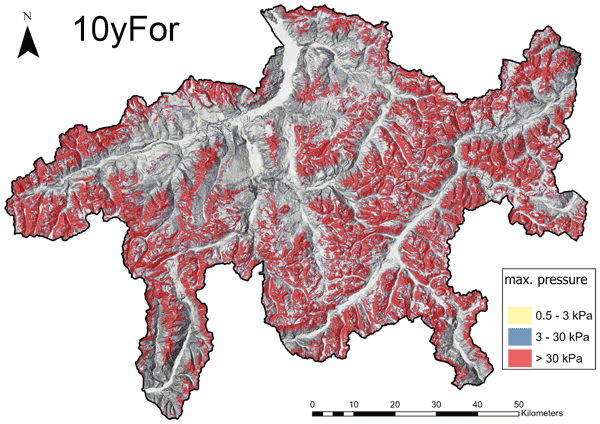
To calculate and visualize the potential avalanche hazard, we develop a method that automatically and efficiently pinpoints avalanche starting zones and simulate their runout for the entire canton of Grisons. The maps produced in this way highlight areas that could be endangered by avalanches and are extremely useful in multiple applications for the cantonal authorities, including the planning of new infrastructure, making alpine regions more safe.
Natalie Brožová, Tommaso Baggio, Vincenzo D'Agostino, Yves Bühler, and Peter Bebi
Nat. Hazards Earth Syst. Sci., 21, 3539–3562, https://doi.org/10.5194/nhess-21-3539-2021, https://doi.org/10.5194/nhess-21-3539-2021, 2021
Short summary
Short summary
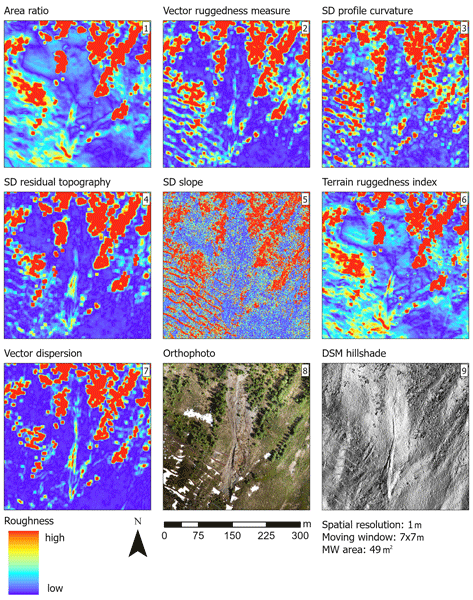
Surface roughness plays a great role in natural hazard processes but is not always well implemented in natural hazard modelling. The results of our study show how surface roughness can be useful in representing vegetation and ground structures, which are currently underrated. By including surface roughness in natural hazard modelling, we could better illustrate the processes and thus improve hazard mapping, which is crucial for infrastructure and settlement planning in mountainous areas.
Cited articles
Abegg, M., Ahles, P., Allgaier Leuch, B., Cioldi, F., Didion, M., Düggelin, C., Fischer, C., Herold, A., Meile, R., Rohner, B., Rösler, E., Speich, S., Temperli, C., and Traub, B.: Swiss national forest inventory – Result table No. 2314378, Swiss Federal Research Institute WSL, https://doi.org/10.21258/1950026, 2023a. a
Abegg, M., Ahles, P., Allgaier Leuch, B., Cioldi, F., Didion, M., Düggelin, C., Fischer, C., Herold, A., Meile, R., Rohner, B., Rösler, E., Speich, S., Temperli, C., and Traub, B.: Swiss national forest inventory – Result table No. 1382008, Swiss Federal Research Institute WSL, https://doi.org/10.21258/1815384, 2023b. a
Acary, V. and Brogliato, B.: Numerical methods for nonsmooth dynamical systems, Lecture notes in applied and computational mechanics, 2008 edition, Springer, https://doi.org/10.1007/978-3-540-75392-6, 2008. a
Acary, V., Bonnefon, O., Brémond, M., Huber, O., Pérignon, F., and Sinclair, S.: An introduction to Siconos, Technical Report RT-0340, INRIA, https://inria.hal.science/inria-00162911 (last access: 30 September 2026), 2019. a
Agliardi, F. and Crosta, G.: High resolution three-dimensional numerical modelling of rockfalls, Int. J. Rock Mech. Min., 40, 455–471, https://doi.org/10.1016/S1365-1609(03)00021-2, 2003. a
Ammann, M.: Schutzwirkung abgestorbener Bäume gegen Naturgefahren, PhD thesis, ETH Zurich, https://doi.org/10.3929/ETHZ-A-005268444, 2006. a, b
Andrew, R., Hume, H., Bartingale, R., Rock, A., and Zhang, R.: CRSP-3D user's manual – Colorado Rockfall Simulation Program, Colorado Geological Survey, https://coloradogeologicalsurvey.org/publications/colorado-rockfall-simulation-program/ (last access: 30 September 2026), 2012. a
Baggio, T., Brožová, N., Bast, A., Bebi, P., and D'Agostino, V.: Novel indices for snow avalanche protection assessment and monitoring of wind-disturbed forests, Ecol. Eng., 181, 106677, https://doi.org/10.1016/j.ecoleng.2022.106677, 2022. a
Barbeito, I., Dawes, M. A., Rixen, C., Senn, J., and Bebi, P.: Factors driving mortality and growth at treeline: a 30-year experiment of 92 000 conifers, Ecology, 93, 389–401, https://doi.org/10.1890/11-0384.1, 2012. a
Bardelli, T., Ascher-Jenull, J., Burkia Stocker, E., Fornasier, F., Arfaioli, P., Fravolini, G., Alves Medeiros, L. R., Egli, M., Pietramellara, G., Insam, H., and Gómez-Brandón, M.: Impact of slope exposure on chemical and microbiological properties of Norway spruce deadwood and underlying soil during early stages of decomposition in the Italian Alps, CATENA, 167, 100–115, https://doi.org/10.1016/j.catena.2018.04.031, 2018. a
Bast, A., Hobi, M., Ginzler, C., Piermattei, L., Fischer, C., Nikolova, P. S., Bührle, L., and Kalt, T.: Individual Detected Trees, EnviDat [data set], https://doi.org/10.16904/envidat.696, 2025a. a
Bast, A., Hobi, M. L., Ginzler, C., Piermattei, L., Fischer, C., Nikolova, P. S., Bührle, L. J., Kalt, T., and Graf, F.: An approach to detect and map forest canopy layers in Swiss mountain forests using nationwide airborne laser scanning data, Int. J. Appl. Earth Obs., 145, 104986, https://doi.org/10.1016/j.jag.2025.104986, 2025b. a, b
Bebi, P., Putallaz, J.-M., Fankhauser, M., Schmid, U., Schwitter, R., and Gerber, W.: Die Schutzfunktion in Windwurfflächen, Schweizerische Zeitschrift fur Forstwesen, 166, 168–176, https://doi.org/10.3188/szf.2015.0168, 2015. a
Borner, J., Bührle, L., Ringenbach, A., and Bebi, P.: Sliding Deadwood Geometry Generator, EnviDat [data set], https://doi.org/10.16904/envidat.770, 2026. a
Bourrier, F., Dorren, L., and Berger, F.: Full scale field tests on rockfall impacting trees felled transverse to the slope, in: 12th Congress INTERPRAEVENT 2012, p. 8, Grenoble, France, https://hal.inrae.fr/hal-02597700 (last access: 30 September 2026), 2012. a
Bührle, L. J., Kalt, T., Bebi, P., Teich, M., Hobi, M. L., Bast, A., Schrott, R., Helzel, K., Temperli, C., Bont, L. G., Blattert, C., Schweier, J., and Bottero, A.: Regional disturbance predisposition assessment to support management in Norway spruce-dominated mountain forests, Forest Ecol. Manag., 611, 123636, https://doi.org/10.1016/j.foreco.2026.123636, 2026. a, b
Caduff, M. E., Brožová, N., Kupferschmid, A. D., Krumm, F., and Bebi, P.: How large-scale bark beetle infestations influence the protective effects of forest stands against avalanches: A case study in the Swiss Alps, Forest Ecol. Manag., 514, 120201, https://doi.org/10.1016/j.foreco.2022.120201, 2022. a, b, c
Christen, M., Bühler, Y., Bartelt, P., Leine, R., Glover, J., Schweizer, A., and Volkwein, A.: Integral hazard management using a unified software environment. Numerical simulation tool “RAMMS” for gravitational natural hazards, in: 12th Congress INTERPRAEVENT 2012, Grenoble, France, Conference proceedings “Protection of living space from natural hazards”, edited by: Koboltschnig, G., Hübl, J., and Braun, J., 77–86, ISBN: 978-3-901164-19-4, 2012. a
Costa, M., Marchi, N., Bettella, F., Bolzon, P., Berger, F., and Lingua, E.: Biological legacies and rockfall: The protective effect of a windthrown forest, Forests, 12, https://doi.org/10.3390/f12091141, 2021. a, b
Coumans, E. and Bai, Y.: PyBullet, a Python module for physics simulation for games, robotics and machine learning, GitHub, https://github.com/bulletphysics/bullet3, 2016–2020. a
Dalponte, M., Reyes, F., Kandare, K., and Gianelle, D.: Delineation of individual tree crowns from ALS and hyperspectral data: a comparison among four methods, Eur. J. Remote Sens., 48, 365–382, https://doi.org/10.5721/EuJRS20154821, 2015. a
Dorren, L.: Rockyfor3D (v6.0) revealed – Transparent description of the complete 3D rockfall model, ecorisQ manual, ecorisQ, https://www.ecorisq.org (last access: 30 September 2026), 2024. a
Edelmann, P., Weisser, W. W., Ambarlı, D., Bässler, C., Buscot, F., Hofrichter, M., Hoppe, B., Kellner, H., Minnich, C., Moll, J., Persoh, D., Seibold, S., Seilwinder, C., Schulze, E.-D., Wöllauer, S., and Borken, W.: Regional variation in deadwood decay of 13 tree species: Effects of climate, soil and forest structure, Forest Ecol. Manag., 541, 121094, https://doi.org/10.1016/j.foreco.2023.121094, 2023. a
Feistl, T., Bebi, P., Teich, M., Bühler, Y., Christen, M., Thuro, K., and Bartelt, P.: Observations and modeling of the braking effect of forests on small and medium avalanches, J. Glaciol., 60, 124–138, https://doi.org/10.3189/2014JoG13J055, 2014. a
Fuhr, M., Bourrier, F., and Cordonnier, T.: Protection against rockfall along a maturity gradient in mountain forests, Forest Ecol. Manag., 354, 224–231, https://doi.org/10.1016/j.foreco.2015.06.012, 2015. a
Getzner, M., Gutheil-Knopp-Kirchwald, G., Kreimer, E., Kirchmeir, H., and Huber, M.: Gravitational natural hazards: Valuing the protective function of alpine forests, Forest Policy Econ., 80, 150–159, https://doi.org/10.1016/j.forpol.2017.03.015, 2017. a
Gossner, M. M., Wende, B., Levick, S., Schall, P., Floren, A., Linsenmair, K. E., Steffan-Dewenter, I., Schulze, E.-D., and Weisser, W. W.: Deadwood enrichment in European forests – Which tree species should be used to promote saproxylic beetle diversity?, Biol. Conserv., 201, 92–102, https://doi.org/10.1016/j.biocon.2016.06.032, 2016. a
Harmon, M., Franklin, J., Swanson, F., Sollins, P., Gregory, S., Lattin, J., Anderson, N., Cline, S., Aumen, N., Sedell, J., Lienkaemper, G., Cromack, K., and Cummins, K.: Ecology of coarse woody debris in temperate ecosystems, in: Advances in Ecological Research, vol. 15 of Advances in Ecological Research, Academic Press, 133–302, https://doi.org/10.1016/S0065-2504(08)60121-X, 1986. a
Herrmann, S., Kahl, T., and Bauhus, J.: Decomposition dynamics of coarse woody debris of three important central european tree species, Forest Ecosystems, 2, https://doi.org/10.1186/s40663-015-0052-5, 2015. a
Holeksa, J., Zielonka, T., and Żywiec, M.: Modeling the decay of coarse woody debris in a subalpine Norway spruce forest of the West Carpathians, Poland, Can. J. Forest Res., 38, 415–428, https://doi.org/10.1139/X07-139, 2008. a
Kemper, J. T. and Scamardo, J.: Snow avalanches as a driver of large wood dynamics in mountain streams, Geophys. Res. Lett., 50, 1–11, https://doi.org/10.1029/2023GL106355, 2023. a
Lachat, T., Brang, P., Bolliger, M., Bollmann, K., Brändli, U.-B., Bütler, R., Herrmann, S., Schneider, O., and Wermelinger, B.: Totholz im Wald: Entstehung, Bedeutung und Förderung, Merkblatt für die Praxis, 52, Swiss Federal Research Institute WSL, ISSN: 2296-4428, 2014. a
Leine, R. I. and van de Wouw, N.: Stability and Convergence of Mechanical Systems with Unilateral Constraints, Lecture Notes in Applied and Computational Mechanics, Springer Berlin Heidelberg, ISBN 9783540769750, https://doi.org/10.1007/978-3-540-76975-0, 2008. a, b
Leine, R. I., Schweizer, A., Christen, M., Glover, J., Bartelt, P., and Gerber, W.: Simulation of rockfall trajectories with consideration of rock shape, Multibody Syst. Dyn., 32, 241–271, https://doi.org/10.1007/s11044-013-9393-4, 2014. a, b, c, d
Leverkus, A. B., Polo, I., Baudoux, C., Thorn, S., Gustafsson, L., and Rubio de Casas, R.: Resilience impacts of a secondary disturbance: Meta-analysis of salvage logging effects on tree regeneration, J. Ecol., 109, 3224–3232, https://doi.org/10.1111/1365-2745.13581, 2021. a
Lu, G., Ringenbach, A., Caviezel, A., Sanchez, M., Christen, M., and Bartelt, P.: Mitigation effects of trees on rockfall hazards: does rock shape matter?, Landslides, 18, 59–77, https://doi.org/10.1007/s10346-020-01418-2, 2021. a
Marangon, D., Betetto, C., Wohlgemuth, T., Cadez, L., Alberti, G., Tomelleri, E., and Lingua, E.: Impact of salvage logging on short-term natural regeneration in montane forests of the Alps after large windthrow events, Forest Ecol. Manag., 567, 122085, https://doi.org/10.1016/j.foreco.2024.122085, 2024. a
Maser, C. and Trappe, J. M.: The seen and unseen world of the fallen tree, General Technical Report PNW-GTR-164, U.S. Department of Agriculture, Forest Service, Pacific Northwest Forest and Range Experiment Station, https://doi.org/10.2737/PNW-GTR-164, 1984. a
May, C. L. and Gresswell, R. E.: Large wood recruitment and redistribution in headwater streams in the southern Oregon coast range, USA, Can. J. Forest Res., 33, 1352–1362, https://doi.org/10.1139/x03-023, 2003. a
Mayer, M., Rosinger, C., Gorfer, M., Berger, H., Deltedesco, E., Bässler, C., Müller, J., Seifert, L., Rewald, B., and Godbold, D. L.: Surviving trees and deadwood moderate changes in soil fungal communities and associated functioning after natural forest disturbance and salvage logging, Soil Biology and Biochemistry, 166, 108558, https://doi.org/10.1016/j.soilbio.2022.108558, 2022. a
Moos, C., Dorren, L., and Stoffel, M.: Quantifying the effect of forests on frequency and intensity of rockfalls, Nat. Hazards Earth Syst. Sci., 17, 291–304, https://doi.org/10.5194/nhess-17-291-2017, 2017. a
Noël, F., Cloutier, C., Jaboyedoff, M., and Locat, J.: Impact-Detection Algorithm That Uses Point Clouds as Topographic Inputs for 3D Rockfall Simulations, Geosciences, 11, https://doi.org/10.3390/geosciences11050188, 2021. a
Oberle, B., Milo, A. M., Myers, J. A., Walton, M. L., Young, D. F., and Zanne, A. E.: Direct estimates of downslope deadwood movement over 30 years in a temperature forest illustrate impacts of treefall on forest ecosystem dynamics, Can. J. Forest Res., 46, 351–361, https://doi.org/10.1139/cjfr-2015-0348, 2016. a
Olmedo Manich, I.: Felled trees as rockfall protection devices: Experimental and numerical studies for design purposes, Theses, INSA de Lyon, https://doi.org/10.70675/b09b0561z2d0fz4887z8171zbed7af26793d, 2015. a
Olschewski, R., Bebi, P., Teich, M., Wissen Hayek, U., and Grêt-Regamey, A.: Avalanche protection by forests – A choice experiment in the Swiss alps, Forest Policy Econ., 15, 108–113, https://doi.org/10.1016/j.forpol.2011.10.002, 2012. a
Perez, S. B., Fraterrigo, J. M., and Dalling, J. W.: Interspecific wood trait variation predicts decreased carbon residence time in changing forests, Funct. Ecol., 36, 674–685, https://doi.org/10.1111/1365-2435.13936, 2022. a
Petrillo, M., Cherubini, P., Fravolini, G., Marchetti, M., Ascher-Jenull, J., Schärer, M., Synal, H.-A., Bertoldi, D., Camin, F., Larcher, R., and Egli, M.: Time since death and decay rate constants of Norway spruce and European larch deadwood in subalpine forests determined using dendrochronology and radiocarbon dating, Biogeosciences, 13, 1537–1552, https://doi.org/10.5194/bg-13-1537-2016, 2016. a
Piazza, N., Bebi, P., Vacchiano, G., Rigling, A., Wohlgemuth, T., and Bottero, A.: Post-windthrow forest development in spruce-dominated mountain forests in Central Europe, Forest Ecol. Manag., 561, 121884, https://doi.org/10.1016/j.foreco.2024.121884, 2024. a
Plath, E. and Fischer, K.: Spruce dieback as chance for biodiversity: Standing deadwood promotes beetle diversity in post-disturbance stands in western Germany, J. Insect Conserv., 28, 525–537, https://doi.org/10.1007/s10841-024-00571-6, 2024. a
Rackelmann, F., Sebesvari, Z., and Bell, R.: Synergies and trade-offs in the management objectives forest health and flood risk reduction, Frontiers in Forests and Global Change, 6, https://doi.org/10.3389/ffgc.2023.1208032, 2023. a
Rammig, A., Fahse, L., Bebi, P., and Bugmann, H.: Wind disturbance in mountain forests: Simulating the impact of management strategies, seed supply, and ungulate browsing on forest succession, Forest Ecol. Manag., 242, 142–154, https://doi.org/10.1016/j.foreco.2007.01.036, 2007. a
Ringenbach, A., Bebi, P., Bartelt, P., Rigling, A., Christen, M., Bühler, Y., Stoffel, A., and Caviezel, A.: Modeling deadwood for rockfall mitigation assessments in windthrow areas, Earth Surf. Dynam., 10, 1303–1319, https://doi.org/10.5194/esurf-10-1303-2022, 2022a. a
Ringenbach, A., Stihl, E., Bühler, Y., Bebi, P., Bartelt, P., Rigling, A., Christen, M., Lu, G., Stoffel, A., Kistler, M., Degonda, S., Simmler, K., Mader, D., and Caviezel, A.: Full-scale experiments to examine the role of deadwood in rockfall dynamics in forests, Nat. Hazards Earth Syst. Sci., 22, 2433–2443, https://doi.org/10.5194/nhess-22-2433-2022, 2022b. a
Ringenbach, A., Bebi, P., Bartelt, P., Rigling, A., Christen, M., Bühler, Y., Stoffel, A., and Caviezel, A.: Shape still matters: rockfall interactions with trees and deadwood in a mountain forest uncover a new facet of rock shape dependency, Earth Surf. Dynam., 11, 779–801, https://doi.org/10.5194/esurf-11-779-2023, 2023. a, b
Rocscience Inc.: RocFall3: Rigid-body dynamics theory manual, Rocscience Inc., https://www.rocscience.com/help/rocfall3/verification-theory/theory-manuals (last access: 10 December 2025), 2024. a
Schönenberger, W., Noack, A., and Thee, P.: Effect of timber removal from windthrow slopes on the risk of snow avalanches and rockfall, Forest Ecol. Manag., 213, 197–208, https://doi.org/10.1016/j.foreco.2005.03.062, 2005. a, b
Seidl, R., Thom, D., Kautz, M., Martin-Benito, D., Peltoniemi, M., Vacchiano, G., Wild, J., Ascoli, D., Petr, M., Honkaniemi, J., Lexer, M. J., Trotsiuk, V., Mairota, P., Svoboda, M., Fabrika, M., Nagel, T. A., and Reyer, C. P. O.: Forest disturbances under climate change, Nat. Clim. Change, 7, 395–402, https://doi.org/10.1038/nclimate3303, 2017. a, b
Stadelmann, G., Bugmann, H., Wermelinger, B., and Bigler, C.: Spatial interactions between storm damage and subsequent infestations by the European spruce bark beetle, Forest Ecol. Manag., 318, 167–174, https://doi.org/10.1016/j.foreco.2014.01.022, 2014. a
Studer, C. W.: Augmented Time-Stepping Integration of Non-Smooth Dynamical Systems, PhD thesis, ETH Zurich, https://doi.org/10.3929/ETHZ-A-005556821, 2008. a
Wermelinger, B.: Ecology and management of the spruce bark beetle Ips typographus – a review of recent research, Forest Ecol. Manag., 202, 67–82, https://doi.org/10.1016/j.foreco.2004.07.018, 2004. a
Yan, P., Zhang, J., Kong, X., and Fang, Q.: Numerical simulation of rockfall trajectory with consideration of arbitrary shapes of falling rocks and terrain, Comput. Geotech., 122, 103511, https://doi.org/10.1016/j.compgeo.2020.103511, 2020. a
Short summary
Deadwood supports biodiversity and contributes to the protective function of mountain forests, but under certain conditions it can itself become a hazard when sliding downslope. This study examines when and why sliding deadwood occurs and how far it can travel. Using a physics-based simulation model and forest data, we show that sliding is favoured by steep slopes, wet surfaces, and specific decay stages, helping identify where hazards can be reduced while preserving protective forest functions.
Deadwood supports biodiversity and contributes to the protective function of mountain forests,...


Altmetrics
Final-revised paper
Preprint