Articles | Volume 26, issue 9
https://doi.org/10.5194/nhess-26-4353-2026
Brief communication
 | 
08 Sep 2026
Brief communication |  | 08 Sep 2026

Brief communication: Keeping pace with human factors in avalanche decision-making – an update to the NHESS scoping review (2023–2026)

Audun Hetland, Olav K. Myksvoll, Tarjei Westerlund, Andrea Mannberg, and Rebecca A. Hetland
Abstract

We update our NHESS scoping review of human factors in avalanche decision-making to include 35 peer-reviewed studies published 1 January 2023–13 May 2026. The new studies concentrates in Decision-making strategies (9/35), with additions to Willingness to take risk (5/35), Population characteristics (4/35), Theory and Methods (5/35), Risk communication (3/35), Social factors and group decision-making (3/35), Risk perception (2/35), and Avalanche accidents (1/35), Motivation (1/35); Avalanche education (1/35), Experience (1/35), none in Biases. Methods and sampling resemble the baseline. We recommend causal identification, behavioral linkage, and group-level designs. Data and scripts are openly provided; this is a time-bounded snapshot with a defined cut-off.

Share
1 Introduction

Human exposure and choices remain central to avalanche risk. Our recent NHESS scoping review synthesized 70 peer-reviewed studies published by 31 December 2022, organizing a heterogeneous literature into 12 themes with a common codebook and open data. To maintain that reference as a living resource, we provide a time-bounded update through 13 May 2026, applying the identical protocol. The goals are to (i) report where growth occurred since 2022, (ii) flag where gaps persist, and (iii) suggest practical priorities for research, education, and operations.

2 Methods and data

Eligibility and scope followed the NHESS review: peer-reviewed English-language studies where human factors are central to risk assessment and/or decisions by individuals personally exposed in avalanche terrain (recreationists, guides, educators, patrollers, forecasters). We excluded rescue/medical-only, purely technical snow/terrain/forecasting, and operational risk management where the decision-maker is not personally exposed. “Ahead-of-print” items were included if DOI-assigned by the cut-off.

Information sources and search replicated the original multi-database strategy (Web of Science, Scopus, PsycInfo, Hospitality and Tourism Complete, ProQuest, ISSW proceedings; Google Scholar for scoping) using the unchanged two-bin Boolean logic (“human factor” × “avalanche”) on titles/abstracts/keywords. Deduplication, dual screening, and dual extraction followed the published protocol; studies were assigned up to three of the 12 themes and coded for methods, population, risk target, focus, and explanatory factors. The cut-off is 13 May 2026.

3 Results and discussion

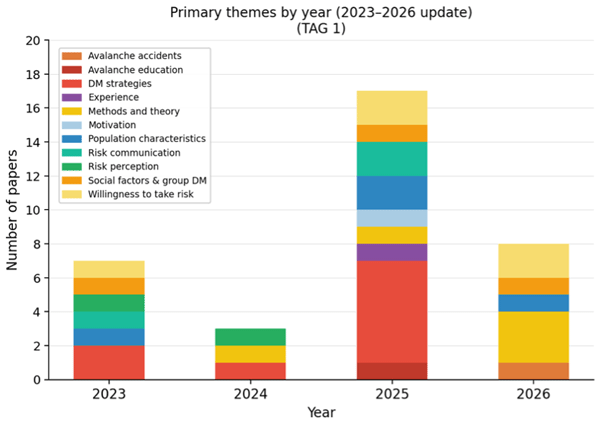
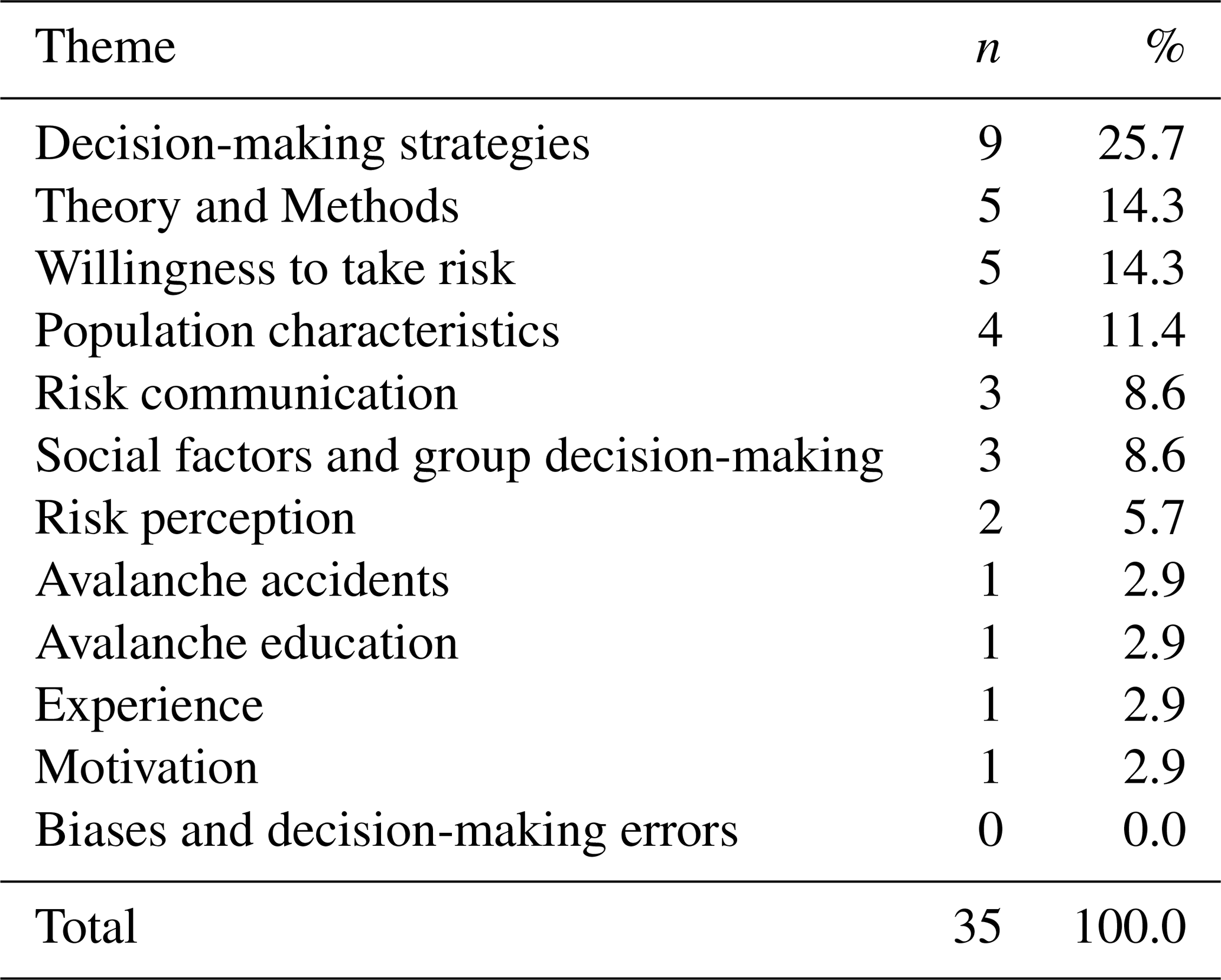
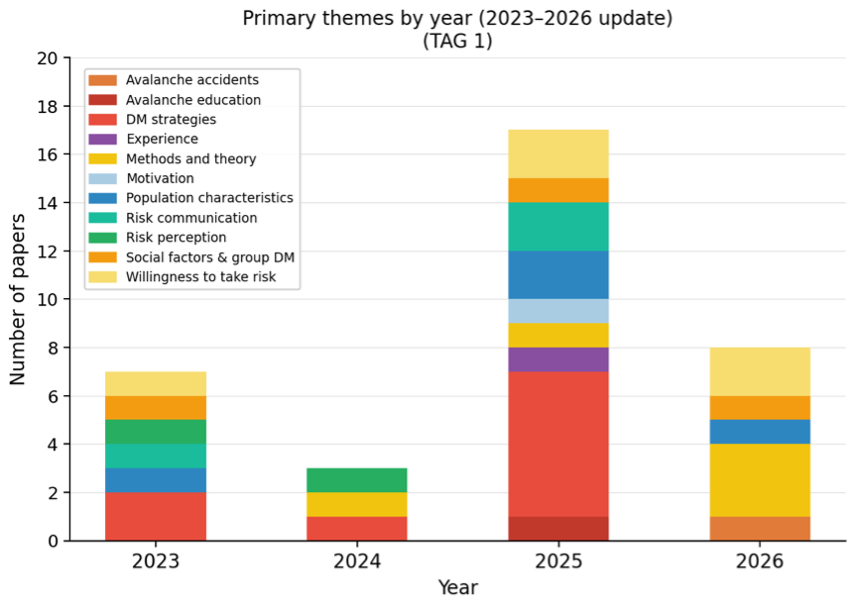
We identified 35 eligible peer-reviewed studies: 2023: 7, 2024: 3, 2025: 17, 2026: 8. Most additions appeared in 2025. Theme distribution (primary, TAG 1). Dominant: Decision-making strategies (9/35; 25.7 %). Additional primary themes: Theory and Methods (5/35; 14.3 %), Willingness to take risk (5/35; 14.3 %), Population characteristics (4/35; 11.4 %), Risk communication (3/35; 8.6 %), Social factors & group decision-making (3/35; 8.6 %), Risk perception (2/35; 5.7 %), and single instances of Avalanche accidents (1/35; 2.9 %), Avalanche education (1/35; 2.9 %), Experience (1/35; 2.9 %), and Motivation (1/35; 2.9 %). No papers were identified under Biases. Methods and sampling resemble the baseline. We recommend causal identification, behavioural linkage, and group-level designs. Data and scripts are openly provided; this is a time-bounded snapshot with a defined cut-off. A full overview of the papers including tags and codes can be found and downloaded through this link: https://osf.io/u9ydm/files/wrcj7 (last access: 4 August 2026). The list of all the 105 papers from the initial review and the current update can be found through this link: https://osf.io/u9ydm/files/4t9w3 (last access: 4 August 2026).

Table 1Primary Theme Distribution Across 35 Eligible Studies.

Note: n= number of studies assigned primary theme tag. Percentages are based on total eligible studies (N=35).

Download Print Version | Download XLSX

https://nhess.copernicus.org/articles/26/4353/2026/nhess-26-4353-2026-f01

Figure 1Primary themes spread by year of publication.

Download

4 Conclusions

Since 2022, human-factors papers in avalanche terrain have grown mainly in decision-process/strategy work and user characterization; biases and accident-centric analyses did not expand in this window. The methodological and sampling profile appears unchanged. Priorities are clear: causal designs, behavioral linkage, and group-level studies within a standardized measurement framework.

Data availability

All extraction sheets (themes, methods, populations, risk targets, focus), figures, and scripts are openly provided and will be versioned with additions beyond the cut-off (https://doi.org/10.17605/OSF.IO/U9YDM, Hetland et al., 2023, 2025).

Author contributions

Conceptualization: AH, RAH, AM; Methodology: RAH, AH; Screening/Extraction: OKM, AH; Analysis: AH, OKH, TW; Writing original draft: AH; Writing review and editing: all authors.

Competing interests

The contact author has declared that none of the authors has any competing interests.

Disclaimer

Publisher's note: Copernicus Publications remains neutral with regard to jurisdictional claims made in the text, published maps, institutional affiliations, or any other geographical representation in this paper. The authors bear the ultimate responsibility for providing appropriate place names. Views expressed in the text are those of the authors and do not necessarily reflect the views of the publisher.

Acknowledgements

We thank colleagues and coders who contributed to the 2025 scoping review and this update.

Financial support

This research has been supported by the NordForsk (grant no. 105061).

Review statement

This paper was edited by Sven Fuchs and reviewed by Benjamin Zweifel and Philip A. Ebert.

References

Hetland, A., Hetland, R., Westerlund, T., Myksvoll, O. K., and Mannberg, A.: Literature review data, extractions, codes and setup, OSF [data set], https://doi.org/10.17605/OSF.IO/U9YDM, 2023.  

Hetland, A., Hetland, R. A., Skille, T. T., and Mannberg, A.: Review article: A scoping review of human factors in avalanche decision-making, Nat. Hazards Earth Syst. Sci., 25, 929–948, https://doi.org/10.5194/nhess-25-929-2025, 2025. 

Download
Short summary
Every year, people are caught in avalanches they themselves triggered, and most had some safety training. This study asked what research has learned about how people make decisions in avalanche terrain. We reviewed 35 recent studies and found growth concentrated in decision strategies and methods, with cognitive bias research notably absent. The findings point toward causal research designs and field-based education that meets recreationists where they actually are in the mountains.
Share
Altmetrics
Final-revised paper
Preprint