Articles | Volume 26, issue 9
https://doi.org/10.5194/nhess-26-4353-2026
© Author(s) 2026. This work is distributed under
the Creative Commons Attribution 4.0 License.
https://doi.org/10.5194/nhess-26-4353-2026
© Author(s) 2026. This work is distributed under
the Creative Commons Attribution 4.0 License.
Brief communication: Keeping pace with human factors in avalanche decision-making – an update to the NHESS scoping review (2023–2026)

CARE (Center for Avalanche Research and Education), UiT The Arctic University of Norway, Tromsø, Norway
Department of Psychology, Faculty of Health Sciences, UiT The Arctic University of Norway, Tromsø, Norway
Olav K. Myksvoll
CARE (Center for Avalanche Research and Education), UiT The Arctic University of Norway, Tromsø, Norway
Department of Psychology, Faculty of Health Sciences, UiT The Arctic University of Norway, Tromsø, Norway
Tarjei Westerlund
CARE (Center for Avalanche Research and Education), UiT The Arctic University of Norway, Tromsø, Norway
Department of Psychology, Faculty of Health Sciences, UiT The Arctic University of Norway, Tromsø, Norway
Andrea Mannberg
CARE (Center for Avalanche Research and Education), UiT The Arctic University of Norway, Tromsø, Norway
School of Business and Economics, Faculty of Biosciences, Fisheries and Economics, UiT The Arctic University of Norway, Tromsø, Norway
Rebecca A. Hetland
Department of Community Medicine, Faculty of Health Sciences, UiT The Arctic University of Norway, Tromsø, Norway
Related authors
Audun Hetland, Rebecca A. Hetland, Tarjei Tveito Skille, and Andrea Mannberg
Nat. Hazards Earth Syst. Sci., 25, 929–948, https://doi.org/10.5194/nhess-25-929-2025, https://doi.org/10.5194/nhess-25-929-2025, 2025
Short summary
Short summary
Research on human factors in avalanche decision-making has become increasingly popular in the past 2 decades. The studies span a wide range of disciplines and are published in a variety of journals. To provide an overview of this literature, this study provides a systematic scoping review of human factors in avalanche decision-making. A total of 70 papers fulfilled the search criteria. We extracted data and sorted the papers according to their main themes.
Håvard B. Toft, John Sykes, Andrew Schauer, Jordy Hendrikx, and Audun Hetland
Nat. Hazards Earth Syst. Sci., 24, 1779–1793, https://doi.org/10.5194/nhess-24-1779-2024, https://doi.org/10.5194/nhess-24-1779-2024, 2024
Short summary
Short summary
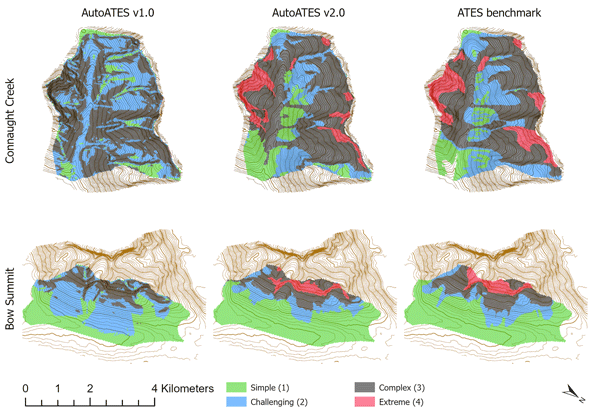
Manual Avalanche Terrain Exposure Scale (ATES) mapping is time-consuming and inefficient for large-scale applications. The updated algorithm for automated ATES mapping overcomes previous limitations by including forest density data, improving the avalanche runout estimations in low-angle runout zones, accounting for overhead exposure and open-source software. Results show that the latest version has significantly improved its performance.
Audun Hetland, Rebecca A. Hetland, Tarjei Tveito Skille, and Andrea Mannberg
Nat. Hazards Earth Syst. Sci., 25, 929–948, https://doi.org/10.5194/nhess-25-929-2025, https://doi.org/10.5194/nhess-25-929-2025, 2025
Short summary
Short summary
Research on human factors in avalanche decision-making has become increasingly popular in the past 2 decades. The studies span a wide range of disciplines and are published in a variety of journals. To provide an overview of this literature, this study provides a systematic scoping review of human factors in avalanche decision-making. A total of 70 papers fulfilled the search criteria. We extracted data and sorted the papers according to their main themes.
Håvard B. Toft, John Sykes, Andrew Schauer, Jordy Hendrikx, and Audun Hetland
Nat. Hazards Earth Syst. Sci., 24, 1779–1793, https://doi.org/10.5194/nhess-24-1779-2024, https://doi.org/10.5194/nhess-24-1779-2024, 2024
Short summary
Short summary
Manual Avalanche Terrain Exposure Scale (ATES) mapping is time-consuming and inefficient for large-scale applications. The updated algorithm for automated ATES mapping overcomes previous limitations by including forest density data, improving the avalanche runout estimations in low-angle runout zones, accounting for overhead exposure and open-source software. Results show that the latest version has significantly improved its performance.
Cited articles
Hetland, A., Hetland, R., Westerlund, T., Myksvoll, O. K., and Mannberg, A.: Literature review data, extractions, codes and setup, OSF [data set], https://doi.org/10.17605/OSF.IO/U9YDM, 2023.
Hetland, A., Hetland, R. A., Skille, T. T., and Mannberg, A.: Review article: A scoping review of human factors in avalanche decision-making, Nat. Hazards Earth Syst. Sci., 25, 929–948, https://doi.org/10.5194/nhess-25-929-2025, 2025.
Short summary
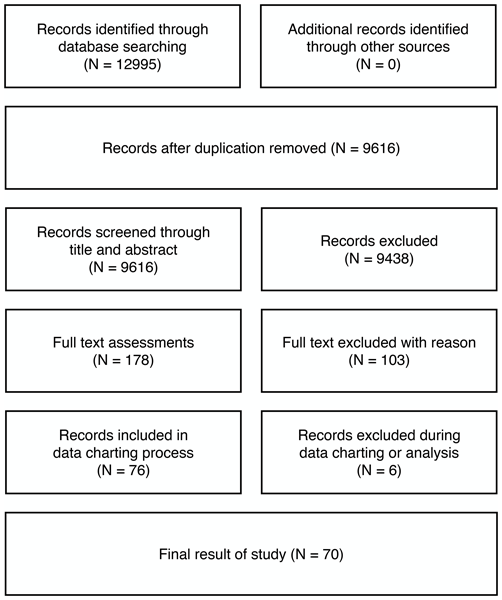
Every year, people are caught in avalanches they themselves triggered, and most had some safety training. This study asked what research has learned about how people make decisions in avalanche terrain. We reviewed 35 recent studies and found growth concentrated in decision strategies and methods, with cognitive bias research notably absent. The findings point toward causal research designs and field-based education that meets recreationists where they actually are in the mountains.
Every year, people are caught in avalanches they themselves triggered, and most had some safety...
Altmetrics
Final-revised paper
Preprint