
Articles | Volume 26, issue 4
https://doi.org/10.5194/nhess-26-1705-2026
© Author(s) 2026. This work is distributed under
the Creative Commons Attribution 4.0 License.
the Creative Commons Attribution 4.0 License.
https://doi.org/10.5194/nhess-26-1705-2026
© Author(s) 2026. This work is distributed under
the Creative Commons Attribution 4.0 License.
the Creative Commons Attribution 4.0 License.
Research article
| 
14 Apr 2026
Research article |
| 14 Apr 2026
| 14 Apr 2026
Quantifying fire effects on debris flow runout using a morphodynamic model and stochastic surrogates
Elaine T. Spiller
CORRESPONDING AUTHOR

Department of Mathematical and Statistical Sciences, Marquette University, Milwaukee, Wisconsin, USA
Luke A. McGuire
Department of Geosciences, University of Arizona, Tucson, Arizona, USA
Palak Patel
Data Intensive Studies Center, Tufts University, Medford, Massachusetts, USA
Abani Patra
Data Intensive Studies Center, Tufts University, Medford, Massachusetts, USA
E. Bruce Pitman
Department of Materials Design and Innovation, University at Buffalo, Buffalo, New York, USA
Related authors
Aidan Gettemy, Susan Minkoff, John Zweck, and Elaine Spiller
Wind Energ. Sci., 11, 3377–3400, https://doi.org/10.5194/wes-11-3377-2026, https://doi.org/10.5194/wes-11-3377-2026, 2026
Short summary
Short summary
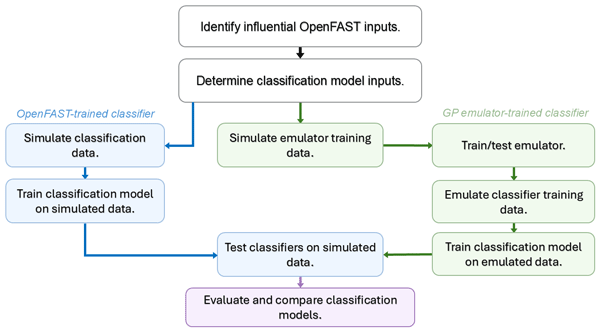
This study introduces a method for detecting wind turbine blade erosion by approximating the outputs from aerodynamic simulations with a Gaussian process emulator. Once trained, querying the emulator is essentially free, which enables the efficient generation of datasets for training damage classification models. This framework could provide an essential building block for constructing a digital twin for wind turbine condition monitoring.
Aidan Gettemy, Susan Minkoff, John Zweck, and Elaine Spiller
Wind Energ. Sci., 11, 3377–3400, https://doi.org/10.5194/wes-11-3377-2026, https://doi.org/10.5194/wes-11-3377-2026, 2026
Short summary
Short summary
This study introduces a method for detecting wind turbine blade erosion by approximating the outputs from aerodynamic simulations with a Gaussian process emulator. Once trained, querying the emulator is essentially free, which enables the efficient generation of datasets for training damage classification models. This framework could provide an essential building block for constructing a digital twin for wind turbine condition monitoring.
Tao Liu, Luke A. McGuire, Ann M. Youberg, Charles J. Abolt, and Adam L. Atchley
Nat. Hazards Earth Syst. Sci., 25, 4135–4151, https://doi.org/10.5194/nhess-25-4135-2025, https://doi.org/10.5194/nhess-25-4135-2025, 2025
Short summary
Short summary
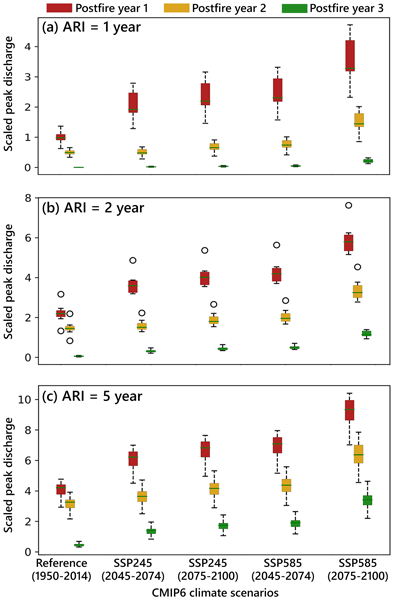
Wildfires increase flood risk by making it harder for soil to absorb water. We studied how this risk changes over time as the landscape recovers and how it will be affected by more intense rainfall due to climate change. Using a computer model of a burned watershed in Arizona, we found that while the soil's ability to soak up water recovers over a few years, future rainfall is predicted to be so intense that the period of high flood danger will last longer, making severe floods much more common.

Joseph P. Tulenko, Sophie A. Goliber, Renette Jones-Ivey, Justin Quinn, Abani Patra, Kristin Poinar, Sophie Nowicki, Beata M. Csatho, and Jason P. Briner
The Cryosphere, 19, 4327–4333, https://doi.org/10.5194/tc-19-4327-2025, https://doi.org/10.5194/tc-19-4327-2025, 2025
Short summary
Short summary
Ghub is an online platform that hosts tools, datasets, and educational resources related to ice sheet science. These resources are provided by ice sheet researchers and allow other researchers, students, educators, and interested members of the general public to analyze, visualize, and download datasets that researchers use to study past and present ice sheet behavior. We describe how users can interact with Ghub, showcase some available resources, and describe the future of the Ghub project.
Jon D. Pelletier, Robert G. Hayes, Olivia Hoch, Brendan Fenerty, and Luke A. McGuire
Earth Surf. Dynam., 13, 219–238, https://doi.org/10.5194/esurf-13-219-2025, https://doi.org/10.5194/esurf-13-219-2025, 2025
Short summary
Short summary
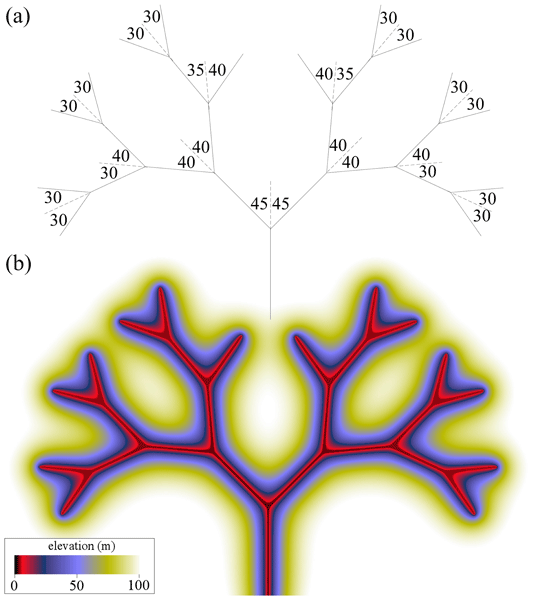
We demonstrate that landscapes with more planar initial conditions tend to have lower mean junction angles. Geomorphic processes on alluvial piedmonts result in especially planar initial conditions, consistent with a correlation between junction angles and the presence/absence of Late Cenozoic alluvial deposits and the constraint imposed by the intersection of planar approximations to the topography upslope from tributary junctions. We caution against using junction angles to infer paleoclimate.
Alexander B. Prescott, Luke A. McGuire, Kwang-Sung Jun, Katherine R. Barnhart, and Nina S. Oakley
Nat. Hazards Earth Syst. Sci., 24, 2359–2374, https://doi.org/10.5194/nhess-24-2359-2024, https://doi.org/10.5194/nhess-24-2359-2024, 2024
Short summary
Short summary
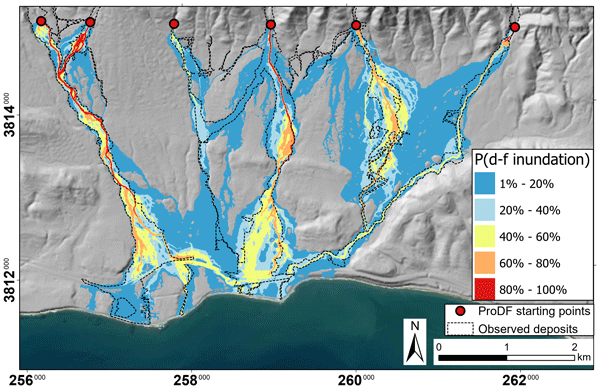
Fire can dramatically increase the risk of debris flows to downstream communities with little warning, but hazard assessments have not traditionally included estimates of inundation. We unify models developed by the scientific community to create probabilistic estimates of inundation area in response to rainfall at forecast lead times (≥ 24 h) needed for decision-making. This work takes an initial step toward a near-real-time postfire debris-flow inundation hazard assessment product.
Luke A. McGuire, Francis K. Rengers, Ann M. Youberg, Alexander N. Gorr, Olivia J. Hoch, Rebecca Beers, and Ryan Porter
Nat. Hazards Earth Syst. Sci., 24, 1357–1379, https://doi.org/10.5194/nhess-24-1357-2024, https://doi.org/10.5194/nhess-24-1357-2024, 2024
Short summary
Short summary
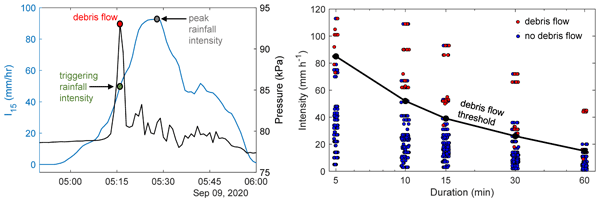
Runoff and erosion increase after fire, leading to a greater likelihood of floods and debris flows. We monitored debris flow activity following a fire in western New Mexico, USA, and observed 16 debris flows over a <2-year monitoring period. Rainstorms with recurrence intervals of approximately 1 year were sufficient to initiate debris flows. All debris flows initiated during the first several months following the fire, indicating a rapid decrease in debris flow susceptibility over time.
Luke A. McGuire, Scott W. McCoy, Odin Marc, William Struble, and Katherine R. Barnhart
Earth Surf. Dynam., 11, 1117–1143, https://doi.org/10.5194/esurf-11-1117-2023, https://doi.org/10.5194/esurf-11-1117-2023, 2023
Short summary
Short summary
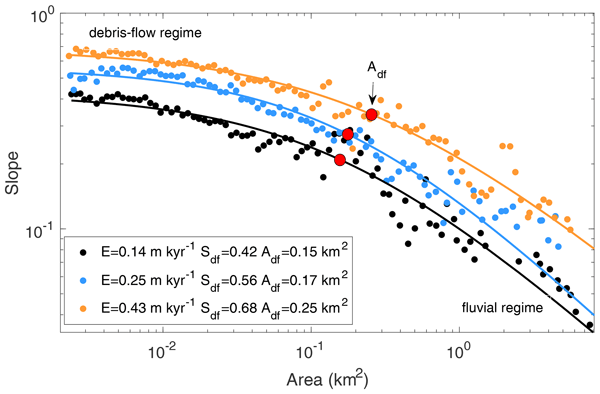
Debris flows are mixtures of mud and rocks that can travel at high speeds across steep landscapes. Here, we propose a new model to describe how landscapes are shaped by debris flow erosion over long timescales. Model results demonstrate that the shapes of channel profiles are sensitive to uplift rate, meaning that it may be possible to use topographic data from steep channel networks to infer how erosion rates vary across a landscape.

Francis K. Rengers, Luke A. McGuire, Katherine R. Barnhart, Ann M. Youberg, Daniel Cadol, Alexander N. Gorr, Olivia J. Hoch, Rebecca Beers, and Jason W. Kean
Nat. Hazards Earth Syst. Sci., 23, 2075–2088, https://doi.org/10.5194/nhess-23-2075-2023, https://doi.org/10.5194/nhess-23-2075-2023, 2023
Short summary
Short summary
Debris flows often occur after wildfires. These debris flows move water, sediment, and wood. The wood can get stuck in channels, creating a dam that holds boulders, cobbles, sand, and muddy material. We investigated how the channel width and wood length influenced how much sediment is stored. We also used a series of equations to back calculate the debris flow speed using the breaking threshold of wood. These data will help improve models and provide insight into future field investigations.
Tao Liu, Luke A. McGuire, Nina Oakley, and Forest Cannon
Nat. Hazards Earth Syst. Sci., 22, 361–376, https://doi.org/10.5194/nhess-22-361-2022, https://doi.org/10.5194/nhess-22-361-2022, 2022
Short summary
Short summary
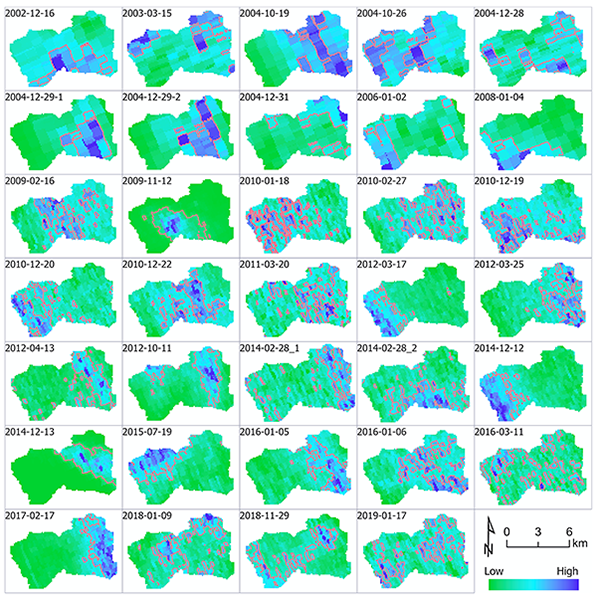
A well-constrained rainfall-runoff model forced by radar-derived precipitation is used to define rainfall intensity-duration (ID) thresholds for flash floods. The rainfall ID doubles in 5 years after a severe wildfire in a watershed in southern California, USA. Rainfall ID performs stably well for intense pulses of rainfall over durations of 30-60 minutes that cover at least 15%-25% of the watershed. This finding could help issuing flash flood warnings based on radar-derived precipitation.
Cited articles
Alessio, P., Dunne, T., and Morell, K.: Post-wildfire generation of debris-flow slurry by rill erosion on colluvial hillslopes, J. Geophys. Res.-Earth, 126, e2021JF006108, https://doi.org/10.1029/2021JF006108, 2021. a, b, c
Barnhart, K. R., Jones, R. P., George, D. L., McArdell, B. W., Rengers, F. K., Staley, D. M., and Kean, J. W.: Multi-model comparison of computed debris flow runout for the 9 January 2018 Montecito, California post-wildfire event, J. Geophys. Res.-Earth, 126, e2021JF006245, https://doi.org/10.1029/2021JF006245, 2021. a, b, c, d
Barnhart, K. R., Miller, C. R., Rengers, F. K., and Kean, J. W.: Evaluation of debris-flow building damage forecasts, Nat. Hazards Earth Syst. Sci., 24, 1459–1483, https://doi.org/10.5194/nhess-24-1459-2024, 2024. a
Bayarri, M. J., Berger, J. O., Calder, E. S., Dalbey, K., Lunagómez, S., Patra, A. K., Pitman, E. B., Spiller, E. T., and Wolpert, R. L.: Using Statistical and Computer Models to Quantify Volcanic Hazards, Technometrics, 51, 402–413, https://doi.org/10.1198/TECH.2009.08018, 2009. a
Bayarri, M. J., Berger, J. O., Calder, E. S., Patra, A. K., Pitman, E. B., Spiller, E. T., and Wolpert, R. L.: A Methodology for Quantifying Volcanic Hazards, International Journal of Uncertainty Quantification, 5, 297–325, https://doi.org/10.1615/Int.J.UncertaintyQuantification.2015011451, 2015. a, b
Bennett, G., Molnar, P., McArdell, B., and Burlando, P.: A probabilistic sediment cascade model of sediment transfer in the Illgraben, Water Resour. Res., 50, 1225–1244, https://doi.org/10.1002/2013WR013806, 2014. a
Berger, J. O. and Smith, L. A.: On the statistical formalism of uncertainty quantification, Annu. Rev. Stat. Appl., 6, 433–460, https://doi.org/10.1146/annurev-statistics-030718-105232, 2019. a
Coe, J. A., Kinner, D. A., and Godt, J. W.: Initiation conditions for debris flows generated by runoff at Chalk Cliffs, central Colorado, Geomorphology, 96, 270–297, https://doi.org/10.1016/j.geomorph.2007.03.017, 2008. a
Conedera, M., Peter, L., Marxer, P., Forster, F., Rickenmann, D., and Re, L.: Consequences of forest fires on the hydrogeological response of mountain catchments: a case study of the Riale Buffaga, Ticino, Switzerland, Earth Surf. Proc. Land., 28, 117–129, https://doi.org/10.1002/esp.425, 2003. a
Currin, C., Mitchell, T., Morris, M., and Ylvisaker, D.: A Bayesian approach to the design and analysis of computer experiments, Tech. rep., Oak Ridge National Laboratory, Oak Ridge, TN, USA, https://doi.org/10.2172/814584, 1988. a
Dalbey, K., Patra, A. ., Pitman, E. B., Bursik, M. I., and Sheridan, M. F.: Input uncertainty propagation methods and hazard mapping of geophysical mass flows, J. Geophys. Res.-Sol. Ea., 113, 1–16, https://doi.org/10.1029/2006JB004471, 2008. a
DeGraff, J. V., Cannon, S. H., and Gartner, J. E.: The timing of susceptibility to post-fire debris flows in the Western United States, Environ. Eng. Geosci., 21, 277–292, https://doi.org/10.2113/gseegeosci.21.4.277, 2015. a, b
Diakakis, M., Mavroulis, S., Vassilakis, E., and Chalvatzi, V.: Exploring the Application of a Debris Flow Likelihood Regression Model in Mediterranean Post-Fire Environments, Using Field Observations-Based Validation, Land, 12, 555, https://doi.org/10.3390/land12030555, 2023. a
DiBiase, R. A. and Lamb, M. P.: Dry sediment loading of headwater channels fuels post-wildfire debris flows in bedrock landscapes, Geology, 48, 189–193, https://doi.org/10.1130/G46847.1, 2020. a
Doehring, D. O.: The effect of fire on geomorphic processes in the San Gabriel Mountains, California, Rocky Mountain Geology, 7, 43–65, 1968. a
Dunne, T., Alessio, P., and Morell, K. D.: Recruitment and dispersal of post-wildfire debris flows, J. Geophys. Res.-Earth, 130, e2025JF008325, https://doi.org/10.1029/2025JF008325, 2025. a
Ebel, B. A.: Measurement method has a larger impact than spatial scale for plot-scale field-saturated hydraulic conductivity (Kfs) after wildfire and prescribed fire in forests, Earth Surf. Proc. Land., 44, 1945–1956, https://doi.org/10.1002/esp.4621, 2019. a
Ebel, B. A.: Temporal evolution of measured and simulated infiltration following wildfire in the Colorado Front Range, USA: Shifting thresholds of runoff generation and hydrologic hazards, J. Hydrol., 585, 124765, https://doi.org/10.1016/j.jhydrol.2020.124765, 2020. a
Ebel, B. A. and Martin, D. A.: Meta-analysis of field-saturated hydraulic conductivity recovery following wildland fire: Applications for hydrologic model parameterization and resilience assessment, Hydrol. Process., 31, 3682–3696, https://doi.org/10.1002/hyp.11288, 2017. a
Ebel, B. A., Moody, J. A., and Martin, D. A.: Post-fire temporal trends in soil-physical and-hydraulic properties and simulated runoff generation: Insights from different burn severities in the 2013 Black Forest Fire, CO, USA, Sci. Total Environ., 802, 149847, https://doi.org/10.1016/j.scitotenv.2021.149847, 2022. a, b
Esposito, G., Gariano, S. L., Masi, R., Alfano, S., and Giannatiempo, G.: Rainfall conditions leading to runoff-initiated post-fire debris flows in Campania, Southern Italy, Geomorphology, 423, 108557, https://doi.org/10.1016/j.geomorph.2022.108557, 2023. a, b, c
Florsheim, J. L., Keller, E. A., and Best, D. W.: Fluvial sediment transport in response to moderate storm flows following chaparral wildfire, Ventura County, southern California, Geol. Soc. Am. Bull., 103, 504–511, https://doi.org/10.1130/0016-7606(1991)103<0504:FSTIRT>2.3.CO;2, 1991. a, b
Gabet, E. J. and Bookter, A.: A morphometric analysis of gullies scoured by post-fire progressively bulked debris flows in southwest Montana, USA, Geomorphology, 96, 298–309, https://doi.org/10.1016/j.geomorph.2007.03.016, 2008. a
Gartner, J. E., Cannon, S. H., and Santi, P. M.: Empirical models for predicting volumes of sediment deposited by debris flows and sediment-laden floods in the transverse ranges of southern California, Eng. Geol., 176, 45–56, https://doi.org/10.1016/j.enggeo.2014.04.008, 2014. a, b, c, d, e, f, g, h
Gibson, S., Moura, L. Z., Ackerman, C., Ortman, N., Amorim, R., Floyd, I., Eom, M., Creech, C., and Sánchez, A.: Prototype scale evaluation of non-Newtonian algorithms in HEC-RAS: Mud and Debris flow case studies of Santa Barbara and Brumadinho, Geosciences, 12, 134, https://doi.org/10.3390/geosciences12030134, 2022. a
Gorr, A. N., McGuire, L. A., Youberg, A. M., and Rengers, F. K.: A progressive flow-routing model for rapid assessment of debris-flow inundation, Landslides, 19, 2055–2073, https://doi.org/10.1007/s10346-022-01890-y, 2022. a, b
Gorr, A. N., McGuire, L. A., and Youberg, A. M.: Empirical models for postfire debris-flow volume in the southwest United States, J. Geophys. Res.-Earth, 129, e2024JF007825, https://doi.org/10.1029/2024JF007825, 2024. a
Graber, A. P., Thomas, M. A., and Kean, J. W.: How Long Do Runoff-Generated Debris-Flow Hazards Persist After Wildfire?, Geophys. Res. Lett., 50, e2023GL105101, https://doi.org/10.1029/2023GL105101, 2023. a
Gregoretti, C. and Fontana, G. D.: The triggering of debris flow due to channel-bed failure in some alpine headwater basins of the Dolomites: Analyses of critical runoff, Hydrol. Process., 22, 2248–2263, https://doi.org/10.1002/hyp.6821, 2008. a
Gu, M. and Berger, J. O.: Parallel partial Gaussian process emulation for computer models with massive output, Ann. Appl. Stat., 10, 1317–1347, https://doi.org/10.1214/16-AOAS934, 2016. a, b, c, d
Gu, M., Wang, X., and Berger, J. O.: Robust Gaussian stochastic process emulation, Ann. Stat., 46, 3038–3066, https://doi.org/10.1214/17-AOS1648, 2018. a
Gu, M., Palomo, J., and Berger, J. O.: RobustGaSP: Robust Gaussian Stochastic Process Emulation in R, R J., 11, 112–136, https://doi.org/10.32614/RJ-2019-011, 2019. a, b
Guilinger, J. J., Gray, A. B., Barth, N. C., and Fong, B. T.: The evolution of sediment sources over a sequence of postfire sediment-laden flows revealed through repeat high-resolution change detection, J. Geophys. Res.-Earth, 125, e2020JF005527, https://doi.org/10.1029/2020JF005527, 2020. a, b
Hairsine, P. and Rose, C.: Modeling water erosion due to overland flow using physical principles: 1. Sheet flow, Water Resour. Res., 28, 237–243, https://doi.org/10.1029/91WR02380, 1992a. a
Hairsine, P. and Rose, C.: Modeling water erosion due to overland flow using physical principles: 2. Rill flow, Water Resour. Res., 28, 245–250, https://doi.org/10.1029/91WR02381, 1992b. a
Heiser, M., Scheidl, C., and Kaitna, R.: Evaluation concepts to compare observed and simulated deposition areas of mass movements, Computat. Geosci., 21, 335–343, https://doi.org/10.1007/s10596-016-9609-9, 2017. a
Hoch, O. J., McGuire, L. A., Youberg, A. M., and Rengers, F. K.: Hydrogeomorphic recovery and temporal changes in rainfall thresholds for debris flows following wildfire, J. Geophys. Res.-Earth, 126, e2021JF006374, https://doi.org/10.1029/2021JF006374, 2021. a
Iverson, R. M., Reid, M. E., and LaHusen, R. G.: Debris-flow mobilization from landslides, Annu. Rev. Earth Pl. Sc., 25, 85–138, https://doi.org/10.1146/annurev.earth.25.1.85, 1997. a
Jakob, M., Hungr, O., and Pierson, T. C.: Hyperconcentrated flow-transitional process between water flow and debris flow, Debris-flow Hazards and Related Phenomena, Springer, 159–202, https://doi.org/10.1007/b138657, 2005. a
Kean, J. W., Staley, D. M., and Cannon, S. H.: In situ measurements of post-fire debris flows in southern California: Comparisons of the timing and magnitude of 24 debris-flow events with rainfall and soil moisture conditions, J. Geophys. Res.-Earth, 116, https://doi.org/10.1029/2011JF002005, 2011. a, b, c, d, e, f
Kean, J. W., Staley, D. M., Lancaster, J. T., Rengers, F. K., Swanson, B. J., Coe, J. A., Hernandez, J., Sigman, A., Allstadt, K. E., and Lindsay, D. N.: Inundation, flow dynamics, and damage in the 9 January 2018 Montecito debris-flow event, California, USA: Opportunities and challenges for post-wildfire risk assessment, Geosphere, 15, 1140–1163, https://doi.org/10.1130/GES02048.1, 2019. a, b, c, d, e, f, g, h, i, j
Kinnell, P.: Raindrop-impact-induced erosion processes and prediction: a review, Hydrol. Process., 19, 2815–2844, https://doi.org/10.1002/hyp.5788, 2005. a
Lamb, M. P., Scheingross, J. S., Amidon, W. H., Swanson, E., and Limaye, A.: A model for fire-induced sediment yield by dry ravel in steep landscapes, J. Geophys. Res.-Earth, 116, https://doi.org/10.1029/2010JF001878, 2011. a
Lancaster, J. T., Swanson, B. J., Lukashov, S. G., Oakley, N. S., Lee, J. B., Spangler, E. R., Hernandez, J. L., Olson, B. P., DeFrisco, M. J., Lindsay, D. N., Schwartz, Y. J., McCrea, S. E., Roffers, P. D., and Tran, C. M.: Observations and analyses of the 9 January 2018 debris-flow disaster, Santa Barbara County, California, Environ. Eng. Geosci., 27, 3–27, https://doi.org/10.2113/EEG-D-20-00015, 2021. a
Liu, T., McGuire, L. A., Wei, H., Rengers, F. K., Gupta, H., Ji, L., and Goodrich, D. C.: The timing and magnitude of changes to Hortonian overland flow at the watershed scale during the post-fire recovery process, Hydrol. Process., 35, e14208, https://doi.org/10.1002/hyp.14208, 2021. a, b, c, d, e, f, g, h, i, j, k, l, m, n
McGuire, L. A. and Youberg, A. M.: What drives spatial variability in rainfall intensity-duration thresholds for post-wildfire debris flows? Insights from the 2018 Buzzard Fire, NM, USA, Landslides, 17, 2385–2399, https://doi.org/10.1007/s10346-020-01470-y, 2020. a, b
McGuire, L. A., Kean, J. W., Staley, D. M., Rengers, F. K., and Wasklewicz, T. A.: Constraining the relative importance of raindrop-and flow-driven sediment transport mechanisms in postwildfire environments and implications for recovery time scales, J. Geophys. Res.-Earth, 121, 2211–2237, https://doi.org/10.1002/2016JF003867, 2016. a, b, c, d, e
McGuire, L. A., Rengers, F. K., Kean, J. W., and Staley, D. M.: Debris flow initiation by runoff in a recently burned basin: Is grain-by-grain sediment bulking or en masse failure to blame?, Geophys. Res. Lett., 44, 7310–7319, https://doi.org/10.1002/2017GL074243, 2017. a, b, c, d, e, f, g, h, i, j, k, l, m, n, o, p
McGuire, L. A., Rengers, F. K., Oakley, N., Kean, J. W., Staley, D. M., Tang, H., de Orla-Barile, M., and Youberg, A. M.: Time since burning and rainfall characteristics impact post-fire debris-flow initiation and magnitude, Environ. Eng. Geosci., 27, 43–56, https://doi.org/10.2113/EEG-D-20-00029, 2021. a, b, c, d, e
McGuire, L. A., Ebel, B. A., Rengers, F. K., Vieira, D. C., and Nyman, P.: Fire effects on geomorphic processes, Nature Reviews Earth & Environment, 5, 486–503, https://doi.org/10.1038/s43017-024-00557-7, 2024. a, b, c
McKay, M. D., Beckman, R. J., and Conover, W. J.: A Comparison of Three Methods for Selecting Values of Input Variables in the Analysis of Output from a Computer Code, Technometrics, 21, 239–245, https://doi.org/10.1080/00401706.2000.10485979, 1979. a, b
Moody, J. A., Shakesby, R. A., Robichaud, P. R., Cannon, S. H., and Martin, D. A.: Current research issues related to post-wildfire runoff and erosion processes, Earth-Sci. Rev., 122, 10–37, https://doi.org/10.1016/j.earscirev.2013.03.004, 2013. a
Moody, J. A., Ebel, B. A., Nyman, P., Martin, D. A., Stoof, C., and McKinley, R.: Relations between soil hydraulic properties and burn severity, Int. J. Wildland Fire, 25, 279–293, https://doi.org/10.1071/WF14062, 2016. a
Morell, K., Alessio, P., Dunne, T., and Keller, E.: Sediment recruitment and redistribution in mountain channel networks by post-wildfire debris flows, Geophys. Res. Lett., 48, e2021GL095549, https://doi.org/10.1029/2021GL095549, 2021. a, b
Nyman, P., Sheridan, G. J., Smith, H. G., and Lane, P. N.: Evidence of debris flow occurrence after wildfire in upland catchments of south-east Australia, Geomorphology, 125, 383–401, https://doi.org/10.1016/j.geomorph.2010.10.016, 2011. a, b
Nyman, P., Smith, H. G., Sherwin, C. B., Langhans, C., Lane, P. N., and Sheridan, G. J.: Predicting sediment delivery from debris flows after wildfire, Geomorphology, 250, 173–186, https://doi.org/10.1016/j.geomorph.2015.08.023, 2015. a
Oakley, N. S., Cannon, F., Munroe, R., Lancaster, J. T., Gomberg, D., and Ralph, F. M.: Brief communication: Meteorological and climatological conditions associated with the 9 January 2018 post-fire debris flows in Montecito and Carpinteria, California, USA, Nat. Hazards Earth Syst. Sci., 18, 3037–3043, https://doi.org/10.5194/nhess-18-3037-2018, 2018. a
Oakley, N. S., Liu, T., McGuire, L. A., Simpson, M., Hatchett, B. J., Tardy, A., Kean, J. W., Castellano, C., Laber, J. L., and Steinhoff, D.: Toward probabilistic post-fire debris-flow hazard decision support, B. Am. Meteor. Soc., https://doi.org/10.1175/BAMS-D-22-0188.1, 2023. a
Oh, B., Kim, J., and Hwang, S.: Influence of Rainfall Patterns on Rainfall–Runoff Processes: Indices for the Quantification of Temporal Distribution of Rainfall, Water, 16, 2904, https://doi.org/10.3390/w16202904, 2024. a
Orem, C. A. and Pelletier, J. D.: The predominance of post-wildfire erosion in the long-term denudation of the Valles Caldera, New Mexico, J. Geophys. Res.-Earth, 121, 843–864, https://doi.org/10.1002/2015JF003663, 2016. a
Pak, J. H. and Lee, J.-J.: A Statistical Sediment Yield Prediction Model Incorporating the Effect of Fires and Subsequent Storm Events 1, J. Am. Water Resour. As., 44, 689–699, https://doi.org/10.1111/j.1752-1688.2008.00199.x, 2008. a
Perkins, J. P., Diaz, C., Corbett, S. C., Cerovski-Darriau, C., Stock, J. D., Prancevic, J. P., Micheli, E., and Jasperse, J.: Multi-Stage Soil-Hydraulic Recovery and Limited Ravel Accumulations Following the 2017 Nuns and Tubbs Wildfires in Northern California, J. Geophys. Res.-Earth, 127, e2022JF006591, https://doi.org/10.1029/2022JF006591, 2022. a, b
Pierson, T. C. and Costa, J. E.: A rheologic classification of subaerial sediment-water flows, Reviews in Engineering Geology, 7, 1–12, https://doi.org/10.1130/REG7-p1, 1987. a
Rasmussen, C. E. and Williams, C. K. I.: Gaussian Processes for Machine Learning, Adaptative computation and machine learning series, The MIT Press, Boston, MA, ISBN 026218253X, 2006. a
Rengers, F. K., McGuire, L. A., Kean, J. W., Staley, D. M., and Hobley, D.: Model simulations of flood and debris flow timing in steep catchments after wildfire, Water Resour. Res., 52, 6041–6061, https://doi.org/10.1002/2015WR018176, 2016. a
Robichaud, P. R., Wagenbrenner, J. W., Pierson, F. B., Spaeth, K. E., Ashmun, L. E., and Moffet, C. A.: Infiltration and interrill erosion rates after a wildfire in western Montana, USA, Catena, 142, 77–88, https://doi.org/10.1016/j.catena.2016.01.027, 2016. a, b
Roering, J. J. and Gerber, M.: Fire and the evolution of steep, soil-mantled landscapes, Geology, 33, 349–352, https://doi.org/10.1130/G21260.1, 2005. a
Rutarindwa, R., Spiller, E. T., Bevilacqua, A., Bursik, M. I., and Patra, A. K.: Dynamic probabilistic hazard mapping in the Long Valley Volcanic Region, CA: Integrating vent opening maps and statistical surrogates of physical models of pyroclastic density currents, J. Geophys. Res.-Sol. Ea., 124, 9600–9621, https://doi.org/10.1029/2019JB017352, 2019. a, b
Sacks, J., Schiller, S. B., and Welch, W. J.: Designs for Computer Experiments, Technometrics, 31, 41–47, https://doi.org/10.1080/00401706.1989.10488474, 1989a. a
Sacks, J., Welch, W. J., Mitchell, T. J., and Wynn, H. P.: Design and Analysis of Computer Experiments, Stat. Sci., 4, 409–423, https://doi.org/10.1214/ss/1177012413, 1989b. a, b
Santi, P. M., deWolfe, V. G., Higgins, J. D., Cannon, S. H., and Gartner, J. E.: Sources of debris flow material in burned areas, Geomorphology, 96, 310–321, https://doi.org/10.1016/j.geomorph.2007.02.022, 2008. a, b
Santner, T. J., Williams, B. J., and Notz, W. I.: The Design and Analysis of Computer Experiments, Springer Series in Statistics, Springer-Verlag, New York, NY, https://doi.org/10.1007/978-1-4939-8847-1, 2003. a, b
Savage, S. B. and Hutter, K.: The motion of a finite mass of granular material down a rough incline, J. Fluid Mech., 199, 177–215, https://doi.org/10.1017/S0022112089000340, 1989. a
Sheridan, G. J., Lane, P. N., and Noske, P. J.: Quantification of hillslope runoff and erosion processes before and after wildfire in a wet Eucalyptus forest, J. Hydrol., 343, 12–28, https://doi.org/10.1016/j.jhydrol.2007.06.005, 2007. a
Simakov, N. A., Jones-Ivey, R. L., Akhavan-Safaei, A., Aghakhani, H., Jones, M. D., and Patra, A. K.: Modernizing Titan2D, a parallel AMR geophysical flow code to support multiple rheologies and extendability, in: International Conference on High Performance Computing, Springer, 101–112, https://doi.org/10.1007/978-3-030-34356-9_10, 2019. a, b, c
Spiller, E. T., Bayarri, M. J., Berger, J. O., Calder, E. S., Patra, A. K., Pitman, E. B., and Wolpert, R. L.: Automating Emulator Construction for Geophysical Hazard Maps, SIAM/ASA Journal of Uncertainty Quantification, 2, 126–152, https://doi.org/10.1137/120899285, 2014. a
Spiller, E. T., Wolpert, R. L., Ogburn, S. E., Calder, E. S., Berger, J. O., Patra, A. K., and Pitman, E. B.: Volcanic hazard assessment for an eruption hiatus, or post-eruption unrest context: Modeling continued dome collapse hazards for Soufrière Hills Volcano, Front. Earth Sci., 8, 396, https://doi.org/10.3389/feart.2020.535567, 2020. a
Spiller, E. T., Wolpert, R. L., Tierz, P., and Asher, T. G.: The Zero Problem: Gaussian Process Emulators for Range-Constrained Computer Models, SIAM/ASA Journal on Uncertainty Quantification, 11, 540–566, https://doi.org/10.1137/21M1467420, 2023. a
Staley, D. M., Wasklewicz, T. A., and Kean, J. W.: Characterizing the primary material sources and dominant erosional processes for post-fire debris-flow initiation in a headwater basin using multi-temporal terrestrial laser scanning data, Geomorphology, 214, 324–338, https://doi.org/10.1016/j.geomorph.2014.02.015, 2014. a, b
Staley, D. M., Negri, J. A., Kean, J. W., Laber, J. L., Tillery, A. C., and Youberg, A. M.: Prediction of spatially explicit rainfall intensity–duration thresholds for post-fire debris-flow generation in the western United States, Geomorphology, 278, 149–162, https://doi.org/10.1016/j.geomorph.2016.10.019, 2017. a, b
Stefanescu, E. R., Bursik, M., Cordoba, G., Dalbey, K., Jones, M. D., Patra, A. K., Pieri, D. C., Pitman, E. B., and Sheridan, M. F.: Digital elevation model uncertainty and hazard analysis using a geophysical flow model, P. Roy. Soc. A, 468, 1543–1563, https://doi.org/10.1098/rspa.2011.0711, 2012a. a
Stefanescu, E. R., Bursik, M., and Patra, A. K.: Effect of digital elevation model on Mohr-Coulomb geophysical flow model output, Nat. Hazards, 62, 635–656, https://doi.org/10.1007/s11069-012-0103-y, 2012b. a
Stein, M. L.: Interpolation of Spatial Data, Springer Verlag, New York, New York, https://doi.org/10.1007/978-1-4612-1494-6, 1999. a
Stoof, C. R., Vervoort, R. W., Iwema, J., van den Elsen, E., Ferreira, A. J. D., and Ritsema, C. J.: Hydrological response of a small catchment burned by experimental fire, Hydrol. Earth Syst. Sci., 16, 267–285, https://doi.org/10.5194/hess-16-267-2012, 2012. a
Stoof, C. R., Ferreira, A. J., Mol, W., Van den Berg, J., De Kort, A., Drooger, S., Slingerland, E. C., Mansholt, A. U., Ferreira, C. S., and Ritsema, C. J.: Soil surface changes increase runoff and erosion risk after a low–moderate severity fire, Geoderma, 239, 58–67, https://doi.org/10.1016/j.geoderma.2014.09.020, 2015. a, b
Struble, W. T., McGuire, L. A., McCoy, S. W., Barnhart, K. R., and Marc, O.: Debris-Flow Process Controls on Steepland Morphology in the San Gabriel Mountains, California, J. Geophys. Res.-Earth, 128, e2022JF007017, https://doi.org/10.1029/2022JF007017, 2023. a
Tang, H., McGuire, L. A., Rengers, F. K., Kean, J. W., Staley, D. M., and Smith, J. B.: Evolution of debris-flow initiation mechanisms and sediment sources during a sequence of postwildfire rainstorms, J. Geophys. Res.-Earth, 124, 1572–1595, https://doi.org/10.1029/2018JF004837, 2019. a, b, c, d, e, f, g
Tang, H., McGuire, L. A., Kean, J. W., and Smith, J. B.: The impact of sediment supply on the initiation and magnitude of runoff-generated debris flows, Geophys. Res. Lett., 47, e2020GL087643, https://doi.org/10.1029/2020GL087643, 2020. a, b
Thomas, M. A., Rengers, F. K., Kean, J. W., McGuire, L. A., Staley, D. M., Barnhart, K. R., and Ebel, B. A.: Postwildfire soil-hydraulic recovery and the persistence of debris flow hazards, J. Geophys. Res.-Earth, 126, e2021JF006091, https://doi.org/10.1029/2021JF006091, 2021. a, b, c, d
U.S. Geological Survey: 3D Elevation Program 1-Meter Resolution Digital Elevation Model, https://www.usgs.gov/the-national-map-data-delivery (last access: 19 December 2025), 2020. a
Wagenbrenner, J., Robichaud, P., and Elliot, W.: Rill erosion in natural and disturbed forests: 2. Modeling approaches, Water Resour. Res., 46, https://doi.org/10.1029/2009WR008315, 2010. a
Welch, W. J., Buck, R. J., Sacks, J., Wynn, H. P., Mitchell, T. J., and Morris, M. D.: Screening, Predicting, and Computer Experiments, Technometrics, 34, 15–25, https://doi.org/10.2307/1269548, 1992. a
Zhao, H. and Kowalski, J.: Bayesian active learning for parameter calibration of landslide run-out models, Landslides, 19, 2033–2045, https://doi.org/10.1007/s10346-022-01857-z, 2022. a, b
Zhao, H., Amann, F., and Kowalski, J.: Emulator-based global sensitivity analysis for flow-like landslide run-out models, Landslides, 18, 3299–3314, https://doi.org/10.1007/s10346-021-01690-w, 2021. a, b
Zhou, W., Zhu, Z., Xie, Y., and Cai, Y.: Impacts of rainfall spatial and temporal variabilities on runoff quality and quantity at the watershed scale, J. Hydrol., 603, 127057, https://doi.org/10.1016/j.jhydrol.2021.127057, 2021. a
Short summary
Fire in steep landscapes increases the potential for debris flows that can develop during intense rainstorms. To explore possible debris flow hazards, we utilize a computational model of the physical processes of debris flow initiation and runout. Such process-based models are computationally intensive and of limited use in rapid hazard assessments. Thus we build statistical surrogate of these physical models to examine how inundation footprints vary with rainfall intensity and time since fire.
Fire in steep landscapes increases the potential for debris flows that can develop during...


Altmetrics
Final-revised paper
Preprint