Articles | Volume 26, issue 3
https://doi.org/10.5194/nhess-26-1325-2026
© Author(s) 2026. This work is distributed under
the Creative Commons Attribution 4.0 License.

https://doi.org/10.5194/nhess-26-1325-2026
© Author(s) 2026. This work is distributed under
the Creative Commons Attribution 4.0 License.
Reducing risk together: moving towards a more holistic approach to multi-hazard and multi-risk assessment and management
Philip J. Ward

CORRESPONDING AUTHOR
Vrije Universiteit Amsterdam, De Boelelaan 1111, 1081 HV Amsterdam, the Netherlands
Deltares, Boussinesqweg 1, 2629 HV Delft, the Netherlands
Sophie L. Buijs
Vrije Universiteit Amsterdam, De Boelelaan 1111, 1081 HV Amsterdam, the Netherlands
Roxana Ciurean
British Geological Survey, Nicker Hill, Keyworth, Nottingham, NG12 5GG, United Kingdom
Judith N. Claassen
Vrije Universiteit Amsterdam, De Boelelaan 1111, 1081 HV Amsterdam, the Netherlands
James Daniell
Risklayer, Bismarckstraße 59, 76133 Karlsruhe, Germany
Kelley De Polt
Vrije Universiteit Amsterdam, De Boelelaan 1111, 1081 HV Amsterdam, the Netherlands
Max Planck Institute for Biogeochemistry, Hans-Knöll-Str. 10 07745 Jena, Germany
Melanie Duncan
British Geological Survey, The Lyell Centre, Research Avenue South, Edinburgh, EH14 4AP, United Kingdom
Stefania Gottardo
CMCC Foundation – Euro-Mediterranean Center on Climate Change, Edificio Porta dell'Innovazione, 2nd floor, Via della Libertà 12, Venice, 30175, Venice, Italy
Venice Ca' Foscari University, Edificio Porta dell'Innovazione, 2nd floor, Via della Libertà 12, Venice, 30175, Veneto, Italy
Stefan Hochrainer-Stigler
International Institute for Applied Systems Analysis (IIASA), Schlosspl. 1, 2361, Laxenburg, Austria
Robert Šakić Trogrlić
International Institute for Applied Systems Analysis (IIASA), Schlosspl. 1, 2361, Laxenburg, Austria
Julius Schlumberger
Vrije Universiteit Amsterdam, De Boelelaan 1111, 1081 HV Amsterdam, the Netherlands
Deltares, Boussinesqweg 1, 2629 HV Delft, the Netherlands
Timothy Tiggeloven
Vrije Universiteit Amsterdam, De Boelelaan 1111, 1081 HV Amsterdam, the Netherlands
CMCC Foundation – Euro-Mediterranean Center on Climate Change, Edificio Porta dell'Innovazione, 2nd floor, Via della Libertà 12, Venice, 30175, Venice, Italy
Silvia Torresan
CMCC Foundation – Euro-Mediterranean Center on Climate Change, Edificio Porta dell'Innovazione, 2nd floor, Via della Libertà 12, Venice, 30175, Venice, Italy
Venice Ca' Foscari University, Edificio Porta dell'Innovazione, 2nd floor, Via della Libertà 12, Venice, 30175, Veneto, Italy
Nicole van Maanen
Vrije Universiteit Amsterdam, De Boelelaan 1111, 1081 HV Amsterdam, the Netherlands
Andrew Warren
Deltares, Boussinesqweg 1, 2629 HV Delft, the Netherlands
Carmen D. Álvarez-Albelo
University of La Laguna (ULL), Calle Padre Herrera, s/n, 38200 San Cristóbal de La Laguna, Tenerife, Spain
Vanessa Banks
British Geological Survey, Nicker Hill, Keyworth, Nottingham, NG12 5GG, United Kingdom
Benjamin Blanz
University of Hamburg, Grindelberg 5, 20144 Hamburg, Germany
Veronica Casartelli
CMCC Foundation – Euro-Mediterranean Center on Climate Change, Edificio Porta dell'Innovazione, 2nd floor, Via della Libertà 12, Venice, 30175, Venice, Italy
Venice Ca' Foscari University, Edificio Porta dell'Innovazione, 2nd floor, Via della Libertà 12, Venice, 30175, Veneto, Italy
Jordan Correa
University of La Laguna (ULL), Calle Padre Herrera, s/n, 38200 San Cristóbal de La Laguna, Tenerife, Spain
Julia Crummy
British Geological Survey, The Lyell Centre, Research Avenue South, Edinburgh, EH14 4AP, United Kingdom
Anne Sophie Daloz
Center for International Climate Research (CICERO), Postboks 1129 Blindern, 0318 Oslo, Norway
Marleen C. de Ruiter
Vrije Universiteit Amsterdam, De Boelelaan 1111, 1081 HV Amsterdam, the Netherlands
Juan José Díaz-Hernández
University of La Laguna (ULL), Calle Padre Herrera, s/n, 38200 San Cristóbal de La Laguna, Tenerife, Spain
Jaime Díaz-Pacheco
University of La Laguna (ULL), Calle Padre Herrera, s/n, 38200 San Cristóbal de La Laguna, Tenerife, Spain
Pedro Dorta Antequera
University of La Laguna (ULL), Calle Padre Herrera, s/n, 38200 San Cristóbal de La Laguna, Tenerife, Spain
Davide Ferrario
CMCC Foundation – Euro-Mediterranean Center on Climate Change, Edificio Porta dell'Innovazione, 2nd floor, Via della Libertà 12, Venice, 30175, Venice, Italy
Venice Ca' Foscari University, Edificio Porta dell'Innovazione, 2nd floor, Via della Libertà 12, Venice, 30175, Veneto, Italy
David Geurts
Deltares, Boussinesqweg 1, 2629 HV Delft, the Netherlands
Sara García-González
University of La Laguna (ULL), Calle Padre Herrera, s/n, 38200 San Cristóbal de La Laguna, Tenerife, Spain
Joel C. Gill
Cardiff University, School of Earth and Environmental Sciences, Main Building, Park Place, CF10 3AT, Cardiff, UK
Raúl Hernández-Martín
University of La Laguna (ULL), Calle Padre Herrera, s/n, 38200 San Cristóbal de La Laguna, Tenerife, Spain
Wiebke S. Jäger
Vrije Universiteit Amsterdam, De Boelelaan 1111, 1081 HV Amsterdam, the Netherlands
Abel López-Díez
University of La Laguna (ULL), Calle Padre Herrera, s/n, 38200 San Cristóbal de La Laguna, Tenerife, Spain
Center for International Climate Research (CICERO), Postboks 1129 Blindern, 0318 Oslo, Norway
Jaroslav Mysiak
CMCC Foundation – Euro-Mediterranean Center on Climate Change, Edificio Porta dell'Innovazione, 2nd floor, Via della Libertà 12, Venice, 30175, Venice, Italy
Venice Ca' Foscari University, Edificio Porta dell'Innovazione, 2nd floor, Via della Libertà 12, Venice, 30175, Veneto, Italy
Diep Ngoc Nguyen
CMCC Foundation – Euro-Mediterranean Center on Climate Change, Edificio Porta dell'Innovazione, 2nd floor, Via della Libertà 12, Venice, 30175, Venice, Italy
Venice Ca' Foscari University, Edificio Porta dell'Innovazione, 2nd floor, Via della Libertà 12, Venice, 30175, Veneto, Italy
Noemi Padrón Fumero
University of La Laguna (ULL), Calle Padre Herrera, s/n, 38200 San Cristóbal de La Laguna, Tenerife, Spain
Eva-Cristina Petrescu
Bucharest University of Economic Studies, Piata Romana 6, Sector 1, 010374 Bucharest, Romania
Karina Reiter
International Institute for Applied Systems Analysis (IIASA), Schlosspl. 1, 2361, Laxenburg, Austria
Jana Sillmann
University of Hamburg, Grindelberg 5, 20144 Hamburg, Germany
Center for International Climate Research (CICERO), Postboks 1129 Blindern, 0318 Oslo, Norway
Lara Smale
British Geological Survey, The Lyell Centre, Research Avenue South, Edinburgh, EH14 4AP, United Kingdom
Tristian Stolte
Vrije Universiteit Amsterdam, De Boelelaan 1111, 1081 HV Amsterdam, the Netherlands
Related authors
Huazhi Li, Robert A. Jane, Dirk Eilander, Alejandra R. Enríquez, Toon Haer, and Philip J. Ward
Nat. Hazards Earth Syst. Sci., 26, 391–409, https://doi.org/10.5194/nhess-26-391-2026, https://doi.org/10.5194/nhess-26-391-2026, 2026
Short summary
Short summary
We assess the likelihood of widespread compound flooding along the U.S. coastline. Using a large set of generated plausible events preserving observed dependence, we find that nearly half of compound floods on the West coast affect multiple sites. Such events are rarer on the East coast while most compound events affect single sites on the Gulf coast. Our results underscore the importance of including spatial dependence in compound flood risk assessment and can help in better risk management.
Julius Schlumberger, Tristian R. Stolte, Helena M. Garcia, Antonia Sebastian, Wiebke Jäger, Philip J. Ward, Marleen C. de Ruiter, Robert Šakić Trogrlić, Annegien Tijssen, and Mariana Madruga de Brito
EGUsphere, https://doi.org/10.5194/egusphere-2025-6132, https://doi.org/10.5194/egusphere-2025-6132, 2026
This preprint is open for discussion and under review for Natural Hazards and Earth System Sciences (NHESS).
Short summary
Short summary
Flood vulnerability is too often analysed for one moment in time (static), whereas vulnerability is highly dynamic. We reviewed 67 articles for their flood vulnerability methodologies and found that traditional methods for unraveling flood vulnerability deal differently with dynamic vulnerability. Each method seems to lend itself well for specific concepts of dynamics and different aspects of vulnerability. We recommend to use the complementary strengths of these approaches to improve the field.
Nicole van Maanen, Marleen de Ruiter, Wiebke Jäger, Veronica Casartelli, Roxana Ciurean, Noemi Padrón-Fumero, Anne Sophie Daloz, David Geurts, Stefania Gottardo, Stefan Hochrainer-Stigler, Abel López Diez, Jaime Díaz Pacheco, Pedro Dorta Antequera, Tamara Febles Arévalo, Sara García González, Raúl Hernández-Martín, Carmen Alvarez-Albelo, Juan José Diaz-Hernandez, Lin Ma, Letizia Monteleone, Karina Reiter, Tristian Stolte, Robert Šakić Trogrlić, Silvia Torresan, Sharon Tatman, David Romero Manrique de Lara, Yeray Hernández González, and Philip J. Ward
Earth Syst. Dynam., 16, 2295–2311, https://doi.org/10.5194/esd-16-2295-2025, https://doi.org/10.5194/esd-16-2295-2025, 2025
Short summary
Short summary
Disaster risk management faces growing challenges from multiple, changing hazards. Interviews with stakeholders in five European regions reveal that climate change, urban growth, and socio-economic shifts increase vulnerability and exposure. Measures to reduce one risk can worsen others, highlighting the need for better coordination. The study calls for flexible, context-specific strategies that connect scientific risk assessments with real-world decision-making.
Wei Li, Philip J. Ward, and Lia van Wesenbeeck
EGUsphere, https://doi.org/10.5194/egusphere-2025-4663, https://doi.org/10.5194/egusphere-2025-4663, 2025
This preprint is open for discussion and under review for Hydrology and Earth System Sciences (HESS).
Short summary
Short summary
This study presents a novel model that captures the interactions among water, energy, and food, revealing how human activities and natural processes mutually shape one another. It shows how human activities alter water quantity and quality, and how these changes reshape resource availability and subsequent human resource use. The Beijing-Tianjin-Hebei case study demonstrates the model's value for advancing hydrological science and informing sustainable and equitable resource management.
Kai Kornuber, Emanuele Bevacqua, Mariana Madruga de Brito, Wiebke S. Jäger, Pauline Rivoire, Cassandra D. W. Rogers, Fabiola Banfi, Fulden Batibeniz, James Carruthers, Carlo de Michele, Silvia de Angeli, Cristina Deidda, Marleen C. de Ruiter, Andreas H. Fink, Henrique M. D. Goulart, Katharina Küpfer, Patrick Ludwig, Douglas Maraun, Gabriele Messori, Shruti Nath, Fiachra O’Loughlin, Joaquim G. Pinto, Benjamin Poschlod, Alexandre M. Ramos, Colin Raymond, Andreia F. S. Ribeiro, Deepti Singh, Laura Suarez Gutierrez, Philip J. Ward, and Christopher J. White
EGUsphere, https://doi.org/10.5194/egusphere-2025-4683, https://doi.org/10.5194/egusphere-2025-4683, 2025
Short summary
Short summary
Impacts from extreme weather events are becoming increasingly severe under global warming, in particular when events occur simultaneously or successively. While these complex event combinations are often difficult to analyse as impact data, early warning schemes or modelling frameworks might not be fit for purpose. In this perspective we reflect on the usability of compound event research to bridge the gap between academic research and real-world applications, by formulating a set of guidelines.
Christopher J. White, Mohammed Sarfaraz Gani Adnan, Marcello Arosio, Stephanie Buller, YoungHwa Cha, Roxana Ciurean, Julia M. Crummy, Melanie Duncan, Joel Gill, Claire Kennedy, Elisa Nobile, Lara Smale, and Philip J. Ward
Nat. Hazards Earth Syst. Sci., 25, 4263–4281, https://doi.org/10.5194/nhess-25-4263-2025, https://doi.org/10.5194/nhess-25-4263-2025, 2025
Short summary
Short summary
Indicators contain observable and measurable characteristics to understand the state of a concept or phenomenon and/or monitor it over time. There have been limited efforts to understand how indicators are being used in multi-hazard and multi-risk contexts. We find most of existing indicators do not include the interactions between hazards or risks. We propose a set of recommendations to enable the development and uptake of multi-hazard and multi-risk indicators.
Wiebke S. Jäger, Marleen C. de Ruiter, Timothy Tiggeloven, and Philip J. Ward
Nat. Hazards Earth Syst. Sci., 25, 2751–2769, https://doi.org/10.5194/nhess-25-2751-2025, https://doi.org/10.5194/nhess-25-2751-2025, 2025
Short summary
Short summary
Multiple hazards, occurring simultaneously or consecutively, can have more extreme impacts than single hazards. We examined the disaster records in the global emergency events database EM-DAT to better understand this phenomenon. We developed a method to identify such multi-hazards and analysed their reported impacts using statistics. Multi-hazards have accounted for a disproportionate number of the impacts, but there appear to be different archetypal patterns in which the impacts compound.
Lou Brett, Christopher J. White, Daniela I. V. Domeisen, Bart van den Hurk, Philip Ward, and Jakob Zscheischler
Nat. Hazards Earth Syst. Sci., 25, 2591–2611, https://doi.org/10.5194/nhess-25-2591-2025, https://doi.org/10.5194/nhess-25-2591-2025, 2025
Short summary
Short summary
Compound events, where multiple weather or climate hazards occur together, pose significant risks to both society and the environment. These events, like simultaneous wind and rain, can have more severe impacts than single hazards. Our review of compound event research from 2012–2022 reveals a rise in studies, especially on events that occur concurrently, hot and dry events, and compounding flooding. The review also highlights opportunities for research in the coming years.
Timothy Tiggeloven, Colin Raymond, Marleen C. de Ruiter, Jana Sillmann, Annegret H. Thieken, Sophie L. Buijs, Roxana Ciurean, Emma Cordier, Julia M. Crummy, Lydia Cumiskey, Kelley De Polt, Melanie Duncan, Davide M. Ferrario, Wiebke S. Jäger, Elco E. Koks, Nicole van Maanen, Heather J. Murdock, Jaroslav Mysiak, Sadhana Nirandjan, Benjamin Poschlod, Peter Priesmeier, Nivedita Sairam, Pia-Johanna Schweizer, Tristian R. Stolte, Marie-Luise Zenker, James E. Daniell, Alexander Fekete, Christian M. Geiß, Marc J. C. van den Homberg, Sirkku K. Juhola, Christian Kuhlicke, Karen Lebek, Robert Šakić Trogrlić, Stefan Schneiderbauer, Silvia Torresan, Cees J. van Westen, Judith N. Claassen, Bijan Khazai, Virginia Murray, Julius Schlumberger, and Philip J. Ward
EGUsphere, https://doi.org/10.5194/egusphere-2025-2771, https://doi.org/10.5194/egusphere-2025-2771, 2025
Short summary
Short summary
Natural hazards like floods, earthquakes, and landslides are often interconnected which may create bigger problems than when they occur alone. We studied expert discussions from an international conference to understand how scientists and policymakers can better prepare for these multi-hazards and use new technologies to protect its communities while contributing to dialogues about future international agreements beyond the Sendai Framework and supporting global sustainability goals.
Irene Benito, Jeroen C. J. H. Aerts, Philip J. Ward, Dirk Eilander, and Sanne Muis
Nat. Hazards Earth Syst. Sci., 25, 2287–2315, https://doi.org/10.5194/nhess-25-2287-2025, https://doi.org/10.5194/nhess-25-2287-2025, 2025
Short summary
Short summary
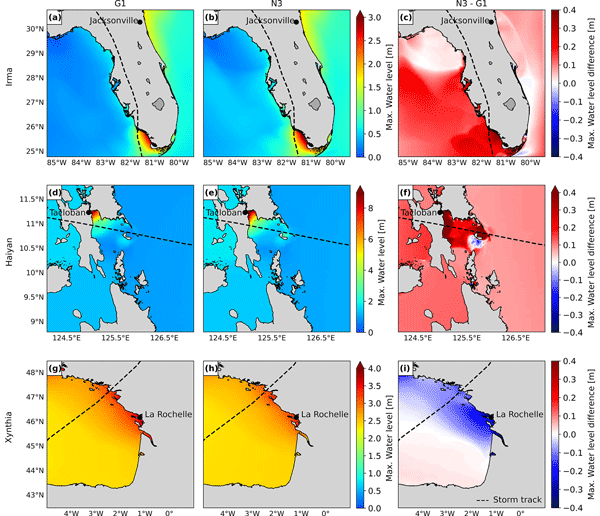
Global flood models are key to the mitigation of coastal flooding impacts, yet they still have limitations when providing actionable insights locally. We present a multiscale framework that couples dynamic water level and flood models and bridges the fully global and local modelling approaches. We apply it to three historical storms. Our findings reveal that the importance of model refinements varies based on the study area characteristics and the storm’s nature.
Nicole van Maanen, Joël J.-F. G. De Plaen, Timothy Tiggeloven, Maria Luisa Colmenares, Philip J. Ward, Paolo Scussolini, and Elco Koks
Nat. Hazards Earth Syst. Sci., 25, 2075–2080, https://doi.org/10.5194/nhess-25-2075-2025, https://doi.org/10.5194/nhess-25-2075-2025, 2025
Short summary
Short summary
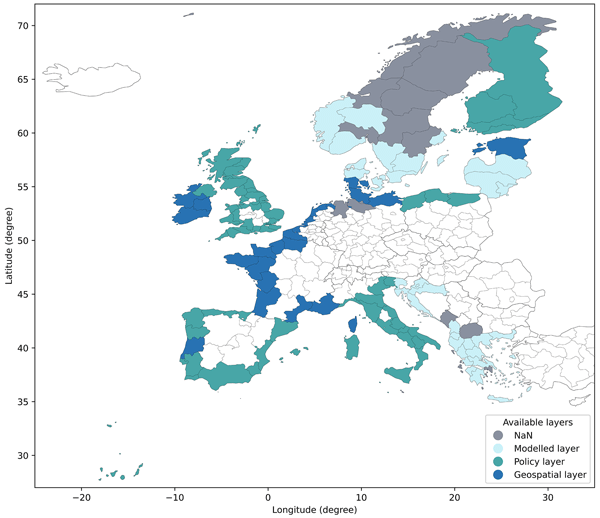
Understanding coastal flood protection is vital for assessing risks from natural disasters and climate change. However, current global data on coastal flood protection are limited and based on simplified assumptions, leading to potential uncertainties in risk estimates. As a step in this direction, we propose a comprehensive dataset, COASTtal flood PROtection Standards within EUrope (COASTPROS-EU), which compiles coastal flood protection standards in Europe.
Julius Schlumberger, Tristian Stolte, Helena Margaret Garcia, Antonia Sebastian, Wiebke Jäger, Philip Ward, Marleen de Ruiter, Robert Šakić Trogrlić, Annegien Tijssen, and Mariana Madruga de Brito
EGUsphere, https://doi.org/10.5194/egusphere-2025-850, https://doi.org/10.5194/egusphere-2025-850, 2025
Preprint archived
Short summary
Short summary
The risk flood of flood impacts is dynamic as society continuously responds to specific events or ongoing developments. We analyzed 28 studies that assess such dynamics of vulnerability. Most research uses surveys and basic statistics data, while integrated, flexible models are seldom used. The studies struggle to link specific events or developments to the observed changes. Our findings highlight needs and possible directions towards a better assessment of vulnerability dynamics.
Joshua Green, Ivan D. Haigh, Niall Quinn, Jeff Neal, Thomas Wahl, Melissa Wood, Dirk Eilander, Marleen de Ruiter, Philip Ward, and Paula Camus
Nat. Hazards Earth Syst. Sci., 25, 747–816, https://doi.org/10.5194/nhess-25-747-2025, https://doi.org/10.5194/nhess-25-747-2025, 2025
Short summary
Short summary
Compound flooding, involving the combination or successive occurrence of two or more flood drivers, can amplify flood impacts in coastal/estuarine regions. This paper reviews the practices, trends, methodologies, applications, and findings of coastal compound flooding literature at regional to global scales. We explore the types of compound flood events, their mechanistic processes, and the range of terminology. Lastly, this review highlights knowledge gaps and implications for future practices.
Sadhana Nirandjan, Elco E. Koks, Mengqi Ye, Raghav Pant, Kees C. H. Van Ginkel, Jeroen C. J. H. Aerts, and Philip J. Ward
Nat. Hazards Earth Syst. Sci., 24, 4341–4368, https://doi.org/10.5194/nhess-24-4341-2024, https://doi.org/10.5194/nhess-24-4341-2024, 2024
Short summary
Short summary
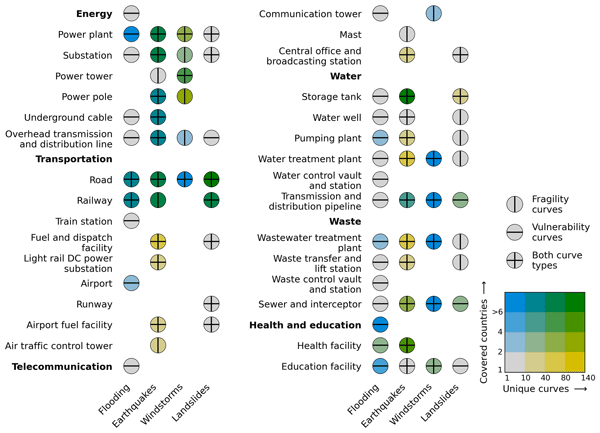
Critical infrastructures (CIs) are exposed to natural hazards, which may result in significant damage and burden society. Vulnerability is a key determinant for reducing these risks, yet crucial information is scattered in the literature. Our study reviews over 1510 fragility and vulnerability curves for CI assets, creating a unique publicly available physical vulnerability database that can be directly used for hazard risk assessments, including floods, earthquakes, windstorms, and landslides.
Eric Mortensen, Timothy Tiggeloven, Toon Haer, Bas van Bemmel, Dewi Le Bars, Sanne Muis, Dirk Eilander, Frederiek Sperna Weiland, Arno Bouwman, Willem Ligtvoet, and Philip J. Ward
Nat. Hazards Earth Syst. Sci., 24, 1381–1400, https://doi.org/10.5194/nhess-24-1381-2024, https://doi.org/10.5194/nhess-24-1381-2024, 2024
Short summary
Short summary
Current levels of coastal flood risk are projected to increase in coming decades due to various reasons, e.g. sea-level rise, land subsidence, and coastal urbanization: action is needed to minimize this future risk. We evaluate dykes and coastal levees, foreshore vegetation, zoning restrictions, and dry-proofing on a global scale to estimate what levels of risk reductions are possible. We demonstrate that there are several potential adaptation pathways forward for certain areas of the world.
Dirk Eilander, Anaïs Couasnon, Frederiek C. Sperna Weiland, Willem Ligtvoet, Arno Bouwman, Hessel C. Winsemius, and Philip J. Ward
Nat. Hazards Earth Syst. Sci., 23, 2251–2272, https://doi.org/10.5194/nhess-23-2251-2023, https://doi.org/10.5194/nhess-23-2251-2023, 2023
Short summary
Short summary
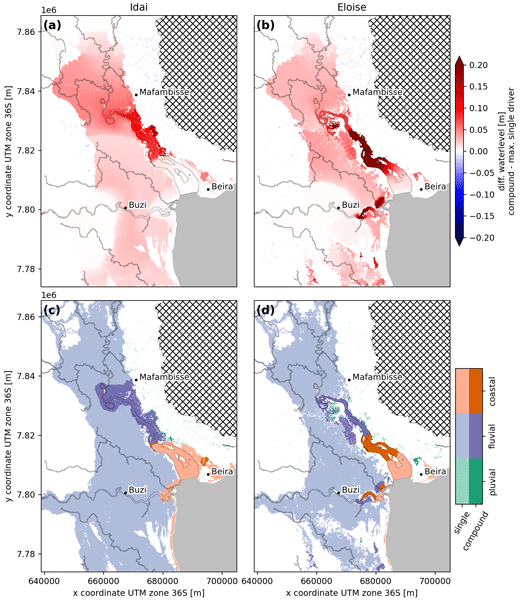
This study presents a framework for assessing compound flood risk using hydrodynamic, impact, and statistical modeling. A pilot in Mozambique shows the importance of accounting for compound events in risk assessments. We also show how the framework can be used to assess the effectiveness of different risk reduction measures. As the framework is based on global datasets and is largely automated, it can easily be applied in other areas for first-order assessments of compound flood risk.
Job C. M. Dullaart, Sanne Muis, Hans de Moel, Philip J. Ward, Dirk Eilander, and Jeroen C. J. H. Aerts
Nat. Hazards Earth Syst. Sci., 23, 1847–1862, https://doi.org/10.5194/nhess-23-1847-2023, https://doi.org/10.5194/nhess-23-1847-2023, 2023
Short summary
Short summary
Coastal flooding is driven by storm surges and high tides and can be devastating. To gain an understanding of the threat posed by coastal flooding and to identify areas that are especially at risk, now and in the future, it is crucial to accurately model coastal inundation and assess the coastal flood hazard. Here, we present a global dataset with hydrographs that represent the typical evolution of an extreme sea level. These can be used to model coastal inundation more accurately.
Heidi Kreibich, Kai Schröter, Giuliano Di Baldassarre, Anne F. Van Loon, Maurizio Mazzoleni, Guta Wakbulcho Abeshu, Svetlana Agafonova, Amir AghaKouchak, Hafzullah Aksoy, Camila Alvarez-Garreton, Blanca Aznar, Laila Balkhi, Marlies H. Barendrecht, Sylvain Biancamaria, Liduin Bos-Burgering, Chris Bradley, Yus Budiyono, Wouter Buytaert, Lucinda Capewell, Hayley Carlson, Yonca Cavus, Anaïs Couasnon, Gemma Coxon, Ioannis Daliakopoulos, Marleen C. de Ruiter, Claire Delus, Mathilde Erfurt, Giuseppe Esposito, Didier François, Frédéric Frappart, Jim Freer, Natalia Frolova, Animesh K. Gain, Manolis Grillakis, Jordi Oriol Grima, Diego A. Guzmán, Laurie S. Huning, Monica Ionita, Maxim Kharlamov, Dao Nguyen Khoi, Natalie Kieboom, Maria Kireeva, Aristeidis Koutroulis, Waldo Lavado-Casimiro, Hong-Yi Li, Maria Carmen LLasat, David Macdonald, Johanna Mård, Hannah Mathew-Richards, Andrew McKenzie, Alfonso Mejia, Eduardo Mario Mendiondo, Marjolein Mens, Shifteh Mobini, Guilherme Samprogna Mohor, Viorica Nagavciuc, Thanh Ngo-Duc, Huynh Thi Thao Nguyen, Pham Thi Thao Nhi, Olga Petrucci, Nguyen Hong Quan, Pere Quintana-Seguí, Saman Razavi, Elena Ridolfi, Jannik Riegel, Md Shibly Sadik, Nivedita Sairam, Elisa Savelli, Alexey Sazonov, Sanjib Sharma, Johanna Sörensen, Felipe Augusto Arguello Souza, Kerstin Stahl, Max Steinhausen, Michael Stoelzle, Wiwiana Szalińska, Qiuhong Tang, Fuqiang Tian, Tamara Tokarczyk, Carolina Tovar, Thi Van Thu Tran, Marjolein H. J. van Huijgevoort, Michelle T. H. van Vliet, Sergiy Vorogushyn, Thorsten Wagener, Yueling Wang, Doris E. Wendt, Elliot Wickham, Long Yang, Mauricio Zambrano-Bigiarini, and Philip J. Ward
Earth Syst. Sci. Data, 15, 2009–2023, https://doi.org/10.5194/essd-15-2009-2023, https://doi.org/10.5194/essd-15-2009-2023, 2023
Short summary
Short summary
As the adverse impacts of hydrological extremes increase in many regions of the world, a better understanding of the drivers of changes in risk and impacts is essential for effective flood and drought risk management. We present a dataset containing data of paired events, i.e. two floods or two droughts that occurred in the same area. The dataset enables comparative analyses and allows detailed context-specific assessments. Additionally, it supports the testing of socio-hydrological models.
Dirk Eilander, Anaïs Couasnon, Tim Leijnse, Hiroaki Ikeuchi, Dai Yamazaki, Sanne Muis, Job Dullaart, Arjen Haag, Hessel C. Winsemius, and Philip J. Ward
Nat. Hazards Earth Syst. Sci., 23, 823–846, https://doi.org/10.5194/nhess-23-823-2023, https://doi.org/10.5194/nhess-23-823-2023, 2023
Short summary
Short summary
In coastal deltas, flooding can occur from interactions between coastal, riverine, and pluvial drivers, so-called compound flooding. Global models however ignore these interactions. We present a framework for automated and reproducible compound flood modeling anywhere globally and validate it for two historical events in Mozambique with good results. The analysis reveals differences in compound flood dynamics between both events related to the magnitude of and time lag between drivers.
Paolo Scussolini, Job Dullaart, Sanne Muis, Alessio Rovere, Pepijn Bakker, Dim Coumou, Hans Renssen, Philip J. Ward, and Jeroen C. J. H. Aerts
Clim. Past, 19, 141–157, https://doi.org/10.5194/cp-19-141-2023, https://doi.org/10.5194/cp-19-141-2023, 2023
Short summary
Short summary
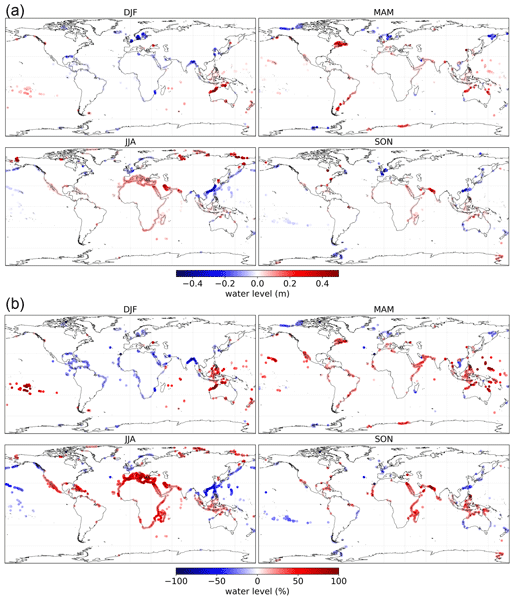
We reconstruct sea level extremes due to storm surges in a past warmer climate. We employ a novel combination of paleoclimate modeling and global ocean hydrodynamic modeling. We find that during the Last Interglacial, about 127 000 years ago, seasonal sea level extremes were indeed significantly different – higher or lower – on long stretches of the global coast. These changes are associated with different patterns of atmospheric storminess linked with meridional shifts in wind bands.
Weihua Zhu, Kai Liu, Ming Wang, Philip J. Ward, and Elco E. Koks
Nat. Hazards Earth Syst. Sci., 22, 1519–1540, https://doi.org/10.5194/nhess-22-1519-2022, https://doi.org/10.5194/nhess-22-1519-2022, 2022
Short summary
Short summary
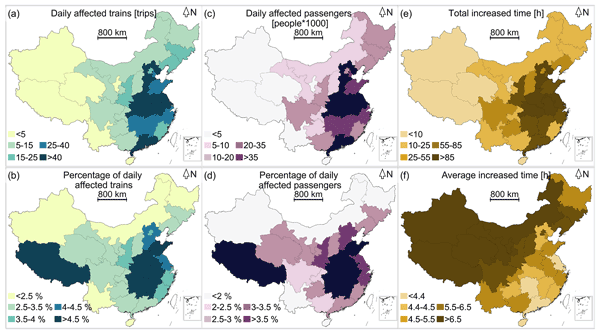
We present a simulation framework to analyse the system vulnerability and risk of the Chinese railway system to floods. To do so, we develop a method for generating flood events at both the national and river basin scale. Results show flood system vulnerability and risk of the railway system are spatially heterogeneous. The event-based approach shows how we can identify critical hotspots, taking the first steps in developing climate-resilient infrastructure.
Philip J. Ward, James Daniell, Melanie Duncan, Anna Dunne, Cédric Hananel, Stefan Hochrainer-Stigler, Annegien Tijssen, Silvia Torresan, Roxana Ciurean, Joel C. Gill, Jana Sillmann, Anaïs Couasnon, Elco Koks, Noemi Padrón-Fumero, Sharon Tatman, Marianne Tronstad Lund, Adewole Adesiyun, Jeroen C. J. H. Aerts, Alexander Alabaster, Bernard Bulder, Carlos Campillo Torres, Andrea Critto, Raúl Hernández-Martín, Marta Machado, Jaroslav Mysiak, Rene Orth, Irene Palomino Antolín, Eva-Cristina Petrescu, Markus Reichstein, Timothy Tiggeloven, Anne F. Van Loon, Hung Vuong Pham, and Marleen C. de Ruiter
Nat. Hazards Earth Syst. Sci., 22, 1487–1497, https://doi.org/10.5194/nhess-22-1487-2022, https://doi.org/10.5194/nhess-22-1487-2022, 2022
Short summary
Short summary
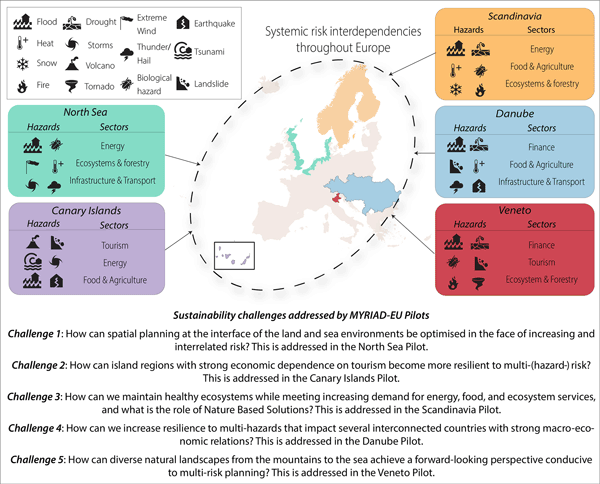
The majority of natural-hazard risk research focuses on single hazards (a flood, a drought, a volcanic eruption, an earthquake, etc.). In the international research and policy community it is recognised that risk management could benefit from a more systemic approach. In this perspective paper, we argue for an approach that addresses multi-hazard, multi-risk management through the lens of sustainability challenges that cut across sectors, regions, and hazards.
Dirk Eilander, Willem van Verseveld, Dai Yamazaki, Albrecht Weerts, Hessel C. Winsemius, and Philip J. Ward
Hydrol. Earth Syst. Sci., 25, 5287–5313, https://doi.org/10.5194/hess-25-5287-2021, https://doi.org/10.5194/hess-25-5287-2021, 2021
Short summary
Short summary
Digital elevation models and derived flow directions are crucial to distributed hydrological modeling. As the spatial resolution of models is typically coarser than these data, we need methods to upscale flow direction data while preserving the river structure. We propose the Iterative Hydrography Upscaling (IHU) method and show it outperforms other often-applied methods. We publish the multi-resolution MERIT Hydro IHU hydrography dataset and the algorithm as part of the pyflwdir Python package.
Marleen Carolijn de Ruiter, Anaïs Couasnon, and Philip James Ward
Geosci. Commun., 4, 383–397, https://doi.org/10.5194/gc-4-383-2021, https://doi.org/10.5194/gc-4-383-2021, 2021
Short summary
Short summary
Many countries can get hit by different hazards, such as earthquakes and floods. Generally, measures and policies are aimed at decreasing the potential damages of one particular hazard type despite their potential of having unwanted effects on other hazard types. We designed a serious game that helps professionals to improve their understanding of these potential negative effects of measures and policies that reduce the impacts of disasters across many different hazard types.
Christopher D. Wells, Lennart Ramme, Chris Smith, Jannes Breier, Adakudlu Muralidhar, Chao Li, Ada Gjermundsen, William Alexander Schoenberg, Benjamin Blanz, and Cecilie Mauritzen
Geosci. Model Dev., 19, 1429–1453, https://doi.org/10.5194/gmd-19-1429-2026, https://doi.org/10.5194/gmd-19-1429-2026, 2026
Short summary
Short summary
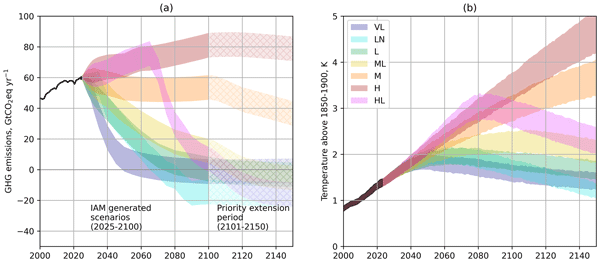
Understanding the change in climate that would occur under different future pathways of greenhouse gas emissions and changes in land use is crucial. Here, we develop a new simple climate model to help study this. We reduce the number of inputs so that our model can be connected to a model of the human causes of climate change. This way, we can study the interaction between climate change and society, including climate impacts. Our model broadly agrees with historical observations.
Maša Ann, Jörn Behrens, and Jana Sillmann
Nonlin. Processes Geophys., 33, 85–102, https://doi.org/10.5194/npg-33-85-2026, https://doi.org/10.5194/npg-33-85-2026, 2026
Short summary
Short summary
We present a new framework based on Dynamic Mode Decomposition (DMD) to better detect outliers and model extremes. Unlike standard DMD, which focuses on average system behaviour, our approach targets rare, exceptional dynamics. Applied to climate data, it improves extreme event approximation and reveals meaningful spatiotemporal patterns. The method may generalise to other types of extremes.
Christopher D. Wells, Benjamin Blanz, Lennart Ramme, Jannes Breier, Beniamino Callegari, Adakudlu Muralidhar, Jefferson K. Rajah, Andreas Nicolaidis Lindqvist, Axel E. Eriksson, William Alexander Schoenberg, Alexandre C. Köberle, Lan Wang-Erlandsson, Cecilie Mauritzen, Martin B. Grimeland, and Chris Smith
Geosci. Model Dev., 19, 1229–1260, https://doi.org/10.5194/gmd-19-1229-2026, https://doi.org/10.5194/gmd-19-1229-2026, 2026
Short summary
Short summary
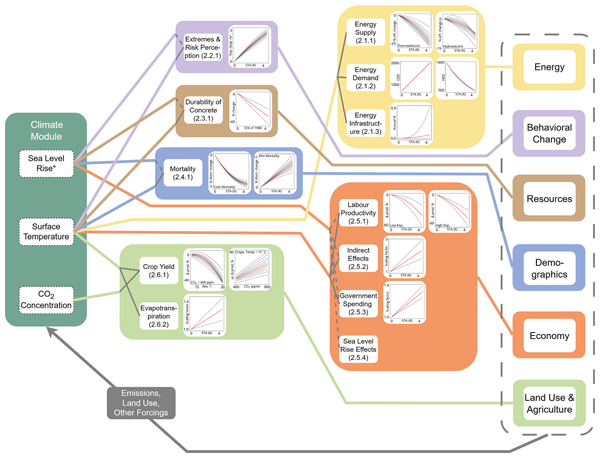
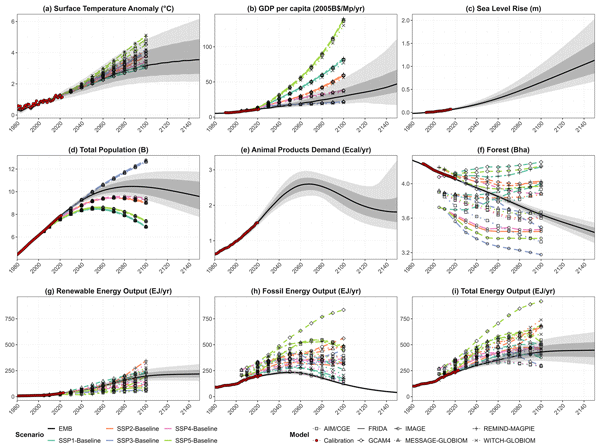
Computer models built to study future developments of human activity and climate change often exclude the impacts of climate change. Here, we include these effects in a new model. We create functions connecting changes in global temperature, carbon dioxide, and sea level to energy supply and demand, food systems, mortality, economic damages, and other important quantities. Including these effects will allow us to explore their impact on future changes in the human and climate realms.
Nina Schuhen, Carley E. Iles, Marit Sandstad, Viktor Ananiev, and Jana Sillmann
Nat. Hazards Earth Syst. Sci., 26, 753–773, https://doi.org/10.5194/nhess-26-753-2026, https://doi.org/10.5194/nhess-26-753-2026, 2026
Short summary
Short summary
As climate changes, extremes are becoming increasingly frequent. We investigate the time of emergence for a large range of different extremes, meaning the earliest time when a significant change in these extremes can be detected beyond natural variability, whether in the past or in the future. The results are based on 21 global climate models and show considerable differences between regions, types of indices and emissions scenarios, as well as between temperature and precipitation extremes.
Martin Breda Grimeland, Benjamin Blanz, William Schoenberg, and Beniamino Callegari
EGUsphere, https://doi.org/10.5194/egusphere-2025-6342, https://doi.org/10.5194/egusphere-2025-6342, 2026
This preprint is open for discussion and under review for Geoscientific Model Development (GMD).
Short summary
Short summary
This study develops a novel global economic model to better capture how climate change interacts with finance, innovation, employment, and public budgets. Instead of treating climate damage as a simple output loss, the model traces how rising temperatures affect investment risk, productivity, unemployment, and government spending. Large simulation ensembles show that without stronger climate action, growth slows, financial fragility rises, and welfare and debt pressures increase.
Huazhi Li, Robert A. Jane, Dirk Eilander, Alejandra R. Enríquez, Toon Haer, and Philip J. Ward
Nat. Hazards Earth Syst. Sci., 26, 391–409, https://doi.org/10.5194/nhess-26-391-2026, https://doi.org/10.5194/nhess-26-391-2026, 2026
Short summary
Short summary
We assess the likelihood of widespread compound flooding along the U.S. coastline. Using a large set of generated plausible events preserving observed dependence, we find that nearly half of compound floods on the West coast affect multiple sites. Such events are rarer on the East coast while most compound events affect single sites on the Gulf coast. Our results underscore the importance of including spatial dependence in compound flood risk assessment and can help in better risk management.
Joel C. Gill
Nat. Hazards Earth Syst. Sci., 26, 271–278, https://doi.org/10.5194/nhess-26-271-2026, https://doi.org/10.5194/nhess-26-271-2026, 2026
Short summary
Short summary
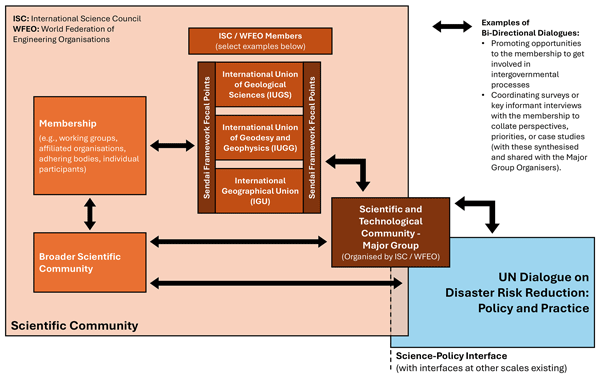
This article looks at how science connects with policy to reduce disaster risks. Although the Sendai Framework says science is key, current efforts to bring together scientists and share their perspectives with other stakeholders are not as effective as they could be. We suggest three ways to improve this: include more voices, better share research, and create spaces to discuss key topics.
Nivedita Sairam and Marleen C. de Ruiter
Nat. Hazards Earth Syst. Sci., 26, 119–130, https://doi.org/10.5194/nhess-26-119-2026, https://doi.org/10.5194/nhess-26-119-2026, 2026
Short summary
Short summary
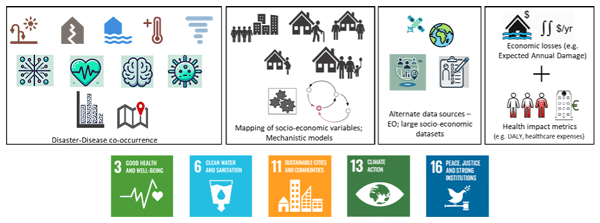
This paper highlights gaps in disaster risk assessments, particularly regarding disease outbreaks after natural hazards. It calls for: (1) learning from compound risk models to understand disaster and disease probabilities, (2) including health metrics in risk frameworks, and (3) improving data and modeling for health impacts. The authors propose a research agenda to enhance disaster risk management.
Yiting Zhu, Marleen de Ruiter, Sophie Buijs, and Nicole van Maanen
EGUsphere, https://doi.org/10.5194/egusphere-2026-94, https://doi.org/10.5194/egusphere-2026-94, 2026
This preprint is open for discussion and under review for Natural Hazards and Earth System Sciences (NHESS).
Short summary
Short summary
Restoring wetlands mitigates climate change, yet fears persist that they spread mosquito-borne diseases. We mapped environmental data across Indonesia to test this. Surprisingly, we found no significant link between high conservation value and disease risk. This proves that protecting nature does not necessarily endanger public health. Our results identify safe areas for conservation, demonstrating that we can safeguard both ecosystems and human communities simultaneously.
Anastasia Vogelbacher, Malte von Szombathely, Marc Lennartz, Benjamin Poschlod, and Jana Sillmann
EGUsphere, https://doi.org/10.5194/egusphere-2025-6362, https://doi.org/10.5194/egusphere-2025-6362, 2026
Short summary
Short summary
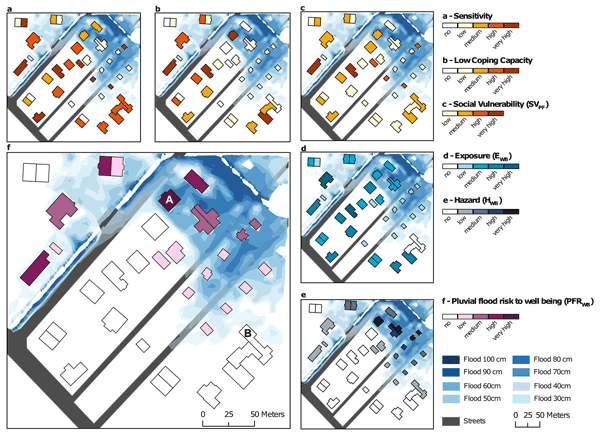
In this study we address risk to pluvial floods by following the risk definition of the Intergovernmental Panel on Climate Change (IPCC), developed in co-operation with stakeholders. We identify buildings in urban areas where residents face higher flood risk due to greater social vulnerability, increased exposure, or elevated flood hazard. We present the development and application of a Python-based ArcGIS toolbox for estimating pluvial flood risk at building scale.
Julius Schlumberger, Tristian R. Stolte, Helena M. Garcia, Antonia Sebastian, Wiebke Jäger, Philip J. Ward, Marleen C. de Ruiter, Robert Šakić Trogrlić, Annegien Tijssen, and Mariana Madruga de Brito
EGUsphere, https://doi.org/10.5194/egusphere-2025-6132, https://doi.org/10.5194/egusphere-2025-6132, 2026
This preprint is open for discussion and under review for Natural Hazards and Earth System Sciences (NHESS).
Short summary
Short summary
Flood vulnerability is too often analysed for one moment in time (static), whereas vulnerability is highly dynamic. We reviewed 67 articles for their flood vulnerability methodologies and found that traditional methods for unraveling flood vulnerability deal differently with dynamic vulnerability. Each method seems to lend itself well for specific concepts of dynamics and different aspects of vulnerability. We recommend to use the complementary strengths of these approaches to improve the field.
Alexander Lee Rischmuller, Benjamin Poschlod, and Jana Sillmann
Adv. Stat. Clim. Meteorol. Oceanogr., 12, 1–19, https://doi.org/10.5194/ascmo-12-1-2026, https://doi.org/10.5194/ascmo-12-1-2026, 2026
Short summary
Short summary
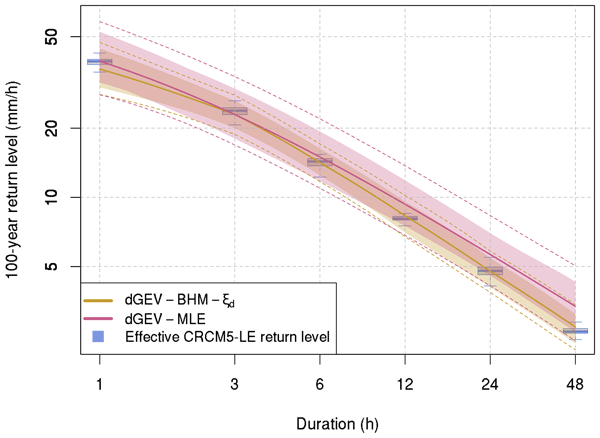
Extreme precipitation probability estimation is vital for hazard protection design but has high uncertainty. We tested six statistical models using 2000 years of climate data. Our Bayesian hierarchical duration-dependent Generalized Extreme Value model shows the highest accuracy and robustness for sample sizes between 30 and 100 years, making it highly promising for use with limited observational records.
Nicole van Maanen, Marleen de Ruiter, Wiebke Jäger, Veronica Casartelli, Roxana Ciurean, Noemi Padrón-Fumero, Anne Sophie Daloz, David Geurts, Stefania Gottardo, Stefan Hochrainer-Stigler, Abel López Diez, Jaime Díaz Pacheco, Pedro Dorta Antequera, Tamara Febles Arévalo, Sara García González, Raúl Hernández-Martín, Carmen Alvarez-Albelo, Juan José Diaz-Hernandez, Lin Ma, Letizia Monteleone, Karina Reiter, Tristian Stolte, Robert Šakić Trogrlić, Silvia Torresan, Sharon Tatman, David Romero Manrique de Lara, Yeray Hernández González, and Philip J. Ward
Earth Syst. Dynam., 16, 2295–2311, https://doi.org/10.5194/esd-16-2295-2025, https://doi.org/10.5194/esd-16-2295-2025, 2025
Short summary
Short summary
Disaster risk management faces growing challenges from multiple, changing hazards. Interviews with stakeholders in five European regions reveal that climate change, urban growth, and socio-economic shifts increase vulnerability and exposure. Measures to reduce one risk can worsen others, highlighting the need for better coordination. The study calls for flexible, context-specific strategies that connect scientific risk assessments with real-world decision-making.
Wei Li, Philip J. Ward, and Lia van Wesenbeeck
EGUsphere, https://doi.org/10.5194/egusphere-2025-4663, https://doi.org/10.5194/egusphere-2025-4663, 2025
This preprint is open for discussion and under review for Hydrology and Earth System Sciences (HESS).
Short summary
Short summary
This study presents a novel model that captures the interactions among water, energy, and food, revealing how human activities and natural processes mutually shape one another. It shows how human activities alter water quantity and quality, and how these changes reshape resource availability and subsequent human resource use. The Beijing-Tianjin-Hebei case study demonstrates the model's value for advancing hydrological science and informing sustainable and equitable resource management.
Lennart Ramme, Benjamin Blanz, Christopher Wells, Tony E. Wong, William Schoenberg, Chris Smith, and Chao Li
Geosci. Model Dev., 18, 10017–10052, https://doi.org/10.5194/gmd-18-10017-2025, https://doi.org/10.5194/gmd-18-10017-2025, 2025
Short summary
Short summary
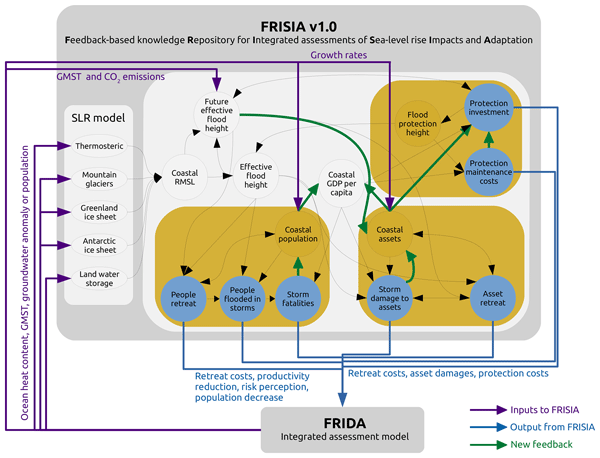
We present FRISIA version 1.0, a model for emulating sea level rise (SLR) and representing SLR impacts and adaptation in integrated assessment models (IAMs). FRISIA includes previously uncaptured coastal socio-economic feedback and a diverse set of impact strains, thereby improving the represenation of SLR impacts in IAMs. Here we describe the baseline behaviour of FRISIA, explore the effects of the additional feedback and showcase the coupling of FRISIA to an IAM.
Iris Mužić, Øivind Hodnebrog, Yeliz A. Yilmaz, Terje K. Berntsen, Jana Sillmann, David M. Lawrence, and Paul A. Dirmeyer
Adv. Stat. Clim. Meteorol. Oceanogr., 11, 273–292, https://doi.org/10.5194/ascmo-11-273-2025, https://doi.org/10.5194/ascmo-11-273-2025, 2025
Short summary
Short summary
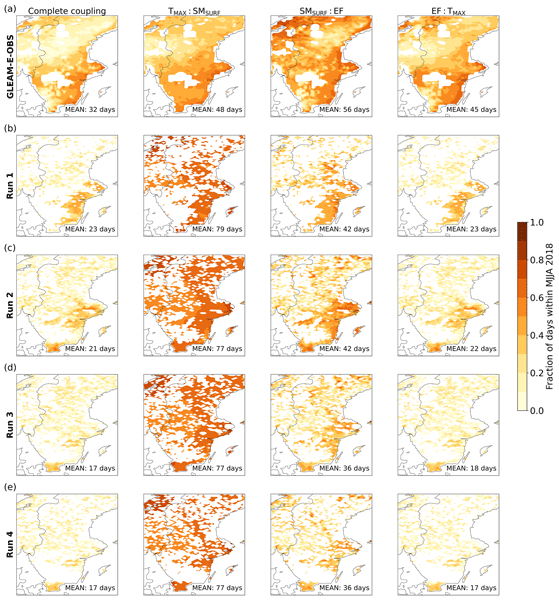
This study investigates soil moisture–temperature coupling during the extreme warm conditions in May–August 2018 in southern and central Sweden using the merged GLEAM-E-OBS dataset and four simulations from the Weather Research and Forecasting model coupled with the Community Terrestrial Systems Model (WRF-CTSM). Based on changes in surface soil moisture, evaporative fraction, and daily maximum 2 m temperature, on average across the region and five datasets, the coupling lasted for 22 d.
Gwendoline Ducros, Timothy Tiggeloven, Lin Ma, Anne Sophie Daloz, Nina Schuhen, Judith Claassen, and Marleen C. de Ruiter
Nat. Hazards Earth Syst. Sci., 25, 4693–4712, https://doi.org/10.5194/nhess-25-4693-2025, https://doi.org/10.5194/nhess-25-4693-2025, 2025
Short summary
Short summary
Our study finds that heatwave, drought and wildfire events occurring simultaneously in Scandinavia are pronounced in the summer months; and the heat-drought 2018 event led to a drop in gross domestic product, affecting agriculture and forestry imports, further impacting Europe's trade balance. This research shows the importance of ripple effects of multi-hazard, and that forest management and adaptation measures are vital to reducing the risks of heat-related multi-hazards in vulnerable areas.
Molly Gilmour, Peter McGowran, Joel Gill, and Faith Taylor
EGUsphere, https://doi.org/10.5194/egusphere-2025-5704, https://doi.org/10.5194/egusphere-2025-5704, 2025
Short summary
Short summary
The term “household preparedness” refers to households being prepared to absorb and recover from disasters. “Multi-hazard disasters” are caused by multiple, interacting hazards (e.g. droughts followed by floods). We analysed academic literature to understand what household preparedness means for multi-hazard disasters. We conclude that more qualitative data is needed to better support household preparedness, particularly in ‘Global South’ countries.
Tim H. J. Hermans, Chiheb Ben Hammouda, Simon Treu, Timothy Tiggeloven, Anaïs Couasnon, Julius J. M. Busecke, and Roderik S. W. van de Wal
Nat. Hazards Earth Syst. Sci., 25, 4593–4612, https://doi.org/10.5194/nhess-25-4593-2025, https://doi.org/10.5194/nhess-25-4593-2025, 2025
Short summary
Short summary
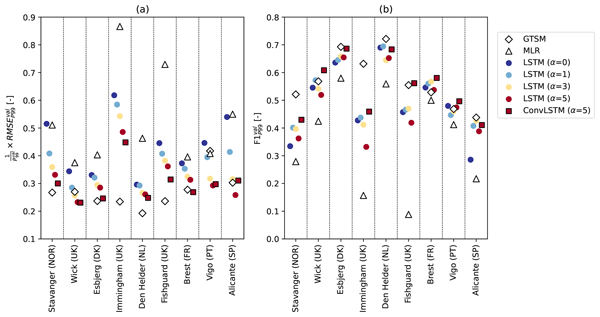
We studied the performance of different types of neural networks at predicting extreme storm surges. We found that that performance improves when during model training, storm surges that are rarer are given a higher weight than moderate storm surges. Additionally, we found that the performance of some of the neural networks approaches that of a state-of-the-art hydrodynamic model. This is promising for the future application of neural networks to climate model simulations.
Aaron Buhrmann, Cecilia I. Nievas, Nivedita Sairam, James E. Daniell, Heidi Kreibich, and Seth Bryant
EGUsphere, https://doi.org/10.5194/egusphere-2025-5172, https://doi.org/10.5194/egusphere-2025-5172, 2025
Short summary
Short summary
Our research lays the groundwork for the next generation of disaster risk modelling by improving how building-level value and use are estimated across Germany. By testing multiple data sources and methods, we identify a transparent, adaptable approach that enhances forecasts of damage and recovery—helping protect lives, property, and communities.
Kai Kornuber, Emanuele Bevacqua, Mariana Madruga de Brito, Wiebke S. Jäger, Pauline Rivoire, Cassandra D. W. Rogers, Fabiola Banfi, Fulden Batibeniz, James Carruthers, Carlo de Michele, Silvia de Angeli, Cristina Deidda, Marleen C. de Ruiter, Andreas H. Fink, Henrique M. D. Goulart, Katharina Küpfer, Patrick Ludwig, Douglas Maraun, Gabriele Messori, Shruti Nath, Fiachra O’Loughlin, Joaquim G. Pinto, Benjamin Poschlod, Alexandre M. Ramos, Colin Raymond, Andreia F. S. Ribeiro, Deepti Singh, Laura Suarez Gutierrez, Philip J. Ward, and Christopher J. White
EGUsphere, https://doi.org/10.5194/egusphere-2025-4683, https://doi.org/10.5194/egusphere-2025-4683, 2025
Short summary
Short summary
Impacts from extreme weather events are becoming increasingly severe under global warming, in particular when events occur simultaneously or successively. While these complex event combinations are often difficult to analyse as impact data, early warning schemes or modelling frameworks might not be fit for purpose. In this perspective we reflect on the usability of compound event research to bridge the gap between academic research and real-world applications, by formulating a set of guidelines.
Natalia Castillo Bautista, Marco Gaetani, Leonard F. Borchert, Benjamin Poschlod, Lukas Brunner, Jana Sillmann, and Mario L. V. Martina
EGUsphere, https://doi.org/10.5194/egusphere-2025-5073, https://doi.org/10.5194/egusphere-2025-5073, 2025
This preprint is open for discussion and under review for Weather and Climate Dynamics (WCD).
Short summary
Short summary
When hot temperatures and drought occur together (compound events), they can cause harmful impacts on crops and society. Using six decades of climate data, we show that such compound events repeatedly occurred in three breadbaskets of the Northern Hemisphere. These events are linked to atmospheric circulation patterns that favor heat and dryness, which in turn interact to amplify the impact. Our study contributes to understand the drivers of these events to support climate impact assessment.
Christopher J. White, Mohammed Sarfaraz Gani Adnan, Marcello Arosio, Stephanie Buller, YoungHwa Cha, Roxana Ciurean, Julia M. Crummy, Melanie Duncan, Joel Gill, Claire Kennedy, Elisa Nobile, Lara Smale, and Philip J. Ward
Nat. Hazards Earth Syst. Sci., 25, 4263–4281, https://doi.org/10.5194/nhess-25-4263-2025, https://doi.org/10.5194/nhess-25-4263-2025, 2025
Short summary
Short summary
Indicators contain observable and measurable characteristics to understand the state of a concept or phenomenon and/or monitor it over time. There have been limited efforts to understand how indicators are being used in multi-hazard and multi-risk contexts. We find most of existing indicators do not include the interactions between hazards or risks. We propose a set of recommendations to enable the development and uptake of multi-hazard and multi-risk indicators.
William Schoenberg, Benjamin Blanz, Jefferson K. Rajah, Beniamino Callegari, Christopher Wells, Jannes Breier, Martin B. Grimeland, Andreas Nicolaidis Lindqvist, Lennart Ramme, Chris Smith, Chao Li, Sarah Mashhadi, Adakudlu Muralidhar, and Cecilie Mauritzen
Geosci. Model Dev., 18, 8047–8069, https://doi.org/10.5194/gmd-18-8047-2025, https://doi.org/10.5194/gmd-18-8047-2025, 2025
Short summary
Short summary
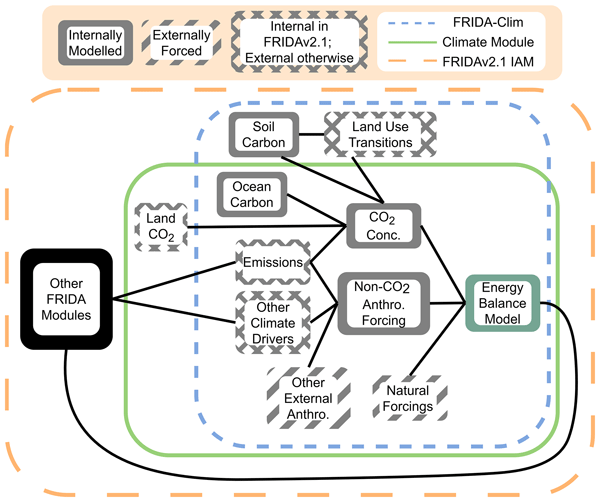
The current crop of models assessed by the Intergovernmental Panel on Climate Change to produce their assessment reports lack endogenous process-based representations of climate-driven changes to human activities, limiting understanding of the feedback between climate and humans. FRIDA (Feedback-based knowledge Repository for IntegrateD Assessments) v2.1 integrates these systems and generate results that suggest standard scenarios the shared socioeconomic pathways baseline scenarios may overestimate economic growth, highlighting the importance of feedbacks for realistic projections and informed policymaking.
Julius Schlumberger, Robert Šakić Trogrlić, Jeroen C. J. H. Aerts, Jung-Hee Hyun, Stefan Hochrainer-Stigler, Marleen de Ruiter, and Marjolijn Haasnoot
Nat. Hazards Earth Syst. Sci., 25, 4089–4113, https://doi.org/10.5194/nhess-25-4089-2025, https://doi.org/10.5194/nhess-25-4089-2025, 2025
Short summary
Short summary
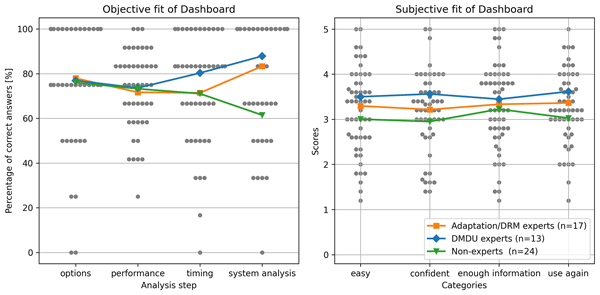
This study presents a dashboard to help decision-makers manage risks in a changing climate. Using interactive visualizations, it simplifies complex choices, even with uncertain information. Tested with 54 users of varying expertise, it enabled accurate responses to 71–80 % of questions. Users valued its scenario exploration and detailed data features. While effective, the guidance and set of visualizations could be extended and the prototype could be adapted for broader applications.
Jefferson K. Rajah, Benjamin Blanz, Birgit Kopainsky, and William Schoenberg
Geosci. Model Dev., 18, 5997–6022, https://doi.org/10.5194/gmd-18-5997-2025, https://doi.org/10.5194/gmd-18-5997-2025, 2025
Short summary
Short summary
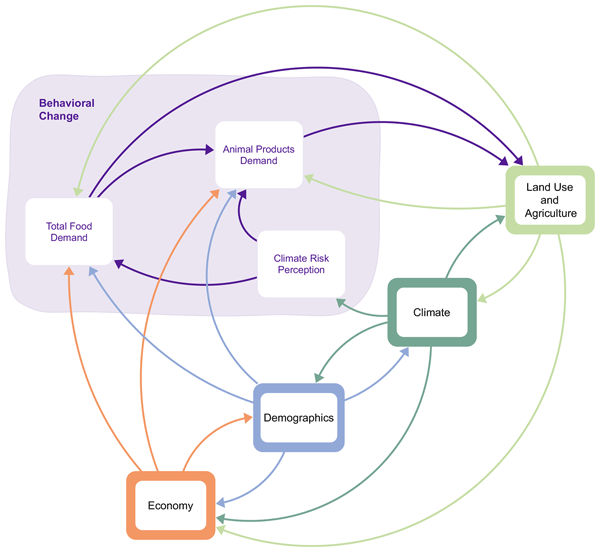
Climate models often exclude human behaviour. We introduce a model that includes economic, social, and environmental factors that influence dietary choices. This helps us understand how behaviour shifts impact future emissions and climate conditions. By considering a range of plausible behaviours, we provide a more accurate picture of potential outcomes, improving representations in climate models.
Kai Schröter, Pia-Johanna Schweizer, Benedikt Gräler, Lydia Cumiskey, Sukaina Bharwani, Janne Parviainen, Chahan M. Kropf, Viktor Wattin Håkansson, Martin Drews, Tracy Irvine, Clarissa Dondi, Heiko Apel, Jana Löhrlein, Stefan Hochrainer-Stigler, Stefano Bagli, Levente Huszti, Christopher Genillard, Silvia Unguendoli, Fred Hattermann, and Max Steinhausen
Nat. Hazards Earth Syst. Sci., 25, 3055–3073, https://doi.org/10.5194/nhess-25-3055-2025, https://doi.org/10.5194/nhess-25-3055-2025, 2025
Short summary
Short summary
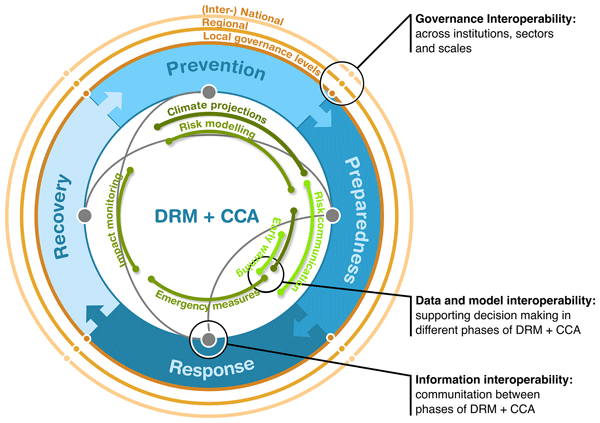
With the increasing negative impacts of extreme weather events globally, it is crucial to align efforts to manage disasters with measures to adapt to climate change. We identify challenges in systems and organizations working together. We suggest that collaboration across various fields is essential and propose an approach to improve collaboration, including a framework for better stakeholder engagement and an open-source data system that helps gather and connect important information.
Sophie L. Buijs, Inga J. Sauer, Chahan M. Kropf, Samuel Juhel, Zélie Stalhandske, and Marleen C. De Ruiter
EGUsphere, https://doi.org/10.5194/egusphere-2025-3200, https://doi.org/10.5194/egusphere-2025-3200, 2025
Short summary
Short summary
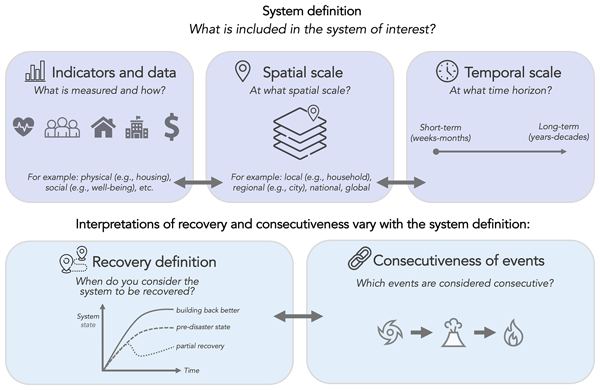
We studied how repeated disasters affect recovery across housing, health, economic systems, and governance. Our findings show that failing to recover fully between events can increase long-term risks but also offers opportunities for learning and adaptation. Understanding these dynamics can help societies plan better, reduce vulnerability, and build resilience to increasingly frequent and severe hazards.
Wiebke S. Jäger, Marleen C. de Ruiter, Timothy Tiggeloven, and Philip J. Ward
Nat. Hazards Earth Syst. Sci., 25, 2751–2769, https://doi.org/10.5194/nhess-25-2751-2025, https://doi.org/10.5194/nhess-25-2751-2025, 2025
Short summary
Short summary
Multiple hazards, occurring simultaneously or consecutively, can have more extreme impacts than single hazards. We examined the disaster records in the global emergency events database EM-DAT to better understand this phenomenon. We developed a method to identify such multi-hazards and analysed their reported impacts using statistics. Multi-hazards have accounted for a disproportionate number of the impacts, but there appear to be different archetypal patterns in which the impacts compound.
Lou Brett, Christopher J. White, Daniela I. V. Domeisen, Bart van den Hurk, Philip Ward, and Jakob Zscheischler
Nat. Hazards Earth Syst. Sci., 25, 2591–2611, https://doi.org/10.5194/nhess-25-2591-2025, https://doi.org/10.5194/nhess-25-2591-2025, 2025
Short summary
Short summary
Compound events, where multiple weather or climate hazards occur together, pose significant risks to both society and the environment. These events, like simultaneous wind and rain, can have more severe impacts than single hazards. Our review of compound event research from 2012–2022 reveals a rise in studies, especially on events that occur concurrently, hot and dry events, and compounding flooding. The review also highlights opportunities for research in the coming years.
Timothy Tiggeloven, Colin Raymond, Marleen C. de Ruiter, Jana Sillmann, Annegret H. Thieken, Sophie L. Buijs, Roxana Ciurean, Emma Cordier, Julia M. Crummy, Lydia Cumiskey, Kelley De Polt, Melanie Duncan, Davide M. Ferrario, Wiebke S. Jäger, Elco E. Koks, Nicole van Maanen, Heather J. Murdock, Jaroslav Mysiak, Sadhana Nirandjan, Benjamin Poschlod, Peter Priesmeier, Nivedita Sairam, Pia-Johanna Schweizer, Tristian R. Stolte, Marie-Luise Zenker, James E. Daniell, Alexander Fekete, Christian M. Geiß, Marc J. C. van den Homberg, Sirkku K. Juhola, Christian Kuhlicke, Karen Lebek, Robert Šakić Trogrlić, Stefan Schneiderbauer, Silvia Torresan, Cees J. van Westen, Judith N. Claassen, Bijan Khazai, Virginia Murray, Julius Schlumberger, and Philip J. Ward
EGUsphere, https://doi.org/10.5194/egusphere-2025-2771, https://doi.org/10.5194/egusphere-2025-2771, 2025
Short summary
Short summary
Natural hazards like floods, earthquakes, and landslides are often interconnected which may create bigger problems than when they occur alone. We studied expert discussions from an international conference to understand how scientists and policymakers can better prepare for these multi-hazards and use new technologies to protect its communities while contributing to dialogues about future international agreements beyond the Sendai Framework and supporting global sustainability goals.
Irene Benito, Jeroen C. J. H. Aerts, Philip J. Ward, Dirk Eilander, and Sanne Muis
Nat. Hazards Earth Syst. Sci., 25, 2287–2315, https://doi.org/10.5194/nhess-25-2287-2025, https://doi.org/10.5194/nhess-25-2287-2025, 2025
Short summary
Short summary
Global flood models are key to the mitigation of coastal flooding impacts, yet they still have limitations when providing actionable insights locally. We present a multiscale framework that couples dynamic water level and flood models and bridges the fully global and local modelling approaches. We apply it to three historical storms. Our findings reveal that the importance of model refinements varies based on the study area characteristics and the storm’s nature.
Hunter C. Quintal, Antonia Sebastian, Marc L. Serre, Wiebke S. Jäger, and Marleen C. de Ruiter
EGUsphere, https://doi.org/10.5194/egusphere-2025-2870, https://doi.org/10.5194/egusphere-2025-2870, 2025
Short summary
Short summary
High quality weather event datasets are crucial to community preparedness and resilience. Researchers create such datasets using clustering methods, which we advance by addressing current limitation in the relationship between space and time. We propose a method to determine the appropriate factor by which to resample the spatial resolution of the data prior to clustering. Ultimately, our approach increases the ability to detect historic heatwaves over current methods.
Nicole van Maanen, Joël J.-F. G. De Plaen, Timothy Tiggeloven, Maria Luisa Colmenares, Philip J. Ward, Paolo Scussolini, and Elco Koks
Nat. Hazards Earth Syst. Sci., 25, 2075–2080, https://doi.org/10.5194/nhess-25-2075-2025, https://doi.org/10.5194/nhess-25-2075-2025, 2025
Short summary
Short summary
Understanding coastal flood protection is vital for assessing risks from natural disasters and climate change. However, current global data on coastal flood protection are limited and based on simplified assumptions, leading to potential uncertainties in risk estimates. As a step in this direction, we propose a comprehensive dataset, COASTtal flood PROtection Standards within EUrope (COASTPROS-EU), which compiles coastal flood protection standards in Europe.
Sophie Kaashoek, Žiga Malek, Nadia Bloemendaal, and Marleen C. de Ruiter
Nat. Hazards Earth Syst. Sci., 25, 1963–1974, https://doi.org/10.5194/nhess-25-1963-2025, https://doi.org/10.5194/nhess-25-1963-2025, 2025
Short summary
Short summary
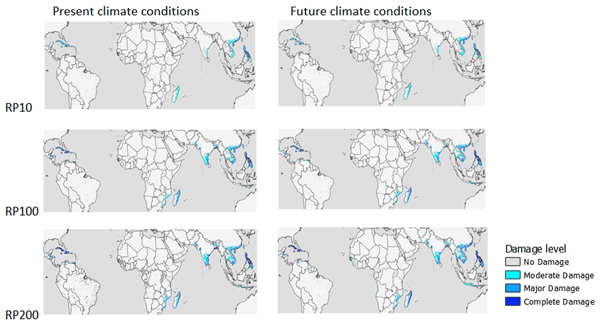
Tropical storms are expected to get stronger all over the world, and this will have a big impact on people, buildings and important activities like growing bananas. Already, in different parts of the world, banana farms are being hurt by these storms, which makes banana prices go up and affects the people who grow them. We are not sure how these storms will affect bananas everywhere in the future. We assessed what happened to banana farms during storms in different parts of the world.
Yigit Uckan, Melissa Ruiz-Vásquez, Kelley De Polt, and René Orth
Earth Syst. Dynam., 16, 869–889, https://doi.org/10.5194/esd-16-869-2025, https://doi.org/10.5194/esd-16-869-2025, 2025
Short summary
Short summary
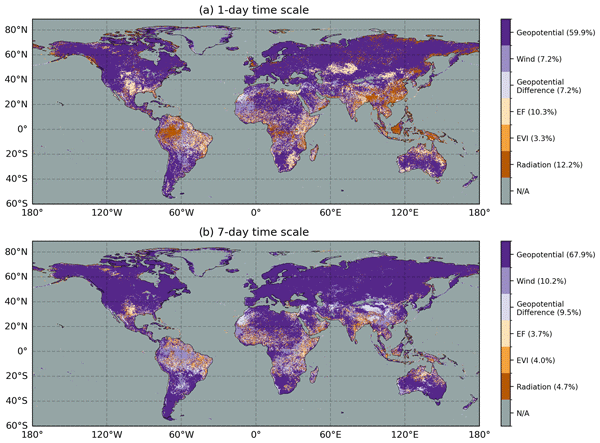
We analyze drivers of hot temperature extremes, focusing on both atmospheric and land-surface factors. Using observation-based data and an analogue-based approach, we find that geopotential height at 500 hPa is the most significant driver worldwide at daily and weekly timescales. Surface net radiation and evaporative fraction play relevant roles at the daily scale and wind at the weekly timescale. The driver influence varies by region, related to differences in climate regimes and land cover.
Danhua Xin, James Edward Daniell, Zhenguo Zhang, Friedemann Wenzel, Shaun Shuxun Wang, and Xiaofei Chen
Nat. Hazards Earth Syst. Sci., 25, 1597–1620, https://doi.org/10.5194/nhess-25-1597-2025, https://doi.org/10.5194/nhess-25-1597-2025, 2025
Short summary
Short summary
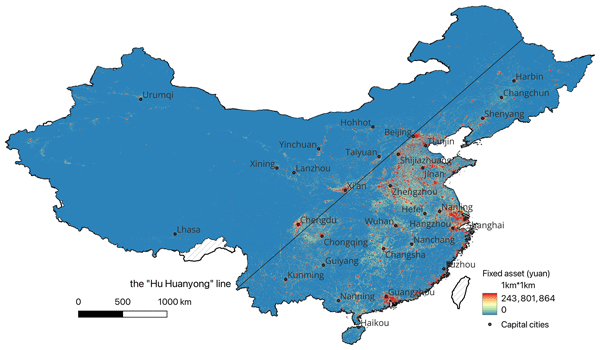
A high-resolution fixed-asset model can help improve the accuracy of earthquake loss assessment. We develop a grid-level fixed-asset model for China from 1951 to 2020. We first compile the provincial-level fixed asset from yearbook-related statistics. Then, this dataset is disaggregated into 1 km × 1 km grids by using multiple remote sensing data as the weight indicator. We find that the fixed-asset value increased rapidly after the 1980s and reached CNY 589.31 trillion in 2020.
Ekta Aggarwal, Marleen C. de Ruiter, Kartikeya S. Sangwan, Rajiv Sinha, Sophie Buijs, Ranjay Shrestha, Sanjeev Gupta, and Alexander C. Whittaker
EGUsphere, https://doi.org/10.5194/egusphere-2024-3901, https://doi.org/10.5194/egusphere-2024-3901, 2025
Preprint archived
Short summary
Short summary
The occurrence of frequent floods in recent years due to changing weather, heavy rainfall, and the natural landscape, has caused major damage to lives and property. This study looks at flood risks in the Ganga Basin, focusing on the factors that cause floods, the areas affected, and the vulnerability of people. The study uses NASA's night-time lights to track human activities. This helps to show how risks are connected to expanding human activities, and changing resilience to floods.
Julius Schlumberger, Tristian Stolte, Helena Margaret Garcia, Antonia Sebastian, Wiebke Jäger, Philip Ward, Marleen de Ruiter, Robert Šakić Trogrlić, Annegien Tijssen, and Mariana Madruga de Brito
EGUsphere, https://doi.org/10.5194/egusphere-2025-850, https://doi.org/10.5194/egusphere-2025-850, 2025
Preprint archived
Short summary
Short summary
The risk flood of flood impacts is dynamic as society continuously responds to specific events or ongoing developments. We analyzed 28 studies that assess such dynamics of vulnerability. Most research uses surveys and basic statistics data, while integrated, flexible models are seldom used. The studies struggle to link specific events or developments to the observed changes. Our findings highlight needs and possible directions towards a better assessment of vulnerability dynamics.
Davide Mauro Ferrario, Marcello Sanò, Margherita Maraschini, Andrea Critto, and Silvia Torresan
EGUsphere, https://doi.org/10.5194/egusphere-2025-670, https://doi.org/10.5194/egusphere-2025-670, 2025
Short summary
Short summary
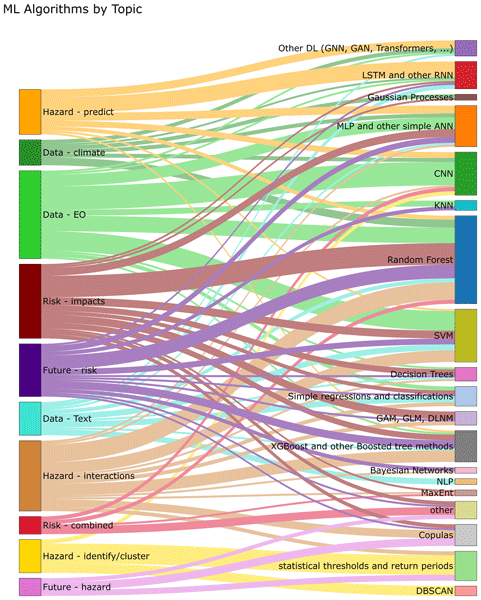
This review explores how Machine Learning (ML) can advance multi-hazard and multi-risk going through four main themes: data processing, hazard prediction, risk assessment, and future climate scenarios. It shows how ML is widely used for Earth observations and climate data processing, with Deep Learning applied for hazard prediction and ensemble ML methods for risks, and how future research moving towards analysis of multi-hazard interactions, dynamic vulnerability and early warning systems.
Joshua Green, Ivan D. Haigh, Niall Quinn, Jeff Neal, Thomas Wahl, Melissa Wood, Dirk Eilander, Marleen de Ruiter, Philip Ward, and Paula Camus
Nat. Hazards Earth Syst. Sci., 25, 747–816, https://doi.org/10.5194/nhess-25-747-2025, https://doi.org/10.5194/nhess-25-747-2025, 2025
Short summary
Short summary
Compound flooding, involving the combination or successive occurrence of two or more flood drivers, can amplify flood impacts in coastal/estuarine regions. This paper reviews the practices, trends, methodologies, applications, and findings of coastal compound flooding literature at regional to global scales. We explore the types of compound flood events, their mechanistic processes, and the range of terminology. Lastly, this review highlights knowledge gaps and implications for future practices.
Franziska Hellmuth, Tim Carlsen, Anne Sophie Daloz, Robert Oscar David, Haochi Che, and Trude Storelvmo
Atmos. Chem. Phys., 25, 1353–1383, https://doi.org/10.5194/acp-25-1353-2025, https://doi.org/10.5194/acp-25-1353-2025, 2025
Short summary
Short summary
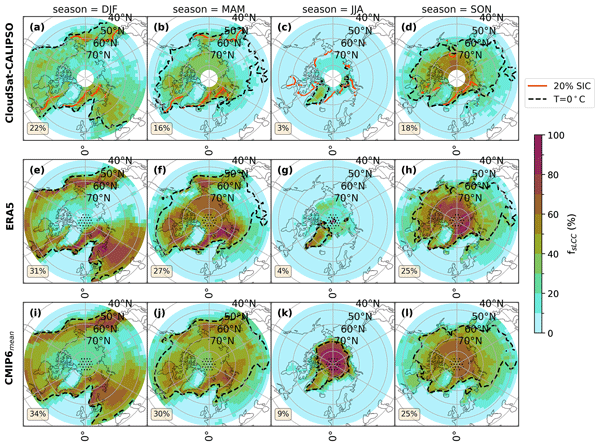
This article compares the occurrence of supercooled liquid-containing clouds (sLCCs) and their link to surface snowfall in CloudSat–CALIPSO, ERA5, and the CMIP6 models. Significant discrepancies were found, with ERA5 and CMIP6 consistently overestimating sLCC and snowfall frequency. This bias is likely due to cloud microphysics parameterization. This conclusion has implications for accurately representing cloud phase and snowfall in future climate projections.
Detlef van Vuuren, Brian O'Neill, Claudia Tebaldi, Louise Chini, Pierre Friedlingstein, Tomoko Hasegawa, Keywan Riahi, Benjamin Sanderson, Bala Govindasamy, Nico Bauer, Veronika Eyring, Cheikh Fall, Katja Frieler, Matthew Gidden, Laila Gohar, Andrew Jones, Andrew King, Reto Knutti, Elmar Kriegler, Peter Lawrence, Chris Lennard, Jason Lowe, Camila Mathison, Shahbaz Mehmood, Luciana Prado, Qiang Zhang, Steven Rose, Alexander Ruane, Carl-Friederich Schleussner, Roland Seferian, Jana Sillmann, Chris Smith, Anna Sörensson, Swapna Panickal, Kaoru Tachiiri, Naomi Vaughan, Saritha Vishwanathan, Tokuta Yokohata, and Tilo Ziehn
EGUsphere, https://doi.org/10.5194/egusphere-2024-3765, https://doi.org/10.5194/egusphere-2024-3765, 2025
Short summary
Short summary
We propose a set of six plausible 21st century emission scenarios, and their multi-century extensions, that will be used by the international community of climate modeling centers to produce the next generation of climate projections. These projections will support climate, impact and mitigation researchers, provide information to practitioners to address future risks from climate change, and contribute to policymakers’ considerations of the trade-offs among various levels of mitigation.
Harriet E. Thompson, Joel C. Gill, Robert Šakić Trogrlić, Faith E. Taylor, and Bruce D. Malamud
Nat. Hazards Earth Syst. Sci., 25, 353–381, https://doi.org/10.5194/nhess-25-353-2025, https://doi.org/10.5194/nhess-25-353-2025, 2025
Short summary
Short summary
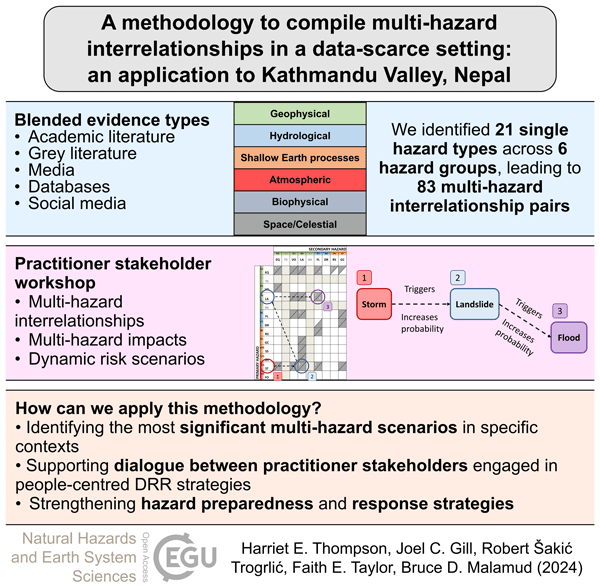
We present a methodology to compile single hazards and multi-hazard interrelationships in data-scarce urban settings, which we apply to the Kathmandu Valley, Nepal. Using blended sources, we collate evidence of 21 single natural hazard types and 83 multi-hazard interrelationships that could impact the Kathmandu Valley. We supplement these exemplars with multi-hazard scenarios developed by practitioner stakeholders, emphasising the need for inclusive disaster preparedness and response approaches.
Sadhana Nirandjan, Elco E. Koks, Mengqi Ye, Raghav Pant, Kees C. H. Van Ginkel, Jeroen C. J. H. Aerts, and Philip J. Ward
Nat. Hazards Earth Syst. Sci., 24, 4341–4368, https://doi.org/10.5194/nhess-24-4341-2024, https://doi.org/10.5194/nhess-24-4341-2024, 2024
Short summary
Short summary
Critical infrastructures (CIs) are exposed to natural hazards, which may result in significant damage and burden society. Vulnerability is a key determinant for reducing these risks, yet crucial information is scattered in the literature. Our study reviews over 1510 fragility and vulnerability curves for CI assets, creating a unique publicly available physical vulnerability database that can be directly used for hazard risk assessments, including floods, earthquakes, windstorms, and landslides.
Hedieh Soltanpour, Kamal Serrhini, Joel C. Gill, Sven Fuchs, and Solmaz Mohadjer
EGUsphere, https://doi.org/10.5194/egusphere-2024-1779, https://doi.org/10.5194/egusphere-2024-1779, 2024
Short summary
Short summary
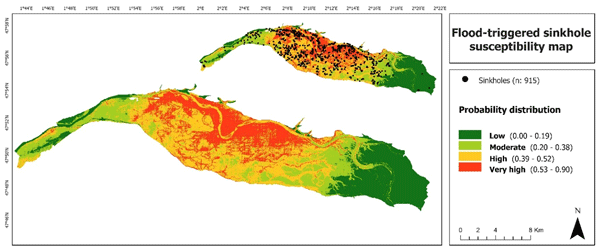
We applied the Maximum Entropy model to characterize multi-hazard scenarios in karst environments, focusing on flood-triggered sinkholes in Val d'Orléans, France. Karst terrains as multi-hazard forming areas, have received little attention in multi-hazard literature. Our study developed a multi-hazard susceptibility map to forecast the spatial distribution of these hazards. The findings improve understanding of hazard interactions and demonstrate the model's utility in multi-hazard analysis.
Viktoria Spaiser, Sirkku Juhola, Sara M. Constantino, Weisi Guo, Tabitha Watson, Jana Sillmann, Alessandro Craparo, Ashleigh Basel, John T. Bruun, Krishna Krishnamurthy, Jürgen Scheffran, Patricia Pinho, Uche T. Okpara, Jonathan F. Donges, Avit Bhowmik, Taha Yasseri, Ricardo Safra de Campos, Graeme S. Cumming, Hugues Chenet, Florian Krampe, Jesse F. Abrams, James G. Dyke, Stefanie Rynders, Yevgeny Aksenov, and Bryan M. Spears
Earth Syst. Dynam., 15, 1179–1206, https://doi.org/10.5194/esd-15-1179-2024, https://doi.org/10.5194/esd-15-1179-2024, 2024
Short summary
Short summary
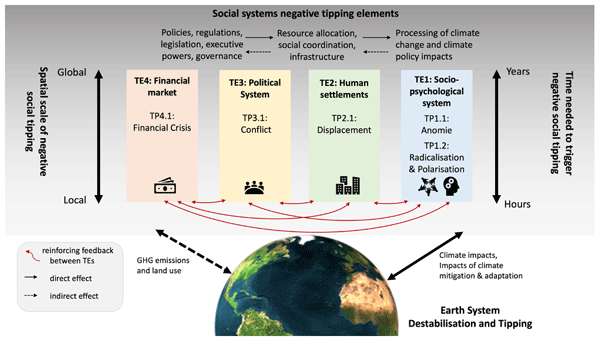
In this paper, we identify potential negative social tipping points linked to Earth system destabilization and draw on related research to understand the drivers and likelihood of these negative social tipping dynamics, their potential effects on human societies and the Earth system, and the potential for cascading interactions and contribution to systemic risks.
Benjamin Poschlod and Anne Sophie Daloz
The Cryosphere, 18, 1959–1981, https://doi.org/10.5194/tc-18-1959-2024, https://doi.org/10.5194/tc-18-1959-2024, 2024
Short summary
Short summary
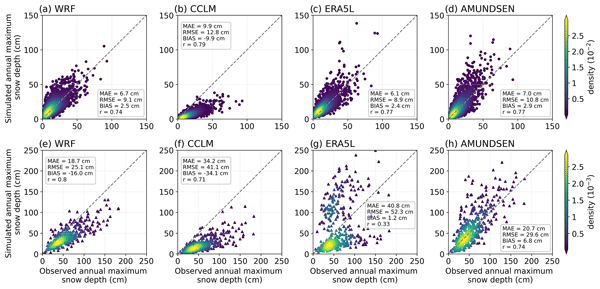
Information about snow depth is important within climate research but also many other sectors, such as tourism, mobility, civil engineering, and ecology. Climate models often feature a spatial resolution which is too coarse to investigate snow depth. Here, we analyse high-resolution simulations and identify added value compared to a coarser-resolution state-of-the-art product. Also, daily snow depth extremes are well reproduced by two models.
Eric Mortensen, Timothy Tiggeloven, Toon Haer, Bas van Bemmel, Dewi Le Bars, Sanne Muis, Dirk Eilander, Frederiek Sperna Weiland, Arno Bouwman, Willem Ligtvoet, and Philip J. Ward
Nat. Hazards Earth Syst. Sci., 24, 1381–1400, https://doi.org/10.5194/nhess-24-1381-2024, https://doi.org/10.5194/nhess-24-1381-2024, 2024
Short summary
Short summary
Current levels of coastal flood risk are projected to increase in coming decades due to various reasons, e.g. sea-level rise, land subsidence, and coastal urbanization: action is needed to minimize this future risk. We evaluate dykes and coastal levees, foreshore vegetation, zoning restrictions, and dry-proofing on a global scale to estimate what levels of risk reductions are possible. We demonstrate that there are several potential adaptation pathways forward for certain areas of the world.
Georg C. Pflug, Viktoria Kittler, and Stefan Hochrainer-Stigler
Nat. Hazards Earth Syst. Sci. Discuss., https://doi.org/10.5194/nhess-2023-194, https://doi.org/10.5194/nhess-2023-194, 2024
Preprint withdrawn
Short summary
Short summary
Multi-hazard events can be devastating and there are indications that in such situations the exposed risk-bearers are affected more severely compared to single-hazard events. We present some statistical modeling approaches to determine possible interrelationships of hazards and tested them for the specific case of the countries within the Danube Region. We especially focused on the question whether certain hazards are more likely to occur due to preceding hazardous events.
Clemens Schwingshackl, Anne Sophie Daloz, Carley Iles, Kristin Aunan, and Jana Sillmann
Nat. Hazards Earth Syst. Sci., 24, 331–354, https://doi.org/10.5194/nhess-24-331-2024, https://doi.org/10.5194/nhess-24-331-2024, 2024
Short summary
Short summary
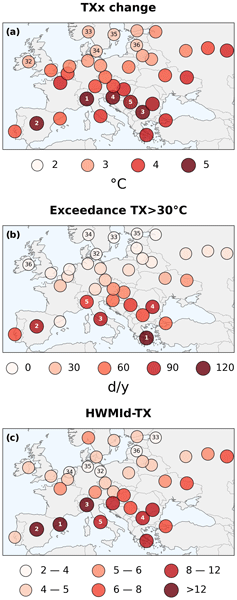
Ambient heat in European cities will substantially increase under global warming, as projected by three heat metrics calculated from high-resolution climate model simulations. While the heat metrics consistently project high levels of ambient heat for several cities, in other cities the projected heat levels vary considerably across the three heat metrics. Using complementary heat metrics for projections of ambient heat is thus important for assessments of future risks from heat stress.
Dirk Eilander, Anaïs Couasnon, Frederiek C. Sperna Weiland, Willem Ligtvoet, Arno Bouwman, Hessel C. Winsemius, and Philip J. Ward
Nat. Hazards Earth Syst. Sci., 23, 2251–2272, https://doi.org/10.5194/nhess-23-2251-2023, https://doi.org/10.5194/nhess-23-2251-2023, 2023
Short summary
Short summary
This study presents a framework for assessing compound flood risk using hydrodynamic, impact, and statistical modeling. A pilot in Mozambique shows the importance of accounting for compound events in risk assessments. We also show how the framework can be used to assess the effectiveness of different risk reduction measures. As the framework is based on global datasets and is largely automated, it can easily be applied in other areas for first-order assessments of compound flood risk.
Job C. M. Dullaart, Sanne Muis, Hans de Moel, Philip J. Ward, Dirk Eilander, and Jeroen C. J. H. Aerts
Nat. Hazards Earth Syst. Sci., 23, 1847–1862, https://doi.org/10.5194/nhess-23-1847-2023, https://doi.org/10.5194/nhess-23-1847-2023, 2023
Short summary
Short summary
Coastal flooding is driven by storm surges and high tides and can be devastating. To gain an understanding of the threat posed by coastal flooding and to identify areas that are especially at risk, now and in the future, it is crucial to accurately model coastal inundation and assess the coastal flood hazard. Here, we present a global dataset with hydrographs that represent the typical evolution of an extreme sea level. These can be used to model coastal inundation more accurately.
Heidi Kreibich, Kai Schröter, Giuliano Di Baldassarre, Anne F. Van Loon, Maurizio Mazzoleni, Guta Wakbulcho Abeshu, Svetlana Agafonova, Amir AghaKouchak, Hafzullah Aksoy, Camila Alvarez-Garreton, Blanca Aznar, Laila Balkhi, Marlies H. Barendrecht, Sylvain Biancamaria, Liduin Bos-Burgering, Chris Bradley, Yus Budiyono, Wouter Buytaert, Lucinda Capewell, Hayley Carlson, Yonca Cavus, Anaïs Couasnon, Gemma Coxon, Ioannis Daliakopoulos, Marleen C. de Ruiter, Claire Delus, Mathilde Erfurt, Giuseppe Esposito, Didier François, Frédéric Frappart, Jim Freer, Natalia Frolova, Animesh K. Gain, Manolis Grillakis, Jordi Oriol Grima, Diego A. Guzmán, Laurie S. Huning, Monica Ionita, Maxim Kharlamov, Dao Nguyen Khoi, Natalie Kieboom, Maria Kireeva, Aristeidis Koutroulis, Waldo Lavado-Casimiro, Hong-Yi Li, Maria Carmen LLasat, David Macdonald, Johanna Mård, Hannah Mathew-Richards, Andrew McKenzie, Alfonso Mejia, Eduardo Mario Mendiondo, Marjolein Mens, Shifteh Mobini, Guilherme Samprogna Mohor, Viorica Nagavciuc, Thanh Ngo-Duc, Huynh Thi Thao Nguyen, Pham Thi Thao Nhi, Olga Petrucci, Nguyen Hong Quan, Pere Quintana-Seguí, Saman Razavi, Elena Ridolfi, Jannik Riegel, Md Shibly Sadik, Nivedita Sairam, Elisa Savelli, Alexey Sazonov, Sanjib Sharma, Johanna Sörensen, Felipe Augusto Arguello Souza, Kerstin Stahl, Max Steinhausen, Michael Stoelzle, Wiwiana Szalińska, Qiuhong Tang, Fuqiang Tian, Tamara Tokarczyk, Carolina Tovar, Thi Van Thu Tran, Marjolein H. J. van Huijgevoort, Michelle T. H. van Vliet, Sergiy Vorogushyn, Thorsten Wagener, Yueling Wang, Doris E. Wendt, Elliot Wickham, Long Yang, Mauricio Zambrano-Bigiarini, and Philip J. Ward
Earth Syst. Sci. Data, 15, 2009–2023, https://doi.org/10.5194/essd-15-2009-2023, https://doi.org/10.5194/essd-15-2009-2023, 2023
Short summary
Short summary
As the adverse impacts of hydrological extremes increase in many regions of the world, a better understanding of the drivers of changes in risk and impacts is essential for effective flood and drought risk management. We present a dataset containing data of paired events, i.e. two floods or two droughts that occurred in the same area. The dataset enables comparative analyses and allows detailed context-specific assessments. Additionally, it supports the testing of socio-hydrological models.
Patrick Ludwig, Florian Ehmele, Mário J. Franca, Susanna Mohr, Alberto Caldas-Alvarez, James E. Daniell, Uwe Ehret, Hendrik Feldmann, Marie Hundhausen, Peter Knippertz, Katharina Küpfer, Michael Kunz, Bernhard Mühr, Joaquim G. Pinto, Julian Quinting, Andreas M. Schäfer, Frank Seidel, and Christina Wisotzky
Nat. Hazards Earth Syst. Sci., 23, 1287–1311, https://doi.org/10.5194/nhess-23-1287-2023, https://doi.org/10.5194/nhess-23-1287-2023, 2023
Short summary
Short summary
Heavy precipitation in July 2021 led to widespread floods in western Germany and neighboring countries. The event was among the five heaviest precipitation events of the past 70 years in Germany, and the river discharges exceeded by far the statistical 100-year return values. Simulations of the event under future climate conditions revealed a strong and non-linear effect on flood peaks: for +2 K global warming, an 18 % increase in rainfall led to a 39 % increase of the flood peak in the Ahr river.
Dirk Eilander, Anaïs Couasnon, Tim Leijnse, Hiroaki Ikeuchi, Dai Yamazaki, Sanne Muis, Job Dullaart, Arjen Haag, Hessel C. Winsemius, and Philip J. Ward
Nat. Hazards Earth Syst. Sci., 23, 823–846, https://doi.org/10.5194/nhess-23-823-2023, https://doi.org/10.5194/nhess-23-823-2023, 2023
Short summary
Short summary
In coastal deltas, flooding can occur from interactions between coastal, riverine, and pluvial drivers, so-called compound flooding. Global models however ignore these interactions. We present a framework for automated and reproducible compound flood modeling anywhere globally and validate it for two historical events in Mozambique with good results. The analysis reveals differences in compound flood dynamics between both events related to the magnitude of and time lag between drivers.
Susanna Mohr, Uwe Ehret, Michael Kunz, Patrick Ludwig, Alberto Caldas-Alvarez, James E. Daniell, Florian Ehmele, Hendrik Feldmann, Mário J. Franca, Christian Gattke, Marie Hundhausen, Peter Knippertz, Katharina Küpfer, Bernhard Mühr, Joaquim G. Pinto, Julian Quinting, Andreas M. Schäfer, Marc Scheibel, Frank Seidel, and Christina Wisotzky
Nat. Hazards Earth Syst. Sci., 23, 525–551, https://doi.org/10.5194/nhess-23-525-2023, https://doi.org/10.5194/nhess-23-525-2023, 2023
Short summary
Short summary
The flood event in July 2021 was one of the most severe disasters in Europe in the last half century. The objective of this two-part study is a multi-disciplinary assessment that examines the complex process interactions in different compartments, from meteorology to hydrological conditions to hydro-morphological processes to impacts on assets and environment. In addition, we address the question of what measures are possible to generate added value to early response management.
Paolo Scussolini, Job Dullaart, Sanne Muis, Alessio Rovere, Pepijn Bakker, Dim Coumou, Hans Renssen, Philip J. Ward, and Jeroen C. J. H. Aerts
Clim. Past, 19, 141–157, https://doi.org/10.5194/cp-19-141-2023, https://doi.org/10.5194/cp-19-141-2023, 2023
Short summary
Short summary
We reconstruct sea level extremes due to storm surges in a past warmer climate. We employ a novel combination of paleoclimate modeling and global ocean hydrodynamic modeling. We find that during the Last Interglacial, about 127 000 years ago, seasonal sea level extremes were indeed significantly different – higher or lower – on long stretches of the global coast. These changes are associated with different patterns of atmospheric storminess linked with meridional shifts in wind bands.
Robert Šakić Trogrlić, Amy Donovan, and Bruce D. Malamud
Nat. Hazards Earth Syst. Sci., 22, 2771–2790, https://doi.org/10.5194/nhess-22-2771-2022, https://doi.org/10.5194/nhess-22-2771-2022, 2022
Short summary
Short summary
Here we present survey responses of 350 natural hazard community members to key challenges in natural hazards research and step changes to achieve the Sustainable Development Goals. Challenges identified range from technical (e.g. model development, early warning) to governance (e.g. co-production with community members). Step changes needed are equally broad; however, the majority of answers showed a need for wider stakeholder engagement, increased risk management and interdisciplinary work.
Julius Schlumberger, Christian Ferrarin, Sebastiaan N. Jonkman, Manuel Andres Diaz Loaiza, Alessandro Antonini, and Sandra Fatorić
Nat. Hazards Earth Syst. Sci., 22, 2381–2400, https://doi.org/10.5194/nhess-22-2381-2022, https://doi.org/10.5194/nhess-22-2381-2022, 2022
Short summary
Short summary
Flooding has serious impacts on the old town of Venice. This paper presents a framework combining a flood model with a flood-impact model to support improving protection against future floods in Venice despite the recently built MOSE barrier. Applying the framework to seven plausible flood scenarios, it was found that individual protection has a significant damage-mediating effect if the MOSE barrier does not operate as anticipated. Contingency planning thus remains important in Venice.
Anne Sophie Daloz, Clemens Schwingshackl, Priscilla Mooney, Susanna Strada, Diana Rechid, Edouard L. Davin, Eleni Katragkou, Nathalie de Noblet-Ducoudré, Michal Belda, Tomas Halenka, Marcus Breil, Rita M. Cardoso, Peter Hoffmann, Daniela C. A. Lima, Ronny Meier, Pedro M. M. Soares, Giannis Sofiadis, Gustav Strandberg, Merja H. Toelle, and Marianne T. Lund
The Cryosphere, 16, 2403–2419, https://doi.org/10.5194/tc-16-2403-2022, https://doi.org/10.5194/tc-16-2403-2022, 2022
Short summary
Short summary
Snow plays a major role in the regulation of the Earth's surface temperature. Together with climate change, rising temperatures are already altering snow in many ways. In this context, it is crucial to better understand the ability of climate models to represent snow and snow processes. This work focuses on Europe and shows that the melting season in spring still represents a challenge for climate models and that more work is needed to accurately simulate snow–atmosphere interactions.
Weihua Zhu, Kai Liu, Ming Wang, Philip J. Ward, and Elco E. Koks
Nat. Hazards Earth Syst. Sci., 22, 1519–1540, https://doi.org/10.5194/nhess-22-1519-2022, https://doi.org/10.5194/nhess-22-1519-2022, 2022
Short summary
Short summary
We present a simulation framework to analyse the system vulnerability and risk of the Chinese railway system to floods. To do so, we develop a method for generating flood events at both the national and river basin scale. Results show flood system vulnerability and risk of the railway system are spatially heterogeneous. The event-based approach shows how we can identify critical hotspots, taking the first steps in developing climate-resilient infrastructure.
Philip J. Ward, James Daniell, Melanie Duncan, Anna Dunne, Cédric Hananel, Stefan Hochrainer-Stigler, Annegien Tijssen, Silvia Torresan, Roxana Ciurean, Joel C. Gill, Jana Sillmann, Anaïs Couasnon, Elco Koks, Noemi Padrón-Fumero, Sharon Tatman, Marianne Tronstad Lund, Adewole Adesiyun, Jeroen C. J. H. Aerts, Alexander Alabaster, Bernard Bulder, Carlos Campillo Torres, Andrea Critto, Raúl Hernández-Martín, Marta Machado, Jaroslav Mysiak, Rene Orth, Irene Palomino Antolín, Eva-Cristina Petrescu, Markus Reichstein, Timothy Tiggeloven, Anne F. Van Loon, Hung Vuong Pham, and Marleen C. de Ruiter
Nat. Hazards Earth Syst. Sci., 22, 1487–1497, https://doi.org/10.5194/nhess-22-1487-2022, https://doi.org/10.5194/nhess-22-1487-2022, 2022
Short summary
Short summary
The majority of natural-hazard risk research focuses on single hazards (a flood, a drought, a volcanic eruption, an earthquake, etc.). In the international research and policy community it is recognised that risk management could benefit from a more systemic approach. In this perspective paper, we argue for an approach that addresses multi-hazard, multi-risk management through the lens of sustainability challenges that cut across sectors, regions, and hazards.
Priscilla A. Mooney, Diana Rechid, Edouard L. Davin, Eleni Katragkou, Natalie de Noblet-Ducoudré, Marcus Breil, Rita M. Cardoso, Anne Sophie Daloz, Peter Hoffmann, Daniela C. A. Lima, Ronny Meier, Pedro M. M. Soares, Giannis Sofiadis, Susanna Strada, Gustav Strandberg, Merja H. Toelle, and Marianne T. Lund
The Cryosphere, 16, 1383–1397, https://doi.org/10.5194/tc-16-1383-2022, https://doi.org/10.5194/tc-16-1383-2022, 2022
Short summary
Short summary
We use multiple regional climate models to show that afforestation in sub-polar and alpine regions reduces the radiative impact of snow albedo on the atmosphere, reduces snow cover, and delays the start of the snowmelt season. This is important for local communities that are highly reliant on snowpack for water resources and winter tourism. However, models disagree on the amount of change particularly when snow is melting. This shows that more research is needed on snow–vegetation interactions.
Mattia Amadio, Arthur H. Essenfelder, Stefano Bagli, Sepehr Marzi, Paolo Mazzoli, Jaroslav Mysiak, and Stephen Roberts
Nat. Hazards Earth Syst. Sci., 22, 265–286, https://doi.org/10.5194/nhess-22-265-2022, https://doi.org/10.5194/nhess-22-265-2022, 2022
Short summary
Short summary
We estimate the risk associated with storm surge events at two case study locations along the North Adriatic Italian coast, considering sea level rise up to the year 2100, and perform a cost–benefit analysis of planned or proposed coastal renovation projects. The study uses nearshore hydrodynamic modelling. Our findings represent a useful indication for disaster risk management, helping to understand the importance of investing in adaptation and estimating the economic return on investments.
Stefano Terzi, Janez Sušnik, Stefan Schneiderbauer, Silvia Torresan, and Andrea Critto
Nat. Hazards Earth Syst. Sci., 21, 3519–3537, https://doi.org/10.5194/nhess-21-3519-2021, https://doi.org/10.5194/nhess-21-3519-2021, 2021
Short summary
Short summary
This study combines outputs from multiple models with statistical assessments of past and future water availability and demand for the Santa Giustina reservoir (Autonomous Province of Trento, Italy). Considering future climate change scenarios, results show high reductions for stored volume and turbined water, with increasing frequency, duration and severity. These results call for the need to adapt to reductions in water availability and effects on the Santa Giustina reservoir management.
Lucas Wouters, Anaïs Couasnon, Marleen C. de Ruiter, Marc J. C. van den Homberg, Aklilu Teklesadik, and Hans de Moel
Nat. Hazards Earth Syst. Sci., 21, 3199–3218, https://doi.org/10.5194/nhess-21-3199-2021, https://doi.org/10.5194/nhess-21-3199-2021, 2021
Short summary
Short summary
This research introduces a novel approach to estimate flood damage in Malawi by applying a machine learning model to UAV imagery. We think that the development of such a model is an essential step to enable the swift allocation of resources for recovery by humanitarian decision-makers. By comparing this method (EUR 10 140) to a conventional land-use-based approach (EUR 15 782) for a specific flood event, recommendations are made for future assessments.
Danhua Xin, James Edward Daniell, Hing-Ho Tsang, and Friedemann Wenzel
Nat. Hazards Earth Syst. Sci., 21, 3031–3056, https://doi.org/10.5194/nhess-21-3031-2021, https://doi.org/10.5194/nhess-21-3031-2021, 2021
Short summary
Short summary
A grid-level residential building stock model (in terms of floor area and replacement value) targeted for seismic risk analysis for mainland China is developed by using census and population density data. Comparisons with previous studies and yearbook records indicate the reliability of our model. The modelled results are openly accessible and can be conveniently updated when more detailed census or statistics data are available.
Dirk Eilander, Willem van Verseveld, Dai Yamazaki, Albrecht Weerts, Hessel C. Winsemius, and Philip J. Ward
Hydrol. Earth Syst. Sci., 25, 5287–5313, https://doi.org/10.5194/hess-25-5287-2021, https://doi.org/10.5194/hess-25-5287-2021, 2021
Short summary
Short summary
Digital elevation models and derived flow directions are crucial to distributed hydrological modeling. As the spatial resolution of models is typically coarser than these data, we need methods to upscale flow direction data while preserving the river structure. We propose the Iterative Hydrography Upscaling (IHU) method and show it outperforms other often-applied methods. We publish the multi-resolution MERIT Hydro IHU hydrography dataset and the algorithm as part of the pyflwdir Python package.
Marleen Carolijn de Ruiter, Anaïs Couasnon, and Philip James Ward
Geosci. Commun., 4, 383–397, https://doi.org/10.5194/gc-4-383-2021, https://doi.org/10.5194/gc-4-383-2021, 2021
Short summary
Short summary
Many countries can get hit by different hazards, such as earthquakes and floods. Generally, measures and policies are aimed at decreasing the potential damages of one particular hazard type despite their potential of having unwanted effects on other hazard types. We designed a serious game that helps professionals to improve their understanding of these potential negative effects of measures and policies that reduce the impacts of disasters across many different hazard types.
Stephen Jewson, Giuliana Barbato, Paola Mercogliano, Jaroslav Mysiak, and Maximiliano Sassi
Nonlin. Processes Geophys., 28, 329–346, https://doi.org/10.5194/npg-28-329-2021, https://doi.org/10.5194/npg-28-329-2021, 2021
Short summary
Short summary
Climate model simulations are uncertain. In some cases this makes it difficult to know how to use them. Significance testing is often used to deal with this issue but has various shortcomings. We describe two alternative ways to manage uncertainty in climate model simulations that avoid these shortcomings. We test them on simulations of future rainfall over Europe and show they produce more accurate projections than either using unadjusted climate model output or statistical testing.
Katja Weigel, Lisa Bock, Bettina K. Gier, Axel Lauer, Mattia Righi, Manuel Schlund, Kemisola Adeniyi, Bouwe Andela, Enrico Arnone, Peter Berg, Louis-Philippe Caron, Irene Cionni, Susanna Corti, Niels Drost, Alasdair Hunter, Llorenç Lledó, Christian Wilhelm Mohr, Aytaç Paçal, Núria Pérez-Zanón, Valeriu Predoi, Marit Sandstad, Jana Sillmann, Andreas Sterl, Javier Vegas-Regidor, Jost von Hardenberg, and Veronika Eyring
Geosci. Model Dev., 14, 3159–3184, https://doi.org/10.5194/gmd-14-3159-2021, https://doi.org/10.5194/gmd-14-3159-2021, 2021
Short summary
Short summary
This work presents new diagnostics for the Earth System Model Evaluation Tool (ESMValTool) v2.0 on the hydrological cycle, extreme events, impact assessment, regional evaluations, and ensemble member selection. The ESMValTool v2.0 diagnostics are developed by a large community of scientists aiming to facilitate the evaluation and comparison of Earth system models (ESMs) with a focus on the ESMs participating in the Coupled Model Intercomparison Project (CMIP).
Claudia Canedo-Rosso, Stefan Hochrainer-Stigler, Georg Pflug, Bruno Condori, and Ronny Berndtsson
Nat. Hazards Earth Syst. Sci., 21, 995–1010, https://doi.org/10.5194/nhess-21-995-2021, https://doi.org/10.5194/nhess-21-995-2021, 2021
Short summary
Short summary
Drought is a major natural hazard that causes large losses for farmers. This study evaluated drought severity based on a drought classification scheme using NDVI and LST, which was related to the ENSO anomalies. In addition, the spatial distribution of NDVI was associated with precipitation and air temperature at the local level. Our findings show that drought severity increases during El Niño years, and as a consequence the socio-economic drought risk of farmers will likely increase.
Benjamin Poschlod, Ralf Ludwig, and Jana Sillmann
Earth Syst. Sci. Data, 13, 983–1003, https://doi.org/10.5194/essd-13-983-2021, https://doi.org/10.5194/essd-13-983-2021, 2021
Short summary
Short summary
This study provides a homogeneous data set of 10-year rainfall return levels based on 50 simulations of the Canadian Regional Climate Model v5 (CRCM5). In order to evaluate its quality, the return levels are compared to those of observation-based rainfall of 16 European countries from 32 different sources. The CRCM5 is able to capture the general spatial pattern of observed extreme precipitation, and also the intensity is reproduced in 77 % of the area for rainfall durations of 3 h and longer.
Cited articles
Aaheim, H. A., Orlov, A., Wei, T., and Glomsrød, S.: GRACE model and applications, CICERO Report, http://hdl.handle.net/11250/2480843, 2018.
Adesiyun, A.: Addressing multi-hazard risk in the transport and infrastructure sector – learnings from the MYRIAD-EU project, MYRIAD-EU Sectoral Brief, Zenodo, https://doi.org/10.5281/zenodo.17787359, 2025.
BBC: Man dies after tree falls on car as Storm Bert sweeps UK, https://www.bbc.com/news/articles/clyg7q6wnwxo (last access: 9 October 2025), 2024.
Budimir, M., Šakić Trogrlić, R., Almeida, C., Arestegui, M., Chuquisengo Vásquez, O., Cisneros, A., Cuba Iriarte, M., Dia, A., Lizon, L., Madueño, G., Ndiaye, A., Ordoñez Caldas, M., Rahman, T., RanaTharu, B., Sall, A., Uprety, D., Anderson, C., and McQuistan, C.: Opportunities and challenges for people-centered multi-hazard early warning systems: Perspectives from the Global South, iScience, 28, 112353, https://doi.org/10.1016/j.isci.2025.112353, 2025.
Buijs, S. L., de Ruiter, M. C., and Ward, P. J.: A continental-scale multi-hazard analysis of economic recovery using nighttime light satellite data, EGU General Assembly 2023, Vienna, Austria, 24–28 Apr 2023, EGU23-717, https://doi.org/10.5194/egusphere-egu23-717, 2023.
Buijs, S. L., Sauer, I. J., Kropf, C. M., Juhel, S., Stalhandske, Z., and De Ruiter, M. C.: Recovery under consecutive disasters: how recovery dynamics shape societal resilience, EGUsphere [preprint], https://doi.org/10.5194/egusphere-2025-3200, 2025.
Bulder, B., Wiggelinkhuizen, E., and Mohanan Nair, J.: Sectoral Brief: Addressing multi-hazard risk in the energy sector, learnings from the MYRIAD-EU project, MYRIAD-EU Sectoral Brief, Zenodo, https://doi.org/10.5281/zenodo.17947317, 2025.
Campillo, C. and Gonzalo, J.: Sectoral Brief: Addressing multi-hazard risk in the food and agriculture sector – learnings from the MYRIAD-EU project, MYRIAD-EU Sectoral Brief, Zenodo, https://doi.org/10.5281/zenodo.17787170, 2025.
Casartelli, V., Salpina, D., Marengo, A., Vivo, G., Sørensen, J., and Mysiak, J.: An innovative framework to conduct peer reviews of disaster risk management capabilities under the Union Civil Protection Mechanism (UCPM), Int. J. Disast. Risk Re., 120, 105350, https://doi.org/10.1016/j.ijdrr.2025.105350, 2025a.
Casartelli, V., Salpina, D., Marengo, A., Ferrario, D. M., Mysiak, J., and Torresan, S.: Back to the future: advancing climate risk assessments with event-based participatory storylines, Climate Risk Management Journal, under review, 2025b.
Champion, A. and Madappatt, N.: Sectoral Brief: Addressing multi-hazard risk in the finance sector – learnings from the MYRIAD-EU project, MYRIAD-EU Sectoral Brief, Zenodo, https://doi.org/10.5281/zenodo.17787018, 2025.
Ciurean, R. L.: Reflections on Stakeholder Engagement, Co-Production Methods, and Knowledge Co-Development in the MYRIAD-EU Project, EGU General Assembly 2025, Vienna, Austria, 27 Apr–2 May 2025, EGU25-21264, https://doi.org/10.5194/egusphere-egu25-21264, 2025.
Claassen, J. N., Ward, P. J., Daniell, J., Koks, E. E., Tiggeloven, T., and de Ruiter, M. C.: A new method to compile global multi-hazard event sets, Sci. Rep., 13, 13808, https://doi.org/10.1038/s41598-023-40400-5, 2023.
Claassen, J. N., Koks, E. E., de Ruiter, M. C., Ward, P. J., and Jäger, W. S.: A Synthetic European Weather Dataset Based on Spatiotemporal Vine Copulas, Scientific Data, 12, 1734, https://doi.org/10.1038/s41597-025-06015-3, 2025a.
Claassen, J. N., Koks, E. E., de Ruiter, M. C., Ward, P. J., and Jäger, W. S.: VineCopulas: an open-source Python package for vine copula modelling. Journal of Open Source Software, 9, 6728, https://doi.org/10.21105/joss.06728, 2025b.
Cocuccioni, S., Pittore, M., Zebisch, M., Schneiderbauer, S., Shepherd, T. G., Casartelli, V., Crummy, J., and Pedde, S.: Risk Storylines: A Community-Led Discussion between Disaster and Climate Science, B. Am. Meteor. Soc., 106, E1717–E1723, https://doi.org/10.1175/BAMS-D-25-0155.1, 2025.
Cordier, E. and Appulo, L.: Sectoral Brief: Addressing linkages between multi-hazard risk and wetlands ecosystems – learnings from the MYRIAD-EU project, MYRIAD-EU Sectoral Brief, Zenodo, https://doi.org/10.5281/zenodo.17947278,2025.
Crummy, J., Banks, V., Ciurean, R., Duncan, M., Smale, L., Daloz, A. S., Ma, L., Casartelli, V., Torresan, S., Stuparu, D., Tatman, S., Geurts, D., Rautenbach, S., Warren, A., Toebrock, L., Šakić Trogrlić, R., Hochrainer-Stigler, S., Padrón Fumero, N., García González, S., and Díaz Pacheco, J.: Online repository of storylines on multi-risk decision-making, Zenodo, https://doi.org/10.5281/zenodo.16366883, 2025.
Dal Barco, M. K., Maraschini, M., Ferrario, D. M., Nguyen, N. D., Vascon, S., Torresan, S., and Critto, A.: A machine learning approach to evaluate coastal risks related to extreme weather events in the Veneto region (Italy), International Journal of Disaster Risk Reduction, 108, 104526, https://doi.org/10.1016/j.ijdrr.2024.104526, 2024.
Dal Barco, M. K., Maraschini, M., Nguyen, N. D., Ferrario, D. M., Rufo, O., Fonseca, H. L., Vascon, S., Torresan, S., and Critto, A: Integrating AI and climate change scenarios for multi-risk assessment in the coastal municipalities of the Veneto region, Sci. Total Environ., 965, 178586, https://doi.org/10.1016/j.scitotenv.2025.178586, 2025.
De Polt, K., Ward, P. J., de Ruiter, M., Bogdanovich, E., Reichstein, M., Frank, D., and Orth, R.: Quantifying impact-relevant heatwave durations, Environ. Res. Lett., 18, 104005, https://doi.org/10.1088/1748-9326/acf05e, 2023.
De Polt, K., Dormann C. F., Ward, P. J., de Ruiter, M. C., Runkle, J. D., Wutzler, T., Reichstein, M., and Orth, R.: Regional Differences in the Impact of Heat and Moisture on Public Health within Europe, ESS Open Archive, https://doi.org/10.22541/essoar.174282873.38972040/v1, 2025a.
De Polt, K., Claassen, J. N., Buijs, S. L., Reluy, N. P., Schlumberger, J., and Ramalingam, N. R.: How can we encourage and empower Early Career Researchers? Reflections on a short course held at EGU 2025, EGU blog, https://blogs.egu.eu/divisions/nh/2025/11/17/how-can-we-encourage-and-empower-early-career-researchers-reflections-on-a-short-course-held-at-egu-2025/ (last access: 27 November 2025), 2025b.
de Ruiter, M., Couasnon, A., Van den Homberg, M. J. C., Daniell, J. E., Gill, J. C., and Ward, P. J.: Why we can no longer ignore consecutive events, Earth's Future, 8, e2019EF001425, https://doi.org/10.1029/2019EF001425, 2020.
de Ruiter, M. C., de Bruijn, J. A., Englhardt, J., Daniell, J. E., de Moel, H., and Ward, P. J.: The asynergies of structural disaster risk reduction measures: Comparing floods and earthquakes, Earth's Future, 9, e2020EF001531, https://doi.org/10.1029/2020EF001531, 2021.
Ducros, G., Tiggeloven, T., Ma, L., Daloz, A. S., Schuhen, N., Claassen, J., and de Ruiter, M. C.: Multi-hazards in Scandinavia: impacts and risks from compound heatwaves, droughts and wildfires, Nat. Hazards Earth Syst. Sci., 25, 4693–4712, https://doi.org/10.5194/nhess-25-4693-2025, 2025.
EEA: European Climate Risk Assessment (EUCRA), European Environment Agency, https://www.eea.europa.eu/en/analysis/publications/european-climate-risk-assessment (last access: 18 February 2026), 2024.
European Commission: Joint communication to the european parliament, the european council, the council, the european economic and social committee and the committee of the regions on the European Preparedness Union Strategy, JOIN(2025) 130 final, European Commission, https://eur-lex.europa.eu/legal-content/EN/TXT/PDF/?uri=CELEX:52023JC0020 (last access: 8 March 2025) , 2025a.
European Commission: Second update on preventing and managing disaster risk in Europe (SWD(2025) 279 final), European Commission, Brussels, https://civil-protection-humanitarian-aid.ec.europa.eu/resources-campaigns/policy-guidelines_en (last access: 11 February 2026), 2025b.
Ferrario, D. M., Tiggeloven T., Maraschini, M., Sano, M., Claassen, J., de Ruiter, M. C., Torresan, S., and Critto, A.: A machine learning methodology to identify current and future multi-hazard extreme events, ESS Open Archive [preprint], https://doi.org/10.22541/essoar.175396232.24844978/v1, 2025a.
Ferrario, D. M., Tiggeloven, T., Casagrande, S., Sanò, M., de Ruiter, M., Critto, A., and Torresan, S.: An AI approach for multi-risk assessment in the Veneto Region , EGU General Assembly 2025, Vienna, Austria, 27 Apr–2 May 2025, EGU25-16640, https://doi.org/10.5194/egusphere-egu25-16640, 2025b.
Gargiulo, M. V.: Building the Future of Multi-hazard Disaster Risk Reduction in Barcelona, EGU Blogs, https://blogs.egu.eu/divisions/nh/2025/01/13/building-the-future-of-multi-hazard-disaster-risk-reduction-in-barcelona/ (last access: 9 October 2025), 2025.
Gill, J., Duncan, M., Ciurean, R., Smale, L., Stuparu, D., Schlumberger, J., de Ruiter, M., Tiggeloven, T., Torresan, S., Gottardo, S., Mysiak, J., Harris, R., Petrescu, E.-C., Girard, T., Khazai, B., Claassen, J., Dai, R., Champion, A., Daloz, A. S., Blanco Cipollone, F., Campillo Torres, C., Palomino Antolin, I., Ferrario, D., Tatman, S., Tijssen, A., Vaidya, S., Adesiyun, A., Goger, T., Angiuli, A., Audren, M., Machado, M., Hochrainer-Stigler, S., Šakić Trogrlić, R., Daniell, J., Bulder, B., Krishna Swamy, S., Wiggelinkhuizen, E.-J., Díaz Pacheco, J., López Díez, A., Mendoza Jiménez, J., Padrón-Fumero, N., Appulo, L., Orth, R., Jana Sillmann, J., and Ward, P. J.: Handbook of Multi-hazard, Multi-Risk Definitions and Concepts, MYRIAD-EU Deliverable 1.2, Zenodo, https://doi.org/10.5281/zenodo.7870260, 2022.
Gill, J., Duncan, M., de Ruiter, M., Tiggeloven, T., Ward, P. J., Smale, L., and Ciurean, R.: Concept note: The multi-hazard context and its relevance to the UN Office for Disaster Risk Reduction/International Science Council's Hazard Information Profiles (HIPs), MYRIAD-EU report, Zenodo, https://doi.org/10.5281/zenodo.15574444, 2025.
Gottardo, S., Ciurean, R., Daloz, A. S., Padron-Fumero, N., Šakić Trogrlić, R., Tatman, S., Torresan, S., Casartelli, V., Critto, A., Dal Barco, M. K., Díaz- Pacheco, J., Ferrario, D. M., García González, S., Gatti, I., Geurts, D., Hochrainer-Stigler, S., Ma, L., Marengo, A., Romero Manrique Lara, D., Mysiak, J., Ngoc Nguyen, D., Petrescu, E.-C., Reiter, K., Salpina, D., Schlumberger, J., Strelkovskii, N., and Ward, P. J.: D3.4 Final report on forward-looking DRM pathways and recommendations for upscaling and transferability, MYRIAD-EU project deliverable, Zenodo, https://doi.org/10.5281/zenodo.17245464, 2025.
Guentchev, G., Palin, E. J., Lowe, J. A., and Harrison, M.: Upscaling of climate services-What is it? A literature review, Climate Services, 30, 100352, https://doi.org/10.1016/j.cliser.2023.100352, 2023
Hadjimichael, A., Schlumberger, J., and Haasnoot, M.: Data visualisation for decision making under deep uncertainty: current challenges and opportunities, Environ. Res. Lett., 19, 111011, https://doi.org/10.1088/1748-9326/ad858b, 2024.
Haer, T. and de Ruiter, M.: A multi-hazard perspective on equitable adaptation and how to assess it, PLOS Climate, 3, e0000521, https://doi.org/10.1371/journal.pclm.0000521, 2024.
Hochrainer-Stigler, S., Šakić Trogrlić, R., and Reiter, K.: Initial Framework and Guidance Protocol Document, MYRIAD-EU Deliverable 2.1, Zenodo, https://doi.org/10.5281/zenodo.7215816, 2022.
Hochrainer-Stigler, S., Šakić Trogrlić, R., Reiter, K., Ward, P. J., de Ruiter, M. C., Duncan, M. J., Torresan, S., Ciurean, R., Mysiak, J., Stuparu, D., and Gottardo, S.: Toward a framework for systemic multi-hazard and multi-risk assessment and management, iScience, 26, 106736, https://doi.org/10.1016/j.isci.2023.106736, 2023.
Jäger, W. S., de Ruiter, M. C., Tiggeloven, T., and Ward, P. J.: What can we learn about multi-hazard impacts from global disaster records?, Nat. Hazards Earth Syst. Sci., 25, 2751–2769, https://doi.org/10.5194/nhess-25-2751-2025, 2025.
Kennedy, C., Douglas, J., Sarfaraz Gani Adnan, M., White, C., Roberts, M., Jensen, E., and De Maio, F.: A generalised framework for the assessment of current and future multi-hazard interactions, MEDiate Deliverable 2.1, 2023.
Khazai, B., Padrón Fumero, N., and Machado, M.: Sectoral Brief: Enhancing Tourism Destination Resilience: Insights of the MYRIAD-EU Multi-risk Approach, MYRIAD-EU Sectoral Brief, Zenodo, https://doi.org/10.5281/zenodo.17787282, 2025.
Koks, E. E. and Thissen, M.: A Multiregional Impact Assessment Model for disaster analysis, Econ. Syst. Res., 28, 429–449, https://doi.org/10.1080/09535314.2016.1232701, 2016.
Kreibich, H., Di Baldassarre, G., Vorogushyn, S., Aerts, J. C. J. H., Apel, H., Aronica, G. T., Arnbjerg-Nielsen, K., Bouwer, L. M., Bubeck, P., Caloiero, T., Chinh, D. T., Cortès, M., Gain, A. K., Giampá, V., Kuhlicke, C., Kundzewicz, Z. W., Carmen Llasat, M., Mård, J., Matczak, P., Mazzoleni, M., Molinari, D., Dung, N. V., Petrucci, O., Schröter, K., Slager, K., Thieken, A. H., Ward, P. J., and Merz, B.: Adaptation to flood risk: Results of international paired flood event studies, Earth's Future, 5, 953–965, https://doi.org/10.1002/2017EF000606, 2017.
Met Office: An upscaling approach for climate services: Toolkit, Met Office, https://www.metoffice.gov.uk/binaries/content/assets/metofficegovuk/pdf/research/spf/upscaling-climate-services/upscaling-toolkit-introduction_and_stage1.pdf (last access: 11 February 2026), 2024.
Mortensen, E., Cassanti, A. C., Tiggeloven, T., Twaalfhoven, A., Ward, P. J., and Haer, T.: On moving towards a more inclusive understanding of disaster risk reduction: A sexual and gender minorities perspective through the lens of global flood risk, Progress in Disaster Science, 26, 100442, https://doi.org/10.1016/j.pdisas.2025.100442, 2025.
Nguyen, D. N., Furlanetto, J., Critto, A., and Torresan, S.: Understanding multi-hazard risk dynamics between land use, climate extremes and water quality leveraging artificial intelligence, Ecological Indicators, 182, 114494, https://doi.org/10.1016/j.ecolind.2025.114494, 2026.
Poledna, S., Miess, M. G., Hommes, C., and Rabitsch, K.: Economic forecasting with an agent-based model, Eur. Econ. Rev., 151, 104306, https://doi.org/10.1016/j.euroecorev.2022.104306, 2023.
Reichstein, M., Benson, V., Blunk, J., Camps-Valls, G., Creutzig, F., Fearnley, C. J., Han, B., Kornhuber, K., Rahaman, N., Schölkopf, B., María Tárraga, J., Vinuesa, R., Dall, K., Denzler, J., Frank, D., Martini, G., Nganga, N., Maddix, D. C., and Weldemariam, K.: Early warning of complex climate risk with integrated artificial intelligence, Nat. Commun., 16, 2564, https://doi.org/10.1038/s41467-025-57640-w, 2025.
Ronco, M., Tilloy, A., Corbane, C., Feyen, L., Paprotny, D., Jager, W., Claassen, J., Tiggeloven, T., Riemann, L., Matano, A., Delforge, D., Kummu, M., Sibilia, A., and Ward, P.: Exploring Vulnerability Dynamics Associated with Compound Flood Impacts Across European Regions, EGU General Assembly 2025, Vienna, Austria, 27 Apr–2 May 2025, EGU25-19024, https://doi.org/10.5194/egusphere-egu25-19024, 2025.
Sairam, N. and de Ruiter, M. C.: Invited perspectives: Redefining disaster risk – the convergence of natural hazards and health crises, Nat. Hazards Earth Syst. Sci., 26, 119–130, https://doi.org/10.5194/nhess-26-119-2026, 2026.
Šakić Trogrlić, R., Reiter, K., Ciurean, R. L., Gottardo, S., Torresan, S., Daloz, A. S., Ma, L., Padrón Fumero, N., Tatman, S., Hochrainer-Stigler, S., de Ruiter, M. C., Schlumberger, J., Harris, R., Garcia-Gonzalez, S., García-Vaquero, M., Lucía Febles Arévalo, T., Hernandez-Martin, R., Mendoza-Jimenez, J., Mauro Ferrario, D., Geurts, D., Stuparu, D., Tiggeloven, T., Duncan, M. J., and Ward, P. J.: Challenges in assessing and managing multi-hazard risks: A European stakeholders perspective, Environ. Sci. Policy, 157, 103774, https://doi.org/10.1016/j.envsci.2024.103774, 2024.
Sakic Trogrlic, R., de Ruiter, M., de Angeli, S., Duncan, M., Gill, J., Kreibich, H., White, C., and Ward, P.: Unlocking Global Insights: Opportunities for Multi-Hazard Risk Management from a Unique Empirical Database, EGU General Assembly 2025, Vienna, Austria, 27 Apr–2 May 2025, EGU25-17791, https://doi.org/10.5194/egusphere-egu25-17791, 2025.
Schaefer, A. M., Daniell, J. E., Khazai, B., and Girard, T.: Stochastic and Empirical Multi-Hazard Event Sets for Europe: Earthquake Stochastic Event Set for Europe (ISO3166 code) (Version V1), Zenodo [data set], https://doi.org/10.5281/zenodo.7141934, 2022.
Schlumberger, J., Haasnoot, M., Aerts, J., and De Ruiter, M.: Proposing DAPP-MR as a disaster risk management pathways framework for complex, dynamic multi-risk, iScience, 25, 105219, https://doi.org/10.1016/j.isci.2022.105219, 2022.
Schlumberger, J., Stuparu, D., Ciurean, R. L., Duncan, M., Mysiak, J., Khazai, B., Rimmer, J., Dochiu, C., Claassen, J., and Warren, A.: D1.3 Report on policies, policy-making processes, and governance for multi- hazard, multi-risk management (Version 2), MYRIAD-EU project deliverable, Zenodo, https://doi.org/10.5281/zenodo.10001937, 2023.
Schlumberger, J., Haasnoot, M., Aerts, J. C., Bril, V., van der Weide, L., and De Ruiter, M. C.: Evaluating adaptation pathways in a complex multi-risk system, Earth's Future, 12, e2023EF004288, https://doi.org/10.1029/2023EF004288, 2024.
Schlumberger, J., Šakić Trogrlić, R., Aerts, J. C. J. H., Hyun, J.-H., Hochrainer-Stigler, S., de Ruiter, M., and Haasnoot, M.: A pathways analysis dashboard prototype for multi-risk systems, Nat. Hazards Earth Syst. Sci., 25, 4089–4113, https://doi.org/10.5194/nhess-25-4089-2025, 2025a.
Schlumberger, J., Warren, A., Daloz, A. S., Geurts, D., Hochrainer-Stigler, S., Ma, L., Padrón-Fumero, N., Reiter, K., Šakić Trogrlić, R., Tatman, S., Banks, V. J., Crummy, J., Díaz-Pacheco, J., Antequera, P. D., García-González, S., López-Díez, A., Febles Arévalo, T.L., Romero-Manrique, D., Strelkovskii, N., Torresan, S., Torvanger, A., Casartelli, V., Ciurean, R., Claassen, J. N., Gottardo, S., Aerts, J. C. J. H., Haasnoot, M., and De Ruiter, M. C.: Developing multi-risk DRM pathways – Lessons from four European case studies, Climate Risk Management, 50, https://doi.org/10.1016/j.crm.2025.100753, 2025b.
Schlumberger, J., De Polt, K., Claassen, J. N., Tiggeloven, T., Buijs, S. L., De Ruiter, M. C., Gargiulo, M. V., Gill, J. C., and Ward, P. J.: Empowering ECRs to make research projects flourish: lessons from a European research project, Open Research Europe [preprint], https://doi.org/10.12688/openreseurope.21517.1, 2025c.
Schlumberger, J., Stolte, T. R., Garcia, H. M., Sebastian, A., Jäger, W., Ward, P. J., de Ruiter, M. C., Trogrlić, R. Š., Tijssen, A., and de Brito, M. M.: Review article: Exploring methods capturing vulnerability dynamics in the context of flood hazard research, EGUsphere [preprint], https://doi.org/10.5194/egusphere-2025-6132, 2026.
Shepherd, T. G., Boyd, E., Calel, R. A., Chapman, S. C., Dessai, S., Dima-West, I. M., Fowler, H. J., James, R., Maraun, D., Martius, O., Senior, C. A., Sobel, A. H., Stainforth, D. A., Tett, S. F. B., Trenberth, K. E., Van den Hurk, B. J. J. M., Watkins, N. W., Wilby, R. L., and Zenghelis, D. A.: Storylines: an alternative approach to representing uncertainty in physical aspects of climate change, Climatic Change, 151, 555–571, https://doi.org/10.1007/s10584-018-2317-9, 2018.
Sillmann, J., Shepherd, T. G., Van den Hurk, B., Hazeleger, W., Martius, O., Slingo, J., and Zscheischler, J.: Event-Based Storylines to Address Climate Risk, Earth's Future, 9, e2020EF001783, https://doi.org/10.1029/2020EF001783, 2021.
Stolte, T. R, Koks, E. E., De Moel, H., Reimann, L., Van Vliet, J., De Ruiter, M. C., and Ward, P. J.: VulneraCity–drivers and dynamics of urban vulnerability based on a global systematic literature review, International Journal of Disaster Risk Reduction, 108, 104535, https://doi.org/10.1016/j.ijdrr.2024.104535, 2024.
Stolte, T. R., Jäger, W., Daniell, J., Ward, P. J., de Ruiter, M., Tiggeloven, T., De Polt, K., Buijs, S. L., Claassen, J., Van Maanen, N., Sestito, B., Benito Lazaro, I., Ferrario, D. M., Nguyen, N. D., Dal Barco, M. K., Schlumberger, J., Torresan, S., Orth, R., Duncan, M., and Smale, L.: Metadatabase for Dynamics of Risk Drivers, MYRIAD-EU Deliverable 4.5, Zenodo, https://doi.org/10.5281/zenodo.16794440, 2025.
Tiggeloven, T., Raymond, C., de Ruiter, M. C., Sillmann, J., Thieken, A. H., Buijs, S. L., Ciurean, R., Cordier, E., Crummy, J. M., Cumiskey, L., De Polt, K., Duncan, M., Ferrario, D. M., Jäger, W. S., Koks, E. E., van Maanen, N., Murdock, H. J., Mysiak, J., Nirandjan, S., Poschlod, B., Priesmeier, P., Sairam, N., Schweizer, P.-J., Stolte, T. R., Zenker, M.-L., Daniell, J. E., Fekete, A., Geiß, C. M., van den Homberg, M. J. C., Juhola, S. K., Kuhlicke, C., Lebek, K., Šakić Trogrlić, R., Schneiderbauer, S., Torresan, S., van Westen, C. J., Claassen, J. N., Khazai, B., Murray, V., Schlumberger, J., and Ward, P. J.: Reflections and Future Directions for Multi-Hazard Risk in the Context of the Sendai Framework and Discussions Beyond, EGUsphere [preprint], https://doi.org/10.5194/egusphere-2025-2771, 2025a.
Tiggeloven, T., Ferrario, D. M., Claassen, J. N., Jäger, W. S., Shapovalova, Y., Koyama, M., de Ruiter, M. C., Daniell, J. E., Torresan, S., and Ward, P. J.: A global approach for mapping multi-hazard susceptibility using deep learning: A case study in Japan, Artificial Intelligence for the Earth Systems, 4, https://doi.org/10.1175/AIES-D-25-0039.1, 2025b.
Tiggeloven, T., Pfeiffer, S., Matanó, A., van den Homberg, M., Thalheimer, L., Reichstein, M., and Torresan, S.: The Role of Artificial Intelligence for Early Warning Systems: Status, Applicability, Guardrails and Ways Forward, iScience, 28, https://doi.org/10.1016/j.isci.2025.113689, 2025c.
Tiggeloven, T., Stolte, T., Claassen, J., Chang, C.-W., Paszkowski, A., Schneiderbauer, S., Yotsui, S., and van Maanen, N.: Multi-hazards in an unequal world, EGU General Assembly 2025, Vienna, Austria, 27 Apr–2 May 2025, EGU25-1005, https://doi.org/10.5194/egusphere-egu25-1005, 2025d.
Tiggeloven, T., van Zelst, V., van Wesenbeeck, B. K., Worthington, T. A., Spalding, M., de Moel, H., and Ward, P. J.: Mangrove restoration and coastal flood adaptation: A global perspective on the potential for hybrid coastal defenses, P. Natl. Acad. Sci. USA, 123, e2510980123, https://doi.org/10.1073/pnas.2510980123, 2026.
UNDRR: Sendai Framework for Disaster Risk Reduction 2015–2030, UNDRR, https://www.undrr.org/publication/sendai-framework-disaster-risk-reduction-2015-2030 (last access: 18 February 2026), 2015.
UNDRR: Terminology for Disaster Risk Reduction, UNDRR, Geneva, Switzerland, https://www.undrr.org/terminology (last access: 4 February 2026), 2017.
UNDRR: Hazard Definition & Classification Review, Technical Report, https://www.undrr.org/publication/documents-and-publications/hazard-definition-and-classification-review-technical-0 (last access: 18 February 2026), 2020.
UNDRR: Global Assessment Report 2022. Our World at Risk: Transforming Governance for a Resilient Future, UNDRR, https://www.undrr.org/gar/gar2022-our-world-risk-gar (last access: 18 February 2026), 2022.
UNDRR: The Report of the Midterm Review of the Implementation of the Sendai Framework for Disaster Risk Reduction 2015–2030, UNDRR, https://sendaiframework-mtr.undrr.org/publication/report-midterm-review-implementation-sendai-framework-disaster-risk-reduction-2015-2030 (last access: 18 February 2026), 2023.
UNDRR: Forensic Insights for Future Resilience, Learning from Past Disasters, GAR Special Report 2024, UNDRR, Geneva, ISBN 9789211067545, 2024.
UNDRR and ISC: UNDRR-ISC Hazard Information Profiles – 2025 Update, United Nations Office for Disaster Risk Reduction, International Science Council, https://doi.org/10.24948/2025.05, 2025.
Van Maanen, N., De Ruiter, M., and Ward, P. J.: Workshop report: The role of Earth Observation for multi-(hazard-)risk assessment and management, iScience, 27, 110833, https://doi.org/10.1016/j.isci.2024.110833, 2024.
van Maanen, N., de Ruiter, M., Jäger, W., Casartelli, V., Ciurean, R., Padrón-Fumero, N., Daloz, A. S., Geurts, D., Gottardo, S., Hochrainer-Stigler, S., López Diez, A., Díaz Pacheco, J., Dorta Antequera, P., Febles Arévalo, T., García González, S., Hernández-Martín, R., Alvarez-Albelo, C., Diaz-Hernandez, J. J., Ma, L., Monteleone, L., Reiter, K., Stolte, T., Šakić Trogrlić, R., Torresan, S., Tatman, S., Romero Manrique de Lara, D., Hernández González, Y., and Ward, P. J.: Bridging science and practice on multi-hazard risk drivers: stakeholder insights from five pilot studies in Europe, Earth Syst. Dynam., 16, 2295–2311, https://doi.org/10.5194/esd-16-2295-2025, 2025.
Ward, P. J., Daniell, J., Duncan, M., Dunne, A., Hananel, C., Hochrainer-Stigler, S., Tijssen, A., Torresan, S., Ciurean, R., Gill, J. C., Sillmann, J., Couasnon, A., Koks, E., Padrón-Fumero, N., Tatman, S., Tronstad Lund, M., Adesiyun, A., Aerts, J. C. J. H., Alabaster, A., Bulder, B., Campillo Torres, C., Critto, A., Hernández-Martín, R., Machado, M., Mysiak, J., Orth, R., Palomino Antolín, I., Petrescu, E.-C., Reichstein, M., Tiggeloven, T., Van Loon, A. F., Vuong Pham, H., and de Ruiter, M. C.: Invited perspectives: A research agenda towards disaster risk management pathways in multi-(hazard-)risk assessment, Nat. Hazards Earth Syst. Sci., 22, 1487–1497, https://doi.org/10.5194/nhess-22-1487-2022, 2022.
White, C. J., Adnan, M. S. G., Arosio, M., Buller, S., Cha, Y., Ciurean, R., Crummy, J. M., Duncan, M., Gill, J., Kennedy, C., Nobile, E., Smale, L., and Ward, P. J.: Review article: Towards multi-hazard and multi-risk indicators – a review and recommendations for development and implementation, Nat. Hazards Earth Syst. Sci., 25, 4263–4281, https://doi.org/10.5194/nhess-25-4263-2025, 2025.
Zschau, J.: Where are we with multihazards, multirisks assessment capacities?, in: Science for disaster risk management 2017: knowing better and losing less, edited by: Poljansek, K., Marin Ferrer, M., De Groeve, T., and Clark, I., European Union, Brussels, Belgium, https://drmkc.jrc.ec.europa.eu/knowledge/science-for-drm/science-for-disaster-risk-management-2017 (last access: 4 February 2026), 2017.
Short summary
Disasters often result from interactions between different hazards, like floods triggering landslides, or earthquakes followed by tropical cyclones, so-called multi-hazards. People and societies are increasingly exposed and vulnerable to these multi-hazards. Assessing these aspects is referred to as multi-risk assessment and management. In this paper we synthesise key learnings from the MYRIAD-EU (Multi-hazard and sYstemic framework for enhancing Risk-Informed mAnagement and Decision-making in the E.U.) project, reflecting on progress and challenges faced in addressing multi-hazards and multi-risk.
Disasters often result from interactions between different hazards, like floods triggering...
Altmetrics
Final-revised paper
Preprint