
Articles | Volume 25, issue 12
https://doi.org/10.5194/nhess-25-4921-2025
© Author(s) 2025. This work is distributed under
the Creative Commons Attribution 4.0 License.
the Creative Commons Attribution 4.0 License.
https://doi.org/10.5194/nhess-25-4921-2025
© Author(s) 2025. This work is distributed under
the Creative Commons Attribution 4.0 License.
the Creative Commons Attribution 4.0 License.
Research article
| 
11 Dec 2025
Research article |
| 11 Dec 2025
| 11 Dec 2025
Influence of the North Atlantic Oscillation on annual spatio-temporal lightning clusters in western and central Europe
Markus Augenstein
CORRESPONDING AUTHOR

Institute of Meteorology and Climate Research Troposphere Research (IMKTRO), Karlsruhe Institute of Technology (KIT), Karlsruhe, Germany
Susanna Mohr
Institute of Meteorology and Climate Research Troposphere Research (IMKTRO), Karlsruhe Institute of Technology (KIT), Karlsruhe, Germany
Center for Disaster Management and Risk Reduction Technology (CEDIM), Karlsruhe Institute of Technology (KIT), Karlsruhe, Germany
Michael Kunz
Institute of Meteorology and Climate Research Troposphere Research (IMKTRO), Karlsruhe Institute of Technology (KIT), Karlsruhe, Germany
Center for Disaster Management and Risk Reduction Technology (CEDIM), Karlsruhe Institute of Technology (KIT), Karlsruhe, Germany
Related authors
Elena Xoplaki, Florian Ellsäßer, Jens Grieger, Katrin M. Nissen, Joaquim G. Pinto, Markus Augenstein, Ting-Chen Chen, Hendrik Feldmann, Petra Friederichs, Daniel Gliksman, Laura Goulier, Karsten Haustein, Jens Heinke, Lisa Jach, Florian Knutzen, Stefan Kollet, Jürg Luterbacher, Niklas Luther, Susanna Mohr, Christoph Mudersbach, Christoph Müller, Efi Rousi, Felix Simon, Laura Suarez-Gutierrez, Svenja Szemkus, Sara M. Vallejo-Bernal, Odysseas Vlachopoulos, and Frederik Wolf
Nat. Hazards Earth Syst. Sci., 25, 541–564, https://doi.org/10.5194/nhess-25-541-2025, https://doi.org/10.5194/nhess-25-541-2025, 2025
Short summary
Short summary
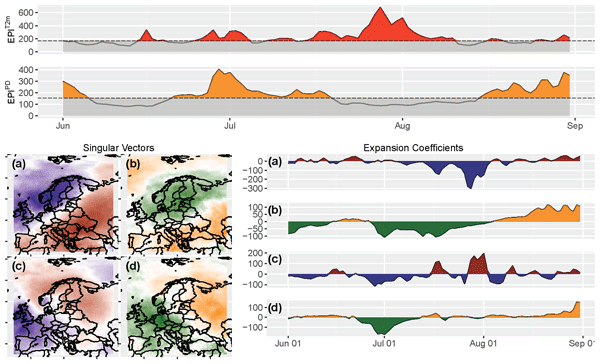
Europe frequently experiences compound events, with major impacts. We investigate these events’ interactions, characteristics, and changes over time, focusing on socio-economic impacts in Germany and central Europe. Highlighting 2018’s extreme events, this study reveals impacts on water, agriculture, and forests and stresses the need for impact-focused definitions and better future risk quantification to support adaptation planning.
Alberto Caldas-Alvarez, Markus Augenstein, Georgy Ayzel, Klemens Barfus, Ribu Cherian, Lisa Dillenardt, Felix Fauer, Hendrik Feldmann, Maik Heistermann, Alexia Karwat, Frank Kaspar, Heidi Kreibich, Etor Emanuel Lucio-Eceiza, Edmund P. Meredith, Susanna Mohr, Deborah Niermann, Stephan Pfahl, Florian Ruff, Henning W. Rust, Lukas Schoppa, Thomas Schwitalla, Stella Steidl, Annegret H. Thieken, Jordis S. Tradowsky, Volker Wulfmeyer, and Johannes Quaas
Nat. Hazards Earth Syst. Sci., 22, 3701–3724, https://doi.org/10.5194/nhess-22-3701-2022, https://doi.org/10.5194/nhess-22-3701-2022, 2022
Short summary
Short summary
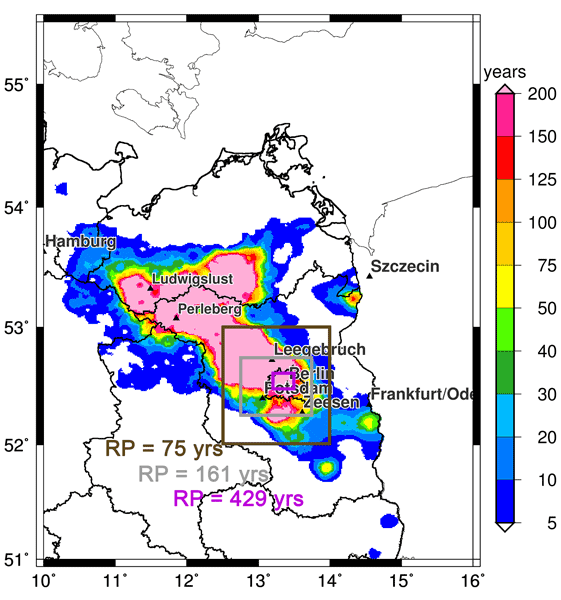
In a warming climate, extreme precipitation events are becoming more frequent. To advance our knowledge on such phenomena, we present a multidisciplinary analysis of a selected case study that took place on 29 June 2017 in the Berlin metropolitan area. Our analysis provides evidence of the extremeness of the case from the atmospheric and the impacts perspectives as well as new insights on the physical mechanisms of the event at the meteorological and climate scales.
Katharina Küpfer, Alexandre Tuel, and Michael Kunz
Nat. Hazards Earth Syst. Sci., 25, 2885–2907, https://doi.org/10.5194/nhess-25-2885-2025, https://doi.org/10.5194/nhess-25-2885-2025, 2025
Short summary
Short summary
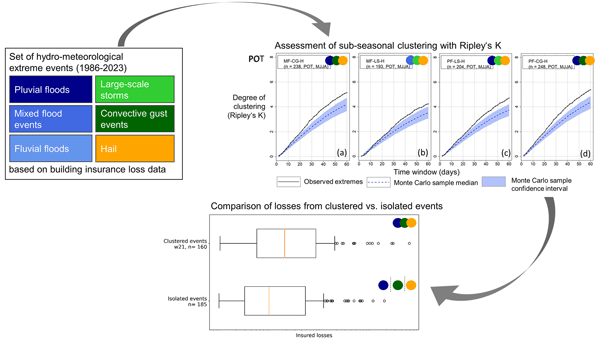
Using loss data, we assess when and how single and multiple types of meteorological extremes (river floods and heavy rainfall events, windstorms and convective gusts, and hail) are related. We find that the combination of several types of hazards clusters robustly on a seasonal scale, whereas only some single hazard types occur in clusters. This can be associated with higher losses compared to isolated events. We argue for the relevance of jointly considering multiple types of hazards.
Elena Xoplaki, Florian Ellsäßer, Jens Grieger, Katrin M. Nissen, Joaquim G. Pinto, Markus Augenstein, Ting-Chen Chen, Hendrik Feldmann, Petra Friederichs, Daniel Gliksman, Laura Goulier, Karsten Haustein, Jens Heinke, Lisa Jach, Florian Knutzen, Stefan Kollet, Jürg Luterbacher, Niklas Luther, Susanna Mohr, Christoph Mudersbach, Christoph Müller, Efi Rousi, Felix Simon, Laura Suarez-Gutierrez, Svenja Szemkus, Sara M. Vallejo-Bernal, Odysseas Vlachopoulos, and Frederik Wolf
Nat. Hazards Earth Syst. Sci., 25, 541–564, https://doi.org/10.5194/nhess-25-541-2025, https://doi.org/10.5194/nhess-25-541-2025, 2025
Short summary
Short summary
Europe frequently experiences compound events, with major impacts. We investigate these events’ interactions, characteristics, and changes over time, focusing on socio-economic impacts in Germany and central Europe. Highlighting 2018’s extreme events, this study reveals impacts on water, agriculture, and forests and stresses the need for impact-focused definitions and better future risk quantification to support adaptation planning.
Antonio Giordani, Michael Kunz, Kristopher M. Bedka, Heinz Jürgen Punge, Tiziana Paccagnella, Valentina Pavan, Ines M. L. Cerenzia, and Silvana Di Sabatino
Nat. Hazards Earth Syst. Sci., 24, 2331–2357, https://doi.org/10.5194/nhess-24-2331-2024, https://doi.org/10.5194/nhess-24-2331-2024, 2024
Short summary
Short summary
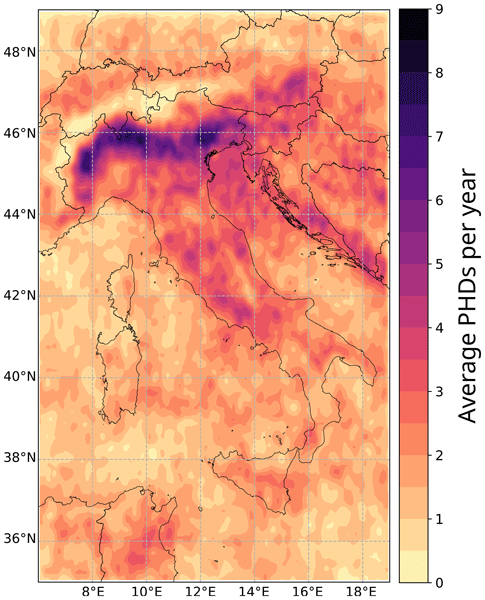
To improve the challenging representation of hazardous hailstorms, a proxy for hail frequency based on satellite detections, convective parameters from high-resolution reanalysis, and crowd-sourced reports is tested and presented. Hail likelihood peaks in mid-summer at 15:00 UTC over northern Italy and shows improved agreement with observations compared to previous estimates. By separating ambient signatures based on hail severity, enhanced appropriateness for large-hail occurrence is found.
Heinz Jürgen Punge, Kristopher M. Bedka, Michael Kunz, Sarah D. Bang, and Kyle F. Itterly
Nat. Hazards Earth Syst. Sci., 23, 1549–1576, https://doi.org/10.5194/nhess-23-1549-2023, https://doi.org/10.5194/nhess-23-1549-2023, 2023
Short summary
Short summary
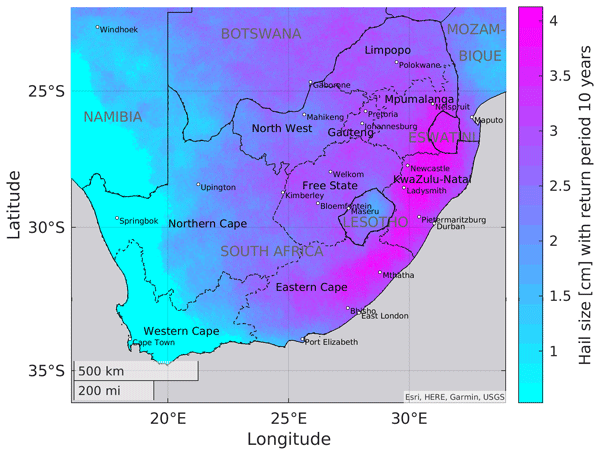
We have estimated the probability of hail events in South Africa using a combination of satellite observations, reanalysis, and insurance claims data. It is found that hail is mainly concentrated in the southeast. Multivariate stochastic modeling of event characteristics, such as multiple events per day or track dimensions, provides an event catalogue for 25 000 years. This can be used to estimate hail risk for return periods of 200 years, as required by insurance companies.

Patrick Ludwig, Florian Ehmele, Mário J. Franca, Susanna Mohr, Alberto Caldas-Alvarez, James E. Daniell, Uwe Ehret, Hendrik Feldmann, Marie Hundhausen, Peter Knippertz, Katharina Küpfer, Michael Kunz, Bernhard Mühr, Joaquim G. Pinto, Julian Quinting, Andreas M. Schäfer, Frank Seidel, and Christina Wisotzky
Nat. Hazards Earth Syst. Sci., 23, 1287–1311, https://doi.org/10.5194/nhess-23-1287-2023, https://doi.org/10.5194/nhess-23-1287-2023, 2023
Short summary
Short summary
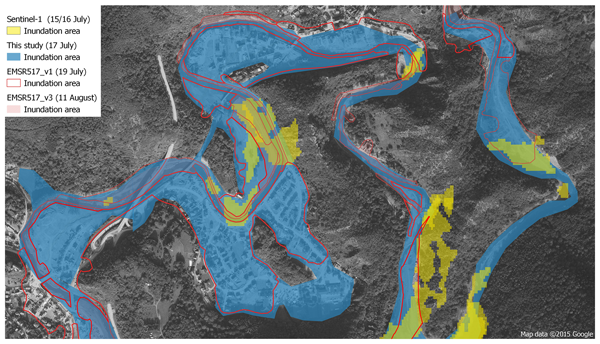
Heavy precipitation in July 2021 led to widespread floods in western Germany and neighboring countries. The event was among the five heaviest precipitation events of the past 70 years in Germany, and the river discharges exceeded by far the statistical 100-year return values. Simulations of the event under future climate conditions revealed a strong and non-linear effect on flood peaks: for +2 K global warming, an 18 % increase in rainfall led to a 39 % increase of the flood peak in the Ahr river.
Susanna Mohr, Uwe Ehret, Michael Kunz, Patrick Ludwig, Alberto Caldas-Alvarez, James E. Daniell, Florian Ehmele, Hendrik Feldmann, Mário J. Franca, Christian Gattke, Marie Hundhausen, Peter Knippertz, Katharina Küpfer, Bernhard Mühr, Joaquim G. Pinto, Julian Quinting, Andreas M. Schäfer, Marc Scheibel, Frank Seidel, and Christina Wisotzky
Nat. Hazards Earth Syst. Sci., 23, 525–551, https://doi.org/10.5194/nhess-23-525-2023, https://doi.org/10.5194/nhess-23-525-2023, 2023
Short summary
Short summary
The flood event in July 2021 was one of the most severe disasters in Europe in the last half century. The objective of this two-part study is a multi-disciplinary assessment that examines the complex process interactions in different compartments, from meteorology to hydrological conditions to hydro-morphological processes to impacts on assets and environment. In addition, we address the question of what measures are possible to generate added value to early response management.
Alberto Caldas-Alvarez, Markus Augenstein, Georgy Ayzel, Klemens Barfus, Ribu Cherian, Lisa Dillenardt, Felix Fauer, Hendrik Feldmann, Maik Heistermann, Alexia Karwat, Frank Kaspar, Heidi Kreibich, Etor Emanuel Lucio-Eceiza, Edmund P. Meredith, Susanna Mohr, Deborah Niermann, Stephan Pfahl, Florian Ruff, Henning W. Rust, Lukas Schoppa, Thomas Schwitalla, Stella Steidl, Annegret H. Thieken, Jordis S. Tradowsky, Volker Wulfmeyer, and Johannes Quaas
Nat. Hazards Earth Syst. Sci., 22, 3701–3724, https://doi.org/10.5194/nhess-22-3701-2022, https://doi.org/10.5194/nhess-22-3701-2022, 2022
Short summary
Short summary
In a warming climate, extreme precipitation events are becoming more frequent. To advance our knowledge on such phenomena, we present a multidisciplinary analysis of a selected case study that took place on 29 June 2017 in the Berlin metropolitan area. Our analysis provides evidence of the extremeness of the case from the atmospheric and the impacts perspectives as well as new insights on the physical mechanisms of the event at the meteorological and climate scales.
Cited articles
Abdi, H.: The method of least squares, Encyclopedia of Measurement and Statistics, 1, 530–532, 2007. a
Allen, J. T.: Climate change and severe thunderstorms, in: Oxford Research Encyclopedia of Climate Science, Oxford University Press, https://doi.org/10.1093/acrefore/9780190228620.013.62, 2018. a
Anderson, G. and Klugmann, D.: A European lightning density analysis using 5 years of ATDnet data, Nat. Hazards Earth Syst. Sci., 14, 815–829, https://doi.org/10.5194/nhess-14-815-2014, 2014. a, b
Barnston, A. G. and Livezey, R. E.: Classification, seasonality and persistence of low-frequency atmospheric circulation patterns, Mon. Weather Rev., 115, 1083–1126, https://doi.org/10.1175/1520-0493(1987)115<1083:CSAPOL>2.0.CO;2, 1987. a
Battaglioli, F., Groenemeijer, P., Púčik, T., Taszarek, M., Ulbrich, U., and Rust, H.: Modeled Multidecadal Trends of Lightning and (Very) Large Hail in Europe and North America (1950–2021), J. Appl. Meteorol. Climatol., 62, 1627–1653, https://doi.org/10.1175/JAMC-D-22-0195.1, 2023. a, b
Betz, H. D., Schmidt, K., Laroche, P., Blanchet, P., Oettinger, W. P., Defer, E., Dziewit, Z., and Konarski, J.: LINET–An international lightning detection network in Europe, Atmos. Res., 91, 564–573, https://doi.org/10.1016/j.atmosres.2008.06.012, 2009. a
Birant, D. and Kut, A.: ST-DBSCAN: An algorithm for clustering spatial–temporal data, Data & knowledge engineering, 60, 208–221, https://doi.org/10.1016/j.datak.2006.01.013, 2007. a, b
Brennan, K. P., Thurnherr, I., Sprenger, M., and Wernli, H.: Insights from hailstorm track analysis in European climate change simulations, Nat. Hazards Earth Syst. Sci., 25, 3693–3712, https://doi.org/10.5194/nhess-25-3693-2025, 2025. a
Brooks, H. E., Lee, J. W., and Craven, J. P.: The spatial distribution of severe thunderstorm and tornado environments from global reanalysis data, Atmos. Res., 67, 73–94, https://doi.org/10.1016/S0169-8095(03)00045-0, 2003. a
Cecil, D. J., Buechler, D. E., and Blakeslee, R. J.: Gridded lightning climatology from TRMM-LIS and OTD: Dataset description, Atmos. Res., 135, 404–414, https://doi.org/10.1016/j.atmosres.2012.06.028, 2014. a
Chen, J. and Dai, A.: The atmosphere has become increasingly unstable during 1979–2020 over the Northern Hemisphere, Geophys. Res. Lett., 50, e2023GL106125, https://doi.org/10.1029/2023GL106125, 2023. a, b
Christian, H. J. and Latham, J.: Satellite measurements of global lightning, Q. J. R. Meteorol. Soc., 124, 1771–1773, https://doi.org/10.1002/qj.49712454919, 1998. a
Cui, R., Thurnherr, I., Velasquez, P., Brennan, K., Leclair, M., Mazzoleni, A., Schmid, T., Wernli, H., and Schär, C.: A European Hail and Lightning Climatology From an 11-Year Kilometer-Scale Regional Climate Simulation, J. Geophys. Res. Atmos., https://doi.org/10.1029/2024JD042828, 2024. a
Cummins, K. L., Murphy, M. J., Bardo, E. A., Hiscox, W. L., Pyle, R. B., and Pifer, A. E.: A combined TOA/MDF technology upgrade of the US National Lightning Detection Network, J. Geophys. Res. Atmos., 103, 9035–9044, https://doi.org/10.1029/98JD00153, 1998. a
Dietzsch, F., Andersson, A., Ziese, M., Schröder, M., Raykova, K., Schamm, K., and Becker, A.: A global ETCCDI-based precipitation climatology from satellite and rain gauge measurements, Climate, 5, 9, https://doi.org/10.3390/cli5010009, 2017. a
Drüe, C., Hauf, T., Finke, U., Keyn, S., and Kreyer, O.: Comparison of a SAFIR lightning detection network in northern Germany to the operational BLIDS network, J. Geophys. Res. Atmos., 112, D18114, https://doi.org/10.1029/2006JD007680, 2007. a, b
Edelsbrunner, H., Kirkpatrick, D., and Seidel, R.: On the Shape of a Set of Points in the Plane, IEEE Transactions on Information Theory, 29, 551–559, https://doi.org/10.1109/TIT.1983.1056714, 1983. a
Enno, S.-E., Sugier, J., Alber, R., and Seltzer, M.: Lightning flash density in Europe based on 10 years of ATDnet data, Atmos. Res., 235, 104769, https://doi.org/10.1016/j.atmosres.2019.104769, 2020. a
Feldmann, M., Blanc, M., Brennan, K. P., Thurnherr, I., Velasquez, P., Martius, O., and Schär, C.: European supercell thunderstorms–an underestimated current threat and an increasing future hazard, arXiv [preprint], https://doi.org/10.48550/arXiv.2503.07466, 2025. a
Fisher, R. A.: Statistical Methods for Research Workers, Springer New York, New York, NY, 66–70, https://doi.org/10.1007/978-1-4612-4380-9_6, 1992. a, b
Fluck, E., Kunz, M., Geissbuehler, P., and Ritz, S. P.: Radar-based assessment of hail frequency in Europe, Nat. Hazards Earth Syst. Sci., 21, 683–701, https://doi.org/10.5194/nhess-21-683-2021, 2021. a, b, c, d
Folland, C. K., Knight, J., Linderholm, H. W., Fereday, D., Ineson, S., and Hurrell, J. W.: The summer North Atlantic Oscillation: past, present, and future, J. Climate, 22, 1082–1103, https://doi.org/10.1175/2008JCLI2459.1, 2009. a
Gaffard, C., Nash, J., Atkinson, N., Bennett, A., Callaghan, G., Hibbett, E., Taylor, P., Turp, M., and Schulz, W.: Observing lightning around the globe from the surface, in: 20th International Lightning Detection Conference, 21–23 April 2008, Tucson, Arizona, 21–23, 2008. a
Galanaki, E., Lagouvardos, K., Kotroni, V., Flaounas, E., and Argiriou, A.: Thunderstorm climatology in the Mediterranean using cloud-to-ground lightning observations, Atmos. Res., 207, 136–144, https://doi.org/10.1016/j.atmosres.2018.03.004, 2018. a, b, c
Ghasemifard, H., Groenemeijer, P., Battaglioli, F., and Púčik, T.: Do changing circulation types raise the frequency of summertime thunderstorms and large hail in Europe?, Environ. Res.: Climate, 3, 015008, https://doi.org/10.1088/2752-5295/ad22ec, 2024. a
Giordani, A., Kunz, M., Bedka, K. M., Punge, H. J., Paccagnella, T., Pavan, V., Cerenzia, I. M. L., and Di Sabatino, S.: Characterizing hail-prone environments using convection-permitting reanalysis and overshooting top detections over south-central Europe, Nat. Hazards Earth Syst. Sci., 24, 2331–2357, https://doi.org/10.5194/nhess-24-2331-2024, 2024. a
Grams, C. M., Beerli, R., Pfenninger, S., Staffell, I., and Wernli, H.: Balancing Europe’s wind-power output through spatial deployment informed by weather regimes, Nat. Clim. Change, 7, 557–562, https://doi.org/10.1038/nclimate3338, 2017. a
Groenemeijer, P., Púčik, T., Holzer, A. M., Antonescu, B., Riemann-Campe, K., Schultz, D. M., Kühne, T., Feuerstein, B., Brooks, H. E., Doswell III, C. A., Koppert, H.-J., and Sausen, R.: Severe convective storms in Europe: Ten years of research and education at the European Severe Storms Laboratory, Bull. Am. Meterol. Soc., 98, 2641–2651, https://doi.org/10.1175/BAMS-D-16-0067.1, 2017. a
Hayward, L., Whitworth, M., Pepin, N., and Dorling, S.: Thunderstorm tracking in Northwest Europe for enhanced hazard preparedness, Int. J. Climatol., https://doi.org/10.1002/joc.8123, 2023. a, b
Hoeppe, P.: Trends in weather related disasters–Consequences for insurers and society, Wea. Clim. Extrem., 11, 70–79, https://doi.org/10.1016/j.wace.2015.10.002, 2016. a
Holle, R. L.: Annual rates of lightning fatalities by country, in: 20th International lightning detection conference, 2425, 2008. a
Hutchins, M. L., Holzworth, R. H., and Brundell, J. B.: Diurnal variation of the global electric circuit from clustered thunderstorms, J. Geophys. Res. Space Phys., 119, 620–629, https://doi.org/10.1002/2013JA019593, 2014. a, b, c, d
Hyndman, R. J. and Shang, H. L.: Rainbow plots, bagplots, and boxplots for functional data, J. Comput. Graph. Stat., 19, 29–45, https://doi.org/10.1198/jcgs.2009.08158, 2010. a
Ibebuchi, C.: Patterns of atmospheric circulation in Western Europe linked to heavy rainfall in Germany: preliminary analysis into the 2021 heavy rainfall episode, Theor. Appl. Climatol., 148, 269–283, https://doi.org/10.1007/s00704-022-03945-5, 2022. a
Kahraman, A., Kendon, E. J., and Fowler, H. J.: Climatology of severe hail potential in Europe based on a convection-permitting simulation, Clim. Dynam., 62, 6625–6642, https://doi.org/10.1007/s00382-024-07227-w, 2024. a
Kalnay, E., Kanamitsu, M., Kistler, R., Collins, W., Deaven, D., Gandin, L., Iredell, M., Saha, S., White, G., Woollen, J., Zhu, Y., Chelliah, M., Ebisuzaki, W., Higgins, W., Janowiak, J., Mo, K. C., Ropelewski, C., Wang, J., Leetmaa, A., Reynolds, R., Jenne, R., and Joseph, D.: The NCEP/NCAR 40-year reanalysis project, Bull. Am. Meterol. Soc., 77, 437–472, https://doi.org/10.1175/1520-0477(1996)077<0437:TNYRP>2.0.CO;2, 1996. a
Kaplan, J. O. and Lau, K. H.-K.: The WGLC global gridded lightning climatology and time series, Earth Syst. Sci. Data, 13, 3219–3237, https://doi.org/10.5194/essd-13-3219-2021, 2021. a
Kendall, M. G.: Rank correlation methods, Charles Griffin, London, UK, 1975. a
Kirshbaum, D. J., Adler, B., Kalthoff, N., Barthlott, C., and Serafin, S.: Moist orographic convection: Physical mechanisms and links to surface-exchange processes, Atmosphere, 9, 80, https://doi.org/10.3390/atmos9030080, 2018. a
Kotroni, V. and Lagouvardos, K.: Lightning in the Mediterranean and its relation with sea-surface temperature, Environ. Res. Lett., 11, 034006, https://doi.org/10.1088/1748-9326/11/3/034006, 2016. a, b, c
Kottmeier, C., Kalthoff, N., Barthlott, C., Corsmeier, U., Van Baelen, J., Behrendt, A., Behrendt, R., Blyth, A., Coulter, R., Crewell, S., di Girolamo, P., Dorninger, M., Flamant, C., Foken, T., Hagen, M., Hauck, C., Höller, H., Konow, H., Kunz, M., Mahlke, H., Mobbs, S., Richard, E., Steinacker, R., Weckwerth, T., Wieser, A., and Wulfmeyer, V.: Mechanisms initiating deep convection over complex terrain during COPS, Metorol. Z., 17, 931–948, 2008. a
Kron, W., Löw, P., and Kundzewicz, Z. W.: Changes in risk of extreme weather events in Europe, Environmental Science & Policy, 100, 74–83, https://doi.org/10.1016/j.envsci.2019.06.007, 2019. a
Kunz, M.: The skill of convective parameters and indices to predict isolated and severe thunderstorms, Nat. Hazards Earth Syst. Sci., 7, 327–342, https://doi.org/10.5194/nhess-7-327-2007, 2007. a
Kunz, M. and Puskeiler, M.: High-resolution assessment of the hail hazard over complex terrain from radar and insurance data, Metorol. Z., 19, 427, https://doi.org/10.1127/0941-2948/2010/0452, 2010. a
Lanzante, J. R.: Resistant, robust and non-parametric techniques for the analysis of climate data: Theory and examples, including applications to historical radiosonde station data, Int. J. Climatol., 16, 1197–1226, https://doi.org/10.1002/(SICI)1097-0088(199611)16:11<1197::AID-JOC89>3.0.CO;2-L, 1996. a
Laviola, S., Levizzani, V., Ferraro, R. R., and Beauchamp, J.: Hailstorm detection by satellite microwave radiometers, Remote Sens., 12, 621, https://doi.org/10.3390/rs12040621, 2020. a
Lucas-Picher, P., Boberg, F., Christensen, J. H., and Berg, P.: Dynamical downscaling with reinitializations: A method to generate finescale climate datasets suitable for impact studies, J. Hydrometeorol., 14, 1159–1174, https://doi.org/10.1175/JHM-D-12-063.1, 2013. a
MacQueen, J.: Some methods for classification and analysis of multivariate observations, in: Proceedings of the fifth Berkeley symposium on mathematical statistics and probability, 1, 281–297, Oakland, CA, USA, 1967. a
Mann, H. B.: Nonparametric tests against trend, Econometrica: Journal of the Econometric Society, 13, 245–259, https://doi.org/10.2307/1907187, 1945. a
Manoochehrnia, P., Schulz, W., Rachidi, F., and Rubinstein, M.: Lightning statistics in the regions of Saentis and St. Chrischona towers in Switzerland, in: 29th International Conference on Lightning Protection (ICLP), 1, 2–3, 2008. a
Manzato, A., Serafin, S., Miglietta, M. M., Kirshbaum, D., and Schulz, W.: A pan-Alpine climatology of lightning and convective initiation, Mon. Weather Rev., 150, 2213–2230, https://doi.org/10.1175/MWR-D-21-0149.1, 2022. a, b, c
Manzato, A., Fasano, G., Cicogna, A., Sioni, F., and Pucillo, A.: Relationships between Environmental Parameters and Storm Observations in Po Valley: Are They Climate Change Invariant?, J. Appl. Meteorol. Climatol., 64, 267–298, https://doi.org/10.1175/JAMC-D-24-0034.1, 2025. a, b
Mohr, S. and Kunz, M.: Recent trends and variabilities of convective parameters relevant for hail events in Germany and Europe, Atmos. Res., 123, 211–228, https://doi.org/10.1016/j.atmosres.2012.05.016, 2013. a, b, c, d
Mohr, S., Kunz, M., and Keuler, K.: Development and application of a logistic model to estimate the past and future hail potential in Germany, J. Geophys. Res. Atmos., 120, 3939–3956, https://doi.org/10.1002/2014JD022959, 2015. a
Mohr, S., Wandel, J., Lenggenhager, S., and Martius, O.: Relationship between atmospheric blocking and warm season thunderstorms over western and central Europe, Q. J. R. Meteorol. Soc., 145, 3040–3056, https://doi.org/10.1002/qj.3603, 2019. a, b
Mohr, S., Wilhelm, J., Wandel, J., Kunz, M., Portmann, R., Punge, H. J., Schmidberger, M., Quinting, J. F., and Grams, C. M.: The role of large-scale dynamics in an exceptional sequence of severe thunderstorms in Europe May–June 2018, Weather Clim. Dynam., 1, 325–348, https://doi.org/10.5194/wcd-1-325-2020, 2020. a
Mohr, S., Tonn, M., Augenstein, M., and Kunz, M.: A 20-year spatio-temporal analysis of 3D radar-based hail tracks in Germany: Trends and regional differences, 12th European Conference on Severe Storms, Utrecht, The Netherlands, 17–21 November 2025, ECSS2025-237, https://doi.org/10.5194/ecss2025-237, 2025. a
Moris, J. V., Conedera, M., Nisi, L., Bernardi, M., Cesti, G., and Pezzatti, G. B.: Lightning-caused fires in the Alps: Identifying the igniting strokes, Agric. For Meteorol., 290, 107990, https://doi.org/10.1016/j.agrformet.2020.107990, 2020. a
Nisi, L., Martius, O., Hering, A., Kunz, M., and Germann, U.: Spatial and temporal distribution of hailstorms in the Alpine region: a long-term, high resolution, radar-based analysis, Q. J. R. Meteorol. Soc., 142, 1590–1604, https://doi.org/10.1002/qj.2771, 2016. a
Nisi, L., Hering, A., Germann, U., and Martius, O.: A 15-year hail streak climatology for the Alpine region, Q. J. R. Meteorol. Soc., 144, 1429–1449, https://doi.org/10.1002/qj.3286, 2018. a
Park, J.-S. and Oh, S.-J.: A New Concave Hull Algorithm and Concaveness Measure for n-dimensional Datasets., Journal of Information Science & Engineering, 28, https://doi.org/10.6688/JISE.2012.28.3.10, 2012. a, b
Pérez-Invernón, F. J., Huntrieser, H., Soler, S., Gordillo-Vázquez, F. J., Pineda, N., Navarro-González, J., Reglero, V., Montanyà, J., van der Velde, O., and Koutsias, N.: Lightning-ignited wildfires and long continuing current lightning in the Mediterranean Basin: preferential meteorological conditions, Atmos. Chem. Phys., 21, 17529–17557, https://doi.org/10.5194/acp-21-17529-2021, 2021. a, b
Pielke, R.: Economic “normalisation” of disaster losses 1998–2020: A literature review and assessment, Environ. Hazards, 20, 93–111, https://doi.org/10.1080/17477891.2020.1800440, 2021. a
Piper, D., Kunz, M., Allen, J., and Mohr, S.: Investigation of the temporal variability of thunderstorms in Central and Western Europe and the relation to large-scale flow and teleconnection patterns, Q. J. R. Meteorol. Soc., 145, 3644–3666, https://doi.org/10.1002/qj.3647, 2019. a
Poelman, D. R., Schulz, W., Diendorfer, G., and Bernardi, M.: The European lightning location system EUCLID – Part 2: Observations, Nat. Hazards Earth Syst. Sci., 16, 607–616, https://doi.org/10.5194/nhess-16-607-2016, 2016. a, b, c, d
Púčik, T., Castellano, C., Groenemeijer, P., Kühne, T., Rädler, A. T., Antonescu, B., and Faust, E.: Large hail incidence and its economic and societal impacts across Europe, Mon. Weather Rev., 147, 3901–3916, https://doi.org/10.1175/MWR-D-19-0204.1, 2019. a
Punge, H., Bedka, K., Kunz, M., and Reinbold, A.: Hail frequency estimation across Europe based on a combination of overshooting top detections and the ERA-INTERIM reanalysis, Atmos. Res., 198, 34–43, https://doi.org/10.1016/j.atmosres.2017.07.025, 2017. a, b
Rädler, A. T., Groenemeijer, P., Faust, E., and Sausen, R.: Detecting severe weather trends using an additive regressive convective hazard model (AR-CHaMo), J. Appl. Meteorol. Climatol., 57, 569–587, https://doi.org/10.1175/JAMC-D-17-0132.1, 2018. a, b, c, d
Rädler, A. T., Groenemeijer, P. H., Faust, E., Sausen, R., and Púčik, T.: Frequency of severe thunderstorms across Europe expected to increase in the 21st century due to rising instability, npj Clim. Atmos. Sci., 2, 30, https://doi.org/10.1038/s41612-019-0083-7, 2019. a
Rakov, V.: Fundamentals of lightning, Cambridge University Press, Cambridge, Großbritannien, https://doi.org/10.1017/CBO9781139680370, 2016. a
Richman, M. B.: Rotation of principal components, J. Climatol., 6, 293–335, https://doi.org/10.1002/joc.3370060305, 1986. a
Ritenour, A. E., Morton, M. J., McManus, J. G., Barillo, D. J., and Cancio, L. C.: Lightning injury: a review, Burns, 34, 585–594, https://doi.org/10.1016/j.burns.2007.11.006, 2008. a
Rousseeuw, P. J., Ruts, I., and Tukey, J. W.: The bagplot: a bivariate boxplot, The American Statistician, 53, 382–387, https://doi.org/10.1080/00031305.1999.10474494, 1999. a, b, c, d
Sanchez, J., Merino, A., Melcón, P., García-Ortega, E., Fernández-González, S., Berthet, C., and Dessens, J.: Are meteorological conditions favoring hail precipitation change in Southern Europe? Analysis of the period 1948–2015, Atmos. Res., 198, 1–10, https://doi.org/10.1016/j.atmosres.2017.08.003, 2017. a
Schmidberger, M.: Hagelgefährdung und Hagelrisiko in Deutschland basierend auf einer Kombination von Radardaten und Versicherungsdaten, PhD thesis, Karlsruhe Institute of Technology (KIT), https://doi.org/10.5445/KSP/1000086012, 2018. a
Schuchard-Ficher, C., Backhaus, K., Humme, U., Lohrberg, W., and Plinke, W.: Multivariate Analysemethoden: Eine anwendungsorientierte Einführung, Springer-Verlag, Berlin, Heidelberg, Germany, https://doi.org//10.1007/978-3-658-47929-9, 2013. a
Schulz, W., Diendorfer, G., Pedeboy, S., and Poelman, D. R.: The European lightning location system EUCLID – Part 1: Performance analysis and validation, Nat. Hazards Earth Syst. Sci., 16, 595–605, https://doi.org/10.5194/nhess-16-595-2016, 2016. a, b, c, d
Schumacher, R. S. and Rasmussen, K. L.: The formation, character and changing nature of mesoscale convective systems, Nat. Rev. Earth Environ., 1, 300–314, https://doi.org/10.1038/s43017-020-0057-7, 2020. a
Sen, P. K.: Estimates of the regression coefficient based on Kendall's tau, Journal of the American Statistical Association, 63, 1379–1389, https://doi.org/10.1080/01621459.1968.10480934, 1968. a
Seneviratne, S., Zhang, X., Adnan, M., Badi, W., Dereczynski, C., Di Luca, A., Ghosh, S., Iskandar, I., Kossin, J., Lewis, S., Otto, F., Pinto, I., Satoh, M., Vicente-Serrano, S., Wehner, M., and Zhou, B.: Weather and Climate Extreme Events in a Changing Climate, Cambridge University Press, Cambridge, United Kingdom and New York, NY, USA, 1513–1766, https://doi.org/10.1017/9781009157896.013, 2023. a
Shi, M., Zhang, W., Fan, P., Chen, Q., Liu, Z., Li, Q., and Liu, X.: Modelling deep convective activity using lightning clusters and machine learning, Int. J. Climatol., 42, 952–973, https://doi.org/10.1002/joc.7282, 2022. a, b
Siegel, A. F.: Robust regression using repeated medians, Biometrika, 69, 242–244, https://doi.org/10.1093/biomet/69.1.242, 1982. a
Spencer, R., Olson, W., Rongzhang, W., Martin, D., Weinman, J., and Santek, D.: Heavy thunderstorms observed over land by the Nimbus 7 Scanning Multichannel Microwave Radiometer, J. Appl. Meteorol. Climatol., 22, 1041–1046, https://doi.org/10.1175/1520-0450(1983)022<1041:HTOOLB>2.0.CO;2, 1983. a
Strajnar, B., Cedilnik, J., Fettich, A., Ličer, M., Pristov, N., Smerkol, P., and Jerman, J.: Impact of two-way coupling and sea-surface temperature on precipitation forecasts in regional atmosphere and ocean models, Q. J. R. Meteorol. Soc., 145, 228–242, https://doi.org/10.1002/qj.3425, 2019. a
Swiss Re: sigma 01/2024 | Natural catastrophes in 2023: gearing up for today's and tomorrow's weather risks, Tech. rep., Swiss Re Institute, Zurich, Switzerland, 2024. a
Taszarek, M., Allen, J., Púčik, T., Groenemeijer, P., Czernecki, B., Kolendowicz, L., Lagouvardos, K., Kotroni, V., and Schulz, W.: A climatology of thunderstorms across Europe from a synthesis of multiple data sources, J. Climate, 32, 1813–1837, https://doi.org/10.1175/JCLI-D-18-0372.1, 2019. a, b, c
Taszarek, M., Allen, J. T., Brooks, H. E., Pilguj, N., and Czernecki, B.: Differing trends in United States and European severe thunderstorm environments in a warming climate, Bull. Am. Meterol. Soc., 102, E296–E322, https://doi.org/10.1175/BAMS-D-20-0004.1, 2021a. a
Taszarek, M., Allen, J. T., Marchio, M., and Brooks, H. E.: Global climatology and trends in convective environments from ERA5 and rawinsonde data, npj Clim. Atmos. Sci., 4, 35, https://doi.org/10.1038/s41612-021-00190-x, 2021b. a
Theil, H.: A rank-invariant method of linear and polynomial regression analysis, Springer Netherlands, Dordrecht, 345–381, ISBN 978-94-011-2546-8, https://doi.org/10.1007/978-94-011-2546-8_20, 1992. a
van Delden, A.: The synoptic setting of thunderstorms in western Europe, Atmos. Res., 56, 89–110, https://doi.org/10.1016/S0169-8095(00)00092-2, 2001. a
von Storch, H., Feser, F., Geyer, B., Klehmet, K., Li, D., Rockel, B., Schubert-Frisius, M., Tim, N., and Zorita, E.: Regional reanalysis without local data: Exploiting the downscaling paradigm, J. Geophys. Res. Atmos., 122, 8631–8649, https://doi.org/10.1002/2016JD026332, 2017. a
Wacker, R. S. and Orville, R. E.: Changes in measured lightning flash count and return stroke peak current after the 1994 US National Lightning Detection Network upgrade: 1. Observations, J. Geophys. Res. Atmos., 104, 2151–2157, https://doi.org/10.1029/1998JD200060, 1999a. a
Wacker, R. S. and Orville, R. E.: Changes in measured lightning flash count and return stroke peak current after the 1994 US National Lightning Detection Network upgrade: 2. Theory, J. Geophys. Res. Atmos., 104, 2159–2162, https://doi.org/10.1029/1998JD200059, 1999b. a
Wapler, K.: High-resolution climatology of lightning characteristics within Central Europe, Meteorol. Atmos. Phys., 122, 175–184, https://doi.org/10.1007/s00703-013-0285-1, 2013. a, b
Wilhelm, J., Mohr, S., Punge, H. J., Mühr, B., Schmidberger, M., Daniell, J. E., Bedka, K. M., and Kunz, M.: Severe thunderstorms with large hail across Germany in June 2019, Weather, 76, 228–237, https://doi.org/10.1002/wea.3886, 2021. a
Wilhelm, L., Schwierz, C., Schröer, K., Taszarek, M., and Martius, O.: Reconstructing hail days in Switzerland with statistical models (1959–2022), Nat. Hazards Earth Syst. Sci., 24, 3869–3894, https://doi.org/10.5194/nhess-24-3869-2024, 2024. a
Yue, S., Pilon, P., Phinney, B., and Cavadias, G.: The influence of autocorrelation on the ability to detect trend in hydrological series, Hydrol. Process, 16, 1807–1829, https://doi.org/10.1002/hyp.1095, 2002. a, b
Short summary
A grid-based analysis of lightning in Europe shows a reduction in thunderstorm activity in many regions. Moving away from a grid-based analysis, a spatio-temporal clustering algorithm was used. The results show a slight trend towards the occurrence of smaller, more separated convective clustered events, suggesting changes in the organization of convective systems. One reason for this could be the increased occurrence of the negative phase of the North Atlantic Oscillation in the last decade.
A grid-based analysis of lightning in Europe shows a reduction in thunderstorm activity in many...


Altmetrics
Final-revised paper
Preprint