Articles | Volume 25, issue 12
https://doi.org/10.5194/nhess-25-4907-2025
© Author(s) 2025. This work is distributed under
the Creative Commons Attribution 4.0 License.
https://doi.org/10.5194/nhess-25-4907-2025
© Author(s) 2025. This work is distributed under
the Creative Commons Attribution 4.0 License.
Use of delayed ERA5-Land soil moisture products for improving landslide early warning

Nunziarita Palazzolo
CORRESPONDING AUTHOR
Department of Civil Engineering and Architecture, University of Catania, Catania, 95125, Italy
Antonino Cancelliere
Department of Civil Engineering and Architecture, University of Catania, Catania, 95125, Italy
Robert D. Zofei
Department of Civil Engineering and Architecture, University of Catania, Catania, 95125, Italy
David J. Peres
Department of Civil Engineering and Architecture, University of Catania, Catania, 95125, Italy
Related authors
Nunziarita Palazzolo, David J. Peres, Enrico Creaco, and Antonino Cancelliere
Nat. Hazards Earth Syst. Sci., 23, 279–291, https://doi.org/10.5194/nhess-23-279-2023, https://doi.org/10.5194/nhess-23-279-2023, 2023
Short summary
Short summary
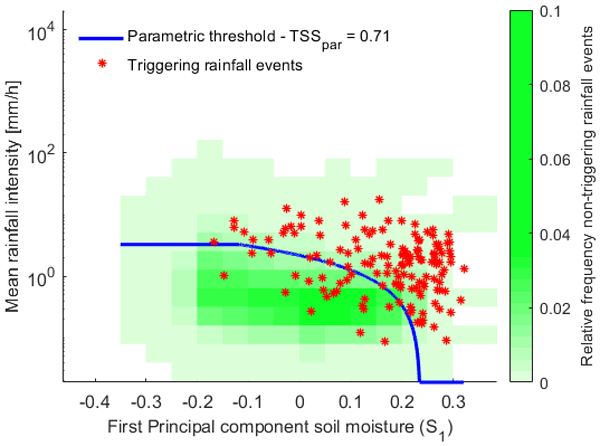
We propose an approach exploiting PCA to derive hydrometeorological landslide-triggering thresholds using multi-layered soil moisture data from ERA5-Land reanalysis. Comparison of thresholds based on single- and multi-layered soil moisture information provides a means to identify the significance of multi-layered data for landslide triggering in a region. In Sicily, the proposed approach yields thresholds with a higher performance than traditional precipitation-based ones (TSS = 0.71 vs. 0.50).
Nunziarita Palazzolo, David J. Peres, Enrico Creaco, and Antonino Cancelliere
Nat. Hazards Earth Syst. Sci., 23, 279–291, https://doi.org/10.5194/nhess-23-279-2023, https://doi.org/10.5194/nhess-23-279-2023, 2023
Short summary
Short summary
We propose an approach exploiting PCA to derive hydrometeorological landslide-triggering thresholds using multi-layered soil moisture data from ERA5-Land reanalysis. Comparison of thresholds based on single- and multi-layered soil moisture information provides a means to identify the significance of multi-layered data for landslide triggering in a region. In Sicily, the proposed approach yields thresholds with a higher performance than traditional precipitation-based ones (TSS = 0.71 vs. 0.50).
Pierpaolo Distefano, David J. Peres, Pietro Scandura, and Antonino Cancelliere
Nat. Hazards Earth Syst. Sci., 22, 1151–1157, https://doi.org/10.5194/nhess-22-1151-2022, https://doi.org/10.5194/nhess-22-1151-2022, 2022
Short summary
Short summary
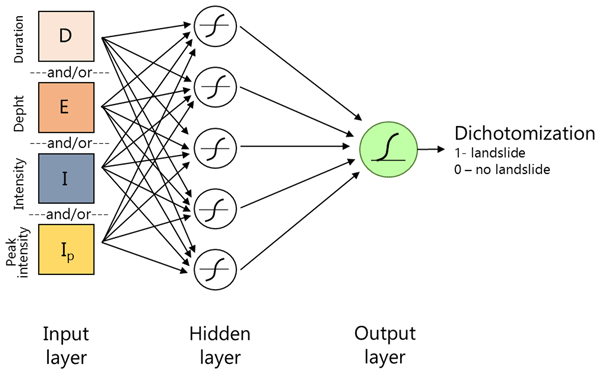
In the communication, we introduce the use of artificial neural networks (ANNs) for improving the performance of rainfall thresholds for landslide early warning. Results show how ANNs using rainfall event duration and mean intensity perform significantly better than a classical power law based on the same variables. Adding peak rainfall intensity as input to the ANN improves performance even more. This further demonstrates the potentialities of the proposed machine learning approach.
Animesh K. Gain, Yves Bühler, Pascal Haegeli, Daniela Molinari, Mario Parise, David J. Peres, Joaquim G. Pinto, Kai Schröter, Ricardo M. Trigo, María Carmen Llasat, and Heidi Kreibich
Nat. Hazards Earth Syst. Sci., 22, 985–993, https://doi.org/10.5194/nhess-22-985-2022, https://doi.org/10.5194/nhess-22-985-2022, 2022
Short summary
Short summary
To mark the 20th anniversary of Natural Hazards and Earth System Sciences (NHESS), an interdisciplinary and international journal dedicated to the public discussion and open-access publication of high-quality studies and original research on natural hazards and their consequences, we highlight 11 key publications covering major subject areas of NHESS that stood out within the past 20 years.
Cited articles
Bogaard, T. and Greco, R.: Invited perspectives: Hydrological perspectives on precipitation intensity-duration thresholds for landslide initiation: proposing hydro-meteorological thresholds, Nat. Hazards Earth Syst. Sci., 18, 31–39, https://doi.org/10.5194/nhess-18-31-2018, 2018.
Bogaard, T. A. and Greco, R.: Landslide hydrology: from hydrology to pore pressure, Wiley Interdiscip. Rev. Water, 3, 439–459, https://doi.org/10.1002/WAT2.1126, 2016.
Caine, N.: The Rainfall Intensity: Duration Control of Shallow Landslides and Debris Flows, Geogr. Ann. Ser. A, Phys. Geogr., 62, 23, https://doi.org/10.2307/520449, 1980.
Calvello, M. and Pecoraro, G.: FraneItalia: a catalog of recent Italian landslides, Geoenvironmental Disasters, 5, 1–16, https://doi.org/10.1186/s40677-018-0105-5, 2018.
Conrad, J. L., Morphew, M. D., Baum, R. L., and Mirus, B. B.: HydroMet: A New Code for Automated Objective Optimization of Hydrometeorological Thresholds for Landslide Initiation, Water, 13, 1752, https://doi.org/10.3390/W13131752, 2021.
Dashtian, H., Young, M. H., Young, B. E., McKinney, T., Rateb, A. M., Niyogi, D., and Kumar, S. V.: A framework to nowcast soil moisture with NASA SMAP level 4 data using in-situ measurements and deep learning, J. Hydrol. Reg. Stud., 56, 102020, https://doi.org/10.1016/J.EJRH.2024.102020, 2024.
Distefano, P., Peres, D. J., Scandura, P., and Cancelliere, A.: Brief communication: Introducing rainfall thresholds for landslide triggering based on artificial neural networks, Nat. Hazards Earth Syst. Sci., 22, 1151–1157, https://doi.org/10.5194/nhess-22-1151-2022, 2022.
Distefano, P., Peres, D. J., Piciullo, L., Palazzolo, N., Scandura, P., and Cancelliere, A.: Hydro-meteorological landslide triggering thresholds based on artificial neural networks using observed precipitation and ERA5-Land soil moisture, Landslides, 20, 2725–2739, https://doi.org/10.1007/s10346-023-02132-5, 2023.
Dutta, K., Poddar, A., Middya, A. I., and Roy, S.: Spatial variations of landslide severity with respect to meteorological and soil related factors, Nat. Hazards, 121, 3267–3291, https://doi.org/10.1007/s11069-024-06930-5, 2025.
ESRI: “Ocean” [basemap], Scale Not Given, “World Ocean Base map”, https://services.arcgisonline.com/arcgis/rest/services/Ocean/World_Ocean_Reference/MapServer (last access: 16 January 2023), 2020.
Fawcett, T.: An introduction to ROC analysis, Pattern Recognit. Lett., 27, 861–874, https://doi.org/10.1016/J.PATREC.2005.10.010, 2006.
Frattini, P., Crosta, G., and Carrara, A.: Techniques for evaluating the performance of landslide susceptibility models, Eng. Geol., 111, 62–72, https://doi.org/10.1016/J.ENGGEO.2009.12.004, 2010.
Froude, M. J. and Petley, D. N.: Global fatal landslide occurrence from 2004 to 2016, Nat. Hazards Earth Syst. Sci., 18, 2161–2181, https://doi.org/10.5194/nhess-18-2161-2018, 2018.
Grosan, C. and Abraham, A.: Artificial Neural Networks, Intell. Syst. Ref. Libr., 17, 281–323, https://doi.org/10.1007/978-3-642-21004-4_12, 2011.
Guzzetti, F., Peruccacci, S., Rossi, M., and Stark, C. P.: Rainfall thresholds for the initiation of landslides in central and southern Europe, Meteorol. Atmos. Phys., 98, 239–267, https://doi.org/10.1007/S00703-007-0262-7, 2007.
Harsa, H., Praja, A. S., Hutapea, D., Hidayat, A., Hidayat, A. M., Mulsandi, A., Suprihadi, B., Kurniawan, R., Habibie, M. N., Daniel Hutapea, T., Swarinoto, Y. S., Eka, E., Makmur, S., Fitria, W., Sapta, R., Sudewi, S., and Sukmana Praja, A.: Machine learning and artificial intelligence models development in rainfall-induced landslide prediction, Artic. IAES Int. J. Artif. Intell., 12, 262–270, https://doi.org/10.11591/ijai.v12.i1.pp262-270, 2023.
Haykin, S.: Neural networks: a comprehensive foundation, Prentice hall PTR, ISBN 0-13-273350-1, 1994.
Hersbach, H., Bell, B., Berrisford, P., Hirahara, S., Horányi, A., Muñoz-Sabater, J., Nicolas, J., Peubey, C., Radu, R., Schepers, D., Simmons, A., Soci, C., Abdalla, S., Abellan, X., Balsamo, G., Bechtold, P., Biavati, G., Bidlot, J., Bonavita, M., De Chiara, G., Dahlgren, P., Dee, D., Diamantakis, M., Dragani, R., Flemming, J., Forbes, R., Fuentes, M., Geer, A., Haimberger, L., Healy, S., Hogan, R. J., Hólm, E., Janisková, M., Keeley, S., Laloyaux, P., Lopez, P., Lupu, C., Radnoti, G., de Rosnay, P., Rozum, I., Vamborg, F., Villaume, S., and Thépaut, J. N.: The ERA5 global reanalysis, Q. J. R. Meteorol. Soc., 146, 1999–2049, https://doi.org/10.1002/QJ.3803, 2020.
Huffman, G. J., Bolvin, D., Braithwaite, D., Hsu, K., Joyce, R., Kidd, C., Nelkin, E., Sorooshian, S., Tan, J., and Xie, P.: NASA Global Precipitation Measurement (GPM) Integrated Multi-Satellite Retrievals for GPM (IMERG), Algorithm Theoretical Basis Document (ATBD) Version 06, vol. 30, NASA/GSFC, Greenbelt, MD, USA, 2019.
ISPRA – Istituto Superiore per la Protezione e la Ricerca Ambientale: Annali idrologici Storici, http://www.bio.isprambiente.it/annalipdf/, last access: 4 December 2025.
Kline, D. M. and Berardi, V. L.: Revisiting squared-error and cross-entropy functions for training neural network classifiers, Neural Comput. Appl., 14, 310–318, https://doi.org/10.1007/s00521-005-0467-y, 2005.
Lee, S., Roh, M., Jo, H. W., Joon, K., and Lee, W. K.: Machine learning-based rainfall-induced landslide susceptibility model and short-term early warning assessment in South Korea, Landslides, 22, 2809–2827, https://doi.org/10.1007/s10346-025-02513-y, 2025.
Marino, P., Peres, D. J., Cancelliere, A., Greco, R., and Bogaard, T. A.: Soil moisture information can improve shallow landslide forecasting using the hydrometeorological threshold approach, Landslides, 17, 2041–2054, https://doi.org/10.1007/s10346-020-01420-8, 2020.
Melillo, M., Brunetti, M. T., Peruccacci, S., Gariano, S. L., and Guzzetti, F.: An algorithm for the objective reconstruction of rainfall events responsible for landslides, Landslides, 12, 311–320, https://doi.org/10.1007/s10346-014-0471-3, 2015.
Melillo, M., Brunetti, M. T., Peruccacci, S., Gariano, S. L., Roccati, A., and Guzzetti, F.: A tool for the automatic calculation of rainfall thresholds for landslide occurrence, Environ. Model. Softw., 105, 230–243, https://doi.org/10.1016/J.ENVSOFT.2018.03.024, 2018.
Meneses, B. M., Pereira, S., and Reis, E.: Effects of different land use and land cover data on the landslide susceptibility zonation of road networks, Nat. Hazards Earth Syst. Sci., 19, 471–487, https://doi.org/10.5194/nhess-19-471-2019, 2019.
Mirus, B. B., Becker, R. E., Baum, R. L., and Smith, J. B.: Integrating real-time subsurface hydrologic monitoring with empirical rainfall thresholds to improve landslide early warning, Landslides, 15, 1909–1919, https://doi.org/10.1007/s10346-018-0995-z, 2018a.
Mirus, B. B., Morphew, M. D., and Smith, J. B.: Developing Hydro-Meteorological Thresholds for Shallow Landslide Initiation and Early Warning, Water, 10, 1274, https://doi.org/10.3390/W10091274, 2018b.
Mirus, B. B., Bogaard, T., Greco, R. and Stähli, M.: Invited perspectives: Integrating hydrologic information into the next generation of landslide early warning systems, 25, 169–182, https://doi.org/10.5194/nhess-25-169-2025, 2025.
Møller, M. F.: A scaled conjugate gradient algorithm for fast supervised learning, Neural Networks, 6, 525–533, https://doi.org/10.1016/S0893-6080(05)80056-5, 1993.
Mondini, A. C., Guzzetti, F., and Melillo, M.: Deep learning forecast of rainfall-induced shallow landslides, Nat. Commun., 14, 1–10, https://doi.org/10.1038/s41467-023-38135-y, 2023.
Muñoz-Sabater, J., Dutra, E., Agustí-Panareda, A., Albergel, C., Arduini, G., Balsamo, G., Boussetta, S., Choulga, M., Harrigan, S., Hersbach, H., Martens, B., Miralles, D. G., Piles, M., Rodríguez-Fernández, N. J., Zsoter, E., Buontempo, C., and Thépaut, J.-N.: ERA5-Land: a state-of-the-art global reanalysis dataset for land applications, Earth Syst. Sci. Data, 13, 4349–4383, https://doi.org/10.5194/essd-13-4349-2021, 2021.
Orland, E., Roering, J. J., Thomas, M. A., and Mirus, B. B.: Deep Learning as a Tool to Forecast Hydrologic Response for Landslide-Prone Hillslopes, Geophys. Res. Lett., 47, e2020GL088731, https://doi.org/10.1029/2020GL088731, 2020.
Palazzolo, N., Peres, D. J., Creaco, E., and Cancelliere, A.: Using principal component analysis to incorporate multi-layer soil moisture information in hydrometeorological thresholds for landslide prediction: an investigation based on ERA5-Land reanalysis data, Nat. Hazards Earth Syst. Sci., 23, 279–291, https://doi.org/10.5194/nhess-23-279-2023, 2023.
Patton, A. I., Luna, L. V., Roering, J. J., Jacobs, A., Korup, O., and Mirus, B. B.: Landslide initiation thresholds in data-sparse regions: application to landslide early warning criteria in Sitka, Alaska, USA, Nat. Hazards Earth Syst. Sci., 23, 3261–3284, https://doi.org/10.5194/nhess-23-3261-2023, 2023.
Peng, B. and Wu, X.: Optimizing rainfall-triggered landslide thresholds for daily landslide hazard warning in the Three Gorges Reservoir area, Nat. Hazards Earth Syst. Sci., 24, 3991–4013, https://doi.org/10.5194/nhess-24-3991-2024, 2024.
Peres, D. J., Cancelliere, A., Greco, R., and Bogaard, T. A.: Influence of uncertain identification of triggering rainfall on the assessment of landslide early warning thresholds, Nat. Hazards Earth Syst. Sci., 18, 633–646, https://doi.org/10.5194/nhess-18-633-2018, 2018.
Peruccacci, S., Gariano, S. L., Melillo, M., Solimano, M., Guzzetti, F., and Brunetti, M. T.: The ITAlian rainfall-induced LandslIdes CAtalogue, an extensive and accurate spatio-temporal catalogue of rainfall-induced landslides in Italy, Earth Syst. Sci. Data, 15, 2863–2877, https://doi.org/10.5194/essd-15-2863-2023, 2023.
Quraishi, M. I. and Choudhury, J. P.: Assessment, Categorisation and Prediction of the Landslide-Affected Regions Using Soft Computing and Clustering Techniques, J. Inst. Eng. Ser. B, 104, 579–602, https://doi.org/10.1007/s40031-023-00876-1, 2023.
Reder, A. and Rianna, G.: Exploring ERA5 reanalysis potentialities for supporting landslide investigations: a test case from Campania Region (Southern Italy), 18, 1909–1924, https://doi.org/10.1007/s10346-020-01610-4, 2021.
Segoni, S., Tofani, V., Rosi, A., Catani, F., and Casagli, N.: Combination of rainfall thresholds and susceptibility maps for dynamic landslide hazard assessment at regional scale, Front. Earth Sci., 6, 375062, https://doi.org/10.3389/feart.2018.00085, 2018.
Shao, X., Yan, W., Yan, C., Zhao, W., Wang, Y., Shi, X., Dong, H., Li, T., Yu, J., Zuo, P., Zhou, Z., and Jin, J.: Explainable Machine Learning for Mapping Rainfall-Induced Landslide Thresholds in Italy, Appl. Sci., 15, 7937, https://doi.org/10.3390/app15147937, 2025.
SIAS – Servizio Informativo Agrometeorologico Siciliano (Sicilian Agro-meteorological Information Service): Dati meteorologici (Meteorological data), SIAS [data set], http://www.sias.regione.sicilia.it/, last access: 4 December 2025.
S.I.T.R - Geoportale Regione Siciliana Infrastruttura dati territoriali [dem], https://www.sitr.regione.sicilia.it/geoportale/mobile/search.html?q=dem, last access: 4 December 2025.
Thomas, M. A., Collins, B. D., and Mirus, B. B.: Assessing the Feasibility of Satellite-Based Thresholds for Hydrologically Driven Landsliding, Water Resour. Res., 55, 9006–9023, https://doi.org/10.1029/2019WR025577, 2018.
Uwihirwe, J., Hrachowitz, M., and Bogaard, T.: Integration of observed and model-derived groundwater levels in landslide threshold models in Rwanda, Nat. Hazards Earth Syst. Sci., 22, 1723–1742, https://doi.org/10.5194/nhess-22-1723-2022, 2022.
Wen, H., Yan, F., Huang, J., and Li, Y.: Interpretable machine learning models and decision-making mechanisms for landslide hazard assessment under different rainfall conditions, Expert Syst. Appl., 270, 126582, https://doi.org/10.1016/J.ESWA.2025.126582, 2025.
Wicki, A., Jansson, P.-E., Lehmann, P., Hauck, C., and Stähli, M.: Simulated or measured soil moisture: which one is adding more value to regional landslide early warning?, Hydrol. Earth Syst. Sci., 25, 4585–4610, https://doi.org/10.5194/hess-25-4585-2021, 2021.
Winter, M. G., Shearer, B., Palmer, D., Peeling, D., Harmer, C., and Sharpe, J.: The Economic Impact of Landslides and Floods on the Road Network, Procedia Eng., 143, 1425–1434, https://doi.org/10.1016/J.PROENG.2016.06.168, 2016.
Short summary
We investigate whether ERA5-Land reanalysis soil moisture data, despite their 5 d publication delay, can be useful for improving the performance of relationships providing triggering conditions for landslides. Using artificial neural networks, we find that soil moisture delayed even up to 15 d allows an improvement of performance respect to precipitation-based models, therefore corroborating the potential use of ERA5-Land soil moisture for improving landslide early warning.
We investigate whether ERA5-Land reanalysis soil moisture data, despite their 5 d publication...
Altmetrics
Final-revised paper
Preprint