Articles | Volume 26, issue 1
https://doi.org/10.5194/nhess-26-85-2026
© Author(s) 2026. This work is distributed under
the Creative Commons Attribution 4.0 License.
https://doi.org/10.5194/nhess-26-85-2026
© Author(s) 2026. This work is distributed under
the Creative Commons Attribution 4.0 License.
Enabling real-time high-resolution flood forecasting for the entire state of Berlin through multi-GPU accelerated physics-based modeling

Shahin Khosh Bin Ghomash
CORRESPONDING AUTHOR
Section Hydrology, GFZ German Research Centre for Geosciences, Potsdam, Germany
Department of Earth System Science, Stanford University, Stanford, USA
Siqi Deng
Institute of Geo-Hydroinformatics, Hamburg University of Technology, Hamburg, Germany
Heiko Apel
Section Hydrology, GFZ German Research Centre for Geosciences, Potsdam, Germany
Related authors
No articles found.
Kai Schröter, Pia-Johanna Schweizer, Benedikt Gräler, Lydia Cumiskey, Sukaina Bharwani, Janne Parviainen, Chahan M. Kropf, Viktor Wattin Håkansson, Martin Drews, Tracy Irvine, Clarissa Dondi, Heiko Apel, Jana Löhrlein, Stefan Hochrainer-Stigler, Stefano Bagli, Levente Huszti, Christopher Genillard, Silvia Unguendoli, Fred Hattermann, and Max Steinhausen
Nat. Hazards Earth Syst. Sci., 25, 3055–3073, https://doi.org/10.5194/nhess-25-3055-2025, https://doi.org/10.5194/nhess-25-3055-2025, 2025
Short summary
Short summary
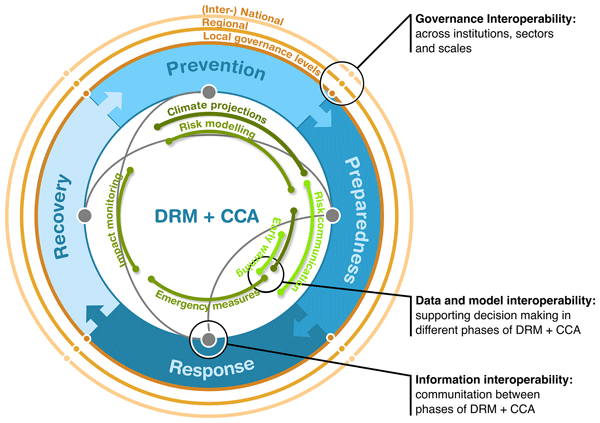
With the increasing negative impacts of extreme weather events globally, it is crucial to align efforts to manage disasters with measures to adapt to climate change. We identify challenges in systems and organizations working together. We suggest that collaboration across various fields is essential and propose an approach to improve collaboration, including a framework for better stakeholder engagement and an open-source data system that helps gather and connect important information.
Atabek Umirbekov, Mayra Daniela Peña-Guerrero, Iulii Didovets, Heiko Apel, Abror Gafurov, and Daniel Müller
Hydrol. Earth Syst. Sci., 29, 3055–3071, https://doi.org/10.5194/hess-29-3055-2025, https://doi.org/10.5194/hess-29-3055-2025, 2025
Short summary
Short summary
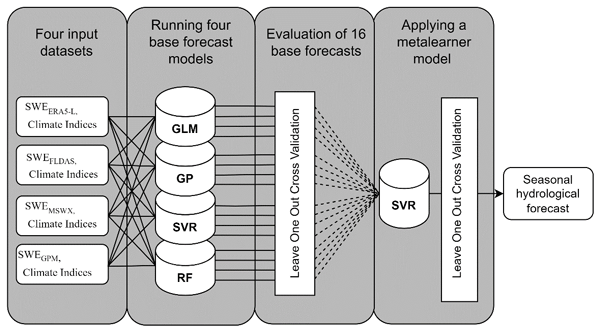
Seasonal streamflow forecasts for snowmelt-dominated catchments often rely on snowpack data, which are not always available and are prone to errors. Our study evaluates near-real-time global snow estimates and climate oscillation indices for predictions in the data-scarce mountains of central Asia. We show that climate indices can improve prediction accuracy at longer lead times, help offset snow data uncertainty, and enhance predictions where streamflow depends on in-season climate variability.
Sergiy Vorogushyn, Li Han, Heiko Apel, Viet Dung Nguyen, Björn Guse, Xiaoxiang Guan, Oldrich Rakovec, Husain Najafi, Luis Samaniego, and Bruno Merz
Nat. Hazards Earth Syst. Sci., 25, 2007–2029, https://doi.org/10.5194/nhess-25-2007-2025, https://doi.org/10.5194/nhess-25-2007-2025, 2025
Short summary
Short summary
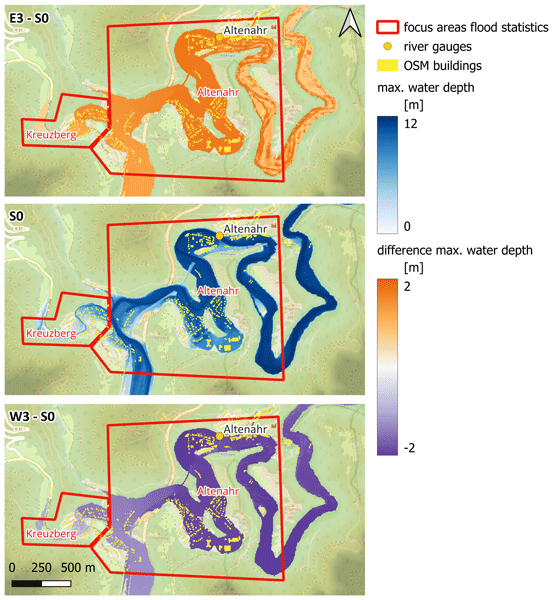
The July 2021 flood in central Europe was one of the deadliest floods in Europe in the recent decades and the most expensive flood in Germany. In this paper, we show that the hydrological impact of this event in the Ahr valley could have been even worse if the rainfall footprint trajectory had been only slightly different. The presented methodology of spatial counterfactuals generates plausible unprecedented events and helps to better prepare for future extreme floods.
Shahin Khosh Bin Ghomash, Nithila Devi Nallasamy, and Heiko Apel
EGUsphere, https://doi.org/10.5194/egusphere-2025-2304, https://doi.org/10.5194/egusphere-2025-2304, 2025
Preprint archived
Short summary
Short summary
This study explores how the way buildings are represented in flood models influences predictions of flood extent, water depth, flow speed, and overall impact. Using a major flood event in Germany as a case study, we evaluate different representation methods across various model resolutions. The results support more accurate flood modeling and impact assessments, helping cities better prepare for and respond to future floods.
Shahin Khosh Bin Ghomash, Heiko Apel, Kai Schröter, and Max Steinhausen
Nat. Hazards Earth Syst. Sci., 25, 1737–1749, https://doi.org/10.5194/nhess-25-1737-2025, https://doi.org/10.5194/nhess-25-1737-2025, 2025
Short summary
Short summary
This work introduces RIM2D (Rapid Inundation Model 2D), a hydrodynamic model for precise and rapid flood predictions that is ideal for early warning systems. We demonstrate RIM2D's ability to deliver detailed and localized flood forecasts using the June 2023 flood in Braunschweig, Germany, as a case study. This research highlights the readiness of RIM2D and the required hardware for integration into operational flood warning and impact-based forecasting systems.
André Felipe Rocha Silva, Julian Cardoso Eleutério, Heiko Apel, and Heidi Kreibich
Nat. Hazards Earth Syst. Sci., 25, 1501–1520, https://doi.org/10.5194/nhess-25-1501-2025, https://doi.org/10.5194/nhess-25-1501-2025, 2025
Short summary
Short summary
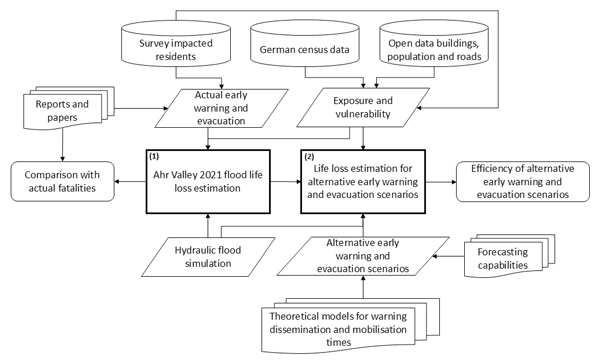
This work uses agent-based modelling to evaluate the impact of flood warning and evacuation systems on human losses during the 2021 Ahr Valley flood in Germany. While the first flood warning with evacuation instructions is identified as timely, its lack of detail and effectiveness resulted in low public risk awareness. Better dissemination of warnings and improved risk perception and preparedness among the population could reduce casualties by up to 80 %.
Shahin Khosh Bin Ghomash, Patricio Yeste, Heiko Apel, and Viet Dung Nguyen
Nat. Hazards Earth Syst. Sci., 25, 975–990, https://doi.org/10.5194/nhess-25-975-2025, https://doi.org/10.5194/nhess-25-975-2025, 2025
Short summary
Short summary
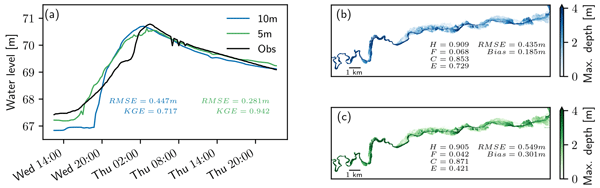
Hydrodynamic models are vital for predicting floods, like those in Germany's Ahr region in July 2021. We refine the RIM2D model for the Ahr region, analyzing the impact of various factors using Monte Carlo simulations. Accurate parameter assignment is crucial, with channel roughness and resolution playing key roles. Coarser resolutions are suitable for flood extent predictions, aiding early-warning systems. Our work provides guidelines for optimizing hydrodynamic models in the Ahr region.
Shahin Khosh Bin Ghomash, Nithila Devi Nallasamy, and Heiko Apel
Hydrol. Earth Syst. Sci. Discuss., https://doi.org/10.5194/hess-2024-314, https://doi.org/10.5194/hess-2024-314, 2024
Manuscript not accepted for further review
Short summary
Short summary
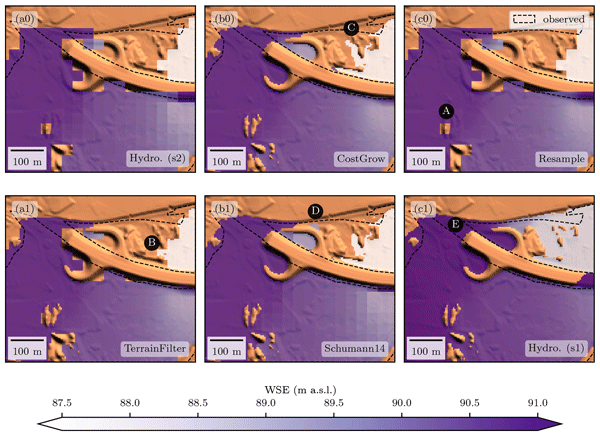
Urbanization and climate change raise flood risk in cities, emphasizing the need for accurate building representation in flood hydrodynamic models. We examine the effects of different building representation techniques on flood modeling using the 2021 Ahr Valley flood data. We demonstrate that building representation significantly affects flood extent and flow dynamics, highlighting the need to choose the appropriate method based on model resolution for effective flood impact assessments.
Shahin Khosh Bin Ghomash, Heiko Apel, and Daniel Caviedes-Voullième
Nat. Hazards Earth Syst. Sci., 24, 2857–2874, https://doi.org/10.5194/nhess-24-2857-2024, https://doi.org/10.5194/nhess-24-2857-2024, 2024
Short summary
Short summary
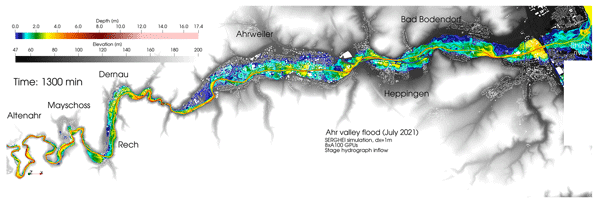
Early warning is essential to minimise the impact of flash floods. We explore the use of highly detailed flood models to simulate the 2021 flood event in the lower Ahr valley (Germany). Using very high-resolution models resolving individual streets and buildings, we produce detailed, quantitative, and actionable information for early flood warning systems. Using state-of-the-art computational technology, these models can guarantee very fast forecasts which allow for sufficient time to respond.
Seth Bryant, Guy Schumann, Heiko Apel, Heidi Kreibich, and Bruno Merz
Hydrol. Earth Syst. Sci., 28, 575–588, https://doi.org/10.5194/hess-28-575-2024, https://doi.org/10.5194/hess-28-575-2024, 2024
Short summary
Short summary
A new algorithm has been developed to quickly produce high-resolution flood maps. It is faster and more accurate than current methods and is available as open-source scripts. This can help communities better prepare for and mitigate flood damages without expensive modelling.
Heiko Apel, Sergiy Vorogushyn, and Bruno Merz
Nat. Hazards Earth Syst. Sci., 22, 3005–3014, https://doi.org/10.5194/nhess-22-3005-2022, https://doi.org/10.5194/nhess-22-3005-2022, 2022
Short summary
Short summary
The paper presents a fast 2D hydraulic simulation model for flood propagation that enables operational forecasts of spatially distributed inundation depths, flood extent, flow velocities, and other flood impacts. The detailed spatial forecast of floods and flood impacts is a large step forward from the currently operational forecasts of discharges at selected gauges, thus enabling a more targeted flood management and early warning.
Cited articles
Alfonso, L., Mukolwe, M., and Di Baldassarre, G.: Probabilistic flood maps to support decision-making: Mapping the value of information, Water Resources Research, 52, 1026–1043, 2016. a
Alipour, A., Jafarzadegan, K., and Moradkhani, H.: Global sensitivity analysis in hydrodynamic modeling and flood inundation mapping, Environmental Modelling & Software, 152, 105398, https://doi.org/10.1016/j.envsoft.2022.105398, 2022. a
Apel, H., Vorogushyn, S., and Merz, B.: Brief communication: Impact forecasting could substantially improve the emergency management of deadly floods: case study July 2021 floods in Germany, Natural Hazards and Earth System Sciences, 22, 3005–3014, https://doi.org/10.5194/nhess-22-3005-2022, 2022. a, b
Assumpção, T. H., Popescu, I., Jonoski, A., and Solomatine, D. P.: Citizen observations contributing to flood modelling: opportunities and challenges, Hydrology and Earth System Sciences, 22, 1473–1489, https://doi.org/10.5194/hess-22-1473-2018, 2018. a
Bachmann, D., Khosh Bin Ghomash, S., and Schotten, R.: Neue entwicklungen in der hochwasserrisikoanalyse: Niederschlagsgeneratoren und kritische infrastrukturen, WasserWirtschaft, 111, 32–38, 2021. a
Bates, P. D., Horritt, M. S., and Fewtrell, T. J.: A simple inertial formulation of the shallow water equations for efficient two-dimensional flood inundation modelling, Journal of Hydrology, 387, 33–45, https://doi.org/10.1016/j.jhydrol.2010.03.027, 2010. a, b, c
Berghäuser, L., Schoppa, L., Ulrich, J., Dillenardt, L., Jurado, O. E., Passow, C., Samprogna Mohor, G., Seleem, O., Petrow, T., and Thieken, A.: Starkregen in Berlin: Meteorologische Ereignisrekonstruktion und Betroffenenbefragung, Universitätsverlag der Universität Potsdam (University Press of the University of Potsdam), Potsdam, Germany, https://doi.org/10.25932/publishup-50056, 2021. a, b
Bodoque, J. M., Esteban-Muñoz, Á., and Ballesteros-Cánovas, J. A.: Overlooking probabilistic mapping renders urban flood risk management inequitable, Communications Earth & Environment, 4, 279, https://doi.org/10.1038/s43247-023-00940-0, 2023. a, b, c
Caldas-Alvarez, A., Augenstein, M., Ayzel, G., Barfus, K., Cherian, R., Dillenardt, L., Fauer, F., Feldmann, H., Heistermann, M., Karwat, A., Kaspar, F., Kreibich, H., Lucio-Eceiza, E. E., Meredith, E. P., Mohr, S., Niermann, D., Pfahl, S., Ruff, F., Rust, H. W., Schoppa, L., Schwitalla, T., Steidl, S., Thieken, A. H., Tradowsky, J. S., Wulfmeyer, V., and Quaas, J.: Meteorological, impact and climate perspectives of the 29 June 2017 heavy precipitation event in the Berlin metropolitan area, Natural Hazards and Earth System Sciences, 22, 3701–3724, https://doi.org/10.5194/nhess-22-3701-2022, 2022. a
Caviedes-Voullième, D., Fernández-Pato, J., and Hinz, C.: Performance assessment of 2D Zero-Inertia and Shallow Water models for simulating rainfall-runoff processes, Journal of Hydrology, 584, 124663, https://doi.org/10.1016/j.jhydrol.2020.124663, 2020. a
Caviedes-Voullième, D., Morales-Hernández, M., Norman, M. R., and Özgen-Xian, I.: SERGHEI (SERGHEI-SWE) v1.0: a performance-portable high-performance parallel-computing shallow-water solver for hydrology and environmental hydraulics, Geoscientific Model Development, 16, 977–1008, https://doi.org/10.5194/gmd-16-977-2023, 2023. a, b, c
Cea, L., Sañudo, E., Montalvo, C., Farfán, J., Puertas, J., and Tamagnone, P.: Recent advances and future challenges in urban pluvial flood modelling, Urban Water Journal, 1–25, https://doi.org/10.1080/1573062x.2024.2446528, 2025. a
Costabile, P., Costanzo, C., Kalogiros, J., and Bellos, V.: Toward Street-Level Nowcasting of Flash Floods Impacts Based on HPC Hydrodynamic Modeling at the Watershed Scale and High-Resolution Weather Radar Data, Water Resources Research, 59, https://doi.org/10.1029/2023wr034599, 2023. a
de Almeida, G. A., Bates, P., Freer, J. E., and Souvignet, M.: Improving the stability of a simple formulation of the shallow water equations for 2-D flood modeling, Water Resources Research, 48, https://doi.org/10.1029/2011WR011570, 2012. a
de MOEL, H. and Aerts, J.: Effect of uncertainty in land use, damage models and inundation depth on flood damage estimates, Natural Hazards, 58, 407–425, 2011. a
Drews, M., Steinhausen, M., Larsen, M. A. D., Dømgaard, M. L., Huszti, L., Rácz, T., Wortmann, M., Hattermann, F. F., and Schröter, K.: The utility of using Volunteered Geographic Information (VGI) for evaluating pluvial flood models, Science of the Total Environment, 894, 164962, https://doi.org/10.1016/j.scitotenv.2023.164962, 2023. a, b, c
DWD: KOSTRA-DWD-2010R: Grids of Return Periods of Heavy Precipitation (Design Precipitation) over Germany, https://www.dwd.de/DE/leistungen/kostra_dwd_rasterwerte/kostra_dwd_rasterwerte.html (last access: 19 May 2025), 2017. a
European Environment Agency: Imperviousness Density 2018 (raster 10 m), Europe, 3-yearly, EEA geospatial data catalogue [data set], https://doi.org/10.2909/3bf542bd-eebd-4d73-b53c-a0243f2ed862, 2020. a, b
Falter, D., Dung, N., Vorogushyn, S., Schröter, K., Hundecha, Y., Kreibich, H., Apel, H., Theisselmann, F., and Merz, B.: Continuous, large-scale simulation model for flood risk assessments: proof-of-concept, Journal of Flood Risk Management, 9, 3–21, https://doi.org/10.1111/jfr3.12105, 2014. a
German Association for Water, Wastewater and Waste (DWA): Hydraulic dimensioning and verification of drain and sewer systems, DWA German Association for Water, Wastewater and Waste, ISBN 978-3-940173-51-5, 2006. a
Jonkman, S. and Penning-Rowsell, E.: Human instability in flood flows 1, JAWRA Journal of the American Water Resources Association, 44, 1208–1218, 2008. a
Khosh Bin Ghomash, S., Caviedes-Voullieme, D., and Hinz, C.: Effects of erosion-induced changes to topography on runoff dynamics, Journal of Hydrology, 573, 811–828, 2019. a
Khosh Bin Ghomash, S., Bachmann, D., Caviedes-Voullième, D., and Hinz, C.: Impact of rainfall movement on flash flood response: A synthetic study of a semi-arid mountainous catchment, Water, 14, 1844, https://doi.org/10.3390/w14121844, 2022. a
Khosh Bin Ghomash, S., Bachmann, D., Caviedes-Voullième, D., and Hinz, C.: Effects of Within-Storm Variability on Allochthonous Flash Flooding: A Synthetic Study, Water, 15, 645, https://doi.org/10.3390/w15040645, 2023. a
Khosh Bin Ghomash, S., Apel, H., and Caviedes-Voullième, D.: Are 2D shallow-water solvers fast enough for early flood warning? A comparative assessment on the 2021 Ahr valley flood event, Natural Hazards and Earth System Sciences, 24, 2857–2874, https://doi.org/10.5194/nhess-24-2857-2024, 2024. a, b, c, d
Khosh Bin Ghomash, S., Apel, H., Schröter, K., and Steinhausen, M.: Rapid high-resolution impact-based flood early warning is possible with RIM2D: a showcase for the 2023 pluvial flood in Braunschweig, Natural Hazards and Earth System Sciences, 25, 1737–1749, https://doi.org/10.5194/nhess-25-1737-2025, 2025a. a, b, c, d, e
Khosh Bin Ghomash, S., Yeste, P., Apel, H., and Nguyen, V. D.: Monte Carlo-based sensitivity analysis of the RIM2D hydrodynamic model for the 2021 flood event in western Germany, Natural Hazards and Earth System Sciences, 25, 975–990, https://doi.org/10.5194/nhess-25-975-2025, 2025b. a, b, c
Kreibich, H., Hudson, P., and Merz, B.: Knowing what to do substantially improves the effectiveness of flood early warning, Bulletin of the American Meteorological Society, 102, E1450–E1463, 2021. a
Landesamt für Natur, Umwelt und Verbraucherschutz Nordrhein-Westfalen (LANUV): Jahresbericht 2023, Tech. rep., Landesamt f”ur Natur, Umwelt und Verbraucherschutz Nordrhein-Westfalen, Recklinghausen, Germany, https://www.lanuk.nrw.de/fileadmin/lanuvpubl/2_jahresberichte/LANUV-Jahresbericht_2023.pdf (last access: 19 December 2025), 2023. a
Lonjou, V., Desjardins, C., Hagolle, O., Petrucci, B., Tremas, T., Dejus, M., Makarau, A., and Auer, S.: Maccs-atcor joint algorithm (maja), in: Remote Sensing of Clouds and the Atmosphere XXI, vol. 10001, 25–37, SPIE, https://doi.org/10.1117/12.2240935, 2016. a
Martins, R., Leandro, J., and Djordjević, S.: A well balanced Roe scheme for the local inertial equations with an unstructured mesh, Advances in Water Resources, 83, 351–363, 2015. a
Merz, B., Kuhlicke, C., Kunz, M., Pittore, M., Babeyko, A., Bresch, D. N., Domeisen, D. I. V., Feser, F., Koszalka, I., Kreibich, H., Pantillon, F., Parolai, S., Pinto, J. G., Punge, J. G., Rivalta, E., Schröter, K., Strehlow, K., Weisse, R., and Wurpts, A.: Impact forecasting to support emergency management of natural hazards, Reviews of Geophysics, 58, e2020RG000704, https://doi.org/10.1029/2020RG000704, 2020. a
Najafi, H., Shrestha, P. K., Rakovec, O., Apel, H., Vorogushyn, S., Kumar, R., Thober, S., Merz, B., and Samaniego, L.: High-resolution impact-based early warning system for riverine flooding, Nature Communications, 15, 3726, https://doi.org/10.1038/s41467-024-48065-y, 2024. a
Neal, J., Schumann, G., Fewtrell, T., Budimir, M., Bates, P., and Mason, D.: Evaluating a new LISFLOOD-FP formulation with data from the summer 2007 floods in Tewkesbury, UK, Journal of Flood Risk Management, 4, 88–95, https://doi.org/10.1111/j.1753-318x.2011.01093.x, 2011. a
Pasculli, A., Cinosi, J., Turconi, L., and Sciarra, N.: Learning case study of a shallow-water model to assess an early-warning system for fast alpine muddy-debris-flow, Water, 13, 750, https://doi.org/10.3390/w13060750, 2021. a
Peel, M. C., Finlayson, B. L., and McMahon, T. A.: Updated world map of the Köppen-Geiger climate classification, Hydrology and Earth System Sciences, 11, 1633–1644, https://doi.org/10.5194/hess-11-1633-2007, 2007. a
Rentschler, J., Avner, P., Marconcini, M., Su, R., Strano, E., Vousdoukas, M., and Hallegatte, S.: Global evidence of rapid urban growth in flood zones since 1985, Nature, 622, 87–92, 2023. a
Riembauer, G., Weinmann, A., Xu, S., Eichfuss, S., Eberz, C., and Neteler, M.: Germany-wide Sentinel-2 based land cover classification and change detection for settlement and infrastructure monitoring, in: Proceedings of the 2021 Conference on Big Data from Space, Virtual, 18–20, https://doi.org/10.2760/125905, 2021. a
Šakić Trogrlić, R., van den Homberg, M., Budimir, M., McQuistan, C., Sneddon, A., and Golding, B.: Early warning systems and their role in disaster risk reduction, in: Towards the “perfect” weather warning: bridging disciplinary gaps through partnership and communication, Springer International Publishing Cham, 11–46, https://doi.org/10.1007/978-3-030-98989-7_2, 2022. a
See, L.: A review of citizen science and crowdsourcing in applications of pluvial flooding, Frontiers in Earth Science, 7, 44, https://doi.org/10.3389/feart.2019.00044, 2019. a
Seleem, O., Ayzel, G., de Souza, A. C. T., Bronstert, A., and Heistermann, M.: Towards urban flood susceptibility mapping using data-driven models in Berlin, Germany, Geomatics, Natural Hazards and Risk, 13, 1640–1662, 2022. a
Shrestha, A., Mascaro, G., and Garcia, M.: Effects of stormwater infrastructure data completeness and model resolution on urban flood modeling, Journal of Hydrology, 607, 127498, https://doi.org/10.1016/j.jhydrol.2022.127498, 2022. a
Thieken, A. H., Bubeck, P., Heidenreich, A., von Keyserlingk, J., Dillenardt, L., and Otto, A.: Performance of the flood warning system in Germany in July 2021 – insights from affected residents, Natural Hazards and Earth System Sciences, 23, 973–990, https://doi.org/10.5194/nhess-23-973-2023, 2023. a
Tügel, F., Nissen, K. M., Steffen, L., Zhang, Y., Ulbrich, U., and Hinkelmann, R.: Extreme precipitation and flooding in Berlin under climate change and effects of selected grey and blue-green measures, Natural Hazards and Earth System Sciences, 25, 4673–4692, https://doi.org/10.5194/nhess-25-4673-2025, 2025. a
Wang, P., Huang, C., and Tilton, J. C.: Mapping three-dimensional urban structure by fusing landsat and global elevation data, arXiv [preprint], https://doi.org/10.48550/arXiv.1807.04368, 2018. a
Ward, P. and de Bruin, S.: The geography of future water challenges, PBL Netherlands Environmental Assessment Agency, https://www.pbl.nl/en/publications/the-geography-of-future-water-challenges (last access: 10 January 2026), 2018. a
Winsemius, H. C., Van Beek, L. P. H., Jongman, B., Ward, P. J., and Bouwman, A.: A framework for global river flood risk assessments, Hydrology and Earth System Sciences, 17, 1871–1892, https://doi.org/10.5194/hess-17-1871-2013, 2013. a
WorldPop: The spatial distribution of population in 2020, Germany, School of Geography and Environmental Science, University of Southampton, Department of Geography and Geosciences, University of Louisville, Departement de Geographie, Universite de Namur, Center for International Earth Science Information Network (CIESIN), Columbia University, Global High Resolution Population Denominators Project – funded by The Bill and Melinda Gates Foundation (OPP1134076), https://doi.org/10.5258/SOTON/WP00670, 2020. a
Zeng, B., Huang, G., and Chen, W.: Research progress and prospects of urban flooding simulation: From traditional numerical models to deep learning approaches, Environmental Modelling & Software, 183, 106213, https://doi.org/10.1016/j.envsoft.2024.106213, 2025. a
Zhou, Q., Leng, G., Su, J., and Ren, Y.: Comparison of urbanization and climate change impacts on urban flood volumes: Importance of urban planning and drainage adaptation, Science of the Total Environment, 658, 24–33, 2019. a
Short summary
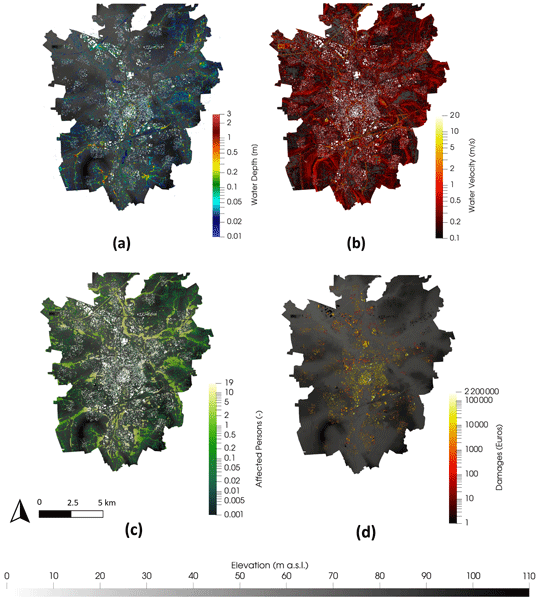
Urban pluvial flooding is worsening due to climate change and urbanization, requiring faster forecasts. This study presents RIM2D, a multi-graphics processing unit (GPU) 2D flood model, simulating high-resolution events (2–10 m) across Berlin (891.8 km²) with up to 8 GPUs. Simulations of real and synthetic floods show multi-GPU use is vital for fine-scale, timely forecasts. RIM2D proves operationally viable for urban-scale early warning using modern GPU hardware.
Urban pluvial flooding is worsening due to climate change and urbanization, requiring faster...
Altmetrics
Final-revised paper
Preprint