
Articles | Volume 26, issue 1
https://doi.org/10.5194/nhess-26-709-2026
© Author(s) 2026. This work is distributed under
the Creative Commons Attribution 4.0 License.
the Creative Commons Attribution 4.0 License.
https://doi.org/10.5194/nhess-26-709-2026
© Author(s) 2026. This work is distributed under
the Creative Commons Attribution 4.0 License.
the Creative Commons Attribution 4.0 License.
Research article
| 
30 Jan 2026
Research article |
| 30 Jan 2026
| 30 Jan 2026
Multiscale modeling for coastal cities: addressing climate change impacts on flood events at urban-scale
Michele Bendoni
Institute of Marine Science, National Research Council of Italy (CNR-ISMAR), Forte Santa Teresa, snc, 19032 – Lerici (SP), Italy
Francesca Caparrini
Institute of Geosciences and Earth Resources, National Research Council of Italy (CNR-IGG), Via G. Moruzzi 1, 56124 – Pisa (PI), Italy
Andrea Cucco
Institute for the study of Anthropic Impacts and Sustainability in marine environment, National Research Council (CNR- IAS), Loc. Sa Mardini Torregrande – Oristano, Italy
Stefano Taddei
LaMMA Consortium, Via Madonna del Piano 10, 50019 Sesto Fiorentino (FI), Italy
Iulia Anton
Atlantic Technological University, Ash Lane F91 YW50, Sligo, Ireland
now at: EirGrid plc, Dublin, Ireland
Roberta Paranunzio
Institute of Atmospheric Sciences and Climate, National Research Council of Italy (CNR-ISAC), Corso Fiume, 4, 10133 Torino (TO), Italy
Rossella Mocali
LaMMA Consortium, Via Madonna del Piano 10, 50019 Sesto Fiorentino (FI), Italy
Massimo Perna
LaMMA Consortium, Via Madonna del Piano 10, 50019 Sesto Fiorentino (FI), Italy
Michele Sacco
LaMMA Consortium, Via Madonna del Piano 10, 50019 Sesto Fiorentino (FI), Italy
Giovanni Vitale
Institute of Marine Science, National Research Council of Italy (CNR-ISMAR), Via Madonna del Piano 10, 50019 Sesto Fiorentino (FI), Italy
LaMMA Consortium, Via Madonna del Piano 10, 50019 Sesto Fiorentino (FI), Italy
Manuela Corongiu
LaMMA Consortium, Via Madonna del Piano 10, 50019 Sesto Fiorentino (FI), Italy
Alberto Ortolani
Institute of Bio-Economy, National Research Council of Italy (CNR-IBE), Via Madonna del Piano 10, 50019 Sesto Fiorentino (FI), Italy
LaMMA Consortium, Via Madonna del Piano 10, 50019 Sesto Fiorentino (FI), Italy
Salem Gharbia
Atlantic Technological University, Ash Lane F91 YW50, Sligo, Ireland
Carlo Brandini
CORRESPONDING AUTHOR

Institute of Marine Science, National Research Council of Italy (CNR-ISMAR), Via Madonna del Piano 10, 50019 Sesto Fiorentino (FI), Italy
LaMMA Consortium, Via Madonna del Piano 10, 50019 Sesto Fiorentino (FI), Italy
Related authors
Michele Bendoni, Andrew Michael Moore, Roberta Sciascia, Carlo Brandini, Katrin Schroeder, Mireno Borghini, and Marcello Gatimu Magaldi
Ocean Sci., 22, 281–303, https://doi.org/10.5194/os-22-281-2026, https://doi.org/10.5194/os-22-281-2026, 2026
Short summary
Short summary
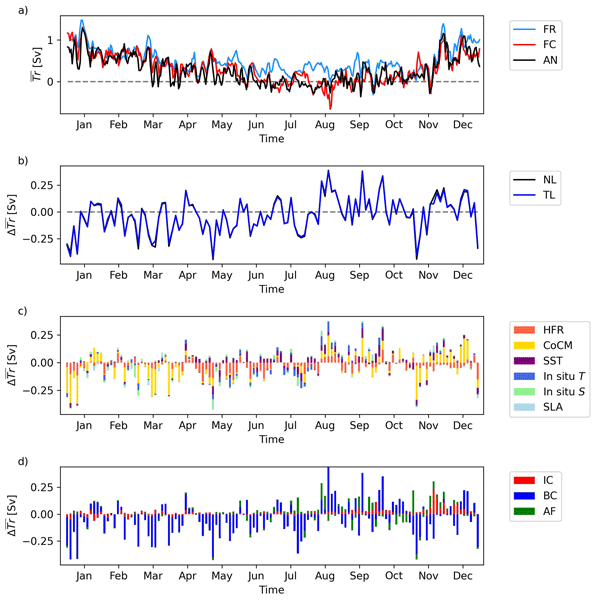
We use data assimilation (DA) to optimally merge information from observations of ocean variables and a numerical model of the north-western Mediterranean Sea. Data come from satellites, coastal high-frequency radars and fixed & movable devices. DA decreases model errors associated to all observed variables. The volume transport across the Corsica Channel, which connects the Tyrrhenian and Ligurian waters, is differently modified based on the typology and location of the assimilated observation.
Emma Reyes, Eva Aguiar, Michele Bendoni, Maristella Berta, Carlo Brandini, Alejandro Cáceres-Euse, Fulvio Capodici, Vanessa Cardin, Daniela Cianelli, Giuseppe Ciraolo, Lorenzo Corgnati, Vlado Dadić, Bartolomeo Doronzo, Aldo Drago, Dylan Dumas, Pierpaolo Falco, Maria Fattorini, Maria J. Fernandes, Adam Gauci, Roberto Gómez, Annalisa Griffa, Charles-Antoine Guérin, Ismael Hernández-Carrasco, Jaime Hernández-Lasheras, Matjaž Ličer, Pablo Lorente, Marcello G. Magaldi, Carlo Mantovani, Hrvoje Mihanović, Anne Molcard, Baptiste Mourre, Adèle Révelard, Catalina Reyes-Suárez, Simona Saviano, Roberta Sciascia, Stefano Taddei, Joaquín Tintoré, Yaron Toledo, Marco Uttieri, Ivica Vilibić, Enrico Zambianchi, and Alejandro Orfila
Ocean Sci., 18, 797–837, https://doi.org/10.5194/os-18-797-2022, https://doi.org/10.5194/os-18-797-2022, 2022
Short summary
Short summary
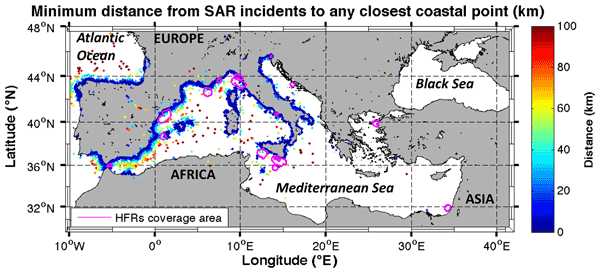
This work reviews the existing advanced and emerging scientific and societal applications using HFR data, developed to address the major challenges identified in Mediterranean coastal waters organized around three main topics: maritime safety, extreme hazards and environmental transport processes. It also includes a discussion and preliminary assessment of the capabilities of existing HFR applications, finally providing a set of recommendations towards setting out future prospects.
Pablo Lorente, Eva Aguiar, Michele Bendoni, Maristella Berta, Carlo Brandini, Alejandro Cáceres-Euse, Fulvio Capodici, Daniela Cianelli, Giuseppe Ciraolo, Lorenzo Corgnati, Vlado Dadić, Bartolomeo Doronzo, Aldo Drago, Dylan Dumas, Pierpaolo Falco, Maria Fattorini, Adam Gauci, Roberto Gómez, Annalisa Griffa, Charles-Antoine Guérin, Ismael Hernández-Carrasco, Jaime Hernández-Lasheras, Matjaž Ličer, Marcello G. Magaldi, Carlo Mantovani, Hrvoje Mihanović, Anne Molcard, Baptiste Mourre, Alejandro Orfila, Adèle Révelard, Emma Reyes, Jorge Sánchez, Simona Saviano, Roberta Sciascia, Stefano Taddei, Joaquín Tintoré, Yaron Toledo, Laura Ursella, Marco Uttieri, Ivica Vilibić, Enrico Zambianchi, and Vanessa Cardin
Ocean Sci., 18, 761–795, https://doi.org/10.5194/os-18-761-2022, https://doi.org/10.5194/os-18-761-2022, 2022
Short summary
Short summary
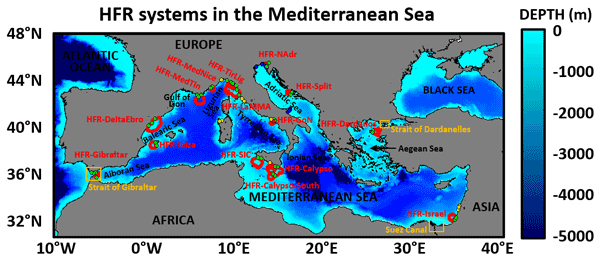
High-frequency radar (HFR) is a land-based remote sensing technology that can provide maps of the surface circulation over broad coastal areas, along with wave and wind information. The main goal of this work is to showcase the current status of the Mediterranean HFR network as well as present and future applications of this sensor for societal benefit such as search and rescue operations, safe vessel navigation, tracking of marine pollutants, and the monitoring of extreme events.
Bartolomeo Doronzo, Stefano Taddei, and Carlo Brandini
EGUsphere, https://doi.org/10.5194/egusphere-2026-3013, https://doi.org/10.5194/egusphere-2026-3013, 2026
Short summary
Short summary
This study presents a new way to map ocean surface currents measured by coastal radar systems. Instead of using fixed grids, the method adapts the spatial resolution to where observations are more reliable. This leads to a more consistent and continuous representation of the flow, especially in complex coastal areas. The approach improves how observational information is used and is particularly useful for applications involving ocean transport and coastal dynamics.
Manuel Vargas-Yáñez, Orens Pasqueron de Fommervault, Emanuela Clementi, Christian Ferrarin, Svitlana Liubertseva, Diego Álvarez-Berastegui, Baptiste Mourre, Salvatore Aronica, Rosa Balbin, Joaquín Ballabrera-Poy, Sana Ben Ismail, Nathaniel Benssousan, Ismail Bessa, Alicia Blanco, Anthony Bosse, Evi Bourma, François Bourrin, Carlo Brandini, Fulvio Capodici, Clara Casals-Baixas, Branko Cermelj, Giuseppe Ciraolo, Pascal Conan, Laurent Coppola, Lorenzo Corgnati, Joaquín del Río, Emilie Diamond Riquier, Lara Diaz-Barroso, Bartolomeo Doronzo, Xavier Durrieu de Madron, Milad Fakhri, Costantine Frangoulis, Claudia Fratianni, Emilio García-Ladona, Jesus García-Lafuente, M. Carmen García-Martínez, Joaquín Garrabou, Josep Gasol, Adam Gauci, Frédéric Gazeau, Gerard Gregory, Abed El Raman Hassoun, Jordi Isern-Fontanet, Dominique Lefevre, Nadia Lo Bue, Guiomar López, Pablo Lorente, Deny Malengros, Ramon Massana, Sinan Mavruk, Stefano Miserocchi, Behzad Mostajir, Laure Mousseau, Francina Moya, Antonio Novellino, Arianna Orasi, Emanuele Organelli, Vicent Ouisse, Tal Ozer, Begoña Pérez-Gómez, Susana Pérez-Rubio, Leonidas Perivoliotis, Georges Petihakis, Anne Petrenko, Sebastien Pinel, Xavier Pitarch, Angela Pomaro, Lucía Quirós-Collazos, Emma Reyes, Simone Sammartino, Anna Sánchez-Vidal, Katrin Schroeder, Stefano Taddei, Elena Tel, Pierre Testor, Marco Torri, Daniela Turk, Laura Ursella, Dimitris Velaoras, Francesca Vidussi, Ivica Vilivić, Enrico Zambiachi, D. Nikolaos Zarokanellos, George Zodiatis, and Vanessa Cardin
EGUsphere, https://doi.org/10.5194/egusphere-2026-2632, https://doi.org/10.5194/egusphere-2026-2632, 2026
Short summary
Short summary
This work compiles current marine observation capabilities in the Mediterranean Sea, making this information accessible to scientists, organizations, stakeholders, and environmental policymakers. It supports initiatives such as Copernicus Marine Service, EMODNet, the European Ocean Pact, and EU directives. It is intended as a living resource to be updated, identifying strengths and gaps in Mediterranean observation systems.
Michele Bendoni, Andrew Michael Moore, Roberta Sciascia, Carlo Brandini, Katrin Schroeder, Mireno Borghini, and Marcello Gatimu Magaldi
Ocean Sci., 22, 281–303, https://doi.org/10.5194/os-22-281-2026, https://doi.org/10.5194/os-22-281-2026, 2026
Short summary
Short summary
We use data assimilation (DA) to optimally merge information from observations of ocean variables and a numerical model of the north-western Mediterranean Sea. Data come from satellites, coastal high-frequency radars and fixed & movable devices. DA decreases model errors associated to all observed variables. The volume transport across the Corsica Channel, which connects the Tyrrhenian and Ligurian waters, is differently modified based on the typology and location of the assimilated observation.
Roberto Sorgente, Antonia Di Maio, Alberto Ribotti, Andrea Cucco, Giovanni Quattrocchi, Simona Genovese, Ignazio Fontana, Giovanni Giacalone, Gualtiero Basilone, Salvatore Aronica, Marco Barra, Paola Rumolo, Antonio Bonanno, Rosalia Ferreri, and Angelo Bonanno
Earth Syst. Sci. Data Discuss., https://doi.org/10.5194/essd-2025-394, https://doi.org/10.5194/essd-2025-394, 2025
Preprint withdrawn
Short summary
Short summary
We analyse 2009–2022 CTD data from 12 summer cruises on the Ligurian - Tyrrhenian shelf. Results show a decadal-scale warming and salinification down to the intermediate layer, leading to enhanced water column stratification. Changes are linked with the BIOS and the cyclonic -anticyclonic state transition of the Northern Ionian Gyre. Results underscore the role of inter-basin connectivity and climate-driven circulation dynamics in shaping the hydrography of the western Mediterranean.
Pierre-Marie Poulain, Luca Centurioni, Carlo Brandini, Stefano Taddei, Maristella Berta, and Milena Menna
Ocean Sci., 19, 1617–1631, https://doi.org/10.5194/os-19-1617-2023, https://doi.org/10.5194/os-19-1617-2023, 2023
Short summary
Short summary
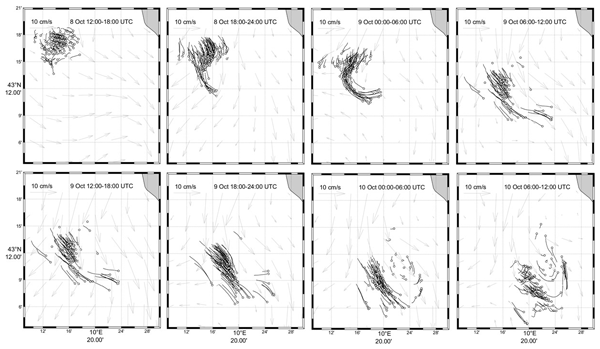
Drifters and a profiling float were deployed in the coastal waters of the southeastern Ligurian Sea to characterize the near-surface circulation at a scale of ~10 km. The drifters were trapped in an offshore-flowing filament and a cyclonic eddy that developed at the southwestern extremity of the filament. Drifter velocities are used to estimate differential kinematic properties and relative dispersion statistics of the surface currents.
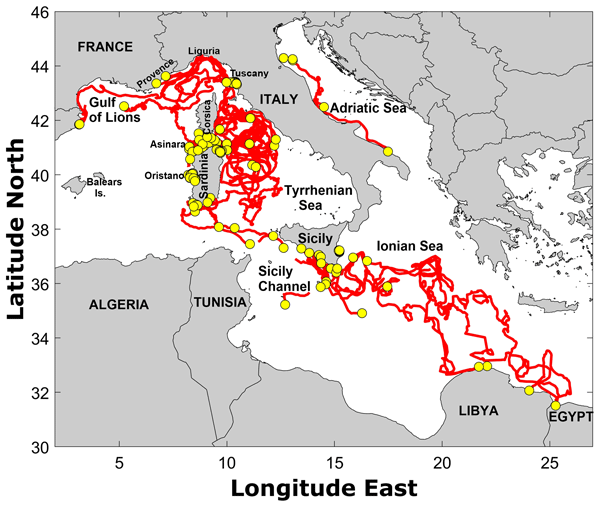
Alberto Ribotti, Antonio Bussani, Milena Menna, Andrea Satta, Roberto Sorgente, Andrea Cucco, and Riccardo Gerin
Earth Syst. Sci. Data, 15, 4651–4659, https://doi.org/10.5194/essd-15-4651-2023, https://doi.org/10.5194/essd-15-4651-2023, 2023
Short summary
Short summary
Over 100 experiments were realized between 1998 and 2022 in the Mediterranean Sea using surface coastal and offshore Lagrangian drifters. Raw data were initially unified and pre-processed. Then, the integrity of the received data packages was checked and incomplete ones were discarded. Deployment information was retrieved and integrated into the PostgreSQL database. Data were interpolated at defined time intervals, providing a dataset of 158 trajectories, available in different formats.
Roberto Sorgente, Federica Pessini, Aldo Francis Drago, Alberto Ribotti, Simona Genovese, Marco Barra, Angelo Perilli, Giovanni Quattrocchi, Andrea Cucco, Ignazio Fontana, Giovanni Giacalone, Gualtiero Basilone, and Angelo Bonanno
EGUsphere, https://doi.org/10.5194/egusphere-2023-2193, https://doi.org/10.5194/egusphere-2023-2193, 2023
Preprint withdrawn
Short summary
Short summary
Presence and interannual variability of water masses on the continental shelf around Sardinia are studied by CTD data from three cruises carried out between 2019 and 2021. For the first time the analyses are identifying the water mass phenomenology on the south-western Sardinia shelf characterized by the presence of the Atlantic Water driven by Algerian eddies. On the southern and eastern shelves, the presence of the Atlantic Water the water column is affected by the South East Sardinia Gyre.
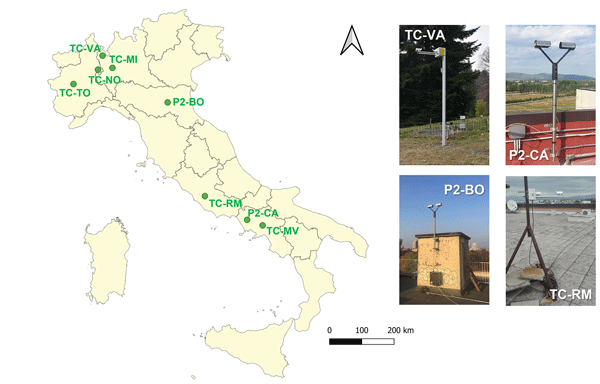
Elisa Adirosi, Federico Porcù, Mario Montopoli, Luca Baldini, Alessandro Bracci, Vincenzo Capozzi, Clizia Annella, Giorgio Budillon, Edoardo Bucchignani, Alessandra Lucia Zollo, Orietta Cazzuli, Giulio Camisani, Renzo Bechini, Roberto Cremonini, Andrea Antonini, Alberto Ortolani, Samantha Melani, Paolo Valisa, and Simone Scapin
Earth Syst. Sci. Data, 15, 2417–2429, https://doi.org/10.5194/essd-15-2417-2023, https://doi.org/10.5194/essd-15-2417-2023, 2023
Short summary
Short summary
The paper describes the database of 1 min drop size distribution (DSD) of atmospheric precipitation collected by the Italian disdrometer network over the last 10 years. These data are useful for several applications that range from climatological, meteorological and hydrological uses to telecommunications, agriculture and conservation of cultural heritage exposed to precipitation. Descriptions of the processing and of the database organization, along with some examples, are provided.
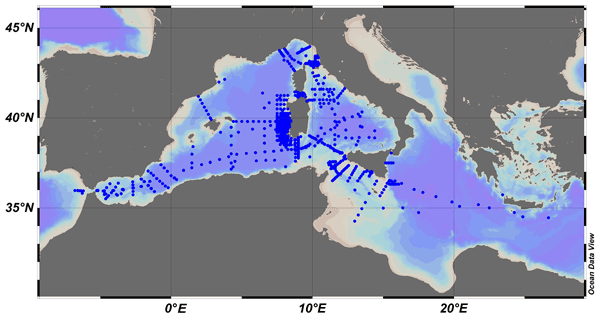
Alberto Ribotti, Roberto Sorgente, Federica Pessini, Andrea Cucco, Giovanni Quattrocchi, and Mireno Borghini
Earth Syst. Sci. Data, 14, 4187–4199, https://doi.org/10.5194/essd-14-4187-2022, https://doi.org/10.5194/essd-14-4187-2022, 2022
Short summary
Short summary
Over 1468 hydrological vertical profiles were acquired in 21 years in the Mediterranean Sea. This allowed us to follow the diffusion of the Western Mediterranean Transient along all western seas or make some important repetitions across straits, channels, or at defined locations. These data are now available in four open-access online datasets, including profiles of water temperature, conductivity, dissolved oxygen, chlorophyll α fluorescence, and, after 2004, turbidity and pH.
Emma Reyes, Eva Aguiar, Michele Bendoni, Maristella Berta, Carlo Brandini, Alejandro Cáceres-Euse, Fulvio Capodici, Vanessa Cardin, Daniela Cianelli, Giuseppe Ciraolo, Lorenzo Corgnati, Vlado Dadić, Bartolomeo Doronzo, Aldo Drago, Dylan Dumas, Pierpaolo Falco, Maria Fattorini, Maria J. Fernandes, Adam Gauci, Roberto Gómez, Annalisa Griffa, Charles-Antoine Guérin, Ismael Hernández-Carrasco, Jaime Hernández-Lasheras, Matjaž Ličer, Pablo Lorente, Marcello G. Magaldi, Carlo Mantovani, Hrvoje Mihanović, Anne Molcard, Baptiste Mourre, Adèle Révelard, Catalina Reyes-Suárez, Simona Saviano, Roberta Sciascia, Stefano Taddei, Joaquín Tintoré, Yaron Toledo, Marco Uttieri, Ivica Vilibić, Enrico Zambianchi, and Alejandro Orfila
Ocean Sci., 18, 797–837, https://doi.org/10.5194/os-18-797-2022, https://doi.org/10.5194/os-18-797-2022, 2022
Short summary
Short summary
This work reviews the existing advanced and emerging scientific and societal applications using HFR data, developed to address the major challenges identified in Mediterranean coastal waters organized around three main topics: maritime safety, extreme hazards and environmental transport processes. It also includes a discussion and preliminary assessment of the capabilities of existing HFR applications, finally providing a set of recommendations towards setting out future prospects.
Pablo Lorente, Eva Aguiar, Michele Bendoni, Maristella Berta, Carlo Brandini, Alejandro Cáceres-Euse, Fulvio Capodici, Daniela Cianelli, Giuseppe Ciraolo, Lorenzo Corgnati, Vlado Dadić, Bartolomeo Doronzo, Aldo Drago, Dylan Dumas, Pierpaolo Falco, Maria Fattorini, Adam Gauci, Roberto Gómez, Annalisa Griffa, Charles-Antoine Guérin, Ismael Hernández-Carrasco, Jaime Hernández-Lasheras, Matjaž Ličer, Marcello G. Magaldi, Carlo Mantovani, Hrvoje Mihanović, Anne Molcard, Baptiste Mourre, Alejandro Orfila, Adèle Révelard, Emma Reyes, Jorge Sánchez, Simona Saviano, Roberta Sciascia, Stefano Taddei, Joaquín Tintoré, Yaron Toledo, Laura Ursella, Marco Uttieri, Ivica Vilibić, Enrico Zambianchi, and Vanessa Cardin
Ocean Sci., 18, 761–795, https://doi.org/10.5194/os-18-761-2022, https://doi.org/10.5194/os-18-761-2022, 2022
Short summary
Short summary
High-frequency radar (HFR) is a land-based remote sensing technology that can provide maps of the surface circulation over broad coastal areas, along with wave and wind information. The main goal of this work is to showcase the current status of the Mediterranean HFR network as well as present and future applications of this sensor for societal benefit such as search and rescue operations, safe vessel navigation, tracking of marine pollutants, and the monitoring of extreme events.
Cited articles
Alfieri, L., Lorini, V., Hirpa, F. A., Harrigan, S., Zsoter, E., Prudhomme, C., and Salamon, P.: A global streamflow reanalysis for 1980–2018, Journal of Hydrology X, 6, 100049, https://doi.org/10.1016/j.hydroa.2019.100049, 2019.
Atkinson, A. L., Power, H. E., Moura, T., Hammond, T., Callaghan, D. P., and Baldock, T. E.: Assessment of runup predictions by empirical models on non-truncated beaches on the south-east Australian coast, Coastal Engineering, 119, 15–31, https://doi.org/10.1016/j.coastaleng.2016.10.001, 2017.
Bajo, M., Zampato, L., Umgiesser, G., Cucco, A., and Canestrelli, P.: A finite element operational model for storm surge prediction in Venice, Estuarine, Coastal and Shelf Science, 75, 236–249, https://doi.org/10.1016/j.ecss.2007.02.025, 2007.
Bajo, M., Međugorac, I., Umgiesser, G., and Orlić, M.: Storm surge and seiche modelling in the Adriatic Sea and the impact of data assimilation, Quarterly Journal of the Royal Meteorological Society, 145, 2070–2084, https://doi.org/10.1002/qj.3544, 2019.
Barnard, P. L., Van Ormondt, M., Erikson, L. H., Eshleman, J., Hapke, C., Ruggiero, P., Adams, P. N., and Foxgrover, A. C.: Development of the Coastal Storm Modeling System (CoSMoS) for predicting the impact of storms on high-energy, active-margin coasts, Natural Hazards, 74, 1095–1125, https://doi.org/10.1007/s11069-014-1236-y, 2014.
Barnard, P. L., Erikson, L. H., Foxgrover, A. C., Hart, J. A. F., Limber, P., O'Neill, A. C., Van Ormondt, M., Vitousek, S., Wood, N., Hayden, M. K., and Jones, J. M.: Dynamic flood modeling essential to assess the coastal impacts of climate change, Scientific Reports, 9, 1, https://doi.org/10.1038/s41598-019-40742-z, 2019.
Bensi, M., Mohammadi, S., Kao, S., and Deneale, S.: Multi-mechanism flood hazard assessment: critical review of current practice and approaches, Oak Ridge National Laboratory, U.S. Department of Energy, https://doi.org/10.2172/1649363, 2020.
Bevacqua, E., Maraun, D., Hobæk Haff, I., Widmann, M., and Vrac, M.: Multivariate statistical modelling of compound events via pair-copula constructions: analysis of floods in Ravenna (Italy), Hydrol. Earth Syst. Sci., 21, 2701–2723, https://doi.org/10.5194/hess-21-2701-2017, 2017.
Bevacqua, E., Vousdoukas, M. I., Zappa, G., Hodges, K., Shepherd, T. G., Maraun, D., Mentaschi, L., and Feyen, L.: More meteorological events that drive compound coastal flooding are projected under climate change, Communications Earth & Environment, 1, 1, https://doi.org/10.1038/s43247-020-00044-z, 2020.
Bloemendaal, N., Muis, S., Haarsma, R. J., Verlaan, M., Apecechea, M. I., De Moel, H., Ward, P. J., and Aerts, J. C. J. H.: Global modeling of tropical cyclone storm surges using high-resolution forecasts, Climate Dynamics, 52, 5031–5044, https://doi.org/10.1007/s00382-018-4430-x, 2018.
Bonamano, S., Federico, I., Causio, S., Piermattei, V., Piazzolla, D., Scanu, S., Madonia, A., Madonia, N., De Cillis, G., Jansen, E., Fersini, G., Coppini, G., and Marcelli, M.: River–coastal–ocean continuum modeling along the Lazio coast (Tyrrhenian Sea, Italy): Assessment of near river dynamics in the Tiber delta, Estuarine Coastal and Shelf Science, 297, 108618, https://doi.org/10.1016/j.ecss.2024.108618, 2024.
Brunner, G. W. and US Army Corps of Engineers: HEC-RAS, River Analysis System Hydraulic Reference Manual (Computer Program Documentation CPD-69), US Army Corps of Engineers, https://www.hec.usace.army.mil/software/hec-ras/documentation/HEC-RAS_6.0_Reference_Manual.pdf (last access: March 2024), 2021.
Brunner, G. W. and U.S. Army Corps of Engineers: HEC-RAS – River Analysis System, U.S. Army Corps of Engineers [code], https://www.hec.usace.army.mil/software/hec-ras/ (last access: March 2024), 2023.
Bulkeley, H., Marvin, S., Palgan, Y. V., McCormick, K., Breitfuss-Loidl, M., Mai, L., Von Wirth, T., and Frantzeskaki, N.: Urban living laboratories: Conducting the experimental city?, European Urban and Regional Studies, 26, 317–335, https://doi.org/10.1177/0969776418787222, 2018.
Carayannis, E. G. and Campbell, D. F.: “Mode 3” and “Quadruple Helix”: toward a 21st century fractal innovation ecosystem, International Journal of Technology Management, 46, 201, https://doi.org/10.1504/ijtm.2009.023374, 2009.
Ciavola, P., Ferreira, O., Haerens, P., Van Koningsveld, M., and Armaroli, C.: Storm impacts along European coastlines. Part 2: lessons learned from the MICORE project, Environmental Science & Policy, 14, 924–933, https://hdl.handle.net/11392/1443312 (last access: December 2021), 2011.
CNR-ISMAR: SHYFEM – Shallow Water Hydrodynamic Finite Element Model, CNR-ISMAR, GitHub repository [code], https://github.com/SHYFEM-model/shyfem (last access: March 2022), 2022.
Coles, S.: An Introduction to Statistical Modeling of Extreme Values, Springer series in statistics, https://doi.org/10.1007/978-1-4471-3675-0, 2001.
Conrad, C. C. and Hilchey, K. G.: A review of citizen science and community-based environmental monitoring: issues and opportunities, Environmental Monitoring and Assessment, 176, 273–291, https://doi.org/10.1007/s10661-010-1582-5, 2010.
Coppola, E., Nogherotto, R., Ciarlo, J. M., Giorgi, F., Van Meijgaard, E., Kadygrov, N., Iles, C., Corre, L., Sandstad, M., Somot, S., Nabat, P., Vautard, R., Levavasseur, G., Schwingshackl, C., Sillmann, J., Kjellström, E., Nikulin, G., Aalbers, E., Lenderink, G., and Wulfmeyer, V.: Assessment of the european climate projections as simulated by the large EURO-CORDEX regional and global climate model ensemble, Journal of Geophysical Research Atmospheres, 126, 4, https://doi.org/10.1029/2019jd032356, 2020.
Cucco, A., Martín, J., Quattrocchi, G., Fenco, H., Umgiesser, G., and Fernández, D. A.: Water circulation and transport time scales in the Beagle channel, southernmost tip of south America, Journal of Marine Science and Engineering, 10, 941, https://doi.org/10.3390/jmse10070941, 2022.
Cucco, A., Rindi, L., Benedetti-Cecchi, L., Quattrocchi, G., Ribotti, A., Ravaglioli, C., Cecchi, E., Perna, M., and Brandini, C.: Assessing the risk of oil spill impacts and potential biodiversity loss for coastal marine environment at the turn of the COVID-19 pandemic event, The Science of the Total Environment, 894, 164972, https://doi.org/10.1016/j.scitotenv.2023.164972, 2023.
Dee, D. P., Uppala, S. M., Simmons, A. J., Berrisford, P., Poli, P., Kobayashi, S., Andrae, U., Balmaseda, M. A., Balsamo, G., Bauer, P., Bechtold, P., Beljaars, A. C. M., Van De Berg, L., Bidlot, J., Bormann, N., Delsol, C., Dragani, R., Fuentes, M., Geer, A. J., and Vitart, F.: The ERA-Interim reanalysis: configuration and performance of the data assimilation system, Quarterly Journal of the Royal Meteorological Society, 137, 553–597, https://doi.org/10.1002/qj.828, 2011.
De Leo, F., Briganti, R., and Besio, G.: Trends in ocean waves climate within the Mediterranean Sea: a review, Clim. Dyn., 62, 1555–1566, https://doi.org/10.1007/s00382-023-06984-4, 2024.
Dessai, S., Hulme, M., Lempert, R., and Pielke, R.: Climate prediction: a limit to adaptation?, in: Adapting to Climate Change: Thresholds, Values, Governance, edited by: Adger, W. N., Lorenzoni, I., and O'Brien, K., Cambridge University Press, Cambridge, 64–78, https://doi.org/10.1017/CBO9780511596667.006, 2009.
Federico, I., Pinardi, N., Coppini, G., Oddo, P., Lecci, R., and Mossa, M.: Coastal ocean forecasting with an unstructured grid model in the southern Adriatic and northern Ionian seas, Nat. Hazards Earth Syst. Sci., 17, 45–59, https://doi.org/10.5194/nhess-17-45-2017, 2017.
Fernández-Montblanc, T., Vousdoukas, M., Ciavola, P., Voukouvalas, E., Mentaschi, L., Breyiannis, G., Feyen, L., and Salamon, P.: Towards robust pan-European storm surge forecasting, Ocean Modelling, 133, 129–144, https://doi.org/10.1016/j.ocemod.2018.12.001, 2018.
Figueiredo, R., Rangel-Parra, R., Bussi, G., Ceresa, P., Coccia, G., and Martina, M. L.: A semi-quantitative multi-hazard risk assessment framework for European coastal urban areas, Geomatics Natural Hazards and Risk, 15, 1, https://doi.org/10.1080/19475705.2024.2378994, 2024.
Ghanbari, M., Arabi, M., Kao, S., Obeysekera, J., and Sweet, W.: Climate change and changes in compound coastal-riverine flooding hazard along the U.S. coasts, Earth's Future, 9, 5, https://doi.org/10.1029/2021ef002055, 2021.
Gilleland, E.: Bootstrap Methods for Statistical Inference. Part II: Extreme-Value Analysis, Journal of Atmospheric and Oceanic Technology, 37, 2135–2144, https://doi.org/10.1175/jtech-d-20-0070.1, 2020.
Gilleland, E. and Katz, R. W.: extRemes2.0: An Extreme Value Analysis Package in R, Journal of Statistical Software, 72, 8, https://doi.org/10.18637/jss.v072.i08, 2016.
Gori, A. and Lin, N.: Projecting Compound Flood Hazard Under Climate Change with Physical Models and Joint Probability Methods, Earth's Future, 10, 12, https://doi.org/10.1029/2022ef003097, 2022.
Hallegatte, S., Green, C., Nicholls, R. J., and Corfee-Morlot, J.: Future flood losses in major coastal cities, Nature Climate Change, 3, 9, 802–806, https://doi.org/10.1038/nclimate1979, 2013.
Intergovernmental Panel on Climate Change (IPCC): Climate Change 2013 – The physical science basis: working group I contribution to the fifth assessment report of the Intergovernmental Panel on Climate Change, Cambridge University Press, https://doi.org/10.1017/CBO9781107415324, 2014.
Intergovernmental Panel on Climate Change (IPCC): Climate Change 2022 – Impacts, adaptation and vulnerability: working group II contribution to the sixth assessment report of the Intergovernmental Panel on Climate Change Cambridge University Press, https://doi.org/10.1017/9781009325844, 2023.
Jacob, D., Petersen, J., Eggert, B., Alias, A., Christensen, O. B., Bouwer, L. M., Braun, A., Colette, A., Déqué, M., Georgievski, G., Georgopoulou, E., Gobiet, A., Menut, L., Nikulin, G., Haensler, A., Hempelmann, N., Jones, C., Keuler, K., Kovats, S., and Yiou, P.: EURO-CORDEX: new high-resolution climate change projections for European impact research, Regional Environmental Change, 14, 2, 563–578, https://doi.org/10.1007/s10113-013-0499-2, 2014.
Joint Research Centre (JRC): Institute for Environment and Sustainability, LISVAP, evaporation pre-processor for the LISFLOOD water balance and flood simulation model – Revised user manual, Publications Office, https://doi.org/10.2788/26160, 2013.
Joint Research Centre (JRC): LISFLOOD hydrological and flood simulation model, European Commission, GitHub repository [code], https://github.com/ec-jrc/lisflood-code (last access: January 2022), 2022.
Khanal, S., Ridder, N., De Vries, H., Terink, W., and Van Den Hurk, B.: Storm Surge and Extreme River Discharge: A compound event analysis using ensemble impact modeling, Frontiers in Earth Science, 7, https://doi.org/10.3389/feart.2019.00224, 2019.
Laino, E., Paranunzio, R., and Iglesias, G.: Scientometric review on multiple climate-related hazards indices, The Science of the Total Environment, 945, 174004, https://doi.org/10.1016/j.scitotenv.2024.174004, 2024.
Lima, F. N., Freitas, A. C. V., and Silva, J.: Climate change flood risk analysis: application of dynamical downscaling and hydrological modeling, Atmosphere, 14, 7, 1069, https://doi.org/10.3390/atmos14071069, 2023.
Maicu, F., De Pascalis, F., Ferrarin, C., and Umgiesser, G.: Hydrodynamics of the Po river-delta-sea system, Journal of Geophysical Research Oceans, 123, 6349–6372, https://doi.org/10.1029/2017jc013601, 2018.
Masina, M., Lamberti, A., and Archetti, R.: Coastal flooding: A copula based approach for estimating the joint probability of water levels and waves, Coastal Engineering, 97, 37–52, https://doi.org/10.1016/j.coastaleng.2014.12.010, 2015.
Moftakhari, H. R., Salvadori, G., AghaKouchak, A., Sanders, B. F., and Matthew, R. A.: Compounding effects of sea level rise and fluvial flooding, Proceedings of the National Academy of Sciences, 114, 37, 9785–9790, https://doi.org/10.1073/pnas.1620325114, 2017.
Munang, R., Thiaw, I., Alverson, K., Liu, J., and Han, Z.: The role of ecosystem services in climate change adaptation and disaster risk reduction, Current Opinion in Environmental Sustainability, 5, 47–52, https://doi.org/10.1016/j.cosust.2013.02.002, 2013.
Neumann, B., Vafeidis, A. T., Zimmermann, J., and Nicholls, R. J.: Future coastal population growth and exposure to sea-level rise and coastal flooding – A global assessment, PLoS ONE, 10, e0118571, https://doi.org/10.1371/journal.pone.0118571, 2015.
Oppenheimer, M., Hinkel, J., Magnan, A., Cai, R., Cifuentes-Jara, M., Deconto, R., Ghosh, T., Biesbroek, R., Buchanan, M., Duvat, V., Ekaykin, A., Ford, J., Fortes, M., Gattuso, J., Kopp, R., Lawrence, J., Mackintosh, A., Melet, A., Mcleod, E., and Zhai, P.: Sea level rise and implications for low-lying islands, coasts and communities, in the ocean and cryosphere in a changing climate: special report of the Intergovernmental Panel on Climate Change, Cambridge University Press, https://doi.org/10.1017/9781009157964.012, 2019.
Orton, P. M., Conticello, F. R., Cioffi, F., Hall, T. M., Georgas, N., Lall, U., Blumberg, A. F., and MacManus, K.: Flood hazard assessment from storm tides, rain and sea level rise for a tidal river estuary, Natural Hazards, 102, 729–757, https://doi.org/10.1007/s11069-018-3251-x, 2018.
Paranunzio, R., Guerrini, M., Dwyer, E., Alexander, P. J., and O'Dwyer, B.: Assessing coastal flood risk in a changing climate for Dublin, Ireland, Journal of Marine Science and Engineering, 10, 1715, https://doi.org/10.3390/jmse10111715, 2022.
Paranunzio, R., Anton, I., Adirosi, E., Ahmed, T., Baldini, L., Brandini, C., Giannetti, F., Meulenberg, C., Ortolani, A., Pilla, F., Iglesias, G., and Gharbia, S.: A new approach towards a user-driven coastal climate service to enhance climate resilience in European cities, Sustainability, 16, 335, https://doi.org/10.3390/su16010335, 2023.
Parodi, M. U., Giardino, A., van Dongeren, A., Pearson, S. G., Bricker, J. D., and Reniers, A. J. H. M.: Uncertainties in coastal flood risk assessments in small island developing states, Nat. Hazards Earth Syst. Sci., 20, 2397–2414, https://doi.org/10.5194/nhess-20-2397-2020, 2020.
Quattrocchi, G., Simeone, S., Pes, A., Sorgente, R., Ribotti, A., and Cucco, A.: An operational numerical system for oil stranding risk assessment in a high-density vessel traffic area, Frontiers in Marine Science, 8, https://doi.org/10.3389/fmars.2021.585396, 2021.
Quinn, N., Lewis, M., Wadey, M. P., and Haigh, I. D.: Assessing the temporal variability in extreme storm-tide time series for coastal flood risk assessment, Journal of Geophysical Research: Oceans, 119, 4983–4998, https://doi.org/10.1002/2014JC010197, 2014.
Reimann, L., Vafeidis, A. T., and Honsel, L. E.: Population development as a driver of coastal risk: Current trends and future pathways, Cambridge Prisms Coastal Futures, 1, https://doi.org/10.1017/cft.2023.3, 2023.
Santamaria-Aguilar, S., Schuerch, M., Vafeidis, A. T., and Carretero, S. C.: Long-term trends and variability of water levels and tides in Buenos Aires and Mar del Plata, Argentina, Frontiers in Marine Science, 4, 380, https://doi.org/10.3389/fmars.2017.00380, 2017.
Satterthwaite, D.: The implications of population growth and urbanization for climate change, Environment and Urbanization, 21, 545–567, https://doi.org/10.1177/0956247809344361, 2009.
Sun, Q., Fang, J., Dang, X., Xu, K., Fang, Y., Li, X., and Liu, M.: Multi-scenario urban flood risk assessment by integrating future land use change models and hydrodynamic models, Nat. Hazards Earth Syst. Sci., 22, 3815–3829, https://doi.org/10.5194/nhess-22-3815-2022, 2022.
Taylor, K. E., Stouffer, R. J., and Meehl, G. A.: An overview of CMIP5 and the experiment design, bulletin of the American Meteorological Society, 93, 4, 485–498, https://doi.org/10.1175/bams-d-11-00094.1, 2011.
Temmerman, S., Meire, P., Bouma, T. J., Herman, P. M. J., Ysebaert, T., and De Vriend, H. J.: Ecosystem-based coastal defence in the face of global change, Nature, 504, 7478, 79–83, https://doi.org/10.1038/nature12859, 2013.
Tiwari, A., Rodrigues, L. C., Lucy, F. E., and Gharbia, S Building climate resilience in coastal city living labs using ecosystem-based adaptation: A Systematic Review, Sustainability, 14, 10863, https://doi.org/10.3390/su141710863, 2022.
Umgiesser, G., Canu, D. M., Cucco, A., and Solidoro, C.: A finite element model for the Venice Lagoon. Development, set up, calibration and validation, Journal of Marine Systems, 51, 123–145, https://doi.org/10.1016/j.jmarsys.2004.05.009, 2004.
Umgiesser, G., Ferrarin, C., Cucco, A., De Pascalis, F., Bellafiore, D., Ghezzo, M., and Bajo, M.: Comparative hydrodynamics of 10 Mediterranean lagoons by means of numerical modeling, Journal of Geophysical Research Oceans, 119, 2212–2226, https://doi.org/10.1002/2013jc009512, 2014.
Umgiesser, G., Ferrarin, C., Bajo, M., Bellafiore, D., Cucco, A., De Pascalis, F., Ghezzo, M., McKiver, W., and Arpaia, L.: Hydrodynamic modeling in marginal and coastal seas – The case of the Adriatic Sea as a permanent laboratory for numerical approach, Ocean Modelling, 179, 102123, https://doi.org/10.1016/j.ocemod.2022.102123, 2022.
Van Den Hurk, B., Van Meijgaard, E., De Valk, P., Van Heeringen, K., and Gooijer, J.: Analysis of a compounding surge and precipitation event in the Netherlands, Environmental Research Letters, 10, 035001, https://doi.org/10.1088/1748-9326/10/3/035001, 2015.
Van Der Knijff, J. M., Younis, J., and De Roo, A. P. J.: LISFLOOD: a GIS-based distributed model for river basin scale water balance and flood simulation, International Journal of Geographical Information Science, 24, 189–212, https://doi.org/10.1080/13658810802549154, 2008.
Vautard, R., Kadygrov, N., Iles, C., Boberg, F., Buonomo, E., Bülow, K., Coppola, E., Corre, L., Van Meijgaard, E., Nogherotto, R., Sandstad, M., Schwingshackl, C., Somot, S., Aalbers, E., Christensen, O. B., Ciarlo, J. M., Demory, M., Giorgi, F., Jacob, D., and Wulfmeyer, V.: Evaluation of the large EURO-CORDEX regional climate model ensemble, Journal of Geophysical Research Atmospheres, 126, 17, https://doi.org/10.1029/2019jd032344, 2020.
Vezzoli, R., Mercogliano, P., Pecora, S., Zollo, A., and Cacciamani, C.: Hydrological simulation of Po River (North Italy) discharge under climate change scenarios using the RCM COSMO-CLM, The Science of the Total Environment, 521–522, 346–358, https://doi.org/10.1016/j.scitotenv.2015.03.096, 2015.
Vitousek, S., Barnard, P. L., Fletcher, C. H., Frazer, N., Erikson, L., and Storlazzi, C. D.: Doubling of coastal flooding frequency within decades due to sea-level rise, Scientific Reports, 7, 1, https://doi.org/10.1038/s41598-017-01362-7, 2017.
Voldoire, A., Sanchez-Gomez, E., Mélia, D. S. Y., Decharme, B., Cassou, C., Sénési, S., Valcke, S., Beau, I., Alias, A., Chevallier, M., Déqué, M., Deshayes, J., Douville, H., Fernandez, E., Madec, G., Maisonnave, E., Moine, M., Planton, S., Saint-Martin, D., and Chauvin, F.: The CNRM-CM5.1 global climate model: description and basic evaluation, Climate Dynamics, 40, 2091–2121, https://doi.org/10.1007/s00382-011-1259-y, 2012.
Vousdoukas, M. I., Mentaschi, L., Voukouvalas, E., Verlaan, M., and Feyen, L.: Extreme Sea level – RCP4.5, European Commission, Joint Research Centre (JRC) [data set], http://data.europa.eu/89h/e9e42344-119d-479e-9bc7-57400d12a8a2, (last access: 10 June 2024), 2016a.
Vousdoukas, M. I., Mentaschi, L., Voukouvalas, E., Verlaan, M., Feyen, L.: Extreme Sea level – RCP85, European Commission, Joint Research Centre (JRC) [data set], http://data.europa.eu/89h/a565eea4-5422-4c7d-a000-2e10ae872da7, (last access: 10 June 2024), 2016b.
Vousdoukas, M. I., Mentaschi, L., Voukouvalas, E., Verlaan, M., and Feyen, L.: Extreme sea levels on the rise along Europe's coasts, Earth's Future, 5, 304–323, https://doi.org/10.1002/2016EF000505, 2017.
Vousdoukas, M. I., Mentaschi, L., Voukouvalas, E., Verlaan, M., Jevrejeva, S., Jackson, L. P., and Feyen, L.: Global probabilistic projections of extreme sea levels show intensification of coastal flood hazard, Nature Communications, 9, 1, https://doi.org/10.1038/s41467-018-04692-w, 2018.
Vousdoukas, M. I., Mentaschi, L., Hinkel, J., Ward, P. J., Mongelli, I., Ciscar, J., and Feyen, L.: Economic motivation for raising coastal flood defenses in Europe, Nature Communications, 11, 1, https://doi.org/10.1038/s41467-020-15665-3, 2020.
Wahl, T., Jain, S., Bender, J., Meyers, S. D., and Luther, M. E.: Increasing risk of compound flooding from storm surge and rainfall for major US cities, Nature Climate Change, 5, 1093–1097, https://doi.org/10.1038/nclimate2736, 2015.
Wahl, T., Haigh, I. D., Nicholls, R. J., Arns, A., Dangendorf, S., Hinkel, J., and Slangen, A. B. A.: Understanding extreme sea levels for broad-scale coastal impact and adaptation analysis, Nature Communications, 8, 1, https://doi.org/10.1038/ncomms16075, 2017.
WAVEWATCH III Development Group (WW3DG): User manual and system documentation of WAVEWATCH III version 6.07, Tech. Note 333, NOAA/NWS/NCEP/MMAB, College Park, MD, USA, 465 pp. + Appendices, https://github.com/NOAA-EMC/WW3/wiki/files/manual.pdf (last access: February 2022), 2019a.
WAVEWATCH III Development Group (WW3DG): WaveWatch III numerical wave model, NOAA Environmental Modeling Center, GitHub repository [code], https://github.com/NOAA-EMC/WW3 (last access: February 2022), 2019b.
Wicks, A. J. and Atkinson, D. E.: Identification and classification of storm surge events at Red Dog Dock, Alaska, 2004–2014, Natural Hazards, 86, 877–900, https://doi.org/10.1007/s11069-016-2722-1, 2017.
Yang, S., Sheng, J., Ohashi, K., Yang, B., Chen, S., and Xing, J.: Non-linear interactions between tides and storm surges during extreme weather events over the eastern Canadian shelf, Ocean Dynamics, 73, 279–301, https://doi.org/10.1007/s10236-023-01556-w, 2023.
Zheng, F., Westra, S., and Sisson, S. A.: Quantifying the dependence between extreme rainfall and storm surge in the coastal zone, Journal of Hydrology, 505, 172–187, https://doi.org/10.1016/j.jhydrol.2013.09.054, 2013.
Zijl, F., Verlaan, M., and Gerritsen, H.: Improved water-level forecasting for the Northwest European Shelf and North Sea through direct modelling of tide, surge and non-linear interaction, Ocean Dynamics, 63, 823–847, https://doi.org/10.1007/s10236-013-0624-2, 2013.
Zhong, M., Xiao, L., Li, X., Mei, Y., Jiang, T., Song, L., and Chen, X.: A study on compound flood prediction and inundation simulation under future scenarios in a coastal city, Journal of Hydrology, 628, 130475, https://doi.org/10.1016/j.jhydrol.2023.130475, 2023.
Short summary
We studied how future climate scenarios may affect flooding in three European coastal cities. Using atmospheric data and an integrated modeling framework, we simulated extreme storm surges, waves, and river discharges at high urban resolution (up to 2 m). Flood trends are driven by local geomorphic features, sea-level rise, and storm intensity changes, providing insights for adaptation strategies.
We studied how future climate scenarios may affect flooding in three European coastal cities....


Altmetrics
Final-revised paper
Preprint