
Articles | Volume 26, issue 1
https://doi.org/10.5194/nhess-26-651-2026
© Author(s) 2026. This work is distributed under
the Creative Commons Attribution 4.0 License.
the Creative Commons Attribution 4.0 License.
https://doi.org/10.5194/nhess-26-651-2026
© Author(s) 2026. This work is distributed under
the Creative Commons Attribution 4.0 License.
the Creative Commons Attribution 4.0 License.
Research article
| 
29 Jan 2026
Research article |
| 29 Jan 2026
| 29 Jan 2026
Coseismic surface rupture probabilities from earthquake cycle simulations: influence of fault geometry
Octavi Gómez-Novell
CORRESPONDING AUTHOR

Instituto Geológico y Minero de España, IGME, CSIC, Madrid, Spain
Francesco Visini
Istituto Nazionale di Geofisica e Vulcanologia, Chieti, Italy
José Antonio Álvarez-Gómez
Universidad Complutense de Madrid, Madrid, Spain
Bruno Pace
Università Degli Studi “Gabriele d'Annunzio” di Chieti e Pescara, Chieti, Italy
Julián García-Mayordomo
Instituto Geológico y Minero de España, IGME, CSIC, Madrid, Spain
Related authors
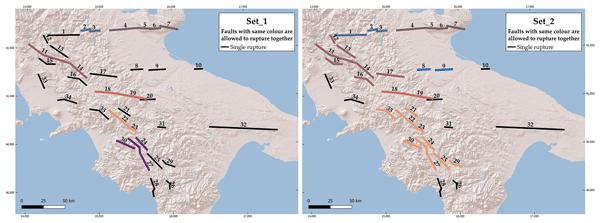
Giulia Alessandrini, Octavi Gómez-Novell, Silvia Castellaro, Michela Giustiniani, and Umberta Tinivella
Nat. Hazards Earth Syst. Sci., 26, 3469–3488, https://doi.org/10.5194/nhess-26-3469-2026, https://doi.org/10.5194/nhess-26-3469-2026, 2026
Short summary
Short summary
We model fault-based seismicity rates by converting the slip rates of active faults into earthquake occurrence, considering both individual-fault ruptures and ruptures involving multiple adjacent faults. Our results show that multi-fault rupture scenarios better reproduce earthquake catalogues and paleoseismic observations, highlighting the importance of incorporating rupture complexity into future seismic hazard models.
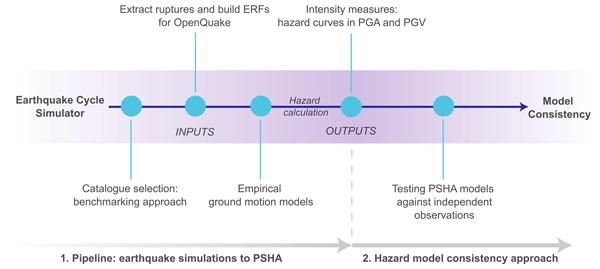
Octavi Gómez-Novell, Francesco Visini, Paula Herrero-Barbero, José A. Álvarez-Gómez, and Julián García-Mayordomo
Nat. Hazards Earth Syst. Sci., 26, 2691–2715, https://doi.org/10.5194/nhess-26-2691-2026, https://doi.org/10.5194/nhess-26-2691-2026, 2026
Short summary
Short summary
Evaluating seismic hazard requires past earthquake observations to perform accurate forecasts. Physics-based earthquake cycle simulators are algorithms that model long-term earthquake sequences on faults, overcoming completeness limitations of observations. We test the performance of physics-based seismic hazard assessments in comparison with traditional approaches in Spain. The physics-based approach yields more accurate forecasts, highlighting the potential of simulators for seismic hazard.
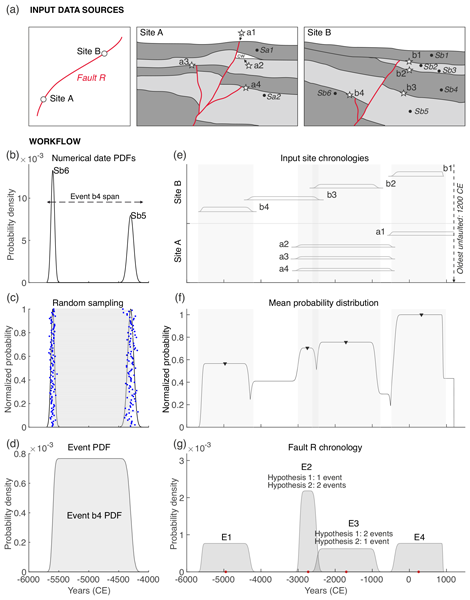
Octavi Gómez-Novell, Bruno Pace, Francesco Visini, Joanna Faure Walker, and Oona Scotti
Geosci. Model Dev., 16, 7339–7355, https://doi.org/10.5194/gmd-16-7339-2023, https://doi.org/10.5194/gmd-16-7339-2023, 2023
Short summary
Short summary
Knowing the rate at which earthquakes happen along active faults is crucial to characterize the hazard that they pose. We present an approach (Paleoseismic EArthquake CHronologies, PEACH) to correlate and compute seismic histories using paleoseismic data, a type of data that characterizes past seismic activity from the geological record. Our approach reduces the uncertainties of the seismic histories and overall can improve the knowledge on fault rupture behavior for the seismic hazard.
Giulia Alessandrini, Octavi Gómez-Novell, Silvia Castellaro, Michela Giustiniani, and Umberta Tinivella
Nat. Hazards Earth Syst. Sci., 26, 3469–3488, https://doi.org/10.5194/nhess-26-3469-2026, https://doi.org/10.5194/nhess-26-3469-2026, 2026
Short summary
Short summary
We model fault-based seismicity rates by converting the slip rates of active faults into earthquake occurrence, considering both individual-fault ruptures and ruptures involving multiple adjacent faults. Our results show that multi-fault rupture scenarios better reproduce earthquake catalogues and paleoseismic observations, highlighting the importance of incorporating rupture complexity into future seismic hazard models.
Octavi Gómez-Novell, Francesco Visini, Paula Herrero-Barbero, José A. Álvarez-Gómez, and Julián García-Mayordomo
Nat. Hazards Earth Syst. Sci., 26, 2691–2715, https://doi.org/10.5194/nhess-26-2691-2026, https://doi.org/10.5194/nhess-26-2691-2026, 2026
Short summary
Short summary
Evaluating seismic hazard requires past earthquake observations to perform accurate forecasts. Physics-based earthquake cycle simulators are algorithms that model long-term earthquake sequences on faults, overcoming completeness limitations of observations. We test the performance of physics-based seismic hazard assessments in comparison with traditional approaches in Spain. The physics-based approach yields more accurate forecasts, highlighting the potential of simulators for seismic hazard.
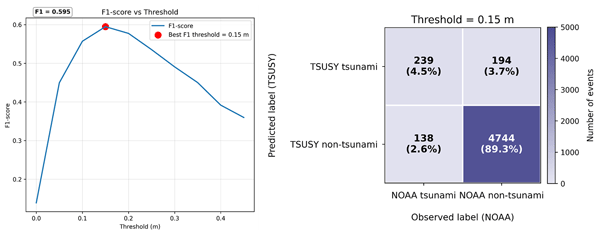
David Galán Pérez, Iñigo Aniel-Quiroga, Albert Gallego, Ignacio Aguirre-Ayerbe, Mauricio González, Omar Quetzalcóatl, Jose A. Álvarez-Gómez, and Luis Pedraz
Nat. Hazards Earth Syst. Sci., 26, 2415–2436, https://doi.org/10.5194/nhess-26-2415-2026, https://doi.org/10.5194/nhess-26-2415-2026, 2026
Short summary
Short summary
Tsunamis can have devastating consequences, yet it remains challenging to identify which earthquakes generate them. This study presents a criterion for identifying tsunamigenic events based on numerical simulations, as well as a global database of tsunami simulations based on historical earthquakes. By comparing the results with historical records, this approach can improve tsunami identification and support tsunami warnings worldwide.
Juan Portela, Marta Béjar-Pizarro, Alejandra Staller, Cécile Lasserre, Beatriz Cosenza-Muralles, José Antonio Álvarez-Gómez, and José Jesús Martínez-Díaz
Solid Earth, 17, 369–387, https://doi.org/10.5194/se-17-369-2026, https://doi.org/10.5194/se-17-369-2026, 2026
Short summary
Short summary
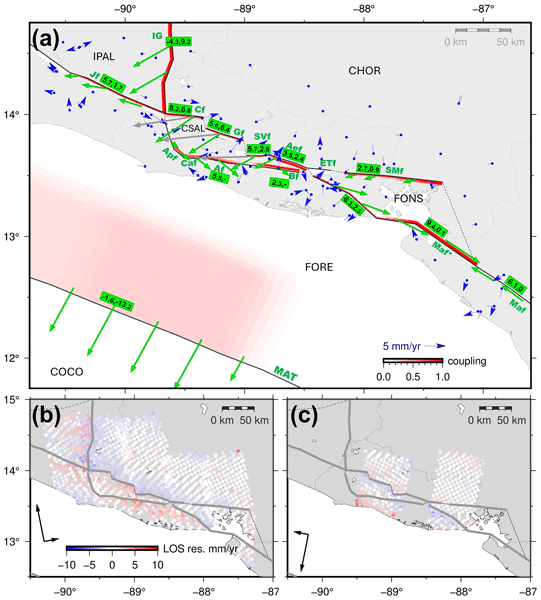
We combined satellite radar and GPS data to model how the faults in El Salvador and nearby regions accumulate deformation. Motion across the central El Salvador Fault Zone is shared by several fault branches, while the offshore subduction zone appears to be weakly locked. These results improve the understanding of regional deformation and seismic hazard in Central America.
Elena Pascual-Sánchez, José Antonio Álvarez-Gómez, Julián García-Mayordomo, and Paula Herrero-Barbero
EGUsphere, https://doi.org/10.5194/egusphere-2025-4870, https://doi.org/10.5194/egusphere-2025-4870, 2025
Short summary
Short summary
This study explores whether seismic hazard depends on the time interval over which an earthquake catalogue is recorded. Using a synthetic earthquake catalogue from the Eastern Betics Shear Zone spanning 1 Myr, we divided it into 10,000 sub-catalogues, each with the same duration as the historical and instrumental catalogue – i.e., 1,000 years. The resulting hazard curves, derived from a probabilistic seismic hazard assessment, show that each sub-catalogue yields different return period values.
Antonio Olaiz, José A. Álvarez Gómez, Gerardo de Vicente, Alfonso Muñoz-Martín, Juan V. Cantavella, Susana Custódio, Dina Vales, and Oliver Heidbach
Solid Earth, 16, 947–1024, https://doi.org/10.5194/se-16-947-2025, https://doi.org/10.5194/se-16-947-2025, 2025
Short summary
Short summary
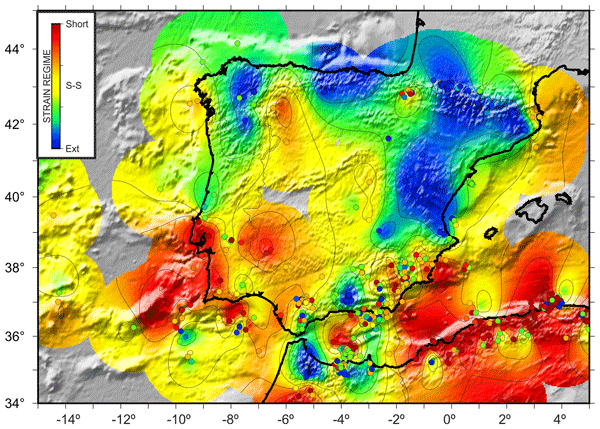
Understanding the stress and strain conditions in the Earth's crust is crucial for various activities, such as oil and gas exploration and assessing seismic hazards. In this article, we have updated the database of moment tensor focal mechanisms for Greater Iberia. We conducted kinematic and dynamic analyses on the selected populations, determining the average focal mechanism, strain and stress orientations, and tectonic regime. The orientation for horizontal compression is primarily N154° E.
Roberto Basili, Laurentiu Danciu, Céline Beauval, Karin Sesetyan, Susana Pires Vilanova, Shota Adamia, Pierre Arroucau, Jure Atanackov, Stéphane Baize, Carolina Canora, Riccardo Caputo, Michele Matteo Cosimo Carafa, Edward Marc Cushing, Susana Custódio, Mine Betul Demircioglu Tumsa, João C. Duarte, Athanassios Ganas, Julián García-Mayordomo, Laura Gómez de la Peña, Eulàlia Gràcia, Petra Jamšek Rupnik, Hervé Jomard, Vanja Kastelic, Francesco Emanuele Maesano, Raquel Martín-Banda, Sara Martínez-Loriente, Marta Neres, Hector Perea, Barbara Šket Motnikar, Mara Monica Tiberti, Nino Tsereteli, Varvara Tsironi, Roberto Vallone, Kris Vanneste, Polona Zupančič, and Domenico Giardini
Nat. Hazards Earth Syst. Sci., 24, 3945–3976, https://doi.org/10.5194/nhess-24-3945-2024, https://doi.org/10.5194/nhess-24-3945-2024, 2024
Short summary
Short summary
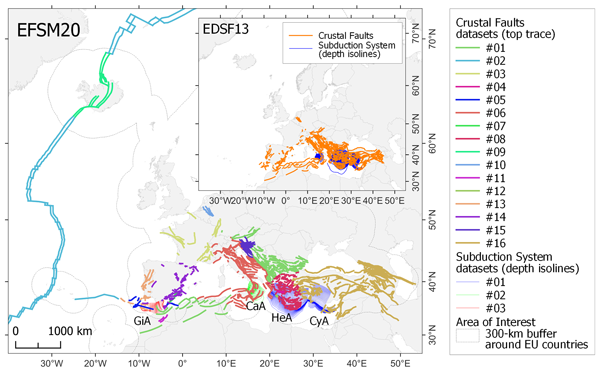
This study presents the European Fault-Source Model 2020 (EFSM20), a dataset of 1248 geologic crustal faults and four subduction systems, each having the necessary parameters to forecast long-term earthquake occurrences in the European continent. This dataset constituted one of the main inputs for the recently released European Seismic Hazard Model 2020, a key instrument to mitigate seismic risk in Europe. EFSM20 adopts recognized open-standard formats, and it is openly accessible and reusable.
Vera D'Amico, Francesco Visini, Andrea Rovida, Warner Marzocchi, and Carlo Meletti
Nat. Hazards Earth Syst. Sci., 24, 1401–1413, https://doi.org/10.5194/nhess-24-1401-2024, https://doi.org/10.5194/nhess-24-1401-2024, 2024
Short summary
Short summary
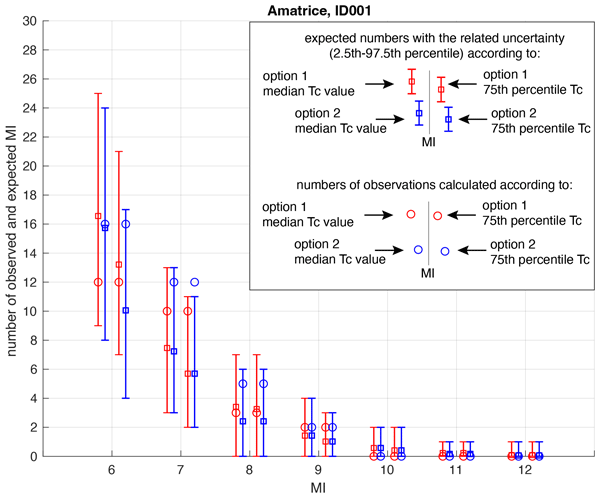
We propose a scoring strategy to rank multiple models/branches of a probabilistic seismic hazard analysis (PSHA) model that could be useful to consider specific requests from stakeholders responsible for seismic risk reduction actions. In fact, applications of PSHA often require sampling a few hazard curves from the model. The procedure is introduced through an application aimed to score and rank the branches of a recent Italian PSHA model according to their fit with macroseismic intensity data.
Octavi Gómez-Novell, Bruno Pace, Francesco Visini, Joanna Faure Walker, and Oona Scotti
Geosci. Model Dev., 16, 7339–7355, https://doi.org/10.5194/gmd-16-7339-2023, https://doi.org/10.5194/gmd-16-7339-2023, 2023
Short summary
Short summary
Knowing the rate at which earthquakes happen along active faults is crucial to characterize the hazard that they pose. We present an approach (Paleoseismic EArthquake CHronologies, PEACH) to correlate and compute seismic histories using paleoseismic data, a type of data that characterizes past seismic activity from the geological record. Our approach reduces the uncertainties of the seismic histories and overall can improve the knowledge on fault rupture behavior for the seismic hazard.

José A. Álvarez-Gómez, Paula Herrero-Barbero, and José J. Martínez-Díaz
Nat. Hazards Earth Syst. Sci., 23, 2031–2052, https://doi.org/10.5194/nhess-23-2031-2023, https://doi.org/10.5194/nhess-23-2031-2023, 2023
Short summary
Short summary
The strike-slip Carboneras fault is one of the largest sources in the Alboran Sea, with it being one of the faster faults in the eastern Betics. The dimensions and location of the Carboneras fault imply a high seismic and tsunami threat. In this work, we present tsunami simulations from sources generated with physics-based earthquake simulators. We show that the Carboneras fault has the capacity to generate locally damaging tsunamis with inter-event times between 2000 and 6000 years.
Francesco Visini, Carlo Meletti, Andrea Rovida, Vera D'Amico, Bruno Pace, and Silvia Pondrelli
Nat. Hazards Earth Syst. Sci., 22, 2807–2827, https://doi.org/10.5194/nhess-22-2807-2022, https://doi.org/10.5194/nhess-22-2807-2022, 2022
Short summary
Short summary
As new data are collected, seismic hazard models can be updated and improved. In the framework of a project aimed to update the Italian seismic hazard model, we proposed a model based on the definition and parametrization of area sources. Using geological data, seismicity and other geophysical constraints, we delineated three-dimensional boundaries and activity rates of a seismotectonic zoning and explored the epistemic uncertainty by means of a logic-tree approach.
Cited articles
Allam, A. A., Kroll, K. A., Milliner, C. W. D., and Richards-Dinger, K. B.: Effects of Fault Roughness on Coseismic Slip and Earthquake Locations, J. Geophys. Res.-Sol. Ea., 124, 11336–11349, https://doi.org/10.1029/2018JB016216, 2019.
Álvarez-Gómez, J. A., Herrero-Barbero, P., and Martínez-Díaz, J. J.: Seismogenic potential and tsunami threat of the strike-slip Carboneras fault in the western Mediterranean from physics-based earthquake simulations, Nat. Hazards Earth Syst. Sci., 23, 2031–2052, https://doi.org/10.5194/nhess-23-2031-2023, 2023.
Brozzetti, F., Boncio, P., Cirillo, D., Ferrarini, F., De Nardis, R., Testa, A., Liberi, F., and Lavecchia, G.: High-Resolution Field Mapping and Analysis of the August–October 2016 Coseismic Surface Faulting (Central Italy Earthquakes): Slip Distribution, Parameterization, and Comparison With Global Earthquakes, Tectonics, 38, 417–439, https://doi.org/10.1029/2018TC005305, 2019.
Chiaraluce, L., Di Stefano, R., Tinti, E., Scognamiglio, L., Michele, M., Casarotti, E., Cattaneo, M., De Gori, P., Chiarabba, C., Monachesi, G., Lombardi, A., Valoroso, L., Latorre, D., and Marzorati, S.: The 2016 Central Italy Seismic Sequence: A First Look at the Mainshocks, Aftershocks, and Source Models, Seismol. Res. Lett., 88, 757–771, https://doi.org/10.1785/0220160221, 2017.
Cinti, F. R., De Martini, P. M., Pantosti, D., Baize, S., Smedile, A., Villani, F., Civico, R., Pucci, S., Lombardi, A. M., Sapia, V., Pizzimenti, L., Caciagli, M., and Brunori, C. A.: 22-kyr-Long Record of Surface Faulting Along the Source of the 30 October 2016 Earthquake (Central Apennines, Italy), From Integrated Paleoseismic Data Sets, J. Geophys. Res.-Sol. Ea., 124, 9021–9048, https://doi.org/10.1029/2019JB017757, 2019.
Daglish, J. M., Stahl, T., Howell, A., and Wotherspoon, L.: Advancing regional analysis of road infrastructure exposure to fault displacement hazard: A New Zealand case study, Int. J. Disast. Risk Re., 122, 105440, https://doi.org/10.1016/j.ijdrr.2025.105440, 2025.
Delogkos, E., Howell, A., Seebeck, H., Shaw, B. E., Nicol, A., Mika Liao, Y., and Walsh, J. J.: Impact of Variable Fault Geometries and Slip Rates on Earthquake Catalogs From Physics-Based Simulations of a Normal Fault, J. Geophys. Res.-Sol. Ea., 128, e2023JB026746, https://doi.org/10.1029/2023JB026746, 2023.
Di Naccio, D., Kastelic, V., Carafa, M. M. C., Esposito, C., Milillo, P., and Di Lorenzo, C.: Gravity Versus Tectonics: The Case of 2016 Amatrice and Norcia (Central Italy) Earthquakes Surface Coseismic Fractures, J. Geophys. Res. Earth Surface, 124, 994–1017, https://doi.org/10.1029/2018JF004762, 2019.
Dieterich, J. H.: Modeling of rock friction: 1. Experimental results and constitutive equations, J. Geophys. Res., 84, 2161–2168, https://doi.org/10.1029/JB084iB05p02161, 1979.
Dieterich, J. H. and Richards-Dinger, K. B.: Earthquake Recurrence in Simulated Fault Systems, Pure Appl. Geophys., 167, 1087–1104, https://doi.org/10.1007/s00024-010-0094-0, 2010.
Faure Walker, J., Boncio, P., Pace, B., Roberts, G., Benedetti, L., Scotti, O., Visini, F., and Peruzza, L.: Fault2SHA Central Apennines database and structuring active fault data for seismic hazard assessment, Sci. Data, 8, 87, https://doi.org/10.1038/s41597-021-00868-0, 2021.
Federal Emergency Management Agency Department of Homeland Security (FEMA): Hazard Mitigation Assistance Guidance, Hazard Mitigation Grant Program, Pre-Disaster Mitigation Program, and Flood Mitigation Assistance Program, 27 February 2015.
Galli, P., Galderisi, A., Peronace, E., Giaccio, B., Hajdas, I., Messina, P., Pileggi, D., and Polpetta, F.: The Awakening of the Dormant Mount Vettore Fault (2016 Central Italy Earthquake, Mw 6.6): Paleoseismic Clues on Its Millennial Silences, Tectonics, 38, 687–705, https://doi.org/10.1029/2018TC005326, 2019.
Gómez-Novell, O., Visini, F., Pace, B., Álvarez-Gómez, J. A., and Herrero-Barbero, P.: A Benchmarking Method to Rank the Performance of Physics-Based Earthquake Simulations, Seismol. Res. Lett., 96, 231–243, https://doi.org/10.1785/0220240027, 2025a.
Gómez-Novell, O., Visini, F., Álvarez-Gómez, J. A., Pace, B., and García-Mayordomo, J.: RSQSim catalogues for the Monte Vettore Fault System (Central Italy), Zenodo [data set], https://doi.org/10.5281/zenodo.15470923, 2025b.
Herrero-Barbero, P., Álvarez-Gómez, J. A., Tsige, M., and Martínez-Díaz, J. J.: Deterministic seismic hazard analysis from physics-based earthquake simulations in the Eastern Betics (SE Iberia), Eng. Geol., 327, 107364, https://doi.org/10.1016/j.enggeo.2023.107364, 2023.
Hughes, L., Lane, E. M., Power, W., Savage, M. K., Arnold, R., Howell, A., Liao, Y.-W. M., Williams, C., Shaw, B., Fry, B., and Nicol, A.: Effects of subduction interface locking distributions on tsunami hazard: a case study on the Hikurangi/Tonga-Kermadec subduction zones, Geophys. J. Int., 240, 1147–1167, https://doi.org/10.1093/gji/ggae441, 2024.
International Atomic Energy Agency (IAEA): Site Evaluation for Nuclear Installations, IAEA, Vienna, ISBN 978-92-0-108718-8, 2019.
International Atomic Energy Agency (IAEA): An introduction to probabilistic fault displacement hazard analysis in site evaluation for existing nuclear installations/International Atomic Energy Agency, IAEA, Vienna, ISBN 978-92-0-138321-1, 2021.
International Atomic Energy Agency (IAEA): Seismic hazards in site evaluation for nuclear installations, IAEA, Vienna, ISBN 978-92-0-117821-3, 2022.
International Atomic Energy Agency (IAEA): Benchmarking Current Practices in Probabilistic Fault Displacement Hazard Analysis for Nuclear Installations, International Atomic Energy Agency, https://doi.org/10.61092/iaea.74us-dn4n, 2025.
Lapusta, N., Rice, J. R., Ben-Zion, Y., and Zheng, G.: Elastodynamic analysis for slow tectonic loading with spontaneous rupture episodes on faults with rate- and state-dependent friction, J. Geophys. Res., 105, 23765–23789, https://doi.org/10.1029/2000JB900250, 2000.
Lavecchia, G., Castaldo, R., De Nardis, R., De Novellis, V., Ferrarini, F., Pepe, S., Brozzetti, F., Solaro, G., Cirillo, D., Bonano, M., Boncio, P., Casu, F., De Luca, C., Lanari, R., Manunta, M., Manzo, M., Pepe, A., Zinno, I., and Tizzani, P.: Ground deformation and source geometry of the 24 August 2016 Amatrice earthquake (Central Italy) investigated through analytical and numerical modeling of DInSAR measurements and structural-geological data, Geophys. Res. Lett., 43, https://doi.org/10.1002/2016GL071723, 2016.
Leonard, M.: Earthquake Fault Scaling: Self-Consistent Relating of Rupture Length, Width, Average Displacement, and Moment Release, B. Seismol. Soc. Am., 100, 1971–1988, https://doi.org/10.1785/0120090189, 2010.
Lettis, W.: Influence of Releasing Step-Overs on Surface Fault Rupture and Fault Segmentation: Examples from the 17 August 1999 Izmit Earthquake on the North Anatolian Fault, Turkey, B. Seismol. Soc. Am., 92, 19–42, https://doi.org/10.1785/0120000808, 2002.
Liao, Y.-W. M., Fry, B., Howell, A., Williams, C. A., Nicol, A., and Rollins, C.: The role of heterogeneous stress in earthquake cycle models of the Hikurangi–Kermadec subduction zone, Geophys. J. Int., 239, 574–590, https://doi.org/10.1093/gji/ggae266, 2024.
Mammarella, L., Visini, F., Boncio, P., Baize, S., Scotti, O., Beauval, C., Pace, B., and Thompson, S.: Conditional probability of surface rupture: A numerical approach for principal faulting, Earthq. Spectra, 87552930241293570, https://doi.org/10.1177/87552930241293570, 2024.
Marone, C.: Laboratory-Derived Friction Laws and their Application to Seismic Faulting, Annu. Rev. Earth Planet. Sci., 26, 643–696, https://doi.org/10.1146/annurev.earth.26.1.643, 1998.
Montone, P. and Mariucci, M. T.: Constraints on the Structure of the Shallow Crust in Central Italy from Geophysical Log Data, Sci. Rep., 10, 3834, https://doi.org/10.1038/s41598-020-60855-0, 2020.
Moss, R. E. S., Stanton, K. V., and Buelna, M. I.: The Impact of Material Stiffness on the Likelihood of Fault Rupture Propagating to the Ground Surface, Seismol. Res. Lett., 84, 485–488, https://doi.org/10.1785/0220110109, 2013.
Moss, R. E. S., Thompson, S. C., Kuo, C. H., Younesi, K., and Baumont, D.: New probabilistic fault displacement hazard models for reverse faulting, Earthq. Spectra, 41, 2838–2858, https://doi.org/10.1177/87552930241288560, 2024.
Nurminen, F., Baize, S., Boncio, P., Blumetti, A. M., Cinti, F. R., Civico, R., and Guerrieri, L.: SURE 2.0 – New release of the worldwide database of surface ruptures for fault displacement hazard analyses, Sci. Data, 9, 729, https://doi.org/10.1038/s41597-022-01835-z, 2022.
Pizza, M., Ferrario, M. F., Thomas, F., Tringali, G., and Livio, F.: Likelihood of Primary Surface Faulting: Updating of Empirical Regressions, B. Seismol. Soc. Am., 113, 2106–2118, https://doi.org/10.1785/0120230019, 2023.
Pousse-Beltran, L., Benedetti, L., Fleury, J., Boncio, P., Guillou, V., Pace, B., Rizza, M., Puliti, I., and Socquet, A.: 36Cl exposure dating of glacial features to constrain the slip rate along the Mt. Vettore Fault (Central Apennines, Italy), Geomorphology, 412, 108302, https://doi.org/10.1016/j.geomorph.2022.108302, 2022.
Puliti, I., Pizzi, A., Benedetti, L., Di Domenica, A., and Fleury, J.: Comparing Slip Distribution of an Active Fault System at Various Timescales: Insights for the Evolution of the Mt. Vettore–Mt. Bove Fault System in Central Apennines, Tectonics, 39, e2020TC006200, https://doi.org/10.1029/2020TC006200, 2020.
Rafiei, M., Khodaverdian, A., and Rahimian, M.: A Probabilistic Physics-Based Seismic Hazard Model for the Alborz Region, Iran, B. Seismol. Soc. Am., 112, 2141–2155, https://doi.org/10.1785/0120210238, 2022.
Rice, J. R.: Spatio-temporal complexity of slip on a fault, J. Geophys. Res., 98, 9885–9907, https://doi.org/10.1029/93JB00191, 1993.
Richards-Dinger, K. and Dieterich, J. H.: RSQSim Earthquake Simulator, Seismol. Res. Lett., 83, 983–990, https://doi.org/10.1785/0220120105, 2012.
Rockwell, T. K. and Klinger, Y.: Surface Rupture and Slip Distribution of the 1940 Imperial Valley Earthquake, Imperial Fault, Southern California: Implications for Rupture Segmentation and Dynamics, B. Seismol. Soc. Am., 103, 629–640, https://doi.org/10.1785/0120120192, 2013.
Rodriguez Padilla, A. M., Oskin, M. E., Brodsky, E. E., Dascher-Cousineau, K., Herrera, V., and White, S.: The Influence of Fault Geometrical Complexity on Surface Rupture Length, Geophys. Res. Lett., 51, e2024GL109957, https://doi.org/10.1029/2024GL109957, 2024.
Ruina, A.: Slip instability and state variable friction laws, J. Geophys. Res., 88, 10359–10370, https://doi.org/10.1029/JB088iB12p10359, 1983.
Shaw, B. E.: Beyond Backslip: Improvement of Earthquake Simulators from New Hybrid Loading Conditions, B. Seismol. Soc. Am., 109, 2159–2167, https://doi.org/10.1785/0120180128, 2019.
Shaw, B. E., Milner, K. R., Field, E. H., Richards-Dinger, K., Gilchrist, J. J., Dieterich, J. H., and Jordan, T. H.: A physics-based earthquake simulator replicates seismic hazard statistics across California, Sci. Adv., 4, eaau0688, https://doi.org/10.1126/sciadv.aau0688, 2018.
Sibson, R. H.: A note on fault reactivation, J. Struct. Geol., 7, 751–754, https://doi.org/10.1016/0191-8141(85)90150-6, 1985.
Takao, M., Tsuchiyama, J., Annaka, T., and Kurita, T.: Application of Probabilistic Fault Displacement Hazard Analysis in Japan, Journal of JAEE, 13, 17–36, https://doi.org/10.5610/jaee.13.17, 2013.
Tarquini, S., Isola, I., Favalli, M., Battistini, A., and Dotta, G.: TINITALY, a digital elevation model of Italy with a 10 m cell size, Version 1.1, Istituto Nazionale di Geofisica e Vulcanologia (INGV), https://doi.org/10.13127/TINITALY/1.1, 2023.
Thingbaijam, K. K. S., Martin Mai, P., and Goda, K.: New Empirical Earthquake Source-Scaling Laws, B. Seismol. Soc. Am., 107, 2225–2246, https://doi.org/10.1785/0120170017, 2017.
Tullis, T. E.: Rock friction constitutive behavior from laboratory experiments and its implications for an earthquake prediction field monitoring program, Pure Appl. Geophys., 126, 555–588, https://doi.org/10.1007/BF00879010, 1988.
Uphoff, C., May, D. A., and Gabriel, A.-A.: A discontinuous Galerkin method for sequences of earthquakes and aseismic slip on multiple faults using unstructured curvilinear grids, Geophys. J. Int., 233, 586–626, https://doi.org/10.1093/gji/ggac467, 2022.
Valentini, A., Fukushima, Y., Contri, P., and Gülerce, Z.: The IAEA exercise on probabilistic fault displacement hazard assessment, Earthq. Spectra, 87552930241306450, https://doi.org/10.1177/87552930241306450, 2025a.
Valentini, A., Visini, F., Boncio, P., Scotti, O., and Baize, S.: Twenty-Five Years of Probabilistic Fault Displacement Hazard Assessment, Rev. Geophys., 63, e2024RG000875, https://doi.org/10.1029/2024RG000875, 2025b.
Villani, F., Pucci, S., Civico, R., De Martini, P. M., Cinti, F. R., and Pantosti, D.: Surface Faulting of the 30 October 2016 Mw 6.5 Central Italy Earthquake: Detailed Analysis of a Complex Coseismic Rupture, Tectonics, 37, 3378–3410, https://doi.org/10.1029/2018TC005175, 2018.
Visini, F., Boncio, P., Valentini, A., Scotti, O., Nurminen, F., Baize, S., and Pace, B.: Empirical regressions for distributed faulting of dip-slip earthquakes, Earthq. Spectra, 87552930241308860, https://doi.org/10.1177/87552930241308860, 2025.
Yang, H., Quigley, M., and King, T.: Surface slip distributions and geometric complexity of intraplate reverse-faulting earthquakes, GSA Bulletin, 133, 1909–1929, https://doi.org/10.1130/B35809.1, 2021.
Youngs, R. R., Arabasz, W. J., Anderson, R. E., Ramelli, A. R., Ake, J. P., Slemmons, D. B., McCalpin, J. P., Doser, D. I., Fridrich, C. J., Swan, F. H., Rogers, A. M., Yount, J. C., Anderson, L. W., Smith, K. D., Bruhn, R. L., Knuepfer, P. L. K., Smith, R. B., dePolo, C. M., O'Leary, D. W., Coppersmith, K. J., Pezzopane, S. K., Schwartz, D. P., Whitney, J. W., Olig, S. S., and Toro, G. R.: A Methodology for Probabilistic Fault Displacement Hazard Analysis (PFDHA), Earthq. Spectra, 19, 191–219, https://doi.org/10.1193/1.1542891, 2003.
Zielke, O. and Mai, P. M.: Subpatch roughness in earthquake rupture investigations, Geophys. Res. Lett., 43, 1893–1900, https://doi.org/10.1002/2015GL067084, 2016.
Zielke, O. and Mai, P. M.: MCQsim: A Multicycle Earthquake Simulator, B. Seismol. Soc. Am., 113, 889–908, https://doi.org/10.1785/0120220248, 2023.
Zielke, O. and Mai, P. M.: Does Subsurface Fault Geometry Affect Aleatory Variability in Modeled Strike-Slip Fault Behavior?, B. Seismol. Soc. Am., 115, 399–415, https://doi.org/10.1785/0120240152, 2025.
Short summary
Earthquake surface ruptures are a hazard for infrastructure and life that requires proper assessment. We use a physics-based earthquake cycle simulator to derive fault displacement hazard statistics in a test fault system and their dependence to fault geometry. Our results show that more complex fault geometries increase surface rupture probabilities and might improve the agreement with observations. Earthquake cycle simulators are thus a promising tool for fault displacement hazard analyses.
Earthquake surface ruptures are a hazard for infrastructure and life that requires proper...


Altmetrics
Final-revised paper
Preprint