
Articles | Volume 26, issue 11
https://doi.org/10.5194/nhess-26-5407-2026
© Author(s) 2026. This work is distributed under
the Creative Commons Attribution 4.0 License.
the Creative Commons Attribution 4.0 License.
https://doi.org/10.5194/nhess-26-5407-2026
© Author(s) 2026. This work is distributed under
the Creative Commons Attribution 4.0 License.
the Creative Commons Attribution 4.0 License.
Research article
| 
30 Oct 2026
Research article |
| 30 Oct 2026
| 30 Oct 2026
The 2025 Mediterranean marine heatwaves through sea surface temperature analogues

Laboratoire des Sciences du Climat et de l'Environnement, UMR 8212 CEA-CNRS-UVSQ, Université Paris-Saclay & IPSL, CEA Saclay l'Orme des Merisiers, 91191 Gif-sur-Yvette, France
London Mathematical Laboratory, 8 Margravine Gardens, London W6 8RH, UK
LMD/IPSL, ENS, Université PSL, École Polytechnique, Institut Polytechnique de Paris, Sorbonne Université, CNRS, Paris, France
Thibault Guinaldo
Météo-France, CNRS, Univ. Toulouse, CNRM, Toulouse, France
Francisco Pastor
Mediterranean Center for Environmental Studies (CEAM), Meteorology and Climatology Area, Valencia, Spain
Tommaso Alberti
Dipartimento Ambiente, Istituto Nazionale di Geofisica e Vulcanologia, via di Vigna Murata 605, 00143, Rome, Italy
Samira Khodayar
Mediterranean Center for Environmental Studies (CEAM), Meteorology and Climatology Area, Valencia, Spain
Related authors
Greta Cazzaniga, Anastasia Akakpo-Numado, Patrick Brockmann, Adrien Burq, Mathieu Vrac, and Davide Faranda
Nat. Hazards Earth Syst. Sci., 26, 4741–4752, https://doi.org/10.5194/nhess-26-4741-2026, https://doi.org/10.5194/nhess-26-4741-2026, 2026
Short summary
Short summary
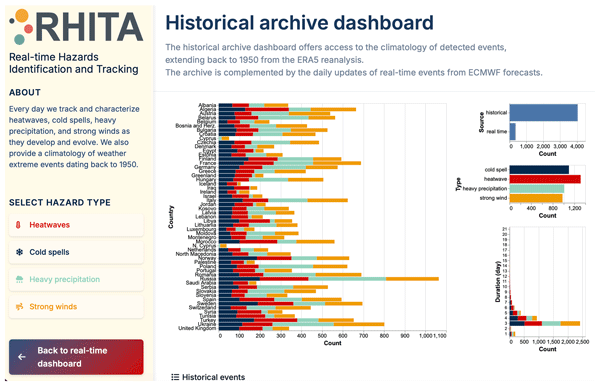
Extreme weather events are becoming more frequent and severe, creating a strong need for rapid and reliable information. We developed an open tool that automatically detects and tracks heatwaves, cold spells, heavy rain, and strong winds across Europe, both in real time and in past decades. By comparing current events with long historical records, the tool shows how unusual an event is and reveals clear increases in heatwaves, while other hazards show more mixed changes.
Adrien Burq, Jean Jouhaud, Victor Xing, Victor Bouvier, Vincent Forcadell, Mateusz Taszarek, Mathieu Vrac, and Davide Faranda
EGUsphere, https://doi.org/10.5194/egusphere-2026-4363, https://doi.org/10.5194/egusphere-2026-4363, 2026
Short summary
Short summary
Lightning is a small-scale process that climate and weather models cannot compute exactly, so it must be approximated. Here we build a deep learning model that predicts lightning across a whole region at once, using inputs from the whole region, and compare it to models that predict each pixel separately. Using this larger-scale information proves beneficial: our model outperforms the single-pixel ones. We also identify the spatial scale and the environmental predictors that matter most.
Tom Dörffel, Natalia Mikula, Lisa Schielicke, Theresa Kiszler, Davide Faranda, Berengere Dubrulle, and Nikki Vercauteren
EGUsphere, https://doi.org/10.5194/egusphere-2026-2918, https://doi.org/10.5194/egusphere-2026-2918, 2026
Short summary
Short summary
We investigate how two different indicators related to measures of energy transfer can be used to assess the dynamics of tropical cyclones. One indicator is based on the energy redistribution across length-scales and the other one is based on more fundamental thermodynamic principles. This research demonstrates the potential of these indicators of being used as predictors for the intensity change of tropical cyclones even in under-resolved simulations.
Clara Naldesi, Nathalie Bertrand, Davide Faranda, and Mathieu Vrac
EGUsphere, https://doi.org/10.5194/egusphere-2026-1466, https://doi.org/10.5194/egusphere-2026-1466, 2026
Short summary
Short summary
The public increasingly needs to know whether and how climate change influences specific extreme events. ClimaMeter is a scientific tool designed to address this demand. This paper reviews the ClimaMeter methodology, focusing on how it estimates the relative roles of natural variability and climate change. We propose a more flexible and general approach within the same framework, enabling a more nuanced assessment of natural variability.
Tommaso Alberti, Davide Faranda, Mohamed Foudad, Erika Coppola, Lia Rapella, Rachel Burbidge, Miguel A. C. Teixeira, and Paul Williams
EGUsphere, https://doi.org/10.5194/egusphere-2026-1178, https://doi.org/10.5194/egusphere-2026-1178, 2026
Short summary
Short summary
We developed TurboMeter to study whether climate change is making airplane turbulence stronger. By comparing current atmospheric conditions with similar past situations, we find that most turbulence events in 2024 were intensified by human-caused climate change, especially over the North Atlantic, East Asia, and the United States. This work shows that climate change is already affecting flight safety and highlights the need for climate-informed planning in aviation.
Valerio Lembo, Gabriele Messori, Davide Faranda, Vera Melinda Galfi, Rune Grand Graversen, and Flavio Emanuele Pons
Weather Clim. Dynam., 7, 453–473, https://doi.org/10.5194/wcd-7-453-2026, https://doi.org/10.5194/wcd-7-453-2026, 2026
Short summary
Short summary
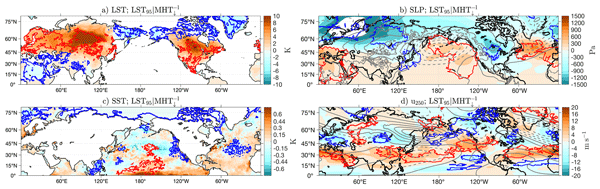
Hemispheric heatwaves have fundamental implications for ecosystems and societies. They are studied together with large-scale atmospheric dynamics, through the lens of poleward heat transports by planetary-scale waves. Extremely weak transports of heat towards the North Pole are found to be associated with hemispheric heatwaves in the Northern Hemisphere mid-latitudes. Therefore, we conclude that heat transports are a possible indicator and a precursor of concurrent hemispheric heatwaves.
Davide Faranda, Lucas Taligrot, Pascal Yiou, and Nada Caud
Geosci. Commun., 9, 115–125, https://doi.org/10.5194/gc-9-115-2026, https://doi.org/10.5194/gc-9-115-2026, 2026
Short summary
Short summary
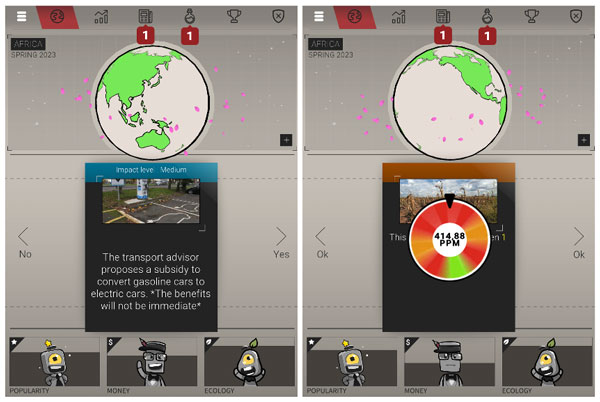
We developed a free online game called ClimarisQ to help people better understand climate change and extreme weather. By playing the game, users learn how decisions about the environment, money, and public opinion affect future risks. We studied how players reacted and found that the game makes climate issues easier to grasp and encourages discussion. This shows that interactive tools like games can support learning and action on climate and environmental challenges.
Emmanouil Flaounas, Stavros Dafis, Silvio Davolio, Davide Faranda, Christian Ferrarin, Katharina Hartmuth, Assaf Hochman, Aristeidis Koutroulis, Samira Khodayar, Mario Marcello Miglietta, Florian Pantillon, Platon Patlakas, Michael Sprenger, and Iris Thurnherr
Weather Clim. Dynam., 6, 1515–1538, https://doi.org/10.5194/wcd-6-1515-2025, https://doi.org/10.5194/wcd-6-1515-2025, 2025
Short summary
Short summary
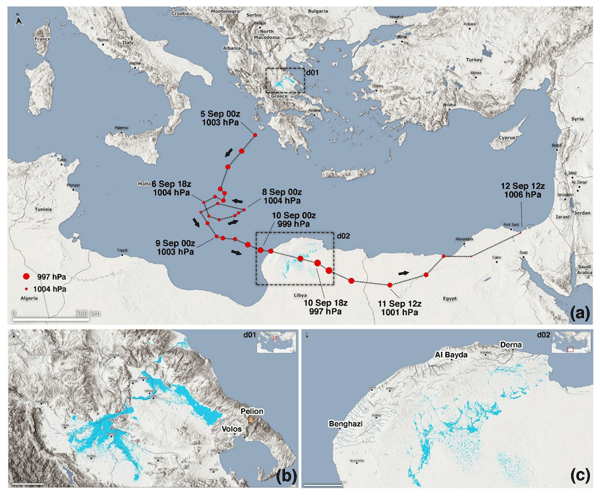
Storm Daniel (2023) is one of the most catastrophic storms ever documented in the Mediterranean. Our results highlight the different dynamics and therefore the different predictability skill of precipitation, its extremes and impacts that have been produced in Greece and Libya, the two most affected countries. Our approach concerns an analysis of the storm by articulating dynamics, weather prediction, hydrological and oceanographic implications, climate extremes, and attribution theory.
Pradeebane Vaittinada Ayar, Stella Bourdin, Davide Faranda, and Mathieu Vrac
Nat. Hazards Earth Syst. Sci., 25, 4655–4672, https://doi.org/10.5194/nhess-25-4655-2025, https://doi.org/10.5194/nhess-25-4655-2025, 2025
Short summary
Short summary
Tracking tropical cyclones (TCs) remains a matter of interest for investigating observed and simulated tropical cyclones. In this study, Random Forest (RF), a machine learning approach, is considered to track TCs. RF associates the TC occurrence or absence with different atmospheric configurations. Compared to trackers found in the literature, it shows similar performance for tracking TCs, better control over false alarms, more flexibility, and reveals key variables for TCs' detection.
Lia Rapella, Tommaso Alberti, Davide Faranda, and Philippe Drobinski
Weather Clim. Dynam., 6, 1339–1363, https://doi.org/10.5194/wcd-6-1339-2025, https://doi.org/10.5194/wcd-6-1339-2025, 2025
Short summary
Short summary
Extreme weather events pose increasing challenges for aviation, including flight disruptions and infrastructure damage. This study examines the influence of anthropogenic climate change on four recent major storms across Europe, the USA, and East Asia. Our research underscores the growing intensity of extreme storms, driven by human-induced climate change, stressing the need to adapt aviation strategies to an increasingly hazardous environment.
Kerry Emanuel, Tommaso Alberti, Stella Bourdin, Suzana J. Camargo, Davide Faranda, Emmanouil Flaounas, Juan Jesus Gonzalez-Aleman, Chia-Ying Lee, Mario Marcello Miglietta, Claudia Pasquero, Alice Portal, Hamish Ramsay, Marco Reale, and Romualdo Romero
Weather Clim. Dynam., 6, 901–926, https://doi.org/10.5194/wcd-6-901-2025, https://doi.org/10.5194/wcd-6-901-2025, 2025
Short summary
Short summary
Storms strongly resembling hurricanes are sometimes observed to form well outside the tropics, even in polar latitudes. They behave capriciously, developing very rapidly and then dying just as quickly. We show that strong dynamical processes in the atmosphere can sometimes cause it to become much colder locally than the underlying ocean, creating the conditions for hurricanes to form but only over small areas and for short times. We call the resulting storms "CYCLOPs".
Robin Noyelle, Davide Faranda, Yoann Robin, Mathieu Vrac, and Pascal Yiou
Weather Clim. Dynam., 6, 817–839, https://doi.org/10.5194/wcd-6-817-2025, https://doi.org/10.5194/wcd-6-817-2025, 2025
Short summary
Short summary
Properties of extreme meteorological and climatological events are changing under human-caused climate change. Extreme event attribution methods seek to estimate the contribution of global warming in the probability and intensity changes of extreme events. Here we propose a procedure to estimate these quantities for the flow analogue method, which compares the observed event to similar events in the past.
Ferran Lopez-Marti, Mireia Ginesta, Davide Faranda, Anna Rutgersson, Pascal Yiou, Lichuan Wu, and Gabriele Messori
Earth Syst. Dynam., 16, 169–187, https://doi.org/10.5194/esd-16-169-2025, https://doi.org/10.5194/esd-16-169-2025, 2025
Short summary
Short summary
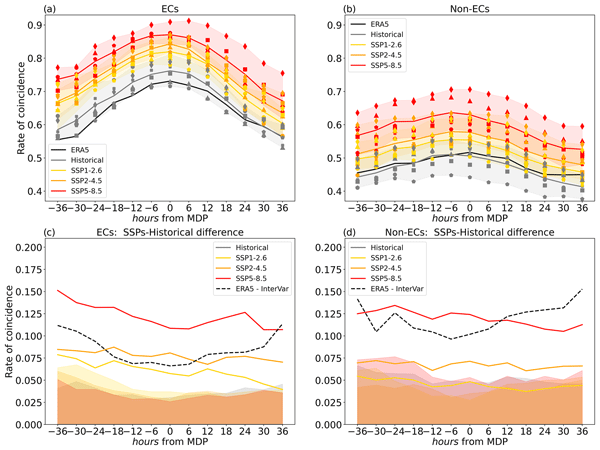
Explosive cyclones and atmospheric rivers are two main drivers of extreme weather in Europe. In this study, we investigate their joint changes in future climates over the North Atlantic. Our results show that both the concurrence of these events and the intensity of atmospheric rivers increase by the end of the century across different future scenarios. Furthermore, explosive cyclones associated with atmospheric rivers last longer and are deeper than those without atmospheric rivers.
Davide Faranda, Gabriele Messori, Erika Coppola, Tommaso Alberti, Mathieu Vrac, Flavio Pons, Pascal Yiou, Marion Saint Lu, Andreia N. S. Hisi, Patrick Brockmann, Stavros Dafis, Gianmarco Mengaldo, and Robert Vautard
Weather Clim. Dynam., 5, 959–983, https://doi.org/10.5194/wcd-5-959-2024, https://doi.org/10.5194/wcd-5-959-2024, 2024
Short summary
Short summary
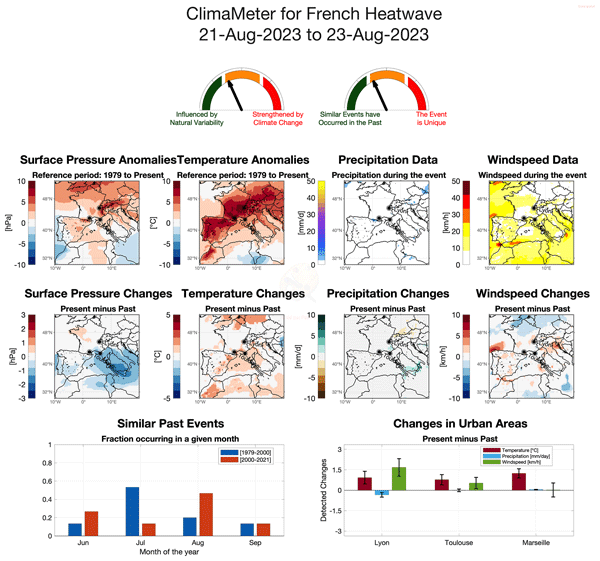
We introduce ClimaMeter, a tool offering real-time insights into extreme-weather events. Our tool unveils how climate change and natural variability affect these events, affecting communities worldwide. Our research equips policymakers and the public with essential knowledge, fostering informed decisions and enhancing climate resilience. We analysed two distinct events, showcasing ClimaMeter's global relevance.
Lucas Fery and Davide Faranda
Weather Clim. Dynam., 5, 439–461, https://doi.org/10.5194/wcd-5-439-2024, https://doi.org/10.5194/wcd-5-439-2024, 2024
Short summary
Short summary
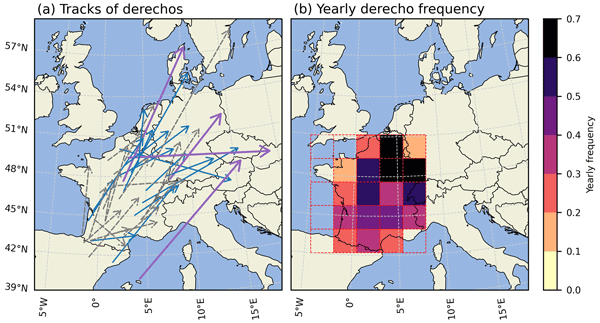
In this study, we analyse warm-season derechos – a type of severe convective windstorm – in France between 2000 and 2022, identifying 38 events. We compare their frequency and features with other countries. We also examine changes in the associated large-scale patterns. We find that convective instability has increased in southern Europe. However, the attribution of these changes to natural climate variability, human-induced climate change or a combination of both remains unclear.
Emma Holmberg, Gabriele Messori, Rodrigo Caballero, and Davide Faranda
Earth Syst. Dynam., 14, 737–765, https://doi.org/10.5194/esd-14-737-2023, https://doi.org/10.5194/esd-14-737-2023, 2023
Short summary
Short summary
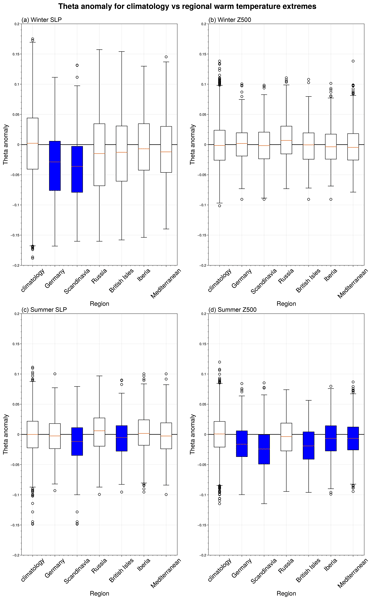
We analyse the duration of large-scale patterns of air movement in the atmosphere, referred to as persistence, and whether unusually persistent patterns favour warm-temperature extremes in Europe. We see no clear relationship between summertime heatwaves and unusually persistent patterns. This suggests that heatwaves do not necessarily require the continued flow of warm air over a region and that local effects could be important for their occurrence.
Davide Faranda, Stella Bourdin, Mireia Ginesta, Meriem Krouma, Robin Noyelle, Flavio Pons, Pascal Yiou, and Gabriele Messori
Weather Clim. Dynam., 3, 1311–1340, https://doi.org/10.5194/wcd-3-1311-2022, https://doi.org/10.5194/wcd-3-1311-2022, 2022
Short summary
Short summary
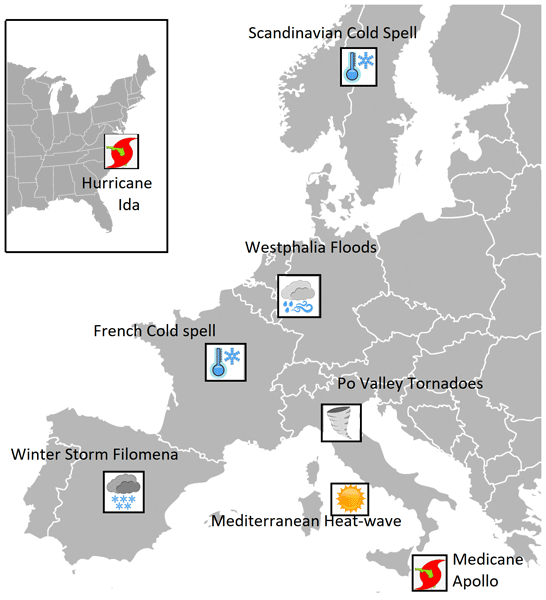
We analyze the atmospheric circulation leading to impactful extreme events for the calendar year 2021 such as the Storm Filomena, Westphalia floods, Hurricane Ida and Medicane Apollo. For some of the events, we find that climate change has contributed to their occurrence or enhanced their intensity; for other events, we find that they are unprecedented. Our approach underscores the importance of considering changes in the atmospheric circulation when performing attribution studies.
Flavio Maria Emanuele Pons and Davide Faranda
Adv. Stat. Clim. Meteorol. Oceanogr., 8, 155–186, https://doi.org/10.5194/ascmo-8-155-2022, https://doi.org/10.5194/ascmo-8-155-2022, 2022
Short summary
Short summary
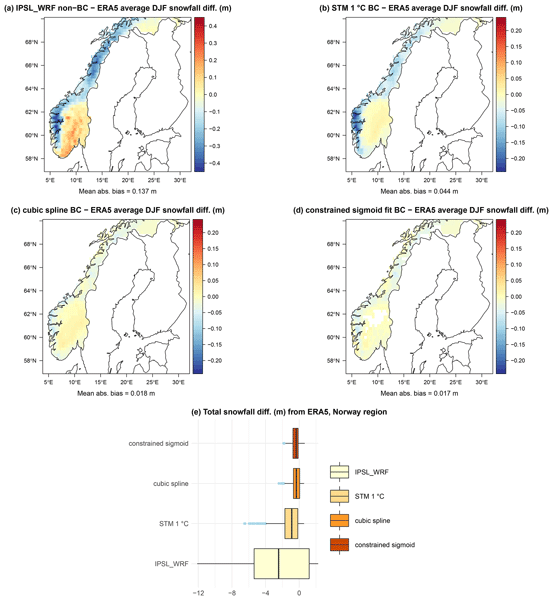
The objective motivating this study is the assessment of the impacts of winter climate extremes, which requires accurate simulation of snowfall. However, climate simulation models contain physical approximations, which result in biases that must be corrected using past data as a reference. We show how to exploit simulated temperature and precipitation to estimate snowfall from already bias-corrected variables, without requiring the elaboration of complex, multivariate bias adjustment techniques.
Miriam D'Errico, Flavio Pons, Pascal Yiou, Soulivanh Tao, Cesare Nardini, Frank Lunkeit, and Davide Faranda
Earth Syst. Dynam., 13, 961–992, https://doi.org/10.5194/esd-13-961-2022, https://doi.org/10.5194/esd-13-961-2022, 2022
Short summary
Short summary
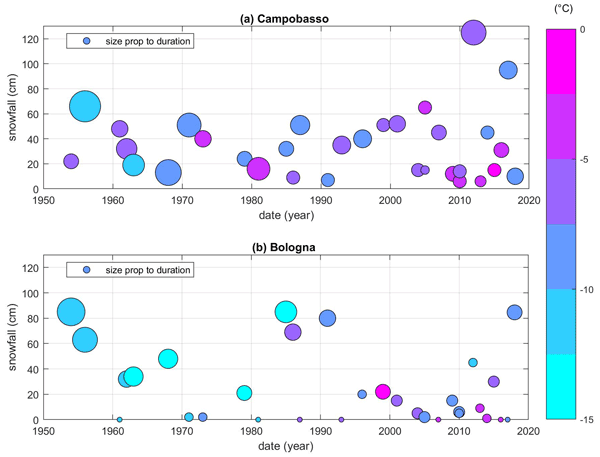
Climate change is already affecting weather extremes. In a warming climate, we will expect the cold spells to decrease in frequency and intensity. Our analysis shows that the frequency of circulation patterns leading to snowy cold-spell events over Italy will not decrease under business-as-usual emission scenarios, although the associated events may not lead to cold conditions in the warmer scenarios.
Bérengère Dubrulle, François Daviaud, Davide Faranda, Louis Marié, and Brice Saint-Michel
Nonlin. Processes Geophys., 29, 17–35, https://doi.org/10.5194/npg-29-17-2022, https://doi.org/10.5194/npg-29-17-2022, 2022
Short summary
Short summary
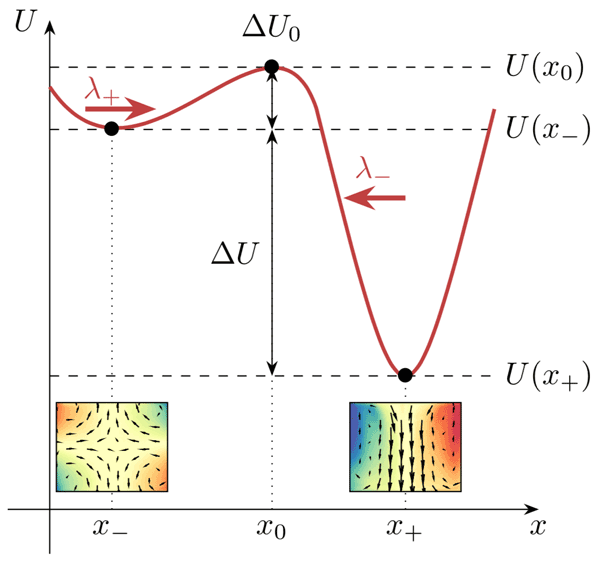
Present climate models discuss climate change but show no sign of bifurcation in the future. Is this because there is none or because they are in essence too simplified to be able to capture them? To get elements of an answer, we ran a laboratory experiment and discovered that the answer is not so simple.
Greta Cazzaniga, Anastasia Akakpo-Numado, Patrick Brockmann, Adrien Burq, Mathieu Vrac, and Davide Faranda
Nat. Hazards Earth Syst. Sci., 26, 4741–4752, https://doi.org/10.5194/nhess-26-4741-2026, https://doi.org/10.5194/nhess-26-4741-2026, 2026
Short summary
Short summary
Extreme weather events are becoming more frequent and severe, creating a strong need for rapid and reliable information. We developed an open tool that automatically detects and tracks heatwaves, cold spells, heavy rain, and strong winds across Europe, both in real time and in past decades. By comparing current events with long historical records, the tool shows how unusual an event is and reveals clear increases in heatwaves, while other hazards show more mixed changes.
Marianne Debue, Thibault Guinaldo, Anastasia Tarasenko, and Stéphane Saux-Picart
Earth Syst. Sci. Data Discuss., https://doi.org/10.5194/essd-2026-589, https://doi.org/10.5194/essd-2026-589, 2026
Preprint under review for ESSD
Short summary
Short summary
This article presents a dataset of Sargassum detections and the methodology used to obtain it. The detections were made using images from the OLCI sensor aboard the Sentinel-3 satellite. They are freely available for the entire tropical Atlantic, the Caribbean Sea, and the Gulf of Mexico, covering the period from May 2018 to the present, with the latest detections added daily. These detections are intended for use in both operational and research applications.
Adrien Burq, Jean Jouhaud, Victor Xing, Victor Bouvier, Vincent Forcadell, Mateusz Taszarek, Mathieu Vrac, and Davide Faranda
EGUsphere, https://doi.org/10.5194/egusphere-2026-4363, https://doi.org/10.5194/egusphere-2026-4363, 2026
Short summary
Short summary
Lightning is a small-scale process that climate and weather models cannot compute exactly, so it must be approximated. Here we build a deep learning model that predicts lightning across a whole region at once, using inputs from the whole region, and compare it to models that predict each pixel separately. Using this larger-scale information proves beneficial: our model outperforms the single-pixel ones. We also identify the spatial scale and the environmental predictors that matter most.
Tom Dörffel, Natalia Mikula, Lisa Schielicke, Theresa Kiszler, Davide Faranda, Berengere Dubrulle, and Nikki Vercauteren
EGUsphere, https://doi.org/10.5194/egusphere-2026-2918, https://doi.org/10.5194/egusphere-2026-2918, 2026
Short summary
Short summary
We investigate how two different indicators related to measures of energy transfer can be used to assess the dynamics of tropical cyclones. One indicator is based on the energy redistribution across length-scales and the other one is based on more fundamental thermodynamic principles. This research demonstrates the potential of these indicators of being used as predictors for the intensity change of tropical cyclones even in under-resolved simulations.
Clara Naldesi, Nathalie Bertrand, Davide Faranda, and Mathieu Vrac
EGUsphere, https://doi.org/10.5194/egusphere-2026-1466, https://doi.org/10.5194/egusphere-2026-1466, 2026
Short summary
Short summary
The public increasingly needs to know whether and how climate change influences specific extreme events. ClimaMeter is a scientific tool designed to address this demand. This paper reviews the ClimaMeter methodology, focusing on how it estimates the relative roles of natural variability and climate change. We propose a more flexible and general approach within the same framework, enabling a more nuanced assessment of natural variability.
Tommaso Alberti, Davide Faranda, Mohamed Foudad, Erika Coppola, Lia Rapella, Rachel Burbidge, Miguel A. C. Teixeira, and Paul Williams
EGUsphere, https://doi.org/10.5194/egusphere-2026-1178, https://doi.org/10.5194/egusphere-2026-1178, 2026
Short summary
Short summary
We developed TurboMeter to study whether climate change is making airplane turbulence stronger. By comparing current atmospheric conditions with similar past situations, we find that most turbulence events in 2024 were intensified by human-caused climate change, especially over the North Atlantic, East Asia, and the United States. This work shows that climate change is already affecting flight safety and highlights the need for climate-informed planning in aviation.
Isaline Bossert, Roland Séférian, Yeray Santana-Falcón, and Thibault Guinaldo
EGUsphere, https://doi.org/10.5194/egusphere-2026-993, https://doi.org/10.5194/egusphere-2026-993, 2026
Short summary
Short summary
The response of the ocean to net-zero emissions remains poorly understood. Using 300-year net-zero Earth system simulations, we show that sea surface temperature and marine heatwaves continue to reorganize long after emissions stop, with major departures from transient projections, implying underestimated long-term marine ecosystem risks.
Valerio Lembo, Gabriele Messori, Davide Faranda, Vera Melinda Galfi, Rune Grand Graversen, and Flavio Emanuele Pons
Weather Clim. Dynam., 7, 453–473, https://doi.org/10.5194/wcd-7-453-2026, https://doi.org/10.5194/wcd-7-453-2026, 2026
Short summary
Short summary
Hemispheric heatwaves have fundamental implications for ecosystems and societies. They are studied together with large-scale atmospheric dynamics, through the lens of poleward heat transports by planetary-scale waves. Extremely weak transports of heat towards the North Pole are found to be associated with hemispheric heatwaves in the Northern Hemisphere mid-latitudes. Therefore, we conclude that heat transports are a possible indicator and a precursor of concurrent hemispheric heatwaves.
Davide Faranda, Lucas Taligrot, Pascal Yiou, and Nada Caud
Geosci. Commun., 9, 115–125, https://doi.org/10.5194/gc-9-115-2026, https://doi.org/10.5194/gc-9-115-2026, 2026
Short summary
Short summary
We developed a free online game called ClimarisQ to help people better understand climate change and extreme weather. By playing the game, users learn how decisions about the environment, money, and public opinion affect future risks. We studied how players reacted and found that the game makes climate issues easier to grasp and encourages discussion. This shows that interactive tools like games can support learning and action on climate and environmental challenges.
Thibault Guinaldo and Griet Neukermans
Ocean Sci., 22, 145–166, https://doi.org/10.5194/os-22-145-2026, https://doi.org/10.5194/os-22-145-2026, 2026
Short summary
Short summary
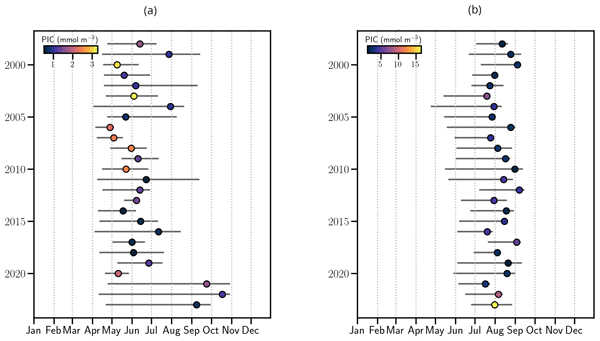
In 2023, an exceptional marine heatwave occurred in the North Atlantic ocean. This study evaluates changes in G.huxleyi dynamics showing bloom decline in the Celtic Sea and reaching unprecedented levels in the Barents Sea. These shifts reflect the direct impact of temperature extremes driven by human-induced climate change with major effects on ocean life and carbon cycle. Continuous monitoring is vital to understand and monitor regional adaptation of marine ecosystems.
Emmanouil Flaounas, Stavros Dafis, Silvio Davolio, Davide Faranda, Christian Ferrarin, Katharina Hartmuth, Assaf Hochman, Aristeidis Koutroulis, Samira Khodayar, Mario Marcello Miglietta, Florian Pantillon, Platon Patlakas, Michael Sprenger, and Iris Thurnherr
Weather Clim. Dynam., 6, 1515–1538, https://doi.org/10.5194/wcd-6-1515-2025, https://doi.org/10.5194/wcd-6-1515-2025, 2025
Short summary
Short summary
Storm Daniel (2023) is one of the most catastrophic storms ever documented in the Mediterranean. Our results highlight the different dynamics and therefore the different predictability skill of precipitation, its extremes and impacts that have been produced in Greece and Libya, the two most affected countries. Our approach concerns an analysis of the storm by articulating dynamics, weather prediction, hydrological and oceanographic implications, climate extremes, and attribution theory.
Pradeebane Vaittinada Ayar, Stella Bourdin, Davide Faranda, and Mathieu Vrac
Nat. Hazards Earth Syst. Sci., 25, 4655–4672, https://doi.org/10.5194/nhess-25-4655-2025, https://doi.org/10.5194/nhess-25-4655-2025, 2025
Short summary
Short summary
Tracking tropical cyclones (TCs) remains a matter of interest for investigating observed and simulated tropical cyclones. In this study, Random Forest (RF), a machine learning approach, is considered to track TCs. RF associates the TC occurrence or absence with different atmospheric configurations. Compared to trackers found in the literature, it shows similar performance for tracking TCs, better control over false alarms, more flexibility, and reveals key variables for TCs' detection.
Lia Rapella, Tommaso Alberti, Davide Faranda, and Philippe Drobinski
Weather Clim. Dynam., 6, 1339–1363, https://doi.org/10.5194/wcd-6-1339-2025, https://doi.org/10.5194/wcd-6-1339-2025, 2025
Short summary
Short summary
Extreme weather events pose increasing challenges for aviation, including flight disruptions and infrastructure damage. This study examines the influence of anthropogenic climate change on four recent major storms across Europe, the USA, and East Asia. Our research underscores the growing intensity of extreme storms, driven by human-induced climate change, stressing the need to adapt aviation strategies to an increasingly hazardous environment.
Kerry Emanuel, Tommaso Alberti, Stella Bourdin, Suzana J. Camargo, Davide Faranda, Emmanouil Flaounas, Juan Jesus Gonzalez-Aleman, Chia-Ying Lee, Mario Marcello Miglietta, Claudia Pasquero, Alice Portal, Hamish Ramsay, Marco Reale, and Romualdo Romero
Weather Clim. Dynam., 6, 901–926, https://doi.org/10.5194/wcd-6-901-2025, https://doi.org/10.5194/wcd-6-901-2025, 2025
Short summary
Short summary
Storms strongly resembling hurricanes are sometimes observed to form well outside the tropics, even in polar latitudes. They behave capriciously, developing very rapidly and then dying just as quickly. We show that strong dynamical processes in the atmosphere can sometimes cause it to become much colder locally than the underlying ocean, creating the conditions for hurricanes to form but only over small areas and for short times. We call the resulting storms "CYCLOPs".
Robin Noyelle, Davide Faranda, Yoann Robin, Mathieu Vrac, and Pascal Yiou
Weather Clim. Dynam., 6, 817–839, https://doi.org/10.5194/wcd-6-817-2025, https://doi.org/10.5194/wcd-6-817-2025, 2025
Short summary
Short summary
Properties of extreme meteorological and climatological events are changing under human-caused climate change. Extreme event attribution methods seek to estimate the contribution of global warming in the probability and intensity changes of extreme events. Here we propose a procedure to estimate these quantities for the flow analogue method, which compares the observed event to similar events in the past.
Ferran Lopez-Marti, Mireia Ginesta, Davide Faranda, Anna Rutgersson, Pascal Yiou, Lichuan Wu, and Gabriele Messori
Earth Syst. Dynam., 16, 169–187, https://doi.org/10.5194/esd-16-169-2025, https://doi.org/10.5194/esd-16-169-2025, 2025
Short summary
Short summary
Explosive cyclones and atmospheric rivers are two main drivers of extreme weather in Europe. In this study, we investigate their joint changes in future climates over the North Atlantic. Our results show that both the concurrence of these events and the intensity of atmospheric rivers increase by the end of the century across different future scenarios. Furthermore, explosive cyclones associated with atmospheric rivers last longer and are deeper than those without atmospheric rivers.
Davide Faranda, Gabriele Messori, Erika Coppola, Tommaso Alberti, Mathieu Vrac, Flavio Pons, Pascal Yiou, Marion Saint Lu, Andreia N. S. Hisi, Patrick Brockmann, Stavros Dafis, Gianmarco Mengaldo, and Robert Vautard
Weather Clim. Dynam., 5, 959–983, https://doi.org/10.5194/wcd-5-959-2024, https://doi.org/10.5194/wcd-5-959-2024, 2024
Short summary
Short summary
We introduce ClimaMeter, a tool offering real-time insights into extreme-weather events. Our tool unveils how climate change and natural variability affect these events, affecting communities worldwide. Our research equips policymakers and the public with essential knowledge, fostering informed decisions and enhancing climate resilience. We analysed two distinct events, showcasing ClimaMeter's global relevance.

Vera Melinda Galfi, Tommaso Alberti, Lesley De Cruz, Christian L. E. Franzke, and Valerio Lembo
Nonlin. Processes Geophys., 31, 185–193, https://doi.org/10.5194/npg-31-185-2024, https://doi.org/10.5194/npg-31-185-2024, 2024
Short summary
Short summary
In the online seminar series "Perspectives on climate sciences: from historical developments to future frontiers" (2020–2021), well-known and established scientists from several fields – including mathematics, physics, climate science and ecology – presented their perspectives on the evolution of climate science and on relevant scientific concepts. In this paper, we first give an overview of the content of the seminar series, and then we introduce the written contributions to this special issue.
Lucas Fery and Davide Faranda
Weather Clim. Dynam., 5, 439–461, https://doi.org/10.5194/wcd-5-439-2024, https://doi.org/10.5194/wcd-5-439-2024, 2024
Short summary
Short summary
In this study, we analyse warm-season derechos – a type of severe convective windstorm – in France between 2000 and 2022, identifying 38 events. We compare their frequency and features with other countries. We also examine changes in the associated large-scale patterns. We find that convective instability has increased in southern Europe. However, the attribution of these changes to natural climate variability, human-induced climate change or a combination of both remains unclear.
Emma Holmberg, Gabriele Messori, Rodrigo Caballero, and Davide Faranda
Earth Syst. Dynam., 14, 737–765, https://doi.org/10.5194/esd-14-737-2023, https://doi.org/10.5194/esd-14-737-2023, 2023
Short summary
Short summary
We analyse the duration of large-scale patterns of air movement in the atmosphere, referred to as persistence, and whether unusually persistent patterns favour warm-temperature extremes in Europe. We see no clear relationship between summertime heatwaves and unusually persistent patterns. This suggests that heatwaves do not necessarily require the continued flow of warm air over a region and that local effects could be important for their occurrence.
Thibault Guinaldo, Aurore Voldoire, Robin Waldman, Stéphane Saux Picart, and Hervé Roquet
Ocean Sci., 19, 629–647, https://doi.org/10.5194/os-19-629-2023, https://doi.org/10.5194/os-19-629-2023, 2023
Short summary
Short summary
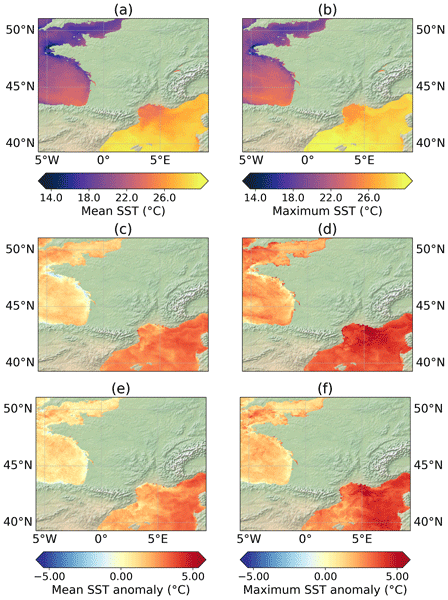
In the summer of 2022, France experienced a series of unprecedented heatwaves. This study is the first to examine the response of sea surface temperatures to these events, using spatial operational data and attributing the observed abnormally warm SSTs to atmospheric forcings. The findings of this study underscore the critical need for an efficient and sustainable operational system to monitor alterations that threaten the oceans in the context of climate change.
Davide Faranda, Stella Bourdin, Mireia Ginesta, Meriem Krouma, Robin Noyelle, Flavio Pons, Pascal Yiou, and Gabriele Messori
Weather Clim. Dynam., 3, 1311–1340, https://doi.org/10.5194/wcd-3-1311-2022, https://doi.org/10.5194/wcd-3-1311-2022, 2022
Short summary
Short summary
We analyze the atmospheric circulation leading to impactful extreme events for the calendar year 2021 such as the Storm Filomena, Westphalia floods, Hurricane Ida and Medicane Apollo. For some of the events, we find that climate change has contributed to their occurrence or enhanced their intensity; for other events, we find that they are unprecedented. Our approach underscores the importance of considering changes in the atmospheric circulation when performing attribution studies.
Flavio Maria Emanuele Pons and Davide Faranda
Adv. Stat. Clim. Meteorol. Oceanogr., 8, 155–186, https://doi.org/10.5194/ascmo-8-155-2022, https://doi.org/10.5194/ascmo-8-155-2022, 2022
Short summary
Short summary
The objective motivating this study is the assessment of the impacts of winter climate extremes, which requires accurate simulation of snowfall. However, climate simulation models contain physical approximations, which result in biases that must be corrected using past data as a reference. We show how to exploit simulated temperature and precipitation to estimate snowfall from already bias-corrected variables, without requiring the elaboration of complex, multivariate bias adjustment techniques.
Miriam D'Errico, Flavio Pons, Pascal Yiou, Soulivanh Tao, Cesare Nardini, Frank Lunkeit, and Davide Faranda
Earth Syst. Dynam., 13, 961–992, https://doi.org/10.5194/esd-13-961-2022, https://doi.org/10.5194/esd-13-961-2022, 2022
Short summary
Short summary
Climate change is already affecting weather extremes. In a warming climate, we will expect the cold spells to decrease in frequency and intensity. Our analysis shows that the frequency of circulation patterns leading to snowy cold-spell events over Italy will not decrease under business-as-usual emission scenarios, although the associated events may not lead to cold conditions in the warmer scenarios.
Bérengère Dubrulle, François Daviaud, Davide Faranda, Louis Marié, and Brice Saint-Michel
Nonlin. Processes Geophys., 29, 17–35, https://doi.org/10.5194/npg-29-17-2022, https://doi.org/10.5194/npg-29-17-2022, 2022
Short summary
Short summary
Present climate models discuss climate change but show no sign of bifurcation in the future. Is this because there is none or because they are in essence too simplified to be able to capture them? To get elements of an answer, we ran a laboratory experiment and discovered that the answer is not so simple.
Cited articles
Artana, C., Kaplan, A., Ramírez, F., Ortega, M., Steenbeek, J. G., and Coll, M.: Marine heatwaves are transforming Western Mediterranean marine ecosystems, Sci. Rep., 16, 5843, https://doi.org/10.1038/s41598-026-35813-x, 2026.
Behr, L., Xoplaki, E., Luther, N., Josey, S. A., and Luterbacher, J.: Atmospheric patterns drive marine heatwaves in the North Atlantic and Mediterranean Sea during summer 2023, Environ. Res. Lett., 20, 104020, https://doi.org/10.1088/1748-9326/ae0055, 2025.
Bonino, G., McAdam, R., Athanasiadis, P., Cavicchia, L., Rodrigues, R. R., Scoccimarro, E., Tibaldi, S., and Masina, S.: Mediterranean summer marine heatwaves triggered by weaker winds under subtropical ridges, Nat. Geosci., 18, 848–853, https://doi.org/10.1038/s41561-025-01762-9, 2025.
Capotondi, A., Rodrigues, R. R., Sen Gupta, A., Benthuysen, J. A., Deser, C., Frölicher, T. L., Lovenduski, N. S., Amaya, D. J., Le Grix, N., Xu, T., Hermes, J., Holbrook, N. J., Martinez-Villalobos, C., Masina, S., Roxy, M. K., Schaeffer, A., Schlegel, R. W., Smith, K. E., and Wang, C.: A global overview of marine heatwaves in a changing climate, Commun. Earth Environ., 5, 701, https://doi.org/10.1038/s43247-024-01806-9, 2024.
Coll, M., Piroddi, C., Steenbeek, J., Kaschner, K., Ben Rais Lasram, F., Aguzzi, J., Ballesteros, E., Bianchi, C. N., Corbera, J., Dailianis, T., Danovaro, R., Estrada, M., Froglia, C., Galil, B. S., Gasol, J. M., Gertwagen, R., Gil, J., Guilhaumon, F., Kesner-Reyes, K., Kitsos, M.-S., Koukouras, A., Lampadariou, N., Laxamana, E., López-Fé de la Cuadra, C. M., Lotze, H. K., Martin, D., Mouillot, D., Oro, D., Raicevich, S., Rius-Barile, J., Saiz-Salinas, J. I., San Vicente, C., Somot, S., Templado, J., Turon, X., Vafidis, D., Villanueva, R., and Voultsiadou, E.: The biodiversity of the Mediterranean Sea: estimates, patterns, and threats, PLoS ONE, 5, e11842, https://doi.org/10.1371/journal.pone.0011842, 2010.
Cramer, W., Guiot, J., Fader, M., Garrabou, J., Gattuso, J.-P., Iglesias, A., Lange, M. A., Lionello, P., Llasat, M. C., Paz, S., Peñuelas, J., Snoussi, M., Toreti, A., Tsimplis, M. N., and Xoplaki, E.: Climate change and interconnected risks to sustainable development in the Mediterranean, Nat. Clim. Change, 8, 972–980, https://doi.org/10.1038/s41558-018-0299-2, 2018.
D'Andrea, F., Duvel, J.-P., Rivière, G., Vautard, R., Cassou, C., Cattiaux, J., Coumou, D., Faranda, D., Happé, T., Jézéquel, A., Ribes, A., and Yiou, P.: Summer deep depressions increase over the Eastern North Atlantic, Geophys. Res. Lett., 51, e2023GL104435, https://doi.org/10.1029/2023GL104435, 2024.
Darmaraki, S., Denaxa, D., Theodorou, I., Livanou, E., Rigatou, D., Raitsos, D. E., Stavrakidis-Zachou, O., Dimarchopoulou, D., Bonino, G., McAdam, R., Organelli, E., Pitsouni, A., and Parasyris, A.: Marine heatwaves in the Mediterranean Sea: A literature review, Mediterr. Mar. Sci., 25, 586–620, https://doi.org/10.12681/mms.38392, 2024.
Deser, C., Phillips, A., Bourdette, V., and Teng, H.: Uncertainty in climate change projections: the role of internal variability, Clim. Dynam., 38, 527–546, https://doi.org/10.1007/s00382-010-0977-x, 2012.
Deser, C., Lehner, F., Rodgers, K. B., Ault, T., Delworth, T. L., DiNezio, P. N., Fiore, A., Frankignoul, C., Fyfe, J. C., Horton, D. E., Kay, J. E., Knutti, R., Lovenduski, N. S., Marotzke, J., McKinnon, K. A., Minobe, S., Randerson, J., Screen, J. A., Simpson, I. R., and Ting, M.: Insights from Earth system model initial-condition large ensembles and future prospects, Nat. Clim. Change, 10, 277–286, https://doi.org/10.1038/s41558-020-0731-2, 2020.
Dong, T., Zeng, Z., Pan, M., Wang, D., Chen, Y., Liang, L., Yang, S., Jin, Y., Luo, S., Liang, S., Huang, X., Zhao, D., Ziegler, A. D., Chen, D., Li, L. Z. X., Zhou, T., and Zhang, D.: Record-breaking 2023 marine heatwaves, Science, 389, 369–374, https://doi.org/10.1126/science.adr0910, 2025.
d'Ortenzio, F., Iudicone, D., de Boyer Montégut, C., Testor, P., Antoine, D., Marullo, S., Santoleri, R., and Madec, G.: Seasonal variability of the mixed layer depth in the Mediterranean Sea as derived from in situ profiles, Geophys. Res. Lett., 32, L12605, https://doi.org/10.1029/2005GL022463, 2005.
Embury, O., Merchant, C. J., Good, S. A., Rayner, N. A., Høyer, J. L., Atkinson, C., Block, T., Alerskans, E., Pearson, K. J., Worsfold, M., McCarroll, N., and Donlon, C.: Satellite-based time-series of sea-surface temperature since 1980 for climate applications, Sci. Data, 11, 326, https://doi.org/10.1038/s41597-024-03147-w, 2024.
England, M. H., Li, Z., Huguenin, M. F., Kiss, A. E., Sen Gupta, A., Holmes, R. M., and Rahmstorf, S.: Drivers of the extreme North Atlantic marine heatwave during 2023, Nature, 642, 636–643, https://doi.org/10.1038/s41586-025-08903-5, 2025.
E.U. Copernicus Marine Service Information (CMEMS): Mediterranean Sea – High Resolution L4 Sea Surface Temperature Reprocessed, Marine Data Store (MDS) [data set], https://doi.org/10.48670/moi-00173, 2024.
Faranda, D., Bourdin, S., Ginesta, M., Krouma, M., Noyelle, R., Pons, F., Yiou, P., and Messori, G.: A climate-change attribution retrospective of some impactful weather extremes of 2021, Weather Clim. Dynam., 3, 1311–1340, https://doi.org/10.5194/wcd-3-1311-2022, 2022.
Faranda, D., Messori, G., Jézéquel, A., Vrac, M., and Yiou, P.: Atmospheric circulation compounds anthropogenic warming and impacts of climate extremes in Europe, P. Natl. Acad. Sci. USA, 120, e2214525120, https://doi.org/10.1073/pnas.2214525120, 2023.
Faranda, D., Messori, G., Coppola, E., Alberti, T., Vrac, M., Pons, F., Yiou, P., Saint Lu, M., Hisi, A. N. S., Brockmann, P., Dafis, S., Mengaldo, G., and Vautard, R.: ClimaMeter: contextualizing extreme weather in a changing climate, Weather Clim. Dynam., 5, 959–983, https://doi.org/10.5194/wcd-5-959-2024, 2024.
Forster, P. M., Smith, C., Walsh, T., Lamb, W. F., Lamboll, R., Cassou, C., Hauser, M., Hausfather, Z., Lee, J.-Y., Palmer, M. D., von Schuckmann, K., Slangen, A. B. A., Szopa, S., Trewin, B., Yun, J., Gillett, N. P., Jenkins, S., Matthews, H. D., Raghavan, K., Ribes, A., Rogelj, J., Rosen, D., Zhang, X., Allen, M., Aleluia Reis, L., Andrew, R. M., Betts, R. A., Borger, A., Broersma, J. A., Burgess, S. N., Cheng, L., Friedlingstein, P., Domingues, C. M., Gambarini, M., Gasser, T., Gütschow, J., Ishii, M., Kadow, C., Kennedy, J., Killick, R. E., Krummel, P. B., Liné, A., Monselesan, D. P., Morice, C., Mühle, J., Naik, V., Peters, G. P., Pirani, A., Pongratz, J., Minx, J. C., Rigby, M., Rohde, R., Savita, A., Seneviratne, S. I., Thorne, P., Wells, C., Western, L. M., van der Werf, G. R., Wijffels, S. E., Masson-Delmotte, V., and Zhai, P.: Indicators of Global Climate Change 2024: annual update of key indicators of the state of the climate system and human influence, Earth Syst. Sci. Data, 17, 2641–2680, https://doi.org/10.5194/essd-17-2641-2025, 2025.
Frölicher, T. L., Fischer, E. M., and Gruber, N.: Marine heatwaves under global warming, Nature, 560, 360–364, https://doi.org/10.1038/s41586-018-0383-9, 2018.
Garrabou, J., Gómez-Gras, D., Medrano, A., Cerrano, C., Ponti, M., Schlegel, R., Bensoussan, N., Turicchia, E., Sini, M., Gerovasileiou, V., Teixido, N., Mirasole, A., Tamburello, L., Cebrian, E., Rilov, G., Ledoux, J.-B., Ben Souissi, J., Khamassi, F., Ghanem, R., Benabdi, M., Grimes, S., Ocaña, O., Bazairi, H., Hereu, B., Linares, C., Kersting, D. K., Rovira, G., Ortega, J., Casals, D., Pagès-Escolà, M., Margarit, N., Capdevila, P., Verdura, J., Ramos, A., Izquierdo, A., Barbera, C., Rubio-Portillo, E., Anton, I., López-Sendino, P., Díaz, D., Vázquez-Luis, M., Duarte, C., Marbà, N., Aspillaga, E., Espinosa, F., Grech, D., Guala, I., Azzurro, E., Farina, S., Gambi, M. C., Chimienti, G., Montefalcone, M., Azzola, A., Mantas, T. P., Fraschetti, S., Ceccherelli, G., Kipson, S., Bakran-Petricioli, T., Petricioli, D., Jimenez, C., Katsanevakis, S., Kizilkaya, I. T., Kizilkaya, Z., Sartoretto, S., Rouanet, E., Ruitton, S., Comeau, S., Gattuso, J.-P., and Harmelin, J.-G.: Marine heatwaves drive recurrent mass mortalities in the Mediterranean Sea, Glob. Change Biol., 28, 5708–5725, https://doi.org/10.1111/gcb.16301, 2022.
Giorgi, F.: Climate change hot-spots, Geophys. Res. Lett., 33, L08707, https://doi.org/10.1029/2006GL025734, 2006.
Goessling, H. F., Rackow, T., and Jung, T.: Recent global temperature surge intensified by record-low planetary albedo, Science, 387, 68–73, https://doi.org/10.1126/science.adq7280, 2025.
Guinaldo, T., Voldoire, A., Waldman, R., Saux Picart, S., and Roquet, H.: Response of the sea surface temperature to heatwaves during the France 2022 meteorological summer, Ocean Sci., 19, 629–647, https://doi.org/10.5194/os-19-629-2023, 2023.
Guinaldo, T., Cassou, C., Sallée, J.-B., and Liné, A.: Internal variability effect doped by climate change drove the 2023 marine heat extreme in the North Atlantic, Commun. Earth Environ., 6, 291, https://doi.org/10.1038/s43247-025-02197-1, 2025.
Gyuleva, G., Knutti, R., and Sippel, S.: Combination of internal variability and forced response reconciles observed 2023-2024 warming, Geophys. Res. Lett., 52, e2025GL115270, https://doi.org/10.1029/2025GL115270, 2025.
Hersbach, H., Bell, B., Berrisford, P., Hirahara, S., Horányi, A., Muñoz-Sabater, J., Nicolas, J., Peubey, C., Radu, R., Schepers, D., Simmons, A., Soci, C., Abdalla, S., Abellan, X., Balsamo, G., Bechtold, P., Biavati, G., Bidlot, J., Bonavita, M., De Chiara, G., Dahlgren, P., Dee, D., Diamantakis, M., Dragani, R., Flemming, J., Forbes, R., Fuentes, M., Geer, A., Haimberger, L., Healy, S., Hogan, R. J., Hólm, E., Janisková, M., Keeley, S., Laloyaux, P., Lopez, P., Lupu, C., Radnoti, G., de Rosnay, P., Rozum, I., Vamborg, F., Villaume, S., and Thépaut, J.-N.: The ERA5 global reanalysis, Q. J. Roy. Meteor. Soc., 146, 1999–2049, https://doi.org/10.1002/qj.3803, 2020.
Hobday, A. J., Alexander, L. V., Perkins, S. E., Smale, D. A., Straub, S. C., Oliver, E. C. J., Benthuysen, J. A., Burrows, M. T., Donat, M. G., Feng, M., Holbrook, N. J., Moore, P. J., Scannell, H. A., Sen Gupta, A., and Wernberg, T.: A hierarchical approach to defining marine heatwaves, Prog. Oceanogr., 141, 227–238, https://doi.org/10.1016/j.pocean.2015.12.014, 2016.
Hobday, A. J., Oliver, E. C. J., Sen Gupta, A., Benthuysen, J. A., Burrows, M. T., Donat, M. G., Holbrook, N. J., Moore, P. J., Thomsen, M. S., Wernberg, T., and Smale, D. A.: Categorizing and naming marine heatwaves, Oceanography, 31, 162–173, https://doi.org/10.5670/oceanog.2018.205, 2018.
Holbrook, N. J., Sen Gupta, A., Oliver, E. C. J., Hobday, A. J., Benthuysen, J. A., Scannell, H. A., Smale, D. A., and Wernberg, T.: Keeping pace with marine heatwaves, Nature Reviews Earth and Environment, 1, 482–493, https://doi.org/10.1038/s43017-020-0068-4, 2020.
Juza, M., Fernández-Mora, À., and Tintoré, J.: Sub-regional marine heat waves in the Mediterranean Sea from observations: Long-term surface changes, sub-surface and coastal responses, Front. Marine Sci., 9, 785771, https://doi.org/10.3389/fmars.2022.785771, 2022.
Laufkötter, C., Zscheischler, J., and Frölicher, T. L.: High-impact marine heatwaves attributable to human-induced global warming, Science, 369, 1621–1625, https://doi.org/10.1126/science.aba0690, 2020.
Lionello, P. and Scarascia, L.: The relation between climate change in the Mediterranean region and global warming, Reg. Environ. Change, 18, 1481–1493, https://doi.org/10.1007/s10113-018-1290-1, 2018.
Marullo, S., Artale, V., and Santoleri, R.: The SST multidecadal variability in the Atlantic Mediterranean region and its relation to AMO, J. Climate, 24, 4385–4401, https://doi.org/10.1175/2011JCLI3884.1, 2011.
Martínez, J., Leonelli, F. E., García-Ladona, E., Garrabou, J., Kersting, D. K., Bensoussan, N., and Pisano, A.: Evolution of marine heatwaves in warming seas: The Mediterranean Sea case study, Front. Mar. Sci., 10, 1193164, https://doi.org/10.3389/fmars.2023.1193164, 2023.
Naveau, P., Hannart, A., and Ribes, A.: Statistical methods for extreme event attribution in climate science, Annu. Rev. Stat. Appl., 7, 89–110, https://doi.org/10.1146/annurev-statistics-031219-041314, 2020.
Oliver, E. C. J., Donat, M. G., Burrows, M. T., Moore, P. J., Smale, D. A., Alexander, L. V., Benthuysen, J. A., Feng, M., Sen Gupta, A., Hobday, A. J., Holbrook, N. J., Perkins-Kirkpatrick, S. E., Scannell, H. A., Straub, S. C., and Wernberg, T.: Longer and more frequent marine heatwaves over the past century, Nat. Commun., 9, 1324, https://doi.org/10.1038/s41467-018-03732-9, 2018.
Otto, F. E. L.: Attribution of extreme events to climate change, Annu. Rev. Env. Resour., 48, 813–828, https://doi.org/10.1146/annurev-environ-112621-083538, 2023.
Paredes-Fortuny, L., Pastor, F., and Khodayar, S.: Concurrent atmospheric heatwaves intensify marine heatwaves through air-sea heat flux change in the Mediterranean Sea, Commun. Earth Environ., 6, 638, https://doi.org/10.1038/s43247-025-02633-2, 2025.
Pastor, F. and Khodayar, S.: Marine heat waves: Characterizing a major climate impact in the Mediterranean, Sci. Total Environ., 861, 160621, https://doi.org/10.1016/j.scitotenv.2022.160621, 2023.
Pastor, F., Valiente, J. A., and Khodayar, S.: A warming Mediterranean: 38 years of increasing sea surface temperature, Remote Sens., 12, 2687, https://doi.org/10.3390/rs12172687, 2020.
Pastor, F., Paredes-Fortuny, L., and Khodayar, S.: Mediterranean marine heatwaves intensify in the presence of concurrent atmospheric heatwaves, Commun. Earth Environ., 5, 797, https://doi.org/10.1038/s43247-024-01982-8, 2024.
Pisano, A., Buongiorno Nardelli, B., Tronconi, C., and Santoleri, R.: The new Mediterranean optimally interpolated pathfinder AVHRR SST Dataset (1982–2012), Remote Sens. Environ., 176, 107–116, https://doi.org/10.1016/j.rse.2016.01.019, 2016.
Pisano, A., Marullo, S., Artale, V., Falcini, F., Yang, C., Leonelli, F. E., Santoleri, R., and Buongiorno Nardelli, B.: New evidence of Mediterranean climate change and variability from sea surface temperature observations, Remote Sens., 12, 132, https://doi.org/10.3390/rs12010132, 2020.
Seneviratne, S. I., Zhang, X., Adnan, M., Badi, W., Dereczynski, C., Di Luca, A., Ghosh, S., Iskandar, I., Kossin, J., Lewis, S., Otto, F., Pinto, I., Satoh, M., Vicente-Serrano, S. M., Wehner, M., and Zhou, B.: Weather and climate extreme events in a changing climate, in: Climate Change 2021: The Physical Science Basis. Contribution of Working Group I to the Sixth Assessment Report of the Intergovernmental Panel on Climate Change, edited by: Masson-Delmotte, V., Zhai, P., Pirani, A., Connors, S. L., Péan, C., Berger, S., Caud, N., Chen, Y., Goldfarb, L., Gomis, M. I., Huang, M., Leitzell, K., Lonnoy, E., Matthews, J. B. R., Maycock, T. K., Waterfield, T., Yelekçi, O., Yu, R., and Zhou, B., Cambridge University Press, Cambridge, UK and New York, NY, USA, 1513–1766, https://doi.org/10.1017/9781009157896.013, 2021.
Sen Gupta, A., Thomsen, M., Benthuysen, J. A., Hobday, A. J., Oliver, E., Alexander, L. V., Burrows, M. T., Donat, M. G., Feng, M., Holbrook, N. J., Perkins-Kirkpatrick, S., Moore, P. J., Rodrigues, R. R., Scannell, H. A., Taschetto, A. S., Ummenhofer, C. C., Wernberg, T., and Smale, D. A.: Drivers and impacts of the most extreme marine heatwave events, Sci. Rep., 10, 19359, https://doi.org/10.1038/s41598-020-75445-3, 2020.
Shepherd, T. G.: Atmospheric circulation as a source of uncertainty in climate change projections, Nat. Geosci., 7, 703–708, https://doi.org/10.1038/ngeo2253, 2014.
Smale, D. A., Wernberg, T., Oliver, E. C. J., Thomsen, M., Harvey, B. P., Straub, S. C., Burrows, M. T., Alexander, L. V., Benthuysen, J. A., Donat, M. G., Feng, M., Hobday, A. J., Holbrook, N. J., Perkins-Kirkpatrick, S. E., Scannell, H. A., Sen Gupta, A., Payne, B. L., and Moore, P. J.: Marine heatwaves threaten global biodiversity and the provision of ecosystem services, Nat. Clim. Change, 9, 306–312, https://doi.org/10.1038/s41558-019-0412-1, 2019.
Smith, K. E., Burrows, M. T., Hobday, A. J., Sen Gupta, A., Moore, P. J., Thomsen, M., Wernberg, T., and Smale, D. A.: Socioeconomic impacts of marine heatwaves: Global issues and opportunities, Science, 374, eabj3593, https://doi.org/10.1126/science.abj3593, 2021.
Trenberth, K. E., Fasullo, J. T., and Shepherd, T. G.: Attribution of climate extreme events, Nat. Clim. Change, 5, 725–730, https://doi.org/10.1038/nclimate2657, 2015.
Tuel, A. and Eltahir, E. A. B.: Why is the Mediterranean a climate change hot spot?, J. Climate, 33, 5829–5843, https://doi.org/10.1175/JCLI-D-19-0910.1, 2020.
Vautard, R., Yiou, P., Otto, F., Stott, P., Christidis, N., van Oldenborgh, G. J., and Schaller, N.: Attribution of human-induced dynamical and thermodynamical contributions in extreme weather events, Environ. Res. Lett., 11, 114009, https://doi.org/10.1088/1748-9326/11/11/114009, 2016.
Wernberg, T., Thomsen, M. S., Burrows, M. T., Filbee-Dexter, K., Hobday, A. J., Holbrook, N. J., Montie, S., Moore, P. J., Oliver, E. C. J., Sen Gupta, A., Smale, D. A., and Smith, K.: Marine heatwaves as hot spots of climate change and impacts on biodiversity and ecosystem services, Nature Reviews Biodiversity, 1, 461–479, https://doi.org/10.1038/s44358-025-00058-5, 2025.
Xu, T., Newman, M., Capotondi, A., Stevenson, S., Di Lorenzo, E., and Alexander, M. A.: An increase in marine heatwaves without significant changes in surface ocean temperature variability, Nat. Commun., 13, 7396, https://doi.org/10.1038/s41467-022-34934-x, 2022.
Short summary
The Mediterranean Sea experienced a record-breaking heatwave in summer 2025. We compared this event to similar patterns from past decades to see how a warmer climate changed its strength. We found that today's warmer background added about 1.5 °C to the sea surface, making the heatwave far more intense and widespread. This shows how climate change is turning ordinary weather patterns into extreme events, with major impacts on marine life, coastal communities, and economies.
The Mediterranean Sea experienced a record-breaking heatwave in summer 2025. We compared this...


Altmetrics
Final-revised paper
Preprint