the Creative Commons Attribution 4.0 License.
the Creative Commons Attribution 4.0 License.
 | 29 Oct 2026
Communication and education strategies to raise awareness and understanding of volcanic hazard during times of quiescence: a literature review

Hollie Smith
Emilie E. E. Hooft
Laura Gattis
This scoping review examines peer-reviewed research on volcanic hazard communication during periods of quiescence, when immediate crisis pressures are absent but opportunities for long-term preparedness are substantial. While much existing work focuses on communication during eruptions or in specific regions, we examine how volcanic hazards are communicated when a volcano is quiet, a time suited for building awareness, understanding, and sustained public engagement. We reviewed relevant studies and grouped 76 resulting articles into three categories: formal educational materials, informal communication approaches, and informal communication tools. Within the reviewed literature, common themes include clear and accessible language, participatory strategies, and trust built through two-way communication. These themes align with broader science and risk communication research, which emphasizes that effective communication requires more than the delivery of accurate scientific information. Rather, communication during quiescence should be locally relevant, responsive to audience needs, and connected to preparedness actions, while also building familiarity with long-term risk, scientific uncertainty, preparedness actions, and trusted information sources. Few reviewed studies evaluate communication effectiveness, and existing research is geographically uneven, highlighting important gaps in volcano-communication research. This review adds to the literature about how volcanic hazard communication during quiescent periods can support hazard awareness and understanding, and it also highlights the need for more evaluated, participatory, and context-specific strategies that help scientists, educators, communicators, and decision-makers strengthen preparedness before unrest or eruption occurs.
- Article
(2369 KB) - Full-text XML
-
Supplement
(378 KB) - BibTeX
- EndNote


Communication of geohazards requires translating complex, often uncertain, and technical information into messages that help people understand risk, prepare before events occur, and take appropriate action when conditions change. These geohazards include earthquakes, tsunamis, landslides, volcanic eruptions, and related processes, each of which can affect different audiences across different timescales, warning systems, spatial footprints, and social contexts. Because the timing, predictability, uncertainty, and available protective actions vary between hazards, communication strategies cannot be assumed to transfer unchanged from one geohazard setting to another or even within a given geohazard across social and cultural contexts. Natural hazard risk communication research emphasizes that communication should be adapted to the hazard type, audience, decision context, and phase of the risk cycle (Höppner et al., 2010; Doyle and Becker, 2022).
Volcanic hazards represent one specific context within this broader geohazard landscape, and communication needs vary across stages of volcanic activity, including quiescence, unrest, eruption, post-eruption, and recovery (Becker et al., 2024; Das et al., 2025). This variation is partly driven by the contrasting timescales of volcanic systems: volcanoes develop over vast geologic timescales, yet individual eruptions and periods of unrest can unfold abruptly, disrupting landscapes, infrastructure, livelihoods, and communities. Communities may therefore live with volcanic risk for generations without experiencing an eruption, but when unrest begins, decisions may need to be made quickly, and preparedness and planning efforts should already be in place.
Quiescent periods are important because they provide time for communication before the pressures of crisis. During unrest or eruption, communication often must focus on immediate warnings, rapidly changing information, and urgent protective actions (Barclay et al., 2008; Bretton et al., 2018a, b). These circumstances require clear, timely, and action-oriented messages that respond to immediate information needs (Mileti and Sorensen, 1990; Sutton and Kuligowski, 2019). During quiescence, communication can instead support longer-term goals: building baseline awareness of volcanic processes and hazards, developing relationships between scientific institutions and the public, understanding audience needs, strengthening trust in information sources, and helping communities prepare before decisions become time-sensitive. These quieter intervals are critical opportunities for sustained education, engagement, and preparedness, and can contribute to more informed decision-making, enhance public trust, and foster cooperation when future crises arise (Stone et al., 2014; Weichselgartner and Pigeon, 2015).
Broadly, science communication and risk communication research provides an important foundation for understanding volcanic hazard communication during quiescence. While an overview or synthesis of these large bodies of literature is beyond the scope of this paper, there are key elements that can inform the context of volcanic hazard communication. Early approaches to science communication often reflected a deficit model, in which experts assume that the public primarily lacks scientific knowledge and that providing more information will lead to better understanding, acceptance, or action. However, science communication research has increasingly recognized the limitations of this one-way model and focused on approaches that recognize context, audience needs, local expertise, and public participation (Bauer et al., 2007; Brossard and Lewenstein, 2010). Similarly, risk communication has evolved from focusing on producing accurate risk estimates to recognizing that audiences need information that is understandable, decision-relevant, and connected to opportunities for engagement or participation in risk management (Fischhoff, 1995; Bostrom, 2014). These approaches and bodies of literature recognize the role of accurate scientific information; however, they also recognize that information alone is rarely sufficient when people are asked to understand uncertain risks, evaluate preparedness actions, or trust institutions responsible for public safety.
Risk communication literature further emphasizes that effective communication must address what audiences actually care about, not only what experts think they need to know. Public response to risk is shaped by values, prior experience, social context, trust, perceived control, uncertainty, and the credibility of the information source (Frewer, 2004; Kasperson, 2014). These factors influence how people interpret risk information and whether they view it as relevant, credible, and useful for decision-making. Rather than treating uncertainty, public concern, or disagreement as barriers to communication, risk communication research highlights the need to understand how different audiences interpret uncertain information, what concerns they want addressed, and what kinds of information are useful for the decisions they face (Frewer, 2004; Kasperson, 2014). Kasperson (2014) further argues that successful risk communication often requires persistent, long-term effort rather than a small communication push at the end of a technical assessment. These lessons are directly relevant to volcanic hazards, where communication and education efforts seek to raise awareness, explain uncertain future activity, support preparedness, and build trust before crises occur (Mossoux et al., 2016; Urlaub et al., 2013; Bandecchi et al., 2019).
Eruptions are often infrequent, uncertain, and unfamiliar to exposed communities. For low-familiarity hazards, people may have limited direct experience to guide preparedness decisions and may rely more heavily on trust in the agencies, scientists, and communicators providing information (Paton, 2007). This makes quiescent periods especially important. They provide time to build relationships, understand audience needs, develop trust, and support readiness before unrest or eruption increases uncertainty and urgency. Community Engagement Theory similarly suggests that preparedness communication is more likely to support action when it builds outcome expectancy, community participation, collective efficacy, empowerment, and trust, rather than simply delivering information to passive audiences (Paton et al., 2024). Despite this importance, quiescent periods remain less directly examined in volcanic hazard communication syntheses.
Previous syntheses of volcanic hazard communication have largely focused on periods of volcanic crises or on specific geographic regions, leaving quiescent periods underexplored. Similarly, the Springer volume Volcano Crisis Communication (Fearnley et al., 2018) compiles many of these case studies and lessons learned from major volcanic events but remains centered on periods of elevated volcanic activity.
Barclay et al. (2008) reviewed risk communication during volcanic crises and emphasized the need to integrate social and physical sciences in volcanic risk communication. They highlight that communication during quiescence differs from warning-focused crisis communication because it must build awareness and motivate risk-reducing behavior before public attention is heightened by unrest or eruption. They also note that, although scientific information has a clear role in disaster risk reduction, less is known about the most effective strategies for communicating volcanic risk during quiet periods.
Subsequent reviews have focused more directly on communication at the hazard-risk interface during periods of volcanic unrest. Bretton et al. (2018a, b) argue that hazard communication should be iterative, structured, and guided by standards that promote contextualization, which they define as “the negotiated product of open and transparent deliberation with stakeholders for the purpose of their risk-related uses” (p. 12). In this framing, effective communication requires meaningful deliberation among scientists, authorities, and the public so that hazard information is relevant to stakeholder needs and decisions.
More recent work has begun to identify research gaps across the full spectrum of volcanic activity. Das et al. (2025) review volcano communication in New Zealand and find that most studies focused on communication during eruptive periods and quiescence while neglecting unrest and post-eruptive stages. They call for more research on how decision-makers use volcano-related information from different periods of activity and for broader documentation of existing practices. In their review, they find that evaluative studies are mostly concentrated on emergency communication, warnings, and response, leaving a need for further examination of how communication during quiescence can support long-term preparedness.
A broader natural hazards synthesis by Graf et al. (2026) further supports the need to distinguish communication strategies by hazard type, temporal context, and communication goal. Their scoping review categorizes risk communication strategies across short-term warnings and long-term adaptation using the goals “Act,” “Prepare,” and “Aware.” They find that strategies vary across hazard groups, that geophysical hazards are commonly addressed through hybrid approaches combining warning and preparedness, and that purely long-term communication strategies are rare despite their importance for resilience. This reinforces the need to examine volcanic quiescence specifically, as quiet periods are when long-term awareness, preparedness, and trust-building must occur.
This study builds on this work by focusing specifically on volcanic hazard communication and education during periods of volcanic quiescence, when immediate crisis pressures are absent but opportunities for long-term preparedness are substantial. We examine how volcanic hazards are communicated during these periods by reviewing studies across three categories: formal educational materials, informal education and communication approaches, and informal communication tools. This scoping review clarifies how volcanic hazard communication during quiescent periods can support hazard awareness and understanding, while also identifying the need for more evaluated, participatory, and context-specific strategies that help scientists, educators, communicators, and decision-makers strengthen preparedness before future volcanic crises.
This study uses a scoping review approach to characterize peer-reviewed literature on volcanic hazard communication during periods of quiescence. Grant and Booth (2009) describe a scoping review as a preliminary assessment of the potential size and scope of an available body of literature, intended to identify the nature and extent of the existing evidence. This approach is appropriate because communication during volcanic quiescence spans diverse study types, audiences, settings, goals, and products. Munn et al. (2018) note that scoping reviews can be useful for reporting “on the types of evidence that address and inform practice in the field and the way research has been conducted” (p. 2). Our purpose is not to synthesize evidence on the effectiveness of a defined intervention, as in a systematic review, or to critically evaluate the quality of the literature and develop a new conceptual model, as in a critical review. Rather, this review characterizes the peer-reviewed literature with a focus on one dimension of volcano communication literature and identifies areas where further volcano-specific research and evaluation are needed. The review was designed to examine what peer-reviewed literature exists on volcanic hazard communication and education during periods of quiescence; which audiences, geographic settings, and communication goals are represented; what recommendations and limitations recur across the reviewed studies; and the extent to which the strategies suggested have been empirically evaluated. These questions guided the selection of search terms related to communication, engagement, outreach, education, public awareness, audiences, and volcanic settings. This review is not intended to provide an exhaustive assessment of all volcanic hazard communication or broader risk and science communication literature; rather, it maps the quiescence-focused studies captured by our search terms and inclusion criteria. Consequently, relevant strategies discussed primarily in crisis, unrest, warning, or response literature may not be included, and the absence of a topic from the reviewed studies does not indicate it is absent from the broader hazard communication literature.
We conducted the scoping review in consultation with a university research librarian to develop and refine the search strategy. Our search strategy emphasizes terms related to communication, engagement, outreach, education, and public awareness in connection with volcanoes, while excluding studies focused on crisis communication:
[AB (communicat* OR engag* OR outreach OR educat* OR “public awareness”) OR TI (communicat* OR engag* OR outreach OR educat* OR “public awareness”) OR SU (communicat* OR engag* OR outreach OR educat* OR “public awareness”)] AND [AB volcan* OR TI volcan* OR SU volcan*] AND [public OR audience OR resident* OR stakehold* OR communit* OR student* OR indigenous* OR touris* OR curricul* OR tool] NOT crisis (TI)
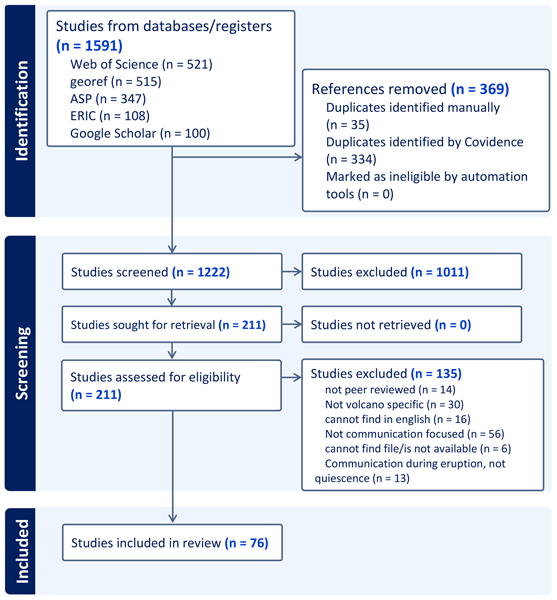
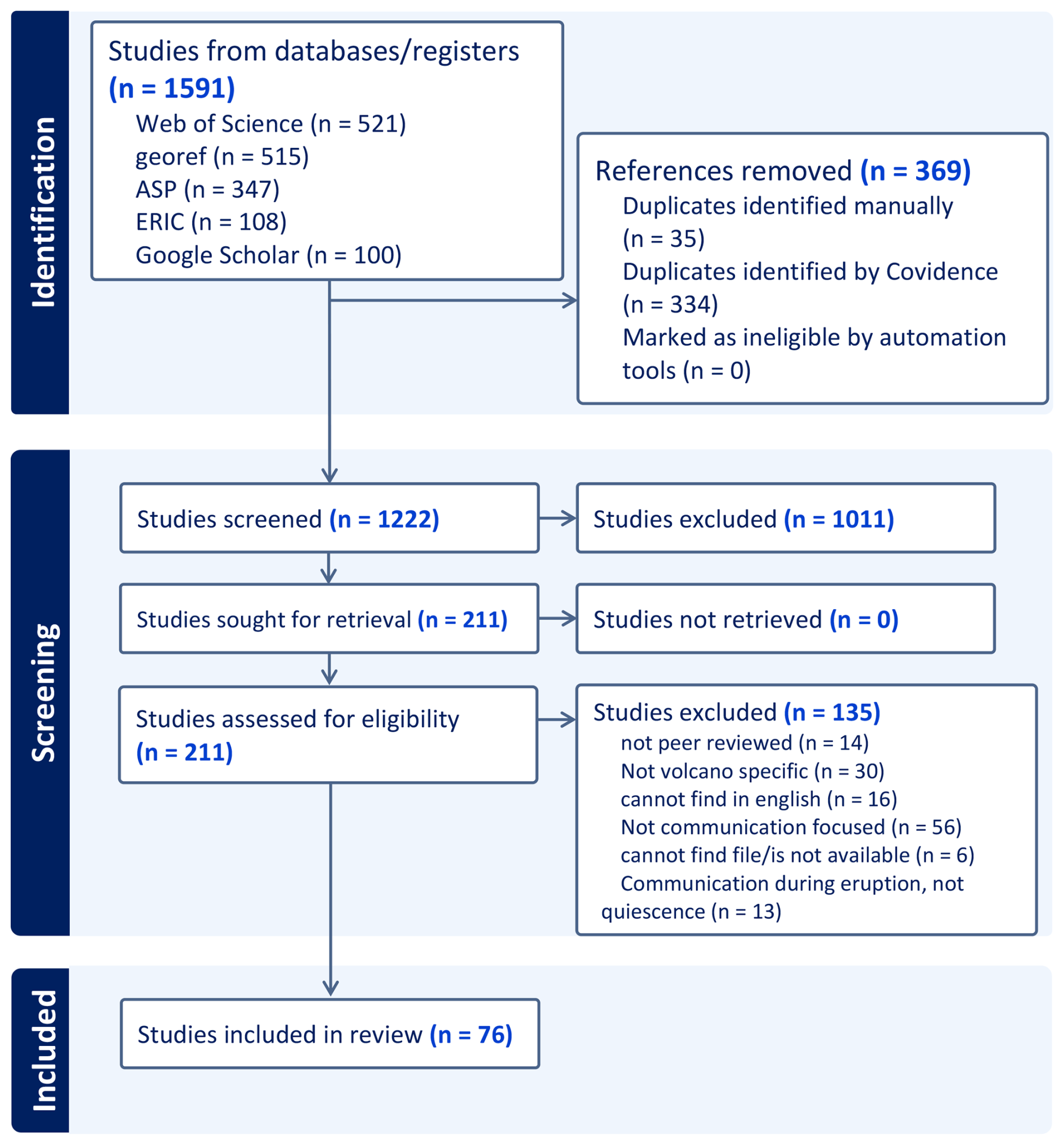
The primary author searched five databases: GeoRef, Web of Science, ERIC, Academic Search Premier, and the first 100 results from Google Scholar on 5 August 2024. All references were uploaded to Covidence (Covidence systematic review software, 2024). After deduplication, the search yielded 1222 results (Fig. 1). Following recommendations from Peters et al. (2020), the authors first pilot tested the screening process on 25 articles to ensure that the screening criteria were being interpreted consistently. After confirming consistency in the application of the criteria, two authors independently screened the remaining abstracts and full texts against the inclusion criteria outlined below, resolving disagreements through discussion. Given that this project sought to provide a broad map of literature and not an exhaustive list, additional citation chaining was not conducted due to resource constraints. After all screening was complete, 76 articles were selected for inclusion in this review.
We bound the review by specific inclusion and exclusion criteria, filtering for articles that are peer-reviewed, volcano focused, and concerned with communication during quiescence. During screening, we interpreted education and communication broadly, while excluding crisis-specific efforts. For inclusion, the article must be:
-
Published after 1980
-
published in a peer-reviewed academic journal or as a book chapter
-
Describing a tool, approach, or communication system; not another volcanic hazard communication synthesis
-
Communication-focused, and must explain a technique or tool (this can include educational tools or communication tools)
-
Volcano-focused, about communicating volcanic hazards (educational material must have volcano-specific recommendations)
-
Not focused on workforce development (STEM careers)
-
Not a communication approach for crisis situations (unrest and eruption phases)
-
Not a personal perspective piece
-
Not an ashfall, air quality, water quality, or other public health study
For each of the 76 final articles, the first author cataloged key aspects of the study. These include the article's authors, institutional affiliations, volcano or region of focus, study objectives, major findings, and any explicit recommendations.
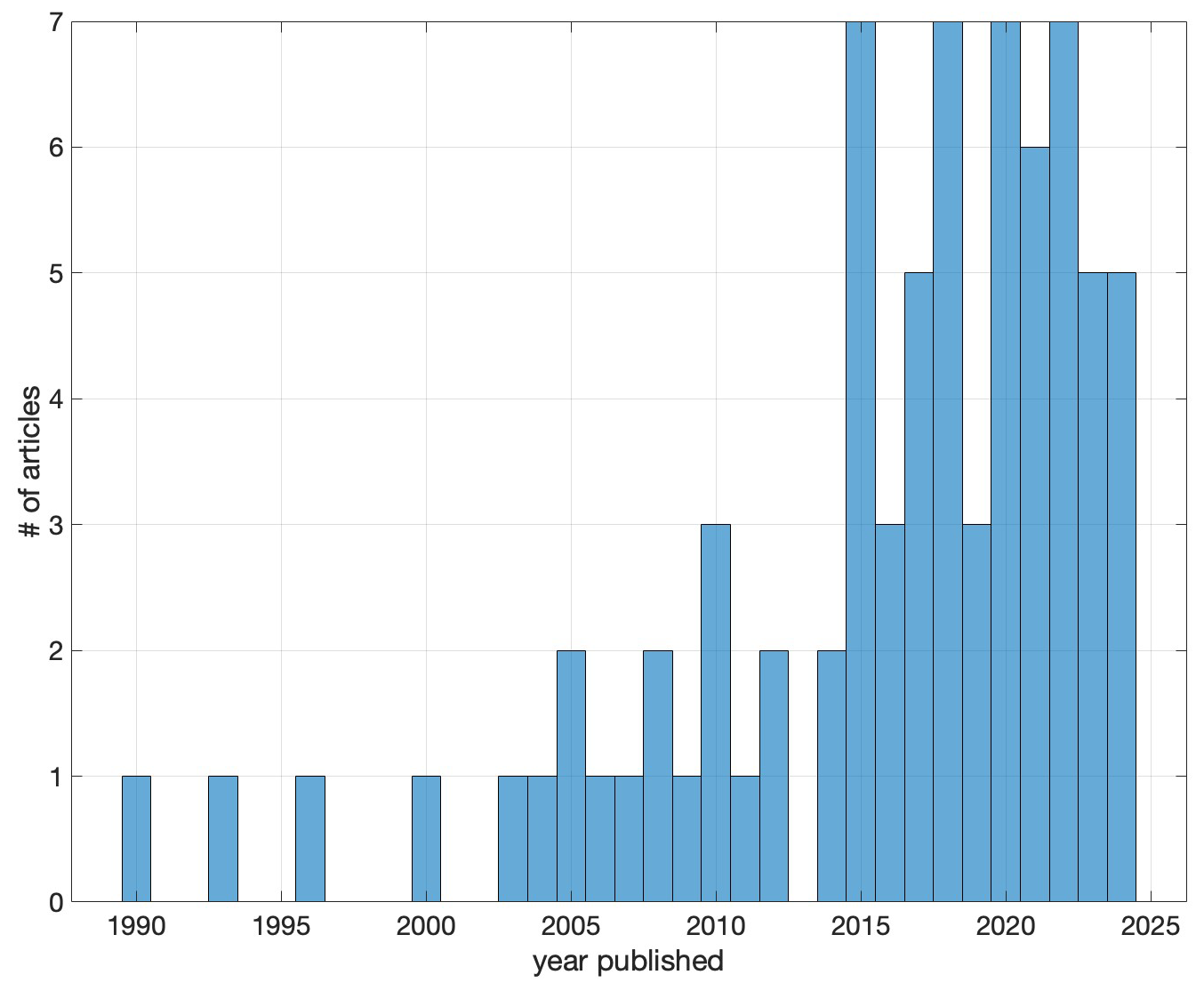
Figure 2Distribution of publication years for the 76 articles included in this review. Articles published before 1980 were excluded during the database search. The literature search was completed on 5 August 2024.
To organize the reviewed literature, we drew on distinctions between science education and science communication. Researchers have noted areas of overlap and divergence in the two fields' histories, operationalization of key concepts, goals, and approaches (e.g., Baram-Tsabari and Osborne, 2015; Lewenstein, 2015; Kohen and Dori, 2019); Baram-Tsabari and Osborne (2015) describe science education as learning that occurs in formal and informal environments, and science communication as interactions between the scientific community and diverse publics. They note that science education is often oriented toward learning and understanding, while science communication more often emphasizes engagement, interaction, and exchange. Because the reviewed articles included both structured classroom materials and broader public-facing communication efforts, we grouped the studies into three categories: formal educational materials, informal education and communication approaches, and informal education and communication tools.
-
Formal educational material refers to any structured resource or program designed for use in a classroom or other formal learning environment, such as curricula, lesson plans, laboratory exercises, or other materials aligned with educational standards.
-
Approaches to informal education and communication encompass broad, often multifaceted strategies for conveying hazard-related information outside of formal education contexts. These may address particular topics or audiences, and often consider multiple dimensions of engagement, sometimes drawing on case studies of specific regions or events. They emphasize overarching methods, frameworks, or guidelines rather than the development of a single product.
-
Tools for informal education and communication are specific, tangible products or media, such as hazard maps, interactive games, virtual outcrops, photographs, artistic works, or films. These are accompanied by practical guidance for their creation or implementation and intended to be deployed as discrete components within broader communication efforts.
The first author assigned articles to the category most closely aligned with their main emphasis, though some articles include elements spanning multiple categories. Studies are referenced by number, with a full numbered list provided in the Supplement.
Here we provide an overview of the reviewed literature, including publication history, geographic focus, and recurring themes, and then present the three thematic categories used to organize the reviewed studies: formal educational materials, informal education and communication approaches, and informal education and communication tools. Our review identified 76 peer-reviewed articles on volcanic hazard communication and education during quiescence. The 76 articles were published between 1990 and 2024 across 41 different publication venues, with a general increase in publication over time, including a sharp rise in the 2010s (Fig. 2). This increase suggests communication and education research during quiescent periods has continued to gain more focus as science communication research has evolved. The most frequently represented publication venues are Bulletin of Volcanology (6 articles) and Advances in Volcanology (5). Of the 76 articles, 42 focus on a specific volcano or volcanic area, while the remainder address volcanic communication more broadly (Fig. 3).
Most geographically focused studies concentrate on Vesuvius, Etna, Katla, and the Taupo Volcanic Zone, all of which are close to substantial population centers and have long histories of monitoring and research. In contrast, many volcanoes that threaten similarly large or even larger nearby populations, including Mount Nyiragongo near Goma, the Hainan Volcanic Field in China, and Popocatépetl in Mexico, receive little attention in the literature reviewed here. This skewed geographic coverage is significant because communication needs, trusted messengers, cultural relationships to volcanoes, and preparedness priorities can vary widely between volcanic regions.
Across all articles, only 26 empirically evaluate the effectiveness of their tool or approach, making it difficult to determine which strategies work best in practice. This gap highlights the need for more structured evaluation to strengthen research-informed volcanic hazard communication during periods of quiescence. Across the reviewed studies, recurring themes include the importance of audience-specific communication, participatory strategies, and trust-building before periods of unrest or eruption. As we describe results in the following sections, we situate those results within broader hazard and risk communication literature.
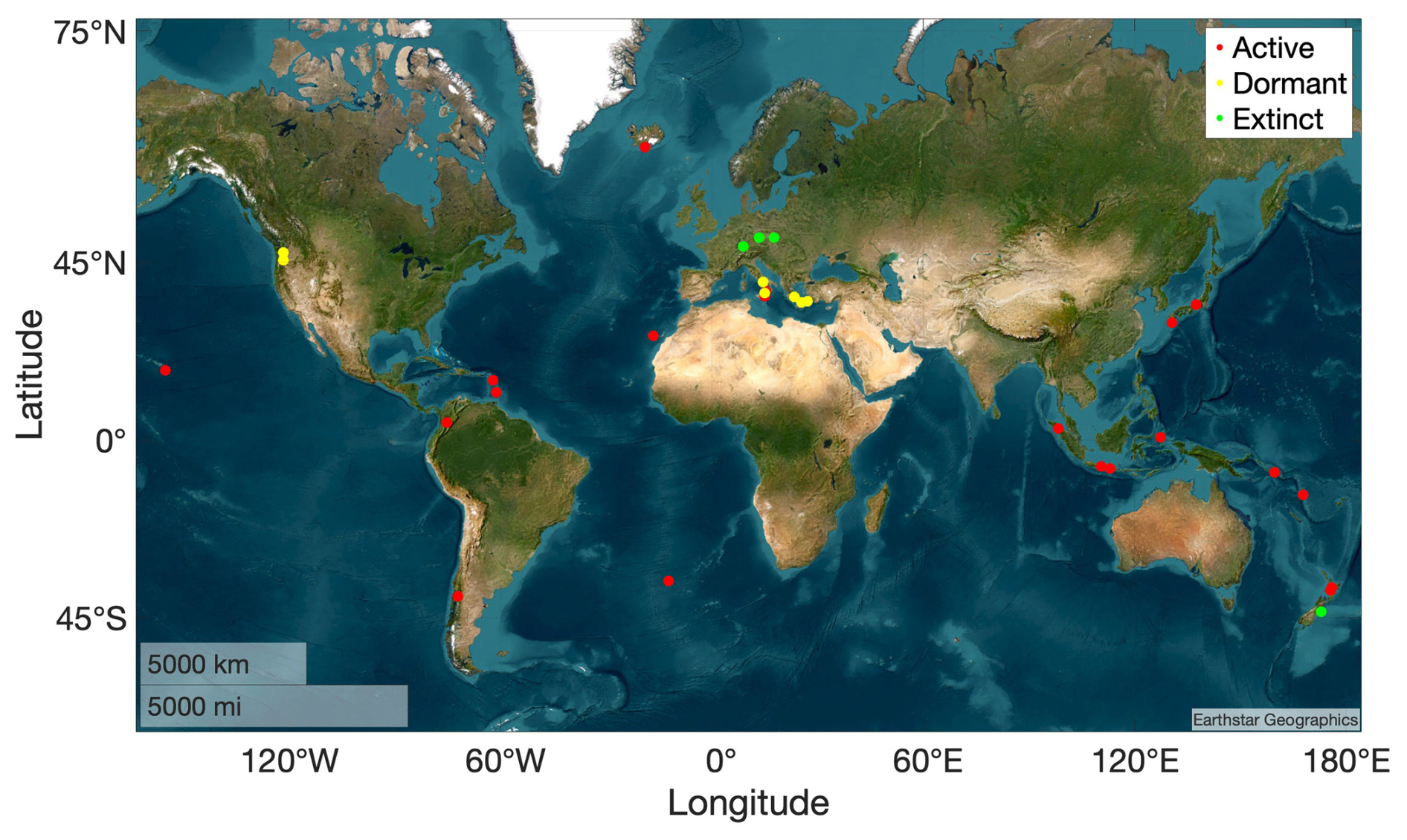
Figure 3Geographic distribution of volcanoes or volcanic regions examined in the 42 geographically focused studies included in this review. The legend indicates the volcanic activity level at the time each study was published.
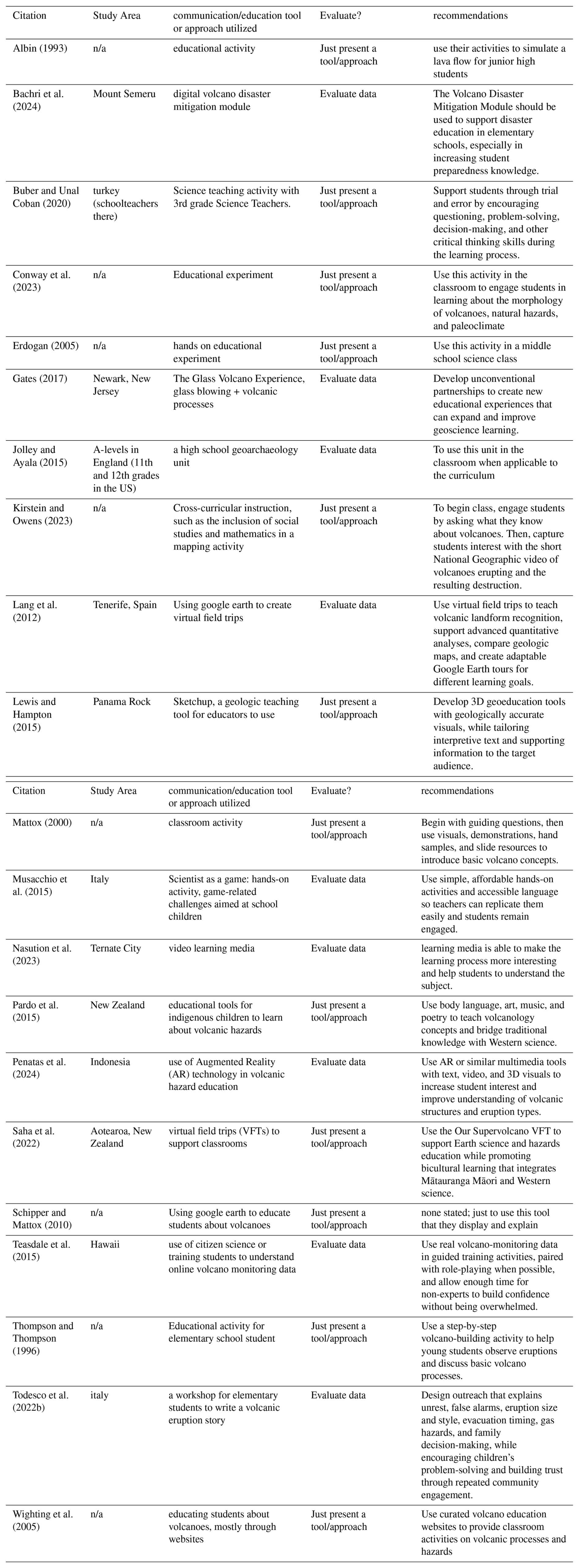
Table 1Articles reviewed placed in the formal education category. n/a – not applicable.
3.1 Formal education
Twenty-one articles focus on formal educational activities designed for classroom settings. These studies include lesson plans, curriculum units, hands-on experiments, online activities, games, videos, and other learning tools. Nine articles evaluate their materials in some way, most commonly through pre- and post-tests of student learning or questionnaires assessing student and teacher perceptions of interest, usability, or effectiveness (Table 1). The formal education studies generally emphasize that school-based activities can help sustain awareness of volcanic hazards during long periods between eruptions. Because students may share what they learn with families and communities, classroom education can be used to extend hazard awareness beyond the school setting (Ronan and Johnston, 2001; Shaw et al., 2004; Todesco et al., 2022b).
Many studies emphasize the importance of active and engaging learning. In classroom settings, students may be present for the activity, but engagement is still needed for hazard information to be understood, remembered, and connected to preparedness (Farley et al., 2013). Hands-on experiments and activities are commonly presented as ways to increase student interest and attention (Albin, 1993; Conway et al., 2023; Erdogan, 2005; Gates, 2017; Musacchio et al., 2015), while more developed curriculum units are used to build deeper understanding of volcanic processes, hazards, and impacts across different regions (Bachri et al., 2024; Buber and Unal Coban, 2020; Mattox, 2000; Thompson and Thompson, 1996; Wighting et al., 2005). Online activities have also become increasingly common, including web-based resources, videos, interactive modules, and games (Lang et al., 2012; Nasution et al., 2023; Penatas et al., 2024; Saha et al., 2022; Schipper and Mattox, 2010; Teasdale et al., 2015). Several studies recommend cross-curricular learning (Bachri et al., 2024; Jolley and Ayala, 2015; Kirstein and Owens, 2023; Pardo et al., 2015; Saha et al., 2022), allowing students to connect volcanic hazards with broader social, historical, geographic, and community impacts. For example, Jolley and Ayala (2015) integrate geoscience and archaeology into a single unit, finding that this approach broadens coverage of standardized learning goals, helps students view both disciplines through a new lens, and increases student interest in the material.
Some formal education studies use student responses to identify misconceptions and guide future educational design. Todesco et al. (2022b) analyzed children's stories about volcanic eruptions and identified common patterns in how students imagined volcanic activity. They found that elementary school students rarely recognized precursory unrest and often underestimated the size and variability of eruptions. The authors suggest that future educational materials should give more attention to periods of volcanic unrest, including how dormant volcanoes may reactivate, how long unrest can last, and how the same volcano can produce different eruptive styles. They recommend interdisciplinary collaboration to develop visual materials that better represent the different eruptive styles volcanoes can display.
Broader disaster education literature supports the value of school-based hazard education while also showing that learning does not automatically translate into preparedness. Johnson et al. (2014a) find that evaluations of children's disaster education programs commonly measure short-term knowledge gains, while fewer studies assess whether education leads to household preparedness, protective behavior, self-efficacy, adaptive capacity, or long-term resilience. Similarly, Ronan et al. (2016) emphasize that child-centered disaster risk reduction should move beyond basic safety messages toward interactive, problem-solving, and skill-building approaches that connect students, households, schools, and communities. This suggests that formal volcanic hazard education during quiescence is valuable because it can sustain awareness when volcanic risk is not immediately visible, but its usefulness depends on whether students are supported in connecting volcanic knowledge to preparedness actions and local decision-making.
Additionally, producing educational materials is only one part of effective disaster education. Johnson et al. (2014b) found that uptake of a voluntary disaster preparedness education resource in New Zealand primary schools depended on teacher awareness, teacher training, school-wide use, curriculum support, and engagement with local emergency management staff. This is especially relevant for volcanic hazards during quiescence, when the absence of recent activity may make disaster education feel less urgent or harder to prioritize. Without sustained implementation support, even well-designed volcanic hazard curricula or classroom activities may have limited reach because effective formal education requires more than just the creation of materials. It also requires integration into school systems, support for teachers, and connections between schools and the agencies or scientists responsible for hazard information.
Formal education must also account for the diversity of students and learning contexts. Ronoh et al. (2017) show that children with disabilities may have substantial hazard knowledge and capacities, but still require accessible language, adapted drills, participatory tools, and opportunities to contribute to disaster planning. This reinforces that school-based volcanic hazard education should not assume a single student audience or a single model of preparedness. Instead, educational materials and activities should be designed so that students with different abilities, experiences, cultural contexts, and local hazard exposures can understand the risk and participate meaningfully in preparedness.
It is critical that these materials be culturally grounded, place-based, and student-centered. Kaiser and Boersen (2020) show that disaster education can be more meaningful when it is developed around local hazards, cultural knowledge, student participation, and community priorities. The materials identified in this review provide a valuable reference for scientists, educators, and communicators seeking classroom resources for volcanic hazard education during quiescence, but they should be adapted and evaluated for the specific audience and context rather than treated as ready-made solutions. However, the results of this literature search provide limited evidence about whether these classroom activities translate into broader volcanic hazard preparedness beyond the lesson itself. Because many of the reviewed materials are not empirically evaluated, it remains unclear which approaches are most effective, for which student audiences, and under what educational or cultural conditions. Future studies should evaluate whether formal education improves preparedness understanding, accessibility to hazard information, family or community discussion, trust in hazard information, and long-term retention in volcanic settings.

3.2 Approaches
Twenty-seven articles found in this review describe approaches for volcanic hazard communication outside formal education settings (Table 2). These approaches are often audience-specific, with six articles focused on communication with tourists and ten focused on communication with Indigenous populations. Other studies provide general communication frameworks, propose strategies for eruption planning and preparedness exercises, or offer guidance on terminology. Few of these approaches are empirically evaluated, instead offering practices and processes that can be adapted.
3.2.1 Tourists
Tourists are a distinct audience for volcanic hazard communication because they may enter hazardous areas with limited local knowledge, limited time to seek information, and varied familiarity with volcanic processes. The studies focused on tourists emphasize that hazard information must be visible, engaging, and easy to interpret within the crowded information environment of tourism. Recommendations include creating bold, attention-seeking materials (Bird et al., 2010; Bird and Gísladóttir, 2020; Vegas et al., 2019) and using pictures, drawings, and video footage to reduce reliance on scientific terminology (Bird et al., 2010; Erfurt-Cooper, 2018). Several studies also emphasize the value of place-based communication. Presenting hazard information at past eruption sites can make the hazard more tangible by helping visitors visualize what occurred there (Megerle, 2020). Learning about an event where it happened can reinforce its significance, especially when paired with brief, informative titles and high-quality photographs on interpretive panels (Megerle, 2020; Migoń and Pijet-Migoń, 2019; Vegas et al., 2019).
These studies also suggest that tourist communication should not rely only on signs or isolated materials; instead, the tourism sector as a whole must be involved in risk reduction strategies (Bird and Gísladóttir, 2020; Megerle, 2020). Tourists are a distinct audience because they are temporary visitors to volcanic landscapes and may differ widely in background knowledge, language, risk perception, and familiarity with local hazards or warning systems. In potentially hazardous volcanic areas, tourists need clear, visible, and accessible safety information, including where to find official updates and what to do if conditions change (Bird and Gísladóttir, 2020). Bird and Gísladóttir (2020) examine risk communication initiatives in Iceland and argue that risk reduction requires whole-community involvement, including the dissemination of risk information by travel agents and tour guides before tourists enter potentially hazardous environments. Guides should be trained for disasters, clear protocols should be in place, and community officials should maintain a long-term commitment to risk communication initiatives. For warnings and preparedness information to be effective, tourist-focused risk communication should be visible, accessible, and integrated into everyday tourism practices through visual materials, interpretive panels, trained guides, travel agents, emergency protocols, and consistent messaging across websites, social media, brochures, signs, short films, and other common visitor channels (Bird et al., 2010; Bird and Gísladóttir, 2020; Erfurt-Cooper, 2018; Megerle, 2020; Migoń and Pijet-Migoń, 2019; Vegas et al., 2019). These findings align with broader risk communication research emphasizing that communication must be designed around audience needs and decision contexts rather than expert assumptions about what information is important (Frewer, 2004; Fischhoff, 1995; Doyle and Becker, 2022).
During quiescence, tourism also provides an opportunity for informal education. When immediate hazard risk is low, visitors may already be interested in the landscape, making place-based interpretation useful for raising awareness of volcanic processes, past eruptions, and long-term hazards (Megerle, 2020; Migoń and Pijet-Migoń, 2019; Vegas et al., 2019). These efforts can improve general volcanic literacy and reduce confusion if visitors later encounter warnings, closures, or future unrest. Future research should evaluate the effectiveness of tourist-focused communication across different visitor groups, including whether materials are noticed, understood, trusted, and connected to appropriate safety actions during changing volcanic conditions.
3.2.2 Indigenous Populations
In the reviewed studies focused on Indigenous populations, communication often emphasizes disaster risk reduction and preparedness actions rather than increasing scientific understanding of volcanic processes. Several articles argue that effective communication does not require reconciling all differences between local and scientific explanations of volcanism, because attempting to replace local knowledge systems can create disagreement or distrust (Cronin et al., 2004a, b; Gabrielsen et al., 2018; Marín et al., 2020). Instead, the reviewed studies suggest that communication should focus on shared goals, such as recognizing warning signs, understanding potential consequences, and developing locally meaningful plans for what to do if precursory signals occur. Oral storytelling is frequently identified as an important way to communicate past volcanic activity, preserve community memory, and convey the severity of rare but catastrophic eruptions (Cronin and Cashman, 2008; Gabrielsen et al., 2018; Holmberg, 2023; Marín et al., 2020; Petterson et al., 2008). As Cronin and Cashman (2008) note, “The dramatic, but highly sporadic, nature of volcanic activity may promote longevity of these oral traditions for the specific purpose of helping future descendants avoid a similar disaster” (p. 198). Effective communication with Indigenous communities requires time to understand local social context, cultural values, customs, taboos, political and governance structures, and relationships to volcanic landscapes (Cronin et al., 2004a, b; Gabrielsen et al., 2018; García and Mendez-Fajury, 2018; Hicks et al., 2014; Marín et al., 2020; Petterson et al., 2008; Saha et al., 2023). The Indigenous communities represented in these studies are not a single, uniform audience. Cultural values, knowledge systems, governance structures, relationships to volcanic landscapes, and experiences of past hazards vary substantially, meaning that strategies developed in one setting cannot be assumed to transfer directly to another without locally grounded engagement and adaptation. This requires Indigenous involvement throughout the communication process, so that scientific knowledge of the volcanic system can be integrated with local knowledge, priorities, and decision-making structures (Cronin et al., 2004a, b; Gabrielsen et al., 2018; García and Mendez-Fajury, 2018; Hicks et al., 2014; Marín et al., 2020; Petterson et al., 2008; Saha et al., 2023).
These findings are consistent with broader risk communication literature showing that effective disaster risk reduction communication should treat local and Indigenous knowledge as expertise and create structured opportunities for communities, scientists, and authorities to discuss values, goals, information needs, and actions together (Bidwell, 2009; Doyle and Becker, 2022). However, participation must be carefully designed. Glicken (2000) cautions that poorly planned processes can exclude key groups, treat public input as symbolic, or increase distrust if stakeholders do not see how their knowledge is used. This is especially important when working with Indigenous communities, where different knowledge holders, governance structures, social roles, and community members may shape how risk is understood and how preparedness actions are developed. Communication with Indigenous communities should therefore be approached as a long-term relationship-building and partnership process rather than a one-time translation of scientific information, and quiescence is the best time to establish this relationship. Hicks et al. (2019) note that participatory DRR can range from treating participation itself as a measure of success to using more co-creative approaches, “where both scientists and citizens use and generate different forms of knowledge to integrate new understandings and create a shared agenda” (para. 9). In this context, oral traditions and local histories are not only communication tools; they are knowledge sources that can preserve memory of rare volcanic events, identify locally meaningful warning signs, and connect preparedness actions to community experience. Future volcano-specific research should evaluate how co-developed and culturally grounded communication approaches affect trust, preparedness actions, warning interpretation, and long-term risk awareness within Indigenous communities, while also documenting how these approaches vary across different volcanic, cultural, and governance contexts.
3.2.3 Community Networks
Several reviewed articles address the design of broader communication systems at the community level before unrest occurs. One recurring recommendation is to work with local actors who already have relationships with the intended audience, such as emergency managers, community leaders, popular local figures, educators, or other trusted members of the community (Cadag et al., 2018). Involving these actors in message design can help communicators understand local concerns, identify appropriate language and channels, and increase trust in the information being shared. This reflects broader risk communication research showing that trust depends not only on message content, but also on the perceived credibility, motives, and relationships of the information source (Frewer, 2004; Paton, 2007; Kasperson, 2014).
Volcanic observatories and scientific institutions also play an important role in building communication capacity during quiescence. The reviewed observatory-focused articles emphasize outreach during quiet periods as a way to educate communities, establish relationships, and maintain visibility before unrest begins (Graham et al., 2022; Horii et al., 2024; Nakamichi, 2024; Todesco et al., 2022a). This is consistent with Community Engagement Theory, which suggests that preparedness is more likely when communication supports outcome expectancy, empowerment, collective efficacy, and trust, rather than simply delivering information to passive audiences (Paton et al., 2024). For observatories, this means that outreach during quiescence should not be limited to occasional public education products but should help establish durable channels for communication and informal learning. Feng et al. (2018) argue that informal disaster education can build community resilience by using everyday social networks, local activities, and trusted facilitators to support localized learning and preparedness. Observatories can contribute to these networks by providing consistent scientific information, supporting local communicators, and creating opportunities for ongoing dialogue. Social media, for example, can provide regular contact with audiences and can be adapted to the level of volcanic activity, but it requires sustained management and clear decisions about what information should be posted during periods of quiescence, unrest, and crisis (Todesco et al., 2022a). Citizen science can extend this role by involving community members in knowledge generation, ranging from data collection to deeper co-production and empowerment, especially when projects provide participant benefits and support long-term engagement (Hicks et al., 2019). However, citizen science efforts are not well documented or evaluated in the articles reviewed here.
Other reviewed articles focus on preparedness resources that can support communication before future activity. Hazard-specific articles synthesize communication needs for particular volcanic hazards, including ballistics and lahars (Fitzgerald et al., 2018; Pierson et al., 2014), while database-focused studies propose centralized volcanic information resources for stakeholders and communicators involved in disaster planning (Nasaruddin et al., 2011; Stix and Heiken, 2022). These approaches suggest that quiescence is a useful time to prepare communication materials, clarify terminology, organize hazard information, and build shared resources before time-sensitive decisions are required. Future work should evaluate how these communication systems, including local messengers, observatory outreach, social media strategies, hazard-specific guidance, and information databases, affect trust, preparedness, and the ability of different audiences to find and use volcanic hazard information when the level of volcanic activity changes.
3.2.4 Probabilities and Uncertainty
Two articles in the reviewed dataset provide resources for communicating probabilities or translating volcanic terminology across languages. Harris et al. (2017) focus on terminology translation and emphasize that translations must follow alphabet and accent conventions, be lexicographically accurate, be grammatically correct, and preserve the intended meaning of the original term. This is important for volcanic hazard communication because direct translation may not be sufficient if the translated term changes the meaning, tone, or clarity of the hazard information.
Harris (2015) examines how probabilities and uncertainties are communicated, using case studies from newspaper reporting on severe weather systems and volcanoes. In the volcano-focused section, Harris argues that terminology is critical when reporting uncertainty and probability because evocative words or dramatic imagery may prompt unintended interpretations. Harris (2015) illustrates this issue in Table 2 of that article, which was collated from Sink (1995) and earlier work by Doyle et al. (2011) and shows that scientists and members of the public often assign different numerical values to the same qualitative probability phrases. Although these results are not volcano-specific, they illustrate a broader communication challenge that is relevant to volcanic hazards: commonly used terms such as “unlikely” or “possible” may not convey consistent numerical meanings across audiences. Because of these discrepancies, Harris agrees with Gill (2008) that uncertainty is often best conveyed through objective numerical measures, such as probabilities, paired with clearly defined plain language. The reviewed article therefore emphasizes that both numerical information and word choice require careful design when communicating volcanic uncertainty.
The reviewed studies show that terminology, probability, and uncertainty communication receive limited attention within quiescence-focused volcanic communication research, even though these topics are well developed in broader risk communication and volcanology literature. Risk communication research shows that uncertainty communication is more complicated than simply deciding whether uncertainty should be included or omitted. Effective uncertainty communication depends on the audience, decision context, type of uncertainty, and actions available despite uncertainty (Fischhoff and Davis, 2014; Frewer, 2004; Kasperson, 2014; Bostrom, 2014; Doyle and Becker, 2022). Fischhoff and Davis (2014) provided practical guidance on communicating uncertainty by focusing on what types of decisions need to be made with the information: “(i) Decisions about action thresholds: Is it time to act? (ii) Decisions with fixed options: Which is best? (iii) Decisions about potential options: What is possible?” (p. 13664). They further note that all three decision-making contexts involve “(i) characterizing uncertainty, by identifying the issues most relevant to the choice; (ii) assessing uncertainty, by summarizing that information in a useful form; and (iii) conveying uncertainty, by creating messages that afford decision makers the detail that their choices warrant” (p. 13664). Dhungana et al. (2025) use qualitative interviews in a disaster risk management (DRM) context and highlight how scientists and decision-makers face different pressures and have different perspectives on how uncertainty information can best be communicated, with scientists focusing more on the technical dimensions of uncertainty due to their scientific training, while decision-makers are more concerned with how uncertainty plays out in real-world scenarios. They recommend that uncertainty information be presented in visually engaging formats that have been tested for comprehension. Recent work by Peters et al. (2025) further shows that the most effective numerical framing may depend on the communication goal, with frequency formats potentially increasing emotional salience and preparedness motivation, and probability formats better supporting other forms of risk judgment.
Volcano-specific research has examined uncertainty communication in the context of unrest and crisis decision-making, explaining why these studies were not captured by the quiescence-focused search used here. This literature shows that providing scientifically accurate information is not sufficient if audiences do not interpret it as intended. The framing of probabilities and forecast time windows can influence perceived likelihood, and verbal probability terms may be understood as more ambiguous than equivalent numerical probabilities, leading to different evacuation decisions (Doyle et al., 2014a, b). Similar challenges arise when complex monitoring data and scientific uncertainty are condensed into volcano alert levels or probabilistic hazard maps. These tools can support decision-making, but their meaning is shaped by audience needs, local context, and design choices, and they are most useful when accompanied by dialogue and supplementary communication (Fearnley, 2013; Fearnley and Beaven, 2018; Thompson et al., 2015). Martí (2015) argues that communication should remain ongoing even when a volcano shows no signs of alarm, so that audiences already have some familiarity with volcanic hazards, forecasts, and uncertainty when information must be interpreted more quickly during a crisis.
Uncertainty communication is especially important for volcanic hazards because uncertainty is central to both the science and the communication challenge (Tadini et al., 2025; Mani et al., 2025). Mani and colleagues (2025) note that while significant progress has been made in volcanic risk communication, many challenges remain due to the dynamic nature of crisis events and the multiple potential breakdown points in communication. Volcanoes can remain quiet for long periods before unrest begins, unrest does not always lead to eruption, and the timing, location, size, and style of future activity may remain uncertain even when monitoring data are available. During quiescence, communities may be asked to understand hazards that are possible but not imminent and to prepare for events that may occur beyond everyday planning horizons. In this setting, uncertainty communication is not only about explaining probabilities; it is also about helping audiences understand what is known, what is not known, what changes in activity might mean, and why scientific uncertainty does not make hazard information unreliable. Yet within the quiescence-focused volcanic communication studies captured by this review, probability and uncertainty communication were not central themes. The reviewed studies provide little volcano-specific evidence about how different audiences interpret probabilistic volcanic information, qualitative likelihood terms, long recurrence intervals, changing alert levels, or uncertainty around unrest and eruption forecasts during quiet periods. This is a notable gap because quiescence may be the best time to build familiarity with this language before crisis conditions increase urgency and stress. Future volcano-specific research should therefore evaluate how uncertainty can be communicated during quiescence in ways that support understanding, preparedness, and trust.
3.3 Tools
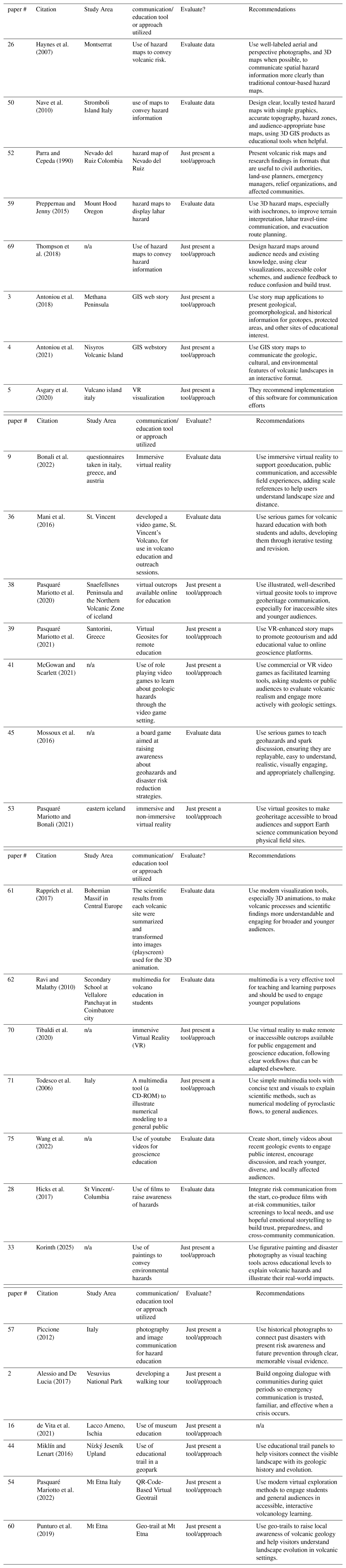
Twenty-eight articles identified in this review present specific tools for volcanic hazard communication outside formal settings, including hazard maps, online tools, video games, virtual reality (VR), photographs, paintings, films, and materials designed for use in geoparks (Table 3). Ten of these articles include empirical evaluation, with most evaluations focused on hazard map assessment (Haynes et al., 2007; Nave et al., 2010; Preppernau and Jenny, 2015) or online media testing (Bonali et al., 2022; Mossoux et al., 2016; Rapprich et al., 2017; Ravi and Malathy, 2010; Wang et al., 2022). Together, these studies show that communication tools can support awareness and understanding during quiescence, but their usefulness depends on whether audiences can access, interpret, trust, and apply the information they provide.
3.3.1 Hazard Maps
Several reviewed articles focus on hazard maps as tools for communicating volcanic risk. These studies show that map design needs vary by audience. Public audiences often prefer aerial photographs and 3D maps because these formats make it easier to interpret the landscape, while scientists and emergency managers may prefer contour maps that provide greater technical detail (Haynes et al., 2007; Nave et al., 2010; Preppernau and Jenny, 2015). The reviewed studies also emphasize that hazard maps should be developed with attention to audience knowledge, perspectives, and information needs. Participatory approaches can help mapmakers understand what information communities value, how they interpret spatial risk, and what map formats are most useful for preparedness and decision-making (Nave et al., 2010; Parra and Cepeda, 1990; Preppernau and Jenny, 2015; Thompson et al., 2018).
Broader participatory mapping and stakeholder engagement literature reinforces that maps are not just technical products; they can also function as tools for dialogue, knowledge integration, and planning. Cadag and Gaillard (2012) show that participatory mapping can help connect scientific and local knowledge, make risk more tangible, and support disaster risk reduction actions when communities are actively involved in the mapping process. Glicken (2000) similarly emphasizes that stakeholder participation must be purposeful and carefully designed so that the right people are included, the right questions are asked, and the resulting information is useful for decision-making. Volcanic hazard maps should therefore be adapted to the intended audience, tested with intended users, and, where possible, developed through participatory processes that clarify what information different users need, how they interpret spatial hazard information, and which map formats best support preparedness, decision-making, trust, understanding, and use of hazard information.
3.3.2 Online Media
Several reviewed articles present online media and digital tools for volcanic hazard communication (Antoniou et al., 2018, 2021; Asgary et al., 2020; Pasquaré Mariotto et al., 2020; Rapprich et al., 2017; Ravi and Malathy, 2010; Todesco et al., 2006; Wang et al., 2022). These studies describe the design of online communication resources, including online museums, virtual outcrops, geostories, and other interactive materials that guide users through volcanic landscapes, histories, and hazards. Articles focused on VR tools similarly describe their development process in detail, often providing step-by-step guidance so that similar tools can be recreated or adapted elsewhere (Bonali et al., 2022; Pasquaré Mariotto et al., 2021; McGowan and Scarlett, 2021; Pasquaré Mariotto and Bonali, 2021; Tibaldi et al., 2020). Many of these digital tools are presented as ways to expand access to volcanic landscapes for audiences who cannot travel to a field site, including students, people with disabilities, or large classroom groups unable to participate in field trips (Bonali et al., 2022; Pasquaré Mariotto et al., 2020, 2021; Pasquaré Mariotto and Bonali, 2021; Rapprich et al., 2017; Tibaldi et al., 2020). Two articles also examine serious games as tools for raising hazard awareness (Mani et al., 2016; Mossoux et al., 2016), showing that scientifically accurate games can support understanding of volcanic processes while engaging users through interactive learning.
These digital tools are valuable for expanding access to volcanic landscapes and hazard information. Ronoh et al. (2017) emphasize that disaster education must account for diverse access and support needs, including for children with disabilities, and that participatory, adapted tools can help make DRR education more inclusive. In this context, online media, VR, virtual outcrops, and serious games may help reach audiences who cannot physically visit volcanic sites, including students, people with disabilities, distant communities, or classrooms without the resources to conduct a field trip. However, the existence of a digital tool does not guarantee that it will be used, understood, or connected to preparedness. For volcanic hazard communication during quiescence, future research should therefore evaluate not only whether online tools are engaging, but whether different volcano-focused audiences can access them, interpret them accurately, trust the information provided, and connect what they learn to preparedness before unrest or eruption occurs.
3.3.3 Creative and Place-Based Media
Creative media like photos, paintings, and film (Hicks et al., 2017; Korinth, 2025; Piccione, 2012) are ways to help raise awareness of volcanic hazards in a passive setting. These studies emphasize the value of interdisciplinary collaboration between scientists, artists, filmmakers, educators, and communicators. Creative media can make volcanic hazards more emotionally resonant and accessible, helping audiences connect with risk information in ways that technical products alone may not (Korinth, 2025). While studies caution against fear-based messaging because it can produce fatalism rather than preparedness (Sanquini et al., 2016), communication that shows how previous communities recovered, adapted, or demonstrated resilience may instead encourage protective action (Hicks et al., 2017). Similarly, place-based tools in geoparks, including exhibits, trails, and interpretive materials, can make volcanic hazards more tangible and personally meaningful by connecting hazard information to visible landscapes, past eruptions, and visitor experience (Alessio and De Lucia, 2017; de Vita et al., 2021; Miklín and Lenart, 2016; Pasquaré Mariotto et al., 2022; Punturo et al., 2019).
Overall, the tools identified in this review provide a useful baseline for scientists, educators, and communicators developing volcanic hazard communication materials during quiescence. Many of the reviewed articles document the design process in enough detail that the tools could be recreated, adapted, or used as models for future efforts. The usefulness of these tools depends on audience needs, decision context, trust in the information source, and accessibility, and should be assessed through evaluation. Their adaptability is one of their strengths, provided they are intentionally tailored rather than applied unchanged across settings. Ideally, tool development should include participation from the intended audience to ensure that the format, language, content, and delivery method are appropriate for the specific volcanic context and communication goal.
This scoping review maps peer-reviewed literature on volcanic hazard communication during periods of quiescence, when immediate crisis pressures are absent but opportunities for long-term preparedness are substantial. This study has several limitations. Its narrow focus on quiescence and volcano-specific communication limits the representation of studies from the broader bodies of literature on geohazard risk communication and science communication. In addition, data were charted only by the first author, and the review was limited to peer-reviewed literature identified through specific databases, excluding grey literature. It therefore does not provide a comprehensive assessment of volcanic hazard communication during quiescence. Despite these limitations, the 76 articles reviewed here document a broad range of formal educational materials, informal education and communication approaches, and informal education and communication tools designed to raise awareness and understanding of volcanic hazards before unrest or eruption occurs. The reviewed literature has grown over the past two decades, showing increasing attention to communication outside crisis settings. Future work should examine grey literature and communication efforts outside the peer-reviewed literature to provide a more complete picture. This scoping review provides insight into research-informed strategies and identifies priorities for future volcano-specific communication research during periods of quiescence.
Across the reviewed articles, several recurring themes emerged. Communication during quiescence should be locally relevant, audience-specific, accessible, and connected to preparedness rather than limited to general awareness or information delivery. Formal educational materials, informal approaches, and informal tools each provide useful models for future work, including classroom activities, participatory engagement, observatory outreach, community networks, hazard maps, digital resources, creative media, and place-based interpretation. However, these strategies should not be treated as ready-made solutions that can be transferred unchanged across settings. As noted throughout this paper, their usefulness depends on audience needs, accessibility, trust in the source, decision context, and cultural and geographic setting, and should be assessed through evaluation.
The reviewed volcano-specific studies are consistent with broader science communication and DRR literature showing that effective communication is context-specific, participatory, and connected to decisions and actions. However, communication during volcanic quiescence poses distinct challenges compared to other geohazards: volcanoes may remain quiet for generations, unrest may or may not lead to eruption, and future activity can involve substantial uncertainty in timing, location, style, and impact. Our results highlight that empirical evaluation during quiescence remains limited. Only 26 of the 76 articles evaluate the effectiveness of their tool or approach, and many evaluations focus on interest, usability, or knowledge rather than preparedness, behavior, trust, long-term retention, or decision-making. Geographic coverage is also uneven, with several well-studied volcanoes represented repeatedly while many volcanic regions with large, exposed populations receive little attention in the quiescence-focused communication literature. This matters because communication needs, trusted information sources, cultural relationships to volcanoes, educational systems, and preparedness priorities vary widely between volcanic settings. More volcano-specific research is therefore needed to evaluate how different audiences interpret, trust, and use hazard information across volcanic settings and activity phases.
For educators, the reviewed studies recommend active, place-based, and inclusive classroom materials that connect volcanic hazard education to preparedness actions beyond short-term knowledge gains. Scientists and observatories can support communication during quiescence by maintaining trusted information channels, developing accessible hazard resources, supporting local communicators, and creating opportunities for dialogue before unrest begins. Communicators or scientists working with tourists, residents, or Indigenous communities should adapt messages to the audience's context, using visual, multilingual, place-based, and participatory approaches rather than assuming that technical information will transfer unchanged across settings. Emergency managers and decision-makers can use quiescent periods to coordinate with schools, tourism networks, community leaders, observatories, and other trusted actors so that preparedness messages, terminology, protocols, and information pathways are already established before activity changes. Across these groups, the reviewed literature suggests that communication is strongest when audiences are treated not merely as recipients of information but as active participants in shaping, translating, sharing, and evaluating volcanic hazard communication.
Quiescence is not a gap between meaningful communication moments, but a period when awareness can be built, relationships can be established, uncertainty can be explained, and preparedness can become part of everyday community knowledge. To fully use this opportunity, volcanic hazard communication needs participatory and context-specific strategies that are rigorously evaluated and that help different audiences understand volcanic hazards and prepare before the pressures of unrest or eruption begin.
The literature reviewed in this manuscript can be reproduced using the search terms, databases, inclusion criteria, and screening procedures described in the Methods section, for publications from 1990 through 5 August 2024. The reviewed articles and extracted study information are listed in the manuscript tables and the Supplement.
The supplement related to this article is available online at https://doi.org/10.5194/nhess-26-5361-2026-supplement.
RH, HS and EH worked together to conceptualize the project. RH, HS, and LG performed paper screening to obtain final dataset; RH performed grouping of articles and information extraction; RH and HS wrote the manuscript draft; and EH reviewed and edited the manuscript.
The contact author has declared that none of the authors has any competing interests.
Publisher's note: Copernicus Publications remains neutral with regard to jurisdictional claims made in the text, published maps, institutional affiliations, or any other geographical representation in this paper. The authors bear the ultimate responsibility for providing appropriate place names. Views expressed in the text are those of the authors and do not necessarily reflect the views of the publisher.
I'm grateful to University of Oregon librarian Annie Zeidman-Karpinski for her generous help navigating databases and developing search terms that were central to this project. I also thank the colleagues and mentors who offered thoughtful guidance along the way.
This research has been supported by the National Science Foundation (grant no. OCE-2023338).
This paper was edited by Giovanni Macedonio and reviewed by Rosella Nave and one anonymous referee.
Albin, E. F.: Volcanism in the classroom, Sci. Act., 30, 25–28, https://doi.org/10.1080/00368121.1993.10113101, 1993.
Alessio, G. and De Lucia, M.: Promotion and development of protected volcanic areas through field-based environmental communication activities: The “Gran Cono” tour in the Vesuvius National Park (Italy), Geoheritage, 9, 435–442, https://doi.org/10.1007/s12371-017-0242-3, 2017.
Antoniou, V., Ragia, L., Nomikou, P., Bardouli, P., Lampridou, D., Ioannou, T., Kalisperakis, I., and Stentoumis, C.: Creating a story map using geographic information systems to explore geomorphology and history of Methana Peninsula, ISPRS Int. J. Geo-Inf., 7, 484, https://doi.org/10.3390/ijgi7120484, 2018.
Antoniou, V., Nomikou, P., Panousis, D., and Zafeirakopoulou, E.: Nisyros volcanic island: A geosite through a tailored GIS story, Geosciences, 11, 132, https://doi.org/10.3390/geosciences11030132, 2021.
Asgary, A., Bonadonna, C., and Frischknecht, C.: Simulation and visualization of volcanic phenomena using Microsoft Hololens: Case of Vulcano Island (Italy), IEEE T. Eng. Manage., 67, 545–553, https://doi.org/10.1109/TEM.2019.2932291, 2020.
Bachri, S., Rahman Hakiki, A. R., Wibowo, N. A., Sumarmi, Amini, R., Yosritzal, and Nursaribilah, E.: Developing an education support system for disaster management through an ethnoscience-based digital disaster learning module, Int. J. Disast. Risk Re., 100, 104214, https://doi.org/10.1016/j.ijdrr.2023.104214, 2024.
Bandecchi, A. E., Pazzi, V., Morelli, S., Valori, L., and Casagli, N.: Geo-hydrological and seismic risk awareness at school: Emergency preparedness and risk perception evaluation, Int. J. Disast. Risk Re., 40, 101280, https://doi.org/10.1016/j.ijdrr.2019.101280, 2019.
Baram-Tsabari, A. and Osborne, J.: Editorial bridging science education and science communication research, J. Res. Sci. Teach., 52, 1451, https://doi.org/10.1002/tea.21294, 2015.
Barclay, J., Haynes, K., Mitchell, T., Solana, C., Teeuw, R., Darnell, A., Crosweller, H. S., Cole, P., Pyle, D., Lowe, C., Fearnley, C., and Kelman, I.: Framing volcanic risk communication within disaster risk reduction: Finding ways for the social and physical sciences to work together, Geol. Soc. Lond. Spec. Publ., 305, 163–177, https://doi.org/10.1144/sp305.14, 2008.
Bauer, M. W., Allum, N., and Miller, S.: What can we learn from 25 years of PUS survey research? Liberating and expanding the agenda, Public Underst. Sci., 16, 79–95, https://doi.org/10.1177/0963662506071287, 2007.
Becker, J. S., Charlton, D., Potter, S., Doyle, E. E. H., Das, M., Scott, B., Krippner, J., Stewart, C., Leonard, G., Tapuke, K., Johnston, D., Clive, M.-A., Vinnell, L., Gabrielsen, H., Miller, C., Fournier, N., and McBride, S.: Long-term communication of volcanic risk for effective decision-making, EQC Project No. 3052, Toka Tü Ake EQC, https://www.eqc.govt.nz/assets/Publications-Resources/Funded-Research-papers/3052-Becker-et-al-Volcano-Communication-Final-Report.pdf (last access: 22 October 2026), 2024.
Bidwell, D.: Is community-based participatory research postnormal science?, Sci. Technol. Hum. Val., 34, 741–761, https://doi.org/10.1177/0162243909340262, 2009.
Bird, D. K. and Gísladóttir, G.: Enhancing tourists' safety in volcanic areas: An investigation of risk communication initiatives in Iceland, Int. J. Disast. Risk Re., 50, 101896, https://doi.org/10.1016/j.ijdrr.2020.101896, 2020.
Bird, D. K., Gísladóttir, G., and Dominey-Howes, D.: Volcanic risk and tourism in southern Iceland: Implications for hazard, risk and emergency response education and training, J. Volcanol. Geoth. Res., 189, 33–48, https://doi.org/10.1016/j.jvolgeores.2009.09.020, 2010.
Bonali, F. L., Russo, E., Vitello, F., Antoniou, V., Marchese, F., Fallati, L., Bracchi, V., Corti, N., Savini, A., Whitworth, M., Drymoni, K., Pasquaré Mariotto, F., Nomikou, P., Sciacca, E., Bressan, S., Falsaperla, S., Reitano, D., van Wyk de Vries, B., Krokos, M., Panieri, G., Stiller-Reeve, M., Vizzari, G., Becciani, U., and Tibaldi, A.: How academics and the public experienced immersive virtual reality for geo-education, Geosciences, 12, 9, https://doi.org/10.3390/geosciences12010009, 2022.
Bostrom, A.: Progress in risk communication since the 1989 NRC report: Response to “Four questions for risk communication” by Roger Kasperson, J. Risk Res., 17, 1259–1264, https://doi.org/10.1080/13669877.2014.923032, 2014.
Bretton, R. J., Gottsmann, J., and Christie, R.: Hazard communication by volcanologists: Part 1 – framing the case for contextualisation and related quality standards in volcanic hazard assessments, J. Appl. Volcanol., 7, 9, https://doi.org/10.1186/s13617-018-0077-x, 2018a.
Bretton, R. J., Gottsmann, J., and Christie, R.: Hazard communication by volcanologists: Part 2 – quality standards for volcanic hazard assessments, J. Appl. Volcanol., 7, 10, https://doi.org/10.1186/s13617-018-0079-8, 2018b.
Brossard, D. and Lewenstein, B. V.: A critical appraisal of models of public understanding of science: Using practice to inform theory, in: Communicating science: New agendas in communication, edited by: Kahlor, L. and Stout, P. A., Routledge, 11–39, https://doi.org/10.4324/9780203867631-9, 2010.
Buber, A. and Unal Coban, G.: From modeling to STEM: A predictor activity of volcanic eruption, Sci. Act., 57, 111–121, https://doi.org/10.1080/00368121.2020.1814193, 2020.
Cadag, J. R. D. and Gaillard, J. C.: Integrating knowledge and actions in disaster risk reduction: The contribution of participatory mapping, Area, 44, 100–109, https://doi.org/10.1111/j.1475-4762.2011.01065.x, 2012.
Cadag, J. R., Driedger, C., Garcia, C., Duncan, M., Gaillard, J. C., Lindsay, J., and Haynes, K.: Fostering participation of local actors in volcanic disaster risk reduction, in: Observing the volcano world: Volcano crisis communication, edited by: Fearnley, C. J., Bird, D. K., Haynes, K., McGuire, W. J., and Jolly, G., Springer, 481–497, https://doi.org/10.1007/11157_2016_39, 2018.
Conway, C. E., Tani, K., Sano, T., Matsumoto, K., and Ishizuka, O.: A kitchen experiment for replicating lava-ice interaction on stratovolcanoes, Front. Earth Sci., 11, 1116157, https://doi.org/10.3389/feart.2023.1116157, 2023.
Cronin, S. J. and Cashman, K. V.: Volcanic oral traditions in hazard assessment and mitigation, in: Living under the shadow: Cultural impacts of volcanic eruptions, edited by: Grattan, J. and Torrence, R., Left Coast Press, Walnut Creek, California, USA, 175–202, ISBN 9781598742688, 2008.
Cronin, S. J., Gaylord, D. R., Charley, D., Alloway, B. V., Wallez, S., and Esau, J. W.: Participatory methods of incorporating scientific with traditional knowledge for volcanic hazard management on Ambae Island, Vanuatu, B. Volcanol., 66, 652–668, https://doi.org/10.1007/s00445-004-0347-9, 2004a.
Cronin, S. J., Petterson, M. G., Taylor, P. W., and Biliki, R.: Maximising multi-stakeholder participation in government and community volcanic hazard management programs: A case study from Savo, Solomon Islands, Nat. Hazards, 33, 105–136, https://doi.org/10.1023/B:NHAZ.0000035021.09838.27, 2004b.
Das, M., Becker, J. S., Doyle, E. E. H., Charlton, D., Clive, M. A., Krippner, J., Vinnell, L. J., Miller, C., Stewart, C., Gabrielsen, H., Potter, S. H., Leonard, G. S., Johnston, D. M., Tapuke, K., Fournier, N., and McBride, S. K.: The communication of volcano information in New Zealand – A narrative review, New Zeal. J. Geol. Geop., 68, 591–608, https://doi.org/10.1080/00288306.2025.2454558, 2025.
de Vita, S., Di Vito, M. A., Barra, D., Aiello, G., and Gialanella, C.: Disseminating the knowledge on the complex interactions between humans and volcanoes: The geological section of the Villa Arbusto archaeological museum at Lacco Ameno (Ischia, Naples, Italy), Ann. Geophys., 64, VO544, https://doi.org/10.4401/ag-8666, 2021.
Dhungana, A., Doyle, E. E. H., Prasanna, R., and McDonald, G. W.: From scientific models to decisions: Exploring uncertainty communication gaps between scientists and decision-makers, Environ. Syst. Decis., 45, 44, https://doi.org/10.1007/s10669-025-10039-w, 2025.
Doyle, E. E. H. and Becker, J. S.: Understanding the risk communication puzzle for natural hazards and disasters, in: Oxford Research Encyclopedia of Natural Hazard Science, Oxford University Press, https://doi.org/10.1093/acrefore/9780199389407.013.208, 2022.
Doyle, E. E. H., Johnston, D. M., McClure, J., and Paton, D.: The communication of uncertain scientific advice during natural hazard events, New Zeal. J. Psychol., 40, 39–50, 2011.
Doyle, E. E. H., McClure, J., Johnston, D. M., and Paton, D.: Communicating likelihoods and probabilities in forecasts of volcanic eruptions, J. Volcanol. Geoth. Res., 272, 1–15, https://doi.org/10.1016/j.jvolgeores.2013.12.006, 2014a.
Doyle, E. E. H., McClure, J., Paton, D., and Johnston, D. M.: Uncertainty and decision making: Volcanic crisis scenarios, Int. J. Disast. Risk Re., 10, 75–101, https://doi.org/10.1016/j.ijdrr.2014.07.006, 2014b.
Erdogan, I.: Controlled volcanism in the classroom: A simulation, Sci. Act., 42, 21–24, https://doi.org/10.3200/SATS.42.1.21-24, 2005.
Erfurt-Cooper, P.: Active hydrothermal features as tourist attractions, in: Observing the volcano world: Volcano crisis communication, edited by: Fearnley, C. J., Bird, D. K., Haynes, K., McGuire, W. J., and Jolly, G., Springer, 85–105, https://doi.org/10.1007/11157_2016_33, 2018.
Farley, J., Risko, E. F., and Kingstone, A.: Everyday attention and lecture retention: The effects of time, fidgeting, and mind wandering, Front. Psychol., 4, 619, https://doi.org/10.3389/fpsyg.2013.00619, 2013.
Fearnley, C. J.: Assigning a volcano alert level: Negotiating uncertainty, risk, and complexity in decision-making processes, Environ. Plan. A, 45, 1891–1911, https://doi.org/10.1068/a4542, 2013.
Fearnley, C. J. and Beaven, S.: Volcano alert level systems: Managing the challenges of effective volcanic crisis communication, B. Volcanol., 80, 46, https://doi.org/10.1007/s00445-018-1219-z, 2018.
Fearnley, C. J., Bird, D. K., Haynes, K., McGuire, W. J., and Jolly, G. (Eds.): Observing the volcano world: Volcano crisis communication, Advances in Volcanology, Springer, Cham, Switzerland, https://doi.org/10.1007/978-3-319-44097-2, 2018.
Feng, S., Hossain, L., and Paton, D.: Harnessing informal education for community resilience, Disaster Prev. Manag., 27, 43–59, https://doi.org/10.1108/DPM-07-2017-0157, 2018.
Fischhoff, B.: Risk perception and communication unplugged: Twenty years of process, Risk Anal., 15, 137–145, https://doi.org/10.1111/j.1539-6924.1995.tb00308.x, 1995.
Fischhoff, B. and Davis, A. L.: Communicating scientific uncertainty, P. Natl. Acad. Sci. USA, 111, 13664–13671, https://doi.org/10.1073/pnas.1317504111, 2014.
Fitzgerald, R. H., Kennedy, B. M., Wilson, T. M., Leonard, G. S., Tsunematsu, K., and Keys, H.: The communication and risk management of volcanic ballistic hazards, in: Observing the volcano world: Volcano crisis communication, edited by: Fearnley, C. J., Bird, D. K., Haynes, K., McGuire, W. J., and Jolly, G., Springer, 121–147, https://doi.org/10.1007/11157_2016_35, 2018.
Frewer, L.: The public and effective risk communication, Toxicol. Lett., 149, 391–397, https://doi.org/10.1016/j.toxlet.2003.12.049, 2004.
Gabrielsen, H., Procter, J., Rainforth, H., Black, T., Harmsworth, G., and Pardo, N.: Reflections from an indigenous community on volcanic event management, communications and resilience, in: Observing the volcano world: Volcano crisis communication, edited by: Fearnley, C. J., Bird, D. K., Haynes, K., McGuire, W. J., and Jolly, G., Springer, 463–479, https://doi.org/10.1007/11157_2016_44, 2018.
García, C. and Mendez-Fajury, R.: If I understand, I am understood: Experiences of volcanic risk communication in Colombia, in: Observing the volcano world: Volcano crisis communication, edited by: Fearnley, C. J., Bird, D. K., Haynes, K., McGuire, W. J., and Jolly, G., Springer, 335–351, https://doi.org/10.1007/11157_2016_46, 2018.
Gates, A. E.: Benefits of a STEAM collaboration in Newark, New Jersey: Volcano simulation through a glass-making experience, J. Geosci. Educ., 65, 4–11, https://doi.org/10.5408/16-188.1, 2017.
Gill, J.: Communicating forecast uncertainty for service providers, WMO Bull., 57, 237–243, 2008.
Glicken, J.: Getting stakeholder participation “right”: A discussion of participatory processes and possible pitfalls, Environ. Sci. Policy, 3, 305–310, https://doi.org/10.1016/S1462-9011(00)00105-2, 2000.
Graf, J., Renner, R., and Klebel, T.: Bridging warning and adaptation: Addressing risk communication strategies for short-term natural hazard warnings and long-term risk adaptation – A scoping review, Prog. Disaster Sci., 29, 100515, https://doi.org/10.1016/j.pdisas.2026.100515, 2026.
Graham, O., Edwards, S., and Robertson, R.: More than a warning: Expanding the role of communication in Eastern Caribbean volcano science, Front. Earth Sci., 10, 907559, https://doi.org/10.3389/feart.2022.907559, 2022.
Grant, M. J. and Booth, A.: A typology of reviews: An analysis of 14 review types and associated methodologies, Health Info. Libr. J., 26, 91–108, https://doi.org/10.1111/j.1471-1842.2009.00848.x, 2009.
Harris, A. J. L.: Forecast communication through the newspaper. Part 2: Perceptions of uncertainty, B. Volcanol., 77, 30, https://doi.org/10.1007/s00445-015-0902-6, 2015.
Harris, A. J. L., Belousov, A., Calvari, S., Delgado-Granados, H., Hort, M., Koga, K., Wulan Mei, E. T., Harijoko, A., Pacheco, J., Prival, J.-M., Solana, C., Þórðarson, Þ., Thouret, J.-C., and van Wyk de Vries, B.: Translations of volcanological terms: Cross-cultural standards for teaching, communication, and reporting, B. Volcanol., 79, 57, https://doi.org/10.1007/s00445-017-1141-9, 2017.
Haynes, K., Barclay, J., and Pidgeon, N.: Volcanic hazard communication using maps: An evaluation of their effectiveness, B. Volcanol., 70, 123–138, https://doi.org/10.1007/s00445-007-0124-7, 2007.
Hicks, A., Barclay, J., Simmons, P., and Loughlin, S.: An interdisciplinary approach to volcanic risk reduction under conditions of uncertainty: a case study of Tristan da Cunha, Nat. Hazards Earth Syst. Sci., 14, 1871–1887, https://doi.org/10.5194/nhess-14-1871-2014, 2014.
Hicks, A., Armijos, M. T., Barclay, J., Stone, J., Robertson, R., and Cortés, G. P.: Risk communication films: Process, product and potential for improving preparedness and behaviour change, Int. J. Disast. Risk Re., 23, 138–151, https://doi.org/10.1016/j.ijdrr.2017.04.015, 2017.
Hicks, A., Barclay, J., Chilvers, J., Armijos, M. T., Oven, K., Simmons, P., and Haklay, M.: Global mapping of citizen science projects for disaster risk reduction, Front. Earth Sci., 7, 226, https://doi.org/10.3389/feart.2019.00226, 2019.
Holmberg, K.: Merapi and its dynamic “disaster culture”, in: Merapi Volcano: Geology, eruptive activity, and monitoring of a high-risk volcano, edited by: Gertisser, R., Troll, V. R., Walter, T. R., Nandaka, I. G. M. A., and Ratdomopurbo, A., Springer, 67–87, https://doi.org/10.1007/978-3-031-15040-1_3, 2023.
Höppner, C., Buchecker, M., and Bründl, M.: Risk communication and natural hazards, CapHaz-Net WP5 Report, Swiss Federal Research Institute WSL, https://giam.zrc-sazu.si/sites/default/files/caphaz-net_wp5_risk-communication2.pdf (last access: 22 October 2026), 2010.
Horii, M., Yamaoka, K., Kim, H.-Y., Takewaki, S., and Kunitomo, T.: Comparative study of literacy enhancement on volcanic disaster reduction for the residents and visitors in Mt. Ontakesan and other volcanic areas, J. Disaster Res., 19, 159–172, https://doi.org/10.20965/jdr.2024.p0159, 2024.
Johnson, V. A., Ronan, K. R., Johnston, D. M., and Peace, R.: Evaluations of disaster education programs for children: A methodological review, Int. J. Disast. Risk Re., 9, 107–123, https://doi.org/10.1016/j.ijdrr.2014.04.001, 2014a.
Johnson, V. A., Ronan, K. R., Johnston, D. M., and Peace, R.: Implementing disaster preparedness education in New Zealand primary schools, Disaster Prev. Manag., 23, 370–380, https://doi.org/10.1108/DPM-09-2013-0151, 2014b.
Jolley, A. and Ayala, G.: “Living with volcanoes”: Cross-curricular teaching in the high school classroom, J. Geosci. Educ., 63, 297–309, https://doi.org/10.5408/14-048.1, 2015.
Kaiser, L. and Boersen, K.: Kura e Tai Āniwhaniwha (schools and tsunami): Bi-cultural and student-centred tsunami education in Aotearoa New Zealand, Aust. J. Emerg. Manag., 35, 58–65, 2020.
Kasperson, R. E.: Four questions for risk communication, J. Risk Res., 17, 1233–1239, https://doi.org/10.1080/13669877.2014.900207, 2014.
Kirstein, K. and Owens, D.: Where are the volcanoes? A socioscientific hunt for volcanoes through the recognition of patterns in Earth science, Science Scope, 46, 34–40, https://doi.org/10.1080/08872376.2023.12290908, 2023.
Kohen, Z. and Dori, Y. J.: Toward narrowing the gap between science communication and science education disciplines, Rev. Educ., 7, 525–566, https://doi.org/10.1002/rev3.3136, 2019.
Korinth, B.: Using paintings to teach about the impact of environmental hazards, Environ. Hazards, 24, 113–125, https://doi.org/10.1080/17477891.2024.2358043, 2025.
Lang, N. P., Lang, K. T., and Camodeca, B. M.: A geology-focused virtual field trip to Tenerife, Spain, in: Google Earth and virtual visualizations in geoscience education and research, Geological Society of America Special Paper 492, edited by: Whitmeyer, S. J., Bailey, J. E., De Paor, D. G., and Ornduff, T., Geological Society of America, 323–334, https://doi.org/10.1130/2012.2492(23), 2012.
Lewenstein, B. V.: Identifying what matters: Science education, science communication, and democracy, J. Res. Sci. Teach., 52, 253–262, https://doi.org/10.1002/tea.21201, 2015.
Lewis, G. M. and Hampton, S. J.: Visualizing volcanic processes in SketchUp: An integrated geo-education tool, Comput. Geosci., 81, 93–100, https://doi.org/10.1016/j.cageo.2015.05.003, 2015.
Mani, L., Cole, P. D., and Stewart, I.: Using video games for volcanic hazard education and communication: an assessment of the method and preliminary results, Nat. Hazards Earth Syst. Sci., 16, 1673–1689, https://doi.org/10.5194/nhess-16-1673-2016, 2016.
Mani, L., Barclay, J., Fearnley, C., Robertson, R. E. A., Mafuko Nyandwi, B., Barsotti, S., Donovan, A., and Stovall, W.: Lessons from 40 years of communicating volcanic risk during crises, Nat. Geosci., 18, 1077–1080, https://doi.org/10.1038/s41561-025-01832-y, 2025.
Marín, A., Vergara-Pinto, F., Prado, F., and Farías, C.: Living near volcanoes: Scoping the gaps between the local community and volcanic experts in southern Chile, J. Volcanol. Geoth. Res., 398, 106903, https://doi.org/10.1016/j.jvolgeores.2020.106903, 2020.
Martí, J.: Scientific communication of uncertainty during volcanic emergencies, in: Global volcanic hazards and risk, edited by: Loughlin, S. C., Sparks, R. S. J., Brown, S. K., Jenkins, S. F., and Vye-Brown, C., Cambridge University Press, 371–378, https://doi.org/10.1017/CBO9781316276273.026, 2015.
Mattox, S. R.: Teaching the basics about volcanoes to K-16 students, J. Geosci. Educ., 48, 576–577, https://doi.org/10.5408/1089-9995-48.5.576b, 2000.
McGowan, E. G. and Scarlett, J. P.: Volcanoes in video games: the portrayal of volcanoes in commercial off-the-shelf (COTS) video games and their learning potential, Geosci. Commun., 4, 11–31, https://doi.org/10.5194/gc-4-11-2021, 2021.
Megerle, H. E.: Geoheritage and geotourism in regions with extinct volcanism in Germany: Case study Southwest Germany with UNESCO Global Geopark Swabian Alb, Geosciences, 10, 445, https://doi.org/10.3390/geosciences10110445, 2020.
Migoń, P. and Pijet-Migoń, E.: Natural disasters, geotourism, and geo-interpretation, Geoheritage, 11, 629–640, https://doi.org/10.1007/s12371-018-0316-x, 2019.
Miklín, J. and Lenart, J.: Visualisation of volcanic relief and processes: The Nízký Jeseník upland educational trail, Czech Republic, J. Maps, 12, 1104–1111, https://doi.org/10.1080/17445647.2015.1127859, 2016.
Mileti, D. S. and Sorensen, J. H.: Communication of emergency public warnings: A social science perspective and state-of-the-art assessment, ORNL-6609, Oak Ridge National Laboratory, https://doi.org/10.2172/6137387, 1990.
Mossoux, S., Delcamp, A., Poppe, S., Michellier, C., Canters, F., and Kervyn, M.: Hazagora: will you survive the next disaster? – A serious game to raise awareness about geohazards and disaster risk reduction, Nat. Hazards Earth Syst. Sci., 16, 135–147, https://doi.org/10.5194/nhess-16-135-2016, 2016.
Munn, Z., Peters, M. D. J., Stern, C., Tufanaru, C., McArthur, A., and Aromataris, E.: Systematic review or scoping review? Guidance for authors when choosing between a systematic or scoping review approach, BMC Med. Res. Methodol., 18, 143, https://doi.org/10.1186/s12874-018-0611-x, 2018.
Musacchio, G., Piangiamore, G. L., D'Addezio, G., Solarino, S., and Eva, E.: “Scientist as a game”: Learning geoscience via competitive activities, Ann. Geophys., 58, S0328, https://doi.org/10.4401/ag-6695, 2015.
Nakamichi, H.: Open-door events of the Sakurajima Volcano Observatory, Kyoto University in the last ten years, J. Disaster Res., 19, 147–153, https://doi.org/10.20965/jdr.2024.p0147, 2024.
Nasaruddin, Munadi, K., Dirhamsyah, M., and Yuliansyah, D.: A web-based geographic information system for Aceh natural hazards, Telkomnika, 9, 89–98, https://doi.org/10.12928/telkomnika.v9i1.673, 2011.
Nasution, L. A., Agustang, A. T. P., and Maulana, J.: Increasing volcanic eruption disaster mitigation through simulation practice with video learning media in Geography Education, University of Khairun, Journal Pendidikan Geografi, 10, 108–116, https://doi.org/10.20527/jpg.v10i2.16653, 2023.
Nave, R., Isaia, R., Vilardo, G., and Barclay, J.: Re-assessing volcanic hazard maps for improving volcanic risk communication: Application to Stromboli Island, Italy, J. Maps, 6, 260–269, https://doi.org/10.4113/jom.2010.1061, 2010.
Pardo, N., Wilson, H., Procter, J. N., Lattughi, E., and Black, T.: Bridging Māori indigenous knowledge and western geosciences to reduce social vulnerability in active volcanic regions, J. Appl. Volcanol., 4, 5, https://doi.org/10.1186/s13617-014-0019-1, 2015.
Parra, E. and Cepeda, H.: Volcanic hazard maps of the Nevado del Ruiz volcano, Colombia, J. Volcanol. Geoth. Res., 42, 117–127, https://doi.org/10.1016/0377-0273(90)90073-O, 1990.
Pasquaré Mariotto, F. and Bonali, F. L.: Virtual geosites as innovative tools for geoheritage popularization: A case study from Eastern Iceland, Geosciences, 11, 149, https://doi.org/10.3390/geosciences11040149, 2021.
Pasquaré Mariotto, F., Bonali, F. L., and Venturini, C.: Iceland, an open-air museum for geoheritage and Earth science communication purposes, Resources, 9, 14, https://doi.org/10.3390/resources9020014, 2020.
Pasquaré Mariotto, F., Antoniou, V., Drymoni, K., Bonali, F. L., Nomikou, P., Fallati, L., Karatzaferis, O., and Vlasopoulos, O.: Virtual geosite communication through a WebGIS platform: A case study from Santorini Island (Greece), Appl. Sci., 11, 5466, https://doi.org/10.3390/app11125466, 2021.
Pasquaré Mariotto, F., Bonali, F. L., Tibaldi, A., De Beni, E., Corti, N., Russo, E., Fallati, L., Cantarero, M., and Neri, M.: A new way to explore volcanic areas: QR-code-based virtual geotrail at Mt. Etna volcano, Italy, Land, 11, 377, https://doi.org/10.3390/land11030377, 2022.
Paton, D.: Preparing for natural hazards: The role of community trust, Disaster Prev. Manag., 16, 370–379, https://doi.org/10.1108/09653560710758323, 2007.
Paton, D., Becker, J. S., Johnston, D. M., Buergelt, P. T., Tedim, F., and Jang, L.-J.: The development and use of Community Engagement Theory to inform readiness interventions for natural hazard events, Australas, J. Disaster Trauma Stud., 28, 37–56, 2024.
Penatas, D. L., Moll, H. L., and Hariyana, B. A. A.: The effect of augmented reality (AR) based multimedia ATLAS: Volcanic Series volcanism material on learning outcomes of students of SMAN 2 Blitar, Future Space: Studies in Geo-Education, 1, 325–335, https://doi.org/10.69877/fssge.v1i3.32, 2024.
Peters, E., Blow, A., Chapman, D. A., and Shoots-Reinhard, B.: The power of numbers in natural hazard communication, J. Risk Res., 28, 383–399, https://doi.org/10.1080/13669877.2025.2512082, 2025.
Peters, M. D. J., Godfrey, C., McInerney, P., Munn, Z., Tricco, A. C., and Khalil, H.: Chapter 11: Scoping reviews (2020 version), in: JBI Manual for Evidence Synthesis, edited by: Aromataris, E. and Munn, Z., https://doi.org/10.46658/JBIMES-20-12, 2020.
Petterson, M. G., Tolia, D., Cronin, S. J., and Addison, R.: Communicating geoscience to indigenous people: Examples from the Solomon Islands, Geol. Soc. Lond. Spec. Publ., 305, 141–161, https://doi.org/10.1144/SP305.13, 2008.
Piccione, C.: Memories of the past contribute to prevention: Photography as a direct means for public understanding of science, Ann. Geophys., 55, 427–431, https://doi.org/10.4401/ag-5529, 2012.
Pierson, T. C., Wood, N. J., and Driedger, C. L.: Reducing risk from lahar hazards: Concepts, case studies, and roles for scientists, J. Appl. Volcanol., 3, 16, https://doi.org/10.1186/s13617-014-0016-4, 2014.
Preppernau, C. A. and Jenny, B.: Three-dimensional versus conventional volcanic hazard maps, Nat. Hazards, 78, 1329–1347, https://doi.org/10.1007/s11069-015-1773-z, 2015.
Punturo, R., Ortolano, G., Visalli, R., Caffo, S., Ferlito, C., and Cirrincione, R.: Geoscience and education: Proposal of a geo-trail at the Etna volcano, Rend. Online Soc. Geol. Ital., 49, 55–61, https://doi.org/10.3301/ROL.2019.52, 2019.
Rapprich, V., Lisec, M., Fiferna, P., and Závada, P.: Application of modern technologies in popularization of the Czech volcanic geoheritage, Geoheritage, 9, 413–420, https://doi.org/10.1007/s12371-016-0208-x, 2017.
Ravi, R. and Malathy, V. A.: Multimedia as an interactive platform in learning volcanoes in social sciences among upper primary students: An experiment, i-manager's Journal on School Educational Technology, 6, 42–46, https://doi.org/10.26634/jsch.6.2.1316, 2010.
Ronan, K. R. and Johnston, D. M.: Correlates of hazard education programs for youth, Risk Anal., 21, 1055–1064, https://doi.org/10.1111/0272-4332.216174, 2001.
Ronan, K. R., Haynes, K., Amri, A., Towers, B., Alisic, E., Davie, S., Ireland, N., and Petal, M.: Child-centred disaster risk reduction: Can disaster resilience programs reduce risk and increase the resilience of children and households?, Aust. J. Emerg. Manag., 31, 49–58, 2016.
Ronoh, S., Gaillard, J. C., and Marlowe, J.: Children with disabilities in disability-inclusive disaster risk reduction: Focussing on school settings, Policy Futures Educ., 15, 380–388, https://doi.org/10.1177/1478210317694500, 2017.
Saha, S., Tapuke, S., Kennedy, B., Tapuke, K., Hersey, S., Wright, F., Tolbert, S., Macfarlane, A., Leonard, G., Tupe, R., Ngaropo, P., Milroy, K., and Smith, B.: Use of “Our Supervolcano” virtual field trip to support bicultural classrooms in Aotearoa New Zealand, Sci. Act., 59, 84–96, https://doi.org/10.1080/00368121.2022.2056115, 2022.
Saha, S., Tapuke, S., Kennedy, B., Tolbert, S., Tapuke, K., Macfarlane, A., Hersey, S., Leonard, G., Tupe, R., Ngaropo, P., Milroy, K., and Smith, B.: A place-based virtual field trip resource that reflects understandings from multiple knowledge systems for volcano hazard education in Aotearoa NZ: Lessons from collaborations between Māori and non-Māori, J. Geosci. Educ., 71, 388–402, https://doi.org/10.1080/10899995.2022.2109397, 2023.
Sanquini, A. M., Thapaliya, S. M., and Wood, M. M.: A survey instrument to isolate effectiveness of a novel risk communication intervention, Nat. Hazards, 82, 59–72, https://doi.org/10.1007/s11069-016-2179-2, 2016.
Schipper, S. and Mattox, S.: Using Google Earth to study the basic characteristics of volcanoes, Science Scope, 34, 28–37, 2010.
Shaw, R., Shiwaku, K., Kobayashi, H., and Kobayashi, M.: Linking experience, education, perception and earthquake preparedness, Disaster Prev. Manag., 13, 39–49, https://doi.org/10.1108/09653560410521689, 2004.
Sink, S. A.: Determining the public's understanding of precipitation forecasts: Results of a survey, Natl. Weather Dig., 19, 9–15, 1995.
Stix, J. and Heiken, G.: Communication when it is needed most: The past, present and future of volcano geoheritage, B. Volcanol., 84, 68, https://doi.org/10.1007/s00445-022-01574-4, 2022.
Stone, J., Barclay, J., Simmons, P., Cole, P. D., Loughlin, S. C., Ramón, P., and Mothes, P.: Risk reduction through community-based monitoring: The Vigías of Tungurahua, Ecuador, J. Appl. Volcanol., 3, 11, https://doi.org/10.1186/s13617-014-0011-9, 2014.
Sutton, J. and Kuligowski, E. D.: Alerts and warnings on short messaging channels: Guidance from an expert panel process, Nat. Hazards Rev., 20, 04019002, https://doi.org/10.1061/(ASCE)NH.1527-6996.0000324, 2019.
Tadini, A., Massaro, S., Bevilacqua, A., Tierz, P., and Aravena, A.: Uncertainty quantification in volcanology: Observations, numerical modelling, and hazard/risk assessment: Preface to the special issue, B. Volcanol., 87, 48, https://doi.org/10.1007/s00445-025-01835-y, 2025.
Teasdale, R., van der Hoeven Kraft, K., and Poland, M. P.: Using near-real-time monitoring data from Pu'u'Ō'ō vent at Kīlauea Volcano for training and educational purposes, J. Appl. Volcanol., 4, 11, https://doi.org/10.1186/s13617-015-0026-x, 2015.
Thompson, M. A., Lindsay, J. M., and Gaillard, J. C.: The influence of probabilistic volcanic hazard map properties on hazard communication, J. Appl. Volcanol., 4, https://doi.org/10.1186/s13617-015-0023-0, 2015.
Thompson, M. A., Lindsay, J. M., and Leonard, G. S.: More than meets the eye: Volcanic hazard map design and visual communication, in: Observing the volcano world: Volcano crisis communication, edited by: Fearnley, C. J., Bird, D. K., Haynes, K., McGuire, W. J., and Jolly, G., Springer, 621–640, https://doi.org/10.1007/11157_2016_47, 2018.
Thompson, S. A. and Thompson, K. S.: Volcanoes in the classroom: An explosive learning experience, Sci. Child., 33, 16–19, https://www.jstor.org/stable/43170661, 1996.
Tibaldi, A., Bonali, F. L., Vitello, F., Delage, E., Nomikou, P., Antoniou, V., Becciani, U., van Wyk de Vries, B., Krokos, M., and Whitworth, M.: Real world–based immersive virtual reality for research, teaching and communication in volcanology, B. Volcanol., 82, 38, https://doi.org/10.1007/s00445-020-01376-6, 2020.
Todesco, M., Neri, A., Demaria, C., Marmo, C., and Macedonio, G.: È VIVO: Virtual eruptions at Vesuvius; A multimedia tool to illustrate numerical modeling to a general public, J. Volcanol. Geoth. Res., 155, 323–328, https://doi.org/10.1016/j.jvolgeores.2006.03.033, 2006.
Todesco, M., De Lucia, M., Bagnato, E., Behncke, B., Bonforte, A., De Astis, G., Giammanco, S., Grassa, F., Neri, M., Scarlato, P., and Neri, A.: Eruptions and social media: Communication and public outreach about volcanoes and volcanic activity in Italy, Front. Earth Sci., 10, 926155, https://doi.org/10.3389/feart.2022.926155, 2022a.
Todesco, M., Ercolani, E., Brasini, F., Modonesi, D., Pessina, V., Nave, R., and Camassi, R.: The imaginary eruption – volcanic activity through kids' eyes, Geosci. Commun., 5, 205–219, https://doi.org/10.5194/gc-5-205-2022, 2022b.
Urlaub, M., Talling, P. J., and Masson, D. G.: Timing and frequency of large submarine landslides: Implications for understanding triggers and future geohazard, Quaternary Sci. Rev., 72, 63–82, https://doi.org/10.1016/j.quascirev.2013.04.020, 2013.
Vegas, J., Galindo, I., Romero, C., Sánchez, N., Díaz, G. A., Martín-González, E., and Mateo, E.: Geoconservation and geotourism in the Lanzarote and Chinijo Islands UNESCO Global Geopark, in: Lanzarote and Chinijo Islands Geopark: From Earth to space, edited by: Mateo, E., Martínez-Frías, J., and Vegas, J., Springer, 99–108, https://doi.org/10.1007/978-3-030-13130-2_7, 2019.
Veritas Health Innovation: Covidence systematic review software, Melbourne, Australia, https://www.covidence.org/, last access: 22 October 2026.
Wang, N., Clowdus, Z., Sealander, A., and Stern, R.: Geonews: timely geoscience educational YouTube videos about recent geologic events, Geosci. Commun., 5, 125–142, https://doi.org/10.5194/gc-5-125-2022, 2022.
Weichselgartner, J. and Pigeon, P.: The role of knowledge in disaster risk reduction, Int. J. Disaster Risk Sci., 6, 107–116, https://doi.org/10.1007/s13753-015-0052-7, 2015.
Wighting, M. J., Lucking, R. A., and Christmann, E. P.: Viewing volcanoes, Science Scope, 28, 54–56, https://www.jstor.org/stable/43181589, 2005.