
Articles | Volume 26, issue 10
https://doi.org/10.5194/nhess-26-5035-2026
© Author(s) 2026. This work is distributed under
the Creative Commons Attribution 4.0 License.
the Creative Commons Attribution 4.0 License.
https://doi.org/10.5194/nhess-26-5035-2026
© Author(s) 2026. This work is distributed under
the Creative Commons Attribution 4.0 License.
the Creative Commons Attribution 4.0 License.
Research article
| 
14 Oct 2026
Research article |
| 14 Oct 2026
| 14 Oct 2026
Seismic and tsunami hazard potential of the Negros–Sulu megathrust, Philippines
Lyndon P. Nawanao Jr.
CORRESPONDING AUTHOR

National Institute of Geological Sciences, University of the Philippines Diliman, 1101, Quezon City, Philippines
Noelynna T. Ramos
CORRESPONDING AUTHOR
National Institute of Geological Sciences, University of the Philippines Diliman, 1101, Quezon City, Philippines
Toshitaka Baba
Graduate School of Science and Technology, Tokushima University, Tokushima, Japan
Naotaka Chikasada
National Research Institute for Earth Science and Disaster Resilience, Tsukuba, Japan
Kenji Satake
Earthquake Research Institute, The University of Tokyo, Tokyo, Japan
Department of Earth Sciences, National Central University, Taoyuan, Taiwan
Related authors
No articles found.
Yuchen Wang, Mohammad Heidarzadeh, Kenji Satake, and Gui Hu
Nat. Hazards Earth Syst. Sci., 22, 1073–1082, https://doi.org/10.5194/nhess-22-1073-2022, https://doi.org/10.5194/nhess-22-1073-2022, 2022
Short summary
Short summary
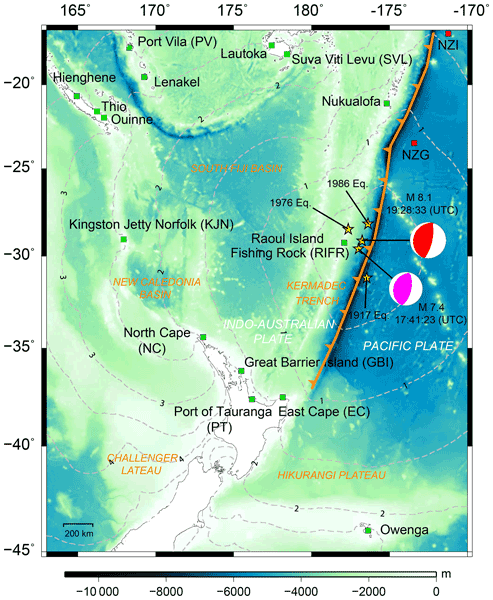
Tsunami waveforms contain the features of its source, propagation path, and local topography. On 4 March 2021, two tsunamis were generated by earthquakes in the Kermadec Islands, New Zealand, within 2 h. This rare case gives us a valuable opportunity to study the characteristics of two tsunamis. We analyzed the records of two tsunamis at tide gauges with spectral analysis tools. It is found that two tsunamis superpose during the few hours after the arrival of the second tsunami.
Cited articles
Acharya, H. K.: Mindanao earthquake of 16 August 1976: Preliminary seismological assessment, B. Seismol. Soc. Am., 68, 1459–1468, 1978.
Allen, T. I. and Hayes, G. P.: Alternative rupture-scaling relationships for subduction interface and other offshore environments, B. Seismol. Soc. Am., 107, 1240–1253, https://doi.org/10.1785/0120160255, 2017.
Aranguiz, R., Catalán, P. A., Cecioni, C., Bellotti, G., Henriquez, P., and González, J.: Tsunami Resonance and Spatial Pattern of Natural Oscillation Modes With Multiple Resonators, J. Geophys. Res.-Oceans, 124, 7797–7816, https://doi.org/10.1029/2019JC015206, 2019.
Athukorala, P. and Resosudarmo, B. P.: The Indian Ocean Tsunami: Economic Impact, Disaster Management, and Lessons, Asian Econ. Pap., 4, 1–39, https://doi.org/10.1162/asep.2005.4.1.1, 2005.
Aurelio, M. A.: Shear partitioning in the Philippines: Constraints from Philippine Fault and global positioning system data, Isl. Arc, 9, 584–597, https://doi.org/10.1111/j.1440-1738.2000.00304.x, 2008.
Aurelio, M. A., Peña, R. E., and Taguibao, K. J. L.: Sculpting the Philippine archipelago since the Cretaceous through rifting, oceanic spreading, subduction, obduction, collision and strike-slip faulting: Contribution to IGMA5000, J. Asian Earth Sci., 72, 102–107, https://doi.org/10.1016/j.jseaes.2012.10.007, 2013.
Baba, T., Cummins, P. R., Hori, T., and Kaneda, Y.: High precision slip distribution of the 1944 Tonankai earthquake inferred from tsunami waveforms: Possible slip on a splay fault, Tectonophysics, 426, 119–134, https://doi.org/10.1016/j.tecto.2006.02.015, 2006.
Baba, T., Takahashi, N., Kaneda, Y., Ando, K., Matsuoka, D., and Kato, T.: Parallel Implementation of Dispersive Tsunami Wave Modeling with a Nesting Algorithm for the 2011 Tohoku Tsunami, Pure Appl. Geophys., 172, 3455–3472, https://doi.org/10.1007/s00024-015-1049-2, 2015.
Baba, T., Allgeyer, S., Hossen, J., Cummins, P. R., Tsushima, H., Imai, K., Yamashita, K., and Kato, T.: Accurate numerical simulation of the far-field tsunami caused by the 2011 Tohoku earthquake, including the effects of Boussinesq dispersion, seawater density stratification, elastic loading, and gravitational potential change, Ocean Model., 111, 46–54, https://doi.org/10.1016/j.ocemod.2017.01.002, 2017.
Badillo, V. L. and Astilla, Z. C.: Moro Gulf Tsunami of 17 August 1976, National Committee on Marine Sciences (Philippines). Special Committee on Tsunami Warning System, Quezon City, Philippines, 1978.
Balmino, G., Vales, N., Bonvalot, S., and Briais, A.: Spherical harmonic modelling to ultra-high degree of Bouguer and isostatic anomalies, J. Geodesy, 86, 499–520, https://doi.org/10.1007/s00190-011-0533-4, 2012.
Bautista, M. L. P., Bautista, B. C., Joan, S., and Narag, I.: Philippine Tsunamis and Seiches (1589–2012), 1–111, Philippine Institute of Volcanology and Seismology, 2012.
Bécel, A., Shillington, D. J., Delescluse, M., Nedimović, M. R., Abers, G. A., Saffer, D. M., Webb, S. C., Keranen, K. M., Roche, P.-H., Li, J., and Kuehn, H.: Tsunamigenic structures in a creeping section of the Alaska subduction zone, Nat. Geosci., 10, 609–613, https://doi.org/10.1038/ngeo2990, 2017.
Benazir, Triatmadja, R., Syamsidik, Nizam, and Warniyati: Vegetation-based approached for tsunami risk reduction: Insights and challenges, Prog. Disaster Sci., 23, 100352, https://doi.org/10.1016/j.pdisas.2024.100352, 2024.
Bletery, Q., Thomas, A. M., Rempel, A. W., Karlstrom, L., Sladen, A., and De Barros, L.: Mega-earthquakes rupture flat megathrusts, Science, 354, 1027–1031, https://doi.org/10.1126/science.aag0482, 2016.
Bondár, I., Engdahl, E. R., Villaseñor, A., Harris, J., and Storchak, D.: ISC-GEM: Global Instrumental Earthquake Catalogue (1900–2009), II. Location and seismicity patterns, Phys. Earth Planet. In., 239, 2–13, https://doi.org/10.1016/j.pepi.2014.06.002, 2015.
Brizzi, S., van Zelst, I., Funiciello, F., Corbi, F., and van Dinther, Y.: How Sediment Thickness Influences Subduction Dynamics and Seismicity, J. Geophys. Res.-Sol. Ea., 125, 1–19, https://doi.org/10.1029/2019JB018964, 2020.
Brocher, T. M., Filson, J. R., Fuis, G. S., Haeussler, P. J., Holzer, T. L., Plafker, G., and Blair, J. L.: The 1964 Great Alaska Earthquake and tsunamis: a modern perspective and enduring legacies, U.S. Geological Survey, https://doi.org/10.3133/fs20143018, 2014.
Chlieh, M., Avouac, J. P., Sieh, K., Natawidjaja, D. H., and Galetzka, J.: Heterogeneous coupling of the Sumatran megathrust constrained by geodetic and paleogeodetic measurements, J. Geophys. Res.-Sol. Ea., 113, 1–31, https://doi.org/10.1029/2007JB004981, 2008.
Claro, S. M. D., Ramos, N. T., Fernando, A. G. S., Ishimura, D., and Switzer, A. D.: Sedimentological evidence of washover deposits from extreme wave events in Zamboanga del Sur, Mindanao, southern Philippines, Mar. Geol., 438, 106535, https://doi.org/10.1016/j.margeo.2021.106535, 2021.
Debaecker, S., Feuillet, N., Satake, K., Sowa, K., Yamada, M., Sato, T., Nakamura, M., Watanabe, A., Saiki, A., Saurel, J.-M., Occhipinti, G., Yu, T.-L., and Shen, C.-C.: Evidence of megathrust earthquakes and seismic supercycles in subtropical Japan from millennia-old coral microatolls, Nat. Commun., 17, 1398, https://doi.org/10.1038/s41467-025-67724-2, 2026.
Delouis, B., Nocquet, J., and Vallée, M.: Slip distribution of the 27 February 2010 Mw = 8.8 Maule Earthquake, central Chile, from static and high-rate GPS, InSAR, and broadband teleseismic data, Geophys. Res. Lett., 37, 1–7, https://doi.org/10.1029/2010GL043899, 2010.
Dengler, L.: The Role of Education in the National Tsunami Hazard Mitigation Program, Nat. Hazards, 35, 141–153, https://doi.org/10.1007/s11069-004-2409-x, 2005.
Di Giacomo, D., Bondár, I., Storchak, D. A., Engdahl, E. R., Bormann, P., and Harris, J.: ISC-GEM: Global Instrumental Earthquake Catalogue (1900–2009), III. Re-computed M and m, proxy M, final magnitude composition and completeness assessment, Phys. Earth Planet. In., 239, 33–47, https://doi.org/10.1016/j.pepi.2014.06.005, 2015.
Di Giacomo, D., Engdahl, E. R., and Storchak, D. A.: The ISC-GEM Earthquake Catalogue (1904–2014): status after the Extension Project, Earth Syst. Sci. Data, 10, 1877–1899, https://doi.org/10.5194/essd-10-1877-2018, 2018.
Duke, C. M.: The Chilean Earthquakes of May 1960, Science, 132, 1797–1802, https://doi.org/10.1126/science.132.3442.1797, 1960.
Fagereng, Å. and Beall, A.: Is complex fault zone behaviour a reflection of rheological heterogeneity?, Philos. T. R. Soc. A, 379, 20190421, https://doi.org/10.1098/rsta.2019.0421, 2021.
Fan, J. and Zhao, D.: P-wave anisotropic tomography of the central and southern Philippines, Phys. Earth Planet. In., 286, 154–164, https://doi.org/10.1016/j.pepi.2018.12.001, 2019.
Fan, J. and Zhao, D.: Subslab heterogeneity and giant megathrust earthquakes, Nat. Geosci., 14, 349–353, https://doi.org/10.1038/s41561-021-00728-x, 2021.
Fan, J., Zhao, D., Dong, D., and Zhang, G.: P-wave tomography of subduction zones around the central Philippines and its geodynamic implications, J. Asian Earth Sci., 146, 76–89, https://doi.org/10.1016/j.jseaes.2017.05.015, 2017.
Fujii, Y., Satake, K., Watada, S., and Ho, T.-C.: Slip distribution of the 2005 Nias earthquake (Mw 8.6) inferred from geodetic and far-field tsunami data, Geophys. J. Int., 223, 1162–1171, https://doi.org/10.1093/gji/ggaa384, 2020.
Fujiwara, T., Kodaira, S., No, T., Kaiho, Y., Takahashi, N., and Kaneda, Y.: The 2011 Tohoku-Oki earthquake: Displacement reaching the trench axis, Science, 334, 1240, https://doi.org/10.1126/science.1211554, 2011.
Galgana, G., Hamburger, M., McCaffrey, R., Corpuz, E., and Chen, Q.: Analysis of crustal deformation in Luzon, Philippines using geodetic observations and earthquake focal mechanisms, Tectonophysics, 432, 63–87, https://doi.org/10.1016/j.tecto.2006.12.001, 2007.
GEBCO Compilation Group: GEBCO 2024 Grid, https://doi.org/10.5285/1c44ce99-0a0d-5f4f-e063-7086abc0ea0f, 2024.
Hayes, G. P., Moore, G. L., Portner, D. E., Hearne, M., Flamme, H., Furtney, M., and Smoczyk, G. M.: Slab2, a comprehensive subduction zone geometry model, Science, 362, 58–61, https://doi.org/10.1126/science.aat4723, 2018.
Heinrich, P. H., Piatanesi, A., and Hébert, H.: Numerical modelling of tsunami generation and propagation from submarine slumps: The 1998 Papua New Guinea event, Geophys. J. Int., 145, 97–111, https://doi.org/10.1111/j.1365-246X.2001.00336.x, 2001.
Hilde, T. W. C., Uyeda, S., and Kroenke, L.: Evolution of the western pacific and its margin, Tectonophysics, 38, https://doi.org/10.1016/0040-1951(77)90205-0, 1977.
Holloway, R. and Hall, R.: Reconstructing Cenozoic SE Asia, Geol. Soc. Spec. Publ., 106, 153–184, https://doi.org/10.1144/GSL.SP.1996.106.01.11, 1996.
Hsu, Y.-J., Yu, S.-B., Song, T.-R. A., and Bacolcol, T.: Plate coupling along the Manila subduction zone between Taiwan and northern Luzon, J. Asian Earth Sci., 51, 98–108, https://doi.org/10.1016/j.jseaes.2012.01.005, 2012.
Hsu, Y.-J., Yu, S.-B., Loveless, J. P., Bacolcol, T., Solidum, R., Luis, A., Pelicano, A., and Woessner, J.: Interseismic deformation and moment deficit along the Manila subduction zone and the Philippine Fault system, J. Geophys. Res.-Sol. Ea., 121, 7639–7665, https://doi.org/10.1002/2016JB013082, 2016.
Imamura, F., Gica, E., Takahashi, T., and Shuto, N.: Numerical simulation of the 1992 Flores tsunami: Interpretation of tsunami phenomena in northeastern Flores Island and damage at Babi Island, Pure Appl. Geophys., 144, 555–568, https://doi.org/10.1007/BF00874383, 1995.
jagurs-admin: jagurs-admin/jagurs: JAGURS-D_V0515a (Version JAGURS-D_V0515a), Zenodo [computer software], https://doi.org/10.5281/zenodo.3737816, 2020.
Kajitani, Y., Chang, S. E., and Tatano, H.: Economic Impacts of the 2011 Tohoku-Oki Earthquake and Tsunami, Earthq. Spectra, 29, 457–478, https://doi.org/10.1193/1.4000108, 2013.
Kreemer, C., Blewitt, G., and Klein, E. C.: A geodetic plate motion and Global Strain Rate Model, Geochem. Geophy. Geosy, 15, 3849–3889, https://doi.org/10.1002/2014GC005407, 2014.
Laske, G., Masters, G., Ma, Z., and Pasyanos, M.: Update on CRUST1.0 – A 1-degree Global Model of Earth's Crust, Geophys. Res. Abstr., EGU2013-2658, EGU General Assembly 2013, Vienna, Austria, 2013.
Li, L., Switzer, A. D., Chan, C., Wang, Y., Weiss, R., and Qiu, Q.: How heterogeneous coseismic slip affects regional probabilistic tsunami hazard assessment: A case study in the South China Sea, J. Geophys. Res.-Sol. Ea., 121, 6250–6272, https://doi.org/10.1002/2016JB013111, 2016.
Métois, M., Socquet, A., Vigny, C., Carrizo, D., Peyrat, S., Delorme, A., Maureira, E., Valderas-Bermejo, M.-C., and Ortega, I.: Revisiting the North Chile seismic gap segmentation using GPS-derived interseismic coupling, Geophys. J. Int., 194, 1283–1294, https://doi.org/10.1093/gji/ggt183, 2013.
Métois, M., Vigny, C., and Socquet, A.: Interseismic Coupling, Megathrust Earthquakes and Seismic Swarms Along the Chilean Subduction Zone (38°–18° S), Pure Appl. Geophys., 173, 1431–1449, https://doi.org/10.1007/s00024-016-1280-5, 2016.
Michel, S., Gualandi, A., and Avouac, J. P.: Interseismic Coupling and Slow Slip Events on the Cascadia Megathrust, Pure Appl. Geophys., 176, 3867–3891, https://doi.org/10.1007/s00024-018-1991-x, 2019.
Moreno, M., Rosenau, M., and Oncken, O.: 2010 Maule earthquake slip correlates with pre-seismic locking of Andean subduction zone, Nature, 467, 198–202, https://doi.org/10.1038/nature09349, 2010.
Nakata, K., Katsumata, A., and Muhari, A.: Submarine landslide source models consistent with multiple tsunami records of the 2018 Palu tsunami, Sulawesi, Indonesia, Earth, Planets Sp., 72, 44, https://doi.org/10.1186/s40623-020-01169-3, 2020.
Nawanao, L. P. and Ramos, N. T.: Frontal wedge variations and controls of submarine landslides in the Negros–Sulu Trench System, Philippines, Front. Earth Sci., 11, 1–17, https://doi.org/10.3389/feart.2023.1054825, 2023.
Nawanao Jr., L. and Ramos, N.: Tsunami Models from Negros–Sulu Megathrust (Philippines) Rupture Scenarios. In Seismic and Tsunami Hazard Potential of the Negros–Sulu Megathrust, Philippines (Version 1.0), Zenodo [data set], https://doi.org/10.5281/zenodo.17234831, 2025.
Nishikawa, T. and Ide, S.: Earthquake size distribution in subduction zones linked to slab buoyancy, Nat. Geosci., 1–5, https://doi.org/10.1038/NGEO2279, 2014.
Nurashid, N. I. I., Shibazaki, B., Fujii, Y., and Yanagisawa, H.: Tsunami inundation modeling along the east coast of Sabah, Malaysia for potential earthquakes in Sulu sea, Bull. Int. Inst. Seismol. Earthq. Eng., 47, 127–132, 2013.
Oetjen, J., Sundar, V., Venkatachalam, S., Reicherter, K., Engel, M., Schüttrumpf, H., and Sannasiraj, S. A.: A comprehensive review on structural tsunami countermeasures, Nat. Hazards, 113, 1419–1449, https://doi.org/10.1007/s11069-022-05367-y, 2022.
Okada, Y.: Surface deformation due to shear and tensile faults in a half-space, B. Seismol. Soc. Am., 75, 1135–1154, https://doi.org/10.1785/BSSA0750041135, 1985.
Okal, E. A., Synolakis, C. E., and Kalligeris, N.: Tsunami Simulations for Regional Sources in the South China and Adjoining Seas, Pure Appl. Geophys., 168, 1153–1173, https://doi.org/10.1007/s00024-010-0230-x, 2011.
Ozawa, S., Nishimura, T., Munekane, H., Suito, H., Kobayashi, T., Tobita, M., and Imakiire, T.: Preceding, coseismic, and postseismic slips of the 2011 Tohoku earthquake, Japan, J. Geophys. Res.-Sol. Ea., 117, https://doi.org/10.1029/2011JB009120, 2012.
Parcutela, N. E., Dimalanta, C. B., Armada, L. T., and Yumul, G. P.: PHILCRUST3.0: New constraints in crustal growth rate computations for the Philippine arc, J. Asian Earth Sci. X, 4, 100032, https://doi.org/10.1016/j.jaesx.2020.100032, 2020.
Pedersen, C., Latif, Z. A., and Lai, C.: TSUNAMI MODELLING AND RISK MAPPING FOR EAST COAST OF SABAH, MALAYSIA, Coast. Eng. Proc., 1, 55, https://doi.org/10.9753/icce.v32.currents.55, 2011.
Peñarubia, H. C., Johnson, K. L., Styron, R. H., Bacolcol, T. C., Sevilla, W. I. G., Perez, J. S., Bonita, J. D., Narag, I. C., Solidum, R. U., Pagani, M. M., and Allen, T. I.: Probabilistic seismic hazard analysis model for the Philippines, Earthq. Spectra, 36, 44–68, https://doi.org/10.1177/8755293019900521, 2020.
Qiu, Q., Li, L., Hsu, Y.-J., Wang, Y., Chan, C.-H., and Switzer, A. D.: Revised earthquake sources along Manila trench for tsunami hazard assessment in the South China Sea, Nat. Hazards Earth Syst. Sci., 19, 1565–1583, https://doi.org/10.5194/nhess-19-1565-2019, 2019.
Ramirez, A. B. G., Ramos, N. T., Nawanao, L. P. J., Mangahas-Flores, R. Z., Narag, I. C., Baba, T., Chikasada, N., and Satake, K.: An Earthquake-Triggered Submarine Mass Failure Mechanism for the 1994 Mindoro Tsunami in the Philippines: Constraints from Numerical Modeling and Submarine Geomorphology, Front. Earth Sci., 10, 1–20, https://doi.org/10.3389/feart.2022.1067002, 2022.
Ramos, N. T., Maxwell, K. V., Tsutsumi, H., Chou, Y.-C., Duan, F., Shen, C.-C., and Satake, K.: Occurrence of 1 ka-old corals on an uplifted reef terrace in west Luzon, Philippines: Implications for a prehistoric extreme wave event in the South China Sea region, Geosci. Lett., 4, 12, https://doi.org/10.1186/s40562-017-0078-3, 2017.
Rangin, C., Le Pichon, X., Mazzotti, S., Pubellier, M., Chamot-Rooke, N., Aurelio, M., Walpersdorf, A., and Quebral, R.: Plate convergence measured by GPS across the Sundaland/Philippine Sea Plate deformed boundary: the Philippines and eastern Indonesia, Geophys. J. Int., 139, 296–316, https://doi.org/10.1046/j.1365-246x.1999.00969.x, 1999.
Roeber, V., Yamazaki, Y., and Cheung, K. F.: Resonance and impact of the 2009 Samoa tsunami around Tutuila, American Samoa, Geophys. Res. Lett., 37, https://doi.org/10.1029/2010GL044419, 2010.
Salcedo, J. C. and Hara, T.: Earthquake source parameters for subduction zone events causing tsunamis in and around the Philippines, Bull. Int. Inst. Seismol. Earthq. Eng., 45, 49–54, 2011.
Satake, K.: 28 Tsunamis, in: International Handbook of Earthquake and Engineering Seismology, Part A, edited by: Lee, W. H. K., Kanamori, H., Jennings, P. C., and Kisslinger, C., Academic Press, 437–451, https://doi.org/10.1016/S0074-6142(02)80231-5, 2002.
Satake, K.: Recurrence and Long-Term Evaluation of Kanto Earthquakes, B. Seismol. Soc. Am., 113, 1826–1841, https://doi.org/10.1785/0120230072, 2023.
Schambach, L., Grilli, S. T., Tappin, D. R., Gangemi, M. D., and Barbaro, G.: New simulations and understanding of the 1908 Messina tsunami for a dual seismic and deep submarine mass failure source, Mar. Geol., 421, 106093, https://doi.org/10.1016/j.margeo.2019.106093, 2020.
Schellart, W. P. and Rawlinson, N.: Global correlations between maximum magnitudes of subduction zone interface thrust earthquakes and physical parameters of subduction zones, Phys. Earth Planet. In., 225, 41–67, https://doi.org/10.1016/j.pepi.2013.10.001, 2013.
Sevilla, W. I.: Seismic Velocity Variations Under Island Arcs: Examples from the Philippines and Montserrat, Pennsylvania State University, 1–202, https://etda.libraries.psu.edu/catalog/10285 (last access: 8 October 2026), 2011.
Simons, W. J. F., Ambrosius, B. A. C., Noomen, R., Angermann, D., Wilson, P., Becker, M., Reinhart, E., Walpersdorf, A., and Vigny, C.: Observing plate motions in S.E. Asia: Geodetic results of the GEODYSSEA Project, Geophys. Res. Lett., 26, 2081–2084, https://doi.org/10.1029/1999GL900395, 1999.
Skarlatoudis, A. A., Somerville, P. G., and Thio, H. K.: Source-scaling relations of interface subduction earthquakes for strong ground motion and tsunami simulation, B. Seismol. Soc. Am., 106, 1652–1662, https://doi.org/10.1785/0120150320, 2016.
Storchak, D. A., Di Giacomo, D., Bondar, I., Engdahl, E. R., Harris, J., Lee, W. H. K., Villasenor, A., and Bormann, P.: Public Release of the ISC-GEM Global Instrumental Earthquake Catalogue (1900–2009), Seismol. Res. Lett., 84, 810–815, https://doi.org/10.1785/0220130034, 2013.
Storchak, D. A., Di Giacomo, D., Engdahl, E. R., Harris, J., Bondár, I., Lee, W. H. K., Bormann, P., and Villaseñor, A.: The ISC-GEM Global Instrumental Earthquake Catalogue (1900–2009): Introduction, Phys. Earth Planet. In., 239, 48–63, https://doi.org/10.1016/j.pepi.2014.06.009, 2015.
Stratta, J. L., Canon, T. J., Duke, M. C., and Selna, L. G.: Reconnaissance Report of the Mindanao, Philippine Earthquake of 17 August 1976, 100 pp., Earthquake Engineering Research Institute, https://learningfromearthquakes.org/wp-content/uploads/EERI-LFE-Reconnaissance-Report-Mindanao-Philippines-1976.pdf (last access: 8 October 2026), 1977.
Straume, E. O., Gaina, C., Medvedev, S., Hochmuth, K., Gohl, K., Whittaker, J. M., Abdul Fattah, R., Doornenbal, J. C., and Hopper, J. R.: GlobSed: Updated Total Sediment Thickness in the World's Oceans, Geochem. Geophy. Geosy., 20, 1756–1772, https://doi.org/10.1029/2018GC008115, 2019.
Strusińska-Correia, A.: Tsunami mitigation in Japan after the 2011 Tōhoku Tsunami, Int. J. Disast. Risk Re., 22, 397–411, https://doi.org/10.1016/j.ijdrr.2017.02.001, 2017.
Suppasri, A., Muhari, A., Ranasinghe, P., Mas, E., Shuto, N., Imamura, F., and Koshimura, S.: Damage and reconstruction after the 2004 Indian Ocean tsunami and the 2011 Great East Japan tsunami, J. Nat. Disaster Sci., 34, 19–39, https://doi.org/10.2328/jnds.34.19, 2012.
Tajima, R., Matsu, Y., Si, H., and Irikuda, K.: Comparative Study on Scaling Relations of Source Parameters for Great Earthquakes in Inland Crusts and on Subducting Plate-Boundaries, Zisin [Journal Seismol. Soc. Japan. 2nd ser.], 66, 31–45, https://doi.org/10.4294/zisin.66.31, 2013.
Takagi, H., Pratama, M. B., Kurobe, S., Esteban, M., Aránguiz, R., and Ke, B.: Analysis of generation and arrival time of landslide tsunami to Palu City due to the 2018 Sulawesi earthquake, Landslides, 983–991, https://doi.org/10.1007/s10346-019-01166-y, 2019.
Tanioka, Y. and Seno, T.: Sediment effect on tsunami generation of the 1896 Sanriku Tsunami Earthquake, Geophys. Res. Lett., 28, 3389–3392, https://doi.org/10.1029/2001GL013149, 2001.
Vela, J., Pérez, B., González, M., Otero, L., Olabarrieta, M., Canals, M., and Casamor, J. L.: Tsunami Resonance in Palma Bay and Harbor, Majorca Island, as Induced by the 2003 Western Mediterranean Earthquake, J. Geol., 122, 165–182, https://doi.org/10.1086/675256, 2014.
Volpe, G., Pozzi, G., Locchi, M. E., Tinti, E., Scuderi, M. M., Marone, C., and Collettini, C.: Rheological heterogeneities at the roots of the seismogenic zone, Geology, 51, 988–992, https://doi.org/10.1130/G51432.1, 2023.
Witter, R. C., Carver, G. A., Briggs, R. W., Gelfenbaum, G., Koehler, R. D., La Selle, S., Bender, A. M., Engelhart, S. E., Hemphill-Haley, E., and Hill, T. D.: Unusually large tsunamis frequent a currently creeping part of the Aleutian megathrust, Geophys. Res. Lett., 43, 76–84, https://doi.org/10.1002/2015GL066083, 2016.
Wu, T.-R. and Huang, H.-C.: Modeling tsunami hazards from Manila trench to Taiwan, J. Asian Earth Sci., 36, 21–28, https://doi.org/10.1016/j.jseaes.2008.12.006, 2009.
Yabe, S. and Ide, S.: Variations in precursory slip behavior resulting from frictional heterogeneity, Prog. Earth Planet. Sc., 5, 43, https://doi.org/10.1186/s40645-018-0201-x, 2018.
Yamazaki, Y. and Cheung, K. F.: Shelf resonance and impact of near-field tsunami generated by the 2010 Chile earthquake, Geophys. Res. Lett., 38, https://doi.org/10.1029/2011GL047508, 2011.
Yumul, G. P., Dimalanta, C. B., Tamayo, R. A., and Maury, R. C.: Collision, subduction and accretion events in the Philippines: A synthesis, Isl. Arc, 12, 77–91, https://doi.org/10.1046/j.1440-1738.2003.00382.x, 2003.
Yumul, G. P., Dimalanta, C. B., Maglambayarw, V. B., and Marquez, E. J.: Tectonic setting of a composite terrane: A review of the Philippine island arc system, Geosci. J., 12, 7–17, https://doi.org/10.1007/s12303-008-0002-0, 2008.
Zahirovic, S., Seton, M., and Müller, R. D.: The Cretaceous and Cenozoic tectonic evolution of Southeast Asia, Solid Earth, 5, 227–273, https://doi.org/10.5194/se-5-227-2014, 2014.
Zhao, G. and Niu, X.: Local amplification of tsunami waves along the west coast of Negros Island and Panay Island, Appl. Ocean Res., 123, 103175, https://doi.org/10.1016/j.apor.2022.103175, 2022.
Short summary
The scarcity of information on the Negros–Sulu megathrust impedes reliable seismic and tsunami hazard assessments. Here, we estimated 18 megathrust rupture scenarios based on available data and modeled tsunami propagations to identify highly exposed coastal areas surrounding the Sulu Sea. The generated rupture parameters, maximum wave heights, flow velocity, and minimum arrival times provide significant bases for regional-scale mitigation strategies and exploring tsunami deposits.
The scarcity of information on the Negros–Sulu megathrust impedes reliable seismic and tsunami...


Altmetrics
Final-revised paper
Preprint