
the Creative Commons Attribution 4.0 License.
the Creative Commons Attribution 4.0 License.
 | 06 Oct 2026
Simulation of sliding deadwood logs in mountain forests: towards a quantitative hazard assessment

Peter Bebi
Leon J. Bührle
Adrian Ringenbach
Remco I. Leine
Deadwood is an integral component of mountain forests, supporting biodiversity and contributing to protection against gravitational hazards. However, under specific conditions, deadwood may itself become a hazard when mobilised and transported downslope. Although sliding logs have been repeatedly observed in steep forests, a quantitative framework to assess their hazard potential has so far been lacking. We present a physics-based model to simulate the motion and runout of sliding deadwood logs in complex terrain. The model extends an existing rockfall simulation framework based on nonsmooth rigid-body dynamics with hard contact laws and Coulomb friction, explicitly representing deadwood log geometries and interactions with terrain, standing trees, and protective structures. Model calibration and evaluation are performed using two recent Swiss case studies in which deadwood logs up to 35 m in length travelled several hundred metres in a single rapid descent and impacted infrastructure. Simulations indicate that sliding deadwood hazard is favoured by very steep slopes > 35°, wet surface conditions, and a narrow decay-stage window characterised by the loss of bark and branches to reduce sliding friction while still retaining sufficient structural strength. Sliding trajectories are strongly controlled by micro-topography, with preferential paths along gullies, while standing trees limit downslope propagation but increase lateral spread through repeated deflections. The proposed model highlights the importance of adaptive forest management in mountain forests and provides a quantitative basis for optimising the balance between the protective and hazardous roles of deadwood.
- Article
(9717 KB) - Full-text XML
- BibTeX
- EndNote


Mountain forests provide cost-effective and natural protection of civil infrastructure against natural hazards in mountain regions (Moos et al., 2017; Getzner et al., 2017; Olschewski et al., 2012). The amount of deadwood in Swiss mountain forests has doubled during the last three decades, from 17 m3 ha−1 in 1995 (Abegg et al., 2023b) to 35 m3 ha−1 today (Abegg et al., 2023a). Under future climatic conditions, the amount of standing and lying deadwood is expected to increase as a result of enhanced drought-induced tree mortality and intensifying natural disturbance regimes (Seidl et al., 2017). While the influence of deadwood on biodiversity (Gossner et al., 2016; Plath and Fischer, 2024), regeneration processes (Marangon et al., 2024), and other ecological functions (Edelmann et al., 2023; Mayer et al., 2022) is relatively well investigated, its effects on protection against natural hazards are less studied and often debated (Fuhr et al., 2015). The few studies conducted so far suggest that deadwood can reduce the risk of avalanches (Caduff et al., 2022; Feistl et al., 2014; Rammig et al., 2007; Schönenberger et al., 2005) and rockfalls (Bourrier et al., 2012; Ringenbach et al., 2023; Costa et al., 2021) in the short to medium term. There are, however, also potential risks associated with leaving deadwood after natural disturbances, including subsequent bark beetle infestations in spruce-dominated forests (Stadelmann et al., 2014), the secondary triggering of rockfall after advanced wood decay (Ringenbach et al., 2022a), and blockage of streams increasing the risk of debris flows and floods (Rackelmann et al., 2023). Moving deadwood can also become a hazard itself, making it crucial to understand the conditions under which this occurs. Such risks highlight the need for an integral view in making general recommendations for deadwood management in mountain forests. In order to better assess both the protective effect and hazard potential of deadwood, information on its spatial distribution and potential downward movements must be known. Various processes drive deadwood movement across a range of spatial scales (Harmon et al., 1986). At the broadest scales, rivers and floods transport deadwood up to several kilometres (May and Gresswell, 2003). At the finest scales, deadwood moves through gradual processes (Bebi et al., 2015) or when snags fall (Oberle et al., 2016). In between, on the slope scale, deadwood may be transported by landslides, surface run-off, or avalanches (Kemper and Scamardo, 2023).
This paper is motivated by recent events in Switzerland in which deadwood without bark and branches was mobilised and travelled several hundred metres in a single rapid descent, causing damage to infrastructure. These events are described in more detail in Sect. 2. We focus thereby on deadwood as a direct form of natural hazard when it is mobilised and slides down a steep slope. To date, the mechanics of such rapid sliding events have not been quantified, and no modelling framework exists to describe how mobilised deadwood moves on steep slopes. As the downslope motion of deadwood shares key mechanical characteristics with rockfall, including gravity-driven acceleration, impact, sliding, and deflection by obstacles, existing rockfall modelling frameworks appear in principle to be an ideal framework for such simulations. However, from a modelling perspective, sliding deadwood poses specific requirements that are not fulfilled by most existing rockfall models, including the ability to represent sliding motion, simulate arbitrary three-dimensional object shapes, and explicitly model interactions with individual standing trees. These limitations motivate the use and adaptation of a physically based rigid-body framework in this study. We therefore adapt the physical approach of RAMMS::Rockfall (Christen et al., 2014) introduced by Leine et al. (2014), using non-smooth, rigid-body mechanics in combination with hard contact laws and Coulomb friction. We calibrate and validate the model based on case studies of recent sliding deadwood events, discuss the factors favouring mobilisation and critical predispositions related to deadwood and terrain conditions, and finally assess the relevance of sliding deadwood logs in the context of other natural hazards as well as their implications for mountain forest management.
2.1 Klosters, Graubünden (CH)
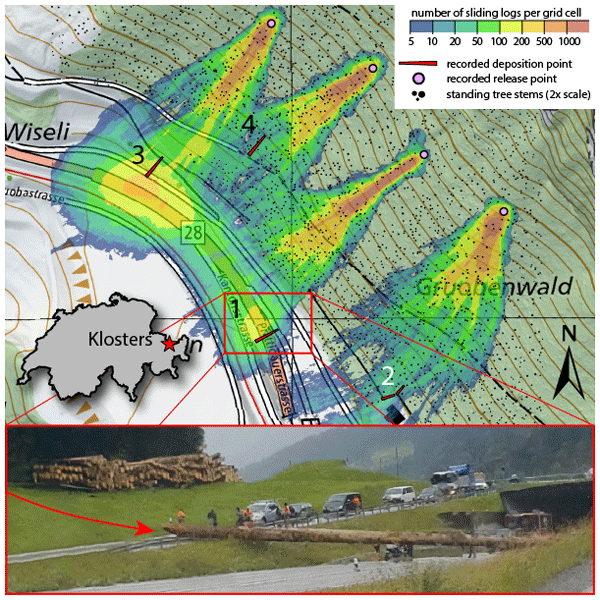
Gruobenwald (46.89025° N; 9.85585° E; 1050–1300 m a.s.l.) is a roughly 35° steep beech spruce forest near Klosters, Switzerland (see Fig. 1). Due to the steep slope, the cliffs above the forest, which reach heights of up to 130 m, and the exposed infrastructure (road of national importance, railway, residential area), rockfall hazards have been an ongoing issue for many years. As the outdated protective structures needed to be replaced, the construction of new measures started in 2022, consisting of 650 m of reinforced earth dams with a capacity of 5000 kJ and 400 m of rockfall barriers with a capacity of 2000 kJ. There are many dead trees, so called snags, without bark and branches, but which are still standing. In June 2022, a storm with heavy rainfall and wind caused a dead tree to fall and slide approximately 120 m down the slope until it came to rest on the national road (Fig. 1c). The mobilised tree had an approximate diameter at breast height DBH = 75 cm and a stem height hS = 30 m. Two days later, another deadwood log of similar dimensions slid down the slope and came to rest in a wooden palisade next to a building (see Fig. 1b). Due to these two incidents and the associated danger to the construction site, the local forestry operators decided to cut down potentially dangerous snags without bark and branches and to transport them down to the valley by helicopter. During this operation, two more logs were mobilised after being cut down, slid down the slope and came to rest on the road or hiking trail, respectively. After completion of the intervention, there were no more recorded events as of December 2025.
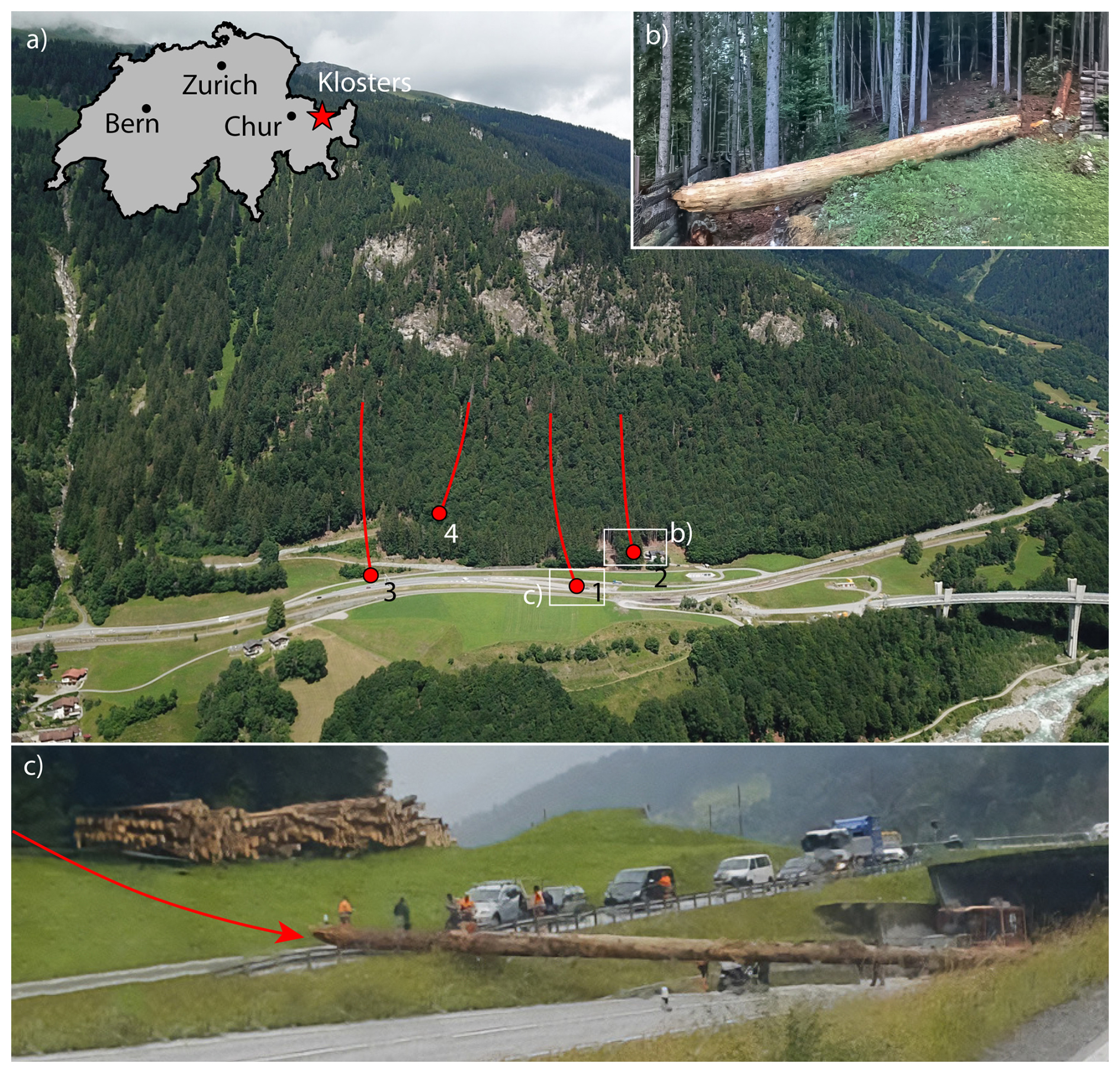
Figure 1The four 2022 events in Gruobenwald, Klosters (CH). (a) Overview of Gruobenwald, including endangered residential area, road and railway. The trajectories and deposition points of the four events are shown qualitatively. Photograph by AWN GR. (b) Deposition of event 2 in a wooden palisade next to a house. (c) Deposition of event 1 on the road. Photograph credit for panels (b) and (c): Flurin Wehrli.
2.2 Rothenbrunnen, Graubünden (CH)
Plattawald (46.77072° N; 9.41829° E; 600–1000 m a.s.l.) is a mountain forest near Rothenbrunnen, Switzerland. The average slope gradient is 35–40°, and a road and railway line run along the foot of the slope. There are numerous cases of rockfall and sliding deadwood on this slope, which cause only minor damage as the rocks and deadwood are caught by a series of rockfall barriers above the road. In February 2022, a tree without bark and branches was mobilised, slid down approximately 200 m in altitude and came to rest in the valley-side guardrail of the road, blocking both the road and the railway. It is unclear whether the mobilised tree was initially standing or lying. Due to a thin layer of snow on the day of the incident, the tracks of the sliding log were clearly visible and were documented by the local forestry operations. As the section of road where the log was deposited is protected by a 3.5 m high rockfall barrier and no traces were found in the immediate vicinity of the barrier, the log must have jumped over the barrier. This claim is reinforced by the fact that the last traces were found on a small terrace about 20 m above the barrier, where the log was presumably launched into the air. The next tracks were then found on the retaining wall next to the road.
For the modelling and simulation of the trajectories of sliding deadwood, we apply the theory and methods of nonsmooth dynamics (Acary and Brogliato, 2008; Leine and van de Wouw, 2008), encompassing rigid-body mechanics coupled with hard contact laws and Coulomb friction. Hereto, we adopt the framework for rockfall modelling introduced by Leine et al. (2014), which provides the mathematical basis for the kinematics, contact formulation, Coulomb friction, and Newton-type impact law, and we adapt this framework to the modelling of sliding deadwood. The deadwood is modelled as rigid, convex polytopes in the shape of a truncated cone, representing straight, radially symmetrical logs with a smooth surface (see Fig. 2b). The properties of these logs include a DBH, simplified as the base diameter of the truncated cone, a stem height hS (also referred to as log length when lying) and a density ρS. The top diameter of the truncated cone is approximated with 0.5 DBH.

Figure 2Simulation model of the sliding deadwood. (a) DEM and standing trees are described in the inertial frame I. Two sliding deadwood logs are exemplary shown as a time series starting at the mobilisation time t0 up to the deposition time tE. (b) Rigid, sliding deadwood with its geometry described as a point cloud in body-fixed frame K fixed at the centre of mass S. (c) Contact between deadwood geometry and terrain with contact forces λi acting at vertex points of the point cloud.
3.1 Coordinate frames and generalised coordinates
Following Leine et al. (2014), the motion of the log is described using two coordinate frames. The inertial frame I is fixed in space and anchored at the origin O, which is defined at the origin of the digital elevation model (DEM). The axes and span the horizontal plane, while the axis extends along the vertical, counter-gravitational direction. The body-fixed frame K is attached to the centre of mass S of the log. The three axes , and are along the log's principal axes of inertia. The minor principal axis of inertia for a truncated cone lies in its longitudinal direction, which we define as . The two coordinate systems, their origins and axes are shown in Fig. 2a.
At any time t, the position and orientation of the log, modelled as a rigid body, is given by the generalised coordinates q:
where IrOS is the position vector from the origin O to the centre of mass S, expressed in the inertial frame I, and is a unit quaternion describing the orientation of the log. A linear mapping of the dimension-reduced, generalised velocities u leads to :
where IvS is the translational velocity vector expressed in the frame I, and KΩ is the rotational velocity vector represented in the frame K.
3.2 Equations of motion
The time evolution of IvS is given by the balance of linear momentum:
where mR is the mass of the deadwood log. IFg is the gravitational force and IFc is the sum of all contact forces between the log and the terrain. The air resistance is neglected. Accordingly, the time evolution of KΩ obeys Euler's equation:
where KΘS defines the inertia tensor for the log expressed in the frame K, and KMS is the net torque generated by contact forces acting on the boundary of the log. The geometry of the log is approximated by a point cloud defining a polytope. Each vertex may come in contact with the terrain, inducing a contact force at that vertex. The contact forces of all vertices are assembled in a tuple λ. When the sliding log is not in contact with the terrain or surrounding trees, both IFc and KMS are zero. The equation of motion of the sliding deadwood can be summarised as:
Here, M is the diagonal mass matrix, h(q,u) contains the forces acting on the centre of mass (i.e. gravity and gyroscopic terms) and W(q) is the matrix of generalised force directions that transfers all the contact forces at the vertices on the log boundary to a corresponding force and torque at its centre of mass. Equation (5) together with contact laws is solved iteratively using Moreau's time-stepping scheme with a Gauss–Seidel iteration method (Studer, 2008).
3.3 Contact and impact laws
A contact between the log and the terrain is detected whenever at least one vertex of the log lies on or below the terrain surface (Leine et al., 2014). At every contact point, a local contact frame is defined with one normal and two tangential directions relative to the terrain surface. In the contact normal direction, the Signorini condition correlates the normal contact force λN and the normal gap gN as follows:
The two tangential directions are mutually orthogonal and span the local tangent plane, while their orientation within this plane is arbitrary. The tangential contact behaviour within this plane is governed by the spatial Coulomb friction law:
where μ is the sliding friction coefficient. The negative sign indicates that the resulting tangential contact force always acts opposite to the relative tangential contact velocity within the terrain tangent plane. The contact force vectors for 4 vertices are visualised in Fig. 2c.
Additionally, the hard contact approach requires an impact law, which, in combination with an impact equation, defines a mapping from pre- to post impact velocities. The impact law used for this model is based on the Newtonian impact law, which includes two cases (Leine and van de Wouw, 2008):
where and are the normal pre- and post-impact velocity components, and εN is the normal restitution coefficient. The first case corresponds to an active impulsive contact force ΛN>0 whereas the second case describes a separation induced by impacts at other contact points. Consistent with rockfall modelling, we use a normal restitution coefficient of εN=0, following the underlying rockfall model.
3.4 Interaction with standing trees and barriers
The contact detection between a sliding log and standing trees follows the algorithm by Lu et al. (2021), with its interaction also considered as hard contact. The standing trees are modelled as rigid, truncated cones with a DBH and hS (see Fig. 2a). The energy dissipation caused by the uprooting and swaying of standing trees during an impact is not considered. Unlike the original tree model for rockfall applications, the standing trees do not have an energy threshold indicating a breaking failure during impact because of the assumption that the sliding deadwood will always break before the standing tree.
In addition, we include existing rockfall barriers in the model as thin, platy obstacles with the same impact behaviour as the standing trees. The barriers are rigid, have an infinite energy threshold and follow hard contact mechanics.
Due to the geometry of a log, the two main types of motion are either a sliding motion in the direction of the longitudinal axis, as shown in Fig. 2a or rolling around the longitudinal axis. Sliding requires either a steep slope or a low friction coefficient, while rolling is also possible on gentle slopes with high friction. However, in forested areas with standing trees, which is generally the case when considering the hazard of sliding deadwood, the standing trees will catch and block a rolling log. Therefore, sliding is the key process considered in this paper.
Fully deterministic models, such as the proposed one, require stochastic initial conditions to enable a statistical analysis of the results (Christen et al., 2012). In rockfall modelling, this is commonly achieved by varying the release locations or, if the rock shape is considered, by varying the initial orientation of the rock. For sliding deadwood, orientation variations mainly cause immediate interception by standing trees if logs are not aligned downslope. Therefore, the only way to introduce statistical variability is to use small spatial perturbations in the initial deadwood positions. To implement this, circular release polygons with a radius of 10 m are defined around the mapped release locations, within which the initial positions of the deadwood are randomly generated.
For the Klosters case study, the mobilised logs have a DBH of 75 cm and a length of hS=30 m, measured from the deposition of the first event (Fig. 1c). For Rothenbrunnen, the deadwood geometry is estimated from photographs of the deposition, yielding a DBH of 30 cm and a length of hS=15 m. For both case studies, the density of the released deadwood logs is assumed to be ρS=300 kg m−3. The initial orientation of the deadwood is always vertically upright. At the start of the simulation, the logs automatically align with the direction of steepest descent due to the low friction of the terrain (Fig. 2a).
It is important to note that, in reality, these initial conditions are considerably more complex. Mobilised snags may fall in any arbitrary direction, resulting in a variety of different initial momenta, whereas mobilised logs have no initial momentum at all, but still show a wide variety of initial orientations. In this paper, we generalise these initial conditions and focus on describing the sliding run-out behaviour given that the deadwood is mobilised.
The locations, DBH, and heights of the standing trees were derived using airborne laser scan (ALS) data from swisstopo (2020–2024), employing a single tree detection approach from Dalponte et al. (2015). Details on the determination of individual tree locations and heights are provided in Bast et al. (2025b). The DBH was then derived by applying an allometric power function to the detected tree heights, using parameter sets calibrated for the corresponding forest ecoregion and altitudinal vegetation zone (Bührle et al., 2026). The dataset containing the locations, DBH, and heights of the individual trees used in this study is published in Bast et al. (2025a). In addition to the simulation with the actual forest, we also analyse a randomly generated forest with uniformly distributed tree positions based on the observed forest density and with DBH and tree heights sampled from normal distributions fitted to the values derived from the ALS in order to discuss the influence of forest structure. For Klosters, the ALS-based analysis yields a forest density of 300 stems ha−1, with DBH normally distributed with a mean of μDBH=60.23 cm and a standard deviation of σDBH=18.64 cm. For Rothenbrunnen, the corresponding forest density is 315 stems ha−1, with DBH normally distributed with a mean of μDBH=44 cm and a standard deviation of σDBH=22 cm. Finally, an additional scenario without forest is simulated to isolate and assess the protective effect of the forest itself.
These scenarios are compared using two main metrics. First, we quantify the relative frequency of reaching the infrastructure impacted in the observed event as
where Nreach is the number of logs reaching the infrastructure and Ntot is the total number of released logs. Second, we compare the lateral spread Δθ of the individual events, which we define as the widest angle between any two deposition points when viewed from the release area
where θi is the azimuth angle of each deposition point (xi,yi) relative to the release point (x0,y0).
All simulations are performed on a 0.5 m DEM from 2023 (swisstopo, 2020–2024). The trajectories resulting from the 3D simulations are evaluated on the same 0.5 m grid as the DEM. We include the shape of the logs in this evaluation, which means that a trajectory is treated as the envelope of a moving polygon and not as a line without width. Consequently, at each time step, a simulated trajectory affects all cells that overlap any part of the deadwood geometry, not just its centre of mass. The model is implemented in the existing software RAMMS::Rockfall (Christen et al., 2014), which is used as a base framework for all simulations.
5.1 Klosters, Graubünden (CH)
Given the initial conditions derived in Sect. 4, the only unknown model parameter left is the friction coefficient μ. The observed deposition pattern can be reproduced with a friction coefficient in the range of μ = 0.2–0.3. With higher friction, the road cannot be reached by the sliding deadwood. With lower friction, the logs do not stop on the road and continue sliding. The corresponding simulation results for a friction coefficient of μ = 0.25 are shown in Fig. 3a. We assume that all four events occurred with the same deadwood geometry and the same friction coefficient. The simulated deadwood logs show average velocities of 14 m s−1 with maximum velocities reaching 30 m s−1. Out of the 20 000 simulated logs, 1829 reach the national road, as determined by counting the number of trajectories intersecting the pink reference line shown in Fig. 3. This corresponds to a relative frequency of 9.1 % according to Eq. (10). The lateral spread, calculated using Eq. (11), amounts to 40, 60, 60, and 55° for events 1–4, respectively. Figure 3b presents the simulation results under the same conditions as Fig. 3a, but with all newly implemented protection measures in place. In the depicted section, these measures include two embankments and six rockfall barriers completed in 2024, which successfully reduce the relative frequency of reaching the road to 0 %. Figure 3c shows the simulation results for the scenario with a randomly generated forest based on the forest density as well as the DBH and tree height distributions obtained from the ALS data. In this case, the relative frequency of reaching the road is reduced to 7 % without a change in lateral spread compared to the case with the real forest structure. An exemplary magnified section below the first release polygon highlights the structural differences between the real forest (Fig. 3e) and the randomly generated forest (Fig. 3f). Lastly, Fig. 3d presents the scenario without any standing trees. In this case, the relative frequency of reaching the road increases to 74.5 %, while the lateral spread for events 1–4 amounts to 23, 31, 25, and 18°, respectively.
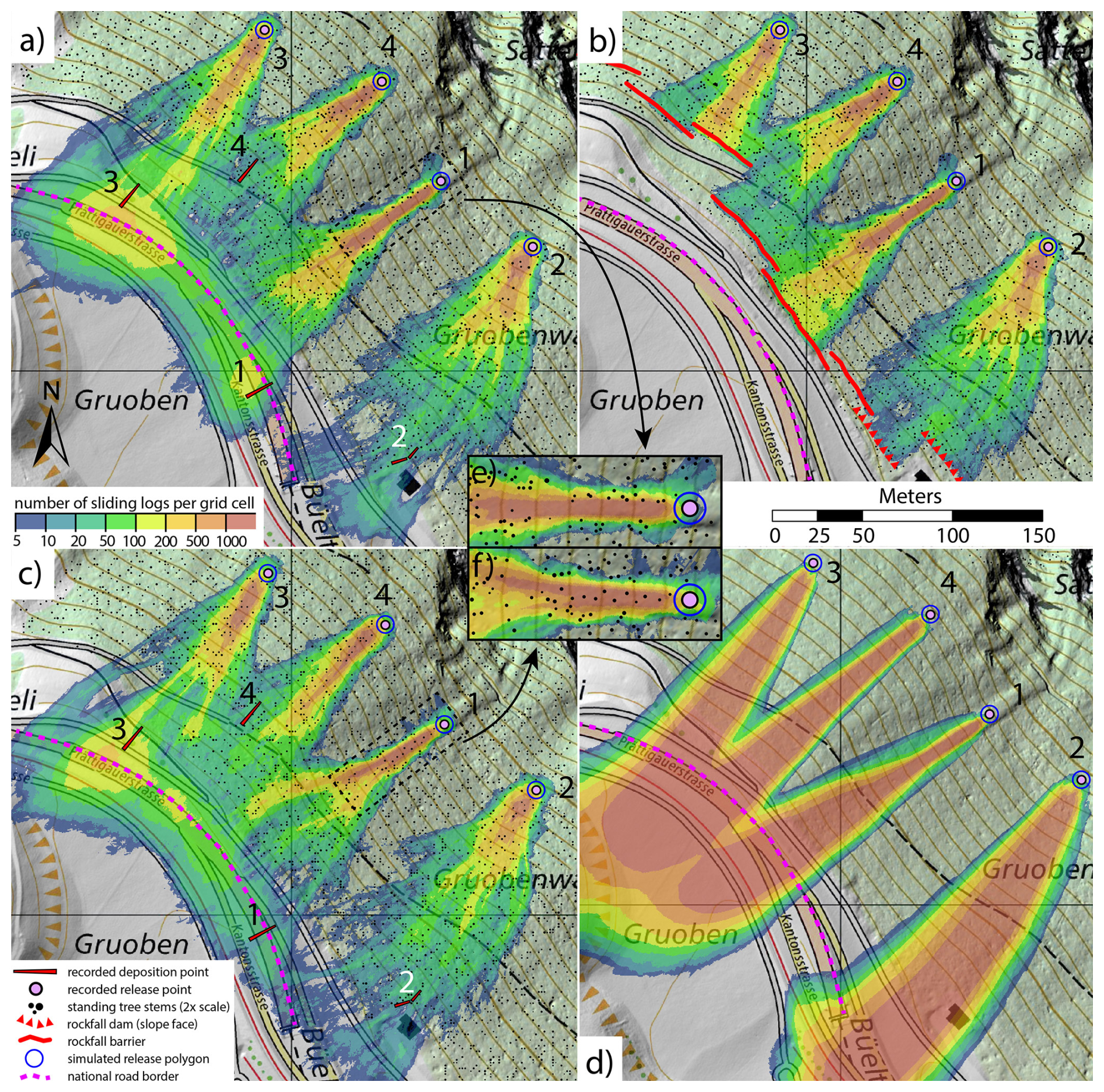
Figure 3Reconstruction of the four events in Gruobenwald, Klosters (CH) with a friction coefficient of μ = 0.25. The colours indicate how many of the 20 000 released logs intersect their motion with each 0.5 × 0.5 m grid cell, revealing preferential sliding paths of the deadwood. (a) Simulation without protection measures and ALS-based tree locations. (b) Simulation with protection measures finished in 2024 and ALS-based tree locations. (c) Simulation without protection measures and randomly generated forest. (d) Simulation without protection measures and no forest. Two magnified sections below release 1 reveal the differences of the forest structure between ALS-based forest (e) and randomly generated forest (f). Map and hillshade from swisstopo (2020–2024).
5.2 Rothenbrunnen, Graubünden (CH)
We can verify the hypothesis of the log jumping over the rockfall barrier by fitting a flight parabola between the presumed take-off and landing points. To obtain the 3D coordinates of the mapped points, they are projected onto a 0.5 m DEM. Since the log was sliding, the lift-off angle must have been equal to the local slope angle. We assume that only gravity acts on the log and that the longitudinal axis of the log is always parallel to the resulting velocity vector. The two projected points, together with the take-off angle, define a unique flight parabola. This parabola passes over the rockfall barrier (see Fig. 4c), which proves that such a jump is indeed possible. In addition, the uniquely defined take-off velocity of 24 m s−1 is within realistic bounds. In order to reach the required take-off velocity to jump over the barrier with the proposed 3D model, a friction coefficient of μ<0.3 is required, which corresponds to the same maximum allowable friction to reconstruct the events in Klosters. Contrary to the Klosters case, however, it is not possible to derive a minimum required friction, as the log was not stopped gradually by friction between log and terrain but abruptly by a guardrail. The 3D simulations confirm that it is possible that a mobilised tree jumps over the rockfall barrier. According to the simulation shown in Fig. 4a, 1442 of the initially 20 000 released logs reached the southernmost barrier of which 1264 were stopped and 178 jumped over. This results in a relative frequency of the observed event of 0.9 % according to Eq. (10). This frequency is small but reasonable given the fact that such an event has never been recorded despite the high number of mobilisations observed. A plausible 3D trajectory of the observed event can be found in Appendix A, Fig. A2. Additionally, we can demonstrate the efficiency of the existing rockfall barriers by removing all protection measures in a simulation (see Fig. 4b). In this case, 4658 logs (23.3 %) reach the road.
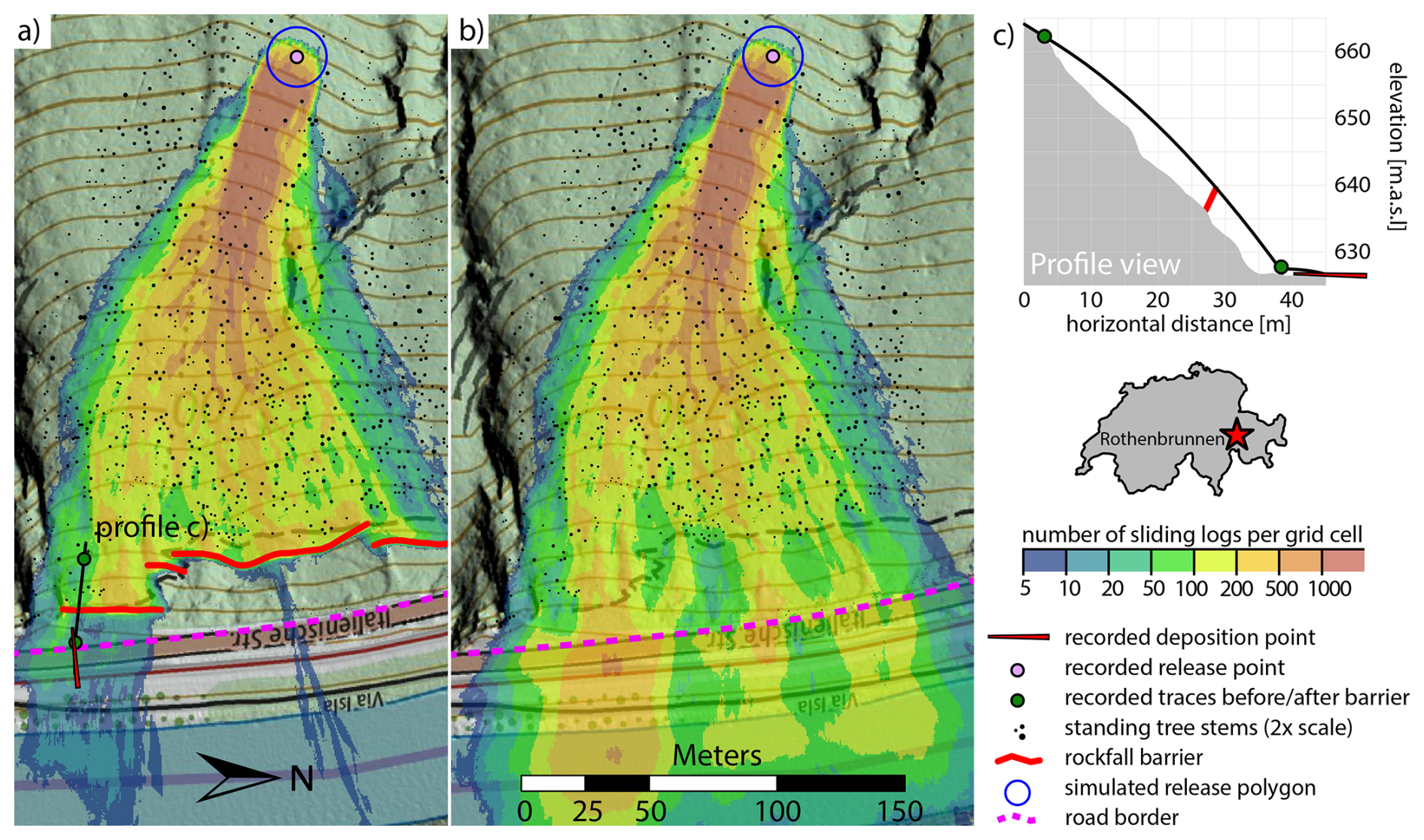
Figure 4Reconstruction of the 2022 event in Plattawald, Rothenbrunnen (CH). All simulations were done with 20 000 randomly distributed upright logs within the release polygon and a friction coefficient of μ = 0.25. The colours indicate how many of the 20 000 released logs intersect their motion with each 0.5 × 0.5 m grid cell, revealing preferential sliding paths of the deadwood. (a) Simulation with ALS-based tree locations and rockfall barriers. (b) Simulation with ALS-based tree locations without barriers. (c) Profile view in the vicinity of the presumably overjumped rockfall barrier with fitted flight parabola. Map and hillshade from swisstopo (2020–2024).
6.1 Factors promoting deadwood sliding hazards
The documented cases of sliding deadwood highlight three key factors contributing to the risk of sliding deadwood impacting infrastructure below: (1) low friction; (2) steep slopes; and (3) early-stage wood decomposition.
Low friction either occurred due to terrain conditions (e.g. wet soil, snow, foliage cover), the condition of the deadwood (wet log without bark and branches) or a combination of both. Physically, a sliding movement is possible for a friction coefficient of μ<tan ψ, where ψ is the slope inclination. The proposed model can reconstruct both case studies with a friction coefficient in the range of μ = 0.2–0.3, which therefore describes the typical contact friction between wet terrain and a wet log without bark and branches. A friction coefficient of μ = 0.3 means that under these conditions, a mobilisation is theoretically possible at slope angles ψ>18°. For a slope angle of 30°, a mobilisation is possible for μ<0.58.
All events occurred in very steep forests with slope angles ψ≥35°. While this is directly linked to the first criterion, slope angle warrants a separate discussion. In a typical multibody simulation of relatively smooth contacting bodies, the Coulomb friction model is used to account for sliding resistance due to various abrasive processes which take place on a microscopic scale. These frictional processes are highly complex, depend heavily on the microscopic roughness, and are quite bluntly described by the Coulomb friction model through a single parameter, being the friction coefficient μ. In the modelling of sliding deadwood (and also rockfall), the macroscopic roughness is modelled through the chosen resolution of the DEM. The roughness effects which fall below the resolution of the DEM are to be accounted for by the Coulomb friction model. This macroscopic roughness of the DEM implies that very steep forests with ψ≥35° are a requirement for deadwood mobilisation even though the calibrated μ = 0.2–0.3 suggests a minimum required slope angle of 12–18°. This also implies that the calibrated μ is only valid for the DEM resolution of 0.5 m and should be increased accordingly when working with lower resolution DEMs. A sensitivity test for the Gruobenwald case study showed that the relative reach frequency of the national road increased from the initial 9.1 % for the 0.5 m DEM to 9.5 % and 18 % for the 2 and 5 m DEMs, respectively, when using the same friction coefficient of 0.25. This illustrates the effect, although its magnitude most likely depends on the terrain roughness present at a given site.
All of the recorded events occurred with fresh deadwood with early-stage wood decomposition. More specifically, the decay was advanced to the point where the trees have lost their branches and bark to reduce sliding friction. At the same time, the trees still showed sufficient structural strength so that they did not break on impacts while sliding. According to the decay stage classification by Maser and Trappe (1984), this deadwood state corresponds to a late stage II or early stage III. In this critical decay stage, a pocket knife can penetrate the wood only in the direction of the fibres but not in perpendicular direction (Lachat et al., 2014). For a case study on a spruce forest with bark beetle infestation, this critical decay stage was reached 2–5 years after death (Ammann, 2006). The critical time period, however, heavily depends on the tree species. Herrmann et al. (2015) showed that beech has significantly higher decay rates than spruce or pine. Additional influencing factors are the stem diameter (Holeksa et al., 2008), temperature, humidity and contact to the ground (Petrillo et al., 2016). Distance to the ground may affect local moisture conditions and accessibility for microbial colonisation, particularly at low heights and where dense vegetation, such as shrubs, tall herbs or grasses, surrounds the dead stems. Perez et al. (2022), for example, included sample distance to ground as a potential predictor of deadwood decay. While they did not find a significant effect, they noted that this variable was measured only at the time of sampling, although it is temporally variable, and that multi-year averages may better represent the conditions experienced by a log throughout the decay process. This is particularly relevant in the present context, as branches may break and the stem may settle closer to the ground over time, potentially increasing moisture availability and contact with decomposer communities and thereby accelerating decay. Slope exposure represents another relevant but complex site factor. Exposure can influence both temperature and moisture, which may have opposing effects on decay rates. South-facing slopes may favour decay through higher temperatures and longer biologically active periods. However, they may also lead to faster drying of stems, potentially constraining decomposition, whereas north-facing slopes may favour decay through higher humidity and more favourable conditions for fungal activity (Bardelli et al., 2018).
This critical decay stage also explains why the majority of deadwood mobilised in the presented events were snags triggered by an active mobilisation mechanism (e.g. windthrow, rockfall, snow weight or logging). Only in the Rothenbrunnen case study, it is unclear from the documentation whether the deadwood was initially standing or lying. Active mobilisation is important especially for snags because if a snag falls purely due to decay without any additional loads, it is very likely that it will immediately break apart on impact and therefore cannot slide over long distances. Lying deadwood may also be mobilised at sufficient structural strength (e.g. by rockfall or erosion). However, since it has already withstood a major mobilisation event when the respective tree or snag initially fell, it must be held back by significant resistance, such as terrain roughness, blocking trees, or other deadwood, making remobilisation inherently more difficult. In fact, lying deadwood may even help reduce the hazard potential of sliding deadwood, as it acts as a natural barrier, blocking or slowing down mobilised logs, provided it is itself firmly locked in place.
While all three factors are prerequisites for risks from sliding logs, local natural conditions can vary significantly. The first case study shows a typical critical combination of conditions which fulfil all the criteria for sliding deadwood, where a steep forest with previous bark beetle infestation led to several snags without bark and branches (reduced friction) and is later hit by a storm (reduced friction due to rain, active mobilisation mechanism due to wind). The second case study shows that wet snow can also be critical, as it causes mechanical stress on trees and at the same time reduces friction.
6.2 The role of forest structure
Standing trees influence sliding deadwood in two distinct ways, each affecting the hazard differently. On the one hand, trees act as effective physical barriers that can block or arrest sliding logs, particularly when the longitudinal axis of a log is misaligned with its velocity vector. This protective effect is clearly reflected in the simulation results. In the Klosters case study, the relative frequency of sliding logs reaching the road increases from 9.1 % for the simulation with standing trees to 74.5 % when the forest is removed. In the Rothenbrunnen case study, this frequency increases from 23.3 % with standing trees to 100 % without forest (see Appendix A, Fig. A1). These results demonstrate that the forest itself represents a highly effective protective measure against hazards caused by its own mobilised deadwood.
On the other hand, standing trees can deflect sliding logs, increasing lateral spread. Due to their elongated shape, logs can traverse slopes over long distances and often deviate substantially from the steepest descent direction. Once a log enters a traverse motion, realignment with the fall line becomes unlikely, as its length and repeated interactions with standing trees hinder rotational adjustment. In the Klosters case study, the simulated lateral spread amounts to 40, 60, 60, and 55° for events 1–4. When the simulations are repeated without forest, the lateral spread decreases to 23, 31, 25, and 18°, respectively. For the Rothenbrunnen case study, the same comparison shows a reduction in lateral spread from 49 to 18° (see Appendix A, Fig. A1).
A key observation from the events in Klosters is that the deadwood tends to slide further when the simulation is run with tree locations and DBH from the ALS instead of a randomly generated forest with the same tree density and DBH distribution. For the simulation shown in Fig. 3a, the relative frequency of reaching the road decreases from 9.1 % with the ALS tree data to 7.0 % with the randomly generated forest. The reason for this decline is that the preferred path of the sliding deadwood is determined by the micro-topography (e.g. sliding in ditches, valleys, gullies). In a randomly generated forest, these preferred paths can be blocked by standing trees. In reality, however, these gullies are often treeless or less densely forested due to rockfall, avalanche dynamics, and other channel processes, as well as unfavourable site conditions related to persistent snow cover and competition from herbaceous vegetation (Barbeito et al., 2012). The comparison between Fig. 3e and f highlights the importance of using ALS–derived tree locations: while the preferential sliding path is largely vegetation-free in the real forest, it is obstructed in the randomly generated forest, leading to an underestimation of the hazard potential.
In contrast, the Rothenbrunnen case study shows a smaller difference between simulations using ALS tree data and a randomly generated forest. For the simulation shown in Fig. 4b, the relative frequency of reaching the road even increases slightly from 23.3 % with the ALS tree data to 23.8 % with the randomly generated forest (Appendix A, Fig. A1). This negligible difference can be explained in this case by the fact that there are no clear preferential sliding paths in gullies that could be blocked by randomly generated trees. This suggests that in non-channelised terrain, precise tree locations are less important, as there are no distinct preferential sliding paths that could be blocked by randomly placed trees. Nonetheless, individual tree data remains valuable for accurately determining forest stem density.
These results furthermore suggest that the spatial correlation between forest structure and terrain-controlled preferential process paths may also be relevant for rockfall modelling, as rocks, similarly to sliding deadwood, tend to follow preferential paths controlled by the terrain. With increasingly detailed forest data and improved processing methods (Bast et al., 2025b; Bührle et al., 2026), explicitly accounting for exact tree locations and forest structure could therefore represent a promising direction for future hazard assessments.
6.3 Sliding deadwood in the context of other natural hazards
Steep mountain forests, where sliding deadwood is possible, often serve as protection against natural hazards. These areas, prone to sliding trees, are thus typically also exposed to rockfalls, avalanches or landslides. Compared to rocks in rockfall hazard scenarios, deadwood logs have a less favourable shape, lower strength and density than rocks, generally resulting in reduced velocities, kinetic energies and run-out distances. This may suggest that, in most cases, the danger from sliding deadwood plays a relatively minor role in the planning of protective measures such as barriers or embankments. However, there are some conditions where a hazard analysis of sliding deadwood should be considered:
-
According to our work, the risks posed by sliding deadwood in protection forests and natural hazard management are relevant only in specific situations. In most forested areas with relatively gentle slopes (< ∼ 35°) and high roughness, deadwood can mitigate rockfall and avalanche risks and support sustainable forest regeneration (Ringenbach et al., 2022b; Caduff et al., 2022). However, along steep gullies with low surface roughness, it may be necessary to assess whether removing dying or dead trees or actively cutting and securing them across the slope is appropriate to reduce overall gravitational hazard risks.
-
Simulations with the proposed model show that sliding deadwood can deviate significantly from the steepest descent suggesting a greater lateral spread than rockfalls. When the simulation shown in Fig. 4b is performed with rocks and ground parameters calibrated for a spruce/beech forest (Ringenbach et al., 2023), the resulting lateral spread decreases from 49° for the deadwood simulation to 40° for a 1 m3 platy rock and 35° for a 1 m3 cubic rock. This means that deadwood may reach unprotected infrastructure by traversing a slope.
-
Despite only few documented cases, the risk to roads, buildings, and infrastructure from sliding deadwood is expected to increase with the rising frequency and intensity of natural disturbances (Seidl et al., 2017)
-
Under the specific conditions which potentially enable deadwood to slide, protective structures must be designed to stop slender objects such as sliding deadwood. This is particularly critical for ring nets with large ring diameters. Besides the possibility of passing through the mesh, longitudinal log impacts may also concentrate the load on a relatively small frontal area, resulting in more localised loading of the net than typical block impacts. Furthermore, depending on the deposition configuration of a log stopped by a rockfall barrier, not clearing the deadwood from the net can lead to a reduction in the braking distance and thus to a lower energy absorption capacity for future rockfall events.
In both case studies, sliding deadwood reached infrastructure despite protective measures. In Klosters, this was due to outdated protective structures (wooden palisades) or a lack of protective measures in some places. In Rothenbrunnen, deadwood was able to jump over a barrier positioned below a terrace. When considering implications for natural hazard management, it is important to note that: (1) a rockfall in both cases could have caused similar or greater damage, and (2) perfect protection is hardly ever guaranteed due to construction constraints like barrier height or length. Nevertheless, the comparisons between scenarios with and without protection, as shown in Figs. 3 and 4, highlight the overall efficiency of the current measures. Although events involving sliding deadwood highlight significant hazards and, depending on topography, can expand the lateral extent of risk zones, the need for additional structural measures must be carefully evaluated.
6.4 Implications for forest management
The decision to leave deadwood in the forest depends on the local natural conditions, the relative importance assigned to biodiversity and various forest functions and potential effects on subsequent disturbances (Costa et al., 2021; Leverkus et al., 2021). Regarding the deadwood's role in natural hazard protection, its changing effects over time are particularly significant (Caduff et al., 2022). Ammann (2006) showed from large-scale laboratory tests that the fracture impact energy of a log is reduced by up to 89 % in 8–10 year old deadwood with rot fungus compared to fresh deadwood. As the structural strength is also important for the protective effect of deadwood, the age of the deadwood is linked to competing positive and negative effects, emphasising the need for an integral view on deadwood from a forest management perspective. Deadwood in its earliest stages shows high structural strength and thus a high protective effect against rockfall and avalanches, but temporarily offers often suitable habitat for bark beetles in spruce-dominated forests (Wermelinger, 2004). In a later decay stage (2–5 years after death for spruce), structural strength and protective effect still remain intact, while at the same time, the hazard of sliding logs increases. In the advanced decay stage (5+ years after death in spruce), the risk of sliding deadwood decreases, but so does its protective effect. Conversely, the ecological value of deadwood continues to increase, particularly as a habitat and, typically after more than 20 years (Piazza et al., 2024), as a substrate for seedling establishment, thereby promoting forest regeneration.
This trade-off also applies spatially. Although deadwood logs in gullies have a higher sliding hazard potential, they also offer increased protection against other natural hazards. For rockfall, these gullies are preferred rolling paths and therefore an optimal location for a natural barrier. In the case of avalanches, deadwood logs stabilise the snow cover in these less vegetated areas (Schönenberger et al., 2005; Baggio et al., 2022). Our study sheds light on an often overlooked but, in specific situations, important effect of deadwood, helping to decide where and when retaining deadwood is overall beneficial, and where alternative management approaches, such as removal or controlled relocation and stabilisation, may be more appropriate. The targeted felling and stabilisation of trees as protective structures was extensively investigated by Olmedo Manich (2015). The configuration of such structures can be optimised, for example by supporting and securing felled trees on stumps or standing trees using wire cables, to enhance their protective effect against rockfall while preventing subsequent downslope mobilisation.
In addition, the strong protective effect of standing trees against sliding deadwood implies a spatial differentiation of hazard within forested slopes. Logs mobilised high on a forested slope still traverse a long forested runout path and therefore have multiple opportunities to be intercepted by standing trees. In contrast, logs mobilised in the lower parts of the forest encounter little or no forest remaining downslope, which substantially increases the likelihood of reaching exposed infrastructure. This suggests that snags and deadwood located in lower forest sections that are still sufficiently steep may require particular attention in hazard assessments, and that interventions such as felling should be carried out with caution in these areas.
6.5 Model limitations and remaining uncertainties
Despite the high level of process detail incorporated through a physically based modelling framework coupled with high-resolution ALS tree data, several limitations remain. Firstly, sliding deadwood is represented as rigid bodies that do not fracture upon impact. While this neglects potential breakage at advanced decay stages, it is fully consistent with the objective of this study. The purpose of the model is not to simulate all possible deadwood conditions, but to quantify runout, lateral spread, and hazard potential under those specific conditions that make sliding deadwood hazardous. As shown in Sect. 6.1, these conditions correspond to a narrow decay-stage window in which sufficient residual structural strength is still present to allow long-distance transport without immediate fragmentation. The model is therefore explicitly conditioned on a prior assessment of decay stage: only logs that fall within this critical structural state are considered potential hazards and simulated. Under this premise, assuming non-breaking rigid logs is appropriate. At the same time, this assumption yields conservative, worst-case estimates of runout and impact frequency, since even structurally strong logs may still break depending on impact velocity and configuration. Logs in more advanced decay stages are expected to fragment early and thus pose a substantially lower hazard, but are outside the intended scope of the present model.
The rigid-body representation furthermore neglects flexural deformation of the log during impacts. In reality, long stems may bend and temporarily store strain energy, which may subsequently be dissipated or released and thereby influence the post-impact translational and rotational motion.
The initial conditions of the simulations introduce an additional limitation. Logs are released in a simplified, upright configuration and randomly positioned within the specified release area, without explicitly modelling the true mechanical triggering process or the transition from toppling to sliding. This idealisation may influence the very early phase of motion, particularly the initial orientation of the log. However, this is fully consistent with the intended application of the model: the mobilisation potential of deadwood is first assessed based on decay stage, terrain inclination, and local site conditions. The simulation tool is then applied under the explicit condition that mobilisation is already deemed possible, in order to quantify runout and lateral spread. This separation between mobilisation assessment and runout modelling follows standard hazard-modelling practice.
Additional simplifications include the rigid and indestructible representation of standing trees, which neglects energy dissipation due to tree swaying, uprooting, breaking or soil–root interactions during impacts. This again leads to slightly conservative estimates of runout and lateral spread. Furthermore, friction is represented by a single effective Coulomb coefficient that implicitly incorporates microscopic surface roughness effects. As discussed in Sect. 6.1, this parameter is resolution-dependent and valid only for the DEM resolution of 0.5 used in this study. Despite these limitations, the model reliably reproduces the observed deposition patterns of documented events and fulfils its intended purpose: providing conservative, physically consistent estimates of runout and lateral spread conditional on a prior mobilisation assessment.
The number of well-documented sliding deadwood events remains small, and the recurring patterns identified in the presented case studies should therefore not be interpreted as an exhaustive description of all possible controls. The observed events consistently indicate the importance of low friction, steep terrain, and a suitable decay stage, but additional mechanisms may become relevant under different site or tree conditions.
One such aspect is the influence of branches, which may introduce competing effects on sliding mobility. They may partially suspend the stem above the ground and help bridge terrain roughness or obstacles, but may conversely increase resistance through interlocking with terrain or standing trees or even penetrating into soft ground. The balance between these mechanisms is likely to depend on terrain roughness, local obstacles, forest structure and crown architecture of the sliding tree. In the presented case studies, all sliding events involved branchless logs, while terrain roughness along the main sliding paths appeared to be of secondary importance. This supports the interpretation that the very low friction of smooth, barkless and wet stems was particularly important under these conditions. At other sites with more pronounced roughness or different crown architectures, the influence of branches may differ.
Additional mobilisation mechanisms may also occur beyond those observed in the presented case studies. Rockfall impacts, for example, could plausibly act as an active mobilisation mechanism if the other necessary predispositions are met. Unlike mobilisation by wind or snow load, a rockfall impact may additionally transfer momentum to the stem and thereby alter its initial motion. These triggering mechanics are not resolved by the present model, which idealises the initial conditions and focuses on runout after mobilisation.
Further systematic documentation of future events would therefore be valuable for testing the generality of the patterns identified here and for better constraining these additional mechanisms.
6.6 Model usage and transferability
The sliding deadwood model can be applied directly by any user with access to RAMMS::Rockfall, without requiring code-level modifications or a special software version. A simulation is set up following the standard rockfall workflow, including the definition of release areas and forest. To suppress scarring effects, the ground mechanical properties are set to a high ME (e.g. ME = 1000 MPa) and a zero drag coefficient (CD = 0). The friction coefficient of the slope is then defined by manually editing the input XML file and setting μmin = μmax equal to the desired effective Coulomb friction coefficient.
The geometry of the sliding log is generated externally, for example using a Python script, based on a chosen DBH and log length, which can then be imported as a custom rock shape in RAMMS.
The presented sliding deadwood model is physically tailored to a rigid-body solver that explicitly resolves frictional contact and interactions with individual trees. In principle, it can only be transferred to numerical frameworks that fulfil three essential requirements:
-
Representation of the moving object as an extended rigid body rather than a lumped mass or spherical particle
-
Explicit resolution of contact forces and Coulomb friction in 3D, allowing for physically consistent sliding motion
-
Discrete representation of individual standing trees as geometric obstacles
If sliding deadwood were approximated as a lumped mass or spherical particle, as is done in many existing models, the simulation would lose all information on object orientation, contact length, and rotational resistance. Characteristic deadwood behaviour such as long-distance basal sliding, lateral deflection due to asymmetric contact, and alignment of the stem with the local slope would therefore be physically misrepresented. This would systematically bias runout distances and lateral spread. Models allowing non-spherical, simplified rock geometries (Dorren, 2024; Agliardi and Crosta, 2003; Andrew et al., 2012; Noël et al., 2021) could, in principle, be adapted to represent logs as elongated ellipsoids or cylinders, but they lack a rigid-body physics engine to resolve the continuous orientation and alignment of the log. In addition, they rely on restitution-coefficient-based impact behaviour, which cannot represent the low-impact, friction-controlled dynamics of sliding logs.
Rockfall models with a physical rigid-body framework, such as the model by Yan et al. (2020) or Rocfall3 (Rocscience Inc., 2024), could in principle reproduce the sliding behaviour of the logs if the log geometry were explicitly incorporated into the model. However, these models do not represent forests with distinct individual trees. In this case, the strong directional control exerted by individual standing trees is lost. The simulations in this study show that single tree impacts dominate lateral deflection, trajectory splitting, and final deposition patterns of sliding logs. Without explicit trees, both lateral spread and estimated reach probabilities would be systematically biased.
Beyond rockfall-specific software, general-purpose rigid-body and nonsmooth contact solvers such as Siconos (Acary et al., 2019) or physics engines such as pyBullet (Coumans and Bai, 2016–2020) would, in principle, satisfy the mechanical requirements for sliding deadwood. However, applying these tools to natural hazard assessment would require rebuilding all essential components for terrain handling, forest representation, stochastic release generation, and hazard-relevant post-processing, making them impractical for immediate operational use.
The findings from our case studies highlight the key factors influencing the hazard of sliding deadwood: low friction, very steep slopes, and early-stage wood decomposition. Our model successfully reconstructs observed events with a friction coefficient in the range of μ = 0.2–0.3 on a DEM resolution of 0.5 m, reinforcing the importance of surface conditions and terrain roughness in deadwood mobilisation. While very steep slopes (> ∼ 35°) are a prerequisite for sliding, local surface roughness significantly impacts the threshold at which movement occurs. The study further emphasises that deadwood in a critical decay stage (2–5 years after death for spruce) exhibits reduced friction while still maintaining sufficient structural integrity to slide long distances without breaking upon impacts. In all presented cases, these conditions were a result of an active triggering mechanism, such as storms, snow loads, rockfalls or logging. The observed events indicate that snags pose the greatest hazard due to their initial momentum when falling. Lying deadwood may also be mobilised in less frequented cases, but can also serve as a natural barrier, blocking or slowing down sliding deadwood. These findings underline that sliding deadwood represents a relevant hazard only under a narrow combination of conditions and does not constitute a widespread or persistent risk in most forested slopes.
Our results demonstrate that forest structure plays a crucial role in sliding deadwood dynamics, affecting both run-out distances and the lateral spread of logs. The presence of standing trees can either block movement or deflect logs. The simulations clearly show that standing trees provide an effective first line of protection against hazards caused by their own mobilised deadwood. Removing forest cover leads to a drastic increase in relative reach frequencies, demonstrating that intact forests can substantially limit runout and reduce the likelihood of sliding deadwood reaching exposed infrastructure. Simulations indicate that natural tree distributions, particularly less densely vegetated gullies, facilitate preferred paths for sliding logs, a factor that should be considered in hazard assessments. High-resolution ALS data helps to identify critical gullies and channels in a forest (which is also extremely important for other natural hazard processes) and to correctly determine the spatial distribution of single trees in these sensitive areas. As a result, measures in protection forests can be better prioritised, including the early removal of snags or actively cutting and securing them across the slope.
Managing deadwood in mountain forests remains challenging. Areas most susceptible to deadwood mobilisation often overlap with zones crucial for mitigating other natural hazards. Likewise, the decay stages at which snags and logs are most prone to move are the very stages in which their structural strength still contributes to protection. Although the framework presented here cannot eliminate these trade-offs, it supports the identification of the most critical locations and deadwood conditions. By applying targeted measures in these critical areas on deadwood in critical conditions, the hazard of sliding deadwood can be minimised, while the protective and ecological benefits of deadwood in mountain forests are largely retained.
This appendix presents additional simulation results for the Rothenbrunnen case study, analogous to the Klosters case study (see Sect. 5.1), including scenarios with a randomly generated forest and without forest. All simulations were performed using the same initial conditions, consisting of 20 000 upright logs randomly distributed within the release polygon and the same friction coefficient of μ = 0.25.
Figure A1a shows the scenario without any standing trees, resulting in a relative frequency of reaching the road, according to Eq. (10), of 100 % and a lateral spread of 18°. Figure A1b presents the simulation results for the scenario with a randomly generated forest based on the forest density as well as the DBH and tree height distributions derived from the ALS. In this case, the relative frequency of reaching the road is 23.8 %, while the lateral spread remains identical to that of the ALS-derived forest scenario at 50°.
Figure A2 illustrates a representative trajectory from the three-dimensional simulation that plausibly reproduces the documented event. The simulated log lifts off near the location of the last recorded trace before the barrier due to a local plateau at a velocity of 27.8 m s−1 (compared to the reconstructed value of approximately 24 m s−1; see Sect. 5.2), and jumps over the barrier. The simulated trajectory results in a maximum jump height of 9.9 m, defined as the vertical distance between the log's centre of mass and the terrain, before the log lands on the road close to the first recorded trace downstream of the barrier.
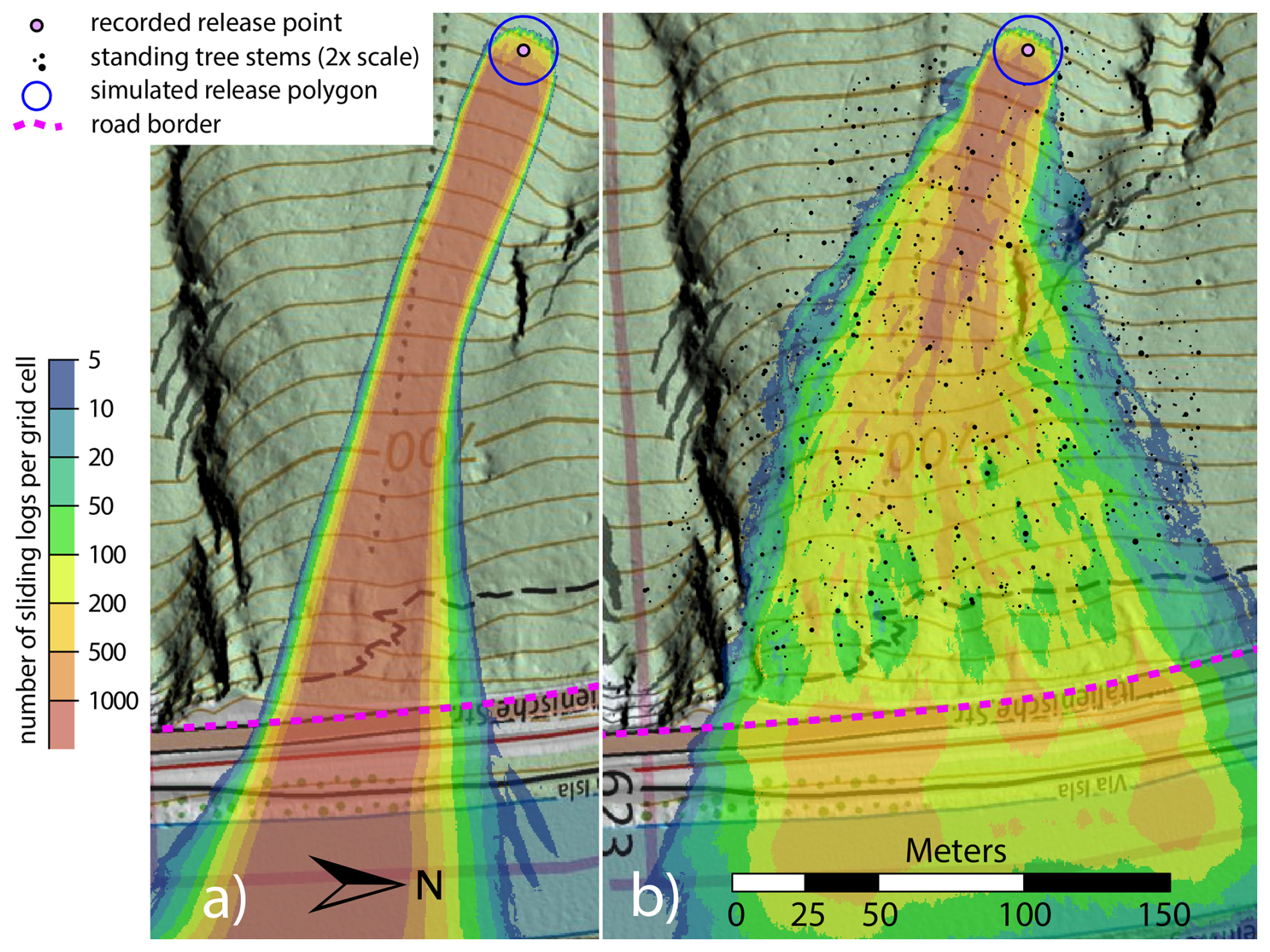
Figure A1Additional simulations based on the 2022 event in Plattawald, Rothenbrunnen (CH). All simulations were performed with 20 000 randomly distributed upright logs within the release polygon and a friction coefficient of μ = 0.25. The colours indicate the number of logs intersecting each 0.5 m × 0.5 m grid cell, highlighting preferential sliding paths of the deadwood. (a) Simulation without forest. (b) Simulation with a randomly generated forest. Map and hillshade from swisstopo (2020–2024).
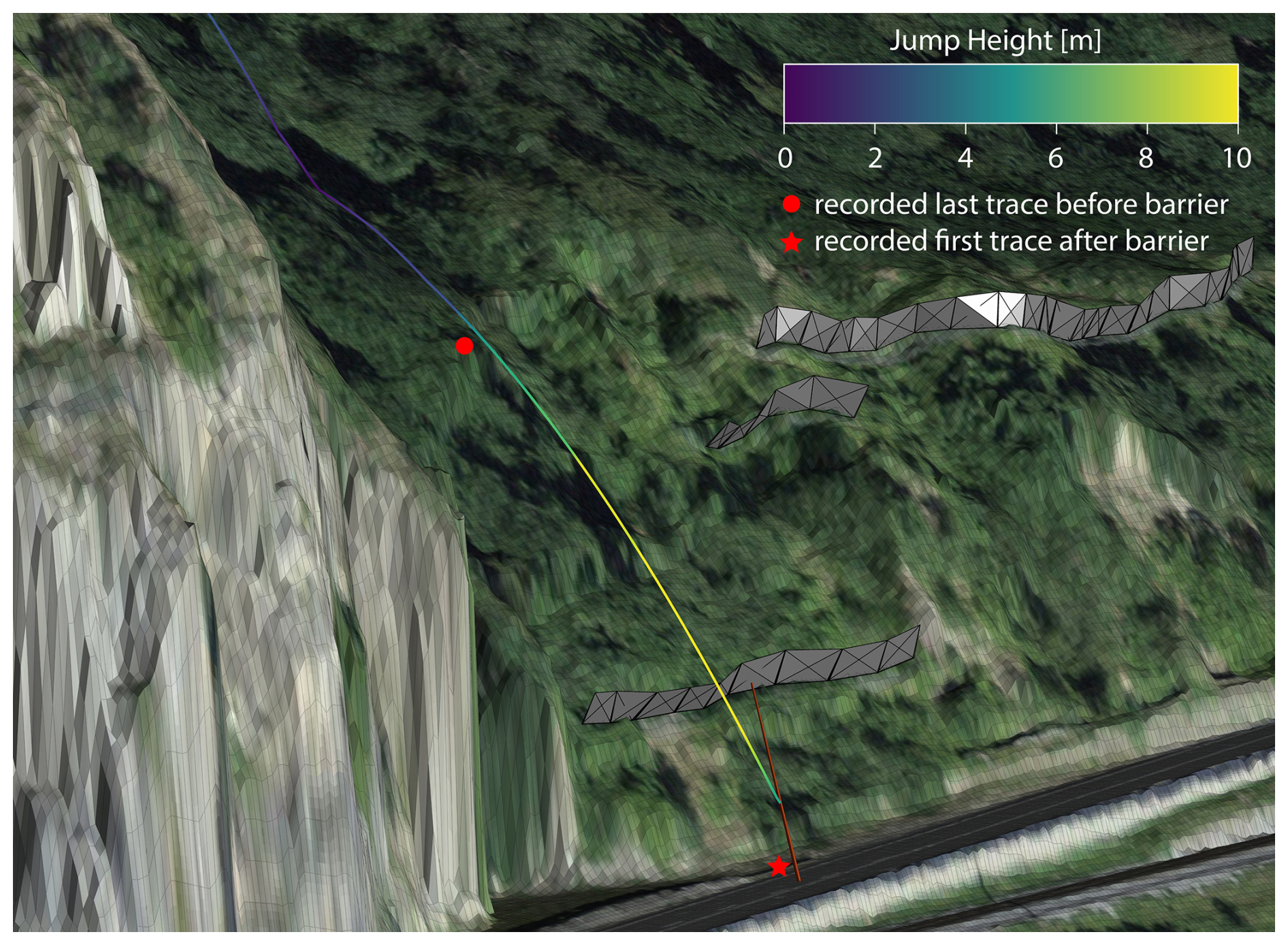
Figure A2Three-dimensional simulation of a representative sliding deadwood trajectory at the Rothenbrunnen site. The figure shows the simulated log position at the time step when the log first touches the terrain after the jump over the barrier. The jump is initiated by a local plateau upslope of the barrier, leading to a maximum jump height of 9.9 m (measured as the vertical distance between the log centre of mass and the terrain) and a velocity of 27.8 m s−1 at take-off. Background orthophoto from swisstopo (2020–2024).
The point cloud files of the deadwood logs used in the simulations, as well as the Python code used to generate these geometries are available on EnviDat (https://doi.org/10.16904/envidat.770, Borner et al., 2026).
JB conceptualised the idea and formulated the aims and methodology of the study. JB and RIL developed the model framework. JB and PB researched the case studies. AR and LJB pre-processed the ALS data for the simulations. JB performed the simulations and post-processed the data. JB led the interpretation of the results and the development of the discussion, with substantial contributions from PB and LJB through targeted literature research and scientific guidance. JB prepared the manuscript with contributions from all co-authors.
The contact author has declared that none of the authors has any competing interests.
Publisher's note: Copernicus Publications remains neutral with regard to jurisdictional claims made in the text, published maps, institutional affiliations, or any other geographical representation in this paper. The authors bear the ultimate responsibility for providing appropriate place names. Views expressed in the text are those of the authors and do not necessarily reflect the views of the publisher.
The authors would like to thank Flurin Wehrli from the Madrisa forestry operation and the Office for Forests and Natural Hazards of the Canton of Graubünden (AWN GR) for providing the necessary documentation of the sliding deadwood events. Furthermore, the authors would like to thank Dr. Perry Bartelt and Marc Christen from RAMMS AG for providing the RAMMS::Rockfall software and their support in adapting the modelling framework. During the preparation of this work, the authors used ChatGPT 5 to improve the readability of some sentences. After using this tool/service, the authors reviewed and edited the content as needed and take full responsibility for the content of the publication. LJB gratefully acknowledges the financial support of the European Union.
LJB was partly funded by the Interreg Alpine Space Programme project MOSAIC, co-funded by the European Union (grant no. ASP0100014).
This paper was edited by Sven Fuchs and reviewed by two anonymous referees.
Abegg, M., Ahles, P., Allgaier Leuch, B., Cioldi, F., Didion, M., Düggelin, C., Fischer, C., Herold, A., Meile, R., Rohner, B., Rösler, E., Speich, S., Temperli, C., and Traub, B.: Swiss national forest inventory – Result table No. 2314378, Swiss Federal Research Institute WSL, https://doi.org/10.21258/1950026, 2023a. a
Abegg, M., Ahles, P., Allgaier Leuch, B., Cioldi, F., Didion, M., Düggelin, C., Fischer, C., Herold, A., Meile, R., Rohner, B., Rösler, E., Speich, S., Temperli, C., and Traub, B.: Swiss national forest inventory – Result table No. 1382008, Swiss Federal Research Institute WSL, https://doi.org/10.21258/1815384, 2023b. a
Acary, V. and Brogliato, B.: Numerical methods for nonsmooth dynamical systems, Lecture notes in applied and computational mechanics, 2008 edition, Springer, https://doi.org/10.1007/978-3-540-75392-6, 2008. a
Acary, V., Bonnefon, O., Brémond, M., Huber, O., Pérignon, F., and Sinclair, S.: An introduction to Siconos, Technical Report RT-0340, INRIA, https://inria.hal.science/inria-00162911 (last access: 30 September 2026), 2019. a
Agliardi, F. and Crosta, G.: High resolution three-dimensional numerical modelling of rockfalls, Int. J. Rock Mech. Min., 40, 455–471, https://doi.org/10.1016/S1365-1609(03)00021-2, 2003. a
Ammann, M.: Schutzwirkung abgestorbener Bäume gegen Naturgefahren, PhD thesis, ETH Zurich, https://doi.org/10.3929/ETHZ-A-005268444, 2006. a, b
Andrew, R., Hume, H., Bartingale, R., Rock, A., and Zhang, R.: CRSP-3D user's manual – Colorado Rockfall Simulation Program, Colorado Geological Survey, https://coloradogeologicalsurvey.org/publications/colorado-rockfall-simulation-program/ (last access: 30 September 2026), 2012. a
Baggio, T., Brožová, N., Bast, A., Bebi, P., and D'Agostino, V.: Novel indices for snow avalanche protection assessment and monitoring of wind-disturbed forests, Ecol. Eng., 181, 106677, https://doi.org/10.1016/j.ecoleng.2022.106677, 2022. a
Barbeito, I., Dawes, M. A., Rixen, C., Senn, J., and Bebi, P.: Factors driving mortality and growth at treeline: a 30-year experiment of 92 000 conifers, Ecology, 93, 389–401, https://doi.org/10.1890/11-0384.1, 2012. a
Bardelli, T., Ascher-Jenull, J., Burkia Stocker, E., Fornasier, F., Arfaioli, P., Fravolini, G., Alves Medeiros, L. R., Egli, M., Pietramellara, G., Insam, H., and Gómez-Brandón, M.: Impact of slope exposure on chemical and microbiological properties of Norway spruce deadwood and underlying soil during early stages of decomposition in the Italian Alps, CATENA, 167, 100–115, https://doi.org/10.1016/j.catena.2018.04.031, 2018. a
Bast, A., Hobi, M., Ginzler, C., Piermattei, L., Fischer, C., Nikolova, P. S., Bührle, L., and Kalt, T.: Individual Detected Trees, EnviDat [data set], https://doi.org/10.16904/envidat.696, 2025a. a
Bast, A., Hobi, M. L., Ginzler, C., Piermattei, L., Fischer, C., Nikolova, P. S., Bührle, L. J., Kalt, T., and Graf, F.: An approach to detect and map forest canopy layers in Swiss mountain forests using nationwide airborne laser scanning data, Int. J. Appl. Earth Obs., 145, 104986, https://doi.org/10.1016/j.jag.2025.104986, 2025b. a, b
Bebi, P., Putallaz, J.-M., Fankhauser, M., Schmid, U., Schwitter, R., and Gerber, W.: Die Schutzfunktion in Windwurfflächen, Schweizerische Zeitschrift fur Forstwesen, 166, 168–176, https://doi.org/10.3188/szf.2015.0168, 2015. a
Borner, J., Bührle, L., Ringenbach, A., and Bebi, P.: Sliding Deadwood Geometry Generator, EnviDat [data set], https://doi.org/10.16904/envidat.770, 2026. a
Bourrier, F., Dorren, L., and Berger, F.: Full scale field tests on rockfall impacting trees felled transverse to the slope, in: 12th Congress INTERPRAEVENT 2012, p. 8, Grenoble, France, https://hal.inrae.fr/hal-02597700 (last access: 30 September 2026), 2012. a
Bührle, L. J., Kalt, T., Bebi, P., Teich, M., Hobi, M. L., Bast, A., Schrott, R., Helzel, K., Temperli, C., Bont, L. G., Blattert, C., Schweier, J., and Bottero, A.: Regional disturbance predisposition assessment to support management in Norway spruce-dominated mountain forests, Forest Ecol. Manag., 611, 123636, https://doi.org/10.1016/j.foreco.2026.123636, 2026. a, b
Caduff, M. E., Brožová, N., Kupferschmid, A. D., Krumm, F., and Bebi, P.: How large-scale bark beetle infestations influence the protective effects of forest stands against avalanches: A case study in the Swiss Alps, Forest Ecol. Manag., 514, 120201, https://doi.org/10.1016/j.foreco.2022.120201, 2022. a, b, c
Christen, M., Bühler, Y., Bartelt, P., Leine, R., Glover, J., Schweizer, A., and Volkwein, A.: Integral hazard management using a unified software environment. Numerical simulation tool “RAMMS” for gravitational natural hazards, in: 12th Congress INTERPRAEVENT 2012, Grenoble, France, Conference proceedings “Protection of living space from natural hazards”, edited by: Koboltschnig, G., Hübl, J., and Braun, J., 77–86, ISBN: 978-3-901164-19-4, 2012. a
Christen, M., Schweizer, A., Leine, R., Caviezel, A., and Bartelt, P.: RAMMS::Rockfall, https://ramms.ch/ramms-rockfall/ (last access: 30 September 2026), 2014. a, b
Costa, M., Marchi, N., Bettella, F., Bolzon, P., Berger, F., and Lingua, E.: Biological legacies and rockfall: The protective effect of a windthrown forest, Forests, 12, https://doi.org/10.3390/f12091141, 2021. a, b
Coumans, E. and Bai, Y.: PyBullet, a Python module for physics simulation for games, robotics and machine learning, GitHub, https://github.com/bulletphysics/bullet3, 2016–2020. a
Dalponte, M., Reyes, F., Kandare, K., and Gianelle, D.: Delineation of individual tree crowns from ALS and hyperspectral data: a comparison among four methods, Eur. J. Remote Sens., 48, 365–382, https://doi.org/10.5721/EuJRS20154821, 2015. a
Dorren, L.: Rockyfor3D (v6.0) revealed – Transparent description of the complete 3D rockfall model, ecorisQ manual, ecorisQ, https://www.ecorisq.org (last access: 30 September 2026), 2024. a
Edelmann, P., Weisser, W. W., Ambarlı, D., Bässler, C., Buscot, F., Hofrichter, M., Hoppe, B., Kellner, H., Minnich, C., Moll, J., Persoh, D., Seibold, S., Seilwinder, C., Schulze, E.-D., Wöllauer, S., and Borken, W.: Regional variation in deadwood decay of 13 tree species: Effects of climate, soil and forest structure, Forest Ecol. Manag., 541, 121094, https://doi.org/10.1016/j.foreco.2023.121094, 2023. a
Feistl, T., Bebi, P., Teich, M., Bühler, Y., Christen, M., Thuro, K., and Bartelt, P.: Observations and modeling of the braking effect of forests on small and medium avalanches, J. Glaciol., 60, 124–138, https://doi.org/10.3189/2014JoG13J055, 2014. a
Fuhr, M., Bourrier, F., and Cordonnier, T.: Protection against rockfall along a maturity gradient in mountain forests, Forest Ecol. Manag., 354, 224–231, https://doi.org/10.1016/j.foreco.2015.06.012, 2015. a
Getzner, M., Gutheil-Knopp-Kirchwald, G., Kreimer, E., Kirchmeir, H., and Huber, M.: Gravitational natural hazards: Valuing the protective function of alpine forests, Forest Policy Econ., 80, 150–159, https://doi.org/10.1016/j.forpol.2017.03.015, 2017. a
Gossner, M. M., Wende, B., Levick, S., Schall, P., Floren, A., Linsenmair, K. E., Steffan-Dewenter, I., Schulze, E.-D., and Weisser, W. W.: Deadwood enrichment in European forests – Which tree species should be used to promote saproxylic beetle diversity?, Biol. Conserv., 201, 92–102, https://doi.org/10.1016/j.biocon.2016.06.032, 2016. a
Harmon, M., Franklin, J., Swanson, F., Sollins, P., Gregory, S., Lattin, J., Anderson, N., Cline, S., Aumen, N., Sedell, J., Lienkaemper, G., Cromack, K., and Cummins, K.: Ecology of coarse woody debris in temperate ecosystems, in: Advances in Ecological Research, vol. 15 of Advances in Ecological Research, Academic Press, 133–302, https://doi.org/10.1016/S0065-2504(08)60121-X, 1986. a
Herrmann, S., Kahl, T., and Bauhus, J.: Decomposition dynamics of coarse woody debris of three important central european tree species, Forest Ecosystems, 2, https://doi.org/10.1186/s40663-015-0052-5, 2015. a
Holeksa, J., Zielonka, T., and Żywiec, M.: Modeling the decay of coarse woody debris in a subalpine Norway spruce forest of the West Carpathians, Poland, Can. J. Forest Res., 38, 415–428, https://doi.org/10.1139/X07-139, 2008. a
Kemper, J. T. and Scamardo, J.: Snow avalanches as a driver of large wood dynamics in mountain streams, Geophys. Res. Lett., 50, 1–11, https://doi.org/10.1029/2023GL106355, 2023. a
Lachat, T., Brang, P., Bolliger, M., Bollmann, K., Brändli, U.-B., Bütler, R., Herrmann, S., Schneider, O., and Wermelinger, B.: Totholz im Wald: Entstehung, Bedeutung und Förderung, Merkblatt für die Praxis, 52, Swiss Federal Research Institute WSL, ISSN: 2296-4428, 2014. a
Leine, R. I. and van de Wouw, N.: Stability and Convergence of Mechanical Systems with Unilateral Constraints, Lecture Notes in Applied and Computational Mechanics, Springer Berlin Heidelberg, ISBN 9783540769750, https://doi.org/10.1007/978-3-540-76975-0, 2008. a, b
Leine, R. I., Schweizer, A., Christen, M., Glover, J., Bartelt, P., and Gerber, W.: Simulation of rockfall trajectories with consideration of rock shape, Multibody Syst. Dyn., 32, 241–271, https://doi.org/10.1007/s11044-013-9393-4, 2014. a, b, c, d
Leverkus, A. B., Polo, I., Baudoux, C., Thorn, S., Gustafsson, L., and Rubio de Casas, R.: Resilience impacts of a secondary disturbance: Meta-analysis of salvage logging effects on tree regeneration, J. Ecol., 109, 3224–3232, https://doi.org/10.1111/1365-2745.13581, 2021. a
Lu, G., Ringenbach, A., Caviezel, A., Sanchez, M., Christen, M., and Bartelt, P.: Mitigation effects of trees on rockfall hazards: does rock shape matter?, Landslides, 18, 59–77, https://doi.org/10.1007/s10346-020-01418-2, 2021. a
Marangon, D., Betetto, C., Wohlgemuth, T., Cadez, L., Alberti, G., Tomelleri, E., and Lingua, E.: Impact of salvage logging on short-term natural regeneration in montane forests of the Alps after large windthrow events, Forest Ecol. Manag., 567, 122085, https://doi.org/10.1016/j.foreco.2024.122085, 2024. a
Maser, C. and Trappe, J. M.: The seen and unseen world of the fallen tree, General Technical Report PNW-GTR-164, U.S. Department of Agriculture, Forest Service, Pacific Northwest Forest and Range Experiment Station, https://doi.org/10.2737/PNW-GTR-164, 1984. a
May, C. L. and Gresswell, R. E.: Large wood recruitment and redistribution in headwater streams in the southern Oregon coast range, USA, Can. J. Forest Res., 33, 1352–1362, https://doi.org/10.1139/x03-023, 2003. a
Mayer, M., Rosinger, C., Gorfer, M., Berger, H., Deltedesco, E., Bässler, C., Müller, J., Seifert, L., Rewald, B., and Godbold, D. L.: Surviving trees and deadwood moderate changes in soil fungal communities and associated functioning after natural forest disturbance and salvage logging, Soil Biology and Biochemistry, 166, 108558, https://doi.org/10.1016/j.soilbio.2022.108558, 2022. a
Moos, C., Dorren, L., and Stoffel, M.: Quantifying the effect of forests on frequency and intensity of rockfalls, Nat. Hazards Earth Syst. Sci., 17, 291–304, https://doi.org/10.5194/nhess-17-291-2017, 2017. a
Noël, F., Cloutier, C., Jaboyedoff, M., and Locat, J.: Impact-Detection Algorithm That Uses Point Clouds as Topographic Inputs for 3D Rockfall Simulations, Geosciences, 11, https://doi.org/10.3390/geosciences11050188, 2021. a
Oberle, B., Milo, A. M., Myers, J. A., Walton, M. L., Young, D. F., and Zanne, A. E.: Direct estimates of downslope deadwood movement over 30 years in a temperature forest illustrate impacts of treefall on forest ecosystem dynamics, Can. J. Forest Res., 46, 351–361, https://doi.org/10.1139/cjfr-2015-0348, 2016. a
Olmedo Manich, I.: Felled trees as rockfall protection devices: Experimental and numerical studies for design purposes, Theses, INSA de Lyon, https://doi.org/10.70675/b09b0561z2d0fz4887z8171zbed7af26793d, 2015. a
Olschewski, R., Bebi, P., Teich, M., Wissen Hayek, U., and Grêt-Regamey, A.: Avalanche protection by forests – A choice experiment in the Swiss alps, Forest Policy Econ., 15, 108–113, https://doi.org/10.1016/j.forpol.2011.10.002, 2012. a
Perez, S. B., Fraterrigo, J. M., and Dalling, J. W.: Interspecific wood trait variation predicts decreased carbon residence time in changing forests, Funct. Ecol., 36, 674–685, https://doi.org/10.1111/1365-2435.13936, 2022. a
Petrillo, M., Cherubini, P., Fravolini, G., Marchetti, M., Ascher-Jenull, J., Schärer, M., Synal, H.-A., Bertoldi, D., Camin, F., Larcher, R., and Egli, M.: Time since death and decay rate constants of Norway spruce and European larch deadwood in subalpine forests determined using dendrochronology and radiocarbon dating, Biogeosciences, 13, 1537–1552, https://doi.org/10.5194/bg-13-1537-2016, 2016. a
Piazza, N., Bebi, P., Vacchiano, G., Rigling, A., Wohlgemuth, T., and Bottero, A.: Post-windthrow forest development in spruce-dominated mountain forests in Central Europe, Forest Ecol. Manag., 561, 121884, https://doi.org/10.1016/j.foreco.2024.121884, 2024. a
Plath, E. and Fischer, K.: Spruce dieback as chance for biodiversity: Standing deadwood promotes beetle diversity in post-disturbance stands in western Germany, J. Insect Conserv., 28, 525–537, https://doi.org/10.1007/s10841-024-00571-6, 2024. a
Rackelmann, F., Sebesvari, Z., and Bell, R.: Synergies and trade-offs in the management objectives forest health and flood risk reduction, Frontiers in Forests and Global Change, 6, https://doi.org/10.3389/ffgc.2023.1208032, 2023. a
Rammig, A., Fahse, L., Bebi, P., and Bugmann, H.: Wind disturbance in mountain forests: Simulating the impact of management strategies, seed supply, and ungulate browsing on forest succession, Forest Ecol. Manag., 242, 142–154, https://doi.org/10.1016/j.foreco.2007.01.036, 2007. a
Ringenbach, A., Bebi, P., Bartelt, P., Rigling, A., Christen, M., Bühler, Y., Stoffel, A., and Caviezel, A.: Modeling deadwood for rockfall mitigation assessments in windthrow areas, Earth Surf. Dynam., 10, 1303–1319, https://doi.org/10.5194/esurf-10-1303-2022, 2022a. a
Ringenbach, A., Stihl, E., Bühler, Y., Bebi, P., Bartelt, P., Rigling, A., Christen, M., Lu, G., Stoffel, A., Kistler, M., Degonda, S., Simmler, K., Mader, D., and Caviezel, A.: Full-scale experiments to examine the role of deadwood in rockfall dynamics in forests, Nat. Hazards Earth Syst. Sci., 22, 2433–2443, https://doi.org/10.5194/nhess-22-2433-2022, 2022b. a
Ringenbach, A., Bebi, P., Bartelt, P., Rigling, A., Christen, M., Bühler, Y., Stoffel, A., and Caviezel, A.: Shape still matters: rockfall interactions with trees and deadwood in a mountain forest uncover a new facet of rock shape dependency, Earth Surf. Dynam., 11, 779–801, https://doi.org/10.5194/esurf-11-779-2023, 2023. a, b
Rocscience Inc.: RocFall3: Rigid-body dynamics theory manual, Rocscience Inc., https://www.rocscience.com/help/rocfall3/verification-theory/theory-manuals (last access: 10 December 2025), 2024. a
Schönenberger, W., Noack, A., and Thee, P.: Effect of timber removal from windthrow slopes on the risk of snow avalanches and rockfall, Forest Ecol. Manag., 213, 197–208, https://doi.org/10.1016/j.foreco.2005.03.062, 2005. a, b
Seidl, R., Thom, D., Kautz, M., Martin-Benito, D., Peltoniemi, M., Vacchiano, G., Wild, J., Ascoli, D., Petr, M., Honkaniemi, J., Lexer, M. J., Trotsiuk, V., Mairota, P., Svoboda, M., Fabrika, M., Nagel, T. A., and Reyer, C. P. O.: Forest disturbances under climate change, Nat. Clim. Change, 7, 395–402, https://doi.org/10.1038/nclimate3303, 2017. a, b
Stadelmann, G., Bugmann, H., Wermelinger, B., and Bigler, C.: Spatial interactions between storm damage and subsequent infestations by the European spruce bark beetle, Forest Ecol. Manag., 318, 167–174, https://doi.org/10.1016/j.foreco.2014.01.022, 2014. a
Studer, C. W.: Augmented Time-Stepping Integration of Non-Smooth Dynamical Systems, PhD thesis, ETH Zurich, https://doi.org/10.3929/ETHZ-A-005556821, 2008. a
swisstopo: swissALTI3D (2023), swissSURFACE3D (2020), SWISSIMAGE (2022), swissMAP Raster 10 (2024), https://www.swisstopo.admin.ch/en (last access: 1 July 2024), 2020–2024. a, b, c, d, e, f
Wermelinger, B.: Ecology and management of the spruce bark beetle Ips typographus – a review of recent research, Forest Ecol. Manag., 202, 67–82, https://doi.org/10.1016/j.foreco.2004.07.018, 2004. a
Yan, P., Zhang, J., Kong, X., and Fang, Q.: Numerical simulation of rockfall trajectory with consideration of arbitrary shapes of falling rocks and terrain, Comput. Geotech., 122, 103511, https://doi.org/10.1016/j.compgeo.2020.103511, 2020. a
- Abstract
- Introduction
- Sliding deadwood events
- Sliding deadwood model with Coulomb friction
- Simulation setup
- Simulation of case studies
- Discussion
- Conclusions
- Appendix A: Rothenbrunnen supplementary simulations
- Code and data availability
- Author contributions
- Competing interests
- Disclaimer
- Acknowledgements
- Financial support
- Review statement
- References
- Abstract
- Introduction
- Sliding deadwood events
- Sliding deadwood model with Coulomb friction
- Simulation setup
- Simulation of case studies
- Discussion
- Conclusions
- Appendix A: Rothenbrunnen supplementary simulations
- Code and data availability
- Author contributions
- Competing interests
- Disclaimer
- Acknowledgements
- Financial support
- Review statement
- References