
Articles | Volume 26, issue 10
https://doi.org/10.5194/nhess-26-4825-2026
© Author(s) 2026. This work is distributed under
the Creative Commons Attribution 4.0 License.
the Creative Commons Attribution 4.0 License.
https://doi.org/10.5194/nhess-26-4825-2026
© Author(s) 2026. This work is distributed under
the Creative Commons Attribution 4.0 License.
the Creative Commons Attribution 4.0 License.
Research article
| 
06 Oct 2026
Research article |
| 06 Oct 2026
| 06 Oct 2026
Forecasting European temperature-related mortality in Summer 2024: data-driven vs. physics-based forecast approaches

Department of Earth Sciences, Uppsala University, Uppsala, Sweden
Centre for Natural Hazards and Disaster Science (CNDS), Uppsala University, Uppsala, Sweden
Swedish Centre for Impacts of Climate Extremes (climes), Uppsala University, Uppsala, Sweden
Institute of Social and Preventative Medicine, University of Bern, Bern, Switzerland
Oeschger Centre for Climate Change Research, University of Bern, Bern, Switzerland
Leonardo Olivetti
Department of Earth Sciences, Uppsala University, Uppsala, Sweden
Centre for Natural Hazards and Disaster Science (CNDS), Uppsala University, Uppsala, Sweden
Swedish Centre for Impacts of Climate Extremes (climes), Uppsala University, Uppsala, Sweden
Related authors
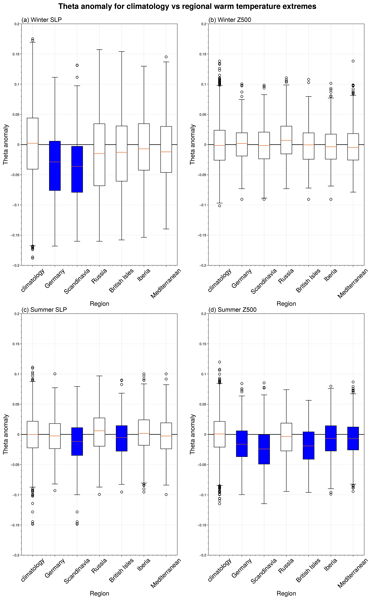
Emma Holmberg, Gabriele Messori, Rodrigo Caballero, and Davide Faranda
Earth Syst. Dynam., 14, 737–765, https://doi.org/10.5194/esd-14-737-2023, https://doi.org/10.5194/esd-14-737-2023, 2023
Short summary
Short summary
We analyse the duration of large-scale patterns of air movement in the atmosphere, referred to as persistence, and whether unusually persistent patterns favour warm-temperature extremes in Europe. We see no clear relationship between summertime heatwaves and unusually persistent patterns. This suggests that heatwaves do not necessarily require the continued flow of warm air over a region and that local effects could be important for their occurrence.
Michael Konrad Schutte, Leonardo Olivetti, Flavio Maria Emanuele Pons, and Gabriele Messori
EGUsphere, https://doi.org/10.5194/egusphere-2026-2203, https://doi.org/10.5194/egusphere-2026-2203, 2026
Short summary
Short summary
When testing whether signals on maps are statistically meaningful, scientists must account for multiple testing. Otherwise, some results may appear significant purely by chance. We show that the widely used false discovery rate correction can be misleading: simply changing the geographic region analyzed can make the same data appear far more statistically significant, even though nothing has changed. We recommend transparent reporting and using region-wide averages instead of point-wise testing.
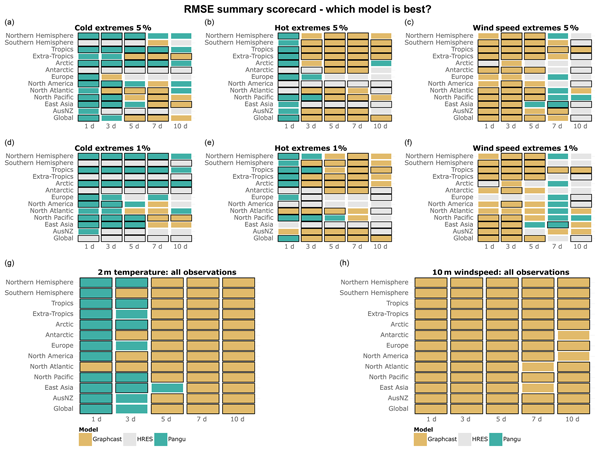
Leonardo Olivetti and Gabriele Messori
Geosci. Model Dev., 17, 7915–7962, https://doi.org/10.5194/gmd-17-7915-2024, https://doi.org/10.5194/gmd-17-7915-2024, 2024
Short summary
Short summary
Data-driven models are becoming a viable alternative to physics-based models for weather forecasting up to 15 d into the future. However, it is unclear whether they are as reliable as physics-based models when forecasting weather extremes. We evaluate their performance in forecasting near-surface cold, hot, and windy extremes globally. We find that data-driven models can compete with physics-based models and that the choice of the best model mainly depends on the region and type of extreme.
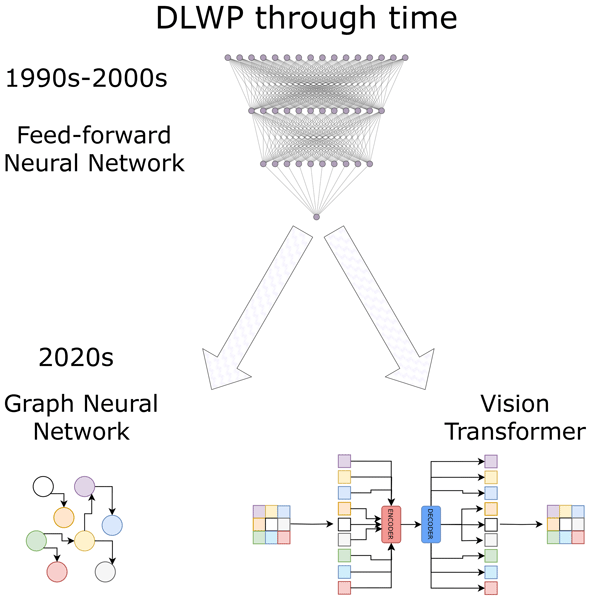
Leonardo Olivetti and Gabriele Messori
Geosci. Model Dev., 17, 2347–2358, https://doi.org/10.5194/gmd-17-2347-2024, https://doi.org/10.5194/gmd-17-2347-2024, 2024
Short summary
Short summary
In the last decades, weather forecasting up to 15 d into the future has been dominated by physics-based numerical models. Recently, deep learning models have challenged this paradigm. However, the latter models may struggle when forecasting weather extremes. In this article, we argue for deep learning models specifically designed to handle extreme events, and we propose a foundational framework to develop such models.
Emma Holmberg, Gabriele Messori, Rodrigo Caballero, and Davide Faranda
Earth Syst. Dynam., 14, 737–765, https://doi.org/10.5194/esd-14-737-2023, https://doi.org/10.5194/esd-14-737-2023, 2023
Short summary
Short summary
We analyse the duration of large-scale patterns of air movement in the atmosphere, referred to as persistence, and whether unusually persistent patterns favour warm-temperature extremes in Europe. We see no clear relationship between summertime heatwaves and unusually persistent patterns. This suggests that heatwaves do not necessarily require the continued flow of warm air over a region and that local effects could be important for their occurrence.
Cited articles
Ballester, J., Quijal-Zamorano, M., Méndez Turrubiates, R. F., Pegenaute, F., Herrmann, F. R., Robine, J. M., Basagaña, X., Tonne, C., Antó, J. M., and Achebak, H.: Heat-related mortality in Europe during the summer of 2022, Nat. Med., 29, 1857–1866, https://doi.org/10.1038/s41591-023-02419-z, 2023. a
Bauer, P., Thorpe, A., and Brunet, G.: The quiet revolution of numerical weather prediction, Nature, 525, 47–55, https://doi.org/10.1038/nature14956, 2015. a
Bouallègue, Z. B., Clare, M. C. A., Magnusson, L., Gascón, E., Maier-Gerber, M., Janoušek, M., Rodwell, M., Pinault, F., Dramsch, J. S., Lang, S. T. K., Raoult, B., Rabier, F., Chevallier, M., Sandu, I., Dueben, P., Chantry, M., and Pappenberger, F.: The rise of data-driven weather forecasting: A first statistical assessment of machine learning-based weather forecasts in an operational-like context, B. Am. Meteorol. Soc., 105, E864–E883, https://doi.org/10.1175/BAMS-D-23-0162.1, 2024. a
Copernicus: Copernicus: Summer 2024 – Hottest on record globally and for Europe, Copernicus, https://climate.copernicus.eu/copernicus-summer-2024-hottest-record-globally-and-europe (last access: 4 December 2025), 2024. a
Copernicus Climate Change Service, Climate Data Store: ERA5 hourly data on single levels from 1940 to present, Copernicus Climate Change Service (C3S) Climate Data Store (CDS) [data set], https://doi.org/10.24381/cds.adbb2d47, 2023. a
Ebi, K. L., Capon, A., Berry, P., Broderick, C., de Dear, R., Havenith, G., Honda, Y., Kovats, R. S., Ma, W., Malik, A., Morris, N. B., Nybo, L., Seneviratne, S. I., Vanos, J., and Jay, O.: Hot weather and heat extremes: health risks, The Lancet, 398, 698–708, https://doi.org/10.1016/S0140-6736(21)01208-3, 2021. a
Ferreira Braga, A. L., Zanobetti, A., and Schwartz, J.: The Time Course of Weather-Related Deaths, Epidemiology, 12, 662–667, https://doi.org/10.1097/00001648-200111000-00014, 2001. a
Fischer, E. M., Seneviratne, S. I., Vidale, P. L., Lüthi, D., and Schär, C.: Soil moisture–atmosphere interactions during the 2003 European summer heat wave, J. Climate, 20, 5081–5099, 2007. a
Gallo, E., Quijal-Zamorano, M., Méndez Turrubiates, R. F., Tonne, C., Basagaña, X., Achebak, H., and Ballester, J.: Heat-related mortality in Europe during 2023 and the role of adaptation in protecting health, Nat. Med., 30, 3101–3105, https://doi.org/10.1038/s41591-024-03186-1, 2024. a, b
Gasparrini, A., Armstrong, B., and Kenward, M. G.: Distributed lag non-linear models, Stat. Med., 29, 2224–2234, https://doi.org/10.1002/sim.3940, 2010. a
Gasparrini, A., Guo, Y., Hashizume, M., Lavigne, E., Zanobetti, A., Schwartz, J., Tobias, A., Tong, S., Rocklöv, J., Forsberg, B., Leone, M., De Sario, M., Bell, M. L., Leon Guo, Y., Wu, C., Kan, H., Yi, S., de Sousa Zanotti Stagliorio Coehlo, M., Nascimento Saldiva, P. H., Honda, Y., Kim, H., and Armstrong, B.: Mortality risk attributable to high and low ambient temperature: a multicountry observational study, The Lancet, 386, 369–375, https://doi.org/10.1016/S0140-6736(14)62114-0, 2015. a, b
Hersbach, H., Bell, B., Berrisford, P., Hirahara, S., Horányi, A., Muñoz-Sabater, J., Nicolas, J., Peubey, C., Radu, R., Schepers, D., Simmons, A., Soci, C., Abdalla, S., Abellan, X., Balsamo, G., Bechtold, P., Biavati, G., Bidlot, J., Bonavita, M., De Chiara, G., Dahlgren, P., Dee, D., Diamantakis, M., Dragani, R., Flemming, J., Forbes, R., Fuentes, M., Geer, A., Haimberger, L., Healy, S., Hogan, R. J., Hólm, E., Janisková, M., Keeley, S., Laloyaux, P., Lopez, P., Lupu, C., Radnoti, G., de Rosnay, P., Rozum, I., Vamborg, F., Villaume, S., and Thépaut, J.-N.: The ERA5 global reanalysis, Q. J. R. Meteorol. Soc., 146, 1999–2049, https://doi.org/10.1002/qj.3803, 2020. a, b
Holmberg, E., Tietsche, S., and Messori, G.: Forecasting atmospheric persistence and implications for the predictability of temperature and temperature extremes, Q. J. R. Meteorol. Soc., 150, 5518–5534, https://doi.org/10.1002/qj.4885, 2024. a
Holmberg, E., Quijal-Zamorano, M., Ballester, J., and Messori, G.: Skillful heat-related mortality forecasting during recent deadly European summers, P. Natl. Acad. Sci., 122, https://doi.org/10.1073/pnas.2426516122, 2025. a, b, c
Huber, V., Breitner-Busch, S., Feldbusch, H., Frieler, K., He, C., Matthies-Wiesler, F., Mengel, M., Zhang, S., Peters, A., and Schneider, A.: Improvements in life expectancy mask rising trends in heat-related excess mortality attributable to climate change, Nat. Commun., 16, https://doi.org/10.1038/s41467-025-66681-0, 2025. a
Ingleby, B., Arduini, G., Balsamo, G., Boussetta, S., Ochi, K., Pinnington, E., and de Rosnay, P.: Improved two-metre temperature forecasts in the 2024 upgrade, ECMWF, https://www.ecmwf.int/en/newsletter/178/earth-system-science/improved-two-metre-temperature-forecasts-2024-upgrade (last access: 7 December 2025), 2024. a
Janoš, T., Quijal-Zamorano, M., Shartova, N., Gallo, E., Méndez Turrubiates, R. F., Denisse Beltrán Barrón, N., Peyrusse, F., and Ballester, J.: Heat-related mortality in Europe during 2024 and health emergency forecasting to reduce preventable deaths, Nat. Med., 31, https://doi.org/10.1038/s41591-025-03954-7, 2025. a, b, c
Jay, O., Capon, A., Berry, P., Broderick, C., de Dear, R., Havenith, G., Honda, Y., Kovats, R. S., Ma, W., Malik, A., Morris, N. B., Nybo, L., Seneviratne, S. I., Vanos, J., and Ebi, K. L.: Reducing the health effects of hot weather and heat extremes: from personal cooling strategies to green cities, The Lancet, 398, 709–724, https://doi.org/10.1016/S0140-6736(21)01209-5, 2021. a
Lüthi, S., Fairless, C., Fischer, E. M., Scovronick, N., Armstrong, B., Coelho, M. D. S. Z. S., Guo, Y. L., Guo, Y., Honda, Y., Huber, V., Kyselý, J., Lavigne, E., Royé, D., Ryti, N., Silva, S., Urban, A., Gasparrini, A., Bresch, D. N., and Vicedo-Cabrera, A. M.: Rapid increase in the risk of heat-related mortality, Nat. Commun., 14, 4894, https://doi.org/10.1038/s41467-023-40599-x, 2023. a
Lüthi, S., Huber, V., Pascal, M., Beyerle, U., Pyrina, M., Domeisen, D., Fischer, E. M., and Vicedo-Cabrera, A. M.: Storylines for month-long heatwaves and associated heat-related mortality impacts over Western Europe, Research Square [preprint], https://doi.org/10.21203/rs.3.rs-5356341/v1, 2024. a
Martínez-Solanas, È., Rodó, X., Herrmann, F., Robine, J., Petrova, D., and Ballester, J.: An integrated heat early warning system for Europe, Environ. Epidemiol., 3, 262–263, 2019. a
Masselot, P. and Gasparrini, A.: Temperature-related mortality exposure-response functions for 854 cities in Europe, Version 2.0.0, Zenodo [data set], https://doi.org/10.5281/zenodo.10288665, 2023. a
Masselot, P., Mistry, M., Vanoli, J., Schneider, R., Iungman, T., Garcia-Leon, D., Ciscar, J. C., Feyen, L., Orru, H., Urban, A., Breitner, S., Huber, V., Schneider, A., Samoli, E., Stafoggia, M., De'Donato, F., Rao, S., Armstrong, B., Nieuwenhuijsen, M., Vicedo-Cabrera, A. M., Gasparrini, A., Achilleos, S., Kyselý, J., Indermitte, E., Jaakkola, J. J., Ryti, N., Pascal, M., Katsouyanni, K., Analitis, A., Goodman, P., Zeka, A., Michelozzi, P., Houthuijs, D., Ameling, C., das Neves Pereira da Silva, S., Madureira, J., Holobaca, I. H., Tobias, A., Íñiguez, C., Forsberg, B., Åström, C., Ragettli, M. S., Zafeiratou, S., Vazquez Fernandez, L., Monteiro, A., Rai, M., Zhang, S., and Aunan, K.: Excess mortality attributed to heat and cold: a health impact assessment study in 854 cities in Europe, The Lancet Planetary Health, 7, e271–e281, https://doi.org/10.1016/S2542-5196(23)00023-2, 2023. a, b, c, d, e, f, g
Masselot, P., Mistry, M. N., Rao, S., Huber, V., Monteiro, A., Samoli, E., Stafoggia, M., De'Donato, F., Garcia-Leon, D., Ciscar, J. C., Feyen, L., Schneider, A., Katsouyanni, K., Vicedo-Cabrera, A. M., Aunan, K., and Gasparrini, A.: Estimating future heat-related and cold-related mortality under climate change, demographic and adaptation scenarios in 854 European cities, Nat. Med., 31, https://doi.org/10.1038/s41591-024-03452-2, 2025. a
Merz, B., Kuhlicke, C., Kunz, M., Pittore, M., Babeyko, A., Bresch, D. N., Domeisen, D. I. V., Feser, F., Koszalka, I., Kreibich, H., Pantillon, F., Parolai, S., Pinto, J. G., Punge, H. J., Rivalta, E., Schröter, K., Strehlow, K., Weisse, R., and Wurpts, A.: Impact Forecasting to Support Emergency Management of Natural Hazards, Rev. Geophys., 58, https://doi.org/10.1029/2020RG000704, 2020. a
Olivetti, L. and Messori, G.: Advances and prospects of deep learning for medium-range extreme weather forecasting, Geosci. Model Dev., 17, 2347–2358, https://doi.org/10.5194/gmd-17-2347-2024, 2024a. a, b
Olivetti, L. and Messori, G.: Do data-driven models beat numerical models in forecasting weather extremes? A comparison of IFS HRES, Pangu-Weather, and GraphCast, Geosci. Model Dev., 17, 7915–7962, https://doi.org/10.5194/gmd-17-7915-2024, 2024b. a
Pasche, O. C., Wider, J., Zhang, Z., Zscheischler, J., and Engelke, S.: Validating Deep Learning Weather Forecast Models on Recent High-Impact Extreme Events, Artificial Intelligence for the Earth Systems, 4, https://doi.org/10.1175/AIES-D-24-0033.1, 2025. a
Persson, A. and Grazzini, F.: User Guide to ECMWF forecast products 4.0, Meteorological Bulletin, 3, https://doi.org/10.21957/m1cs7h 2007. a
Price, I., Sanchez-Gonzalez, A., Alet, F., Andersson, T. R., El-Kadi, A., Masters, D., Ewalds, T., Stott, J., Mohamed, S., Battaglia, P., Lam, R., and Willson, M.: Probabilistic weather forecasting with machine learning, Nature, 637, 84–90, https://doi.org/10.1038/s41586-024-08252-9, 2025. a
Quijal-Zamorano, M., Petrova, D., Martínez-Solanas, E., Herrmann, F. R., Rodó, X., Robine, J.-M., Marí-Dell'Olmo, M., Achebak, H., and Ballester, J.: Forecast skill assessment of an operational continental heat-cold-health forecasting system: New avenues for health early warning systems, Sci. Adv., 10, https://doi.org/10.1126/sciadv.ado5286, 2024. a, b
Rasp, S., Hoyer, S., Merose, A., Langmore, I., Battaglia, P., Russell, T., Sanchez-Gonzalez, A., Yang, V., Carver, R., Agrawal, S., Chantry, M., Ben Bouallegue, Z., Dueben, P., Bromberg, C., Sisk, J., Barrington, L., Bell, A., and Sha, F.: WeatherBench 2: A Benchmark for the Next Generation of Data-Driven Global Weather Models, J. Adv. Model. Earth Sy., 16, https://doi.org/10.1029/2023MS004019, 2024. a
Robine, J.-M., Cheung, S. L. K., Le Roy, S., Van Oyen, H., Griffiths, C., Michel, J.-P., and Herrmann, F. R.: Death toll exceeded 70 000 in Europe during the summer of 2003, Comptes Rendus. Biologies, 331, 171–178, 2008. a
Schwartz, J.: The distributed lag between air pollution and daily deaths, Epidemiology, 11, 320–326, https://journals.lww.com/epidem/fulltext/2000/05000/the_distributed_lag_between_air_pollution_and.16.aspx (last access: 2 October 2026), 2000. a
Sun, Y. Q., Hassanzadeh, P., Zand, M., Chattopadhyay, A., Weare, J., and Abbot, D. S.: Can AI weather models predict out-of-distribution gray swan tropical cyclones?, P. Natl. Acad. Sci., 122, https://doi.org/10.1073/pnas.2420914122, 2025. a
Vanos, J., Guzman-Echavarria, G., Baldwin, J. W., Bongers, C., Ebi, K. L., and Jay, O.: A physiological approach for assessing human survivability and liveability to heat in a changing climate, Nat. Commun., 14, 1–14, https://doi.org/10.1038/s41467-023-43121-5, 2023. a
Vicedo-Cabrera, A. M., Scovronick, N., Sera, F., Royé, D., Schneider, R., Tobias, A., Astrom, C., Guo, Y., Honda, Y., Hondula, D. M., Abrutzky, R., Tong, S., Coelho, M. d. S. Z. S., Saldiva, P. H., Lavigne, E., Correa, P. M., Ortega, N. V., Kan, H., Osorio, S., Kyselý, J., Urban, A., Orru, H., Indermitte, E., Jaakkola, J. J., Ryti, N., Pascal, M., Schneider, A., Katsouyanni, K., Samoli, E., Mayvaneh, F., Entezari, A., Goodman, P., Zeka, A., Michelozzi, P., De'Donato, F., Hashizume, M., Alahmad, B., Diaz, M. H., Valencia, C. D. L. C., Overcenco, A., Houthuijs, D., Ameling, C., Rao, S., Di Ruscio, F., Carrasco-Escobar, G., Seposo, X., Silva, S., Madureira, J., Holobaca, I. H., Fratianni, S., Acquaotta, F., Kim, H., Lee, W., Iniguez, C., Forsberg, B., Ragettli, M. S., Guo, Y. L., Chen, B. Y., Li, S., Armstrong, B., Aleman, A., Zanobetti, A., Schwartz, J., Dang, T. N., Dung, D. V., Gillett, N., Haines, A., Mengel, M., Huber, V., and Gasparrini, A.: The burden of heat-related mortality attributable to recent human-induced climate change, Nat. Clim. Change, 11, 492–500, https://doi.org/10.1038/s41558-021-01058-x, 2021. a
Virtanen, P., Gommers, R., Oliphant, T. E., Haberland, M., Reddy, T., Cournapeau, D., Burovski, E., Peterson, P., Weckesser, W., Bright, J., van der Walt, S. J., Brett, M., Wilson, J., Millman, K. J., Mayorov, N., Nelson, A. R. J., Jones, E., Kern, R., Larson, E., Carey, C. J., Polat, İ., Feng, Y., Moore, E. W., VanderPlas, J., Laxalde, D., Perktold, J., Cimrman, R., Henriksen, I., Quintero, E. A., Harris, C. R., Archibald, A. M., Ribeiro, A. H., Pedregosa, F., van Mulbregt, P., and SciPy 1.0 Contributors: SciPy 1.0: Fundamental Algorithms for Scientific Computing in Python, Nat. Methods, 17, 261–272, https://doi.org/10.1038/s41592-019-0686-2, 2020. a, b
Xu, W., Chen, K., Han, T., Chen, H., Ouyang, W., and Bai, L.: ExtremeCast: Boosting Extreme Value Prediction for Global Weather Forecast, arXiv [preprint], https://doi.org/10.48550/arXiv.2402.01295, 2024. a
Zhang, Z., Fischer, E., Zscheischler, J., and Engelke, S.: Physics-based models outperform AI weather forecasts of record-breaking extremes, Sci. Adv., 12, https://doi.org/10.1126/sciadv.aec1433, 2026. a
Zhao, T., Li, Q., Tu, T., and Chen, X.: An extension of WeatherBench 2 to binary hydroclimatic forecasts, Geosci. Model Dev., 18, 5781–5799, https://doi.org/10.5194/gmd-18-5781-2025, 2025. a
Short summary
The health burden of extreme heat necessitates the development of effective early warning systems. These systems depend critically on the underlying weather forecasts. We compare forecasts of temperature-related mortality based on data-driven weather forecasts with those based on physics-based weather forecasts for summer 2024 in Europe. We find that forecasts based on data-driven weather forecasts could represent a promising avenue for the development of heat-related health impact forecasts.
The health burden of extreme heat necessitates the development of effective early warning...


Altmetrics
Final-revised paper
Preprint