Calcaterra, D., Parise, M., Palma, B., and Pelella, L.: The May 5th, 1998, landsliding event in Campania (Southern Italy): inventory of slope movements in the Quindici area, in: Proceedings of the Symposium on Slope Stability Engineering, edited by: Yagi, Y. and Jiang, J., Balkema, Rotterdam, 1361–1366, ISBN 90 5809 149 X, 1999.
Cascini, L., Cuomo, S., and Guida, D.: Typical source areas of May 1998 flow-like mass movements in the Campania region, Southern Italy, Eng. Geol., 96, 107–125, https://doi.org/10.1016/j.enggeo.2007.10.003, 2008.
Chen, C., Shen, Z., Fang, L., Lin, J., Li, S., and Wang, K.: Incorporating modelling uncertainty and prior knowledge into landslide susceptibility mapping using Bayesian neural networks, Georisk: Assessment and Management of Risk for Engineered Systems and Geohazards, 19, 513–532, https://doi.org/10.1080/17499518.2024.2422498, 2025.
Crosta, G. and Frattini, P.: Rainfall thresholds for triggering soil slips and debris flow, in: Proceedings of the EGS 2nd Plinius Conference on Mediterranean Storms, Siena, 2000, Bios, 2000.
de Riso, R., Budetta, P., Calcaterra, D., De Luca, C., Del Prete, S., Di Crescenzo, G., Guarino, P. M., Mele, R., Palma, B., Santo, A., and Sgambati, D.: Fenomeni di instabilità dei Monti Lattari e dell'area flegrea (Campania): scenari di suscettibilità da frana in aree-campione, Quaderni di Geologia Applicata, 11, 1–26, 2004.
De Vita, P., Di Clemente, E., Rolandi, M., and Celico, P.: Engineering geological models of the initial landslides occurred on the April 30th, 2006, at the Mount Di Vezzi (Ischia Island, Italy), Ital. J. Eng. Geol. Environ., https://doi.org/10.4408/IJEGE.2007-02.O-08, 2007.
De Vita, P., Napolitano, E., Godt, J. W., and Baum, R. L.: Deterministic estimation of hydrological thresholds for shallow landslide initiation and slope stability models: case study from the Somma-Vesuvius area of southern Italy, Landslides, 10, 713–728, https://doi.org/10.1007/s10346-012-0348-2, 2013.
D. P. G. R. n. 299 30/06/2005: Decreto del Presidente della Giunta Regionale della Campania: Il Sistema di Allertamento Regionale per il rischio Idrogeologico e Idraulico ai fini di protezione civile, Bollettino Ufficiale della Regione Campania, n. speciale 01/08/2005,
https://sito.regione.campania.it/burc/pdf05/burcsp01_08_05/decpregiure299_05allsub_A.pdf (last access: 4 August 2025), 2005.
Ducci, D. and Tranfaglia, G.: Effects of climate change on groundwater resources in Campania (southern Italy), Geol. Soc. London Spec. Publ., 288, 25–38, https://doi.org/10.1144/sp288.3, 2008.
Felsberg, A., Heyvaert, Z., Poesen, J., Stanley, T., and De Lannoy, G. J. M.: Probabilistic Hydrological Estimation of LandSlides (PHELS): global ensemble landslide hazard modelling, Nat. Hazards Earth Syst. Sci., 23, 3805–3821, https://doi.org/10.5194/nhess-23-3805-2023, 2023.
Fischhoff, B., Lichtenstein, S., Slovic, P., Derby, S. L., and Keeney, R. L.: Acceptable Risk, Cambridge University Press, New York, ISBN 0521241642, 9780521241649, 1981.
Forte, G., Pirone, M., Santo, A., Nicotera, M. V., and Urciuoli, G.: Triggering and predisposing factors for flow-like landslides in pyroclastic soils: the case study of the Lattari Mts. (southern Italy), Eng. Geol., 257, 105137, https://doi.org/10.1016/j.enggeo.2019.05.014, 2019.
Fusco, F., Tufano, R., De Vita, P., Di Martire, D., Di Napoli, M., Guerriero, L., Mileti, F. A., Terribile, F., and Calcaterra, D.: A revised landslide inventory of the Campania region (Italy), Sci. Data, 10, 355, https://doi.org/10.1038/s41597-023-02155-6, 2023.
Gelman, A., Carlin, J. B., Stern, H. S., Dunson, D. B., Vehtari, A., and Rubin, D. B.: Bayesian Data Analysis, Chapman & Hall/CRC, Boca Raton, FL, ISBN 1439840954, 9781439840955, 2014.
Guadagno, F. M.: Debris flows in the Campanian volcaniclastic soils, in: Slope Stability Engineering: Developments and Applications, Emerald Publishing Limited, 125–130, https://doi.org/10.1680/ssedaa.16606.0021, 1991.
Guzzetti, F.: Landslide Cartography, Hazard Assessment and Risk Evaluation: Overview, Limits and Prospective, in: Proceedings of 3rd MITCH Workshop Floods, droughts and landslides who plans, who pays, Potsdam, Germany, November 24–26, https://geomorphology.irpi.cnr.it/publications/repository/public/ proceedings/2002/landslide-hazard-assessment-and-risk-evaluation-overview-limits-and-prospective.pdf (last access: 14 September 2025), 2002.
Guzzetti, F., Cardinali, M., Reichenbach, P., and Carrara, A.: Comparing landslide maps: a case study in the Upper Tiber River Basin, Central Italy, Environ. Manage., 25, 247–263, https://doi.org/10.1007/s002679910020, 2000.
Guzzetti, F., Peruccacci, S., Rossi, M., and Stark, C. P.: Rainfall thresholds for the initiation of landslides in central and southern Europe, Meteorol. Atmos. Phys., 98, 239–267, https://doi.org/10.1007/s00703-007-0262-7, 2007.
Guzzetti, F., Peruccacci, S., Rossi, M., and Stark, C. P.: The rainfall intensity–duration control of shallow landslides and debris flows: an update, Landslides, 5, 3–17, https://doi.org/10.1007/s10346-007-0112-1, 2008.
Guzzetti, F., Gariano, S. L., Peruccacci, S., Brunetti, M. T., Marchesini, I., Rossi, M., and Melillo, M.: Geographical landslide early warning systems, Earth-Sci. Rev., 200, 102973, https://doi.org/10.1016/j.earscirev.2019.102973, 2020.
Guzzetti, F., Berti, M., Reichenbach, P., and Tofani, V.: Landslide risk management in Italy: practices, advances, and future directions, Rend. Fis. Acc. Lincei, 36, 1165–1173, https://doi.org/10.1007/s12210-025-01382-w, 2025.
Hutchinson, J. N.: Keynote paper: landslide hazard assessment, in: Proceedings of the 6th International Symposium on Landslides, edited by: Bell, D. H., Balkema, Rotterdam, 1805–1841, 1995.
Jackob, M. and Hungr, O.: Debris-flow Hazards and Related Phenomena, Springer-Verlag, Berlin, Heidelberg, ISBN 3-540-20726-0, 2005.
Jenkins, S., Magill, C., McAneney, J., and Blong, R.: Regional ash fall hazard I: a probabilistic assessment methodology, B. Volcanol., 74, 1699–1712, https://doi.org/10.1007/s00445-012-0627-8, 2012.
Jiang, W., Chen, G., Meng, X., Jin, J., Zhao, Y., Lin, L., Li, Y., and Zhang, Y.: Probabilistic rainfall threshold of landslides in data-scarce mountainous areas: a case study of the Bailong River Basin, China, Catena, 213, 106190, https://doi.org/10.1016/j.catena.2022.106190, 2022.
Lombardo, L., Opitz, T., Ardizzone, F., Guzzetti, F., and Huser, R.: Space-time landslide predictive modelling, Earth-Sci. Rev., 209, 103318, https://doi.org/10.1016/j.earscirev.2020.103318, 2020.
Longobardi, A. and Boulariah, O.: Long-term regional changes in inter-annual precipitation variability in the Campania Region, Southern Italy, Theor. Appl. Climatol., 148, 869–879, https://doi.org/10.1007/s00704-022-03972-2, 2022.
Lyell, C.: The Principles of Geology, Being an Attempt to Explain the Former Changes of the Earth's Surface by Reference to Causes Now in Operation, John Murray, London, 1830.
Marzocchi, W.: Predictive seismology, Seismol. Res. Lett., 89, 1998–2000, https://doi.org/10.1785/0220180238, 2018.
Marzocchi, W. and Jordan, T. H.: Testing for ontological errors in probabilistic forecasting models of natural systems, P. Natl. Acad. Sci. USA, 111, 11973–11978, https://doi.org/10.1073/pnas.1410183111, 2014.
Marzocchi, W., Sandri, L., and Selva, J.: BET_EF: a probabilistic tool for long- and short-term eruption forecasting, B. Volcanol., 70, 623–632, https://doi.org/10.1007/s00445-007-0157-y, 2008.
Mondini, A. C., Guzzetti, F., and Melillo, M.: Deep learning forecast of rainfall-induced shallow landslides, Nat. Commun., 14, 2466, https://doi.org/10.1038/s41467-023-38135-y, 2023.
Napolitano, E., Fusco, F., Baum, R. L., Godt, J. W., and De Vita, P.: Effect of antecedent-hydrological conditions on rainfall triggering of debris flows in ashfall pyroclastic mantled slopes of Campania (southern Italy), Landslides, 13, 967–983, https://doi.org/10.1007/s10346-015-0647-5, 2016.
Nocentini, M., Tofani, V., Gigli, G., Fidolini, F., and Casagli, N.: Modeling debris flows in volcanic terrains for hazard mapping: the case study of Ischia Island (Italy), Landslides, 12, 831–846, https://doi.org/10.1007/s10346-014-0524-7, 2015.
Pecoraro, G. and Calvello, M.: Definition and first application of a probabilistic warning model for rainfall-induced landslides, in: Understanding and Reducing Landslide Disaster Risk, ICL Contribution to Landslide Disaster Risk Reduction, edited by: Casagli, N., Tofani, V., Sassa, K., Bobrowsky, P. T., and Takara, K., Springer, Cham, https://doi.org/10.1007/978-3-030-60311-3_20, 2021.
Peres, D. J. and Cancelliere, A.: Derivation and evaluation of landslide-triggering thresholds by a Monte Carlo approach, Hydrol. Earth Syst. Sci., 18, 4913–4931, https://doi.org/10.5194/hess-18-4913-2014, 2014.
Peres, D. J., Cancelliere, A., Greco, R., and Bogaard, T. A.: Influence of uncertain identification of triggering rainfall on the assessment of landslide early warning thresholds, Nat. Hazards Earth Syst. Sci., 18, 633–646, https://doi.org/10.5194/nhess-18-633-2018, 2018.
Peruccacci, S., Brunetti, M. T., Gariano, S. L., Melillo, M., Rossi, M., and Guzzetti, F.: Rainfall thresholds for possible landslide occurrence in Italy, Geomorphology, 290, 39–57, https://doi.org/10.1016/j.geomorph.2017.03.031, 2017.
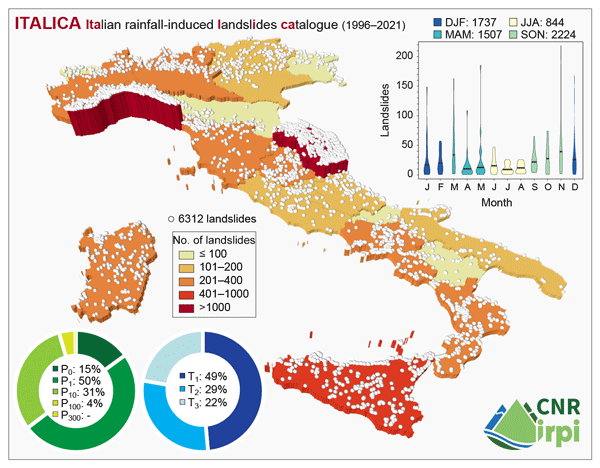
Peruccacci, S., Gariano, S. L., Melillo, M., Solimano, M., Guzzetti, F., and Brunetti, M. T.: The ITAlian rainfall-induced LandslIdes CAtalogue, an extensive and accurate spatio-temporal catalogue of rainfall-induced landslides in Italy, Earth Syst. Sci. Data, 15, 2863–2877, https://doi.org/10.5194/essd-15-2863-2023, 2023.
Piciullo, L., Gariano, S. L., Melillo, M., Brunetti, M. T., Peruccacci, S., Guzzetti, F., and Calvello, M.: Definition and performance of a threshold-based regional early warning model for rainfall-induced landslides, Landslides, 14, 995–1008, https://doi.org/10.1007/s10346-016-0750-2, 2017.
Piciullo, L., Calvello, M., and Cepeda, J. M.: Territorial early warning systems for rainfall-induced landslides, Earth-Sci. Rev., 179, 228–247, https://doi.org/10.1016/j.earscirev.2018.02.013, 2018.
Prete, M., Guadagno, M., and Hawkins, A.: Preliminary report on the landslides of 5 May 1998, Campania, southern Italy, B. Eng. Geol. Environ., 57, 113–129, 1998.
R Core Team: R: A Language and Environment for Statistical Computing, R Foundation for Statistical Computing, Vienna, Austria [code],
https://www.R-project.org/ (last access: 27 July 2025), 2025.
Revellino, P., Hungr, O., Guadagno, F. M., and Evans, S. G.: Velocity and runout simulation of destructive debris flows and debris avalanches in pyroclastic deposits, Campania region, Italy, Environ. Geol., 45, 295–311, https://doi.org/10.1007/s00254-003-0885-z, 2004.
Rianna, G., Pagano, L., and Urciuoli, G.: Rainfall patterns triggering shallow flowslides in pyroclastic soils, Eng. Geol., 174, 22–35, https://doi.org/10.1016/j.enggeo.2014.03.004, 2014.
Rossi, M., Witt, A., Guzzetti, F., Malamud, B. D., and Peruccacci, S.: Analysis of historical landslide time series in the Emilia-Romagna region, northern Italy, Earth Surf. Proc. Land., 35, 1123–1137, https://doi.org/10.1002/esp.1858, 2010.
Rossi, M., Luciani, S., Valigi, D., Kirschbaum, D., Brunetti, M. T., Peruccacci, S., and Guzzetti, F.: Statistical approaches for the definition of landslide rainfall thresholds and their uncertainty using rain gauge and satellite data, Geomorphology, 285, 16–27, 2017.
Segoni, S., Piciullo, L., and Gariano, S. L.: A review of the recent literature on rainfall thresholds for landslide occurrence, Landslides, 15, 1483–1501, https://doi.org/10.1007/s10346-018-0966-4, 2018.
Staley, D., Kean, J., Cannon, S., Schmidt, K. M., and Laber, J. L.: Objective definition of rainfall intensity–duration thresholds for the initiation of post-fire debris flows in southern California, Landslides, 10, 547–562, https://doi.org/10.1007/s10346-012-0341-9, 2013.
Strandberg, G. and Lind, P.: The importance of horizontal model resolution on simulated precipitation in Europe – from global to regional models, Weather Clim. Dynam., 2, 181–204, https://doi.org/10.5194/wcd-2-181-2021, 2021.
The MathWorks Inc.: Optimization Toolbox version 24.2 (R2024b), The MathWorks Inc., Natick, Massachusetts [code],
https://www.mathworks.com (last access: May 2025), 2024.
Zanchetta, G., Sulpizio, R., Pareschi, M. T., Leoni, F. M., and Santacroce, R.: Characteristics of May 5–6, 1998 volcaniclastic debris flows in the Sarno area (Campania, southern Italy): relationships to structural damage and hazard zonation, J. Volcanol. Geoth. Res., 133, 377–393, https://doi.org/10.1016/s0377-0273(03)00409-8, 2004.
Zhang, S., Pecoraro, G., Jiang, Q., and Calvello, M.: A probabilistic procedure to define multidimensional rainfall thresholds for territorial landslide warning models, Landslides, 22, 1773–1787, https://doi.org/10.1007/s10346-025-02461-7, 2025.
Zhao, B., Zhang, L., Gu, X., Luo, W., Yu, Z., and Yuan, L.: How is the occurrence of rainfall-triggered landslides related to extreme rainfall?, Geomorphology, 475, https://doi.org/10.1016/j.geomorph.2025.109666, 2025.