
Articles | Volume 26, issue 9
https://doi.org/10.5194/nhess-26-4335-2026
© Author(s) 2026. This work is distributed under
the Creative Commons Attribution 4.0 License.
the Creative Commons Attribution 4.0 License.
https://doi.org/10.5194/nhess-26-4335-2026
© Author(s) 2026. This work is distributed under
the Creative Commons Attribution 4.0 License.
the Creative Commons Attribution 4.0 License.
Invited perspectives
| 
07 Sep 2026
Invited perspectives |
| 07 Sep 2026
| 07 Sep 2026
Invited perspectives: reframing transboundary flood vulnerability through “Hydrosocial Connectivity” for just and adaptive governance

School of Geography, Earth and Environmental Sciences, University of Birmingham, Birmingham, United Kingdom
Birmingham Institute for Sustainability and Climate Change (BISCA), Birmingham, United Kingdom
now at: School of Geographical Sciences, University of Bristol, Bristol, United Kingdom
Rose Cook
School of Engineering, University of Birmingham, Birmingham, United Kingdom
Xilin Xia
Birmingham Institute for Sustainability and Climate Change (BISCA), Birmingham, United Kingdom
School of Engineering, University of Birmingham, Birmingham, United Kingdom
School of Geography, Earth and Environmental Sciences, University of Birmingham, Birmingham, United Kingdom
Birmingham Institute for Sustainability and Climate Change (BISCA), Birmingham, United Kingdom
Iseult Lynch
School of Geography, Earth and Environmental Sciences, University of Birmingham, Birmingham, United Kingdom
Birmingham Institute for Sustainability and Climate Change (BISCA), Birmingham, United Kingdom
Related authors
Sudhanshu Dixit, Sumit Sen, Tahmina Yasmin, Kieran Khamis, Debashish Sen, Wouter Buytaert, and David M. Hannah
Nat. Hazards Earth Syst. Sci., 26, 1251–1268, https://doi.org/10.5194/nhess-26-1251-2026, https://doi.org/10.5194/nhess-26-1251-2026, 2026
Short summary
Short summary
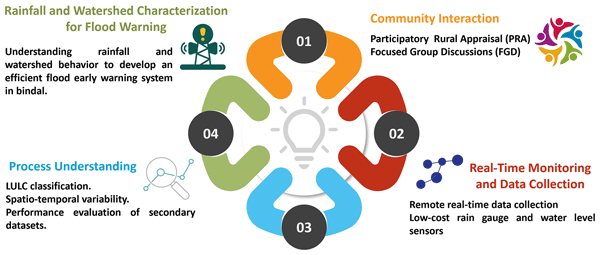
Flash floods are becoming more frequent in mountainous regions due to heavier rainstorms. To protect people and property, we are working to better understand local hydrology and improve the efficiency of early warning systems for urban flooding in Lesser Himalayas. By combining community knowledge, low-cost technology, we can enhance understanding of flood dynamics and strengthen preparedness in mountains. This work is a step toward building resilience by bridging science and community insight.
Tahmina Yasmin, Kieran Khamis, Anthony Ross, Subir Sen, Anita Sharma, Debashish Sen, Sumit Sen, Wouter Buytaert, and David M. Hannah
Nat. Hazards Earth Syst. Sci., 23, 667–674, https://doi.org/10.5194/nhess-23-667-2023, https://doi.org/10.5194/nhess-23-667-2023, 2023
Short summary
Short summary
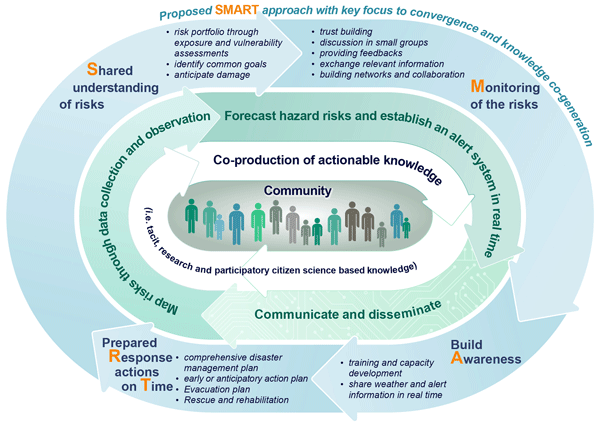
Floods continue to be a wicked problem that require developing early warning systems with plausible assumptions of risk behaviour, with more targeted conversations with the community at risk. Through this paper we advocate the use of a SMART approach to encourage bottom-up initiatives to develop inclusive and purposeful early warning systems that benefit the community at risk by engaging them at every step of the way along with including other stakeholders at multiple scales of operations.
Sudhanshu Dixit, Sumit Sen, Tahmina Yasmin, Kieran Khamis, Debashish Sen, Wouter Buytaert, and David M. Hannah
Nat. Hazards Earth Syst. Sci., 26, 1251–1268, https://doi.org/10.5194/nhess-26-1251-2026, https://doi.org/10.5194/nhess-26-1251-2026, 2026
Short summary
Short summary
Flash floods are becoming more frequent in mountainous regions due to heavier rainstorms. To protect people and property, we are working to better understand local hydrology and improve the efficiency of early warning systems for urban flooding in Lesser Himalayas. By combining community knowledge, low-cost technology, we can enhance understanding of flood dynamics and strengthen preparedness in mountains. This work is a step toward building resilience by bridging science and community insight.
Daniel G. Kingston, Liam Cooper, David A. Lavers, and David M. Hannah
Nat. Hazards Earth Syst. Sci., 25, 675–682, https://doi.org/10.5194/nhess-25-675-2025, https://doi.org/10.5194/nhess-25-675-2025, 2025
Short summary
Short summary
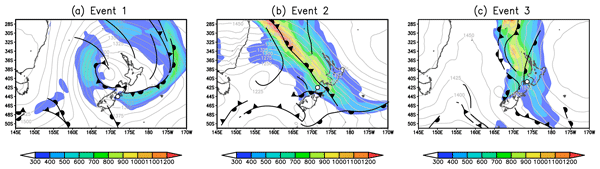
Extreme rainfall comprises a major hydrohazard for New Zealand and is commonly associated with atmospheric rivers – narrow plumes of very high atmospheric moisture transport. Here, we focus on improved forecasting of these events by testing a forecasting tool previously applied to similar situations in western Europe. However, our results for New Zealand suggest the performance of this forecasting tool may vary depending on geographical setting.
Jonathan D. Mackay, Nicholas E. Barrand, David M. Hannah, Emily Potter, Nilton Montoya, and Wouter Buytaert
The Cryosphere, 19, 685–712, https://doi.org/10.5194/tc-19-685-2025, https://doi.org/10.5194/tc-19-685-2025, 2025
Short summary
Short summary
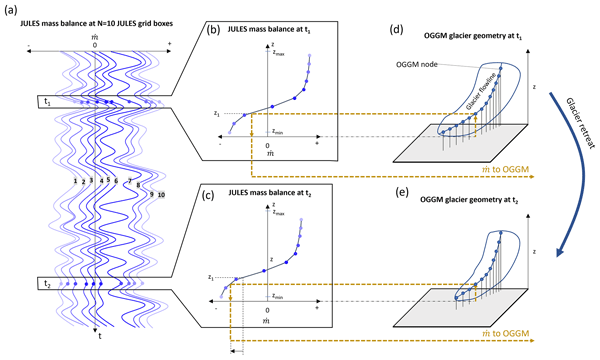
We combine two globally capable glacier evolution models to include processes that are typically neglected but thought to control tropical glacier retreat (e.g. sublimation). We apply the model to Peru's Vilcanota-Urubamba Basin. The model captures observed glacier mass changes,but struggles with surface albedo dynamics. Projections show glacier mass shrinking to 17 % or 6 % of 2000 levels by 2100 under moderate- and high-emission scenarios, respectively.
Zhen Lei Wei, Yue Quan Shang, Qiu Hua Liang, and Xi Lin Xia
Nat. Hazards Earth Syst. Sci., 24, 3357–3379, https://doi.org/10.5194/nhess-24-3357-2024, https://doi.org/10.5194/nhess-24-3357-2024, 2024
Short summary
Short summary
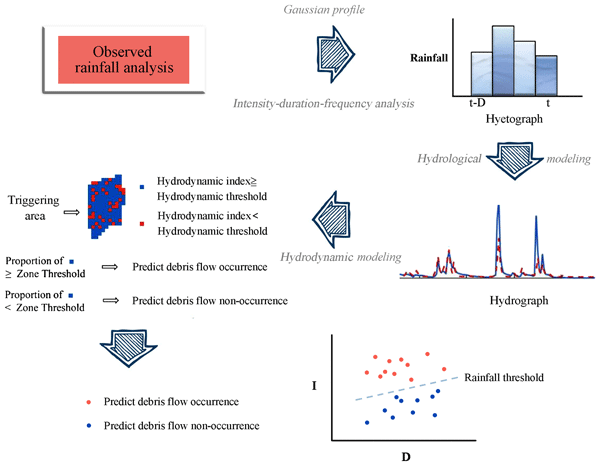
The initiation of debris flows is significantly influenced by rainfall-induced hydrological processes. We propose a novel framework based on an integrated hydrological and hydrodynamic model and aimed at estimating intensity–duration (ID) rainfall thresholds responsible for triggering debris flows. In comparison to traditional statistical approaches, this physically based framework is particularly suitable for application in ungauged catchments where historical debris flow data are scarce.
Danny Croghan, Pertti Ala-Aho, Jeffrey Welker, Kaisa-Riikka Mustonen, Kieran Khamis, David M. Hannah, Jussi Vuorenmaa, Bjørn Kløve, and Hannu Marttila
Hydrol. Earth Syst. Sci., 28, 1055–1070, https://doi.org/10.5194/hess-28-1055-2024, https://doi.org/10.5194/hess-28-1055-2024, 2024
Short summary
Short summary
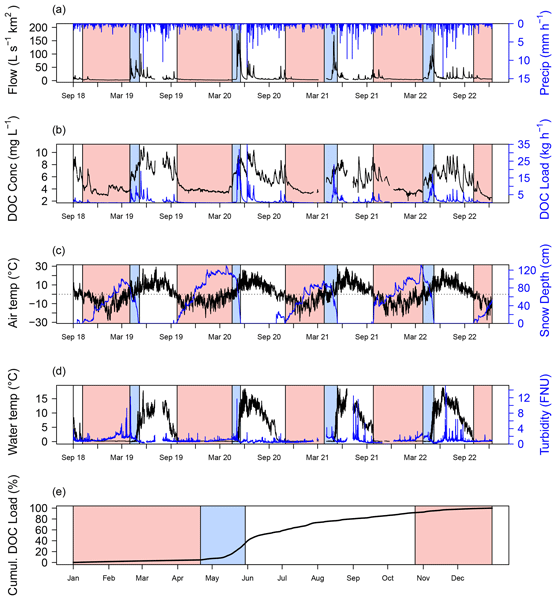
The transport of dissolved organic carbon (DOC) from land into streams is changing due to climate change. We used a multi-year dataset of DOC and predictors of DOC in a subarctic stream to find out how transport of DOC varied between seasons and between years. We found that the way DOC is transported varied strongly seasonally, but year-to-year differences were less apparent. We conclude that the mechanisms of transport show a higher degree of interannual consistency than previously thought.
Tahmina Yasmin, Kieran Khamis, Anthony Ross, Subir Sen, Anita Sharma, Debashish Sen, Sumit Sen, Wouter Buytaert, and David M. Hannah
Nat. Hazards Earth Syst. Sci., 23, 667–674, https://doi.org/10.5194/nhess-23-667-2023, https://doi.org/10.5194/nhess-23-667-2023, 2023
Short summary
Short summary
Floods continue to be a wicked problem that require developing early warning systems with plausible assumptions of risk behaviour, with more targeted conversations with the community at risk. Through this paper we advocate the use of a SMART approach to encourage bottom-up initiatives to develop inclusive and purposeful early warning systems that benefit the community at risk by engaging them at every step of the way along with including other stakeholders at multiple scales of operations.
Doris E. Wendt, John P. Bloomfield, Anne F. Van Loon, Margaret Garcia, Benedikt Heudorfer, Joshua Larsen, and David M. Hannah
Nat. Hazards Earth Syst. Sci., 21, 3113–3139, https://doi.org/10.5194/nhess-21-3113-2021, https://doi.org/10.5194/nhess-21-3113-2021, 2021
Short summary
Short summary
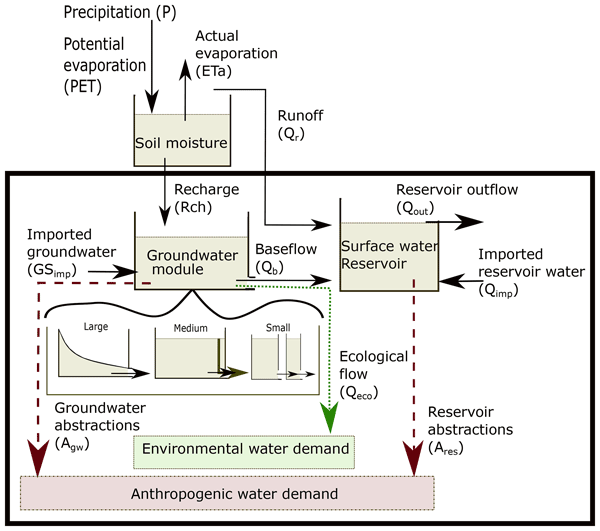
Managing water demand and supply during droughts is complex, as highly pressured human–water systems can overuse water sources to maintain water supply. We evaluated the impact of drought policies on water resources using a socio-hydrological model. For a range of hydrogeological conditions, we found that integrated drought policies reduce baseflow and groundwater droughts most if extra surface water is imported, reducing the pressure on water resources during droughts.
Cited articles
Bakker, M. H.: Transboundary river floods and institutional capacity 1, J. Am. Water Resour. As., 45, 553–566, https://doi.org/10.1111/j.1752-1688.2009.00325.x, 2009.
Baranyai, G.: Emerging Challenges to Transboundary Water Governance, in: European Water Law and Hydropolitics: Water Governance – Concepts, Methods, and Practice, Springer, Cham., https://doi.org/10.1007/978-3-030-22541-4_6, 2019.
Baseer, A. and Iqbal, M. F.: Flood monitoring and reservoir management in the transboundary Chenab River Basin using machine learning and remote sensing techniques, Model. Earth Syst. Environ., 11, 21, https://doi.org/10.1007/s40808-024-02182-1, 2025.
Bhattarai, Y., Duwal, S., Sharma, S., and Talchabhadel, R.: Leveraging machine learning and open-source spatial datasets to enhance flood susceptibility mapping in transboundary river basin, Int. J. Digit. Earth, 17, 2313857, https://doi.org/10.1080/17538947.2024.2313857, 2024.
Biswas, A. K.: Management of Transboundary Waters: An Overview, in: Management of Transboundary Rivers and Lakes, edited by: Varis, O., Biswas, A. K., and Tortajada, C., Berlin, Heidelberg, https://doi.org/10.1007/978-3-540-74928-8_1, 2008.
Boelens, R., Hoogesteger, J., Swyngedouw, E., Vos, J., and Wester, P.: Hydrosocial territories: a political ecology perspective, Water Int., 41, 1–14, https://doi.org/10.1080/02508060.2016.1134898, 2016.
Burton, C. G., Toquica, M., Asad, K. M. B., and Musori, M.: Validation and development of composite indices for measuring vulnerability to earthquakes using a socio-economic perspective, Nat. Hazards, 111, 1301–1334, https://doi.org/10.1007/s11069-021-05095-9, 2022.
Chowdhury, M. A., Nawaz, S., Hossen, M. N., Islam, S. L. U., Habiba, S. U., Karim, M. E., Hossain, M. L., and Kabir, M. H.: A review of flood management in South Asia: approaches, challenges, and opportunities, Handbook of Flood Risk Management in Developing Countries, 302–318, ISBN: 9781000847765, 2023.
Debnath, J., Sahariah, D., Lahon, D., Nath, N., Chand, K., Meraj, G., Farooq, M., Kumar, P., Kanga, S., and Singh, S. K.: Geospatial modeling to assess the past and future land use-land cover changes in the Brahmaputra Valley, NE India, for sustainable land resource management, Environ. Sci. Pollut. Res., 30, 106997–107020, https://doi.org/10.1007/s11356-022-24248-2, 2023.
De Stefano, L., Petersen-Perlman, J. D., Sproles, E. A., Eynard, J., and Wolf, A. T.: Assessment of transboundary river basins for potential hydro-political tensions, Global Environ. Chang., 45, 35–46, https://doi.org/10.1016/j.gloenvcha.2017.04.008, 2017.
Dixit, S., Sen, S., Yasmin, T., Khamis, K., Sen, D., Buytaert, W., and Hannah, D. M.: Integrating SMART principles in flood early warning system design in the Himalayas, Nat. Hazards Earth Syst. Sci., 26, 1251–1268, https://doi.org/10.5194/nhess-26-1251-2026, 2026.
Dubey, A. K., Kumar, P., Chembolu, V., Dutta, S., Singh, R. P., and Rajawat, A. S.: Flood modeling of a large transboundary river using WRF-Hydro and microwave remote sensing, J. Hydrol., 598, 126391, https://doi.org/10.1016/j.jhydrol.2021.126391, 2021.
FAO: AQUASTAT Transboundary River Basins – Ganges-Brahmaputra-Meghna River Basin, Food and Agriculture Organization of the United Nations (FAO), Rome, Italy, https://openknowledge.fao.org/server/api/core/bitstreams/0b663060-87be-4338-9248-58cb9a2bfd8a/content (last access: 10 May 2025), 2011.
Fox, S., Agyemang, F., Hawker, L., and Neal, J.: Integrating social vulnerability into high-resolution global flood risk mapping, Nat. Commun., 15, 3155, https://doi.org/10.1038/s41467-024-47394-2, 2024.
Gädeke, A., Wortmann, M., Menz, C., Islam, A. S., Masood, M., Krysanova, V., Lange, S., and Hattermann, F. F.: Climate impact emergence and flood peak synchronization projections in the Ganges, Brahmaputra and Meghna basins under CMIP5 and CMIP6 scenarios, Environ. Res. Lett., 17, 094036, https://doi.org/10.1088/1748-9326/ac8ca1, 2022.
Grünwald, R., Feng, Y., and Wang, W.: Reconceptualization of the Transboundary Water Interaction Nexus (TWINS): approaches, opportunities and challenges, Water Int., 45, 458–478, https://doi.org/10.1080/02508060.2020.1780854, 2020.
Haque, S. E., Nahar, N., Chowdhury, N. N., Sayanno, T. K., and Haque, M. S.: Geomorphological changes of river Surma due to climate change, Int. J. Energ. Water Res., 9, 113–132, https://doi.org/10.1007/s42108-023-00275-8, 2025.
Hazarika, M. K.: Assessing and mapping flood hazard, vulnerability and risk in the Upper Brahmaputra River basin using remote sensing and GIS, J. Flood Risk Manage., 9, 278–291, 2016.
Hazarika, N., Barman, D., Das, A. K., Sarma, A. K., and Borah, S. B.: Assessing and mapping flood hazard, vulnerability and risk in the Upper Brahmaputra River valley using stakeholders' knowledge and multicriteria evaluation (MCE), J. Flood Risk Manage., 11, S700–S716, https://doi.org/10.1111/jfr3.12237, 2018.
Islam, S. N.: Deltaic floodplains development and wetland ecosystems management in the Ganges–Brahmaputra–Meghna Rivers Delta in Bangladesh, Sustain. Water Resour. Manag., 2, 237–256, https://doi.org/10.1007/s40899-016-0047-6, 2016.
Linton, J. and Budds, J.: The hydrosocial cycle: Defining and mobilizing a relational-dialectical approach to water, Geoforum, 57, 170–180, https://doi.org/10.1016/j.geoforum.2013.10.008, 2014.
López, P. L., Sultana, T., Kafi, M. A. H., Hossain, M. S., Khan, A. S., and Masud, M. S.: Evaluation of global water resources reanalysis data for estimating flood events in the Brahmaputra River Basin, Water Resour. Manag., 34, 2201–2220, https://doi.org/10.1007/s11269-020-02546-z, 2020.
Lyu, H., Tian, F., Zhang, K., and Nan, Y.: Water-energy-food nexus in the Yarlung Tsangpo-Brahmaputra River Basin: Impact of mainstream hydropower development, J. Hydrol.-Reg. Stud., 45, 101293, https://doi.org/10.1016/j.ejrh.2022.101293, 2023.
Matheswaran, K., Alahacoon, N., Pandey, R., and Amarnath, G.: Flood risk assessment in South Asia to prioritize flood index insurance applications in Bihar, India, Geomat. Nat. Haz. Risk, 10, 26–48, https://doi.org/10.1080/19475705.2018.1500495, 2018.
Mehta, A. S. and Warner, J. F.: Multi-level hegemony in transboundary Flood Risk Management: A downstream perspective on the Maritsa Basin, Environ. Sci. Pol., 129, 126–136, https://doi.org/10.1016/j.envsci.2021.12.014, 2022.
Nagendra, H., Bai, X., Brondizio, E. S., and Lwasa, S.: The urban south and the predicament of global sustainability, Nat. Sustain., 1, 341–349, https://doi.org/10.1038/s41893-018-0101-5, 2018.
Pansera, J. N.: International Meuse Commission: 20 years of cooperation, Water Int., 49, 455–465, https://doi.org/10.1080/02508060.2024.2321689, 2024.
Pradhan, N. S., Das, P. J., Gupta, N., and Shrestha, A. B.: Sustainable management options for healthy rivers in South Asia: The case of Brahmaputra, Sustainability, 13, 1087, https://doi.org/10.3390/su13031087, 2021.
Rahayu, H. P., Zulfa, K. I., Nurhasanah, D., Haigh, R., Amaratunga, D., and Wahdiny, I. I.: Unveiling transboundary challenges in river flood risk management: learning from the Ciliwung River basin, Nat. Hazards Earth Syst. Sci., 24, 2045–2064, https://doi.org/10.5194/nhess-24-2045-2024, 2024.
Rahman, K. F., Pal, I., Szabo, S., Pramanik, M., and Udmale, P.: Transboundary water risk governance frameworks in deltaic socio-economic regions: A case study of river deltas in Bangladesh, India, and Vietnam, in: Disaster Resilience and Sustainability, Elsevier, 49–72, https://doi.org/10.1016/B978-0-323-85195-4.00011-1, 2021.
Rakib, M. R., Islam, M. N., and Islam, M. N.: Flood vulnerability mapping to riverine floods: a study on the old Brahmaputra River, Curr. Res. Geosci., 7, 47–58, https://doi.org/10.3844/ajgsp.2017.47.58, 2017.
Rodríguez, C., Serrano, J., Sanchez, R., and Leiva, E.: The hydrosocial cycle and the inequalities in access to water in rural areas of Metropolitan Region of Santiago, Chile, Water 16, 2811, https://doi.org/10.3390/w16192811, 2024.
Sahana, M., Dhali, M. K., and Lindley, S.: Global disparities in transboundary river research have implications for sustainable management, Commun. Earth Environ., 5, 786, https://doi.org/10.1038/s43247-024-01928-0, 2024.
Schmidt, J. J. and Peppard, C. Z.: Water ethics on a human-dominated planet: Rationality, context and values in global governance, Wiley Interdiscip. Rev.-Water, 1, 533–547, https://doi.org/10.1002/wat2.1043, 2014.
Shampa, I. J. N., Hussain, M. M., Islam, M. M., and Zoha, R. H.: Evaluating 2021 extreme flash flood of Teesta River, Hydrol. Res., 54, 1095–1114, https://doi.org/10.2166/nh.2023.122, 2023.
Surinaidu, L., Amarasinghe, U., Maheswaran, R., and Nandan, M. J.: Assessment of long-term hydrogeological changes and plausible solutions to manage hydrological extremes in the transnational Ganga river basin, H2Open J., 3, 457–480, https://doi.org/10.2166/h2oj.2020.049, 2020.
UNEP-DHI and UNEP: Transboundary River Basins: Status and Trends – Summary for Policy Makers, United Nations Environment Programme and UNEP-DHI Centre for Water and Environment, https://unepdhi.org/wp-content/uploads/sites/2/2020/05/GEF_TWAPRB_FullTechnicalReport_compressed.pdf (last access: 10 May 2025), 2016.
UN (United Nations): Integrated Water Resources Monitoring and Assessment in Transboundary Basins: Working Group Report, United Nations Digital Library, https://unepdhi.org/wp-content/uploads/sites/2/2020/05/GEF_TWAPRB_FullTechnicalReport_compressed.pdf (last access: 10 May 2025), 2008.
Yang, J. and Huang, G.: Study on the mechanism of multi-scalar transboundary water security governance in the Shenzhen River, Sustainability, 16, 7138, https://doi.org/10.3390/su16167138, 2024.
Short summary
Absence of basin-wide agreements, limited data-sharing, and the exclusion of local knowledge reinforce vulnerability and undermine resilience in the Ganges-Brahmaputra Basin. We urge a shift to hydrosocial connectivity – linking water flows, social relations, and governance. This framing reveals risks are shaped by power, politics, and participation. By centring justice, equity, and collaboration, it offers more coordinated approach with adaptive and inclusive transboundary governance outcomes.
Absence of basin-wide agreements, limited data-sharing, and the exclusion of local knowledge...


Altmetrics
Final-revised paper
Preprint