
Articles | Volume 26, issue 8
https://doi.org/10.5194/nhess-26-3815-2026
© Author(s) 2026. This work is distributed under
the Creative Commons Attribution 4.0 License.
the Creative Commons Attribution 4.0 License.
https://doi.org/10.5194/nhess-26-3815-2026
© Author(s) 2026. This work is distributed under
the Creative Commons Attribution 4.0 License.
the Creative Commons Attribution 4.0 License.
Research article
| 
14 Aug 2026
Research article |
| 14 Aug 2026
| 14 Aug 2026
Modeling the combined effects of the 2023 Türkiye–Syria earthquake and an Atmospheric River event on landslide hazard
Hunter N. Jimenez
CORRESPONDING AUTHOR

Civil and Environmental Engineering Department, University of Washington, Seattle, WA, USA
Erkan Istanbulluoglu
Civil and Environmental Engineering Department, University of Washington, Seattle, WA, USA
Tolga Gorum
Eurasia Institute of Earth Sciences, Istanbul Technical University, Istanbul, Türkiye
Thomas A. Stanley
GESTAR II, University of Maryland Baltimore County, Baltimore, MD, USA
Hydrological Sciences Laboratory, NASA Goddard Space Flight Center, Greenbelt, MD, USA
Pukar M. Amatya
GESTAR II, University of Maryland Baltimore County, Baltimore, MD, USA
Hydrological Sciences Laboratory, NASA Goddard Space Flight Center, Greenbelt, MD, USA
Hakan Tanyas
Faculty of Geo-information Science and Earth Observation (ITC), University of Twente, Enschede, the Netherlands
Mehmet C. Demirel
Civil Engineering Department, Istanbul Technical University, Istanbul, Türkiye
Aykut Akgun
Geological Engineering Department, Karadeniz Technical University, Trabzon, Türkiye
Department of Earthquake, Disaster and Emergency Management Authority (AFAD), Ankara, Türkiye
Deniz Bozkurt
Department of Meteorology, University of Valparaıso, Valparaıso, Chile
Related authors
No articles found.
Suat Coskun, Caglar Bayik, Fusun Balik Sanli, Tolga Gorum, and Saygin Abdikan
Int. Arch. Photogramm. Remote Sens. Spatial Inf. Sci., XLIX-B3-2026, 481–486, https://doi.org/10.5194/isprs-archives-XLIX-B3-2026-481-2026, https://doi.org/10.5194/isprs-archives-XLIX-B3-2026-481-2026, 2026
Suat Coskun, Caglar Bayik, Saygin Abdikan, Tolga Gorum, and Fusun Balik Sanli
Int. Arch. Photogramm. Remote Sens. Spatial Inf. Sci., XLVIII-4-W18-2025, 77–82, https://doi.org/10.5194/isprs-archives-XLVIII-4-W18-2025-77-2026, https://doi.org/10.5194/isprs-archives-XLVIII-4-W18-2025-77-2026, 2026
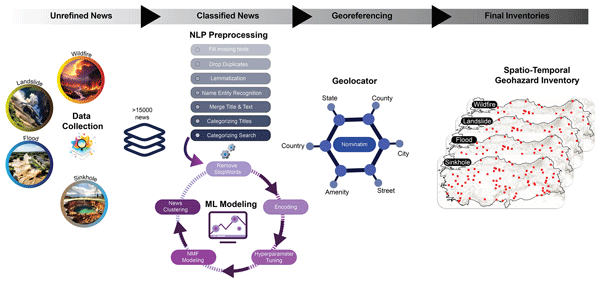
Aydoğan Avcıoğlu, Ogün Demir, and Tolga Görüm
Nat. Hazards Earth Syst. Sci., 25, 2421–2435, https://doi.org/10.5194/nhess-25-2421-2025, https://doi.org/10.5194/nhess-25-2421-2025, 2025
Short summary
Short summary
We demonstrate an approach for the development of inventories from internet sources to geolocalize geohazard incidents. We created a tool that autonomously gets news, processes it using natural language processing, and then builds inventories. Consequently, we present spatiotemporal inventories for geohazards, resulting in a total of 13 940 incidents between 1997 and 2023 in Türkiye. Our alternative and easy-to-implement development inventory method aids geohazard management and resilience.
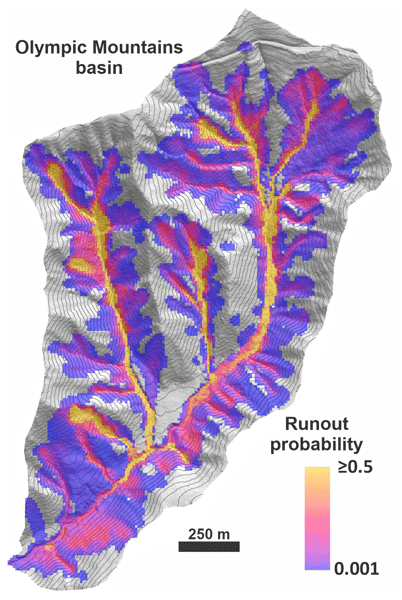
Jeffrey Keck, Erkan Istanbulluoglu, Benjamin Campforts, Gregory Tucker, and Alexander Horner-Devine
Earth Surf. Dynam., 12, 1165–1191, https://doi.org/10.5194/esurf-12-1165-2024, https://doi.org/10.5194/esurf-12-1165-2024, 2024
Short summary
Short summary
MassWastingRunout (MWR) is a new landslide runout model designed for sediment transport, landscape evolution, and hazard assessment applications. MWR is written in Python and includes a calibration utility that automatically determines best-fit parameters for a site and empirical probability density functions of each parameter for probabilistic model implementation. MWR and Jupyter Notebook tutorials are available as part of the Landlab package at https://github.com/landlab/landlab.
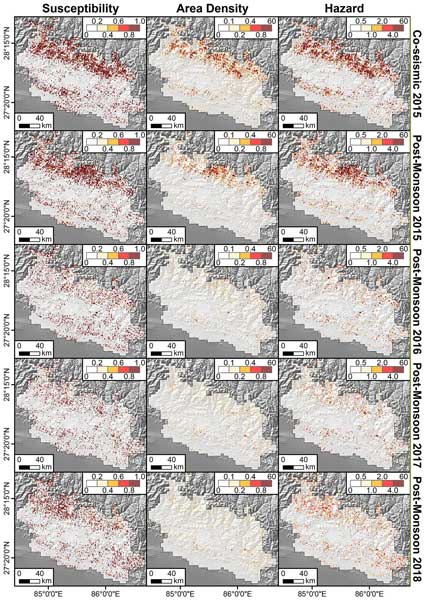
Ashok Dahal, Hakan Tanyas, Cees van Westen, Mark van der Meijde, Paul Martin Mai, Raphaël Huser, and Luigi Lombardo
Nat. Hazards Earth Syst. Sci., 24, 823–845, https://doi.org/10.5194/nhess-24-823-2024, https://doi.org/10.5194/nhess-24-823-2024, 2024
Short summary
Short summary
We propose a modeling approach capable of recognizing slopes that may generate landslides, as well as how large these mass movements may be. This protocol is implemented, tested, and validated with data that change in both space and time via an Ensemble Neural Network architecture.
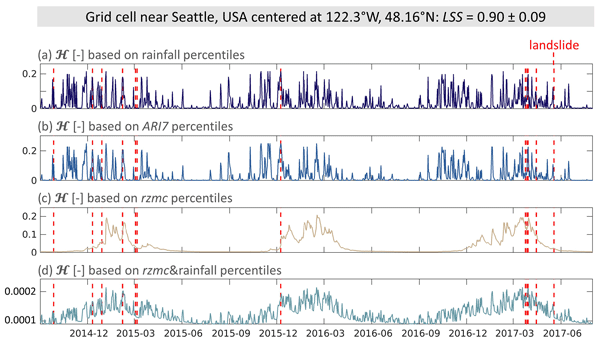
Anne Felsberg, Zdenko Heyvaert, Jean Poesen, Thomas Stanley, and Gabriëlle J. M. De Lannoy
Nat. Hazards Earth Syst. Sci., 23, 3805–3821, https://doi.org/10.5194/nhess-23-3805-2023, https://doi.org/10.5194/nhess-23-3805-2023, 2023
Short summary
Short summary
The Probabilistic Hydrological Estimation of LandSlides (PHELS) model combines ensembles of landslide susceptibility and of hydrological predictor variables to provide daily, global ensembles of hazard for hydrologically triggered landslides. Testing different hydrological predictors showed that the combination of rainfall and soil moisture performed best, with the lowest number of missed and false alarms. The ensemble approach allowed the estimation of the associated prediction uncertainty.
S. Coskun, C. Bayik, S. Abdikan, T. Gorum, and F. Balik Sanli
Int. Arch. Photogramm. Remote Sens. Spatial Inf. Sci., XLVIII-M-1-2023, 497–502, https://doi.org/10.5194/isprs-archives-XLVIII-M-1-2023-497-2023, https://doi.org/10.5194/isprs-archives-XLVIII-M-1-2023-497-2023, 2023

Tomás Carrasco-Escaff, Maisa Rojas, René Darío Garreaud, Deniz Bozkurt, and Marius Schaefer
The Cryosphere, 17, 1127–1149, https://doi.org/10.5194/tc-17-1127-2023, https://doi.org/10.5194/tc-17-1127-2023, 2023
Short summary
Short summary
In this study, we investigate the interplay between climate and the Patagonian Icefields. By modeling the glacioclimatic conditions of the southern Andes, we found that the annual variations in net surface mass change experienced by these icefields are mainly controlled by annual variations in the air pressure field observed near the Drake Passage. Little dependence on main modes of variability was found, suggesting the Drake Passage as a key region for understanding the Patagonian Icefields.

Ionut Cristi Nicu, Letizia Elia, Lena Rubensdotter, Hakan Tanyaş, and Luigi Lombardo
Earth Syst. Sci. Data, 15, 447–464, https://doi.org/10.5194/essd-15-447-2023, https://doi.org/10.5194/essd-15-447-2023, 2023
Short summary
Short summary
Thaw slumps and thermo-erosion gullies are cryospheric hazards that are widely encountered in Nordenskiöld Land, the largest and most compact ice-free area of the Svalbard Archipelago. By statistically analysing the landscape characteristics of locations where these processes occurred, we can estimate where they may occur in the future. We mapped 562 thaw slumps and 908 thermo-erosion gullies and used them to create the first multi-hazard susceptibility map in a high-Arctic environment.
Robert Emberson, Dalia B. Kirschbaum, Pukar Amatya, Hakan Tanyas, and Odin Marc
Nat. Hazards Earth Syst. Sci., 22, 1129–1149, https://doi.org/10.5194/nhess-22-1129-2022, https://doi.org/10.5194/nhess-22-1129-2022, 2022
Short summary
Short summary
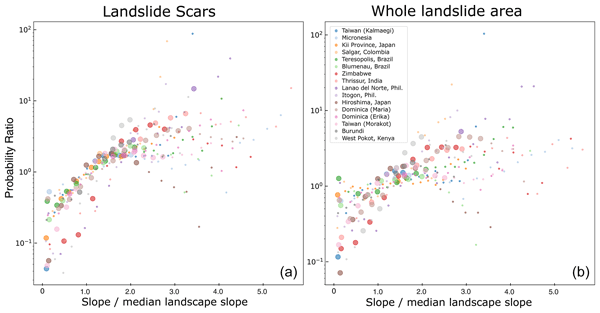
Understanding where landslides occur in mountainous areas is critical to support hazard analysis as well as understand landscape evolution. In this study, we present a large compilation of inventories of landslides triggered by rainfall, including several that are described here for the first time. We analyze the topographic characteristics of the landslides, finding consistent relationships for landslide source and deposition areas, despite differences in the inventories' locations.
Cited articles
Abbaszadeh, M., Shahriar, K., Sharifzadeh, M., and Heydari, M.: Uncertainty and reliability analysis applied to slope stability: a case study from Sungun copper mine, Geotechnical and Geological Engineering, 29, 581–596, https://doi.org/10.1007/s10706-011-9405-1, 2011.
Allstadt, K. E., Thompson, E. M., Jibson, R., Wald, D. J., Hearne, M., Hunter, E. J., Fee, J., Schovanec, H., Slosky, D., and Haynie, K. L.: The US Geological Survey ground failure product: Near-real-time estimates of earthquake-triggered landslides and liquefaction, Earthq. Spectra, 38, 5–36, https://doi.org/10.1177/87552930211032685, 2022.
Alvarado-Franco, J. P., Castro, D., Estrada, N., Caicedo, B., Sánchez-Silva, M., Camacho, L. A., and Muñoz, F.: Quantitative-mechanistic model for assessing landslide probability and pipeline failure probability due to landslides, Eng. Geol., 222, 212–224, https://doi.org/10.1016/j.enggeo.2017.04.005, 2017.
Anderson, S. P., Dietrich, W. E., Montgomery, D. R., Torres, R., Conrad, M. E., and Loague, K.: Subsurface flow paths in a steep, unchanneled catchment, Water Resour. Res., 33, 2637–2653, https://doi.org/10.1029/97WR02595, 1997.
ASCE-EWRI: The ASCE standardized reference evapotranspiration equation, Technical Committee Report to the Environmental and Water Resources Institute of the American Society of Civil Engineers from the Task Committee on Standardization of Reference Evapotranspiration, ASCE-EWRI, Reston, VA, 173 pp., https://doi.org/10.1061/9780784408056, 2005.
Assouline, S. and Or, D.: Anisotropy factor of saturated and unsaturated soils, Water Resour. Res., 42, W12403, https://doi.org/10.1029/2006WR005001, 2006.
Baise, L. G., Higgins, R. B., and Brankman, C. M.: Liquefaction hazard mapping-statistical and spatial characterization of susceptible units, J. Geotech. Geoenviron., 132, 705–715, https://doi.org/10.1061/(ASCE)1090-0241(2006)132:6(705), 2006.
Barnhart, K. R., Hutton, E. W. H., Tucker, G. E., Gasparini, N. M., Istanbulluoglu, E., Hobley, D. E. J., Lyons, N. J., Mouchene, M., Nudurupati, S. S., Adams, J. M., and Bandaragoda, C.: Short communication: Landlab v2.0: a software package for Earth surface dynamics, Earth Surf. Dynam., 8, 379–397, https://doi.org/10.5194/esurf-8-379-2020, 2020.
Baum, R. L., Savage, W. Z., and Godt, J. W.: TRIGRS-A FORTRAN program for transient rainfall infiltration and grid-based regional slope-stability analysis, U. S. Geol. Surv. Open-File Rep., 02-0424, 64 pp., http://pubs.usgs.gov/of/2002/ofr-02-424/ (last access: 8 August 2026), 2002.
Baum, R. L., Godt, J. W., and Savage, W. Z.: Estimating the timing and location of shallow rainfall-induced landslides using a model for transient, unsaturated infiltration, J. Geophys. Res.-Earth, 115, F03013, https://doi.org/10.1029/2009JF001321, 2010.
Berrett, B., Fulmer, E., Leshchinsky, B., Olsen, M., Massey, C., and Wartman, J.: Simplified analysis of coseismic slope displacement and hillslope weakening, Eng. Geol., 352, 108058, https://doi.org/10.1016/j.enggeo.2025.108058, 2025.
Beven, K. J. and Kirkby, M. J.: A physically based variable contributing area model of basin hydrology, Hydrol. Sci. B., 24, 43–69, https://doi.org/10.1080/02626667909491834, 1979.
Borga, M., Fontana, G. D., and Cazorzi, F.: Analysis of topographic and climatic control on rainfall-triggered shallow landsliding using a quasi-dynamic wetness index, J. Hydrol., 268, 56–71, https://doi.org/10.1016/S0022-1694(02)00118-X, 2002.
Bozkurt, D., Sen, O. L., Ezber, Y., Guan, B., Viale, M., and Caglar, F.: Influence of African Atmospheric Rivers on Precipitation and Snowmelt in the Near East's Highlands, J. Geophys. Res.-Atmos., 126, https://doi.org/10.1029/2020JD033646, 2021.
Brain, M. J., Rosser, N. J., and Tunstall, N.: The control of earthquake sequences on hillslope stability, Geophys. Res. Lett., 44, 865–872, https://doi.org/10.1002/2016GL071879, 2017.
Brain, M. J., Moya, S., Kincey, M. E., Tunstall, N., Petley, D. N., and Sepúlveda, S. A.: Controls on Post-Seismic Landslide Behavior in Brittle Rocks, J. Geophys. Res.-Earth, 126, https://doi.org/10.1029/2021JF006242, 2021.
Burrows, K., Marc, O., and Andermann, C.: Retrieval of Monsoon Landslide Timings with Sentinel-1 Reveals the Effects of Earthquakes and Extreme Rainfall, Geophys. Res. Lett., 50, https://doi.org/10.1029/2023GL104720, 2023.
Campforts, B., Shobe, C. M., Steer, P., Vanmaercke, M., Lague, D., and Braun, J.: HyLands 1.0: a hybrid landscape evolution model to simulate the impact of landslides and landslide-derived sediment on landscape evolution, Geosci. Model Dev., 13, 3863–3886, https://doi.org/10.5194/gmd-13-3863-2020, 2020.
Chen, Z., Huang, D., and Wang, G.: A regional scale co-seismic landslide analysis framework: Integrating physics-based simulation with flexible sliding analysis, Eng. Geol., 315, 107040, https://doi.org/10.1016/j.enggeo.2023.107040, 2023.
Dai, A., Trenberth, K. E., and Karl, T. R.: Effects of Clouds, Soil Moisture, Precipitation, and Water Vapor on Diurnal Temperature Range, J. Climate, 12, 2451–2473, https://doi.org/10.1175/1520-0442(1999)012<2451:EOCSMP>2.0.CO;2, 1999.
Djukem, D. L. W., Fan, X., Braun, A., Chevalier, M.-L., Wang, X., Dai, L., Fang, C., Zhang, X., Görüm, T., and Xu, Q.: Traditional and modified Newmark displacement methods after the 2022 Ms 6.8 Luding earthquake (Eastern Tibetan Plateau), Landslides, 21, 807–828, https://doi.org/10.1007/s10346-023-02194-5, 2024.
Duncan, J. M.: State of the Art: Limit Equilibrium and Finite-Element Analysis of Slopes, J. Geotech. Eng.-ASCE, 122, 577–596, https://doi.org/10.1061/(ASCE)0733-9410(1996)122:7(577), 1996.
Emre, Ö., Duman, T. Y., Özalp, S., Elmacı, H., Olgun, Ş., and Şaroğlu, F.: Açıklamalı Türkiye diri fay haritası ölçek 1:1.250.000, Maden Tetkik ve Arama Genel Müdürlüğü, ISBN 978-605-5310-56-1, 2013.
Fan, X., Scaringi, G., Korup, O., West, A. J., van Westen, C. J., Tanyas, H., Hovius, N., Hales, T. C., Jibson, R. W., Allstadt, K. E., Zhang, L., Evans, S. G., Xu, C., Li, G., Pei, X., Xu, Q., and Huang, R.: Earthquake-Induced Chains of Geologic Hazards: Patterns, Mechanisms, and Impacts, Rev. Geophys., 57, 421–503, https://doi.org/10.1029/2018RG000626, 2019.
Fawcett, T.: An introduction to ROC analysis, Pattern Recogn. Lett., 27, 861–874, https://doi.org/10.1016/j.patrec.2005.10.010, 2006.
Francis, O., Fan, X., Hales, T., Hobley, D., Xu, Q., and Huang, R.: The Fate of Sediment After a Large Earthquake, J. Geophys. Res.-Earth, 127, https://doi.org/10.1029/2021JF006352, 2022.
GDAL/OGR contributors: GDAL/OGR Geospatial Data Abstraction Software Library, Open-Source Geospatial Foundation, https://gdal.org (last access: 8 August 2026), 2024.
Ghaffarian, S.: Rethinking digital twin: Introducing digital risk twin for disaster risk management, Nat. Hazards, 2, 79, https://doi.org/10.1038/s44304-025-00135-x, 2025.
Gong, W., Zekkos, D., and Clark, M.: The influence of seismic displacement models on spatial prediction of regional earthquake-induced landslides, Eng. Geol., 325, 107288, https://doi.org/10.1016/j.enggeo.2023.107288, 2023.
Görüm, T., Tanyas, H., Karabacak, F., Yılmaz, A., Girgin, S., Allstadt, K. E., Süzen, M. L., and Burgi, P.: Preliminary documentation of coseismic ground failure triggered by the February 6, 2023 Türkiye earthquake sequence, Eng. Geol., 327, 107315, https://doi.org/10.1016/j.enggeo.2023.107315, 2023.
Görüm, T., Bozkurt, D., Korup, O., İstanbulluoğlu, E., Şen, Ö. L., Yılmaz, A., Karabacak, F., Lombardo, L., Guan, B., and Tanyas, H.: The 2023 Türkiye–Syria earthquake disaster was exacerbated by an atmospheric river, Commun. Earth Environ., 6, 151, https://doi.org/10.1038/s43247-025-02111-9, 2025.
Griffiths, D. V. and Lane, P. A.: Assessment of Stability of Slopes under Draindown Conditions, J. Geotech. Geoenviron., 126, 443–450, https://doi.org/10.1061/(ASCE)1090-0241(2000)126:5(443), 2001.
Hairong, D., Yong, L., Chongjian, S., Svirchev, L., Qiang, X., Zhaokun, Y., Liang, Y., Shijun, N., and Zeming, S.: Mechanism of post-seismic floods after the Wenchuan earthquake in the upper Minjiang River, China, J. Earth Syst. Sci., 126, 96, https://doi.org/10.1007/s12040-017-0871-6, 2017.
Hammond, C., Hall, D., Miller, S., and Swetik, P.: Level 1 stability analysis (LISA), documentation for Version 2.0, USDA Forest Service, Intermountain Research Station, General Technical Report INT-285, Moscow, ID, https://archive.org/details/CAT31304159 (last access: 8 August 2026), 1992.
Hartmann, A. and Blume, T.: The evolution of hillslope hydrology: Links between form, function and the underlying control of geology, Water Resour. Res., 60, e2023WR035937, https://doi.org/10.1029/2023WR035937, 2024.
He, K., Lombardo, L., Chang, L., Sadhasivam, N., Hu, X., Fang, Z., Dahal, A., Fadel, I., Luo, G., and Tanyas, H.: Investigating earthquake legacy effect on hillslope deformation using InSAR-derived time series, Earth Surf. Proc. Land., 49, 980–990, https://doi.org/10.1002/esp.5746, 2024.
Hobley, D. E. J., Adams, J. M., Nudurupati, S. S., Hutton, E. W. H., Gasparini, N. M., Istanbulluoglu, E., and Tucker, G. E.: Creative computing with Landlab: an open-source toolkit for building, coupling, and exploring two-dimensional numerical models of Earth-surface dynamics, Earth Surf. Dynam., 5, 21–46, https://doi.org/10.5194/esurf-5-21-2017, 2017.
Hovius, N., Meunier, P., Lin, C. W., Chen, H., Chen, Y. G., Dadson, S., Horng, M.-J., and Lines, M.: Prolonged seismically induced erosion and the mass balance of a large earthquake, Earth Planet. Sc. Lett., 304, 347–355, https://doi.org/10.1016/j.epsl.2011.02.005, 2011.
Huang, R. and Fan, X.: The landslide story, Nat. Geosci., 6, 325–326, https://doi.org/10.1038/ngeo1806, 2013.
Jibson, R.: Methods for assessing the stability of slopes during earthquakes-A retrospective, Eng. Geol., 122, 43–50, https://doi.org/10.1016/j.enggeo.2010.09.017, 2011.
Jibson, R. W.: Predicting earthquake-induced landslide displacements using Newmark's sliding block analysis, Transp. Res. Record, 1411, 9–17, 1993.
Jimenez, H.: Modeling the Combined Effects of the 2023 Türkiye-Syria Earthquake and an Atmospheric River Event on Landslide Hazard - Code and Data Availability, Zenodo [code/data set], https://doi.org/10.5281/zenodo.20683726, 2026.
Jones, J. N., Boulton, S. J., Stokes, M., Bennett, G. L., and Whitworth, M. R. Z.: 30-year record of Himalaya mass-wasting reveals landscape perturbations by extreme events, Nat. Commun., 12, 6701, https://doi.org/10.1038/s41467-021-26964-8, 2021.
Keefer, D. K.: Landslides caused by earthquakes, Geol. Soc. Am. Bull., 95, 406–421, https://doi.org/10.1130/0016-7606(1984)95<406:LCBE>2.0.CO;2, 1984.
Kincey, M. E., Rosser, N. J., Densmore, A. L., Robinson, T. R., Shrestha, R., Singh Pujara, D., Horton, P., Swirad, Z. M., Oven, K. J., and Arrell, K.: Modelling post-earthquake cascading hazards: Changing patterns of landslide runout following the 2015 Gorkha earthquake, Nepal, Earth Surf. Proc. Land., 48, 537–554, https://doi.org/10.1002/esp.5501, 2023.
Kirschbaum, D. and Stanley, T.: Satellite-Based Assessment of Rainfall-Triggered Landslide Hazard for Situational Awareness, Earths Future, 6, 505–523, https://doi.org/10.1002/2017EF000715, 2018.
Laio, F., Porporato, A., Ridolfi, L., and Rodriguez-Iturbe, I.: Plants in water-controlled ecosystems: active role in hydrologic processes and response to water stress: II, Probabilistic soil moisture dynamics, Adv. Water Resour., 24, 707–723, https://doi.org/10.1016/S0309-1708(01)00005-7, 2001.
Lenti, L. and Martino, S.: A Parametric Numerical Study of the Interaction between Seismic Waves and Landslides for the Evaluation of the Susceptibility to Seismically Induced Displacements, B. Seismol. Soc. Am., 103, 33–56, https://doi.org/10.1785/0120120019, 2013.
Lepore, C., Arnone, E., Noto, L. V., Sivandran, G., and Bras, R. L.: Physically based modeling of rainfall-triggered landslides: a case study in the Luquillo forest, Puerto Rico, Hydrol. Earth Syst. Sci., 17, 3371–3387, https://doi.org/10.5194/hess-17-3371-2013, 2013.
Leshchinsky, B., Lehmann, P., and Or, D.: Enhanced Rainfall-Induced Shallow Landslide Activity Following Seismic Disturbance-From Triggering to Healing, J. Geophys. Res.-Earth, 126, e2020JF005669, https://doi.org/10.1029/2020JF005669, 2021.
Li, C., Wang, G., He, J., and Wang, Y.: A novel approach to probabilistic seismic landslide hazard mapping using Monte Carlo simulations, Eng. Geol., 301, 106616, https://doi.org/10.1016/j.enggeo.2022.106616, 2022.
Lim, K. J., Engel, B. A., Muthukrishnan, S., and Harbor, J.: Effects of Initial Abstraction and Urbanization on Estimated Runoff Using CN Technology 1, J. Am. Water Resour. As., 42, 629–643, https://doi.org/10.1111/j.1752-1688.2006.tb04481.x, 2006.
Lin, C. W., Shieh, C. L., Yuan, B. D., Shieh, Y. C., Liu, S. H., and Lee, S. Y.: Impact of Chi-Chi earthquake on the occurrence of landslides and debris flows: Example from the Chenyulan River watershed, Nantou, Taiwan, Eng. Geol., 71, 49–61, https://doi.org/10.1016/S0013-7952(03)00125-X, 2004.
Liu, F. and Yang, S.: The effect of the Wenchuan earthquake on the fluvial morphology in the Longmen Shan, eastern Tibetan Plateau: Discussion and speculation, Quatern. Int., 371, 280–289, https://doi.org/10.1016/j.quaint.2014.09.021, 2015.
Makkonen, L.: Plotting Positions in Extreme Value Analysis, J. Appl. Meteorol. Clim., 45, 334–340, https://doi.org/10.1175/JAM2349.1, 2006.
Malkawi, A. I. H., Hassan, W. F., and Abdulla, F. A.: Uncertainty and reliability analysis applied to slope stability, Struct. Saf., 22, 161–187, https://doi.org/10.1016/S0167-4730(00)00006-0, 2000.
Marc, O., Hovius, N., Meunier, P., Görüm, T., and Uchida, T.: A seismologically consistent expression for the total area and volume of earthquake-triggered landsliding, J. Geophys. Res.-Earth, 121, 640–663, https://doi.org/10.1002/2015JF003732, 2016.
Meng, J., Kusky, T., Mooney, W. D., Bozkurt, E., Bodur, M. N., and Wang, L.: Surface deformations of the 6 February 2023 earthquake sequence, eastern Türkiye, Science, 383, 298–305, https://doi.org/10.1126/science.adj3770, 2023.
Meunier, P., Hovius, N., and Haines, J. A.: Topographic site effects and the location of earthquake induced landslides, Earth Planet. Sc. Lett., 275, 221–232, https://doi.org/10.1016/j.epsl.2008.07.020, 2008.
Meunier, P., Uchida, T., and Hovius, N.: Landslide patterns reveal the sources of large earthquakes, Earth Planet. Sc. Lett., 363, 27–33, https://doi.org/10.1016/j.epsl.2012.12.018, 2013.
Montgomery, D. R. and Dietrich, W. E.: A Physically Based Model for the Topographic Control on Shallow Landsliding, Water Resour. Res., 30, 1153–1171, https://doi.org/10.1029/93WR02979, 1994.
Montgomery, D. R., Dietrich, W. E., Torres, R., Anderson, S. P., Heffner, J. T., and Loague, K.: Hydrologic response of a steep, unchanneled valley to natural and applied rainfall, Water Resour. Res., 33, 91–109, https://doi.org/10.1029/96WR02985, 1997.
Moon, S., Formetta, G., Higa, J. T., Busti, R., Bellugi, D. G., Milledge, D. G., Ebel, B. A., and Dietrich, W. E.: Deep critical zone controls on shallow landslides, P. Natl. Acad. Sci. USA, 123, e2524542123, https://doi.org/10.1073/pnas.2524542123, 2026.
MTA: 1:500 000 scaled Turkish geology map series, MTA Genel Müdürlüğü, Ankara, https://eticaret.mta.gov.tr/index.php?route=product/search&tag=1/500.000 (last access: 8 August 2026), 2002.
Newmark, N. M.: Effects of Earthquakes on Dams and Embankments, Geotechnique, 15, 139–160, https://doi.org/10.1680/geot.1965.15.2.139, 1965.
Nguyen, B. Q. V., Doan, V. L., Kim, Y. T., Song, C.-H., and Lee, J.-S.: Considering antecedent rainfall to improve susceptibility assessment of rainfall-earthquake-triggered landslides on unsaturated slopes, Environ. Earth Sci., 83, 142, https://doi.org/10.1007/s12665-024-11482-9, 2024.
Nudurupati, S. S., Istanbulluoglu, E., Tucker, G. E., Gasparini, N. M., Hobley, D. E. J., Hutton, E. W. H., Barnhart, K. R., and Adams, J. M.: On transient semi-arid ecosystem dynamics using Landlab: Vegetation shifts, topographic refugia, and response to climate, Water Resour. Res., 59, e2021WR031179, https://doi.org/10.1029/2021WR031179, 2023.
Pack, R. T., Tarboton, D. G., and Goodwin, C. N.: The SINMAP approach to terrain stability mapping, in: Proceedings of the 8th International Congress of the International Association of Engineering Geology and the Environment, Vancouver, British Columbia, Canada, 21–25 September 1998, AA Balkema, Rotterdam, 1157–1165, ISBN 978-90-5410-992-1, 1998.
Pack, R. T., Tarboton, D. G., and Goodwin, C.: SINMAP 2.0-A Stability Index Approach to Terrain Stability Hazard Mapping, User's Manual, https://digitalcommons.usu.edu/cgi/viewcontent.cgi?article=1015&context=cee_facpub (last access: 28 January 2018), 2005.
Peláez, J. A., Hamdache, M., Galindo-Zaldívar, J., Henares, J., and Delgado, J.: Landslide susceptibility assessment in the Rif-Tell orogenic belt region (NW Africa) from a PGA, PGV and AI probabilistic seismic hazard analysis, Soil Dyn. Earthq. Eng., 195, 109395, https://doi.org/10.1016/j.soildyn.2025.109395, 2025.
Pelletier, J. D. and Rasmussen, C.: Geomorphically based predictive mapping of soil thickness in upland watersheds, Water Resour. Res., 45, W09417, https://doi.org/10.1029/2008WR007319, 2009.
Reichenbach, P., Rossi, M., Malamud, B. D., Mihir, M., and Guzzetti, F.: A review of statistically-based landslide susceptibility models, Earth-Sci. Rev., 180, 60–91, https://doi.org/10.1016/j.earscirev.2018.03.001, 2018.
Selby, M. J.: Hillslope Materials and Processes, 2nd edn., Oxford University Press, Oxford, UK, ISBN 978-0-19-874165-7, 1993.
Shao, X. and Xu, C.: Earthquake-induced landslides susceptibility assessment: a review of the state-of-the-art, Nat. Hazards Res., 2, 172–182, https://doi.org/10.1016/j.nhres.2022.03.002, 2022.
Sidle, R. C. and Ochiai, H.: Landslides: Processes, Prediction, and Land Use, Water Resources Monograph 18, American Geophysical Union, Washington, DC, https://doi.org/10.1029/WM018, 2006.
Steenhuis, T. S., Winchell, M., Rossing, J., Zollweg, J. A., and Walter, M. F.: SCS Runoff Equation Revisited for Variable-Source Runoff Areas, J. Irrig. Drain. Eng., 121, 234–238, https://doi.org/10.1061/(ASCE)0733-9437(1995)121:3(234), 1995.
Strauch, R., Istanbulluoglu, E., Nudurupati, S. S., Bandaragoda, C., Gasparini, N. M., and Tucker, G. E.: A hydroclimatological approach to predicting regional landslide probability using Landlab, Earth Surf. Dynam., 6, 49–75, https://doi.org/10.5194/esurf-6-49-2018, 2018.
Tanyaş, H., van Westen, C. J., Allstadt, K. E., Nowicki Jessee, M. A., Görüm, T., Jibson, R. W., Godt, J. W., Sato, H. P., Schmitt, R. G., Marc, O., and Hovius, N.: Presentation and analysis of a worldwide database of earthquake-induced landslide inventories, J. Geophys. Res.-Earth, 122, 1991–2015, https://doi.org/10.1002/2017JF004236, 2017.
Tanyaş, H., Kirschbaum, D., Görüm, T., van Westen, C. J., Tang, C., and Lombardo, L.: A closer look at factors governing landslide recovery time in post-seismic periods, Geomorphology, 391, 107912, https://doi.org/10.1016/j.geomorph.2021.107912, 2021a.
Tanyaş, H., Kirschbaum, D., Görüm, T., van Westen, C. J., and Lombardo, L.: New Insight into Post-seismic Landslide Evolution Processes in the Tropics, Front. Earth Sci., 9, https://doi.org/10.3389/feart.2021.700546, 2021b.
Tarolli, P. and Tarboton, D. G.: A new method for determination of most likely landslide initiation points and the evaluation of digital terrain model scale in terrain stability mapping, Hydrol. Earth Syst. Sci., 10, 663–677, https://doi.org/10.5194/hess-10-663-2006, 2006.
U.S. Geological Survey: M 7.5 – Elbistan earthquake, Kahramanmaras earthquake sequence, USGS Earthquake Hazards Program, https://earthquake.usgs.gov/earthquakes/eventpage/us6000jlqa (last access: 8 August 2026), 2023a.
U.S. Geological Survey: M 7.8 – Pazarcik earthquake, Kahramanmaras earthquake sequence, USGS Earthquake Hazards Program, https://earthquake.usgs.gov/earthquakes/eventpage/us6000jllz (last access: 8 August 2026), 2023b.
van den Bout, B., Tang, C., van Westen, C., and Jetten, V.: Physically based modeling of co-seismic landslide, debris flow, and flood cascade, Nat. Hazards Earth Syst. Sci., 22, 3183–3209, https://doi.org/10.5194/nhess-22-3183-2022, 2022.
Wang, S., Ma, X., Zhou, S., Wu, L., Wang, H., Tang, Z., Xu, G., Jing, Z., Chen, Z., and Gan, B.: Extreme atmospheric rivers in a warming climate, Nat. Commun., 14, 3219, https://doi.org/10.1038/s41467-023-38980-x, 2023.
Wang, Y. and Rathje, E. M.: Probabilistic seismic landslide hazard maps including epistemic uncertainty, Eng. Geol., 196, 313–324, https://doi.org/10.1016/j.enggeo.2015.08.001, 2015.
Warner, M. D., Mass, C. F., and Salathé, E. P.: Changes in Winter Atmospheric Rivers along the North American West Coast in CMIP5 Climate Models, J. Hydrometeorol., 16, 118–128, https://doi.org/10.1175/JHM-D-14-0080.1, 2015.
Wartman, J., Bray, J. D., and Seed, R. B.: Inclined Plane Studies of the Newmark Sliding Block Procedure, J. Geotech. Geoenviron., 129, 8, https://doi.org/10.1193/1.1737250, 2003.
Xi, C., Tanyas, H., Lombardo, L., He, K., Hu, X., and Jibson, R. W.: Estimating weakening on hillslopes caused by strong earthquakes, Commun. Earth Environ., 5, 81, https://doi.org/10.1038/s43247-024-01256-3, 2024a.
Xi, C., Tanyas, H., Lombardo, L., He, K., Hu, X., and Jibson, R. W.: Co-seismic hillslope weakening, Eng. Geol., 338, 107607, https://doi.org/10.1016/j.enggeo.2024.107607, 2024b.
Zang, M., Qi, S., Zou, Y., Sheng, Z., and Zamora, B. S.: An improved method of Newmark analysis for mapping hazards of coseismic landslides, Nat. Hazards Earth Syst. Sci., 20, 713–726, https://doi.org/10.5194/nhess-20-713-2020, 2020.
Zeng, Y., Zhang, Y., Xiao, S., Liu, J., Yu, Q., and Zhu, H.: A refined assessment model for landslide susceptibility under rainfall-earthquake coupling effects, Environ. Earth Sci., 84, 662, https://doi.org/10.1007/s12665-025-12552-2, 2025.
Zhang, C., Wang, Z., Xiao, J., Wang, Z., Zhao, D., and Li, Z.: Evaluation of coseismic landslide susceptibility by combining Newmark model and XGBoost algorithm, PLoS One, 20, e0328705, https://doi.org/10.1371/journal.pone.0328705, 2025.
Zhang, S. and Zhang, L. M.: Impact of the 2008 Wenchuan earthquake in China on subsequent long-term debris flow activities in the epicentral area, Geomorphology, 276, 86–103, https://doi.org/10.1016/j.geomorph.2016.10.009, 2017.
Short summary
After a major earthquake struck near the Türkiye/Syria border in February 2023, a powerful storm brought intense rainfall to the region, triggering additional landslides. We used satellite data and a physics-based model to map probabilistic landslide hazard using both coseismic and hydrologic drivers. We also explored how the sequence of these disasters affected landslide risk. Finally, we offer a method for seasonal forecasting of landslide hazard in at-risk areas using the historic climate.
After a major earthquake struck near the Türkiye/Syria border in February 2023, a powerful storm...


Altmetrics
Final-revised paper
Preprint