
Articles | Volume 26, issue 5
https://doi.org/10.5194/nhess-26-2111-2026
Copyright waived. This work has been dedicated to the public domain (Creative Commons Public Domain Dedication).
https://doi.org/10.5194/nhess-26-2111-2026
Copyright waived. This work has been dedicated to the public domain (Creative Commons Public Domain Dedication).
Research article
| 
08 May 2026
Research article |
| 08 May 2026
An improved empirical model for predicting postfire debris-flow volume in the western United States

U.S. Geological Survey, Geologic Hazards Science Center, Golden, CO, USA
Francis K. Rengers
U.S. Geological Survey, Geologic Hazards Science Center, Golden, CO, USA
Katherine R. Barnhart
U.S. Geological Survey, Geologic Hazards Science Center, Golden, CO, USA
Matthew A. Thomas
U.S. Geological Survey, Geologic Hazards Science Center, Golden, CO, USA
Jason W. Kean
U.S. Geological Survey, Geologic Hazards Science Center, Golden, CO, USA
Related authors
Luke A. McGuire, Francis K. Rengers, Ann M. Youberg, Alexander N. Gorr, Olivia J. Hoch, Rebecca Beers, and Ryan Porter
Nat. Hazards Earth Syst. Sci., 24, 1357–1379, https://doi.org/10.5194/nhess-24-1357-2024, https://doi.org/10.5194/nhess-24-1357-2024, 2024
Short summary
Short summary
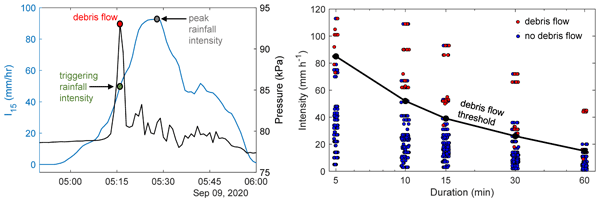
Runoff and erosion increase after fire, leading to a greater likelihood of floods and debris flows. We monitored debris flow activity following a fire in western New Mexico, USA, and observed 16 debris flows over a <2-year monitoring period. Rainstorms with recurrence intervals of approximately 1 year were sufficient to initiate debris flows. All debris flows initiated during the first several months following the fire, indicating a rapid decrease in debris flow susceptibility over time.

Francis K. Rengers, Luke A. McGuire, Katherine R. Barnhart, Ann M. Youberg, Daniel Cadol, Alexander N. Gorr, Olivia J. Hoch, Rebecca Beers, and Jason W. Kean
Nat. Hazards Earth Syst. Sci., 23, 2075–2088, https://doi.org/10.5194/nhess-23-2075-2023, https://doi.org/10.5194/nhess-23-2075-2023, 2023
Short summary
Short summary
Debris flows often occur after wildfires. These debris flows move water, sediment, and wood. The wood can get stuck in channels, creating a dam that holds boulders, cobbles, sand, and muddy material. We investigated how the channel width and wood length influenced how much sediment is stored. We also used a series of equations to back calculate the debris flow speed using the breaking threshold of wood. These data will help improve models and provide insight into future field investigations.
Andrew D. Wickert, Jabari C. Jones, Devon Libby, Phillip H. Larson, Katherine R. Barnhart, Maximillian S. Van Wyk de Vries, and Taylor F. Schildgen
EGUsphere, https://doi.org/10.5194/egusphere-2026-1018, https://doi.org/10.5194/egusphere-2026-1018, 2026
Short summary
Short summary
Some rivers are wide. Others are narrow. Why is this, and do they change over time? To answer these questions, we developed a model and tested it against real rivers. Rivers erode bank materials to widen, but transported sediments can settle on and rebuild the banks. Rivers generally widen during large floods and narrow during moderate ones. We demonstrate how changing streamflow alters river-channel width over time, with implications for erosion and flood hazards.

Nicole M. Gasparini, Adam M. Forte, and Katherine R. Barnhart
Earth Surf. Dynam., 12, 1227–1242, https://doi.org/10.5194/esurf-12-1227-2024, https://doi.org/10.5194/esurf-12-1227-2024, 2024
Short summary
Short summary
The time it takes for a landscape to adjust to new environmental conditions is critical for understanding the impacts of past and future environmental changes. We used different computational models and methods and found that predicted times for a landscape to reach a stable condition vary greatly. Our results illustrate that reporting how timescales are measured is important. Modelers should ensure that the measurement technique addresses the question.
Alexander B. Prescott, Luke A. McGuire, Kwang-Sung Jun, Katherine R. Barnhart, and Nina S. Oakley
Nat. Hazards Earth Syst. Sci., 24, 2359–2374, https://doi.org/10.5194/nhess-24-2359-2024, https://doi.org/10.5194/nhess-24-2359-2024, 2024
Short summary
Short summary
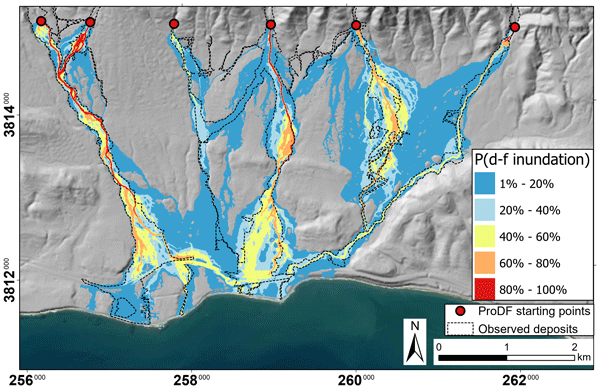
Fire can dramatically increase the risk of debris flows to downstream communities with little warning, but hazard assessments have not traditionally included estimates of inundation. We unify models developed by the scientific community to create probabilistic estimates of inundation area in response to rainfall at forecast lead times (≥ 24 h) needed for decision-making. This work takes an initial step toward a near-real-time postfire debris-flow inundation hazard assessment product.
Francis K. Rengers, Samuel Bower, Andrew Knapp, Jason W. Kean, Danielle W. vonLembke, Matthew A. Thomas, Jaime Kostelnik, Katherine R. Barnhart, Matthew Bethel, Joseph E. Gartner, Madeline Hille, Dennis M. Staley, Justin K. Anderson, Elizabeth K. Roberts, Stephen B. DeLong, Belize Lane, Paxton Ridgway, and Brendan P. Murphy
Nat. Hazards Earth Syst. Sci., 24, 2093–2114, https://doi.org/10.5194/nhess-24-2093-2024, https://doi.org/10.5194/nhess-24-2093-2024, 2024
Short summary
Short summary
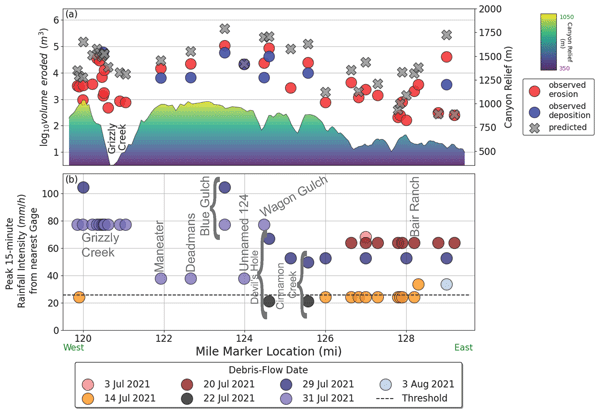
Every year the U.S. Geological Survey produces 50–100 postfire debris-flow hazard assessments using models for debris-flow likelihood and volume. To refine these models they must be tested with datasets that clearly document rainfall, debris-flow response, and debris-flow volume. These datasets are difficult to obtain, but this study developed and analyzed a postfire dataset with more than 100 postfire storm responses over a 2-year period. We also proposed ways to improve these models.
Katherine R. Barnhart, Christopher R. Miller, Francis K. Rengers, and Jason W. Kean
Nat. Hazards Earth Syst. Sci., 24, 1459–1483, https://doi.org/10.5194/nhess-24-1459-2024, https://doi.org/10.5194/nhess-24-1459-2024, 2024
Short summary
Short summary
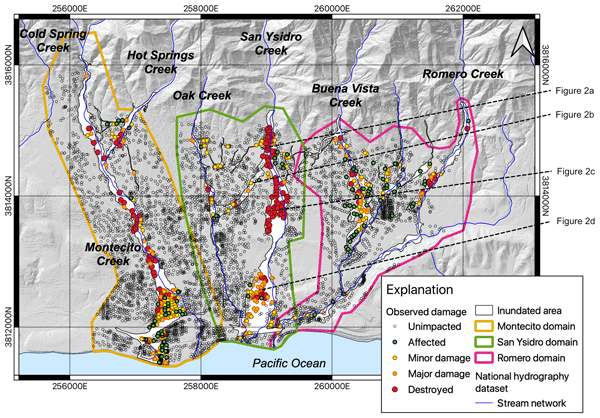
Debris flows are a type of fast-moving landslide that start from shallow landslides or during intense rain. Infrastructure located downstream of watersheds susceptible to debris flows may be damaged should a debris flow reach them. We present and evaluate an approach to forecast building damage caused by debris flows. We test three alternative models for simulating the motion of debris flows and find that only one can forecast the correct number and spatial pattern of damaged buildings.
Luke A. McGuire, Francis K. Rengers, Ann M. Youberg, Alexander N. Gorr, Olivia J. Hoch, Rebecca Beers, and Ryan Porter
Nat. Hazards Earth Syst. Sci., 24, 1357–1379, https://doi.org/10.5194/nhess-24-1357-2024, https://doi.org/10.5194/nhess-24-1357-2024, 2024
Short summary
Short summary
Runoff and erosion increase after fire, leading to a greater likelihood of floods and debris flows. We monitored debris flow activity following a fire in western New Mexico, USA, and observed 16 debris flows over a <2-year monitoring period. Rainstorms with recurrence intervals of approximately 1 year were sufficient to initiate debris flows. All debris flows initiated during the first several months following the fire, indicating a rapid decrease in debris flow susceptibility over time.
Luke A. McGuire, Scott W. McCoy, Odin Marc, William Struble, and Katherine R. Barnhart
Earth Surf. Dynam., 11, 1117–1143, https://doi.org/10.5194/esurf-11-1117-2023, https://doi.org/10.5194/esurf-11-1117-2023, 2023
Short summary
Short summary
Debris flows are mixtures of mud and rocks that can travel at high speeds across steep landscapes. Here, we propose a new model to describe how landscapes are shaped by debris flow erosion over long timescales. Model results demonstrate that the shapes of channel profiles are sensitive to uplift rate, meaning that it may be possible to use topographic data from steep channel networks to infer how erosion rates vary across a landscape.
Francis K. Rengers, Luke A. McGuire, Katherine R. Barnhart, Ann M. Youberg, Daniel Cadol, Alexander N. Gorr, Olivia J. Hoch, Rebecca Beers, and Jason W. Kean
Nat. Hazards Earth Syst. Sci., 23, 2075–2088, https://doi.org/10.5194/nhess-23-2075-2023, https://doi.org/10.5194/nhess-23-2075-2023, 2023
Short summary
Short summary
Debris flows often occur after wildfires. These debris flows move water, sediment, and wood. The wood can get stuck in channels, creating a dam that holds boulders, cobbles, sand, and muddy material. We investigated how the channel width and wood length influenced how much sediment is stored. We also used a series of equations to back calculate the debris flow speed using the breaking threshold of wood. These data will help improve models and provide insight into future field investigations.

Gregory E. Tucker, Eric W. H. Hutton, Mark D. Piper, Benjamin Campforts, Tian Gan, Katherine R. Barnhart, Albert J. Kettner, Irina Overeem, Scott D. Peckham, Lynn McCready, and Jaia Syvitski
Geosci. Model Dev., 15, 1413–1439, https://doi.org/10.5194/gmd-15-1413-2022, https://doi.org/10.5194/gmd-15-1413-2022, 2022
Short summary
Short summary
Scientists use computer simulation models to understand how Earth surface processes work, including floods, landslides, soil erosion, river channel migration, ocean sedimentation, and coastal change. Research benefits when the software for simulation modeling is open, shared, and coordinated. The Community Surface Dynamics Modeling System (CSDMS) is a US-based facility that supports research by providing community support, computing tools and guidelines, and educational resources.
Cited articles
Alin, A.: Multicollinearity, WIREs Computational Statistics, 2, 370–374, https://doi.org/10.1002/wics.84, 2010.
Anderson, T. W. and Darling, D. A.: A Test of Goodness of Fit, J. Am. Stat. Assoc., 49, 765–769, https://doi.org/10.1080/01621459.1954.10501232, 1954.
Barnhart, K. R., Jones, R. P., George, D. L., McArdell, B. W., Rengers, F. K., Staley, D. M., and Kean, J. W.: Multi-Model Comparison of Computed Debris Flow Runout for the 9 January 2018 Montecito, California Post-Wildfire Event, J. Geophys. Res.-Earth, 126, e2021JF006245, https://doi.org/10.1029/2021JF006245, 2021.
Berti, M. and Simoni, A.: Prediction of debris flow inundation areas using empirical mobility relationships, Geomorphology, 90, 144–161, https://doi.org/10.1016/j.geomorph.2007.01.014, 2007.
Bonnin, G. M., Martin, D., Lin, B., Parzybok, T., Yekta, M., and Riley, D.: Precipitation-Frequency Atlas of the United States, Volume 1, Version 5.0, Semiarid Southwest (Arizona, Southeast California, Nevada, New Mexico, Utah), NOAA, National Weather Service, https://repository.library.noaa.gov/view/noaa/22609 (last access: 29 April 2026), 2011.
Brown, M. B. and Forsythe, A. B.: Robust Tests for the Equality of Variances, J. Am. Stat. Assoc., 69, 364–367, https://doi.org/10.1080/01621459.1974.10482955, 1974.
Cannon, S., Gartner, J., Rupert, M., Michael, J., Rea, A., and Parrett, C.: Predicting the probability and volume of postwildfire debris flows in the intermountain western United States, Geol. Soc. Am. Bull., 122, 127–144, https://doi.org/10.1130/B26459.1, 2010.
Cannon, S. H. and Gartner, J. E.: Wildfire-related debris flow from a hazards perspective, in: Debris-flow Hazards and Related Phenomena, edited by: Jakob, M. and Hungr, O., Springer, Berlin, Heidelberg, 363–385, https://doi.org/10.1007/3-540-27129-5_15, 2005.
Cannon, S. H., Kirkham, R. M., and Parise, M.: Wildfire-related debris-flow initiation processes, Storm King Mountain, Colorado, Geomorphology, 39, 171–188, https://doi.org/10.1016/S0169-555X(00)00108-2, 2001.
Cannon, S. H., Gartner, J. E., Wilson, R. C., Bowers, J. C., and Laber, J. L.: Storm rainfall conditions for floods and debris flows from recently burned areas in southwestern Colorado and southern California, Geomorphology, 96, 250–269, https://doi.org/10.1016/j.geomorph.2007.03.019, 2008.
Cavagnaro, D. B., McCoy, S. W., Thomas, M. A., Kostelnik, J., and Lindsay, D. N.: Geophysical Research Letters, Improved Prediction of Postfire Debris Flows Through Rainfall Anomaly Maps, Geophys. Res. Lett., 52, e2025GL114791, https://doi.org/10.1029/2025GL114791, 2025a.
Cavagnaro, D. B., McCoy, S. W., Lindsay, D. N., McGuire, L. A., Kean, J. W., and Trugman, D. T.: Rainfall Thresholds for Postfire Debris-Flow Initiation Vary With Short-Duration Rainfall Climatology, J. Geophys. Res.-Earth, 130, e2024JF007781, https://doi.org/10.1029/2024JF007781, 2025b.
Daurio, M.: Cascading hazards, cascading consequences: Linking social-ecological systems in post-fire recovery, Hum. Organ., 84, 339–350, https://doi.org/10.1080/00187259.2025.2499680, 2025.
DeGraff, J. V., Wagner, D. L., Gallegos, A. J., DeRose, M., Shannon, C., and Ellsworth, T.: The remarkable occurrence of large rainfall-induced debris flows at two different locations on July 12, 2008, Southern Sierra Nevada, CA, USA, Landslides, 8, 343–353, https://doi.org/10.1007/s10346-010-0245-5, 2011.
DiBiase, R. A. and Lamb, M. P.: Dry sediment loading of headwater channels fuels post-wildfire debris flows in bedrock landscapes, Geology, 48, 189–193, https://doi.org/10.1130/G46847.1, 2020.
Donovan, I. P. and Santi, P. M.: A probabilistic approach to post-wildfire debris-flow volume modeling, Landslides, 14, 1345–1360, https://doi.org/10.1007/s10346-016-0786-3, 2017.
Dowling, C. A. and Santi, P. M.: Debris flows and their toll on human life: a global analysis of debris-flow fatalities from 1950 to 2011, Nat. Hazards, 71, 203–227, https://doi.org/10.1007/s11069-013-0907-4, 2014.
Drummond, M. A.: Southern Rockies Ecoregion, in: Status and Trends of Land Change in the Western United States – 1973 to 2000, edited by: Sleeter B. M., Wilson, T. S., and Acevedo, W., U. S. Geological Survey, 95–103, https://pubs.usgs.gov/pp/1794/a/ (last access: 4 April 2025), 2012.
Ebel, B. A., Moody, J. A., and Martin, D. A.: Hydrologic conditions controlling runoff generation immediately after wildfire, Water Resour. Res., 48, https://doi.org/10.1029/2011WR011470, 2012.
Esposito, G., Gariano, S. L., Masi, R., Alfano, S., and Giannatiempo, G.: Rainfall conditions leading to runoff-initiated post-fire debris flows in Campania, Southern Italy, Geomorphology, 423, 108557, https://doi.org/10.1016/j.geomorph.2022.108557, 2023.
Gabet, E. J. and Bookter, A.: A morphometric analysis of gullies scoured by post-fire progressively bulked debris flows in southwest Montana, USA, Geomorphology, 96, 298–309, https://doi.org/10.1016/j.geomorph.2007.03.016, 2008.
García-Ruiz, J. M., Arnáez, J., Gómez-Villar, A., Ortigosa, L., and Lana-Renault, N.: Fire-related debris flows in the Iberian Range, Spain, Geomorphology, 196, 221–230, https://doi.org/10.1016/j.geomorph.2012.03.032, 2013.
Gartner, J. E., Cannon, S. H., Santi, P. M., and Dewolfe, V. G.: Empirical models to predict the volumes of debris flows generated by recently burned basins in the western U. S., Geomorphology, 96, 339–354, https://doi.org/10.1016/j.geomorph.2007.02.033, 2008.
Gartner, J. E., Cannon, S. H., and Santi, P. M.: Empirical models for predicting volumes of sediment deposited by debris flows and sediment-laden floods in the transverse ranges of southern California, Eng. Geol., 176, 45–56, https://doi.org/10.1016/j.enggeo.2014.04.008, 2014.
Gartner, J. E., Kean, J. W., Rengers, F. K., McCoy, S. W., Oakley, N., and Sheridan, G.: Post-Wildfire Debris Flows, in: Advances in Debris-flow Science and Practice, edited by: Jakob, M., McDougall, S., and Santi, P., Springer International Publishing, Cham, 309–345, https://doi.org/10.1007/978-3-031-48691-3_11, 2024.
Gatwood, E., Pederson, J., and Casey, K.: Los Angeles district method for prediction of debris yield, US Army Corps of Engineers, Los Angeles District, 145, 2000.
Gorr, A. N., McGuire, L. A., Youberg, A. M., and Rengers, F. K.: A progressive flow-routing model for rapid assessment of debris-flow inundation, Landslides, 19, 2055–2073, https://doi.org/10.1007/s10346-022-01890-y, 2022.
Gorr, A. N., McGuire, L. A., Beers, R., and Hoch, O. J.: Triggering conditions, runout, and downstream impacts of debris flows following the 2021 Flag Fire, Arizona, USA, Nat. Hazards, 117, 2473–2504, https://doi.org/10.1007/s11069-023-05952-9, 2023.
Gorr, A. N., McGuire, L. A., and Youberg, A. M.: Empirical Models for Postfire Debris-Flow Volume in the Southwest United States, J. Geophys. Res.-Earth, 129, e2024JF007825, https://doi.org/10.1029/2024JF007825, 2024a.
Gorr, A. N., McGuire, L. A., Youberg, A. M., Beers, R., and Liu, T.: Inundation and flow properties of a runoff-generated debris flow following successive high-severity wildfires in northern Arizona, USA, Earth Surf. Proc. Land., 49, 622–641, https://doi.org/10.1002/esp.5724, 2024b.
Gorr, A. N., Rengers, F. K., Barnhart, K. R., Thomas, M. A., Kean, J. W., and Crowder, C. A.: Inventory of 227 postfire debris-flow volumes for 34 fires in the western United States, United States Geological Survey Data Release, https://doi.org/10.5066/P13EZSWW, 2025.
Griffith, G. E., Omernik, J. M., Smith, D. W., Cook, T. D., Tallyn, E., Moseley, K., and Johnson, C. B.: Ecoregions of California, U. S. Geological Survey, Open-File Report 2016-1021, https://doi.org/10.3133/ofr20161021, 2016.
Griswold, J. P. and Iverson, R. M.: Mobility statistics and automated hazard mapping for debris flows and rock avalanches, Scientific Investigations Report, U. S. Geological Survey, https://doi.org/10.3133/sir20075276, 2008.
Guthrie, R. H., Friele, P., Allstadt, K., Roberts, N., Evans, S. G., Delaney, K. B., Roche, D., Clague, J. J., and Jakob, M.: The 6 August 2010 Mount Meager rock slide-debris flow, Coast Mountains, British Columbia: characteristics, dynamics, and implications for hazard and risk assessment, Nat. Hazards Earth Syst. Sci., 12, 1277–1294, https://doi.org/10.5194/nhess-12-1277-2012, 2012.
Hancock, C.-A. and Wlodarczyk, K.: The role of wildfires and forest harvesting on geohazards and channel instability during the November 2021 atmospheric river in southwestern British Columbia, Canada, Earth Surf. Proc. Land., 50, e6065, https://doi.org/10.1002/esp.6065, 2025.
Helsel, D. R., Hirsch, R. M., Ryberg, K. R., Archfield, A., and Gilroy, E. J.: Statistical Methods in Water Resources, in: U. S. Geological Survey Techniques and Methods, U.S. Geological Survey, https://doi.org/10.3133/tm4A3, 2020.
Hoch, O. J., McGuire, L. A., Youberg, A. M., and Rengers, F. K.: Hydrogeomorphic Recovery and Temporal Changes in Rainfall Thresholds for Debris Flows Following Wildfire, J. Geophys. Res.-Earth, 126, e2021JF006374, https://doi.org/10.1029/2021JF006374, 2021.
Iverson, R. M., Schilling, S. P., and Vallance, J. W.: Objective delineation of lahar-inundation hazard zones, GSA Bulletin, 110, 972–984, https://doi.org/10.1130/0016-7606(1998)110<0972:ODOLIH>2.3.CO;2, 1998.
Kean, J. W., Staley, D. M., Lancaster, J. T., Rengers, F. K., Swanson, B. J., Coe, J. A., Hernandez, J. L., Sigman, A. J., Allstadt, K. E., and Lindsay, D. N.: Inundation, flow dynamics, and damage in the 9 January 2018 Montecito debris-flow event, California, USA: Opportunities and challenges for post-wildfire risk assessment, Geosphere, 15, 1140–1163, https://doi.org/10.1130/GES02048.1, 2019.
Kohavi, R.: A study of cross-validation and bootstrap for accuracy estimation and model selection, in: Proceedings of the 14th international joint conference on Artificial intelligence – Volume 2, San Francisco, CA, USA, 1137–1143, 1995.
Lamb, M. P., Scheingross, J. S., Amidon, W. H., Swanson, E., and Limaye, A.: A model for fire-induced sediment yield by dry ravel in steep landscapes, J. Geophys. Res.-Earth, 116, https://doi.org/10.1029/2010JF001878, 2011.
Lancaster, J. T., Swanson, B. J., Lukashov, S. G., Oakley, N. S., Lee, J. B., Spangler, E. R., Hernandez, J. L., Olson, B. P. E., DeFrisco, M. J., Lindsay, D. N., Schwartz, Y. J., McCrea, S. E., Roffers, P. D., and Tran, C. M.: Observations and Analyses of the 9 January 2018 Debris-Flow Disaster, Santa Barbara County, California, Environ. Eng. Geosci., 27, 3–27, https://doi.org/10.2113/EEG-D-20-00015, 2021.
Landslide Hazards Program: Scientific Background, U.S. Geological Survey, https://www.usgs.gov/programs/landslide-hazards/science/scientific-background (last access: 19 May 2025), 2018.
Langhans, C., Smith, H. G., Chong, D. M. O., Nyman, P., Lane, P. N. J., and Sheridan, G. J.: A model for assessing water quality risk in catchments prone to wildfire, J. Hydrol., 534, 407–426, https://doi.org/10.1016/j.jhydrol.2015.12.048, 2016.
Marquardt, D. W.: Generalized Inverses, Ridge Regression, Biased Linear Estimation, and Nonlinear Estimation, Technometrics, 12, 591–612, https://doi.org/10.1080/00401706.1970.10488699, 1970.
McGuire, L. A. and Youberg, A. M.: Impacts of successive wildfire on soil hydraulic properties: Implications for debris flow hazards and system resilience, Earth Surf. Proc. Land., 44, 2236–2250, https://doi.org/10.1002/esp.4632, 2019.
McGuire, L. A., Youberg, A. M., Rengers, F. K., Abramson, N. S., Ganesh, I., Gorr, A. N., Hoch, O., Johnson, J. C., Lamom, P., Prescott, A. B., Zanetell, J., and Fenerty, B.: Extreme Precipitation Across Adjacent Burned and Unburned Watersheds Reveals Impacts of Low Severity Wildfire on Debris-Flow Processes, J. Geophys. Res.-Earth, 126, e2020JF005997, https://doi.org/10.1029/2020JF005997, 2021.
McGuire, L. A., Rengers, F. K., Youberg, A. M., Gorr, A. N., Hoch, O. J., Beers, R., and Porter, R.: Characteristics of debris-flow-prone watersheds and debris-flow-triggering rainstorms following the Tadpole Fire, New Mexico, USA, Nat. Hazards Earth Syst. Sci., 24, 1357–1379, https://doi.org/10.5194/nhess-24-1357-2024, 2024a.
McGuire, L. A., Ebel, B. A., Rengers, F. K., Vieira, D. C. S., and Nyman, P.: Fire effects on geomorphic processes, Nature Reviews Earth & Environment, 5, 486–503, https://doi.org/10.1038/s43017-024-00557-7, 2024b.
Meyer, G. A. and Wells, S. G.: Fire-related sedimentation events on alluvial fans, Yellowstone National Park, U. S. A., J. Sediment. Res., 67, 776–791, https://doi.org/10.1306/D426863A-2B26-11D7-8648000102C1865D, 1997.
Miller, J. D. and Safford, H.: Trends in Wildfire Severity: 1984 to 2010 in the Sierra Nevada, Modoc Plateau, and Southern Cascades, California, USA, Fire Ecol., 8, 41–57, https://doi.org/10.4996/fireecology.0803041, 2012.
Miller, J. F., Frederick, R. H., and Tracy, R. J.: Precipitation-Frequency Atlas of the Western United States, Volume IX-Washington, NOAA, National Weather Service, https://hdsc.nws.noaa.gov/pfds/other/wa_pfds.html (last access: 29 April 2026), 1973.
Monitoring Trends in Burn Severity: Direct download [data set], Monitoring Trends in Burn Severity, https://burnseverity.cr.usgs.gov/direct-download (last access: 16 July 2025), 2025.
Neptune, C. K., Degraff, J. V., Pluhar, C. J., Lancaster, J. T., and Staley, D. M.: Rainfall Thresholds for Post-Fire Debris-Flow Generation, Western Sierra Nevada, CA, Environ. Eng. Geosci., 27, 439–453, https://doi.org/10.2113/EEG-D-21-00039, 2021.
Nyman, P., Sheridan, G. J., Smith, H. G., and Lane, P. N. J.: Evidence of debris flow occurrence after wildfire in upland catchments of south-east Australia, Geomorphology, 125, 383–401, https://doi.org/10.1016/j.geomorph.2010.10.016, 2011.
Nyman, P., Smith, H. G., Sherwin, C. B., Langhans, C., Lane, P. N. J., and Sheridan, G. J.: Predicting sediment delivery from debris flows after wildfire, Geomorphology, 250, 173–186, https://doi.org/10.1016/j.geomorph.2015.08.023, 2015.
Pak, J. H. and Lee, J. J.: A Statistical Sediment Yield Prediction Model Incorporating the Effect of Fires and Subsequent Storm Events, J. Am. Water Resour. As., 44, 689–699, https://doi.org/10.1111/j.1752-1688.2008.00199.x, 2008.
Palucis, M. C., Ulizio, T. P., and Lamb, M. P.: Debris flow initiation from ravel-filled channel bed failure following wildfire in a bedrock landscape with limited sediment supply, GSA Bulletin, 133, 2079–2096, https://doi.org/10.1130/B35822.1, 2021.
Parise, M. and Cannon, S. H.: Wildfire impacts on the processes that generate debris flows in burned watersheds, Nat. Hazards, 61, 217–227, https://doi.org/10.1007/s11069-011-9769-9, 2012.
Parsons, A., Robichaud, P. R., Lewis, S. A., Napper, C., and Clark, J. T.: Field guide for mapping post-fire soil burn severity, General Technical Report RMRS-GTR-243, U. S. Department of Agriculture, Forest Service, Rocky Mountain Research Station, Fort Collins, CO, 49 p., 2010.
Pelletier, J. D. and Orem, C. A.: How do sediment yields from post-wildfire debris-laden flows depend on terrain slope, soil burn severity class, and drainage basin area? Insights from airborne-LiDAR change detection, Earth Surf. Proc. Land., 39, 1822–1832, https://doi.org/10.1002/esp.3570, 2014.
Perica, S., Martin, D., Pavlovic, S., Roy, I., St. Laurent, M., Trypaluk, C., Unruh, D., Yekta, M., and Bonnin, G.: Precipitation-Frequency Atlas of the United States, Volume 8, Version 2.0, Midwestern States (Colorado, Iowa, Kansas, Michigan, Minnesota, Missouri, Nebraska, North Dakota, Oklahoma, South Dakota, Wisconsin), NOAA, National Weather Service, https://repository.library.noaa.gov/view/noaa/22616 (last access: 29 April 2026), 2013.
Perica, S., Dietz, S., Heim, S., Hiner, L., Maitaria, K., Martin, D., Pavlovic, S., Roy, I., Trypaluk, C., Unruh, D., Yan, F., Yekta, M., Zhao, T., Bonnin, G., Brewer, D., Chen, L.-C., Parzybok, T., and Yarchoan, J.: Precipitation-Frequency Atlas of the United States, Volume 6, Version 2.3, California, NOAA, National Weather Service, https://repository.library.noaa.gov/view/noaa/22614 (last access: 29 April 2026), 2014.
Perkins, J. P., Diaz, C., Corbett, S. C., Cerovski-Darriau, C., Stock, J. D., Prancevic, J. P., Micheli, E., and Jasperse, J.: Multi-Stage Soil-Hydraulic Recovery and Limited Ravel Accumulations Following the 2017 Nuns and Tubbs Wildfires in Northern California, J. Geophys. Res.-Earth, 127, e2022JF006591, https://doi.org/10.1029/2022JF006591, 2022.
Prescott, A. B., McGuire, L. A., Jun, K.-S., Barnhart, K. R., and Oakley, N. S.: Probabilistic assessment of postfire debris-flow inundation in response to forecast rainfall, Nat. Hazards Earth Syst. Sci., 24, 2359–2374, https://doi.org/10.5194/nhess-24-2359-2024, 2024.
PRISM Climate Group: Oregon State University [data set], https://prism.oregonstate.edu (last access: 16 July 2025), 2025.
Radeloff, V. C., Helmers, D. P., Kramer, H. A., Mockrin, M. H., Alexandre, P. M., Bar-Massada, A., Butsic, V., Hawbaker, T. J., Martinuzzi, S., Syphard, A. D., and Stewart, S. I.: Rapid growth of the US wildland-urban interface raises wildfire risk, P. Natl. Acad. Sci. USA, 115, 3314–3319, https://doi.org/10.1073/pnas.1718850115, 2018.
Reilly, M. J., Zuspan, A., Halofsky, J. S., Raymond, C., McEvoy, A., Dye, A. W., Donato, D. C., Kim, J. B., Potter, B. E., Walker, N., Davis, R. J., Dunn, C. J., Bell, D. M., Gregory, M. J., Johnston, J. D., Harvey, B. J., Halofsky, J. E., and Kerns, B. K.: Cascadia Burning: The historic, but not historically unprecedented, 2020 wildfires in the Pacific Northwest, USA, Ecosphere, 13, e4070, https://doi.org/10.1002/ecs2.4070, 2022.
Rengers, F. K., McGuire, L. A., Barnhart, K. R., Youberg, A. M., Cadol, D., Gorr, A. N., Hoch, O. J., Beers, R., and Kean, J. W.: The influence of large woody debris on post-wildfire debris flow sediment storage, Nat. Hazards Earth Syst. Sci., 23, 2075–2088, https://doi.org/10.5194/nhess-23-2075-2023, 2023.
Rengers, F. K., Bower, S., Knapp, A., Kean, J. W., vonLembke, D. W., Thomas, M. A., Kostelnik, J., Barnhart, K. R., Bethel, M., Gartner, J. E., Hille, M., Staley, D. M., Anderson, J. K., Roberts, E. K., DeLong, S. B., Lane, B., Ridgway, P., and Murphy, B. P.: Evaluating post-wildfire debris-flow rainfall thresholds and volume models at the 2020 Grizzly Creek Fire in Glenwood Canyon, Colorado, USA, Nat. Hazards Earth Syst. Sci., 24, 2093–2114, https://doi.org/10.5194/nhess-24-2093-2024, 2024.
Rickenmann, D.: Empirical Relationships for Debris Flows, Nat. Hazards, 19, 47–77, https://doi.org/10.1023/A:1008064220727, 1999.
Rickenmann, D. and Zimmermann, M.: The 1987 debris flows in Switzerland: documentation and analysis, Geomorphology, 8, 175–189, https://doi.org/10.1016/0169-555X(93)90036-2, 1993.
Santi, P. M.: Precision and Accuracy in Debris-Flow Volume Measurement, Environ. Eng. Geosci., 20, 349–359, https://doi.org/10.2113/gseegeosci.20.4.349, 2014.
Santi, P. M. and Morandi, L.: Comparison of debris-flow volumes from burned and unburned areas, Landslides, 10, 757–769, https://doi.org/10.1007/s10346-012-0354-4, 2013.
Selander, B. D., Calhoun, N., Burns, W. J., Kean, J. W., and Rengers, F. K.: Assessment of western Oregon debris-flow hazards in burned and unburned environments, Earth Surf. Proc. Land., 50, e70045, https://doi.org/10.1002/esp.70045, 2025.
Sepúlveda, S. A., Rebolledo, S., and Vargas, G.: Recent catastrophic debris flows in Chile: Geological hazard, climatic relationships and human response, Quatern. Int., 158, 83–95, https://doi.org/10.1016/j.quaint.2006.05.031, 2006.
Smith, D. P., Schnieders, J., Marshall, L., Melchor, K., Wolfe, S., Campbell, D., French, A., Randolph, J., Whitaker, M., Klein, J., Steinmetz, C., and Kwan, R.: Influence of a Post-dam Sediment Pulse and Post-fire Debris Flows on Steelhead Spawning Gravel in the Carmel River, California, Front. Earth Sci., 9, https://doi.org/10.3389/feart.2021.802825, 2021.
Smith, H. G., Sheridan, G. J., Lane, P. N. J., Nyman, P., and Haydon, S.: Wildfire effects on water quality in forest catchments: A review with implications for water supply, J. Hydrol., 396, 170–192, https://doi.org/10.1016/j.jhydrol.2010.10.043, 2011.
Smith, T., Rheinwalt, A., and Bookhagen, B.: Determining the optimal grid resolution for topographic analysis on an airborne lidar dataset, Earth Surf. Dynam., 7, 475–489, https://doi.org/10.5194/esurf-7-475-2019, 2019.
Staley, D. M., Kean, J. W., Cannon, S. H., Schmidt, K. M., and Laber, J. L.: Objective definition of rainfall intensity–duration thresholds for the initiation of post-fire debris flows in southern California, Landslides, 10, 547–562, https://doi.org/10.1007/s10346-012-0341-9, 2013.
Staley, D. M., Gartner, J. E., and Kean, J. W.: Objective Definition of Rainfall Intensity-Duration Thresholds for Post-fire Flash Floods and Debris Flows in the Area Burned by the Waldo Canyon Fire, Colorado, USA, in: Engineering Geology for Society and Territory – Volume 2, Springer, Cham, 621–624, https://doi.org/10.1007/978-3-319-09057-3_103, 2015.
Staley, D. M., Negri, J. A., Kean, J. W., Laber, J. L., Tillery, A. C., and Youberg, A. M.: Prediction of spatially explicit rainfall intensity–duration thresholds for post-fire debris-flow generation in the western United States, Geomorphology, 278, 149–162, https://doi.org/10.1016/j.geomorph.2016.10.019, 2017.
Staley, D. M., Kean, J. W., and Rengers, F. K.: The recurrence interval of post-fire debris-flow generating rainfall in the southwestern United States, Geomorphology, 370, 107392, https://doi.org/10.1016/j.geomorph.2020.107392, 2020.
Swanson, B. J., Lindsay, D. N., Cato, K., DiBiase, R. A., and Neely, A. B.: Debris flows and sediment transport at Yucaipa Ridge and impacts to Oak Glen and Forest Falls area, southern California, following the 2020 El Dorado and Apple Fires, in: From Coastal Geomorphology to Magmatism: Guides to GSA Connects 2024 Field Trips in Southern California and Beyond, vol. 70, edited by: Van Buer, N. J. and Schwartz, J. J., Geological Society of America, https://doi.org/10.1130/2024.0070(03), 2024.
Thomas, M. A., Lindsay, D. N., Cavagnaro, D. B., Kean, J. W., McCoy, S. W., and Graber, A. P.: The Rainfall Intensity-Duration Control of Debris Flows After Wildfire, Geophys. Res. Lett., 50, e2023GL103645, https://doi.org/10.1029/2023GL103645, 2023.
Tillery, A. C. and Rengers, F. K.: Controls on debris-flow initiation on burned and unburned hillslopes during an exceptional rainstorm in southern New Mexico, USA, Earth Surf. Proc. Land., 45, 1051–1066, https://doi.org/10.1002/esp.4761, 2020.
U.S. Environmental Protection Agency: Level III ecoregions of the continental United States, U.S. EPA – National Health and Environmental Effects Research Laboratory, Corvallis, Oregon, https://www.epa.gov/eco-research/level-iii-and-iv-ecoregions-continental-united-states (last access: 4 April 2025), 2013.
Vieira, D. C. S., Fernández, C., Vega, J. A., and Keizer, J. J.: Does soil burn severity affect the post-fire runoff and interrill erosion response? A review based on meta-analysis of field rainfall simulation data, J. Hydrol., 523, 452–464, https://doi.org/10.1016/j.jhydrol.2015.01.071, 2015.
Wall, S., Murphy, B. P., Belmont, P., and Yocom, L.: Predicting post-fire debris flow grain sizes and depositional volumes in the Intermountain West, United States, Earth Surf. Proc. Land., 48, 179–197, https://doi.org/10.1002/esp.5480, 2023.
Wall, S. A., Roering, J. J., and Rengers, F. K.: Runoff-initiated post-fire debris flow Western Cascades, Oregon, Landslides, 17, 1649–1661, https://doi.org/10.1007/s10346-020-01376-9, 2020.
Wang, G., Sassa, K., and Fukuoka, H.: Downslope volume enlargement of a debris slide–debris flow in the 1999 Hiroshima, Japan, rainstorm, Eng. Geol., 69, 309–330, https://doi.org/10.1016/S0013-7952(02)00289-2, 2003.
Wells II, W. G.: The effects of fire on the generation of debris flows in southern California, in: Debris Flows/Avalanches: Process, Recognition, and Mitigation, vol. 7, edited by: Costa, J. E. and Wieczorek, G. F., Geological Society of America, https://doi.org/10.1130/REG7-p105, 1987.
Westerling, A. L.: Increasing western US forest wildfire activity: sensitivity to changes in the timing of spring, Philos. T. R. Soc. B, 371, 20150178, https://doi.org/10.1098/rstb.2015.0178, 2016.
Wilken, E., Nava, F. N., and Griffith, G.: North America Terrestrial Ecoregions – Level III, Commission for Environmental Cooperation, 2011.
Youberg, A. M.: Prehistoric and modern debris flows in semi-arid watersheds: Implications for hazard assessments in a changing climate, The University of Arizona, 235 pp., https://www.proquest.com/openview/8afb04c177d6704159b3d015f8ff8b9c/1?pq-origsite=gscholar&cbl=18750 (last access: 29 April 2026), 2014.
Short summary
Postfire debris flows are fast-moving landslides that pose a significant risk to downstream communities around the world. Accurately predicting how large postfire debris flows will be, before they occur, allows us to better understand the potential effects of future events. In this study, we develop a new method for predicting postfire debris-flow volume in the western United States. Results show that this new method outperforms existing volume models and can improve postfire hazard assessments.
Postfire debris flows are fast-moving landslides that pose a significant risk to downstream...


Altmetrics
Final-revised paper
Preprint