
Articles | Volume 26, issue 4
https://doi.org/10.5194/nhess-26-1975-2026
© Author(s) 2026. This work is distributed under
the Creative Commons Attribution 4.0 License.
the Creative Commons Attribution 4.0 License.
https://doi.org/10.5194/nhess-26-1975-2026
© Author(s) 2026. This work is distributed under
the Creative Commons Attribution 4.0 License.
the Creative Commons Attribution 4.0 License.
Research article
| 
30 Apr 2026
Research article |
| 30 Apr 2026
| 30 Apr 2026
Detection and characterization of precipitation extremes and geohydrological hazards over a transboundary Alpine area based on different methods and climate datasets

Center for Climate Change and Transformation, Eurac Research, Bolzano, Italy
Katharina Enigl
Department Climate – Impact – Research, GeoSphere Austria, Vienna, Austria
Department of Meteorology and Geophysics, University of Vienna, Vienna, Austria
Sebastian Lehner
Department Climate – Impact – Research, GeoSphere Austria, Vienna, Austria
Department of Meteorology and Geophysics, University of Vienna, Vienna, Austria
Klaus Haslinger
Department Climate – Impact – Research, GeoSphere Austria, Vienna, Austria
Massimiliano Pittore
Center for Climate Change and Transformation, Eurac Research, Bolzano, Italy
Related authors
Stefan Steger, Raphael Spiekermann, Mateo Moreno, Sebastian Lehner, Katharina Enigl, Alice Crespi, and Matthias Schlögl
Nat. Hazards Earth Syst. Sci., 26, 3637–3665, https://doi.org/10.5194/nhess-26-3637-2026, https://doi.org/10.5194/nhess-26-3637-2026, 2026
Short summary
Short summary
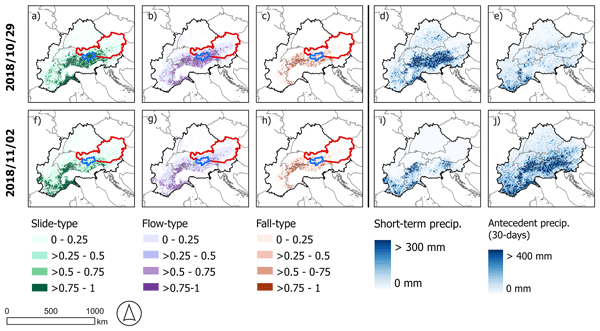
We developed three space-time models to predict the daily impact potential of mass movements on infrastructure in the Alps, distinguishing slides, flows, and falls. The basin-scale approach accounts for potential process paths and integrates meteorological, geo-environmental, and exposure information. Results indicate suitability for impact-based warning. We discuss the broad applicability of the modelling framework to other impacts and beyond the warning context.
Marc Lemus-Canovas, Alice Crespi, Elena Maines, Stefano Terzi, and Massimiliano Pittore
Hydrol. Earth Syst. Sci., 29, 6781–6809, https://doi.org/10.5194/hess-29-6781-2025, https://doi.org/10.5194/hess-29-6781-2025, 2025
Short summary
Short summary
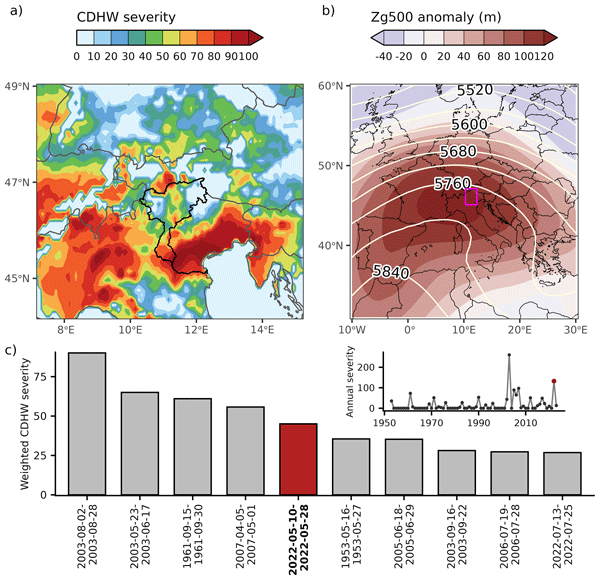
We studied a severe compound drought and heatwave event in the Adige River basin in May 2022 and found that similar events are now hotter and drier due to current warming. These changes worsen water stress and river drying. We show that timing matters: events in June are now more critical than in April, as the snowmelt contribution to streamflow in June has become much lower than in the past. However, many climate models still fail to capture these changes.
Giulio Bongiovanni, Michael Matiu, Alice Crespi, Anna Napoli, Bruno Majone, and Dino Zardi
Earth Syst. Sci. Data, 17, 1367–1391, https://doi.org/10.5194/essd-17-1367-2025, https://doi.org/10.5194/essd-17-1367-2025, 2025
Short summary
Short summary
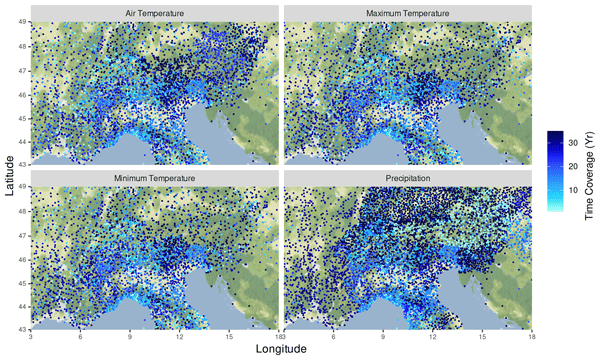
EEAR-Clim is a new and unprecedented observational dataset gathering in situ daily measurements of air temperature and precipitation from a network of about 9000 weather stations covering the European Alps. Data collected, including time series from recordings up to 2020 and time series significantly enhancing data coverage at high elevations, were tested for quality and homogeneity. The dataset aims to serve as a powerful tool for better understanding climate change over the European Alpine region.
Stefan Steger, Mateo Moreno, Alice Crespi, Peter James Zellner, Stefano Luigi Gariano, Maria Teresa Brunetti, Massimo Melillo, Silvia Peruccacci, Francesco Marra, Robin Kohrs, Jason Goetz, Volkmar Mair, and Massimiliano Pittore
Nat. Hazards Earth Syst. Sci., 23, 1483–1506, https://doi.org/10.5194/nhess-23-1483-2023, https://doi.org/10.5194/nhess-23-1483-2023, 2023
Short summary
Short summary
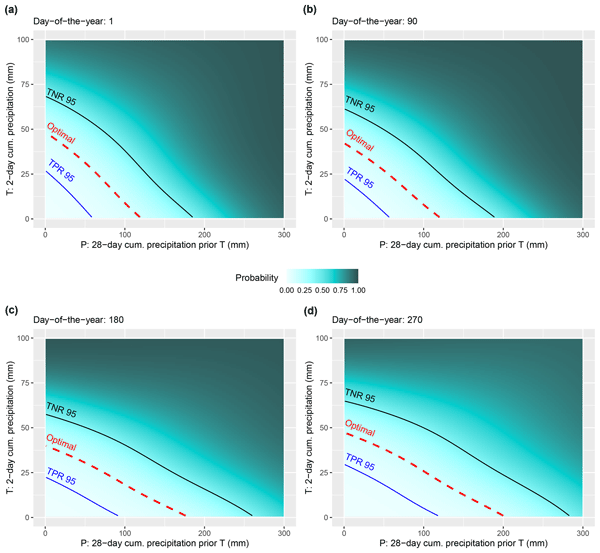
We present a novel data-driven modelling approach to determine season-specific critical precipitation conditions for landslide occurrence. It is shown that the amount of precipitation required to trigger a landslide in South Tyrol varies from season to season. In summer, a higher amount of preparatory precipitation is required to trigger a landslide, probably due to denser vegetation and higher temperatures. We derive dynamic thresholds that directly relate to hit rates and false-alarm rates.
Stefan Steger, Raphael Spiekermann, Mateo Moreno, Sebastian Lehner, Katharina Enigl, Alice Crespi, and Matthias Schlögl
Nat. Hazards Earth Syst. Sci., 26, 3637–3665, https://doi.org/10.5194/nhess-26-3637-2026, https://doi.org/10.5194/nhess-26-3637-2026, 2026
Short summary
Short summary
We developed three space-time models to predict the daily impact potential of mass movements on infrastructure in the Alps, distinguishing slides, flows, and falls. The basin-scale approach accounts for potential process paths and integrates meteorological, geo-environmental, and exposure information. Results indicate suitability for impact-based warning. We discuss the broad applicability of the modelling framework to other impacts and beyond the warning context.
Simon Seelig, Magdalena Seelig, Matevž Vremec, Martin Masten, Thomas Wagner, Karl Krainer, Michael Avian, Klaus Haslinger, Heike Brielmann, Albrecht Leis, Markus Ribis, Maria Obwegs, Matthias Hausleber, Rudolf Philippitsch, Richild Mauthner-Weber, Ernst Überreiter, and Gerfried Winkler
EGUsphere, https://doi.org/10.5194/egusphere-2026-3664, https://doi.org/10.5194/egusphere-2026-3664, 2026
Short summary
Short summary
Modeling 21st-century climate impacts across 15 nested Austrian catchments, this study shows how shifting snow-to-rain regimes interact with subsurface storage. Because alpine headwaters lack the aquifer capacity to buffer earlier snowmelt and summer deficits, they drive cascading shifts downstream. Ultimately, the loss of cryospheric storage forces a flashier, precipitation-coupled regime across the network, amplifying high flows but mitigating winter low flows.
Jürgen Komma, Peter Valent, Miriam Bertola, Juraj Parajka, Klaus Haslinger, Benedikt Bica, Georg Pistotnik, Korbinian Breinl, Gabriele Müller, Lovrenc Pavlin, Bianca Kahl, Achim Naderer, and Günter Blöschl
Hydrol. Earth Syst. Sci., 30, 4075–4093, https://doi.org/10.5194/hess-30-4075-2026, https://doi.org/10.5194/hess-30-4075-2026, 2026
Short summary
Short summary
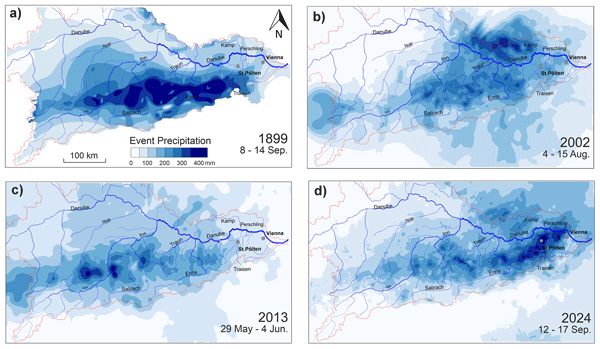
In September 2024 an exceptional flood hit the Austrian Danube Basin, the largest in parts of Lower Austria since records began. Using weather and river data, we compare this event with historic floods from 1899, 2002 and 2013. The 2024 flood was driven by a slow-moving rainstorm and saturated soils, causing record flows at smaller rivers. The study shows a shift toward more localized, intense floods, highlighting the need for adaptive flood-risk management in a warming climate.
Sebastian Lehner, Harald Schellander, Theresa Schellander-Gorgas, Matthias Schlögl, and Klaus Haslinger
EGUsphere, https://doi.org/10.5194/egusphere-2026-1825, https://doi.org/10.5194/egusphere-2026-1825, 2026
Short summary
Short summary
In September 2024, Central & Eastern Europe experienced heavy precipitation. Northeastern Austria was particularly affected, with several station records broken. In order to characterize how extreme this event was, we analyze five-day total precipitation compared to historical observations. We find that this event broke records in a larger area of Austria compared to previous major floods. New records are up to 2.6 times higher compared to the past, making this event exceptionally severe & rare.
Jess L. Delves, Kathrin Renner, Piero Campalani, Jesica Piñon, Stefan Schneiderbauer, Mateo Moreno, Maria Belen Benito Oterino, Eduardo Perez, and Massimiliano Pittore
Nat. Hazards Earth Syst. Sci., 26, 1347–1373, https://doi.org/10.5194/nhess-26-1347-2026, https://doi.org/10.5194/nhess-26-1347-2026, 2026
Short summary
Short summary
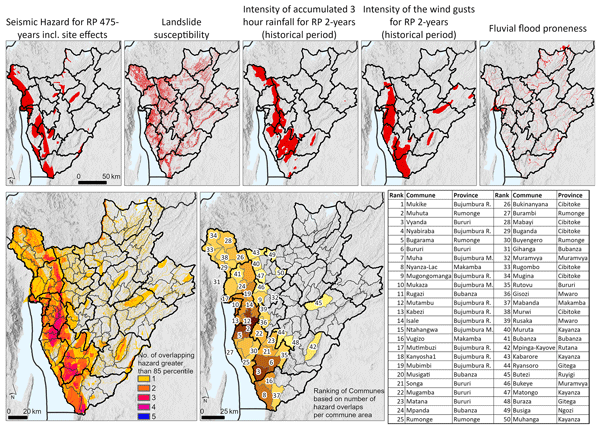
This scientific paper presents a multi-hazard risk assessment for Burundi, focusing on flooding, torrential rains, landslides, earthquakes, and strong winds. The study identifies key risk hotspots with estimated economic losses of 92 million USD (2.5 % of Gross Domestic Product (GDP)). Climate change projections indicate increased precipitation. The paper highlights data limitations and stresses the need for improved hazard models and the consideration of compounding risks in future assessments.
Susen Shrestha, Stefano Terzi, Davide Zoccatelli, Mattia Zaramella, Marco Borga, Andrea Galletti, Mattia Callegari, Roberto Dinale, Massimiliano Pittore, and Giacomo Bertoldi
EGUsphere, https://doi.org/10.5194/egusphere-2025-6387, https://doi.org/10.5194/egusphere-2025-6387, 2026
Short summary
Short summary
Glaciers and snow contribute to buffer river streamflow during droughts. Due to climate change, their role is shrinking with severe implications for water management. Here we investigated the role of glaciers to buffer the 2003, 2005 and 2022 droughts that occurred in the upper Adige River Basin (Italy). Glaciers provided 4 to 12 % of summer water during droughts and their buffering is weakening due to their retreat with lower contribution in 2022 compared to the similar drought of 2003.
Marc Lemus-Canovas, Alice Crespi, Elena Maines, Stefano Terzi, and Massimiliano Pittore
Hydrol. Earth Syst. Sci., 29, 6781–6809, https://doi.org/10.5194/hess-29-6781-2025, https://doi.org/10.5194/hess-29-6781-2025, 2025
Short summary
Short summary
We studied a severe compound drought and heatwave event in the Adige River basin in May 2022 and found that similar events are now hotter and drier due to current warming. These changes worsen water stress and river drying. We show that timing matters: events in June are now more critical than in April, as the snowmelt contribution to streamflow in June has become much lower than in the past. However, many climate models still fail to capture these changes.
Gabriella Tocchi, Massimiliano Pittore, and Maria Polese
Nat. Hazards Earth Syst. Sci., 25, 3665–3692, https://doi.org/10.5194/nhess-25-3665-2025, https://doi.org/10.5194/nhess-25-3665-2025, 2025
Short summary
Short summary
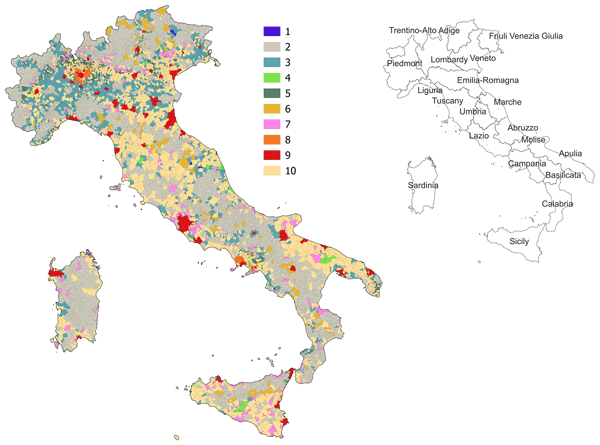
This study identifies different types of urban areas in Italy based on population, location, and economic conditions to understand their vulnerability to risks. Using public data and clustering methods, it defines 18 urban archetypes. These archetypes provide a structured understanding of urban vulnerability, helping policymakers assess disaster risk, allocate adaptation funding, and design targeted resilience strategies for urban settlements at regional and national scales.
Giulio Bongiovanni, Michael Matiu, Alice Crespi, Anna Napoli, Bruno Majone, and Dino Zardi
Earth Syst. Sci. Data, 17, 1367–1391, https://doi.org/10.5194/essd-17-1367-2025, https://doi.org/10.5194/essd-17-1367-2025, 2025
Short summary
Short summary
EEAR-Clim is a new and unprecedented observational dataset gathering in situ daily measurements of air temperature and precipitation from a network of about 9000 weather stations covering the European Alps. Data collected, including time series from recordings up to 2020 and time series significantly enhancing data coverage at high elevations, were tested for quality and homogeneity. The dataset aims to serve as a powerful tool for better understanding climate change over the European Alpine region.
Klaus Haslinger, Wolfgang Schöner, Jakob Abermann, Gregor Laaha, Konrad Andre, Marc Olefs, and Roland Koch
Nat. Hazards Earth Syst. Sci., 23, 2749–2768, https://doi.org/10.5194/nhess-23-2749-2023, https://doi.org/10.5194/nhess-23-2749-2023, 2023
Short summary
Short summary
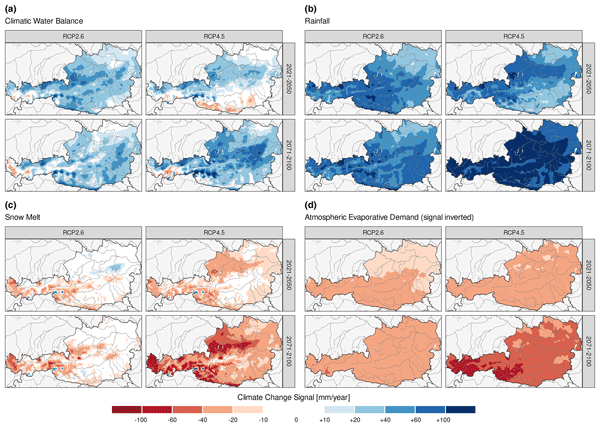
Future changes of surface water availability in Austria are investigated. Alterations of the climatic water balance and its components are analysed along different levels of elevation. Results indicate in general wetter conditions with particular shifts in timing of the snow melt season. On the contrary, an increasing risk for summer droughts is apparent due to increasing year-to-year variability and decreasing snow melt under future climate conditions.
Simon Seelig, Thomas Wagner, Karl Krainer, Michael Avian, Marc Olefs, Klaus Haslinger, and Gerfried Winkler
Nat. Hazards Earth Syst. Sci., 23, 2547–2568, https://doi.org/10.5194/nhess-23-2547-2023, https://doi.org/10.5194/nhess-23-2547-2023, 2023
Short summary
Short summary
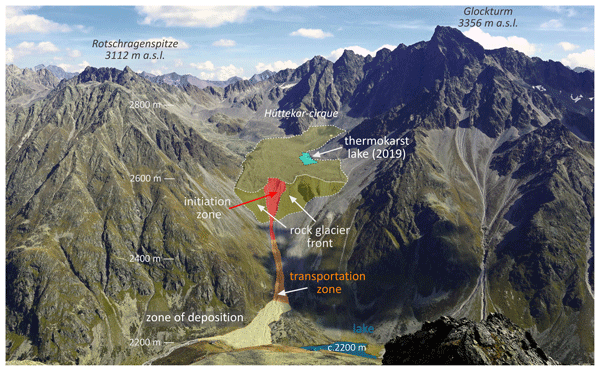
A rapid sequence of cascading events involving thermokarst lake outburst, rock glacier front failure, debris flow development, and river blockage hit an alpine valley in Austria during summer 2019. We analyze the environmental conditions initiating the process chain and identify the rapid evolution of a thermokarst channel network as the main driver. Our results highlight the need to account for permafrost degradation in debris flow hazard assessment studies.
Juan Camilo Gómez Zapata, Massimiliano Pittore, Nils Brinckmann, Juan Lizarazo-Marriaga, Sergio Medina, Nicola Tarque, and Fabrice Cotton
Nat. Hazards Earth Syst. Sci., 23, 2203–2228, https://doi.org/10.5194/nhess-23-2203-2023, https://doi.org/10.5194/nhess-23-2203-2023, 2023
Short summary
Short summary
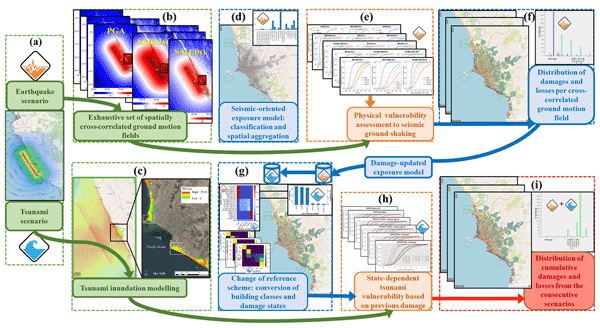
To investigate cumulative damage on extended building portfolios, we propose an alternative and modular method to probabilistically integrate sets of single-hazard vulnerability models that are being constantly developed by experts from various research fields to be used within a multi-risk context. We demonstrate its application by assessing the economic losses expected for the residential building stock of Lima, Peru, a megacity commonly exposed to consecutive earthquake and tsunami scenarios.
Stefan Steger, Mateo Moreno, Alice Crespi, Peter James Zellner, Stefano Luigi Gariano, Maria Teresa Brunetti, Massimo Melillo, Silvia Peruccacci, Francesco Marra, Robin Kohrs, Jason Goetz, Volkmar Mair, and Massimiliano Pittore
Nat. Hazards Earth Syst. Sci., 23, 1483–1506, https://doi.org/10.5194/nhess-23-1483-2023, https://doi.org/10.5194/nhess-23-1483-2023, 2023
Short summary
Short summary
We present a novel data-driven modelling approach to determine season-specific critical precipitation conditions for landslide occurrence. It is shown that the amount of precipitation required to trigger a landslide in South Tyrol varies from season to season. In summer, a higher amount of preparatory precipitation is required to trigger a landslide, probably due to denser vegetation and higher temperatures. We derive dynamic thresholds that directly relate to hit rates and false-alarm rates.
Juan Camilo Gomez-Zapata, Nils Brinckmann, Sven Harig, Raquel Zafrir, Massimiliano Pittore, Fabrice Cotton, and Andrey Babeyko
Nat. Hazards Earth Syst. Sci., 21, 3599–3628, https://doi.org/10.5194/nhess-21-3599-2021, https://doi.org/10.5194/nhess-21-3599-2021, 2021
Short summary
Short summary
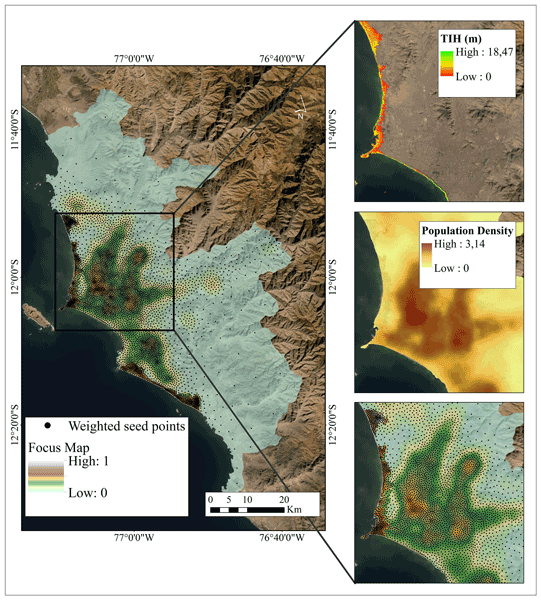
We present variable-resolution boundaries based on central Voronoi tessellations (CVTs) to spatially aggregate building exposure models and physical vulnerability assessment. Their geo-cell sizes are inversely proportional to underlying distributions that account for the combination between hazard intensities and exposure proxies. We explore their efficiency and associated uncertainties in risk–loss estimations and mapping from decoupled scenario-based earthquakes and tsunamis in Lima, Peru.
Cited articles
Alexander, L. V., Bador, M., Roca, R., Contractor, S., Donat, M. G., and Nguyen, P. L.: Intercomparison of annual precipitation indices and extremes over global land areas from in situ, space-based and reanalysis products, Environ. Res. Lett., 15, 055002, https://doi.org/10.1088/1748-9326/ab79e2, 2020.
Araújo, J. R., Ramos, A. M., Soares, P. M. M., Melo, R., Oliveira, S. C., and Trigo, R. M.: Impact of extreme rainfall events on landslide activity in Portugal under climate change scenarios, Landslides, 19, 2279–2293, https://doi.org/10.1007/s10346-022-01895-7, 2022.
ASTAT: Il Censimento permanente della popolazione in provincia di Bolzano – 2023, https://astat.provinz.bz.it/de/publikationen/demografische-daten-2023 (last access: April 2026), 2023.
ASTAT: Andamento turistico – 2022/23, https://astat.provinz.bz.it/it/pubblicazioni/andamento-turistico-anno-turistico-2022-23 (last access: April 2026), 2024.
Bandhauer, M., Isotta, F., Lakatos, M., Lussana, C., Båserud, L., Izsák, B., Szentes, O., Tveito, O. E., and Frei, C.: Evaluation of daily precipitation analyses in E-OBS (v19.0e) and ERA5 by comparison to regional high-resolution datasets in European regions, Int. J. Climatol., 42, 727–747, https://doi.org/10.1002/joc.7269, 2022.
Banfi, F. and De Michele, C.: Temporal Clustering of Precipitation Driving Landslides Over the Italian Territory, Earths Future, 12, e2023EF003885, https://doi.org/10.1029/2023EF003885, 2024.
Barlow, M., Gutowski, W. J., Gyakum, J. R., Katz, R. W., Lim, Y.-K., Schumacher, R. S., Wehner, M. F., Agel, L., Bosilovich, M., Collow, A., Gershunov, A., Grotjahn, R., Leung, R., Milrad, S., and Min, S.-K.: North American extreme precipitation events and related large-scale meteorological patterns: a review of statistical methods, dynamics, modeling, and trends, Clim. Dyn., 53, 6835–6875, https://doi.org/10.1007/s00382-019-04958-z, 2019.
Barton, Y., Rivoire, P., Koh, J., Ali S., M., Kopp, J., and Martius, O.: On the temporal clustering of European extreme precipitation events and its relationship to persistent and transient large-scale atmospheric drivers, Weather and Climate Extremes, 38, 100518, https://doi.org/10.1016/j.wace.2022.100518, 2022.
Borga, M., Stoffel, M., Marchi, L., Marra, F., and Jakob, M.: Hydrogeomorphic response to extreme rainfall in headwater systems: Flash floods and debris flows, J. Hydrol., 518, 194–205, https://doi.org/10.1016/j.jhydrol.2014.05.022, 2014.
Bouwer, L. M.: Observed and Projected Impacts from Extreme Weather Events: Implications for Loss and Damage, in: Loss and Damage from Climate Change, edited by: Mechler, R., Bouwer, L. M., Schinko, T., Surminski, S., and Linnerooth-Bayer, J., Springer International Publishing, Cham, 63–82, https://doi.org/10.1007/978-3-319-72026-5_3, 2019.
Breugem, A. J., Wesseling, J. G., Oostindie, K., and Ritsema, C. J.: Meteorological aspects of heavy precipitation in relation to floods – An overview, Earth-Sci. Rev., 204, 103171, https://doi.org/10.1016/j.earscirev.2020.103171, 2020.
Bundesministerium für Nachhaltigkeit und Tourismus: Richtlinie für den Wildbach- und Lawinenkataster (WLK-RL), BMNT, https://www.bmluk.gv.at/themen/wald/wald-und-naturgefahren/wildbach--und-lawinenverbauung/richtliniensammlung/wlk_rl.html (last access: April 2026), 2018.
Cavalleri, F., Lussana, C., Viterbo, F., Brunetti, M., Bonanno, R., Manara, V., Lacavalla, M., Sperati, S., Raffa, M., Capecchi, V., Cesari, D., Giordani, A., Cerenzia, I. M. L., and Maugeri, M.: Multi-scale assessment of high-resolution reanalysis precipitation fields over Italy, Atmos. Res., 312, 107734, https://doi.org/10.1016/j.atmosres.2024.107734, 2024.
Crespi, A., Matiu, M., Bertoldi, G., Petitta, M., and Zebisch, M.: A high-resolution gridded dataset of daily temperature and precipitation records (1980–2018) for Trentino-South Tyrol (north-eastern Italian Alps), Earth Syst. Sci. Data, 13, 2801–2818, https://doi.org/10.5194/essd-13-2801-2021, 2021.
Crespi, A., Enigl, K., Lehner, S., Haslinger, K., and Pittore, M.: 1-day precipitation extremes over 2003–2020 in a transboundary Alpine area (Eastern Alps) identified by different methods and climate datasets (Version v1), Zenodo [data set], https://doi.org/10.5281/zenodo.15756269, 2025.
Dalla Torre, D., Di Marco, N., Menapace, A., Avesani, D., Righetti, M., and Majone, B.: Suitability of ERA5-Land reanalysis dataset for hydrological modelling in the Alpine region, J. Hydrol.-Regional Studies, 52, 101718, https://doi.org/10.1016/j.ejrh.2024.101718, 2024.
Frank, C. W., Pospichal, B., Wahl, S., Keller, J. D., Hense, A., and Crewell, S.: The added value of high resolution regional reanalyses for wind power applications, Renew. Energ., 148, 1094–1109, https://doi.org/10.1016/j.renene.2019.09.138, 2020.
Ghaemi, E., Foelsche, U., Kann, A., and Fuchsberger, J.: Evaluation of Integrated Nowcasting through Comprehensive Analysis (INCA) precipitation analysis using a dense rain-gauge network in southeastern Austria, Hydrol. Earth Syst. Sci., 25, 4335–4356, https://doi.org/10.5194/hess-25-4335-2021, 2021.
Giordani, A., Cerenzia, I. M. L., Paccagnella, T., and Di Sabatino, S.: SPHERA, a new convection-permitting regional reanalysis over Italy: Improving the description of heavy rainfall, Q. J. Roy. Meteor. Soc., 149, 781–808, https://doi.org/10.1002/qj.4428, 2023.
Gonzalez, F. C. G., Cavacanti, M. D. C. R., Nahas Ribeiro, W., Mendonça, M. B. D., and Haddad, A. N.: A systematic review on rainfall thresholds for landslides occurrence, Heliyon, 10, e23247, https://doi.org/10.1016/j.heliyon.2023.e23247, 2024.
Haiden, T., Kann, A., Wittmann, C., Pistotnik, G., Bica, B., and Gruber, C.: The Integrated Nowcasting through Comprehensive Analysis (INCA) System and Its Validation over the Eastern Alpine Region, Weather Forecast., 26, 166–183, https://doi.org/10.1175/2010WAF2222451.1, 2011.
Heiser, M., Hübl, J., and Scheidl, C.: Completeness analyses of the Austrian torrential event catalog, Landslides, 16, 2115–2126, https://doi.org/10.1007/s10346-019-01218-3, 2019.
Hiebl, J. and Frei, C.: Daily precipitation grids for Austria since 1961 – development and evaluation of a spatial dataset for hydroclimatic monitoring and modelling, Theor. Appl. Climatol., 132, 327–345, https://doi.org/10.1007/s00704-017-2093-x, 2018.
Hofstätter, M., Chimani, B., Lexer, A., and Blöschl, G.: A new classification scheme of European cyclone tracks with relevance to precipitation, Water Resour. Res., 52, 7086–7104, https://doi.org/10.1002/2016WR019146, 2016.
Hu, G. and Franzke, C. L. E.: Evaluation of Daily Precipitation Extremes in Reanalysis and Gridded Observation-Based Data Sets Over Germany, Geophys. Res. Lett., 47, e2020GL089624, https://doi.org/10.1029/2020GL089624, 2020.
Hübl, J. and Beck, M.: Ereignisdokumentation 2018, IAN Report 202, https://boku.ac.at/lawi/alpe/forschung/reports-forschungsberichte (last access: April 2026), 2019.
Insua-Costa, D., Lemus-Cánovas, M., Miguez-Macho, G., and Llasat, M. C.: Climatology and ranking of hazardous precipitation events in the western Mediterranean area, Atmos. Res., 255, 105521, https://doi.org/10.1016/j.atmosres.2021.105521, 2021.
Kirschbaum, D., Stanley, T., and Zhou, Y.: Spatial and temporal analysis of a global landslide catalog, Geomorphology, 249, 4–15, https://doi.org/10.1016/j.geomorph.2015.03.016, 2015.
Kotlarski, S., Gobiet, A., Morin, S., Olefs, M., Rajczak, J., and Samacoïts, R.: 21st Century alpine climate change, Clim. Dyn., 60, 65–86, https://doi.org/10.1007/s00382-022-06303-3, 2023.
Leonarduzzi, E. and Molnar, P.: Deriving rainfall thresholds for landsliding at the regional scale: daily and hourly resolutions, normalisation, and antecedent rainfall, Nat. Hazards Earth Syst. Sci., 20, 2905–2919, https://doi.org/10.5194/nhess-20-2905-2020, 2020.
Liu, Y., Chen, J., Pan, T., Liu, Y., Zhang, Y., Ge, Q., Ciais, P., and Penuelas, J.: Global Socioeconomic Risk of Precipitation Extremes Under Climate Change, Earths Future, 8, e2019EF001331, https://doi.org/10.1029/2019EF001331, 2020.
Llasat, M. C., Llasat-Botija, M., Petrucci, O., Pasqua, A. A., Rosselló, J., Vinet, F., and Boissier, L.: Towards a database on societal impact of Mediterranean floods within the framework of the HYMEX project, Nat. Hazards Earth Syst. Sci., 13, 1337–1350, https://doi.org/10.5194/nhess-13-1337-2013, 2013.
McPhillips, L. E., Chang, H., Chester, M. V., Depietri, Y., Friedman, E., Grimm, N. B., Kominoski, J. S., McPhearson, T., Méndez-Lázaro, P., Rosi, E. J., and Shafiei Shiva, J.: Defining Extreme Events: A Cross-Disciplinary Review, Earths Future, 6, 441–455, https://doi.org/10.1002/2017EF000686, 2018.
Meyer, J., Neuper, M., Mathias, L., Zehe, E., and Pfister, L.: Atmospheric conditions favouring extreme precipitation and flash floods in temperate regions of Europe, Hydrol. Earth Syst. Sci., 26, 6163–6183, https://doi.org/10.5194/hess-26-6163-2022, 2022.
Millán-Arancibia, C. and Lavado-Casimiro, W.: Rainfall thresholds estimation for shallow landslides in Peru from gridded daily data, Nat. Hazards Earth Syst. Sci., 23, 1191–1206, https://doi.org/10.5194/nhess-23-1191-2023, 2023.
Monteiro, D. and Morin, S.: Multi-decadal analysis of past winter temperature, precipitation and snow cover data in the European Alps from reanalyses, climate models and observational datasets, The Cryosphere, 17, 3617–3660, https://doi.org/10.5194/tc-17-3617-2023, 2023.
Munich RE: Natural disasters in 2023, Munich RE NatCatSERVICE, https://www.munichre.com/en/company/media-relations/media-information-and-corporate-news/media-information/2024/natural-disaster-figures-2023.html (last access: April 2026), 2024.
Muñoz-Sabater, J., Dutra, E., Agustí-Panareda, A., Albergel, C., Arduini, G., Balsamo, G., Boussetta, S., Choulga, M., Harrigan, S., Hersbach, H., Martens, B., Miralles, D. G., Piles, M., Rodríguez-Fernández, N. J., Zsoter, E., Buontempo, C., and Thépaut, J.-N.: ERA5-Land: a state-of-the-art global reanalysis dataset for land applications, Earth Syst. Sci. Data, 13, 4349–4383, https://doi.org/10.5194/essd-13-4349-2021, 2021.
Overeem, A., van den Besselaar, E., van der Schrier, G., Meirink, J. F., van der Plas, E., and Leijnse, H.: EURADCLIM: the European climatological high-resolution gauge-adjusted radar precipitation dataset, Earth Syst. Sci. Data, 15, 1441–1464, https://doi.org/10.5194/essd-15-1441-2023, 2023.
Peruccacci, S., Brunetti, M. T., Gariano, S. L., Melillo, M., Rossi, M., and Guzzetti, F.: Rainfall thresholds for possible landslide occurrence in Italy, Geomorphology, 290, 39–57, https://doi.org/10.1016/j.geomorph.2017.03.031, 2017.
Pinto, J. G., Ulbrich, S., Parodi, A., Rudari, R., Boni, G., and Ulbrich, U.: Identification and ranking of extraordinary rainfall events over Northwest Italy: The role of Atlantic moisture, J. Geophys. Res.-Atmos., 118, 2085–2097, https://doi.org/10.1002/jgrd.50179, 2013.
Pittore, M., Campalani, P., Renner, K., Plörer, M., and Tagliavini, F.: Border-independent multi-functional, multi-hazard exposure modelling in Alpine regions, Nat. Hazards, 119, 837–858, https://doi.org/10.1007/s11069-023-06134-3, 2023.
Price, C.: Will a drier climate result in more lightning?, Atmos. Res., 91, 479–484, https://doi.org/10.1016/j.atmosres.2008.05.016, 2009.
Raj, S., Shukla, R., Trigo, R. M., Merz, B., Rathinasamy, M., Ramos, A. M., and Agarwal, A.: Ranking and characterization of precipitation extremes for the past 113 years for Indian western Himalayas, Int. J. Climatol., 41, 6602–6615, https://doi.org/10.1002/joc.7215, 2021.
Rajczak, J. and Schär, C.: Projections of Future Precipitation Extremes Over Europe: A Multimodel Assessment of Climate Simulations, J. Geophys. Res.-Atmos., 122, https://doi.org/10.1002/2017JD027176, 2017.
Ramos, A. M., Trigo, R. M., and Liberato, M. L. R.: A ranking of high-resolution daily precipitation extreme events for the Iberian Peninsula, Atmos. Sci. Lett., 15, 328–334, https://doi.org/10.1002/asl2.507, 2014.
Reder, A., Raffa, M., Padulano, R., Rianna, G., and Mercogliano, P.: Characterizing extreme values of precipitation at very high resolution: An experiment over twenty European cities, Weather and Climate Extremes, 35, 100407, https://doi.org/10.1016/j.wace.2022.100407, 2022.
Ridal, M., Bazile, E., Le Moigne, P., Randriamampianina, R., Schimanke, S., Andrae, U., Berggren, L., Brousseau, P., Dahlgren, P., Edvinsson, L., El-Said, A., Glinton, M., Hagelin, S., Hopsch, S., Isaksson, L., Medeiros, P., Olsson, E., Unden, P., and Wang, Z. Q.: CERRA, the Copernicus European Regional Reanalysis system, Q. J. Roy. Meteor. Soc., qj.4764, https://doi.org/10.1002/qj.4764, 2024.
Schlögl, M., Fuchs, S., Scheidl, C., and Heiser, M.: Trends in torrential flooding in the Austrian Alps: A combination of climate change, exposure dynamics, and mitigation measures, Climate Risk Management, 32, 100294, https://doi.org/10.1016/j.crm.2021.100294, 2021.
Schlögel, R., Kofler, C., Gariano, S. L., Van Campenhout, J., and Plummer, S.: Changes in climate patterns and their association to natural hazard distribution in South Tyrol (Eastern Italian Alps), Sci. Rep., 10, 5022, https://doi.org/10.1038/s41598-020-61615-w, 2020.
Soci, C., Bazile, E., Besson, F., and Landelius, T.: High-resolution precipitation re-analysis system for climatological purposes, Tellus A, 68, 29879, https://doi.org/10.3402/tellusa.v68.29879, 2016.
Spiekermann, R. I., Van Zadelhoff, F., Schindler, J., Smith, H., Phillips, C., and Schwarz, M.: Comparing physical and statistical landslide susceptibility models at the scale of individual trees, Geomorphology, 440, 108870, https://doi.org/10.1016/j.geomorph.2023.108870, 2023.
Statistik Austria: Tourismus in Österreich 2023 – Ergebnisse der Beherbergungsstatistik, ISBN 978-3-903393-91-2, https://www.statistik.at/fileadmin/user_upload/Tourismus_2023_barr.pdf (last access: April 2026), 2024.
Steger, S., Moreno, M., Crespi, A., Zellner, P. J., Gariano, S. L., Brunetti, M. T., Melillo, M., Peruccacci, S., Marra, F., Kohrs, R., Goetz, J., Mair, V., and Pittore, M.: Deciphering seasonal effects of triggering and preparatory precipitation for improved shallow landslide prediction using generalized additive mixed models, Nat. Hazards Earth Syst. Sci., 23, 1483–1506, https://doi.org/10.5194/nhess-23-1483-2023, 2023.
Steger, S., Moreno, M., Crespi, A., Luigi Gariano, S., Teresa Brunetti, M., Melillo, M., Peruccacci, S., Marra, F., De Vugt, L., Zieher, T., Rutzinger, M., Mair, V., and Pittore, M.: Adopting the margin of stability for space–time landslide prediction – A data-driven approach for generating spatial dynamic thresholds, Geosci. Front., 15, 101822, https://doi.org/10.1016/j.gsf.2024.101822, 2024.
Stoffel, M., Tiranti, D., and Huggel, C.: Climate change impacts on mass movements – Case studies from the European Alps, Sci. Total Environ., 493, 1255–1266, https://doi.org/10.1016/j.scitotenv.2014.02.102, 2014.
Tilch, N., Kociu, A., Haberler, A., Melzner, S., Schwarz, L., and Lotter, M.: The Data Management System GEORIOS of the Geological Survey of Austria (GBA), 2011.
Vaz, T., Zêzere, J. L., Pereira, S., Oliveira, S. C., Garcia, R. A. C., and Quaresma, I.: Regional rainfall thresholds for landslide occurrence using a centenary database, Nat. Hazards Earth Syst. Sci., 18, 1037–1054, https://doi.org/10.5194/nhess-18-1037-2018, 2018.
Wilhelm, B., Rapuc, W., Amann, B., Anselmetti, F. S., Arnaud, F., Blanchet, J., Brauer, A., Czymzik, M., Giguet-Covex, C., Gilli, A., Glur, L., Grosjean, M., Irmler, R., Nicolle, M., Sabatier, P., Swierczynski, T., and Wirth, S. B.: Impact of warmer climate periods on flood hazard in the European Alps, Nat. Geosci., 15, 118–123, https://doi.org/10.1038/s41561-021-00878-y, 2022.
Wood, R. R., Janzing, J., van Hamel, A., Götte, J., Schumacher, D. L., and Brunner, M. I.: Comparison of high-resolution climate reanalysis datasets for hydro-climatic impact studies, Hydrol. Earth Syst. Sci., 29, 4153–4178, https://doi.org/10.5194/hess-29-4153-2025, 2025.
Zscheischler, J., Martius, O., Westra, S., Bevacqua, E., Raymond, C., Horton, R. M., Van Den Hurk, B., AghaKouchak, A., Jézéquel, A., Mahecha, M. D., Maraun, D., Ramos, A. M., Ridder, N. N., Thiery, W., and Vignotto, E.: A typology of compound weather and climate events, Nat. Rev. Earth Environ., 1, 333–347, https://doi.org/10.1038/s43017-020-0060-z, 2020.
Short summary
Extreme precipitation poses a risk to the Alpine region as it can trigger geohydrological hazards, such as floods, debris flows, and landslides, with serious impacts on people and their activities. This study focuses on a transboundary Alpine area between Italy and Austria and evaluates data and methods for detecting past precipitation extremes corresponding to hazard occurrences. The results can inform risk managers and support methodological choices for developing early warning systems.
Extreme precipitation poses a risk to the Alpine region as it can trigger geohydrological...


Altmetrics
Final-revised paper
Preprint