Articles | Volume 26, issue 4
https://doi.org/10.5194/nhess-26-1883-2026
© Author(s) 2026. This work is distributed under
the Creative Commons Attribution 4.0 License.
https://doi.org/10.5194/nhess-26-1883-2026
© Author(s) 2026. This work is distributed under
the Creative Commons Attribution 4.0 License.
Brief communication: In-situ measurements of basal sliding in natural debris flows

BOKU University, Department of Landscape, Water and Infrastructure, Institute of Mountain Risk Engineering, 1190 Vienna, Austria
Maximilian Ender
CORRESPONDING AUTHOR
BOKU University, Department of Landscape, Water and Infrastructure, Institute of Mountain Risk Engineering, 1190 Vienna, Austria
Felix Klein
BOKU University, Department of Landscape, Water and Infrastructure, Institute of Mountain Risk Engineering, 1190 Vienna, Austria
Brian McArdell
Swiss Federal Institute for Forest, Snow and Landscape Research WSL, 8903 Birmensdorf, Switzerland
Stefan Boss
Swiss Federal Institute for Forest, Snow and Landscape Research WSL, 8903 Birmensdorf, Switzerland
Jordan Aaron
Geological Institute, ETH Zürich, 8902 Zürich, Switzerland
Friedrich Zott
BOKU University, Department of Landscape, Water and Infrastructure, Institute of Mountain Risk Engineering, 1190 Vienna, Austria
Johannes Hübl
BOKU University, Department of Landscape, Water and Infrastructure, Institute of Mountain Risk Engineering, 1190 Vienna, Austria
Roland Kaitna
BOKU University, Department of Landscape, Water and Infrastructure, Institute of Mountain Risk Engineering, 1190 Vienna, Austria
Related authors
No articles found.
Chantal Schmidt, David Mair, Naki Akçar, Marcus Christl, Negar Haghipour, Christof Vockenhuber, Philip Gautschi, Brian McArdell, and Fritz Schlunegger
Earth Surf. Dynam., 14, 33–53, https://doi.org/10.5194/esurf-14-33-2026, https://doi.org/10.5194/esurf-14-33-2026, 2026
Short summary
Short summary
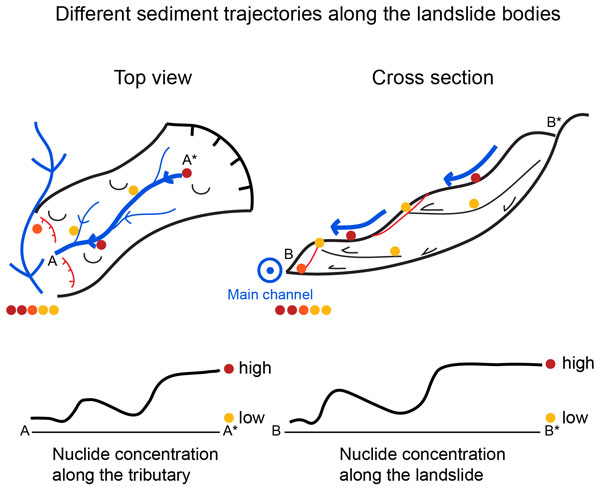
Our study examines erosion in a small, pre-Alpine basin by using cosmogenic nuclides in river sediments. Based on a dense measuring network we were able to distinguish two main zones: an upper zone with slow erosion of surface material, and a steeper, lower zone where faster erosion is driven by landslides. The data suggests that sediment has been constantly produced over thousands of years, indicating a stable, long-term balance between contrasting erosion processes.
Magali Ponds, Sarah Hanus, Harry Zekollari, Marie-Claire ten Veldhuis, Gerrit Schoups, Roland Kaitna, and Markus Hrachowitz
Hydrol. Earth Syst. Sci., 29, 3545–3568, https://doi.org/10.5194/hess-29-3545-2025, https://doi.org/10.5194/hess-29-3545-2025, 2025
Short summary
Short summary
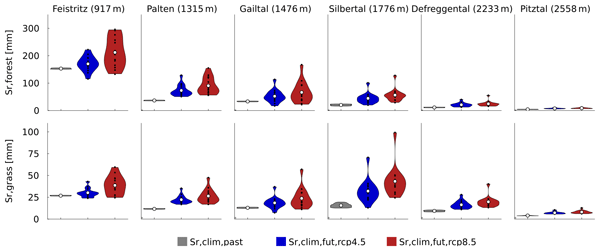
This research examines how future climate changes impact root zone storage, a key hydrological model parameter. Root zone storage – the soil water accessible to plants – adapts to climate but is often kept constant in models. We estimated climate-adapted storage in six Austrian Alps catchments. While storage increased, streamflow projections showed minimal change, which suggests that dynamic root zone representation is less critical in humid regions but warrants further study in arid areas.
Yu Zhuang, Brian W. McArdell, and Perry Bartelt
Nat. Hazards Earth Syst. Sci., 25, 1901–1912, https://doi.org/10.5194/nhess-25-1901-2025, https://doi.org/10.5194/nhess-25-1901-2025, 2025
Short summary
Short summary
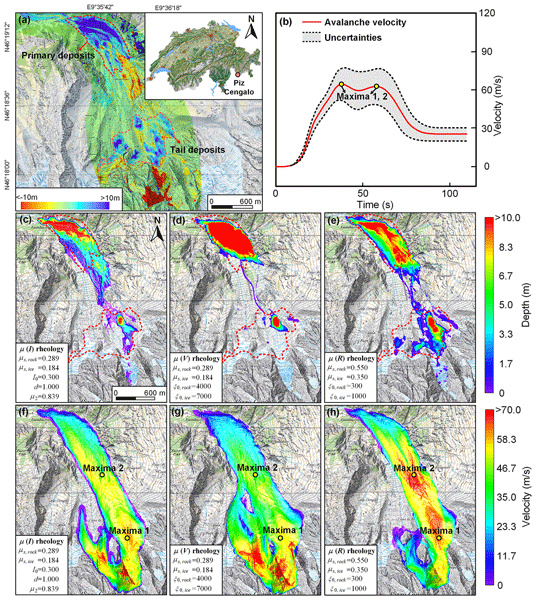
The experimentally based μ(I) rheology, widely used for gravitational mass flows, is reinterpreted as a Voellmy-type relationship to highlight its link to grain flow theory. Through block modeling and case studies, we establish its equivalence to μ(R) rheology. μ(I) models shear thinning but fails to capture acceleration and deceleration processes and deposit structure. Incorporating fluctuation energy in μ(R) improves accuracy, refining mass flow modeling and revealing practical challenges.
Daniel Bolliger, Fritz Schlunegger, and Brian W. McArdell
Nat. Hazards Earth Syst. Sci., 24, 1035–1049, https://doi.org/10.5194/nhess-24-1035-2024, https://doi.org/10.5194/nhess-24-1035-2024, 2024
Short summary
Short summary
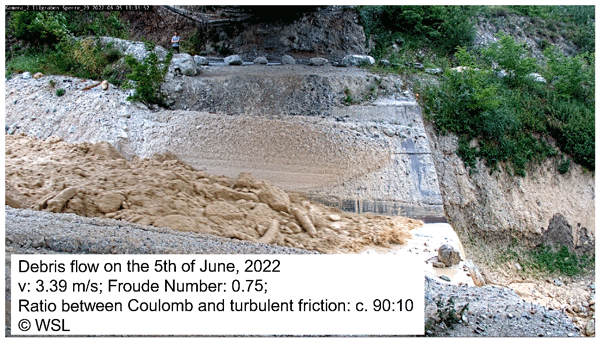
We analysed data from the Illgraben debris flow monitoring station, Switzerland, and we modelled these flows with a debris flow runout model. We found that no correlation exists between the grain size distribution, the mineralogical composition of the matrix, and the debris flow properties. The flow properties rather appear to be determined by the flow volume, from which most other parameters can be derived.
Sandra Melzner, Marco Conedera, Johannes Hübl, and Mauro Rossi
Nat. Hazards Earth Syst. Sci., 23, 3079–3093, https://doi.org/10.5194/nhess-23-3079-2023, https://doi.org/10.5194/nhess-23-3079-2023, 2023
Short summary
Short summary
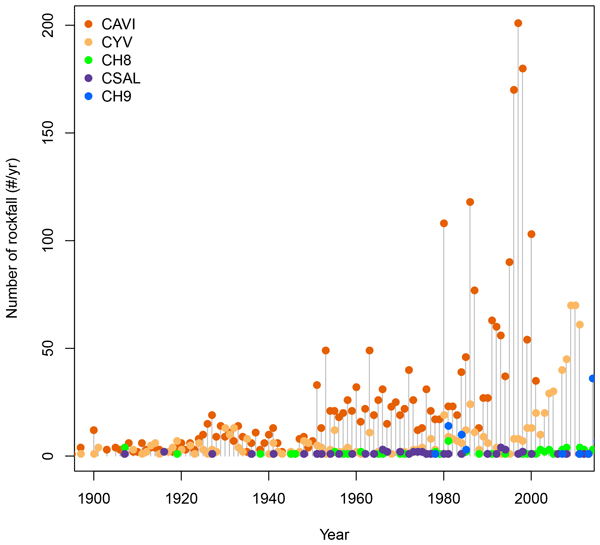
The estimation of the temporal frequency of the involved rockfall processes is an important part in hazard and risk assessments. Different methods can be used to collect and analyse rockfall data. From a statistical point of view, rockfall datasets are nearly always incomplete. Accurate data collection approaches and the application of statistical methods on existing rockfall data series as reported in this study should be better considered in rockfall hazard and risk assessments in the future.
Catharina Dieleman, Philip Deline, Susan Ivy Ochs, Patricia Hug, Jordan Aaron, Marcus Christl, and Naki Akçar
EGUsphere, https://doi.org/10.5194/egusphere-2023-1873, https://doi.org/10.5194/egusphere-2023-1873, 2023
Preprint withdrawn
Short summary
Short summary
Valleys in the Alps are shaped by glaciers, rivers, mass movements, and slope processes. An understanding of such processes is of great importance in hazard mitigation. We focused on the evolution of the Frébouge cone, which is composed of glacial, debris flow, rock avalanche, and snow avalanche deposits. Debris flows started to form the cone prior to ca. 2 ka ago. In addition, the cone was overrun by a 10 Mm3 large rock avalanche at 1.3 ± 0.1 ka and by the Frébouge glacier at 300 ± 40 a.
Fabian Walter, Elias Hodel, Erik S. Mannerfelt, Kristen Cook, Michael Dietze, Livia Estermann, Michaela Wenner, Daniel Farinotti, Martin Fengler, Lukas Hammerschmidt, Flavia Hänsli, Jacob Hirschberg, Brian McArdell, and Peter Molnar
Nat. Hazards Earth Syst. Sci., 22, 4011–4018, https://doi.org/10.5194/nhess-22-4011-2022, https://doi.org/10.5194/nhess-22-4011-2022, 2022
Short summary
Short summary
Debris flows are dangerous sediment–water mixtures in steep terrain. Their formation takes place in poorly accessible terrain where instrumentation cannot be installed. Here we propose to monitor such source terrain with an autonomous drone for mapping sediments which were left behind by debris flows or may contribute to future events. Short flight intervals elucidate changes of such sediments, providing important information for landscape evolution and the likelihood of future debris flows.
Dieter Rickenmann, Lorenz Ammann, Tobias Nicollier, Stefan Boss, Bruno Fritschi, Gilles Antoniazza, Nicolas Steeb, Zheng Chen, Carlos Wyss, and Alexandre Badoux
Earth Surf. Dynam., 10, 1165–1183, https://doi.org/10.5194/esurf-10-1165-2022, https://doi.org/10.5194/esurf-10-1165-2022, 2022
Short summary
Short summary
The Swiss plate geophone system has been installed and tested in more than 20 steep gravel-bed streams. It is an indirect bedload transport measuring system. We compare the performance of this system with three alternative surrogate measuring systems, using calibration measurements with direct bedload samples from three field sites and an outdoor flume facility. Three of the four systems resulted in robust calibration relations between signal impulse counts and transported bedload mass.
Andrew Mitchell, Sophia Zubrycky, Scott McDougall, Jordan Aaron, Mylène Jacquemart, Johannes Hübl, Roland Kaitna, and Christoph Graf
Nat. Hazards Earth Syst. Sci., 22, 1627–1654, https://doi.org/10.5194/nhess-22-1627-2022, https://doi.org/10.5194/nhess-22-1627-2022, 2022
Short summary
Short summary
Debris flows are complex, surging movements of sediment and water. Discharge observations from well-studied debris-flow channels were used as inputs for a numerical modelling study of the downstream effects of chaotic inflows. The results show that downstream impacts are sensitive to inflow conditions. Inflow conditions for predictive modelling are highly uncertain, and our method provides a means to estimate the potential variability in future events.
Elena Leonarduzzi, Brian W. McArdell, and Peter Molnar
Hydrol. Earth Syst. Sci., 25, 5937–5950, https://doi.org/10.5194/hess-25-5937-2021, https://doi.org/10.5194/hess-25-5937-2021, 2021
Short summary
Short summary
Landslides are a dangerous natural hazard affecting alpine regions, calling for effective warning systems. Here we consider different approaches for the prediction of rainfall-induced shallow landslides at the regional scale, based on open-access datasets and operational hydrological forecasting systems. We find antecedent wetness useful to improve upon the classical rainfall thresholds and the resolution of the hydrological model used for its estimate to be a critical aspect.
Jacob Hirschberg, Alexandre Badoux, Brian W. McArdell, Elena Leonarduzzi, and Peter Molnar
Nat. Hazards Earth Syst. Sci., 21, 2773–2789, https://doi.org/10.5194/nhess-21-2773-2021, https://doi.org/10.5194/nhess-21-2773-2021, 2021
Short summary
Short summary
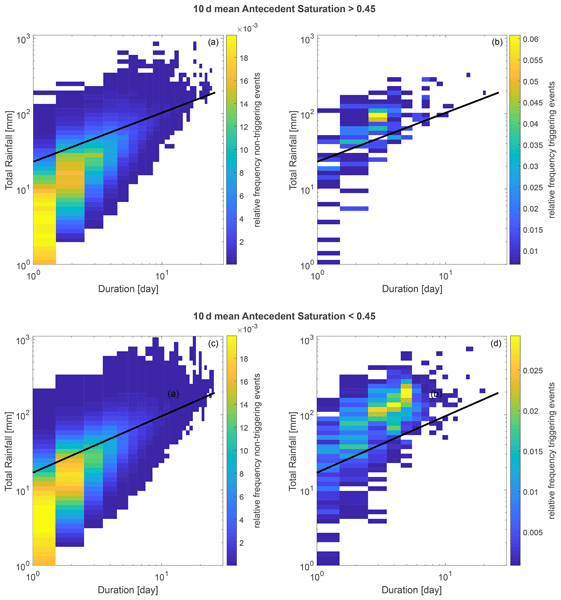
Debris-flow prediction is often based on rainfall thresholds, but uncertainty assessments are rare. We established rainfall thresholds using two approaches and find that 25 debris flows are needed for uncertainties to converge in an Alpine basin and that the suitable method differs for regional compared to local thresholds. Finally, we demonstrate the potential of a statistical learning algorithm to improve threshold performance. These findings are helpful for early warning system development.
Sarah Hanus, Markus Hrachowitz, Harry Zekollari, Gerrit Schoups, Miren Vizcaino, and Roland Kaitna
Hydrol. Earth Syst. Sci., 25, 3429–3453, https://doi.org/10.5194/hess-25-3429-2021, https://doi.org/10.5194/hess-25-3429-2021, 2021
Short summary
Short summary
This study investigates the effects of climate change on runoff patterns in six Alpine catchments in Austria at the end of the 21st century. Our results indicate a substantial shift to earlier occurrences in annual maximum and minimum flows in high-elevation catchments. Magnitudes of annual extremes are projected to increase under a moderate emission scenario in all catchments. Changes are generally more pronounced for high-elevation catchments.
Cited articles
Aaron, J., Spielmann, R., McArdell, B. W., and Graf, C.: High-frequency 3D LiDAR measurements of a debris flow: a novel method to investigate the dynamics of full-scale events in the field, Geophys. Res. Lett., 50, https://doi.org/10.1029/2022GL102373, 2023.
Aigner, P., Kuschel, E., Sklar, L., Zangerl, C., Hrachowitz, M., De Haas, T., Huebl, J., and Kaitna, R.: Debris-flow activity and sediment dynamics in the landslide-influenced Lattenbach catchment, Austria, E3S Web of Conf., 415, 04001, https://doi.org/10.1051/e3sconf/202341504001, 2023.
Berger, C., McArdell, B. W., and Schlunegger, F.: Direct measurement of channel erosion by debris flows, Illgraben, Switzerland, J. Geophys. Res., 116, https://doi.org/10.1029/2010JF001722, 2011.
Bierman, P. R. and Montgomery, D. R.: Key Concepts in Geomorphology, 2nd edn., Macmillan Learning, Austin Boston New York Plymouth 526 pp., ISBN 978-1429238601, 2020.
Domnik, B. and Pudasaini, S. P.: Full two-dimensional rapid chute flows of simple viscoplastic granular materials with a pressure-dependent dynamic slip-velocity and their numerical simulations, J. Non-Newton. Fluid, 173–174, 72–86, https://doi.org/10.1016/j.jnnfm.2012.03.001, 2012.
Hsu, L., Dietrich, W. E., and Sklar, L. S.: Experimental study of bedrock erosion by granular flows, J. Geophys. Res., 113, 2007JF000778, https://doi.org/10.1029/2007JF000778, 2008.
Huebl, J. and Kaitna, R.: Monitoring debris-flow surges and triggering rainfall at the Lattenbach Creek, Austria, Environ. Eng. Geosci., 27, 213–220, https://doi.org/10.2113/EEG-D-20-00010, 2021.
Hungr, O., Leroueil, S., and Picarelli, L.: The Varnes classification of landslide types, an update, Landslides, 11, 167–194, https://doi.org/10.1007/s10346-013-0436-y, 2014.
Hürlimann, M., Coviello, V., Bel, C., Guo, X., Berti, M., Graf, C., Hübl, J., Miyata, S., Smith, J. B., and Yin, H.-Y.: Debris-flow monitoring and warning: review and examples, Earth-Sci. Rev., 199, 102981, https://doi.org/10.1016/j.earscirev.2019.102981, 2019.
Iverson, R. M., Logan, M., LaHusen, R. G., and Berti, M.: The perfect debris flow? Aggregated results from 28 large-scale experiments, J. Geophys. Res., 115, 2009JF001514, https://doi.org/10.1029/2009JF001514, 2010.
Kaitna, R., Dietrich, W. E., and Hsu, L.: Surface slopes, velocity profiles and fluid pressure in coarse-grained debris flows saturated with water and mud, J. Fluid Mech., 741, 377–403, https://doi.org/10.1017/jfm.2013.675, 2014.
Kamali Zarch, M., Zhang, L., Haeri, S. M., and He, J.: Classic, modern, and physics-based rheological laws for geophysical granular flows in a landslide hazard chain, Earth-Sci. Rev., 269, 105204, https://doi.org/10.1016/j.earscirev.2025.105204, 2025.
Kern, M., Bartelt, P., Sovilla, B., and Buser, O.: Measured shear rates in large dry and wet snow avalanches, J. Glaciol., 55, 327–338, https://doi.org/10.3189/002214309788608714, 2009.
Nagl, G. and Ender, M.: Supplementary material: Brief Communication: In-Situ Measurements of Basal Sliding in Natural Debris Flows, in: First field observations of basal slip velocities in natural debris flows, Zenodo [data set], https://doi.org/10.5281/zenodo.17249343, 2025.
Nagl, G., Hübl, J., and Kaitna, R.: Velocity profiles and basal stresses in natural debris flows, Earth Surf. Proc. Land., 45, 1764–1776, https://doi.org/10.1002/esp.4844, 2020.
Pitman, E. B. and Le, L.: A two-fluid model for avalanche and debris flows, Philos. T. Roy. Soc. A, 363, 1573–1601, https://doi.org/10.1098/rsta.2005.1596, 2005.
Pudasaini, S. P. and Mergili, M.: A multi-phase mass flow model, J. Geophys. Res.-Earth, 124, 2920–2942, https://doi.org/10.1029/2019JF005204, 2019.
Pudasaini, S. P. and Mergili, M.: Mechanically Controlled Landslide Deformation, J. Geophys. Res.-Earth, 129, e2023JF007466, https://doi.org/10.1029/2023JF007466, 2024.
Roelofs, L., Colucci, P., and de Haas, T.: How debris-flow composition affects bed erosion quantity and mechanisms: an experimental assessment, Earth Surf. Proc. Land., 47, 2151–2169, https://doi.org/10.1002/esp.5369, 2022.
Sanvitale, N. and Bowman, E. T.: Visualization of dominant stress-transfer mechanisms in experimental debris flows of different particle-size distribution, Can. Geotech. J., 54, 258–269, https://doi.org/10.1139/cgj-2015-0532, 2017.
Schöffl, T., Nagl, G., Koschuch, R., Schreiber, H., Hübl, J., and Kaitna, R.: A perspective of surge dynamics in natural debris flows through pulse-Doppler radar observations, J. Geophys. Res.-Earth, 128, e2023JF007171, https://doi.org/10.1029/2023JF007171, 2023.
Taylor-Noonan, A. M., Bowman, E. T., McArdell, B. W., Kaitna, R., McElwaine, J. N., and Take, W. A.: Influence of pore fluid on grain-scale interactions and mobility of granular flows of differing volume, J. Geophys. Res.-Earth, 127, https://doi.org/10.1029/2022JF006622, 2022.
von Boetticher, A., Turowski, J. M., McArdell, B. W., Rickenmann, D., and Kirchner, J. W.: DebrisInterMixing-2.3: a finite volume solver for three-dimensional debris-flow simulations with two calibration parameters – Part 1: Model description, Geosci. Model Dev., 9, 2909–2923, https://doi.org/10.5194/gmd-9-2909-2016, 2016.
Zheng, H., Shi, Z., Hanley, K. J., Peng, M., Guan, S., Feng, S., and Chen, K.: Deposition characteristics of debris flows in a lateral flume considering upstream entrainment, Geomorphology, 394, 107960, https://doi.org/10.1016/j.geomorph.2021.107960, 2021.
Short summary
Debris flows are fast-moving mixtures of rocks, sediment, and water that threaten mountain communities. Their speed is controlled partly by sliding at the flow base, but this has never been directly measured in nature. We built a novel sensor setup in Tyrol, Austria, to close this gap. Two events showed signs of partial occurrence of base sliding, strongest at the flow front. Future work will study more events and refine the approach to improve hazard prediction.
Debris flows are fast-moving mixtures of rocks, sediment, and water that threaten mountain...
Altmetrics
Final-revised paper
Preprint