
the Creative Commons Attribution 4.0 License.
the Creative Commons Attribution 4.0 License.
 | 24 Apr 2026
Brief communication: In-situ measurements of basal sliding in natural debris flows
Maximilian Ender
Felix Klein
Brian McArdell
Stefan Boss
Jordan Aaron
Friedrich Zott
Johannes Hübl
Roland Kaitna
The propagation of debris flows is expected to be controlled not only by the internal deformation of the material but also by basal sliding of sediment along the channel. In-situ measurements of basal slip velocities in field-scale debris flows are currently missing. This study introduces a novel monitoring setup that has been designed to directly measure basal slip velocities using paired conductivity sensors. Preliminary results of two events that were recorded at the Lattenbach catchment (Tyrol, Austria) in June 2025, are associated with a high degree of uncertainty, however, results indicate a tendential presence of basal sliding especially at the front of natural debris flows. Independently measured surface velocities were consistently larger than estimated basal slip. These preliminary findings support theoretical approaches that represent the granular nature of such flows. Future research will focus on refining the derivation methodology, the temporal resolution, an assessment of the detection depth of the sensors, analysing additional events, and conducting comparative studies across different catchments to further understand the role of basal slip in debris flows.
- Article
(3179 KB) - Full-text XML
- BibTeX
- EndNote


Debris flows are unsorted mixtures of sediment and water that transit steep channels (Hungr et al., 2014) and can pose a hazard to settlements and infrastructure prompting the need for predictive hazard assessment in form of numerical simulation tools. The variable composition of debris flows, which includes submerged grains and boulders of various sizes suspended in a mixture of fine particles and water, is expected to result in sliding, colliding, and rolling of grains and boulders along the basal flow boundaries. Unlike the no-slip boundary condition typically associated with fluid flow over a solid surface, the movement of solid particles across a solid surface necessitates a slip boundary condition (e.g. von Boetticher et al., 2016; Domnik and Pudasaini, 2012). This is supported by experiments and simulations that have demonstrated the significant influence of surface roughness on debris-flow motion (Iverson et al., 2010; Sanvitale and Bowman, 2017; Taylor-Noonan et al., 2022; Zheng et al., 2021).
In often used shallow water models, the flow resistance may be represented by rheological models that consider debris flows as a homogenous viscous fluid (e.g. Kamali Zarch et al., 2025), and by that simplify the representation of the complex processes governing the flow behaviour, including the assumption of a non-slip condition at the boundary. On the other side, models that represent the granular nature of debris flows include basal sliding at the flow-bed interface (e.g. Pitman and Le, 2005; Pudasaini and Mergili, 2019).
In natural debris flows, the presence of basal slip has not yet been directly confirmed; however, there is indication supporting the existence of a sliding part of a debris flow at the base, based on investigations of erosion of bedrock (Hsu et al., 2008) and loose sediment (Berger et al., 2011; Roelofs et al., 2022) as well as measurements of surface velocities (Aaron et al., 2023) or vertical velocity distributions (Nagl et al., 2020). This study introduces a novel monitoring setup aimed to directly measuring basal sliding and reports the first results derived for two natural debris flows. The focus is on the following three research questions:
-
Is the proposed method capable measuring basal slip velocities?
-
What is the value range of the derived slip velocities?
-
Is derived slip velocity in a plausible range compared to independently measured surface velocity?
The Lattenbach catchment (Fig. 1a), located in western Tyrol, Austria, covers an area of approximately 5.3 km2 and lies within a tectonic fault zone at the transition between the Silvretta crystalline and the carbonate rocks of the Northern Calcareous Alps. This geological setting together with deep seated landslides promotes high sediment delivery to the channel, which in turn favours the frequent occurrence of debris-flow processes (Aigner et al., 2023; Huebl and Kaitna, 2021). The measurement system used to observe slip velocities is part of an in-channel monitoring setup situated at an elevation of approximately 1000 This system is installed between two force plates within a channel section, which is reinforced by a series of check dams with a fixed concrete bed preventing erosion. While this fixed bed condition does not represent natural channels with mobile sediment beds, it is representative of bedrock channels and alpine torrents that have been stabilized with check dams and concrete armouring for hazard mitigation (cf. Hürlimann et al., 2019). The fixed boundary condition prevents bed erosion, allowing direct measurement of slip velocities over a non-erodible surface, which is relevant for a fundamental understanding of the flow-behaviour of debris flows.
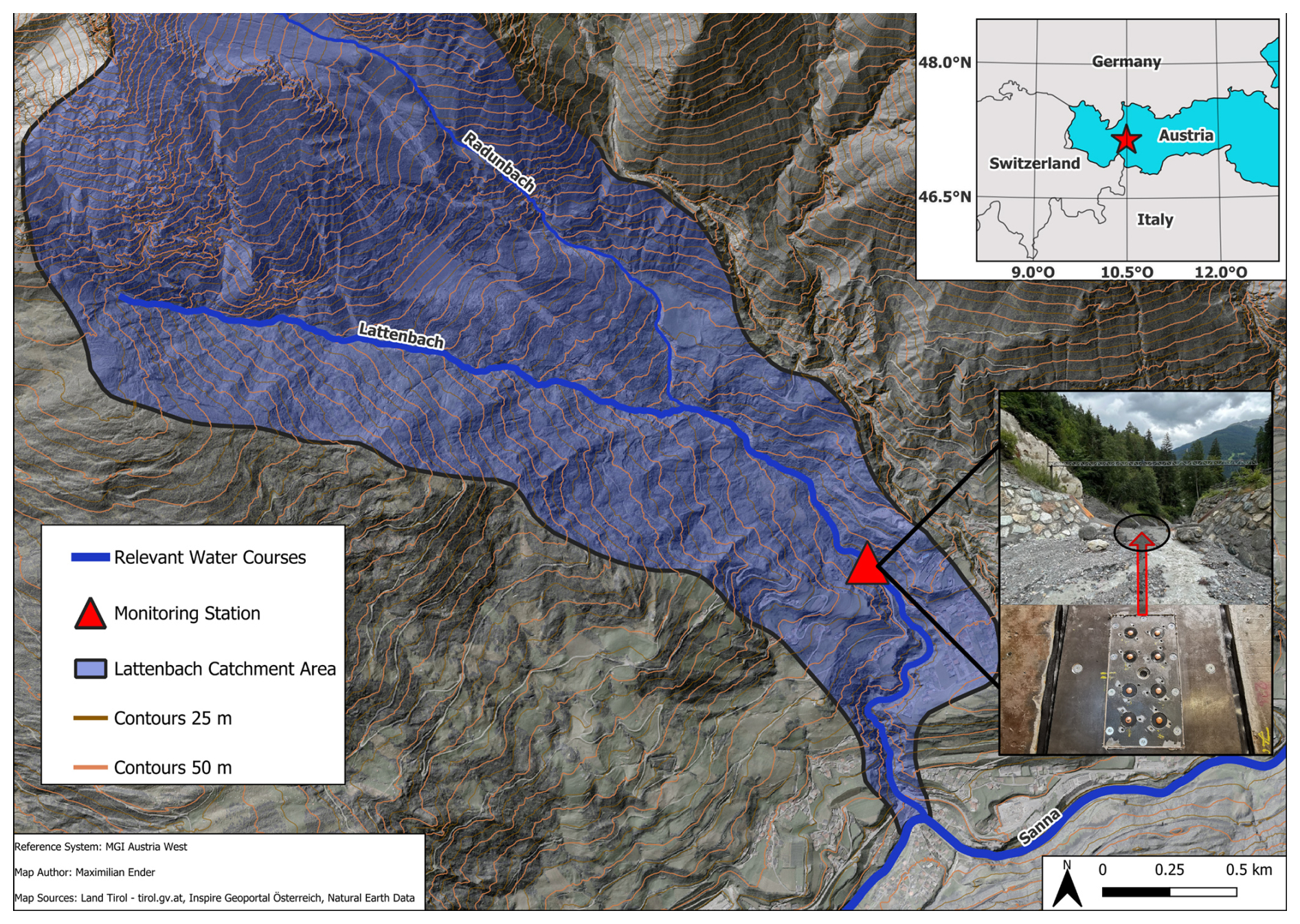
Figure 1Visualization of (a) the catchment overview map with presentation of location of the monitoring station and (b) the slip velocity measurement system setup.
The measurement principle is similar to a technique introduced for laboratory experiments to measure vertical velocity profiles in sediment-fluid mixtures in a rotating drum setup (Kaitna et al., 2014) and was transferred to a field debris-flow monitoring station at the Gadria creek, Italy (Nagl et al., 2020). High-resolution temporal fluctuations in the conductivity of the passing debris are measured at the channel bed using four pairs of electrodes (ED1, ED2, ED3, and ED4) (see Fig. 1b). Conductivity fluctuations from each electrode pair undergo low-pass (200 Hz) and band-stop (45–55, 95–105, 124–126, 145–155, and 170–180 Hz) filtering, and the filtered signals are then cross-correlated between adjacent pairs. We assume that signal variations are induced by particle movement within the fluid passing the sensors. Velocity estimates were derived by cross correlating the filtered conductivity data using a floating window with a duration of 1.0 s (2400 values) and an overlap of 50 % of the window length. Since the distance between the pairs is known, the time lag can be used to infer velocities according to the relationship . Regarding sensor combinations, only adjacent electrode pairs (ED1_ED2 with a spacing of 6.0 cm, ED2_ED3 with a spacing of 7.7 cm, ED3_ED4 with a spacing of 6.0 cm) were cross-correlated. Note that cross-correlation-based velocity derivation is subject to a lower-bound velocity vlow, which primarily depends on the sensor-pair spacing Δs and the length of the floating window tWIN: . Since very low velocities are expected in the basal region of natural debris flows, the maximum lag (i.e. the maximum allowable shift within the cross-correlation function) was calculated over the entire length of the sliding data window in this analysis. This yields lower cutoff velocities vlow of 0.06 m s−1 (ED1_ED2 and ED3_ED4) and 0.077 m s−1 (ED2_ED3), but may also be associated with weaker correlations, as only few data points are compared at the edges of the window. Due to the larger spacing for the sensor combination ED2_ED3, vlow is slightly higher when using an equally long floating window, potentially causing a light upward shift in the median.
Due to weak signal quality, we here use all returned correlation estimates, irrespective of the correlation coefficient (ACF). For an assessment of the tendency of basal slip, the results of all considered electrode combinations bounded in the range from −10 to +10 m s−1 were subjected to a running median with a window of 5 s, yielding a smoothed estimate of the velocity distribution over time. For a more comprehensible visualization, a LOESS trend regression based on the running median was additionally applied. In the case of a right-skewed distribution, the running median is positive and provisionally interpreted as basal velocity. A running median close to the cutoff velocity, we interpret as no detectable basal slip.
Surface velocity was independently measured by a Pulse Doppler Radar at a sampling frequency of 4 Hz (cf. Schöffl et al., 2023). It should be noted that there is a small temporal offset between surface velocity and slip estimates, which can be attributed to the fact that surface velocity is averaged within an areal range gate with approximately 15 m depth. We evaluate the monitoring setup based on two debris-flow events occurred on 15 and 30 June 2025. Digital videos of both events are provided in Nagl and Ender (2025).
The first event had a duration of 25 min and consisted of a single main surge (Fig. 2a). Qualitative analysis of the video recordings reveals a coarse-grained front, followed by finer material with a homogeneous grain-size distribution. Within the surge, several roll waves occurred. Toward the end, flow behavior becomes increasingly turbulent, transitioning gradually into debris flood and finally into above-average streamflow conditions.
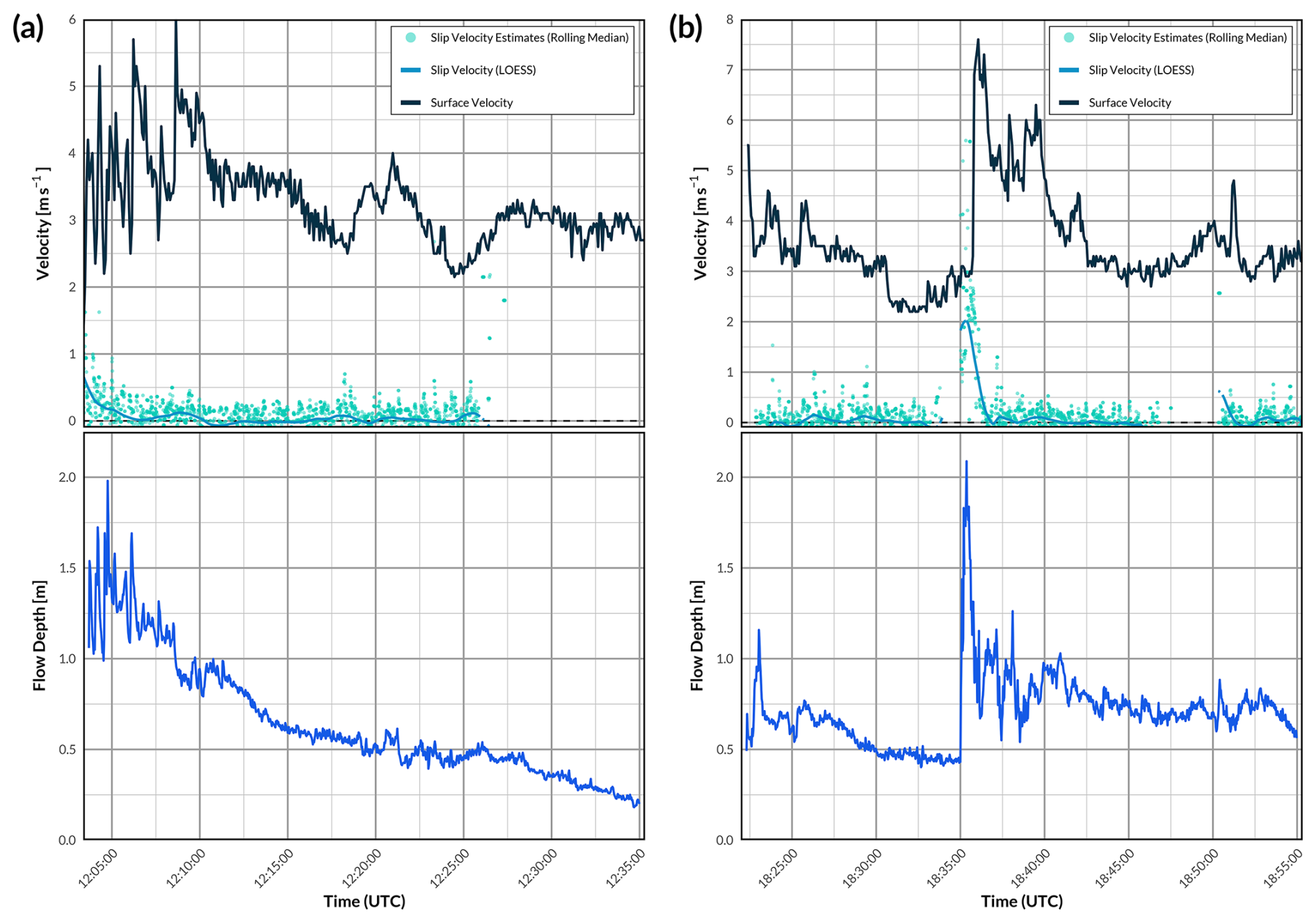
Figure 2Tendency of basal slip for two debris-flow events at Lattenbach: (a) 15 June 2025 and (b) 30 June 2025. In the respective upper plots, the turquoise scatter represents rolling median values of cross-correlated velocity estimates from three sensor pair combinations, the light blue line represents a trend of these rolling median values (LOESS), and the gray-blue line shows the individual measured surface velocity. The blue line in the respective lower plots represents the fluctuation of flow depth from a laser gauge.
The second event, on 30 June, had a duration of 35 min and comprised three surges (Fig. 2b). The first surge had a viscous appearance and displayed turbulent flow behavior, with a coarse-grained front. The second surge showed significantly higher velocities and flow depths, again exhibiting turbulent flow behavior. The third surge is difficult to distinguish from the second; it exhibits a relatively similar velocity to the waning second surge, with a visually slight change to a more fluid material composition. Toward the end of the event, the flow transitions also into a debris flood.
Based on our first analysis, we observe intermittent slip in both events in some parts of the flow. During both events, slip occurs predominantly at the onset of debris-flow surges. In the first event, on 15 June 2025, this is particularly pronounced during the initial 2 min (Fig. 2a), with significant positive velocities starting >0.5 m s−1 and then decreasing to 0.25 m s−1, yet substantially lower than the surface velocity (3–5 ms−1). At the very front, the ratio of is around 0.5 followed by a continuous decrease. Subsequently, slip velocities reduce to values close to the cutoff velocity vlim, suggesting only negligible movement in the basal layer of the debris flow. Beyond the transition from debris flood to normal streamflow conditions (after approximately 12:27:00 UTC), no slip velocity estimates can be derived.
For the second event, on 30 June 2025, three distinct surge-like sections can be identified (Fig. 2b). The middle surge is characterized by a notably high slip velocity of almost 2 m s−1 at the beginning, which in this case matches averaged surface velocity. In the first and the third surge, no significant slip can be observed, with individual binned slip velocity medians and the trend line fluctuating around zero. Accordingly, the ratio reaches >0.5 only at the onset of the second debris-flow surge (18:35:00 UTC), while fluctuating near zero on all other sections. In the inter-surge periods (18:33:00–18:35:00 and 18:46:00–18:50:00 UTC), characterized by visually observed elevated stream flow conditions, derivation of slip velocities is not feasible.
For both events, individual correlations are widely scattered, and no clear trend can be identified indicating that lower slip velocity values are associated with higher correlation coefficients, or vice versa. A subtle downstream trend is observable in the proportion of the number of valid correlation returns. In the first event, valid correlations increased from 57.0 % (ED1_ED2) to 57.6 % (ED2_ED3) to 60.7 % (ED3_ED4). This pattern persists in the second event with proportions of 53.2 %, 55.8 %, and 56.3 % respectively, where values are slightly elevated due to smaller data gaps between surges. The consistently higher proportion for the most downstream sensor pair (ED3_ED4) may indicate marginally improved signal quality in this section. The correlated slip velocity values of the central sensor combination are slightly higher in the median for both events compared to the two outer sensor-pair combinations. For the event on 15 June, the medians were 0.11 m s−1 for the combination ED1_ED2, 0.13 m s−1 for ED2_ED3, and 0.11 m s−1 for ED3_ED4. In the second event of 30 June, this difference was less pronounced, with values of 0.12 m s−1 for the combination ED1_ED2, 0.13 m s−1 for ED2_ED3, and 0.08 m s−1 for ED3_ED4. The relatively uniform distribution is also indicated by the standard deviation of the sip velocity distributions, which range between 2.0–2.2 m s−1, with slightly higher scatter observed in the second event. Respective figures can be found in Nagl and Ender (2025).
Basal sliding occurs in many, gravity-driven geomorphological mass flows, such as in snow avalanches (e.g. Kern et al., 2009), rock avalanches (e.g. Pudasaini and Mergili, 2024) or temperate glaciers (e.g. Bierman and Montgomery, 2020).
Based on two natural debris-flow events, we demonstrate that an assessment of slip velocities is feasible and that basal sliding can occur in natural debris-flows over non-erodible (fixed) channel beds. There is indication of basal sliding at the debris-flow fronts, potentially due to their coarser, more granular sediment composition, as demonstrated in laboratory studies, e.g. by Sanvitale and Bowman (2017), where significant slip velocities are observed predominantly at the fronts of debris-flow surges, while the waning phase of surges and the more viscous flow regimes exhibit non-detectable conditions.
The exact detection depth of the conductivity sensor pairs, i.e. the influence of the shear rate along the boundary layer, is not yet known. As a first approximation, this detection depth corresponds roughly to the spacing between the sensor pairs, although the conductivity of a debris-flow mixture is primarily governed by its composition and, above all, by its fluid content. At lower fluid contents (e.g. at debris-flow fronts or in very granular debris flows), we expect a reduced conductivity and, accordingly, a shallower detection depth. If the detection depth is found to be high, the measured velocities may not accurately represent the slip velocity at the channel bed but could instead reflect the velocity gradient of the lowermost layers of the flowing debris.
An additional factor to consider when interpreting our first results, is the location of the slip velocity sensor setup directly above a check dam, which could further affect basal acceleration effects, also in view of the slightly reduced channel-bed roughness in the cross-section.
The generally higher correlated velocities observed within the central sensor-pair combination ED2_ED3 may be attributed to the larger spacing between these two electrode pairs (7.7 cm compared to 6.0 cm between the other pairs ED1_ED2 as well as ED3_ED4), leading necessarily to a higher cutoff-velocity. In other words, the larger the distance between the sensor pairs, the higher the minimum detectable velocities and the lower the quality of the cross-correlations at such low velocities, as it takes more time for the debris to traverse the spacing in-between. It is therefore likely that the longer travel distance leads to a preferential return of higher velocity estimates.
In this study, we present a conductivity-based setup to measure basal sliding in natural debris flows at the Lattenbach creek, Tyrol, Austria. Based on recordings from two debris-flow events in June 2025 we conclude that the setup is capable of detecting the tendency for basal sliding. A preliminary analysis with rather coarse temporal resolution indicates the presence of basal velocities which we provisionally interpret as slip velocity throughout the first event and during surge phases in the second event. The velocities observed in both events were consistently lower than independently measured surface velocities using a pulse Doppler radar, adding plausibility to this first assessment. While our preliminary results are limited to fixed bed-conditions and only consider two single events, further refinement is required, primarily considering the analysis methodology as well as a validation of the sensor detection depth, they provide a first insight into direct field evidence of basal slip conditions in natural debris flows.
Future research will focus on analysing additional debris-flow events and evaluating the sensor detection depth into the flowing debris-mass through laboratory experiments. These data will also provide a basis for a detailed optimization of the signal processing and the cross-correlation derivation methodology (e.g. signal filtering, quality control of the derived velocity estimates). Furthermore, a similar sensor system has recently been installed at Illgraben, Switzerland, where a complementary study on basis of the mentioned methodological improvements is planned to provide further insights into the magnitude and spatial distribution of slip velocities along the flow and across different catchments. Such observations may help assess the relevance of basal slip processes in natural debris flows and their potential implications for model boundary condition assumptions.
The analyses were performed using R. The code and data can be found in https://doi.org/10.5281/zenodo.17249343 (Nagl and Ender, 2025).
Video recordings of the respective debris-flow events can be found in https://doi.org/10.5281/zenodo.17249343 (Nagl and Ender, 2025).
GN and ME contributed equally to data preparation, data analysis, result visualization and interpretation, and manuscript writing. FK, BM, JA, JH, and RK were primarily involved in data analysis. SB and FZ played an important role in the design, construction, and installation of the sensor setup.
The contact author has declared that none of the authors has any competing interests.
Publisher's note: Copernicus Publications remains neutral with regard to jurisdictional claims made in the text, published maps, institutional affiliations, or any other geographical representation in this paper. The authors bear the ultimate responsibility for providing appropriate place names. Views expressed in the text are those of the authors and do not necessarily reflect the views of the publisher.
Maximilian Ender and Felix Klein were supported by the Doctoral School Hazards and Risks in Alpine Regions under Global Change (HADRIAN) of BOKU University, Vienna.
This research has been supported by the Austrian Science Fund (grant no. https://doi.org/10.55776/PAT2495323).
This paper was edited by Mihai Niculita and reviewed by Dongri Song and two anonymous referees.
Aaron, J., Spielmann, R., McArdell, B. W., and Graf, C.: High-frequency 3D LiDAR measurements of a debris flow: a novel method to investigate the dynamics of full-scale events in the field, Geophys. Res. Lett., 50, https://doi.org/10.1029/2022GL102373, 2023.
Aigner, P., Kuschel, E., Sklar, L., Zangerl, C., Hrachowitz, M., De Haas, T., Huebl, J., and Kaitna, R.: Debris-flow activity and sediment dynamics in the landslide-influenced Lattenbach catchment, Austria, E3S Web of Conf., 415, 04001, https://doi.org/10.1051/e3sconf/202341504001, 2023.
Berger, C., McArdell, B. W., and Schlunegger, F.: Direct measurement of channel erosion by debris flows, Illgraben, Switzerland, J. Geophys. Res., 116, https://doi.org/10.1029/2010JF001722, 2011.
Bierman, P. R. and Montgomery, D. R.: Key Concepts in Geomorphology, 2nd edn., Macmillan Learning, Austin Boston New York Plymouth 526 pp., ISBN 978-1429238601, 2020.
Domnik, B. and Pudasaini, S. P.: Full two-dimensional rapid chute flows of simple viscoplastic granular materials with a pressure-dependent dynamic slip-velocity and their numerical simulations, J. Non-Newton. Fluid, 173–174, 72–86, https://doi.org/10.1016/j.jnnfm.2012.03.001, 2012.
Hsu, L., Dietrich, W. E., and Sklar, L. S.: Experimental study of bedrock erosion by granular flows, J. Geophys. Res., 113, 2007JF000778, https://doi.org/10.1029/2007JF000778, 2008.
Huebl, J. and Kaitna, R.: Monitoring debris-flow surges and triggering rainfall at the Lattenbach Creek, Austria, Environ. Eng. Geosci., 27, 213–220, https://doi.org/10.2113/EEG-D-20-00010, 2021.
Hungr, O., Leroueil, S., and Picarelli, L.: The Varnes classification of landslide types, an update, Landslides, 11, 167–194, https://doi.org/10.1007/s10346-013-0436-y, 2014.
Hürlimann, M., Coviello, V., Bel, C., Guo, X., Berti, M., Graf, C., Hübl, J., Miyata, S., Smith, J. B., and Yin, H.-Y.: Debris-flow monitoring and warning: review and examples, Earth-Sci. Rev., 199, 102981, https://doi.org/10.1016/j.earscirev.2019.102981, 2019.
Iverson, R. M., Logan, M., LaHusen, R. G., and Berti, M.: The perfect debris flow? Aggregated results from 28 large-scale experiments, J. Geophys. Res., 115, 2009JF001514, https://doi.org/10.1029/2009JF001514, 2010.
Kaitna, R., Dietrich, W. E., and Hsu, L.: Surface slopes, velocity profiles and fluid pressure in coarse-grained debris flows saturated with water and mud, J. Fluid Mech., 741, 377–403, https://doi.org/10.1017/jfm.2013.675, 2014.
Kamali Zarch, M., Zhang, L., Haeri, S. M., and He, J.: Classic, modern, and physics-based rheological laws for geophysical granular flows in a landslide hazard chain, Earth-Sci. Rev., 269, 105204, https://doi.org/10.1016/j.earscirev.2025.105204, 2025.
Kern, M., Bartelt, P., Sovilla, B., and Buser, O.: Measured shear rates in large dry and wet snow avalanches, J. Glaciol., 55, 327–338, https://doi.org/10.3189/002214309788608714, 2009.
Nagl, G. and Ender, M.: Supplementary material: Brief Communication: In-Situ Measurements of Basal Sliding in Natural Debris Flows, in: First field observations of basal slip velocities in natural debris flows, Zenodo [data set], https://doi.org/10.5281/zenodo.17249343, 2025.
Nagl, G., Hübl, J., and Kaitna, R.: Velocity profiles and basal stresses in natural debris flows, Earth Surf. Proc. Land., 45, 1764–1776, https://doi.org/10.1002/esp.4844, 2020.
Pitman, E. B. and Le, L.: A two-fluid model for avalanche and debris flows, Philos. T. Roy. Soc. A, 363, 1573–1601, https://doi.org/10.1098/rsta.2005.1596, 2005.
Pudasaini, S. P. and Mergili, M.: A multi-phase mass flow model, J. Geophys. Res.-Earth, 124, 2920–2942, https://doi.org/10.1029/2019JF005204, 2019.
Pudasaini, S. P. and Mergili, M.: Mechanically Controlled Landslide Deformation, J. Geophys. Res.-Earth, 129, e2023JF007466, https://doi.org/10.1029/2023JF007466, 2024.
Roelofs, L., Colucci, P., and de Haas, T.: How debris-flow composition affects bed erosion quantity and mechanisms: an experimental assessment, Earth Surf. Proc. Land., 47, 2151–2169, https://doi.org/10.1002/esp.5369, 2022.
Sanvitale, N. and Bowman, E. T.: Visualization of dominant stress-transfer mechanisms in experimental debris flows of different particle-size distribution, Can. Geotech. J., 54, 258–269, https://doi.org/10.1139/cgj-2015-0532, 2017.
Schöffl, T., Nagl, G., Koschuch, R., Schreiber, H., Hübl, J., and Kaitna, R.: A perspective of surge dynamics in natural debris flows through pulse-Doppler radar observations, J. Geophys. Res.-Earth, 128, e2023JF007171, https://doi.org/10.1029/2023JF007171, 2023.
Taylor-Noonan, A. M., Bowman, E. T., McArdell, B. W., Kaitna, R., McElwaine, J. N., and Take, W. A.: Influence of pore fluid on grain-scale interactions and mobility of granular flows of differing volume, J. Geophys. Res.-Earth, 127, https://doi.org/10.1029/2022JF006622, 2022.
von Boetticher, A., Turowski, J. M., McArdell, B. W., Rickenmann, D., and Kirchner, J. W.: DebrisInterMixing-2.3: a finite volume solver for three-dimensional debris-flow simulations with two calibration parameters – Part 1: Model description, Geosci. Model Dev., 9, 2909–2923, https://doi.org/10.5194/gmd-9-2909-2016, 2016.
Zheng, H., Shi, Z., Hanley, K. J., Peng, M., Guan, S., Feng, S., and Chen, K.: Deposition characteristics of debris flows in a lateral flume considering upstream entrainment, Geomorphology, 394, 107960, https://doi.org/10.1016/j.geomorph.2021.107960, 2021.