
Articles | Volume 26, issue 3
https://doi.org/10.5194/nhess-26-1287-2026
© Author(s) 2026. This work is distributed under
the Creative Commons Attribution 4.0 License.
the Creative Commons Attribution 4.0 License.
https://doi.org/10.5194/nhess-26-1287-2026
© Author(s) 2026. This work is distributed under
the Creative Commons Attribution 4.0 License.
the Creative Commons Attribution 4.0 License.
Research article
| Highlight paper
| 
11 Mar 2026
Research article | Highlight paper |
| 11 Mar 2026
| 11 Mar 2026
Numerical experiments of cloud seeding for mitigating localization of heavy rainfall: a case study of Mesoscale Convective System in Japan
Yusuke Hiraga
CORRESPONDING AUTHOR

Department of Civil and Environmental Engineering, Tohoku University, Sendai, Japan
Jacqueline Muthoni Mbugua
Department of Civil and Environmental Engineering, Tohoku University, Sendai, Japan
Shunji Kotsuki
Center for Environmental Remote Sensing, Chiba University, Chiba, Japan
Institute for Advanced Academic Research, Chiba University, Chiba, Japan
Yoshiharu Suzuki
Department of Civil and Environmental Engineering, Hosei University, Tokyo, Japan
Shu-Hua Chen
Department of Land, Air and Water Resources, University of California, Davis, CA, USA
Atsushi Hamada
Faculty of Sustainable Design, University of Toyama, Toyama, Japan
Center for Environmental Remote Sensing, Chiba University, Chiba, Japan
Kazuaki Yasunaga
Faculty of Sustainable Design, University of Toyama, Toyama, Japan
Takuya Funatomi
Academic Center for Computing and Media Studies, Kyoto University, Kyoto, Japan
Related authors
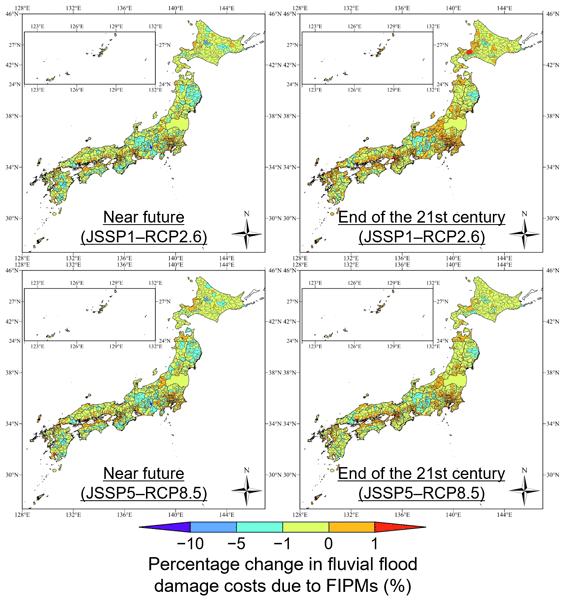
Hayata Yanagihara, So Kazama, Kei Gomi, Yusuke Hiraga, and Atsuya Ikemoto
Nat. Hazards Earth Syst. Sci., 26, 3969–3986, https://doi.org/10.5194/nhess-26-3969-2026, https://doi.org/10.5194/nhess-26-3969-2026, 2026
Short summary
Short summary
Flooding can influence population movements. However, most studies of future flood damage costs do not consider these movements. We examined how such movements may change future flood damage costs in Japan. National and prefectural effects were small, but some municipalities showed reductions of more than 10 % in these costs. These results show that considering population movements can improve future flood risk planning.
Yusuke Hiraga, Sohta Tadaki, Ryotaro Tahara, and Jose Angelo Hokson
EGUsphere, https://doi.org/10.5194/egusphere-2026-2597, https://doi.org/10.5194/egusphere-2026-2597, 2026
Short summary
Short summary
To understand why some atmospheric rivers trigger catastrophic rainfall in Japan while others cause minimal impact, we analyzed eighty-four years of weather data. We found that extreme rainfall is not driven by water vapor transport alone; it requires strong wind convergence, atmospheric instability, and orographic uplift. High atmospheric moisture enables the formation of dangerous, stationary rainbands. These insights help us better understand heavy rain mechanisms and improve flood forecasts.
Binquan Qiu, Qiuyi Ren, Yuta Higuchi, Houtian He, Kazuaki Yasunaga, Yang Bai, and Masaki Ogura
EGUsphere, https://doi.org/10.5194/egusphere-2026-5677, https://doi.org/10.5194/egusphere-2026-5677, 2026
This preprint is open for discussion and under review for Nonlinear Processes in Geophysics (NPG).
Short summary
Short summary
Heavy rainfall can cause economic damage, motivating efforts to regulate individual rainfall events. We developed a method that repeatedly uses computer weather simulations to place and orient offshore sail arrays that disturb near-surface airflow and influence rainfall formation. Across multiple experiments, simulated rainfall over the target area was reduced by 21% on average compared with no intervention. The findings offer a possible step beyond experience-based or simplified approaches.
Hayata Yanagihara, So Kazama, Kei Gomi, Yusuke Hiraga, and Atsuya Ikemoto
Nat. Hazards Earth Syst. Sci., 26, 3969–3986, https://doi.org/10.5194/nhess-26-3969-2026, https://doi.org/10.5194/nhess-26-3969-2026, 2026
Short summary
Short summary
Flooding can influence population movements. However, most studies of future flood damage costs do not consider these movements. We examined how such movements may change future flood damage costs in Japan. National and prefectural effects were small, but some municipalities showed reductions of more than 10 % in these costs. These results show that considering population movements can improve future flood risk planning.
Yusuke Hiraga, Sohta Tadaki, Ryotaro Tahara, and Jose Angelo Hokson
EGUsphere, https://doi.org/10.5194/egusphere-2026-2597, https://doi.org/10.5194/egusphere-2026-2597, 2026
Short summary
Short summary
To understand why some atmospheric rivers trigger catastrophic rainfall in Japan while others cause minimal impact, we analyzed eighty-four years of weather data. We found that extreme rainfall is not driven by water vapor transport alone; it requires strong wind convergence, atmospheric instability, and orographic uplift. High atmospheric moisture enables the formation of dangerous, stationary rainbands. These insights help us better understand heavy rain mechanisms and improve flood forecasts.
Magfira Syarifuddin, Hamada Atsushi, Houtian He, and Kazuaki Yasunaga
EGUsphere, https://doi.org/10.5194/egusphere-2026-1052, https://doi.org/10.5194/egusphere-2026-1052, 2026
Short summary
Short summary
Extreme rainfall can cause severe damage, as seen in the August 2021 Kyushu event. This study evaluates how forecast accuracy depends on model resolution, ensemble size, and simulation length using high-resolution weather simulations. We show that while higher resolution improves detail, large ensembles and statistical corrections are equally important, allowing accurate forecasts without excessive computational cost. These insights support better hazard prediction and planning.
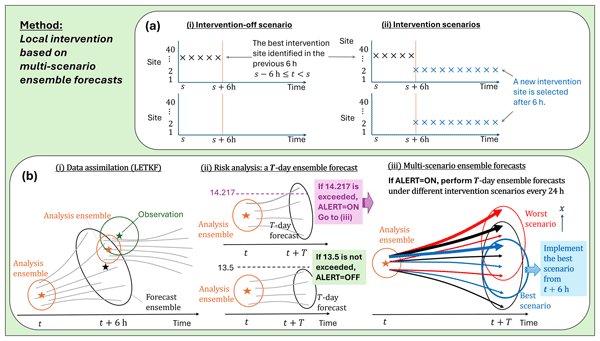
Takahito Mitsui, Shunji Kotsuki, Naoya Fujiwara, Atsushi Okazaki, and Keita Tokuda
Nonlin. Processes Geophys., 32, 457–469, https://doi.org/10.5194/npg-32-457-2025, https://doi.org/10.5194/npg-32-457-2025, 2025
Short summary
Short summary
Extreme weather poses serious risks, making prevention crucial. Using the Lorenz 96 model as a testbed, we propose a bottom-up approach to mitigate extreme events via local interventions guided by multi-scenario ensemble forecasts. Unlike control-theoretic methods, our approach selects the best control scenario from available options. It achieves a high success rate of 99.4% while maintaining reasonable costs, offering a practical strategy to reduce extremes under limited control.
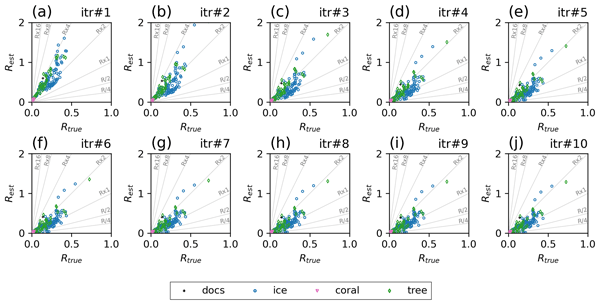
Atsushi Okazaki, Diego S. Carrió, Quentin Dalaiden, Jarrah Harrison-Lofthouse, Shunji Kotsuki, and Kei Yoshimura
Clim. Past, 21, 1801–1819, https://doi.org/10.5194/cp-21-1801-2025, https://doi.org/10.5194/cp-21-1801-2025, 2025
Short summary
Short summary
Data assimilation (DA) has been used to reconstruct paleoclimate fields. DA integrates model simulations and climate proxies based on their error sizes. Consequently, error information is vital for DA to function optimally. This study estimated observation errors using "innovation statistics" and demonstrated that DA with estimated errors outperformed previous studies.
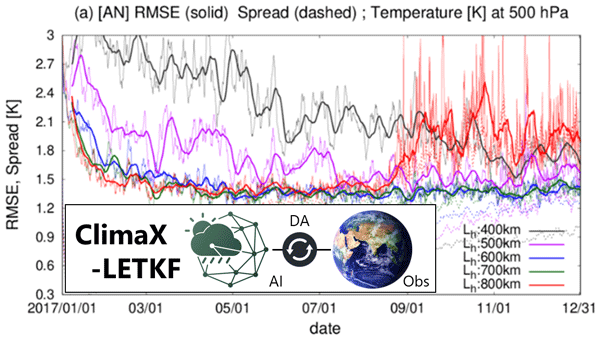
Shunji Kotsuki, Kenta Shiraishi, and Atsushi Okazaki
Geosci. Model Dev., 18, 7215–7225, https://doi.org/10.5194/gmd-18-7215-2025, https://doi.org/10.5194/gmd-18-7215-2025, 2025
Short summary
Short summary
Artificial intelligence (AI) is playing a bigger role in weather forecasting, often competing with physical models. However, combining AI models with data assimilation, a process that improves weather forecasts by incorporating observation data, is still relatively unexplored. This study explored the coupling of ensemble data assimilation with an AI weather prediction model, ClimaX, which succeeded in employing weather forecasts stably by applying techniques conventionally used for physical models.
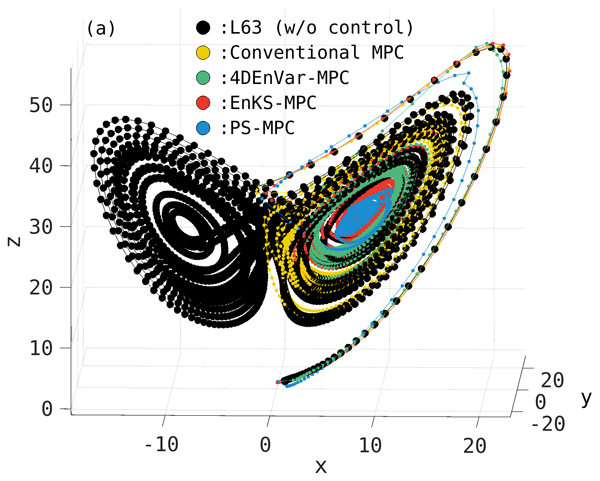
Kenta Kurosawa, Atsushi Okazaki, Fumitoshi Kawasaki, and Shunji Kotsuki
Nonlin. Processes Geophys., 32, 293–307, https://doi.org/10.5194/npg-32-293-2025, https://doi.org/10.5194/npg-32-293-2025, 2025
Short summary
Short summary
We propose ensemble-based model predictive control (EnMPC), a novel method that improves the control of complex systems like the atmosphere by integrating control theory with data assimilation. Unlike traditional methods, which are computationally expensive, EnMPC uses ensemble simulations to efficiently handle uncertainties and optimize solutions. This approach reduces computational cost while maintaining accuracy, making it a promising step toward real-world applications in dynamic system control.
Yang Yu, Yin-Nan Li, Rong-Hua Zhang, Shu-Hua Chen, Yu-Heng Tseng, Wenzhe Zhang, and Hongna Wang
Geosci. Model Dev., 18, 5527–5547, https://doi.org/10.5194/gmd-18-5527-2025, https://doi.org/10.5194/gmd-18-5527-2025, 2025
Short summary
Short summary
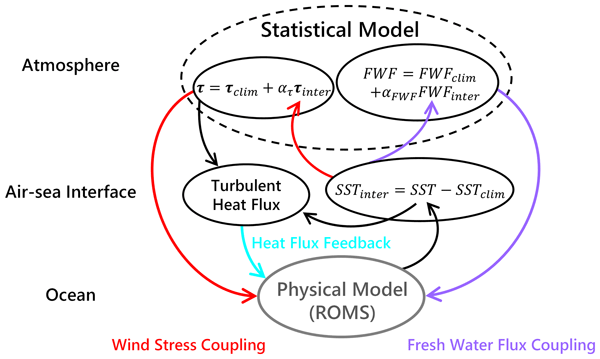
In this paper, we develop a new flexible hybrid coupled model (HCM) by incorporating the Regional Ocean Modeling System (ROMS) into a statistical atmospheric model. The model performance is evaluated for its ability to simulate processes related to El Niño–Southern Oscillation (ENSO). The newly developed HCMROMS is expected to become an effective modeling tool for studying the multiscale and multisphere interactions associated with ENSO in the tropical Pacific.
Rikuto Nagai, Yang Bai, Masaki Ogura, Shunji Kotsuki, and Naoki Wakamiya
Nonlin. Processes Geophys., 32, 281–292, https://doi.org/10.5194/npg-32-281-2025, https://doi.org/10.5194/npg-32-281-2025, 2025
Short summary
Short summary
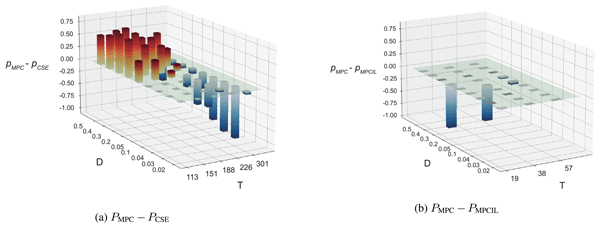
Controlling chaotic systems is a key step toward weather control. The control simulation experiment (CSE) modifies weather systems using small perturbations, as shown in studies with the Lorenz-63 model. However, the effectiveness of CSE compared to other methods is unclear. This study evaluates CSE against model predictive control (MPC). Simulations reveal that MPC achieves higher success rates with less effort under certain conditions, linking control theory and atmospheric science.
Fumitoshi Kawasaki, Atsushi Okazaki, Kenta Kurosawa, Tadashi Tsuyuki, and Shunji Kotsuki
EGUsphere, https://doi.org/10.5194/egusphere-2025-1785, https://doi.org/10.5194/egusphere-2025-1785, 2025
Preprint archived
Short summary
Short summary
A major challenge in weather control aimed at mitigating extreme weather events is identifying effective control inputs under limited computational resources. This study proposes a novel control framework called model predictive control with foreseeing horizon, designed to efficiently control chaotic dynamical systems. Using a 40-variable chaotic dynamical model, the proposed method successfully mitigated extreme events and reduced computational cost compared to the conventional approach.
Pascal Oettli, Keita Tokuda, Yusuke Imoto, and Shunji Kotsuki
EGUsphere, https://doi.org/10.5194/egusphere-2025-1458, https://doi.org/10.5194/egusphere-2025-1458, 2025
Preprint archived
Short summary
Short summary
A tropical cyclone is a circular air movement that emerges over warm waters of the tropical ocean and its movement is guided by complex interactions between the ocean and the atmosphere. To better understand this complexity, we adopted ideas and techniques from biology and bioinformatics, to have a fresh look at this matter. This led to the creation of "MeteoScape," a tool that calculates the probability of paths for tropical cyclones can take and visualize them in an understandable way.
Yuka Muto and Shunji Kotsuki
Hydrol. Earth Syst. Sci., 28, 5401–5417, https://doi.org/10.5194/hess-28-5401-2024, https://doi.org/10.5194/hess-28-5401-2024, 2024
Short summary
Short summary
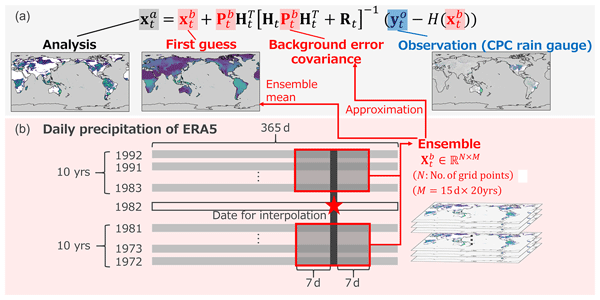
It is crucial to improve global precipitation estimates to understand water-related disasters and water resources. This study proposes a new methodology to interpolate global precipitation fields from ground rain gauge observations using ensemble data assimilation and the precipitation of a numerical weather prediction model. Our estimates agree better with independent rain gauge observations than existing precipitation estimates, especially in mountainous or rain-gauge-sparse regions.
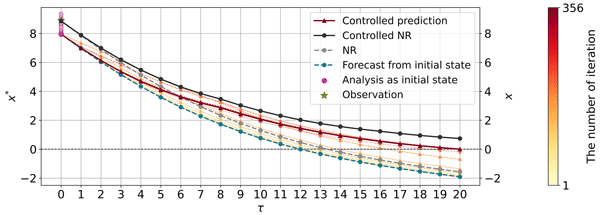
Fumitoshi Kawasaki and Shunji Kotsuki
Nonlin. Processes Geophys., 31, 319–333, https://doi.org/10.5194/npg-31-319-2024, https://doi.org/10.5194/npg-31-319-2024, 2024
Short summary
Short summary
Recently, scientists have been looking into ways to control the weather to lead to a desirable direction for mitigating weather-induced disasters caused by torrential rainfall and typhoons. This study proposes using the model predictive control (MPC), an advanced control method, to control a chaotic system. Through numerical experiments using a low-dimensional chaotic system, we demonstrate that the system can be successfully controlled with shorter forecasts compared to previous studies.
Toshiyuki Ohtsuka, Atsushi Okazaki, Masaki Ogura, and Shunji Kotsuki
EGUsphere, https://doi.org/10.48550/arXiv.2405.19546, https://doi.org/10.48550/arXiv.2405.19546, 2024
Preprint withdrawn
Short summary
Short summary
We utilize weather forecasts in the reverse direction and determine how much we should change the temperature or humidity of the atmosphere at a certain time to change the future rainfall as desired. Even though a weather phenomenon is complicated, we can superimpose the effects of small changes in the atmosphere and find suitable small changes to realize desirable rainfall by solving an optimization problem. We examine this idea on a realistic weather simulator and show it is promising.
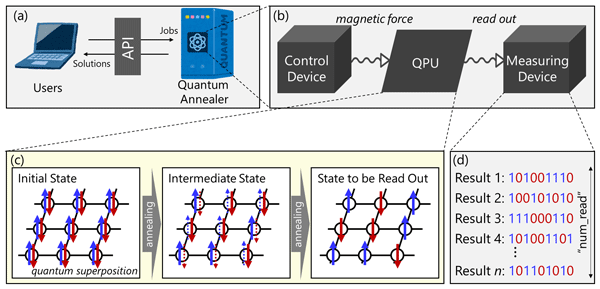
Shunji Kotsuki, Fumitoshi Kawasaki, and Masanao Ohashi
Nonlin. Processes Geophys., 31, 237–245, https://doi.org/10.5194/npg-31-237-2024, https://doi.org/10.5194/npg-31-237-2024, 2024
Short summary
Short summary
In Earth science, data assimilation plays an important role in integrating real-world observations with numerical simulations for improving subsequent predictions. To overcome the time-consuming computations of conventional data assimilation methods, this paper proposes using quantum annealing machines. Using the D-Wave quantum annealer, the proposed method found solutions with comparable accuracy to conventional approaches and significantly reduced computational time.
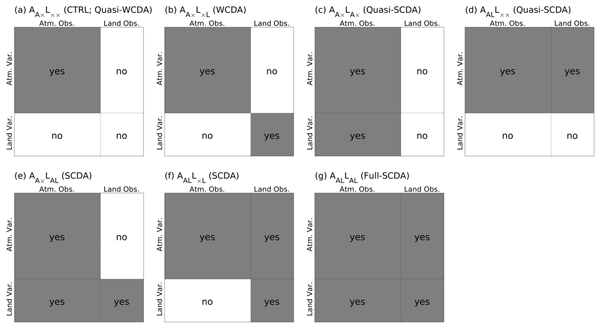
Kenta Kurosawa, Shunji Kotsuki, and Takemasa Miyoshi
Nonlin. Processes Geophys., 30, 457–479, https://doi.org/10.5194/npg-30-457-2023, https://doi.org/10.5194/npg-30-457-2023, 2023
Short summary
Short summary
This study aimed to enhance weather and hydrological forecasts by integrating soil moisture data into a global weather model. By assimilating atmospheric observations and soil moisture data, the accuracy of forecasts was improved, and certain biases were reduced. The method was found to be particularly beneficial in areas like the Sahel and equatorial Africa, where precipitation patterns vary seasonally. This new approach has the potential to improve the precision of weather predictions.
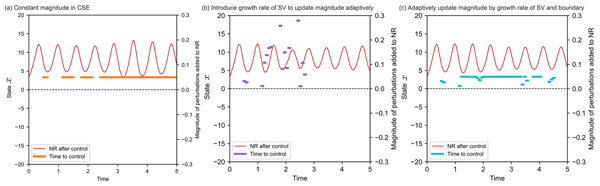
Mao Ouyang, Keita Tokuda, and Shunji Kotsuki
Nonlin. Processes Geophys., 30, 183–193, https://doi.org/10.5194/npg-30-183-2023, https://doi.org/10.5194/npg-30-183-2023, 2023
Short summary
Short summary
This research found that weather control would change the chaotic behavior of an atmospheric model. We proposed to introduce chaos theory in the weather control. Experimental results demonstrated that the proposed approach reduced the manipulations, including the control times and magnitudes, which throw light on the weather control in a real atmospheric model.
Shunji Kotsuki, Takemasa Miyoshi, Keiichi Kondo, and Roland Potthast
Geosci. Model Dev., 15, 8325–8348, https://doi.org/10.5194/gmd-15-8325-2022, https://doi.org/10.5194/gmd-15-8325-2022, 2022
Short summary
Short summary
Data assimilation plays an important part in numerical weather prediction (NWP) in terms of combining forecasted states and observations. While data assimilation methods in NWP usually assume the Gaussian error distribution, some variables in the atmosphere, such as precipitation, are known to have non-Gaussian error statistics. This study extended a widely used ensemble data assimilation algorithm to enable the assimilation of more non-Gaussian observations.
Cited articles
Abshaev, A. M., Flossmann, A., Siems, S. T., Prabhakaran, T., Yao, Z., and Tessendorf, S.: Rain enhancement through cloud seeding, in: Unconventional Water Resources, Springer International Publishing, 21–49, https://doi.org/10.1007/978-3-030-90146-2_2, 2022.
Abe, M., Fudeyasu, H., and Sasaoka, M.: Historical Review of Research Activities toward Typhoons/Hurricanes Modification in Japan and the United States, J. Meteorol. Soc. JPN II, 103, 305–320, https://doi.org/10.2151/jmsj.2025-015, 2025.
Alamaro, M., Michele, J., and Pudov, V.: A preliminary assessment of inducing anthropogenic tropical cyclones using compressible free jets and the potential for hurricane mitigation, The J. Weather Modification, 38, 82–96, https://doi.org/10.54782/001c.132982, 2006.
Avolio, E. and Federico, S.: WRF simulations for a heavy rainfall event in southern Italy: Verification and sensitivity tests, Atmos. Res., 209, 14–35, https://doi.org/10.1016/j.atmosres.2018.03.009, 2018.
Bae, S. Y., Hong, S. Y., and Tao, W. K.: Development of a single-moment cloud microphysics scheme with prognostic hail for the Weather Research and Forecasting (WRF) model, Asia-Pac. J. Atmos. Sci., https://doi.org/10.1007/s13143-018-0066-3, 2018.
Bougeault, P. and Lacarrere, P.: Parameterization of Orography–Induced Turbulence in a Mesobeta–Scale Model, Mon. Weather Rev., 117, 1872–1890, https://doi.org/10.1175/1520-0493(1989)117<1872:POOITI>2.0.CO;2, 1989.
Bruintjes, R. T.: A review of cloud seeding experiments to enhance precipitation and some new prospects, B. Am. Meteorol. Soc., 80, 805–820, https://doi.org/10.1175/1520-0477(1999)080<0805:AROCSE>2.0.CO;2, 1999.
Cha, D. H. and Wang, Y.: A dynamical initialization scheme for real-time forecasts of tropical cyclones using the WRF model, Mon. Weather Rev., 141, 964–986, https://doi.org/10.1175/MWR-D-12-00077.1, 2013.
Changnon, S. A. and Towery, N. G.: Evaluating cloud seeding opportunities for agricultural drought assistance, J. Appl. Meteorol. Climatol., 29, 1065–1075, 1990.
DOC/NOAA/NWS/NCEP: National Centers for Environmental Prediction, National Weather Service, NOAA, U.S. Department of Commerce, 2015, updated daily, NCEP GDAS/FNL 0.25 Degree Global Tropospheric Analyses and Forecast Grids, NSF National Center for Atmospheric Research, https://doi.org/10.5065/D65Q4T4Z, 2015.
Dong, X., Zhao, C., Huang, Z., Mai, R., Lv, F., Xue, X., and Sun, Y.: Increase of precipitation by cloud seeding observed from a case study in November 2020 over Shijiazhuang, China, Atmos. Res., 262, 105766, https://doi.org/10.1016/j.atmosres.2021.105766, 2021.
Fischer, E. M. and Knutti, R.: Observed heavy precipitation increase confirms theory and early models, Nat. Clim. Change, 6, 986–991, https://doi.org/10.1038/nclimate3110, 2016.
Fukuta, N., Schmeling, W. A., and Evans, L. F.: Experimental determination of ice nucleation by falling dry ice pellets, J. Appl. Meteorol. (1962–1982), 1174–1179, https://doi.org/10.1175/1520-0450(1971)010<1174:EDOINB>2.0.CO;2, 1971.
Grant, L. O. and Elliott, R. E.: The cloud seeding temperature window, J. Appl. Meteorol. (1962–1982), 355–363, 1974.
Guo, C., Chen, D., Chen, M., Qi, Y., Guo, J., and Ma, Z.: Aerosol impacts on summer precipitation forecast over the North China Plain by using Thompson aerosol aware scheme in WRF: Process analysis and response sensitivity to aerosol concentrations during a Heavy Rainfall Event in Beijing, Atmos. Res., 309, 107575, https://doi.org/10.1016/j.atmosres.2024.107575, 2024.
Hashimoto, A., Kuba, N., and Murakami, M.: Research on Precipitation Enhancement by Using Numerical Model, Earozoru Kenkyu, 30, 32–39, https://doi.org/10.11203/jar.30.32, 2015.
Henneberger, J., Ramelli, F., Spirig, R., Omanovic, N., Miller, A. J., Fuchs, C., Zhang, H., Bühl J., Hervo, M., Kanji ZA., Ohneiser, K., Radenz M., Rösch M., Seifert, P., and Lohmann, U.: Seeding of supercooled low stratus clouds with a UAV to study microphysical ice processes: an introduction to the CLOUDLAB project, B. Am. Meteorol. Soc., 104, E1962–E1979, https://doi.org/10.1175/BAMS-D-22-0178.1, 2023.
Hibino, K., Takayabu, I., Wakazuki, Y., and Ogata, T.: Physical responses of convective heavy rainfall to future warming condition: Case study of the Hiroshima event, Front. Earth Sci., 6, 35, https://doi.org/10.3389/feart.2018.00035 , 2018.
Hiraga, Y. and Tahara, R.: Sensitivity of localized heavy rainfall in Northern Japan to WRF physics parameterization schemes, Atmos. Res., 314, 107802, https://doi.org/10.1016/j.atmosres.2024.107802, 2025.
Hiraga, Y., Watanabe, S., Yamashita, T., and Takizawa, H.: Climate Change Effects on Probable Maximum Precipitation of Mesoscale Convective Systems: Model-based estimation and large ensemble-based frequency analysis, J. Hydrol., 133724, https://doi.org/10.1016/j.jhydrol.2025.133724, 2025.
Hirockawa, Y., Kato, T., Tsuguti, H., and Seino, N.: Identification and classification of heavy rainfall areas and their characteristic features in Japan, J. Meteorol. Soc. JPN II, 98, 835–857, https://doi.org/10.2151/jmsj.2020-043, 2020.
Huang, Y., Wang, Y., Xue, L., Wei, X., Zhang, L., and Li, H.: Comparison of three microphysics parameterization schemes in the WRF model for an extreme rainfall event in the coastal metropolitan City of Guangzhou, China, Atmos. Res., 240, 104939, https://doi.org/10.1016/j.atmosres.2020.104939, 2020.
Iacono, M. J., Delamere, J. S., Mlawer, E. J., Shephard, M. W., Clough, S. A., and Collins, W. D.: Radiative forcing by long–lived greenhouse gases: Calculations with the AER radiative transfer models, J. Geophys. Res., 113, D13103, https://doi.org/10.1029/2008JD009944, 2008.
Jimenez, P. A., Dudhia, J., Gonzalez-Rouco, J. F., Navarro, J., Montavez, J. P., and Garcia-Bustamante, E.: A revised scheme for the WRF surface layer formulation, Mon. Weather Rev., 140, 898–918, https://doi.org/10.1175/MWR-D-11-00056.1, 2012.
Kain, J. S.: The Kain–Fritsch convective parameterization: An update, J. Appl. Meteor., 43, 170–181, https://doi.org/10.1175/1520-0450(2004)043<0170:TKCPAU>2.0.CO;2, 2004.
Kazim, M., Azzam, R., Burger, R., Wehbe, Y., Zweri, Y., Seneviratne, L., and Werghi, N.: Unmanned aircraft systems for precipitation enhancement: Advancements, challenges, and future prospects, Atmos. Res., 108333, https://doi.org/10.1016/j.atmosres.2025.108333, 2025.
Kato, T.: Quasi-stationary band-shaped precipitation systems, named “Senjo-Kousuitai”, causing localized heavy rainfall in Japan, J. Meteorol. Soc. JPN II, 98, 485–509, https://doi.org/10.2151/jmsj.2020-029, 2020.
Kawano, T. and Kawamura, R.: Genesis and maintenance processes of a quasi-stationary convective band that produced record-breaking precipitation in northern Kyushu, Japan on 5 July 2017, J. Meteorol. Soc. JPN II, 98, 673–690, https://doi.org/10.2151/jmsj.2020-033, 2020.
Kawase, H., Nosaka, M., Watanabe, S. I., Yamamoto, K., Shimura, T., Naka, Y., Wu, Y.-H., Okachi, H., Hoshino, T., Ito, R., Sugimoto, S., Suzuki, C., Fukui, S., Takemi, T., Ishikawa, Y., Mori, N., Nakakita, E., Yamada, T. J., Murata, A., Nakaegawa, T., and Takayabu, I.: Identifying Robust Changes of Extreme Precipitation in Japan From Large Ensemble 5-km-Grid Regional Experiments for 4K Warming Scenario, J. Geophys. Res.-Atmos., 128, e2023JD038513, https://doi.org/10.1029/2023JD038513, 2023.
Kita, M., Kawahara, Y., Tsubaki, R., and Nyunt, C. T.: High-resolution downscaled simulation of heavy rainfall in Hiroshima in August 2014 using WRF, J. Jap. Soc. Civil Eng. B1 (Hydraulic Engineering), 72, I_211–I_216, https://doi.org/10.2208/jscejhe.72.I_211, 2016.
Klima, K., Lin, N., Emanuel, K., Morgan, M. G., and Grossmann, I.: Hurricane modification and adaptation in Miami-Dade County, Florida, Environ. Sci. Technol., 46, 636–642, https://doi.org/10.1021/es202640p, 2012.
Koloskov, B. P., Korneev, V. P., Petrov, V. V., Beryulev, G. P., and Danelyan, B. G.: Modern conception of meteorological protection of megalopolises using cloud seeding methods, Russ. Meteorol. Hydro.+, 35, 515–523, https://doi.org/10.3103/S1068373910080029, 2010.
Korneev, V. P., Koloskov, B. P., Bychkov, A. A., Petrunin, A. M., and Chastukhin, A. V.: Cloud seeding for improving weather in megacities, Russ. Meteorol. Hydrol.+, 47, 523–529, https://doi.org/10.3103/S1068373922070041, 2022.
Kreibich, H., Bubeck, P., Van Vliet, M., and De Moel, H.: A review of damage-reducing measures to manage fluvial flood risks in a changing climate, Mitig. Adapt. Strat. Gl., 20, 967–989, https://doi.org/10.1007/s11027-014-9629-5, 2015.
Liu, Y., Zhuo, L., and Han, D.: Developing spin-up time framework for WRF extreme precipitation simulations, J. Hydrol., 620, 129443, https://doi.org/10.1016/j.jhydrol.2023.129443, 2023.
Mason, B. J.: The Physics of Clouds, Oxford Univ. Press, Oxford, 671 pp., https://link.springer.com/chapter/10.1007/978-3-642-45881-1_9 (last access: 10 March 2026), 1971.
Murakami, M.: What is Rainmaking?, Earozoru Kenkyu, 30, 5–13, https://doi.org/10.11203/jar.30.5, 2015.
Minamiguchi, Y., Shimadera, H., Matsuo, T., and Kondo, A.: Numerical simulation of heavy rainfall in August 2014 over Japan and analysis of its sensitivity to sea surface temperature, Atmosphere, 9, 84, https://doi.org/10.3390/atmos9030084, 2018.
MLIT: Disaster records: Considering Countermeasures Against Flood Disasters, https://www.mlit.go.jp/river/pamphlet_jirei/bousai/saigai/kiroku/suigai/suigai_4-2-6.html (last access: 9 April 2025), 2007.
Mohan, P. R., Srinivas, C. V., Yesubabu, V., Baskaran, R., and Venkatraman, B.: Simulation of a heavy rainfall event over Chennai in Southeast India using WRF: Sensitivity to microphysics parameterization, Atmos. Res., 210, 83–99, https://doi.org/10.1016/j.atmosres.2018.04.005, 2018.
Morrison, H., Curry, J. A., and Khvorostyanov, V. I.: A new double-moment microphysics parameterization for application in cloud and climate models, Part I: Description, J. Atmos. Sci., 62, 1665–1677, https://doi.org/10.1175/JAS3446.1, 2005.
Morrison, H. and Milbrandt, J. A.: Parameterization of cloud microphysics based on the prediction of bulk ice particle properties, Part I: Scheme description and idealized tests, J. Atmos. Sci., 72, 287–311, https://doi.org/10.1175/JAS-D-14-0065.1, 2015.
Morrison, H., Thompson, G., and Tatarskii, V.: Impact of cloud microphysics on the development of trailing stratiform precipitation in a simulated squall line: Comparison of one- and two-moment schemes, Mon.Weather Rev., 137, 991–1007, https://doi.org/10.1175/2008MWR2556.1, 2009.
Naabil, E., Lamptey, B. L., Arnault, J., Olufayo, A., and Kunstmann, H.: Water resources management using the WRF-Hydro modelling system: Case-study of the Tono dam in West Africa, J. Hydrol.-Reg. Stud., 12, 196–209, https://doi.org/10.1016/j.ejrh.2017.05.010, 2017.
Nakanishi, M.: Contribution of shallow convection to the localization of a band-shaped area of heavy precipitation on 4 July 2020, SOLA, 20, 1–7, https://doi.org/10.2151/sola.2024-001, 2024.
Nakanishi, M. and Niino, H.: An improved Mellor–Yamada level 3 model: its numerical stability and application to a regional prediction of advecting fog, Bound.-Lay. Meteorol., 119, 397–407, https://doi.org/10.1007/s10546-005-9030-8, 2006.
Nakanishi, M. and Niino, H.: Development of an improved turbulence closure model for the atmospheric boundary layer, J. Meteorol. Soc. JPN, 87, 895–912, https://doi.org/10.2151/jmsj.87.895, 2009.
Niu, G.-Y., Yang, Z.-L., Mitchell, K. E., Chen, F., Ek, M. B., Barlage, M., Kumar, A., Manning, K., Niyogi, D., Rosero, E., Tewari, M., and Xia, Y.: The community Noah land surface model with multiparameterization options (Noah–MP), 1: Model description and evaluation with local–scale measurements, J. Geophys. Res., 116, D12109, https://doi.org/10.1029/2010JD015139, 2011.
Nozaki, S., Suzuki, Y., Nishiyama, K., and Souma, K.: Numerical experiments using SCALE-RM on the cloud-seeding method for heavy rain mitigation considering multiple implementation conditions, J. Jap. Soc. Nat. Disaster Sci., 43, 179–191, 2024.
Oizumi, T., Saito, K., Duc, L., and Ito, J.: Ultra-high resolution numerical weather prediction with a large domain using the K computer, Part 2: The case of the Hiroshima heavy rainfall event on August 2014 and dependency of simulated convective cells on model resolutions, J. Meteorol. Soc. JPN II, 98, 1163–1182, https://doi.org/10.2151/jmsj.2020-060, 2020.
Onaka, T. and Suzuki, Y.: Numerical experiments of cloud seeding aiming to evaluate and verify its mitigating effect on torrential rains and clarify the mechanism of the mitigation, J. Jap. Soc. Civil En. B1 (Hydraulic Engineering), 70, I_553–I_558, https://doi.org/10.2208/jscejhe.70.I_553, 2014.
Papalexiou, S. M. and Montanari, A.: Global and regional increase of precipitation extremes under global warming, Water Resour. Res., 55, 4901–4914, https://doi.org/10.1029/2018WR024067, 2019.
Pfahl, S., O'Gorman, P. A., and Fischer, E. M.: Understanding the regional pattern of projected future changes in extreme precipitation, Nat. Clim. Change, 7, 423–427, https://doi.org/10.1038/nclimate3287, 2017.
Rogers, R. R. and Yau, M. K.: A Short Course in Cloud Physics, 3rd ed., Butterworth-Heinemann, Woburn, MA, USA, https://books.google.co.jp/books?id=ClKbCgAAQBAJ&printsec=copyright&redir_esc=y#v=onepage&q&f=false (last access: 10 March 2026), 1989.
Rokicki, M. L. and Young, K. C.: The initiation of precipitation in updrafts, J. Appl. Meteorol. Climatol., 17, 745–754, https://doi.org/10.1175/1520-0450(1978)017<0745:TIOPIU>2.0.CO;2, 1978.
Sano, R., Suzuki, Y., Nishiyama, K., and Souma, K.: Numerical experiments on the effectiveness of pinpoint-seeding operation aiming for heavy rainfall mitigation in linear convective systems, J. Jap. Soc. Nat. Disaster Sci., 43, 193–206, https://doi.org/10.24762/jndsj.43.S11_193, 2024.
Silverman, B. A.: An evaluation of eleven operational cloud seeding programs in the watersheds of the Sierra Nevada Mountains, Atmos. Res., 97, 526–539, https://doi.org/10.1016/j.atmosres.2010.06.013, 2010.
Skamarock, W. C., Klemp, J. B., Dudhia, J., Gill, D. O., Liu, Z., Berner, J., and Huang, X. Y.: A description of the advanced research WRF version 4, NCAR Technical Note NCAR/TN-556+STR, https://doi.org/10.5065/1dfh-6p97, 2019.
Suzuki, Y., Tanaka, S., and Go, Y.: Numerical experiments of weather modification by cloud seeding focusing on the mitigating effect on torrential rains, J. Jap. Soc. Civil Eng. B1 (Hydraulic Engineering), 68, I_391–I_396, https://doi.org/10.2208/jscejhe.68.I_391, 2012.
Tabari, H.: Climate change impact on flood and extreme precipitation increases with water availability, Sci. Rep., 10, 13768, https://doi.org/10.1038/s41598-020-70816-2, 2020.
Tahara, R., Hiraga, Y., and Kazama, S.: Climate change effects on the localized heavy rainfall event in northern Japan in 2022: Uncertainties in a pseudo-global warming approach, Atmos. Res., 314, 107780, https://doi.org/10.1016/j.atmosres.2024.107780, 2025.
Thompson, G. and Eidhammer, T.: A study of aerosol impacts on clouds and precipitation development in a large winter cyclone, J. Atmos. Sci., 71, 3636–3658, https://doi.org/10.1175/JAS-D-13-0305.1, 2014.
Trenberth, K. E.: Changes in precipitation with climate change, Clim. Res., 47, 123–138, https://doi.org/10.3354/cr00953, 2011.
Wang, F., Wu, Y. H., Yang, H., Tanida, Y., and Kamei, A.: Preliminary investigation of the 20 August 2014 debris flows triggered by a severe rainstorm in Hiroshima City, Japan, Geoenviron. Disast., 2, 1–16, https://doi.org/10.1186/s40677-015-0025-6, 2015.
Willoughby, H. E., Jorgensen, D. P., Black, R. A., and Rosenthal, S. L.: Project STORMFURY: A scientific chronicle 1962–1983, B. Am. Meteorol. Soc., 66, 505–514, https://doi.org/10.1175/1520-0477(1985)066<0505:PSASC>2.0.CO;2, 1985.
Xue, L., Hashimoto, A., Murakami, M., Rasmussen, R., Tessendorf, S. A., Breed, D., Parkinson, S., Holbrook, P., and Blestrud, D.: Implementation of a Silver Iodide Cloud-Seeding Parameterization in WRF, Part I: Model Description and Idealized 2D Sensitivity Tests, J. Appl. Meteorol. Climatol., 52, 1433–1457, https://doi.org/10.1175/JAMC-D-12-0148.1, 2013a.
Xue, L., Tessendorf, S., Nelson, E., Rasmussen, R., Breed, D., Parkinson, S., Holbrook, P., and Blestrud, D.: Implementation of a Silver Iodide Cloud Seeding Parameterization in WRF, Part II: 3D Simulations of Actual Seeding Events and Sensitivity Tests, J. Appl. Meteorol. Climatol., 52, 1458–1476, https://doi.org/10.1175/JAMC-D-12-0149.1, 2013b.
Yang, Z.-L., Niu, G.-Y., Mitchell, K. E., Chen, F., Ek, M. B., Barlage, M., Longuevergne, L., Manning, K., Niyogi, D., Tewari, M., and Xia, Y.: The community Noah land surface model with multiparameterization options (Noah–MP), 2: Evaluation over global river basins, J. Geophys. Res., 116, D12110, https://doi.org/10.1029/2010JD015140, 2011.
Yokoyama, K., Onaka, T., and Suzuki, Y.: Study of the mitigating effect on torrential rains and its mitigation mechanism by cloud seeding in the early stage of cloud development, J. Jap. Soc. Civil Eng. B1 (Hydraulic Engineering), 71, I_499–I_504, https://doi.org/10.2208/jscejhe.71.I_499, 2015.
Zhuo, L., Dai, Q., Han, D., Chen, N., and Zhao, B.: Assessment of simulated soil moisture from WRF Noah, Noah-MP, and CLM land surface schemes for landslide hazard application, Hydrol. Earth Syst. Sci., 23, 4199–4218, https://doi.org/10.5194/hess-23-4199-2019, 2019.
Editorial statement
The study investigates the potential of cloud seeding to mitigate extreme rainfall localization associated with mesoscale convective systems. Using a numerical weather prediction model, numerical cloud
seeding experiments were conducted artificially increasing ice nuclei concentrations in a double-moment microphysics scheme for the heavy
rainfall event. For a disastrous event that occurred in Japan in 2014, the authors show that idealized overseeding can suppress peak rainfall in high risk areas while producing an accompanying rainfall increase downwind. Estimates of the required amount of seeding substances in practical applications are provided.
The study investigates the potential of cloud seeding to mitigate extreme rainfall localization...
Short summary
Can disasters caused by extreme rainfall be mitigated through human intervention? Using numerical simulations reproducing a devastating rainfall event, we show that injecting large amounts of ice nuclei into convective clouds can trigger an “overseeding” effect that suppresses raindrop growth. This process disperses intense rainfall downstream and reduces peak 3-hour rainfall by up to 32 %, highlighting the potential of cloud seeding as a new strategy for mitigating heavy rainfall disasters.
Can disasters caused by extreme rainfall be mitigated through human intervention? Using...


Altmetrics
Final-revised paper
Preprint