
Articles | Volume 26, issue 1
https://doi.org/10.5194/nhess-26-449-2026
© Author(s) 2026. This work is distributed under
the Creative Commons Attribution 4.0 License.
the Creative Commons Attribution 4.0 License.
https://doi.org/10.5194/nhess-26-449-2026
© Author(s) 2026. This work is distributed under
the Creative Commons Attribution 4.0 License.
the Creative Commons Attribution 4.0 License.
Research article
| 
23 Jan 2026
Research article |
| 23 Jan 2026
| 23 Jan 2026
Dynamic analysis of flowlike landslides at Brienz/Brinzauls, Graubünden, Switzerland

Geological Institute, ETH Zurich, Zurich, Switzerland
Larissa de Palézieux
Geological Institute, ETH Zurich, Zurich, Switzerland
Jake Langham
Department of Mathematics and Manchester Centre for Nonlinear Dynamics, University of Manchester, Oxford Road, Manchester M13 9PL, UK
Valentin Gischig
Geological Institute, ETH Zurich, Zurich, Switzerland
Reto Thoeny
BTG Büro für Technische Geologie AG, Sargans, Switzerland
Daniel Figi
BTG Büro für Technische Geologie AG, Sargans, Switzerland
Related authors
Tobias Halter, Manfred Stähli, Alexander Bast, Peter Lehmann, and Jordan Aaron
EGUsphere, https://doi.org/10.5194/egusphere-2026-2858, https://doi.org/10.5194/egusphere-2026-2858, 2026
Short summary
Short summary
Despite substantial progress in predicting landslide susceptibility, landslides still occur at unexpected locations. In this article, we investigated the root causes of these mispredictions by analysing surface and subsurface field observations. Our findings highlight the inherent limitations of state-of-the-art machine learning models. The articles advocates for a shift toward process-based understanding and the integration and advancement of high-resolution in-situ and remote sensing data.
Gwendolyn Dasser, Alessandro Maissen, Michele Volpi, Jordan Aaron, Florian Denzinger, Hugo Raetzo, and Andrea Manconi
EGUsphere, https://doi.org/10.5194/egusphere-2026-375, https://doi.org/10.5194/egusphere-2026-375, 2026
Short summary
Short summary
We aim to improve early landslide detection and monitoring by automating signal segmentation of Sentinel-1 radar interferograms. We first compared how different experts map mass-movement related signals on interferograms using ten case studies, identifying dataset uncertainties and limitations. We then trained and evaluated deep learning approaches to perform segmentation. Finally showing that models can achieve results comparable to expert variability while improving efficiency.
Paul E. Schmid, Jacob Hirschberg, Raffaele Spielmann, and Jordan Aaron
Nat. Hazards Earth Syst. Sci., 25, 4863–4880, https://doi.org/10.5194/nhess-25-4863-2025, https://doi.org/10.5194/nhess-25-4863-2025, 2025
Short summary
Short summary
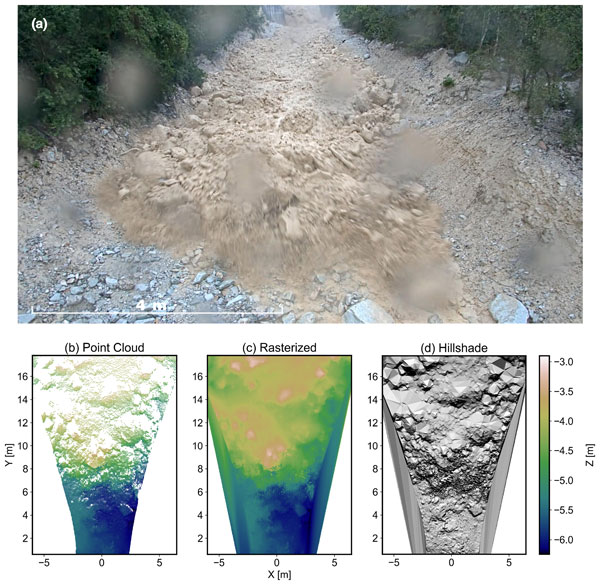
Debris flows are fast-moving water-sediment mixtures in steep channels, posing risks to infrastructure and lives. Traditional analysis is slow and labor-intensive. This study presents a method using laserscanners and deep learning to detect and track moving objects during active events. By converting three-dimensional data to two-dimensional images, it enables fast, accurate measurement of object speed and size. This improves debris-flow monitoring, enhancing hazard understanding and mitigation.
Valentin Samuel Gischig, Antonio Pio Rinaldi, Andres Alcolea, Falko Bethman, Marco Broccardo, Kai Bröker, Raymi Castilla, Federico Ciardo, Victor Clasen Repollés, Virginie Durand, Nima Gholizadeh Doonechaly, Marian Hertrich, Rebecca Hochreutener, Philipp Kästli, Dimitrios Karvounis, Xiaodong Ma, Men-Andrin Meier, Peter Meier, Maria Mesimeri, Arnaud Mignan, Anne Obermann, Katrin Plenkers, Martina Rosskopf, Francisco Serbeto, Paul Selvadurai, Alexis Shakas, Linus Villiger, Quinn Wenning, Alba Zappone, Jordan Aaron, Hansruedi Maurer, Domenico Giardini, and Stefan Wiemer
Solid Earth, 16, 1153–1180, https://doi.org/10.5194/se-16-1153-2025, https://doi.org/10.5194/se-16-1153-2025, 2025
Short summary
Short summary
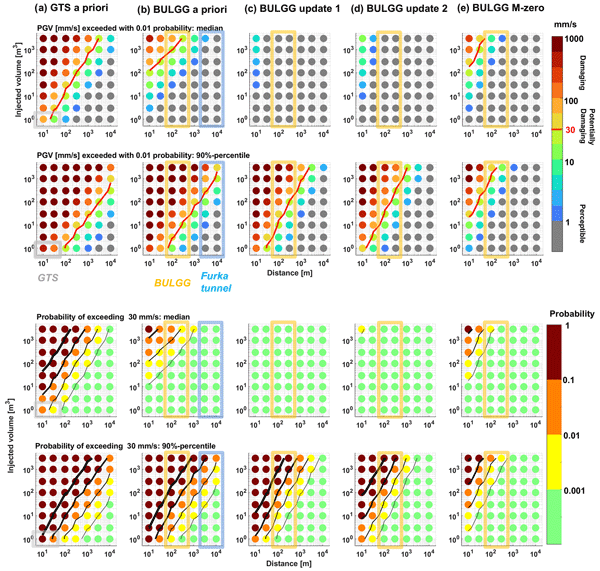
Induced earthquakes present a major obstacle for developing geoenergy resources. These occur during hydraulic stimulations that enhance fluid pathways in the rock. In the Bedretto Underground Laboratory, hydraulic stimulations are investigated in a downscaled manner. A workflow to analyze the hazard posed by induced earthquakes is applied at different stages of the test program. The hazard estimates illustrate the difficulty in reducing the uncertainty due to the variable seismogenic responses.
Tobias Halter, Manfred Stähli, Alexander Bast, Peter Lehmann, and Jordan Aaron
EGUsphere, https://doi.org/10.5194/egusphere-2026-2858, https://doi.org/10.5194/egusphere-2026-2858, 2026
Short summary
Short summary
Despite substantial progress in predicting landslide susceptibility, landslides still occur at unexpected locations. In this article, we investigated the root causes of these mispredictions by analysing surface and subsurface field observations. Our findings highlight the inherent limitations of state-of-the-art machine learning models. The articles advocates for a shift toward process-based understanding and the integration and advancement of high-resolution in-situ and remote sensing data.
Ryan Schultz, Linus Villiger, Valentin Gischig, and Stefan Wiemer
Solid Earth, 17, 617–642, https://doi.org/10.5194/se-17-617-2026, https://doi.org/10.5194/se-17-617-2026, 2026
Short summary
Short summary
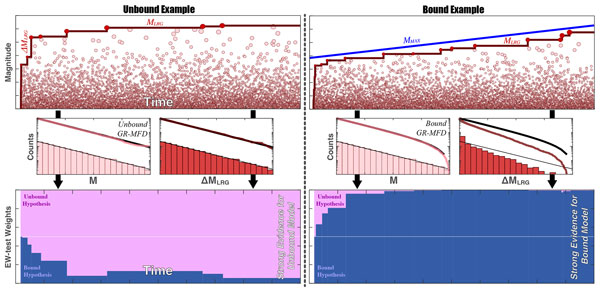
We use statistical tests to infer MMAX (maximum possible magnitude) from an earthquake catalogue and focus on data from three underground laboratories with controlled injection experiments. There, we find clear evidence for MMAX bounds and corroborate interpretations of fracture growth against other geophysical studies. Unbound sequences occur when stimulation is directed towards pre-existing faults. The validation of our methods against well-studied cases is encouraging and will help validate future interpretations.
Tom Schaber, Mohammedreza Jalali, Alberto Ceccato, Alba Simona Zappone, Giacomo Pozzi, Valentin Gischig, Marian Hertrich, Men-Andrin Meier, Timo Seemann, Hannes Claes, Yves Guglielmi, Domenico Giardini, Stefan Wiemer, Massimo Cocco, and Florian Amann
Solid Earth, 17, 275–295, https://doi.org/10.5194/se-17-275-2026, https://doi.org/10.5194/se-17-275-2026, 2026
Short summary
Short summary
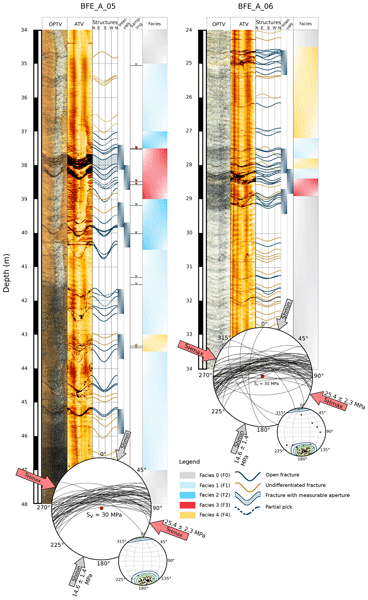
We studied a deep fault zone in Switzerland to gain a better understanding of how water moves through faults and how this affects earthquake activity. Using field and laboratory tests, we found that flow is strongly controlled by open fractures and permeability changes significantly with scale. Small samples underestimate flow compared to larger tests. Our results show that faults are heterogeneous, highlighting the need for site-specific studies when assessing risks or planning experiments.
Gwendolyn Dasser, Alessandro Maissen, Michele Volpi, Jordan Aaron, Florian Denzinger, Hugo Raetzo, and Andrea Manconi
EGUsphere, https://doi.org/10.5194/egusphere-2026-375, https://doi.org/10.5194/egusphere-2026-375, 2026
Short summary
Short summary
We aim to improve early landslide detection and monitoring by automating signal segmentation of Sentinel-1 radar interferograms. We first compared how different experts map mass-movement related signals on interferograms using ten case studies, identifying dataset uncertainties and limitations. We then trained and evaluated deep learning approaches to perform segmentation. Finally showing that models can achieve results comparable to expert variability while improving efficiency.
Paul E. Schmid, Jacob Hirschberg, Raffaele Spielmann, and Jordan Aaron
Nat. Hazards Earth Syst. Sci., 25, 4863–4880, https://doi.org/10.5194/nhess-25-4863-2025, https://doi.org/10.5194/nhess-25-4863-2025, 2025
Short summary
Short summary
Debris flows are fast-moving water-sediment mixtures in steep channels, posing risks to infrastructure and lives. Traditional analysis is slow and labor-intensive. This study presents a method using laserscanners and deep learning to detect and track moving objects during active events. By converting three-dimensional data to two-dimensional images, it enables fast, accurate measurement of object speed and size. This improves debris-flow monitoring, enhancing hazard understanding and mitigation.
Valentin Samuel Gischig, Antonio Pio Rinaldi, Andres Alcolea, Falko Bethman, Marco Broccardo, Kai Bröker, Raymi Castilla, Federico Ciardo, Victor Clasen Repollés, Virginie Durand, Nima Gholizadeh Doonechaly, Marian Hertrich, Rebecca Hochreutener, Philipp Kästli, Dimitrios Karvounis, Xiaodong Ma, Men-Andrin Meier, Peter Meier, Maria Mesimeri, Arnaud Mignan, Anne Obermann, Katrin Plenkers, Martina Rosskopf, Francisco Serbeto, Paul Selvadurai, Alexis Shakas, Linus Villiger, Quinn Wenning, Alba Zappone, Jordan Aaron, Hansruedi Maurer, Domenico Giardini, and Stefan Wiemer
Solid Earth, 16, 1153–1180, https://doi.org/10.5194/se-16-1153-2025, https://doi.org/10.5194/se-16-1153-2025, 2025
Short summary
Short summary
Induced earthquakes present a major obstacle for developing geoenergy resources. These occur during hydraulic stimulations that enhance fluid pathways in the rock. In the Bedretto Underground Laboratory, hydraulic stimulations are investigated in a downscaled manner. A workflow to analyze the hazard posed by induced earthquakes is applied at different stages of the test program. The hazard estimates illustrate the difficulty in reducing the uncertainty due to the variable seismogenic responses.
Cited articles
Aaron, J.: Advancement and Calibration of a 3D Numerical Model for Landslide Runout Analysis, PhD thesis, University of British Columbia, 353 pp., http://hdl.handle.net/2429/63355 (last access: 4 December 2025), 2017.
Aaron, J.: ORIN-3D – A new model for efficient simulation of landslide motion on a GPU using CUDA, Comput. Geotech., 153, 105078, https://doi.org/10.1016/j.compgeo.2022.105078, 2023.
Aaron, J. and Hungr, O.: Dynamic simulation of the motion of partially-coherent landslides, Eng. Geol., 205, 1–11, https://doi.org/10.1016/j.enggeo.2016.02.006, 2016.
Aaron, J. and McDougall, S.: Rock avalanche mobility: The role of path material, Eng. Geol., 257, 105126, https://doi.org/10.1016/j.enggeo.2019.05.003, 2019.
Aaron, J., McDougall, S., Moore, J. R., Coe, J. A., and Hungr, O.: The role of initial coherence and path materials in the dynamics of three rock avalanche case histories, Geoenvironmental Disasters, 4, 5, https://doi.org/10.1186/s40677-017-0070-4, 2017.
Aaron, J., McDougall, S., and Nolde, N.: Two methodologies to calibrate landslide runout models, Landslides, 16, 907–920, https://doi.org/10.1007/s10346-018-1116-8, 2019.
Aaron, J., Wolter, A., Loew, S., and Volken, S.: Understanding Failure and Runout Mechanisms of the Flims Rockslide/Rock Avalanche, Front. Earth Sci., 8, https://doi.org/10.3389/feart.2020.00224, 2020.
Aaron, J., Loew, S., and Forrer, M.: Recharge response and kinematics of an unusual earthflow in Liechtenstein, Landslides, 18, 2383–2401, https://doi.org/10.1007/s10346-021-01633-5, 2021.
Aaron, J., McDougall, S., Kowalski, J., Mitchell, A., and Nolde, N.: Probabilistic prediction of rock avalanche runout using a numerical model, Landslides, 19, 2853–2869, https://doi.org/10.1007/s10346-022-01939-y, 2022.
Aaron, J., de Palézieux, L., Gischig, V., Thoeny, R., and Figi, D.: Data For: Dynamic Analysis of Flowlike Landslides at Brienz/Brinzauls, Graubünden, Switzerland, ETH Zurich [data set], https://doi.org/10.3929/ethz-c-000788974, 2026.
Borgeat, X., Glueer, F., Häusler, M., Hobiger, M., and Fäh, D.: On the variability of the site-response parameters of the active rock slope in Brienz/Brinzauls (Switzerland), Geophys. J. Int., 240, 779–790, https://doi.org/10.1093/gji/ggae412, 2025.
Bouchut, F., Mangeney-Castelnau, A., Perthame, B., and Vilotte, J.-P.: A new model of Saint Venant and Savage–Hutter type for gravity driven shallow water flows, Comptes Rendus Math., 336, 531–536, https://doi.org/10.1016/S1631-073X(03)00117-1, 2003.
BTG AG: Geologischer Synthesebericht, Buro fur Technische Geologie AG, 2022.
Casulli, V.: Semi-implicit finite difference methods for the two-dimensional shallow water equations, J. Comput. Phys., 86, 56–74, https://doi.org/10.1016/0021-9991(90)90091-E, 1990.
Chertock, A., Cui, S., Kurganov, A., and Wu, T.: Steady State and Sign Preserving Semi-Implicit Runge–Kutta Methods for ODEs with Stiff Damping Term, SIAM J. Numer. Anal., 53, 2008–2029, https://doi.org/10.1137/151005798, 2015a.
Chertock, A., Cui, S., Kurganov, A., and Wu, T.: Well-balanced positivity preserving central-upwind scheme for the shallow water system with friction terms, Int. J. Numer. Methods Fluids, 78, 355–383, https://doi.org/10.1002/fld.4023, 2015b.
Christen, M., Kowalski, J., and Bartelt, P.: RAMMS: Numerical simulation of dense snow avalanches in three-dimensional terrain, Cold Reg. Sci. Technol., 63, 1–14, https://doi.org/10.1016/j.coldregions.2010.04.005, 2010.
Coe, J. A., Baum, R. L., Allstadt, K. E., Kochevar, B. F., Schmitt, R. G., Morgan, M. L., White, J. L., Stratton, B. T., Hayashi, T. A., and Kean, J. W.: Rock-avalanche dynamics revealed by large-scale field mapping and seismic signals at a highly mobile avalanche in the West Salt Creek valley, western Colorado, Geosphere, 12, 607–631, https://doi.org/10.1130/GES01265.1, 2016.
Crosta, G. B., di Prisco, C., Frattini, P., Frigerio, G., Castellanza, R., and Agliardi, F.: Chasing a complete understanding of the triggering mechanisms of a large rapidly evolving rockslide, Landslides, 11, 747–764, https://doi.org/10.1007/s10346-013-0433-1, 2013.
Cruden, D. and Hungr, O.: The debris of the Frank Slide and theories of rockslide-avalanche mobility, Can. J. Earth Sci., 23, 425–432, https://doi.org/10.1139/e86-044, 1986.
Davies, T. R., McSaveney, M. J., and Hodgson, K. A.: A fragmentation-spreading model for long-runout rock avalanches, Can. Geotech. J., 36, 1096–1110, https://doi.org/10.1139/t99-067, 1999.
Dufresne, A., Bösmeier, A., and Prager, C.: Sedimentology of rock avalanche deposits – Case study and review, Earth-Sci. Rev., 163, 234–259, https://doi.org/10.1016/j.earscirev.2016.10.002, 2016.
Eberhardt, E., Stead, D., and Coggan, J. S.: Numerical analysis of initiation and progressive failure in natural rock slopes-the 1991 Randa rockslide, Int. J. Rock Mech. Min. Sci., 41, 69–87, https://doi.org/10.1016/S1365-1609(03)00076-5, 2004.
Evans, S., Hungr, O., and Enegren, E. G.: The Avalanche Lake rock avalanche, Mackenzie Mountains, Northewest Territories, Canada: description, dating and dynamics, Can. Geotech. J., 31, 749–768, https://doi.org/10.1139/t94-086, 1994.
Häusler, M., Gischig, V., Thöny, R., Glueer, F., and Donat, F.: Monitoring the changing seismic site response of a fast-moving rockslide (Brienz/Brinzauls, Switzerland), Geophys. J. Int., 229, 299–310, https://doi.org/10.1093/gji/ggab473, 2022.
Häusler, M., Glueer, F., and Fäh, D.: The Changing Seismic Site Response of the Brienz/Brinzauls Rock Slope Instability: Insights from 5 Years of Monitoring Before, During and After a Partial Collapse in June 2023, in: Progress in Landslide Research and Technology, Volume 3 Issue 2, 2024, edited by: Abolmasov, B., Alcántara-Ayala, I., Arbanas, Ž., Huntley, D., Konagai, K., Mikoš, M., Sassa, K., Sassa, S., and Tiwari, B., Springer Nature Switzerland, Cham, https://doi.org/10.1007/978-3-031-72736-8_4, 47–59, 2025.
Heim, A.: Brienzer Rutsch – Gutachten, 1881.
Heim, A.: Bergsturz und Menschenleben (Landslides and Human Lives), translated by: Skermer, N., Bitech Press, Vancouver, 1932.
Hungr, O.: A model for the runout analysis of rapid flow slides, debris flows and avalanches, Can. Geotech. J., 32, 610–623, 1995.
Hungr, O. and Evans, S. G.: Entrainment of debris in rock avalanches: An analysis of a long run-out mechanism, Geol. Soc. Am. Bull., 116, 1240–1252, https://doi.org/10.1130/B25362.1, 2004.
Hungr, O. and McDougall, S.: Two numerical models for landslide dynamic analysis, Comput. Geosci., 35, 978–992, https://doi.org/10.1016/j.cageo.2007.12.003, 2009.
Hungr, O., Leroueil, S., and Picarelli, L.: The Varnes classification of landslide types, an update, Landslides, 11, 167–194, https://doi.org/10.1007/s10346-013-0436-y, 2014.
Keefer, D. K. and Johnson, A. M.: Earth flows: Morphology, mobilization, and movement, USGS Professional Paper 1264, U.S. Geological Survey, https://doi.org/10.3133/pp1264, 1983.
Kenner, R., Gischig, V., Gojcic, Z., Quéau, Y., Kienholz, C., Figi, D., Thöny, R., and Bonanomi, Y.: The potential of point clouds for the analysis of rock kinematics in large slope instabilities: examples from the Swiss Alps: Brinzauls, Pizzo Cengalo and Spitze Stei, Landslides, 19, 1357–1377, https://doi.org/10.1007/s10346-022-01852-4, 2022.
Kenner, R., Schwestermann, T., Thöny, R., Figi, D., Stoffel, A., Bühler, Y., Vallet, J., and Manconi, A.: Formation phases and structural failure of a landslide compartment at Brienz/Brinzauls, Switzerland, Engineering Geology, 357, 108343, https://doi.org/10.1016/j.enggeo.2025.108343, 2025.
Li, T.: A mathematical model for predicting the extent of a major rockfall, Zeitschrift Fur Geomorphologie, 27, 473–482, https://doi.org/10.1127/zfg/27/1983/473, 1983.
Loew, S., Schneider, S., Josuran, M., Figi, D., Thoeny, R., Huwiler, A., Largiadèr, A., and Naenni, C.: Early warning and dynamics of compound rockslides: lessons learnt from the Brienz/Brinzauls 2023 rockslope failure, Landslides, 22, https://doi.org/10.1007/s10346-024-02380-z, 2024.
Mackey, B. H. and Roering, J. J.: Sediment yield, spatial characteristics, and the long-term evolution of active earthflows determined from airborne LiDAR and historical aerial photographs, Eel River, California, Bull. Geol. Soc. Am., 123, 1560–1576, https://doi.org/10.1130/B30306.1, 2011.
Mangeney-Castelnau, A.: Numerical modeling of avalanches based on Saint Venant equations using a kinetic scheme, J. Geophys. Res., 108, 2527, https://doi.org/10.1029/2002JB002024, 2003.
McDougall, S. and Hungr, O.: A model for the analysis of rapid landslide motion across three-dimensional terrain, Can. Geotech. J., 41, 1084–1097, https://doi.org/10.1139/t04-052, 2004.
Nereson, A. L. and Finnegan, N. J.: Drivers of earthflow motion revealed by an 80 yr record of displacement from Oak Ridge earthflow, Diablo Range, California, USA, Bull. Geol. Soc. Am., 131, 389–402, https://doi.org/10.1130/B32020.1, 2018.
Pirulli, M.: Numerical Modelling of Landslide Runout, PhD Thesis, Politecnico Di Torino, 128 pp., https://www.ipgp.fr/~mangeney/PhDThesis_Pirulli2005.pdf (last access: 13 January 2023), 2005.
Poschinger, A. V., Wassmer, P., and Maisch, M.: The flims rockslide: History of interpretation and new insights, in: Landslides from Massive Rock Slope Failure, NATO Science Series, IV, Earth and Environmental Sciences, vol. 49, edited by: Evans, S., Scarascia Mugnozza, G., Strom, A. L., and Hermans, R., vol. 49, Springer, Dordrecht, https://doi.org/10.1007/978-1-4020-4037-5_18, 329–356, 2006.
Preuth, T., Bartelt, P., Korup, O., and McArdell, B. W.: A random kinetic energy model for rock avalanches: Eight case studies, J. Geophys. Res.-Earth Surf., 115, https://doi.org/10.1029/2009JF001640, 2010.
Pudasaini, S. P. and Mergili, M.: A Multi-Phase Mass Flow Model, J. Geophys. Res.-Earth Surf., 124, 2920–2942, https://doi.org/10.1029/2019JF005204, 2019.
Pudasaini, S. P. and Mergili, M.: A dynamic earthflow model, Eng. Geol., 350, 107959, https://doi.org/10.1016/j.enggeo.2025.107959, 2025.
Ranalli, M., Gottardi, G., Medina-Cetina, Z., and Nadim, F.: Uncertainty quantification in the calibration of a dynamic viscoplastic model of slow slope movements, Landslides, 7, 31–41, https://doi.org/10.1007/s10346-009-0185-0, 2010.
Rutter, E. H. and Green, S.: Quantifying creep behaviour of clay-bearing rocks below the critical stress state for rapid failure: Mam Tor landslide, Derbyshire, England, J. Geol. Soc., 168, 359–372, https://doi.org/10.1144/0016-76492010-133, 2011.
Scheidegger, A.: On the Prediction of the Reach and Velocity of Catastrophic Landslides, Rock Mech., 5, 231–236, https://doi.org/10.1007/BF01301796, 1973.
Schneider, M., Oestreicher, N., Ehrat, T., and Loew, S.: Rockfall monitoring with a Doppler radar on an active rockslide complex in Brienz/Brinzauls (Switzerland), Nat. Hazards Earth Syst. Sci., 23, 3337–3354, https://doi.org/10.5194/nhess-23-3337-2023, 2023.
Skempton, A. W., Leadbeater, A. D., and Chandler, R. J.: The Mam Tor landslide, North Derbyshire, Philos. Trans. R. Soc. Lond. Ser. Math. Phys. Sci., 329, 503–547, https://doi.org/10.1098/rsta.1989.0088, 1997.
Sosio, R., Crosta, G. B., Chen, J. H., and Hungr, O.: Modelling rock avalanche propagation onto glaciers, Quaternary Sci. Rev., 47, 23–40, https://doi.org/10.1016/j.quascirev.2012.05.010, 2012.
Swiss Seismological Service (SED) At ETH Zurich: Temporary deployments in Switzerland associated with landslides, Eidgendssisch Technische Hochschule – Swiss Seismological Service (ETH), Switzerland, 2012.
Varnes, D. J.: Slope Movement Types and Processes, in: Landslides, analysis and control, special report 176: Transportation research board, National Academy of Sciences, Washington, DC, 11–33, 1978.
Vassallo, R., Doglioni, A., Grimaldi, G. M., Di Maio, C., and Simeone, V.: Relationships between rain and displacements of an active earthflow: a data-driven approach by EPRMOGA, Nat. Hazards, 81, 1467–1482, https://doi.org/10.1007/s11069-015-2140-9, 2016.
Whittall, J. R., Eberhardt, E., and McDougall, S.: Runout analysis and mobility observations for large open pit slope failures, Can. Geotech. J., 54, 373–391, https://doi.org/10.1139/cgj-2016-0255, 2017.
Wolter, A., Roques, C., Gröble, J., Ivy-Ochs, S., Christl, M., and Loew, S.: Integrated multi-temporal analysis of the displacement behaviour and morphology of a deep-seated compound landslide (Cerentino, Switzerland), Eng. Geol., 270, 105577, https://doi.org/10.1016/j.enggeo.2020.105577, 2020.
Short summary
In mid-May, 2023, the village of Brienz/Brinzauls in the Swiss canton of Graubunden was evacuated, and one month later a flowlike landslide emplaced with velocities of ~25 m/s and narrowly missed impacting the village. Landslides at this site have emplaced with velocities that can vary by 5 order-of-magnitude, a puzzling observation which we analyse in the present work. Our results show that the range of scenarios usually considered in landslide risk analyses must be expanded.
In mid-May, 2023, the village of Brienz/Brinzauls in the Swiss canton of Graubunden was...


Altmetrics
Final-revised paper
Preprint