
the Creative Commons Attribution 4.0 License.
the Creative Commons Attribution 4.0 License.
 | 07 Sep 2026
Invited perspectives: Towards usable compound event research

Emanuele Bevacqua
Mariana Madruga de Brito
Wiebke S. Jäger
Pauline Rivoire
Cassandra D. W. Rogers
Fabiola Banfi
Fulden Batibeniz
James Carruthers
Carlo De Michele
Silvia De Angeli
Cristina Deidda
Marleen C. de Ruiter
Andreas H. Fink
Henrique M. D. Goulart
Katharina Küpfer
Patrick Ludwig
Douglas Maraun
Gabriele Messori
Shruti Nath
Fiachra O'Loughlin
Joaquim G. Pinto
Benjamin Poschlod
Alexandre M. Ramos
Colin Raymond
Andreia F. S. Ribeiro
Deepti Singh
Laura Suarez Gutierrez
Philip J. Ward
Christopher J. White
Supporting stakeholders with science-based decision-making to mitigate and adapt to climate change impacts is a central mandate of the climate research community. In particular, mapping out scenario-dependent climate risk landscapes is one of the most pressing challenges. Increasingly, communities and regions are experiencing high-impact climate and weather extremes that arise from a complex interplay of processes and events acting across various spatial and temporal scales. To account for these emerging trends, there is a growing recognition that both climate impact and early warning research needs to incorporate risks from compound events to better inform climate adaptation and mitigation efforts. This demand for more fine-grained and applicable knowledge gives rise to new data and modeling needs, and can increase uncertainties. Consequently, new methodological approaches and effective communication strategies are required for making research usable outside scientific communities. In this perspective, we reflect on this usability challenge by discussing impact data products, early warning and modeling capabilities, and communication tools, urging climate impact scientists to increasingly incorporate usability considerations in their research to meet the pressing demand for usable compound event research.
- Article
(1572 KB) - Full-text XML
- BibTeX
- EndNote


An increase in more impactful climate and weather extremes is a direct consequence of global warming (Intergovernmental Panel on Climate Change (IPCC), 2023). Unambiguous observational evidence of more frequent and more intense weather extremes has emerged for various climate hazards, from heatwaves (Kornhuber et al., 2024; Perkins-Kirkpatrick and Lewis, 2020), to heavy rainfall (Fischer and Knutti, 2016; Robinson et al., 2021) and floods (Slater et al., 2021), droughts (Chen et al., 2025) and wildfire conditions (Jones et al., 2022) – a trend that is consistent with our understanding of how the Earth's climate system responds to increasing greenhouse gas emissions. These changes contribute to increasing interactions between climate hazards and extremes, through physical processes and from mere stochastic reasons driven by rising event frequencies. Thus, climate change increasingly leads to situations where the impacts of multiple climate hazards can be amplified beyond the sum of single hazard impacts (Messori et al., 2025; Ridder et al., 2022). Under these conditions, the assumption that single climate hazards act independently when assessing their impacts is increasingly inaccurate (Sarhadi et al., 2018; Touma et al., 2022). In particular, climate risk assessment frameworks in the private and public sector need to consider the interconnectedness of increasingly compounding weather events, which has not been a routine exercise to date (Dolk et al., 2023). Doing so could avoid the underestimation of some climate risks, and some of the most impactful events could be better anticipated. Fully accounting for often complex hazard and impact dynamics, however, is not a trivial exercise.
Compound event research has emerged as a new perspective in climate and environmental science over the past two decades (Brett et al., 2025a; Field et al., 2012), recognizing that for a comprehensive understanding of the climate risk landscape the full range of spatio-temporal hazard dynamics needs to be taken into account (Raymond et al., 2020b; Zscheischler et al., 2018). Compound events “emerge from the combination of multiple drivers and/or hazards that contribute to societal or environmental risks” (Intergovernmental Panel on Climate Change (IPCC), 2023; Zscheischler et al., 2020). A compound event perspective therefore goes beyond former risk-concepts in which climate impact drivers are assumed to act independently from each other. Categorized by the three dimensions over which climate impacts unfold: space, time, and impact drivers, four categories of compound events have been defined (Bevacqua et al., 2021; Zscheischler et al., 2020): (i.) Multivariate events describe co-located, simultaneous drivers or hazards resulting in amplified impacts. (ii.) Spatially compounding events describe events where impacts result from multiple spatially separated events that co-occur within a restricted time window. (iii.) Temporally compounding events refer to the sequential occurrence of hazards within the same region and within a specific time window. Lastly, (iv.) preconditioned events refer to situations in which prior climatic conditions set the stage for a hazard to unfold. For example, extensive wildfires that expose hillsides to erosion and scald the ground, followed by intense rain, constitute a preconditioned event (Touma et al., 2022). In these situations, water cannot be absorbed in the hydrophobic soils, increasing the risk of floods and mudslides.
Complex risks from compounding factors have been described by other terms in related contexts (Simpson et al., 2021). Multi-hazards, for instance, consider the full range of hazards, climate impact drivers as well as non-climatic hazards (e.g. geological hazards such as earthquakes and landslides or biological hazards such as epidemics). Complex risk on the other hand is an overarching term that also considers sectoral dependencies across different societal systems, allowing for the investigation of shock cascades (e.g. impacts on the electricity grid and financial-, health- or food systems) (Kruczkiewicz et al., 2021; Simpson et al., 2021). Such relationships have also been discussed in the contexts of Systemic Risk frameworks (Sillmann et al., 2022) and Connected Extremes (Raymond et al., 2020b), in recognition that human responses to one type of hazard can amplify the risk from another (Simpson et al., 2021). In this perspective we focus on Compound Events from interacting weather, climate and environmental hazards, while acknowledging that the other terms and concepts carry value in their respective contexts.
Compound events research is strongly motivated by the potential for harmful consequences for societal and environmental systems. Due to often complex hazard and impact dynamics, these harmful consequences can occur unexpectedly, especially when new hazard combinations emerge due to climate change (see e.g. Ramos et al., 2023). Sectors at risk include infrastructure and urban resilience (Hemmati et al., 2022), agriculture (Hamed et al., 2025; Haqiqi et al., 2021; Kornhuber et al., 2023; Lesk et al., 2022), water and ecosystem management (Bastos et al., 2023; Lian et al., 2025), and biodiversity conservation (Mahecha et al., 2024) , public health (Raymond et al., 2020a; Rogers et al., 2021; Wang et al., 2025b), energy systems (Lesk and Kornhuber, 2022; Moftakhari and AghaKouchak, 2019), and particularly globally interconnected networks such as food systems (Kornhuber et al., 2020; Lesk et al., 2021), transport, trade and supply chains (Levermann, 2014; Zhang et al., 2026), and the insurance and financial sectors (Dolk et al., 2023; Dunz et al., 2021; Singh et al., 2023). A better understanding of the intricate interconnections of climate hazards, coupled with a frictionless integration of knowledge into early warning systems (Kruczkiewicz et al., 2021; Reichstein et al., 2025) and climate adaptation and mitigation processes (Field et al., 2012; Raymond et al., 2020b), carries the potential for a reduction of climate risks and their associated societal harm.
Bridging science and practice has long been identified as a challenge within climate science (Brett et al., 2025b). Recently, questions about scientific usability were raised to foster introspection about how constrained time and budget capacities in academia can be best invested given the reality of an unfolding and escalating climate emergency (Coen and Sobel, 2022). Coen and Sobel (2022) argue that a lack of scientific evidence is often not a limiting factor in ongoing efforts to mitigate global warming and proposed that those interested in the usability of their research should strengthen their focus on adaptation science. In essence, “usable climate science is adaptation science” (Sobel, 2021).
While agreeing with the premise of this argument, we propose that usable adaptation science is reliant on accurate climate risk estimates which in turn are most useful if based on a sufficiently mature understanding of the physical processes and statistics of high impact – often compound events – in a warming world. Due to the inherent complexity of compound events and their impacts-focused nature, a multitude of disciplines are required to explore, understand, and model risks from compound events, including characterizing exposure and vulnerability dimensions. Understanding physical processes relies on expertise in various components of the weather and climate system, including atmospheric and climate dynamics, meteorology, oceanography, vegetation and land-process science, cryosphere, forestry, and agriculture. Next to physical processes, the rarity and complexity of climate extremes require advanced statistics, as well as reliable data from earth observations and regional and global climate models. Finally, hazards are only one of the determinants of risk: vulnerability and exposure dynamics are challenging to quantify, and require other disciplines including geography, social sciences and disaster risk management perspective (Raymond et al., 2020b; Rusca et al., 2021; Simpson et al., 2021). Thus, fundamental research in multiple disciplines is needed to effectively map out the dynamical properties of a more complex climate risk landscape associated with compound events.
This perspective is written by authors from within the research community, providing reflections on usability principles for major pillars of compound event research, impact data, early warning, modelling and uncertainty based on interactions and consultations with end-users. It thereby serves a dual purpose: to provide usability guidelines for the research community and insights for end-users to better understand challenges and limitations. In the first section, we find that Socioeconomic and environmental impact data lack a common standard or are not freely available, inhibiting comprehensive compound event databases that would allow for generating usable impact specific damage functions. In the section on Prediction and early warning of compound events, we propose that truly usable early warning systems need to incorporate compound events to avoid the underestimation of high-impact events. In section four Modeling and projecting compound events, we reflect on compound event specific challenges when modelling extremes at high resolution. In section five we address Uncertainty in compound event projections with a focus on storyline approaches. We close with a synopsis on overarching challenges and a set of recommendations for aligning compound events research with a usability perspective in section six Overarching challenges and the way forward.
Effectively mitigating the risks from compound events requires a deep understanding of their potential impact on different socioeconomic and environmental sectors. Impact datasets often stand at the beginning of establishing robust relationships between compound events and impacts as they provide a record of historical event–damage combinations. Damage functions constitute statistical relationships between cause (the event type) and effect (the damage on a specific sector) and are fundamental for projecting and forecasting potential damages from compound events (Hagenlocher et al., 2023; Hobeichi et al., 2022) for the purpose of adaptation and early warning. Impact datasets and damage functions are therefore essential for the usability of compound event science as they help build bridges between academic knowledge and the end-user application. Thus, reliable impact datasets can be equally important as a good understanding of compound event dynamics in providing damage outlooks.
While a wide range of impact datasets exist (e.g. EM-DAT, Desiventar, see Table 1), there are several factors that make it challenging to identify usable connections between compound events and damages. We consider impact data as structured datasets that provide quantitiative societal or ecological information, allowing for the investigation of impacts associated with specific hazard types. Here we describe three main challenges that go beyond the well known general issues of hazard bias, temporal bias, threshold bias, accounting bias, geographic bias, and systemic bias (Gall et al., 2009), questionable quality of impact data (Moriyama et al., 2018; Panwar and Sen, 2020), and data gaps (Jones et al., 2022).
First, events listed in these databases are often assigned to a single hazard ignoring the interactions between different hazards (AghaKouchak et al., 2021; De Brito, 2021; Gill and Malamud, 2014; Niggli et al., 2022). However, high impact events are often caused by multiple coincident physical drivers. For example, tropical cyclones cause damage with high wind speeds as well as flooding from heavy precipitation and storm surges. Impacts, such as casualties and economic damages, however, are rarely attributed to combinations of multiple impact drivers but rather to a main impact driver. Most existing open impact datasets often cover only specific hazard types, regions, and impact categories (see Table 1 for examples). A well-known exception is the EM-DAT database where events can include multiple hazard types and which has been used for multi-hazard analyses. Lee et al. (2024) studied the various combinations of natural hazard types in the events and classified them into single-hazard events or one of the four compound event types (multivariate, preconditioning, spatially compounding and temporally compounding). The results show that approximately 19 % of the disasters recorded in EM-DAT can be classified as multi-hazard events. However, Jäger et al. (2025) found that multi-hazard events are also often reported as multiple separate single-hazard events in EM-DAT suggesting a higher percentage of multi-hazard events than reported and pointing to a lack of multi-hazard information in EM-DAT. More detail in impact reporting, especially including information about different contributing hazards, is needed to disentangle the specifics of impact drivers (e.g. Calvello and Pecoraro, 2018; Crozier, 2017).
Second, impact datasets are often biased towards very high-impact acute events, whereas small-scale “nuisance” events may remain underreported. For example, EM-DAT only reports events above a certain impact threshold (Delforge et al., 2025). Nevertheless, temporally compounding small-scale events can result in a constant stream of local losses without adequate recovery time between events, therefore resulting in substantial losses for the region (Brennan and Danielak, 2022; De Ruiter et al., 2020; Moftakhari et al., 2017; Van der Wiel et al., 2020). In addition, existing databases typically do not account for slow-onset or long-lasting impacts, such as those from drought, which may be felt long after the peak of the physical hazard and can precondition and amplify impacts from other hazards (Gill and Malamud, 2014; Van Loon et al., 2024).
Third, inconsistent or incomplete information on the temporal and spatial characteristics of the reported events (e.g., Jäger et al., 2025) can hinder building robust connections between event types and damages. Spatial information is provided in various forms, for instance, cities, natural features (e.g., the Alps), administrative divisions, whole countries, or geographical areas without clear formal boundaries. Yet, climate events do not follow political boundaries and the impacts of events often extend beyond the region they affect. Similarly, temporal specifications for events in the same hazard category can be assigned a date range in days, months, or years, or only a starting date. These inconsistencies limit the derivation of relationships between impacts and climate anomalies, in particular for compound events where these characteristics are essential for differentiating event types.
To address the challenges described above and develop socioeconomic and environmental impact datasets that are usable for compound events research, efforts must focus on standardization, data assimilation, and integration, along with a more nuanced characterization of events that captures their complexity. A shift in perspective is needed regarding data collection and structuring, including the consideration of amplified impacts generated by compound events. Rather than collecting information about multiple hazards and impacts individually, which can result in the loss of critical interconnections, records need to be linked in a standardized and comprehensive way.
A promising example of a comprehensive impact database is the LAND-deFeND database (Napolitano et al., 2018), which allows for storing multiple nature-related, human-related, geospatial-related, and information source-related entries to comprehensively describe geo-hydrological events. Another example is the multi-risk database by Dallons Thanneur et al. (2025), which explicitly documents possible interactions between hazards, their characteristics and detailed impacts for events related to rockfall, landslides, snow avalanches, hydrological and glacial hazards in the French Alps. Further, efforts are being made to improve national disaster risk management by establishing standardized event-based loss and dame databases (Themessl et al., 2022). Lastly, newspaper based databases are also useful even if they are biased towards urban areas. An example of this is the Disaster Database for Portugal which includes hydro-geomorphologic cases (floods and landslides) that generated human damages in Portugal since 1865 (Pereira et al., 2018).
Overviews that merge the information from multiple datasets across a wide range of hazards, following the example set by Lindersson et al. (2020), are useful to understand and address the challenges associated with their use. Some important steps towards standardization have also already been taken by the Centre for Research on the Epidemiology of Disasters (CRED) and other stakeholders to develop a standardized disaster category classification system and the GLobal IDEntifier (GLIDE) number attempts to enable unique identification of events across databases (Nishikawa, 2003).
There is a need for improved impact and hazard datasets, with global coverage and high temporal and spatial resolution, covering multi-hazards and multi-impacts across different sectors to support usable risk assessments. To be fit for purpose, we argue that addressing this challenge requires a multi-faceted approach, including three avenues: (1) improved open and collaborative data infrastructure, (2) employing novel data sources, and (3) better leveraging of existing data using statistical methods that have already proven useful for other applications (Fig.1).
State institutions, governments, and international organizations should work towards streamlining their data collection and implementing data collection infrastructure to improve global coverage and help close the climate impact data gap (Osuteye et al., 2017). It is, however, important to note that increased access and availability of data from Global South countries should be utilized ethically, with efforts made to meaningfully engage and collaborate with local scientists, facilitate resource investments in local institutions, credit contributions from local researchers and institutions, and support capacity building (Serwadda et al., 2018). In addition, corporate datasets should become openly accessible for scientific research to be truly usable (UNDRR 2024: https://www.undrr.org/explainer/uncounted-costs-of-disasters-2023, last access: 22 August 2026). In particular those impact datasets that provide information on financial and insurance impacts of natural hazards, are corporate intellectual property and therefore often not freely accessible for climate impact researchers and decision makers (see Table 1 for examples). This lack of access to impact data hinders the public and equitable use of information that could be used to adapt to climate hazards and advance climate science (see comment in New York Times by Justin Mankin: https://www.nytimes.com/2024/01/20/opinion/climate-risk-disasters-data.html, last access: 22 August 2026).
A concrete avenue for increasing the quantity of impact data involves exploring novel data sources and developing advanced methods for collecting impact information. For example, natural language processing techniques have predominantly been applied to univariate hazard types, but could be applied to compound events as well: automated data extraction from text has been utilized for estimating the impacts of droughts (Sodoge et al., 2023), floods (Madruga De Brito et al., 2025), as well as for building global, spatiotemporally referenced, multi-hazard impact databases and using large language models (LLMs) to build databases of extreme climate impacts (Li et al., 2024). Another notable area of interest is opportunistic sensing. For example, data from ubiquitous technologies, such as Waze (a navigation app with live traffic information), can be utilized to rapidly identify flooded areas (Lowrie et al., 2022; Yuan et al., 2023), while analyzing credit card transactions can provide insights into spatial patterns of disaster impacts and recovery duration (Yuan et al., 2022), and nighttime light satellite data can be used to assess changes in economic activity and recovery (Barton-Henry and Wenz, 2022; Qiang et al., 2020). Social media data can also be used to assess the impacts of individual and compound hazards. For example, Moore and Obradovich (2020), used social media data to estimate county-level flooding. Such an approach could also be applied to source impact data. Lastly, citizen science, such as people submitting observation reports with descriptions and photos of drought impacts (https://www.drought.gov/data-maps-tools/condition-monitoring-observer-reports-drought-cmor-drought, last access: 22 August 2026), has potential a valuable source for impact data (e.g., Walker et al., 2024).
Finally, as a timely and pragmatic solution, statistical techniques can be applied to currently available impact datasets to provide additional information. For example, statistical techniques can be applied to fill data gaps. Jones et al. (2023) provide an overview of studies attempting imputation and augmentation techniques to fill data gaps in EM-DAT, however, the authors note that these approaches “were commonly ad-hoc with little statistical basis”. Other studies focus on extending impact datasets with additional information. For example, Tschumi and Zscheischler (2020) investigated countrywide climate features associated with disasters in EM-DAT and Rosvold and Buhaug (2021) geo-coded information from EM-DAT into a new GDIS dataset to improve usability. Jäger et al. (2025) combined GDIS and EM-DAT and developed an algorithm to identify potential multi-hazard events and their impacts based on spatio-temporal relationships between individual disaster records. Moreover, impacts may be estimated and gaps may be filled using impact domain or sector-specific models, for instance, Wang et al. (2019) applied a mathematical model for road networks to estimate large-scale road disruptions due to floods, an approach that could also be employed for other types of infrastructure and multiple hazards. Of course, such an approach requires substantial knowledge about the hazard(s) in question, which might not always be available.
Table 1Selected examples of impact datasets and relevant attributes.
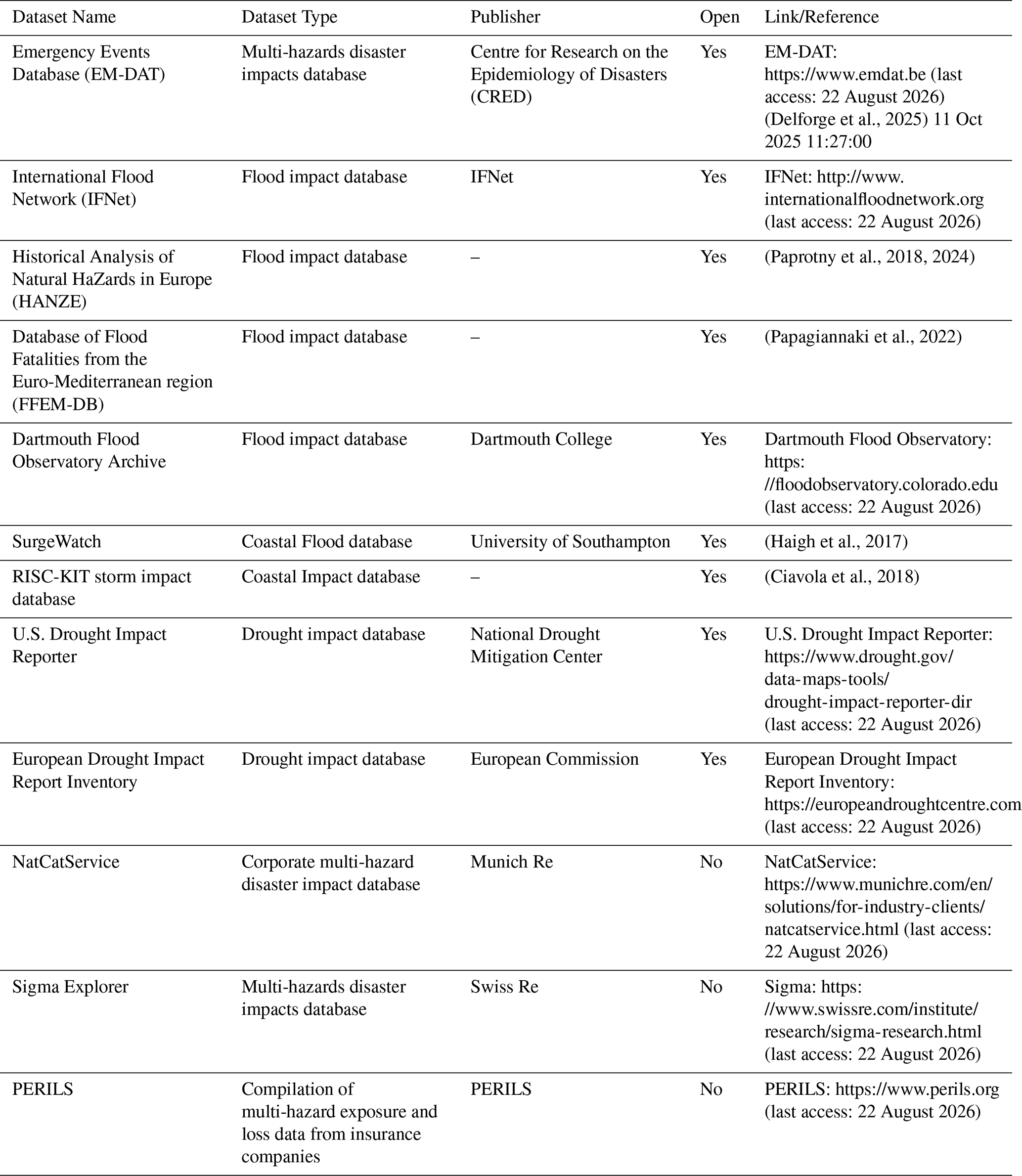
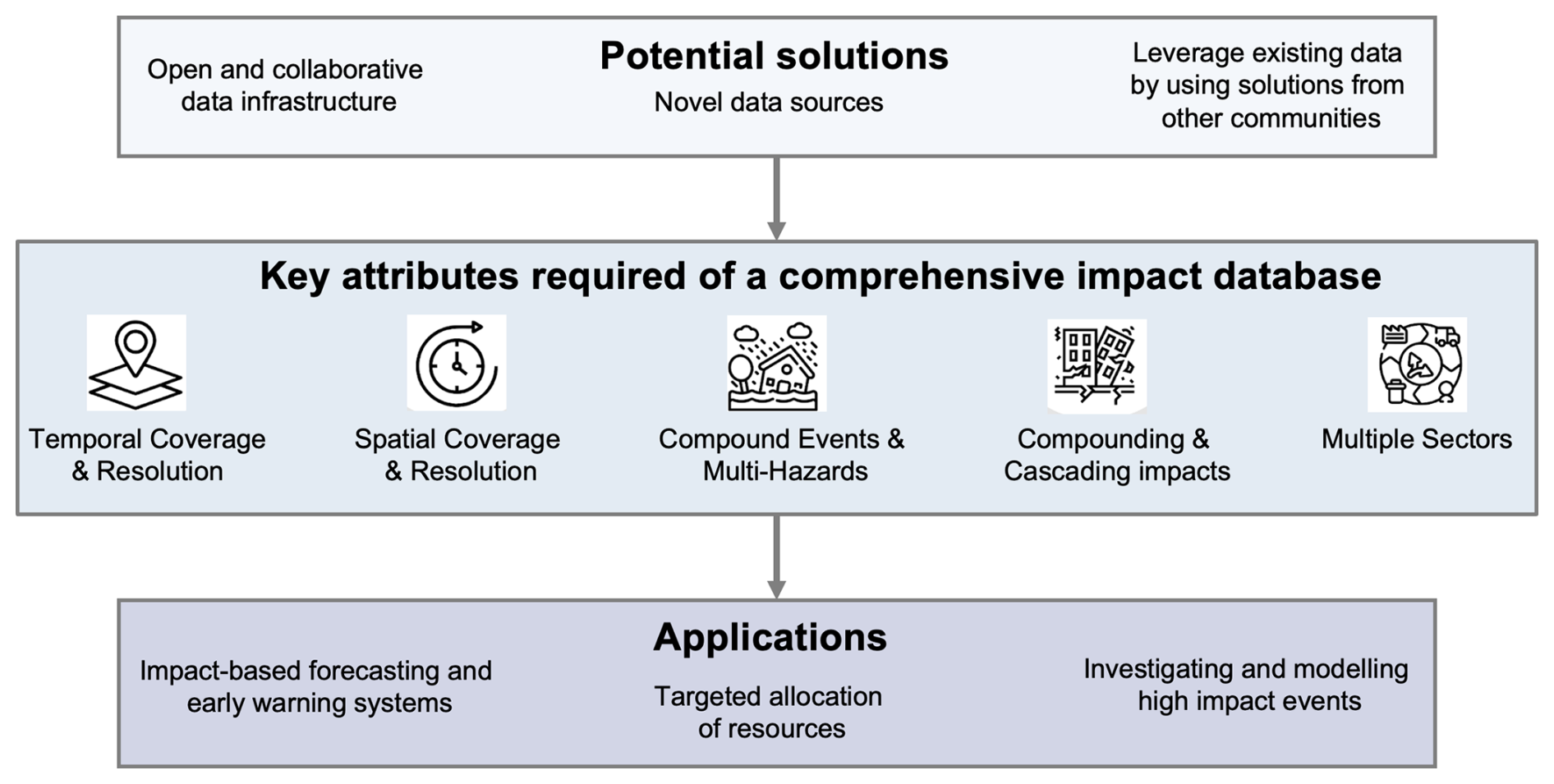
Figure 1Steps towards usable socioeconomic and environmental impact data for compound events research. From comprehensive datasets to improved process understanding, modeling, projections, and early warning of compounding hazards.
The impacts of extreme weather events can be mitigated through early responses from emergency services, communities, local authorities, and individuals, which are in turn dependent on the availability, quality, and successful communication of local hydrological and weather forecasts, impact forecasts (where available), and early warning systems (Golding, 2022; WMO, 2023). In 2022, the United Nations launched the Early Warnings for All initiative to build and expand capacity to enable access to early warnings for everyone by 2027 to minimize risks from future climate hazards. Improving early warnings on various predictive timescales can be achieved by considering the complex interconnections between hazards and their drivers, together with knowledge of direct and indirect impacts.
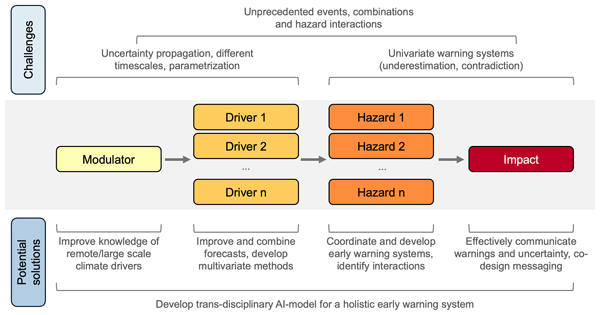
The current ability of early warning systems to provide adequate warnings for extreme weather events, including compound events, strongly depends on the hazard(s) in question (Golding, 2022; UNDRR, 2025), the location of the event (Judt, 2020), the lead-time required by the user, and the ability to translate hazards into impacts through impact forecasting (Shyrokaya et al., 2024), among other factors. In particular, impact forecasting in a multi-hazard context has been recognized as essential for effective response measures (WMO, 2015), yet the field still faces a number of challenges. With many hazards exhibiting increasing trends due to factors including the greater energy and moisture capacity of a warming atmosphere, changing seasonality, and changes in dynamics (e.g., Rogers et al., 2022), certain previously rare or unknown hazard combinations have become much more probable (Messori et al., 2025), challenging established univariate warning systems. Further, interactions between certain hazards may not be well understood or considered in existing early warning systems, such as compounding risk from tropical cyclone–extreme heat combinations that have emerged in recent years (Matthews et al., 2019). Challenges and potential solutions for early warning systems for compound events are illustrated in Fig. 2 and discussed throughout this section.
Early warning systems for compound events face specific challenges. For example, due to the relatively short lead time of operational forecasts of approximately one week, certain preconditioned or temporally compounding events may not be predictable before the first event has occurred, such as multiple floods in the same location over several months. Knowledge of the second event could impact holistic risk assessments, alter preparations that might otherwise be taken for the first event in isolation, and inform disaster response resources and strategies that might be impacted by successive events. However, an understanding of the historical dependence structures and the temporal relationships between specific hazards, their local and remote physical drivers, and how these relationships may have already changed in a non-stationary climate can provide predictability on subseasonal-to-seasonal scales (Golding, 2022). For instance, the knowledge that natural variability modes such as the El Niño-Southern Oscillation can lead to simultaneous droughts in multiple regions (Singh et al., 2021, 2022) can be used to forecast food shortages or food insecurity on seasonal timescales, which can inform the allocation of food aid and humanitarian resources. With such anticipation, coordinated preparation and response plans could be developed. A well-developed multi-hazard warning system could incorporate information about the effects of recent events on physical systems (e.g. preconditioning) or on human systems (e.g. response capacity) to refine risk assessment and communication.
Opportunities exist to develop low-cost, but limited, multi-hazard warning systems by combining existing warning products. The harmonization of multiple hazard warning systems is a crucial step when deciding where to deploy limited emergency response resources, or when shaping a single warning message that acknowledges the potentially conflicting responses required of multiple hazards. For example, in March 2021 in the southeastern United States, tornado warnings advised people to seek shelter in basements to provide protection from flying debris, but the advice did not appear to consider simultaneous forecasts for flash flooding, whereby people are typically advised to move to higher ground to avoid the hazard (First et al., 2022; Henderson et al., 2020). Compound event early warning systems should consider the risks associated with such coinciding hazards along with responses that will likely differ for coinciding hazards relative to responses for individual hazards. Substantial expert input would likely be needed for this delicate and context-specific task towards skillfull impact forecasting (Kam et al., 2024; Merz et al., 2020).
Forecast uncertainty can come from many factors, including data quality, human judgment, limitations of NWPs for certain univariate hazards, and varying prediction skill across compound event components (Henderson et al., 2023; Porras et al., 2021; Rennie et al., 2021). Uncertainty can be quantified through verification methods to support decision making (e.g. Loveday and Carroll, 2025), but this is likely to be difficult to homogenize across compound event types, forecast quality metrics, and prediction type (i.e., deterministic versus probabilistic). By their own nature, distinct event types in different locations require different verification tools, with time aggregations meaningful to users (Domeisen et al., 2022). Appropriate verification methods for compound events are largely unexplored and would require novel skill measures, forecast timescales, and calibration techniques, specifically adapted for forecasts of multivariate extremes, as well as suitable sample sizes to address sampling uncertainties (Coelho et al., 2019). These verification methods need to be designed to build knowledge about the strengths and weaknesses of forecasts, and eventually increase confidence in compound event forecast products and applications (Goddard et al., 2015; White et al., 2022).
Improvements in existing forecasting capabilities can potentially enhance compound event prediction opportunities. The combination of dynamical- and data-driven forecasts, as well as large ensemble probabilistic forecasts (Maier-Gerber et al., 2021) and subseasonal-to-seasonal forecasts (White et al., 2022), are promising tools to predict extreme events on longer forecasting timescales (Domeisen et al., 2022). Current dynamical models can be additionally improved by resolving processes, whereby spatial resolution is increased to avoid parameterization (Judt, 2020). The propagation of errors is also important (Golding, 2022; Judt, 2020), especially with the different temporal and spatial scales involved in compound events. One potential method of error reduction for compound events is via multivariate post-processing of numerical models, to preserve the dependency between variables requiring bias adjustment (see Sect. 4 and Vrac and Friederichs, 2015). Additional opportunities for forecast improvement arise from recent advances in artificial intelligence (AI) based weather forecasting models, such as ECMWF's Artificial Intelligence Forecasting System (AIFS) (Lang et al., 2024), Pangu-Weather (Bi et al., 2023), and GraphCast (Lam et al., 2023), however, further development is required. After testing four different AI forecasts of a high-impact weather event, Charlton-Perez et al. (2024) note that while the AI models showed promise compared to traditional NWP models, none of them could replicate the magnitude of the event. Recent analyses suggest that numerical models still outperform AI based approaches when it comes to unprecedented extremes (Zhang et al., 2025).
A lack of knowledge of hazard interactions (in particular in a non-stationary climate) can prevent adequate preparations from being put in place. Knowledge about the complex web of compounding and cascading hazards and impacts is crucial for predicting societal impacts of compound events and for making robust decisions. Given the sheer number of potential interconnections, a pragmatic and location specific focus on the most relevant event combinations is crucial. Probabilistic weather forecasts can be leveraged to evaluate the potential of anticipated low-likelihood, high-impact compound event scenarios, which can also inform planning and response. In addition, AI models can potentially identify hazard relationships and drivers, including causal links, due to the abilities of AI to connect complex chains of compound events (Allen et al., 2025; Reichstein et al., 2025). Developing a comprehensive understanding of historic hazard interactions, how they are changing in a warmer climate, and their consequences requires not only high-quality weather observations, but also readily available socioeconomic and environmental impact data (as discussed in Sect. 2) – all of which should be considered when assessing hazard interactions. A further challenge is posed by the emergence of previously unprecedented events, which can include previously unseen individual hazard intensities due to compounding drivers (Bartusek et al., 2022) or combinations of hazards that do not exist in the observational record (AghaKouchak et al., 2020; Feng et al., 2022; Zscheischler et al., 2018). The complex nature of compound events can lead to overlooking subtleties and potentially underestimating upcoming events or their impacts (Bastos et al., 2023; De Brito et al., 2024).
Useful early warning systems also require an understanding of vulnerability and exposure, both of which are unlikely to be consistent across different hazards (WMO, 2023). For example, certain housing types might be well prepared for univariate extreme heat, featuring design elements such as wide verandahs and cross-flow ventilation, but are left vulnerable if the heat co-occurs with high levels of pollution (Ahmed et al., 2021). Certain compound events may have unprecedented impacts, not because the individual hazards are unprecedented, but because exposure and vulnerability are nonstationary and might be modulated by past events (De Ruiter et al., 2020; WMO, 2023). That is, if vulnerability and exposure are elevated during the recovery period of an initial hazard, the threshold for compounding impacts from additional hazards will be lower. Thus, the criteria for issuing a warning needs to shift during recovery periods (Manning et al., 2025). For example, a loss of electricity and air conditioning due to a tropical cyclone is likely to lower the threshold for dangerous heat. In this context, subseasonal-to-seasonal forecasts may offer great value (e.g., White et al., 2022) allowing for a “pre-alert” state. Overall, a thorough understanding of historic compound events that are likely to recur, as well as their impacts, in conjunction with current and projected exposure and vulnerability data can help bridge this gap. Additionally, even more so than univariate extremes, many compound events cause socioeconomically regressive impacts, a factor that should be accounted for if warning systems are to minimize harm.
Communicating warnings that result in efficient action requires effective communication of predictability and uncertainty to the end user, and optimization of the amount of detail in the warning (Krocak et al., 2023), as too much information can lead to confusion and inaction. Given that the success of early warning systems for hazard impact reduction is heavily dependent on products from local weather forecasters and action taken on the ground by first responders (Sengupta et al., 2022), early warning systems should be co-designed with these users to ensure the necessary data, context, and uncertainties are provided (UNDRR, 2024). Suggested responses to cope with the risks should also include how the impacts might manifest and options specific to different vulnerable populations, which requires understanding how these communities minimize risk and engaging these populations in the development of early warning messages. The development of useful early warning systems for compound events will not be a simple task and will require bringing together currently discrete communities to instigate a step-change in the way compound event predictions on various time-scales are produced, communicated, and used. As such, this co-design process should also include users and practitioners to ensure the necessary data, context, and uncertainties are provided. It is also crucial that we learn from and share our successes and shortcomings as a global community of researchers and practitioners (UNDRR, 2025). Communication of early warnings should also be adapted to different local languages and provided via multiple communication pathways to reach affected communities, including remote and historically underserved communities.
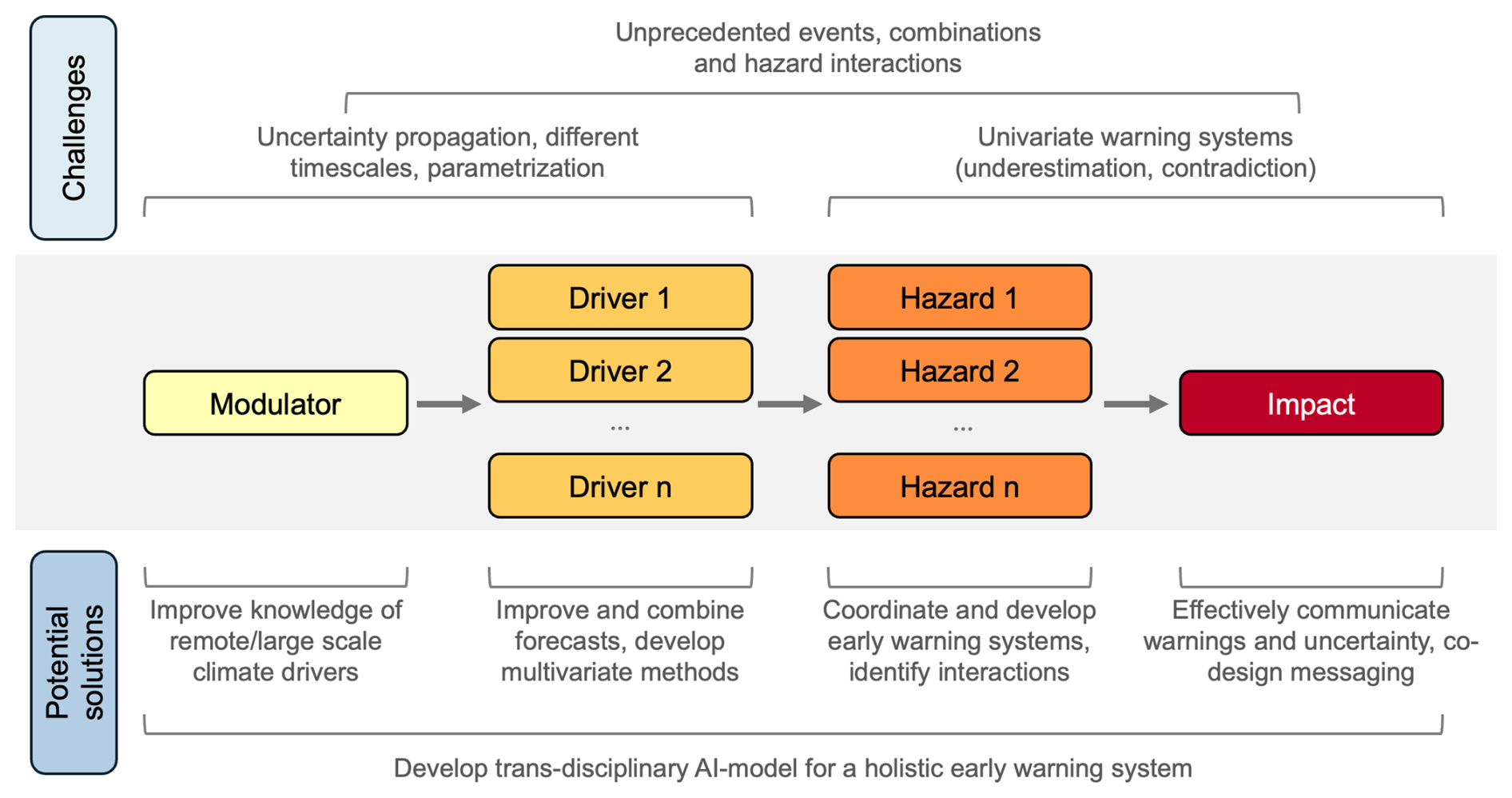
Figure 2Challenges (top row) and proposed solutions (bottom row) for early warning systems for compound events. The elements of a compound event (middle row) are depicted as described by Zscheischler et al. (2020).
Climate models are essential tools for exploring compound events under different climatic conditions on timescales of decades to centuries in the past, present and future. The usability of climate models in the context of compound events research is linked to the degree of certainty with which a specific event probability is provided, the accuracy by which impact-relevant event characteristics are reproduced and the level of temporal and spatial detail provided by the model.
High levels of spatio-temporal detail and uncertainty exploration are limited by computational and storage capacities, while a skillful reproduction of event specifics can also be limited by our process understanding. In particular, for compound events and impacts, a trade-off remains between computational affordability and obtaining localized climate information using high resolution models that can have higher fidelity in representing compounding processes. Furthermore, compound events are often extreme events that contribute to the tails of multivariate distributions. Due to their rare occurrence, large datasets are necessary to narrow down uncertainty ranges and enhance the understanding of the influence of natural variability and physical uncertainty. Different modeling architectures and methods have been proposed to find a balance between high-resolution and extreme event datasets, enabling conclusive sample sizes.
Uncertainty tends to increase substantially with the number of elements included in an analysis (the “curse of dimensionality”). The rarity of many compound events and their specific combinations of hazards and drivers requires a large sample size to obtain a representative sample of the joint distribution tails to study these events. Thus, uncertainties in frequencies of compound events over a specific time period are particularly large. For example, the frequency of three consecutive dry years averaged across Central North America varies by a factor of more than 10 across different plausible 31-year datasets (Bevacqua et al., 2023) (see further details on uncertainties discussed in Sect. 5, also).
Large climate model datasets consisting of hundreds to thousands of years of data from large ensemble simulations (e.g. Single Model Initial-condition Large Ensembles (SMILES) (Lehner, 2024) and UNprecedented Simulated Extreme Ensembles (UNSEEN), Thompson et al. (2017) can be used to explore low-likelihood, high-impact scenarios and obtain appropriate uncertainty estimates of very rare, often extreme events in present and future climates. These datasets consist of many simulations done with Earth System Models (ESMs) and General Circulation Models (GCMs), which are highly complex and aim to model all relevant components of the climate system and their interactions. A source of large-ensemble data for furthering process understanding are numerical weather predictions, which have been succesfully employed in the context of extreme weather attribution (Leach et al., 2021). ESMs, particularly those coordinated by CMIP (Eyring et al., 2016), are evolving in accuracy in conjunction with our physical understanding of the earth system and our computational abilities (Intergovernmental Panel on Climate Change (IPCC), 2023), with some ESMs operating at 50 to 100 km and 3-hourly to daily scales (Olonscheck et al., 2023). While models perform well for averages over large spatial and temporal scales some inacuracies remain for extreme weather events, in particular for hydroclimatic extremes (Shepherd, 2014) and those involving processes at scales below the model resolution such as tropical cyclones (Camargo and Wing, 2016).
Simple climate models or climate emulators offer rapid and computationally affordable production of climate projections under various emission scenarios, which enables the generation of large datasets to efficiently explore sources of uncertainty surrounding climate projections. In contrast to GCMs and ESMs, emulators are not based on physics but instead rely on statistical approximations of relationships identified from GCM output. Emulators rely on stochastic generative principles that approximate a given variable based on key covariance structures, commonly covariance with global mean temperatures (GMTs) as well as spatio-temporal covariances, which can be informed by process understanding. Thus, emulators can produce realistic estimates of the evolution of global patterns of certain climate variables at given GMT levels. Some emulators manage to leap the climate layer and link GMT levels directly to specific impact drivers such as droughts, wildfires and even impacts themselves (Byers et al., 2025), making emulators a potent tool for high level exploration of climate risks and impacts under different scenarios for climate policy work.
While emulators are able to produce very large and versatile climate datasets, they struggle at accurately modeling the extreme tails of distributions and can fail to capture more complex interrelationships between different parts of the earth system, both of which are important when considering high-impact, rare compound events. Further, emulations are often univariate, with information provided at low temporal resolution of monthly or annual timescales, making the application to compound events a challenge for which cross-variable covariance structures should be maintained. While most existing emulators model one variable at a time, several approaches have already been taken for multivariate emulation (e.g., Nath et al., 2025; Quilcaille et al., 2023), to jointly generate multiple variables, thus maintaining covariance between variables (e.g. Claassen et al., 2024). Advances in AI based emulators (e.g. Quickclim, Kitsios et al., 2023) could provide further avenues for fast, accurate and skillful modeling of compound events, but further research is required.
GCMs often operate at coarse spatial resolutions (∼100 km). However, climate hazards and impacts can unfold at much finer scales – from sub-kilometer to kilometer scales – scales relevant for, e.g., urban infrastructure and highly localized assets. New generation 1–10 km-scale GCMs offer a better representation of dynamical processes (see e.g., Destination Earth and nextGEMS (Hohenegger et al., 2023; Rackow et al., 2025)), such as ocean and atmospheric eddies, and thermodynamic mechanisms, including convection and cloud mechanisms. While kilometer-scale models could be particularly valuable for studying compound events due to their ability to resolve relevant meteorological processes, such as strongly improving the representation of convective precipitation, their implementation comes with substantial computational costs and data management challenges, and large ensembles of these higher resolution models are currently not computationally feasible.
Downscaling techniques allow for the generation of high resolution climate data based on lower resolution data. The two main downscaling approaches are: statistical downscaling and dynamical downscaling. Dynamical downscaling is a physics-based approach that feeds ESM outputs into a nested, high resolution Regional Climate Model (RCM), such as the CORDEX initiative (Jacob et al., 2014). Dynamical downscaling can produce output at various scales, but at spatial resolutions of 4 km or less, RCMs are assumed to explicitly resolve convection and are therefore called convection-permitting models (CPM; Prein et al., 2015). Often, dynamical downscaling experiments are not coupled, thus high-resolution information cannot feed back into the driving global climate. This limits the representation of some compound effects in which two-way interactions with the large-scale circulation are important. Further, since the spatial extent of RCMs is limited, global interrelationships that extend outside the downscaled region cannot be investigated, such as large-scale co-occurring extreme heat events. Still, RCMs can provide added value compared to the global simulations, both in terms of mean climate and the representation of extremes (Ban et al., 2021; Hundhausen et al., 2024; Klimiuk et al., 2025; Pichelli et al., 2021; Poschlod and Koh, 2024) and compound events (Zscheischler et al., 2021). In addition, large multi-model ensembles of high-resolution climate model data over selected areas are available (Coppola et al., 2021; Hundhausen et al., 2023; Kendon et al., 2023). Another approach combines the added value of dynamical downscaling and SMILEs, producing RCM SMILEs (Aalbers et al., 2018; Leduc et al., 2019), which deliver large sample sizes and high resolution at impact-relevant scales (Ehmele et al., 2022; Felsche et al., 2024; Santos et al., 2021; Van Den Hurk et al., 2015).
For statistical downscaling, in turn, statistical relationships are identified between large-scale and local variables from observational data. These relationships are then applied to GCM/ESM output to generate high-resolution simulations (Maraun et al., 2010; Maraun and Widmann, 2018). Many implementations of different grades of sophistication exist, for example, statistical downscaling using terrain and large-scale atmospheric predictors (e.g. CHELSEA (Karger et al., 2023), PRISM (Daly et al., 2008)), can account for sub-grid climate conditions, thus improving hydrologic simulations (e.g. Michalek et al., 2023). However, these deterministic methods have limitations – they can break the physical dependence between variables (Karger et al., 2023) and fail to represent local variability and extreme events that occur at scales smaller than the initial resolution. To address these shortcomings, stochastic methods have been developed, which are essentially weather generators driven by GCM/ESM output. Typical limitations of these models are the representation of local feedbacks, interannual variability and spatial dependence (Maraun and Widmann, 2018). Over the last decade, machine learning has emerged as a subclass of statistical downscaling (Rampal et al., 2024). These approaches outperform earlier statistical downscaling approaches (Baño-Medina et al., 2020) and show potential for the fine-scale reproduction of extreme events (Rampal et al., 2024; Vosper et al., 2023). However, a key challenge remains: preserving interdependencies between climate variables – which is crucial for usable compound event research (Quesada‐Chacón et al., 2023).
Impact relevant event characteristics such as duration, timing, magnitude and frequency must be accurately reproduced in models. Bias adjustment, also known as bias correction or calibration, is a commonly used approach in impact and hazard modeling to account for known deficiencies of GCMs, RCMs and CPMs in the representation of impact relevant variables and their extremes (Bevacqua et al., 2023; Suarez-Gutierrez et al., 2021). In this process, model output is adjusted by statistical postprocessing towards reference observations (Maraun, 2016). Being a purely statistical and non-physics based approach, bias adjustment needs to be applied carefully, as unwanted artefacts may occur (Maraun et al., 2017) and in the worst case may deteriorate the original model simulation.
Bias adjustment is particularly challenging in the context of compound events. For instance, univariate quantile mapping methods do not necessarily conserve multivariate relationships, as they act differently depending on which variable and which part of the distribution they are applied to (e.g., Zscheischler et al., 2019), without considering physical dependencies (e.g. heat and drought). Therefore, bias adjustment methods have been proposed that maintain statistical relationships between impact-relevant variables (Cannon, 2018; Hess et al., 2023; Vrac and Friederichs, 2015). While some research shows that multivariate methods perform better than univariate methods (Vogel et al., 2023), others suggest that univariate methods can maintain inter-variable dependencies (Wilcke et al., 2013). All bias correction methods reduce the consistency between the bias corrected data and the driving model, however, these inconsistencies can be amplified when using multivariate methods (Maraun, 2016). Careful consideration should be made as to which aspects of the data can be adjusted without breaking consistency with the driving processes
The stronger the initial model biases, the stronger the error propagation and final artefacts. Therefore, it is often an advantage to use RCM and particularly CPM data as a starting point for bias correction, as these models provide a much better representation of the target variables and their variability on regional to local scales (Prein et al., 2015; Pichelli et al., 2021). Ideally, hybrid models can be trained with this very high-resolution model data to provide effective ways for bias correction and downscaling of large CMIP ensembles. Another major limitation of bias adjusting climate data is a lack of suitable reference datasets in some locations. Bias adjustment without accurate, spatially and temporally complete observational data records will be of limited benefit. Since some regions have good records for some variables but incomplete records for others (e.g., temperature and humidity, respectively, over southern Africa, Rogers et al. (2021), or soil moisture which is notoriously difficult to observe), bias adjustment for derived multivariate indices, such as wet-bulb temperature, can pose additional challenges for compound events research. Lastly, purely statistical bias adjustment methods might miss changes to dependence structures and changes in the shape of the distributions induced for example by novel feedback dynamics under different warming levels (Bartusek et al., 2022; Kornhuber et al., 2024).
Uncertainty poses a particular challenge to the usability of compound event assessments. Various methods, tools, and frameworks for dealing with compound events under large uncertainty have been developed (Ward et al. 2022). There are three main types of uncertainty in climate models (Lehner et al., 2020): (1) model uncertainty (see Sect. 4), (2) internal variability, due to the chaotic nature of the climate system, and (3) scenario uncertainty, due to the multiple possible pathways of future greenhouse gas emissions. This section discusses these three types of uncertainty and discusses avenues for addressing them.
Model uncertainty arises from our incomplete understanding and representation of the climate system and how impact-relevant variables respond to human-induced climate change on a local scale. Although we are far from a perfect modelling of compound events (Villalobos-Herrera et al., 2021), model uncertainty can be reduced by improving the representation of relevant physical processes in models. Model uncertainty can also be reduced by narrowing the plausible range of future projections by applying emergent constraints, based on relationships between observable historical variables and future climate responses in models (Wu et al., 2025), and by applying performance constraints, based on the ability of models to reproduce observed processes or metrics (Palmer et al., 2023). Uncertainty related to compound events may be amplified if interactions between components of compound events or cascading hazards are not captured well in models.
In contrast to model uncertainty, uncertainty arising from internal climate variability cannot be reduced as it is inherent to the climate system (Hawkins et al., 2016). That is, the chaotic nature of the climate system, as well as cyclical modes of ocean currents and their atmospheric responses and feedbacks, all contribute to internal variability. This means that a perfect model, seamlessly initialized with a perfect set of observations from the real world, would not be able to deterministically predict the future climate trajectory beyond the predictability horizon. Beyond this predictability horizon, which ranges from one to two weeks for most atmospheric weather processes such as heatwaves (Lorenz, 1969) to a few years for the upper oceans (Branstator and Teng, 2010), this idealized perfect model would rather produce a range of plausible climate outcomes determined by the system's internal variability.
Scenario uncertainty relates to a vast range of possible climate futures that depend mostly on societal decisions in the context of climate policies, such as chosen emissions pathways or land-use change. Although we, as humans, are in control of these decisions, societal actions and their consequences are very difficult, if not impossible, to predict reliably (Lehner et al., 2020; Moraga et al., 2022). Uncertainties can be particularly large in the context of compound event projections as each climate variable may contribute its own uncertainties in timing, location and magnitude respectively.
In the context of future climate risks from compound events, storylines can be used as a tool to explore the range of plausible future compound climate events (Sillmann et al., 2021; Van der Wiel et al., 2024) despite potentially large uncertainties. Storylines can be considered stress-testing exercises, in which a plausible high-risk scenario is designed to test the resilience of the system in question, often with the use of climate models. There have also been recent efforts to integrate societal processes in storylines, to enable linking climate risks to societal impacts (Rusca et al., 2023). In general, storylines describe either physically consistent future climates, hereinafter climate storylines, or individual events, hereinafter weather event-based storylines, under plausible future conditions (Shepherd et al., 2018; Bevacqua et al., 2023; Sillmann et al., 2021; Klimiuk et al., 2025) (Fig. 3a). For both storyline types, emphasis is placed on the physical plausibility of the storyline rather than on its probability given the difficulty associated with attaching probability accurately (Shepherd et al., 2018). To illustrate how climate storylines can help address model uncertainty, we explore the example of hot-dry summers in southern Africa, which are climatic impact-drivers threatening agriculture and food security, in a world that is 3 °C warmer than pre-industrial conditions (Fig. 3b, c). Potential high-impact and low-impact storylines are compared, which are represented by a model with a high frequency of future hot-dry events (GFDL-ESM2M) and one with a lower frequency (CanESM2). Note that both of these outcomes are physically plausible outcomes from climate models, which are a priori equally likely. Scenario uncertainty can be addressed in a similar way, e.g. by anchoring storylines to different emission pathways and associated warming levels. In contrast, where internal climate variability controls uncertainty, divergent climate conditions can be identified using different ensemble members from the same SMILE (Deser, 2020).
To better understand specific compound event types in the future, weather event-based storylines can be used to identify historic high-impact events or near misses (Woo, 2021) and explore how they may unfold in the future. For example, using a severe landslide event that occurred in Austria in 2009 due to compounding effects of rainfall and soil moisture, Maraun et al. (2022) provided stakeholders with information on probabilities of future landslide and options for adaptation by revealing how the event may unfold under multiple plausible future climates and land-use changes. As another example, Goulart et al. (2024) generated storylines of Hurricane Sandy, including the effects of both climate change and natural variability, with a compound flood modeling framework to explore and quantify alternative flood impacts of Sandy on critical infrastructure in New York City.
A standard approach for event-based storylines are pseudo global warming simulations, in which the meteorological conditions associated with an observed event are reproduced in a regional climate model with boundary conditions from historic and future conditions (Ludwig et al., 2023; Takayabu et al., 2015). Given that large-scale atmospheric circulation is fixed in these simulations, internal variability is considerably reduced for weather event-based storylines, which improves the signal-to-noise ratio, enabling better quantification of the actual event-specific thermodynamic and local responses to climate change. These simulations can show what certain historic events would have looked like under different global warming levels. Another approach is downward counterfactuals (Ciullo et al., 2021). This approach builds plausible events for storylines by modifying one or more impact relevant components of an observed event to simulate alternative, more severe outcomes (Woo, 2021). This approach can be used for stress-testing exercises, or to account for both grey swan events (rare but foreseeable high-impact events) and black swan events (extreme outliers with severe consequences that have no historical analogue). For example, a study evaluating the impacts of tropical cyclones on the European Union Solidarity Fund found that some counterfactuals of tropical cyclones increased impacts by 90 % (Ciullo et al., 2021).
The inability to model potential unprecedented event types or interactions between multiple climate drivers under future warming is a limitation for weather event-based storylines that are built solely on past high-impact events. Examples include the recent emergence of tropical cyclone–deadly heat events (Matthews et al., 2019), the unprecedented intensity of the 2021 heatwave in northwestern North America (Bartusek et al., 2022) or dynamical changes such as prolonged and more stationary blocking patterns. To anticipate emerging compound events driven by new combinations of climate drivers at a specific location, insights can be drawn from historic events at other locations. For instance, to help anticipate occurrences of megafloods in a given catchment in Europe, observations of megafloods in hydrologically similar catchments in other climate zones can be used (Bertola et al., 2023).
Despite their limitations, event-based storylines provide a useful modeling framework to link climate and impact simulations. To translate climate storylines into associated impacts, impact models – such as renewable energy, hydrological, or crop models – can be forced with the most extreme storylines (Goulart et al., 2021; Lucia Martin et al., 2025). Such storylines can be identified via an impact indicator, which should be co-designed by climate scientists, impact modelers, and stakeholders, carefully considering that extreme impacts often result from unexpected combinations of hazards (van der Wiel et al., 2020; Lehner et al. 2024). For example, for the renewable energy sector, an impact indicator could use climate model simulations to identify future extreme, widespread heatwaves and wintertime cold spells (Mattu et al., 2025; Singh et al., 2024), which increase electricity demand, that co-occur with very low wind conditions (which decrease energy production) (Meng et al., 2025; Van Duinen et al., 2025; Wang et al., 2025a; Zheng et al., 2025). In general, estimating impacts from specific compound event types requires a clear understanding of weather–impact relationships. A systematic assessment of these relationships relies on well maintained and comprehensive impact datasets (see Sect. 2) as well as high-quality weather observations.
One of the major challenges associated with communicating future climate change impacts and risk is the accurate yet concise communication of uncertainty and the implications it has for how to interpret climate projections. This challenge is complicated when considering the multiple hazards and/or drivers comprising compound events. Further, too much information can result in inaction as deciding on a course of action is too difficult, but too little information can result in overconfidence in an action, followed by dissatisfaction, for example, when an adaptation falls short of an actual hazard impact. Lessons can be learned from related disciplines that have developed effective methods and strategies for effective communication of complex risks, e.g., the frameworks for systemic multi-hazard and multi-risk assessment and management developed in Hochrainer-Stigler et al. (2023). This six-step framework provides a generic approach for analyzing risk across a spectrum ranging from single to multi-risk and systemic risk, providing a user with simple “guidance protocols” for each step, i.e., guiding questions to help them carry out the steps. Another popular approach is the use of impact chains (e.g. Schneiderbauer et al., 2013; Zebisch et al., 2021). These are conceptual models using cause-effect chains that include all major factors and processes leading to specific risks in a given context. These, and other approaches such as narrative descriptions, hazard wheels, hazard matrices, network diagrams, and hazard/risk indices (Gill and Malamud, 2014; Kappes et al., 2012; Tilloy et al., 2019) could be integrated into the research on compound climate events, which would assist in further aligning these fields. This is also important in the context of the global agendas (e.g. Sendai Framework for Disaster Risk Reduction, Paris Agreement on Climate Change, Sustainable Development Goals), which are increasingly focusing on common targets and goals, further alignment, and more closely synergising the closely-related fields of climate adaptation and disaster risk management (UNDRR, 2022).
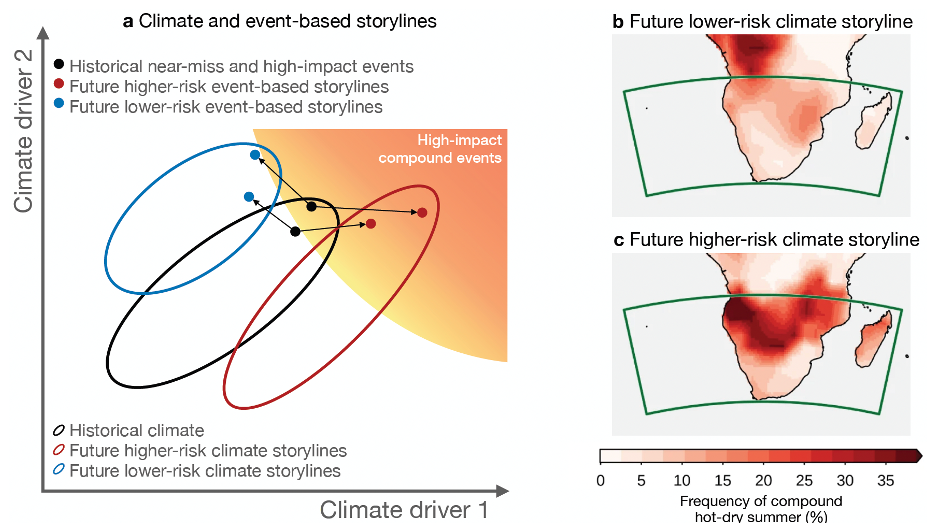
Figure 3Climate and event-based storylines. (a) Climate and event-based storylines to explore uncertainties in future climatic conditions for a representative compound event type defined by two climate drivers. Impacts increase with higher values of both drivers (top-right corner). The historical climate (black ellipse) may shift in multiple ways – via changes in mean and variance of the climate drivers, as well as their correlations – as represented by a higher-risk (red) and lower-risk (blue) climate storylines. Event-based storylines are shown as dots, with two historical events (in black, a near miss without impacts and a historical impactful event), which can evolve differently into higher-risk (red) to lower-risk (blue) future event-based storylines. (b, c) Future climate storylines characterized by high and low frequency of compound hot-dry summers in southern Africa in a 3 °C warmer world than pre-industrial conditions. The storylines are obtained by ranking seven climate models (selected based on their large sample size so as to ensure a robust frequency of compound events) in terms of the future frequency of compound hot-dry summers averaged over the southern Africa region (green box). Figure adapted from Bevacqua et al. (2023).
While compound events have occurred throughout the historical record, new compound event combinations, as well as the rapidly increasing frequency and intensity of many types of events, pose emerging risks to societies in a changing climate (Messori et al., 2025). While univariate climate risk assessments are on the way to being operationalized as ready to use frameworks by non-academic, private sector entities, compound events remain a scientific frontier where promising advances have been made (Stalhandske et al., 2024) but out-of-the-box solutions are not yet readily available. Similarly, an improved understanding of amplified impacts from compound events can be used to produce more informative and usable impact data and warnings towards operationalized impact forecasting (Kam et al., 2024). Setting standards for usable compound event research could help provide publicly accessible climate risk knowledge. We therefore propose four guiding principles, detailed below.
6.1 Accessibility and interpretability: Climate risk information should be provided free of charge and presented in an intuitive way
Impact datasets constitute the foundation of compound event research as they allow us to establish robust event–impact relationships and inform the search for highly-impactful event combinations. Often impact datasets are not publicly accessible, are incomplete, or are structured in ways that hinder the investigation of compound events (see Sect. 2). We call for impact data from a variety of sectors, such as health, agriculture, energy, and insurance, to be made readily available. This shared data will facilitate the advancement of our understanding of the impacts of individual and compound climate events. There are substantial data gaps over certain regions, particularly South America, Africa, and parts of Asia, that limit the characterization of compounding climate risks in those regions. Alongside efforts to increase data availability from these regions, Serwadda et al. (2018) underscore the need for researchers to employ best practices for ethical use of the data, engage in local collaborations that are meaningful and equitable, and support the development of local capacity and resources to support climate resilience. In contrast, much progress has been made regarding accessible hazard data, where numerous ready to use datasets can be found online (e.g., Kong and Huber, 2025). Online tools for downloading time series and geospatial analyses, such as the Climate Impact Explorer (https://climate-impact-explorer.climateanalytics.org, last access: 22 August 2026) could be extended to include a wide range of standardized compound event types, such as those provided in the framework of Yin et al. (2025).
Interpretability can be fostered by working towards a common goal. Different scientific fields, such as climatology, hydrology, disaster risk science, and social sciences, often use the same terms to describe slightly to completely different concepts (Gill et al., 2022). For example, an impact can refer either to a hazardous event caused by climatic drivers (from a compound perspective) or the physical or economic loss resulting from a combination of hazard, exposure, and vulnerability from a (multi-hazard) disaster science or IPCC perspective. Furthermore, terms like “impact” and “risk” are subjective and context-dependent. Setting standards and agreement on common definitions (e.g. through glossaries) can help to reduce confusion across scientific communities (Zscheischler et al., 2021; Simpson et al., 2021). Positive examples include the DAMOCLES Cost Action on Compound Events, which included research from a multitude of scientific backgrounds, and the Risk Knowledge Action Network (Risk KAN) on Emergent Risks and Extreme Events, a joint initiative from Future Earth and WCRP consisting of a set of working groups that bring together practitioners and researchers from different disciplines. ANTICIPATE, a newly funded European COST Action, will focus on the prediction of compound events on different timescales and will tackle challenges discussed in Sect. 3 of this perspective.
6.2 Fitness for purpose: Sufficient detail in time and space at certainty levels that match the application
To ensure fitness for purpose, compound event scientists, stakeholders, decision makers, and hazard responders must come together in the co-development process from the outset, to ensure that the development of models, metrics, and other tools are truly usable on the necessary temporal and spatial scales. Transdisciplinary approaches with non-academic stakeholders for co-developing the research design and generating knowledge can help (Norström et al., 2020). Integrating researchers, agencies, and other stakeholders helps to dissolve barriers between different sectors and align the expectations of the different stakeholders by focusing on shared outcomes and creating a common understanding, bridging the science-policy-practice gap (Brett et al., 2025b; Gall et al., 2015). Expectation management is a key part of such processes as uncertainties are an inherent part of climate risk projection and early warnings. This holds in particular for highly resolved spatial and temporal risk estimates, which can go beyond the capacities of what the state-of-science can deliver. Communicating the full range of uncertainties is also important to enable users to determine the level of risk that they want to incorporate in their applications of this information, whether it be for design, planning, or preparedness.
6.3 Timeliness and pragmatism: The best available knowledge should be provided, as early as possible
Unmitigated climate change leads to situations in which the emergence of compound hazards and the need for actionable information outpaces scientific progress. As compound climate events affect societies now, imperfect and available information might at times be the preferred option, compared to a perfect solution potentially available beyond undefined time-horizons (e.g., accurate and near deterministic risk estimates at sub kilometer-scales). In this context, the communication of underlying assumptions and limitations of chosen approaches are of high importance. Considerations around timeliness and pragmatism should therefore be tailored towards the specific target audience. While technical professionals in public agencies need detailed data on climate models and risk assessments for effective risk management, policymakers require concise, comprehensible evidence to quickly inform policies and emergency preparedness without being overwhelmed by technicalities. On the other hand, the private sector, including agriculture and insurance, requires detailed risk assessments and forecasts to plan for business continuity and to manage risks.
6.4 Transparency and accountability: Assumptions, limitations and methods need to be clearly stated and underlying data need to be publicly available
In a landscape of imperfect solutions, transparency of underlying assumptions and limitations of chosen approaches can prevent misinterpretation and inappropriate application of compound event knowledge. While strict code and data availability requirements are becoming standard in academic research, no such scrutiny exists in the private sector. Transparency of methodologies is also imperative to ensure that analyses are repeatable and reproducible. This transparency also allows researchers and other users to better understand analyses and potentially identify unforeseen limitations, again reducing the misinterpretation of results and allowing methods to be improved in the future. Profit interests in a competitive market can disincentivize transparent communication of methods and limitations of the offered products and services, with risks of maladaptation leading to increased exposure and vulnerability to hazards. New accountability standards for hazard and climate risk estimates from the private sector could help in securing the reliability and trust in such products. Further, an open, intellectual environment, with best practices shared across disciplines, geographies, and hazards, encourages the needed dynamism for meaningful, usable climate-impact advances.
As extreme events are already occurring at a rate that increasingly outpaces climate scientists' capacity to thoroughly investigate them, a slowdown and reversal of global warming to meet the Paris Agreement targets by mitigating greenhouse gas emissions is imperative. Notwithstanding this objective, an improved knowledge of the complex interactions of hazards and their climate impact drivers in a non-stationary climate is certainly needed. More comprehensive and standardized climate impact datasets and modeling efforts are a key element in moving towards producing more usable climate information and reducing uncertainties. While these efforts will not be able to eliminate limits to adaptation, which are set by local adaptive capacity, human liveability and survivability thresholds, and global tipping points that might cause rapid irreversible changes in the climate system, an improved, more holistic understanding of hazards and their impacts can help us understand when, where, and which aspects of weather extremes merit the greatest devotion of research and operational resources. While there is always the potential to extend our knowledge, more systematic usability reflections facilitated by the presented guidelines could help maximize the application potential of the insights and methodologies already at hand right now.
No Datasets used when writing this Perspective.
KK led the writing and conceived the scope of this perspective with support from all authors. Section 2 was led by MMdB and WSJ, with contributions from AMR, CD, CDM, CDWR, FB, GM and KKÜ. Section 3 was led by PR and CDWR, with contributions from JC, MCdR, AHF, KK, FOL, CR, DS, GM, and CJW. Section 4 was led by KK, with contributions from DM, LSG, PL, JGP, BP. Section 5 was led by EB, with contributions from PL, AFSR, BP and LSG. Section 6 was jointly led by CJW, SDA, PJW and KK.
At least one of the (co-)authors is a member of the editorial board of Natural Hazards and Earth System Sciences. The peer-review process was guided by an independent editor, and the authors also have no other competing interests to declare.
Publisher's note: Copernicus Publications remains neutral with regard to jurisdictional claims made in the text, published maps, institutional affiliations, or any other geographical representation in this paper. The authors bear the ultimate responsibility for providing appropriate place names. Views expressed in the text are those of the authors and do not necessarily reflect the views of the publisher.
KK has been partly supported by the German Federal Ministry for Education and Research (BMBF) via the ClimXtreme project (subproject PERSEVERE, phase 2nd, grant no. 01LP2322D). CDWR is supported with funding from the Australian Government under the National Environmental Science Program. WSJ, MCdR and PJW are supported by the MYRIAD-EU project; this project has received funding from the European Union's Horizon 2020 research and innovation programme (grant agreement no. 101003276). CD has received funding from the European Union's Horizon 2020 research and innovation programme under the Marie Skłodowska-Curie grant agreement no. 945380. MCdR is also supported by the Netherlands Organisation for Scientific Research (NWO) (VENI; grant no. VI.Veni.222.169). CJW acknowledges the COST Action ANTICIPATE: extended-range multi-hazard predictions and early warnings (CA24144), supported by COST (European Cooperation in Science and Technology), and is supported by the European Union's Horizon Europe “Multi-hazard and risk informed system for enhanced local and regional disaster risk management (MEDiate)” project (grant agreement no. 101074075) and the Weather and Climate Science for Services Partnership (WCSSP) “WCSSP India MIDAS project: Multi-risk Impact baseD forecASting” project from the Met Office / Department for Science, Innovation and Technology (DN684504 reference 664626/FWS1322). EB received funding from the DFG via the Emmy Noether Programme (grant ID 524780515). SDA is supported by the “Habi(Li)ter – Co-defining the habitability of Lorraine under climate change and future multi-risk conditions” research project, developed in the framework of the Project IMPACT “EPHemeris – Earth and Planet Habitability”, funded by Lorraine Université d'Excellence (LUE). BP has been funded by the Deutsche Forschungsgemeinschaft (DFG, German Research Foundation) under Germany's Excellence Strategy – EXC 2037 “CLICCS – Climate, Climatic Change, and Society” – Project Number: 390683824, contribution to the Center for Earth System Research and Sustainability (CEN) of Universität Hamburg. PL and AMR thank the Helmholtz Program “Changing Earth”. JGP and AHF thank the German Federal Ministry of Education and Research (BMBF) research program ClimXtreme II (Grant number: 01LP2322A). JGP thanks the AXA Research Fund for support. GM was supported by the European Union's Horizon 2020 research and innovation programme through the European Research Council (grant no. 948309 CENÆ) and by the Swedish Research Council Vetenskapsrådet (grants nos. 2022-06599 and 2022-03448). CDM and FB are supported by the RETURN project (Multi-risk science for resilient communities under a changing climate) with Extended Partnership, which received funding from the European Union Next-GenerationEU, National Recovery and Resilience Plan – NRRP, Mission 4, Component 2, Investment 1.3 – DD 1243 2/8/2022, PE0000005. LSG received funding from the European Union's Horizon Europe Framework Programme under the Marie Skłodowska-Curie Action grant agreement No 101064940. AFSR acknowledges the Alexander von Humboldt Foundation (AvH) for a postdoctoral fellowship and the DFG Walter Benjamin Programme (project no. 530175554). KKÜ thanks the Stiftung Umwelt und Schadenvorsorge (“Foundation for Protection Against Natural Hazards”) for financial support. PR acknowledges the Faculty of Geosciences and the Environment at the University of Lausanne for the Early Career Postdoctoral Fellowship. PR is part of the SPEED2ZERO, a Joint Initiative co-financed by the ETH Board. MMdB was funded by the Helmholtz EXTREME-ADAPT and the Volkswagen Stiftung CASCADE project. JC was funded by the Climate+ Co-Centre (grant no. NE/Y006496/1).
This paper was edited by Mihai Niculita and reviewed by David N. Bresch and two anonymous referees.
Aalbers, E. E., Lenderink, G., Van Meijgaard, E., and Van Den Hurk, B. J. J. M.: Local-scale changes in mean and heavy precipitation in Western Europe, climate change or internal variability?, Clim. Dyn., 50, 4745–4766, https://doi.org/10.1007/s00382-017-3901-9, 2018.
AghaKouchak, A., Chiang, F., Huning, L. S., Love, C. A., Mallakpour, I., Mazdiyasni, O., Moftakhari, H., Papalexiou, S. M., Ragno, E., and Sadegh, M.: Climate Extremes and Compound Hazards in a Warming World, Annu. Rev. Earth Planet. Sci., 48, 519–548, https://doi.org/10.1146/annurev-earth-071719-055228, 2020.
AghaKouchak, A., Mirchi, A., Madani, K., Di Baldassarre, G., Nazemi, A., Alborzi, A., Anjileli, H., Azarderakhsh, M., Chiang, F., Hassanzadeh, E., Huning, L. S., Mallakpour, I., Martinez, A., Mazdiyasni, O., Moftakhari, H., Norouzi, H., Sadegh, M., Sadeqi, D., Van Loon, A. F., and Wanders, N.: Anthropogenic Drought: Definition, Challenges, and Opportunities, Rev. Geophys., 59, e2019RG000683, https://doi.org/10.1029/2019RG000683, 2021.
Ahmed, T., Kumar, P., and Mottet, L.: Natural ventilation in warm climates: The challenges of thermal comfort, heatwave resilience and indoor air quality, Renew. Sustain. Energy Rev., 138, 110669, https://doi.org/10.1016/j.rser.2020.110669, 2021.
Allen, A., Markou, S., Tebbutt, W., Requeima, J., Bruinsma, W. P., Andersson, T. R., Herzog, M., Lane, N. D., Chantry, M., Hosking, J. S., and Turner, R. E.: End-to-end data-driven weather prediction, Nature, 641, 1172–1179, https://doi.org/10.1038/s41586-025-08897-0, 2025.
Ban, N., Caillaud, C., Coppola, E., Pichelli, E., Sobolowski, S., Adinolfi, M., Ahrens, B., Alias, A., Anders, I., Bastin, S., Beluić, D., Berthou, S., Brisson, E., Cardoso, R. M., Chan, S. C., Christensen, O. B., Fernández, J., Fita, L., Frisius, T., Gaparac, G., Giorgi, F., Goergen, K., Haugen, J. E., Hodnebrog, Ø., Kartsios, S., Katragkou, E., Kendon, E. J., Keuler, K., Lavin-Gullon, A., Lenderink, G., Leutwyler, D., Lorenz, T., Maraun, D., Mercogliano, P., Milovac, J., Panitz, H.-J., Raffa, M., Remedio, A. R., Schär, C., Soares, P. M. M., Srnec, L., Steensen, B. M., Stocchi, P., Tölle, M. H., Truhetz, H., Vergara-Temprado, J., De Vries, H., Warrach-Sagi, K., Wulfmeyer, V., and Zander, M. J.: The first multi-model ensemble of regional climate simulations at kilometer-scale resolution, part I: evaluation of precipitation, Clim. Dyn., 57, 275–302, https://doi.org/10.1007/s00382-021-05708-w, 2021.
Baño-Medina, J., Manzanas, R., and Gutiérrez, J. M.: Configuration and intercomparison of deep learning neural models for statistical downscaling, Geosci. Model Dev., 13, 2109–2124, https://doi.org/10.5194/gmd-13-2109-2020, 2020.
Barton-Henry, K. and Wenz, L.: Nighttime light data reveal lack of full recovery after hurricanes in Southern US, Environ. Res. Lett., 17, 114015, https://doi.org/10.1088/1748-9326/ac998d, 2022.
Bartusek, S., Kornhuber, K., and Ting, M.: 2021 North American heatwave amplified by climate change-driven nonlinear interactions, Nat. Clim. Change, 12, 1143–1150, https://doi.org/10.1038/s41558-022-01520-4, 2022.
Bastos, A., Sippel, S., Frank, D., Mahecha, M. D., Zaehle, S., Zscheischler, J., and Reichstein, M.: A joint framework for studying compound ecoclimatic events, Nat. Rev. Earth Environ., 4, 333–350, https://doi.org/10.1038/s43017-023-00410-3, 2023.
Bertola, M., Blöschl, G., Bohac, M., Borga, M., Castellarin, A., Chirico, G. B., Claps, P., Dallan, E., Danilovich, I., Ganora, D., Gorbachova, L., Ledvinka, O., Mavrova-Guirguinova, M., Montanari, A., Ovcharuk, V., Viglione, A., Volpi, E., Arheimer, B., Aronica, G. T., Bonacci, O., Čanjevac, I., Csik, A., Frolova, N., Gnandt, B., Gribovszki, Z., Gül, A., Günther, K., Guse, B., Hannaford, J., Harrigan, S., Kireeva, M., Kohnová, S., Komma, J., Kriauciuniene, J., Kronvang, B., Lawrence, D., Lüdtke, S., Mediero, L., Merz, B., Molnar, P., Murphy, C., Oskoru, D., Osuch, M., Parajka, J., Pfister, L., Radevski, I., Sauquet, E., Schröter, K., raj, M., Szolgay, J., Turner, S., Valent, P., Veijalainen, N., Ward, P. J., Willems, P., and Zivkovic, N.: Megafloods in Europe can be anticipated from observations in hydrologically similar catchments, Nat. Geosci., 16, 982–988, https://doi.org/10.1038/s41561-023-01300-5, 2023.
Bevacqua, E., De Michele, C., Manning, C., Couasnon, A., Ribeiro, A. F. S., Ramos, A. M., Vignotto, E., Bastos, A., Blesić, S., Durante, F., Hillier, J., Oliveira, S. C., Pinto, J. G., Ragno, E., Rivoire, P., Saunders, K., Van Der Wiel, K., Wu, W., Zhang, T., and Zscheischler, J.: Guidelines for Studying Diverse Types of Compound Weather and Climate Events, Earths Future, 9, e2021EF002340, https://doi.org/10.1029/2021EF002340, 2021.
Bevacqua, E., Suarez-Gutierrez, L., Jézéquel, A., Lehner, F., Vrac, M., Yiou, P., and Zscheischler, J.: Advancing research on compound weather and climate events via large ensemble model simulations, Nat. Commun., 14, 2145, https://doi.org/10.1038/s41467-023-37847-5, 2023.
Bi, K., Xie, L., Zhang, H., Chen, X., Gu, X., and Tian, Q.: Accurate medium-range global weather forecasting with 3D neural networks, Nature, 619, 533–538, https://doi.org/10.1038/s41586-023-06185-3, 2023.
Branstator, G. and Teng, H.: Two Limits of Initial-Value Decadal Predictability in a CGCM, J. Climate, 23, 6292–6311, https://doi.org/10.1175/2010JCLI3678.1, 2010.
Brennan, M. E. and Danielak, S.: Too small to count? The cumulative impacts and policy implications of small disasters in the Sahel, Int. J. Disaster Risk Reduct., 68, 102687, https://doi.org/10.1016/j.ijdrr.2021.102687, 2022.
Brett, L., White, C. J., Domeisen, D. I. V., van den Hurk, B., Ward, P., and Zscheischler, J.: Review article: The growth in compound weather and climate event research in the decade since SREX, Nat. Hazards Earth Syst. Sci., 25, 2591–2611, https://doi.org/10.5194/nhess-25-2591-2025, 2025a.
Brett, L., Bloomfield, H. C., Bradley, A., Calvet, T., Champion, A., De Angeli, S., De Ruiter, M. C., Guerreiro, S. B., Hillier, J., Jaroszweski, D., Kamranzad, B., Keinänen‐Toivola, M. M., Kornhuber, K., Küpfer, K., Manning, C., Mattu, K., Murtagh, E., Murray, V., Bhreasail, Á. N., O'Loughlin, F., Parker, C., Pregnolato, M., Ramos, A. M., Schlumberger, J., Theochari, D., Ward, P., Wessels, A., and White, C. J.: Science–policy–practice insights for compound and multi‐hazard risks, Meteorol. Appl., 32, e70043, https://doi.org/10.1002/met.70043, 2025b.
Byers, E., Werning, M., Perrette, M., Schwind, N., Krey, V., Riahi, K., and Schleussner, C.-F.: Fast climate impact emulation for global temperature scenarios with the rapid impact model emulator (RIME), Environ. Res. Clim., 4, 035011, https://doi.org/10.1088/2752-5295/adee3d, 2025.
Calvello, M. and Pecoraro, G.: FraneItalia: a catalog of recent Italian landslides, Geoenvironmental Disasters, 5, 13, https://doi.org/10.1186/s40677-018-0105-5, 2018.
Camargo, S. J. and Wing, A. A.: Tropical cyclones in climate models, WIREs Clim. Change, 7, 211–237, https://doi.org/10.1002/wcc.373, 2016.
Cannon, A. J.: Multivariate quantile mapping bias correction: an N-dimensional probability density function transform for climate model simulations of multiple variables, Clim. Dyn., 50, 31–49, https://doi.org/10.1007/s00382-017-3580-6, 2018.
Charlton-Perez, A. J., Dacre, H. F., Driscoll, S., Gray, S. L., Harvey, B., Harvey, N. J., Hunt, K. M. R., Lee, R. W., Swaminathan, R., Vandaele, R., and Volonté, A.: Do AI models produce better weather forecasts than physics-based models? A quantitative evaluation case study of Storm Ciarán, Npj Clim. Atmos. Sci., 7, 93, https://doi.org/10.1038/s41612-024-00638-w, 2024.
Chen, L., Brun, P., Buri, P., Fatichi, S., Gessler, A., McCarthy, M. J., Pellicciotti, F., Stocker, B., and Karger, D. N.: Global increase in the occurrence and impact of multiyear droughts, Science, 387, 278–284, https://doi.org/10.1126/science.ado4245, 2025.
Ciavola, P., Harley, M. D., and Den Heijer, C.: The RISC-KIT storm impact database: A new tool in support of DRR, Coast. Eng., 134, 24–32, https://doi.org/10.1016/j.coastaleng.2017.08.016, 2018.
Ciullo, A., Martius, O., Strobl, E., and Bresch, D. N.: A framework for building climate storylines based on downward counterfactuals: The case of the European Union Solidarity fund, Clim. Risk Manag., 33, 100349, https://doi.org/10.1016/j.crm.2021.100349, 2021.
Claassen, J. N., Koks, E. E., De Ruiter, M. C., Ward, P. J., and Jäger, W. S.: VineCopulas: an open-source Python package for vinecopula modelling, J. Open Source Softw., 9, 6728, https://doi.org/10.21105/joss.06728, 2024.
Coelho, C. A. S., Brown, B., Wilson, L., Mittermaier, M., and Casati, B.: Forecast Verification for S2S Timescales, in: Sub-Seasonal to Seasonal Prediction, Elsevier, 337–361, https://doi.org/10.1016/B978-0-12-811714-9.00016-4, 2019.
Coen, D. R. and Sobel, A.: Introduction: Critical and historical perspectives on usable climate science, Clim. Change, 172, s10584-022-03369–0, https://doi.org/10.1007/s10584-022-03369-0, 2022.
Coppola, E., Nogherotto, R., Ciarlo', J. M., Giorgi, F., Van Meijgaard, E., Kadygrov, N., Iles, C., Corre, L., Sandstad, M., Somot, S., Nabat, P., Vautard, R., Levavasseur, G., Schwingshackl, C., Sillmann, J., Kjellström, E., Nikulin, G., Aalbers, E., Lenderink, G., Christensen, O. B., Boberg, F., Sørland, S. L., Demory, M., Bülow, K., Teichmann, C., Warrach‐Sagi, K., and Wulfmeyer, V.: Assessment of the European Climate Projections as Simulated by the Large EURO‐CORDEX Regional and Global Climate Model Ensemble, J. Geophys. Res.-Atmos., 126, https://doi.org/10.1029/2019jd032356, 2021.
Crozier, M. J.: A proposed cell model for multiple-occurrence regional landslide events: Implications for landslide susceptibility mapping, Geomorphology, 295, 480–488, https://doi.org/10.1016/j.geomorph.2017.07.032, 2017.
Dallons Thanneur, L., Giacona, F., Eckert, N., and Frey, P.: Constitution of a multicentennial multirisk database in a mountainous environment from composite sources: the example of the Vallouise-Pelvoux municipality (Ecrins, France), EGUsphere [preprint], https://doi.org/10.5194/egusphere-2025-761, 2025.
Daly, C., Halbleib, M., Smith, J. I., Gibson, W. P., Doggett, M. K., Taylor, G. H., Curtis, J., and Pasteris, P. P.: Physiographically sensitive mapping of climatological temperature and precipitation across the conterminous United States, Int. J. Climatol., 28, 2031–2064, https://doi.org/10.1002/joc.1688, 2008.
De Brito, M. M.: Compound and cascading drought impacts do not happen by chance: A proposal to quantify their relationships, Sci. Total Environ., 778, 146236, https://doi.org/10.1016/j.scitotenv.2021.146236, 2021.
De Brito, M. M., Sodoge, J., Fekete, A., Hagenlocher, M., Koks, E., Kuhlicke, C., Messori, G., De Ruiter, M., Schweizer, P., and Ward, P. J.: Uncovering the Dynamics of Multi‐Sector Impacts of Hydrological Extremes: A Methods Overview, Earths Future, 12, e2023EF003906, https://doi.org/10.1029/2023EF003906, 2024.
De Ruiter, M. C., Couasnon, A., Van Den Homberg, M. J. C., Daniell, J. E., Gill, J. C., and Ward, P. J.: Why We Can No Longer Ignore Consecutive Disasters, Earths Future, 8, e2019EF001425, https://doi.org/10.1029/2019EF001425, 2020.
Delforge, D., Wathelet, V., Below, R., Sofia, C. L., Tonnelier, M., Van Loenhout, J. A. F., and Speybroeck, N.: EM-DAT: the Emergency Events Database, Int. J. Disaster Risk Reduct., 124, 105509, https://doi.org/10.1016/j.ijdrr.2025.105509, 2025.
Deser, C.: “Certain Uncertainty: The Role of Internal Climate Variability in Projections of Regional Climate Change and Risk Management,” Earths Future, 8, https://doi.org/10.1029/2020ef001854, 2020.
Dolk, M., Mahul, O., Ranger, N., Ceglar, A., and Kornhuber, K.: Compound Risks: Implications for Physical Climate Scenario Analysis, NGFS Brief. Note, https://www.ngfs.net/system/files/import/ngfs/media/2023/11/07/ngfs_compound_risks_implications_for_physical_climate_scenario_analysis.pdf (last access: 22 August 2026), 2023.
Domeisen, D. I. V., White, C. J., Afargan-Gerstman, H., Muñoz, Á. G., Janiga, M. A., Vitart, F., Wulff, C. O., Antoine, S., Ardilouze, C., Batté, L., Bloomfield, H. C., Brayshaw, D. J., Camargo, S. J., Charlton-Pérez, A., Collins, D., Cowan, T., Del Mar Chaves, M., Ferranti, L., Gómez, R., González, P. L. M., González Romero, C., Infanti, J. M., Karozis, S., Kim, H., Kolstad, E. W., LaJoie, E., Lledó, L., Magnusson, L., Malguzzi, P., Manrique-Suñén, A., Mastrangelo, D., Materia, S., Medina, H., Palma, L., Pineda, L. E., Sfetsos, A., Son, S.-W., Soret, A., Strazzo, S., and Tian, D.: Advances in the Subseasonal Prediction of Extreme Events: Relevant Case Studies across the Globe, B. Am. Meteorol. Soc., 103, E1473–E1501, https://doi.org/10.1175/BAMS-D-20-0221.1, 2022.
Dunz, N., Mazzocchetti, A., Monasterolo, I., Hrast Essenfelder, A., and Raberto, M.: Macroeconomic and Financial Impacts of Compounding Pandemics and Climate Risks, SSRN Electron. J., https://doi.org/10.2139/ssrn.3827853, 2021.
Ehmele, F., Kautz, L.-A., Feldmann, H., He, Y., Kadlec, M., Kelemen, F. D., Lentink, H. S., Ludwig, P., Manful, D., and Pinto, J. G.: Adaptation and application of the large LAERTES-EU regional climate model ensemble for modeling hydrological extremes: a pilot study for the Rhine basin, Nat. Hazards Earth Syst. Sci., 22, 677–692, https://doi.org/10.5194/nhess-22-677-2022, 2022.
Eyring, V., Bony, S., Meehl, G. A., Senior, C. A., Stevens, B., Stouffer, R. J., and Taylor, K. E.: Overview of the Coupled Model Intercomparison Project Phase 6 (CMIP6) experimental design and organization, Geosci. Model Dev., 9, 1937–1958, https://doi.org/10.5194/gmd-9-1937-2016, 2016.
Felsche, E., Böhnisch, A., Poschlod, B., and Ludwig, R.: European hot and dry summers are projected to become more frequent and expand northwards, Commun. Earth Environ., 5, 410, https://doi.org/10.1038/s43247-024-01575-5, 2024.
Feng, K., Ouyang, M., and Lin, N.: Tropical cyclone-blackout-heatwave compound hazard resilience in a changing climate, Nat. Commun., 13, 4421, https://doi.org/10.1038/s41467-022-32018-4, 2022.
Field, C. B., Barros, V., Stocker, T. F., Qin, D., Dokken, D. J., Ebi, K. L., Mastrandrea, M. D., Mach, K. J., Plattner, G.-K., Allen, S. K., Tignor, M., and Midgley, P. M.: Managing the Risks of Extreme Events and Disasters to Advance Climate Change Adaptation: A Special Report of Working Groups I and II of the Intergovernmental Panel on Climate Change (SREX), Cambridge University Press, Cambridge, United Kingdom and New York, NY, USA, https://digitallibrary.un.org/record/3893037?ln=en&v=pdf (last access: 22 August 2026), 2012.
First, J. M., Ellis, K., and Strader, S.: Double trouble: Examining public protective decision-making during concurrent tornado and flash flood threats in the U.S. Southeast, Int. J. Disaster Risk Reduct., 81, 103297, https://doi.org/10.1016/j.ijdrr.2022.103297, 2022.
Fischer, E. M. and Knutti, R.: Observed heavy precipitation increase confirms theory and early models, Nat. Clim. Change, 6, 986–991, https://doi.org/10.1038/nclimate3110, 2016.
Gall, M., Borden, K. A., and Cutter, S. L.: When Do Losses Count?: Six Fallacies of Natural Hazards Loss Data, Bull. Am. Meteorol. Soc., 90, 799–810, https://doi.org/10.1175/2008BAMS2721.1, 2009.
Gall, M., Nguyen, K. H., and Cutter, S. L.: Integrated research on disaster risk: Is it really integrated?, Int. J. Disaster Risk Reduct., 12, 255–267, https://doi.org/10.1016/j.ijdrr.2015.01.010, 2015.
Gill, J. C. and Malamud, B. D.: Reviewing and visualizing the interactions of natural hazards: Interactions of Natural Hazards, Rev. Geophys., 52, 680–722, https://doi.org/10.1002/2013RG000445, 2014.
Gill, J. C., Duncan, M., Ciurean, R., Smale, L., Stuparu, D., Schlumberger, J., de Ruiter, M., Tiggeloven, T., Torresan, S., Gottardo, S., Mysiak, J., Harris, R., Petrescu, E. C., Girard, T., Khazai, B., Claassen, J., Dai, R., Champion, A., Daloz, A. S., and Ward, P.: MYRIAD-EU D1.2 Handbook of Multi-hazard, Multi-Risk Definitions and Concepts, H2020 MYRIAD-EU Project, https://ec.europa.eu/research/participants/documents/downloadPublic?documentIds=080166e5efc857cb&appId=PPGMS (last access: 22 August 2026), 2022.
Goddard, L. M., Baethgen, W. E., Bhojwani, H., and Robertson, A. W.: The International Research Institute for Climate and Society: why, what and how, SpringerOpen, https://doi.org/10.7916/D8FT8KZZ, 2015.
Golding, B. (Ed.): Towards the “Perfect” Weather Warning: Bridging Disciplinary Gaps through Partnership and Communication, Springer International Publishing, Cham, https://doi.org/10.1007/978-3-030-98989-7, 2022.
Goulart, H. M. D., van der Wiel, K., Folberth, C., Balkovic, J., and van den Hurk, B.: Storylines of weather-induced crop failure events under climate change, Earth Syst. Dynam., 12, 1503–1527, https://doi.org/10.5194/esd-12-1503-2021, 2021.
Goulart, H. M. D., Benito Lazaro, I., van Garderen, L., van der Wiel, K., Le Bars, D., Koks, E., and van den Hurk, B.: Compound flood impacts from Hurricane Sandy on New York City in climate-driven storylines, Nat. Hazards Earth Syst. Sci., 24, 29–45, https://doi.org/10.5194/nhess-24-29-2024, 2024.
Hagenlocher, M., Naumann, G., Meza, I., Blauhut, V., Cotti, D., Döll, P., Ehlert, K., Gaupp, F., Van Loon, A. F., Marengo, J. A., Rossi, L., Sabino Siemons, A. S., Siebert, S., Tsehayu, A. T., Toreti, A., Tsegai, D., Vera, C., Vogt, J., and Wens, M.: Tackling Growing Drought Risks – The Need for a Systemic Perspective, Earths Future, 11, e2023EF003857, https://doi.org/10.1029/2023EF003857, 2023.
Haigh, I. D., Ozsoy, O., Wadey, M. P., Nicholls, R. J., Gallop, S. L., Wahl, T., and Brown, J. M.: An improved database of coastal flooding in the United Kingdom from 1915 to 2016, Sci. Data, 4, 170100, https://doi.org/10.1038/sdata.2017.100, 2017.
Hamed, R., Steinmann, C. B., Ma, Q., Balanzategui, D., Broadman, E., Lesk, C., and Kornhuber, K.: Amplified agricultural impacts from more frequent and intense sequential heat events, Environ. Res. Lett., 20, 114001, https://doi.org/10.1088/1748-9326/ae06b8, 2025.
Haqiqi, I., Grogan, D. S., Hertel, T. W., and Schlenker, W.: Quantifying the impacts of compound extremes on agriculture, Hydrol. Earth Syst. Sci., 25, 551–564, https://doi.org/10.5194/hess-25-551-2021, 2021.
Hawkins, E., Smith, R. S., Gregory, J. M., and Stainforth, D. A.: Irreducible uncertainty in near-term climate projections, Clim. Dyn., 46, 3807–3819, https://doi.org/10.1007/s00382-015-2806-8, 2016.
Hemmati, M., Kornhuber, K., and Kruczkiewicz, A.: Enhanced urban adaptation efforts needed to counter rising extreme rainfall risks, Npj Urban Sustain., 2, 16, https://doi.org/10.1038/s42949-022-00058-w, 2022.
Henderson, J., Nielsen, E. R., Herman, G. R., and Schumacher, R. S.: A Hazard Multiple: Overlapping Tornado and Flash Flood Warnings in a National Weather Service Forecast Office in the Southeastern United States, Weather Forecast., 35, 1459–1481, https://doi.org/10.1175/WAF-D-19-0216.1, 2020.
Henderson, J., Spinney, J., and Demuth, J. L.: Conceptualizing Confidence: A Multisited Qualitative Analysis in a Severe Weather Context, Bull. Am. Meteorol. Soc., 104, E459–E479, https://doi.org/10.1175/BAMS-D-22-0137.1, 2023.
Hess, P., Lange, S., Schötz, C., and Boers, N.: Deep Learning for Bias‐Correcting CMIP6‐Class Earth System Models, Earths Future, 11, e2023EF004002, https://doi.org/10.1029/2023EF004002, 2023.
Hobeichi, S., Abramowitz, G., Evans, J. P., and Ukkola, A.: Toward a Robust, Impact‐Based, Predictive Drought Metric, Water Resour. Res., 58, e2021WR031829, https://doi.org/10.1029/2021WR031829, 2022.
Hochrainer-Stigler, S., akić Trogrlić, R., Reiter, K., Ward, P. J., De Ruiter, M. C., Duncan, M. J., Torresan, S., Ciurean, R., Mysiak, J., Stuparu, D., and Gottardo, S.: Toward a framework for systemic multi-hazard and multi-risk assessment and management, iScience, 26, 106736, https://doi.org/10.1016/j.isci.2023.106736, 2023.
Hohenegger, C., Korn, P., Linardakis, L., Redler, R., Schnur, R., Adamidis, P., Bao, J., Bastin, S., Behravesh, M., Bergemann, M., Biercamp, J., Bockelmann, H., Brokopf, R., Brüggemann, N., Casaroli, L., Chegini, F., Datseris, G., Esch, M., George, G., Giorgetta, M., Gutjahr, O., Haak, H., Hanke, M., Ilyina, T., Jahns, T., Jungclaus, J., Kern, M., Klocke, D., Kluft, L., Kölling, T., Kornblueh, L., Kosukhin, S., Kroll, C., Lee, J., Mauritsen, T., Mehlmann, C., Mieslinger, T., Naumann, A. K., Paccini, L., Peinado, A., Praturi, D. S., Putrasahan, D., Rast, S., Riddick, T., Roeber, N., Schmidt, H., Schulzweida, U., Schütte, F., Segura, H., Shevchenko, R., Singh, V., Specht, M., Stephan, C. C., von Storch, J.-S., Vogel, R., Wengel, C., Winkler, M., Ziemen, F., Marotzke, J., and Stevens, B.: ICON-Sapphire: simulating the components of the Earth system and their interactions at kilometer and subkilometer scales, Geosci. Model Dev., 16, 779–811, https://doi.org/10.5194/gmd-16-779-2023, 2023.
Hundhausen, M., Feldmann, H., Laube, N., and Pinto, J. G.: Future heat extremes and impacts in a convection-permitting climate ensemble over Germany, Nat. Hazards Earth Syst. Sci., 23, 2873–2893, https://doi.org/10.5194/nhess-23-2873-2023, 2023.
Hundhausen, M., Feldmann, H., Kohlhepp, R., and Pinto, J. G.: Climate change signals of extreme precipitation return levels for Germany in a transient convection‐permitting simulation ensemble, Int. J. Climatol., 44, 1454–1471, https://doi.org/10.1002/joc.8393, 2024.
Intergovernmental Panel on Climate Change (IPCC): Climate Change 2021 – The Physical Science Basis: Working Group I Contribution to the Sixth Assessment Report of the Intergovernmental Panel on Climate Change, 1st ed., Cambridge University Press, https://doi.org/10.1017/9781009157896, 2023.
Jacob, D., Petersen, J., Eggert, B., Alias, A., Christensen, O. B., Bouwer, L. M., Braun, A., Colette, A., Déqué, M., Georgievski, G., Georgopoulou, E., Gobiet, A., Menut, L., Nikulin, G., Haensler, A., Hempelmann, N., Jones, C., Keuler, K., Kovats, S., Kröner, N., Kotlarski, S., Kriegsmann, A., Martin, E., Van Meijgaard, E., Moseley, C., Pfeifer, S., Preuschmann, S., Radermacher, C., Radtke, K., Rechid, D., Rounsevell, M., Samuelsson, P., Somot, S., Soussana, J.-F., Teichmann, C., Valentini, R., Vautard, R., Weber, B., and Yiou, P.: EURO-CORDEX: new high-resolution climate change projections for European impact research, Reg. Environ. Change, 14, 563–578, https://doi.org/10.1007/s10113-013-0499-2, 2014.
Jäger, W. S., de Ruiter, M. C., Tiggeloven, T., and Ward, P. J.: What can we learn about multi-hazard impacts from global disaster records?, Nat. Hazards Earth Syst. Sci., 25, 2751–2769, https://doi.org/10.5194/nhess-25-2751-2025, 2025.
Jones, M. W., Abatzoglou, J. T., Veraverbeke, S., Andela, N., Lasslop, G., Forkel, M., Smith, A. J. P., Burton, C., Betts, R. A., Van Der Werf, G. R., Sitch, S., Canadell, J. G., Santín, C., Kolden, C., Doerr, S. H., and Le Quéré, C.: Global and Regional Trends and Drivers of Fire Under Climate Change, Rev. Geophys., 60, e2020RG000726, https://doi.org/10.1029/2020RG000726, 2022.
Jones, R. L., Kharb, A., and Tubeuf, S.: The untold story of missing data in disaster research: a systematic review of the empirical literature utilising the Emergency Events Database (EM-DAT), Environ. Res. Lett., 18, 103006, https://doi.org/10.1088/1748-9326/acfd42, 2023.
Judt, F.: Atmospheric Predictability of the Tropics, Middle Latitudes, and Polar Regions Explored through Global Storm-Resolving Simulations, J. Atmos. Sci., 77, 257–276, https://doi.org/10.1175/JAS-D-19-0116.1, 2020.
Kam, P. M., Ciccone, F., Kropf, C. M., Riedel, L., Fairless, C., and Bresch, D. N.: Impact-based forecasting of tropical cyclone-related human displacement to support anticipatory action, Nat. Commun., 15, 8795, https://doi.org/10.1038/s41467-024-53200-w, 2024.
Kappes, M. S., Keiler, M., Von Elverfeldt, K., and Glade, T.: Challenges of analyzing multi-hazard risk: a review, Nat. Hazards, 64, 1925–1958, https://doi.org/10.1007/s11069-012-0294-2, 2012.
Karger, D. N., Lange, S., Hari, C., Reyer, C. P. O., Conrad, O., Zimmermann, N. E., and Frieler, K.: CHELSA-W5E5: daily 1 km meteorological forcing data for climate impact studies, Earth Syst. Sci. Data, 15, 2445–2464, https://doi.org/10.5194/essd-15-2445-2023, 2023.
Kendon, E. J., Fischer, E. M., and Short, C. J.: Variability conceals emerging trend in 100yr projections of UK local hourly rainfall extremes, Nat. Commun., 14, 1133, https://doi.org/10.1038/s41467-023-36499-9, 2023.
Kitsios, V., O'Kane, T. J., and Newth, D.: A machine learning approach to rapidly project climate responses under a multitude of net-zero emission pathways, Commun. Earth Environ., 4, 355, https://doi.org/10.1038/s43247-023-01011-0, 2023.
Klimiuk, T., Ludwig, P., Sanchez-Benitez, A., Goessling, H. F., Braesicke, P., and Pinto, J. G.: The European summer heatwave of 2019 – a regional storyline perspective, Earth Syst. Dynam., 16, 239–255, https://doi.org/10.5194/esd-16-239-2025, 2025.
Kong, Q. and Huber, M.: A global high-resolution and bias-corrected dataset of CMIP6 projected heat stress metrics, Sci. Data, 12, https://doi.org/10.1038/s41597-025-04527-6, 2025.
Kornhuber, K., Coumou, D., Vogel, E., Lesk, C., Donges, J. F., Lehmann, J., and Horton, R. M.: Amplified Rossby waves enhance risk of concurrent heatwaves in major breadbasket regions, Nat. Clim. Change, 10, 48–53, https://doi.org/10.1038/s41558-019-0637-z, 2020.
Kornhuber, K., Lesk, C., Schleussner, C. F., Jägermeyr, J., Pfleiderer, P., and Horton, R. M.: Risks of synchronized low yields are underestimated in climate and crop model projections, Nat. Commun., 14, 3528, https://doi.org/10.1038/s41467-023-38906-7, 2023.
Kornhuber, K., Bartusek, S., Seager, R., Schellnhuber, H. J., and Ting, M.: Global emergence of regional heatwave hotspots outpaces climate model simulations, Proc. Natl. Acad. Sci. USA, 121, https://doi.org/10.1073/pnas.2411258121, 2024.
Krocak, M. J., Ripberger, J. T., Ernst, S., Silva, C., Jenkins-Smith, H., and Bitterman, A.: Public Information Priorities across Weather Hazards and Time Scales, Bull. Am. Meteorol. Soc., 104, E768–E780, https://doi.org/10.1175/BAMS-D-22-0190.1, 2023.
Kruczkiewicz, A., Klopp, J., Fisher, J., Mason, S., McClain, S., Sheekh, N. M., Moss, R., Parks, R. M., and Braneon, C.: Compound risks and complex emergencies require new approaches to preparedness, Proc. Natl. Acad. Sci. USA, 118, e2106795118, https://doi.org/10.1073/pnas.2106795118, 2021.
Lam, R., Sanchez-Gonzalez, A., Willson, M., Wirnsberger, P., Fortunato, M., Alet, F., Ravuri, S., Ewalds, T., Eaton-Rosen, Z., Hu, W., Merose, A., Hoyer, S., Holland, G., Vinyals, O., Stott, J., Pritzel, A., Mohamed, S., and Battaglia, P.: Learning skillful medium-range global weather forecasting, Science, 382, 1416–1421, https://doi.org/10.1126/science.adi2336, 2023.
Lang, S., Alexe, M., Chantry, M., Dramsch, J., Pinault, F., Raoult, B., Clare, M. C. A., Lessig, C., Maier-Gerber, M., Magnusson, L., Bouallègue, Z. B., Nemesio, A. P., Dueben, P. D., Brown, A., Pappenberger, F., and Rabier, F.: AIFS – ECMWF's data-driven forecasting system, ArXiv, https://doi.org/10.48550/ARXIV.2406.01465, 2024.
Leach, N. J., Weisheimer, A., Allen, M. R., and Palmer, T.: Forecast-based attribution of a winter heatwave within the limit of predictability, Proc. Natl. Acad. Sci. USA, 118, e2112087118, https://doi.org/10.1073/pnas.2112087118, 2021.
Leduc, M., Mailhot, A., Frigon, A., Martel, J.-L., Ludwig, R., Brietzke, G. B., Giguère, M., Brissette, F., Turcotte, R., Braun, M., and Scinocca, J.: The ClimEx Project: A 50-Member Ensemble of Climate Change Projections at 12-km Resolution over Europe and Northeastern North America with the Canadian Regional Climate Model (CRCM5), J. Appl. Meteorol. Climatol., 58, 663–693, https://doi.org/10.1175/JAMC-D-18-0021.1, 2019.
Lee, R., White, C. J., Adnan, M. S. G., Douglas, J., Mahecha, M. D., O'Loughlin, F. E., Patelli, E., Ramos, A. M., Roberts, M. J., Martius, O., Tubaldi, E., Van Den Hurk, B., Ward, P. J., and Zscheischler, J.: Reclassifying historical disasters: From single to multi-hazards, Sci. Total Environ., 912, 169120, https://doi.org/10.1016/j.scitotenv.2023.169120, 2024.
Lehner, F.: Climate model large ensembles as test beds for applied compound event research, iScience, 27, 111113, https://doi.org/10.1016/j.isci.2024.111113, 2024.
Lehner, F., Deser, C., Maher, N., Marotzke, J., Fischer, E. M., Brunner, L., Knutti, R., and Hawkins, E.: Partitioning climate projection uncertainty with multiple large ensembles and CMIP5/6, Earth Syst. Dynam., 11, 491–508, https://doi.org/10.5194/esd-11-491-2020, 2020.
Lesk, C. and Kornhuber, K.: An effective clean energy transition must anticipate growing climate disruptions, Environ. Res. Clim., 1, 013002, https://doi.org/10.1088/2752-5295/ac76db, 2022.
Lesk, C., Coffel, E., Winter, J., Ray, D., Zscheischler, J., Seneviratne, S. I., and Horton, R.: Stronger temperature–moisture couplings exacerbate the impact of climate warming on global crop yields, Nat. Food, 2, 683–691, https://doi.org/10.1038/s43016-021-00341-6, 2021.
Lesk, C., Anderson, W., Rigden, A., Coast, O., Jägermeyr, J., McDermid, S., Davis, K. F., and Konar, M.: Compound heat and moisture extreme impacts on global crop yields under climate change, Nat. Rev. Earth Environ., 3, 872–889, https://doi.org/10.1038/s43017-022-00368-8, 2022.
Levermann, A.: Climate economics: Make supply chains climate-smart, Nature, 506, 27–29, https://doi.org/10.1038/506027a, 2014.
Li, N., Zahra, S., Madruga de Brito, M., Flynn, C. M., Görnerup, O., Worou, K., Kurfalı, M., Meng, C., Thiery, W., Zscheischler, J., Messori, G., and Nivre, J.: Using LLMs to Build a Database of Climate Extreme Impacts, in: Proceedings of the 1st Workshop on Natural Language Processing Meets Climate Change, ClimateNLP, 93–110, 2024.
Lian, X., Li, Y., Liu, J., Kornhuber, K., and Gentine, P.: Northern ecosystem productivity reduced by Rossby-wave-driven hot–dry conditions, Nat. Geosci., 18, 615–623, https://doi.org/10.1038/s41561-025-01722-3, 2025.
Lindersson, S., Brandimarte, L., Mård, J., and Di Baldassarre, G.: A review of freely accessible global datasets for the study of floods, droughts and their interactions with human societies, WIREs Water, 7, e1424, https://doi.org/10.1002/wat2.1424, 2020.
Lorenz, E. N.: The predictability of a flow which possesses many scales of motion, Tellus Dyn. Meteorol. Oceanogr., 21, 289, https://doi.org/10.3402/tellusa.v21i3.10086, 1969.
Loveday, N. and Carroll, M.: Evaluation and Statistical Correction of Area-Based Heat Index Forecasts That Drive a Heatwave Warning Service, Weather Forecast., 40, 381–392, https://doi.org/10.1175/WAF-D-24-0129.1, 2025.
Lowrie, C., Kruczkiewicz, A., McClain, S. N., Nielsen, M., and Mason, S. J.: Evaluating the usefulness of VGI from Waze for the reporting of flash floods, Sci. Rep., 12, 5268, https://doi.org/10.1038/s41598-022-08751-7, 2022.
Lucia Martin, L., Smerald, A., Kiese, R., Klimiuk, T., Ludwig, P., Sanchéz-Benítez, A., Goessling, H., and Scheer, C.: The vulnerability of European agricultural areas to anthesis heat stress increases with climate change, Environ. Res. Food Syst., 2, 025002, https://doi.org/10.1088/2976-601X/adb03d, 2025.
Ludwig, P., Ehmele, F., Franca, M. J., Mohr, S., Caldas-Alvarez, A., Daniell, J. E., Ehret, U., Feldmann, H., Hundhausen, M., Knippertz, P., Küpfer, K., Kunz, M., Mühr, B., Pinto, J. G., Quinting, J., Schäfer, A. M., Seidel, F., and Wisotzky, C.: A multi-disciplinary analysis of the exceptional flood event of July 2021 in central Europe – Part 2: Historical context and relation to climate change, Nat. Hazards Earth Syst. Sci., 23, 1287–1311, https://doi.org/10.5194/nhess-23-1287-2023, 2023.
Madruga De Brito, M., Sodoge, J., Kreibich, H., and Kuhlicke, C.: Comprehensive Assessment of Flood Socioeconomic Impacts Through Text‐Mining, Water Resour. Res., 61, e2024WR037813, https://doi.org/10.1029/2024WR037813, 2025.
Mahecha, M. D., Bastos, A., Bohn, F. J., Eisenhauer, N., Feilhauer, H., Hickler, T., Kalesse‐Los, H., Migliavacca, M., Otto, F. E. L., Peng, J., Sippel, S., Tegen, I., Weigelt, A., Wendisch, M., Wirth, C., Al‐Halbouni, D., Deneke, H., Doktor, D., Dunker, S., Duveiller, G., Ehrlich, A., Foth, A., García‐García, A., Guerra, C. A., Guimarães‐Steinicke, C., Hartmann, H., Henning, S., Herrmann, H., Hu, P., Ji, C., Kattenborn, T., Kolleck, N., Kretschmer, M., Kühn, I., Luttkus, M. L., Maahn, M., Mönks, M., Mora, K., Pöhlker, M., Reichstein, M., Rüger, N., Sánchez‐Parra, B., Schäfer, M., Stratmann, F., Tesche, M., Wehner, B., Wieneke, S., Winkler, A. J., Wolf, S., Zaehle, S., Zscheischler, J., and Quaas, J.: Biodiversity and Climate Extremes: Known Interactions and Research Gaps, Earths Future, 12, e2023EF003963, https://doi.org/10.1029/2023EF003963, 2024.
Maier-Gerber, M., Fink, A. H., Riemer, M., Schoemer, E., Fischer, C., and Schulz, B.: Statistical-Dynamical Forecasting of Sub-Seasonal North Atlantic Tropical Cyclone Occurrence, Weather Forecast., https://doi.org/10.1175/WAF-D-21-0020.1, 2021.
Manning, C., Wilkinson, S., Fowler, H. J., and Kendon, E. J.: Antecedent rainfall, wind direction and seasonal effects may amplify the risk of wind-driven power outages in the UK, Commun. Earth Environ., 6, 217, https://doi.org/10.1038/s43247-025-02176-6, 2025.
Maraun, D.: Bias Correcting Climate Change Simulations - a Critical Review, Curr. Clim. Change Rep., 2, 211–220, https://doi.org/10.1007/s40641-016-0050-x, 2016.
Maraun, D. and Widmann, M.: Cross-validation of bias-corrected climate simulations is misleading, Hydrol. Earth Syst. Sci., 22, 4867–4873, https://doi.org/10.5194/hess-22-4867-2018, 2018.
Maraun, D., Wetterhall, F., Ireson, A. M., Chandler, R. E., Kendon, E. J., Widmann, M., Brienen, S., Rust, H. W., Sauter, T., Themeßl, M., Venema, V. K. C., Chun, K. P., Goodess, C. M., Jones, R. G., Onof, C., Vrac, M., and Thiele-Eich, I.: Precipitation downscaling under climate change: Recent developments to bridge the gap between dynamical models and the end user, Rev. Geophys., 48, RG3003, https://doi.org/10.1029/2009RG000314, 2010.
Maraun, D., Shepherd, T. G., Widmann, M., Zappa, G., Walton, D., Gutiérrez, J. M., Hagemann, S., Richter, I., Soares, P. M. M., Hall, A., and Mearns, L. O.: Towards process-informed bias correction of climate change simulations, Nat. Clim. Change, 7, 764–773, https://doi.org/10.1038/nclimate3418, 2017.
Maraun, D., Knevels, R., Mishra, A. N., Truhetz, H., Bevacqua, E., Proske, H., Zappa, G., Brenning, A., Petschko, H., Schaffer, A., Leopold, P., and Puxley, B. L.: A severe landslide event in the Alpine foreland under possible future climate and land-use changes, Commun. Earth Environ., 3, 87, https://doi.org/10.1038/s43247-022-00408-7, 2022.
Matthews, T., Wilby, R. L., and Murphy, C.: An emerging tropical cyclone–deadly heat compound hazard, Nat. Clim. Change, 9, 602–606, https://doi.org/10.1038/s41558-019-0525-6, 2019.
Mattu, K. L., White, C. J., Bloomfield, H., and Robbins, J.: Characterising Cold‐Dry and Cold‐Wet Compound Events in the United Kingdom, Int. J. Climatol., 45, e8859, https://doi.org/10.1002/joc.8859, 2025.
Meng, Y., Schmidt, J., Zscheischler, J., and Bevacqua, E.: Climate-driven compounding effects and historical trends in renewable electricity droughts in Europe, Appl. Energy, 401, 126623, https://doi.org/10.1016/j.apenergy.2025.126623, 2025.
Merz, B., Kuhlicke, C., Kunz, M., Pittore, M., Babeyko, A., Bresch, D. N., Domeisen, D. I. V., Feser, F., Koszalka, I., Kreibich, H., Pantillon, F., Parolai, S., Pinto, J. G., Punge, H. J., Rivalta, E., Schröter, K., Strehlow, K., Weisse, R., and Wurpts, A.: Impact Forecasting to Support Emergency Management of Natural Hazards, Rev. Geophys., 58, e2020RG000704, https://doi.org/10.1029/2020RG000704, 2020.
Messori, G., Muheki, D., Batibeniz, F., Bevacqua, E., Suarez‐Gutierrez, L., and Thiery, W.: Global Mapping of Concurrent Hazards and Impacts Associated With Climate Extremes Under Climate Change, Earths Future, 13, e2025EF006325, https://doi.org/10.1029/2025EF006325, 2025.
Michalek, A. T., Villarini, G., Kim, T., Quintero, F., Krajewski, W. F., and Scoccimarro, E.: Evaluation of CMIP6 HighResMIP for Hydrologic Modeling of Annual Maximum Discharge in Iowa, Water Resour. Res., 59, e2022WR034166, https://doi.org/10.1029/2022WR034166, 2023.
Moftakhari, H. and AghaKouchak, A.: Increasing exposure of energy infrastructure to compound hazards: cascading wildfires and extreme rainfall, Environ. Res. Lett., 14, 104018, https://doi.org/10.1088/1748-9326/ab41a6, 2019.
Moftakhari, H. R., AghaKouchak, A., Sanders, B. F., and Matthew, R. A.: Cumulative hazard: The case of nuisance flooding, Earths Future, 5, 214–223, https://doi.org/10.1002/2016EF000494, 2017.
Moore, F. C. and Obradovich, N.: Using remarkability to define coastal flooding thresholds, Nat. Commun., 11, 530, https://doi.org/10.1038/s41467-019-13935-3, 2020.
Moraga, J. S., Peleg, N., Molnar, P., Fatichi, S., and Burlando, P.: Uncertainty in high‐resolution hydrological projections: Partitioning the influence of climate models and natural climate variability, Hydrol. Process., 36, e14695, https://doi.org/10.1002/hyp.14695, 2022.
Moriyama, K., Sasaki, D., and Ono, Y.: Comparison of Global Databases for Disaster Loss and Damage Data, J. Disaster Res., 13, 1007–1014, https://doi.org/10.20965/jdr.2018.p1007, 2018.
Napolitano, E., Marchesini, I., Salvati, P., Donnini, M., Bianchi, C., and Guzzetti, F.: LAND-deFeND – An innovative database structure for landslides and floods and their consequences, J. Environ. Manage., 207, 203–218, https://doi.org/10.1016/j.jenvman.2017.11.022, 2018.
Nath, S., Carreau, J., Kornhuber, K., Pfleiderer, P., Schleussner, C., and Naveau, P.: MERCURY: A Fast and Versatile Multi‐Resolution Based Global Emulator of Compound Climate Hazards, J. Adv. Model. Earth Syst., 17, e2024MS004905, https://doi.org/10.1029/2024MS004905, 2025.
Niggli, L., Huggel, C., Muccione, V., Neukom, R., and Salzmann, N.: Towards improved understanding of cascading and interconnected risks from concurrent weather extremes: Analysis of historical heat and drought extreme events, PLOS Clim., 1, e0000057, https://doi.org/10.1371/journal.pclm.0000057, 2022.
Nishikawa, S.: GLobal Unique Disaster IDEntifier Number (GLIDE): For Effective Disaster Information Sharing and Management, in: The International Conference on Total Disaster Risk Management, The International Conference on Total Disaster Risk Management, https://glidenumber.net/glide/public/about.jsp (last access: 22 August 2026), 2003.
Norström, A. V., Cvitanovic, C., Löf, M. F., West, S., Wyborn, C., Balvanera, P., Bednarek, A. T., Bennett, E. M., Biggs, R., De Bremond, A., Campbell, B. M., Canadell, J. G., Carpenter, S. R., Folke, C., Fulton, E. A., Gaffney, O., Gelcich, S., Jouffray, J.-B., Leach, M., Le Tissier, M., Martín-López, B., Louder, E., Loutre, M.-F., Meadow, A. M., Nagendra, H., Payne, D., Peterson, G. D., Reyers, B., Scholes, R., Speranza, C. I., Spierenburg, M., Stafford-Smith, M., Tengö, M., Van Der Hel, S., Van Putten, I., and Österblom, H.: Principles for knowledge co-production in sustainability research, Nat. Sustain., 3, 182–190, https://doi.org/10.1038/s41893-019-0448-2, 2020.
Olonscheck, D., Suarez‐Gutierrez, L., Milinski, S., Beobide‐Arsuaga, G., Baehr, J., Fröb, F., Ilyina, T., Kadow, C., Krieger, D., Li, H., Marotzke, J., Plésiat, É., Schupfner, M., Wachsmann, F., Wallberg, L., Wieners, K., and Brune, S.: The New Max Planck Institute Grand Ensemble With CMIP6 Forcing and High‐Frequency Model Output, J. Adv. Model. Earth Syst., 15, e2023MS003790, https://doi.org/10.1029/2023MS003790, 2023.
Osuteye, E., Johnson, C., and Brown, D.: The data gap: An analysis of data availability on disaster losses in sub-Saharan African cities, Int. J. Disaster Risk Reduct., 26, 24–33, https://doi.org/10.1016/j.ijdrr.2017.09.026, 2017.
Palmer, T. E., McSweeney, C. F., Booth, B. B. B., Priestley, M. D. K., Davini, P., Brunner, L., Borchert, L., and Menary, M. B.: Performance-based sub-selection of CMIP6 models for impact assessments in Europe, Earth Syst. Dynam., 14, 457–483, https://doi.org/10.5194/esd-14-457-2023, 2023.
Panwar, V. and Sen, S.: Disaster Damage Records of EM-DAT and DesInventar: A Systematic Comparison, Econ. Disasters Clim. Change, 4, 295–317, https://doi.org/10.1007/s41885-019-00052-0, 2020.
Papagiannaki, K., Petrucci, O., Diakakis, M., Kotroni, V., Aceto, L., Bianchi, C., Brázdil, R., Gelabert, M. G., Inbar, M., Kahraman, A., Kılıç, Ö., Krahn, A., Kreibich, H., Llasat, M. C., Llasat-Botija, M., Macdonald, N., De Brito, M. M., Mercuri, M., Pereira, S., Řehoř, J., Geli, J. R., Salvati, P., Vinet, F., and Zêzere, J. L.: Developing a large-scale dataset of flood fatalities for territories in the Euro-Mediterranean region, FFEM-DB, Sci. Data, 9, 166, https://doi.org/10.1038/s41597-022-01273-x, 2022.
Paprotny, D., Morales-Nápoles, O., and Jonkman, S. N.: HANZE: a pan-European database of exposure to natural hazards and damaging historical floods since 1870, Earth Syst. Sci. Data, 10, 565–581, https://doi.org/10.5194/essd-10-565-2018, 2018.
Paprotny, D., Terefenko, P., and Śledziowski, J.: HANZE v2.1: an improved database of flood impacts in Europe from 1870 to 2020, Earth Syst. Sci. Data, 16, 5145–5170, https://doi.org/10.5194/essd-16-5145-2024, 2024.
Pereira, S., Ramos, A. M., Rebelo, L., Trigo, R. M., and Zêzere, J. L.: A centennial catalogue of hydro-geomorphological events and their atmospheric forcing, Adv. Water Resour., 122, 98–112, https://doi.org/10.1016/j.advwatres.2018.10.001, 2018.
Perkins-Kirkpatrick, S. E. and Lewis, S. C.: Increasing trends in regional heatwaves, Nat. Commun., 11, 3357, https://doi.org/10.1038/s41467-020-16970-7, 2020.
Pichelli, E., Coppola, E., Sobolowski, S., Ban, N., Giorgi, F., Stocchi, P., Alias, A., Beluić, D., Berthou, S., Caillaud, C., Cardoso, R. M., Chan, S., Christensen, O. B., Dobler, A., De Vries, H., Goergen, K., Kendon, E. J., Keuler, K., Lenderink, G., Lorenz, T., Mishra, A. N., Panitz, H.-J., Schär, C., Soares, P. M. M., Truhetz, H., and Vergara-Temprado, J.: The first multi-model ensemble of regional climate simulations at kilometer-scale resolution part 2: historical and future simulations of precipitation, Clim. Dyn., 56, 3581–3602, https://doi.org/10.1007/s00382-021-05657-4, 2021.
Porras, I., Solé, J. M., Marcos, R., and Arasa, R.: Meteorological and Climate Modelling Services Tailored to Viticulturists, Atmos. Clim. Sci., 11, 148–164, https://doi.org/10.4236/acs.2021.111010, 2021.
Poschlod, B. and Koh, J.: Convection‐Permitting Climate Models Can Support Observations to Generate Rainfall Return Levels, Water Resour. Res., 60, e2023WR035159, https://doi.org/10.1029/2023WR035159, 2024.
Prein, A. F., Langhans, W., Fosser, G., Ferrone, A., Ban, N., Goergen, K., Keller, M., Tölle, M., Gutjahr, O., Feser, F., Brisson, E., Kollet, S., Schmidli, J., Van Lipzig, N. P. M., and Leung, R.: A review on regional convection‐permitting climate modeling: Demonstrations, prospects, and challenges, Rev. Geophys., 53, 323–361, https://doi.org/10.1002/2014RG000475, 2015.
Qiang, Y., Huang, Q., and Xu, J.: Observing community resilience from space: Using nighttime lights to model economic disturbance and recovery pattern in natural disaster, Sustain. Cities Soc., 57, 102115, https://doi.org/10.1016/j.scs.2020.102115, 2020.
Quesada‐Chacón, D., Baño‐Medina, J., Barfus, K., and Bernhofer, C.: Downscaling CORDEX Through Deep Learning to Daily 1 km Multivariate Ensemble in Complex Terrain, Earths Future, 11, e2023EF003531, https://doi.org/10.1029/2023EF003531, 2023.
Quilcaille, Y., Gudmundsson, L., and Seneviratne, S. I.: Extending MESMER-X: a spatially resolved Earth system model emulator for fire weather and soil moisture, Earth Syst. Dynam., 14, 1333–1362, https://doi.org/10.5194/esd-14-1333-2023, 2023.
Rackow, T., Pedruzo-Bagazgoitia, X., Becker, T., Milinski, S., Sandu, I., Aguridan, R., Bechtold, P., Beyer, S., Bidlot, J., Boussetta, S., Deconinck, W., Diamantakis, M., Dueben, P., Dutra, E., Forbes, R., Ghosh, R., Goessling, H. F., Hadade, I., Hegewald, J., Jung, T., Keeley, S., Kluft, L., Koldunov, N., Koldunov, A., Kölling, T., Kousal, J., Kühnlein, C., Maciel, P., Mogensen, K., Quintino, T., Polichtchouk, I., Reuter, B., Sármány, D., Scholz, P., Sidorenko, D., Streffing, J., Sützl, B., Takasuka, D., Tietsche, S., Valentini, M., Vannière, B., Wedi, N., Zampieri, L., and Ziemen, F.: Multi-year simulations at kilometre scale with the Integrated Forecasting System coupled to FESOM2.5 and NEMOv3.4, Geosci. Model Dev., 18, 33–69, https://doi.org/10.5194/gmd-18-33-2025, 2025.
Ramos, A. M., Russo, A., DaCamara, C. C., Nunes, S., Sousa, P., Soares, P. M. M., Lima, M. M., Hurduc, A., and Trigo, R. M.: The compound event that triggered the destructive fires of October 2017 in Portugal, iScience, 26, 106141, https://doi.org/10.1016/j.isci.2023.106141, 2023.
Rampal, N., Hobeichi, S., Gibson, P. B., Baño-Medina, J., Abramowitz, G., Beucler, T., González-Abad, J., Chapman, W., Harder, P., and Gutiérrez, J. M.: Enhancing Regional Climate Downscaling through Advances in Machine Learning, Artif. Intell. Earth Syst., 3, 230066, https://doi.org/10.1175/AIES-D-23-0066.1, 2024.
Raymond, C., Matthews, T., and Horton, R. M.: The emergence of heat and humidity too severe for human tolerance, Sci. Adv., 6, https://doi.org/10.1126/sciadv.aaw1838, 2020a.
Raymond, C., Horton, R. M., Zscheischler, J., Martius, O., AghaKouchak, A., Balch, J., Bowen, S. G., Camargo, S. J., Hess, J., Kornhuber, K., Oppenheimer, M., Ruane, A. C., Wahl, T., and White, K.: Understanding and managing connected extreme events, Nat. Clim. Change, 10, 611–621, https://doi.org/10.1038/s41558-020-0790-4, 2020b.
Reichstein, M., Benson, V., Blunk, J., Camps-Valls, G., Creutzig, F., Fearnley, C. J., Han, B., Kornhuber, K., Rahaman, N., Schölkopf, B., Tárraga, J. M., Vinuesa, R., Dall, K., Denzler, J., Frank, D., Martini, G., Nganga, N., Maddix, D. C., and Weldemariam, K.: Early warning of complex climate risk with integrated artificial intelligence, Nat. Commun., 16, 2564, https://doi.org/10.1038/s41467-025-57640-w, 2025.
Rennie, M. P., Isaksen, L., Weiler, F., De Kloe, J., Kanitz, T., and Reitebuch, O.: The impact of Aeolus wind retrievals on ECMWF global weather forecasts, Q. J. R. Meteorol. Soc., 147, 3555–3586, https://doi.org/10.1002/qj.4142, 2021.
Ridder, N. N., Ukkola, A. M., Pitman, A. J., and Perkins-Kirkpatrick, S. E.: Increased occurrence of high impact compound events under climate change, Npj Clim. Atmos. Sci., 5, https://doi.org/10.1038/s41612-021-00224-4, 2022.
Robinson, A., Lehmann, J., Barriopedro, D., Rahmstorf, S., and Coumou, D.: Increasing heat and rainfall extremes now far outside the historical climate, Npj Clim. Atmos. Sci., 4, 45, https://doi.org/10.1038/s41612-021-00202-w, 2021.
Rogers, C. D. W., Ting, M., Li, C., Kornhuber, K., Coffel, E. D., Horton, R. M., Raymond, C., and Singh, D.: Recent Increases in Exposure to Extreme Humid‐Heat Events Disproportionately Affect Populated Regions, Geophys. Res. Lett., 48, https://doi.org/10.1029/2021gl094183, 2021.
Rogers, C. D. W., Kornhuber, K., Perkins-Kirkpatrick, S. E., Loikith, P. C., and Singh, D.: Sixfold Increase in Historical Northern Hemisphere Concurrent Large Heatwaves Driven by Warming and Changing Atmospheric Circulations, J. Climate, 35, 1063–1078, https://doi.org/10.1175/jcli-d-21-0200.1, 2022.
Rosvold, E. L. and Buhaug, H.: GDIS, a global dataset of geocoded disaster locations, Sci. Data, 8, 61, https://doi.org/10.1038/s41597-021-00846-6, 2021.
Rusca, M., Messori, G., and Di Baldassarre, G.: Scenarios of Human Responses to Unprecedented Social‐Environmental Extreme Events, Earths Future, 9, e2020EF001911, https://doi.org/10.1029/2020EF001911, 2021.
Rusca, M., Savelli, E., Di Baldassarre, G., Biza, A., and Messori, G.: Unprecedented droughts are expected to exacerbate urban inequalities in Southern Africa, Nat. Clim. Change, 13, 98–105, https://doi.org/10.1038/s41558-022-01546-8, 2023.
Santos, V. M., Casas-Prat, M., Poschlod, B., Ragno, E., van den Hurk, B., Hao, Z., Kalmár, T., Zhu, L., and Najafi, H.: Statistical modelling and climate variability of compound surge and precipitation events in a managed water system: a case study in the Netherlands, Hydrol. Earth Syst. Sci., 25, 3595–3615, https://doi.org/10.5194/hess-25-3595-2021, 2021.
Sarhadi, A., Ausín, M. C., Wiper, M. P., Touma, D., and Diffenbaugh, N. S.: Multidimensional risk in a nonstationary climate: Joint probability of increasingly severe warm and dry conditions, Sci. Adv., 4, https://doi.org/10.1126/sciadv.aau3487, 2018.
Schneiderbauer, S., Pedoth, L., Zhang, D., and Zebisch, M.: Assessing adaptive capacity within regional climate change vulnerability studies – an Alpine example, Nat. Hazards, 67, 1059–1073, https://doi.org/10.1007/s11069-011-9919-0, 2013.
Sengupta, A., Singh, B., DeFlorio, M. J., Raymond, C., Robertson, A. W., Zeng, X., Waliser, D. E., and Jones, J.: Advances in Subseasonal to Seasonal Prediction Relevant to Water Management in the Western United States, Bull. Am. Meteorol. Soc., 103, E2168–E2175, https://doi.org/10.1175/BAMS-D-22-0146.1, 2022.
Serwadda, D., Ndebele, P., Grabowski, M. K., Bajunirwe, F., and Wanyenze, R. K.: Open data sharing and the Global South – Who benefits?, Science, 359, 642–643, https://doi.org/10.1126/science.aap8395, 2018.
Shepherd, T. G.: Atmospheric circulation as a source of uncertainty in climate change projections, Nat. Geosci., 7, 703–708, https://doi.org/10.1038/ngeo2253, 2014.
Shepherd, T. G., Boyd, E., Calel, R. A., Chapman, S. C., Dessai, S., Dima-West, I. M., Fowler, H. J., James, R., Maraun, D., Martius, O., Senior, C. A., Sobel, A. H., Stainforth, D. A., Tett, S. F. B., Trenberth, K. E., Van Den Hurk, B. J. J. M., Watkins, N. W., Wilby, R. L., and Zenghelis, D. A.: Storylines: an alternative approach to representing uncertainty in physical aspects of climate change, Clim. Change, 151, 555–571, https://doi.org/10.1007/s10584-018-2317-9, 2018.
Shyrokaya, A., Pappenberger, F., Pechlivanidis, I., Messori, G., Khatami, S., Mazzoleni, M., and Di Baldassarre, G.: Advances and gaps in the science and practice of impact‐based forecasting of droughts, WIREs Water, 11, e1698, https://doi.org/10.1002/wat2.1698, 2024.
Sillmann, J., Shepherd, T. G., Van Den Hurk, B., Hazeleger, W., Martius, O., Slingo, J., and Zscheischler, J.: Event‐Based Storylines to Address Climate Risk, Earths Future, 9, e2020EF001783, https://doi.org/10.1029/2020EF001783, 2021.
Sillmann, J., Christensen, I., Hochrainer-Stigler, S., Huang-Lachmann, J., Juhola, S., Kornhuber, K., Mahecha, M., Mechler, R., Reichstein, M., Ruane, A.C., Schweizer, P.-J. and Williams, S.: ISC-UNDRR-RISK KAN Briefing note on systemic risk, Paris, France, International Science Council, https://doi.org/10.24948/2022.0, 2022.
Simpson, N. P., Mach, K. J., Constable, A., Hess, J., Hogarth, R., Howden, M., Lawrence, J., Lempert, R. J., Muccione, V., Mackey, B., New, M. G., O'Neill, B., Otto, F., Pörtner, H.-O., Reisinger, A., Roberts, D., Schmidt, D. N., Seneviratne, S., Strongin, S., Van Aalst, M., Totin, E., and Trisos, C. H.: A framework for complex climate change risk assessment, One Earth, 4, 489–501, https://doi.org/10.1016/j.oneear.2021.03.005, 2021.
Singh, D., Crimmins, A. R., Pflug, J. M., Barnard, P. L., Helgeson, J. F., Hoell, A., Jacobs, F. H., Jacox, M. G., Jerolleman, A., Wehner, M. F., Crimmins, A. R., Avery, C. W., Easterling, D. R., Kunkel, K. E., Stewart, B. C., and Maycock, T. K.: Focus on i: Focus on Compound Events. Fifth National Climate Assessment, U.S. Global Change Research Program, https://doi.org/10.7930/NCA5.2023.F1, 2023.
Singh, D., Bekris, Y. S., Rogers, C. D. W., Doss-Gollin, J., Coffel, E. D., and Kalashnikov, D. A.: Enhanced solar and wind potential during widespread temperature extremes across the U.S. interconnected energy grids, Environ. Res. Lett., 19, 044018, https://doi.org/10.1088/1748-9326/ad2e72, 2024.
Singh, J., Ashfaq, M., Skinner, C. B., Anderson, W. B., and Singh, D.: Amplified risk of spatially compounding droughts during co-occurrences of modes of natural ocean variability, Npj Clim. Atmos. Sci., 4, 7, https://doi.org/10.1038/s41612-021-00161-2, 2021.
Singh, J., Ashfaq, M., Skinner, C. B., Anderson, W. B., Mishra, V., and Singh, D.: Enhanced risk of concurrent regional droughts with increased ENSO variability and warming, Nat. Clim. Change, 12, 163–170, https://doi.org/10.1038/s41558-021-01276-3, 2022.
Slater, L., Villarini, G., Archfield, S., Faulkner, D., Lamb, R., Khouakhi, A., and Yin, J.: Global Changes in 20‐Year, 50‐Year, and 100‐Year River Floods, Geophys. Res. Lett., 48, e2020GL091824, https://doi.org/10.1029/2020GL091824, 2021.
Sobel, A. H.: Usable climate science is adaptation science, Clim. Change, 166, 8, https://doi.org/10.1007/s10584-021-03108-x, 2021.
Sodoge, J., Kuhlicke, C., and De Brito, M. M.: Automatized spatio-temporal detection of drought impacts from newspaper articles using natural language processing and machine learning, Weather Clim. Extrem., 41, 100574, https://doi.org/10.1016/j.wace.2023.100574, 2023.
Stalhandske, Z., Steinmann, C. B., Meiler, S., Sauer, I. J., Vogt, T., Bresch, D. N., and Kropf, C. M.: Global multi-hazard risk assessment in a changing climate, Sci. Rep., 14, 5875, https://doi.org/10.1038/s41598-024-55775-2, 2024.
Suarez-Gutierrez, L., Milinski, S., and Maher, N.: Exploiting large ensembles for a better yet simpler climate model evaluation, Clim. Dyn., 57, 2557–2580, https://doi.org/10.1007/s00382-021-05821-w, 2021.
Takayabu, I., Hibino, K., Sasaki, H., Shiogama, H., Mori, N., Shibutani, Y., and Takemi, T.: Climate change effects on the worst-case storm surge: a case study of Typhoon Haiyan, Environ. Res. Lett., 10, 064011, https://doi.org/10.1088/1748-9326/10/6/064011, 2015.
Themessl, M., Enigl, K., Reisenhofer, S., Köberl, J., Kortschak, D., Reichel, S., Ostermann, M., Kienberger, S., Tiede, D., Bresch, D. N., Röösli, T., Lehner, D., Schubert, C., Pichler, A., Leitner, M., and Balas, M.: Collection, Standardization and Attribution of Robust Disaster Event Information – A Demonstrator of a National Event-Based Loss and Damage Database in Austria, Geosciences, 12, 283, https://doi.org/10.3390/geosciences12080283, 2022.
Thompson, V., Dunstone, N. J., Scaife, A. A., Smith, D. M., Slingo, J. M., Brown, S., and Belcher, S. E.: High risk of unprecedented UK rainfall in the current climate, Nat. Commun., 8, 107, https://doi.org/10.1038/s41467-017-00275-3, 2017.
Tilloy, A., Malamud, B. D., Winter, H., and Joly-Laugel, A.: A review of quantification methodologies for multi-hazard interrelationships, Earth-Sci. Rev., 196, 102881, https://doi.org/10.1016/j.earscirev.2019.102881, 2019.
Touma, D., Stevenson, S., Swain, D. L., Singh, D., Kalashnikov, D. A., and Huang, X.: Climate change increases risk of extreme rainfall following wildfire in the western United States, Sci. Adv., 8, https://doi.org/10.1126/sciadv.abm0320, 2022.
Tschumi, E. and Zscheischler, J.: Countrywide climate features during recorded climate-related disasters, Clim. Change, 158, 593–609, https://doi.org/10.1007/s10584-019-02556-w, 2020.
UNDRR: Technical guidance on comprehensive risk assessment and planning in the context of climate change, https://www.undrr.org/publication/technical-guidance-comprehensive-risk-assessment (last access: 22 August 2026), 2022.
UNDRR: Global status of multi-hazard early warning systems, https://library.wmo.int/idurl/4/69684 (last access: 22 August 2026), 2025.
Van Den Hurk, B., Van Meijgaard, E., De Valk, P., Van Heeringen, K.-J., and Gooijer, J.: Analysis of a compounding surge and precipitation event in the Netherlands, Environ. Res. Lett., 10, 035001, https://doi.org/10.1088/1748-9326/10/3/035001, 2015.
Van der Wiel, K., Selten, F. M., Bintanja, R., Blackport, R., and Screen, J. A.: Ensemble climate-impact modelling: extreme impacts from moderate meteorological conditions, Environ. Res. Lett., 15, 034050, https://doi.org/10.1088/1748-9326/ab7668, 2020.
Van der Wiel, K., Beersma, J., Van Den Brink, H., Krikken, F., Selten, F., Severijns, C., Sterl, A., Van Meijgaard, E., Reerink, T., and Van Dorland, R.: KNMI'23 Climate Scenarios for the Netherlands: Storyline Scenarios of Regional Climate Change, Earths Future, 12, e2023EF003983, https://doi.org/10.1029/2023EF003983, 2024.
Van Duinen, B., Van Der Most, L., Baatsen, M. L. J., and Van Der Wiel, K.: Meteorological drivers of co-occurring renewable energy droughts in Europe, Renew. Sustain. Energy Rev., 223, 115993, https://doi.org/10.1016/j.rser.2025.115993, 2025.
Van Loon, A. F., Kchouk, S., Matanó, A., Tootoonchi, F., Alvarez-Garreton, C., Hassaballah, K. E. A., Wu, M., Wens, M. L. K., Shyrokaya, A., Ridolfi, E., Biella, R., Nagavciuc, V., Barendrecht, M. H., Bastos, A., Cavalcante, L., de Vries, F. T., Garcia, M., Mård, J., Streefkerk, I. N., Teutschbein, C., Tootoonchi, R., Weesie, R., Aich, V., Boisier, J. P., Di Baldassarre, G., Du, Y., Galleguillos, M., Garreaud, R., Ionita, M., Khatami, S., Koehler, J. K. L., Luce, C. H., Maskey, S., Mendoza, H. D., Mwangi, M. N., Pechlivanidis, I. G., Ribeiro Neto, G. G., Roy, T., Stefanski, R., Trambauer, P., Koebele, E. A., Vico, G., and Werner, M.: Review article: Drought as a continuum – memory effects in interlinked hydrological, ecological, and social systems, Nat. Hazards Earth Syst. Sci., 24, 3173–3205, https://doi.org/10.5194/nhess-24-3173-2024, 2024.
Villalobos-Herrera, R., Bevacqua, E., Ribeiro, A. F. S., Auld, G., Crocetti, L., Mircheva, B., Ha, M., Zscheischler, J., and De Michele, C.: Towards a compound-event-oriented climate model evaluation: a decomposition of the underlying biases in multivariate fire and heat stress hazards, Nat. Hazards Earth Syst. Sci., 21, 1867–1885, https://doi.org/10.5194/nhess-21-1867-2021, 2021.
Vogel, E., Johnson, F., Marshall, L., Bende-Michl, U., Wilson, L., Peter, J. R., Wasko, C., Srikanthan, S., Sharples, W., Dowdy, A., Hope, P., Khan, Z., Mehrotra, R., Sharma, A., Matic, V., Oke, A., Turner, M., Thomas, S., Donnelly, C., and Duong, V. C.: An evaluation framework for downscaling and bias correction in climate change impact studies, J. Hydrol., 622, 129693, https://doi.org/10.1016/j.jhydrol.2023.129693, 2023.
Vosper, E., Watson, P., Harris, L., McRae, A., Santos‐Rodriguez, R., Aitchison, L., and Mitchell, D.: Deep Learning for Downscaling Tropical Cyclone Rainfall to Hazard‐Relevant Spatial Scales, J. Geophys. Res.-Atmos., 128, e2022JD038163, https://doi.org/10.1029/2022JD038163, 2023.
Vrac, M. and Friederichs, P.: Multivariate – Intervariable, Spatial, and Temporal – Bias Correction*, J. Clim., 28, 218–237, https://doi.org/10.1175/JCLI-D-14-00059.1, 2015.
Walker, D. W., Oliveira, J. L., Cavalcante, L., Kchouk, S., Ribeiro Neto, G., Melsen, L. A., Fernandes, F. B. P., Mitroi, V., Gondim, R. S., Martins, E. S. P. R., and Van Oel, P. R.: It's not all about drought: What “drought impacts” monitoring can reveal, Int. J. Disaster Risk Reduct., 103, 104338, https://doi.org/10.1016/j.ijdrr.2024.104338, 2024.
Wang, Q., Liu, K., Wang, M., Zhang, Z., Chen, H., Liu, L., Wu, J., and Zheng, H.: Rising worldwide challenges to climate-induced extreme low-production events of photovoltaic and wind power, Nat. Commun., 17, 734, https://doi.org/10.1038/s41467-025-67428-7, 2025a.
Wang, W., Yang, S., Stanley, H. E., and Gao, J.: Local floods induce large-scale abrupt failures of road networks, Nat. Commun., 10, 2114, https://doi.org/10.1038/s41467-019-10063-w, 2019.
Wang, Y., Lin, C., Lau, A. K. H., Fung, J. C. H., Chong, K. C., and Ren, C.: Assessing the impact of compound heatwave-ozone event with varied definitions on mortality risk in Hong Kong, Environ. Int., 201, 109595, https://doi.org/10.1016/j.envint.2025.109595, 2025b.
White, C. J., Domeisen, D. I. V., Acharya, N., Adefisan, E. A., Anderson, M. L., Aura, S., Balogun, A. A., Bertram, D., Bluhm, S., Brayshaw, D. J., Browell, J., Büeler, D., Charlton-Perez, A., Chourio, X., Christel, I., Coelho, C. A. S., DeFlorio, M. J., Delle Monache, L., Di Giuseppe, F., García-Solórzano, A. M., Gibson, P. B., Goddard, L., González Romero, C., Graham, R. J., Graham, R. M., Grams, C. M., Halford, A., Huang, W. T. K., Jensen, K., Kilavi, M., Lawal, K. A., Lee, R. W., MacLeod, D., Manrique-Suñén, A., Martins, E. S. P. R., Maxwell, C. J., Merryfield, W. J., Muñoz, Á. G., Olaniyan, E., Otieno, G., Oyedepo, J. A., Palma, L., Pechlivanidis, I. G., Pons, D., Ralph, F. M., Reis, D. S., Remenyi, T. A., Risbey, J. S., Robertson, D. J. C., Robertson, A. W., Smith, S., Soret, A., Sun, T., Todd, M. C., Tozer, C. R., Vasconcelos, F. C., Vigo, I., Waliser, D. E., Wetterhall, F., and Wilson, R. G.: Advances in the Application and Utility of Subseasonal-to-Seasonal Predictions, Bull. Am. Meteorol. Soc., 103, E1448–E1472, https://doi.org/10.1175/BAMS-D-20-0224.1, 2022.
Wilcke, R. A. I., Mendlik, T., and Gobiet, A.: Multi-variable error correction of regional climate models, Clim. Change, 120, 871–887, https://doi.org/10.1007/s10584-013-0845-x, 2013.
WMO: WMO Guidelines on Multi-hazard Impact-based Forecast and Warning Services, https://etrp.wmo.int/pluginfile.php/16270/mod_resource/content/0/wmo_1150_en.pdf (last access: 22 August 2026), 2015.
WMO: Early Warnings for All in Focus: Hazard Monitoring and Forecasting, https://wmo.int/resources/publication-series/global-status-of-multi-hazard-early-warning-systems/early-warnings-all-focus-hazard-monitoring-and-forecasting (last access: 22 August 2026), 2023.
Woo, G.: A counterfactual perspective on compound weather risk, Weather Clim. Extrem., 32, 100314, https://doi.org/10.1016/j.wace.2021.100314, 2021.
Wu, M., She, D., Zhang, Q., Yue, Y., Xia, J., Hu, W., and Zhou, Y.: Leveraging emergent constraints to reduce uncertainty in future compound drought and heatwave events across mainland China, J. Hydrol., 661, 133551, https://doi.org/10.1016/j.jhydrol.2025.133551, 2025.
Yin, C., Ting, M., Kornhuber, K., Horton, R. M., Yang, Y., and Jiang, Y.: CETD, a global compound events detection and visualisation toolbox and dataset, Sci. Data, 12, 356, https://doi.org/10.1038/s41597-025-04530-x, 2025.
Yuan, F., Esmalian, A., Oztekin, B., and Mostafavi, A.: Unveiling spatial patterns of disaster impacts and recovery using credit card transaction fluctuations, Environ. Plan. B Urban Anal. City Sci., 49, 2378–2391, https://doi.org/10.1177/23998083221090246, 2022.
Yuan, F., Lee, C.-C., Mobley, W., Farahmand, H., Xu, Y., Blessing, R., Dong, S., Mostafavi, A., and Brody, S. D.: Predicting road flooding risk with crowdsourced reports and fine-grained traffic data, Comput. Urban Sci., 3, 15, https://doi.org/10.1007/s43762-023-00082-1, 2023.
Zebisch, M., Schneiderbauer, S., Fritzsche, K., Bubeck, P., Kienberger, S., Kahlenborn, W., Schwan, S., and Below, T.: The vulnerability sourcebook and climate impact chains – a standardised framework for a climate vulnerability and risk assessment, Int. J. Clim. Change Strateg. Manag., 13, 35–59, https://doi.org/10.1108/IJCCSM-07-2019-0042, 2021.
Zhang, R., Arnav, A., Karakoc, D. B., and Konar, M.: Compound shocks to agri-food supply chain transport and trade in the United States, Front. Sustain. Food Syst., 9, 1661492, https://doi.org/10.3389/fsufs.2025.1661492, 2026.
Zhang, Z., Fischer, E., Zscheischler, J., and Engelke, S.: Physics-based models outperform AI weather forecasts of record-breaking extremes, Sci. Adv., 12, eaec1433, https://doi.org/10.1126/sciadv.aec1433, 2026.
Zheng, D., Yan, X., Tong, D., Davis, S. J., Caldeira, K., Lin, Y., Guo, Y., Li, J., Wang, P., Ping, L., Feng, S., Liu, Y., Cheng, J., Chen, D., He, K., and Zhang, Q.: Strategies for climate-resilient global wind and solar power systems, Nature, 643, 1263–1270, https://doi.org/10.1038/s41586-025-09266-7, 2025.
Zscheischler, J., Westra, S., Van Den Hurk, B. J. J. M., Seneviratne, S. I., Ward, P. J., Pitman, A., AghaKouchak, A., Bresch, D. N., Leonard, M., Wahl, T., and Zhang, X.: Future climate risk from compound events, Nat. Clim. Change, 8, 469–477, https://doi.org/10.1038/s41558-018-0156-3, 2018.
Zscheischler, J., Fischer, E. M., and Lange, S.: The effect of univariate bias adjustment on multivariate hazard estimates, Earth Syst. Dynam., 10, 31–43, https://doi.org/10.5194/esd-10-31-2019, 2019.
Zscheischler, J., Martius, O., Westra, S., Bevacqua, E., Raymond, C., Horton, R. M., van den Hurk, B., AghaKouchak, A., Jézéquel, A., Mahecha, M. D., Maraun, D., Ramos, A. M., Ridder, N. N., Thiery, W., and Vignotto, E.: A typology of compound weather and climate events, Nat. Rev. Earth Environ., 1, 333–347, https://doi.org/10.1038/s43017-020-0060-z, 2020.
Zscheischler, J., Naveau, P., Martius, O., Engelke, S., and Raible, C. C.: Evaluating the dependence structure of compound precipitation and wind speed extremes, Earth Syst. Dynam., 12, 1–16, https://doi.org/10.5194/esd-12-1-2021, 2021.
- Abstract
- Introduction
- Socioeconomic and environmental impact data
- Prediction and early warning of compound events
- Modeling and projecting compound events
- Addressing uncertainty in compound event projections
- Overarching challenges and the way forward
- Data availability
- Author contributions
- Competing interests
- Disclaimer
- Financial support
- Review statement
- References
- Abstract
- Introduction
- Socioeconomic and environmental impact data
- Prediction and early warning of compound events
- Modeling and projecting compound events
- Addressing uncertainty in compound event projections
- Overarching challenges and the way forward
- Data availability
- Author contributions
- Competing interests
- Disclaimer
- Financial support
- Review statement
- References