Articles | Volume 26, issue 9
https://doi.org/10.5194/nhess-26-4231-2026
© Author(s) 2026. This work is distributed under
the Creative Commons Attribution 4.0 License.
https://doi.org/10.5194/nhess-26-4231-2026
© Author(s) 2026. This work is distributed under
the Creative Commons Attribution 4.0 License.
Developing a coastal hazard prediction system in ice-infested waters – Part 1: High-resolution regional wave modeling in the Estuary and Gulf of St. Lawrence

Institut des sciences de la mer, Université du Québec à Rimouski, Québec G5L 3A1, Canada
Laboratoire d'études des littoraux nordiques et arctiques, Université du Québec à Rimouski, Québec G5L 3A1, Canada
Dany Dumont
Institut des sciences de la mer, Université du Québec à Rimouski, Québec G5L 3A1, Canada
David Didier
Laboratoire d'études des littoraux nordiques et arctiques, Université du Québec à Rimouski, Québec G5L 3A1, Canada
Pascal Bernatchez
Laboratoire de dynamique et de gestion intégrée des zones côtières, Université du Québec à Rimouski, Québec G5L 3A1, Canada
Sébastien Dugas
Laboratoire de dynamique et de gestion intégrée des zones côtières, Université du Québec à Rimouski, Québec G5L 3A1, Canada
Related authors
No articles found.
Hooshmand Zandi, Ludovic Métivier, Romain Brossier, Sebastien Kuchly, Vasco Zanchi, Nicolas Mokus, Véronique Dansereau, Antonin Eddi, Stéphane Perrard, Dany Dumont, and Ludovic Moreau
EGUsphere, https://doi.org/10.5194/egusphere-2026-2519, https://doi.org/10.5194/egusphere-2026-2519, 2026
This preprint is open for discussion and under review for The Cryosphere (TC).
Short summary
Short summary
Sea ice is declining quickly, yet its thickness varies over short distances and is hard to measure with satellites. We developed a way to map thickness in detail from vibrations that travel through the ice. Using data from two field sites, we estimated thickness along many paths and combined them into continuous maps. Our results show that this approach captures fine-scale changes, offering a practical tool to better track ice conditions for climate studies, ecosystems, and safe human activities
Ludovic Pascal, Éléonore Dansereau-Macias, David Didier, Christian Nozais, Luc Sirois, Faten Zouaghi, and Gwénaëlle Chaillou
EGUsphere, https://doi.org/10.5194/egusphere-2026-582, https://doi.org/10.5194/egusphere-2026-582, 2026
Short summary
Short summary
Coastal structures built to protect against rising sea often change local environments. We studied how a breakwater in the Saint Lawrence Estuary altered sediments and marine organisms. The structure led to accumulation of fine, organic-rich sediments with different communities dominated by worms rather than mollusks. Surprisingly, the ability to filter nitrogen from water was similar between altered and natural areas, suggesting ecosystems can maintain some functions through different pathways.
Sébastien Kuchly, Baptiste Auvity, Nicolas Mokus, Matilde Bureau, Paul Nicot, Amaury Fourgeaud, Véronique Dansereau, Antonin Eddi, Stéphane Perrard, Dany Dumont, and Ludovic Moreau
The Cryosphere, 19, 6927–6941, https://doi.org/10.5194/tc-19-6927-2025, https://doi.org/10.5194/tc-19-6927-2025, 2025
Short summary
Short summary
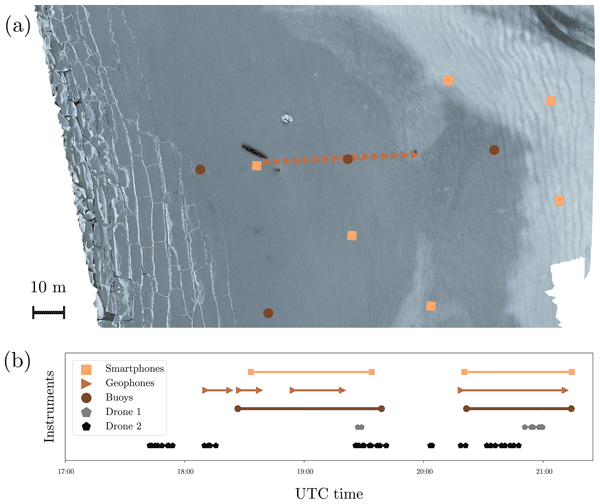
During February and March 2024, we realized a multi-instrument field campaign in the St. Lawrence Estuary, to capture swell-driven sea ice fragmentation. The dataset combines geophones, wave buoys, smartphones, and video recordings with drones, to study wave-ice interactions under natural conditions. It enables analysis of ice thickness, wave properties, and ice motion. Preliminary results show strong consistency across instruments, offering a valuable resource to improve sea ice models.
Elie Dumas-Lefebvre and Dany Dumont
The Cryosphere, 17, 827–842, https://doi.org/10.5194/tc-17-827-2023, https://doi.org/10.5194/tc-17-827-2023, 2023
Short summary
Short summary
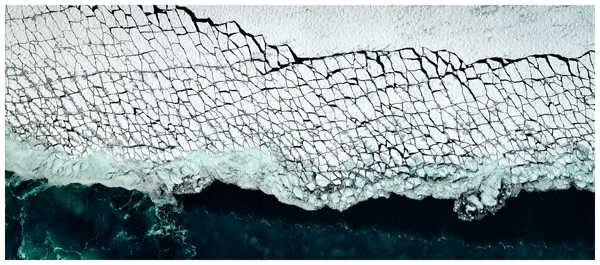
By changing the shape of ice floes, wave-induced sea ice breakup dramatically affects the large-scale dynamics of sea ice. As this process is also the trigger of multiple others, it was deemed relevant to study how breakup itself affects the ice floe size distribution. To do so, a ship sailed close to ice floes, and the breakup that it generated was recorded with a drone. The obtained data shed light on the underlying physics of wave-induced sea ice breakup.
Flavienne Bruyant, Rémi Amiraux, Marie-Pier Amyot, Philippe Archambault, Lise Artigue, Lucas Barbedo de Freitas, Guislain Bécu, Simon Bélanger, Pascaline Bourgain, Annick Bricaud, Etienne Brouard, Camille Brunet, Tonya Burgers, Danielle Caleb, Katrine Chalut, Hervé Claustre, Véronique Cornet-Barthaux, Pierre Coupel, Marine Cusa, Fanny Cusset, Laeticia Dadaglio, Marty Davelaar, Gabrièle Deslongchamps, Céline Dimier, Julie Dinasquet, Dany Dumont, Brent Else, Igor Eulaers, Joannie Ferland, Gabrielle Filteau, Marie-Hélène Forget, Jérome Fort, Louis Fortier, Martí Galí, Morgane Gallinari, Svend-Erik Garbus, Nicole Garcia, Catherine Gérikas Ribeiro, Colline Gombault, Priscilla Gourvil, Clémence Goyens, Cindy Grant, Pierre-Luc Grondin, Pascal Guillot, Sandrine Hillion, Rachel Hussherr, Fabien Joux, Hannah Joy-Warren, Gabriel Joyal, David Kieber, Augustin Lafond, José Lagunas, Patrick Lajeunesse, Catherine Lalande, Jade Larivière, Florence Le Gall, Karine Leblanc, Mathieu Leblanc, Justine Legras, Keith Lévesque, Kate-M. Lewis, Edouard Leymarie, Aude Leynaert, Thomas Linkowski, Martine Lizotte, Adriana Lopes dos Santos, Claudie Marec, Dominique Marie, Guillaume Massé, Philippe Massicotte, Atsushi Matsuoka, Lisa A. Miller, Sharif Mirshak, Nathalie Morata, Brivaela Moriceau, Philippe-Israël Morin, Simon Morisset, Anders Mosbech, Alfonso Mucci, Gabrielle Nadaï, Christian Nozais, Ingrid Obernosterer, Thimoté Paire, Christos Panagiotopoulos, Marie Parenteau, Noémie Pelletier, Marc Picheral, Bernard Quéguiner, Patrick Raimbault, Joséphine Ras, Eric Rehm, Llúcia Ribot Lacosta, Jean-François Rontani, Blanche Saint-Béat, Julie Sansoulet, Noé Sardet, Catherine Schmechtig, Antoine Sciandra, Richard Sempéré, Caroline Sévigny, Jordan Toullec, Margot Tragin, Jean-Éric Tremblay, Annie-Pier Trottier, Daniel Vaulot, Anda Vladoiu, Lei Xue, Gustavo Yunda-Guarin, and Marcel Babin
Earth Syst. Sci. Data, 14, 4607–4642, https://doi.org/10.5194/essd-14-4607-2022, https://doi.org/10.5194/essd-14-4607-2022, 2022
Short summary
Short summary
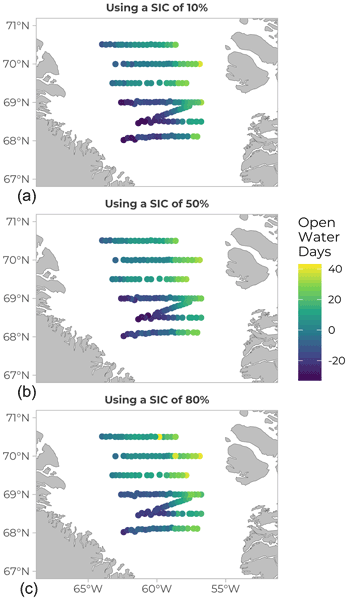
This paper presents a dataset acquired during a research cruise held in Baffin Bay in 2016. We observed that the disappearance of sea ice in the Arctic Ocean increases both the length and spatial extent of the phytoplankton growth season. In the future, this will impact the food webs on which the local populations depend for their food supply and fisheries. This dataset will provide insight into quantifying these impacts and help the decision-making process for policymakers.
Frédéric Dupont, Dany Dumont, Jean-François Lemieux, Elie Dumas-Lefebvre, and Alain Caya
The Cryosphere, 16, 1963–1977, https://doi.org/10.5194/tc-16-1963-2022, https://doi.org/10.5194/tc-16-1963-2022, 2022
Short summary
Short summary
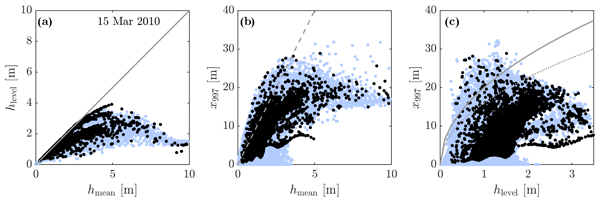
In some shallow seas, grounded ice ridges contribute to stabilizing and maintaining a landfast ice cover. A scheme has already proposed where the keel thickness varies linearly with the mean thickness. Here, we extend the approach by taking into account the ice thickness and bathymetry distributions. The probabilistic approach shows a reasonably good agreement with observations and previous grounding scheme while potentially offering more physical insights into the formation of landfast ice.
Cited articles
Ardhuin, F. and Roland, A.: Coastal wave reflection, directional spread, and seismoacoustic noise sources, J. Geophys. Res.-Oceans, 117, https://doi.org/10.1029/2011JC007832, 2012. a
Aretxabaleta, A. L., Doran, K. S., Long, J. W., Erikson, L. H., and Storlazzi, C. D.: Toward a national coastal hazard forecast of total water levels, in: Coastal Sediments 2019: Proceedings of the 9th International Conference, World Scientific, 1373–1384, https://doi.org/10.1142/9789811204487_0120, 2019. a
Avissar, R.: Conceptual aspects of a statistical-dynamical approach to represent landscape subgrid-scale heterogeneities in atmospheric models, J. Geophys. Res., 97, 2729–2742, 1992. a
Bandet, M., Caulet, C., Baudry, J., Didier, D., Dubuc, D., Marion, N., McKinnon, R., Paul-Hus, C., Caveen, J., Sévigny, C., Senneville, S., Dumont, D., and Bernatchez, P.: Programme de mesure et de modélisation de la morphodynamique de l’érosion et de la submersion côtière dans l’estuaire et le golfe du Saint-Laurent (MoDESCo), Phase III: rapport final. Chaire de recherche en géoscience côtière, Laboratoire de dynamique et de gestion intégrée des zones côtières, Université du Québec à Rimouski. Rapport remis au ministère de la sécurité publique du Québec, novembre 2020, 259 p., 2020. a
Barnard, P. L., van Ormondt, M., Erikson, L. H., Eshleman, J., Hapke, C., Ruggiero, P., Adams, P. N., and Foxgrover, A. C.: Development of the Coastal Storm Modeling System (CoSMoS) for predicting the impact of storms on high-energy, active-margin coasts, Nat. Hazards, 74, 1095–1125, 2014. a
Battjes, J. A. and Janssen, J.: Energy loss and set-up due to breaking of random waves, in: Coastal engineering 1978, 569–587, https://doi.org/10.1061/9780872621909.034, 1978. a
Bernatchez, P., Fraser, C., Lefaivre, D., and Dugas, S.: Integrating anthropogenic factors, geomorphological indicators and local knowledge in the analysis of coastal flooding and erosion hazards, Ocean Coast. Manage., 54, 621–632, https://doi.org/10.1016/j.ocecoaman.2011.06.001, 2011. a
Bernatchez, P., Dugas, S., Fraser, C., and Da Silva, L.: Évaluation économique des impacts potentiels de l'érosion des côtes du Québec maritime dans un contexte de changements climatiques, Ouranos, https://doi.org/10.1061/9780872621909.034, 2015. a
Bernatchez, P., Didier, D., Baudry, J., Dugas, S., and Dumont, D.: Developing a coastal hazard prediction system in ice-infested waters, part 1: High-resolution regional wave modeling in the estuary and gulf of st. lawrence, Zenodo [data set], https://doi.org/10.5281/zenodo.22097470, 2026. a
Bertotti, L., Bidlot, J.-R., Bunney, C., Cavaleri, L., Delli Passeri, L., Gomez, M., Lefèvre, J.-M., Paccagnella, T., Torrisi, L., Valentini, A., and Vocino, A.: Performance of different forecast systems in an exceptional storm in the Western Mediterranean Sea, Q. J. Roy. Meteor. Soc., 138, 34–55, 2012. a
Birchler, J. J., Palmsten, M. L., Doran, K. S., Karwandyar, S., Pardun, J. M., Oades, E. M., Mulligan, R. P., and Whitehead-Zimmers, E. S.: Skill assessment of a total water level and coastal change forecast during the landfall of a hurricane, Coast. Eng., 193, 104590, https://doi.org/10.1016/j.coastaleng.2024.104590, 2024. a
Booij, N., Ris, R. C., and Holthuijsen, L. H.: A third-generation wave model for coastal regions: 1. Model description and validation, J. Geophys. Res.-Oceans, 104, 7649–7666, 1999. a
Boutin, G., Williams, T., Rampal, P., Olason, E., and Lique, C.: Wave–sea-ice interactions in a brittle rheological framework, The Cryosphere, 15, 431–457, https://doi.org/10.5194/tc-15-431-2021, 2021. a, b
Buehner, M., Morneau, J., and Charette, C.: Four-dimensional ensemble-variational data assimilation for global deterministic weather prediction, Nonlin. Processes Geophys., 20, 669–682, https://doi.org/10.5194/npg-20-669-2013, 2013. a
Campos, R., Alves, J., Soares, C. G., Guimaraes, L., and Parente, C.: Extreme wind-wave modeling and analysis in the south Atlantic ocean, Ocean Model., 124, 75–93, 2018. a
Campos, R. M. and Guedes Soares, C.: Comparison and assessment of three wave hindcasts in the North Atlantic Ocean, J. Oper. Oceanogr., 9, 26–44, 2016. a
Carrera, M. L., Bélair, S., and Bilodeau, B.: The Canadian land data assimilation system (CaLDAS): Description and synthetic evaluation study, J. Hydrometeorol., 16, 1293–1314, 2015. a
Ciavola, P., Ferreira, O., Haerens, P., Van Koningsveld, M., and Armaroli, C.: Storm impacts along European coastlines. Part 2: lessons learned from the MICORE project, Environ. Sci. Policy, 14, 924–933, 2011a. a
Ciavola, P., Ferreira, O., Haerens, P., Van Koningsveld, M., Armaroli, C., and Lequeux, Q.: Storm impacts along European coastlines. Part 1: The joint effort of the MICORE and ConHaz Projects, Environ. Sci. Policy, 14, 912–923, 2011b. a
Collins, C. and Rogers, W. E.: A source term for wave attenuation by sea ice in WAVEWATCH III®: IC4, Tech. rep., Tech. Rep. NRL/MR/7320–17-9726, 25 pp., https://www.researchgate.net/publication/318216170_A_Source_Term_for_Wave_Attenuation_by_Sea_Ice_in_WAVEWATCH_III_R_IC4 (last access: 25 August 2026), 2017. a, b, c
Côté, J., Desmarais, J.-G., Gravel, S., Méthot, A., Patoine, A., Roch, M., and Staniforth, A.: The operational CMC–MRB global environmental multiscale (GEM) model. Part II: Results, Mon. Weather Rev., 126, 1397–1418, 1998a. a
Côté, J., Gravel, S., Méthot, A., Patoine, A., Roch, M., and Staniforth, A.: The operational CMC–MRB global environmental multiscale (GEM) model. Part I: Design considerations and formulation, Mon. Weather Rev., 126, 1373–1395, 1998b. a
Didier, D., Baudry, J., Bernatchez, P., Dumont, D., Sadegh, M., Bismuth, E., Bandet, M., Dugas, S., and Sévigny, C.: Multihazard simulation for coastal flood mapping: Bathtub versus numerical modelling in an open estuary, Eastern Canada, J. Flood Risk Manag., 12, e12505, https://doi.org/10.1111/jfr3.12505, 2019. a, b
Didier, D., Caulet, C., Bandet, M., Bernatchez, P., Dumont, D., Augereau, E., Floc'h, F., and Delacourt, C.: Wave runup parameterization for sandy, gravel and platform beaches in a fetch-limited, large estuarine system, Cont. Shelf Res., 192, 104024, https://doi.org/10.1016/j.csr.2019.104024, 2020. a
Dumont, D.: Marginal ice zone dynamics: history, definitions and research perspectives, Phil. Trans. Royal Soc. A, 380, https://doi.org/10.1098/rsta.2021.0253, 2022. a, b
Essery, R., Best, M., Betts, R., Cox, P. M., and Taylor, C. M.: Explicit representation of subgrid heterogeneity in a GCM land surface scheme, J. Hydrometeorol., 4, 530–543, 2003. a
Forbes, D. L., Manson, G. K., Chagnon, R., Solomon, S. M., van der Sanden, J. J., and Lynds, T. L.: Nearshore ice and climate change in the southern Gulf of St. Lawrence, in: Ice in the environment, Proceedings 16th IAHR International Symposium on Ice, 344–351, https://www.researchgate.net/profile/Jj-Sanden/publication/264545064_Nearshore_ice_and_climate_change_in_the_southern_Gulf_of_St_Lawrence/links/5756c24408aef6cbe35f0ba4/Nearshore-ice-and-climate-change-in-the-southern-Gulf-of-St-Lawrence.pdf (last access: 25 August 2026), 2002. a
Friesinger, S. and Bernatchez, P.: Perceptions of Gulf of St. Lawrence coastal communities confronting environmental change: Hazards and adaptation, Québec, Canada, Ocean Coast. Manage., 53, 669–678, 2010. a
Galbraith, P., Sévigny, C., Bourgault, D., and Dumont, D.: Sea ice interannual variability and sensitivity to fall oceanic conditions and winter air temperature in the Gulf of St. Lawrence, Canada, J. Geophys. Res., 129, e2023JC020784, https://doi.org/10.1029/2023JC020784, 2024. a, b
Gallien, T. W.: Validated coastal flood modeling at Imperial Beach, California: Comparing total water level, empirical and numerical overtopping methodologies, Coast. Eng., 111, 95–104, 2016. a
Garzon, J. L., Ferreira, Ó., Zózimo, A., Fortes, C., Ferreira, A., Pinheiro, L., and Reis, M.: Development of a Bayesian networks-based early warning system for wave-induced flooding, Int. J. Disast. Risk Re., 96, 103931, https://doi.org/10.1016/j.ijdrr.2023.103931, 2023. a
GEBCO Bathymetric Compilation Group: GEBCO_2019 Grid, British Oceanographic Data Centre, National Oceanography Centre [data set], https://doi.org/10.5285/836f016a-33be-6ddc-e053-6c86abc0788e, 2019. a
George, E., Lunardi, B., Smith, A., Lehner, J., Wernette, P., and Houser, C.: Storm impact and recovery of a beach-dune system in Prince Edward Island, Geomorphology, 384, 107721, https://doi.org/10.1016/j.geomorph.2021.107721, 2021. a
Giorgi, F. and Avissar, R.: Representation of heterogeneity effects in earth system modeling: Experience from land surface modeling, Rev. Geophys., 35, 413–437, 1997. a
Goda, Y.: The observed joint distribution of periods and heights of sea waves, Coast. Eng., 227–246, https://doi.org/10.1061/9780872621909.013, 1978. a
Hasselmann, K., Barnett, T. P., Bouws, E., Carlson, H., Cartwright, D. E., Enke, K., Ewing, J., Gienapp, A., Hasselmann, D., Kruseman, P., Meerburg, A., Müller, P., Olbers, D., Richter, K., Sell, W., and Walden, H.: Measurements of wind-wave growth and swell decay during the Joint North Sea Wave Project (JONSWAP), Ergaenzungsheft zur Deutschen Hydrographischen Zeitschrift, Reihe A, 1973. a
Hasselmann, S., Hasselmann, K., Allender, J., and Barnett, T.: Computations and parameterizations of the nonlinear energy transfer in a gravity-wave specturm. Part II: Parameterizations of the nonlinear energy transfer for application in wave models, J. Phys. Oceanogr., 15, 1378–1391, 1985. a
Hoeke, R. K., McInnes, K. L., Kruger, J. C., McNaught, R. J., Hunter, J. R., and Smithers, S. G.: Widespread inundation of Pacific islands triggered by distant-source wind-waves, Global Planet. Change, 108, 128–138, 2013. a
Hundecha, Y., St-Hilaire, A., Ouarda, T., El Adlouni, S., and Gachon, P.: A nonstationary extreme value analysis for the assessment of changes in extreme annual wind speed over the Gulf of St. Lawrence, Canada, J. Appl. Meteorol. Clim., 47, 2745–2759, 2008. a
Hunke, E. C. and Dukowicz, J. K.: An elastic–viscous–plastic model for sea ice dynamics, J. Phys. Oceanogr., 27, 1849–1867, 1997. a
Hunke, E. C., Lipscomb, W. H., Turner, A. K., Jeffery, N., and Elliott, S.: CICE: the Los Alamos sea ice model documentation and software user’s manual, Version 4.1, LA-CC-06-012, T-3 Fluid Dynamics Group, Los Alamos National Laboratory, Vol. 675, 500 pp., 2010. a
IBC: Severe Weather Caused $1.3 Billion in Insured Damage in 2019, https://www.ibc.ca/news-insights/news/severe-weather-caused-1-3-billion-in-insured-damage-in-2019 (last asscess: 30 September 2023), 2020. a
IBC: Insured Damages from Hurricane Fiona Now Over $800 Million, https://www.ibc.ca/news-insights/news/insured-damages-from-hurricane-fiona-now-over-800-million(last asscess: 30 September 2023), 2023. a
Idier, D., Bertin, X., Thompson, P., and Pickering, M. D.: Interactions between mean sea level, tide, surge, waves and flooding: mechanisms and contributions to sea level variations at the coast, Surv. Geophys., 40, 1603–1630, 2019. a
Jardine, D. E., Wang, X., and Fenech, A. L.: Highwater mark collection after post tropical storm Dorian and implications for Prince Edward Island, Canada, Water, 13, 3201, https://doi.org/10.3390/w13223201, 2021. a, b
Leijnse, T. W., van Dongeren, A., van Ormondt, M., de Goede, R., and Aerts, J. C.: The importance of waves in large-scale coastal compound flooding: A case study of Hurricane Florence (2018), Coast. Eng., 199, 104726, https://doi.org/10.1016/j.coastaleng.2025.104726, 2025. a
Lesser, G. R., Roelvink, J. A., van Kester, J. A. T. M., and Stelling, G. S.: Development and validation of a three-dimensional morphological model, Coast. Eng., 51, 883–915, 2004. a
Li, S., Wahl, T., Barroso, A., Coats, S., Dangendorf, S., Piecuch, C., Sun, Q., Thompson, P., and Liu, L.: Contributions of different sea-level processes to high-tide flooding along the US Coastline, J. Geophys. Res.-Oceans, 127, e2021JC018276, https://doi.org/10.1029/2021JC018276, 2022. a
Lin, S., Sheng, J., and Xing, J.: Performance evaluation of parameterizations for wind input and wave dissipation in the spectral wave model for the northwest Atlantic Ocean, Atmos. Ocean, 58, 258–286, 2020. a
Long, Z., Perrie, W., Chassé, J., Brickman, D., Guo, L., Drozdowski, A., and Hu, H.: Impacts of climate change in the Gulf of St. Lawrence, Atmos. Ocean, 54, 337–351, 2016. a
Longuet-Higgins, M. S.: On the joint distribution of wave periods and amplitudes in a random wave field, P. R. Soc. London A, 389, 241–258, 1983. a
Madec, G. and the NEMO team: NEMO ocean engine, Earth Prints, Note du Pôle de modélisation, Institut Pierre-Simon Laplace (IPSL), France, No 27, ISSN No 1288–1619, 2017. a
Manson, G. K., Davidson-Arnott, R. G., and Ollerhead, J.: Attenuation of wave energy by nearshore sea ice: Prince Edward Island, Canada, J. Coast. Res., 32, 253–263, 2016. a
McCall, R., Masselink, G., Poate, T., Roelvink, J., and Almeida, L.: Modelling the morphodynamics of gravel beaches during storms with XBeach-G, Coast. Eng., 103, 52–66, 2015. a
Myslenkov, S., Zelenko, A., Resnyanskii, Y., Arkhipkin, V., and Silvestrova, K.: Quality of the wind wave forecast in the Black Sea including storm wave analysis, Sustainability, 13, 13099, https://doi.org/10.3390/su132313099, 2021. a
Nakanowatari, T., Xie, J., Bertino, L., Matsueda, M., Yamagami, A., and Inoue, J.: Ensemble forecast experiments of summertime sea ice in the Arctic Ocean using the TOPAZ4 ice-ocean data assimilation system, Environ. Res., 209, 112769, https://doi.org/10.1016/j.envres.2022.112769, 2022. a
Orviku, K., Jaagus, J., Kont, A., Ratas, U., and Rivis, R.: Increasing activity of coastal processes associated with climate change in Estonia, J. Coastal Res., 19, 364–375, 2003. a
Perrie, W., Long, Z., Chassé, J., Blokhina, M., Guo, L., and Hu, H.: Projected changes in surface air temperature and surface wind in the Gulf of St. Lawrence, Atmos. Ocean, 53, 571–581, 2015. a
Peterson, K., Smith, G., Lemieux, J., Roy, F., Buehner, M., Caya, A., Houtekamer, P., Lin, H., Muncaster, R., Deng, X., Dupont, F., Gagnon, N., Hata, Y., Martinez, Y., Fontecilla, Juan S., and Surcel-Colan, D.: Understanding sources of Northern Hemisphere uncertainty and forecast error in a medium-range coupled ensemble sea-ice prediction system, QJ Roy. Meteor. Soc., 148, 2877–2902, 2022. a
Poelhekke, L., Jäger, W. S., Van Dongeren, A., Plomaritis, T. A., McCall, R., and Ferreira, Ó.: Predicting coastal hazards for sandy coasts with a Bayesian Network, Coast. Eng., 118, 21–34, 2016. a
Roelvink, D., Reniers, A., Van Dongeren, A., De Vries, J. V. T., McCall, R., and Lescinski, J.: Modelling storm impacts on beaches, dunes and barrier islands, Coast. Eng., 56, 1133–1152, 2009. a
Röhrs, J., Gusdal, Y., Rikardsen, E. S. U., Durán Moro, M., Brændshøi, J., Kristensen, N. M., Fritzner, S., Wang, K., Sperrevik, A. K., Idžanović, M., Lavergne, T., Debernard, J. B., and Christensen, K. H.: Barents-2.5km v2.0: an operational data-assimilative coupled ocean and sea ice ensemble prediction model for the Barents Sea and Svalbard, Geosci. Model Dev., 16, 5401–5426, https://doi.org/10.5194/gmd-16-5401-2023, 2023. a, b
Ruest, B., Neumeier, U., Dumont, D., Bismuth, E., Senneville, S., and Caveen, J.: Recent wave climate and expected future changes in the seasonally ice-infested waters of the Gulf of St. Lawrence, Canada, Clim. Dyman., 46, 449–466, 2016. a
Ryabchuk, D., Kolesov, A., Chubarenko, B., Spiridonov, M., Kurennoy, D., and Soomere, T.: Coastal erosion processes in the eastern Gulf of Finland and their links with geological and hydrometeorological factors, Boreal Environ. Res., 16, Suppl. A, 117–137, 2011. a
Saha, S., Moorthi, S., Pan, H.-L., Wu, X., Wang, J., Nadiga, S., Tripp, P., Kistler, R., Woollen, J., Behringer, D., Liu, H., Stokes, D., Grumbine, R., Gayno, G., Wang, J., Hou, Y.-T., Chuang, H.-y., Juang, H.-M. H., Sela, J., Iredell, M., Treadon, R., Kleist, D., Van Delst, P., Keyser, D., Derber, J., Ek, M., Meng, J., Wei, H., Yang, R., Lord, S., van den Dool, H., Kumar, A., Wang, W., Long, C., Chelliah, M., Xue, Y., Huang, B., Schemm, J.-K., Ebisuzaki, W., Lin, R., Xie, P., Chen, M., Zhou, S., Higgins, W., Zou, C.-Z., Liu, Q., Chen, Y., Han, Y., Cucurull, L., Reynolds, R. W., Rutledge, G., and Goldberg, M.: The NCEP climate forecast system reanalysis, B. Am. Meteorol. Soc., 91, 1015–1058, 2010. a
Sallenger Jr., A. H.: Storm impact scale for barrier islands, J. Coastal Res., 16, 890–895, 2000. a
Serafin, K. A., Ruggiero, P., and Stockdon, H. F.: The relative contribution of waves, tides, and nontidal residuals to extreme total water levels on US West Coast sandy beaches, Geophys. Res. Lett., 44, 1839–1847, 2017. a
Smith, G. C., Roy, F., Reszka, M., Surcel Colan, D., He, Z., Deacu, D., Belanger, J.-M., Skachko, S., Liu, Y., Dupont, F., Lemieux, J.-F., Beaudoin, C., Tranchant, B., Drévillon, M., Garric, G., Testut, C.-E., Lellouche, J.-M., Pellerin, P., Ritchie, H., Lu, Y., Davidson, F., Buehner, M., Caya, A., and Lajoie, M.: Sea ice forecast verification in the Canadian global ice ocean prediction system, Q. J. Roy. Meteor. Soc., 142, 659–671, 2016. a
Soomere, T.: Wind wave statistics in Tallinn Bay, Boreal Environ. Res., 10, 103–118, 2005. a
Statistics Canada: Table 38-10-0170-01 Coastal population and dwellings by elevation and distance from coastline, Statistics Canada [data set], https://doi.org/10.25318/3810017001-ENG, 2024. a
Stockdon, H. F., Holman, R. A., Howd, P. A., and Sallenger, A. H.: Empirical parameterization of setup, swash, and runup, Coast. Eng., 53, 573–588, https://doi.org/10.1016/j.coastaleng.2005.12.005, 2006. a
Stockdon, H. F., Long, J. W., Palmsten, M. L., Van der Westhuysen, A., Doran, K. S., and Snell, R. J.: Operational forecasts of wave-driven water levels and coastal hazards for US Gulf and Atlantic coasts, Communications Earth & Environment, 4, 169, https://doi.org/10.1038/s43247-023-00817-2, 2023. a, b
Stopa, J. E., Sutherland, P., and Ardhuin, F.: Strong and highly variable push of ocean waves on Southern Ocean sea ice, P. Natl. Acad. Sci. USA, 115, 5861–5865, https://doi.org/10.1073/pnas.1802011115, 2018. a
Strommen, K., Mayer, M., Storto, A., Spaeth, J., and Tietsche, S.: The impact of stochastic sea ice perturbations on seasonal forecasts, EGUsphere [preprint], https://doi.org/10.5194/egusphere-2025-6402, 2026. a
Sutherland, P. and Dumont, D.: Marginal ice zone thickness and extent due to wave radiation stress, J. Phys. Oceanogr., 48, 1885–1901, https://doi.org/10.1175/JPO-D-17-0167.1, 2018. a
Themault, J.-C., Petrie, B., Pepin, P., Gagnon, J., Gregory, D., Helbig, J., Herrnan, A., Lefaivre, D., Mitchell, M., Pelchat, B., Runge, J., and Sarneoto, D.: Proposal for a northwest Atlantic zonal monitoring program, Can. Tech. Rep. Hydrogr. Ocean Sci., 194, vii+57 p., 1998. a
Thomson, J.: Wave propagation in the marginal ice zone: connections and feedback mechanisms within the air–ice–ocean system, Philos. T. Roy. Soc. A, 380, 20210251, https://doi.org/10.1098/rsta.2021.0251, 2022. a
Tuomi, L., Kanarik, H., Björkqvist, J.-V., Marjamaa, R., Vainio, J., Hordoir, R., Höglund, A., and Kahma, K. K.: Impact of ice data quality and treatment on wave hindcast statistics in seasonally ice-covered seas, Frontiers in Earth Science, 7, 166, https://doi.org/10.3389/feart.2019.00166, 2019. a
Van Dongeren, A., Ciavola, P., Martinez, G., Viavattene, C., Bogaard, T., Ferreira, O., Higgins, R., and McCall, R.: Introduction to RISC-KIT: Resilience-increasing strategies for coasts, Coast. Eng., 134, 2–9, 2018. a
Wang, L., Perrie, W., Long, Z., Blokhina, M., Zhang, G., Toulany, B., and Zhang, M.: The impact of climate change on the wave climate in the Gulf of St. Lawrence, Ocean Model., 128, 87–101, 2018. a
Short summary
This two-part study explores the development of a short-term (up to 48 hours) coastal flood forecasting system along the Quebec coastline. The first part of the study focuses on wave prediction, a main contributor to coastal hazards. The key results of the study show that wave conditions can be accurately predicted during summer, however, the performances of the model in winter are considerably reduced, primarily because predicting sea ice conditions at fine spatial scales remains challenging.
This two-part study explores the development of a short-term (up to 48 hours) coastal flood...
Altmetrics
Final-revised paper
Preprint