
Articles | Volume 26, issue 8
https://doi.org/10.5194/nhess-26-3987-2026
© Author(s) 2026. This work is distributed under
the Creative Commons Attribution 4.0 License.
the Creative Commons Attribution 4.0 License.
https://doi.org/10.5194/nhess-26-3987-2026
© Author(s) 2026. This work is distributed under
the Creative Commons Attribution 4.0 License.
the Creative Commons Attribution 4.0 License.
Research article
| 
21 Aug 2026
Research article |
| 21 Aug 2026
| 21 Aug 2026
Impact of extreme rainfall on triggering conditions and susceptibility for shallow landslides: a case study in the Alpes-Maritimes region (France)
Lucie Armand
CORRESPONDING AUTHOR

Univ. Grenoble Alpes, INRAE, CNRS, IRD, Grenoble INP, IGE, 38000 Grenoble, France
BRGM, 45060 Orléans, France
Guillaume Chambon
Univ. Grenoble Alpes, INRAE, CNRS, IRD, Grenoble INP, IGE, 38000 Grenoble, France
Olivier Cerdan
BRGM, 45060 Orléans, France
Yannick Thiery
BRGM, 33600 Pessac, France
Nathalie Marçot
BRGM, 13276 Marseille, France
Louis Ferradou
BRGM, 13276 Marseille, France
Nicolas Saby
INRAE, Unité Info&Sol, 45075 Orléans, France
Séverine Bernardie
BRGM, 45060 Orléans, France
Related authors
No articles found.
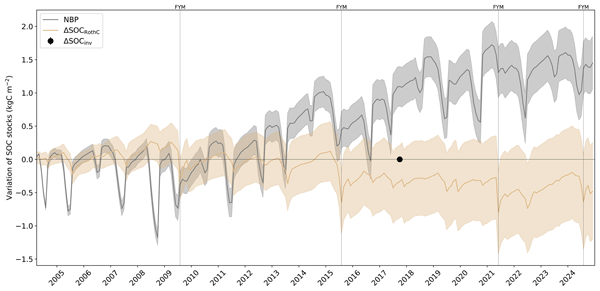
Quentin Beauclaire, Bernard Longdoz, Laura Delhez, Bruna Winck, Benjamin Loubet, Yue Zhou, Marmar Sabetizade, Neo Arquin, Nicolas Saby, and Bernard Heinesch
Biogeosciences, 23, 7345–7374, https://doi.org/10.5194/bg-23-7345-2026, https://doi.org/10.5194/bg-23-7345-2026, 2026
Short summary
Short summary
We studied how soil organic carbon stocks changed over 21 years in a Belgian cropland by combining soil sampling, a soil carbon model, and measurements from a flux tower. The soil appeared mostly stable overall, but the flux-tower approach suggested much larger carbon losses than the other methods. Our results show that using several approaches together is important to better understand soil organic carbon changes and to identify farming practices that either build up or reduce soil carbon.

Mohit Mishra, Gildas Besançon, Guillaume Chambon, and Laurent Baillet
Nat. Hazards Earth Syst. Sci., 26, 1621–1633, https://doi.org/10.5194/nhess-26-1621-2026, https://doi.org/10.5194/nhess-26-1621-2026, 2026
Short summary
Short summary
This work was initiated in the context of a large interdisciplinary research project about Risk at Grenoble University, France. It relates to the challenging topic of landslide monitoring, and combines geotechnical sciences with techniques from control system engineering. Considering a specific modelling approach, the study provides a methodology towards estimation of some landslide parameters and their use in motion prediction. This could then be extended to the design of alert systems.
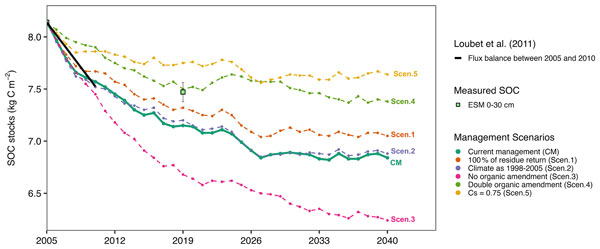
Benjamin Loubet, Nicolas P. A. Saby, Bruna Winck, Maryam Gebleh, Pauline Buysse, Jean-Philippe Chenu, Céline Ratié, Claudy Jolivet, Carmen Kalalian, Florent Levavasseur, Jose-Luis Munera-Echeverri, Sébastien Lafont, Denis Loustau, Dario Papale, Giacomo Nicolini, and Dominique Arrouays
Biogeosciences, 23, 2059–2077, https://doi.org/10.5194/bg-23-2059-2026, https://doi.org/10.5194/bg-23-2059-2026, 2026
Short summary
Short summary
Soil is a large pool of carbon storing globally, from 2 to 3 times more carbon than the atmosphere and vegetation. We measure the soil stock change from 2005 to 2019 at the ICOS crop site FR-Gri near Paris. The soil carbon stock decreased by approximately 72 ± 17 g C m-2 yr-1 over the period, resulting in a total loss of around 8% of the initial soil stock. This strong destocking is primarily attributed to a decrease in residue return and organic amendments to the site.
Simon Filhol, Clément Misset, Noélie Bontemps, Diego Cusicanqui, Emmanuel Paquet, Marie Dumont, Olivier Gagliardini, Pascal Lacroix, Simon Gascoin, Guillaume Thirel, Julien Brondex, Pascal Hagenmuller, Eric Larose, Philipp Schoeneich, Denis Roy, Emmanuel Thibert, Nicolas Eckert, Félix de Montety, Robin Mainieri, Alexandre Hauet, Frédéric Gottardi, Johan Berthet, Alexandre Baratier, Frédéric Liébault, Małgorzata Chmiel, Guillaume Piton, Guillaume Chambon, Guillaume James, Philippe Frey, Philip Deline, Laurent Astrade, Christian Vincent, Dominique Laigle, Alain Recking, Fatima Karbou, Adrien Mauss, Mylène Bonnefoy-Demongeot, Firmin Fontaine, Mickael Langlais, Etienne Berthier, and Antoine Blanc
EGUsphere, https://doi.org/10.5194/egusphere-2026-971, https://doi.org/10.5194/egusphere-2026-971, 2026
Short summary
Short summary
On June 21 2024, the village of La Bérarde, in the French Alps, was devastated by a flood destroying centuries old buildings. This study is an interdisciplinary work to decipher the causes and chronology of the event. The flood started with decadal rain falling on a thick snowpack. A lake observed on top of a glacier few days prior, had drained post event. With climate change, should we expect more similar compound events for alpine communities?
Anna Wirbel, Felix Oesterle, Guillaume Chambon, Thierry Faug, Johan Gaume, Julia Glaus, Stefan Hergarten, Dieter Issler, Yoichi Ito, Marco Martini, Martin Mergili, Matthias Rauter, Jörg Robl, Giorgio Rosatti, Kae Tsunematsu, Christian Tollinger, Hervé Vicari, Daniel Zugliani, and Jan-Thomas Fischer
EGUsphere, https://doi.org/10.5194/egusphere-2025-6053, https://doi.org/10.5194/egusphere-2025-6053, 2026
This preprint is open for discussion and under review for Geoscientific Model Development (GMD).
Short summary
Short summary
We present the first extended intercomparison of snow avalanche flow simulation tools. In this pilot-study, simulation results of mainly thickness/depth-integrated shallow flow models are compared for three simple test cases representative of standard applications. This analysis serves as a first quantitative assessment of the uncertainty introduced by the different implementation workflows (e.g., numerical schemes, ad-hoc treatments, geo-data handling, curvature treatment, etc.).
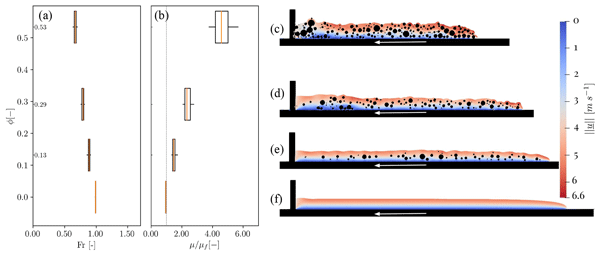
Suzanne Lapillonne, Georgios Fourtakas, Vincent Richefeu, Guillaume Piton, and Guillaume Chambon
Geosci. Model Dev., 18, 7059–7075, https://doi.org/10.5194/gmd-18-7059-2025, https://doi.org/10.5194/gmd-18-7059-2025, 2025
Short summary
Short summary
Debris flows are fast-flowing events that are saturated with granular material. They naturally occur in steep creeks and are a threat to local communities. Scientists have turned to numerical models to better understand how they behave. We investigate the accuracy of a numerical model that relies on modelling the debris flow as a mixture of a granular phase and a fluid phase. We focus on a demonstration of the capacity of the model to reliably represent the behaviour of the flow at different scales.
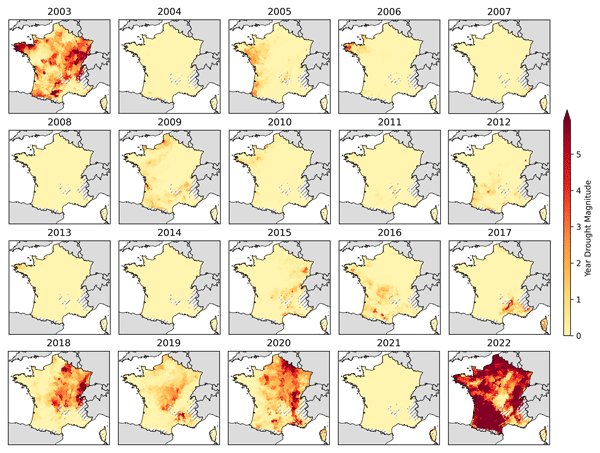
Sophie Barthelemy, Bertrand Bonan, Miquel Tomas-Burguera, Gilles Grandjean, Séverine Bernardie, Jean-Philippe Naulin, Patrick Le Moigne, Aaron Boone, and Jean-Christophe Calvet
Hydrol. Earth Syst. Sci., 29, 2321–2337, https://doi.org/10.5194/hess-29-2321-2025, https://doi.org/10.5194/hess-29-2321-2025, 2025
Short summary
Short summary
A drought index is developed that quantifies drought on an annual scale, making it applicable to monitoring clay shrinkage damage to buildings. A comparison with the number of insurance claims for subsidence shows that the presence of trees near individual houses must be taken into account. Significant soil moisture droughts occurred in France in 2003, 2018, 2019, 2020, and 2022. Particularly high index values are observed in 2022. It is found that droughts will become more severe in the future.
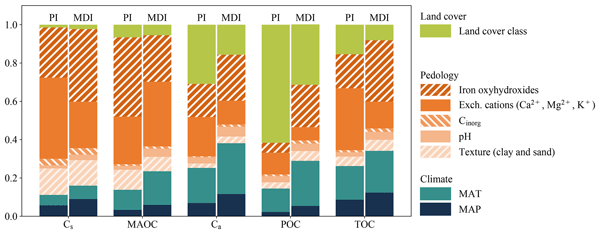
Amicie A. Delahaie, Lauric Cécillon, Marija Stojanova, Samuel Abiven, Pierre Arbelet, Dominique Arrouays, François Baudin, Antonio Bispo, Line Boulonne, Claire Chenu, Jussi Heinonsalo, Claudy Jolivet, Kristiina Karhu, Manuel Martin, Lorenza Pacini, Christopher Poeplau, Céline Ratié, Pierre Roudier, Nicolas P. A. Saby, Florence Savignac, and Pierre Barré
SOIL, 10, 795–812, https://doi.org/10.5194/soil-10-795-2024, https://doi.org/10.5194/soil-10-795-2024, 2024
Short summary
Short summary
This paper compares the soil organic carbon fractions obtained from a new thermal fractionation scheme and a well-known physical fractionation scheme on an unprecedented dataset of French topsoil samples. For each fraction, we use a machine learning model to determine its environmental drivers (pedology, climate, and land cover). Our results suggest that these two fractionation schemes provide different fractions, which means they provide complementary information.
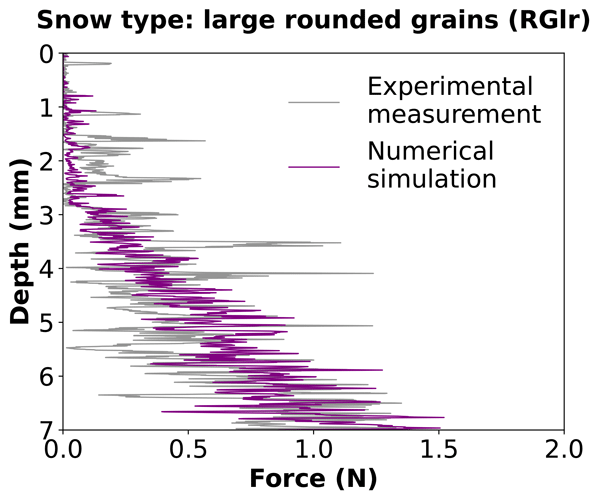
Clémence Herny, Pascal Hagenmuller, Guillaume Chambon, Isabel Peinke, and Jacques Roulle
The Cryosphere, 18, 3787–3805, https://doi.org/10.5194/tc-18-3787-2024, https://doi.org/10.5194/tc-18-3787-2024, 2024
Short summary
Short summary
This paper presents the evaluation of a numerical discrete element method (DEM) by simulating cone penetration tests in different snow samples. The DEM model demonstrated a good ability to reproduce the measured mechanical behaviour of the snow, namely the force evolution on the cone and the grain displacement field. Systematic sensitivity tests showed that the mechanical response depends not only on the microstructure of the sample but also on the mechanical parameters of grain contacts.
Saoirse Robin Goodwin, Thierry Faug, and Guillaume Chambon
Nat. Hazards Earth Syst. Sci. Discuss., https://doi.org/10.5194/nhess-2024-123, https://doi.org/10.5194/nhess-2024-123, 2024
Preprint withdrawn
Short summary
Short summary
This paper considers how we can objectivity define stoppage of numerically-modelled snow avalanches. When modelling real topographies, numerically-modelled avalanche snow velocities typically do not converge to 0, so stoppage is defined with arbitrary criteria, which must be tuned on a case-by-case basis. We propose a new objective arrest criterion based on local flow properties, in tandem with a newly-implemented physical yielding criterion.
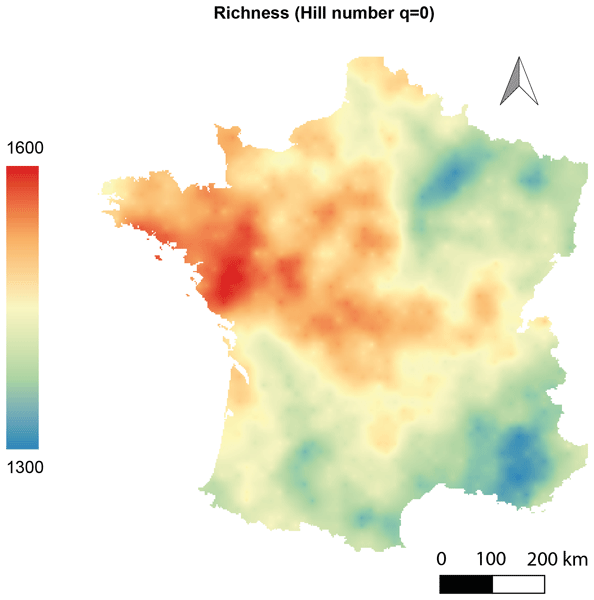
Christophe Djemiel, Samuel Dequiedt, Walid Horrigue, Arthur Bailly, Mélanie Lelièvre, Julie Tripied, Charles Guilland, Solène Perrin, Gwendoline Comment, Nicolas P. A. Saby, Claudy Jolivet, Antonio Bispo, Line Boulonne, Antoine Pierart, Patrick Wincker, Corinne Cruaud, Pierre-Alain Maron, Sébastien Terrat, and Lionel Ranjard
SOIL, 10, 251–273, https://doi.org/10.5194/soil-10-251-2024, https://doi.org/10.5194/soil-10-251-2024, 2024
Short summary
Short summary
The fungal kingdom has been diversifying for more than 800 million years by colonizing a large number of habitats on Earth. Based on a unique dataset (18S rDNA meta-barcoding), we described the spatial distribution of fungal diversity at the scale of France and the environmental drivers by tackling biogeographical patterns. We also explored the fungal network interactions across land uses and climate types.
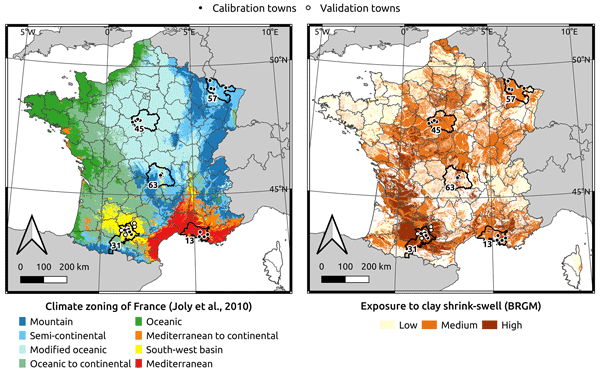
Sophie Barthelemy, Bertrand Bonan, Jean-Christophe Calvet, Gilles Grandjean, David Moncoulon, Dorothée Kapsambelis, and Séverine Bernardie
Nat. Hazards Earth Syst. Sci., 24, 999–1016, https://doi.org/10.5194/nhess-24-999-2024, https://doi.org/10.5194/nhess-24-999-2024, 2024
Short summary
Short summary
This work presents a drought index specifically adapted to subsidence, a seasonal phenomenon of soil shrinkage that occurs frequently in France and damages buildings. The index is computed from land surface model simulations and evaluated by a rank correlation test with insurance data. With its optimal configuration, the index is able to identify years of both zero and significant loss.
Amicie A. Delahaie, Pierre Barré, François Baudin, Dominique Arrouays, Antonio Bispo, Line Boulonne, Claire Chenu, Claudy Jolivet, Manuel P. Martin, Céline Ratié, Nicolas P. A. Saby, Florence Savignac, and Lauric Cécillon
SOIL, 9, 209–229, https://doi.org/10.5194/soil-9-209-2023, https://doi.org/10.5194/soil-9-209-2023, 2023
Short summary
Short summary
We characterized organic matter in French soils by analysing samples from the French RMQS network using Rock-Eval thermal analysis. We found that thermal analysis is appropriate to characterize large set of samples (ca. 2000) and provides interpretation references for Rock-Eval parameter values. This shows that organic matter in managed soils is on average more oxidized and more thermally stable and that some Rock-Eval parameters are good proxies for organic matter biogeochemical stability.

Alexandre M. J.-C. Wadoux, Nicolas P. A. Saby, and Manuel P. Martin
SOIL, 9, 21–38, https://doi.org/10.5194/soil-9-21-2023, https://doi.org/10.5194/soil-9-21-2023, 2023
Short summary
Short summary
We introduce Shapley values for machine learning model interpretation and reveal the local and global controlling factors of soil organic carbon (SOC) stocks. The method enables spatial analysis of the important variables. Vegetation and topography determine much of the SOC stock variation in mainland France. We conclude that SOC stock variation is complex and should be interpreted at multiple levels.
Marc Peruzzetto, Yoann Legendre, Aude Nachbaur, Thomas J. B. Dewez, Yannick Thiery, Clara Levy, and Benoit Vittecoq
Nat. Hazards Earth Syst. Sci., 22, 3973–3992, https://doi.org/10.5194/nhess-22-3973-2022, https://doi.org/10.5194/nhess-22-3973-2022, 2022
Short summary
Short summary
Volcanic edifices result from successive construction and dismantling phases. Thus, the geological units forming volcanoes display complex geometries. We show that such geometries can be reconstructed thanks to aerial views, topographic surveys and photogrammetric models. In our case study of the Samperre cliff (Martinique, Lesser Antilles), it allows us to link destabilizations from a rocky cliff to the existence of a filled paleo-valley and estimate a potentially unstable volume.
Edouard Patault, Valentin Landemaine, Jérôme Ledun, Arnaud Soulignac, Matthieu Fournier, Jean-François Ouvry, Olivier Cerdan, and Benoit Laignel
Hydrol. Earth Syst. Sci., 25, 6223–6238, https://doi.org/10.5194/hess-25-6223-2021, https://doi.org/10.5194/hess-25-6223-2021, 2021
Short summary
Short summary
The goal of this study was to assess the sediment discharge variability at a water treatment plant (Normandy, France) according to multiple realistic land use scenarios. We developed a new cascade modelling approach and simulations suggested that coupling eco-engineering and best farming practices can significantly reduce the sediment discharge (up to 80 %).
Cited articles
Achu, A. L., Thomas, J., Aju, C. D., Vijith, H., and Gopinath, G.: Redefining landslide susceptibility under extreme rainfall events using deep learning, Geomorphology, 448, 109033, https://doi.org/10.1016/j.geomorph.2023.109033, 2024.
Altmann, A., Toloşi, L., Sander, O., and Lengauer, T.: Permutation importance: a corrected feature importance measure, Bioinformatics, 26, 1340–1347, https://doi.org/10.1093/bioinformatics/btq134, 2010.
Arbizzi, S., Cinotti, B., Desbouis, J.-F., Moreau, L., Sauzey, P., and Vilmus, F.: Retour d'expérience des intempéries des 2 et 3 octobre 2020 dans les Alpes-Maritimes, https://www.igedd.developpement-durable.gouv.fr/IMG/pdf/013618-01_rapport-publie_cle57ddc8.pdf (last access: 27 July 2026), 2021.
Armaş, I., Vartolomei, F., Stroia, F., and Braşoveanu, L.: Landslide susceptibility deterministic approach using geographic information systems: application to Breaza town, Romania, Nat. Hazards, 70, 995–1017, https://doi.org/10.1007/s11069-013-0857-x, 2014.
Barthélemy, S., Bernardie, S., and Grandjean, G.: Assessing rainfall threshold for shallow landslides triggering: a case study in the Alpes Maritimes region, France, Nat. Hazards, https://doi.org/10.1007/s11069-024-06941-2, 2024.
Bisquert, A., Mainieri, R., Carladous, S., Robert, Y., Giacona, F., Verry, P., and Eckert, N.: La base de données événementielles RTM pour la connaissance des risques naturels en montagne : L'exemple du département de l'Isère (France), rga, 113–4, https://doi.org/10.4000/137kf, 2025.
Breiman, L.: Random Forest, Mach. Learn., 45, 5–32, https://doi.org/10.1023/A:1010933404324, 2001.
Caine, N.: The Rainfall Intensity – Duration Control of Shallow Landslides and Debris Flows, Geogr. Ann. A, 62, 23–27, https://doi.org/10.1080/04353676.1980.11879996, 1980.
Carrega, P. and Michelot, N.: Une catastrophe hors norme d'origine météorologique le 2 octobre 2020 dans les montagnes des Alpes-Maritimes, Physio-Geo, 1–70, https://doi.org/10.4000/physio-geo.12370, 2021.
Catani, F., Lagomarsino, D., Segoni, S., and Tofani, V.: Landslide susceptibility estimation by random forests technique: sensitivity and scaling issues, Nat. Hazards Earth Syst. Sci., 13, 2815–2831, https://doi.org/10.5194/nhess-13-2815-2013, 2013.
Chen, W., Xie, X., Wang, J., Pradhan, B., Hong, H., Bui, D. T., Duan, Z., and Ma, J.: A comparative study of logistic model tree, random forest, and classification and regression tree models for spatial prediction of landslide susceptibility, CATENA, 151, 147–160, https://doi.org/10.1016/j.catena.2016.11.032, 2017.
Chochon, R., Martin, N., Lebourg, T., and Vidal, M.: Analysis of Extreme Precipitation During the Mediterranean Event Associated with the Alex Storm in The Alpes-Maritimes: Atmospheric Mechanisms and Resulting Rainfall, in: Advances in Hydroinformatics, edited by: Gourbesville, P. and Caignaert, G., Springer Nature Singapore, Singapore, 397–418, https://doi.org/10.1007/978-981-19-1600-7_26, 2022.
Clapuyt, F., Vanacker, V., Christl, M., Van Oost, K., and Schlunegger, F.: Spatio-temporal dynamics of sediment transfer systems in landslide-prone Alpine catchments , Solid Earth, 10, 1489–1503, https://doi.org/10.5194/se-10-1489-2019, 2019.
Corominas, J., van Westen, C., Frattini, P., Cascini, L., Malet, J.-P., Fotopoulou, S., Catani, F., Van Den Eeckhaut, M., Mavrouli, O., Agliardi, F., Pitilakis, K., Winter, M. G., Pastor, M., Ferlisi, S., Tofani, V., Hervás, J., and Smith, J. T.: Recommendations for the quantitative analysis of landslide risk, B. Eng. Geol. Environ., 73, 209–263, https://doi.org/10.1007/s10064-013-0538-8, 2014.
Cruden, D. M. and Varnes, D. J.: Landslide Types and Processe, Special Report – National Research Council, Transportation Research Board, 247, 36–57, 1996.
Fell, R., Corominas, J., Bonnard, C., Cascini, L., Leroi, E., and Savage, W. Z.: Guidelines for landslide susceptibility, hazard and risk zoning for land use planning, Eng. Geol., 102, 85–98, https://doi.org/10.1016/j.enggeo.2008.03.022, 2008.
Fu, Y., Fan, Z., Li, X., Wang, P., Sun, X., Ren, Y., and Cao, W.: The Influence of Non-Landslide Sample Selection Methods on Landslide Susceptibility Prediction, Land, 14, 722, https://doi.org/10.3390/land14040722, 2025.
Gariano, S. L., Brunetti, M. T., Iovine, G., Melillo, M., Peruccacci, S., Terranova, O., Vennari, C., and Guzzetti, F.: Calibration and validation of rainfall thresholds for shallow landslide forecasting in Sicily, southern Italy, Geomorphology, 228, 653–665, https://doi.org/10.1016/j.geomorph.2014.10.019, 2015.
Gökceoglu, C. and Aksoy, H.: Landslide susceptibility mapping of the slopes in the residual soils of the Mengen region (Turkey) by deterministic stability analyses and image processing techniques, Eng. Geol., 44, 147–161, https://doi.org/10.1016/S0013-7952(97)81260-4, 1996.
Gonzalès, G.: Carte géologique harmonisée du département des Alpes-Maritimes – Notice géologique, BRGM, Rapport BRGM/RP-56161-FR, 393 pp., http://ficheinfoterre.brgm.fr/document/RP-56161-FR (last access: 17 August 2026), 2008.
Gonzalez, F. C. G., Cavacanti, M. D. C. R., Nahas Ribeiro, W., Mendonça, M. B. D., and Haddad, A. N.: A systematic review on rainfall thresholds for landslides occurrence, Heliyon, 10, e23247, https://doi.org/10.1016/j.heliyon.2023.e23247, 2024.
Gu, T., Li, J., Wang, M., Duan, P., Zhang, Y., and Cheng, L.: Study on landslide susceptibility mapping with different factor screening methods and random forest models, PLoS One, 18, e0292897, https://doi.org/10.1371/journal.pone.0292897, 2023.
Gu, T., Duan, P., Wang, M., Li, J., and Zhang, Y.: Effects of non-landslide sampling strategies on machine learning models in landslide susceptibility mapping, Sci. Rep., 14, 7201, https://doi.org/10.1038/s41598-024-57964-5, 2024.
Habets, F., Boone, A., Champeaux, J. L., Etchevers, P., Franchistéguy, L., Leblois, E., Ledoux, E., Le Moigne, P., Martin, E., Morel, S., Noilhan, J., Quintana Seguí, P., Rousset‐Regimbeau, F., and Viennot, P.: The SAFRAN‐ISBA‐MODCOU hydrometeorological model applied over France, J. Geophys. Res., 113, 2007JD008548, https://doi.org/10.1029/2007JD008548, 2008.
Iverson, R. M.: Landslide triggering by rain infiltration, Water Resour. Res., 36, 1897–1910, https://doi.org/10.1029/2000WR900090, 2000.
Iwahashi, J. and Pike, R. J.: Automated classifications of topography from DEMs by an unsupervised nested-means algorithm and a three-part geometric signature, Geomorphology, 86, 409–440, https://doi.org/10.1016/j.geomorph.2006.09.012, 2007.
Joly, D., Brossard, T., Cardot, H., Cavailhes, J., Hilal, M., and Wavresky, P.: Les types de climats en France, une construction spatiale, cybergeo, https://doi.org/10.4000/cybergeo.23155, 2010.
Jones, J. N., Boulton, S. J., Bennett, G. L., Stokes, M., and Whitworth, M. R. Z.: Temporal Variations in Landslide Distributions Following Extreme Events: Implications for Landslide Susceptibility Modeling, J. Geophys. Res.-Earth, 126, e2021JF006067, https://doi.org/10.1029/2021JF006067, 2021.
Lee, C.-T., Huang, C.-C., Lee, J.-F., Pan, K.-L., Lin, M.-L., and Dong, J.-J.: Statistical approach to storm event-induced landslides susceptibility, Nat. Hazards Earth Syst. Sci., 8, 941–960, https://doi.org/10.5194/nhess-8-941-2008, 2008.
Li, B., Liu, K., Wang, M., He, Q., Jiang, Z., Zhu, W., and Qiao, N.: Global Dynamic Rainfall-Induced Landslide Susceptibility Mapping Using Machine Learning, Remote Sens., 14, 5795, https://doi.org/10.3390/rs14225795, 2022.
Liébault, F., Melun, G., Piton, G., Chapuis, M., Passy, P., and Tacon, S.: Channel change during catastrophic flood: Example of Storm Alex in the Vésubie and Roya valleys, Geomorphology, 446, 109008, https://doi.org/10.1016/j.geomorph.2023.109008, 2024.
Lionello, P., Malanotte-Rizzoli, P., Boscolo, R., Alpert, P., Artale, V., Li, L. Z. X., May, W., Luterbacher, J. R., Trigo, R. M., Tsimplis, M., Ulbrich, U., and Xoplaki, E.: The Mediterranean climate: An overview of the main characteristics and issues, Developments in Earth and Environmental Sciences, 4, 1–26, https://doi.org/10.1016/S1571-9197(06)80003-0, 2006.
Lombardo, L., Cama, M., Maerker, M., and Rotigliano, E.: A test of transferability for landslides susceptibility models under extreme climatic events: application to the Messina 2009 disaster, Nat. Hazards, 74, 1951–1989, https://doi.org/10.1007/s11069-014-1285-2, 2014.
Lombardo, L., Opitz, T., Ardizzone, F., Guzzetti, F., and Huser, R.: Space-time landslide predictive modelling, Earth-Sci. Rev., 209, 103318, https://doi.org/10.1016/j.earscirev.2020.103318, 2020.
Lucas, T.: Proposition d'une carte de susceptibilité glissement de terrain sur le département des Alpes-Maritimes (06) dans le cadre de la réalisation d'un système de vigilance, Master GEE-GERINAT internship report, Aix-Marseille Université and BRGM, 8 pp., 2023.
Marra, F.: Rainfall thresholds for landslide occurrence: systematic underestimation using coarse temporal resolution data, Nat. Hazards, 95, 883–890, https://doi.org/10.1007/s11069-018-3508-4, 2019.
Melillo, M., Brunetti, M. T., Peruccacci, S., Gariano, S. L., and Guzzetti, F.: An algorithm for the objective reconstruction of rainfall events responsible for landslides, Landslides, 12, 311–320, https://doi.org/10.1007/s10346-014-0471-3, 2015.
Melillo, M., Brunetti, M. T., Peruccacci, S., Gariano, S. L., and Guzzetti, F.: Rainfall thresholds for the possible landslide occurrence in Sicily (Southern Italy) based on the automatic reconstruction of rainfall events, Landslides, 13, 165–172, https://doi.org/10.1007/s10346-015-0630-1, 2016.
Melillo, M., Brunetti, M. T., Peruccacci, S., Gariano, S. L., Roccati, A., and Guzzetti, F.: A tool for the automatic calculation of rainfall thresholds for landslide occurrence, Environ. Modell. Softw., 105, 230–243, https://doi.org/10.1016/j.envsoft.2018.03.024, 2018.
Montrasio, L. and Valentino, R.: A model for triggering mechanisms of shallow landslides, Nat. Hazards Earth Syst. Sci., 8, 1149–1159, https://doi.org/10.5194/nhess-8-1149-2008, 2008.
Moreno, M., Lombardo, L., Crespi, A., Zellner, P. J., Mair, V., Pittore, M., van Westen, C., and Steger, S.: Space-time data-driven modeling of precipitation-induced shallow landslides in South Tyrol, Italy, Sci. Total Environ., 912, 169166, https://doi.org/10.1016/j.scitotenv.2023.169166, 2024.
Ng, C. W. W., Yang, B., Liu, Z. Q., Kwan, J. S. H., and Chen, L.: Spatiotemporal modelling of rainfall-induced landslides using machine learning, Landslides, 18, 2499–2514, https://doi.org/10.1007/s10346-021-01662-0, 2021.
Nocentini, N., Rosi, A., Piciullo, L., Liu, Z., Segoni, S., and Fanti, R.: Regional-scale spatiotemporal landslide probability assessment through machine learning and potential applications for operational warning systems: a case study in Kvam (Norway), Landslides, 21, 2369–2387, https://doi.org/10.1007/s10346-024-02287-9, 2024.
Park, S. and Kim, J.: Landslide Susceptibility Mapping Based on Random Forest and Boosted Regression Tree Models, and a Comparison of Their Performance, Appl. Sci., 9, 942, https://doi.org/10.3390/app9050942, 2019.
Peres, D. J. and Cancelliere, A.: Comparing methods for determining landslide early warning thresholds: potential use of non-triggering rainfall for locations with scarce landslide data availability, Landslides, 18, 3135–3147, https://doi.org/10.1007/s10346-021-01704-7, 2021.
Pradhan, A. M. S. and Kim, Y. T.: Evaluation of a combined spatial multi-criteria evaluation model and deterministic model for landslide susceptibility mapping, CATENA, 140, 125–139, https://doi.org/10.1016/j.catena.2016.01.022, 2016.
Ran, Q., Hong, Y., Li, W., and Gao, J.: A modelling study of rainfall-induced shallow landslide mechanisms under different rainfall characteristics, J. Hydrol., 563, 790–801, https://doi.org/10.1016/j.jhydrol.2018.06.040, 2018.
Rebora, N., Molini, L., Casella, E., Comellas, A., Fiori, E., Pignone, F., Siccardi, F., Silvestro, F., Tanelli, S., and Parodi, A.: Extreme Rainfall in the Mediterranean: What Can We Learn from Observations?, J. Hydrometeorol., 14, 906–922, https://doi.org/10.1175/JHM-D-12-083.1, 2013.
Reichenbach, P., Rossi, M., Malamud, B. D., Mihir, M., and Guzzetti, F.: A review of statistically-based landslide susceptibility models, Earth-Sci. Rev., 180, 60–91, https://doi.org/10.1016/j.earscirev.2018.03.001, 2018.
Salee, R., Chinkulkijniwat, A., Yubonchit, S., Horpibulsuk, S., Wangfaoklang, C., and Soisompong, S.: New threshold for landslide warning in the southern part of Thailand integrates cumulative rainfall with event rainfall depth-duration, Nat. Hazards, 113, 125–141, https://doi.org/10.1007/s11069-022-05292-0, 2022.
Segoni, S., Piciullo, L., and Gariano, S. L.: A review of the recent literature on rainfall thresholds for landslide occurrence, Landslides, 15, 1483–1501, https://doi.org/10.1007/s10346-018-0966-4, 2018.
Shou, K.-J. and Lin, J.-F.: Evaluation of the extreme rainfall predictions and their impact on landslide susceptibility in a sub-catchment scale, Eng. Geol., 265, 105434, https://doi.org/10.1016/j.enggeo.2019.105434, 2020.
Steger, S., Moreno, M., Crespi, A., Luigi Gariano, S., Teresa Brunetti, M., Melillo, M., Peruccacci, S., Marra, F., De Vugt, L., Zieher, T., Rutzinger, M., Mair, V., and Pittore, M.: Adopting the margin of stability for space–time landslide prediction – A data-driven approach for generating spatial dynamic thresholds, Geosci. Front., 15, 101822, https://doi.org/10.1016/j.gsf.2024.101822, 2024.
Suleymanov, A., Richer-de-Forges, A. C., Saby, N. P. A., Arrouays, D., Martin, M. P., and Bispo, A.: National-scale digital soil mapping performances are related to covariates and sampling density: Lessons from France, Geoderma Regional, 37, e00801, https://doi.org/10.1016/j.geodrs.2024.e00801, 2024.
Sun, D., Wen, H., Wang, D., and Xu, J.: A random forest model of landslide susceptibility mapping based on hyperparameter optimization using Bayes algorithm, Geomorphology, 362, 107201, https://doi.org/10.1016/j.geomorph.2020.107201, 2020.
Suradi, M., Fourie, A. B., and Saynor, M. J.: An experimental and numerical study of a landslide triggered by an extreme rainfall event in northern Australia, Landslides, 13, 1125–1138, https://doi.org/10.1007/s10346-015-0606-1, 2016.
Taalab, K., Cheng, T., and Zhang, Y.: Mapping landslide susceptibility and types using Random Forest, Big Earth Data, 2, 159–178, https://doi.org/10.1080/20964471.2018.1472392, 2018.
Tabary, P., Dupuy, P., L'Henaff, G., Gueguen, C., Moulin, L., Laurentin, O., Merlier, C., and Soubeyroux, J.-M.: A 10-year (1997–2006) reanalysis of Quantitative Precipitation Estimation over France: methodology and first results, Iahs-Aish P, Symposium (Exeter 18 April 2011), https://iahs.info/uploads/dms/15900.047-255-260-351-73-IAHS_Tabary_et_a.pdf (last access: 17 August 2026), 2012.
Terlien, M. T. J.: The determination of statistical and deterministic hydrological landslide-triggering thresholds, Environ. Geol., 35, 124–130, https://doi.org/10.1007/s002540050299, 1998.
Thiery, Y.: Glissements de terrain: des catalogues d’événements et observations géomorphologiques à la modélisation spatiale de la susceptibilité et de l’aléa, Habilitation à diriger des recherches, Université de Caen Normandie, 2026, tel-05621963, https://hal.science/tel-05621963, last access: 17 August 2026.
Trigila, A., Iadanza, C., Esposito, C., and Scarascia-Mugnozza, G.: Comparison of Logistic Regression and Random Forests techniques for shallow landslide susceptibility assessment in Giampilieri (NE Sicily, Italy), Geomorphology, 249, 119–136, https://doi.org/10.1016/j.geomorph.2015.06.001, 2015.
Tsai, T.-L.: The influence of rainstorm pattern on shallow landslide, Environ. Geol., 53, 1563–1569, https://doi.org/10.1007/s00254-007-0767-x, 2008.
Weiss, A.: Topographic position and landforms analysis, Poster presentation, ESRI User Conference, 9–13 July 2001, San Diego, CA, USA, https://www.jennessent.com/arcview/TPI_Weiss_poster.htm (last access: 17 August 2026), 2001.
Xu, C., Xu, X., Dai, F., and Saraf, A. K.: Comparison of different models for susceptibility mapping of earthquake triggered landslides related with the 2008 Wenchuan earthquake in China, Computers & Geosciences, 46, 317–329, https://doi.org/10.1016/j.cageo.2012.01.002, 2012.
Zevenbergen, L. W. and Thorne, C. R.: Quantitative analysis of land surface topography, Earth Surf. Proc. Land., 12, 47–56, https://doi.org/10.1002/esp.3290120107, 1987.
Zhang, S., Li, L., Zhao, D., Ni, B., Qiang, Y., and Zheng, Z.: Stability and time-delay effect of rainfall-induced landslide considering air entrapment, Geoscience Letters, 9, 8, https://doi.org/10.1186/s40562-022-00216-z, 2022.
Zhou, X., Wen, H., Zhang, Y., Xu, J., and Zhang, W.: Landslide susceptibility mapping using hybrid random forest with GeoDetector and RFE for factor optimization, Geosci. Front., 12, 101211, https://doi.org/10.1016/j.gsf.2021.101211, 2021.
Short summary
This research examines how extreme-rainfall-induced landslides affect predictive tools for shallow landslides. Focusing on Storm Alex (France), we compared predictions with and without Alex-induced landslides. Results show that Alex-induced landslides do not follow the same triggering conditions as those observed during more frequent rainfalls, leading to different rainfall thresholds and susceptibility maps. This highlights the importance of accounting for rare events when predicting landslide.
This research examines how extreme-rainfall-induced landslides affect predictive tools for...


Altmetrics
Final-revised paper
Preprint