Articles | Volume 26, issue 6
https://doi.org/10.5194/nhess-26-2637-2026
Research article
 | 
05 Jun 2026
Research article |  | 05 Jun 2026

Quantifying the current and future likelihood of the 2022 extreme wildfire weather conditions in France with anthropogenic climate change

Shengling Zhu, Renaud Barbero, François Pimont, and Benjamin Renard

Related authors

Using artificial intelligence to monitor live fuel moisture content across France, based on a high-resolution land surface analysis
Yann Baehr, Pierre Vanderbecken, Bertrand Bonan, Catherine Robert, Mathieu Regimbeau, François Pimont, Kevyn Raynal, Xiangzhuo Liu, Remi Savazzi, Moncef Garouani, Josiane Mothe, Nemesio Rodriguez-Fernandez, Lionel Jarlan, and Jean-Christophe Calvet
EGUsphere, https://doi.org/10.5194/egusphere-2026-1247,https://doi.org/10.5194/egusphere-2026-1247, 2026
This preprint is open for discussion and under review for Natural Hazards and Earth System Sciences (NHESS).
Short summary
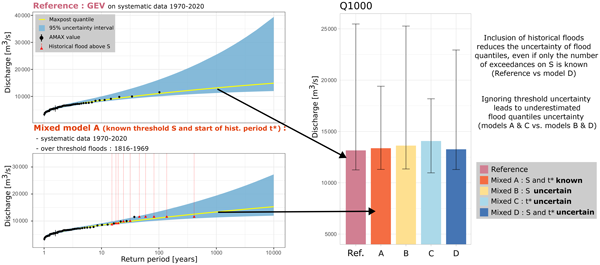
A Joint Space-Time Probabilistic Model for Agricultural Droughts, Hydrological Droughts and Fire Weather in France
Benjamin Renard, Renaud Barbero, Issa Goukouni, Jean-Philippe Vidal, Louise Mimeau, Carina Furusho-Percot, Iñaki García de Cortázar-Atauri, Maël Aubry, Thomas Opitz, and Denis Allard
EGUsphere, https://doi.org/10.5194/egusphere-2026-1406,https://doi.org/10.5194/egusphere-2026-1406, 2026
This preprint is open for discussion and under review for Natural Hazards and Earth System Sciences (NHESS).
Short summary
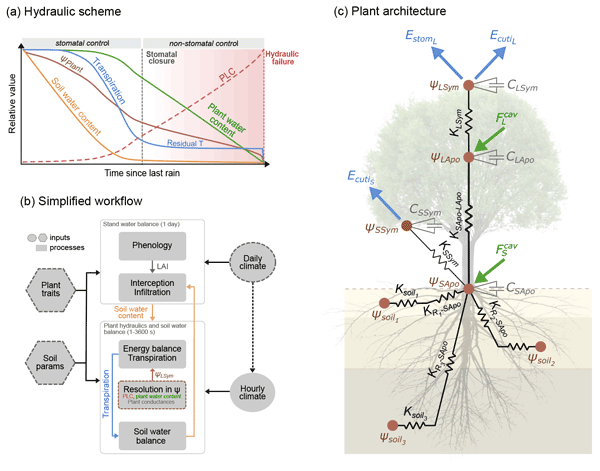
PHOREAU v1.0: a new process-based model to predict forest functioning, from tree ecophysiology to forest dynamics and biogeography
Tanguy Postic, François de Coligny, Isabelle Chuine, Louis Devresse, Daniel Berveiller, Hervé Cochard, Matthias Cuntz, Nicolas Delpierre, Émilie Joetzjer, Jean-Marc Limousin, Jean-Marc Ourcival, François Pimont, Julien Ruffault, Guillaume Simioni, Nicolas K. Martin-StPaul, and Xavier Morin
Geosci. Model Dev., 18, 7603–7679, https://doi.org/10.5194/gmd-18-7603-2025,https://doi.org/10.5194/gmd-18-7603-2025, 2025
Short summary
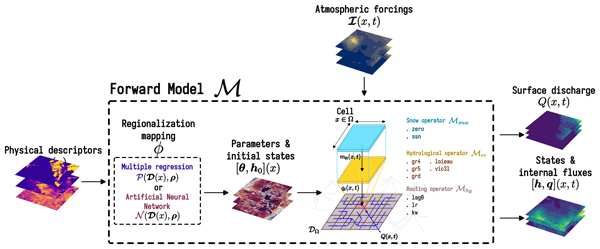
smash v1.0: a differentiable and regionalizable high-resolution hydrological modeling and data assimilation framework
François Colleoni, Ngo Nghi Truyen Huynh, Pierre-André Garambois, Maxime Jay-Allemand, Didier Organde, Benjamin Renard, Thomas De Fournas, Apolline El Baz, Julie Demargne, and Pierre Javelle
Geosci. Model Dev., 18, 7003–7034, https://doi.org/10.5194/gmd-18-7003-2025,https://doi.org/10.5194/gmd-18-7003-2025, 2025
Short summary
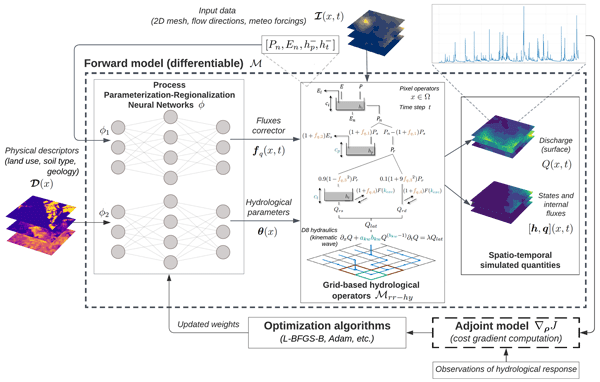
A distributed hybrid physics–AI framework for learning corrections of internal hydrological fluxes and enhancing high-resolution regionalized flood modeling
Ngo Nghi Truyen Huynh, Pierre-André Garambois, Benjamin Renard, François Colleoni, Jérôme Monnier, and Hélène Roux
Hydrol. Earth Syst. Sci., 29, 3589–3613, https://doi.org/10.5194/hess-29-3589-2025,https://doi.org/10.5194/hess-29-3589-2025, 2025
Short summary

Cited articles

Abatzoglou, J. T. and Williams, A. P.: Impact of anthropogenic climate change on wildfire across western US forests, P. Natl. Acad. Sci. USA, 113, 11770–11775, https://doi.org/10.1073/pnas.1607171113, 2016. a
Abatzoglou, J. T., Williams, A. P., and Barbero, R.: Global emergence of anthropogenic climate change in fire weather indices, Geophys. Res. Lett., 46, 326–336, https://doi.org/10.1029/2018GL080959, 2019. a
Abatzoglou, J. T., Kolden, C. A., Cullen, A. C., Sadegh, M., Williams, E. L., Turco, M., and Jones, M. W.: Climate change has increased the odds of extreme regional forest fire years globally, Nat. Commun., 16, 6390, https://doi.org/10.1038/s41467-025-61608-1, 2025. a
Angélil, O., Stone, D., Perkins-Kirkpatrick, S., Alexander, L. V., Wehner, M., Shiogama, H., Wolski, P., Ciavarella, A., and Christidis, N.: On the nonlinearity of spatial scales in extreme weather attribution statements, Clim. Dynam., 50, 2739–2752, https://doi.org/10.1007/s00382-017-3768-9, 2018. a, b
Balch, J. K., Abatzoglou, J. T., Joseph, M. B., Koontz, M. J., Mahood, A. L., McGlinchy, J., Cattau, M. E., and Williams, A. P.: Warming weakens the night-time barrier to global fire, Nature, 602, 442–448, https://doi.org/10.1038/s41586-021-04325-1, 2022. a
Download
Short summary
In 2022, southwestern France saw exceptional wildfires, burning an area about 14 times the regional average. Using fire records, weather data, and climate simulations with and without human influence, we show that human-caused climate change made the weather conditions linked to the 3 largest wildfires about 2 to 10 times more likely; such conditions could become roughly 10 to 100 times more probable by 2100 under moderate emissions, highlighting a growing need for prevention.
Share
Altmetrics
Final-revised paper
Preprint