
Articles | Volume 26, issue 1
https://doi.org/10.5194/nhess-26-251-2026
© Author(s) 2026. This work is distributed under
the Creative Commons Attribution 4.0 License.
the Creative Commons Attribution 4.0 License.
https://doi.org/10.5194/nhess-26-251-2026
© Author(s) 2026. This work is distributed under
the Creative Commons Attribution 4.0 License.
the Creative Commons Attribution 4.0 License.
Research article
| 
19 Jan 2026
Research article |
| 19 Jan 2026
| 19 Jan 2026
Econometric modelling for estimating direct flood damage to firms: a micro-scale approach using post-event records in Italy
Marta Ballocci
CORRESPONDING AUTHOR

University School for Advanced Studies, Pavia, Italy
Daniela Molinari
Dept. of Civil and Environmental Engineering DICA, Politecnico di Milano, Milano, Italy
Giovanni Marin
Department of Economics, Society, Politics, University of Urbino “Carlo Bo”, via Aurelio Saffi, 2, 61029 Urbino, Italy
Marta Galliani
University School for Advanced Studies, Pavia, Italy
Alessio Domeneghetti
Dept. of Civil, Chemical, Environmental and Materials Engineering, Alma Mater Studiorum – University of Bologna, Bologna, Italy
Giovanni Menduni
Dept. of Civil and Environmental Engineering DICA, Politecnico di Milano, Milano, Italy
Simone Sterlacchini
Institute of Environmental Geology & Geoengineering, National Research Council of Italy, Milano, Italy
Francesco Ballio
Dept. of Civil and Environmental Engineering DICA, Politecnico di Milano, Milano, Italy
Related authors
Sara Rrokaj, Chiara Arrighi, Marta Ballocci, Gabriele Bertoli, Francesca da Porto, Claudia De Lucia, Mario Di Bacco, Paola Di Fluri, Alessio Domeneghetti, Marco Donà, Alice Gallazzi, Andrea Gennaro, Mohammed Hammouti, Gianluca Lelli, Sara Mozzon, Natasha Petruccelli, Elisa Saler, Anna Rita Scorzini, Simone Sterlacchini, Gaia Treglia, Debora Voltolina, Marco Zazzeri, and Daniela Molinari
Earth Syst. Sci. Data, 17, 6487–6496, https://doi.org/10.5194/essd-17-6487-2025, https://doi.org/10.5194/essd-17-6487-2025, 2025
Short summary
Short summary
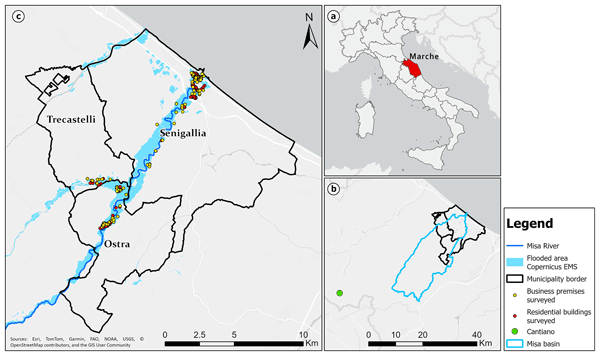
Flood damage data are key to understanding territorial risks and supporting the design of mitigation measures. However, such data are scarce, and the available ones often lack a high level of detail. We conducted a field survey of residential, commercial, and industrial premises affected by the record-breaking flood event that hit Italy’s Marche region in 2022. The resulting datasets cover 256 assets and include detailed information on damage, building features, and mitigation measures.
Sara Rrokaj, Chiara Arrighi, Marta Ballocci, Gabriele Bertoli, Francesca da Porto, Claudia De Lucia, Mario Di Bacco, Paola Di Fluri, Alessio Domeneghetti, Marco Donà, Alice Gallazzi, Andrea Gennaro, Mohammed Hammouti, Gianluca Lelli, Sara Mozzon, Natasha Petruccelli, Elisa Saler, Anna Rita Scorzini, Simone Sterlacchini, Gaia Treglia, Debora Voltolina, Marco Zazzeri, and Daniela Molinari
Earth Syst. Sci. Data, 17, 6487–6496, https://doi.org/10.5194/essd-17-6487-2025, https://doi.org/10.5194/essd-17-6487-2025, 2025
Short summary
Short summary
Flood damage data are key to understanding territorial risks and supporting the design of mitigation measures. However, such data are scarce, and the available ones often lack a high level of detail. We conducted a field survey of residential, commercial, and industrial premises affected by the record-breaking flood event that hit Italy’s Marche region in 2022. The resulting datasets cover 256 assets and include detailed information on damage, building features, and mitigation measures.
Pradeep Acharya, Mario Di Bacco, Daniela Molinari, and Anna Rita Scorzini
Nat. Hazards Earth Syst. Sci., 25, 4317–4330, https://doi.org/10.5194/nhess-25-4317-2025, https://doi.org/10.5194/nhess-25-4317-2025, 2025
Short summary
Short summary
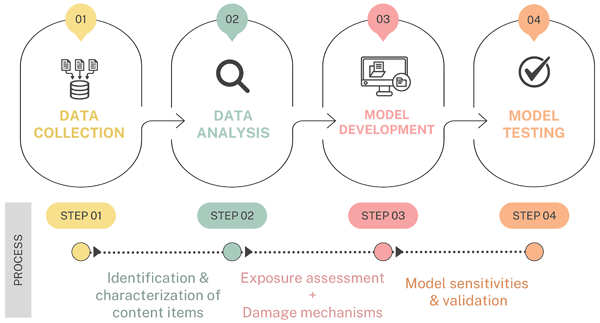
INSYDE-content is a novel probabilistic model designed to estimate flood damage to household contents. Based on a synthetic “what-if” approach, it integrates multiple input variables describing both exposed items and damage mechanisms, while accounting for uncertainty. The model expands the range of available tools for flood damage assessment by including an often overlooked asset in current literature.
Cristina Prieto, Dhruvesh Patel, Dawei Han, Benjamin Dewals, Michaela Bray, and Daniela Molinari
Nat. Hazards Earth Syst. Sci., 24, 3381–3386, https://doi.org/10.5194/nhess-24-3381-2024, https://doi.org/10.5194/nhess-24-3381-2024, 2024
Mario Di Bacco, Daniela Molinari, and Anna Rita Scorzini
Nat. Hazards Earth Syst. Sci., 24, 1681–1696, https://doi.org/10.5194/nhess-24-1681-2024, https://doi.org/10.5194/nhess-24-1681-2024, 2024
Short summary
Short summary
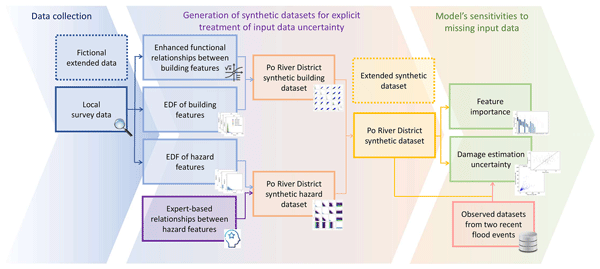
INSYDE 2.0 is a tool for modelling flood damage to residential buildings. By incorporating ultra-detailed survey and desk-based data, it improves the reliability and informativeness of damage assessments while addressing input data uncertainties.
Natasha Petruccelli, Luca Mantecchini, Alice Gallazzi, Daniela Molinari, Mohammed Hammouti, Marco Zazzeri, Simone Sterlacchini, Francesco Ballio, Armando Brath, and Alessio Domeneghetti
Proc. IAHS, 385, 407–413, https://doi.org/10.5194/piahs-385-407-2024, https://doi.org/10.5194/piahs-385-407-2024, 2024
Short summary
Short summary
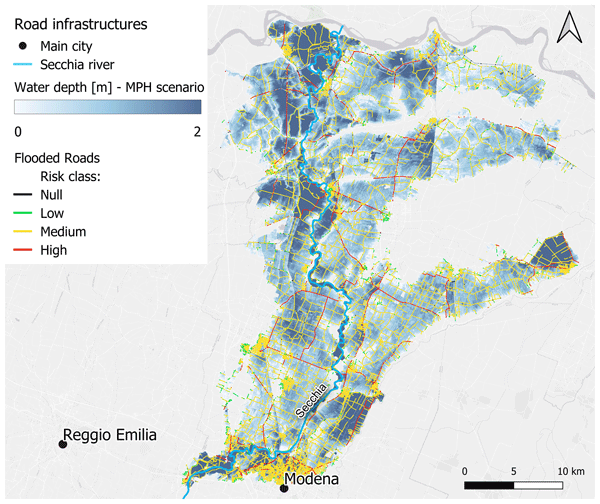
The study illustrates the methodology developed for flood risk assessment for road and railway infrastructures. Through the creation of a detailed database, using different data sources, and the definition of a risk matrix, a risk level (High, Medium, Low and Null) is assigned to each section, considering the physical and functional characteristics of the infrastructure, as well as its relevance and the magnitude of the expected event.
Chiara Arrighi and Alessio Domeneghetti
Nat. Hazards Earth Syst. Sci., 24, 673–679, https://doi.org/10.5194/nhess-24-673-2024, https://doi.org/10.5194/nhess-24-673-2024, 2024
Short summary
Short summary
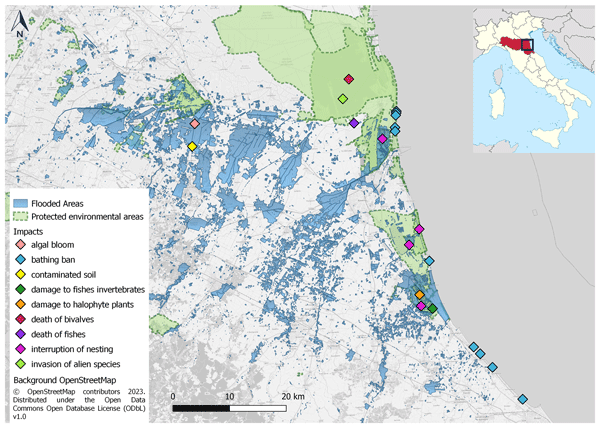
In this communication, we reflect on environmental flood impacts by analysing the reported environmental consequences of the 2023 Emilia-Romagna floods. The most frequently reported damage involves water resources and water-related ecosystems. Indirect effects in time and space, intrinsic recovery capacity, cascade impacts on socio-economic systems, and the lack of established monitoring activities appear to be the most challenging aspects for future research.
Panagiotis Asaridis and Daniela Molinari
Adv. Geosci., 61, 1–21, https://doi.org/10.5194/adgeo-61-1-2023, https://doi.org/10.5194/adgeo-61-1-2023, 2023
Short summary
Short summary
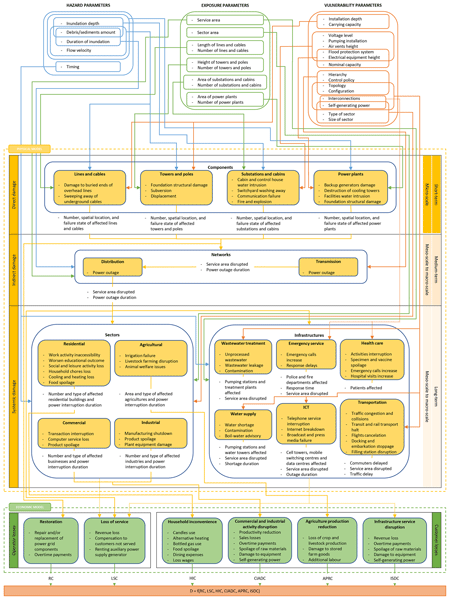
This paper presents a conceptual model for the estimation of flood damage to power grids and reviews the available methodologies, to better understand current modelling approaches, challenges, and limitations. The model adopts an interdisciplinary and multi-scale evaluation approach to handle the complex damage mechanisms and capture the cascading effects. In doing so, it adapts to different geographical and economic contexts, allowing stakeholders to implement comprehensive damage assessments.
Tommaso Simonelli, Laura Zoppi, Daniela Molinari, and Francesco Ballio
Nat. Hazards Earth Syst. Sci., 22, 1819–1823, https://doi.org/10.5194/nhess-22-1819-2022, https://doi.org/10.5194/nhess-22-1819-2022, 2022
Short summary
Short summary
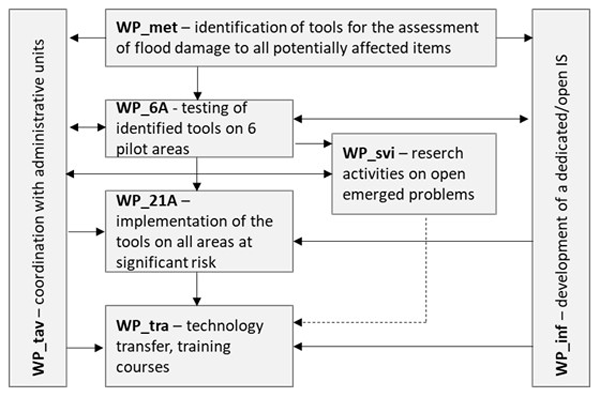
The paper discusses challenges (and solutions) emerged during a collaboration among practitioners, stakeholders, and scientists in the definition of flood damage maps in the Po River District. Social aspects were proven to be fundamental components of the risk assessment; variety of competences in the working group was key in finding solutions and revealing weaknesses of intermediate proposals. This paper finally highlights the need of duplicating such an experience at a broader European level.

Anna Rita Scorzini, Benjamin Dewals, Daniela Rodriguez Castro, Pierre Archambeau, and Daniela Molinari
Nat. Hazards Earth Syst. Sci., 22, 1743–1761, https://doi.org/10.5194/nhess-22-1743-2022, https://doi.org/10.5194/nhess-22-1743-2022, 2022
Short summary
Short summary
This study presents a replicable procedure for the adaptation of synthetic, multi-variable flood damage models among countries that may have different hazard and vulnerability features. The procedure is exemplified here for the case of adaptation to the Belgian context of a flood damage model, INSYDE, for the residential sector, originally developed for Italy. The study describes necessary changes in model assumptions and input parameters to properly represent the new context of implementation.
Animesh K. Gain, Yves Bühler, Pascal Haegeli, Daniela Molinari, Mario Parise, David J. Peres, Joaquim G. Pinto, Kai Schröter, Ricardo M. Trigo, María Carmen Llasat, and Heidi Kreibich
Nat. Hazards Earth Syst. Sci., 22, 985–993, https://doi.org/10.5194/nhess-22-985-2022, https://doi.org/10.5194/nhess-22-985-2022, 2022
Short summary
Short summary
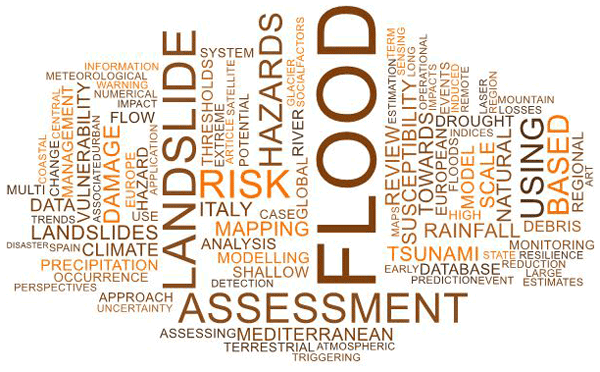
To mark the 20th anniversary of Natural Hazards and Earth System Sciences (NHESS), an interdisciplinary and international journal dedicated to the public discussion and open-access publication of high-quality studies and original research on natural hazards and their consequences, we highlight 11 key publications covering major subject areas of NHESS that stood out within the past 20 years.
Cited articles
Allaire, M.: Socio-economic impacts of flooding: A review of the empirical literature, Water Secur., 3, 18–26, https://doi.org/10.1016/j.wasec.2018.09.002, 2018.
Amadio, M., Mysiak, J., Carrera, L., and Koks, E.: Improving flood damage assessment models in Italy, Nat. Hazards, 82, 2075–2088, https://doi.org/10.1007/s11069-016-2286-0, 2016.
Amadio, M., Scorzini, A. R., Carisi, F., Essenfelder, A. H., Domeneghetti, A., Mysiak, J., and Castellarin, A.: Testing empirical and synthetic flood damage models: the case of Italy, Nat. Hazards Earth Syst. Sci., 19, 661–678, https://doi.org/10.5194/nhess-19-661-2019, 2019.
Arrighi, C., Brugioni, M., Castelli, F., Franceschini, S., and Mazzanti, B.: Urban micro-scale flood risk estimation with parsimonious hydraulic modelling and census data, Nat. Hazards Earth Syst. Sci., 13, 1375–1391, https://doi.org/10.5194/nhess-13-1375-2013, 2013.
Balbi, S., Giupponi, C., Olschewski, R., and Mojtahed, V.: The economics of hydro-meteorological disasters: approaching the estimation of the total costs, SSRN J., BC3 Working Paper Series 2013-12, https://doi.org/10.2139/ssrn.2317437, 2013.
Ballio, F., Molinari, D., Minucci, G., Mazuran, M., Arias Munoz, C., Menoni, S., Atun, F., Ardagna, D., Berni, N., and Pandolfo, C.: The RISPOSTA procedure for the collection, storage and analysis of high quality, consistent and reliable damage data in the aftermath of floods, J. Flood Risk Manag., 11, e12216, https://doi.org/10.1111/jfr3.12216, 2018.
Bari, M. A., Alam, L., Alam, M. M., Rahman, L. F., and Pereira, J. J.: Estimation of losses and damages caused by flash floods in the commercial area of Kajang, Selangor, Malaysia, Arab. J. Geosci., 14, 195, https://doi.org/10.1007/s12517-021-06503-x, 2021.
Booysen, H. J., Viljoen, M. F., and de Villiers, G. T.: Methodology for the calculation of industrial flood damage and its application to an industry in Vereeniging, Water SA, 25, 41–46, 1999.
Bremond, P., Grelot, F., and Tarrit, R.: Flood damage functions at national scale for activities: challenges and insights, Conference Abstracts 162, EGU General Assembly 2018, 2018.
Carisi, F., Schröter, K., Domeneghetti, A., Kreibich, H., and Castellarin, A.: Development and assessment of uni- and multivariable flood loss models for Emilia-Romagna (Italy), Nat. Hazards Earth Syst. Sci., 18, 2057–2079, https://doi.org/10.5194/nhess-18-2057-2018, 2018.
Cammerer, H., Thieken, A. H., and Lammel, J.: Adaptability and transferability of flood loss functions in residential areas, Nat. Hazards Earth Syst. Sci., 13, 3063–3081, https://doi.org/10.5194/nhess-13-3063-2013, 2013.
CGGD (Commissariat Général au Développement Durable – Ministère de la transition écologique et solidaire): Analyse multicritère des projets de prévention des inondations, Guide méthodologique 2018, March 2018.
Danish Coastal Authority: Development of a Model for the Assessment of Costs of Business Interruption, Technical report, Danish Coastal Authority, Denmark, 28 pp., 2017.
Dottori, F., Figueiredo, R., Martina, M. L. V., Molinari, D., and Scorzini, A. R.: INSYDE: a synthetic, probabilistic flood damage model based on explicit cost analysis, Nat. Hazards Earth Syst. Sci., 16, 2577–2591, https://doi.org/10.5194/nhess-16-2577-2016, 2016.
Endendijk, T., Botzen, W. J. W., de Moel, H., Aerts, J. C. J. H., Slager, K., and Kok, M.: Flood vulnerability models and household flood damage mitigation measures: An econometric analysis of survey data, Water Resour. Res., 59, e2022WR034192, https://doi.org/10.1029/2022WR034192, 2023.
Gatti, F.: Stima del rischio alluvionale per le attività economiche: il caso di studio di Olbia (OT), Master's degree thesis in Natural Science, Università degli Studi di Milano, Supervisor, Sterlacchini, S., Co-Supervisor: Zazzeri, M., 2016.
Gissing, A. and Blong, R.: Accounting for variability in commercial flood damage estimation, Aust. Geogr., 35, 209–222, https://doi.org/10.1080/0004918042000249511, 2004.
Grelot, F. and Richert, C.: floodam: Modelling Flood Damage functions of buildings, Manual for floodam v1.0.0, irstea, 59 pp., hal-02609309, 2019.
Hasanzadeh Nafari, R., Ngo, T., and Lehman, W.: Development and evaluation of FLFAcs – A new Flood Loss Function for Australian commercial structures, Int. J. Disaster Risk Reduct., 17, 13–23, https://doi.org/10.1016/j.ijdrr.2016.03.007, 2016.
Heckman, J. J.: Sample Selection Bias as a Specification Error, Econometrica, 47, 153–161, https://doi.org/10.2307/1912352, 1979.
Hu, X., Pant, R., Hall, J. W., Surminski, S., and Huang, J.: Multi-Scale Assessment of the Economic Impacts of Flooding: Evidence from Firm to Macro-Level Analysis in the Chinese Manufacturing Sector, Sustainability, 11, 1933, https://doi.org/10.3390/su11071933, 2019.
Hung, B. V. and Diep, N. N.: Assessment on the economic damage of trading households due to urban inundation, J. Water Clim. Change, 13, 1–12, https://doi.org/10.2166/wcc.2021.351, 2022.
International Commission for the Protection of the Rhine (ICPR): Rhine Atlas, ICPR, Koblenz, Germany, 2001.
IPCC: Climate Change 2022: Impacts, Adaptation, and Vulnerability. Technical Summary, IPCC_AR6_WGII_TechnicalSummary, https://www.ipcc.ch/report/ar6/wg2/downloads/report/IPCC_AR6_WGII_TechnicalSummary.pdf (last access: June 2024), 2022.
Koks, E. E., Bočkarjova, M., De Moel, H., and Aerts, J. C. J. H.: Integrated Direct and Indirect Flood Risk Modeling: Development and Sensitivity Analysis, Risk Anal., 35, 882–900, https://doi.org/10.1111/risa.12300, 2015.
Kreibich, H., Müller, M., Thieken, A. H., and Merz, B.: Flood precaution of companies and their ability to cope with the flood in August 2002 in Saxony, Germany, Water Resour. Res., 43, W03408, https://doi.org/10.1029/2005WR004691, 2007.
Kreibich, H., Seifert, I., Merz, B., and Thieken, A. H.: Development of FLEMOcs – a new model for the estimation of flood losses in the commercial sector, Hydrol. Sci. J., 55, 1302–1314, https://doi.org/10.1080/02626667.2010.529815, 2010.
Kuroda, N., Kajitani, Y., and Tatano, H.: Estimating fragility curves for asset damage in business sector caused by a flood disaster: A case of the heavy rain event of July 2018 in Japan, J. JSCE, 10, 494–505, https://doi.org/10.2208/journalofjsce.10.1_494, 2022.
Li, W., Wen, J., Xu, B., Li, X., and Du, S.: Integrated assessment of economic losses in manufacturing industry in Shanghai Metropolitan Area under an extreme storm flood scenario, Sustainability, 11, 126, https://doi.org/10.3390/su11010126, 2018.
Martinez, G., Spadaro, J., Chapizanis, D., Kendrovski, V., Kochubovski, M., and Mudu, P.: Health impacts and economic costs of air pollution in the metropolitan area of Skopje, Int. J. Environ. Res. Public Health, 15, 626, https://doi.org/10.3390/ijerph15040626, 2018.
Martínez-Gomariz, E., Forero-Ortiz, E., Guerrero-Hidalga, M., Castán, S., and Gómez, M.: Flood depth-damage curves for Spanish urban areas, Sustainability, 12, 2666, https://doi.org/10.3390/su12072666, 2020.
Menoni, S., Molinari, D., Ballio, F., Minucci, G., Mejri, O., Atun, F., Berni, N., and Pandolfo, C.: Flood damage: a model for consistent, complete and multipurpose scenarios, Nat. Hazards Earth Syst. Sci., 16, 2783–2797, https://doi.org/10.5194/nhess-16-2783-2016, 2016.
Merz, B., Kreibich, H., Schwarze, R., and Thieken, A.: Review article “Assessment of economic flood damage”, Nat. Hazards Earth Syst. Sci., 10, 1697–1724, https://doi.org/10.5194/nhess-10-1697-2010, 2010.
Ministère de la Transition Écologique et de la Cohésion des Territoires: L'évaluation économique des projets de gestion des risques naturels, https://www.ecologie.gouv.fr/politiques-publiques/levaluation-economique-projets-gestion-risques-naturels (last access: June 2024), 2024.
Molinari, D., Minucci, G., Mendoza, M. T., and Simonelli, T.: Implementing the European “Floods Directive”: the Case of the Po River Basin, Water Resour. Manage., 30, 1739–1756, https://doi.org/10.1007/s11269-016-1248-3, 2016.
Molinari, D., Minucci, G., Gallazzi, A., Galliani, M., Mendoza, M. T., Pesaro, G., Radice, A., Scorzini, A. R., Menoni, S., and Del Ballio, F.: Strumenti per la modellazione del danno alluvionale. Deliverable of the project Flood-IMPAT+ an Integrated Meso & Micro Scale Procedure to Assess Territorial Flood Risk, http://www.floodimpatproject.polimi.it (last access: June 2024), 2019.
Molinari, D., Scorzini, A. R., Arrighi, C., Carisi, F., Castelli, F., Domeneghetti, A., Gallazzi, A., Galliani, M., Grelot, F., Kellermann, P., Kreibich, H., Mohor, G. S., Mosimann, M., Natho, S., Richert, C., Schroeter, K., Thieken, A. H., Zischg, A. P., and Ballio, F.: Are flood damage models converging to “reality”? Lessons learnt from a blind test, Nat. Hazards Earth Syst. Sci., 20, 2997–3017, https://doi.org/10.5194/nhess-20-2997-2020, 2020.
Olmez, H. N. and Deniz, D.: Assembly-based flood repair cost and time models for industrial buildings in Turkey, Reliab. Eng. Syst. Saf., 238, 109444, https://doi.org/10.1016/j.ress.2023.109444, 2023.
Paprotny, D., Kreibich, H., Morales-Nápoles, O., Castellarin, A., Carisi, F., and Schröter, K.: Exposure and vulnerability estimation for modelling flood losses to commercial assets in Europe, Sci. Total Environ., 737, 140011, https://doi.org/10.1016/j.scitotenv.2020.140011, 2020.
Penning-Rowsell, E., Johnson, C., Tunstall, S., Tapsell, S., Morris, J., Chatterton, J., and Green, C.: The Benefits of Flood and Coastal Risk Management: A Handbook of Assessment Techniques, Middlesex University Press, London, ISBN 978-1-904750-51-2, 2005.
Pogliani, A., Bertulessi, M., Bignami, D. F., Boschini, I., Del Vecchio, M., Menduni, G., Molinari, D., and Zambrini, F.: A zero-order flood damage model for regional-scale quick assessments, Water, 13, 1292, https://doi.org/10.3390/w13091292, 2021.
Samantha, G.: The impact of natural disasters on micro, small and medium enterprises (MSMEs): A case study on 2016 flood event in western Sri Lanka, Procedia Eng., 212, 744–751, https://doi.org/10.1016/j.proeng.2018.01.096, 2018.
Scawthorn, C., Flores, P., Blais, N., Seligson, H., Tate, E., Chang, S., Mifflin, E., Thomas, W., Murphy, J., Jones, C., and Lawrence, M.: HAZUS-MH flood loss estimation methodology. II. Damage and loss assessment, Nat. Hazards Rev., 7, 72–81, https://doi.org/10.1061/(ASCE)1527-6988(2006)7:2(72), 2006.
Schoppa, L., Sieg, T., Vogel, K., Zöller, G., and Kreibich, H.: Probabilistic flood loss models for companies, Water Resour. Res., 56, e2020WR027649, https://doi.org/10.1029/2020WR027649, 2020.
Scorzini, A. R., Radice, A., and Molinari, D.: A New Tool to Estimate Inundation Depths by Spatial Interpolation (RAPIDE): Design, Application and Impact on Quantitative Assessment of Flood490 Damages, Water, 10, 1805, https://doi.org/10.3390/w10121805, 2018.
Simonelli, T., Zoppi, L., Molinari, D., and Ballio, F.: Invited perspectives: When research meets practice: challenges, opportunities, and suggestions from the implementation of the Floods Directive in the largest Italian river basin, Nat. Hazards Earth Syst. Sci., 22, 1819–1823, https://doi.org/10.5194/nhess-22-1819-2022, 2022.
Smith, D.: Flood damage estimation – A review of urban stage-damage curves and loss functions, Flood Hazard Research Centre Report, 20, 1994.
Tarpanelli, A., Bonaccorsi, B., Sinagra, M., Domeneghetti, A., Brocca, L., and Barbetta, S.: Flooding in the Digital Twin Earth: The case study of the Enza River levee breach in December 2017, Water, 15, 1644, https://doi.org/10.3390/w15091644, 2023.
Trigila, A., Iadanza, C., Lastoria, B., Bussettini, M., and Barbano, A.: Dissesto idrogeologico in Italia: pericolosità e indicatori di rischio – Edizione 2021, ISPRA, Rapporti 356/2021, 2021.
Van Ootegem, L., Verhofstadt, E., Van Herck, K., and Creten, T.: Multivariate pluvial flood damage models, Environ. Impact Assess. Rev., 54, 91–100, https://doi.org/10.1016/j.eiar.2015.05.005, 2015.
Wagenaar, D., de Jong, J., and Bouwer, L. M.: Multi-variable flood damage modelling with limited data using supervised learning approaches, Nat. Hazards Earth Syst. Sci., 17, 1683–1696, https://doi.org/10.5194/nhess-17-1683-2017, 2017.
Wedawatta, G., Ingirige, B., and Proverbs, D.: Small businesses and flood impacts: the case of the 2009 flood event in Cockermouth, J. Flood Risk Manag., 7, 42–53, https://doi.org/10.1111/jfr3.12031, 2014.
Zhou, F. and Botzen, W.: Firm level evidence of disaster impacts on growth in Vietnam, Environ. Resour. Econ., 79, 277–322, https://doi.org/10.1007/s10640-021-00562-0, 2021.
Short summary
This study estimates flood direct damage to businesses in Italy using 812 damage records from five riverine flood case studies. A multiple regression model predicts economic damage based on business size, water depth, and economic sectors. The results show that damage increases non-proportionally with firm size, while water depth mainly affects stock damage. Healthcare, commercial, and manufacturing sectors are most vulnerable to building, stock, and equipment damage, respectively.
This study estimates flood direct damage to businesses in Italy using 812 damage records from...


Altmetrics
Final-revised paper
Preprint