
Articles | Volume 26, issue 5
https://doi.org/10.5194/nhess-26-2133-2026
© Author(s) 2026. This work is distributed under
the Creative Commons Attribution 4.0 License.
the Creative Commons Attribution 4.0 License.
https://doi.org/10.5194/nhess-26-2133-2026
© Author(s) 2026. This work is distributed under
the Creative Commons Attribution 4.0 License.
the Creative Commons Attribution 4.0 License.
Research article
| 
08 May 2026
Research article |
| 08 May 2026
| 08 May 2026
Combining hazard, exposure and vulnerability data to predict historical United States hurricane losses
Alexander F. Vessey
CORRESPONDING AUTHOR

AXA XL, 20 Gracechurch Street, London, United Kingdom
Alexander J. Baker
CORRESPONDING AUTHOR
Department of Meteorology, University of Reading, Reading, United Kingdom
National Centre for Atmospheric Science, Reading, United Kingdom
Vernie Marcellin-Honore
Department of Meteorology, University of Reading, Reading, United Kingdom
James Michelin
Department of Meteorology, University of Reading, Reading, United Kingdom
Publisher's note: on 11 May 2026, a mistake in the section numbering was corrected.
Related authors
Alexander Frank Vessey, Kevin I. Hodges, Len C. Shaffrey, and Jonathan J. Day
Nat. Hazards Earth Syst. Sci., 24, 2115–2132, https://doi.org/10.5194/nhess-24-2115-2024, https://doi.org/10.5194/nhess-24-2115-2024, 2024
Short summary
Short summary
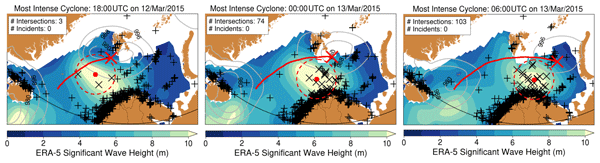
The risk posed to ships by Arctic cyclones has seldom been quantified due to the lack of publicly available historical Arctic ship track data. This study investigates historical Arctic ship tracks, cyclone tracks, and shipping incident reports to determine the number of shipping incidents caused by the passage of Arctic cyclones. Results suggest that Arctic cyclones have not been hazardous to ships and that ships are resilient to the rough sea conditions caused by Arctic cyclones.
Alexander F. Vessey, Kevin I. Hodges, Len C. Shaffrey, and Jonathan J. Day
Weather Clim. Dynam., 3, 1097–1112, https://doi.org/10.5194/wcd-3-1097-2022, https://doi.org/10.5194/wcd-3-1097-2022, 2022
Short summary
Short summary
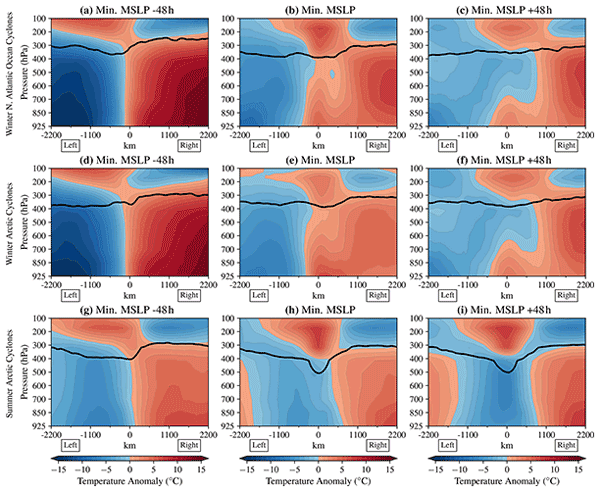
Understanding the location and intensity of hazardous weather across the Arctic is important for assessing risks to infrastructure, shipping, and coastal communities. This study describes the typical lifetime and structure of intense winter and summer Arctic cyclones. Results show the composite development and structure of intense summer Arctic cyclones are different from intense winter Arctic and North Atlantic Ocean extra-tropical cyclones and from conceptual models.
Stella Bourdin, Kevin Hodges, Yushan Han, Leo Saffin, Alexander Baker, John Methven, and Pier Luigi Vidale
Earth Syst. Sci. Data Discuss., https://doi.org/10.5194/essd-2026-403, https://doi.org/10.5194/essd-2026-403, 2026
Preprint under review for ESSD
Short summary
Short summary
This paper describes a new dataset for the study of historical tropical cyclones. RABTracks is a global dataset that combines official tropical cyclone records with multiple weather reanalyses and tracking methods from 1940 to today. It extends cyclone tracks before formation and after dissipation, adding information on intensity, size, structure, and transition to extratropical storms. The dataset is designed to support improved cyclone risk analysis.
Hans Segura, Xabier Pedruzo-Bagazgoitia, Philipp Weiss, Sebastian K. Müller, Thomas Rackow, Junhong Lee, Edgar Dolores-Tesillos, Imme Benedict, Matthias Aengenheyster, Razvan Aguridan, Gabriele Arduini, Alexander J. Baker, Jiawei Bao, Swantje Bastin, Eulàlia Baulenas, Tobias Becker, Sebastian Beyer, Hendryk Bockelmann, Nils Brüggemann, Lukas Brunner, Suvarchal K. Cheedela, Sushant Das, Jasper Denissen, Ian Dragaud, Piotr Dziekan, Madeleine Ekblom, Jan Frederik Engels, Monika Esch, Richard Forbes, Claudia Frauen, Lilli Freischem, Diego García-Maroto, Philipp Geier, Paul Gierz, Álvaro González-Cervera, Katherine Grayson, Matthew Griffith, Oliver Gutjahr, Helmuth Haak, Ioan Hadade, Kerstin Haslehner, Shabeh ul Hasson, Jan Hegewald, Lukas Kluft, Aleksei Koldunov, Nikolay Koldunov, Tobias Kölling, Shunya Koseki, Sergey Kosukhin, Josh Kousal, Peter Kuma, Arjun U. Kumar, Rumeng Li, Nicolas Maury, Maximilian Meindl, Sebastian Milinski, Kristian Mogensen, Bimochan Niraula, Jakub Nowak, Divya Sri Praturi, Ulrike Proske, Dian Putrasahan, René Redler, David Santuy, Domokos Sármány, Reiner Schnur, Patrick Scholz, Dmitry Sidorenko, Dorian Spät, Birgit Sützl, Daisuke Takasuka, Adrian Tompkins, Alejandro Uribe, Mirco Valentini, Menno Veerman, Aiko Voigt, Sarah Warnau, Fabian Wachsmann, Marta Wacławczyk, Nils Wedi, Karl-Hermann Wieners, Jonathan Wille, Marius Winkler, Yuting Wu, Florian Ziemen, Janos Zimmermann, Frida A.-M. Bender, Dragana Bojovic, Sandrine Bony, Simona Bordoni, Patrice Brehmer, Marcus Dengler, Emanuel Dutra, Saliou Faye, Erich Fischer, Chiel van Heerwaarden, Cathy Hohenegger, Heikki Järvinen, Markus Jochum, Thomas Jung, Johann H. Jungclaus, Noel S. Keenlyside, Daniel Klocke, Heike Konow, Martina Klose, Szymon Malinowski, Olivia Martius, Thorsten Mauritsen, Juan Pedro Mellado, Theresa Mieslinger, Elsa Mohino, Hanna Pawłowska, Karsten Peters-von Gehlen, Abdoulaye Sarré, Pajam Sobhani, Philip Stier, Lauri Tuppi, Pier Luigi Vidale, Irina Sandu, and Bjorn Stevens
Geosci. Model Dev., 18, 7735–7761, https://doi.org/10.5194/gmd-18-7735-2025, https://doi.org/10.5194/gmd-18-7735-2025, 2025
Short summary
Short summary
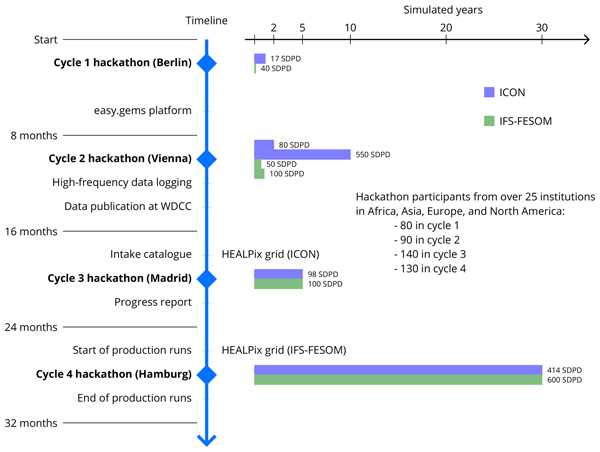
The Next Generation of Earth Modeling Systems project (nextGEMS) developed two Earth system models that use horizontal grid spacing of 10 km and finer, giving more fidelity to the representation of local phenomena, globally. In its fourth cycle, nextGEMS simulated the Earth System climate over the 2020–2049 period under the SSP3-7.0 scenario. Here, we provide an overview of nextGEMS, insights into the model development, and the realism of multi-decadal, kilometer-scale simulations.
Alexander Frank Vessey, Kevin I. Hodges, Len C. Shaffrey, and Jonathan J. Day
Nat. Hazards Earth Syst. Sci., 24, 2115–2132, https://doi.org/10.5194/nhess-24-2115-2024, https://doi.org/10.5194/nhess-24-2115-2024, 2024
Short summary
Short summary
The risk posed to ships by Arctic cyclones has seldom been quantified due to the lack of publicly available historical Arctic ship track data. This study investigates historical Arctic ship tracks, cyclone tracks, and shipping incident reports to determine the number of shipping incidents caused by the passage of Arctic cyclones. Results suggest that Arctic cyclones have not been hazardous to ships and that ships are resilient to the rough sea conditions caused by Arctic cyclones.
Elliott Michael Sainsbury, Reinhard K. H. Schiemann, Kevin I. Hodges, Alexander J. Baker, Len C. Shaffrey, Kieran T. Bhatia, and Stella Bourdin
Weather Clim. Dynam., 3, 1359–1379, https://doi.org/10.5194/wcd-3-1359-2022, https://doi.org/10.5194/wcd-3-1359-2022, 2022
Short summary
Short summary
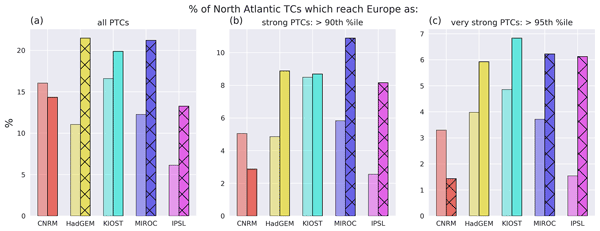
Post-tropical cyclones (PTCs) can bring severe weather to Europe. By tracking and identifying PTCs in five global climate models, we investigate how the frequency and intensity of PTCs may change across Europe by 2100. We find no robust change in the frequency or intensity of Europe-impacting PTCs in the future. This study indicates that large uncertainties surround future Europe-impacting PTCs and provides a framework for evaluating PTCs in future generations of climate models.
Alexander F. Vessey, Kevin I. Hodges, Len C. Shaffrey, and Jonathan J. Day
Weather Clim. Dynam., 3, 1097–1112, https://doi.org/10.5194/wcd-3-1097-2022, https://doi.org/10.5194/wcd-3-1097-2022, 2022
Short summary
Short summary
Understanding the location and intensity of hazardous weather across the Arctic is important for assessing risks to infrastructure, shipping, and coastal communities. This study describes the typical lifetime and structure of intense winter and summer Arctic cyclones. Results show the composite development and structure of intense summer Arctic cyclones are different from intense winter Arctic and North Atlantic Ocean extra-tropical cyclones and from conceptual models.
Cited articles
Aon: 2025 Climate and Catastrophe Insight, https://www.aon.com/en/insights/reports/climate-and-catastrophe-report (last access: 18 May 2025), 2025.
Aznar-Siguan, G. and Bresch, D. N.: CLIMADA v1: a global weather and climate risk assessment platform, Geosci. Model Dev., 12, 3085–3097, https://doi.org/10.5194/gmd-12-3085-2019, 2019.
Baker, A. J.: ncas-metoffice-hrcm/hurricane_loss, Zenodo [code], https://doi.org/10.5281/zenodo.20050811, 2026.
Baker, A. J., Vannière, B., and Vidale, P. L.: On the Realism of Tropical Cyclone Intensification in Global Storm-Resolving Climate Models, Geophys. Res. Lett., 51, e2024GL109841, https://doi.org/10.1029/2024GL109841, 2024.
Balaguru, K., Chang, C.-C., Leung, L. R., Ullrich, P. A., Han, Y., Rice, J. R., Hagos, S., Chavas, D., Taraphdar, S., Harrop, B., Sun, N., and Judi, D. R.: Recent Tropical Cyclone Outer Size Increases in the Western North Atlantic, Earth's Future, 14, e2025EF007162, https://doi.org/10.1029/2025EF007162, 2026.
Baldwin, J. W., Lee, C.-Y., Walsh, B. J., Camargo, S. J., and Sobel, A. H.: Vulnerability in a Tropical Cyclone Risk Model: Philippines Case Study, Weather Clim. Soc., 15, 503–523, https://doi.org/10.1175/WCAS-D-22-0049.1, 2023.
Beck, H. E., Wood, E. F., Pan, M., Fisher, C. K., Miralles, D. G., van Dijk, A. I. J. M., McVicar, T. R., and Adler, R. F.: MSWEP V2 Global 3-Hourly 0.1° Precipitation: Methodology and Quantitative Assessment, B. Am. Meteorol. Soc., 100, 473–500, https://doi.org/10.1175/BAMS-D-17-0138.1, 2019.
Beven, K. J., Almeida, S., Aspinall, W. P., Bates, P. D., Blazkova, S., Borgomeo, E., Freer, J., Goda, K., Hall, J. W., Phillips, J. C., Simpson, M., Smith, P. J., Stephenson, D. B., Wagener, T., Watson, M., and Wilkins, K. L.: Epistemic uncertainties and natural hazard risk assessment – Part 1: A review of different natural hazard areas, Nat. Hazards Earth Syst. Sci., 18, 2741–2768, https://doi.org/10.5194/nhess-18-2741-2018, 2018.
Black, R., Arnell, N. W., Adger, W. N., Thomas, D., and Geddes, A.: Migration, immobility and displacement outcomes following extreme events, Environ. Sci. Policy, 27, S32–S43, https://doi.org/10.1016/j.envsci.2012.09.001, 2013.
Bloemendaal, N., de Moel, H., Mol, J. M., Bosma, P. R. M., Polen, A. N., and Collins, J. M.: Adequately reflecting the severity of tropical cyclones using the new Tropical Cyclone Severity Scale, Environ. Res. Lett., 16, 014048, https://doi.org/10.1088/1748-9326/abd131, 2021.
Camelo, J. and Mayo, T.: The lasting impacts of the Saffir-Simpson Hurricane Wind Scale on storm surge risk communication: The need for multidisciplinary research in addressing a multidisciplinary challenge, Weather and Climate Extremes, 33, 100335, https://doi.org/10.1016/j.wace.2021.100335, 2021.
Cass, E., Shao, W., Hao, F., Moradkhani, H., and Yeates, E.: Identifying trends in interpretation and responses to hurricane and climate change communication tools, Int. J. Disast. Risk Re., 93, 103752, https://doi.org/10.1016/j.ijdrr.2023.103752, 2023.
Chavas, D. R., Knaff, J. A., and Klotzbach, P.: A Simple Model for Predicting Tropical Cyclone Minimum Central Pressure from Intensity and Size, Weather Forecast., 40, 333–346, https://doi.org/10.1175/WAF-D-24-0031.1, 2025.
Chavas, D. R., Reed, K. A., and Knaff, J. A.: Physical understanding of the tropical cyclone wind-pressure relationship, Nat. Commun., 8, 1360, https://doi.org/10.1038/s41467-017-01546-9, 2017.
Ciullo, A., Strobl, E., Meiler, S., Martius, O., and Bresch, D. N.: Increasing countries' financial resilience through global catastrophe risk pooling, Nat. Commun., 14, 922, https://doi.org/10.1038/s41467-023-36539-4, 2023.
Copernicus Climate Change Service: Global sea level change time series from 1950 to 2050 derived from reanalysis and high resolution CMIP6 climate projections, Copernicus Climate Change Service (C3S) Climate Data Store (CDS) [data set], https://doi.org/10.24381/cds.a6d42d60, 2022.
Delforge, D., Wathelet, V., Below, R., Sofia, C. L., Tonnelier, M., van Loenhout, J. A. F., and Speybroeck, N.: EM-DAT: the Emergency Events Database, Int. J. Disast. Risk Re., 124, 105509, https://doi.org/10.1016/j.ijdrr.2025.105509, 2025.
Eberenz, S., Lüthi, S., and Bresch, D. N.: Regional tropical cyclone impact functions for globally consistent risk assessments, Nat. Hazards Earth Syst. Sci., 21, 393–415, https://doi.org/10.5194/nhess-21-393-2021, 2021.
Eberenz, S., Stocker, D., Röösli, T., and Bresch, D. N.: Asset exposure data for global physical risk assessment, Earth Syst. Sci. Data, 12, 817–833, https://doi.org/10.5194/essd-12-817-2020, 2020.
Emanuel, K.: Global Warming Effects on U.S. Hurricane Damage, Weather Clim. Soc., 3, 261–268, https://doi.org/10.1175/WCAS-D-11-00007.1, 2011.
Federal Emergency Management Agency: Hazus Hurricane Model Technical Manual, Hazuz 6.1, https://www.fema.gov/sites/default/files/documents/Hazus_6.1_Hurricane_Model_Technical_Manual.pdf (last access: 18 May 2025), 2024a.
Federal Emergency Management Agency: National Risk Index: Future Risk, Technical Documentation, https://eelp.law.harvard.edu/wp-content/uploads/2025/03/NRI_Future_Risk_Technical_Document.pdf (last access: 18 May 2025), 2024b.
Federal Emergency Management Agency: Building Code Adoption Tracking, https://www.fema.gov/emergency-managers/risk-management/building-science/bcat (last access: 18 May 2025), 2025.
Gahtan, J., Knapp, K., Schreck III, C., Diamond, H., Kossin, J., and Kruk, M. C.: International Best Track Archive for Climate Stewardship (IBTrACS), Version 4r01, NOAA National Centers for Environmental Information [data set], https://doi.org/10.25921/82ty-9e16, 2024.
Gettelman, A., Bresch, D. N., Chen, C. C., Truesdale, J. E., and Bacmeister, J. T.: Projections of future tropical cyclone damage with a high-resolution global climate model, Climatic Change, 146, 575–585, https://doi.org/10.1007/s10584-017-1902-7, 2018.
Gori, A., Lin, N., Schenkel, B., and Chavas, D.: North Atlantic Tropical Cyclone Size and Storm Surge Reconstructions From 1950-Present, J. Geophys. Res.-Atmos., 128, e2022JD037312, https://doi.org/10.1029/2022JD037312, 2023.
Gori, A., Lin, N., Chavas, D., Oppenheimer, M., and Xian, S.: Sensitivity of tropical cyclone risk across the US to changes in storm climatology and socioeconomic growth, Environ. Res. Lett., 20, 064050, https://doi.org/10.1088/1748-9326/add60d, 2025.
Grinsted, A., Ditlevsen, P., and Christensen, J. H.: Normalized US hurricane damage estimates using area of total destruction, 1900–2018, P. Natl. Acad. Sci. USA, 116, 23942–23946, https://doi.org/10.1073/pnas.1912277116, 2019.
Hersbach, H., Bell, B., Berrisford, P., Hirahara, S., Horányi, A., Muñoz-Sabater, J., Nicolas, J., Peubey, C., Radu, R., Schepers, D., Simmons, A., Soci, C., Abdalla, S., Abellan, X., Balsamo, G., Bechtold, P., Biavati, G., Bidlot, J., Bonavita, M., De Chiara, G., Dahlgren, P., Dee, D., Diamantakis, M., Dragani, R., Flemming, J., Forbes, R., Fuentes, M., Geer, A., Haimberger, L., Healy, S., Hogan, R. J., Hólm, E., Janisková, M., Keeley, S., Laloyaux, P., Lopez, P., Lupu, C., Radnoti, G., de Rosnay, P., Rozum, I., Vamborg, F., Villaume, S., and Thépaut, J.-N.: The ERA5 global reanalysis, Q. J. Roy. Meteor. Soc., 146, 1999–2049, https://doi.org/10.1002/qj.3803, 2020.
Holland, G. J., Belanger, J. I., and Fritz, A.: A Revised Model for Radial Profiles of Hurricane Winds, Mon. Weather Rev., 138, 4393–4401, https://doi.org/10.1175/2010MWR3317.1, 2010.
Hurricane Research Division: Detailed List of Continental United States Hurricane Impacts/Landfalls, http://www.aoml.noaa.gov/hrd/hurdat/UShurrs_detailed.html (last access: 18 May 2025), 2025.
Ibrahim, H. A., Elawady, A., and Prevatt, D. O.: Empirical hurricane fragility assessment of elevated and slab-on-grade residential houses, Int. J. Disast. Risk Re., 110, 104663, https://doi.org/10.1016/j.ijdrr.2024.104663, 2024.
Iglesias, V., Braswell, A. E., Rossi, M. W., Joseph, M. B., McShane, C., Cattau, M., Koontz, M. J., McGlinchy, J., Nagy, R. C., Balch, J., Leyk, S., and Travis, W. R.: Risky Development: Increasing Exposure to Natural Hazards in the United States, Earth's Future, 9, e2020EF001795, https://doi.org/10.1029/2020EF001795, 2021.
Jewson, S.: The Impact of Projected Changes in Hurricane Frequencies on U.S. Hurricane Wind and Surge Damage, J. Appl. Meteorol. Clim., 62, 1827–1843, https://doi.org/10.1175/JAMC-D-23-0087.1, 2023.
Kelman, I.: Saffir–Simpson Hurricane Intensity Scale, in: Encyclopedia of Natural Hazards, edited by: Bobrowsky, P. T., Springer, Dordrecht, https://doi.org/10.1007/978-1-4020-4399-4_306, 2013.
Kernkamp, H. W. J., Van Dam, A., Stelling, G. S., and de Goede, E. D.: Efficient scheme for the shallow water equations on unstructured grids with application to the Continental Shelf, Ocean Dynam., 61, 1175–1188, https://doi.org/10.1007/s10236-011-0423-6, 2011.
Klotzbach, P. J., Bell, M. M., Bowen, S. G., Gibney, E. J., Knapp, K. R., and Schreck III, C. J.: Surface Pressure a More Skillful Predictor of Normalized Hurricane Damage than Maximum Sustained Wind, B. Am. Meteorol. Soc., 101, E830–E846, https://doi.org/10.1175/BAMS-D-19-0062.1, 2020.
Klotzbach, P. J., Chavas, D. R., Bell, M. M., Bowen, S. G., Gibney, E. J., and Schreck III, C. J.: Characterizing Continental US Hurricane Risk: Which Intensity Metric Is Best?, J. Geophys. Res.-Atmos., 127, e2022JD037030, https://doi.org/10.1029/2022JD037030, 2022a.
Klotzbach, P. J., Wood, K. M., Schreck III, C. J., Bowen, S. G., Patricola, C. M., and Bell, M. M.: Trends in Global Tropical Cyclone Activity: 1990–2021, Geophys. Res. Lett., 49, e2021GL095774, https://doi.org/10.1029/2021GL095774, 2022b.
Knutson, T., Camargo, S. J., Chan, J. C. L., Emanuel, K., Ho, C.-H., Kossin, J., Mohapatra, M., Satoh, M., Sugi, M., Walsh, K., and Wu, L.: Tropical Cyclones and Climate Change Assessment: Part II: Projected Response to Anthropogenic Warming, B. Am. Meteorol. Soc., 101, E303–E322, https://doi.org/10.1175/BAMS-D-18-0194.1, 2020.
König, N.: Case Study of Hurricane Matthew: Loss Analysis with CLIMADA and Oasis LMF using ECMWF Forecast Data, Institute of Atmospheric and Climate Sciences, Eidgenössische Technische Hochschule Zürich, Zürich, https://doi.org/10.13140/RG.2.2.28957.72169, 2017.
Landsea, C. W. and Franklin, J. L.: Atlantic Hurricane Database Uncertainty and Presentation of a New Database Format, Mon. Weather Rev., 141, 3576–3592, https://doi.org/10.1175/mwr-d-12-00254.1, 2013.
Lavender, S. L., Walsh, K. J. E., Utembe, S., Caron, L.-P., and Guishard, M.: Estimation of maximum seasonal tropical cyclone damage in the Atlantic using climate models, Nat. Hazards, 110, 1025–1038, https://doi.org/10.1007/s11069-021-04977-2, 2022.
Lockwood, J. F., Dunstone, N., Hermanson, L., Saville, G. R., Scaife, A. A., Smith, D., and Thornton, H. E.: A Decadal Climate Service for Insurance: Skillful Multiyear Predictions of North Atlantic Hurricane Activity and U.S. Hurricane Damage, J. Appl. Meteorol. Clim., 62, 1151–1163, https://doi.org/10.1175/JAMC-D-22-0147.1, 2023.
Meiler, S., Ciullo, A., Kropf, C. M., Emanuel, K., and Bresch, D. N.: Uncertainties and sensitivities in the quantification of future tropical cyclone risk, Communications Earth & Environment, 4, 371, https://doi.org/10.1038/s43247-023-00998-w, 2023.
Meiler, S., Vogt, T., Bloemendaal, N., Ciullo, A., Lee, C.-Y., Camargo, S. J., Emanuel, K., and Bresch, D. N.: Intercomparison of regional loss estimates from global synthetic tropical cyclone models, Nat. Commun., 13, 6156, https://doi.org/10.1038/s41467-022-33918-1, 2022.
Meiler, S., Kropf, C. M., McCaughey, J. W., Lee, C.-Y., Camargo, S. J., Sobel, A. H., Bloemendaal, N., Emanuel, K., and Bresch, D. N.: Navigating and attributing uncertainty in future tropical cyclone risk estimates, Science Advances, 11, eadn4607, https://doi.org/10.1126/sciadv.adn4607, 2025.
Muller, J., Mooney, K., Bowen, S. G., Klotzbach, P. J., Martin, T., Philp, T. J., Dhruvkumar, B., Dixon, R. S., and Girimurugan, S. B.: Normalized Hurricane Damage in the United States: 1900–2022, B. Am. Meteorol. Soc., 106, E51–E67, https://doi.org/10.1175/BAMS-D-23-0280.1, 2025.
National Centers for Environmental Information: U.S. Billion-Dollar Weather and Climate Disasters, National Oceanographic and Atmospheric Administration, https://doi.org/10.25921/stkw-7w73, 2025.
National Oceanographic and Atmospheric Administration: Hurricane Costs, https://coast.noaa.gov/states/fast-facts/hurricane-costs.html (last access: 18 May 2025), 2024.
National Oceanographic and Atmospheric Administration: Tropical Cyclone Rainfall, https://www.wpc.ncep.noaa.gov/tropical/rain/tcrainfall.html (last access: 18 May 2025), 2025.
Oasis Loss Modelling Framework: Oasis Loss Modelling Framework (Oasis LMF) [open-source catastrophe modelling platform], https://oasislmf.org (last access: 18 May 2025), 2025.
Oliver-Smith, A.: Hurricanes, Climate Change, and the Social Construction of Risk, International Journal of Mass Emergencies & Disasters, 38, 1–12, https://doi.org/10.1177/028072702003800101, 2020.
Pesaresi, M. and Politis, P.: GHS-BUILT-S R2023A – GHS built-up surface grid, derived from Sentinel2 composite and Landsat, multitemporal (1975–2030), European Commission, Joint Research Centre [data set], https://doi.org/10.2905/9F06F36F-4B11-47EC-ABB0-4F8B7B1D72EA, 2023.
Pilkington, S. F. and Mahmoud, H. N.: Using artificial neural networks to forecast economic impact of multi-hazard hurricane-based events, Sustainable and Resilient Infrastructure, 1, 63–83, https://doi.org/10.1080/23789689.2016.1179529, 2016.
Qi, W., Yong, B., Ritchie, E. A., Tyo, J. S., and Toumi, R.: Global Increase of Tropical Cyclone Precipitation Rate Toward Coasts, Geophys. Res. Lett., 52, e2025GL115500, https://doi.org/10.1029/2025GL115500, 2025.
Rappaport, E. N.: Fatalities in the United States from Atlantic Tropical Cyclones: New Data and Interpretation, B. Am. Meteorol. Soc., 95, 341–346, https://doi.org/10.1175/BAMS-D-12-00074.1, 2014.
Schenkel, B. A., Chavas, D., Lin, N., Knutson, T., Vecchi, G., and Brammer, A.: North Atlantic Tropical Cyclone Outer Size and Structure Remain Unchanged by the Late Twenty-First Century, J. Climate, 36, 359–382, https://doi.org/10.1175/JCLI-D-22-0066.1, 2023.
Stansfield, A. M. and Reed, K. A.: Global tropical cyclone precipitation scaling with sea surface temperature, npj Climate and Atmospheric Science, 6, 60, https://doi.org/10.1038/s41612-023-00391-6, 2023.
Stansfield, A. M., Reed, K. A., Zarzycki, C. M., Ullrich, P. A., and Chavas, D. R.: Assessing Tropical Cyclones' Contribution to Precipitation over the Eastern United States and Sensitivity to the Variable-Resolution Domain Extent, J. Hydrometeorol., 21, 1425–1445, https://doi.org/10.1175/JHM-D-19-0240.1, 2020.
Tripathy, S. S., Jafarzadegan, K., Moftakhari, H., and Moradkhani, H.: Dynamic bivariate hazard forecasting of hurricanes for improved disaster preparedness, Communications Earth & Environment, 5, 12, https://doi.org/10.1038/s43247-023-01198-2, 2024.
U.S. Bureau of Economic Analysis: Current-cost net stock of fixed assets and consumer durable goods [K1WTOTL1ES000], https://fred.stlouisfed.org/series/K1WTOTL1ES000 (last access: 18 May 2025), 2023.
U.S. Bureau of Economic Analysis: National Data, Fixed Assets Accounts Tables, https://apps.bea.gov/iTable/?reqid=10&step=3&isuri=1&table_list=16 (last access: 18 May 2025), 2025.
U.S. Census Bureau: American Community Survey Housing Units by Year Built Variables — Tract, https://hub.scag.ca.gov/datasets/41c90eef3a12451faff10c2a6b26fc46_2/about (last access: 18 May 2025), 2024.
Vickery, P. J., Skerlj, P. F., Lin, J., Twisdale Jr., L. A., Young, M. A., and Lavelle, F. M.: HAZUS-MH Hurricane Model Methodology. II: Damage and Loss Estimation, Nat. Hazards Rev., 7, 94–103, https://doi.org/10.1061/(ASCE)1527-6988(2006)7:2(94), 2006.
Wang, D., Chavas, D. R., and Schenkel, B. A.: Tropical cyclones expand faster at warmer relative sea surface temperature, P. Natl. Acad. Sci. USA, 122, e2424385122, https://doi.org/10.1073/pnas.2424385122, 2025.
Wang, S. and Toumi, R.: On the relationship between hurricane cost and the integrated wind profile, Environ. Res. Lett., 11, 114005, https://doi.org/10.1088/1748-9326/11/11/114005, 2016.
Wang, S. and Toumi, R.: Recent migration of tropical cyclones toward coasts, Science, 371, 514, https://doi.org/10.1126/science.abb9038, 2021.
Wang, X., Verlaan, M., Apecechea, M. I., and Lin, H. X.: Computation-Efficient Parameter Estimation for a High-Resolution Global Tide and Surge Model, J. Geophys. Res.-Oceans, 126, e2020JC016917, https://doi.org/10.1029/2020JC016917, 2021.
Ward, P. J., Blauhut, V., Bloemendaal, N., Daniell, J. E., de Ruiter, M. C., Duncan, M. J., Emberson, R., Jenkins, S. F., Kirschbaum, D., Kunz, M., Mohr, S., Muis, S., Riddell, G. A., Schäfer, A., Stanley, T., Veldkamp, T. I. E., and Winsemius, H. C.: Review article: Natural hazard risk assessments at the global scale, Nat. Hazards Earth Syst. Sci., 20, 1069–1096, https://doi.org/10.5194/nhess-20-1069-2020, 2020.
Wehner, M. F. and Kossin, J. P.: The growing inadequacy of an open-ended Saffir–Simpson hurricane wind scale in a warming world, P. Natl. Acad. Sci. USA, 121, e2308901121, https://doi.org/10.1073/pnas.2308901121, 2024.
Weinkle, J., Landsea, C., Collins, D., Musulin, R., Crompton, R. P., Klotzbach, P. J., and Pielke, R.: Normalized hurricane damage in the continental United States 1900–2017, Nature Sustainability, 1, 808–813, https://doi.org/10.1038/s41893-018-0165-2, 2018.
Welker, C., Röösli, T., and Bresch, D. N.: Comparing an insurer's perspective on building damages with modelled damages from pan-European winter windstorm event sets: a case study from Zurich, Switzerland, Nat. Hazards Earth Syst. Sci., 21, 279–299, https://doi.org/10.5194/nhess-21-279-2021, 2021.
Wilson, K. M., Baldwin, J. W., and Young, R. M.: Estimating Tropical Cyclone Vulnerability: A Review of Different Open-Source Approaches, in: Hurricane Risk in a Changing Climate, edited by: Collins, J. M. and Done, J. M., Springer International Publishing, Cham, 255–281, https://doi.org/10.1007/978-3-031-08568-0_11, 2022.
Wong-Parodi, G. and Garfin, D. R.: Hurricane adaptation behaviors in Texas and Florida: exploring the roles of negative personal experience and subjective attribution to climate change, Environ. Res. Lett., 17, 034033, https://doi.org/10.1088/1748-9326/ac4858, 2022.
World Meteorological Organization: WMO Atlas of Mortality and Economic Losses from Weather, Climate and Water Extremes (1970–2019), WMO-No. 1267, https://library.wmo.int/idurl/4/57564 (last access: 18 May 2025), 2021.
WorldPop: Global High Resolution Population Denominators Project, WorldPop [data set], https://doi.org/10.5258/SOTON/WP00674, 2018.
Xu, Z., Guo, J., Zhang, G., Ye, Y., Zhao, H., and Chen, H.: Global tropical cyclone size and intensity reconstruction dataset for 1959–2022 based on IBTrACS and ERA5 data, Earth Syst. Sci. Data, 16, 5753–5766, https://doi.org/10.5194/essd-16-5753-2024, 2024.
Zhong, Q., Gan, J., Tu, S., Toumi, R., and Chan, J. C. L.: Global increase in rain rate of tropical cyclones prior to landfall, Nat. Commun., 17, 114, https://doi.org/10.1038/s41467-025-68070-z, 2026.
Zuzak, C., Goodenough, E., Stanton, C., Mowrer, M., Ranalli, N., Kealey, D., and Rozelle, J.: National risk index technical documentation, https://www.fema.gov/about/openfema/data-sets/national-risk-index-data (last access: 18 May 2025), 2021.
Download
Please read the editorial note first before accessing the article.
- Article
(4587 KB) - Full-text XML
-
Supplement
(2544 KB) - BibTeX
- EndNote
Short summary
Hurricanes are a destructive natural hazard. Historically, however, their Saffir–Simpson categories and losses are not well correlated. We combined hazard, exposure, and vulnerability data to predict losses from landfalling hurricanes for the United States. Our model significantly reduces errors between predicted and observed losses and is more skilful than hazard-only predictions. Additionally, we developed a novel loss-based hurricane classification scheme to aid risk management.
Hurricanes are a destructive natural hazard. Historically, however, their Saffir–Simpson...


Altmetrics
Final-revised paper
Preprint