
Articles | Volume 26, issue 4
https://doi.org/10.5194/nhess-26-1935-2026
© Author(s) 2026. This work is distributed under
the Creative Commons Attribution 4.0 License.
the Creative Commons Attribution 4.0 License.
https://doi.org/10.5194/nhess-26-1935-2026
© Author(s) 2026. This work is distributed under
the Creative Commons Attribution 4.0 License.
the Creative Commons Attribution 4.0 License.
Research article
| 
29 Apr 2026
Research article |
| 29 Apr 2026
| 29 Apr 2026
Assessing extreme total water levels across Europe for large-scale coastal flood analysis
Camila Cotrim
IHCantabria – Instituto de Hidráulica Ambiental de la Universidad de Cantabria, Santander, 39011, Spain
IHCantabria – Instituto de Hidráulica Ambiental de la Universidad de Cantabria, Santander, 39011, Spain
Iñigo J. Losada
IHCantabria – Instituto de Hidráulica Ambiental de la Universidad de Cantabria, Santander, 39011, Spain
Melisa Menéndez
IHCantabria – Instituto de Hidráulica Ambiental de la Universidad de Cantabria, Santander, 39011, Spain
Hector Lobeto
IHCantabria – Instituto de Hidráulica Ambiental de la Universidad de Cantabria, Santander, 39011, Spain
Related authors
Camila Cotrim, Alexandra Toimil, Iñigo J. Losada, Sara Novo, and Iria Suárez
Nat. Hazards Earth Syst. Sci., 26, 1859–1881, https://doi.org/10.5194/nhess-26-1859-2026, https://doi.org/10.5194/nhess-26-1859-2026, 2026
Short summary
Short summary
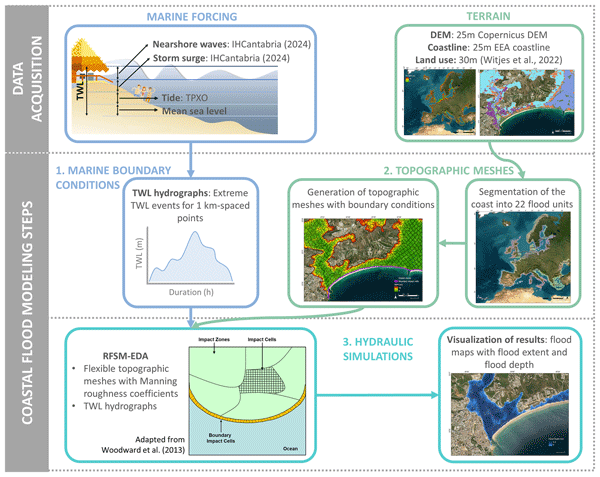
Coastal flooding places millions of people and infrastructures at risk. In this study, we introduce a Europe-wide approach to identify areas exposed to coastal flooding. The approach combines information on how water levels change under storm conditions with a model that simulates how flood spreads across the land. We found that using simpler methods, as is often done, can make the results less reliable in places like Belgium and the United Kingdom.
Maialen Irazoqui Apecechea, Angélique Melet, Melisa Menendez, Hector Lobeto, and Jonathan B. Valle-Rodriguez
Nat. Hazards Earth Syst. Sci., 26, 2269–2290, https://doi.org/10.5194/nhess-26-2269-2026, https://doi.org/10.5194/nhess-26-2269-2026, 2026
Short summary
Short summary
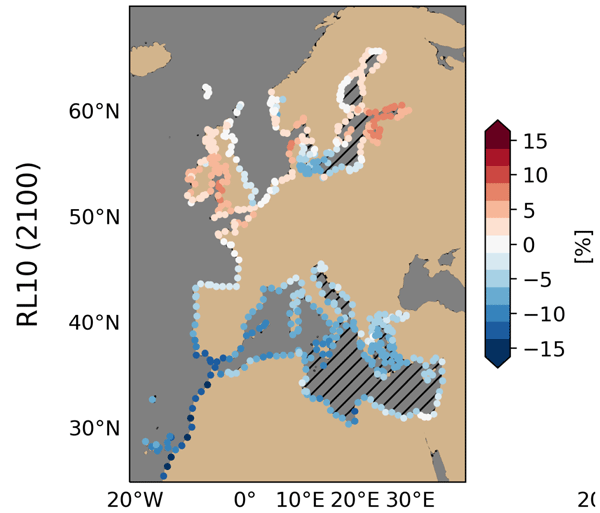
We applied a fast statistical model to estimate future extreme storm surges in Europe using data from 17 climate models – about twice as many as in past studies. Results show robust regional patterns – decreases in the Mediterranean and Moroccan coast, increases in the Irish Sea and Gulf of Finland – with high uncertainty in other areas. Out results increase our knowledge on future storm surge uncertainties, needed for informed coastal planning.
Camila Cotrim, Alexandra Toimil, Iñigo J. Losada, Sara Novo, and Iria Suárez
Nat. Hazards Earth Syst. Sci., 26, 1859–1881, https://doi.org/10.5194/nhess-26-1859-2026, https://doi.org/10.5194/nhess-26-1859-2026, 2026
Short summary
Short summary
Coastal flooding places millions of people and infrastructures at risk. In this study, we introduce a Europe-wide approach to identify areas exposed to coastal flooding. The approach combines information on how water levels change under storm conditions with a model that simulates how flood spreads across the land. We found that using simpler methods, as is often done, can make the results less reliable in places like Belgium and the United Kingdom.
Alisée A. Chaigneau, Melisa Menéndez, Marta Ramírez-Pérez, and Alexandra Toimil
Nat. Hazards Earth Syst. Sci., 24, 4109–4131, https://doi.org/10.5194/nhess-24-4109-2024, https://doi.org/10.5194/nhess-24-4109-2024, 2024
Short summary
Short summary
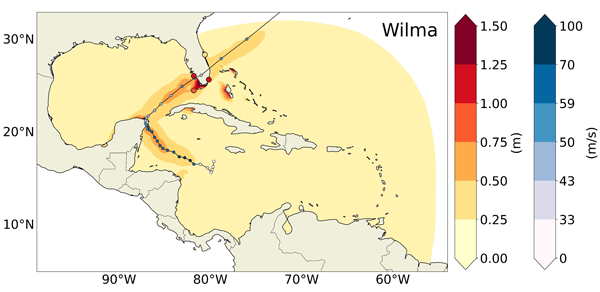
Tropical cyclones drive extreme sea levels, causing large storm surges due to low atmospheric pressure and strong winds. This study explores factors affecting the numerical modelling of storm surges induced by hurricanes in the tropical Atlantic. Two ocean models are compared and used for sensitivity experiments. ERA5 atmospheric reanalysis forcing generally improves surge estimates compared to parametric wind models. Including ocean circulations reduces errors in surge estimates in some areas.
Roderik van de Wal, Angélique Melet, Debora Bellafiore, Paula Camus, Christian Ferrarin, Gualbert Oude Essink, Ivan D. Haigh, Piero Lionello, Arjen Luijendijk, Alexandra Toimil, Joanna Staneva, and Michalis Vousdoukas
State Planet, 3-slre1, 5, https://doi.org/10.5194/sp-3-slre1-5-2024, https://doi.org/10.5194/sp-3-slre1-5-2024, 2024
Short summary
Short summary
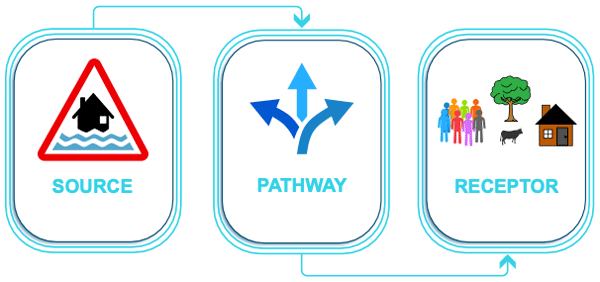
Sea level rise has major impacts in Europe, which vary from place to place and in time, depending on the source of the impacts. Flooding, erosion, and saltwater intrusion lead, via different pathways, to various consequences for coastal regions across Europe. This causes damage to assets, the environment, and people for all three categories of impacts discussed in this paper. The paper provides an overview of the various impacts in Europe.
Rémi Thiéblemont, Gonéri Le Cozannet, Jérémy Rohmer, Alexandra Toimil, Moisés Álvarez-Cuesta, and Iñigo J. Losada
Nat. Hazards Earth Syst. Sci., 21, 2257–2276, https://doi.org/10.5194/nhess-21-2257-2021, https://doi.org/10.5194/nhess-21-2257-2021, 2021
Short summary
Short summary
Sea level rise and its acceleration are projected to aggravate coastal erosion over the 21st century. Resulting shoreline projections are deeply uncertain, however, which constitutes a major challenge for coastal planning and management. Our work presents a new extra-probabilistic framework to develop future shoreline projections and shows that deep uncertainties could be drastically reduced by better constraining sea level projections and improving coastal impact models.
Cited articles
Almar, R., Ranasinghe, R., Bergsma, E. W. J., Diaz, H., Melet, A., Papa, F., Vousdoukas, M., Athanasiou, P., Dada, O., Almeida, L. P., and Kestenare, E.: A global analysis of extreme coastal water levels with implications for potential coastal overtopping, Nat. Commun., 12, 1–9, https://doi.org/10.1038/s41467-021-24008-9, 2021.
Anthony, E. J. and Héquette, A.: The grain-size characterisation of coastal sand from the Somme estuary to Belgium: Sediment sorting processes and mixing in a tide- and storm-dominated setting, Sediment. Geol., 202, 369–382, https://doi.org/10.1016/j.sedgeo.2007.03.022, 2007.
Arns, A., Wahl, T., Haigh, I. D., Jensen, J., and Pattiaratchi, C.: Estimating extreme water level probabilities: A comparison of the direct methods and recommendations for best practise, Coast. Eng., 81, 51–66, https://doi.org/10.1016/j.coastaleng.2013.07.003, 2013.
Arns, A., Wahl, T., Wolff, C., Vafeidis, A. T., Haigh, I. D., Woodworth, P., Niehüser, S., and Jensen, J.: Non-linear interaction modulates global extreme sea levels, coastal flood exposure, and impacts, Nat. Commun., 11, 1–9, https://doi.org/10.1038/s41467-020-15752-5, 2020.
Barboza, F. R. and Defeo, O.: Global diversity patterns in sandy beach macrofauna: A biogeographic analysis, Sci. Rep., 5, 1–9, https://doi.org/10.1038/srep14515, 2015.
Barnard, P. L., Erikson, L. H., Foxgrover, A. C., Hart, J. A. F., Limber, P., O'Neill, A. C., van Ormondt, M., Vitousek, S., Wood, N., Hayden, M. K., and Jones, J. M.: Dynamic flood modeling essential to assess the coastal impacts of climate change, Sci. Rep., 9, 1–13, https://doi.org/10.1038/s41598-019-40742-z, 2019.
Bertin, X., Bruneau, N., Breilh, J. F., Fortunato, A. B., and Karpytchev, M.: Importance of wave age and resonance in storm surges: The case Xynthia, Bay of Biscay, Ocean Model., 42, 16–30, https://doi.org/10.1016/j.ocemod.2011.11.001, 2012.
Bevacqua, E., Vousdoukas, M. I., Zappa, G., Hodges, K., Shepherd, T. G., Maraun, D., Mentaschi, L., and Feyen, L.: More meteorological events that drive compound coastal flooding are projected under climate change, Commun. Earth Environ., 1, https://doi.org/10.1038/s43247-020-00044-z, 2020.
Bezak, N., Brilly, M., and Šraj, M.: Comparaison entre les méthodes de dépassement de seuil et du maximum annuel pour les analyses de fréquence des crues, Hydrolog. Sci. J., 59, 959–977, https://doi.org/10.1080/02626667.2013.831174, 2014.
Cabrita, P., Montes, J., Duo, E., Brunetta, R., and Ciavola, P.: The Role of Different Total Water Level Definitions in Coastal Flood Modelling on a Low-Elevation Dune System, J. Mar. Sci. Eng., 12, 1003, https://doi.org/10.3390/jmse12061003, 2024.
Calafat, F. M. and Marcos, M.: Probabilistic reanalysis of storm surge extremes in Europe, P. Natl. Acad. Sci. USA, 117, 1877–1883, https://doi.org/10.1073/pnas.1913049117, 2020.
Camus, P., Mendez, F. J., Medina, R., and Cofiño, A. S.: Analysis of clustering and selection algorithms for the study of multivariate wave climate, Coast. Eng., 58, 453–462, https://doi.org/10.1016/j.coastaleng.2011.02.003, 2011.
Camus, P., Mendez, F. J., Medina, R., Tomas, A., and Izaguirre, C.: High resolution downscaled ocean waves (DOW) reanalysis in coastal areas, Coast. Eng., 72, 56–68, https://doi.org/10.1016/j.coastaleng.2012.09.002, 2013.
Coles, S.: An Introduction to Statistical Modeling of Extreme Values, Springer series in statistics, Springer, London (UK), ISBN 1852334592, 2001.
Collings, T. P., Quinn, N. D., Haigh, I. D., Green, J., Probyn, I., Wilkinson, H., Muis, S., Sweet, W. V., and Bates, P. D.: Global application of a regional frequency analysis to extreme sea levels, Nat. Hazards Earth Syst. Sci., 24, 2403–2423, https://doi.org/10.5194/nhess-24-2403-2024, 2024.
Copernicus: DEM – Global and European Digital Elevation Model, Copernicus, https://dataspace.copernicus.eu/explore-data/data-collections/copernicus-contributing-missions/collections-description/COP-DEM (last access: 23 April 2026), 2019.
Cotrim, C., Toimil, A., Losada, I., Menéndez, M., and Lobeto, H.: European extreme total water level, Zenodo [data set], https://doi.org/10.5281/zenodo.15111960, 2025.
Dalinghaus, C., Coco, G., and Higuera, P.: Assessing ToTal Water Level Uncertainties Using Global Sensitivity Analysis, J. Geophys. Res.-Oceans, 130, 460–466, https://doi.org/10.1029/2025JC023011, 2025.
Dodet, G., Melet, A., Ardhuin, F., Bertin, X., Idier, D., and Almar, R.: The Contribution of Wind-Generated Waves to Coastal Sea-Level Changes, Springer Netherlands, 1563–1601 pp., https://doi.org/10.1007/s10712-019-09557-5, 2019.
Duo, E., Sanuy, M., Jiménez, J. A., and Ciavola, P.: How good are symmetric triangular synthetic storms to represent real events for coastal hazard modelling, Coast. Eng., 159, https://doi.org/10.1016/j.coastaleng.2020.103728, 2020.
Egbert, G. D. and Erofeeva, S. Y.: Efficient inverse modeling of barotropic ocean tides, J. Atmos. Ocean. Tech., 19, 183–204, https://doi.org/10.1175/1520-0426(2002)019<0183:EIMOBO>2.0.CO;2, 2002.
Egon, A., Farrell, E., Iglesias, G., and Nash, S.: Measurement and Modelling of Beach Response to Storm Waves: A Case Study of Brandon Bay, Ireland, Coasts, 5, 1–24, https://doi.org/10.3390/coasts5030032, 2025.
Gomes da Silva, P., Coco, G., Garnier, R., and Klein, A. H. F.: On the prediction of runup, setup and swash on beaches, Earth-Sci. Rev., 204, 103148, https://doi.org/10.1016/j.earscirev.2020.103148, 2020.
Guza, R. T. and Thornton, E. B.: Wave set-up on a natural beach, J. Geophys. Res., 86, 4133–4137, https://doi.org/10.1029/JC086iC05p04133, 1981.
Haigh, I. D., Wijeratne, E. M. S., MacPherson, L. R., Pattiaratchi, C. B., Mason, M. S., Crompton, R. P., and George, S.: Estimating present day extreme water level exceedance probabilities around the coastline of Australia: Tides, extra-tropical storm surges and mean sea level, Clim. Dynam., 42, 121–138, https://doi.org/10.1007/s00382-012-1652-1, 2014.
Harley, M.: Coastal Storm Definition, in: Coastal Storms: Processes and ImpactsEdition, first edition chapter, Wiley-Blackwell, https://doi.org/10.1002/9781118937099.ch1, 2017.
Hersbach, H., Bell, B., Berrisford, P., Hirahara, S., Horányi, A., Muñoz-Sabater, J., Nicolas, J., Peubey, C., Radu, R., Schepers, D., Simmons, A., Soci, C., Abdalla, S., Abellan, X., Balsamo, G., Bechtold, P., Biavati, G., Bidlot, J., Bonavita, M., De Chiara, G., Dahlgren, P., Dee, D., Diamantakis, M., Dragani, R., Flemming, J., Forbes, R., Fuentes, M., Geer, A., Haimberger, L., Healy, S., Hogan, R. J., Hólm, E., Janisková, M., Keeley, S., Laloyaux, P., Lopez, P., Lupu, C., Radnoti, G., de Rosnay, P., Rozum, I., Vamborg, F., Villaume, S., and Thépaut, J. N.: The ERA5 global reanalysis, Q. J. Roy. Meteor. Soc., 146, 1999–2049, https://doi.org/10.1002/qj.3803, 2020.
Hinkel, J., Feyen, L., Hemer, M., Le Cozannet, G., Lincke, D., Marcos, M., Mentaschi, L., Merkens, J. L., de Moel, H., Muis, S., Nicholls, R. J., Vafeidis, A. T., van de Wal, R. S. W., Vousdoukas, M. I., Wahl, T., Ward, P. J., and Wolff, C.: Uncertainty and Bias in Global to Regional Scale Assessments of Current and Future Coastal Flood Risk, Earths Future, 9, 1–28, https://doi.org/10.1029/2020EF001882, 2021.
Horn, D. P. and Walton, S. M.: Spatial and temporal variations of sediment size on a mixed sand and gravel beach, Sediment. Geol., 202, 509–528, https://doi.org/10.1016/j.sedgeo.2007.03.023, 2007.
Idier, D., Bertin, X., Thompson, P., and Pickering, M. D.: Interactions Between Mean Sea Level, Tide, Surge, Waves and Flooding: Mechanisms and Contributions to Sea Level Variations at the Coast, Surv. Geophys., 40, 1603–1630, https://doi.org/10.1007/s10712-019-09549-5, 2019.
IHCantabria (Instituto de Hidráulica Ambiental de Cantabria): CoCliCo D3.4: Pan-European storm surge and wave hindcast and projections, EU Horizon 2020 Project Report, Instituto de Hidráulica Ambiental de Cantabria, 167 pp., https://coclicoservices.eu/workpackages/worckpackage-3/#toggle-id-2 (last access: 23 April 2026), 2024.
Kirezci, E., Young, I. R., Ranasinghe, R., Muis, S., Nicholls, R. J., Lincke, D., and Hinkel, J.: Projections of global-scale extreme sea levels and resulting episodic coastal flooding over the 21st Century, Sci. Rep., 10, 1–12, https://doi.org/10.1038/s41598-020-67736-6, 2020.
Kumar, R., Lemos, G., Semedo, A., and Li, J. G.: A global high-resolution CMIP6 ensemble of wave climate simulations and projections using a coastal multigrid: Configuration and performance evaluation, Ocean Model., 197, 102566, https://doi.org/10.1016/j.ocemod.2025.102566, 2025.
Le Gal, M., Fernández-Montblanc, T., Duo, E., Montes Perez, J., Cabrita, P., Souto Ceccon, P., Gastal, V., Ciavola, P., and Armaroli, C.: A new European coastal flood database for low–medium intensity events, Nat. Hazards Earth Syst. Sci., 23, 3585–3602, https://doi.org/10.5194/nhess-23-3585-2023, 2023.
Liu, H., Yang, F., and Wang, H.: Research on Threshold Selection Method in Wave Extreme Value Analysis, Water (Switzerland), 15, https://doi.org/10.3390/w15203648, 2023.
Liu, P., Din, A. H., and Hamden, M. H.: Reconstructing hourly coastal total sea levels and assessing current and future extreme sea levels threats to the Coast of China, Sci. Rep., 1–16, https://doi.org/10.1038/s41598-025-22493-2, 2025.
Lobeto, H., Semedo, A., Lemos, G., Dastgheib, A., Menendez, M., Ranasinghe, R., and Bidlot, J.-R.: Global coastal wave storminess, Sci. Rep., 14, https://doi.org/10.1038/s41598-024-51420-0, 2024.
Lorenz, M., Arns, A., and Gräwe, U.: How Sea Level Rise May Hit You Through the Backdoor: Changing Extreme Water Levels in Shallow Coastal Lagoons, Geophys. Res. Lett., 50, 1–11, https://doi.org/10.1029/2023GL105512, 2023.
MacPherson, L. R., Arns, A., Dangendorf, S., Vafeidis, A. T., and Jensen, J.: A Stochastic Extreme Sea Level Model for the German Baltic Sea Coast, J. Geophys. Res.-Oceans, 124, 2054–2071, https://doi.org/10.1029/2018JC014718, 2019.
Marcos, M. and Woodworth, P. L.: Spatiotemporal changes in extreme sea levels along the coasts of the North Atlantic and the Gulf of Mexico, J. Geophys. Res.-Ocean., 122, 7031–7048, https://doi.org/10.1002/2017JC013065, 2017.
Melet, A., Meyssignac, B., Almar, R., and Le Cozannet, G.: Under-estimated wave contribution to coastal sea-level rise, Nat. Clim. Change, 8, 234–239, https://doi.org/10.1038/s41558-018-0088-y, 2018.
Melet, A., Almar, R., Hemer, M., Le Cozannet, G., Meyssignac, B., and Ruggiero, P.: Contribution of Wave Setup to Projected Coastal Sea Level Changes, J. Geophys. Res.-Oceans, 125, https://doi.org/10.1029/2020JC016078, 2020.
Merrifield, M. A., Genz, A. S., Kontoes, C. P., and Marra, J. J.: Annual maximum water levels from tide gauges: Contributing factors and geographic patterns, J. Geophys. Res.-Oceans, 118, 2535–2546, https://doi.org/10.1002/jgrc.20173, 2013.
Muis, S., Verlaan, M., Winsemius, H., Aerts, J., and Ward, P.: The first global-scale hidncast of extreme sea levels, in: E-proceedings of the 36th IAHR World Congress, 6177–6182, ISBN 978-90-824846-0-1, 2015.
Muis, S., Verlaan, M., Winsemius, H. C., Aerts, J. C. J. H., and Ward, P. J.: A global reanalysis of storm surges and extreme sea levels, Nat. Commun., 7, https://doi.org/10.1038/ncomms11969, 2016.
Neumann, B., Vafeidis, A. T., Zimmermann, J., and Nicholls, R. J.: Future Coastal Population Growth and Exposure to Sea-Level Rise and Coastal Flooding – A Global Assessment, PLOS One, 10, 1–34, 2015.
Palmer, K., Watson, C. S., Power, H. E., and Hunter, J. R.: Quantifying the Mean Sea Level, Tide, and Surge Contributions to Changing Coastal High Water Levels, J. Geophys. Res.-Oceans, 129, https://doi.org/10.1029/2023JC020737, 2024.
Paprotny, D., Morales-Nápoles, O., and Nikulin, G.: Extreme sea levels under present and future climate: A pan-European database, E3S Web Conf., 7, https://doi.org/10.1051/e3sconf/20160702001, 2016.
Paprotny, D., Morales-Nápoles, O., Vousdoukas, M. I., Jonkman, S. N., and Nikulin, G.: Accuracy of pan-European coastal flood mapping, J. Flood Risk Manag., 12, 1–16, https://doi.org/10.1111/jfr3.12459, 2018.
Parker, K., Erikson, L., Thomas, J., Nederhoff, K., Barnard, P., and Muis, S.: Relative contributions of water-level components to extreme water levels along the US Southeast Atlantic Coast from a regional-scale water-level hindcast, Nat. Hazards, 117, 2219–2248, https://doi.org/10.1007/s11069-023-05939-6, 2023.
Plant, N. G. and Stockdon, H. F.: How well can wave runup be predicted? Comment on Laudier et al. (2011) and Stockdon et al. (2006), Coast. Eng., 102, 44–48, https://doi.org/10.1016/j.coastaleng.2015.05.001, 2015.
Pugh, D.: Tides, surges and mean sea level, A handbook, J. Wiley and Sons, Hoboken, NJ, USA, ISBN 047191505X, 1987.
Pugh, D. and Woodworth, P.: Sea-Level Science: Understanding Tides, Surges, Tsunamis and Mean Sea-Level Changes, 2nd edn., Cambridge University Press, ISBN 978-1-107-02819-7, 2014.
Rashid, M. M., Wahl, T., and Chambers, D. P.: Extreme sea level variability dominates coastal flood risk changes at decadal time scales, Environ. Res. Lett., 16, https://doi.org/10.1088/1748-9326/abd4aa, 2021.
Rasmussen, D. J., Kulp, S., Kopp, R. E., Oppenheimer, M., and Strauss, B. H.: Popular extreme sea level metrics can better communicate impacts, Climatic Change, 170, https://doi.org/10.1007/s10584-021-03288-6, 2022.
Rohmer, J., Lincke, D., Hinkel, J., Le Cozannet, G., Lambert, E., and Vafeidis, A. T.: Unravelling the importance of uncertainties in global-scale coastal flood risk assessments under sea level rise, Water (Switzerland), 13, 1–18, https://doi.org/10.3390/w13060774, 2021.
Rueda, A., Vitousek, S., Camus, P., Tomas, A., Espejo, A., Losada, I. J., Barnard, P. L., Erikson, L. H., Ruggiero, P., Reguero, B. G., and Mendez, F. J.: A global classification of coastal flood hazard climates associated with large-scale oceanographic forcing, Sci. Rep., 7, 5038, https://doi.org/10.1038/s41598-017-05090-w, 2017.
Serafin, K. A., Ruggiero, P., Barnard, P. L., and Stockdon, H. F.: The influence of shelf bathymetry and beach topography on extreme total water levels: Linking large-scale changes of the wave climate to local coastal hazards, Coast. Eng., 150, 1–17, https://doi.org/10.1016/j.coastaleng.2019.03.012, 2019.
Shchepetkin, A. F. and McWilliams, J. C.: The regional oceanic modeling system (ROMS): A split-explicit, free-surface, topography-following-coordinate oceanic model, Ocean Model., 9, 347–404, https://doi.org/10.1016/j.ocemod.2004.08.002, 2005.
Stockdon, H. F., Holman, R. A., Howd, P. A., and Sallenger, A. H.: Empirical parameterization of setup, swash, and runup, Coas. Eng., 53, 573–588, https://doi.org/10.1016/j.coastaleng.2005.12.005, 2006.
Su, J., Murawski, J., Nielsen, J. W., and Madsen, K. S.: Coinciding storm surge and wave setup: A regional assessment of sea level rise impact, Ocean Eng., 305, https://doi.org/10.1016/j.oceaneng.2024.117885, 2024.
Sunamura, T.: Quantitative Predictions of Beach-Face Slopes, Bull. Geol. Soc. Am., 95, 242–245, https://doi.org/10.1130/0016-7606(1984)95<242:qpobs>2.0.co;2, 1984.
Toimil, A., Losada, I. J., Nicholls, R. J., Dalrymple, R. A., and Stive, M. J. F.: Addressing the challenges of climate change risks and adaptation in coastal areas: A review, Coast. Eng., 156, https://doi.org/10.1016/j.coastaleng.2019.103611, 2020.
Tolman, H. L.: User manual and system documentation of WAVEWATCH-IIITM version 3.14, Department of Commerce, National Oceanic and Atmospheric Administration, National Centers for Environmental Prediction, Marine Modeling and Analysis Branch Technical Note No. 276, https://polar.ncep.noaa.gov/mmab/papers/tn276/MMAB_276.pdf (last access: 23 April 2026), 2009.
Treu, S., Muis, S., Dangendorf, S., Wahl, T., Oelsmann, J., Heinicke, S., Frieler, K., and Mengel, M.: Reconstruction of hourly coastal water levels and counterfactuals without sea level rise for impact attribution, Earth Syst. Sci. Data, 16, 1121–1136, https://doi.org/10.5194/essd-16-1121-2024, 2024.
USACE (US Army Corps of Engineers): Shore Protection Manual, 4th edn., 653 pp., US Army Corps of Engineers, Washington, DC, https://usace.contentdm.oclc.org/digital/collection/p16021coll11/id/1934/ (last access: 23 April 2026), 1984.
Vafeidis, A. T., Nicholls, R. J., McFadden, L., Tol, R. S. J., Hinkel, J., Spencer, T., Grashoff, P. S., Boot, G., and Klein, R. J. T.: A new global coastal database for impact and vulnerability analysis to sea-level rise, J. Coast. Res., 24, 917–924, https://doi.org/10.2112/06-0725.1, 2008.
Vitousek, S., Barnard, P. L., Fletcher, C. H., Frazer, N., Erikson, L., and Storlazzi, C. D.: Doubling of coastal flooding frequency within decades due to sea-level rise, Sci. Rep., 7, 1–9, https://doi.org/10.1038/s41598-017-01362-7, 2017.
Vousdoukas, M. I., Voukouvalas, E., Mentaschi, L., Dottori, F., Giardino, A., Bouziotas, D., Bianchi, A., Salamon, P., and Feyen, L.: Developments in large-scale coastal flood hazard mapping, Nat. Hazards Earth Syst. Sci., 16, 1841–1853, https://doi.org/10.5194/nhess-16-1841-2016, 2016.
Vousdoukas, M. I., Mentaschi, L., Voukouvalas, E., Verlaan, M., Jevrejeva, S., Jackson, L. P., and Feyen, L.: Global probabilistic projections of extreme sea levels show intensification of coastal flood hazard, Nat. Commun., 9, 1–12, https://doi.org/10.1038/s41467-018-04692-w, 2018a.
Vousdoukas, M. I., Bouziotas, D., Giardino, A., Bouwer, L. M., Mentaschi, L., Voukouvalas, E., and Feyen, L.: Understanding epistemic uncertainty in large-scale coastal flood risk assessment for present and future climates, Nat. Hazards Earth Syst. Sci., 18, 2127–2142, https://doi.org/10.5194/nhess-18-2127-2018, 2018b.
Williams, J., Horsburgh, K. J., Williams, J. A., and Proctor, R. N. F.: Tide and skew surge independence: New insights for flood risk, Geophys. Res. Lett., 43, 6410–6417, https://doi.org/10.1002/2016GL069522, 2016.
Wing, O. E. J., Bates, P. D., Quinn, N. D., Savage, J. T. S., Uhe, P. F., Cooper, A., Collings, T. P., Addor, N., Lord, N. S., Hatchard, S., Hoch, J. M., Bates, J., Probyn, I., Himsworth, S., Rodríguez González, J., Brine, M. P., Wilkinson, H., Sampson, C. C., Smith, A. M., Neal, J. C., and Haigh, I. D.: A 30 m Global Flood Inundation Model for Any Climate Scenario, Water Resour. Res., 60, https://doi.org/10.1029/2023WR036460, 2024.
Woodworth, P. L., Melet, A., Marcos, M., Ray, R. D., Wöppelmann, G., Sasaki, Y. N., Cirano, M., Hibbert, A., Huthnance, J. M., Monserrat, S., and Merrifield, M. A.: Forcing Factors Affecting Sea Level Changes at the Coast, Springer Netherlands, 1351–1397 pp., https://doi.org/10.1007/s10712-019-09531-1, 2019.
Short summary
Coastal storms place millions of people and infrastructures at risk. For this reason, we propose a method to estimate extreme total water levels in a consistent way across Europe, as this is the main indicator for coastal flooding. We consider local variations in tides, storm surges, waves, and beach slopes. We found that parts of Europe are affected differently, with tides being important on the Atlantic coast, storm surges in the Baltic Sea, and waves mattering most in the Mediterranean Sea.
Coastal storms place millions of people and infrastructures at risk. For this reason, we propose...


Altmetrics
Final-revised paper
Preprint