
Articles | Volume 26, issue 3
https://doi.org/10.5194/nhess-26-1347-2026
© Author(s) 2026. This work is distributed under
the Creative Commons Attribution 4.0 License.
the Creative Commons Attribution 4.0 License.
https://doi.org/10.5194/nhess-26-1347-2026
© Author(s) 2026. This work is distributed under
the Creative Commons Attribution 4.0 License.
the Creative Commons Attribution 4.0 License.
Research article
| 
16 Mar 2026
Research article |
| 16 Mar 2026
| 16 Mar 2026
Comprehensive multi-hazard risk assessment in data-scarce regions – a study focused on Burundi
Jess L. Delves
Eurac Research, Bolzano, 39100, Italy
GLOMOS-UNU-EHS, Bolzano, 39100, Italy

Eurac Research, Bolzano, 39100, Italy
Piero Campalani
Eurac Research, Bolzano, 39100, Italy
Jesica Piñon
METEOSIM S.L., Barcelona, 08028, Spain
Stefan Schneiderbauer
Eurac Research, Bolzano, 39100, Italy
GLOMOS-UNU-EHS, Bolzano, 39100, Italy
Mateo Moreno
Eurac Research, Bolzano, 39100, Italy
OpenGeoHub Foundation, Doorwerth, 6865 HK, the Netherlands
Maria Belen Benito Oterino
Seismic Engineering Group (GIIS) UPM, Madrid, 28031, Spain
Eduardo Perez
IDOM Consulting, Engineering, Architecture, S.A.U., Bilbao, 48015 Spain
Massimiliano Pittore
Eurac Research, Bolzano, 39100, Italy
Related authors
No articles found.
Mateo Moreno, Leandro Parente, Lars Hein, Carmelo Bonannella, Qin Xu, Mustafa Serkan Isik, Maulana Ikram Wibisana, Michelle Piccoli, and Tomislav Hengl
EGUsphere, https://doi.org/10.5194/egusphere-2026-5540, https://doi.org/10.5194/egusphere-2026-5540, 2026
This preprint is open for discussion and under review for Earth Observation (EO).
Short summary
Short summary
We present two new global land cover maps at 10 m and 30 m resolution for 2020–2024. We combined 24 existing satellite datasets using transparent, documented rules so that each mapped area can be traced to its source data. The maps identify more than 40 land cover types and show high overall accuracy, although wetlands and sparsely vegetated areas remain challenging. The openly available maps and code can support land monitoring, ecosystem assessment, agriculture, and biodiversity studies.
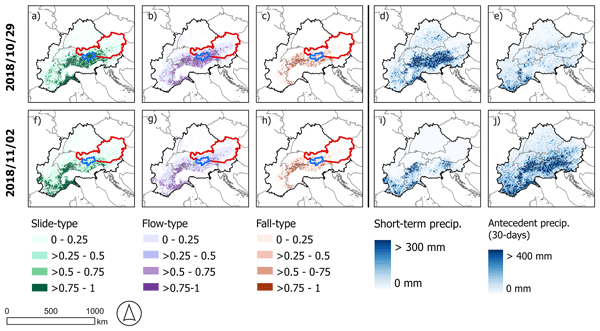
Stefan Steger, Raphael Spiekermann, Mateo Moreno, Sebastian Lehner, Katharina Enigl, Alice Crespi, and Matthias Schlögl
Nat. Hazards Earth Syst. Sci., 26, 3637–3665, https://doi.org/10.5194/nhess-26-3637-2026, https://doi.org/10.5194/nhess-26-3637-2026, 2026
Short summary
Short summary
We developed three space-time models to predict the daily impact potential of mass movements on infrastructure in the Alps, distinguishing slides, flows, and falls. The basin-scale approach accounts for potential process paths and integrates meteorological, geo-environmental, and exposure information. Results indicate suitability for impact-based warning. We discuss the broad applicability of the modelling framework to other impacts and beyond the warning context.
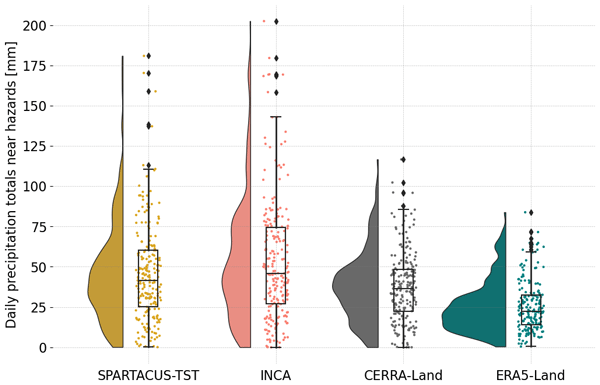
Alice Crespi, Katharina Enigl, Sebastian Lehner, Klaus Haslinger, and Massimiliano Pittore
Nat. Hazards Earth Syst. Sci., 26, 1975–1996, https://doi.org/10.5194/nhess-26-1975-2026, https://doi.org/10.5194/nhess-26-1975-2026, 2026
Short summary
Short summary
Extreme precipitation poses a risk to the Alpine region as it can trigger geohydrological hazards, such as floods, debris flows, and landslides, with serious impacts on people and their activities. This study focuses on a transboundary Alpine area between Italy and Austria and evaluates data and methods for detecting past precipitation extremes corresponding to hazard occurrences. The results can inform risk managers and support methodological choices for developing early warning systems.
Susen Shrestha, Stefano Terzi, Davide Zoccatelli, Mattia Zaramella, Marco Borga, Andrea Galletti, Mattia Callegari, Roberto Dinale, Massimiliano Pittore, and Giacomo Bertoldi
EGUsphere, https://doi.org/10.5194/egusphere-2025-6387, https://doi.org/10.5194/egusphere-2025-6387, 2026
Short summary
Short summary
Glaciers and snow contribute to buffer river streamflow during droughts. Due to climate change, their role is shrinking with severe implications for water management. Here we investigated the role of glaciers to buffer the 2003, 2005 and 2022 droughts that occurred in the upper Adige River Basin (Italy). Glaciers provided 4 to 12 % of summer water during droughts and their buffering is weakening due to their retreat with lower contribution in 2022 compared to the similar drought of 2003.
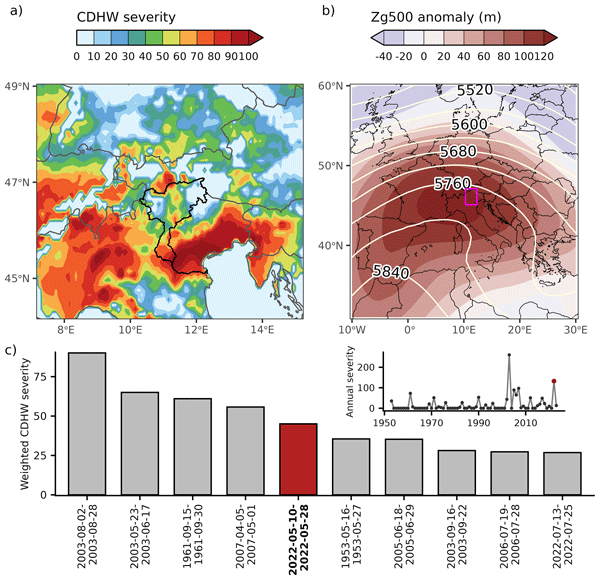
Marc Lemus-Canovas, Alice Crespi, Elena Maines, Stefano Terzi, and Massimiliano Pittore
Hydrol. Earth Syst. Sci., 29, 6781–6809, https://doi.org/10.5194/hess-29-6781-2025, https://doi.org/10.5194/hess-29-6781-2025, 2025
Short summary
Short summary
We studied a severe compound drought and heatwave event in the Adige River basin in May 2022 and found that similar events are now hotter and drier due to current warming. These changes worsen water stress and river drying. We show that timing matters: events in June are now more critical than in April, as the snowmelt contribution to streamflow in June has become much lower than in the past. However, many climate models still fail to capture these changes.
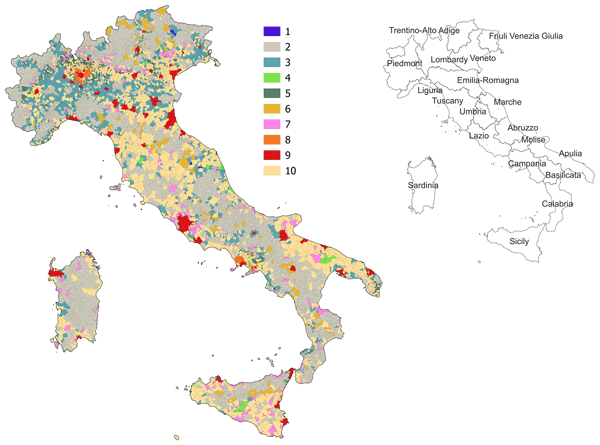
Gabriella Tocchi, Massimiliano Pittore, and Maria Polese
Nat. Hazards Earth Syst. Sci., 25, 3665–3692, https://doi.org/10.5194/nhess-25-3665-2025, https://doi.org/10.5194/nhess-25-3665-2025, 2025
Short summary
Short summary
This study identifies different types of urban areas in Italy based on population, location, and economic conditions to understand their vulnerability to risks. Using public data and clustering methods, it defines 18 urban archetypes. These archetypes provide a structured understanding of urban vulnerability, helping policymakers assess disaster risk, allocate adaptation funding, and design targeted resilience strategies for urban settlements at regional and national scales.
Juan Camilo Gómez Zapata, Massimiliano Pittore, Nils Brinckmann, Juan Lizarazo-Marriaga, Sergio Medina, Nicola Tarque, and Fabrice Cotton
Nat. Hazards Earth Syst. Sci., 23, 2203–2228, https://doi.org/10.5194/nhess-23-2203-2023, https://doi.org/10.5194/nhess-23-2203-2023, 2023
Short summary
Short summary
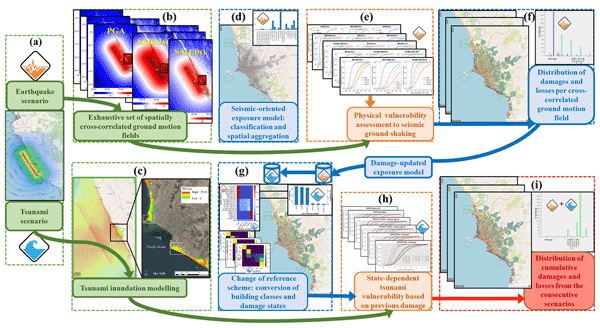
To investigate cumulative damage on extended building portfolios, we propose an alternative and modular method to probabilistically integrate sets of single-hazard vulnerability models that are being constantly developed by experts from various research fields to be used within a multi-risk context. We demonstrate its application by assessing the economic losses expected for the residential building stock of Lima, Peru, a megacity commonly exposed to consecutive earthquake and tsunami scenarios.
Stefan Steger, Mateo Moreno, Alice Crespi, Peter James Zellner, Stefano Luigi Gariano, Maria Teresa Brunetti, Massimo Melillo, Silvia Peruccacci, Francesco Marra, Robin Kohrs, Jason Goetz, Volkmar Mair, and Massimiliano Pittore
Nat. Hazards Earth Syst. Sci., 23, 1483–1506, https://doi.org/10.5194/nhess-23-1483-2023, https://doi.org/10.5194/nhess-23-1483-2023, 2023
Short summary
Short summary
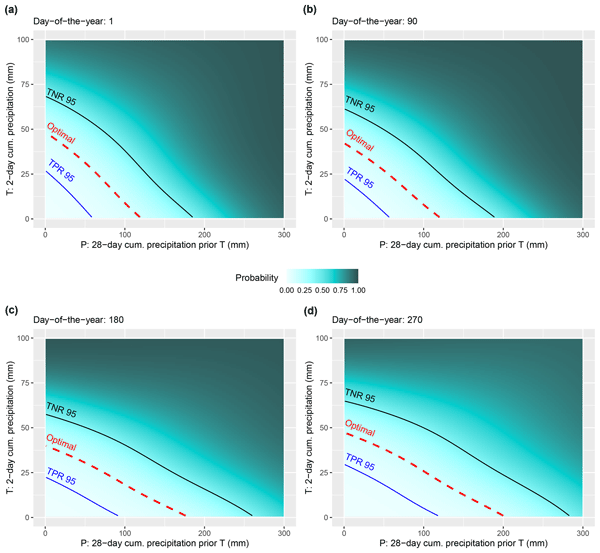
We present a novel data-driven modelling approach to determine season-specific critical precipitation conditions for landslide occurrence. It is shown that the amount of precipitation required to trigger a landslide in South Tyrol varies from season to season. In summer, a higher amount of preparatory precipitation is required to trigger a landslide, probably due to denser vegetation and higher temperatures. We derive dynamic thresholds that directly relate to hit rates and false-alarm rates.
Juan Camilo Gomez-Zapata, Nils Brinckmann, Sven Harig, Raquel Zafrir, Massimiliano Pittore, Fabrice Cotton, and Andrey Babeyko
Nat. Hazards Earth Syst. Sci., 21, 3599–3628, https://doi.org/10.5194/nhess-21-3599-2021, https://doi.org/10.5194/nhess-21-3599-2021, 2021
Short summary
Short summary
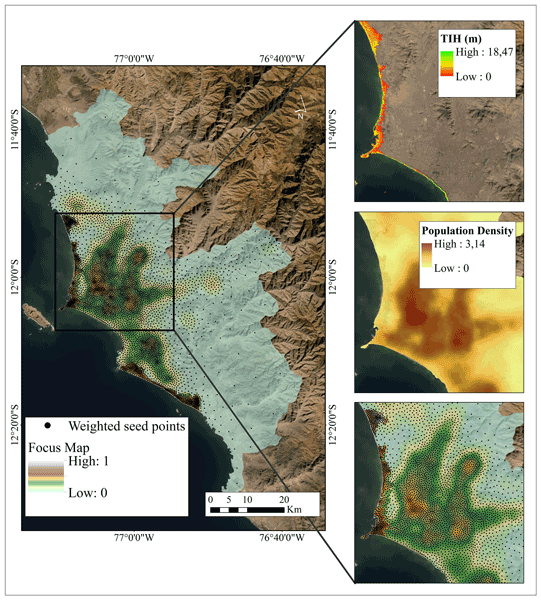
We present variable-resolution boundaries based on central Voronoi tessellations (CVTs) to spatially aggregate building exposure models and physical vulnerability assessment. Their geo-cell sizes are inversely proportional to underlying distributions that account for the combination between hazard intensities and exposure proxies. We explore their efficiency and associated uncertainties in risk–loss estimations and mapping from decoupled scenario-based earthquakes and tsunamis in Lima, Peru.
Stefano Terzi, Janez Sušnik, Stefan Schneiderbauer, Silvia Torresan, and Andrea Critto
Nat. Hazards Earth Syst. Sci., 21, 3519–3537, https://doi.org/10.5194/nhess-21-3519-2021, https://doi.org/10.5194/nhess-21-3519-2021, 2021
Short summary
Short summary
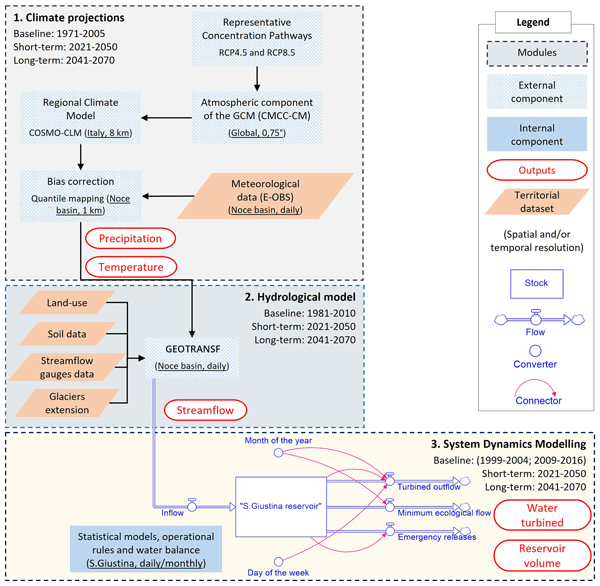
This study combines outputs from multiple models with statistical assessments of past and future water availability and demand for the Santa Giustina reservoir (Autonomous Province of Trento, Italy). Considering future climate change scenarios, results show high reductions for stored volume and turbined water, with increasing frequency, duration and severity. These results call for the need to adapt to reductions in water availability and effects on the Santa Giustina reservoir management.
Cited articles
American Society of Civil Engineers: Minimum Design Loads and Associated Criteria for Buildings and Other Structures, American Society of Civil Engineers, Reston, VA, https://doi.org/10.1061/9780784415788, 2021.
Baddeley, A., Turner, R., Møller, J., and Hazelton, M.: Residual Analysis for Spatial Point Processes (with Discussion), J. R. Stat. Soc. Ser. B Stat. Methodol., 67, 617–666, https://doi.org/10.1111/j.1467-9868.2005.00519.x, 2005.
Birkmann, J., Cardona, O. D., Carreño, M. L., Barbat, A. H., Pelling, M., Schneiderbauer, S., Kienberger, S., Keiler, M., Alexander, D., Zeil, P., and Welle, T.: Framing vulnerability, risk and societal responses: the MOVE framework, Nat. Hazards, 67, 193–211, https://doi.org/10.1007/s11069-013-0558-5, 2013.
Broeckx, J., Vanmaercke, M., Duchateau, R., and Poesen, J.: A data-based landslide susceptibility map of Africa, Earth-Sci. Rev., 185, 102–121, https://doi.org/10.1016/j.earscirev.2018.05.002, 2018.
Brzev, S., Scawthorn, C., Charleson, A. W., Allen, L., Greene, M., Jaiswal, K. S., and Silva, V.: GEM Building Taxonomy Version 2.0, GEM, https://cloud-storage.globalquakemodel.org/public/wix-new-website/pdf-collections-wix/publications/GEM Building Taxonomy Version 2.0.pdf (last access: 17 February 2026), 2013.
Calvo, B. and Savi, F.: A real-world application of Monte Carlo procedure for debris flow risk assessment, Comput. Geosci., 35, 967–977, https://doi.org/10.1016/j.cageo.2008.04.002, 2009.
Campalani, P., Pittore, M., and Renner, K.: Assessing OpenStreetMap roads fitness-for-use for disaster risk assessment in developing countries: The case of Burundi, Open Geosci., 15, 20220485, https://doi.org/10.1515/geo-2022-0485, 2023.
CEN (European Committee for Standardization): Eurocode 8: Design of structures for earthquake resistance – Part 1: General rules, seismic actions and rules for buildings (EN 1998-1:2004), Brussels: CEN, https://structuraldynamics.ulb.be/DOS/Eurocode8.pdf (last access: 17 February 2026), 2004.
Choi, E., Ha, J.-G., Hahm, D., and Kim, M. K.: A review of multihazard risk assessment: Progress, potential, and challenges in the application to nuclear power plants, Int. J. Disaster Risk Reduct., 53, 101933, https://doi.org/10.1016/j.ijdrr.2020.101933, 2021.
Cocuccioni, S., Plörer, M., and Kirchner, M.: Stakeholder Integration and Participatory Processes as Part of an Ecosystem-Based and Integrated Natural Hazard Risk Management, https://doi.org/10.5772/intechopen.99516, 2022.
Coles, S.: An Introduction to Statistical Modeling of Extreme Values, Springer London, London, https://doi.org/10.1007/978-1-4471-3675-0, 2001.
Copernicus: Flood hazard assessment in Bujumbura, Burundi, https://mapping.emergency.copernicus.eu/activations/EMSN191/#:~:text=Geodata REST API Fast Access,through JRC's ArcGIS REST services (last access: 17 February 2026), 2024.
Cornell, C. A.: Engineering seismic risk analysis, Bull. Seismol. Soc. Am., 58, 1583–1606, https://doi.org/10.1785/BSSA0580051583, 1968.
Corominas, J. and Moya, J.: A review of assessing landslide frequency for hazard zoning purposes, Eng. Geol., 102, 193–213, https://doi.org/10.1016/j.enggeo.2008.03.018, 2008.
Deijns: Deijns et al. NHESS -SAR Timing- GH Event Inventories, Zenodo, https://doi.org/10.5281/zenodo.7198321, 2022.
Delvaux, D., Mulumba, J.-L., Sebagenzi, M. N. S., Bondo, S. F., Kervyn, F., and Havenith, H.-B.: Seismic hazard assessment of the Kivu rift segment based on a new seismotectonic zonation model (western branch, East African Rift system), J. Afr. Earth Sci., 134, 831–855, https://doi.org/10.1016/j.jafrearsci.2016.10.004, 2017.
Depicker, A., Jacobs, L., Mboga, N., Smets, B., Van Rompaey, A., Lennert, M., Wolff, E., Kervyn, F., Michellier, C., Dewitte, O., and Govers, G.: Historical dynamics of landslide risk from population and forest-cover changes in the Kivu Rift, Nat. Sustain., 4, 965–974, https://doi.org/10.1038/s41893-021-00757-9, 2021a.
Depicker, A., Govers, G., Jacobs, L., Campforts, B., Uwihirwe, J., and Dewitte, O.: Interactions between deforestation, landscape rejuvenation, and shallow landslides in the North Tanganyika–Kivu rift region, Africa, Earth Surf. Dynam., 9, 445–462, https://doi.org/10.5194/esurf-9-445-2021, 2021b.
Depicker, A., Govers, G., Jacobs, L., Vanmaercke, M., Uwihirwe, J., Campforts, B., Kubwimana, D., Maki Mateso, J.-C., Mugaruka Bibentyo, T., Nahimana, L., Smets, B., and Dewitte, O.: Mobilization rates of landslides in a changing tropical environment: 60-year record over a large region of the East African Rift, Geomorphology, 454, 109156, https://doi.org/10.1016/j.geomorph.2024.109156, 2024.
Dewitte, O., Dille, A., Depicker, A., Kubwimana, D., Maki Mateso, J.-C., Mugaruka Bibentyo, T., Uwihirwe, J., and Monsieurs, E.: Constraining landslide timing in a data-scarce context: from recent to very old processes in the tropical environment of the North Tanganyika-Kivu Rift region, Landslides, 18, 161–177, https://doi.org/10.1007/s10346-020-01452-0, 2021.
Dike, V. N., Addi, M., Andang'o, H. A., Attig, B. F., Barimalala, R., Diasso, U. J., Du Plessis, M., Lamine, S., Mongwe, P. N., Zaroug, M., and Ochanda, V. K.: Obstacles facing Africa's young climate scientists, Nat. Clim. Change, 8, 447–449, https://doi.org/10.1038/s41558-018-0178-x, 2018.
Dixon, J., Garrity, D. P., Boffa, J.-M., Williams, T. O., Amede, T., Auricht, C., Lott, R., and Mburathi, G. (Eds.): Farming Systems and Food Security in Africa: Priorities for Science and Policy under Global Change, 1st ed., Routledge, New York, Routledge, https://doi.org/10.4324/9781315658841, 2019.
Englhardt, J., de Moel, H., Huyck, C. K., de Ruiter, M. C., Aerts, J. C. J. H., and Ward, P. J.: Enhancement of large-scale flood risk assessments using building-material-based vulnerability curves for an object-based approach in urban and rural areas, Nat. Hazards Earth Syst. Sci., 19, 1703–1722, https://doi.org/10.5194/nhess-19-1703-2019, 2019.
EU-DRMKC: INFORM Subnational Risk Assessment, https://drmkc.jrc.ec.europa.eu/inform-index/INFORM-Subnational-risk (last access: 17 February 2026), 2020.
European Commission, Joint Research Centre: Index for risk management – INFORM: concept and methodology, version 2017, Publications Office, LU, https://doi.org/10.2760/094023, 2017.
European Commission, Joint Research Centre: INFORM report 2023: shared evidence for managing crises and disasters, Publications Office, LU, https://doi.org/10.2760/073809, 2023.
FEMA: Hazus-MH 2.1 Earthquake Model Technical Manual, Federal Emergency Management Agency, Washington, DC, https://www.fema.gov/flood-maps/tools-resources/flood-map-products/hazus/documentation (last access: 17 February 2026), 2012.
FEMA: NEHRP Recommended Seismic Provisions for New Buildings and Other Structures (FEMA P-2082), Federal Emergency Management Agency, Washington, DC, https://www.wbdg.org/dhs/criteria/fema-p-2082-vol-1 (last access: 17 February 2026), 2020.
Fritzsche, K., Schneiderbauer, S., Bubeck, P., Kienberger, S., Buth, M., Zebisch, M., and Kahlenborn, W.: The Vulnerability Sourcebook. Concept and guidelines for standardised vulnerability assessments., Deutsche Gesellschaft für Internationale Zusammenarbeit (GIZ), https://health.bmz.de/wp-content/uploads/page/Vulnerability_Sourcebook__1_.pdf, (last access: 17 February 2026), 2014.
Gallina, V., Torresan, S., Critto, A., Sperotto, A., Glade, T., and Marcomini, A.: A review of multi-risk methodologies for natural hazards: Consequences and challenges for a climate change impact assessment, J. Environ. Manage., 168, 123–132, https://doi.org/10.1016/j.jenvman.2015.11.011, 2016.
Gbetkom, P. G., Crétaux, J.-F., Biancamaria, S., Blazquez, A., Paris, A., Tchilibou, M., Gal, L., Kitambo, B., Jucá Oliveira, R. A., and Gosset, M.: Lake Tanganyika basin water storage variations from 2003–2021 for water balance and flood monitoring, Remote Sens. Appl. Soc. Environ., 34, 101182, https://doi.org/10.1016/j.rsase.2024.101182, 2024.
Harper, B. A., Kepert, J. D., and Ginger, J. D.: Guidelines for converting between various wind averaging periods in tropical cyclone conditions, Geneva, https://library.wmo.int/idurl/4/48652 (last access: 17 February 2026), 2010.
Hungr, O., Leroueil, S., and Picarelli, L.: The Varnes classification of landslide types, an update, Landslides, 11, 167–194, https://doi.org/10.1007/s10346-013-0436-y, 2014.
Intergovernmental Panel On Climate Change (IPCC): Climate Change 2022 – Impacts, Adaptation and Vulnerability: Working Group II Contribution to the Sixth Assessment Report of the Intergovernmental Panel on Climate Change, 1st ed., Cambridge University Press, https://doi.org/10.1017/9781009325844, 2023.
IOM: Burundi Displacement Tracking Matrix (DTM) [April 2020], International Organization for Migration, 2020.
IPCC: IPCC Appendix I: Glossary, in: Global Warming of 1.5° C. An IPCC Special Report on the impacts of global warming of 1.5° C above pre-industrial levels and related global greenhouse gas emission pathways, in the context of strengthening the global response to the threat of climate change, sustainable development, and efforts to eradicate poverty, edited by: Matthews, J. B. R., Masson-Delmotte, V., Zhai, P., Pörtner, H.-O., Roberts, D., Skea, J., Shukla, P. R., Pirani, A., Moufouma-Okia, W., Péan, C., Pidcock, R., Connors, S., Matthews, J. B. R., Chen, Y., Zhou, X., Gomis, M. I., Lonnoy, E., Maycock, T., Tignor, M., and Waterfield, T., Cambridge University Press, Cambridge, UK and New York, NY, US, 541–562, https://doi.org/10.1017/9781009157940, 2018.
ISTEEBU: Rapport des projection demographiques 2008–2030, Institut de statistiques et d'études économiques du Burundi, Ministère des finances et de la planification du développement économique, Bujumbura, https://burundi.unfpa.org/sites/default/files/resource-pdf/Rapportdesprojections2008-2030.pdf (last access: 17 February 2026), 2013.
ISTEEBU: Projections démographiques 2010–2050 niveau national et provincial, Institut de statistiques et d’études économiques du Burundi, Bujumbura, 2017.
ISTEEBU: Annuaire Statistique du Burundi 2019, https://www.insbu.bi/documents/Annuaires/Annuaire-Statistique-du-Burundi_2020.pdf (last access: 17 February 2026), 2020.
Jacobs, L., Dewitte, O., Poesen, J., Sekajugo, J., Nobile, A., Rossi, M., Thiery, W., and Kervyn, M.: Field-based landslide susceptibility assessment in a data-scarce environment: the populated areas of the Rwenzori Mountains, Nat. Hazards Earth Syst. Sci., 18, 105–124, https://doi.org/10.5194/nhess-18-105-2018, 2018.
JRC: Science for disaster risk management 2020: acting today, protecting tomorrow, https://doi.org/10.2760/438998, 2021.
Kappes, M. S., Keiler, M., Von Elverfeldt, K., and Glade, T.: Challenges of analyzing multi-hazard risk: a review, Nat. Hazards, 64, 1925–1958, https://doi.org/10.1007/s11069-012-0294-2, 2012.
Kircher, C. A., Whitman, R. V., and Holmes, W. T.: HAZUS Earthquake Loss Estimation Methods, Nat. Hazards Rev., 7, 45–59, https://doi.org/10.1061/(ASCE)1527-6988(2006)7:2(45), 2006.
Kramer, S. L.: Geotechnical Earthquake Engineering, Prentice Hall, https://archive.org/details/geotechnicaleart0000kram (last access: 17 February 2026), 1996.
Kubwimana, D., Ait Brahim, L., Nkurunziza, P., Dille, A., Depicker, A., Nahimana, L., Abdelouafi, A., and Dewitte, O.: Characteristics and Distribution of Landslides in the Populated Hillslopes of Bujumbura, Burundi, Geosciences, 11, 259, https://doi.org/10.3390/geosciences11060259, 2021.
Luo, H. Y., Zhang, L. M., Zhang, L. L., He, J., and Yin, K. S.: Vulnerability of buildings to landslides: The state of the art and future needs, Earth-Sci. Rev., 238, 104329, https://doi.org/10.1016/j.earscirev.2023.104329, 2023.
Malamud, B. D., Turcotte, D. L., Guzzetti, F., and Reichenbach, P.: Landslide inventories and their statistical properties, Earth Surf. Process. Landf., 29, 687–711, https://doi.org/10.1002/esp.1064, 2004.
McGuire, R. K.: Seismic hazard and risk analysis, Earthquake Engineering Research Institute, Oakland, Calif, 221 pp., 2004.
MEEATU: Description du Burundi: Aspects Physiques, Ministère de L'Eau, de l'Environnement, de l'Amenagement du Territoire et de l'Urbanisme, 2012.
Michellier, C., Pigeon, P., Paillet, A., Trefon, T., Dewitte, O., and Kervyn, F.: The Challenging Place of Natural Hazards in Disaster Risk Reduction Conceptual Models: Insights from Central Africa and the European Alps, Int. J. Disaster Risk Sci., 11, 316–332, https://doi.org/10.1007/s13753-020-00273-y, 2020.
Molinari, D., Scorzini, A. R., Gallazzi, A., and Ballio, F.: AGRIDE-c, a conceptual model for the estimation of flood damage to crops: development and implementation, Nat. Hazards Earth Syst. Sci., 19, 2565–2582, https://doi.org/10.5194/nhess-19-2565-2019, 2019.
Monsieurs, E., Dewitte, O., and Demoulin, A.: A susceptibility-based rainfall threshold approach for landslide occurrence, Nat. Hazards Earth Syst. Sci., 19, 775–789, https://doi.org/10.5194/nhess-19-775-2019, 2019.
NASA JPL/USGS: NASA Shuttle Radar Topography Mission (SRTM) Global 1 arc second, 2000.
Nibigira, L., Draidia, S., and Havenith, H.-B.: La vallée du rift est-africain face aux risques gravitaires: cas de Bujumbura (Burundi), https://hdl.handle.net/2268/158392, 2013.
Nkunzimana, A., Bi, S., Jiang, T., Wu, W., and Abro, M. I.: Spatiotemporal variation of rainfall and occurrence of extreme events over Burundi during 1960 to 2010, Arab. J. Geosci., 12, 176, https://doi.org/10.1007/s12517-019-4335-y, 2019.
Nsabimana, J., Henry, S., Ndayisenga, A., Kubwimana, D., Dewitte, O., Kervyn, F., and Michellier, C.: Geo-Hydrological Hazard Impacts, Vulnerability and Perception in Bujumbura (Burundi): A High-Resolution Field-Based Assessment in a Sprawling City, Land, 12, 1876, https://doi.org/10.3390/land12101876, 2023.
OCHA: Aperçu des besoins humanitaires Burundi, https://www.unocha.org/publications/report/burundi/burundi-aper-u-des-besoins-humanitaires-2020-f-vrier-2020 (last access: 17 February 2026), 2020.
Owolabi, T. A. and Sajjad, M.: A global outlook on multi-hazard risk analysis: A systematic and scientometric review, Int. J. Disaster Risk Reduct., 92, 103727, https://doi.org/10.1016/j.ijdrr.2023.103727, 2023.
Patanè, G., Bortolotti, T., Yordanov, V., Biagi, L. G. A., Brovelli, M. A., Truong, X. Q., and Vantini, S.: An interpretable and transferable model for shallow landslides detachment combining spatial Poisson point processes and generalized additive models, Stoch. Environ. Res. Risk Assess., 39, 1723–1740, https://doi.org/10.1007/s00477-025-02943-z, 2025.
Paul, N. and Silva, V.: Probabilistic seismic risk assessment of Africa, Int. J. Disaster Risk Reduct., 119, 105303, https://doi.org/10.1016/j.ijdrr.2025.105303, 2025.
Pittore, M., Wieland, M., and Fleming, K.: Perspectives on global dynamic exposure modelling for geo-risk assessment, Nat. Hazards, 86, 7–30, https://doi.org/10.1007/s11069-016-2437-3, 2017.
Raju, E., Boyd, E., and Otto, F.: Stop blaming the climate for disasters, Commun. Earth Environ., 3, https://doi.org/10.1038/s43247-021-00332-2, 2022.
Rözer, V., Surminski, S., Laurien, F., McQuistan, C., and Mechler, R.: Multiple resilience dividends at the community level: A comparative study of disaster risk reduction interventions in different countries, Clim. Risk Manag., 40, 100518, https://doi.org/10.1016/j.crm.2023.100518, 2023.
Šakić Trogrlić, R., Reiter, K., Ciurean, R. L., Gottardo, S., Torresan, S., Daloz, A. S., Ma, L., Padrón Fumero, N., Tatman, S., Hochrainer-Stigler, S., De Ruiter, M. C., Schlumberger, J., Harris, R., Garcia-Gonzalez, S., García-Vaquero, M., Arévalo, T. L. F., Hernandez-Martin, R., Mendoza-Jimenez, J., Ferrario, D. M., Geurts, D., Stuparu, D., Tiggeloven, T., Duncan, M. J., and Ward, P. J.: Challenges in assessing and managing multi-hazard risks: A European stakeholders perspective, Environ. Sci. Policy, 157, 103774, https://doi.org/10.1016/j.envsci.2024.103774, 2024.
Schneiderbauer, S., Calliari, E., Eidsvig, U., and Hagenlocher, M.: The most recent view of vulnerability, in: Science for disaster risk management 2017 knowing better and losing less, edited by: Poljanšek, K., Marin-Ferrer, M., De Groeve, T., and Clark, L., Publications Office of the European Union, Luxembourg, 68–82, https://doi.org/10.2788/842809, 2017.
Schneiderbauer, S., Baunach, D., Pedoth, L., Renner, K., Fritzsche, K., Bollin, C., Pregnolato, M., Zebisch, M., Liersch, S., Rivas López, M. del R., and Ruzima, S.: Spatial-Explicit Climate Change Vulnerability Assessments Based on Impact Chains. Findings from a Case Study in Burundi, Sustainability, 12, 6354, https://doi.org/10.3390/su12166354, 2020.
Sekajugo, J., Kagoro-Rugunda, G., Mutyebere, R., Kabaseke, C., Mubiru, D., Kanyiginya, V., Vranken, L., Jacobs, L., Dewitte, O., and Kervyn, M.: Exposure and physical vulnerability to geo-hydrological hazards in rural environments: A field-based assessment in East Africa, Int. J. Disaster Risk Reduct., 102, 104282, https://doi.org/10.1016/j.ijdrr.2024.104282, 2024.
Silva, V., Amo-Oduro, D., Calderon, A., Dabbeek, J., Despotaki, V., Martins, L., Rao, A., Simionato, M., Viganò, D., Yepes, C., Acevedo, A., Horspool, N., Crowley, H., Jaiswal, K., Journeay, M., and Pittore, M.: Global Earthquake Model (GEM) Exposure Map (version 2018), Global Earthquake Model Foundation, Pavia, Italy, 2018.
Skamarock, W. C., Klemp, J. B., Dudhia, J., Gill, D. O., Barker, D. M., Duda, M. G., Huang, X.-Y., Wang, W., and Powers, J. G.: A Description of the Advanced Research WRF Version 3, NCAR Tech. Note NCARTN-475STR June 2008 Mesoscale Microscale Meteorol. Div. Natl. Cent. Atmospheric Res. Boulder, 475, 1, https://doi.org/10.5065/D68S4MVH, 2008.
Stalhandske, Z., Steinmann, C. B., Meiler, S., Sauer, I. J., Vogt, T., Bresch, D. N., and Kropf, C. M.: Global multi-hazard risk assessment in a changing climate, Sci. Rep., 14, https://doi.org/10.1038/s41598-024-55775-2, 2024.
Stark, C. P. and Hovius, N.: The characterization of landslide size distributions, Geophys. Res. Lett., 28, 1091–1094, https://doi.org/10.1029/2000GL008527, 2001.
Stevens, F. R., Gaughan, A. E., Linard, C., and Tatem, A. J.: Disaggregating Census Data for Population Mapping Using Random Forests with Remotely-Sensed and Ancillary Data, PLOS ONE, 10, e0107042, https://doi.org/10.1371/journal.pone.0107042, 2015.
Tanyaş, H., Van Westen, C. J., Allstadt, K. E., and Jibson, R. W.: Factors controlling landslide frequency–area distributions, Earth Surf. Process. Landf., 44, 900–917, https://doi.org/10.1002/esp.4543, 2019.
Tebbens, S. F.: Landslide Scaling: A Review, Earth Space Sci., 7, https://doi.org/10.1029/2019ea000662, 2020.
UNICEF: Burundi Country Office – Flash Humanitarian Situation Report No. 1 (April 2024), UNICEF, Bujumbura, Burundi, https://www.unicef.org/documents/burundi-flash-humanitarian-situation-report-no-1-30-april-2024 (last access: 4 March 2026), 2024.
UNISDR: Global Assessment Report on Disaster Risk Reduction 2015: Making Development Sustainable: The Future of Disaster Risk Management, United Nations Office for Disaster Risk Reduction (UNISDR), Geneva, Switzerland, https://doi.org/10.18356/919076d9-en, 2015a.
UNISDR: Sendai Framework for Disaster Risk Reduction 2015–2030, United Nations Office for Disaster Risk Reduction (UNISDR), Geneva, Switzerland, https://www.undrr.org/publication/sendai-framework-disaster-risk-reduction-2015-2030 (last access: 17 February 2026), 2015b.
Van Den Eeckhaut, M., Poesen, J., Govers, G., Verstraeten, G., and Demoulin, A.: Characteristics of the size distribution of recent and historical landslides in a populated hilly region, Earth Planet. Sci. Lett., 256, 588–603, https://doi.org/10.1016/j.epsl.2007.01.040, 2007a.
Van Den Eeckhaut, M., Poesen, J., Govers, G., Verstraeten, G., and Demoulin, A.: Characteristics of the size distribution of recent and historical landslides in a populated hilly region, Earth Planet. Sci. Lett., 256, 588–603, https://doi.org/10.1016/j.epsl.2007.01.040, 2007b.
Ward, P. J., Blauhut, V., Bloemendaal, N., Daniell, J. E., de Ruiter, M. C., Duncan, M. J., Emberson, R., Jenkins, S. F., Kirschbaum, D., Kunz, M., Mohr, S., Muis, S., Riddell, G. A., Schäfer, A., Stanley, T., Veldkamp, T. I. E., and Winsemius, H. C.: Review article: Natural hazard risk assessments at the global scale, Nat. Hazards Earth Syst. Sci., 20, 1069–1096, https://doi.org/10.5194/nhess-20-1069-2020, 2020.
World Bank: Understanding Risk in an Evolving World: Emerging Best Practices in Natural Disaster Risk Assessment, Global Facility for Disaster Reduction and Recovery (GFDRR), https://doi.org/10.1596/20579, 2014.
Zebisch, M., Renner, K., Pittore, M., Fritsch, U., Fruchter, S. R., Kienberger, S., Schinko, T., Sparkes, E., Hagenlocher, M., Schneiderbauer, S., and Delves, J. L.: Climate Risk Sourcebook, Deutsche Gesellschaft für Internationale Zusammenarbeit (GIZ), https://www.adaptationcommunity.net/wp-content/uploads/2023/10/giz_2023_Climate_Risk_Sourcebook.pdf (last access: 17 February 2026), 2023.
Short summary
This scientific paper presents a multi-hazard risk assessment for Burundi, focusing on flooding, torrential rains, landslides, earthquakes, and strong winds. The study identifies key risk hotspots with estimated economic losses of 92 million USD (2.5 % of Gross Domestic Product (GDP)). Climate change projections indicate increased precipitation. The paper highlights data limitations and stresses the need for improved hazard models and the consideration of compounding risks in future assessments.
This scientific paper presents a multi-hazard risk assessment for Burundi, focusing on flooding,...


Altmetrics
Final-revised paper
Preprint