Articles | Volume 26, issue 3
https://doi.org/10.5194/nhess-26-1105-2026
© Author(s) 2026. This work is distributed under
the Creative Commons Attribution 4.0 License.
https://doi.org/10.5194/nhess-26-1105-2026
© Author(s) 2026. This work is distributed under
the Creative Commons Attribution 4.0 License.
A thorough review of the 5 May 1990 Potenza (Southern Italy) earthquake: constraints from macroseismology and insights from hydrology

Andrea Antonucci
CORRESPONDING AUTHOR
Istituto Nazionale di Geofisica e Vulcanologia (INGV), Milano, Italy
Corrado Castellano
Istituto Nazionale di Geofisica e Vulcanologia (INGV), Roma, Italy
Luigi Cucci
Istituto Nazionale di Geofisica e Vulcanologia (INGV), Roma, Italy
Andrea Tertulliani
Istituto Nazionale di Geofisica e Vulcanologia (INGV), Roma, Italy
Related authors
Andrea Tertulliani, Andrea Antonucci, Filippo Bernardini, Viviana Castelli, Emanuela Ercolani, Laura Graziani, Alessandra Maramai, Martina Orlando, Antonio Rossi, and Tiziana Tuvè
Earth Syst. Sci. Data, 17, 4063–4077, https://doi.org/10.5194/essd-17-4063-2025, https://doi.org/10.5194/essd-17-4063-2025, 2025
Short summary
Short summary
We present the results of a rapid and reliable study of 45 Italian earthquakes characterized by datasets with potential inconsistencies or inhomogeneities. The used methodology obviates the need for exhaustive earthquake re-evaluation, and it is particularly effective for the updating of medium and low events, with a large amount of low-intensity data. The result is a new dataset very useful in improving “seismic histories” and in contributing to the enhancement of the seismic hazard of an area.
Andrea Rovida, Mario Locati, Andrea Antonucci, and Romano Camassi
Earth Syst. Sci. Data, 17, 3109–3124, https://doi.org/10.5194/essd-17-3109-2025, https://doi.org/10.5194/essd-17-3109-2025, 2025
Short summary
Short summary
ASMI, the Italian Archive of Historical Earthquake Data, is an online data collection that currently provides seismological data on earthquakes that occurred in and around Italy from from 461 BCE to 2025 CE. Based on more than 450 data sources, ASMI's web portal distributes earthquake parameters and macroseismic intensity data, along with the bibliographical reference of the data source and – if possible – the data source itself, through queries by both earthquake and data source.
Andrea Antonucci, Andrea Rovida, Vera D'Amico, and Dario Albarello
Nat. Hazards Earth Syst. Sci., 23, 1805–1816, https://doi.org/10.5194/nhess-23-1805-2023, https://doi.org/10.5194/nhess-23-1805-2023, 2023
Short summary
Short summary
The earthquake effects undocumented at 228 Italian localities were calculated through a probabilistic approach starting from the values obtained through the use of an intensity prediction equation, taking into account the intensity data documented at close localities for a given earthquake. The results showed some geographical dependencies and correlations with the intensity levels investigated.
Andrea Rovida, Andrea Antonucci, and Mario Locati
Earth Syst. Sci. Data, 14, 5213–5231, https://doi.org/10.5194/essd-14-5213-2022, https://doi.org/10.5194/essd-14-5213-2022, 2022
Short summary
Short summary
EPICA is the 1000–1899 catalogue compiled for the European Seismic Hazard Model 2020 and contains 5703 earthquakes with Mw ≥ 4.0. It relies on the data of the European Archive of Historical Earthquake Data (AHEAD), both macroseismic intensities from historical seismological studies and parameters from regional catalogues. For each earthquake, the most representative datasets were selected and processed in order to derive harmonised parameters, both from intensity data and parametric catalogues.
Andrea Antonucci, Andrea Rovida, Vera D'Amico, and Dario Albarello
Nat. Hazards Earth Syst. Sci., 21, 2299–2311, https://doi.org/10.5194/nhess-21-2299-2021, https://doi.org/10.5194/nhess-21-2299-2021, 2021
Short summary
Short summary
We present a probabilistic approach for integrating incomplete intensity distributions by means of the Bayesian combination of estimates provided by intensity prediction equations (IPEs) and data documented at nearby localities, accounting for the relevant uncertainties. The performance of the proposed methodology is tested at 28 Italian localities with long and rich seismic histories and for the strong 1980 and 2009 earthquakes in Italy. An application of this approach is also illustrated.
Andrea Tertulliani, Laura Graziani, Mario Locati, Manuela Sbarra, Corrado Castellano, and Michele Berardi
Earth Syst. Sci. Data Discuss., https://doi.org/10.5194/essd-2025-637, https://doi.org/10.5194/essd-2025-637, 2025
Preprint under review for ESSD
Short summary
Short summary
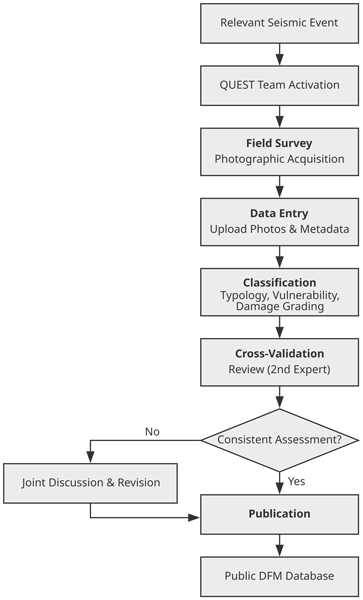
The DFM, managed by QUEST – the INGV's macroseismic field survey team – preserves essential photographic records of earthquake effects that might otherwise be lost. Each image is carefully validated by experts using the European Macroseismic Scale 1998 to classify building damage. This expanding archive is a key resource for training surveyors, improving vulnerability assessments, and strengthening national preparedness for future seismic emergencies.
Andrea Tertulliani, Andrea Antonucci, Filippo Bernardini, Viviana Castelli, Emanuela Ercolani, Laura Graziani, Alessandra Maramai, Martina Orlando, Antonio Rossi, and Tiziana Tuvè
Earth Syst. Sci. Data, 17, 4063–4077, https://doi.org/10.5194/essd-17-4063-2025, https://doi.org/10.5194/essd-17-4063-2025, 2025
Short summary
Short summary
We present the results of a rapid and reliable study of 45 Italian earthquakes characterized by datasets with potential inconsistencies or inhomogeneities. The used methodology obviates the need for exhaustive earthquake re-evaluation, and it is particularly effective for the updating of medium and low events, with a large amount of low-intensity data. The result is a new dataset very useful in improving “seismic histories” and in contributing to the enhancement of the seismic hazard of an area.
Andrea Rovida, Mario Locati, Andrea Antonucci, and Romano Camassi
Earth Syst. Sci. Data, 17, 3109–3124, https://doi.org/10.5194/essd-17-3109-2025, https://doi.org/10.5194/essd-17-3109-2025, 2025
Short summary
Short summary
ASMI, the Italian Archive of Historical Earthquake Data, is an online data collection that currently provides seismological data on earthquakes that occurred in and around Italy from from 461 BCE to 2025 CE. Based on more than 450 data sources, ASMI's web portal distributes earthquake parameters and macroseismic intensity data, along with the bibliographical reference of the data source and – if possible – the data source itself, through queries by both earthquake and data source.
Andrea Antonucci, Andrea Rovida, Vera D'Amico, and Dario Albarello
Nat. Hazards Earth Syst. Sci., 23, 1805–1816, https://doi.org/10.5194/nhess-23-1805-2023, https://doi.org/10.5194/nhess-23-1805-2023, 2023
Short summary
Short summary
The earthquake effects undocumented at 228 Italian localities were calculated through a probabilistic approach starting from the values obtained through the use of an intensity prediction equation, taking into account the intensity data documented at close localities for a given earthquake. The results showed some geographical dependencies and correlations with the intensity levels investigated.
Andrea Rovida, Andrea Antonucci, and Mario Locati
Earth Syst. Sci. Data, 14, 5213–5231, https://doi.org/10.5194/essd-14-5213-2022, https://doi.org/10.5194/essd-14-5213-2022, 2022
Short summary
Short summary
EPICA is the 1000–1899 catalogue compiled for the European Seismic Hazard Model 2020 and contains 5703 earthquakes with Mw ≥ 4.0. It relies on the data of the European Archive of Historical Earthquake Data (AHEAD), both macroseismic intensities from historical seismological studies and parameters from regional catalogues. For each earthquake, the most representative datasets were selected and processed in order to derive harmonised parameters, both from intensity data and parametric catalogues.
Fabrizio Marra, Alberto Frepoli, Dario Gioia, Marcello Schiattarella, Andrea Tertulliani, Monica Bini, Gaetano De Luca, and Marco Luppichini
Nat. Hazards Earth Syst. Sci., 22, 2445–2457, https://doi.org/10.5194/nhess-22-2445-2022, https://doi.org/10.5194/nhess-22-2445-2022, 2022
Short summary
Short summary
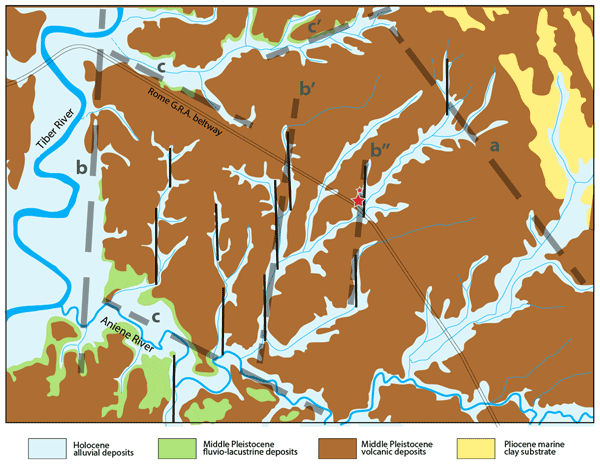
Through the analysis of the morphostructural setting in which the seismicity of Rome is framed, we explain why the city should not expect to suffer damage from a big earthquake.
Andrea Antonucci, Andrea Rovida, Vera D'Amico, and Dario Albarello
Nat. Hazards Earth Syst. Sci., 21, 2299–2311, https://doi.org/10.5194/nhess-21-2299-2021, https://doi.org/10.5194/nhess-21-2299-2021, 2021
Short summary
Short summary
We present a probabilistic approach for integrating incomplete intensity distributions by means of the Bayesian combination of estimates provided by intensity prediction equations (IPEs) and data documented at nearby localities, accounting for the relevant uncertainties. The performance of the proposed methodology is tested at 28 Italian localities with long and rich seismic histories and for the strong 1980 and 2009 earthquakes in Italy. An application of this approach is also illustrated.
Cited articles
Alessio, G., Esposito, E., Gorini, A., and Porfido, S.: Detailed study of the Potentino seismic zone in the Southern Apennines, Italy, Tectonophysics, 250, 113–134, 1995.
Allen, T. I., Wald, D. J., and Worden, C. B.: Intensity attenuation for active crustal regions, J. Seismol., 16, 409–433, https://doi.org/10.1007/s10950-012-9278-7, 2012.
Antonucci, A., Augliera, P., Locati, M., and Rovida, A.: Impact of the intensity assessment on the macroseismic parameters of earthquakes in Italy, Geophys. J. Int., 242, 1–11, https://doi.org/10.1093/gji/ggaf224, 2025.
Azzara, R., Basili, A., Beranzoli, L., Chiarabba, C., Di Giovambattista, R., and Selvaggi, G.: The seismic sequence of Potenza (May 1990), Ann. Geofis., 36, 237–243, 1993.
Bakun, W. H. and Scotti, O.: Regional intensity attenuation models for France and the estimation of magnitude and location of historical earthquakes, Geophys. J. Int., 164, 596–610, https://doi.org/10.1111/j.1365-246X.2005.02808.x, 2006.
Bakun, W. H., Gomez Capera, A., and Stucchi, M.: Epistemic uncertainty in the location and magnitude of earthquakes in Italy from macroseismic data, B. Seismol. Soc. Am., 101, 2712–2725, 2011.
Becker, J. S., Potter, S. H., McBride, S. K., Wein, A., Doyle, E. E. H., and Paton, D.: When the earth doesn't stop shaking: How experiences over time influenced information needs, communication, and interpretation of aftershock information during the Canterbury Earthquake Sequence, New Zealand, Int. J. Disast. Risk Red., 34, 397–411, https://doi.org/10.1016/j.ijdrr.2018.12.009, 2019.
Bindi, D., Parolai, S., Oth, A., Abdrakhmatov, K., Muraliev, A., and Zschau, J.: Intensity prediction equations for Central Asia, Geophys. J. Int., 187, 327–337, https://doi.org/10.1111/j.1365-246X.2011.05142.x, 2011.
Boncio, P., Mancini, T., Lavecchia, G., and Selvaggi G.: Seismotectonics of strike–slip earthquakes within the deep crust of southern Italy: Geometry, kinematics, stress field and crustal rheology of the Potenza 1990–1991 seismic sequences (Mmax 5.7), Tectonophysics, 445, 3–4, https://doi.org/10.1016/j.tecto.2007.08.016, 2007.
Castello, B., Selvaggi, G., Chiarabba, C., and Amato, A.: CSI Catalogueo della sismicità italiana 1981–2002, versione 1.1, Istituto Nazionale di Geofisica e Vulcanologia (INGV), https://doi.org/10.13127/CSI.1.1, 2006.
Cucci, L. and Tertulliani, A.: Variation of human perceptiveness of earthquakes during seismic sequences, J. Seismol., 11, 205–219, https://doi.org/10.1007/s10950-007-9048-0, 2007.
Cucci, L., Castellano, C., and Tertulliani, A.: The Hydrological Impact of Historical and Modern Earthquakes in Central-Southern Italy: Data Analysis and Seismotectonic Insights, Seismol. Res. Lett., 96, 1117–1133, https://doi.org/10.1785/0220240234, 2024.
Cucci, L., Castellano, C., and Tertulliani, A.: A dataset of hydrological effects induced by historical and modern earthquakes in Southern Apennines (Italy), Sci. Data, 12, 879, https://doi.org/10.1038/s41597-025-05219-x, 2025.
D'Amico, S., Tuvè, T., and Mantovani, A.: New relationships between macroseismic intensity and local magnitude for the volcanic region of Mt. Etna (Italy), J. Seismol., 29, 305–315, https://doi.org/10.1007/s10950-024-10274-9, 2025.
Del Mese, S., Graziani, L., Meroni, F., Pessina, V., and Tertulliani, A.: Considerations on using MCS and EMS-98 macroseismic scales for the intensity assessment of contemporary Italian earthquakes, Bull. Earthq. Eng., 21, 4167–4189, https://doi.org/10.1007/s10518-023-01703-0, 2023.
Di Luccio, F., Piscini, A., Pino, N. A., and Ventura, G.: Reactivation of deep faults beneath Southern Apennines: evidence from the 1990–1991 Potenza seismic sequences, Terra Nova, 17, 542–548, https://doi.org/10.1111/j.1365-3121.2005.00653.x, 2005.
Di Maro, R. and Tertulliani, A.: The relation between intensity and magnitude for Italian earthquakes, Pure Appl. Geophys., 132, 711–718, 1990.
Fernández-Fraile, J., Mattesini, M., and Buforn, E.: Re-Evaluation of the Earthquake Catalog for Spain Using the EMS-98 Scale for the Period 1900–1962, Pure Appl. Geophys., 182, 1237–1261, https://doi.org/10.1007/s00024-024-03461-9, 2025.
Galli, P.: New empirical relationships between magnitude and distance for liquefaction, Tectonophysics, 324, 169–187, 2000.
Gasparini, C., Tertulliani, A., Riguzzi, F., Anzidei, M., Maramai, A., Murru, M., De Rubeis, V., Vecchi, M., Del Mese, S., Vannucci, C., Conte, S., Massucci, A., and Saraceni, A. M.: Bollettino macrosismico 1990, Istituto Nazionale di Geofisica, Roma, 285 pp., https://emidius.mi.ingv.it/ASMI/study/BMING991b (last access: 27 February 2026), 1991.
Gasparini, C., De Rubeis, V., and Tertulliani, A.: A method for the analysis of macroseismic questionnaires, Nat. Hazards, 5, 169–177, 1992.
Gasperini, P., Bernardini, F., Valensise, G., and Boschi, E.: Defining seismogenic sources from historical earthquake felt reports, B. Seismol. Soc. Am., 89, 94–110, 1999.
Gasperini, P., Vannucci, G., Tripone, D., and Boschi, E.: The Location and Sizing of Historical Earthquakes Using the Attenuation of Macroseismic Intensity with Distance, B. Seismol. Soc. Am., 100, 2035–2066, https://doi.org/10.1785/0120090330, 2010.
Gomez-Capera, A. A., D'Amico, M., Lanzano, G., Locati, M., and Santulin, M.: Relationships between ground motion parameters and macroseismic intensity for Italy, Bull. Earthq. Eng., 18, 5143–5164, 75, https://doi.org/10.1007/s10518-020-00905-0, 2020.
Gomez-Capera, A. A., Santulin, M., D'Amico, M., D'Amico, V., Locati, M., Meletti, C., and Varini, E.: Macroseismic intensity attenuation models calibrated in Mw for Italy, Bull. Earthq. Eng., https://doi.org/10.1007/s10518-023-01822-8, 2024.
Graziani, L., Bernardini, F., Castellano, C., Del Mese, S., Ercolani, E., Rossi, A., Tertulliani, A., and Vecchi, M.: The 2012 Emilia earthquake sequence: an attempt of historical reading, J. Seismol., 19, 371–387, https://doi.org/10.1007/s10950-014-9471-y, 2015.
Grünthal, G. (Ed.): European Macroseismic Scale 1998, Vol. 13, Conseil de l'Europe, Cahiers du Centre Européen de Géodynamique et de Séismologie, Luxembourg, 99 pp., ISBN N2-87977-008-4, 1998.
Guidoboni, E., Ferrari, G., Mariotti, D., Comastri, A., Tarabusi, G., and Valensise G.: CFTI4Med, Catalogue of Strong Earthquakes in Italy (461 B.C.-1997) and Mediterranean Area (760 B.C.-1500), INGV-SGA, http://storing.ingv.it/cfti4med/ (last access: 27 February), 2007.
Hough, S. E. and Martin, S. S.: Which earthquake accounts matter?, Seismol. Res. Lett., 92, 1069–1084, https://doi.org/10.1785/0220200366, 2021.
Hu, J.: Empirical relationships between earthquake magnitude and maximum distance based on the extended global liquefaction-induced damage cases, Acta Geotech., 18, 2081–2095, https://doi.org/10.1007/s11440-022-01637-y, 2023.
International Seismological Centre: On-line Bulletin, https://doi.org/10.31905/D808B830, 2025.
Joffe, H., Rossetto, T., Solberg, C., and O'Connor, C.: Social Representations of Earthquakes: A Study of People Living in Three Highly Seismic Areas, Earthq. Spectra, 29, 367–397, https://doi.org/10.1193/1.4000138, 2013.
Locati, M., Camassi, R., Rovida, A., Ercolani, E., Bernardini, F., Castelli, V., Caracciolo, C. H., Tertulliani, A., Rossi, A., Azzaro, R., D'Amico, S., and Antonucci, A.: Database Macrosismico Italiano (DBMI15), versione 4.0, Istituto Nazionale di Geofisica e Vulcanologia (INGV), https://doi.org/10.13127/DBMI/DBMI15.4, 2022.
Lolli, B., Gasperini, P., and Vannucci, G.: Recalibration of the intensity prediction equation in Italy using the macroseismic dataset DBMI15 version 2.0, Seismol. Res. Lett., 95, 2399–2408, https://doi.org/10.1785/0220230212, 2024.
Maggi, C., Frepoli, A., Cimini, G. B., Console, R., and Chiappini, M.: Recent seismicity and crustal stress field in the Lucanian Apennines and surrounding areas (Southern Italy): Seismotectonic implications, Tectonophysics, 463, 130–144, https://doi.org/10.1016/j.tecto.2008.09.032, 2009.
Montgomery, D. R. and Manga, M.: Streamflow and water well responses to earthquakes, Science, 300, 2047–2049, 2003.
Oliveti, I., Faenza, L., and Michelini, A.: New reversible relationships between ground motion parameters and macroseismic intensity for Italy and their application in ShakeMap, Geophys. J. Int., 231, 1117–1137, https://doi.org/10.1093/gji/ggac245, 2022.
Pirrotta, C., Barbano, M. S., Guarnera, P., and Gerardi, F.: A new dataset and empirical relationships between magnitude/intensity and epicentral distance for liquefaction in central-eastern Sicily, Ann. Geophys., 50, 763–774, https://doi.org/10.4401/ag-3055, 2007.
Provost, L. and Scotti, O.: QUake-MD: Open-Source Code to Quantify Uncertainties in Magnitude – Depth Estimates of Earthquakes from Macroseismic Intensities, Seismol. Res. Lett., 91, 2520–2530, https://doi.org/10.1785/0220200064, 2020.
Rovida, A., Locati, M., Antonucci, A., and Camassi, R. (Eds.): Archivio Storico Macrosismico Italiano (ASMI), Istituto Nazionale di Geofisica e Vulcanologia (INGV), https://doi.org/10.13127/asmi, 2017.
Rovida, A., Locati, M., Camassi, R., Lolli, B., and Gasperini, P.: The Italian earthquake Catalogue CPTI15, Bull. Earthq. Eng., 18, 2953–2984, https://doi.org/10.1007/s10518-020-00818-y, 2020.
Rovida, A., Locati, M., Camassi, R., Lolli, B., Gasperini, P., and Antonucci, A.: Italian Parametric Earthquake Catalogue (CPTI15), version 4.0, Istituto Nazionale di Geofisica e Vulcanologia (INGV), https://doi.org/10.13127/cpti/cpti15.4, 2022.
Rovida, A., Locati, M., Antonucci, A., and Camassi, R.: The Italian Archive of Historical Earthquake Data, ASMI, Earth Syst. Sci. Data, 17, 3109–3124, https://doi.org/10.5194/essd-17-3109-2025, 2025.
Sbarra, P., Burrato, P., De Rubeis, V., Tosi, P., Valensise, G., Vallone, R., and Vannoli, P.: Inferring the depth and magnitude of pre-instrumental earthquakes from intensity attenuation curves, Nat. Hazards Earth Syst. Sci., 23, 1007–1028, https://doi.org/10.5194/nhess-23-1007-2023, 2023.
Sieberg, A.: Die Erdbeben, in: Handbuch der Geophysik, edited by: Gutenberg, B., Gebrüder Bornträger, Berlin, 527–686, 1932.
Tertulliani, A. and Castellano, C.: Il terremoto del 26 agosto 1806 è stato veramente il più forte evento nell'area romana?, Quad. Geofis., 193, 1–48, https://doi.org/10.13127/qdg/193, 2024.
Tertulliani, A., Anzidei, M., Maramai, A., Murru, M., and Riguzzi, F.: Macroseismic study of the Potenza (Southern Italy) earthquake of May 5, 1990, Nat. Hazards, 6, 25–38, 1992.
Tertulliani, A., Castelli, V., Rossi, A., and Vecchi, M.: Reappraising a wartime earthquake: the October 3, 1943 event in the southern Marches (central Italy), Ann. Geophys., 57, https://doi.org/10.4401/ag-6645, 2014.
Tertulliani, A., Antonucci, A., Bernardini, F., Castelli, V., Ercolani, E., Graziani, L., Maramai, A., Orlando, M., Rossi, A., and Tuvè, T.: A comprehensive integrated macroseismic dataset from multiple earthquake studies, Earth Syst. Sci. Data, 17, 4063–4077, https://doi.org/10.5194/essd-17-4063-2025, 2025.
Vannucci, G., Lolli, B., and Gasperini, P.: Inhomogeneity of macroseismic intensities in Italy and consequences for macroseismic magnitude estimation, Seismol. Res. Lett., 92, 2234–2244, https://doi.org/10.1785/0220200273, 2021.
Short summary
We present a revised and comprehensive macroseismic dataset of the 5 May 1990 earthquake that occurred in southern Italy (Mw 5.77). By re-evaluating all sources, we compiled a new dataset of 1393 macroseismic data points. This revised dataset shows a general decrease in higher intensity values compared to previous assessments. Additionally, we collect extensive observations of seismically-induced hydrological changes.
We present a revised and comprehensive macroseismic dataset of the 5 May 1990 earthquake that...
Altmetrics
Final-revised paper
Preprint