
Articles | Volume 24, issue 11
https://doi.org/10.5194/nhess-24-3755-2024
© Author(s) 2024. This work is distributed under
the Creative Commons Attribution 4.0 License.
the Creative Commons Attribution 4.0 License.
Special issue:
https://doi.org/10.5194/nhess-24-3755-2024
© Author(s) 2024. This work is distributed under
the Creative Commons Attribution 4.0 License.
the Creative Commons Attribution 4.0 License.
Research article
| 
06 Nov 2024
Research article |
| 06 Nov 2024
| 06 Nov 2024
Strategies for comparison of modern probabilistic seismic hazard models and insights from the Germany and France border region
Graeme Weatherill
CORRESPONDING AUTHOR
GFZ German Research Centre for Geosciences, Potsdam, 14473, Germany
Fabrice Cotton
GFZ German Research Centre for Geosciences, Potsdam, 14473, Germany
Institute of Geosciences, University of Potsdam, Potsdam-Golm, 14476, Germany
Guillaume Daniel
Électricité de France, Aix-en-Provence, 13290, France
Irmela Zentner
Électricité de France, EDF R&D Lab Paris-Saclay, Paris-Saclay, 91120, France
Pablo Iturrieta
GFZ German Research Centre for Geosciences, Potsdam, 14473, Germany
Institute of Geosciences, University of Potsdam, Potsdam-Golm, 14476, Germany
Christian Bosse
GFZ German Research Centre for Geosciences, Potsdam, 14473, Germany
Related authors
Laurentiu Danciu, Domenico Giardini, Graeme Weatherill, Roberto Basili, Shyam Nandan, Andrea Rovida, Céline Beauval, Pierre-Yves Bard, Marco Pagani, Celso G. Reyes, Karin Sesetyan, Susana Vilanova, Fabrice Cotton, and Stefan Wiemer
Nat. Hazards Earth Syst. Sci., 24, 3049–3073, https://doi.org/10.5194/nhess-24-3049-2024, https://doi.org/10.5194/nhess-24-3049-2024, 2024
Short summary
Short summary
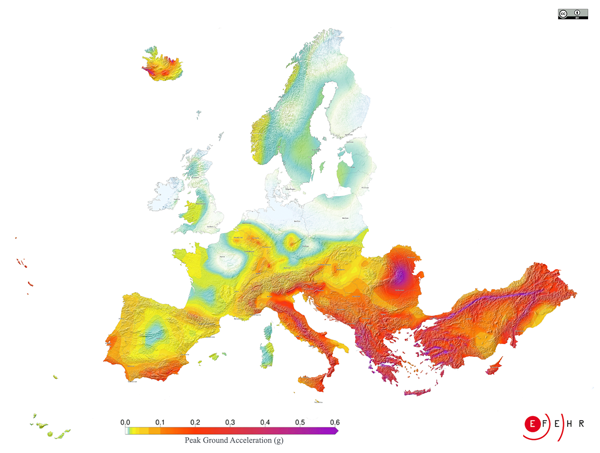
The 2020 European Seismic Hazard Model (ESHM20) is the latest seismic hazard assessment update for the Euro-Mediterranean region. This state-of-the-art model delivers a broad range of hazard results, including hazard curves, maps, and uniform hazard spectra. ESHM20 provides two hazard maps as informative references in the next update of the European Seismic Design Code (CEN EC8), and it also provides a key input to the first earthquake risk model for Europe.
Graeme Weatherill, Sreeram Reddy Kotha, Laurentiu Danciu, Susana Vilanova, and Fabrice Cotton
Nat. Hazards Earth Syst. Sci., 24, 1795–1834, https://doi.org/10.5194/nhess-24-1795-2024, https://doi.org/10.5194/nhess-24-1795-2024, 2024
Short summary
Short summary
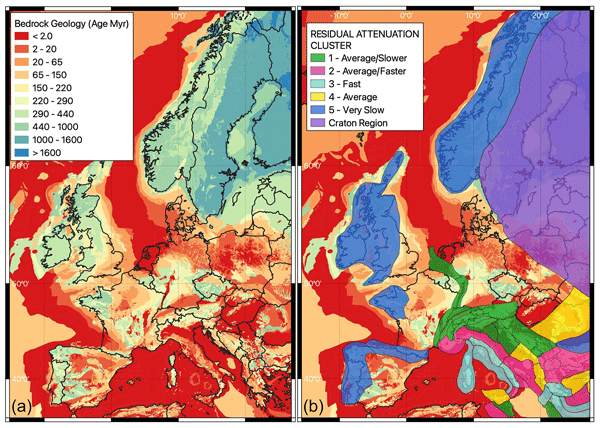
The ground motion models (GMMs) selected for the 2020 European Seismic Hazard Model (ESHM20) and their uncertainties require adaptation to different tectonic environments. Using insights from new data, local experts and developments in the scientific literature, we further calibrate the ESHM20 GMM logic tree to capture previously unmodelled regional variation. We also propose a new scaled-backbone logic tree for application to Europe's subduction zones and the Vrancea deep seismic source.
Karina Loviknes, Fabrice Cotton, and Graeme Weatherill
Nat. Hazards Earth Syst. Sci., 24, 1223–1247, https://doi.org/10.5194/nhess-24-1223-2024, https://doi.org/10.5194/nhess-24-1223-2024, 2024
Short summary
Short summary
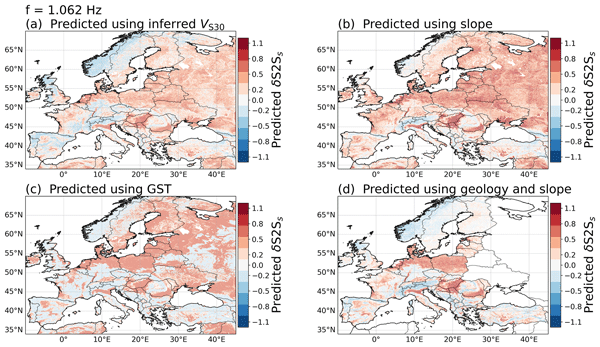
Earthquake ground shaking can be strongly affected by local geology and is often amplified by soft sediments. In this study, we introduce a global geomorphological model for sediment thickness as a protentional parameter for predicting this site amplification. The results show that including geology and geomorphology in site-amplification predictions adds important value and that global or regional models for sediment thickness from fields beyond engineering seismology are worth considering.
Irina Dallo, Michèle Marti, Nadja Valenzuela, Helen Crowley, Jamal Dabbeek, Laurentiu Danciu, Simone Zaugg, Fabrice Cotton, Domenico Giardini, Rui Pinho, John F. Schneider, Céline Beauval, António A. Correia, Olga-Joan Ktenidou, Päivi Mäntyniemi, Marco Pagani, Vitor Silva, Graeme Weatherill, and Stefan Wiemer
Nat. Hazards Earth Syst. Sci., 24, 291–307, https://doi.org/10.5194/nhess-24-291-2024, https://doi.org/10.5194/nhess-24-291-2024, 2024
Short summary
Short summary
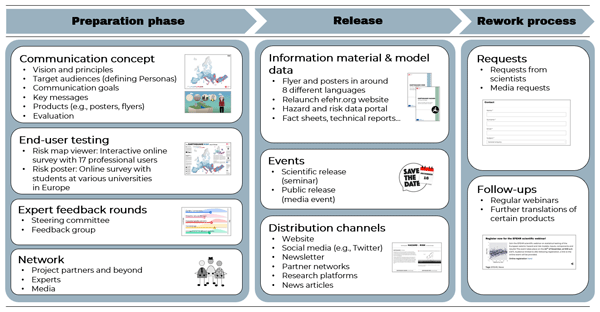
For the release of cross-country harmonised hazard and risk models, a communication strategy co-defined by the model developers and communication experts is needed. The strategy should consist of a communication concept, user testing, expert feedback mechanisms, and the establishment of a network with outreach specialists. Here we present our approach for the release of the European Seismic Hazard Model and European Seismic Risk Model and provide practical recommendations for similar efforts.
Ssu-Ting Lai, Kyaw Moe Oo, Yin Myo Min Htwe, Tin Yi, Htay Htay Than, Oo Than, Zaw Min, Tun Minn Oo, Phyo Maung Maung, Dino Bindi, Fabrice Cotton, Peter L. Evans, Andres Heinloo, Laura Hillmann, Joachim Saul, Christoph Sens-Schönfelder, Angelo Strollo, Frederik Tilmann, Graeme Weatherill, Ming-Hsuan Yen, Riccardo Zaccarelli, Thomas Zieke, and Claus Milkereit
Earth Syst. Sci. Data, 17, 5149–5164, https://doi.org/10.5194/essd-17-5149-2025, https://doi.org/10.5194/essd-17-5149-2025, 2025
Short summary
Short summary
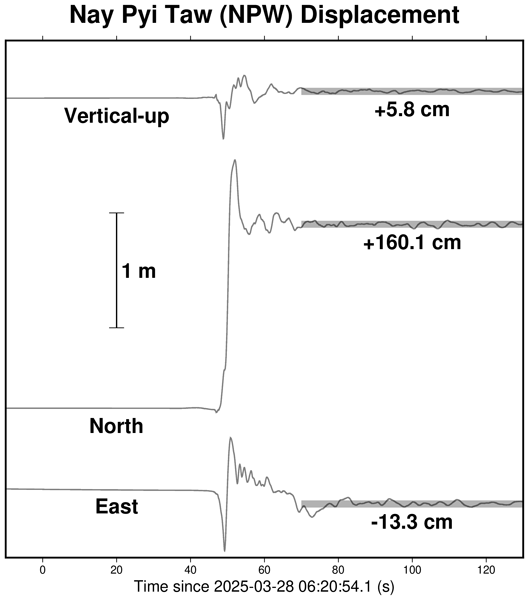
On 28 March 2025, Myanmar was struck by a destructive Mw 7.7 earthquake. We present detailed information on the data and metadata availability for the Naypyitaw station (NPW) in Myanmar, the only local strong-motion station located near the Sagaing Fault that recorded the mainshock without saturation. We also highlight the collaborative effort that made the installation of NPW possible. The high-quality recordings from NPW offer critical insights for seismic hazard assessment in the region.
Laurentiu Danciu, Domenico Giardini, Graeme Weatherill, Roberto Basili, Shyam Nandan, Andrea Rovida, Céline Beauval, Pierre-Yves Bard, Marco Pagani, Celso G. Reyes, Karin Sesetyan, Susana Vilanova, Fabrice Cotton, and Stefan Wiemer
Nat. Hazards Earth Syst. Sci., 24, 3049–3073, https://doi.org/10.5194/nhess-24-3049-2024, https://doi.org/10.5194/nhess-24-3049-2024, 2024
Short summary
Short summary
The 2020 European Seismic Hazard Model (ESHM20) is the latest seismic hazard assessment update for the Euro-Mediterranean region. This state-of-the-art model delivers a broad range of hazard results, including hazard curves, maps, and uniform hazard spectra. ESHM20 provides two hazard maps as informative references in the next update of the European Seismic Design Code (CEN EC8), and it also provides a key input to the first earthquake risk model for Europe.
Graeme Weatherill, Sreeram Reddy Kotha, Laurentiu Danciu, Susana Vilanova, and Fabrice Cotton
Nat. Hazards Earth Syst. Sci., 24, 1795–1834, https://doi.org/10.5194/nhess-24-1795-2024, https://doi.org/10.5194/nhess-24-1795-2024, 2024
Short summary
Short summary
The ground motion models (GMMs) selected for the 2020 European Seismic Hazard Model (ESHM20) and their uncertainties require adaptation to different tectonic environments. Using insights from new data, local experts and developments in the scientific literature, we further calibrate the ESHM20 GMM logic tree to capture previously unmodelled regional variation. We also propose a new scaled-backbone logic tree for application to Europe's subduction zones and the Vrancea deep seismic source.
Karina Loviknes, Fabrice Cotton, and Graeme Weatherill
Nat. Hazards Earth Syst. Sci., 24, 1223–1247, https://doi.org/10.5194/nhess-24-1223-2024, https://doi.org/10.5194/nhess-24-1223-2024, 2024
Short summary
Short summary
Earthquake ground shaking can be strongly affected by local geology and is often amplified by soft sediments. In this study, we introduce a global geomorphological model for sediment thickness as a protentional parameter for predicting this site amplification. The results show that including geology and geomorphology in site-amplification predictions adds important value and that global or regional models for sediment thickness from fields beyond engineering seismology are worth considering.
Dino Bindi, Riccardo Zaccarelli, Angelo Strollo, Domenico Di Giacomo, Andres Heinloo, Peter Evans, Fabrice Cotton, and Frederik Tilmann
Earth Syst. Sci. Data, 16, 1733–1745, https://doi.org/10.5194/essd-16-1733-2024, https://doi.org/10.5194/essd-16-1733-2024, 2024
Short summary
Short summary
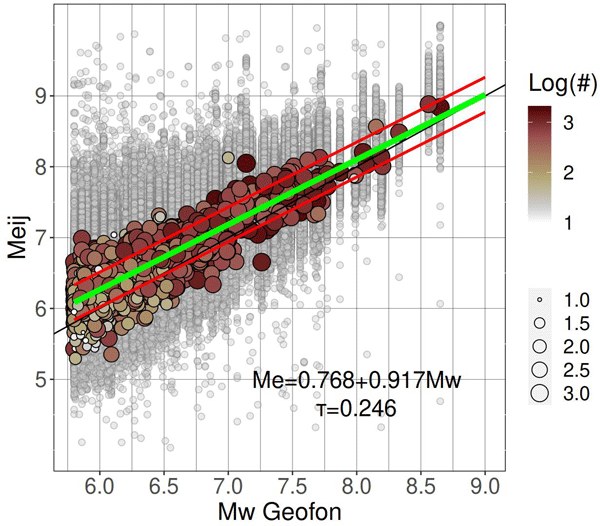
The size of an earthquake is often described by a single number called the magnitude. Among the possible magnitude scales, the seismic moment (Mw) and the radiated energy (Me) scales are based on physical parameters describing the rupture process. Since these two magnitude scales provide complementary information that can be used for seismic hazard assessment and for seismic risk mitigation, we complement the Mw catalog disseminated by the GEOFON Data Centre with Me values.
Irina Dallo, Michèle Marti, Nadja Valenzuela, Helen Crowley, Jamal Dabbeek, Laurentiu Danciu, Simone Zaugg, Fabrice Cotton, Domenico Giardini, Rui Pinho, John F. Schneider, Céline Beauval, António A. Correia, Olga-Joan Ktenidou, Päivi Mäntyniemi, Marco Pagani, Vitor Silva, Graeme Weatherill, and Stefan Wiemer
Nat. Hazards Earth Syst. Sci., 24, 291–307, https://doi.org/10.5194/nhess-24-291-2024, https://doi.org/10.5194/nhess-24-291-2024, 2024
Short summary
Short summary
For the release of cross-country harmonised hazard and risk models, a communication strategy co-defined by the model developers and communication experts is needed. The strategy should consist of a communication concept, user testing, expert feedback mechanisms, and the establishment of a network with outreach specialists. Here we present our approach for the release of the European Seismic Hazard Model and European Seismic Risk Model and provide practical recommendations for similar efforts.
Max Schneider, Fabrice Cotton, and Pia-Johanna Schweizer
Nat. Hazards Earth Syst. Sci., 23, 2505–2521, https://doi.org/10.5194/nhess-23-2505-2023, https://doi.org/10.5194/nhess-23-2505-2023, 2023
Short summary
Short summary
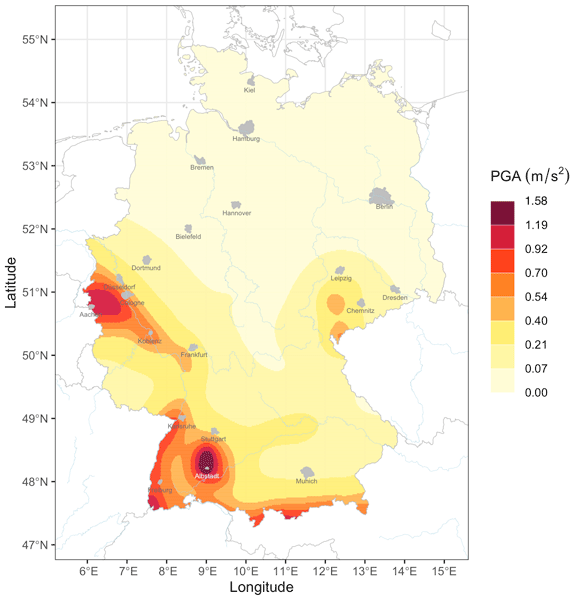
Hazard maps are fundamental to earthquake risk reduction, but research is missing on how to design them. We review the visualization literature to identify evidence-based criteria for color and classification schemes for hazard maps. We implement these for the German seismic hazard map, focusing on communicating four properties of seismic hazard. Our evaluation finds that the redesigned map successfully communicates seismic hazard in Germany, improving on the baseline map for two key properties.
Juan Camilo Gómez Zapata, Massimiliano Pittore, Nils Brinckmann, Juan Lizarazo-Marriaga, Sergio Medina, Nicola Tarque, and Fabrice Cotton
Nat. Hazards Earth Syst. Sci., 23, 2203–2228, https://doi.org/10.5194/nhess-23-2203-2023, https://doi.org/10.5194/nhess-23-2203-2023, 2023
Short summary
Short summary
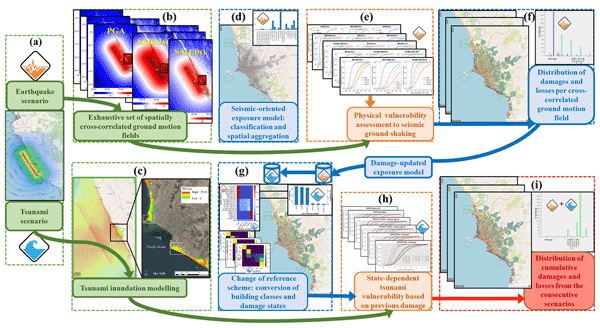
To investigate cumulative damage on extended building portfolios, we propose an alternative and modular method to probabilistically integrate sets of single-hazard vulnerability models that are being constantly developed by experts from various research fields to be used within a multi-risk context. We demonstrate its application by assessing the economic losses expected for the residential building stock of Lima, Peru, a megacity commonly exposed to consecutive earthquake and tsunami scenarios.
Audrey Bonnelye, Pierre Dick, Marco Bohnhoff, Fabrice Cotton, Rüdiger Giese, Jan Henninges, Damien Jougnot, Grzegorz Kwiatek, and Stefan Lüth
Adv. Geosci., 58, 177–188, https://doi.org/10.5194/adgeo-58-177-2023, https://doi.org/10.5194/adgeo-58-177-2023, 2023
Short summary
Short summary
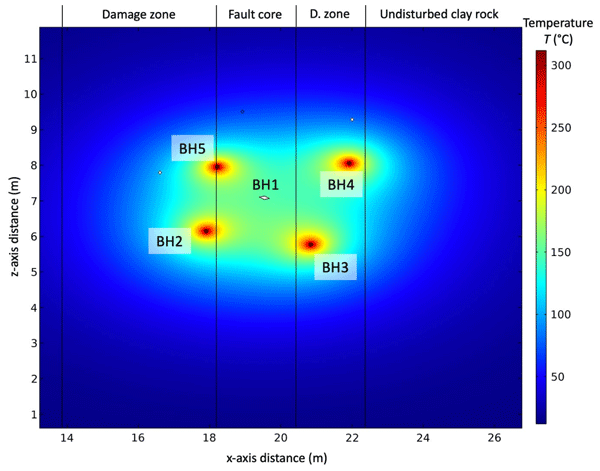
The overall objective of the CHENILLE project is to performed an in-situ experiment in the Underground Reaserch Laboratory of Tournemire (Southern France) consisting of hydraulic and thermal stimulation of a fault zone. This experiment is monitored with extensive geophysical means (passive seismic, active seismic, distributed fiber optics for temperature measurements) in order to unravel the physical processes taking place during the stimulation for a better charactization of fault zones.
Juan Camilo Gomez-Zapata, Nils Brinckmann, Sven Harig, Raquel Zafrir, Massimiliano Pittore, Fabrice Cotton, and Andrey Babeyko
Nat. Hazards Earth Syst. Sci., 21, 3599–3628, https://doi.org/10.5194/nhess-21-3599-2021, https://doi.org/10.5194/nhess-21-3599-2021, 2021
Short summary
Short summary
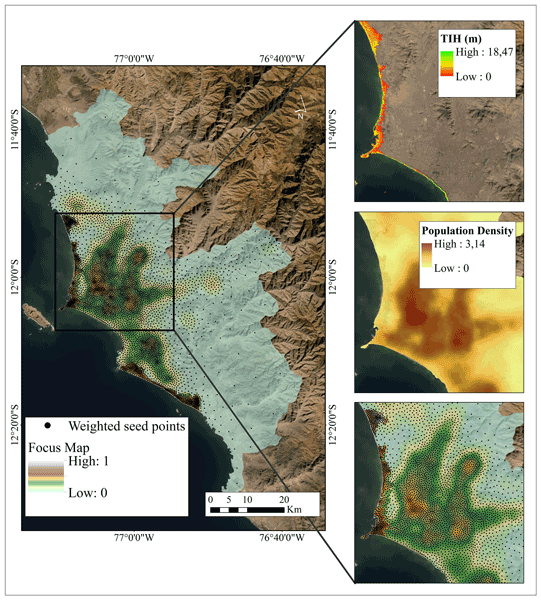
We present variable-resolution boundaries based on central Voronoi tessellations (CVTs) to spatially aggregate building exposure models and physical vulnerability assessment. Their geo-cell sizes are inversely proportional to underlying distributions that account for the combination between hazard intensities and exposure proxies. We explore their efficiency and associated uncertainties in risk–loss estimations and mapping from decoupled scenario-based earthquakes and tsunamis in Lima, Peru.
Cited articles
Abbott, E., Horspool, N., Gerstenberger, M., Huso, R., Van Houtte, C., McVerry, G., and Canessa, S.: Challenges and opportunities in New Zealand seismic hazard and risk modeling using OpenQuake, Earthq. Spectra, 36, 210–225, https://doi.org/10.1177/8755293020966338, 2020.
Abrahamson, N. A., Silva, W. J., and Kamai, R.: Summary of the ASK14 Ground Motion Relation for Active Crustal Regions, Earthq. Spectra, 30, 1025–1055, https://doi.org/10.1193/070913EQS198M, 2014.
Ake, J., Munson, C., Stamatakos, J., Juckett, M., Coppersmith, K., and Bommer, J.: Updated Implementation Guidelines for SSHAC Hazard Studies, Report No. NUREG-2213, U. S. Nuclear Regulatory Commission, Washington D. C., 145 pp., https://www.nrc.gov/reading-rm/doc-collections/nuregs/staff/sr2213/index.html (last access: October 2024), 2018.
Akkar, S., Sandıkkaya, M. A., and Bommer, J. J.: Empirical ground-motion models for point- and extended-source crustal earthquake scenarios in Europe and the Middle East, Bull. Earthquake Eng., 12, 359–387, https://doi.org/10.1007/s10518-013-9461-4, 2014a.
Akkar, S., Sandíkkaya, M. A., Senyurt, M., Azari Sisi, A., Ay, B. Ö., Traversa, P., Douglas, J., Cotton, F., Luzi, L., Hernandez, B., and Godey, S.: Reference database for seismic ground-motion in Europe (RESORCE), Bull. Earthquake Eng., 12, 311–339, 2014b.
Akkar, S., Azak, T., Çan, T., Çeken, U., Demircioğlu Tümsa, M. B., Duman, T. Y., Erdik, M., Ergintav, S., Kadirioğlu, F. T., Kalafat, D., Kale, Ö., Kartal, R. F., Kekovalı, K., Kılıç, T., Özalp, S., Altuncu Poyraz, S., Şeşetyan, K., Tekin, S., Yakut, A., Yılmaz, M. T., Yücemen, M. S., and Zülfikar, Ö.: Evolution of seismic hazard maps in Turkey, Bull. Earthquake Eng., 16, 3197–3228, https://doi.org/10.1007/s10518-018-0349-1, 2018.
Aldama-Bustos, G., Tromans, I. J., Strasser, F., Garrard, G., Green, G., Rivers, L., Douglas, J., Musson, R. M. W., Hunt, S., Lessi-Cheimariou, A., Daví, M., and Robertson, C.: A streamlined approach for the seismic hazard assessment of a new nuclear power plant in the UK, Bull. Earthquake Eng., 17, 37–54, https://doi.org/10.1007/s10518-018-0442-5, 2019.
Allen, T. I., Halchuk, S., Adams, J., and Weatherill, G. A.: Forensic PSHA: Benchmarking Canada's Fifth Generation seismic hazard model using the OpenQuake-engine, Earthq. Spectra, 36(1_suppl), 91–111, https://doi.org/10.1177/8755293019900779, 2020
Ameri, G.: Empirical Ground Motion Model Adapted to the French Context, Seismic Ground Motion Assessment (SIGMA) Deliverable No. SIGMA-2014-D2-131, 2014.
Ameri, G., Drouet, S., Traversa, P., Bindi, D., and Cotton, F.: Toward an empirical ground motion prediction equation for France: accounting for regional differences in the source stress parameter, Bull. Earthquake Eng., 15, 4681–4717, https://doi.org/10.1007/s10518-017-0171-1, 2017.
Assatourians, K. and Atkinson, G. M.: EqHaz: An Open-Source Probabilistic Seismic Hazard Code Based on the Monte Carlo Simulation Approach, Seismol. Res. Lett., 84, 516–524, 2014.
Basili, R., Danciu, L., Beauval, C., Sesetyan, K., Vilanova, S. P., Adamia, S., Arroucau, P., Atanackov, J., Baize, S., Canora, C., Caputo, R., Carafa, M. M. C., Cushing, E. M., Custódio, S., Demircioglu Tumsa, M. B., Duarte, J. C., Ganas, A., García-Mayordomo, J., Gómez de la Peña, L., Gràcia, E., Jamšek Rupnik, P., Jomard, H., Kastelic, V., Maesano, F. E., Martín-Banda, R., Martínez-Loriente, S., Neres, M., Perea, H., Šket Motnikar, B., Tiberti, M. M., Tsereteli, N., Tsironi, V., Vallone, R., Vanneste, K., Zupančič, P., and Giardini, D.: The European Fault-Source Model 2020 (EFSM20): geologic input data for the European Seismic Hazard Model 2020, Nat. Hazards Earth Syst. Sci. Discuss. [preprint], https://doi.org/10.5194/nhess-2023-118, in review, 2023.
Bindi, D., Massa, M., Luzi, L., Ameri, G., Pacor, F., Puglia, R., and Augliera, P.: Pan-European ground-motion prediction equations for the average horizontal component of PGA, PGV, and 5 %-damped PSA at spectral periods up to 3.0 s using the RESORCE dataset, Bull. Earthquake Eng., 12, 391–430, https://doi.org/10.1007/s10518-013-9525-5, 2014.
Bindi, D., Cotton, F., Kotha, S. R., Bosse, C., Stromeyer, D., and Grünthal, G.: Application-driven ground motion prediction equation for seismic hazard assessments in non-cratonic moderate-seismicity areas, J Seismol, 21, 1201–1218, https://doi.org/10.1007/s10950-017-9661-5, 2017.
Bommer, J. J., Coppersmith, K. J., Coppersmith, R. T., Hanson, K. L., Mangongolo, A., Neveling, J., Rathje, E. M., Rodriguez-Marek, A., Scherbaum, F., Shelembe, R., Stafford, P. J., and Strasser, F. O.: A SSHAC Level 3 Probabilistic Seismic Hazard Analysis for a New-Build Nuclear Site in South Africa, Earthq. Spectra, 31, 661–698, https://doi.org/10.1193/060913EQS145M, 2015.
Burkhard, M. and Grünthal, G.: Seismic source zone characterization for the seismic hazard assessment project PEGASOSby the Expert Group 2 (EG 1b), Swiss J. Geosci., 102, 149–188, 2009
Cauzzi, C., Faccioli, E., Vanini, M., and Bianchini, A.: Updated predictive equations for broadband (0.01–10 s) horizontal response spectra and peak ground motions, based on a global dataset of digital acceleration records, Bull. Earthquake Eng., 13, 1587–1612, https://doi.org/10.1007/s10518-014-9685-y, 2015.
CEN: Eurocode 8: Design of structures for earthquake resistance – Part 1: General rules, seismic actions and rules for buildings, European Committee for Standardization (Comité Européen de Normalistion), 2004.
Crowley, H., Dabbeek, J., Despotaki, V., Rodrigues, D., Martins, L., Silva, V., Romão, X., Pereira, N., Weatherill, G., and Danciu, L.: European Seismic Risk Model (ESRM20), EFEHR Technical Report 002 V1.0.1, https://doi.org/10.7414/EUC-EFEHR-TR002-ESRM20, 2021.
Cornell, C. A.: Engineering seismic risk analysis, B. Seismol. Soc. Am., 58, 1583–1606, 1968.
Derras, B., Bard, P. Y., and Cotton, F.: Towards fully data driven ground-motion prediction models for Europe, Bull. Earthquake Eng., 12, 495–516, https://doi.org/10.1007/s10518-013-9481-0, 2014.
Danciu, L., Nandan, S., Reyes, C., Basili, R., Weatherill, G., Beauval, C., Rovida, A., Vilanova, S., Sesetyan, K., Bard, P-Y., Cotton, F., Wiemer, S., and Giardini, D.: The 2020 update of the European Seismic Hazard Model: Model Overview, EFEHR Technical Report 001, v1.0.0, https://doi.org/10.12686/a15, 2021.
Drouet, S. and Cotton, F.: Regional Stochastic GMPEs in Low-Seismicity Areas: Scaling and Aleatory Variability Analysis – Application to the French Alps, B. Seismol. Soc. Am., 105, 1883–1902, https://doi.org/10.1785/0120140240, 2015.
Drouet, S., Ameri, G., Le Dortz, K., Secanell, R., and Senfaute, G.: A probabilistic seismic hazard map for the metropolitan France, Bull. Earthquake Eng., 18, 1865–1898, https://doi.org/10.1007/s10518-020-00790-7, 2020.
Ebel, J. E. and Kafka, A. L.: A Monte Carlo Approach to Seismic Hazard Analysis, B. Seismol. Soc. Am., 89, 854–866, 1999.
E DIN EN 1998-1/NA:2018-10: Nationaler Anhang – national festgelegte Parameter – Teil 1/NA: Eurocode 8: Auslegung von Bauwerken gegen Erdbeben – Grundlagen, Erdbebenwirkungen und Regeln für Hochbau, Beuth-Verlag, Berlin, Ausgabe Oktober 2018, 2018.
EPRI: Central and Eastern United States Seismic Source Characterization for Nuclear Facilities, U.S. DOE and U.S. NRC Technical Report, Palo Alto, CA, https://www.nrc.gov/reading-rm/doc-collections/nuregs/staff/sr2115/v1/index.html (last access: June 2020), 2012.
Field, E. H., Jordan, T. H., and Cornell, C. A.: OpenSHA: A Developing Community-modeling Environment for Seismic Hazard Analysis, Seismol. Res. Lett., 74, 406–419, 2003.
Field, E. H., Biasi, G. P., Bird, P., Dawson, T. E., Felzer, K. R., Jackson, D. D., Johnson, K. M., Jordan, T. H., Madden, C., Michael, A. J., Milner, K. R., Page, M. T., Parsons, T., Powers, P. M., Shaw, B. E., Thatcher, W. R., Weldon, R. J., and Zeng. Y.: Long-term time-dependent probabilities for the third uniform California earthquake rupture forecast (UCERF3), B. Seismol. Soc. Am., 105, 511–543, https://doi.org/10.1785/0120140093, 2015.
Field, E. H., Milner, K. R., Hatem, A. E., Powers, P. M., Pollitz, F. F., Llenos, A. L., Zeng, Y., Johnson, K. M., Shaw, B. E., McPhillips, D., Thompson Jobe, J., Shumway, A. M., Michael, A. J., Shen, Z.-K., Evans, E. L., Hearn, E. H., Mueller, C. S., Frankel, A. D., Petersen, M. D., DuRoss, C., Briggs, R. W., Page, M. T., Rubinstein, J. L., and Herrick, J. A.: The USGS 2023 Conterminous U.S. Time-Independent Earthquake Rupture Forecast, B. Seismol. Soc. Am., 114, 523–571,https://doi.org/10.1785/0120230120, 2024.
Gerstenberger, M. C., Marzocchi, W., Allen, T., Pagani, M., Adams, J., Danciu, L., Field, E. H., Fujiwara, H., Luco, N., Ma, K. -F., Meletti, C., and Petersen, M. D.: Probabilistic seismic hazard analysis at regional and national scales: State of the art and future challenges, Rev. Geophys., 58, e2019RG000653, https://doi.org/10.1029/2019RG000653, 2020
GEOTER: Probabilistic seismic hazard for the French metropolitan territory, Fugro Document No GTR-EDF-0517-1603, Électricité de France EDF, Aix-en-Provence, France, 2017.
Giardini, D., Wiemer, S., Fäh, D., and Deichmanm, N.: Seismic Hazard Assessment of Switzerland, 2004, Technical Report, Swiss Seismological Service, 1–95, 2004.
Grünthal, G.: The updated earthquake catalogue for the German Democratic Republic and adjacent areas – statistical data characteristics and conclusions for hazard assessment, 3rd International Symposium on the Analysis of Seismicity and Seismic Risk, Liblice/Czechoslovakia, 17–22 June 1985, Proceedings Vol. 1, 19–25, 1985.
Grünthal, G. and Wahlström, R.: The European-Mediterranean Earthquake Catalogue (EMEC) for the last millennium, J. Seismol., 16, 535–570, https://doi.org/10.1007/s10950-012-9302-y, 2012.
Grünthal, G., Stromeyer, D., Bosse, C., Cotton, F., and Bindi, D.: The probabilistic seismic hazard assessment of Germany – version 2016, considering the range of epistemic uncertainties and aleatory variability, Bull. Earthquake Eng., 16, 4339–4395, https://doi.org/10.1007/s10518-018-0315-y, 2018.
Gutenberg, B. and Richter, C. F.: Frequency of Earthquakes in California, B. Seismol. Soc. Am., 34, 185–188, 1944.
Hakimhashemi, A. H. and Grünthal, G.: A Statistical Method for Estimating Catalog Completeness Applicable to Long-Term Nonstationary Seismicity Data, B. Seismol. Soc. Am., 102, 2530–2546, 2012.
Hale, C., Abrahamson, N., and Bozorgnia, Y.: Probabilistic Seismic Hazard Analysis Code Verification, Pacific Earthquake Engineering Research Center, https://doi.org/10.55461/KJZH2652, 2018.
Helmstetter, A. and Werner, M. J.: Adaptive Spatiotemporal Smoothing of Seismicity for Long-Term Earthquake Forecasts in California, B. Seismol. Soc. Am., 102, 2518–2529, https://doi.org/10.1785/0120120062, 2012.
Johnston, A. C., Coppersmith, K. J., Kanter, L. R., and Cornell, C. A.: The Earthquakes of Stable Continental Regions, Electric Power Research Institute, 1994.
Instituto Geográfico Nacional (IGN): Actualización de mapas de peligrosidad sísmica de España, Centro Nacional de Información Geográfica, Technical Report, 1–272, https://doi.org/10.7419/162.05.2017, 2017
Jomard, H., Cushing, E. M., Palumbo, L., Baize, S., David, C., and Chartier, T.: Transposing an active fault database into a seismic hazard fault model for nuclear facilities – Part 1: Building a database of potentially active faults (BDFA) for metropolitan France, Nat. Hazards Earth Syst. Sci., 17, 1573–1584, https://doi.org/10.5194/nhess-17-1573-2017, 2017.
Kagan, Y. Y.: Seismic moment distribution revisited: 1. Statistical results, Geophys. J. Int., 148, 521–542, 2002.
Kotha, S. R., Weatherill, G., Bindi, D., and Cotton, F.: A regionally-adaptable ground-motion model for shallow crustal earthquakes in Europe, Bull. Earthquake Eng., 18, 4091–4125, https://doi.org/10.1007/s10518-020-00869-1, 2020.
Lanzano, G., Sgobba, S., Luzi, L., Puglia, R., Pacor, F., Felicetta, C., D'Amico, M., Cotton, F., and Bindi, D.: The pan-European Engineering Strong Motion (ESM) flatfile: compilation criteria and data statistics, Bull. Earthquake Eng., 17, 561–582, https://doi.org/10.1007/s10518-018-0480-z, 2019.
Manchuel, K., Traversa, P., Baumont, D., Cara, M., Nayman, E., and Durouchoux, C.: The French seismic CATalogue (FCAT-17), Bull. Earthquake Eng., 16, 2227–2251, https://doi.org/10.1007/s10518-017-0236-1, 2018.
McGuire, R.: FORTRAN computer program for seismic risk analysis, USGS Open-File Report, 76–67, 1976.
Meletti, C., D'Amico, V., and Martinelli, F.: Homogenous determination of maximum magnitude, Seismic Hazard Harmonisation in Europe (SHARE) Deliverable 3.3, 1–23, http://www.share-eu.org/node/52.html (last access: October 2024), 2013.
Meletti, C., Marzocchi, W., D'Amico, V., Lanzano, G., Luzi, L., Martinelli, F., Pace, B., Rovida, A., Taroni, M., Visini, F., and Group, M. W.: The new Italian seismic hazard model (MPS19), Ann. Geophys., 64, 6, https://doi.org/10.4401/ag-8579, 2021.
Miller, A. C. and Rice, T. R.: Discrete Approximations of Probability Distributions, Manage. Sci., 29, 352–362, 1983.
Monahan, J. F.: Numerical Methods of Statistics, Cambridge Series in Statistical and Probabilistic Mathematics, Cambridge University Press, ISBN 0-52179168-5, 2001.
Mosca, I., Sargeant, S., Baptie, B., Musson, R. M. W., and Pharaoh, T. C.: The 2020 national seismic hazard model for the United Kingdom, Bull. Earthquake Eng., 20, 633–675, https://doi.org/10.1007/s10518-021-01281-z, 2022.
Musson, R. M. W.: The use of Monte Carlo simulations for seismic hazard assessment in the UK, Ann. Geofis., 43, 1–9, 2000.
Nandan, S., Danciu, L., Wiemer, S., and Giardini, D.: Background smoothed seismicity model underlying ESHM20, Proceedings of the 3rd European Conference on Earthquake Engineering and Seismology, Bucharest, Romania, ISBN 978-973-100-533-1, 2022.
Pagani, M., Monelli, D., Weatherill, G., Danciu, L., Crowley, H., Silva, V., Henshaw, P., Butler, L., Nastasi, M., Panzeri, L., Simionato, M., and Vigano, D.: OpenQuake Engine: An Open Hazard (and Risk) Software for the Global Earthquake Model, Seismol. Res. Lett., 85, 692–702, https://doi.org/10.1785/0220130087, 2014.
Pagani, M., Garcia-Pelaez, J., Gee, R., Johnson, K., Poggi, V., Silva, V., Simionato, M., Styron, R., Viganò, D., Danciu, L., Monelli, D., and Weatherill, G.: The 2018 version of the Global Earthquake Model: Hazard component, Earthq. Spectra, 36, 226–251, https://doi.org/10.1177/8755293020931866, 2020.
Pecker, A., Faccioli, E., Gurpinar, A., Martin, C., and Renault, P.: An Overview of the SIGMA Research Project, Springer, https://doi.org/10.1007/978-3-319-58154-5, 2017.
Rollins, C., Gerstenberger, M. C., Rhoades, D. A., Rastin, S. J., Christophersen, A., Thingbaijam, K. K. S., Van Dissen, R. J., Graham, K., DiCaprio, C., and Fraser, J.: The Magnitude–Frequency Distributions of Earthquakes in Aotearoa New Zealand and on Adjoining Subduction Zones, Using a New Integrated Earthquake Catalog, B. Seismol. Soc. Am., 114, 150–181, https://doi.org/10.1785/0120230177, 2024.
Rovida, A., Antonucci, A., and Locati, M.: The European Preinstrumental Earthquake Catalogue EPICA, the 1000–1899 catalogue for the European Seismic Hazard Model 2020, Earth Syst. Sci. Data, 14, 5213–5231, https://doi.org/10.5194/essd-14-5213-2022, 2022.
Scherbaum, F., Kuehn, N. M., Ohrnberger, M., and Koehler, A.: Exploring the Proximity of Ground-Motion Models Using High-Dimensional Visualization Techniques, Earthq. Spectra, 26, 1117–1138, https://doi.org/10.1193/1.3478697, 2010.
Stromeyer, D. and Grünthal, G.: Capturing the Uncertainty of Seismic Activity Rates in Probabilistic Seismic-Hazard Assessments, B. Seismol. Soc. Am., 105, 580–589, https://doi.org/10.1785/0120140185, 2015.
Stucchi, M., Meletti, C., Montaldo, V., Crowley, H., Calvi, G. M., and Boschi, E.: Seismic Hazard Assessment (2003–2009) for the Italian Building Code, B. Seismol. Soc. Am., 101, 1885–1911, https://doi.org/10.1785/0120100130, 2011
Thomas, P., Wong, I., and Abrahamson, N.: Verification of Probabilistic Seismic Hazard Analysis Computer Programs, Pacific Earthquake Engineering Research Center, https://peer.berkeley.edu/publications/2010-106 (last access: October 2024), 2010.
Tromans, I. J., Aldama-Bustos, G., Douglas, J., Lessi-Cheimariou, A., Hunt, S., Daví, M., Musson, R. M. W., Garrard, G., Strasser, F. O., and Robertson, C.: Probabilistic seismic hazard assessment for a new-build nuclear power plant site in the UK, Bull. Earthquake Eng., 17, 1–36, https://doi.org/10.1007/s10518-018-0441-6, 2019.
U. S. Nuclear Regulatory Commission: Practical Implementation Guidelines for SSHAC Level 3 and 4 Hazard Studies. NUREG-2117, U. S. Nuclear Regulatory Commission Report, Washington, D. C., https://www.nrc.gov/reading-rm/doc-collections/nuregs/staff/sr2117/index.html (last access: October 2024), 2012.
Vanneste, K., Camelbeeck, T., and Verbeeck, K.: A Model of Composite Seismic Sources for the Lower Rhine Graben, Northwest Europe, B. Seismol. Soc. Am., 103, 984–1007, https://doi.org/10.1785/0120120037, 2013.
Vaserstein, L. N.: Markov processes over denumerable products of spaces, describing large systems of automats, Problemy Peredaci Informacii, 5, 64–72, 1969
Weatherill, G.: Data and Code for the Implementation of the Drouet et al. (2024) PSHA Model for Metropolitan France into OpenQuake, Zenodo [data set], https://doi.org/10.5281/zenodo.13991952, 2022.
Weatherill, G. and Burton, P. W.: An alternative approach to probabilistic seismic hazard analysis in the Aegean region using Monte Carlo simulation, Tectonophysics, 492, 253–278, https://doi.org/10.1016/j.tecto.2010.06.022, 2010.
Weatherill, G., Kotha, S. R., and Cotton, F.: A regionally-adaptable “scaled backbone” ground motion logic tree for shallow seismicity in Europe: application to the 2020 European seismic hazard model, Bull. Earthquake Eng., 18, 5087–5117, https://doi.org/10.1007/s10518-020-00899-9, 2020.
Weatherill, G., Cotton, F., Daniel, G., and Zentner, I.: Implementation of the Drouet et al. (2020) PSHA for France in OpenQuake: Comparisons and Modelling Issues, EDF, https://www.sigma-2.net/pages/deliverables/deliverables.html (last access: October 2024), 2022.
Weichert, D. H.: Estimation of the Earthquake Recurrence Parameters for Unequal Observation Periods for Different Magnitude, B. Seismol. Soc. Am., 70, 1337–1346, 1980.
Wiemer, S., Danciu, L., Edwards, B., Marti, M., Fäh, D., Hiemer, S., Wössner, J., Cauzzi, C., Kästli, P., and Kremer, K.: Seismic Hazard Model (2015) for Switzerlan (SUIhaz2015), Swiss Seismological Service, ETH Zurich, https://doi.org/10.12686/a2, 2016.
Wössner, J., Laurentiu, D., Giardini, D., Crowley, H., Cotton, F., Grünthal, G., Valensise, G., Arvidsson, R., Basili, R., Demircioglu, M. B., Hiemer, S., Meletti, C., Musson, R. W., Rovida, A. N., Sesetyan, K., Stucchi, M., and The SHARE Consortium: The 2013 European Seismic Hazard Model: key components and results, Bull. Earthquake Eng., 13, 3553–3596, https://doi.org/10.1007/s10518-015-9795-1, 2015.
Woo, G.: Kernel Estimation Methods for Seismic Hazard Area Source Modelling, B. Seismol. Soc. Am., 86, 353–362, 1996.
Short summary
New generations of seismic hazard models are developed with sophisticated approaches to quantify uncertainties in our knowledge of earthquake processes. To understand why and how recent state-of-the-art seismic hazard models for France, Germany, and Europe differ despite similar underlying assumptions, we present a systematic approach to investigate model-to-model differences and to quantify and visualise them while accounting for their respective uncertainties.
New generations of seismic hazard models are developed with sophisticated approaches to quantify...


Special issue
Altmetrics
Final-revised paper
Preprint