Articles | Volume 26, issue 2
https://doi.org/10.5194/nhess-26-863-2026
© Author(s) 2026. This work is distributed under
the Creative Commons Attribution 4.0 License.
https://doi.org/10.5194/nhess-26-863-2026
© Author(s) 2026. This work is distributed under
the Creative Commons Attribution 4.0 License.
Beyond and beneath displacement time series: towards InSAR-based early warnings and deformation analysis of the Achoma landslide, Peru

School of Geography, Earth and Environmental Sciences, University of Birmingham, Birmingham, UK
formerly at: ISTerre, Université Grenoble-Alpes, Grenoble, France
Pascal Lacroix
ISTerre, Université Grenoble-Alpes, Grenoble, France
Marie-Pierre Doin
ISTerre, Université Grenoble-Alpes, Grenoble, France
Related authors
Benedetta Dini, Georgina L. Bennett, Aldina M. A. Franco, Michael R. Z. Whitworth, Kristen L. Cook, Andreas Senn, and John M. Reynolds
Earth Surf. Dynam., 9, 295–315, https://doi.org/10.5194/esurf-9-295-2021, https://doi.org/10.5194/esurf-9-295-2021, 2021
Short summary
Short summary
We use long-range smart sensors connected to a network based on the Internet of Things to explore the possibility of detecting hazardous boulder movements in real time. Prior to the 2019 monsoon season we inserted the devices in 23 boulders spread over debris flow channels and a landslide in northeastern Nepal. The data obtained in this pilot study show the potential of this technology to be used in remote hazard-prone areas in future early warning systems.
Andreas Aspaas, Gregory Bievre, Pascal Lacroix, Nadège Langet, Juditha Aga, Ingrid Skrede, Lene Kristensen, Bernd Etzelmuller, and François Renard
EGUsphere, https://doi.org/10.5194/egusphere-2026-62, https://doi.org/10.5194/egusphere-2026-62, 2026
This preprint is open for discussion and under review for Earth Surface Dynamics (ESurf).
Short summary
Short summary
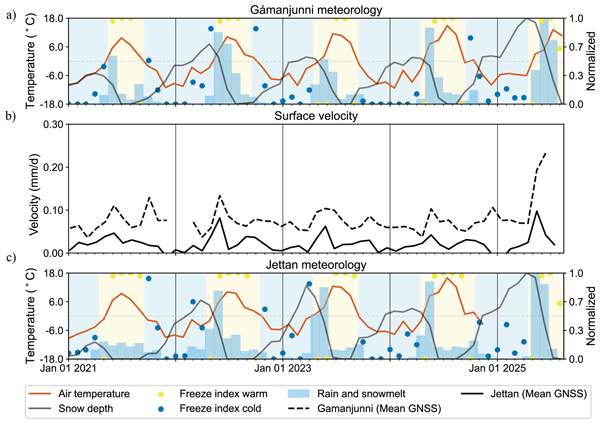
Climate change increases landslide risk in cold regions. We analyzed 12 years of GPS, borehole, water, and seismic data from two landslides in Arctic Norway, one with permafrost and one without. Both accelerate in spring and autumn due to water infiltration. One slip zone shows increasing snowmelt sensitivity while seismic data reveal seasonal stiffness changes. Results advance understanding of water-driven landslide dynamics in Arctic climates.
Diego Cusicanqui, Pascal Lacroix, Xavier Bodin, Benjamin Aubrey Robson, Andreas Kääb, and Shelley MacDonell
The Cryosphere, 19, 2559–2581, https://doi.org/10.5194/tc-19-2559-2025, https://doi.org/10.5194/tc-19-2559-2025, 2025
Short summary
Short summary
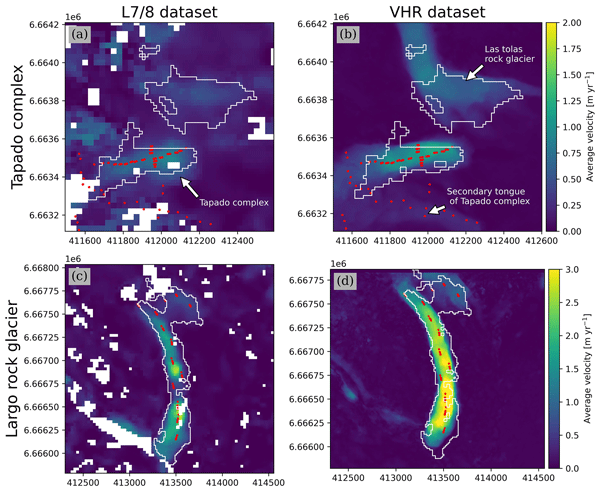
This study presents a robust methodological approach to detect and analyse rock glacier kinematics using Landsat 7/Landsat 8 imagery. In the semiarid Andes, 382 landforms were monitored, showing an average velocity of 0.37 ± 0.07 m yr⁻¹ over 24 years, with rock glaciers moving 23 % faster. Results demonstrate the feasibility of using medium-resolution optical imagery, combined with radar interferometry, to monitor rock glacier kinematics with widely available satellite datasets.
Jacques Mourey, Pascal Lacroix, Pierre-Allain Duvillard, Guilhem Marsy, Marco Marcer, Emmanuel Malet, and Ludovic Ravanel
Nat. Hazards Earth Syst. Sci., 22, 445–460, https://doi.org/10.5194/nhess-22-445-2022, https://doi.org/10.5194/nhess-22-445-2022, 2022
Short summary
Short summary
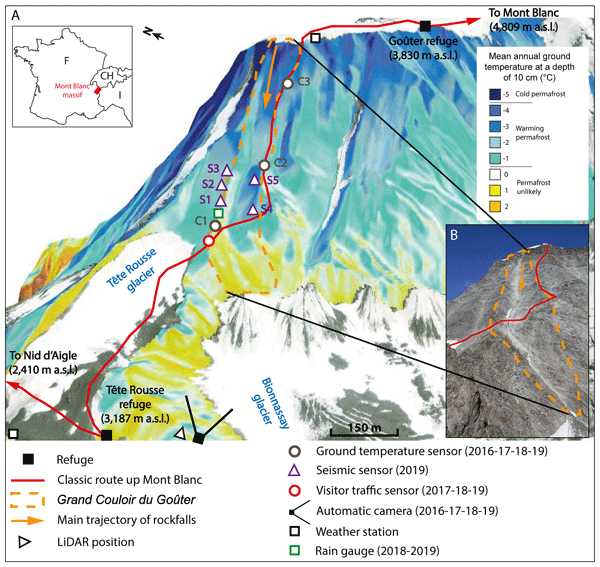
More frequent rockfalls in high alpine environments due to climate change are a growing threat to mountaineers. This hazard is particularly important on the classic route up Mont Blanc. Our results show that rockfalls are most frequent during snowmelt periods and the warmest hours of the day, and that mountaineers do not adapt to the local rockfall hazard when planning their ascent. Disseminating the knowledge acquired from our study caused management measures to be implemented for the route.
Benedetta Dini, Georgina L. Bennett, Aldina M. A. Franco, Michael R. Z. Whitworth, Kristen L. Cook, Andreas Senn, and John M. Reynolds
Earth Surf. Dynam., 9, 295–315, https://doi.org/10.5194/esurf-9-295-2021, https://doi.org/10.5194/esurf-9-295-2021, 2021
Short summary
Short summary
We use long-range smart sensors connected to a network based on the Internet of Things to explore the possibility of detecting hazardous boulder movements in real time. Prior to the 2019 monsoon season we inserted the devices in 23 boulders spread over debris flow channels and a landslide in northeastern Nepal. The data obtained in this pilot study show the potential of this technology to be used in remote hazard-prone areas in future early warning systems.
Cited articles
Agliardi, F., Scuderi, M. M., Fusi, N., and Collettini, C.: Slow-to-fast transition of giant creeping rockslides modulated by undrained loading in basal shear zones, Nat. Commun., 11, 1–11, https://doi.org/10.1038/s41467-020-15093-3, 2020.
Akkar, S. and Bommer, J. J.: Empirical equations for the prediction of PGA, PGV, and spectral accelerations in Europe, the Mediterranean region, and the Middle East, Seismol. Res. Lett., 81, 195–206, https://doi.org/10.1785/gssrl.81.2.195, 2010.
Badoux, A., Graf, C., Rhyner, J., Kuntner, R., and McArdell, B. W.: A debris-flow alarm system for the Alpine Illgraben catchment: design and performance, Nat. Hazards, 49, 517–539, 2009.
Ballantyne, C. K.: Landslides and slope failures in Scotland: a review, Scot. Geogr. Mag., 102, 134–150, https://doi.org/10.1080/00369228618736667, 1986.
Berardino, P., Fornaro, G., Lanari, R., and Sansosti, E.: A new algorithm for surface deformation monitoring based on small baseline differential SAR interferograms, IEEE T. Geosci. Remote, 40, 2375–2383, 2002.
Bontemps, N., Lacroix, P., Larose, E., Jara, J., and Taipe, E.: Rain and small earthquakes maintain a slow-moving landslide in a persistent critical state, Nat. Commun., 11, 1–10, https://doi.org/10.1038/s41467-020-14445-3, 2020.
Carey, J. M., Massey, C. I., Lyndsell, B., and Petley, D. N.: Displacement mechanisms of slow-moving landslides in response to changes in porewater pressure and dynamic stress, Earth Surf. Dynam., 7, 707–722, https://doi.org/10.5194/esurf-7-707-2019, 2019.
Carlà, T., Intrieri, E., Di Traglia, F., Nolesini, T., Gigli, G., and Casagli, N.: Guidelines on the use of inverse velocity method as a tool for setting alarm thresholds and forecasting landslides and structure collapses, Landslides, 14, 517–534, 2017.
Carlà, T., Intrieri, E., Raspini, F., Bardi, F., Farina, P., Ferretti, A., Colombo, D., Novali, F., and Casagli, N.: Author Correction: Perspectives on the prediction of catastrophic slope failures from satellite InSAR (Scientific Reports, 2019, 9, 1, 14137, https://doi.org/10.1038/s41598-019-50792-y), Sci. Rep., 9, 1–9, https://doi.org/10.1038/s41598-019-55024-x, 2019.
Cheaib, A., Lacroix, P., Zerathe, S., Jongmans, D., Ajorlou, N., Doin, M.-P., Hollingsworth, J., and Abdallah, C.: Landslides induced by the 2017 Mw7.3 Sarpol Zahab earthquake (Iran), Landslides, 19, 603–619, 2022.
Chen, X., Yao, X., Zhou, Z., Liu, Y., Yao, C., and Ren, K.: DRs-UNet: A Deep Semantic Segmentation Network for the Recognition of Active Landslides from InSAR Imagery in the Three Rivers Region of the Qinghai–Tibet Plateau, Remote Sens.-Basel, 14, 1848, https://doi.org/10.3390/rs14081848, 2022.
Colesanti, C. and Wasowski, J.: Investigating landslides with space-borne Synthetic Aperture Radar (SAR) interferometry, Eng. Geol., 88, 173–199, 2006.
Cook, K. L., Rekapalli, R., Dietze, M., Pilz, M., Cesca, S., Rao, N. P., Srinagesh, D., Paul, H., Metz, M., and Mandal, P.: Detection and potential early warning of catastrophic flow events with regional seismic networks, Science, 374, 87–92, 2021.
Costantini, M., Minati, F., Trillo, F., Ferretti, A., Novali, F., Passera, E., Dehls, J., Larsen, Y., Marinkovic, P., Eineder, M., Brcic, R., Siegmund, R., Kotzerke, P., Probeck, M., Kenyeres, A., Proietti, S., Solari, L., and Andersen, H. S.: European Ground Motion Service (EGMS), in: 2021 IEEE International Geoscience and Remote Sensing Symposium IGARSS, IEEE, 3293–3296, https://doi.org/10.1109/IGARSS47720.2021.9553562, 2021.
Dini, B., Manconi, A., and Loew, S.: Investigation of slope instabilities in NW Bhutan as derived from systematic DInSAR analyses, Eng. Geol., 259, https://doi.org/10.1016/j.enggeo.2019.04.008, 2019.
Dini, B., Manconi, A., Loew, S., and Chophel, J.: The Punatsangchhu-I dam landslide illuminated by InSAR multitemporal analyses, Sci. Rep., 10, 1–10, 2020.
Dini, B., Doin, M.-P., Lacroix, P., and Gay, M.: Satellite-based InSAR: application and signal extraction for the detection of landslide precursors, in: 28° Colloque sur le traitement du signal et des images (GRETSI), Nancy, France, 6–9 September 2022, 1233–1236, https://gretsi.fr/data/colloque/pdf/2022_dini987.pdf (last access: 16 February 2026), 2022.
Dini, B., Lacroix, P., and Doin, M.-P.: Data and scripts for the analysis of Achoma landslide precursors, Version v1, Zenodo [code, data set], https://doi.org/10.5281/zenodo.17753976, 2025a.
Dini, B., Lacroix, P., and Doin, M.-P.: Wrapped interferograms and coherence Achoma landslide, Version v1, Zenodo [data set], https://doi.org/10.5281/zenodo.17602759, 2025b.
Doin, M.-P., Guillaso, S., Jolivet, R., Lasserre, C., Lodge, F., Ducret, G., and Grandin, R.: Presentation of the small baseline NSBAS processing chain on a case example: The Etna deformation monitoring from 2003 to 2010 using Envisat data, in: Proceedings of the Fringe symposium, 3434–3437, https://hal.science/hal-02185213 (last access: 16 February 2026), 2011.
Fan, X., Xu, Q., Liu, J., Subramanian, S. S., He, C., Zhu, X., and Zhou, L.: Successful early warning and emergency response of a disastrous rockslide in Guizhou province, China, Landslides, 16, 2445–2457, 2019.
Ferretti, A., Prati, C., Rocca, F., Casagli, N., Farina, P., and Young, B.: Permanent Scatterers technology: a powerful state of the art tool for historic and future monitoring of landslides and other terrain instability phenomena, International Conference on Landslide Risk Management, 18th Annual Vancouver Geotechnical Society Symposium, 1–9, ISBN 9780415380430, 2005.
Ferretti, A., Prati, C., and Rocca, F.: Permanent scatterers in SAR interferometry, IEEE T. Geosci. Remote, 39, 8–20, 2001.
Ferretti, A., Fumagalli, A., Novali, F., Prati, C., Rocca, F., and Rucci, A.: A New Algorithm for Processing Interferometric Data-Stacks: SqueeSAR, IEEE T. Geosci. Remote, 49, 3460–3470, https://doi.org/10.1109/TGRS.2011.2124465, 2011.
Fiolleau, S., Jongmans, D., Bièvre, G., Chambon, G., Baillet, L., and Vial, B.: Seismic characterization of a clay-block rupture in Harmalière landslide, French Western Alps, Geophys. J. Int., 221, 1777–1788, 2020.
Fourniadis, I. G., Liu, J. G., and Mason, P. J.: Regional assessment of landslide impact in the Three Gorges area, China, using ASTER data: Wushan-Zigui, Landslides, 4, 267–278, https://doi.org/10.1007/s10346-007-0080-5, 2007.
Guzzetti, F.: Invited perspectives: Landslide populations – can they be predicted?, Nat. Hazards Earth Syst. Sci., 21, 1467–1471, https://doi.org/10.5194/nhess-21-1467-2021, 2021.
Handwerger, A. L., Huang, M., Fielding, E. J., Booth, A. M., and Bürgmann, R.: A shift from drought to extreme rainfall drives a stable landslide to catastrophic failure, Sci. Rep., 9, 1569, https://doi.org/10.1038/s41598-018-38300-0, 2019.
Handwerger, A. L., Lacroix, P., Bell, A. F., Booth, A. M., Huang, M.-H., Mudd, S. M., Bürgmann, R., and Fielding, E. J.: Multi-sensor remote sensing captures geometry and slow-to-fast sliding transition of the 2017 Mud Creek landslide, Sci. Rep., 15, 29831, https://doi.org/10.1038/s41598-025-11399-8, 2025.
Instituto Geofísico del Peru: https://ultimosismo.igp.gob.pe/repositorio/datos-sismicos, last access: 1 September 2022.
Intrieri, E., Raspini, F., Fumagalli, A., Lu, P., Del Conte, S., Farina, P., Allievi, J., Ferretti, A., and Casagli, N.: The Maoxian landslide as seen from space: detecting precursors of failure with Sentinel-1 data, Landslides, 15, 123–133, 2018.
Jacquemart, M. and Tiampo, K.: Leveraging time series analysis of radar coherence and normalized difference vegetation index ratios to characterize pre-failure activity of the Mud Creek landslide, California, Nat. Hazards Earth Syst. Sci., 21, 629–642, https://doi.org/10.5194/nhess-21-629-2021, 2021.
Kumar, V. and Venkataraman, G.: SAR interferometric coherence analysis for snow cover mapping in the western Himalayan region, Int. J. Digit. Earth, 4, 78–90, https://doi.org/10.1080/17538940903521591, 2011.
Lacroix, P., Perfettini, H., Taipe, E., and Guillier, B.: Coseismic and postseismic motion of a landslide: Observations, modeling, and analogy with tectonic faults, Geophys. Res. Lett., 41, 6676–6680, https://doi.org/10.1002/2014GL061170, 2014.
Lacroix, P., Berthier, E., and Maquerhua, E. T.: Earthquake-driven acceleration of slow-moving landslides in the Colca valley, Peru, detected from Pléiades images, Remote Sens. Environ., 165, 148–158, https://doi.org/10.1016/j.rse.2015.05.010, 2015.
Lacroix, P., Bièvre, G., Pathier, E., Kniess, U., and Jongmans, D.: Use of Sentinel-2 images for the detection of precursory motions before landslide failures, Remote Sens. Environ., 215, 507–516, https://doi.org/10.1016/j.rse.2018.03.042, 2018.
Lacroix, P., Dehecq, A., and Taipe, E.: Irrigation-triggered landslides in a Peruvian desert caused by modern intensive farming, Nat. Geosci., 13, 56–60, 2020.
Lacroix, P., Dini, B., and Cheaib, A.: Measuring Kinematics of Slow-Moving Landslides from Satellite Images, in: Surface Displacement Measurement from Remote Sensing Images, edited by: Cavalié, O. and Trouvé, E., Iste-Wiley, 315–338, https://doi.org/10.1002/9781119986843.ch10, 2021.
Lacroix, P., Gavillon, T., Bouchant, C., Lavé, J., Mugnier, J.-L., Dhungel, S., and Vernier, F.: SAR and optical images correlation illuminates post-seismic landslide motion after the Mw 7.8 Gorkha earthquake (Nepal), Sci. Rep., 12, 6266, https://doi.org/10.1038/s41598-022-10016-2, 2022.
Lacroix, P., Huanca, J., Angel, L. A., and Taipe, E.: Precursory Motion and Time-Of-Failure Prediction of the Achoma Landslide, Peru, From High Frequency PlanetScope Satellites, Geophys. Res. Lett., 50, 1–11, https://doi.org/10.1029/2023GL105413, 2023.
Li, M., Zhang, L., Ding, C., Li, W., Luo, H., Liao, M., and Xu, Q.: Retrieval of historical surface displacements of the Baige landslide from time-series SAR observations for retrospective analysis of the collapse event, Remote Sens. Environ., 240, 111695, https://doi.org/10.1016/j.rse.2020.111695, 2020.
Liu, P., Li, Z., Hoey, T., Kincal, C., Zhang, J., Zeng, Q., and Muller, J.-P.: Using advanced InSAR time series techniques to monitor landslide movements in Badong of the Three Gorges region, China, Int. J. Appl. Earth Obs., 21, 253–264, 2013.
Loew, S., Gschwind, S., Gischig, V., Keller-Signer, A., and Valenti, G.: Monitoring and early warning of the 2012 Preonzo catastrophic rockslope failure, Landslides, 14, 141–154, https://doi.org/10.1007/s10346-016-0701-y, 2017.
López-Quiroz, P., Doin, M.-P., Tupin, F., Briole, P., and Nicolas, J.-M.: Time series analysis of Mexico City subsidence constrained by radar interferometry, J. Appl. Geophys., 69, 1–15, 2009.
Manconi, A.: How phase aliasing limits systematic space-borne DInSAR monitoring and failure forecast of alpine landslides, Eng. Geol., 287, 106094, https://doi.org/10.1016/j.enggeo.2021.106094, 2021.
McColl, S. T.: Landslide causes and triggers, in: Landslide Hazards, Risks, and Disasters, 2nd edn., edited by: Davies, T., Rosser, N., and Shroder, J. F., Elsevier, 13–41, https://doi.org/10.1016/b978-0-12-818464-6.00011-1, 2022.
Meyer, F. J. and Sandwell, D. T.: SAR interferometry at Venus for topography and change detection, Planet. Space Sci., 73, 130–144, https://doi.org/10.1016/j.pss.2012.10.006, 2012.
Notti, D., Meisina, C., Zucca, F., and Colombo, A.: Models to predict Persistent Scatterers data distribution and their capacity to register movement along the slope, in: Proceedings of the FRINGE 2011 Workshop, Frascati, Italy, 19–23 September 2011, https://earth.esa.int/eogateway/documents/20142/37627/Models_predict_persistent_scatterers_data_distribution.pdf (last access: 16 February 2026), 2012.
Palmer, J.: Creeping catastrophes: Studies of slow landslides could unmask the mechanics of a worldwide scourge, Nature, 548, 384–386, https://doi.org/10.1038/548384a, 2017.
Pham, M. Q., Lacroix, P., and Doin, M. P.: Sparsity optimization method for slow-moving landslides detection in satellite image time-series, IEEE T. Geosci. Remote., 57, 2133–2144, 2018.
Roy, P., Martha, T. R., Khanna, K., Jain, N., and Kumar, K. V.: Time and path prediction of landslides using InSAR and flow model, Remote Sens. Environ., 271, 112899, https://doi.org/10.1016/j.rse.2022.112899, 2022.
Servicio Nacional de Meteorología e Hidrología del Perú: https://www.senamhi.gob.pe/servicios/?p=estaciones, last access: 10 October 2023.
Strozzi, T., Caduff, R., Jones, N., Barboux, C., Delaloye, R., Bodin, X., Kääb, A., Mätzler, E., and Schrott, L.: Monitoring rock glacier kinematics with satellite synthetic aperture radar, Remote Sens.-Basel, 12, 1–24, https://doi.org/10.3390/rs12030559, 2020.
Strząbała, K., Ćwiąkała, P., and Puniach, E.: Identification of landslide precursors for early warning of hazards with remote sensing, Remote Sens.-Basel, 16, 2781, https://doi.org/10.3390/rs16152781, 2024.
Thollard, F., Clesse, D., Doin, M.-P., Donadieu, J., Durand, P., Grandin, R., Lasserre, C., Laurent, C., Deschamps-Ostanciaux, E., Pathier, E., Pointal, E., Proy, C., and Specht, B.: FLATSIM: The ForM@Ter LArge-Scale Multi-Temporal Sentinel-1 InterferoMetry Service, Remote Sens., 13, 3734, https://doi.org/10.3390/rs13183734, 2021.
Thouret, J. C., Wörner, G., Gunnell, Y., Singer, B., Zhang, X., and Souriot, T.: Geochronologic and stratigraphic constraints on canyon incision and Miocene uplift of the Central Andes in Peru, Earth Planet. Sc. Lett., 263, 151–166, https://doi.org/10.1016/j.epsl.2007.07.023, 2007.
Valletta, A., Carri, A., and Segalini, A.: Definition and application of a multi-criteria algorithm to identify landslide acceleration phases, Georisk: Assessment and Management of Risk for Engineered Systems and Geohazards, 16, 555–569, 2022.
Van Wyk de Vries, M., Arrell, K., Basyal, G. K., Densmore, A. L., Dunant, A., Harvey, E. L., Jimee, G. K., Kincey, M. E., Li, S., and Singh Pujara, D.: Detection of slow-moving landslides through automated monitoring of surface deformation using Sentinel-2 satellite imagery, Earth Surf. Proc. Land., 49, 1397–1410, 2024.
Wasowski, J. and Bovenga, F.: Investigating landslides and unstable slopes with satellite Multi Temporal Interferometry: Current issues and future perspectives, Eng. Geol., 174, 103–138, 2014.
Wasowski, J. and Bovenga, F.: Remote sensing of landslide motion with emphasis on satellite multi-temporal interferometry applications: an overview, in: Hazards and Disasters Series, 2nd edn., edited by: Davies, T., Rosser, N., and Shroder, J. F., Elsevier, 365–438, https://doi.org/10.1016/B978-0-12-818464-6.00006-8, 2022.
Yang, W., Wang, Y., Sun, S., Wang, Y., and Ma, C.: Using Sentinel-2 time series to detect slope movement before the Jinsha River landslide, Landslides, 16, 1313–1324, 2019.
Yang, W., Fang, J., and Liu-Zeng, J.: Landslide-lake outburst floods accelerate downstream hillslope slippage, Earth Surf. Dynam., 9, 1251–1262, https://doi.org/10.5194/esurf-9-1251-2021, 2021.
Zerathe, S., Lacroix, P., Jongmans, D., Marino, J., Taipe, E., Wathelet, M., Pari, W., Smoll, L. F., Norabuena, E., Guillier, B., and Tatard, L.: Morphology, structure and kinematics of a rainfall controlled slow-moving Andean landslide, Peru, Earth Surf. Proc. Land., 41, 1477–1493, https://doi.org/10.1002/esp.3913, 2016.
Zhou, C., Yin, K., Cao, Y., Intrieri, E., Ahmed, B., and Catani, F.: Displacement prediction of step-like landslide by applying a novel kernel extreme learning machine method, Landslides, 15, 2211–2225, https://doi.org/10.1007/s10346-018-1022-0, 2018.
Short summary
Landslides can occur without warning. Traditional satellite radar (InSAR) methods are valuable but have limitations. We show that lesser-used radar signals can act as early warning markers, revealing instability up to five years before failure in a Peruvian landslide, even when standard methods fail or underestimate displacement. These alternative radar approaches complement existing techniques and could transform early detection and targeted monitoring across large regions.
Landslides can occur without warning. Traditional satellite radar (InSAR) methods are valuable...
Altmetrics
Final-revised paper
Preprint