
the Creative Commons Attribution 4.0 License.
the Creative Commons Attribution 4.0 License.
 | 19 Nov 2026
Retreating glaciers and snow cover are amplifying summer droughts in the upper Adige River Basin (Italy)
Susen Shrestha

Davide Zoccatelli
Mattia Zaramella
Marco Borga
Andrea Galletti
Mattia Callegari
Roberto Dinale
Massimiliano Pittore
Giacomo Bertoldi
Snow and glacier meltwater play a critical role in sustaining summer streamflow in mountains and downstream regions. Yet, understanding glaciers' contributions to buffer river streamflow during droughts remains limited and poses major barriers to improve present and future water management within the context of climate change.
This study evaluates the contribution of glacier melt to summer flows and its role in mitigating hydrological droughts in the upper Adige River basin (Italy). We developed and implemented a new dynamic glacier module into the ICHYMOD-TOPMELT hydrological model, annually updating glacier area and improving the quantification of meltwater contributions under progressive glacier retreat (from 111 km2 in 1997 to 79 km2 in 2017).
The hydrological model exhibited robust performance (KGE = 0.89 for 1997–2022 for the whole upper Adige River basin at the Bronzolo closing station; 0.88 in summers) capturing observed glacier area, mass balance, and seasonal melt trends. Results show that glacier melt in the upper Adige River basin contributed an average of 4.5 % to total summer streamflow during 1997–2022, with significant spatial variability, reaching 30 % in glacierized subbasins. During the severe droughts of 2003, 2005 and 2022, glacier melt contributions ranged between 4 % and 12 % at the upper Adige closing section. In 2003, high temperature and limited Snow Water Equivalent (SWE) led to glacier melt accounting for 11.67 % of summer flows. By contrast, the significant runoff deficit in 2005 was driven by colder temperatures, which reduced glacier melt contributions to 4.85 %, combined with low SWE conditions. In 2022, the combination of low precipitation, low snow cover and high temperature drove glacier melt. In contrast to the 2003 drought, reduced glacier areas led to lower absolute contributions (8.17 %).
Our findings reveal that despite the increased melt rates in recent warm years, retreating glacier areas have reduced their absolute buffering effect. Glacier retreat is weakening the contribution of glaciers to summer flows, increasing the upper Adige River basin's dependence on precipitation and snowmelt, the latter of which is also showing a decreasing trend. For these reasons, accounting for dynamic glacier and snow changes is essential to improve future drought projections and inform adaptive water management in glacier-fed basins within the context of climate and anthropogenic changes.
- Article
(5625 KB) - Full-text XML
-
Supplement
(742 KB) - BibTeX
- EndNote


Recent droughts in Europe caused widespread socio-ecological impacts in the Italian Alps and downstream areas (Avanzi et al., 2024, 2026; Biella et al., 2025; Montanari et al., 2023). The increase in meltwater from snow and glaciers temporarily and partially offset the lack of water from below-average snowfall in winter, limited rainfall and exceptionally high temperatures during spring and summer (Leone et al., 2026).
However, rising temperatures and changes in precipitation patterns related to climate change are progressively shrinking and pushing glaciers to a point of no return (Hock et al., 2022; Pepin et al., 2022; Van Tricht et al., 2026). From 2000 to 2023, 39 % of the European glacier mass was already lost (The GlaMBIE Team, 2025) and according to the IPCC projections most of the glaciers in the European Alps are expected to disappear by 2100 (Hock et al., 2022). Of particular concern are the potential consequences of Alpine glacier recession on water provisioning to downstream areas, both in the long term and during drought events, when water is most needed (Ultee et al., 2022).
Yet, understanding glaciers' contribution to buffering river streamflow during droughts remains limited and poses a major barrier to improving present and future water management. On the one hand, this limitation is mainly due to difficulties in dynamically capturing glacier evolution within hydrological models, requiring a trade-off between the limited data availability on glaciers, high model parameterisation, and computational costs (Seibert et al., 2018). In particular, models often rely on highly parameterized energy-balance equations (Frans et al., 2016; Naz et al., 2014), fully distributed (Maussion et al., 2019) or data-intensive statistical approaches (Shen et al., 2023), which can lead to high computational costs and/or limited interpretability of glacier dynamics and their contributions within hydrological models. Indeed, existing applications have increasingly integrated glacier evolution schemes into hydrological models to simulate mass balance, including equilibrium-line altitude shifts (Linsbauer et al., 2013), volume-area scaling (Luo et al., 2013; Radić and Hock, 2010; Stahl et al., 2008) and the Δh parameterisation (Huss et al., 2008, 2010).
On the other hand, existing applications integrating glacier changes into semi-distributed hydrological models (Li et al., 2015; Seibert et al., 2018) often neither consider dynamic glacier evolution nor focus on glacier contributions during droughts. Therefore, there is a need for a simplified yet reliable glacier dynamic representation in semi-distributed hydrological models to improve the understanding of the hydro-climatic conditions (temperature, precipitation and snow cover anomalies) affecting the contribution of glacier melt to buffering summer droughts.
The critical 2022 drought situation for the Italian Alps calls for improving our understanding of how much, where and when glaciers contributed to mitigating drought impacts. The upper Adige River Basin in the Italian Alps represents a case in point (Fig. 1). Even though it has been considered an area with plenty of water from accumulated snow and glacier melt sustaining summer streamflow and supporting extensive water uses across multiple sectors (Lemus-Canovas et al., 2025; Zebisch et al., 2025), drought events in 2015, 2017 and 2022 challenged water management and have been raising concerns about the high sensitivity of the basin to droughts in the context of ever-decreasing contributions from snow and glacier melt (Chiogna et al., 2015; Colombo et al., 2023; Stephan et al., 2021).
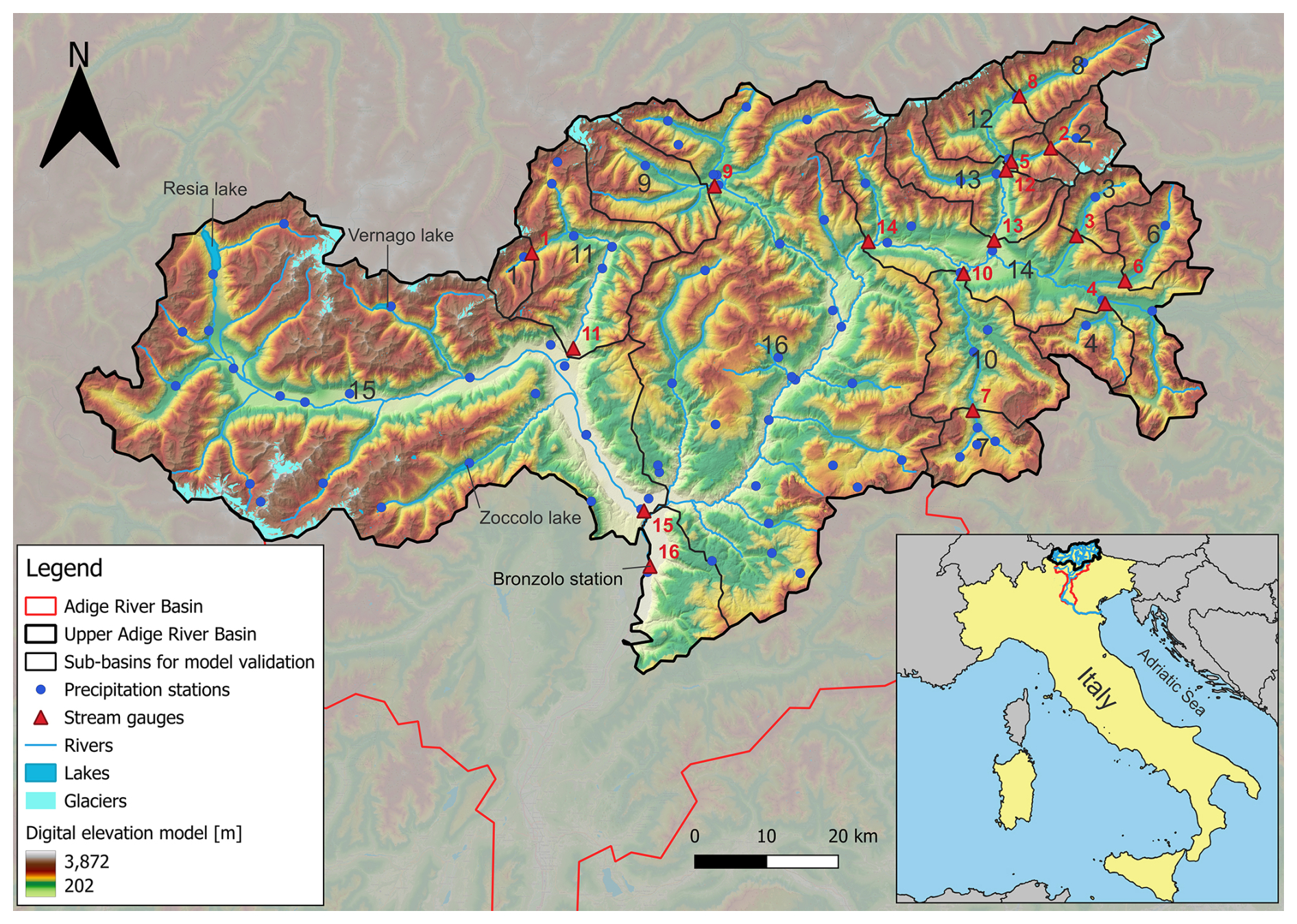
Figure 1Map of the upper part of the Adige River Basin (Italy) with glacier extension (Galos et al., 2022), precipitation and river-gauge stations, the 16 subbasins used in the hydrological modelling and the digital elevation model (National Science Foundation, 2013) as a background layer.
For these reasons, our research aims to improve long-term predictions of glacier meltwater contributions to streamflow during droughts in the upper Adige River Basin. Moreover, we propose a modelling approach that can be applied to other glacierized catchments to evaluate the effect of glacier melt in mitigating hydrological droughts under conditions of glacier retreat.
To do so, we integrated a novel dynamic glacier module within the existing ICHYMOD-TOPMELT semi-distributed hydrological model (Norbiato et al., 2008, 2009) that annually updates glacier extent using a volume-area scaling relationship to better characterize in space and time glacier melt contributions to streamflow conditions in the upper part of the Adige River Basin (Sects. 2.2, 3.1 and 3.2). We focused on major drought years including the unprecedented 2022, investigating the role of multiple hydro-climatic conditions (temperature, precipitation and snow cover anomalies) in contributing to droughts (Sect. 2.5). By doing so, we estimated glacier contributions during critical conditions, thereby highlighting potential vulnerabilities associated with future glacier retreat (Sect. 3.3). Finally, we investigated a counterfactual scenario considering the 1997 glacier extent during the 2022 drought to estimate its potential buffering effects during extreme conditions (Sect. 3.3.3).
2.1 Study area and input data
The Adige River flows from the eastern Italian Alps to the Adriatic Sea for 410 km, making it the second longest river in Italy with an overall drainage area of 12 200 km2 (Lemus-Canovas et al., 2025; Navarro-Ortega et al., 2015). The upper part of the Adige River Basin (6924 km2, Fig. 1) is characterized by different climatic conditions, with a semi-continental climate in low-elevation areas with mild winters and warm summers, and an alpine climate at higher elevations with cold winters and summers (Bertoldi et al., 2023; Tscholl et al., 2025). At higher altitudes, significant water resources accumulate during the winter season in the form of snow, which are mobilised during spring. This situation determines the alpine nivo-glacial hydrological regime, characterised by two peaks, one in spring due to snow and glacier melt and the other in autumn due to cyclonic storms (Larsen et al., 2021), which provide abundant water for the development of various and intensive anthropogenic activities.
The large availability of water shapes these areas, with reservoirs, hydropower plants and managed pastures at high elevation to irrigated apple orchards and vineyards intensively cultivated at valley bottoms.
Hydrological alterations are mainly induced by various artificial dams with the three largest being the Lake Resia (116 Mm3), Lake Vernago (44 Mm3) and Lake Zoccolo (34 Mm3) storing water which is mainly used for hydropower production. Most of the lakes receive water from upstream glaciers, the extent of which was mapped as decreasing from 111 km2 in 1997, 98 km2 in 2005 and 79 km2 in 2017 (Galos et al., 2022, further annual mass balance data for the whole Adige River Basin are available from Dussaillant et al., 2025). The study area includes a dense network of hydro-meteorological stations, comprising 88 rain gauges (approximately one per 72 km2), 124 temperature gauges (approximately one per 55 km2) and 50 streamflow gauges (one per 23 km of river), with hourly time series of precipitation, temperature and streamflow, most of them available from the Civil Protection Agency of the province of Bolzano (https://meteo.provincia.bz.it/download-dati.asp, last access: 8 October 2026).
2.2 Hydrological model
The simulation of water availability in the upper part of the Adige River Basin starts from the combination of the hydrological model ICHYMOD (Norbiato et al., 2008, 2009), with the TOPMELT snow module (Zaramella et al., 2019). The resulting ICHYMOD-TOPMELT is a computationally efficient, semi-distributed conceptual hydrological model that simulates hydro-meteorological state variables (i.e., precipitation, temperature, Snow Water Equivalent (SWE), glacier melt and runoff) at hourly resolution while representing spatial variability in snow and ice melt within subbasins.
The model has been operationally employed by the Province of Bolzano Civil Protection Office for flood forecasting, and previous extensive model validation in the same region has been performed for runoff production (Dalla Torre et al., 2024; Stergiadi et al., 2020), snow and ice melt modelling (Di Marco et al., 2021).
Runoff generation, soil moisture, and evapotranspiration processes are lumped at the sub-basin scale using the Probability Distributed Model (PDM, Moore, 2007, 1985). Catchment outflows include direct runoff, baseflow, and evapotranspiration (ET), which is estimated using the Hargreaves method and adjusted for soil moisture availability.
In order to properly model snow and ice accumulation and melt processes in complex terrain, the subbasins have been subdivided into elevation and radiation classes, which are updated monthly using clear-sky potential solar radiation. Elevation drives gradients in precipitation and temperature, using regionally calibrated lapse rates. Snow and glacier processes are calculated independently for each combination of elevation and radiation using a modified temperature-index model based on the snowpack formulation of Cazorzi and Dalla Fontana (1996).
Snow and ice melt are estimated from both radiative and thermal energy exchanges, with separate formulations for daytime, nighttime, and rainy conditions (Zaramella et al., 2019). Snow and ice differ in their reflectivity: snow albedo decreases over time as the surface ages and warms, following Brock et al. (2000), whereas ice maintains a lower, fixed albedo that enhances radiation absorption and accelerates melt. In areas covered by glaciers, glacier ice melt begins when snow water equivalent in a radiation–elevation band falls below a threshold value of 5 mm as defined by Zaramella et al. (2019). Moreover, we updated the snow-to-ice transformation for each elevation and energy band following a 1:1 volumetric conversion of available SWE to ice depth. Finally, SWE and glacier melt values, based on the elevation and radiation classes for each subbasin, were aggregated to obtain basin-scale values.
2.2.1 The new glacier dynamics module
We developed the simulation of glacier area dynamics over time and integrated it as a new module into the semi-distributed hydrological model ICHYMOD (Norbiato et al., 2008, 2009). At the foundation of the glacier module is the relationship between glacier volume and area, which was applied at the subbasin level, with the annual hydrological balance used to dynamically update glacier volume.
We used the glacier outline from 1997 and the 1994 Digital Elevation Model (DEM) to create the initial ice thickness map. This was achieved by applying the flow law described by Glen (1955) and Farinotti et al. (2009), relying only on glacier surface topography. We divided each glacier into i contour lines, where the specific ice flux was estimated based on their distance from the equilibrium-line altitude (ELA), following the approach of Huss and Farinotti (2012). The ice thickness hi is then calculated as:
Where A is a flow rate factor calibrated over the whole region (), C is a correction factor for basal sliding, ρ is the ice density, g is the gravitational acceleration, is the mean slope in a direction perpendicular to the contour line and n is set to 3, the standard value adopted in glacier modelling following (Farinotti et al., 2009; Huss and Farinotti, 2012). The ice thickness is then smoothed across contour lines, corrected for local surface slope, distributed using a triangular profile along the contour line, and interpolated across the original grid resolution. The glacier area is reported for each elevation unit and time-invariant radiation classes, assumed representative for the melt period, that form the basis of ICHYMOD-TOPMELT. We validated the results for the initial glacier depth by comparing them with the 1997 South Tyrol glacier inventory, which estimates a total glacier volume of 3326 million m3 (Galos et al., 2015; Knoll and Kerschner, 2009).
The initial ice thickness is reduced gradually using the Δh methodology developed by Huss et al. (2010):
where Δh is the normalized variation of ice thickness and hr is the normalized elevation range as in Huss et al. (2010). The parameters used are those recommended for small glaciers, as most glaciers have areas below 5 km2. Using this method, we gradually reduced glacier volume while updating glacier 3D geometry, creating a relationship between glacier volume in each basin and area within each class of time-invariant elevation and radiation. At the end of each hydrological year, we computed the glacier balance for each basin, which is the net balance between the glacier melt and the snow accumulation on the glacier area, assuming that any snow remaining on the glacier at the end of the year directly transforms into ice. We updated the previous-year glacier volume with the glacier balance. For each elevation and energy class, we calculated the new glacier area by linear interpolation between the available steps in the volume-area relationship. Finally, we calculated the glacier volume and area for the whole study basin by summing up all individual subbasins.
2.3 Simulation setup
Following the semi-distributed approach of the ICHYMOD-TOPMELT model, we performed hydrological simulations considering 61 hydrological response units (hereafter referred to as subbasins) within the upper Adige River Basin. For each subbasin, we computed the vertical water mass balance before routing the resulting flows along the river network. From a temporal point of view, we considered the hydrological year from October to September of the following year. In order to effectively start our assessment in October 1997 (year of the first available glacier area observation), we ran the model at 1 h time steps from 1996 until 2022, using the first year as a spin-up period and hence discarding it from subsequent analyses.
The parametrization of the hydrological kernel of ICHYMOD-TOPMELT was obtained by maximizing Nash-Sutcliffe efficiency (NSE) at 16 stream gauges over the period 2003–2019. As simulations of glacier dynamics were highly sensitive to the glacier albedo parameter, we calibrated it through a sensitivity analysis by testing values ranging from 0.4 to 0.8, consistent with those reported in studies conducted in similar areas, e.g., Hartl et al. (2025), Krampe et al. (2022), and Richter et al. (2026). We then selected the albedo value that provided the closest match to the available glacier area observations over the entire simulation span (1997–2022).
Finally, an additional simulation considered the same glacier area, as recorded in 1997, for the whole simulation period from 1997 to 2022. By doing so, we aimed to better understand how drought severity would have differed due to changes in glacier area that occurred over the last 26 years.
2.4 Prediction performance metrics
We considered the Kling-Gupta Efficiency (KGE), defined by Gupta et al. (2009), to evaluate hydrological model performance over the entire simulation period (1997–2022). To quantify the benefits of shifting from static to dynamic glacier modelling, we considered percentage changes in KGE as well as in the mean bias ratio (MBR) of modelled runoff, both for the entire study period and for the selected summer months of 2003, 2005 and 2022. We evaluated the performance of the glacier module against available observations of glacier area, volume and annual mass balance. In addition, we validated the modelled cumulative mass balance against the annual glacier mass balance dataset of Dussaillant et al. (2025) for the entire study area, covering the period from 1997 onward.
2.5 Hydro-climatic drivers of droughts
For the analysis and characterization of past hydrological droughts occurrence and evolution, we considered a set of hydro-climatic drivers describing the physical conditions that led to droughts. The drivers were implemented and analysed both spatially on the whole upper Adige River Basin and temporally over multiple years and seasons, with a focus on the summer season. In addition, the analysis focused on the 2003, 2005 and 2022 drought years, which were selected as the most severe based on the lowest summer Streamflow Standardized Index (SSI, Modarres, 2007; Telesca et al., 2012), computed for July-August-September (JAS) at the Bronzolo closing section (further information is provided in the Supplement).
The hydro-climatic drivers analysed for past major drought events were precipitation, temperature, SWE at the end of June (assumed to be a proxy for summer snow coverage and therefore for the amount of ice melt contributing to summer runoff; Penna et al., 2017), glacier melt and runoff (at the basin outlet). In particular, for each of the 61 subbasin outlets, we computed the area-weighted averages of all the hydro-climatic variables as:
Where i is the given subbasin number while k considers all the subbasins nested within subbasin i. By doing so, we aggregated the variables and made them comparable according to the runoff routing pathway.
Further, we analysed multiple hydro-climatic drivers (total precipitation, temperature anomalies, and SWE at the end of June) and their z-score values for all modelled years from 1997 to 2022. In particular, the z-score metric (Kreyszig et al., 2011), evaluates how many standard deviations a data point is from the mean of its own dataset, effectively capturing whether values are above or below the climatological mean for each month (positive and negative z-scores, respectively). The z-score provides a standardized interannual comparison of precipitation, temperature, SWE, runoff and glacier melt patterns and captures drought patterns in relation to glacier melt conditions during summer months (i.e., July, August and September).
Finally, we provide spatially distributed representations of summer climatologies as well as focused analyses of the specific droughts in 2003, 2005 and 2022. We reported precipitation, SWE, runoff and glacier melt contributions as percentage differences from the climatological mean, and temperature as an absolute difference.
3.1 Glacier module performance
The dynamic glacier module was initialized with the 1997 glacier area observation, iteratively updated and run until 2022 (Fig. 2). The calibration of the glacier albedo parameter resulted in a value of 0.65 as it achieved an overall R2 of 0.84 between the simulated glacier mass balance and the median value in Dussaillant et al. (2025) glacier mass balance observations (bottom panel in Fig. 2), while ensuring a close fit to the 2005 and 2017 glacier area observations (top panel in Fig. 2). The sensitivity analysis on the albedo range 0.4–0.8 (grey band in Fig. 2) shows a potential glacier area reduction ranging from 28 % to 49 % and mass loss ranging from 15 to 27 m w.e. at the end of the 26-year study period.
The simulated glacier values showed a generalized reduction in both glacier area (−48.93 km2) and mass (−1.99 km3) over the 26-years of simulation, corresponding to a mean areal reduction rate of 1.95 km2 yr−1 and mean mass reduction of 0.079 km2 yr−1, with only a few years showing positive glacier mass accumulation in the basin, such as .
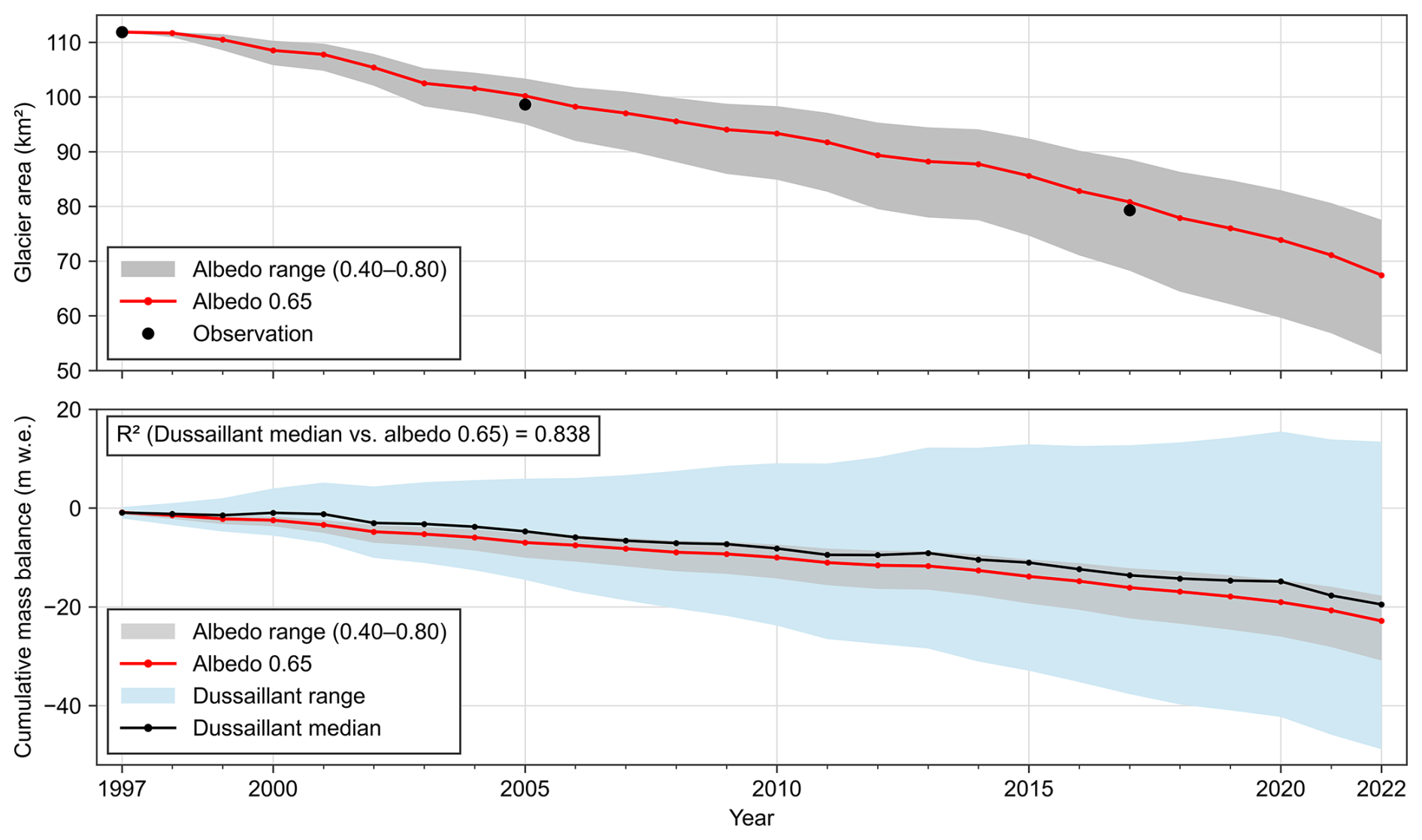
Figure 2Time series of glacier area (top panel) and mass balance (bottom panel) from 1997 to 2022 with modelled values (red line) and different albedo range from 0.4 to 0.8 (grey area), the annual median (black line) along with the range of glacier mass change of all available glaciers (light blue) from Dussaillant et al. (2025) while glacier area observations are shown as black dots (Galos et al., 2022).
3.2 Integrated hydrological model results
The hydrological model simulations considered both dynamic and static glacier modules. We compared their results to evaluate glacier contributions at the subbasin level, over the simulation period and especially during specific drought events. When integrating the dynamic glacier module, the hydrological model showed KGE values ranging from 0.40 to 0.86 for all the glacierized basins, with an average value of 0.70 (Fig. 3).
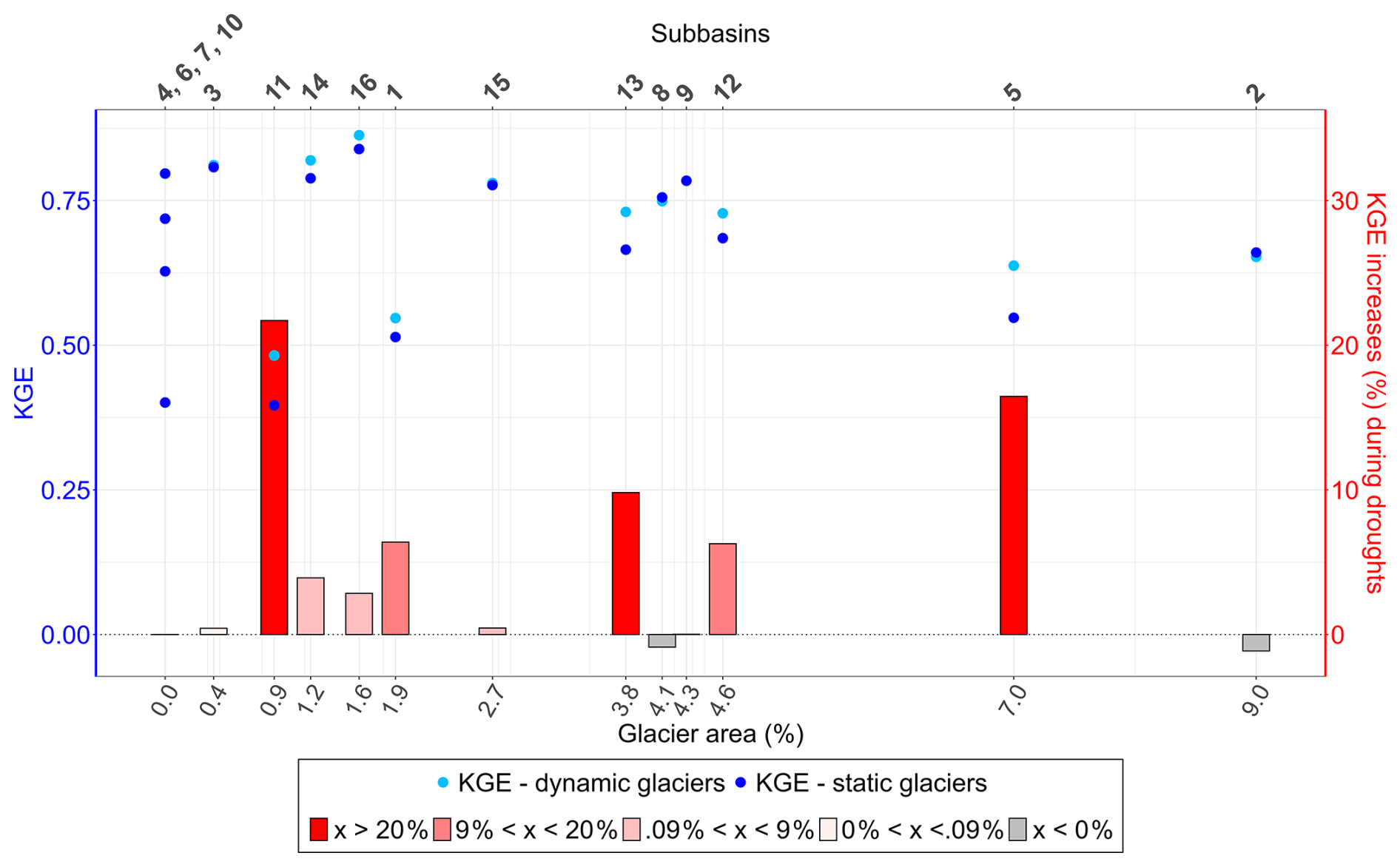
Figure 3The Kling-Gupta Efficiency (KGE) performance metric (left y-axis) for the streamflow simulation for the whole period (1997–2022), integrating a dynamic glacier module (light blue dots) and a static glacier module (blue dots) according to increasing values of glacier area within each subbasin area on the x-axis. The bar plot represents KGE variation (%, right y-axis) between the static and dynamic glacier modelling modules, with specific reference to the summer droughts of 2003, 2005 and 2022. Darker red colour indicates greater model improvement.
Over the entire simulation period, the differences between the integration of the dynamic or static glacier modules are limited. For three subbasins, the overall KGE performance slightly increased, with values below +0.01, while for others it slightly decreased, by less than −0.006. The latter subbasins with declining KGE values for the dynamic module are those showing a negative runoff bias for simulations with the static glacier module (see Tables S3 and S4 in the Supplement). While the dynamic glacier module improved the representation of reduced glacier area conditions, it also implies a decrease in the glacier melt contribution, thereby increasing the already negative runoff bias, ultimately leading to a decrease of the KGE.
These results become even more pronounced when focusing on the specific summer months (JAS) of drought events in 2003, 2005 and 2022. During that time, streamflow reached its lowest observed levels over the simulated period, hence making the glacial meltwater contribution proportionally more relevant. During the three considered droughts, the simulations with the dynamic glacier module showed improved KGE performance for all glacierized subbasins, except for two, as depicted in the bar plot of Fig. 3. In particular, the largest increases were observed in subbasin n.11 (+21.7 %), n.5 (+16.5 %) and n.13 (+9.8 %), while a slight KGE decrease was recorded for the subbasins n.8 (−0.87 %) and n.2 (−1.14 %). This latter subbasin shows the lowest percentage KGE decrease, despite having the highest proportion of glacier coverage. In particular, the KGE value slightly decreases from 0.66 to 0.65 due to a decrease in MBR from 0.78 to 0.77 when shifting from the static to the dynamic glacier module.
3.3 Evaluating the hydro-climatic drivers of droughts
3.3.1 Temporal patterns of hydro-climatic variables in the upper Adige
Results from the simulations were aggregated at the basin scale to support the temporal analysis of hydro-climatic variables driving droughts. The purpose was to understand the hydro-climatic conditions that lead to the maximum glacier compensation effect during droughts. Figure 4 (panel a) shows a heatmap of interannual z-score values over summer seasons (JAS) from 1998 to 2022 for all hydro-climatic variables (with the exception of SWE, for which the z-score was evaluated based on its value at the end of June) together with their related mutual correlation values (panel b). In the heatmap, no single hydro-climatic variable can fully capture drought conditions, as high SWE can compensate for below-average summer precipitation (e.g., years 2001 and 2014), while winters with below-average snow can be compensated for by a rainy summer (e.g., years 2012 and 2017). Nevertheless, an overview of the correlation analysis between the hydro-climatic variables provides further insights.
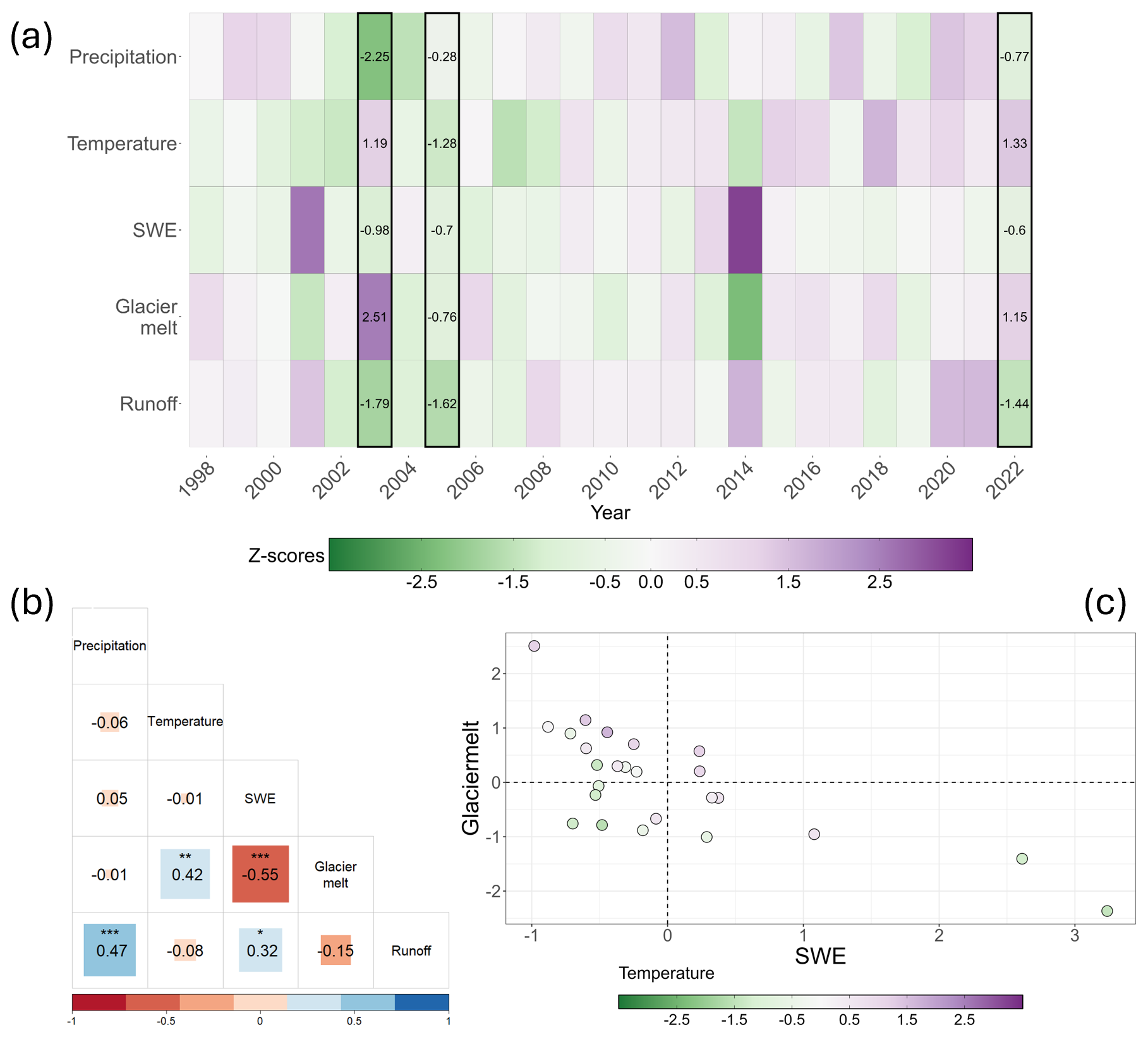
Figure 4Heatmap of the z-score values (green negative, purple positive) for the 5 hydro-climatic drivers of droughts for the whole upper Adige River Basin from 1998 to 2022 calculated for the summer months JAS and at the end of June for SWE (a). Mann–Kendall correlations (from −1 to 1) between variables and significance: *, and refer to significant p-values ≤ 0.05, ≤ 0.01 and ≤ 0.001, respectively (b). Scatterplot of z-scores for SWE and glacier melt with colours for the temperature z-scores (c).
In particular, runoff shows a moderate positive correlation with precipitation (r=0.47, p<0.001) with decreasing correlation values with SWE (r=0.32, p<0.05), while it appears uncorrelated with glacier melt (p>0.05, Fig. 4, panel b). On the one hand, SWE and glacier melt show a moderate and highly significant negative correlation (, p<0.001), recalling the blanketing effect of abundant snow cover, which protects glaciers from melting. On the other hand, glacier melt is driven by summer temperature (r=0.42, p<0.01) as highlighted by the conditions during 2003 and 2022, when high temperature combined with low SWE led to above-average glacier melt during severe hydrological droughts.
We further examined the apparent relationship between SWE, temperature, and glacier melt, visualizing each summer in a scatterplot (Fig. 4, panel c). High glacier melt rates typically occur under above-average temperatures and below-average SWE at the end of June, confirming the behaviour suggested by the correlation analysis.
3.3.2 Focus on the major past hydrological droughts
In the selected years of 2003, 2005 and 2022, different temporal and spatial dynamics led to runoff deficit and droughts across the study area (Figs. 4 and 5). The year 2003 was characterized by exceptionally hot and dry spring and summer conditions triggering a hydrological drought. In particular, Val d'Ultimo showed a reduction of 60 % compared to its average summer (JAS) runoff of 75 mm and Val Sarentino showed a 58 % reduction relative to its runoff average of 68 mm (Fig. 5, further information on subbasin locations and names is available in Fig. S1 and Table S2 of the Supplement). Other areas in the north-east also showed runoff reductions of around 50 % relative to an average runoff of 99 mm, despite increased glacier melt contributions. The runoff decline was primarily driven by strong precipitation deficits that affected the entire study area. The most severe deficit was observed in Val d'Ultimo, with a summer precipitation reduction of 77 % below the average value of 106 mm. Temperature anomalies were above average, with a mean increase of 0.89 °C across the upper Adige River Basin. Snow Water Equivalent (SWE) at the end of June showed negative anomalies throughout the region, with 14 subbasins recording values 100 % below their climatological mean. The 14 subbasins that showed the lowest decrease in SWE during summer 2003 were also those that showed the lowest climatological SWE values over the 26-year simulation period. Due to the hot summer conditions in 2003, glacier melt strongly contributed across the region. Glacierized subbasins in the southwest showed glacier melt values 101 % higher compared to the summer average values of 0.7–1.2 mm, while northeastern glaciers showed even stronger increases reaching 180 % above the average value of 0.7 mm.
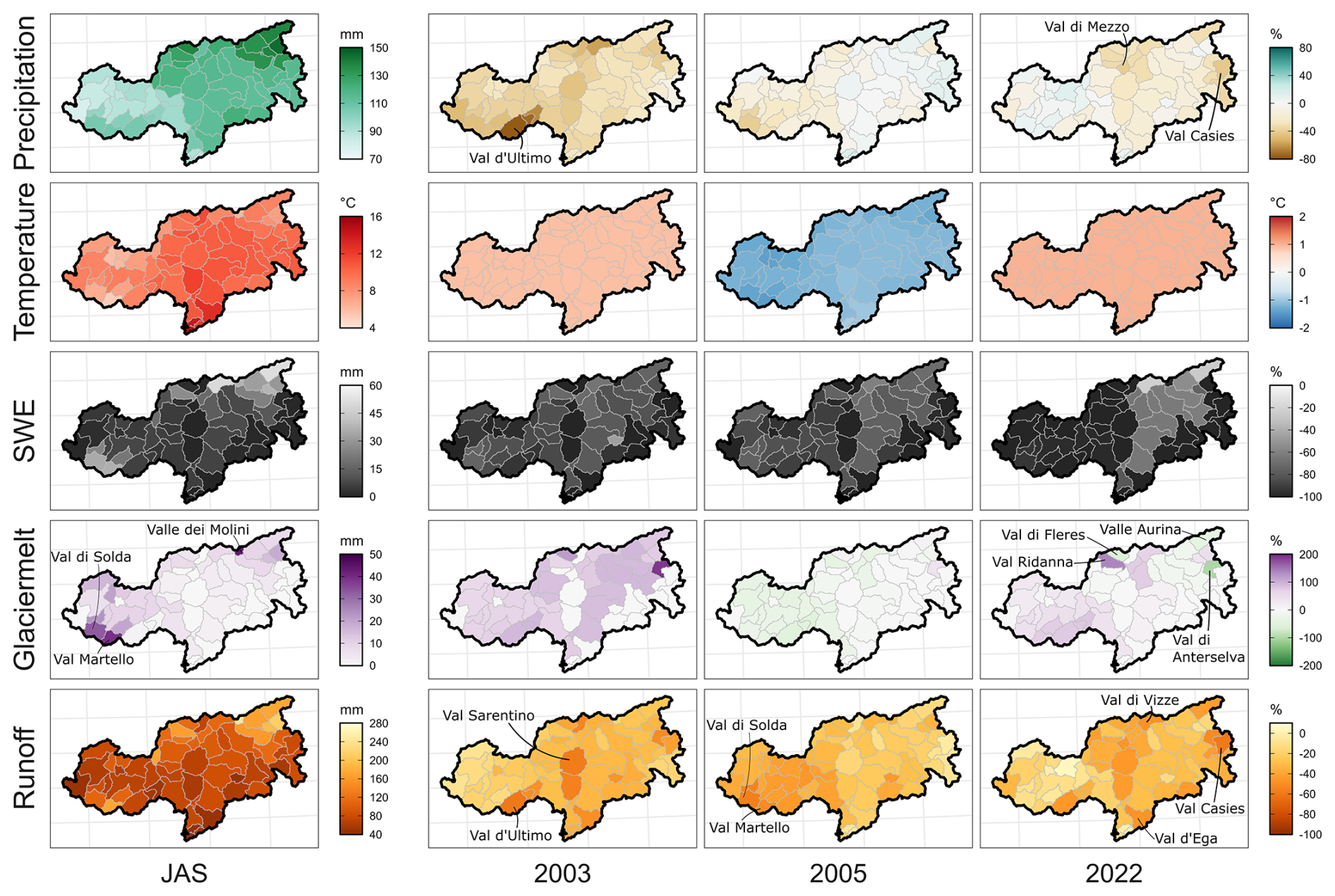
Figure 5Spatial representation of climatological mean (first column on the left) and anomalies (three columns on the right) computed for the average summer values from 1997–2022 within the upper Adige River Basin of the hydro-climatic variables. Only SWE considers values at the end of June. The anomalies refer to the selected drought years of 2003, 2005 and 2022.
In 2005, the runoff deficits across the region were the result of different factors compared to the 2003 drought. The most pronounced runoff reductions occurred in the already dry western areas, with runoff deficits of 55 % relative to the average runoff of 107 mm in Val di Solda and 54 % relative to the average runoff of 81 mm in the lower Val di Solda.
In contrast, the eastern part of the region, where both precipitation and glacier melt anomalies were mild or even positive, experienced more limited runoff deficits of around 20 %. These patterns were influenced by a less severe precipitation deficit than in 2003. The western part of the region consistently experienced dry conditions, with precipitation deficits down to −40 %, while the southern part recorded positive anomalies of up to 22 % and the eastern part up to 18 %.
Temperature anomalies were negative across the entire area, with a widespread cooling of 0.8–1.4 °C below average. This colder-than-average summer had a notable impact on other hydrological components. Despite the cold summer temperatures, SWE at the end of June was similar to that of 2003, with deficits ranging from −100 % to −60 % across the region, particularly in headwater subbasins. Differently than in 2003, glacier melt in 2005 showed lower values, largely driven by the cooler temperatures. However, some eastern subbasins still exhibited glacier melt anomalies up to 31 %, contributing to the relatively smaller runoff deficits in that part of the region.
During the severe 2022 drought, precipitation anomalies, especially in the eastern part, were compounded by higher-than-average temperature (+1 °C) and one of the most severe SWE deficits, especially in the western part. Runoff deficits reached 60 % relative to the average summer runoff of 81 mm in Val Casies, 48 % relative to 111 mm in Val di Vizze, 47 % relative to 48 mm in Val d'Ega and 46 % relative to the average summer runoff of 75 mm in Val d'Ultimo. Precipitation deficits were mostly located in the centre-eastern part. Val Casies and Val di Mezzo recorded the lowest values with deficits of 45 % and 42 % respectively, relative to summer averages of 12 and 113 mm. Positive temperature anomalies were widespread across the region, with average values of +1 °C, contributing to accelerated snow- and ice-melt processes. SWE at the end of June showed one of the most severe reductions, particularly in the western part. Overall, 75 % of the subbasins showed SWE deficits below 90 %, except for the north- and central-eastern areas. Glacier melt was only partially affected by the warmer conditions and reduced snow cover. Increased glacier melt was observed in some areas, such as in Val Ridanna, which recorded a 156 % increase relative to its summer average of 7.1 mm. However, in other subbasins, glacier melt anomalies were negative, including a reduction of 100 % in Val di Anterselva, 62 % in Val di Fleres, and 41 % in Val Aurina.
3.3.3 What if glaciers did not retreat?
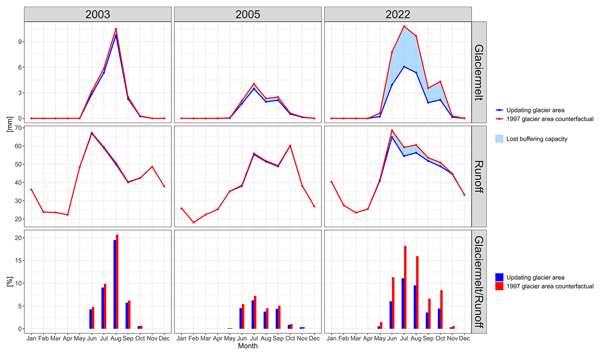
To further quantify the effects of glacier retreat on droughts in the upper Adige, we compared runoff and glacier melt conditions from 1997 to 2023 considering a counterfactual scenario of constant glacier area and volume at their 1997 levels. Results show progressively increasing differences both in terms of glacier melt and runoff during the selected drought events. This condition highlights the growing influence of glacier recession and the buffering capacity lost that would have been available during drought years. During the 2003 drought, average summer glacier melt from the dynamic simulation was 7.81 % lower than under 1997 glacier conditions, indicating a relatively limited loss of buffering capacity. The difference increased to 15 % in 2005 and reached 44.7 % in 2022, demonstrating the growing impact of glacier retreat on meltwater availability during dry summers (Fig. 6).
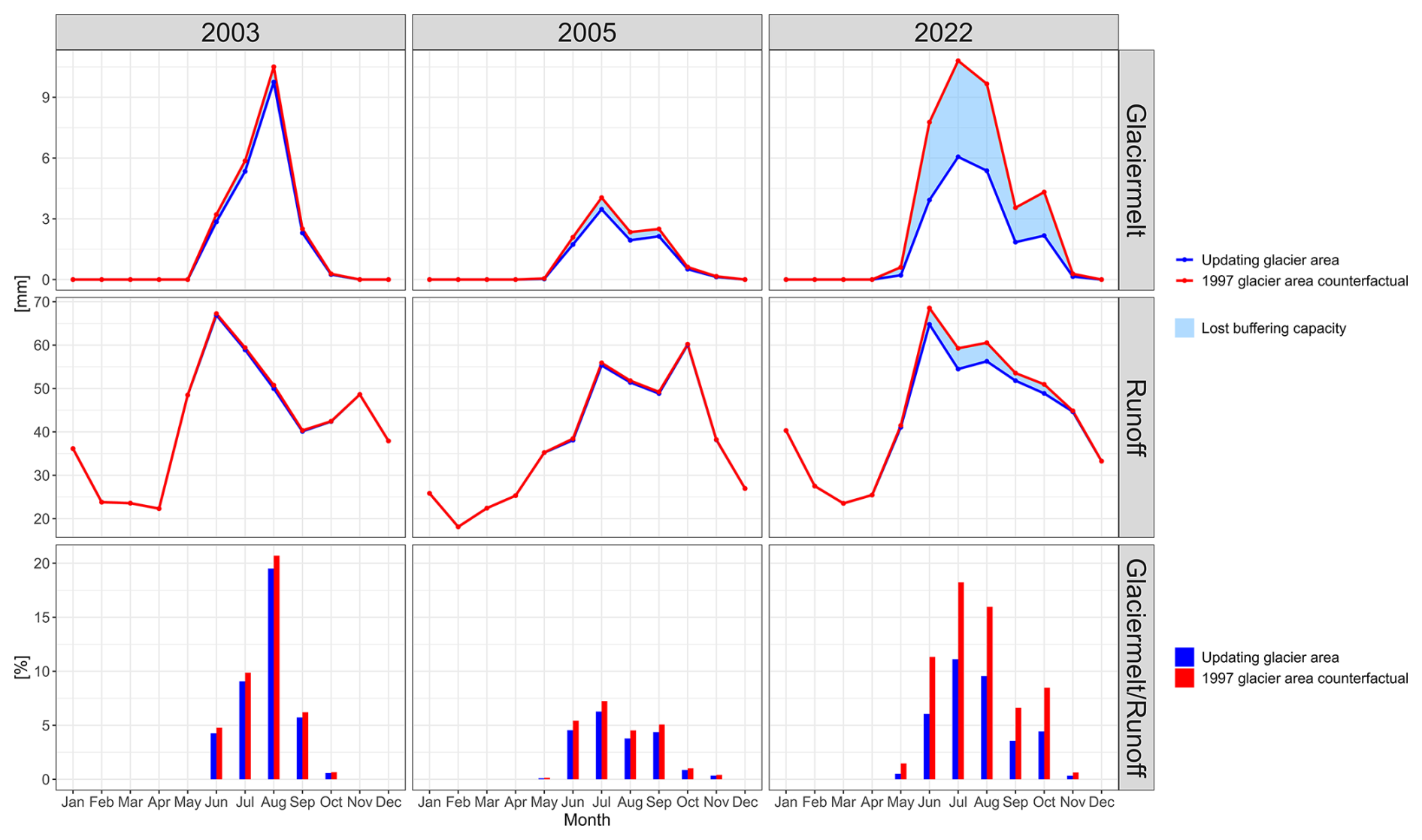
Figure 6Simulating the lost buffering capacity (light blue shaded area) in terms of glaciermelt, runoff and glaciermelt contribution to runoff at the Bronzolo gauge station using the 1997 glacier areas (red lines/bars) and yearly updating the glacier area (blue lines/bar).
The loss of glacier buffering capacity translated into reductions in summer runoff, although the magnitude of the effect was smaller than that observed for glacier melt. In 2003, runoff was 0.99 % lower in the dynamic simulation, while in 2005, both scenarios produced similar runoff values mainly due to lower contributions from glaciers during the cold 2005 drought conditions. In 2022, runoff was 6.23 % lower than in the counterfactual scenario.
The percentage contribution of glacier melt to total runoff most clearly shows the erosion of glacier buffering capacity. In relation to the 1997-glacier counterfactual, the contribution of glacier melt to total runoff was reduced by 6.89 % during the 2003 drought, 14.29 % in 2005 and 41.01 % in 2022. This result indicates that by 2022, more than two-fifths of the potential glacier buffering capacity that would have been available under the 1997 glacier extension had already been lost. While the reduction in glacier melt is mainly attributable to the shrinking glacier area, the longer the simulation period and the wider the gap between the two simulations from 2003 to 2022 dynamic and 1997-glacier scenario, highlighting the reducing capacity of the upper Adige river basin to sustain streamflow during dry and warm summers.
This study highlights the evolving role of glaciers in buffering hydrological responses to drought in the upper Adige River Basin. During major past droughts, glacier melt contributed between 4 % and 13 % of summer runoff. However, this buffering capacity is diminishing due to ongoing glacier retreat. Over the 26 years of simulation, glaciers in the upper Adige River Basin shrunk at an average rate of 1.95 km2 per year (Fig. 2), significantly reducing their ability to sustain summer flows during dry periods.
During individual summer drought events, glacier melt contributions are shaped by the interaction among cryospheric and climatic conditions (Figs. 4 and 5). In particular, the amount of snow cover at the end of June and the high temperature conditions during July-August-September months play a critical role in determining summer glacier melt within the upper Adige River Basin (Fig. 4). Reduced snow cover shortens the duration of snowmelt contribution while also exposing glacier ice to high temperatures earlier in the summer and hence increasing glacier melt rates. This result aligns with previous studies on factors driving glacier compensation effects in other glacierized areas in the world (Jenicek et al., 2016; Van Tiel et al., 2021).
The comparison of the 2003, 2005, and 2022 major drought events also provides evidence that the buffering role of glaciers is changing over time. Although 2022 experienced temperature conditions comparable to those of 2003, the compensatory effect provided by glaciers declined from 12 % of summer runoff in 2003 to 8 % in 2022. Despite the inherent uncertainty embedded in multiple factors such as glacier extent, elevation range, aspect, glacier melt data and model uncertainties, the implemented dynamic glacier module consistently indicates a lower glacier melt contribution in summer 2022 than in 2003. This result points to the reduction in glacierized area as an important factor limiting meltwater availability during recent droughts.
The exceptional importance of glacier melt during the 2022 drought has also been identified in other glacierized catchments in northern Italy, although the magnitude of the estimated anomaly differs among regions. In the upper Adige River basin, results indicate that the summer 2022 glacier melt contribution was 280 % above the climatological mean, whereas Leone et al. (2026) found an anomaly of about 350 % for other glacierized catchments in Valle d'Aosta and Valtellina in northern Italy. Despite these quantitative differences, both studies indicate that enhanced glacier melt substantially sustained summer streamflow during the 2022 drought.
The declining glacier melt contribution to summer streamflow (Figs. 5 and 6) between the two similar droughts of 2003 and 2022 suggests that the peak glacier water in the upper Adige River basin may already have been reached or is being approached. Similar patterns have been reported across the Alps, where glacier melt remains an important component of summer streamflow during dry years, even though its absolute contribution is already declining because of glacier retreat (Huss and Hock, 2018; Sommer et al., 2020; van Tiel et al., 2026).
For these reasons, the continued loss of this natural water storage could have important implications for water-demanding sectors in the future, particularly hydropower generation and irrigated agriculture, whose demands can remain high during periods of limited summer availability (Clason et al., 2022; Schaefli et al., 2019). Moreover, sharp declines during drought periods could strengthen upstream-downstream dependencies and increase the potential for competition among water uses. These pressures are likely to become more relevant under future climate and socio-economic changes. Future water management plans should therefore consider the progressive loss of cryospheric buffering and combine short-term improvements in water allocation with longer-term adaptation and transformation strategies addressing water demand, sectoral priorities and basin-wide coordination.
4.1 Limitations
While the integration of the glacier module into the ICHYMOD-TOPMELT hydrological model has provided valuable insights into glacier melt contributions and drought responses in the upper Adige River Basin, some limitations and opportunities for future improvements must be acknowledged.
The glacier module is based on the empirical relationship between glacier volume and area at the catchment scale. Although it performs well in simulating overall glacier melt contributions, it cannot capture the full complexity of glacier dynamics, such as internal flows, at the individual glacier level. Moreover, the module assumes that available SWE over glacier surfaces at the end of each hydrological year directly contributes to glacier mass balance. This approach shows limitations to accurately simulate specific years with net glacier mass gain, as observed in certain periods. Additionally, while the model reproduces glacier area evolution reliably, its representation of mass balance is constrained by uncertainties in the Dussaillant dataset used for calibration (Fig. 2). Nonetheless, the cumulative mass balance estimates from the model fall within the uncertainty range of Dussaillant-derived values, supporting its value for basin-scale assessments.
The use of a fixed albedo value in the glacier model constitutes a model simplification compared to state-of-the-art glacier models (Maussion et al., 2019). Although glacier albedo may vary spatially and temporally, we tested a range of spatio-temporally fixed parameters in order to (i) substantially reduce the computational effort and (ii) avoid a clear risk of equifinality, given the limited validation data available relative to the large number of potential spatio-temporal albedo configurations. Several other parameters equally influence glacier melt dynamics, namely combined melt factor for combined radiation-temperature driven melt, rain-melt factor and night-melt factor, all handling ice melt in different conditions. However, these parameters are coupled for snow and ice melt by model design, and therefore simultaneously affect the behaviour of both storages. We consequently focused the calibration on glacier albedo, which is the only parameter in the model framework that allows glacier melt to be adjusted independently of snowmelt. The selected calibration value of 0.65 is higher than usual values typically associated with bare glacier ice and is closer to those reported for firn. Nevertheless, it lies within the range reported by studies conducted in comparable Alpine environments (e.g., Hartl et al., 2025; Krampe et al., 2022; Richter et al., 2026) and remains below the fresh snow albedo value of 0.9 used in the model.
The performance of the integrated hydrological model shows a decreasing trend in Kling-Gupta Efficiency (KGE) values for subbasins with glacier coverage exceeding 1 %. These subbasins are typically small, high-elevation catchments where modelling challenges are amplified due to limited data availability, uncertainty in meteorological forcing data and the complexity of snow- and ice-related processes. In this regard, only eight glacierized subbasins had complete runoff observations for the summer periods of 2003, 2005, and 2022, restricting the robustness of model validation and of the analyses focused on these years, as detailed in the Supplement.
Despite these limitations, including a dynamic glacier module improved streamflow representation during low-flow summer events. The enhanced model improved the glacier melt quantification during droughts and provided a valuable tool for understanding the conditions that lead to high or low glacier melt contributions during summer droughts, that can be applied to other mountain glacierized catchments. The tool can be used to support the adaption of water resources management in alpine regions within the context of climate change, where glacier retreat is altering seasonal water availability.
This study provides a modelling approach to quantify the role of glaciers and snow cover in buffering summer droughts, implementing a novel dynamic glacier module into the ICHYMOD-TOPMELT hydrological model. The application in the upper Adige River Basin shows an almost monotonic trend of glacier retreat over 26 consecutive years. Focusing on the severe droughts of 2003, 2005 and 2022, we show how the combination of multiple hydro-climatic variables (i.e., summer precipitation, temperature and especially snow water equivalent at the beginning of summer) drives the amount of glacier melt that mitigates hydrological droughts. Glacier melt contributions ranged between 4 % and 12 % at the upper Adige closing section while the decreases in glacier extent (from 111 km2 in 1997 to 79 km2 in 2017) is leading to a significant decline in glacier melt contribution to the overall runoff, especially during acute hot and dry events. This condition suggests that the glacier peak water in the upper Adige River basin may already have been reached or is being approached. Moreover, our counterfactual analysis showed that, if glaciers had retained their 1997 extent, their contribution to total runoff during the 2022 drought could have been 41.01 % higher than the contribution estimated under the actual 2022 glacier extent. For these reasons, the continued glacier loss and its implications for water management need to be considered in future plans, particularly with increasing demand across multiple sectors and for downstream users. Given the increasing emissions, rising global temperature and the consequent disappearance of glaciers (Van Tricht et al., 2026), our results call for proactive adaptation and transformation strategies in water demand planning that accounts for the decreasing buffering role of glaciers to sustain summer flows and mitigate drought conditions.
Input datasets used in this study are publicly available from the institutional sources and published repositories referenced in the manuscript. The modelling framework used in this study is currently subject to intellectual property restrictions and consequently the source code is not publicly available. The model outputs supporting the findings of this study are available from the corresponding author upon reasonable request.
The supplement related to this article is available online at https://doi.org/10.5194/nhess-26-5941-2026-supplement.
SuS, ST and GB conceived the study, and SuS performed the analysis with the significant support from ST, GB, AG, MZ, DZ. SuS and ST wrote the first manuscript draft with support from AG, DZ and GB. MB, RD, MP contributed with insights, discussed the argument and review the manuscript. ST secured funding. SuS and ST equally contributed to the study.
The contact author has declared that none of the authors has any competing interests.
Publisher's note: Copernicus Publications remains neutral with regard to jurisdictional claims made in the text, published maps, institutional affiliations, or any other geographical representation in this paper. The authors bear the ultimate responsibility for providing appropriate place names. Views expressed in the text are those of the authors and do not necessarily reflect the views of the publisher.
The authors would like to thank the two anonymous reviewers for their helpful comments and feedback.
The publication of this research was partially funded by the NEXOGENESIS project (grant agreement no. 101003881), financed by the European Commission under the EU H2020 programme. Further support was provided by the European Space Agency (ESA) under the EO4MULTIHA project (2023–2025) (contract no. 4000141754/23/I-DT), by the project PE00000005_RETURN: “Multi-Risk sciEnce for resilient communities undeR a changing Climate” PNRR, under the Missione 4, Componente 2, Investimento 1.3, call n. 341 del 15/03/2022 CUP: D53C22002510002 declaration, by the PRIN 2022 project finanziamenti PNRR – Missione 4 “Istruzione e Ricerca” Componente C2 Investimento 1.1 “Fondo per il programma Nazionale di Ricerca e Progetti di Rilevante Interesse Nazionale” (PRIN) – CUP C53D23001990006, the PNRR project “Interconnected Nord-Est Innovation Ecosystem (iNEST)” Spoke 1 – RT1: Safety and quality of life in mountain environments CUP C43C22000340006 – financed by the European Union – Next Generation EU and by the project Nextwater_ST, funded by the Autonomous Province of Bolzano (Decree no. 23075/2024, CUP D53C24005810003).
This paper was edited by Olga Petrucci and reviewed by two anonymous referees.
Avanzi, F., Munerol, F., Milelli, M., Gabellani, S., Massari, C., Girotto, M., Cremonese, E., Galvagno, M., Bruno, G., Morra di Cella, U., Rossi, L., Altamura, M., and Ferraris, L.: Winter snow deficit was a harbinger of summer 2022 socio-hydrologic drought in the Po Basin, Italy, Commun. Earth Environ., 5, 1–12, https://doi.org/10.1038/s43247-024-01222-z, 2024.
Avanzi, F., Terzi, S., Castelli, M., Munerol, F., Andreaggi, M., Galvagno, M., Galletti, A., Maurer, T., Massari, C., Carlson, G., Girotto, M., Bertoldi, G., Cremonese, E., Gabellani, S., di Cella, U. M., Altamura, M., Rossi, L., and Ferraris, L.: Impacts of Mediterranean snow droughts on mountain socio-ecohydrology, Hydrol. Earth Syst. Sci., 30, 5769–5790, https://doi.org/10.5194/hess-30-5769-2026, 2026.
Bertoldi, G., Bozzoli, M., Crespi, A., Matiu, M., Giovannini, L., Zardi, D., and Majone, B.: Diverging snowfall trends across months and elevation in the northeastern Italian Alps, Int. J. Climatol., 43, 2794–2819, https://doi.org/10.1002/joc.8002, 2023.
Biella, R., Shyrokaya, A., Ionita, M., Vignola, R., Sutanto, S. J., Todorovic, A., Teutschbein, C., Cid, D., Llasat, M. C., Alencar, P., Matanó, A., Ridolfi, E., Moccia, B., Pechlivanidis, I., van Loon, A., Wendt, D. E., Stenfors, E., Russo, F., Vidal, J.-P., Barker, L., de Brito, M. M., Lam, M., Bláhová, M., Trambauer, P., Hamed, R., McGrane, S. J., Ceola, S., Bakke, S. J., Krakovska, S., Nagavciuc, V., Tootoonchi, F., Di Baldassarre, G., Hauswirth, S., Maskey, S., Zubkovych, S., Wens, M., and Tallaksen, L. M.: The 2022 drought needs to be a turning point for European drought risk management, Nat. Hazards Earth Syst. Sci., 25, 4475–4501, https://doi.org/10.5194/nhess-25-4475-2025, 2025.
Brock, B. W., Willis, I. C., and Sharp, M. J.: Measurement and parameterization of albedo variations at Haut Glacier d'Arolla, Switzerland, J. Glaciol., 46, 675–688, https://doi.org/10.3189/172756500781832675, 2000.
Cazorzi, F. and Dalla Fontana, G.: Snowmelt modelling by combining air temperature and a distributed radiation index, J. Hydrol., 181, 169–187, https://doi.org/10.1016/0022-1694(95)02913-3, 1996.
Chiogna, G., Majone, B., Paoli, K. C., Diamantini, E., Stella, E., Mallucci, S., Lencioni, V., Zandonai, F., and Bellin, A.: A review of hydrological and chemical stressors in the Adige catchment and its ecological status, Sci. Total Environ., 540, 429–443, https://doi.org/10.1016/j.scitotenv.2015.06.149, 2015.
Clason, C., Rangecroft, S., Owens, P. N., Łokas, E., Baccolo, G., Selmes, N., Beard, D., Kitch, J., Dextre, R. M., Morera, S., and Blake, W.: Contribution of glaciers to water, energy and food security in mountain regions: current perspectives and future priorities, Ann. Glaciol., 63, 73–78, https://doi.org/10.1017/aog.2023.14, 2022.
Colombo, N., Guyennon, N., Valt, M., Salerno, F., Godone, D., Cianfarra, P., Freppaz, M., Maugeri, M., Manara, V., Acquaotta, F., Petrangeli, A. B., and Romano, E.: Unprecedented snow-drought conditions in the Italian Alps during the early 2020s, Environ. Res. Lett., 18, 074014, https://doi.org/10.1088/1748-9326/acdb88, 2023.
Dalla Torre, D., Di Marco, N., Menapace, A., Avesani, D., Righetti, M., and Majone, B.: Suitability of ERA5-Land reanalysis dataset for hydrological modelling in the Alpine region, J. Hydrol. Reg. Stud., 52, 101718, https://doi.org/10.1016/j.ejrh.2024.101718, 2024.
Di Marco, N., Avesani, D., Righetti, M., Zaramella, M., Majone, B., and Borga, M.: Reducing hydrological modelling uncertainty by using MODIS snow cover data and a topography-based distribution function snowmelt model, J. Hydrol., 599, 126020, https://doi.org/10.1016/j.jhydrol.2021.126020, 2021.
Dussaillant, I., Hugonnet, R., Huss, M., Berthier, E., Bannwart, J., Paul, F., and Zemp, M.: Annual mass change of the world's glaciers from 1976 to 2024 by temporal downscaling of satellite data with in situ observations, Earth Syst. Sci. Data, 17, 1977–2006, https://doi.org/10.5194/essd-17-1977-2025, 2025.
Farinotti, D., Huss, M., Bauder, A., Funk, M., and Truffer, M.: A method to estimate the ice volume and ice-thickness distribution of alpine glaciers, J. Glaciol., 55, 422–430, https://doi.org/10.3189/002214309788816759, 2009.
Frans, C., Istanbulluoglu, E., Lettenmaier, D. P., Clarke, G., Bohn, T. J., and Stumbaugh, M.: Implications of decadal to century scale glacio-hydrological change for water resources of the Hood River basin, OR, USA, Hydrol. Process., 30, 4314–4329, https://doi.org/10.1002/hyp.10872, 2016.
Galos, S. P., Klug, R., Prinz, R., Rieg, L., Dinale, R., Sailer, R., and Kaser, G.: Recent glacier changes and related contribution potential to river discharge in the Vinschau/Val Venosta, Italian Alps, Geogr. Fis. E Din. Quat., 143–154, https://doi.org/10.4461/GFDQ.2015.38.13, 2015.
Galos, S. P., Klug, C., and Dinale, R.: 20 Years of Glacier Change: The Homogenized Glacier Inventories for South Tyrol 1997-2005-2017, Geogr. Fis. E Din. Quat., 45, 171–183, https://doi.org/10.4461/gfdq.2022.45.6, 2022.
Glen, J. W.: The creep of polycrystalline ice, Proc. R. Soc. Lond. Math. Phys. Sci., 228, 519–538, https://doi.org/10.1098/rspa.1955.0066, 1955.
Gupta, H. V., Kling, H., Yilmaz, K. K., and Martinez, G. F.: Decomposition of the mean squared error and NSE performance criteria: Implications for improving hydrological modelling, J. Hydrol., 377, 80–91, https://doi.org/10.1016/j.jhydrol.2009.08.003, 2009.
Hartl, L., Covi, F., Stocker-Waldhuber, M., Baldo, A., Fugazza, D., Di Mauro, B., and Naegeli, K.: Loss of accumulation zone exposes dark ice and drives increased ablation at Weißseespitze, Austria, The Cryosphere, 19, 3329–3353, https://doi.org/10.5194/tc-19-3329-2025, 2025.
Hock, R., Rasul, G., Adler, C., Cáceres, B., Gruber, S., Hirabayashi, Y., Jackson, M., Kääb, A., Kang, S., Kutuzov, S., Milner, A., Molau, U., Morin, S., Orlove, B., and Steltzer, H.: High Mountain Areas, in: IPCC Special Report on the Ocean and Cryosphere in a Changing Climate, edited by: Pörtner, H.-O., Roberts, D. C., Masson-Delmotte, V., Zhai, P., Tignor, M., Poloczanska, E., Mintenbeck, K., Alegría, A., Nicolai, M., Okem, A., Petzold, J., Rama, B., Weyer, N. M., 1st ed., Cambridge University Press, https://doi.org/10.1017/9781009157964, 2022.
Huss, M. and Farinotti, D.: Distributed ice thickness and volume of all glaciers around the globe, J. Geophys. Res.-Earth Surf., 117, https://doi.org/10.1029/2012JF002523, 2012.
Huss, M. and Hock, R.: Global-scale hydrological response to future glacier mass loss, Nat. Clim. Change, 8, 135–140, https://doi.org/10.1038/s41558-017-0049-x, 2018.
Huss, M., Farinotti, D., Bauder, A., and Funk, M.: Modelling runoff from highly glacierized alpine drainage basins in a changing climate, Hydrol. Process., 22, 3888–3902, https://doi.org/10.1002/hyp.7055, 2008.
Huss, M., Jouvet, G., Farinotti, D., and Bauder, A.: Future high-mountain hydrology: a new parameterization of glacier retreat, Hydrol. Earth Syst. Sci., 14, 815–829, https://doi.org/10.5194/hess-14-815-2010, 2010.
Jenicek, M., Seibert, J., Zappa, M., Staudinger, M., and Jonas, T.: Importance of maximum snow accumulation for summer low flows in humid catchments, Hydrol. Earth Syst. Sci., 20, 859–874, https://doi.org/10.5194/hess-20-859-2016, 2016.
Knoll, C. and Kerschner, H.: A glacier inventory for South Tyrol, Italy, based on airborne laser-scanner data, Ann. Glaciol., 50, 46–52, https://doi.org/10.3189/172756410790595903, 2009.
Krampe, D., Arndt, A., and Schneider, C.: Energy and glacier mass balance of Fürkeleferner, Italy: past, present, and future, Front. Earth Sci., 10, https://doi.org/10.3389/feart.2022.814027, 2022.
Kreyszig, E., Kreyszig, H., and Norminton, E. J.: Advanced Engineering Mathematics, Tenth., Wiley, Hoboken, NJ, https://drspmaths.wordpress.com/wp-content/uploads/2019/01/advanced-engineering-mathematics_by-erwin-kreyszig-__10th_edition-1.pdf (last access: 8 October 2026), 2011.
Larsen, S., Majone, B., Zulian, P., Stella, E., Bellin, A., Bruno, M. C., and Zolezzi, G.: Combining Hydrologic Simulations and Stream-network Models to Reveal Flow-ecology Relationships in a Large Alpine Catchment, Water Resour. Res., 57, https://doi.org/10.1029/2020wr028496, 2021.
Lemus-Canovas, M., Crespi, A., Maines, E., Terzi, S., and Pittore, M.: More intense heatwaves under drier conditions: a compound event analysis in the Adige River basin (Eastern Italian Alps), Hydrol. Earth Syst. Sci., 29, 6781–6809, https://doi.org/10.5194/hess-29-6781-2025, 2025.
Leone, M., Avanzi, F., Morra di Cella, U., Gabellani, S., Cremonese, E., Isabellon, M., Pogliotti, P., Scotti, R., Monti, A., Ferraris, L., and Colombo, R.: The 2022–2023 snow drought in the Italian Alps doubled glacier contribution to summer streamflow, Hydrol. Earth Syst. Sci., 30, 4649–4666, https://doi.org/10.5194/hess-30-4649-2026, 2026.
Li, H., Beldring, S., Xu, C.-Y., Huss, M., Melvold, K., and Jain, S. K.: Integrating a glacier retreat model into a hydrological model – Case studies of three glacierised catchments in Norway and Himalayan region, J. Hydrol., 527, 656–667, https://doi.org/10.1016/j.jhydrol.2015.05.017, 2015.
Linsbauer, A., Paul, F., Machguth, H., and Haeberli, W.: Comparing three different methods to model scenarios of future glacier change in the Swiss Alps, Ann. Glaciol., 54, 241–253, https://doi.org/10.3189/2013AoG63A400, 2013.
Luo, Y., Arnold, J., Liu, S., Wang, X., and Chen, X.: Inclusion of glacier processes for distributed hydrological modeling at basin scale with application to a watershed in Tianshan Mountains, northwest China, J. Hydrol., 477, 72–85, https://doi.org/10.1016/j.jhydrol.2012.11.005, 2013.
Maussion, F., Butenko, A., Champollion, N., Dusch, M., Eis, J., Fourteau, K., Gregor, P., Jarosch, A. H., Landmann, J., Oesterle, F., Recinos, B., Rothenpieler, T., Vlug, A., Wild, C. T., and Marzeion, B.: The Open Global Glacier Model (OGGM) v1.1, Geosci. Model Dev., 12, 909–931, https://doi.org/10.5194/gmd-12-909-2019, 2019.
Modarres, R.: Streamflow drought time series forecasting, Stoch. Environ. Res. Risk Assess., 21, 223–233, https://doi.org/10.1007/s00477-006-0058-1, 2007.
Montanari, A., Nguyen, H., Rubinetti, S., Ceola, S., Galelli, S., Rubino, A., and Zanchettin, D.: Why the 2022 Po River drought is the worst in the past two centuries, Sci. Adv., 9, eadg8304, https://doi.org/10.1126/sciadv.adg8304, 2023.
Moore, R. J.: The probability-distributed principle and runoff production at point and basin scales, Hydrol. Sci. J., 30, 273–297, https://doi.org/10.1080/02626668509490989, 1985.
Moore, R. J.: The PDM rainfall-runoff model, Hydrol. Earth Syst. Sci., 11, 483–499, https://doi.org/10.5194/hess-11-483-2007, 2007.
National Science Foundation: NASA Shuttle Radar Topography Mission (SRTM) Global, Distributed by OpenTopography: Shuttle Radar Topography Mission (SRTM), https://doi.org/10.5069/G9445JDF, 2013.
Navarro-Ortega, A., Acuña, V., Bellin, A., Burek, P., Cassiani, G., Choukr-Allah, R., Dolédec, S., Elosegi, A., Ferrari, F., Ginebreda, A., Grathwohl, P., Jones, C., Rault, P. K., Kok, K., Koundouri, P., Ludwig, R. P., Merz, R., Milacic, R., Muñoz, I., Nikulin, G., Paniconi, C., Paunović, M., Petrovic, M., Sabater, L., Sabater, S., Skoulikidis, N. Th., Slob, A., Teutsch, G., Voulvoulis, N., and Barceló, D.: Managing the effects of multiple stressors on aquatic ecosystems under water scarcity. The GLOBAQUA project, Sci. Total Environ., 503–504, 3–9, https://doi.org/10.1016/j.scitotenv.2014.06.081, 2015.
Naz, B. S., Frans, C. D., Clarke, G. K. C., Burns, P., and Lettenmaier, D. P.: Modeling the effect of glacier recession on streamflow response using a coupled glacio-hydrological model, Hydrol. Earth Syst. Sci., 18, 787–802, https://doi.org/10.5194/hess-18-787-2014, 2014.
Norbiato, D., Borga, M., Esposti, S. D., Gaume, E., and Anquetin, S.: Flash flood warning based on rainfall thresholds and soil moisture conditions: An assessment for gauged and ungauged basins, J. Hydrol., 362, 274–290, https://doi.org/10.1016/j.jhydrol.2008.08.023, 2008.
Norbiato, D., Borga, M., Merz, R., Blöschl, G., and Carton, A.: Controls on event runoff coefficients in the eastern Italian Alps, J. Hydrol., 375, 312–325, https://doi.org/10.1016/j.jhydrol.2009.06.044, 2009.
Penna, D., Engel, M., Bertoldi, G., and Comiti, F.: Towards a tracer-based conceptualization of meltwater dynamics and streamflow response in a glacierized catchment, Hydrol. Earth Syst. Sci., 21, 23–41, https://doi.org/10.5194/hess-21-23-2017, 2017.
Pepin, N. C., Arnone, E., Gobiet, A., Haslinger, K., Kotlarski, S., Notarnicola, C., Palazzi, E., Seibert, P., Serafin, S., Schöner, W., Terzago, S., Thornton, J. M., Vuille, M., and Adler, C.: Climate Changes and Their Elevational Patterns in the Mountains of the World, Rev. Geophys., 60, e2020RG000730, https://doi.org/10.1029/2020RG000730, 2022.
Radić, V. and Hock, R.: Regional and global volumes of glaciers derived from statistical upscaling of glacier inventory data, J. Geophys. Res.-Earth Surf., 115, https://doi.org/10.1029/2009JF001373, 2010.
Richter, J. N., Arndt, A., Ban, N., Gampierakis, N., Maussion, F., Prinz, R., Scheiter, M., Umlauf, N., and Nicholson, L.: Towards the Bayesian calibration of a glacier surface energy balance model for unmonitored glaciers, EGUsphere [preprint], https://doi.org/10.5194/egusphere-2025-6249, 2026.
Schaefli, B., Manso, P., Fischer, M., Huss, M., and Farinotti, D.: The role of glacier retreat for Swiss hydropower production, Renew. Energy, 132, 615–627, https://doi.org/10.1016/j.renene.2018.07.104, 2019.
Seibert, J., Vis, M. J. P., Kohn, I., Weiler, M., and Stahl, K.: Technical note: Representing glacier geometry changes in a semi-distributed hydrological model, Hydrol. Earth Syst. Sci., 22, 2211–2224, https://doi.org/10.5194/hess-22-2211-2018, 2018.
Shen, C., Appling, A. P., Gentine, P., Bandai, T., Gupta, H., Tartakovsky, A., Baity-Jesi, M., Fenicia, F., Kifer, D., Li, L., Liu, X., Ren, W., Zheng, Y., Harman, C. J., Clark, M., Farthing, M., Feng, D., Kumar, P., Aboelyazeed, D., Rahmani, F., Song, Y., Beck, H. E., Bindas, T., Dwivedi, D., Fang, K., Höge, M., Rackauckas, C., Mohanty, B., Roy, T., Xu, C., and Lawson, K.: Differentiable modelling to unify machine learning and physical models for geosciences, Nat. Rev. Earth Environ., 4, 552–567, https://doi.org/10.1038/s43017-023-00450-9, 2023.
Sommer, C., Malz, P., Seehaus, T. C., Lippl, S., Zemp, M., and Braun, M. H.: Rapid glacier retreat and downwasting throughout the European Alps in the early 21st century, Nat. Commun., 11, 3209, https://doi.org/10.1038/s41467-020-16818-0, 2020.
Stahl, K., Moore, R. D., Shea, J. M., Hutchinson, D., and Cannon, A. J.: Coupled modelling of glacier and streamflow response to future climate scenarios, Water Resour. Res., 44, https://doi.org/10.1029/2007WR005956, 2008.
Stephan, R., Erfurt, M., Terzi, S., Žun, M., Kristan, B., Haslinger, K., and Stahl, K.: An inventory of Alpine drought impact reports to explore past droughts in a mountain region, Nat. Hazards Earth Syst. Sci., 21, 2485–2501, https://doi.org/10.5194/nhess-21-2485-2021, 2021.
Stergiadi, M., Di Marco, N., Avesani, D., Righetti, M., and Borga, M.: Impact of Geology on Seasonal Hydrological Predictability in Alpine Regions by a Sensitivity Analysis Framework, Water, 12, 2255, https://doi.org/10.3390/w12082255, 2020.
Telesca, L., Lovallo, M., Lopez-Moreno, I., and Vicente-Serrano, S.: Investigation of scaling properties in monthly streamflow and Standardized Streamflow Index (SSI) time series in the Ebro basin (Spain), Phys. Stat. Mech. Its Appl., 391, 1662–1678, https://doi.org/10.1016/j.physa.2011.10.023, 2012.
The GlaMBIE Team: Community estimate of global glacier mass changes from 2000 to 2023, Nature, 639, 382–388, https://doi.org/10.1038/s41586-024-08545-z, 2025.
Tscholl, S., Marsoner, T., Bertoldi, G., Bottarin, R., and Egarter Vigl, L.: A High-Resolution Climatic Water Balance for Eco-Hydrological Inference in the Upper Adige Catchment (Italy), Geosci. Data J., 12, e70007, https://doi.org/10.1002/gdj3.70007, 2025.
Ultee, L., Coats, S., and Mackay, J.: Glacial runoff buffers droughts through the 21st century, Earth Syst. Dynam., 13, 935–959, https://doi.org/10.5194/esd-13-935-2022, 2022.
van Tiel, M., Huss, M., Zappa, M., Jonas, T., and Farinotti, D.: Swiss glacier mass loss during the 2022 drought: persistent streamflow contributions amid declining melt water volumes, Hydrol. Earth Syst. Sci., 30, 23–43, https://doi.org/10.5194/hess-30-23-2026, 2026.
Van Tiel, M., Van Loon, A. F., Seibert, J., and Stahl, K.: Hydrological response to warm and dry weather: do glaciers compensate?, Hydrol. Earth Syst. Sci., 25, 3245–3265, https://doi.org/10.5194/hess-25-3245-2021, 2021.
Van Tricht, L., Zekollari, H., Huss, M., Rounce, D. R., Schuster, L., Aguayo, R., Schmitt, P., Maussion, F., Tober, B., and Farinotti, D.: Peak glacier extinction in the mid-twenty-first century, Nat. Clim. Change, 16, 143–147, https://doi.org/10.1038/s41558-025-02513-9, 2026.
Zaramella, M., Borga, M., Zoccatelli, D., and Carturan, L.: TOPMELT 1.0: a topography-based distribution function approach to snowmelt simulation for hydrological modelling at basin scale, Geosci. Model Dev., 12, 5251–5265, https://doi.org/10.5194/gmd-12-5251-2019, 2019.
Zebisch, M., Pedoth, L., Pörnbacher, M., Renner, K., Fritsch, U., Alberton, M., Bertoldi, G., Bisignano, J., Corradini, P., Crespi, A., Crippa, C., Ducati, V., Eisendle, F., Hilpold, A., Hoffmann, C., Horvath, K., Kircher, V., Lun, G., Maino, F., Misconel, S., Obojes, N., Omizzolo, A., Pellegrini, C., Perkmann, U., Prina, M. G., Roveri, G., Sparber, W., Strapazzon, G., and Thaler, F.: Rischi climatici e adattamento – Verso un Alto Adige resiliente al clima, Eurac Research, 188, https://doi.org/10.57749/Q8Y8-TV70, 2025.