
Articles | Volume 26, issue 1
https://doi.org/10.5194/nhess-26-587-2026
© Author(s) 2026. This work is distributed under
the Creative Commons Attribution 4.0 License.
the Creative Commons Attribution 4.0 License.
https://doi.org/10.5194/nhess-26-587-2026
© Author(s) 2026. This work is distributed under
the Creative Commons Attribution 4.0 License.
the Creative Commons Attribution 4.0 License.
Research article
| 
28 Jan 2026
Research article |
| 28 Jan 2026
| 28 Jan 2026
Bedrock ledges, colluvial wedges, and ridgetop wetlands: characterizing geomorphic and atmospheric controls on the 2023 Wrangell landslide to inform landslide assessment in Southeast Alaska, USA
Department of Earth Sciences, University of Oregon, Eugene, OR, USA
Margaret M. Darrow
Department of Civil, Geological, and Environmental Engineering, University of Alaska Fairbanks, Fairbanks, AK, USA
Annette I. Patton
College of Forestry, Oregon State University, Corvallis, OR, USA
Aaron Jacobs
National Weather Service, Juneau, AK, USA
Related authors
Nathaniel Klema, Leif Karlstrom, and Joshua Roering
Earth Surf. Dynam., 14, 493–515, https://doi.org/10.5194/esurf-14-493-2026, https://doi.org/10.5194/esurf-14-493-2026, 2026
Short summary
Short summary
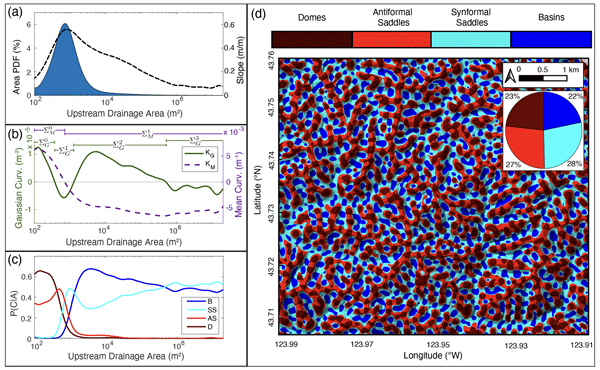
Geomorphology is built on process models that take topographic geometry as inputs. However, many studies calculate these metrics on 2-D projections of topography rather than on true surfaces in 3-D space. In this work we apply classical surface theory to fluvial topography of the Oregon Coast Range, USA. This formal approach improves the accuracy of geometry calculations, extracts more information than standard methods, and sheds light on the organizational structure of landscapes.
Ian D. Wachino, Joshua J. Roering, Reuben Cash, and Annette I. Patton
Nat. Hazards Earth Syst. Sci., 26, 1435–1456, https://doi.org/10.5194/nhess-26-1435-2026, https://doi.org/10.5194/nhess-26-1435-2026, 2026
Short summary
Short summary
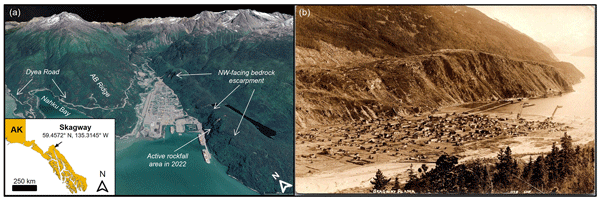
Rockfalls are a common hazard in steep mountain valleys, especially near Skagway, Alaska, where recent events have threatened public safety and infrastructure. This study identifies zones prone to rockfall by analyzing rockfall records, rock formations, past rockfall deposits, and computer models predicting how rocks travel downslope. Our findings highlight high-risk areas and provide insights to improve hazard mitigation, helping protect communities and tourism in the region.
Greg Balco, Alan J. Hidy, William T. Struble, and Joshua J. Roering
Geochronology, 6, 71–76, https://doi.org/10.5194/gchron-6-71-2024, https://doi.org/10.5194/gchron-6-71-2024, 2024
Short summary
Short summary
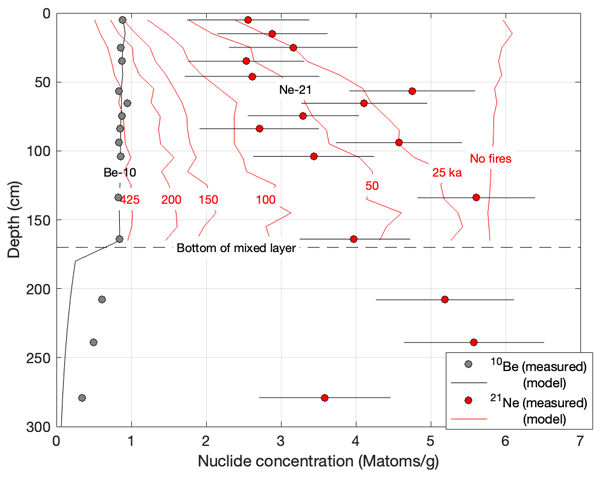
We describe a new method of reconstructing the long-term, pre-observational frequency and/or intensity of wildfires in forested landscapes using trace concentrations of the noble gases helium and neon that are formed in soil mineral grains by cosmic-ray bombardment of the Earth's surface.
Annette I. Patton, Lisa V. Luna, Joshua J. Roering, Aaron Jacobs, Oliver Korup, and Benjamin B. Mirus
Nat. Hazards Earth Syst. Sci., 23, 3261–3284, https://doi.org/10.5194/nhess-23-3261-2023, https://doi.org/10.5194/nhess-23-3261-2023, 2023
Short summary
Short summary
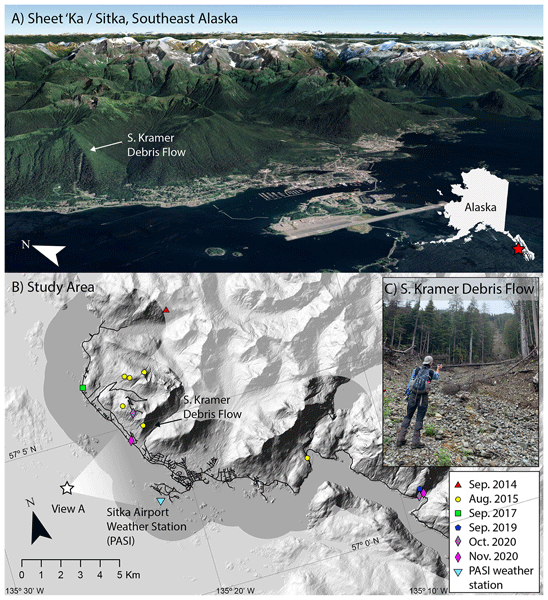
Landslide warning systems often use statistical models to predict landslides based on rainfall. They are typically trained on large datasets with many landslide occurrences, but in rural areas large datasets may not exist. In this study, we evaluate which statistical model types are best suited to predicting landslides and demonstrate that even a small landslide inventory (five storms) can be used to train useful models for landslide early warning when non-landslide events are also included.

William T. Struble and Joshua J. Roering
Earth Surf. Dynam., 9, 1279–1300, https://doi.org/10.5194/esurf-9-1279-2021, https://doi.org/10.5194/esurf-9-1279-2021, 2021
Short summary
Short summary
We used a mathematical technique known as a wavelet transform to calculate the curvature of hilltops in western Oregon, which we used to estimate erosion rate. We find that this technique operates over 1000 times faster than other techniques and produces accurate erosion rates. We additionally built artificial hillslopes to test the accuracy of curvature measurement methods. We find that at fast erosion rates, curvature is underestimated, raising questions of measurement accuracy elsewhere.
Nathaniel Klema, Leif Karlstrom, and Joshua Roering
Earth Surf. Dynam., 14, 493–515, https://doi.org/10.5194/esurf-14-493-2026, https://doi.org/10.5194/esurf-14-493-2026, 2026
Short summary
Short summary
Geomorphology is built on process models that take topographic geometry as inputs. However, many studies calculate these metrics on 2-D projections of topography rather than on true surfaces in 3-D space. In this work we apply classical surface theory to fluvial topography of the Oregon Coast Range, USA. This formal approach improves the accuracy of geometry calculations, extracts more information than standard methods, and sheds light on the organizational structure of landscapes.
Ian D. Wachino, Joshua J. Roering, Reuben Cash, and Annette I. Patton
Nat. Hazards Earth Syst. Sci., 26, 1435–1456, https://doi.org/10.5194/nhess-26-1435-2026, https://doi.org/10.5194/nhess-26-1435-2026, 2026
Short summary
Short summary
Rockfalls are a common hazard in steep mountain valleys, especially near Skagway, Alaska, where recent events have threatened public safety and infrastructure. This study identifies zones prone to rockfall by analyzing rockfall records, rock formations, past rockfall deposits, and computer models predicting how rocks travel downslope. Our findings highlight high-risk areas and provide insights to improve hazard mitigation, helping protect communities and tourism in the region.
Line Rouyet, Tobias Bolch, Francesco Brardinoni, Rafael Caduff, Diego Cusicanqui, Margaret Darrow, Reynald Delaloye, Thomas Echelard, Christophe Lambiel, Cécile Pellet, Lucas Ruiz, Lea Schmid, Flavius Sirbu, and Tazio Strozzi
Earth Syst. Sci. Data, 17, 4125–4157, https://doi.org/10.5194/essd-17-4125-2025, https://doi.org/10.5194/essd-17-4125-2025, 2025
Short summary
Short summary
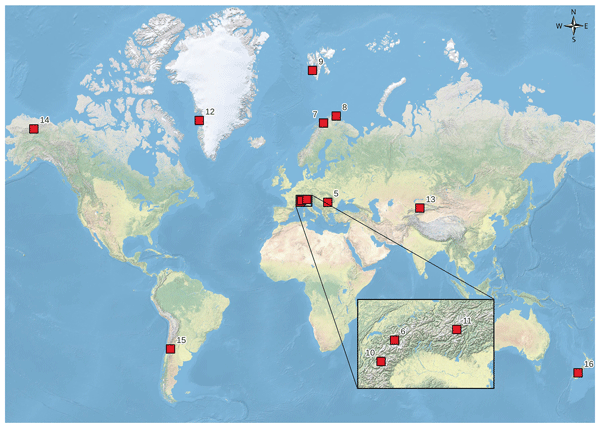
Rock glaciers are landforms generated by the creep of frozen ground (permafrost) in cold-climate mountains. Mapping rock glaciers contributes to documenting the distribution and the dynamics of mountain permafrost. We compiled inventories documenting the location, the characteristics, and the extent of rock glaciers in 12 mountain regions around the world. In each region, a team of operators performed the work following common rules and agreed on final solutions when discrepancies were identified.
Greg Balco, Alan J. Hidy, William T. Struble, and Joshua J. Roering
Geochronology, 6, 71–76, https://doi.org/10.5194/gchron-6-71-2024, https://doi.org/10.5194/gchron-6-71-2024, 2024
Short summary
Short summary
We describe a new method of reconstructing the long-term, pre-observational frequency and/or intensity of wildfires in forested landscapes using trace concentrations of the noble gases helium and neon that are formed in soil mineral grains by cosmic-ray bombardment of the Earth's surface.
Annette I. Patton, Lisa V. Luna, Joshua J. Roering, Aaron Jacobs, Oliver Korup, and Benjamin B. Mirus
Nat. Hazards Earth Syst. Sci., 23, 3261–3284, https://doi.org/10.5194/nhess-23-3261-2023, https://doi.org/10.5194/nhess-23-3261-2023, 2023
Short summary
Short summary
Landslide warning systems often use statistical models to predict landslides based on rainfall. They are typically trained on large datasets with many landslide occurrences, but in rural areas large datasets may not exist. In this study, we evaluate which statistical model types are best suited to predicting landslides and demonstrate that even a small landslide inventory (five storms) can be used to train useful models for landslide early warning when non-landslide events are also included.
Aldo Bertone, Chloé Barboux, Xavier Bodin, Tobias Bolch, Francesco Brardinoni, Rafael Caduff, Hanne H. Christiansen, Margaret M. Darrow, Reynald Delaloye, Bernd Etzelmüller, Ole Humlum, Christophe Lambiel, Karianne S. Lilleøren, Volkmar Mair, Gabriel Pellegrinon, Line Rouyet, Lucas Ruiz, and Tazio Strozzi
The Cryosphere, 16, 2769–2792, https://doi.org/10.5194/tc-16-2769-2022, https://doi.org/10.5194/tc-16-2769-2022, 2022
Short summary
Short summary
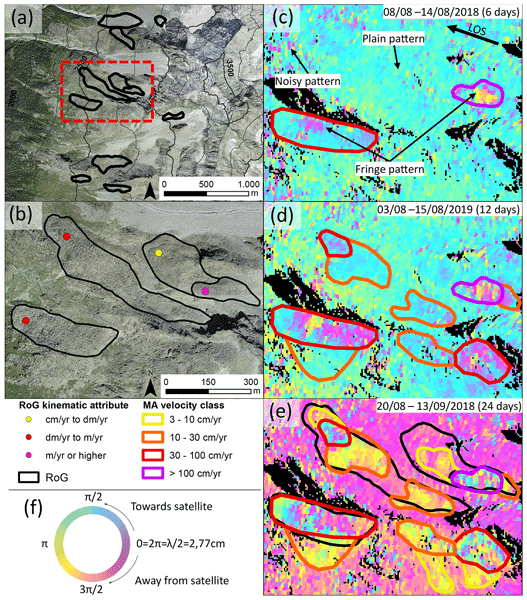
We present the guidelines developed by the IPA Action Group and within the ESA Permafrost CCI project to include InSAR-based kinematic information in rock glacier inventories. Nine operators applied these guidelines to 11 regions worldwide; more than 3600 rock glaciers are classified according to their kinematics. We test and demonstrate the feasibility of applying common rules to produce homogeneous kinematic inventories at global scale, useful for hydrological and climate change purposes.
William T. Struble and Joshua J. Roering
Earth Surf. Dynam., 9, 1279–1300, https://doi.org/10.5194/esurf-9-1279-2021, https://doi.org/10.5194/esurf-9-1279-2021, 2021
Short summary
Short summary
We used a mathematical technique known as a wavelet transform to calculate the curvature of hilltops in western Oregon, which we used to estimate erosion rate. We find that this technique operates over 1000 times faster than other techniques and produces accurate erosion rates. We additionally built artificial hillslopes to test the accuracy of curvature measurement methods. We find that at fast erosion rates, curvature is underestimated, raising questions of measurement accuracy elsewhere.
Cited articles
Alaska Department of Transportation and Public Facilities: Alaska Test Methods Manual: ADOT&PF, 2023.
American Society for Testing Materials: Standard Test Method for Determination of Rock Hardness by Rebound Hammer Method, 2014a.
American Society for Testing Materials: Standard Test Methods for Specific Gravity of Soil Solids by Water Pycnometer, 2014b.
American Society for Testing Materials: Standard Practice for Classification of Soils for Engineering Purposes (Unified Soil Classification System), 2017a.
American Society for Testing Materials: Standard Test Methods for Particle-Size Distribution (Gradation) of Soils Using Sieve Analysis, 2017b.
American Society for Testing Materials: Standard Test Method for Particle-Size Distribution (Gradation) of Fine-Grained Soils Using the Sedimentation (Hydrometer) Analysis, 2021.
Aydin, A. and Basu, A.: The Schmidt hammer in rock material characterization, Engineering Geology, 81, 1–14, https://doi.org/10.1016/j.enggeo.2005.06.006, 2005.
Baichtal, J. F., Lesnek, A. J., Carlson, R. J., Schmuck, N. S., Smith, J. L., Landwehr, D. J., and Briner, J. P.: Late Pleistocene and early Holocene sea-level history and glacial retreat interpreted from shell-bearing marine deposits of southeastern Alaska, USA, Geosphere, 17, 1590–1615, https://doi.org/10.1130/GES02359.1, 2021.
Benda, L. and Dunne, T.: Stochastic forcing of sediment supply to channel networks from landsliding and debris flow, Water Resources Research, 33, 2849–2863, https://doi.org/10.1029/97WR02388, 1997.
Booth, A. M., Sifford, C., Vascik, B., Siebert, C., and Buma, B.: Large wood inhibits debris flow runout in forested southeast Alaska, Earth Surface Processes and Landforms, https://doi.org/10.1002/esp.4830, 2020.
Booth, A. M., Buma, B., and Nagorski, S.: Effects of Landslides on Terrestrial Carbon Stocks With a Coupled Geomorphic-Biologic Model: Southeast Alaska, United States, Journal of Geophysical Research: Biogeosciences, 128, e2022JG007297, https://doi.org/10.1029/2022JG007297, 2023.
Bovy, B., Braun, J., and Demoulin, A.: A new numerical framework for simulating the control of weather and climate on the evolution of soil-mantled hillslopes, Geomorphology, 263, 99–112, https://doi.org/10.1016/j.geomorph.2016.03.016, 2016.
Brardinoni, F. and Hassan, M. A.: Glacial erosion, evolution of river long profiles, and the organization of process domains in mountain drainage basins of coastal British Columbia, Journal of Geophysical Research, 111, https://doi.org/10.1029/2005JF000358, 2006.
Brardinoni, F., Hassan, M. A., Rollerson, T., and Maynard, D.: Colluvial sediment dynamics in mountain drainage basins, Earth and Planetary Science Letters, 284, 310–319, https://doi.org/10.1016/j.epsl.2009.05.002, 2009.
Brardinoni, F., Picotti, V., Maraio, S., Bruno, P. P., Cucato, M., Morelli, C., and Mair, V.: Postglacial evolution of a formerly glaciated valley: Reconstructing sediment supply, fan building, and confluence effects at the millennial time scale, GSA Bulletin, 130, 1457–1473, https://doi.org/10.1130/B31924.1, 2018.
Brien, D. L., Reid, M. E., Cronkite-Ratcliff, C., and Perkins, J. P.: Topographic controls on landslide mobility: modeling hurricane-induced landslide runout and debris-flow inundation in Puerto Rico, Nat. Hazards Earth Syst. Sci., 25, 1229–1253, https://doi.org/10.5194/nhess-25-1229-2025, 2025.
Buma, B. and Johnson, A. C.: The role of windstorm exposure and yellow cedar decline on landslide susceptibility in southeast Alaskan temperate rainforests, Geomorphology, 228, 504–511, https://doi.org/10.1016/j.geomorph.2014.10.014, 2015.
Buma, B. and Pawlik, Ł.: Post-landslide soil and vegetation recovery in a dry, montane system is slow and patchy, Ecosphere, 12, https://doi.org/10.1002/ecs2.3346, 2021.
Carrara, P. E., Ager, T. A., Baichtal, J. F., and VanSistine, D. P.: Map of glacial limits and possible refugia in the southern Alexander Archipelago, Alaska, during the late Wisconsin glaciation, Miscellaneous Field Studies Map, https://doi.org/10.3133/mf2424, 2003.
Cohen, D., Lehmann, P., and Or, D.: Fiber bundle model for multiscale modeling of hydromechanical triggering of shallow landslides, Water Resources Research, 45, https://doi.org/10.1029/2009WR007889, 2009.
Collins, B. D. and Reid, M. E.: Enhanced landslide mobility by basal liquefaction: The 2014 State Route 530 (Oso), Washington, landslide, GSA Bulletin, 132, 451–476, https://doi.org/10.1130/B35146.1, 2020.
Cordeira, J. M., Stock, J., Dettinger, M. D., Young, A. M., Kalansky, J. F., and Ralph, F. M.: A 142-year Climatology of Northern California Landslides and Atmospheric Rivers, Bulletin of the American Meteorological Society, BAMS-D-18-0158.1, https://doi.org/10.1175/BAMS-D-18-0158.1, 2019.
Corominas, J.: The angle of reach as a mobility index for small and large landslides, Can. Geotech. J., 33, 260–271, https://doi.org/10.1139/t96-005, 1996.
Darrow, M. M., Nelson, V. A., Grilliot, M., Wartman, J., Jacobs, A., Baichtal, J. F., and Buxton, C.: Geomorphology and initiation mechanisms of the 2020 Haines, Alaska landslide, Landslides, https://doi.org/10.1007/s10346-022-01899-3, 2022.
DiBiase, R. A., Lamb, M. P., Ganti, V., and Booth, A. M.: Slope, grain size, and roughness controls on dry sediment transport and storage on steep hillslopes: PARTICLE TRANSPORT ON STEEP HILLSLOPES, Journal of Geophysical Research: Earth Surface, 122, 941–960, https://doi.org/10.1002/2016JF003970, 2017.
Dietrich, W. E., Wilson, C. J., and Reneau, S. L.: Hollows, colluvium, and landslides in soil-mantled landscapes, in: Hillslope Processes, edited by: Abrahams, A. D., Routledge, 362–388, https://doi.org/10.4324/9781003028840-17, 1986.
Dietrich, W. E., Reiss, R., Hsu, M., and Montgomery, D. R.: A process-based model for colluvial soil depth and shallow landsliding using digital elevation data, Hydrological Processes, 9, 383–400, https://doi.org/10.1002/hyp.3360090311, 1995.
D'Odorico, P. and Fagherazzi, S.: A probabilistic model of rainfall-triggered shallow landslides in hollows: A long-term analysis, Water Resources Research, 39, https://doi.org/10.1029/2002WR001595, 2003.
Fan, L., Lehmann, P., Zheng, C., and Or, D.: Rainfall Intensity Temporal Patterns Affect Shallow Landslide Triggering and Hazard Evolution, Geophys. Res. Lett., 47, e2019GL085994, https://doi.org/10.1029/2019GL085994, 2020.
Flagstad, L., Steer, A., Boucher, T., Aisu, M., and Lema, P.: Wetlands across Alaska: Statewide wetland map and Assessment of rare wetland ecosystems, Alaska Center for Conservation Science, Technical Report, 2018.
Gabet, E. J. and Mudd, S. M.: The mobilization of debris flows from shallow landslides, Geomorphology, 74, 207–218, https://doi.org/10.1016/j.geomorph.2005.08.013, 2006.
Godt, J. W., Wood, N. J., Pennaz, A. B., Dacey, C. M., Mirus, B. B., Schaefer, L. N., and Slaughter, S. L.: National strategy for landslide loss reduction, Open-File Report, U.S. Geological Survey, https://doi.org/10.3133/ofr20221075, 2022.
Goetz, J. N., Guthrie, R. H., and Brenning, A.: Forest harvesting is associated with increased landslide activity during an extreme rainstorm on Vancouver Island, Canada, Nat. Hazards Earth Syst. Sci., 15, 1311–1330, https://doi.org/10.5194/nhess-15-1311-2015, 2015.
Gonzalez de Vallejo, L. and Ferrer, M.: Geological Engineering, CRC Press, London, 700 pp., https://doi.org/10.1201/b11745, 2011.
Gorr, A. N., McGuire, L. A., Youberg, A. M., and Rengers, F. K.: A progressive flow-routing model for rapid assessment of debris-flow inundation, Landslides, 19, 2055–2073, https://doi.org/10.1007/s10346-022-01890-y, 2022.
Guan, B., Waliser, D. E., Ralph, F. M., Fetzer, E. J., and Neiman, P. J.: Hydrometeorological characteristics of rain-on-snow events associated with atmospheric rivers, Geophysical Research Letters, 43, 2964–2973, https://doi.org/10.1002/2016GL067978, 2016.
Guilinger, J. J., Foufoula-Georgiou, E., Gray, A. B., Randerson, J. T., Smyth, P., Barth, N. C., and Goulden, M. L.: Predicting Postfire Sediment Yields of Small Steep Catchments Using Airborne Lidar Differencing, Geophysical Research Letters, 50, e2023GL104626, https://doi.org/10.1029/2023GL104626, 2023.
Guthrie, R. H.: The effects of logging on frequency and distribution of landslides in three watersheds on Vancouver Island, British Columbia, Geomorphology, 43, 273–292, https://doi.org/10.1016/S0169-555X(01)00138-6, 2002.
Guthrie, R. H., Mitchell, S. J., Lanquaye-Opoku, N., and Evans, S. G.: Extreme weather and landslide initiation in coastal British Columbia, Quarterly Journal of Engineering Geology and Hydrogeology, 43, 417–428, https://doi.org/10.1144/1470-9236/08-119, 2010.
Haeussler, P. J.: Structural evolution of an arc-basin: The Gravina Belt in central southeastern Alaska, Tectonics, 11, 1245–1265, https://doi.org/10.1029/92TC01107, 1992.
Hales, T. C.: Modelling biome-scale root reinforcement and slope stability, Earth Surface Processes and Landforms, 43, 2157–2166, https://doi.org/10.1002/esp.4381, 2018.
Hamilton, T. D.: Late Cenozoic glaciation of Alaska, in: The Geology of Alaska, vol. G-1, edited by: Plafker, G. and Berg, H. C., Geological Society of America, 0, https://doi.org/10.1130/DNAG-GNA-G1.813, 1994.
Harris, A. S. and Farr, W. A.: The forest ecosystem of southeast Alaska: 7. Forest ecology and timber management., Gen. Tech. Rep. PNW-GTR-025. Portland, OR: U.S. Department of Agriculture, Forest Service, Pacific Northwest Research Station, 116 p., 025, 1974.
Harris, A. S., Hutchison, K., Meehan, W. R., Swanston, D. N., Helmers, A. E., Hendee, J. C., and Collins, T. M.: The forest ecosystem of southeast Alaska, The Setting, USDA, Portland, OR, 1974.
Hasebe, M. and Kumekawa, T.: Estimation of snowmelt volume using air temperature and wind speed, Environment International, 21, 497–500, https://doi.org/10.1016/0160-4120(95)00048-P, 1995.
Hatchett, B. J.: Snow Level Characteristics and Impacts of a Spring Typhoon-Originating Atmospheric River in the Sierra Nevada, USA, Atmosphere, 9, 233, https://doi.org/10.3390/atmos9060233, 2018.
Henn, B., Musselman, K. N., Lestak, L., Ralph, F. M., and Molotch, N. P.: Extreme Runoff Generation From Atmospheric River Driven Snowmelt During the 2017 Oroville Dam Spillways Incident, Geophysical Research Letters, 47, e2020GL088189, https://doi.org/10.1029/2020GL088189, 2020.
Holden, J.: Chapter 14 Peatland hydrology, in: Developments in Earth Surface Processes, vol. 9, edited by: Martini, I. P., Martínez Cortizas, A., and Chesworth, W., Elsevier, 319–346, https://doi.org/10.1016/S0928-2025(06)09014-6, 2006.
Hovius, N., Stark, C. P., and Allen, P. A.: Sediment flux from a mountain belt derived by landslide mapping, Geology, 25, 231, https://doi.org/10.1130/0091-7613(1997)025<0231:SFFAMB>2.3.CO;2, 1997.
Howe, M., Graham, E. E., and Nelson, K. N.: Defoliator outbreaks track with warming across the Pacific coastal temperate rainforest of North America, Ecography, 2024, e07370, https://doi.org/10.1111/ecog.07370, 2024.
Imaizumi, F., Nishii, R., Murakami, W., and Daimaru, H.: Parallel retreat of rock slopes underlain by alternation of strata, Geomorphology, 238, 27–36, https://doi.org/10.1016/j.geomorph.2015.02.030, 2015.
Iverson, R. M.: Landslide triggering by rain infiltration, Water Resour. Res., 36, 1897–1910, https://doi.org/10.1029/2000WR900090, 2000.
Iverson, R. M. and Ouyang, C.: Entrainment of bed material by Earth-surface mass flows: Review and reformulation of depth-integrated theory: Entrainment of bed material, Reviews of Geophysics, 53, 27–58, https://doi.org/10.1002/2013RG000447, 2015.
Iverson, R. M., Schilling, S. P., and Vallance, J. W.: Objective delineation of lahar-inundation hazard zones, Geological Society of America Bulletin, 110, 972–984, https://doi.org/10.1130/0016-7606(1998)110<0972:ODOLIH>2.3.CO;2, 1998.
Iverson, R. M., Reid, M. E., Logan, M., LaHusen, R. G., Godt, J. W., and Griswold, J. P.: Positive feedback and momentum growth during debris-flow entrainment of wet bed sediment, Nat. Geosci., 4, 116–121, https://doi.org/10.1038/ngeo1040, 2011.
Iverson, R. M., George, D. L., Allstadt, K., Reid, M. E., Collins, B. D., Vallance, J. W., Schilling, S. P., Godt, J. W., Cannon, C. M., Magirl, C. S., Baum, R. L., Coe, J. A., Schulz, W. H., and Bower, J. B.: Landslide mobility and hazards: implications of the 2014 Oso disaster, Earth and Planetary Science Letters, 412, 197–208, https://doi.org/10.1016/j.epsl.2014.12.020, 2015.
Jackson, R. B., Canadell, J., Ehleringer, J. R., Mooney, H. A., Sala, O. E., and Schulze, E. D.: A global analysis of root distributions for terrestrial biomes, Oecologia, 108, 389–411, https://doi.org/10.1007/BF00333714, 1996.
Johnson, A. C., Swanston, D. N., and McGee, K. E.: Landslide initiation, runout, and deposition within clearcuts and old-growth forests of Alaska, J. American Water Resour. Assoc., 36, 17–30, https://doi.org/10.1111/j.1752-1688.2000.tb04245.x, 2000.
Jordan, P.: Post-wildfire debris flows in southern British Columbia, Canada, Int. J. Wildland Fire, 25, 322, https://doi.org/10.1071/WF14070, 2016.
Karl, S. M., Haeussler, P. J., and Mccafferty, A. E.: Reconnaissance Geologic Map of the Duncan Canal/Zarembo Island Area, Southeastern Alaska, Reston, VA, USGS Open File Report, 99–168, 1999.
Korup, O., Densmore, A. L., and Schlunegger, F.: The role of landslides in mountain range evolution, Geomorphology, 120, 77–90, https://doi.org/10.1016/j.geomorph.2009.09.017, 2010.
Lader, R., Bidlack, A., Walsh, J. E., Bhatt, U. S., and Bieniek, P. A.: Dynamical Downscaling for Southeast Alaska: Historical Climate and Future Projections, https://doi.org/10.1175/JAMC-D-20-0076.1, 2020.
Lamb, M. P., Scheingross, J. S., Amidon, W. H., Swanson, E., and Limaye, A.: A model for fire-induced sediment yield by dry ravel in steep landscapes, Journal of Geophysical Research, 116, https://doi.org/10.1029/2010JF001878, 2011.
Lancaster, S. T., Hayes, S. K., and Grant, G. E.: Effects of wood on debris flow runout in small mountain watersheds: effects of wood on debris flow runout, Water Resources Research, 39, https://doi.org/10.1029/2001WR001227, 2003.
Larsen, I. J., Montgomery, D. R., and Korup, O.: Landslide erosion controlled by hillslope material, Nature Geoscience, 3, 247–251, https://doi.org/10.1038/ngeo776, 2010.
Lempert, R. J., Busch, L., Brown, R., Patton, A., Turner, S., Schmidt, J., and Young, T.: Community-Level, Participatory Co-Design for Landslide Warning with Implications for Climate Services, Sustainability, 15, 4294, https://doi.org/10.3390/su15054294, 2023.
Lin, Y.-C., Hsieh, J.-Y., Shih, H.-S., and Wang, W.-H.: Strong wind is one of the important factors that trigger landslides, npj Nat. Hazards, 2, 12, https://doi.org/10.1038/s44304-025-00062-x, 2025.
Mann, D. H. and Hamilton, T. D.: Late Pleistocene and Holocene paleoenvironments of the North Pacific coast, Quaternary Science Reviews, 14, 449–471, https://doi.org/10.1016/0277-3791(95)00016-I, 1995.
Marra, F., Armon, M., and Morin, E.: Coastal and orographic effects on extreme precipitation revealed by weather radar observations, Hydrol. Earth Syst. Sci., 26, 1439–1458, https://doi.org/10.5194/hess-26-1439-2022, 2022.
Menounos, B., Goehring, B. M., Osborn, G., Margold, M., Ward, B., Bond, J., Clarke, G. K. C., Clague, J. J., Lakeman, T., Koch, J., Caffee, M. W., Gosse, J., Stroeven, A. P., Seguinot, J., and Heyman, J.: Cordilleran Ice Sheet mass loss preceded climate reversals near the Pleistocene Termination, Science, 358, 781–784, https://doi.org/10.1126/science.aan3001, 2017.
Montgomery, D. R., Dietrich, W. E., Torres, R., Anderson, S. P., Heffner, J. T., and Loague, K.: Hydrologic response of a steep, unchanneled valley to natural and applied rainfall, Water Resour. Res., 33, 91–109, https://doi.org/10.1029/96WR02985, 1997.
Moore, J. R., Sanders, J. W., Dietrich, W. E., and Glaser, S. D.: Influence of rock mass strength on the erosion rate of alpine cliffs, Earth Surface Processes and Landforms, 34, 1339–1352, https://doi.org/10.1002/esp.1821, 2009.
Nash, D., Rutz, J. J., and Jacobs, A.: Atmospheric Rivers in Southeast Alaska: Meteorological Conditions Associated With Extreme Precipitation, Journal of Geophysical Research: Atmospheres, 129, e2023JD039294, https://doi.org/10.1029/2023JD039294, 2024.
National Oceanographic and Atmospheric Administration (NOAA): NOWData – NOAA Online Weather Data, https://www.weather.gov/climateservices (last access: 26 January 2026), 2024.
Neiman, P. J., Ralph, F. M., Wick, G. A., Lundquist, J. D., and Dettinger, M. D.: Meteorological Characteristics and Overland Precipitation Impacts of Atmospheric Rivers Affecting the West Coast of North America Based on Eight Years of SSM/I Satellite Observations, Journal of Hydrometeorology, 9, 22–47, https://doi.org/10.1175/2007JHM855.1, 2008.
Nicolazzo, J. A., Wikstrom Jones, K. M., Salisbury, J. B., and Horen, K. C.: Post-landslide elevation changes detected from multi-temporal lidar surveys of the November 2023 Wrangell, Alaska, landslides, Alaska Division of Geological & Geophysical Surveys, https://doi.org/10.14509/31124, 2024.
Oakley, N. S., Lancaster, J. T., Hatchett, B. J., Stock, J., Ralph, F. M., Roj, S., and Lukashov, S.: A 22-Year Climatology of Cool Season Hourly Precipitation Thresholds Conducive to Shallow Landslides in California, Earth Interact., 22, 1–35, https://doi.org/10.1175/EI-D-17-0029.1, 2018.
Parra, E., Mohr, C. H., and Korup, O.: Predicting Patagonian Landslides: Roles of Forest Cover and Wind Speed, Geophysical Research Letters, 48, e2021GL095224, https://doi.org/10.1029/2021GL095224, 2021.
Patton, A. I., Roering, J. J., and Orland, E.: Debris flow initiation in postglacial terrain: Insights from shallow landslide initiation models and geomorphic mapping in Southeast Alaska, Earth Surface Processes and Landforms, https://doi.org/10.1002/esp.5336, 2022.
Patton, A. I., Luna, L. V., Roering, J. J., Jacobs, A., Korup, O., and Mirus, B. B.: Landslide initiation thresholds in data-sparse regions: application to landslide early warning criteria in Sitka, Alaska, USA, Nat. Hazards Earth Syst. Sci., 23, 3261–3284, https://doi.org/10.5194/nhess-23-3261-2023, 2023.
Ralph, F. M., Neiman, P. J., and Wick, G. A.: Satellite and CALJET Aircraft Observations of Atmospheric Rivers over the Eastern North Pacific Ocean during the Winter of 1997/98, Monthly Weather Review, https://doi.org/10.1175/1520-0493(2004)132<1721:SACAOO>2.0.CO;2, 2004.
Reid, M. E.: Entrainment of bed sediment by debris flows: results from large-scale experiments, Italian Journal of Engineering Geology and Environment, 367–374, https://doi.org/10.4408/IJEGE.2011-03.B-042, 2011.
Reid, M. E., Coe, J. A., and Brien, D. L.: Forecasting inundation from debris flows that grow volumetrically during travel, with application to the Oregon Coast Range, USA, Geomorphology, 273, 396–411, https://doi.org/10.1016/j.geomorph.2016.07.039, 2016.
Reid, M. E., Brien, D. L., Cronkite-Ratcliff, C., and Perkins, J. P.: Grfin Tools–User guide and methods for modeling landslide runout and debris-flow growth and inundation, Techniques and Methods, U.S. Geological Survey, https://doi.org/10.3133/tm14A3, 2025.
Remaître, A., van Asch, Th. W. J., Malet, J.-P., and Maquaire, O.: Influence of check dams on debris-flow run-out intensity, Nat. Hazards Earth Syst. Sci., 8, 1403–1416, https://doi.org/10.5194/nhess-8-1403-2008, 2008.
Rengers, F. K., Kean, J. W., Reitman, N. G., Smith, J. B., Coe, J. A., and McGuire, L. A.: The Influence of Frost Weathering on Debris Flow Sediment Supply in an Alpine Basin, Journal of Geophysical Research: Earth Surface, 125, e2019JF005369, https://doi.org/10.1029/2019JF005369, 2020.
Rickenmann, D.: Empirical Relationships for Debris Flows, Natural Hazards, 19, 47–77, https://doi.org/10.1023/A:1008064220727, 1999.
Rulli, M. C., Meneguzzo, F., and Rosso, R.: Wind control of storm-triggered shallow landslides, Geophysical Research Letters, 34, https://doi.org/10.1029/2006GL028613, 2007.
Schmidt, K. M., Roering, J. J., Stock, J. D., Dietrich, W. E., Montgomery, D. R., and Schaub, T.: The variability of root cohesion as an influence on shallow landslide susceptibility in the Oregon Coast Range, Canadian Geotechnical Journal, 38, 995–1024, https://doi.org/10.1139/cgj-38-5-995, 2001.
Schuster, R. L. and Highland, L. M.: Socioeconomic and environmental impacts of landslides in the Western Hemisphere, USGS Open File Report 01-276, https://doi.org/10.3133/ofr01276, 2001.
Schwanghart, W. and Scherler, D.: Short Communication: TopoToolbox 2 – MATLAB-based software for topographic analysis and modeling in Earth surface sciences, Earth Surf. Dynam., 2, 1–7, https://doi.org/10.5194/esurf-2-1-2014, 2014.
Sharma, A. R. and Déry, S. J.: Contribution of Atmospheric Rivers to Annual, Seasonal, and Extreme Precipitation Across British Columbia and Southeastern Alaska, J. Geophys. Res. Atmos., 125, https://doi.org/10.1029/2019JD031823, 2020.
Spinola, D., Margerum, A., Zhang, Y., Hesser, R., D'Amore, D., and Portes, R.: Rapid soil formation and carbon accumulation along a Little Ice Age soil chronosequence in southeast Alaska, Catena, 246, 108460, https://doi.org/10.1016/j.catena.2024.108460, 2024.
Stock, J. and Dietrich, W. E.: Valley incision by debris flows: Evidence of a topographic signature: valley incision by debris flows, Water Resources Research, 39, https://doi.org/10.1029/2001WR001057, 2003.
Stoffel, M., Trappmann, D. G., Coullie, M. I., Ballesteros Cánovas, J. A., and Corona, C.: Rockfall from an increasingly unstable mountain slope driven by climate warming, Nat. Geosci., 1–6, https://doi.org/10.1038/s41561-024-01390-9, 2024.
Swanson, F. J., Benda, L. E., Duncan, S. H., Grant, G. E., Megahan, W. F., Reid, L. M., and Ziemer, R. R.: Mass failures and other processes of sediment production in Pacific northwest forest landscapes, Pages 9-38, in: Streamside Management: Forestry and Fishery Interactions, Proceedings of a Symposium held at University of Washington, edited by: Salo, E. O. and Cundy, T. W., 12–14 February 1986. Contribution no. 57, Institute of Forest Resources, Seattle, Washington, 1987.
Swanston, D. N.: Mass Wasting in Coastal Alaska, USDA Forest Service Research Paper PNW, 83, 1–15, 1969.
Swanston, D. N.: Mechanics of Avalanching in Shallow till soils of SE Alaska, USDA Forest Service Research Paper PNW, 103, 1–16, 1970.
Swanston, D. N.: Judging Landslide Potential in Glaciated Valleys of Southeastern Alaska, Explorers Journal, 214–217, 1973.
U.S. Forest Service: Satellite-based Change Detection Southeast Alaska, https://usfs.maps.arcgis.com/apps/webappviewer/index.html?id=12e96b1fdd1546448f8ceec6acadc372 (last access: 23 January 2026), 2025a.
U.S. Forest Service: Tongass Landslide Areas: Data.gov, https://data.fs.usda.gov/geodata/edw/datasets.php?xmlKeyword=tongass (last access: 19 July 2026), 2025b.
van Hees, W. W. S. and Mead, B. R.: Extensive, strategic assessment of southeast Alaska's vegetative resources., Landscape and Urban Planning, 72, 25–48, https://doi.org/10.1016/j.landurbplan.2004.09.027, 2005.
Vascik, B. A., Booth, A. M., Buma, B., and Berti, M.: Estimated Amounts and Rates of Carbon Mobilized by Landsliding in Old-Growth Temperate Forests of SE Alaska, JGR Biogeosciences, 126, https://doi.org/10.1029/2021JG006321, 2021.
Waliser, D. and Guan, B.: Extreme winds and precipitation during landfall of atmospheric rivers, Nat. Geosci., 10, 179–183, https://doi.org/10.1038/ngeo2894, 2017.
Wendler, G., Galloway, K., and Stuefer, M.: On the climate and climate change of Sitka, Southeast Alaska, Theor. Appl. Climatol., 126, 27–34, https://doi.org/10.1007/s00704-015-1542-7, 2016.
Wheeler, J. O. and McFeely, P.: Tectonic assemblage map of the Canadian Cordillera and adjacent parts of the United States of America, Geological Survey of Canada, “A” Series Map, 1712A, https://doi.org/10.4095/133549, 1991.
Wu, T. H., McKinnell III, W. P., and Swanston, D. N.: Strength of tree roots and landslides on Prince of Wales Island, Alaska, Can. Geotech. J., 16, 19–33, https://doi.org/10.1139/t79-003, 1979.
Wyllie, D. C. and Mah, C. W.: Rock Slope Engineering, 4th ed., Spon, 456 pp., https://doi.org/10.4324/9781315154039, 2004.
Zechmann, J. M., Wikstrom Jones, K. M., and Wolken, G. J.: Lidar-derived elevation data for Wrangell Island, Southeast Alaska, collected July 2023, Alaska Division of Geological & Geophysical Surveys, https://doi.org/10.14509/31098, 2023.
Zechmann, J. M., Wikstrom Jones, K. M., and Wolken, G. J.: Lidar-derived elevation data for Wrangell Island, Southeast Alaska, collected November 28–29, 2023, Alaska Division of Geological & Geophysical Surveys, https://doi.org/10.14509/31106, 2024.
Short summary
A deadly landslide struck Wrangell Island, Alaska, in November 2023, traveling over a kilometer and claiming six lives. Our study shows it was likely triggered by moderate rainfall combined with rapid snowmelt and drainage from a ridgetop wetland, which saturated deep soil deposits on a steep hillslope. The landslide grew unusually large as it entrained abundant soil. Findings highlight the role of storm patterns, geology, and hydrology in driving future landslide hazards in SE Alaska.
A deadly landslide struck Wrangell Island, Alaska, in November 2023, traveling over a kilometer...


Altmetrics
Final-revised paper
Preprint