
Articles | Volume 26, issue 9
https://doi.org/10.5194/nhess-26-4621-2026
© Author(s) 2026. This work is distributed under
the Creative Commons Attribution 4.0 License.
the Creative Commons Attribution 4.0 License.
https://doi.org/10.5194/nhess-26-4621-2026
© Author(s) 2026. This work is distributed under
the Creative Commons Attribution 4.0 License.
the Creative Commons Attribution 4.0 License.
Research article
| 
29 Sep 2026
Research article |
| 29 Sep 2026
| 29 Sep 2026
Characteristics of extreme snowfall–wind-gust events in Finland (1960–2024): frequency, duration, and intensity

Finnish Meteorological Institute, Helsinki, 00101, Finland
Terhi K. Laurila
Finnish Meteorological Institute, Helsinki, 00101, Finland
Ari Aaltonen
Finnish Meteorological Institute, Helsinki, 00101, Finland
Kirsti Jylhä
Finnish Meteorological Institute, Helsinki, 00101, Finland
Related authors
Meri Virman, Taru Olsson, Petter Lind, and Kirsti Jylhä
Weather Clim. Dynam., 7, 695–715, https://doi.org/10.5194/wcd-7-695-2026, https://doi.org/10.5194/wcd-7-695-2026, 2026
Short summary
Short summary
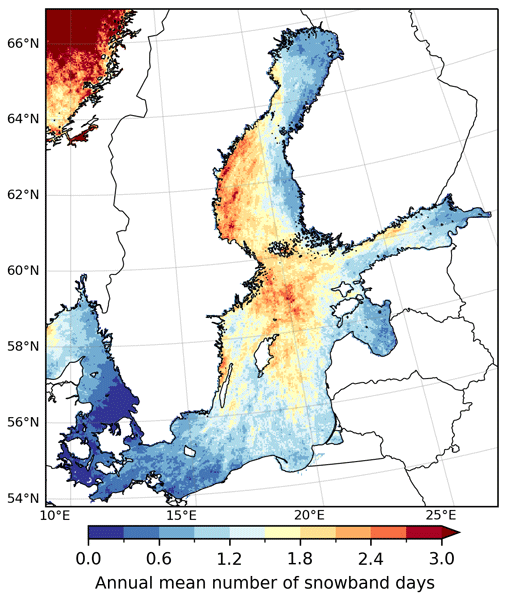
We use a kilometer-scale regional climate model to investigate the occurrence and intensity of sea-effect snowfall in the Baltic Sea region during 1998–2018. Sea-effect snowbands occur most frequently from November to February and when low-level winds have an easterly component near the eastern coast of Sweden and the southern coast of Finland. Over the southern Baltic Sea, snowbands tend to occur under northerly low-level winds and are most common from December to March.
Anna Rutgersson, Erik Kjellström, Jari Haapala, Martin Stendel, Irina Danilovich, Martin Drews, Kirsti Jylhä, Pentti Kujala, Xiaoli Guo Larsén, Kirsten Halsnæs, Ilari Lehtonen, Anna Luomaranta, Erik Nilsson, Taru Olsson, Jani Särkkä, Laura Tuomi, and Norbert Wasmund
Earth Syst. Dynam., 13, 251–301, https://doi.org/10.5194/esd-13-251-2022, https://doi.org/10.5194/esd-13-251-2022, 2022
Short summary
Short summary
A natural hazard is a naturally occurring extreme event with a negative effect on people, society, or the environment; major events in the study area include wind storms, extreme waves, high and low sea level, ice ridging, heavy precipitation, sea-effect snowfall, river floods, heat waves, ice seasons, and drought. In the future, an increase in sea level, extreme precipitation, heat waves, and phytoplankton blooms is expected, and a decrease in cold spells and severe ice winters is anticipated.
Meri Virman, Terhi K. Laurila, Antti Mäkelä, Petter Lind, Anna Luomaranta, and Hilppa Gregow
EGUsphere, https://doi.org/10.5194/egusphere-2026-4247, https://doi.org/10.5194/egusphere-2026-4247, 2026
Short summary
Short summary
Possible future changes in atmospheric conditions favourable for thunderstorms in Fennoscandia are investigated using HCLIM climate model data at 3 km spatial resolution. The frequency of thunderstorm- and severe-thunderstorm-favourable days is projected to increase across Fennoscandia under medium- and high-emission scenarios. The findings improve understanding of future thunderstorm hazards and support climate adaptation in Fennoscandia, where such information is currently limited.
Meri Virman, Taru Olsson, Petter Lind, and Kirsti Jylhä
Weather Clim. Dynam., 7, 695–715, https://doi.org/10.5194/wcd-7-695-2026, https://doi.org/10.5194/wcd-7-695-2026, 2026
Short summary
Short summary
We use a kilometer-scale regional climate model to investigate the occurrence and intensity of sea-effect snowfall in the Baltic Sea region during 1998–2018. Sea-effect snowbands occur most frequently from November to February and when low-level winds have an easterly component near the eastern coast of Sweden and the southern coast of Finland. Over the southern Baltic Sea, snowbands tend to occur under northerly low-level winds and are most common from December to March.
Natalia Korhonen, Otto Hyvärinen, Virpi Kollanus, Timo Lanki, Juha Jokisalo, Risto Kosonen, David S. Richardson, and Kirsti Jylhä
Nat. Hazards Earth Syst. Sci., 25, 1865–1879, https://doi.org/10.5194/nhess-25-1865-2025, https://doi.org/10.5194/nhess-25-1865-2025, 2025
Short summary
Short summary
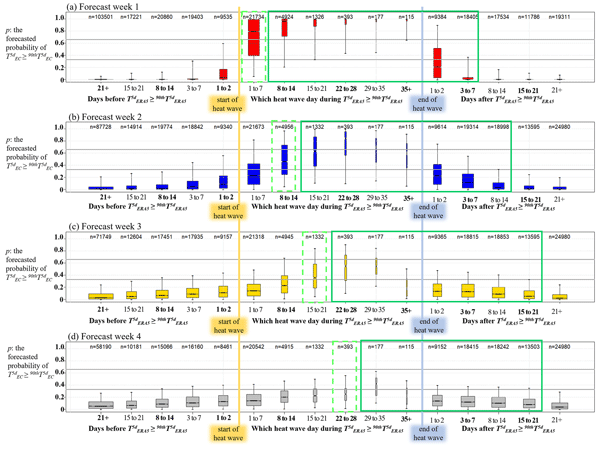
The skill of hindcasts from the European Centre for Medium-Range Weather Forecasts in forecasting heat wave days, defined as periods with the 5 d moving average temperature exceeding its local summer 90th percentile over Europe 1 to 4 weeks ahead, is examined. Forecasts of heat wave days show potential for warning of heat risk 1 to 2 weeks in advance and enhanced accuracy in forecasting prolonged heat waves up to 3 weeks ahead, when the heat wave had already begun before forecast issuance.
Ilona Láng-Ritter, Terhi Kristiina Laurila, Antti Mäkelä, Hilppa Gregow, and Victoria Anne Sinclair
Nat. Hazards Earth Syst. Sci., 25, 1697–1717, https://doi.org/10.5194/nhess-25-1697-2025, https://doi.org/10.5194/nhess-25-1697-2025, 2025
Short summary
Short summary
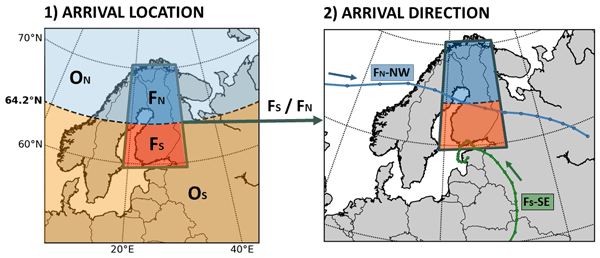
We present a classification method for extratropical cyclones and windstorms and show their impacts on Finland's electricity grid by analysing the 92 most damaging windstorms (2005–2018). The south-west- and north-west-arriving windstorms cause the most damage to the power grid. The most relevant parameters for damage are the wind gust speed and extent of wind gusts. Windstorms are more frequent and damaging in autumn and winter, but weaker wind speeds in summer also cause significant damage.
Anna Rutgersson, Erik Kjellström, Jari Haapala, Martin Stendel, Irina Danilovich, Martin Drews, Kirsti Jylhä, Pentti Kujala, Xiaoli Guo Larsén, Kirsten Halsnæs, Ilari Lehtonen, Anna Luomaranta, Erik Nilsson, Taru Olsson, Jani Särkkä, Laura Tuomi, and Norbert Wasmund
Earth Syst. Dynam., 13, 251–301, https://doi.org/10.5194/esd-13-251-2022, https://doi.org/10.5194/esd-13-251-2022, 2022
Short summary
Short summary
A natural hazard is a naturally occurring extreme event with a negative effect on people, society, or the environment; major events in the study area include wind storms, extreme waves, high and low sea level, ice ridging, heavy precipitation, sea-effect snowfall, river floods, heat waves, ice seasons, and drought. In the future, an increase in sea level, extreme precipitation, heat waves, and phytoplankton blooms is expected, and a decrease in cold spells and severe ice winters is anticipated.
Terhi K. Laurila, Hilppa Gregow, Joona Cornér, and Victoria A. Sinclair
Weather Clim. Dynam., 2, 1111–1130, https://doi.org/10.5194/wcd-2-1111-2021, https://doi.org/10.5194/wcd-2-1111-2021, 2021
Short summary
Short summary
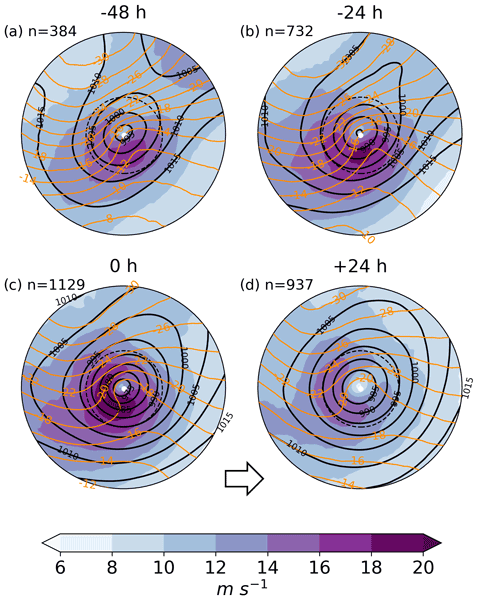
We create a climatology of mid-latitude cyclones and windstorms in northern Europe and investigate how sensitive the minimum pressure and maximum gust of windstorms are to four precursors. Windstorms are more common in the cold season than the warm season, whereas the number of mid-latitude cyclones has no annual cycle. The low-level temperature gradient has the strongest impact of all considered precursors on the intensity of windstorms in terms of both the minimum pressure and maximum gust.
Mika Rantanen, Kirsti Jylhä, Jani Särkkä, Jani Räihä, and Ulpu Leijala
Nat. Hazards Earth Syst. Sci. Discuss., https://doi.org/10.5194/nhess-2021-314, https://doi.org/10.5194/nhess-2021-314, 2021
Revised manuscript not accepted
Short summary
Short summary
Using sea level and precipitation observations, we analysed the meteorological characteristics of days when heavy precipitation and high sea level occur simultaneously in Finland. We found that around 5 % of all heavy precipitation and high sea level events on the Finnish coast are so called compound events when they both occur simultaneously, and these events were associated with close passages of mid-latitude cyclones. Our results act as a basis for compound flooding research in Finland.
Cited articles
FMI: Road weather conditions for drivers, Finnish Meteorological Institute, https://en.ilmatieteenlaitos.fi/traffic-weather-warning (last access: 15 October 2025), 2021.
FMI: Wind warnings for land and sea, Finnish Meteorological Institute, https://en.ilmatieteenlaitos.fi/wind-warnings (last access: 16 October 2025), 2025a.
FMI: Lumipyryn vaikutuksia Suomessa (The effects of snowstorms in Finland), Finnish Meteorological Institute, https://www.ilmatieteenlaitos.fi/lumipyryn-vaikutuksia-suomessa (last access: 15 October 2025), 2025b.
Gregow, H., Puranen, U., Venäläinen, A, Peltola, H., Kellomäki, S., and Schultz, D.: Temporal and spatial occurrence of strong winds and large snow load amounts in Finland during 1961–2000, Silva Fenn., 42, 231, https://doi.org/10.14214/sf.231, 2008.
Helander, J.: Identification and Analysis of External Event Combinations for Hanhikivi 1 PRA, Nucl. Eng. Technol., 49, 380–386, ISSN 1738-5733, https://doi.org/10.1016/j.net.2017.01.007, 2017.
Hénin, R., Ramos, A. M., Pinto, J. G., and Liberato, M. L. R.: A ranking of concurrent precipitation and wind events for the Iberian Peninsula, Int. J. Climatol., 41, 1421–1437, https://doi.org/10.1002/joc.6829, 2021.
Hersbach, H., Bell, B., Berrisford, P., Hirahara, S., Horányi, A., Muñoz-Sabater, J., Nicolas, J., Peubey, C., Radu, R., Schepers, D., Simmons, A., Soci, C., Abdalla, S., Abellan, X., Balsamo, G., Bechtold, P., Biavati, G., Bidlot, J., Bonavita, M., Chiara, G., Dahlgren, P., Dee, D., Diamantakis, M., Dragani, R., Flemming, J., Forbes, R., Fuentes, M., Geer, A., Haimberger, L., Healy, S., Hogan, R. J., Hólm, E., Janisková, M., Keeley, S., Laloyaux, P., Lopez, P., Lupu, C., Radnoti, G., Rosnay, P., Rozum, I., Vamborg, F., Villaume, S., and Thépaut, J.-N.: The ERA5 global reanalysis, Q. J. Roy. Meteorol. Soc., 146, 1999–2049, https://doi.org/10.1002/qj.3803, 2020.
Hersbach, H., Bell, B., Berrisford, P., Biavati, G., Horányi, A., Muñoz Sabater, J., Nicolas, J., Peubey, C., Radu, R., Rozum, I., Schepers, D., Simmons, A., Soci, C., Dee, D., and Thépaut, J.-N.: ERA5 hourly data on single levels from 1940 to present, Copernicus Climate Change Service (C3S) Climate Data Store (CDS) [data set], https://doi.org/10.24381/cds.adbb2d47, 2023.
Jylhä, K., Kämäräinen, M., Fortelius, C., Gregow, H., Helander, H., Hyvärinen, O., Johansson, M., Karppinen, A., Korpinen, A., Kouznetsov, Kurzeneva, R.E., Leijala, U., Mäkelä, A., Pellikka, H., Saku, S., Sandberg, J., Sofiev, M., Vajda, A., Venäläinen, A., and Vira, A.: Recent meteorological and marine studies to support nuclear power plant safety in Finland, Energy, 165, 1102–1118, https://doi.org/10.1016/j.energy.2018.09.033, 2018.
Láng-Ritter, I., Laurila, T. K., Mäkelä, A., Gregow, H., and Sinclair, V. A.: Classifying extratropical cyclones and their impact on Finland's electricity grid: insights from 92 damaging windstorms, Nat. Hazards Earth Syst. Sci., 25, 1697–1717, https://doi.org/10.5194/nhess-25-1697-2025, 2025.
Laurila, T. K., Laapas, M., Olsson, T., and Jylhä, K.: Wind speeds and gusts in Finland: a comparison of observations and ERA5 reanalysis, Boreal Environ. Res., 30, 181–193, https://doi.org/10.60910/ber2025.q6kf-qp39, 2025a.
Laurila, T. K., Rantanen, M., and Punkka, A.-J.: Storm Lyly, the first storm with observed hurricane-force winds in Finland, Weather, 80, 124–126, https://doi.org/10.1002/wea.7684, 2025b.
Lavers, D. A., Simmons, A., Vamborg, F., and Rodwell, M. J.: An evaluation of ERA5 precipitation for climate monitoring, Q. J. Roy. Meteorol. Soc., 148, 3124–3137, https://doi.org/10.1002/qj.4351, 2022.
Lehtonen, I.: Marraskuussa oli useita myrskypäiviä, Ilmastokatsaus, 26, 4–5, https://doi.org/10.35614/ISSN-2341-6408-IK-2024-11-01, 2024.
Martius, O., Pfahl, S., and Chevalier, C.: A global quantification of compound precipitation and wind extremes, Geophys. Res. Lett., 43, 7709–7717, https://doi.org/10.1002/2016GL070017, 2016.
Niinimäki, N.: Lumimyrskyt Etelä- ja Lounais-Suomessa 1965–2005, MS Thesis, Department of Physics: University of Helsinki, 80 pp., 2008 (in Finnish).
Olsson, T., Luomaranta, A., Nyman, H., and Jylhä, K.: Climatology of sea-effect snow in Finland, Int. J. Climatol., 43, 650–667, https://doi.org/10.1002/joc.7801, 2023.
Owen, L., Catto, J. L., Stephenson, D. B., and Dunstone, N. J.: Compound precipitation and wind extremes over Europe and their relationship to extratropical cyclones, Weather Clim. Extr., 33, https://doi.org/10.1016/j.wace.2021.100342, 2021.
Punkka, A.-J. and Láng-Ritter, I.: Lyly puhalsi hirmumyrskyn voimalla, FMI Clim. Bull., 26, 8–10, https://doi.org/10.35614/ISSN-2341-6408-IK-2024-11-02, 2024.
Räisänen, O., Saleem, A., Lehtonen, I., Haakana, J., Haapaniemi, J., and Lassila, J.: High-resolution model for assessing the impact of climate change on the outage risk caused by crown snow load in distribution networks, Reliab. Eng. Syst. Safe., 267, Part A, https://doi.org/10.1016/j.ress.2025.111864, 2026
Rasmussen, R. M., Vivekanandan, J., Cole, J., Myers, B., and Masters, C.: The Estimation of Snowfall Rate Using Visibility, J. Appl. Meteor. Climatol., 38, 1542–1563, https://doi.org/10.1175/1520-0450(1999)038<1542:TEOSRU>2.0.CO;2, 1999.
Rauhala, J. and Juga, I.: Wind and Snow Storm Impacts on Society, Proceedings of the 15th SIRWEC Conference, International Road Weather Conference, Quebec City, Canada, 5–7 February 2010, https://sirwec.org/wp-content/uploads/2022/04/Quebec-D-20.pdf (last access: 28 September 2026), 2010.
Rutgersson, A., Kjellström, E., Haapala, J., Stendel, M., Danilovich, I., Drews, M., Jylhä, K., Kujala, P., Larsén, X. G., Halsnæs, K., Lehtonen, I., Luomaranta, A., Nilsson, E., Olsson, T., Särkkä, J., Tuomi, L., and Wasmund, N.: Natural hazards and extreme events in the Baltic Sea region, Earth Syst. Dynam., 13, 251–301, https://doi.org/10.5194/esd-13-251-2022, 2022.
STT: Fingrid: Suurjännitepylväiden kaatumisen taustalla rakenteiden heikentyminen, Maaseudun Tulevaisuus. https://www.maaseuduntulevaisuus.fi/uutiset/b67aaf73-25e8-40ae-b225-2ff254a2b243 (last access: 5 August 2026), 2024.
Trimble: November storm tested Finland's power grids and utility companies' readiness, Trimble Energy and Public Administration (Europe), https://upa.trimble.com/en-eu/november-storm-tested-finlands-power-grids-and-utility (last access: 5 August 2025), 2024.
Vajda, A., Tuomenvirta, H., Juga, I., Nurmi, P., Jokinen, P., and Rauhala, J.: Severe weather affecting European transport systems: The identification, classification and frequencies of events, Nat. Hazards, 72, https://doi.org/10.1007/s11069-013-0895-4, 2014.
Xoplaki, E., Ellsäßer, F., Grieger, J., Nissen, K. M., Pinto, J. G., Augenstein, M., Chen, T.-C., Feldmann, H., Friederichs, P., Gliksman, D., Goulier, L., Haustein, K., Heinke, J., Jach, L., Knutzen, F., Kollet, S., Luterbacher, J., Luther, N., Mohr, S., Mudersbach, C., Müller, C., Rousi, E., Simon, F., Suarez-Gutierrez, L., Szemkus, S., Vallejo-Bernal, S. M., Vlachopoulos, O., and Wolf, F.: Compound events in Germany in 2018: drivers and case studies, Nat. Hazards Earth Syst. Sci., 25, 541–564, https://doi.org/10.5194/nhess-25-541-2025, 2025.
YLE: Finland's roads remain hazardous following first winter storm, YLE News, https://yle.fi/a/74-20126495 (last access: 5 August 2025), 2024.
Zhang, Y., Sun, X., and Chen C.: Characteristics of concurrent precipitation and wind speed extremes in China, Weather Clim. Extr., 32, 100322, https://doi.org/10.1016/j.wace.2021.100322, 2021.
Zhao, J., Li, J., Khan, M. S. H., Oka, K., Yasunaga, A., Nakaya, T., Kaczynski, A. T., McCormack, G. R., and Koohsari, M. J.: Snow-sensitive built environment metrics and active behaviour: a systematic review, BMC Public Health, https://doi.org/10.1186/s12889-026-28674-6, 2026.
Short summary
Strong winds coinciding with heavy snowfall can damage infrastructure, disrupt daily life and threaten safety. We examined how often these events occur in Finland and how long-lasting and severe they are, using reanalysis data. Such events were most common in coastal and eastern areas and usually short, while long and intense cases were rare. These events can challenge energy supply and essential services, highlighting the need to consider combined weather hazards in societal risk planning.
Strong winds coinciding with heavy snowfall can damage infrastructure, disrupt daily life and...


Altmetrics
Final-revised paper
Preprint