Articles | Volume 26, issue 8
https://doi.org/10.5194/nhess-26-3969-2026
© Author(s) 2026. This work is distributed under
the Creative Commons Attribution 4.0 License.
https://doi.org/10.5194/nhess-26-3969-2026
© Author(s) 2026. This work is distributed under
the Creative Commons Attribution 4.0 License.
Integrating flood-induced population movements into future fluvial flood damage estimates in Japan

Hayata Yanagihara
CORRESPONDING AUTHOR
Department of Civil and Environmental Engineering, Graduate School of Engineering, Tohoku University, Sendai, Miyagi 980-8579, Japan
currently at: Sustainable System Research Laboratory, Central Research Institute of Electric Power Industry, Abiko, Chiba 270-1194, Japan
So Kazama
Department of Civil and Environmental Engineering, Graduate School of Engineering, Tohoku University, Sendai, Miyagi 980-8579, Japan
Kei Gomi
Regional Environmental Renovation Section, Fukushima Regional Collaborative Research Center, National Institute for Environmental Studies, Miharu, Fukushima 963-7700, Japan
Yusuke Hiraga
Department of Civil and Environmental Engineering, Graduate School of Engineering, Tohoku University, Sendai, Miyagi 980-8579, Japan
Atsuya Ikemoto
Department of Civil and Environmental Engineering, Graduate School of Engineering, Tohoku University, Sendai, Miyagi 980-8579, Japan
Related authors
No articles found.
Yusuke Hiraga, Sohta Tadaki, Ryotaro Tahara, and Jose Angelo Hokson
EGUsphere, https://doi.org/10.5194/egusphere-2026-2597, https://doi.org/10.5194/egusphere-2026-2597, 2026
Short summary
Short summary
To understand why some atmospheric rivers trigger catastrophic rainfall in Japan while others cause minimal impact, we analyzed eighty-four years of weather data. We found that extreme rainfall is not driven by water vapor transport alone; it requires strong wind convergence, atmospheric instability, and orographic uplift. High atmospheric moisture enables the formation of dangerous, stationary rainbands. These insights help us better understand heavy rain mechanisms and improve flood forecasts.
Yusuke Hiraga, Jacqueline Muthoni Mbugua, Shunji Kotsuki, Yoshiharu Suzuki, Shu-Hua Chen, Atsushi Hamada, Kazuaki Yasunaga, and Takuya Funatomi
Nat. Hazards Earth Syst. Sci., 26, 1287–1303, https://doi.org/10.5194/nhess-26-1287-2026, https://doi.org/10.5194/nhess-26-1287-2026, 2026
Short summary
Short summary
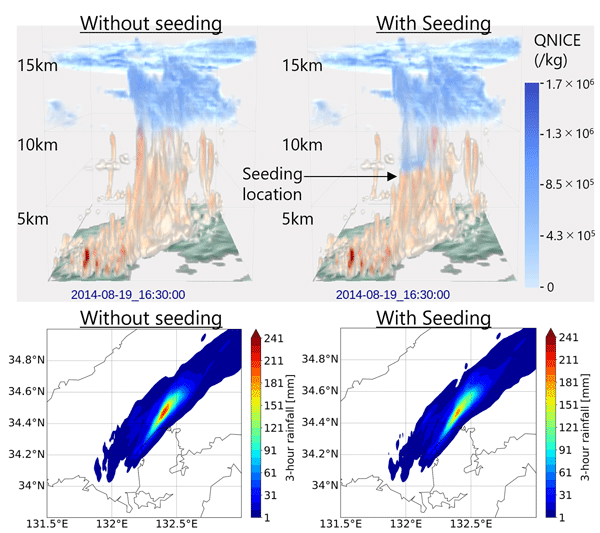
Can disasters caused by extreme rainfall be mitigated through human intervention? Using numerical simulations reproducing a devastating rainfall event, we show that injecting large amounts of ice nuclei into convective clouds can trigger an “overseeding” effect that suppresses raindrop growth. This process disperses intense rainfall downstream and reduces peak 3-hour rainfall by up to 32 %, highlighting the potential of cloud seeding as a new strategy for mitigating heavy rainfall disasters.
Cited articles
Alfieri, L., Bisselink, B., Dottori, F., Naumann, G., de Roo, A., Salamon, P., Wyser, K., and Feyen, L.: Global projections of river flood risk in a warmer world, Earth's Future, 5, 171–182, https://doi.org/10.1002/2016EF000485, 2017.
Alves, P. J., Lima, R. C. de A., and Emanuel, L.: Natural disasters and establishment performance: Evidence from the 2011 Rio de Janeiro Landslides, Reg. Sci. Urban Econ., 95, 103761, https://doi.org/10.1016/j.regsciurbeco.2021.103761, 2022.
Arakawa, K. and Noyori, S. S.: The relationship of socioeconomic factors and migration from large cities to rural areas, Socio-Informatics, 11, 19–33, https://doi.org/10.14836/ssi.11.3_19, 2023.
Baker, A. C., Larcker, D. F., and Wang, C. C. Y.: How much should we trust staggered difference-in-differences estimates?, J. Financ. Econ., 144, 370–395, https://doi.org/10.1016/j.jfineco.2022.01.004, 2022.
Black, R., Adger, W. N., Arnell, N. W., Dercon, S., Geddes, A., and Thomas, D.: The effect of environmental change on human migration, Glob. Environ. Change, 21, S3–S11, https://doi.org/10.1016/j.gloenvcha.2011.10.001, 2011.
Cengiz, D., Dube, A., Lindner, A., and Zipperer, B.: The effect of minimum wages on low-wage jobs, Q. J. Econ., 134, 1405–1454, https://doi.org/10.1093/qje/qjz014, 2019.
Chen, H., Matsuhashi, K., Takahashi, K., Fujimori, S., Honjo, K., and Gomi, K.: Adapting global shared socio-economic pathways for national scenarios in Japan, Sustain. Sci., 15, 985–1000, https://doi.org/10.1007/s11625-019-00780-y, 2020.
Chen, J., Sayama, T., Yamada, M., and Sugawara, Y.: Reducing the computational cost of process-based flood frequency estimation by extracting precipitation events from a large-ensemble climate dataset, J. Hydrol., 655, 132946, https://doi.org/10.1016/j.jhydrol.2025.132946, 2025.
Del Rio Amador, L., Boudreault, M., and Carozza, D. A.: Projecting climate and socioeconomic contributions to global flood-induced displacements using a data-driven approach, Nat. Hazards, 121, 16935–16973, https://doi.org/10.1007/s11069-025-07457-z, 2025.
Delforge, D., Wathelet, V., Below, R., Sofia, C. L., Tonnelier, M., van Loenhout, J. A. F., and Speybroeck, N.: EM-DAT: the Emergency Events Database, Int. J. Disast. Risk Re., 124, 105509, https://doi.org/10.1016/j.ijdrr.2025.105509, 2025.
Goodman-Bacon, A.: Difference-in-differences with variation in treatment timing, J. Econom., 225, 254–277, https://doi.org/10.1016/j.jeconom.2021.03.014, 2021.
Internal Displacement Monitoring Centre (IDMC): Global Internal Displacement Database – Disasters, https://www.internal-displacement.org/database/displacement-data/ (last access: 10 July 2025), 2023.
Ishizaki, N. N.: Bias corrected climate scenarios over Japan based on CDFDM method using CMIP6 (NIES2020), Ver.1, National Institute for Environmental Studies, Japan [data set], https://doi.org/10.17595/20210501.001, 2021.
Ishizaki, N. N., Shiogama, H., Hanasaki, N., and Takahashi, K.: Development of CMIP6-based climate scenarios for Japan using statistical method and their applicability to heat-related impact studies, Earth Space Sci., 9, e2022EA002451, https://doi.org/10.1029/2022EA002451, 2022.
Jarzebski, M. P., Elmqvist, T., Gasparatos, A., Fukushi, K., Eckersten, S., Haase, D., Goodness, J., Khoshkar, S., Saito, O., Takeuchi, K., Theorell, T., Dong, N., Kasuga, F., Watanabe, R., Sioen, G. B., Yokohari, M., and Pu, J.: Ageing and population shrinking: implications for sustainability in the urban century, npj Urban Sustain., 1, 17, https://doi.org/10.1038/s42949-021-00023-z, 2021.
Kakinuma, K., Puma, M. J., Hirabayashi, Y., Tanoue, M., Baptista, E. A., and Kanae, S.: Flood-induced population displacements in the world, Environ. Res. Lett., 15, 124029, https://doi.org/10.1088/1748-9326/abc586, 2020.
Kam, P. M., Aznar-Siguan, G., Schewe, J., Milano, L., Ginnetti, J., Willner, S., McCaughey, J. W., and Bresch, D. N.: Global warming and population change both heighten future risk of human displacement due to river floods, Environ. Res. Lett., 16, 044026, https://doi.org/10.1088/1748-9326/abd26c, 2021.
Kono, T., Tatano, H., Ushiki, K., Nakazono, D., and Sugisawa, F.: Relocation of firms due to public release of tsunami hazard map, Journal of Japan Society of Civil Engineers, Ser. D3 (Infrastructure Planning and Management), 77, 301–315, https://doi.org/10.2208/jscejipm.77.4_301, 2021.
Lee, Z. and Lee, K.: Causal interaction and effect modification: a randomization-based approach to inference, J. Korean Stat. Soc., 54, 665–684, https://doi.org/10.1007/s42952-025-00313-7, 2025.
Marvi, M. T.: A review of flood damage analysis for a building structure and contents, Nat. Hazards, 102, 967–995, https://doi.org/10.1007/s11069-020-03941-w, 2020.
McAdam, J. and Ferris, E.: Planned relocations in the context of climate change: unpacking the legal and conceptual issues, Camb. Int. Law J., 4, 137–166, https://doi.org/10.7574/cjicl.04.01.137, 2015.
Merz, B., Kreibich, H., Schwarze, R., and Thieken, A.: Review article “Assessment of economic flood damage”, Nat. Hazards Earth Syst. Sci., 10, 1697–1724, https://doi.org/10.5194/nhess-10-1697-2010, 2010.
Ministry of Land, Infrastructure and Transport of Japan (MLIT): Rivers in Japan, https://www.mlit.go.jp/river/basic_info/english/pdf/riversinjapan.pdf (last access: 2 July 2025), 2006.
Momoi, M., Kotsuki, S., Kikuchi, R., Watanabe, S., Yamada, M., and Abe, S.: Emulating rainfall-runoff-inundation model using deep neural network with dimensionality reduction, Artificial Intelligence for the Earth Systems, 2, e220036, https://doi.org/10.1175/AIES-D-22-0036.1, 2023.
Morita, H.: Introduction to empirical analysis, Nippon Hyoron Sha, Tokyo, 344 pp., ISBN 978-4-535-55793-2, 2014.
Namikawa, K., Koyama, N., and Yamada, T.: Analysis of impact of catastrophic flooding on the local population and its causes, Advances in River Engineering, 28, 385–390, https://doi.org/10.11532/river.28.0_385, 2022.
National Institute for Environmental Studies, Japan (NIES): Results of Environment Research and Technology Development Fund 2-1805 (Japanese SSP Population Scenarios for Municipalities, 2nd Edition), https://adaptation-platform.nies.go.jp/data/socioeconomic/index.html (last access: 2 July 2025), 2021a.
National Institute for Environmental Studies, Japan (NIES): Japanese SSP Population Projections for Municipalities (2nd Edition), http://adaptation-platform.nies.go.jp/data/socioeconomic/pdf/population_manual_v2.pdf (last access: 2 July 2025), 2021b.
National Institute for Environmental Studies, Japan (NIES): Results of Environment Research and Technology Development Fund 2-1805 (Japanese SSP Third Mesh Population Scenarios, 2nd Edition), https://adaptation-platform.nies.go.jp/data/socioeconomic/index.html (last access: 2 July 2025), 2021c.
Nguyen, M.: A Guide on Data Analysis, https://bookdown.org/mike/data_analysis/ (last access: 2 July 2025), 2020.
Niu, F.: A push-pull model for inter-city migration simulation, Cities, 131, 104005, https://doi.org/10.1016/j.cities.2022.104005, 2022.
Okamoto, A., Yanagihara, H., Kazama, S., and Hiraga, Y.: Statistical analysis of municipal population change and their factors caused by flood damage, Japanese Journal of JSCE, 79, 23-27044, https://doi.org/10.2208/jscejj.23-27044, 2023.
Redondo-Tilano, S. A., Boucher, M.-A., and Lacey, J.: Emerging strategies for addressing flood-damage modeling issues: A review, Int. J. Disast. Risk Re., 116, 105058, https://doi.org/10.1016/j.ijdrr.2024.105058, 2025.
Rogers, J. S., Maneta, M. P., Sain, S. R., Madaus, L. E., and Hacker, J. P.: The role of climate and population change in global flood exposure and vulnerability, Nat. Commun., 16, 1287, https://doi.org/10.1038/s41467-025-56654-8, 2025.
Shu, E. G., Porter, J. R., Hauer, M. E., Olascoaga, S. S., Gourevitch, J., Wilson, B., Pope, M., Melecio-Vazquez, D., and Kearns, E.: Integrating climate change induced flood risk into future population projections, Nat. Commun., 14, 7870, https://doi.org/10.1038/s41467-023-43493-8, 2023.
Sivapalan, M., Savenije, H. H. G., and Blöschl, G.: Socio-hydrology: A new science of people and water, Hydrol. Process., 26, 1270–1276, https://doi.org/10.1002/hyp.8426, 2012.
Swain, D. L., Wing, O. E. J., Bates, P. D., Done, J. M., Johnson, K. A., and Cameron, D. R.: Increased flood exposure due to climate change and population growth in the United States, Earth's Future, 8, e2020EF001778, https://doi.org/10.1029/2020EF001778, 2020.
Ton, M. J., de Moel, H., de Bruijn, J. A., Reimann, L., Botzen, W. J. W., and Aerts, J. C. J. H.: Economic damage from natural hazards and internal migration in the United States, Nat. Hazards, 121, 4985–5005, https://doi.org/10.1007/s11069-024-06987-2, 2025.
Tsuda, H. and Tebakari, T.: A macroscopic analysis of the demographic impacts of flood inundation in Thailand (2005–2019), Prog. Earth Planet. Sci., 10, 36, https://doi.org/10.1186/s40645-023-00569-9, 2023.
Ujihara, T., Wake, H., and Morinaga, Y.: Changing population and land prices in areas damaged by torrential rains in Kanto and Tohoku, September 2015, Journal of the City Planning Institute of Japan, 54, 57–63, https://doi.org/10.11361/journalcpij.54.57, 2019.
Ushiki, K., Kono, T., Tatano, H., Nakazono, D., and Sugisawa, F.: Understanding changes in population distribution by age group due to the publication of tsunami inundation estimates using difference-in-differences analysis, Proceedings of Infrastructure Planning, 60, 02–03, 2019.
Wing, O. E. J., Lehman, W., Bates, P. D., Sampson, C. C., Quinn, N., Smith, A. M., Neal, J. C., Porter, J. R., and Kousky, C.: Inequitable patterns of US flood risk in the Anthropocene, Nat. Clim. Change, 12, 156–162, https://doi.org/10.1038/s41558-021-01265-6, 2022.
Yanagihara, H., Kazama, S., Yamamoto, T., Ikemoto, A., Tada, T., and Touge, Y.: Nationwide evaluation of changes in fluvial and pluvial flood damage and the effectiveness of adaptation measures in Japan under population decline, Int. J. Disast. Risk Re., 110, 104605, https://doi.org/10.1016/j.ijdrr.2024.104605, 2024.
Yanagihara, H., Kazama, S., Gomi, K., Hiraga, Y., and Ikemoto, A.: Code and data supporting “Integrating flood-induced population movements into future fluvial flood damage estimates in Japan”, Zenodo [data set], https://doi.org/10.5281/zenodo.20823575, 2026.
Yoshikawa, S., Imamura, K., Yamasaki, J., Nitanai, R., Manabe, R., Murayama, A., Takahashi, K., Matsuhashi, K., and Mimura, N.: Estimation of future building area by use for data development associated with Japan SSPs, Japanese Journal of JSCE, 80, 24-27049, https://doi.org/10.2208/jscejj.24-27049, 2024.
Short summary
Flooding can influence population movements. However, most studies of future flood damage costs do not consider these movements. We examined how such movements may change future flood damage costs in Japan. National and prefectural effects were small, but some municipalities showed reductions of more than 10 % in these costs. These results show that considering population movements can improve future flood risk planning.
Flooding can influence population movements. However, most studies of future flood damage costs...
Altmetrics
Final-revised paper
Preprint