
Articles | Volume 26, issue 8
https://doi.org/10.5194/nhess-26-3741-2026
© Author(s) 2026. This work is distributed under
the Creative Commons Attribution 4.0 License.
the Creative Commons Attribution 4.0 License.
https://doi.org/10.5194/nhess-26-3741-2026
© Author(s) 2026. This work is distributed under
the Creative Commons Attribution 4.0 License.
the Creative Commons Attribution 4.0 License.
Brief communication
| 
11 Aug 2026
Brief communication |
| 11 Aug 2026
| 11 Aug 2026
Brief communication: Atmospheric moisture and near-surface temperature anomalies: key drivers in the 2022 European mega-drought
José C. Fernández-Alvarez
CORRESPONDING AUTHOR

Galicia Supercomputing Center (CESGA), Climate System Research Unit, Santiago de Compostela, 15705, Spain
CESAM, Departamento de Física, Universidade de Aveiro, 3810-193, Aveiro, Portugal
Raquel Nieto
Centro de Investigación Mariña, Universidade de Vigo, Environmental Physics Laboratory (EPhysLab), Ourense, 32004, Spain
Climate System Research Unit, UVigo-CESGA, Ourense, 32004, Spain
Unidad Asociada CSIC-Universidad de Vigo: Grupo de Física de la Atmósfera y del Océano, Ourense, 32004, Spain
Sergio M. Vicente-Serrano
Instituto Pirenaico de Ecología, Consejo Superior de Investigaciones Científicas (IPE–CSIC), Zaragoza, 50059, Spain
David Carvalho
CESAM, Departamento de Física, Universidade de Aveiro, 3810-193, Aveiro, Portugal
Luis Gimeno
Centro de Investigación Mariña, Universidade de Vigo, Environmental Physics Laboratory (EPhysLab), Ourense, 32004, Spain
Climate System Research Unit, UVigo-CESGA, Ourense, 32004, Spain
Unidad Asociada CSIC-Universidad de Vigo: Grupo de Física de la Atmósfera y del Océano, Ourense, 32004, Spain
Related authors
Brieuc Thomas, Jose Carlos Fernández-Alvarez, Xurxo Costoya, Maite deCastro, Raquel Nieto, David Carvalho, Luis Gimeno, and Moncho Gómez-Gesteira
EGUsphere, https://doi.org/10.5194/egusphere-2025-1339, https://doi.org/10.5194/egusphere-2025-1339, 2025
Preprint archived
Short summary
Short summary
Understanding climate change is crucial, but global models lack fine detail for local assessments. Regional climate models improve accuracy by simulating climate at higher resolution. This study compares two approaches: one continuous and one resetting daily to reduce errors and speed up processing. Both perform well and similarly, but the reinitialized method is 30 times more efficient. Its lower cost makes it a promising option for high-resolution climate modelling and regional predictions.
Ahmed M. El Kenawy, Fernando Domínguez-Castro, Santiago Beguería, Javier Vela-Tambo, Amar Halifa-Marín, Maria Adell-Michavila, Alex Crespillo, Borja Latorre, Magí Franquesa, and Sergio M. Vicente-Serrano
Nat. Hazards Earth Syst. Sci., 26, 4977–4996, https://doi.org/10.5194/nhess-26-4977-2026, https://doi.org/10.5194/nhess-26-4977-2026, 2026
Short summary
Short summary
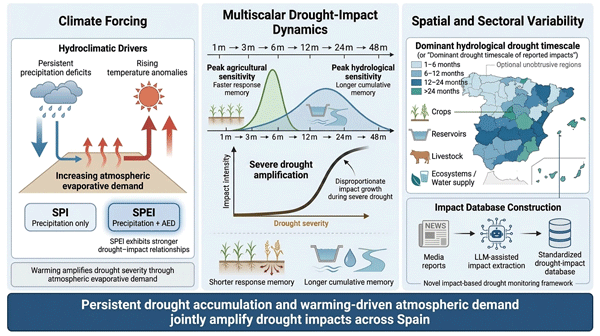
This study synthesizes the multiscalar and nonlinear dynamics of drought impacts across Spain. It highlights the combined role of precipitation deficits and rising temperatures, showing the stronger performance of the standardized precipitation evapotranspiration index (SPEI) over the standardized precipitation index (SPI) under warming conditions. Agricultural impacts respond to intermediate drought durations, while hydrological systems show delayed long-term responses. Severe droughts amplify impacts nonlinearly, with strong spatial variability affecting crops, reservoirs and ecosystems.
Andres Barrio-Martin, Carlos Calvo-Sancho, Nuria P. Plaza-Martin, Cesar Azorin-Molina, Andreas F. Prein, Tim R. McVicar, Sergio M. Vicente-Serrano, Luis Gimeno, Raquel Nieto, Zhenzhong Zeng, Ana Morata, and Deliang Chen
EGUsphere, https://doi.org/10.5194/egusphere-2026-5202, https://doi.org/10.5194/egusphere-2026-5202, 2026
This preprint is open for discussion and under review for Natural Hazards and Earth System Sciences (NHESS).
Short summary
Short summary
We identified the atmospheric conditions that distinguish ordinary thunderstorms from four severe weather hazards, highlighting numerical proxies for their modelling in the Mediterranean. Severe winds occur in warm, unstable air (summer) or with strong mid-level winds (other seasons); tornadoes are favored by instability near the ground; large hail occurs when instability and strong winds combine; and short-duration heavy precipitation is favored by high moisture and slow-moving thunderstorms.
Albenis Pérez-Alarcón, Raquel Nieto, and Luis Gimeno
EGUsphere, https://doi.org/10.5194/egusphere-2026-5144, https://doi.org/10.5194/egusphere-2026-5144, 2026
This preprint is open for discussion and under review for Weather and Climate Dynamics (WCD).
Short summary
Short summary
We assess the sensitivity of the Lagrangian temperature anomaly decomposition to model choice using the 2021 Pacific Northwest heatwave. Our results show that pure Lagrangian trajectory models attribute warming primarily to diabatic heating, while dispersion models favour adiabatic warming. This divergence stems from differing vertical histories and turbulence treatment, cautioning that inferred process dominance may reflect methodological choices rather than underlying physics.
Oscar M. Baez-Villanueva, Alfredo Crespo-Otero, Sara Modanesi, Pierre Laluet, Sergio Vicente-Serrano, Jaap Schellekens, Jacopo Dari, Hylke E. Beck, Wouter Dorigo, Christian Massari, Chiara Corbari, Joppe Massant, Kwint Delbare, Olivier Bonte, Aaron Boone, Diego Fernández-Prieto, and Diego G. Miralles
EGUsphere, https://doi.org/10.5194/egusphere-2026-1856, https://doi.org/10.5194/egusphere-2026-1856, 2026
Short summary
Short summary
We developed a new method to estimate daily land evaporation at high resolution across the Iberian Peninsula, explicitly accounting for irrigation. By combining satellite and meteorological data, we show that irrigation can strongly increase evaporation in agricultural areas. The results better match ground observations and improve understanding of water use. This approach can support farming decisions and water management at the regional scale, and will be extended to global applications.
Magí Franquesa, Fergus Reig, Manuel Arretxea, Maria Adell-Michavila, Amar Halifa-Marín, Daniel Vilas, Santiago Beguería, and Sergio M. Vicente-Serrano
Earth Syst. Sci. Data, 17, 5885–5902, https://doi.org/10.5194/essd-17-5885-2025, https://doi.org/10.5194/essd-17-5885-2025, 2025
Short summary
Short summary
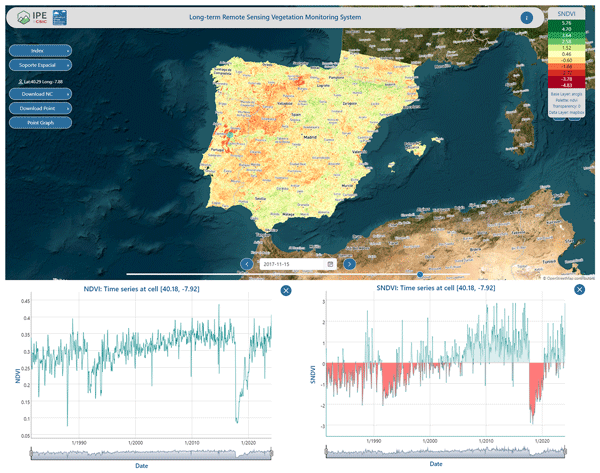
Our study created a unique database that tracks vegetation health across Spain and the Balearic Islands from 1981 to now, updated every two weeks. By using satellite images from multiple sources, we provide accurate and consistent data that helps detect changes in vegetation due to factors like fires. This tool is crucial for farmers, environmental managers, and policymakers to monitor and protect plant life, ensuring better management of natural resources and agricultural productivity.
Brieuc Thomas, Jose Carlos Fernández-Alvarez, Xurxo Costoya, Maite deCastro, Raquel Nieto, David Carvalho, Luis Gimeno, and Moncho Gómez-Gesteira
EGUsphere, https://doi.org/10.5194/egusphere-2025-1339, https://doi.org/10.5194/egusphere-2025-1339, 2025
Preprint archived
Short summary
Short summary
Understanding climate change is crucial, but global models lack fine detail for local assessments. Regional climate models improve accuracy by simulating climate at higher resolution. This study compares two approaches: one continuous and one resetting daily to reduce errors and speed up processing. Both perform well and similarly, but the reinitialized method is 30 times more efficient. Its lower cost makes it a promising option for high-resolution climate modelling and regional predictions.
Solomon H. Gebrechorkos, Jian Peng, Ellen Dyer, Diego G. Miralles, Sergio M. Vicente-Serrano, Chris Funk, Hylke E. Beck, Dagmawi T. Asfaw, Michael B. Singer, and Simon J. Dadson
Earth Syst. Sci. Data, 15, 5449–5466, https://doi.org/10.5194/essd-15-5449-2023, https://doi.org/10.5194/essd-15-5449-2023, 2023
Short summary
Short summary
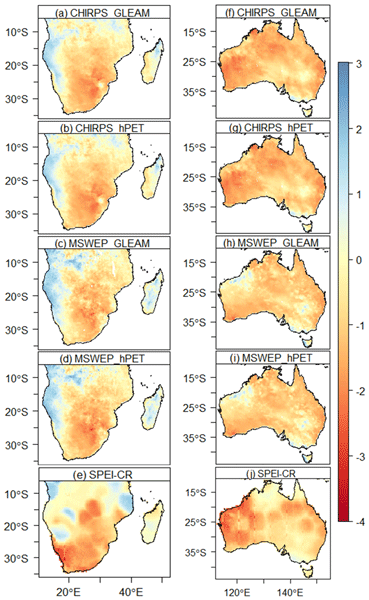
Drought is undeniably one of the most intricate and significant natural hazards with far-reaching consequences for the environment, economy, water resources, agriculture, and societies across the globe. In response to this challenge, we have devised high-resolution drought indices. These indices serve as invaluable indicators for assessing shifts in drought patterns and their associated impacts on a global, regional, and local level facilitating the development of tailored adaptation strategies.
Cited articles
Allen, M. R. and Ingram, W. J.: Constraints on future changes in climate and the hydrologic cycle, Nature, 419, 228–232, https://doi.org/10.1038/nature01092, 2002.
Baruth, B., Bassu, S., Ben Aoun, W., Biavetti, I., Bratu, M., Cerrani, I., Chemin, Y., Claverie, M., De Palma, P., Fumagalli, D., Manfron, G., Morel, J., Nisini, L., Panarello, L., Ronchetti, G., Seguini, L., Tamavsky, E., Van Den Berg, M., Zajac, Z., and Zucchini, A.: JRC MARS Bulletin – Crop monitoring in Europe – September 2022, Vol. 30 No. 9, in: Van Den Berg, M. et al. (Eds.), Publications Office of the European Union, Luxembourg, https://doi.org/10.2760/067974, 2022.
Bevacqua, E., Rakovec, O., Schumacher, D. L., Kumar, R., Thober, S., Samaniego, L., Seneviratne, S. I., and Zscheischler, J.: Direct and lagged climate change effects intensified the 2022 European drought, Nat. Geosci., 17, 1100–1107, https://doi.org/10.1038/s41561-024-01559-2, 2024.
Copernicus Climate Change Service: European State of the Climate 2022, Copernicus Climate Change Service, https://climate.copernicus.eu/esotc/2022 (last access: 16 March 2025), 2022a.
Copernicus Climate Change Service: European State of the Climate 2022: Drought, Copernicus Climate Change Service, https://climate.copernicus.eu/esotc/2022 (last access: 16 March 2025), 2022b.
Faranda, D., Pascale, S., and Bulut, B.: Persistent anticyclonic conditions and climate change exacerbated the exceptional 2022 European–Mediterranean drought, Environ. Res. Lett., 18, 034030, https://doi.org/10.1088/1748-9326/acbc37, 2023.
Garrido-Pérez, J. M., Vicente-Serrano, S. M., Barriopedro, D., García-Herrera, R., Trigo, R., and Beguería, S.: Examining the outstanding Euro-Mediterranean drought of 2021–2022 and its historical context, J. Hydrol., 630, 130653, https://doi.org/10.1016/j.jhydrol.2024.130653, 2024.
Gharun, M., Shekhar, A., Xiao, J., Li, X., and Buchmann, N.: Effect of the 2022 summer drought across forest types in Europe, Biogeosciences, 21, 5481–5494, https://doi.org/10.5194/bg-21-5481-2024, 2024.
Gimeno, L., Stohl, A., Trigo, R. M., Dominguez, F., Yoshimura, K., Yu, L., Drumond, A., Durán-Quesada, A. M., and Nieto, R.: Oceanic and terrestrial sources of continental precipitation, Rev. Geophys., 50, RG4003, https://doi.org/10.1029/2012RG000389, 2012.
Gimeno-Sotelo, L., Fernández-Alvarez, J. C., Nieto, R., Vázquez, Vicente-Serrano S. M., and Gimeno, L.: The increasing influence of atmospheric moisture transport on hydrometeorological extremes in the Euromediterranean region with global warming, Commun. Earth Environ., 5, 604, https://doi.org/10.1038/s43247-024-01787-9, 2024.
Hamal, K. and Pfahl, S.: Physical processes leading to extreme day-to-day temperature change – Part 1: Present-day climate, Weather Clim. Dynam., 6, 879–899, https://doi.org/10.5194/wcd-6-879-2025, 2025.
Herrera-Lormendez, P., Douville, H., and Matschullat, J.: European summer synoptic circulations and their observed 2022 and projected influence on hot extremes and dry spells, Geophys. Res. Lett., 50, e2023GL104580, https://doi.org/10.1029/2023GL104580, 2023.
Hersbach, H., Bell, B., Berrisford, P., Hirahara, S., Horányi, A., Muñoz-Sabater, J., Nicolas, J., Peubey, C., Radu, R., Schepers, D., Simmons, A., Soci, C., Abdalla, S., Abellan, X., Balsamo, G., Bechtold, P., Biavati, G., Bidlot, J., Bonavita, M., De Chiara, G., Dahlgren, P., Dee, D., Diamantakis, M., Dragani, R., Flemming, J., Forbes, R., Fuentes, M., Geer, A., Haimberger, L., Healy, S., Hogan, R. J., Hólm, E., Janisková, M., Keeley, S., Laloyaux, P., Lopez, P., Lupu, C., Radnoti, G., de Rosnay, P., Rozum, I., Vamborg, F., Villaume, S., and Thépaut, J.-N.: The ERA5 global reanalysis, Q. J. R. Meteorol. Soc., 146, 1999–2049, https://doi.org/10.1002/qj.3803, 2020.
Liu, B., Tan, X., Gan, T. Y., Chen, X., Lin, K., Lu, M., and Liu, Z.: Global atmospheric moisture transport associated with precipitation extremes: mechanisms and climate change impacts, WIREs Water, 7, e1412, https://doi.org/10.1002/wat2.1412, 2020.
Papritz, L. and Röthlisberger, M.: A novel temperature anomaly source diagnostic: method and application to the 2021 heatwave in the Pacific Northwest, Geophys. Res. Lett., 50, e2023GL105641, https://doi.org/10.1029/2023GL105641, 2023.
Pisso, I., Sollum, E., Grythe, H., Kristiansen, N. I., Cassiani, M., Eckhardt, S., Arnold, D., Morton, D., Thompson, R. L., Groot Zwaaftink, C. D., Evangeliou, N., Sodemann, H., Haimberger, L., Henne, S., Brunner, D., Burkhart, J. F., Fouilloux, A., Brioude, J., Philipp, A., Seibert, P., and Stohl, A.: The Lagrangian particle dispersion model FLEXPART version 10.4, Geosci. Model Dev., 12, 4955–4997, https://doi.org/10.5194/gmd-12-4955-2019, 2019.
Röthlisberger, M. and Papritz, L.: Quantifying the physical processes leading to atmospheric hot extremes at a global scale, Nat. Geosci., 16, 210–216, https://doi.org/10.1038/s41561-023-01126-1, 2023.
Schumacher, D. L., Zachariah, M., Otto, F., Barnes, C., Philip, S., Kew, S., Vahlberg, M., Singh, R., Heinrich, D., Arrighi, J., van Aalst, M., Hauser, M., Hirschi, M., Bessenbacher, V., Gudmundsson, L., Beaudoing, H. K., Rodell, M., Li, S., Yang, W., Vecchi, G. A., Harrington, L. J., Lehner, F., Balsamo, G., and Seneviratne, S. I.: Detecting the human fingerprint in the summer 2022 western–central European soil drought, Earth Syst. Dynam., 15, 131–154, https://doi.org/10.5194/esd-15-131-2024, 2024.
Soden, B. J. and Held, I. M.: An assessment of climate feedbacks in coupled ocean–atmosphere models, J. Clim., 19, 6263–3360, https://doi.org/10.1175/JCLI3799.1, 2006.
Toreti, A., Masante, D., Acosta Navarro, J., Bavera, D., Cammalleri, C., De Felice, M., De Jager, A., Di Ciollo, C., Hrast Essenfelder, A., and Maetens, W.: Drought in Europe July 2022: GDO Analytical Report, Publications Office of the European Union, Luxembourg, ISBN 978-92-76-54953-6, https://doi.org/10.2760/014884, 2022.
Vázquez, M., Alvarez-Socorro, G., Fernández-Alvarez, J. C., Nieto, R., and Gimeno, L.: Global FLEXPART–ERA5 simulations using 30 million atmospheric parcels since 1980, Zenodo [data set], https://doi.org/10.5281/zenodo.12204017, 2024.
Short summary
Using a Lagrangian moisture–temperature framework, we show that the 2022 European mega‑drought featured a strong decoupling between enhanced regional moisture uptake and sharply reduced Atlantic–Mediterranean precipitation contributions. Persistent anticyclonic circulation and subsidence suppressed convection and induced adiabatic warming. The abrupt termination highlights that large‑scale dynamics, not moisture availability, control drought severity.
Using a Lagrangian moisture–temperature framework, we show that the 2022 European mega‑drought...


Altmetrics
Final-revised paper
Preprint